Showing posts with label спорт. Show all posts

Thursday, February 6, 2025

trump

Трамп запретил участие трансгендерных спортсменок в женских соревнованиях


Президент США Дональд Трамп подписал указ, который запрещает трансгендерным спортсменкам участвовать в женских соревнованиях.

«С этого момента женский спорт будет только для женщин», — заявил Трамп во время церемонии подписания, окруженный молодыми спортсменками.

Запрет касается всех учебных заведений, получающих федеральное финансирование. Если школа или колледж допустит трансгендерных спортсменок к участию в женских соревнованиях или предоставит им доступ в женские раздевалки, учреждение может лишиться госфинансирования.

Трамп назвал указ «концом войны против женского спорта», подчеркнув, что он защищает женщин-атлеток от несправедливой конкуренции.

Дискуссия об участии трансгендерных спортсменок разгорелась в США после победы Лии Томас, трансгендерной пловчихи, в студенческом чемпионате три года назад. Критики утверждают, что те, кто родился с мужскими физическими характеристиками, имеют преимущество перед биологическими женщинами.

Ожидается, что новые правила повлияют и на олимпийскую систему в США. Белый дом потребовал от Национального олимпийского комитета запретить трансгендерным спортсменкам участие в женских соревнованиях.

Как и предыдущие спорные указы Трампа, новый запрет, вероятно, будет оспорен в суде. Активисты за права трансгендеров и демократы уже осудили решение президента, назвав его дискриминационным.

@BILD_Russia

Tuesday, July 30, 2024

sports

Сколько лет жизни прибавляет регулярная физическая активность


Больше всего жизни прибавляет бег: один час бега в неделю добавляет в среднем 3.67 года жизни! Второй час бега в неделю прибавит уже заметно меньше: 0.75 года, третий - ещё 0.45. Но в сумме это почти пять лет всего за 3 часа в неделю!

Тут, правда, речь идёт о быстром беге: на скорости 10 миль в час - это 16 км/ч. Более расслабленный без на скорости порядка 10 км/ч занял четвёртое место: 3.27 года за один час в неделю и чуть меньше 4.5 лет за три.

"Серебро" получил велосипед: 3.45 года за один час в неделю и 4.5 - за три! А "бронзу", неожиданно, rope jumping (прыжки с высоты на верёвки - по сути, "тарзанка")

Больше всего жизни прибавляет бег: один час бега в неделю добавляет в среднем 3.67 года жизни! Второй час бега в неделю прибавит уже заметно меньше: 0.75 года, третий - ещё 0.45. Но в сумме это почти пять лет всего за 3 часа в неделю!

Тут, правда, речь идёт о быстром беге: на скорости 10 миль в час - это 16 км/ч. Более расслабленный без на скорости порядка 10 км/ч занял четвёртое место: 3.27 года за один час в неделю и чуть меньше 4.5 лет за три.

"Серебро" получил велосипед: 3.45 года за один час в неделю и 4.5 - за три! А "бронзу", неожиданно, rope jumping (прыжки с высоты на верёвки - по сути, "тарзанка").

Tuesday, July 18, 2023

Alcaraz Halts Djokovic's Grand Slam March

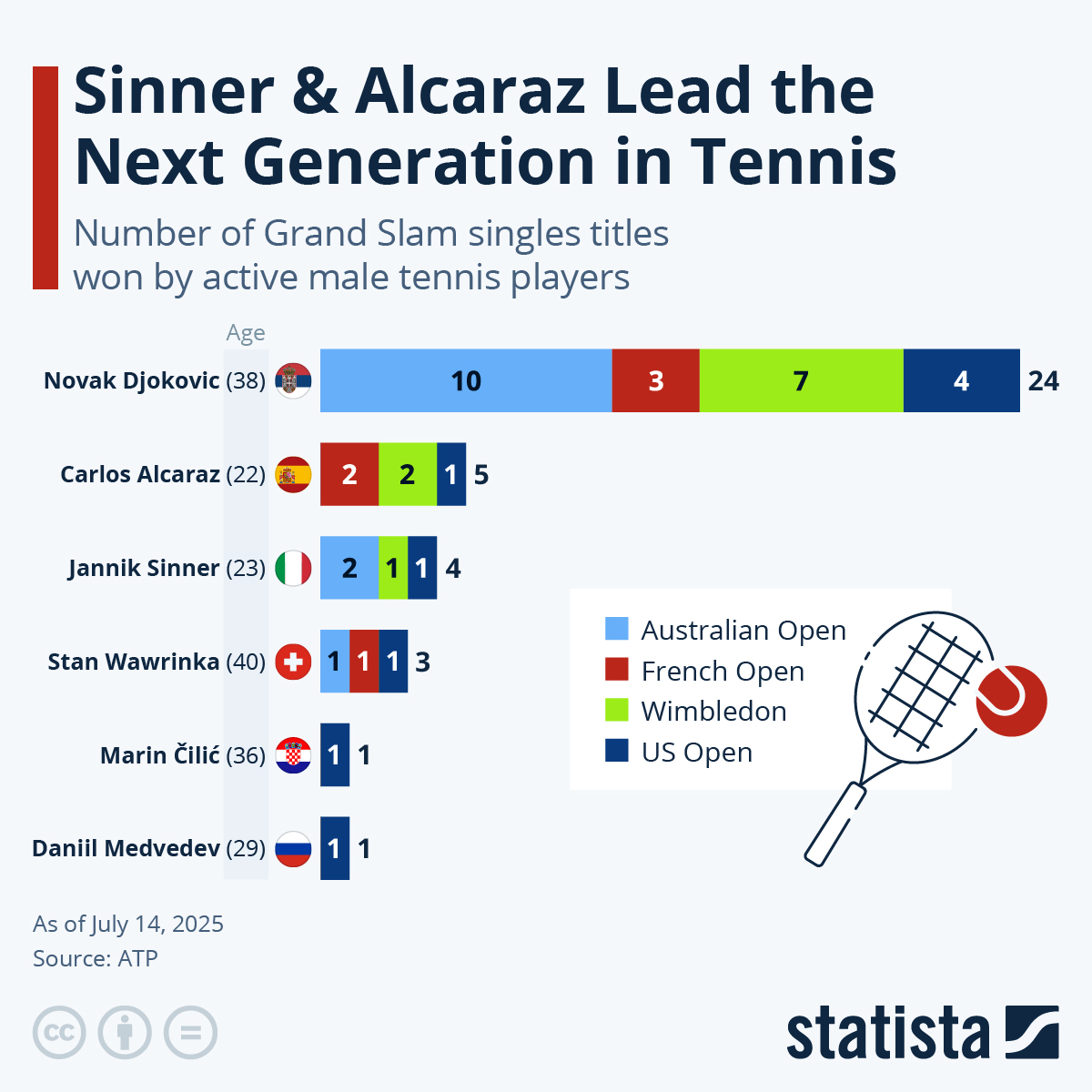
As the Wimbledon final began yesterday, Novak Djokovic was on the verge of equaling three significant records: Most consecutive Wimbledon titles (five), most Wimbledon titles in total (eight) and most Grand Slams including the pre-Open era (24). Spain's 20-year-old world number one Carlos Alcaraz had lofty ambitions of his own, though, and ended up beating the Serbian 1-6, 7-6, 6-1, 3-6, 6-4 in a thrilling match at the All England Club.

That victory takes Alcaraz to a total of two Grand Slam titles and leaves Djokovic still tantalizingly close to surpassing Serena Williams as the Open Era player with the most major tournament wins. The Serb had been in blistering form this year, going into the tournament with the Australian and French Opens already under his belt. His next chance to win that coveted 24th Grand Slam? The U.S. open: A competition he last won in 2018 and whose reigning champion is none other than Carlos Alcaraz.Alcaraz Halts Djokovic's Grand Slam March

Tuesday, May 2, 2023

anger and training

Хочешь выпустить пар в спортзале — одумайся!


Исследователи из США пришли к выводу, что чувство гнева и тренировка удваивают шансы на сердечный приступ.

Ученые опросили 12 500 человек, переживших сердечный приступ.

Они рассказали, что делали за час и за день до приступа, а также каково было их общее эмоциональное состояние.

Оказалось, что большинство занимались физическими упражнениями и злились. Причина кроется в том, что интенсивные упражнения, как и гнев, вызывают сужение кровеносных сосудов, и те оказываются не в состоянии доставлять необходимое количество крови и кислорода к сердцу. Именно этот дефицит и вызывает сердечный приступ.

Результаты пугающие, однако стоит отметить, что у здоровых людей моложе шестидесяти лет сердечные приступы редки.

Например, согласно отчету Американской кардиологической ассоциации за 2016 год, среди мужчин в возрасте от 20 до 59 лет они случаются у менее, чем 5%.

Playboy

Friday, December 23, 2022

Olympic Games help children grow up healthy

December 12, 2022 Chao Guo

The benefits of the Olympic Games may be numerous and long lasting. Chao Guo highlights the positive role of the 2008 Beijing Olympic Games in reducing the risks of both under- and over-nutrition of children in China.


Shortly after the Tokyo Olympic Games, the Beijing Winter Olympic Games and Paralympic Games were held in February 2022. Previously, public health experts had expressed great concerns over the safety of the Tokyo Olympic Games amid the COVID-19 pandemic and appealed for a global conversation on this issue (The Lancet 2021).

Mass gatherings have potential risks, especially amid a global health crisis. However, the benefits of the Olympic Games may be wide-ranging, including economic growth, urban development and expansion of sports infrastructure. They may also help improve public health services and risk management, public health surveillance and reporting systems (e.g. of air quality), as well as individual health awareness and behaviours. Several previous studies have investigated the association between the Olympic Games and health outcomes such as exposure to respirable particulate matter, adolescent psychological health, and asthma, but apparently none have studied the long-term association between the Olympic Games and child growth.

Underweight and overweight among Chinese children. A triple difference-in-difference analysis


In a recent study (Guo et al., 2022), we estimated the association between the 2008 Beijing Olympic Games (BOG) and child growth in China. We used the BOG as a natural experiment to capture the potential long-term effect of the Olympic Games on child growth at the population level. Individual-level data were obtained from the China Family Panel Studies (CFPS). Children aged 3–10 years during the survey window in 2014 and in 2018 were pooled into a dataset and included for analysis.

Exposure to the BOG was measured by triple difference-in-difference analysis. First, children aged 7–10 years were identified as the treated group, as they were born either before the 2008 BOG (in 2004–2007) if surveyed in CFPS wave 2014, or after the BOG (in 2008–2011) if surveyed in wave 2018. Children aged 3–6 years were identified as the control group, as they were born after the 2008 BOG in both survey waves. The difference observed between two waves within the control group (D1) can be interpreted as a common temporal change, due, for example, to the general socio-economic development. Conversely, the difference between two waves within the treated group (D2) includes this common trend plus the effect of being born either before or after the 2008 BOG. This means that the variation “caused” by being born after the 2008 BOG and not before can be identified through the difference between the treated group and control group in the difference between two waves (D2–D1).

Additionally, although the Olympic Games is an event of national and even world significance, we assume that it affected mainly those living close to the venue of the Games and its surrounding areas. The host city of the 2008 BOG was Beijing, together with five mainland cities: Shanghai, Tianjin, Shenyang (Liaoning province), Qinhuangdao (Hebei province) and Qingdao (Shandong province), as co-host cities. (Hong Kong, the sixth co-host city, was not included in our analysis due to data limitations.) We thus categorized the areas of residence of our child participants into a binary variable: BOG areas or non-BOG areas. The rate of child growth is not the same at 3–6 years or at 7–10 years, and this is something that the D2–D1 estimator mentioned above does not control for. However, we can assume that the trend differential between the two groups of children is the same in BOG and in non-BOG areas. Thus, the association between the BOG and child growth can be identified through the difference between areas in the difference between age groups in the difference between waves: (D3–D2–D1), or DDD.

Child growth was assessed via four binary variables: stunting, underweight, overweight, and obesity. We generated standardizing anthropometric measures for children including z-score of height-for-age (HAZ) and z-score of weight-for-age (WAZ) according to the WHO growth charts, and derived indices of stunting if HAZ ≤ 2 and underweight if WAZ ≤ 2, respectively. Furthermore, overweight and obesity were measured by binary variables according to the international body mass index (BMI) thresholds for children aged 2–18 years (BMI ≥ 25 for overweight and BMI ≥ 30 for obesity).

The study included 6,951 Chinese children aged 3–10 years, among whom 3,201 were interviewed in 2014 and 3,750 in 2018. The pooled prevalence rates of stunting, underweight, overweight, and obesity were 7.8%, 26.4%, 14.10%, and 20.9% (Figure 1).

The health(y) effects of 2008 Beijing Olympic Games


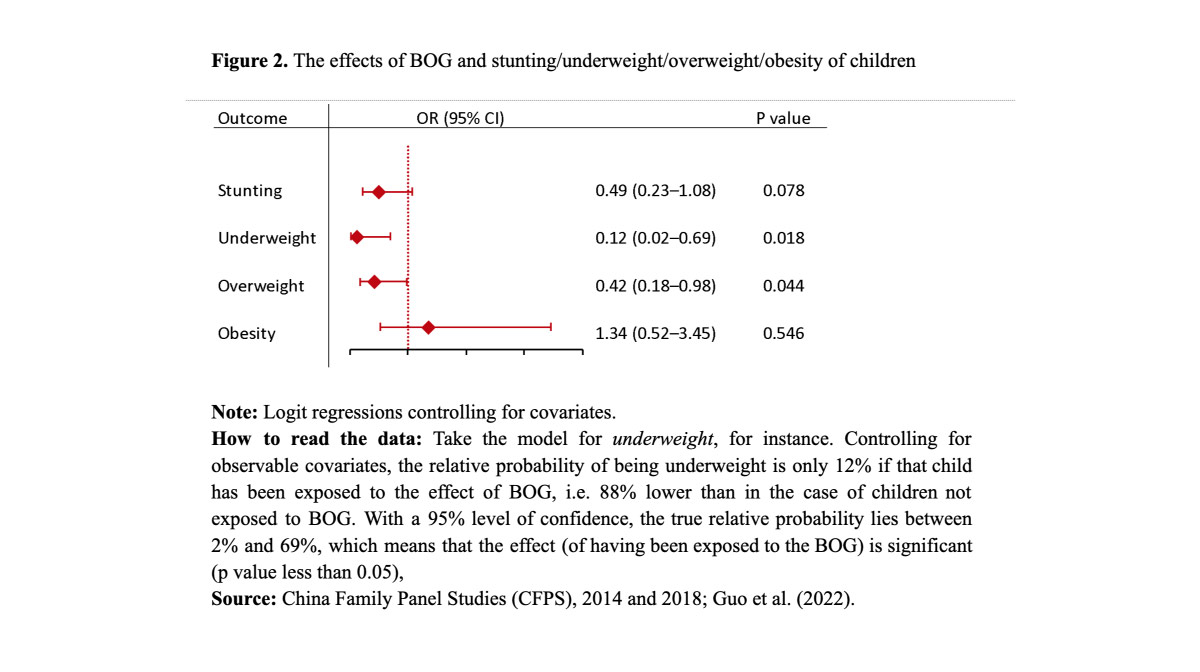
Our DDD estimates reveal that BOG exposure decreased the risk of underweight by 88% among Chinese children, and that of overweight by 58% (Figure 2). The effects of BOG on the odds of stunting and obesity were not statistically significant.

We did not detect sex heterogeneity of associations between the BOG and stunting, underweight or overweight. However, we did find a sex difference for the association between the BOG and child obesity, with a significantly lower risk of obesity found in the female, but not in the male sample. In girls, the risk of obesity was 21% (95% CI: 5%-88%) for those exposed to the BOG compared with those not exposed, after controlling for observable covariates.

Long-term health legacy planning before mega-events


To the best of our knowledge, this is the first attempt at estimating the effect of the Olympics on child growth. Our findings are that the 2008 Beijing Olympic Games decreased their risk of underweight and overweight, and, for girls only, also the risk of obesity.

This may have happened through several potential mechanisms. First, children of the post-Olympic generation might have benefited from a variety of favourable conditions related to the Olympic Games during the fetal period. This may be because, according to the International Organizing Committee, the Games had a positive impact on several social, urban, environmental, and economic criteria, such air quality, food and water safety, regeneration of the physical environment, Anti-smoking measures and the development of venues and training facilities promoting mass sport. Second, the Games may have also prompted active participation in sports, at all levels and at all ages, among children born shortly after the Games and their families.

While the mechanisms may be unclear, and not necessarily replicable elsewhere in the world, the results, as highlighted by our DDD research design, seem clear enough: children’s health improved in China following the 2008 Beijing Olympic Games.

References

  • The Lancet. (2021). We need a global conversation on the 2020 Olympic Games. Lancet 397:2225. doi: https://doi.org/10.1016/S0140-6736(21)01293-9.
  • Guo, C., Hu, X., Xu, C., & Zheng, X. (2022) Association between Olympic Games and children’s growth: evidence from China. British Journal of Sports Medicine 56(19): 1110–1114. doi: 10.1136/bjsports-2021-104844.

Wednesday, August 31, 2022

New Balls Please!

Covid Drives U.S. Tennis Boom


As gyms were forced to shut down when the Covid-19 pandemic hit in March 2020 and remained deserted for large parts of 2020 and 2021, Americans were forced to look for alternative ways to work out and stay active. And while many discovered cycling as a nice, socially-distanced activity amid lockdowns, others picked up their old tennis rackets, hitting the outdoor courts across the country.

According to the Sports & Fitness Industry Association’s (SFIA) 2022 Sports, Fitness and Leisure Activities Topline Participation Report (стоимость отчёта впечатляет), 22.6 million Americans played tennis last year, up almost five million from the last pre-pandemic year. "Many individuals turned to tennis during the pandemic and it is incredibly encouraging to see that the sport was able to capitalize on this momentum and continued to see growth in 2021,” Craig Morris, Chief Executive, Community Tennis at the USTA said in a statement, applauding the next American tennis boom.

Interestingly, this boom differs from previous tennis crazes as it is more of a grassroots movement, driven by people’s desire to exercise and play rather than by the pull of an American superstar player. In the 1980s, every kid wanted to be John McEnroe, in the 1990s everyone wanted to be Andre Agassi. Now, it seems, people just want to play tennis.
New Balls Please!

Wednesday, August 10, 2022

Tennis' GOAT Debate: How About Serena?

a goat
When Andy Murray answered “Serena” to a fan’s question about who he considers the GOAT (greatest of all time) in tennis, it was a breath of fresh air in debate that is getting as old as its main protagonists. Many tennis fans appear to have made it their hobby to cheer on their respective favorites online, all while belittling the achievements of any player other than their personal hero.

And while the debate is usually Roger (Federer), Rafa (Nadal) or Novak (Djokovic) – tennis fans have the habit of calling their idols by their first name – there’s a case to be made that Serena (Williams) is the greatest tennis player of all time. Williams won more Grand Slam titles in the Open Era then any other player, the last one while pregnant with her first child in 2017 (try matching that Roger/Rafa/Novak).

Williams’ list of achievements goes far beyond her 23 Grand Slam singles titles, however. She also has 14 Grand Slam doubles titles, 2 Grand Slam mixed titles and 4 Olympic gold medals to her name, speaking volumes of the dominance she achieved in her sport. Serena also matches (or exceeds) her male counterparts in longevity, which is saying much considering that Federer, who just turned 41, and Nadal (36) stubbornly refuse to call it a day. Williams made her professional debut in 1995 and almost 27 years later, she’s still playing on tour, contending with players less than half her age.

On August 9, 2022, Williams announced her retirement after this year’s U.S. Open, fittingly in a personal essay published in Vogue – not Sports Illustrated. “I’m here to tell you that I’m evolving away from tennis,” Williams writes, saying that she never liked the word retirement. “Believe me, I never wanted to have to choose between tennis and a family. I don’t think it’s fair,” she writes, adding that she would continue playing and winning if she had a wife “doing the physical labor of expanding our family,” clearly hinting at her male contemporaries. Williams admits that she “feels a great deal of pain” leaving the sport, while feeling ready for her next big goal in life, which is to grow her family.Tennis' GOAT Debate: How About Serena?

Saturday, May 21, 2022

The World's Highest-Paid Athletes

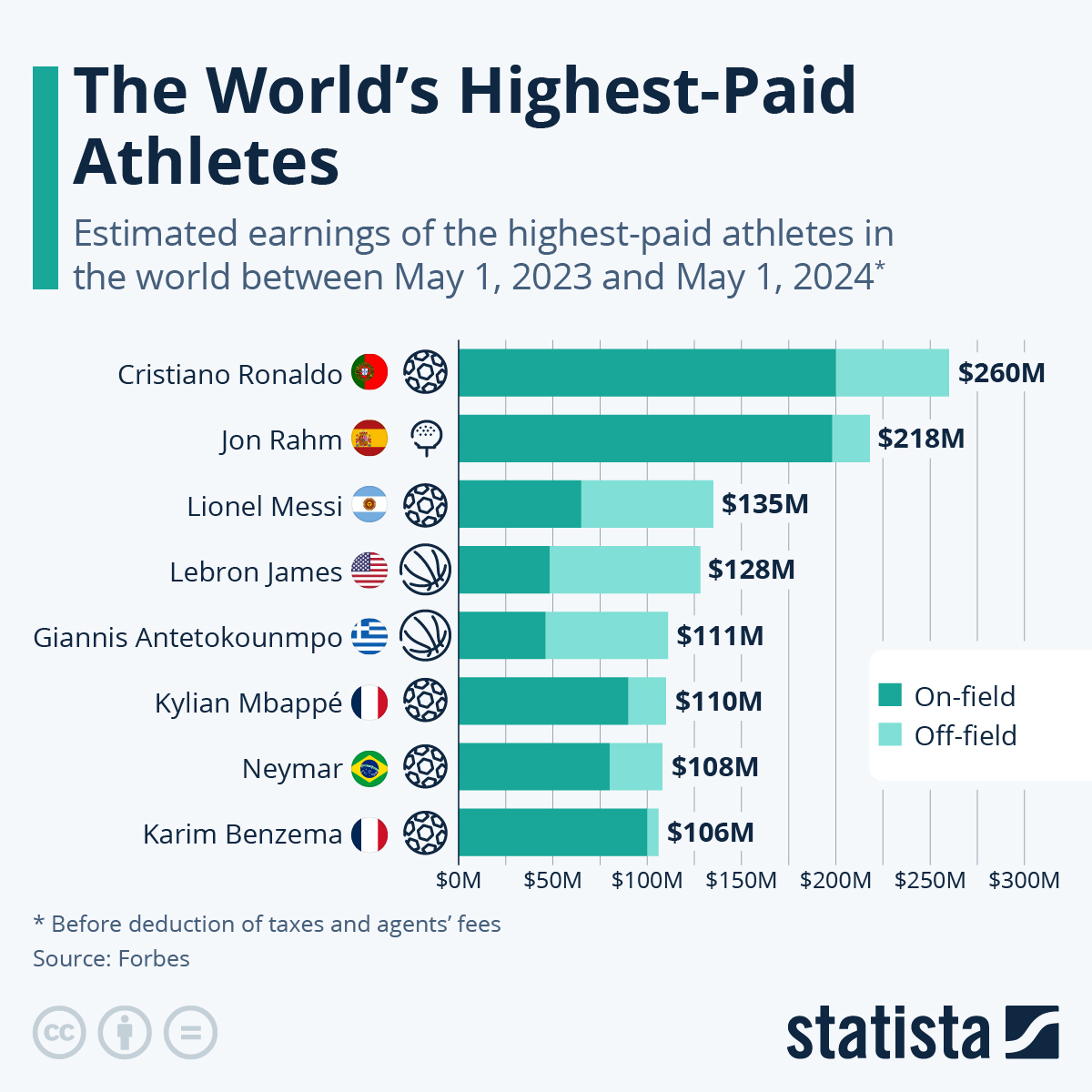
He may no longer be in his prime from a sporting perspective, but that doesn't stop Lionel Messi from cashing some large checks at the end of the month. According to Forbes' latest ranking, the Argentinian football wizard was the highest-paid athlete in the world over the past twelve months, raking in $130 million between May 1, 2021 and May 1, 2022.

Messi is joined by Lebron James and eternal rival Cristiano Ronaldo in the $100 million club, with the rest of the top 8 earners all making between $90 and $95 million last year. Looking at on- versus off-the-field earnings yields quite different results depending on who you look at. While salaries and endorsement earnings roughly even out for most of this year's top earners, Roger Federer and Canelo Álvarez are notable exceptions.

While Roger Federer, who has barely touched a racket in the past year due to injuries, mad virtually all of his $91 million from its various sponsorship deals, Mexican boxer Canelo Álvarez made just $5 million outside the ring and $85 million in it. In fact, Álvarez would have tied with Lionel Messi for first place, had the $40 million he reportedly netted for his May 7 loss to Dmitry Bivol not been just outside Forbes' tracking window.The World's Highest-Paid Athletes

Wednesday, August 25, 2021

The Most Successful Paralympic Nations

With the Summer Olympics having drawn to a close on 8 August, the next major multi-discipline international sporting event is due to get started this week - the Paralympics. Meaning the 'parallel olympics', the Games are a meeting of the world's top athletes that have some form of disability and have taken place since 1960.

As our infographic shows, like the Olympics the United States has been the dominant force here too with a total of 2,175 medals the most overall victories. Great Britain is currently in second place with 1,789 while Germany makes up the top 3 with 1,443. The opening ceremony will take place on 24 August while the first competitions will be started the following day, including medals being awarded in the swimming, cycling and wheelchair fencing.Infographic: The Most Successful Paralympic Nations | Statistaобщий зачёт Олимпиады — РФ еа 5-м месте, Китай на 2-м

Monday, August 16, 2021

The Biggest Gold Medal Hauls at the Tokyo Olympics

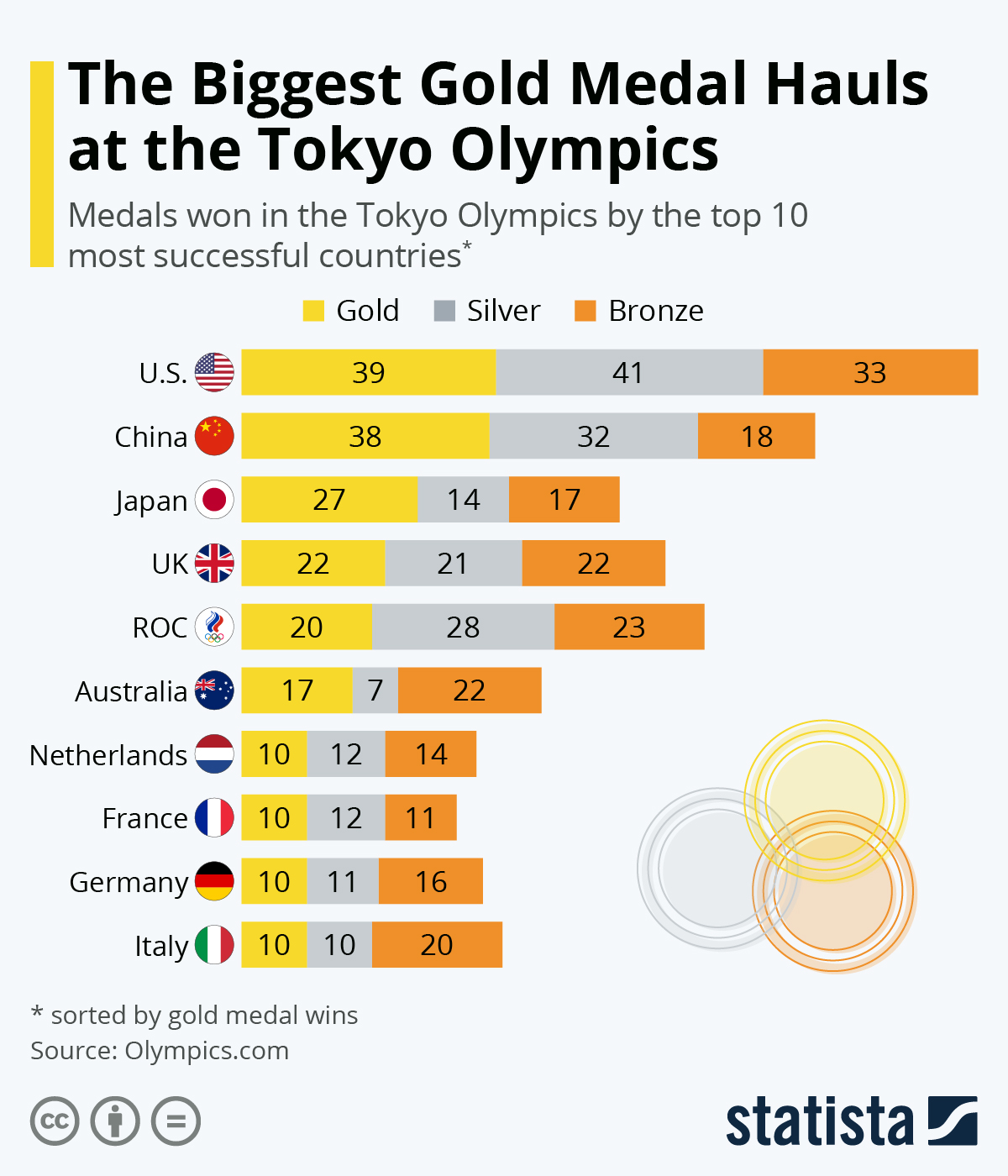
After the two countries had been going head-to-head for the last week of the Tokyo Olympics, the U.S. beat China as the most successful nation at this year’s Olympic Games. The country clenched 113 medals in total, 39 of them gold medals, ahead of China's 88 medals (38 golden ones).

China has only once become the most successful nation at a Summer Olympic Games. At home in Beijing in 2008, Chinese athletes dominated gold medal wins, but even then, the U.S. won more medals in total - 112 - over China's 100.

China won most gold medals this year in weightlifting (7), followed by diving (5), shooting (4) and table tennis (4). The medal count also includes surprise wins, like Zhang Yufei’s gold in the 200m butterfly competition or another swimming victory in the 4x200m freestyle relay.

The United States' strong suits continue to be swimming and athletics with eleven and seven gold medals won, respectively.

Host Japan comes third for most gold medals, but fifth behind Russia and the UK for overall medals. After three gold medals for skateboarding, the country won both the baseball and the softball finals as well as hauling home nine gold medals in judo, five in wrestling and one in karate.Infographic: The Biggest Gold Medal Hauls at the Tokyo Olympics | Statista

Thursday, April 1, 2021

in a visual world if you aren't noticed you just don't exist

The Rise And Rise Of The Spornosexual


Max Olesker spent three months in the gym to find out what ripped-to-shit feels like


By Max Olesker

Even now, still, it's 'Brad Pitt in Fight Club'. That's the body blokes ask for," says personal trainer Tim Walker. "He looks great but he's not massive. He's just got really good abs, good arms and an alright chest. And that's what people want: to be lean, have a six pack." Walker, 34, from Essex, has been a personal trainer since 2003, and for the last 12 years has specialised in transforming men's physiques in 12 weeks. "My clients tend to be from 20 to around 50 years old," Walker says. "I'm training one bloke who's 57." The programme is intense and comprehensive, consisting of four weekly one-on-one sessions with Walker plus "homework" (think sprints, press-ups and cardio) and a complete diet overhaul. It's a schedule I have agreed to undertake.

I'm embarking on Walker's three-month Warrior Workout because I'm investigating men's bodies. That is, ahem, I'm investigating the trend of men getting increasingly… ripped. Jacked. Pumped. Whatever you call it, it's a certain type of "fit". "There's this big thing now called 'physique training'," Walker says. "It's all about having abs, looking like a fitness model." It's a look that has come to prominence in recent years. "It used to be bodybuilding," Walker adds, "but that look's unattainable — you have to take steroids. With physique training, instead of spending 10 years trying to build mass, you just get really lean."

This tendency towards buffness is a cultural phenomenon defined by author and journalist Mark Simpson as "spornosexuality". The term, denoting men who strive to look like sportsmen or porn stars, marks the next stage in the evolution of the preening, mediated "metrosexual" (a word Simpson introduced to the public consciousness in a 1994 article in The Independent, then popularised in a 2002 piece for US news site salon.com).

Simpson first began writing about "sporno" culture in 2006, noting the rise in hypersexualised, homoprovocative imagery of sportsmen: Dolce & Gabbana's fashion shoots featuring the Italian national football team in the shower in 2006; Freddie Ljungberg on the cover of Attitude magazine; the French rugby players of the Dieux du Stade nude calendars. The concept appeared as one of the New York Times' 2006 Ideas of the Year. In 2014, Simpson pronounced the metrosexual finally dead — superseded by the spornosexual.

The spornosexual is a more extreme breed of man than his metro forebear. He is just as plucked, tanned and moisturised, but leaner, buffer, more jacked and obsessed not just with "looking good" in the abstract, but with the actual physical proportions of his frame: the striation of his abs, the vascularity of his biceps, the definition of his calves.

He defines himself less by the clothes he wears than by his HD-ready body, which is perpetually ready to be ogled on the beach, admired on the high street as it bursts out of a skin-tight plunging V-neck T-shirt, or rubbed-up-against under the flickering strobe of an Essex nightclub. He was defined as the "modern British douchebag" by writer Clive Martin in Vice, who described him as "an erection in a vest. A walking, preening monument to the British masculinity crisis, a sports science Übermensch with an indecent exposure charge to his name."

Do I want to become one of… those people? A tattooed, deep-tanned, skin-tight-V-neck-T-shirt-wearing, fist-pumping #lad? Well, no. Definitely not. But do I want to shake off the soft, doughy outer layer that working life and indolence have led me to develop? To acknowledge and then do battle against the stringy arms, appalling posture and incipient gut that I must have privately decided to ignore at some point in my mid-twenties? To devote myself, shamelessly, to the cultivation of my physique, radically change my lifestyle and try and look like (or, at the very least, feel like) some completely unattainable combination of Cristiano Ronaldo in an underwear shoot and Chris Hemsworth as Thor? To attempt to spornolize my body? Yes. Yes, I do.

Partly it's just vanity, obviously. A desire to find out what it feels like to be lean, strong and muscular. To walk around with the swagger of someone who is no longer in denial about their waist measurement. To show off to my mates, to impress my girlfriend. But there's also a different sort of curiosity. A slight case of Fear Of Missing Out that stems from the worry that, at 27, I only missed out on being engulfed by sporno culture by a few short years.

I mention this to Walker. "Yeah, it's not my generation that's properly into it, but the one below. The guys in their early twenties," he says. The creeping awareness that being hench now seems to be de rigueur for lads a few years younger than me was what prompted my investigation into the phenomenon in the first place. I just want to know what it feels like. Is that so wrong?

The night before my Warrior Workout programme begins, I go to a restaurant with my girlfriend and eat my last unhealthy meal (cheeseburger, thick-cut chips, two glasses of red wine, a side-order of dread). While I am dimly aware of what might lie ahead, I am acutely aware that Walker recently helped Men's Health writer Jamie Millar achieve an extraordinary, cover-model physique. The bar has been set high (and loaded with weights). It begins.

The next day, Walker measures me. I'm out of shape. Not fat-fat, but deeply unremarkable. The weak, soft, shapeless frame of a 27-year-old man with a career involving zero physical exertion. Walker documents my not-particularly-vital statistics in a Google spreadsheet, and then we get down to the business of lifting weights. It's absolute hell. Throughout my first session with Walker — a punishing, non-stop bombardment of squats, chin-ups, dead lifts, press-ups, shoulder presses and rows — I spend the hour attempting not to throw up. After our second — a leg-obliterating succession of squats, lunges and dead lifts — I take 20 minutes to walk to a destination Google Maps tells me is approximately 500m from the gym.

Very gradually, though, I start to adjust. Dormant muscle fibres begin to flicker to life. My lung capacity starts to improve. The workouts become almost… enjoyable? I start to get into a rhythm. I keep pumping iron and attempt to trace the sporno movement back to its source.

Hugh Jackman tweeted, "If the bar ain't bendin', then you're just pretendin'," when he was preparing for 2014's X-Men: Days of Future Past. The tweet is accompanied by a picture of the actor deadlifting 180kg and looking, as many online commentators noted, both huge and jacked. The most impressive thing about Jackman's transformation is not just how stacked his Wolverine has become, it's how much more stacked his Wolverine has become since the first time he played the character.

Look at the evidence. In 2000, Jackman's physique is athletic but not otherworldly. Over the course of the subsequent six films in the X-Men franchise, he grows increasingly lean and muscular. By the time he appears in last year's outing, filmed when Jackman was some 44 years of age, he's an absolute beast.

At this point, it's worth clarifying the nature of "metrosexuality" as Mark Simpson originally meant it, that is, not as shorthand for "bloke who uses moisturiser". "Metrosexuality is, in a paradox that Wilde would have relished, not skin deep," he told The Telegraph. "It's not about facials and manbags, guyliner and flip-flops. It's not about men becoming 'girly' or 'gay'." Rather, it's about the young-man-as-mediated-individual.

A product of the myriad pressures exerted on him by gleeful marketeers pumping aspirational imagery of men into pop videos, fragrance adverts, TV shows, filmsand magazines such as this one. Simpson says, "It's about men becoming everything. To themselves. Just as women have been encouraged to do for some time."

Spornosexuality, then, places further pressure on men by requiring them to not only tick all of the metro boxes (ie, looking groomed, smelling good, dressing exclusively in branded clothing) but also to adhere to a specific physical ideal. It's an improbable, sporty, porny, ripped-to-shit ideal, and means that men are increasingly beholden to the same unrealistic body expectations that have long plagued women, with the abdominal "V-line" becoming as fetishised as the "thigh gap".

With the spornosexual movement in full flight, men are now constantly bombarded with potent imagery of celebrities with improbable physiques: some of the most potent and pervasive are from Hollywood. Which leads us back to Wolverine and his deadlifts…

Jackman is not alone: Hollywood's leading men have been getting buffer for some time. The strapping, athletic physique of Christopher Reeve's 1978 Superman looks puny in comparison to the extraordinary proportions of modern Man of SteelHenry Cavill. Michael Keaton's Batman got by in a plastic muscle suit, as did Val Kilmer and George Clooney, but not so Christian Bale, who in 2005 debuted a Dark Knight who looked as pumped without the suit as he did with it (your move, Ben Affleck).

That same year, Daniel Craig signed up to inherit the role of James Bond. The spy, an enduring archetype of aspirational Hollywood masculinity, never needed a six-pack before, but in the modern, sporno era it is as essential a tool in Bond's arsenal as the hover-gondola was to Roger Moore in Moonraker. Daniel Craig, in unveiling his eye-popping physique as he strode out of the sea, gave us the first Bond who required that his protein be shaken not stirred. Or, as Simpson puts it, "With Craig, Bond finally became his own busty Bond Girl."

That's not to say Hollywood hasn't been plying us with images of muscular men since the year dot, from broad-shouldered swimmer Johnny Weissmuller's Tarzan in the Thirties to bodybuilder Steve Reeves' Hercules in the Fifties (and subsequent identikit sword 'n' sandals heroes).

Arnie, of course, dragged bodybuilding into the mainstream with his star-making turn as Conan the Barbarian in 1982, but he, too, was an outsider. Despite lacing many of his roles with wry humour, Schwarzenegger remained an unknowable freak attraction: his Olympian frame forged from superhuman Austrian willpower and futuristic robot technology. He did not seem mortal and was rarely presented as such.

In the modern era, however, the spornolized Hollywood star has a body like a Greek statue as a matter of course. Matt Damon, 44, is reprising his role as pumped-up secret agent Jason Bourne, Brad Pitt is still lean at 51 and Channing Tatum has retained the body he first monetised when working as a stripper. Even Chris Pratt, Parks and Recreation's very own bumbling man-child Andy Dwyer, transformed himself from cuddly to chiseled for his role in Guardians of the Galaxy. Despite superhero movies' copious use of CGI, the real-life transformation of an actor's body is inevitably one of the most crowd-pleasing special effects it is possible to achieve.

Hollywood, however, is losing ground to a faster, more democratic means of distributing body-image-warping content — social media. Indeed, in a society where nearly everyone carries an internet-enabled HD camera in their pockets, the internet provides the perfect platform for spornos to broadcast their achievements to the world at large. A pioneer, in the fields of both online peacocking and the cultivation of a spornosexual physique, was Australian bodybuilder Aziz Shavershian, popularly known as Zyzz, who died in 2011 aged 22, the result of a congenital heart defect.

Zyzz, who resembled Tom Daley as drawn by a Manga pornographer, truly embodied the sporno ideal. After his death, his catchphrases — "You mirin'?" and "You jelly?" — have been taken up as sporno slang and placed alongside, "Do you even lift, bro?" and "Friends don't let friends skip leg day" in the hallowed annals of internet fitness meme culture.

Though Zyzz is no longer with us, many others sharing his philosophy have become Instagram celebrities. Leaders of the pack include Yugoslavian fitness model Sadik Hadzovic (150k followers), former coal miner Cory Gregory (305k followers) and aptly-named Canadian model Marc Fitt (490k followers): men comparatively unknown to the world at large, but with a growing and appreciative online fanbase ready and willing to fawn over their "big ass lats and shoulders", "awesome chest pump" and "clavicle width" whenever they post a pic (which, fear not, is regularly).

Among the most successful of the online sporno generation is Lazar Angelov, a Bulgarian personal trainer who commands a vast audience on both Facebook and Instagram (7.8m likes and 1.2m followers, respectively). A man of unerring symmetry — in both his fat-free physique and his facial hair, which appears to have been painted on — Angelov's feeds are a constant klaxon-call to the world's spornosexuals, mainly via photos of him working out and motivational phrases, generally superimposed over photos of him working out.

On Instagram, an unapologetic snap of his stomach, captioned simply "#Monday #AbsCheck", accrues 43.7k likes. Over on Facebook, Angelov bellows "WORK HARD STAY HUMBLE" in capitalised Impact typeface over a black and white photo of his naked upper body, to 124,748 likes and 3,602 shares.

Two-thirds of the way through my training regime, I am constantly exhausted, constantly sore, and constantly going either to or from the gym. My whole life becomes governed by an immutable set of weekly edicts issued by Walker. I buy Tupperware containers and begin to weigh each of my five daily high-protein meals, then log them for his approval on the My Fitness Pal app, as per his orders. Walker tells me I "no longer eat breakfast. From now on, think of it as 'Meal One'." On some days, my 'Meal One' consists of chicken and spinach. Alcohol is verboten in this new world, as are carbohydrates. As is sugar. As is fruit. I am restricted to one coffee per day. My strict adherence to the times I must eat means that I find myself hastily consuming meals while on the bus, outside in the street and, on one particularly low occasion, standing on the eastbound Central Line platform at Oxford Circus tube station.

I want to quit. But I've made the commitment, and categorically refuse to back out — what would Lazar Angelov think of me? I check his Facebook page for inspiration. There's a photo of a lion's head, accompanied by the phrase, "Your state of mind is a magnet that creates your reality". I'm not sure what this means. I make myself a protein shake (Monkey Nutrition, strawberry flavour). Onwards.

I write to Mark Simpson, the sporno daddy himself. I explain that I'm currently in the middle of my programme, and that I have found myself simultaneously fascinated and repulsed by sporno culture: the enthusiastic pursuit of a physical aesthetic and, particularly, the documenting of your bodybuilding achievements via every available social media outlet feels somehow un-British. Vulgar.

"Of course," Simpson counters, via email. "That's one of its great virtues. Vulgarity, like sex, is never ironic. Which is why hipsters, the anti-sexual wing of metrosexuality, hate spornosexuals. Which shades into the general, historical English (middle class) problem with bodies and pleasure. And the particular discomfort with the 'open', 'passive', neediness of today's male's desire to be desired."

I mention to Simpson my theory that Hollywood's men are becoming increasingly stacked. He doesn't disagree, but notes, "I also think that Hollywood still has problems with red-blooded spornosexuality, and its full-on sensuality and shameless tartiness. Hollywood often feels the need to justify all that male voluptuousness with dead bodies — he's no spornosexual, dude! He's a warrior! In that I think that they're way behind much of Essex and the North East."

Simpson's not wrong. In fact, one of the great get-out clause words driving the male fitness push seems to be "functionality". It's the prevailing ethos behind CrossFit, the über-popular, organised workout system, a variation of which Daniel Craig used to carve his 007 physique. It is also the raison d'etre of Gym Jones (yes, named after the cult leader) the austere, private, near-mythical training facility in Salt Lake City run by world-class alpine climber Mark Twight. Twight's severe methods recently transformed Henry Cavill's frame and Gym Jones first achieved notoriety for training the cast of 2006's 300 (a seminal cinematic moment on the sporno timeline).

The genius of the word "functionality" is that it allows closet-spornos — those who are secretly exercising to attain a pumped, aesthetically-pleasing physique but are too grown-up to admit it — to pursue their goal with impunity. Take Simon Waterson, Daniel Craig's personal trainer for the Bond films. "Aesthetics were never on the table", he sniffed in an interview with bodybuilding.com. "It wasn't about creating a certain look; it was about creating a certain performance, being functional, and being able to look like you can do shit. The aesthetics was just a byproduct." And as for those light-hearted souls over at Gym Jones? "Our objective is functional fitness, and not merely the appearance of fitness: actual capacity strengthens confidence, a facade is merely physical." But of course.

The end is in sight. For better or worse, in two days I will have "Evolved". Something that strikes me about the process is that no-one in the gym — not Walker, nor any of the other trainers — has made any passing reference to steroid usage. Not in passing, not as a joke, not at all. I ask Walker about them. "Steroids get used more by people who're looking to get massive," he says. "There just aren't as many of them about at the moment. But what the young lads, the 19, 20, 25-year-olds, are jumping on at the moment are the aggressive fat strippers. Things like ephedrine, clenbuterol, ECA." As a shortcut to staying trim, presumably? "Yeah, lads feel they have to be massively lean, and that they have to go out on the piss. It's not possible to do both, but they do. It's Geordie Shore's fault."

Yes, so-called "scripted reality" shows Geordie Shore (and its New Jersey predecessor in the US) and The Only Way Is Essex are obvious bastions of the sporno ideal. "It's fitting," says Simpson, "that in a post-industrial landscape, the lads in these programmes work on their own bodies in the gym instead of someone else's property/product down the gym or the shipyard. The 'structured' reality is their own hyper-real bodies."

Simpson goes further, providing a socio-historic explanation for the Geordie attraction to sporno. "The North East was carpet-bombed by Thatcherism in the Eighties," says Simpson. "Coal and shipbuilding disappeared and were replaced by shopping, service industries, gyms and tanning salons. Metrosexuality and then spornosexuality both took root in the North East because a new generation of young men had to adapt to the wreckage around them, while their fathers' traditional ideas about masculinity were as redundant now as they were themselves. The post- industrial North East ended up being on the 'coalface' of metrosexuality and then spornosexuality."

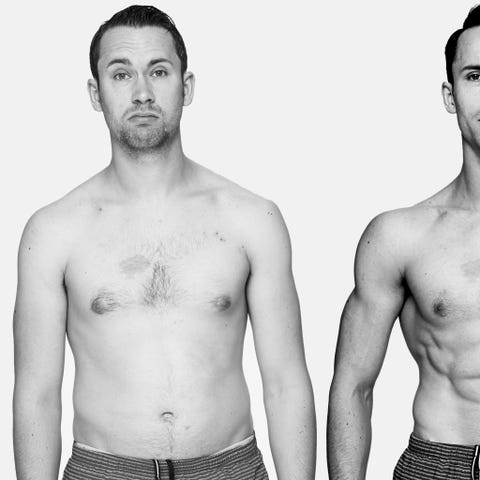
After 12 weeks, 48 training sessions, 64 protein shakes, four "cheat meals" that spiralled wildly out of control, 316½ chin-ups and at least four mental breakdowns later, it's over. I am delirious with exhaustion and have developed a pathological aversion to chicken breast, but Tim Walker really does know what he's doing. The "after" photos are taken. I feel relief, more than anything else. I have achieved what I set out to — I have transformed myself as best I could — but I realise the thing that makes me happiest of all is that very soon I'll be allowed to eat some bread. It's a good feeling.

And what comes next? What happens after spornosexuality? I ask the man who, if past form is anything to go by, is likely to be leading the pop-culture vanguard when the next zeitgeist-capturing phrase is coined. "The eager male self-objectification that spornosexuality symbolises is only likely to continue," says Mark Simpson, "in a world in which the sexual division of labour and loving has broken down. Not only have men discovered that they like — no love — being looked at, traditionally a 'feminine' pleasure, they have also learned that in a visual world if you aren't noticed you just don't exist."

Or, as Walker succinctly puts it: "People love it. There's no top or pair of shoes you could wear that gets as much reaction as a six pack."

Tuesday, October 27, 2020

the difference in life span

за долгую жизнь
алкоголики живут дольше спортсменов


Очень часто молодые и сильные спортсмены умирают до 50 лет. Говорят, что «не выдержало сердце».

Правильное питание и здоровый образ жизни почему-то не помогают продлить годы жизни.

Учёные института долголетия Марк Турянский и Владислав Гришин пришли к выводу, что «непосильные физические нагрузки спортсменов для достижения результата приводят к истощению сердечной мышцы и ранней смерти».

Оказалось, что алкоголики живут дольше спортсменов. Почему так происходит, рассказали учёные.

Алкоголь, безусловно, разрушает организм, истощает органы и системы. Он снижает умственную деятельность, интеллект. Наступает недопонимание происходящего, тормозится нервное возбуждение. Человек деградирует, потребности снижаются. Постоянное состояние эйфории добавляет годы жизни, но лишает разума. Как правило, такие люди заканчивают жизнь в психиатрических клиниках.

Спортсмены, которые дают себе неправильные физические нагрузки, убивают себя раньше времени. Такая нагрузка истощает сердце и перегружает сосуды. В этом случае правильное питание и здоровый образ жизни не помогут. Инфаркт, разрыв аорты, инсульт происходят от непосильной физической нагрузки.

Нужно рассчитывать нагрузки с тренером, следуя рекомендациям врача. Своевременно проходить профосмотры, чтобы вовремя выявить возможное отклонение от нормы и принять адекватные меры для устранения. Это поможет избежать плачевных последствий, и продлить годы жизни.

Friday, August 28, 2020

Americans Divided on Athlete Protests

Four years after San Francisco 49ers quarterback Colin Kaepernick kicked off a wave of athlete protests against systematic racial injustice by sitting during the national anthem in a preseason game against the Green Bay Packers, professional athletes from several sports made their boldest statement yet, by simply refusing to play.

It was the Milwaukee Bucks that took the first step by deciding to sit out their playoff game against the Orlando Magic in the wake of the police shooting of Jacob Blake in Kenosha, Wisconsin earlier this week. Several teams from the NBA, WNBA, Major League Baseball and Major League Soccer followed the Bucks’ lead and joined the walkout that caused all of Wednesday night’s NBA fixtures to be cancelled.

Having repeatedly kneeled in protest against racial injustice and spoken out in support of the Black Lives Matter movement, several athletes vented their frustration over a lack of progress following Sunday’s shooting in Kenosha, eventually leading to Wednesday’s unprecedented events.Ever since Kaepernick’s first protest in 2016, a debate had raged in the U.S. over whether or not the silent protests by countless athletes is appropriate or disrespectful.

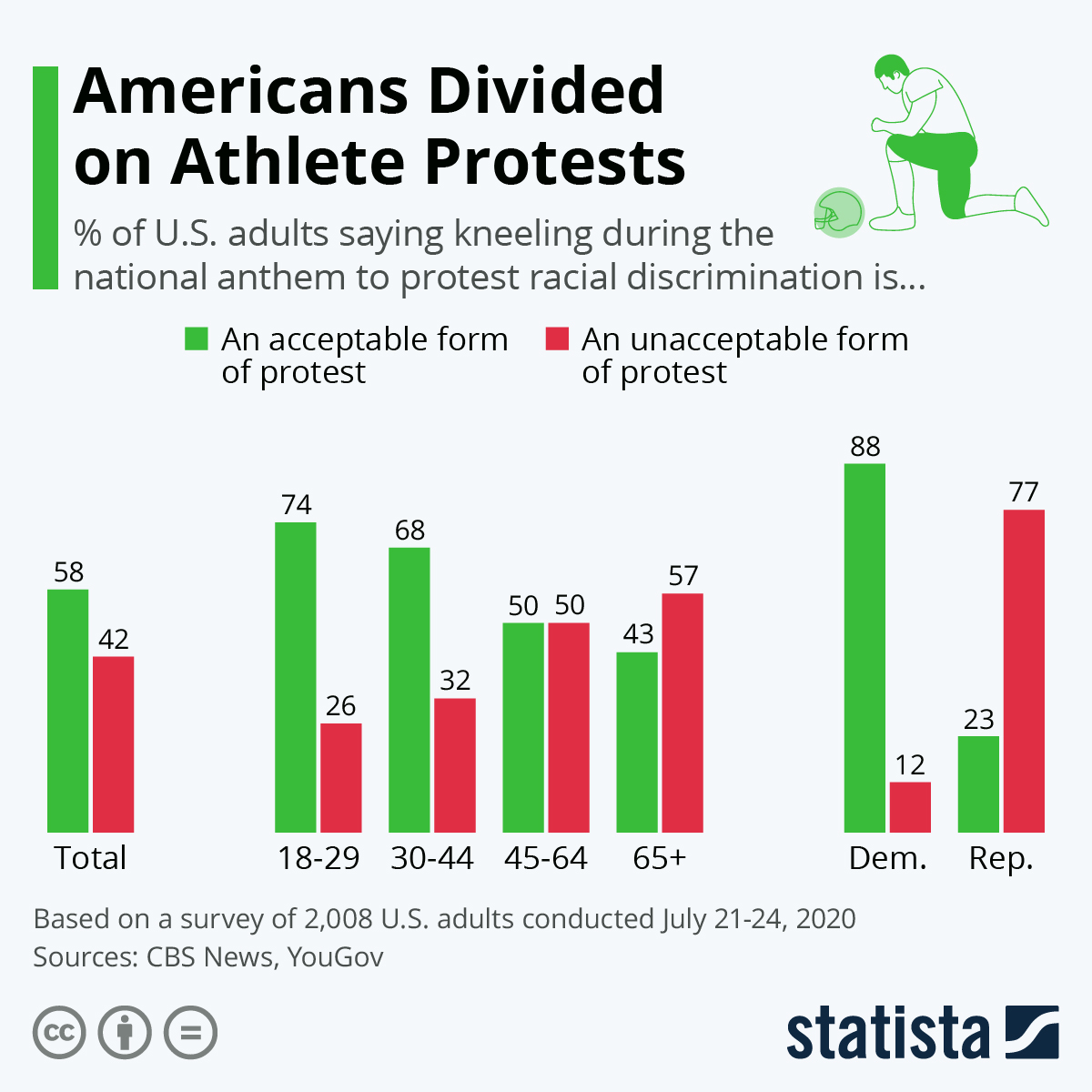
As a recent poll conducted by YouGov on behalf of CBS News shows, the country is still divided on the issue, with 58 percent of U.S. adults saying that kneeling during the anthem is an acceptable form of protest and 42 percent thinking it’s not acceptable. As the following chart shows there’s an age gap and a partisan divide in how the protests are viewed. While young Americans and Democrats overwhelmingly support the protesting athletes, older Americans and Republicans widely oppose the protests.Infographic: Americans Divided on Athlete Protests | Statista
Кто в молодости не был революционером — у того нет сердца, кто в зрелости не стал консерватором — у того нет ума.
Зелёные демократы — новое слово?

Tuesday, November 21, 2017

harassment is a legal doping

harassment is a legal doping
... настоящий эффект дают вовсе не романтические отношения, а именно секс. После ночи любви пловчихи проходили дистанцию гораздо быстрее, а гимнастки выполняли программу четко и без ошибок. Секрет в том, что секс положительно влияет на работу гипофиза, расслабляет напряженные мышцы, повышает уровень тестостерона. Да это же самый легальный допинг из всех возможных! Стоит заметить, что пару подобрать было возможно далеко не всегда. Но кто остановится, обладая такими уникальными знаниями в области повышения результатов? Тренеры решили брать «пульт управления» в свои руки. Стал популярен «фаворитизм», когда наставник своими силами формировал необходимый энергетический заряд у своей подопечной. На такое отношение никто особенно не жаловался, да и куда было бежать? Тем более что 24/7 ты проводишь со своим тренером, а он уже волей-неволей становится для тебя близким человеком. Интересно, что даже в 1997 году по обвинению в развращении 11 несовершеннолетних спортсменок в Англии осудили тренера по плаванию Пола Хиксона. В суде он сказал: «Я всего лишь желал побед для своих девочек». Известно, каким способом. Но на самом деле это был еще не самый сомнительный путь достижения успехов.

Спортивные боссы и тренеры продолжали искать уникальную формулу успеха и наконец нашли – беременность. Оказывается, на ранних стадиях в женском организме вырабатывается особое вещество хорионический гонадотропин человека. Оно значительно улучшает физическое состояние женщины. То есть действует как гормон роста. Это ли не тот необходимый допинг, столь желанный в различных видах спорта, зависящих от аэробной выносливости. В анонимных донесениях, попадавших в прессу в 1970-х годах, сообщалось, что тренеры заставляли беременеть чуть ли не 13-летних девочек. Естественно, после делался аборт. Кстати, аборт – неотъемлемая часть этой своеобразной формулы успеха. После прерывания беременности в женском организме происходит реабсорбция выработанных гормонов, а это влияет на увеличение мышечной массы.

...сексуальная жизнь стимулирует работу гипофиза, положительно влияя на женскую эмоциональность. Ведь мужская сперма – та дополнительная энергия, которая спортсменкам необходима. Поэтому часто юным гимнасткам, фигуристкам, пловчихам, претендующим на успех в большом спорте, приходится расставаться со своей невинностью. Пара фигуристов или танцоров бальных танцев выступает, как правило, успешнее, если между партнерами налаживаются интимные отношения. Тренер тут нередко выступает в роли сводни.

...нас было несколько молодых смазливых девчонок. А перед большим турниром ставку делали на одну. И когда фаворитка вечером отправлялась на очередную «беседу» с нашим тренером, я дико завидовала и ревновала. Не думала ни о будущем, ни о нравственной стороне дела, мне хотелось оказаться там, на месте фаворитки....

см про дробности:

Секс, спорт, страдания – три составляющих больших достижений


Это все бред

Wednesday, February 15, 2017

olympic demographics

магистратура
магистратура непричом

Олимпиада для поступления в магистратуру НИУ ВШЭ


В Олимпиаде, которую проводит Национальный исследовательский университет «Высшая школа экономики», могут принять участие студенты, осваивающие образовательные программы бакалавриата или специалитета, а также выпускники образовательных организаций высшего образования независимо от гражданства.

Победители и призеры Олимпиады по решению Ученого совета НИУ ВШЭ получают льготы при зачислении в НИУ ВШЭ на магистерские программы, соответствующие профилю олимпиады.

Участие в Олимпиаде является свободным и бесплатным.

Время проведения: 18-19 марта 2017 года.
Регистрация открыта с 1 декабря 2016 года до 6 марта 2017 года 15:00 (UTC+3).

Обратите внимание, что регистрация состоит из двух шагов — после получения логина и пароля необходимо зайти в личный кабинет и выбрать направление и профиль олимпиады. Только после получения регистрационного номера регистрация считается завершенной.

Олимпиада проводится в 24 городах России, Турции, Болгарии, Польше, Латвии, Азербайджане, Киргизии, Таджикистане, Армении, Казахстане, Украине, Молдавии, Белоруссии, Узбекистане. Список городов проведения Олимпиады: https://olymp.hse.ru/ma/2017/place

Сайт Олимпиады: http://olymp.hse.ru/ma/.

Олимпиада для поступления на магистерскую программу «Демография» (направление 39.04.01 «Социология») проводится в форме ЭССЕ по ОДНОЙ из предложенных соискателю тем.

Методические указания и демоверсия варианта находятся здесь: https://olymp.hse.ru/data/2016/11/28/1112763312/200_Демография.pdf

Олимпиада для поступления на англоязычную магистерскую программу «Население и развитие» (направление 38.04.04 «Государственное и муниципальное управление») проводится в форме критического разбора предложенного задания (статьи), выполняемого на английском языке.

Методические указания и демоверсия варианта находятся здесь: https://olymp.hse.ru/data/2016/11/30/1112644421/162_Population%20and%20development.pdf

По всем справочным и уточняющим вопросам, а также вопросам, связанным с подготовкой к написанию Эссе по Демографии, можно обращаться к Абылкаликову Салавату (abylkalikov@yandex.ru) и Марии Винник (vinnikmaria@mail.ru).

По всем справочным и уточняющим вопросам, связанным с подготовкой к написанию задания для поступления на магистерскую программу «Население и развитие», можно обращаться к Фаттахову Тимуру tfattahov@hse.ru, timur300385@mail.ru

Sunday, September 25, 2016

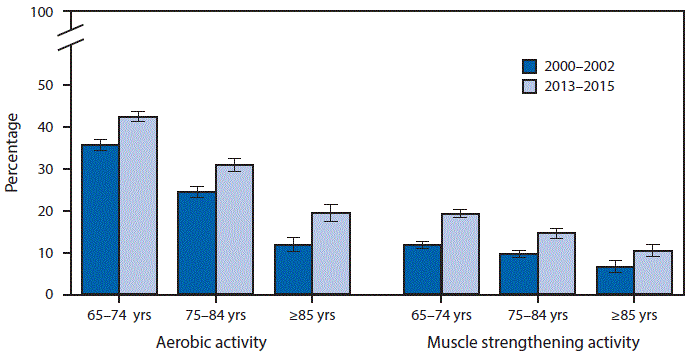
Leisure-Time Aerobic and Muscle-Strengthening

QuickStats: Percentage* of Adults† Aged ≥65 Years Meeting 2008 Federal Guidelines for Leisure-Time Aerobic§ and Muscle-Strengthening¶ Activities, by Age and Type of Activity — United States, 2000–2002 and 2013–2015 Weekly / September 23, 2016 / 65(37);1019
Percentage of Adults Aged ≥65 Years Meeting 2008 Federal Guidelines for Leisure-Time Aerobic and Muscle-Strengthening Activities, by Age and Type of Activity — United States, 2000–2002 and 2013–2015. MMWR Morb Mortal Wkly Rep 2016;65:1019. DOI: http://dx.doi.org/10.15585/mmwr.mm6537a9
* With 95% confidence intervals indicated with error bars.
† Estimates are based on household interviews of a sample of the noninstitutionalized U.S. civilian population and are derived from the National Health Interview Survey sample adult component.
§ Performing at least 150 minutes (2 hours and 30 minutes) per week of moderate-intensity, or 75 minutes (1 hour and 15 minutes) per week of vigorous-intensity aerobic physical activity, or an equivalent combination of moderate/vigorous-intensity aerobic activity.
¶ Performing moderate/high intensity muscle-strengthening activities that involve all major muscle groups on ≥2 days per week.

From 2000–2002 to 2013–2015, the percentage of older adults who met the 2008 federal guidelines for aerobic activity increased from 35.7% to 42.5% among persons aged 65–74 years, from 24.5% to 30.9% among persons aged 75–84 years, and from 11.9% to 19.4% among persons aged ≥85 years. The percentage who met the guidelines for muscle strengthening activities increased from 11.7% to 19.3% among those aged 65–74 years, from 9.6% to 14.6% among those aged 75–84 years, and from 6.5% to 10.4% among those aged ≥85 years. In both periods, within each age group participation declined with age and was lower for muscle strengthening activities compared with aerobic activities.

Source: National Health Interview Survey; http://www.cdc.gov/nchs/nhis.htm.

Reported by: Yelena Gorina, MPH, MS, ygorina@cdc.gov, 301-458-4241.

Thursday, August 25, 2016

ethnic composition of Russian Rio medals

Этнический состав российских медалистов Олимпиады в Рио

56 медалей – 
это четвертое место в неофициальном медальном зачете. 
Впереди оказались сборные США (121 медаль), Великобритании (67) и Китая (70). [Британия впереди Китая, потому что на самом деле зачёт не медальный, хотя называется так, а золотомедальный, но сейчас всё таг] 
19 медалей — этнически неруские

ист: национальный акцент
  • Золото – 19.
Две медали принесли дзюдоисты: первое золото для России в Рио выиграл кабардинец Беслан Мудранов, через пару дней болельщиков порадовал ингуш Хасан Халмурзаев. Первые места заняли россиянин грузинского происхождения Давит Чакветадзе (греко-римская борьба), аварец Абдулрашид Садулаев (вольная борьба), спортсмен с осетинскими корнями Сослан Рамонов (вольная борьба) и армянка Яна Егорян (фехтование).
Немало среди золотых медалистов и россиян-татар: командное золото в фехтовании принесли в том числе Артур Ахматхузин и Тимур Сафин. Лучшей спортивной гимнасткой стала Алия Мустафина, по ее словам, наполовину татарка.

  • Серебро – 18.
Серебряных медалей Россия получила на одну меньше, чем золотых –18. Неудивительно, что среди российской команды по стрельбе из лука, занявшей второе место, бурятки Инна Степанова и Туяна Дашидоржиева: у этого народа меткость в стрельбе из лука в крови. Буряты издревле состязаются в стрельбе из роговых луков на народном празднике Сурхарбан.
Алия Мустафина кроме золотой завоевала и серебряную медаль в составе команды по спортивной гимнастике. Вместе с ней в группе помимо прочих выступила армянка Седа Тутхалян.
Второе место в вольной борьбе заняла Наталья Воробьёва — наполовину лезгинка. Серебро в российскую копилку принесли россиянин кабардинского происхождения Аниуар Гедуев (борьба), езид Михаил Алоян(бокс) и тхэквондист цыганского происхождения Алексей Денисенко.

  • Бронза – 19. 
Здесь национальный разброс уже не такой широкий, как в золоте и серебре. Снова проявили себя татары— Тимур Сафин (фехтование) и Алия Мустафина (спортивная гимнастика), еще одну бронзу России принес российский стрелокармянского происхождения Кирилл Григорьян.

в обработке window on eurasia 2:

Gold 9

Beslan Murdranov, Kabardinian, Judo
Khasan Khalmurzayev, Ingush, Judo
Davit Chakvetadze, Georgian, wrestling
Abdulrashid Sadulayev, Avar, boxing
Soslan Ramonov, Osetin, wrestling
Yana Yegoryan, Armenian, fencing
Artur Akhmatkhuzin, Tatar, fencing
Aliya Mustafina, “half-Tatar” in her own words, gymnastics
Margarita Mamun, “half Russian, half Bengali” in her own words, gymnastics

Silver 7

Inna Stepanova, Buryat, archery
Tuyana Dashidorzhiyeva, Buryat, archery
Aliya Mustafina, “half-Tatar” in her own words, gymnastics
Natalya Vorobyova, “half-Legin,” boxing [лезгинка, видимо]
Abiuar Geduyev, Kabardinian, boxing
Mikhail Aloyan, Yezidi, boxing
Aleksey Denisenko, Roma, taekwondo

Bronze 3

Timur Safin, Tatar, fencing
Aliya Mustafina, Tatar, gymnastics
Kirill Grigoryan, Armenian, shooting

курсивом выделил имевших союзные национальные республики в СССР
другие страны тоже любопытно было бы посчитать, включая КНР

Thursday, August 11, 2016

medal cost

Athletes competing at the Rio Olympics could be chasing more than gold. The fame and glory involved in winning a gold medal are certainly prime incentives for competitors but the sizeable cash rewards offered by some nations add another dimension to the games, making the taste of victory even sweeter. During the Winter Olympics in Sochi in 2014, former-Soviet states proved especially generous in terms of medal bonuses with Kazakhstan in particular offering its athletes $250,000 for each gold medal won.

Rio is no different with massive financial rewards on offer for some gold medal winners. Singapore is offering its potential Olympic champions the most money, a cool $1 million Singapore dollars according to Fox Sports Australia. The following infographic (which was converted from Australian to U.S. dollars) provides an overview of the biggest estimated cash rewards for gold medal winners with Indonesia in second place ($383,000) followed by Azerbaijan ($255,000). Even though U.S. winners won’t enjoy a big payday by Singaporean standards, each winner still stands to take home $25,000. Not a bad day at the office.

Successful athletes from Singapore are awarded a prize of $1 million Singapore dollars, not a bad day at the office at all. Indonesia offers its successful Olympians around $380,000, according to Fox Sports Australia. The following infographic provides an overview of the biggest estimated cash rewards for gold medal winners in Rio (the values were converted from Australian to U.S. dollars).
Infographic: Some Athletes Are Chasing Huge Gold Medal Bonuses | Statista
любопытно будет взглянуть на реальные расходы post factum

Sunday, August 7, 2016

The Olympic Games

The 2016 Summer Olympic Games will officially get underway this evening after a spectacular opening ceremony in Rio de Janeiro's Maracanã Stadium. The organizers have put a huge amount of work and invested an impressive amount of cash to get to this point. Hosting the Olympics is expensive with the people of Hamburg voting to withdraw their city's bid for the 2024 games in late 2015, primarily on funding grounds.

Costs ran 51 percent over budget in Rio, ending up at $4.58 billion. Even though that may seem like a huge amount of money, it pales in comparison to the Winter Olympics in Sochi in 2014. Costs there quickly snowballed with many venues coming in catastophically over budget. The final bill for the games came to a whopping $21.89 billion.

This chart shows the cost of hosting the Olympic Games since 1992.
Infographic: The Massive Costs Behind The Olympic Games  | Statista
особенно сравимы Сочи и Пекин — прям инфа для инвестора по рейтингу коррупции

Sunday, July 31, 2016

Rio Olympics

Cтатейко про расходы олимпийского Рио

In sum, we find for the Rio 2016 Olympic Summer Games, based on the current projected cost figures for Rio:
  • At USD 4.6 billion, the Rio Games appear to be on track to reverse the high expenditures of London 2012 and Sochi 2014 and deliver a Summer Games at the median cost for such Games. 
  • At 51 percent in real terms, Rio 2016 seems on track to incur a substantial cost overrun of USD 1.6 billion. This is less than the overruns for the most recent Games in London and Sochi, but the same as median overrun for Games since 1999. 
  • At USD 0.4 million per athlete, Rio is on track to deliver its Games at a cost per athlete similar to previous Summer Games and substantially lower than both London 2012 and Sochi 2014.