Showing posts with label ООН. Show all posts

Tuesday, October 22, 2024

carbonization

Национальные и планетарные интересы в сохранении равновесия природы и эко-номического роста

Предметы исследования-международные соглашения по защите окружающей среды и национальная экологическая политика. Актуальность проблемы обусловлена продолжающейся дискуссией о роли и вкладе развитых и развивающихся стран в уменьшение неблагоприятных климатических изменений. Цель статьи-показать, что в современных условиях необходимы не только совместные усилия разных групп стран для восстановления равновесия в системе «природа-общество», но и новая философия политики экономического роста. В статье дан краткий анализ истории развития международного сотрудничества по решению экологических проблем в рамках инициатив ООН, выделены этапы сотрудничества и роль Киотского протокола. Статья рассматривает дискуссии во время обсуждения и принятия Парижского соглашения и дает анализ степени его влияния на дальнейшее развитие международных и национальных усилий по достижению эколого-климатических целей современного международного сообщества, выделяя роль позиций и разногласий стран G20 по этим вопросам, отношения к Парижскому соглашению крупнейших стран планеты, а также роль, цели и политику декарбонизации в современной экономике.
Thursday, August 29, 2024

who research

Каждый пятый 15-летний мальчик и каждая седьмая 15-летняя девочка имели сексуальный контакт в 2022 году — исследование ВОЗ, проводившееся в 42 странах Европы, Центральной Азии и Канаде. При этом около трети сексуально активных подростков этого возраста не использовали ни презерватив, ни противозачаточные таблетки.


В России объяснять про методы контрацепции будут на уроках ОБЖ и защиты Родины.


🔵 Bloomberg

Thursday, September 21, 2023

UN

Here are the latest headlines from the UN General Assembly


At the UN General Assembly on Wednesday, leaders turned their attention to some of the most pressing issues of our time; from the climate crisis, to development finance, to preventing future pandemics.

UN Secretary-General António GuterresClimate Ambition Summit focused on the leadership, solutions and actions that are driving the push toward a more sustainable future.

“The future of humanity is in your hands,” the Secretary-General told leaders gathered for the Summit, warning that the world must turn up the tempo in its climate action efforts. “We can still build a world of clear air, green jobs, and affordable clean power for all.”

In a meeting on pandemic preparedness, global leaders reached a historic agreement to strengthen international cooperation to help avoid a repeat of the devastating health and socio-economic impacts caused by COVID-19 and ensure the world is better prepared for future pandemics.
At a high-level meeting on financing for development, leaders also discussed innovative and practical solutions to close the widening divisions between rich and poor countries, which will be essential to achieve the Sustainable Development Goals. “It is clear that the systemic problems of financing for sustainable development require a system solution: reforms of the global financial architecture,” said António Guterres. A view of the UNGA hashtag during the General Assembly at UNHQ in New York.

UNGA continues on Thursday with a set of meetings on health issues of global concern, including one on the need for Universal Health Coverage and the Fight Against Tuberculosis.

You can follow the continuing action from New York right here on our page and take part in the global conversation by using the #UNGA hashtag!

Tuesday, September 19, 2023

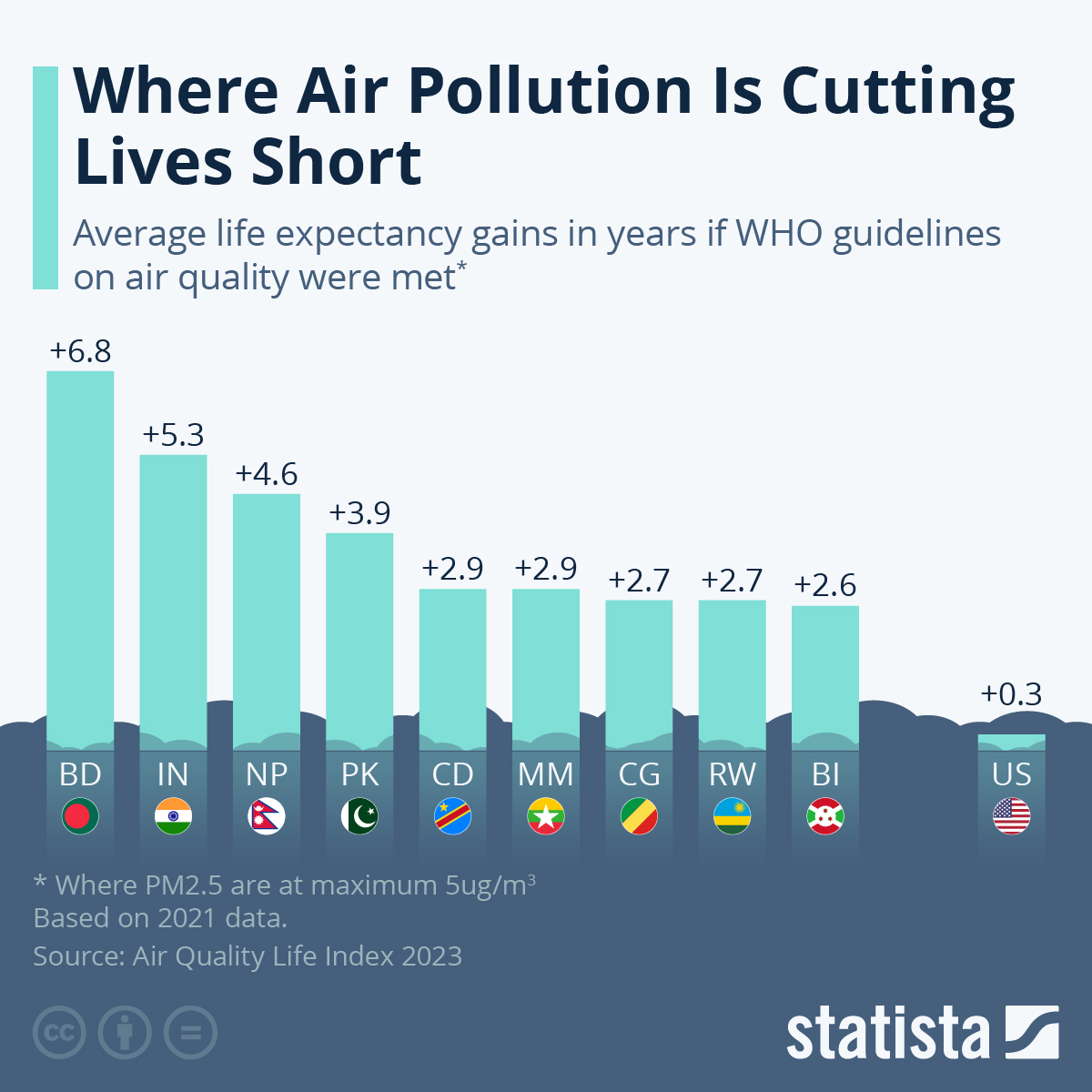
Where Air Pollution Is Cutting Lives Short

The average person on the planet could live 2.3 years longer if global particulate pollution levels were reduced to meet the World Health Organization guideline. This is according to research carried out by the Energy Policy Institute at the University of Chicago and published in the Air Quality Life Index 2023.

In many countries, this figure is far worse. Bangladesh recorded the worst PM2.5 levels worldwide at 74 ug/m3, a stark contrast to the WHO recommendation of a maximum of 5 ug/m3. If these levels of pollution persist, resident’s lives are estimated to be cut short by an average of 6.8 years. The next three worst offenders are also in South Asia, with India ranking second (5.3 years), Nepal in third (4.6 years) and Pakistan in fourth place (3.9 years).

China has seen a marked improvement in recent years. Since 2013, the country has extended its inhabitants’ average life expectancy by 2.2 years - again, so long as these reductions in pollution are sustained. This has been thanks to a push to improve air quality in the nation. However, levels are still dangerous enough to take around 2.5 years off people’s lives.

African countries are also overrepresented in the top nine roundup with the Democratic Republic of the Congo, Rwanda, Burundi, and Republic of the Congo all included. According to the report, the DRC's regions of Mai-Ndombe, Kwilu and Kasaï are all experiencing levels of air pollution that are losing its residents up to four years of life. This is partly due to waste burning, mining and practices such as cement manufacturing.

The United States ranks comparatively lower with its residents’ lives shortened by 3.6 months. As with all countries surveyed, there are considerable differences depending on the location within the country. For example, in 2021, 20 out of the top 30 most polluted counties were in California due to wildfires.Where Air Pollution Is CuWhere Air Pollution Is Cutting Lives Shorttting Lives Short

Sunday, September 17, 2023

what you need to know about the 78th session of the UNGA

Here’s what you need to know about the 78th session of the UN General Assembly.


Every September, world leaders gather at United Nations Headquarters in New York for the high-level week of the UN General Assembly (UNGA), where they work together to seek solutions to some of humanity’s most pressing challenges.

From tackling the climate emergency to addressing global health concerns to reducing inequalities; leaders at UNGA 78 will share their ideas and vision for creating a better future for all.

During the General Debate, world leaders will take the podium to explore solutions to the multitude of intertwined challenges facing the world today. The theme for the 78th session will focus on the need to rebuild trust and reignite global solidarity as we approach the halfway point in our efforts to achieve the Sustainable Development Goals by 2030.

The SDG Summit, which will put a spotlight on the need to recommit and take action to achieve the 17 Global Goals. The Summit will showcase bold actions and solutions that are needed to ensure a sustainable future.

UN Secretary-General António GuterresClimate Ambition Summit will focus on the need to accelerate action from governments, businesses, finance, local authorities and civil society. By showcasing “first movers and doers”, the Summit will explore the leadership, solutions, and ambitious actions that are driving the push towards a more sustainable future.

More details on the week’s events can be found here.

You can follow all the action from New York right here on our page and take part in the global conversation by using the #UNGA hashtag!


Friday, September 1, 2023

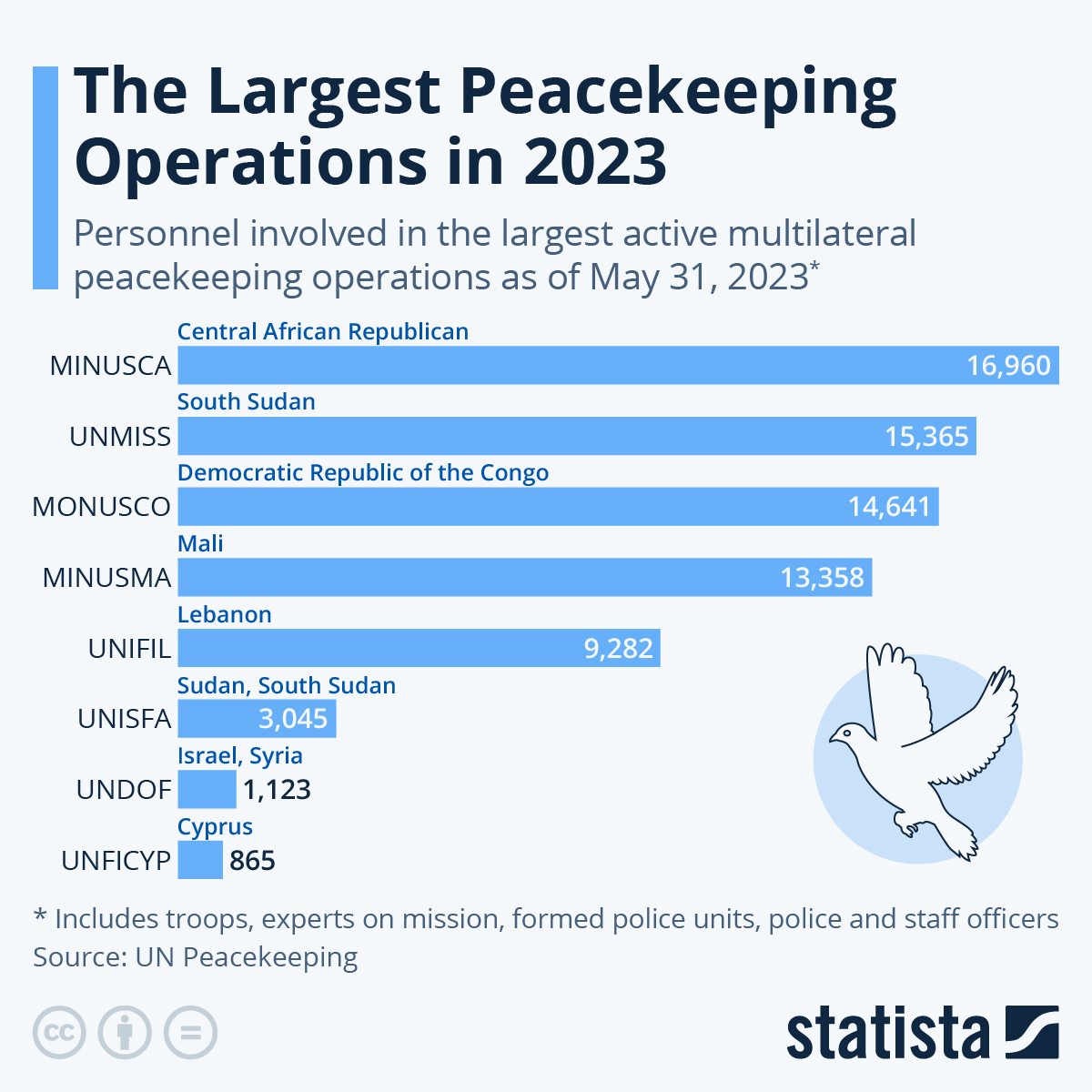
The Largest UN Peacekeeping Operations in 2023

The United Nations is withdrawing 13,000 personnel from Mali, in what UN Secretary-General António Guterres has called an “unprecedented” move, following a request from the Malian military junta to vacate the country. Mali’s Foreign Minister Abdoulaye Diop told the United Nations Security Council in June that the UN’s peacekeepers had "become a part of the problem in fuelling intercommunal tensions." The UN has been given until December 31 to pull out its mission members, as well as to close its 12 camps and to hand over a temporary base to the authorities.

Mali has been under military rule since a coup in 2012, and has since experienced ongoing instability with separatist and jihadist rebellions. In 2020 and 2021 the country saw two more coup d’etats and in June 2023, Human Rights Watch (HRW) released a report stating that the Malian armed forces and foreign fighters - allegedly from the Wagner Group who had been brought in to fight jihadist groups - had killed dozens of civilians since December 2022.

The following chart shows that as of May 31, 2023, the Mali peacekeeping mission, formally known as the United Nations Multidimensional Integrated Stabilization Mission in Mali, or MINUSMA for short, was the fourth largest of its kind, with more than 13,000 uniformed personnel stationed there. The mission that was established in April 2013 supported the now deposed elected government of Mali with the stabilization of the country. According to the UN peacekeeping platform, a total of 303 MINUSMA personnel have been killed in Mali so far, making it the second deadliest of the 12 UN missions currently ongoing. Only UNIFIL in Lebanon is more fatal for peacekeepers, with 329 deaths recorded.

Three other UN missions currently rank higher in terms of personnel numbers, all of which are in Africa. As the following chart shows, as of May 31, the largest of the group was the United Nations Multidimensional Integrated Stabilization Mission in the Central African Republic (MINUSCA) with nearly 17,000 personnel, which became operational in September 2014. The United Nations Mission in South Sudan (UNMISS) was the second largest with more than 15,000 personnel, followed by MONUSCO, the United Nations Organization Stabilization Mission in the Democratic Republic of the Congo with around 14,600 members.The Largest UN Peacekeeping Operations in 2023

Thursday, August 31, 2023

ds forever

мкб
Не могу не процитировать Телеграмное Менделевича [значит есть — надо подписаться]:

"ШИЗОФРЕНИЯ РЕАЛЬНАЯ И ШИЗОФРЕНИЯ ВООБРАЖАЕМАЯ


Возможно, мои коллеги знают (другим объясню) - в среде отечественных психиатров происходит брожение. Дрожи подбросила новая классификация болезней (МКБ-11), принятая Всемирной организацией здравоохранения. Наш Минздрав должен как того требуют процедуры принять ее в РФ. Для этого были созданы рабочие группы, адаптирующие ангоязычную версию к русскоязычной реальности. Но неожиданно выяснилось, что часть российских психиатров не согласны с внедрением психиатрической части МКБ-11 в отечественную практику.

Напомню, что Международные классификации болезней принимаются не на Западе и не на Востоке. Они являются результатом консенсуса между специалистами из разных точек мира. Российские психиатры принимали участие в разработке МКБ-11 наряду с американскими, китайскими, южноафриканскими, бразильскими и европейскими. Процедура растянулась на десятилетие, но в конце концов диагностический консенсус был достигнут.

И вот выясняется, что «у российской психиатрии свой путь», что «не учтены наши научные традиции», что «западная психиатрия пошла на поводу у общзества», что «толерантность победила науку» и пр. Одна из коллег-психиатресс резюмировала, что «лучше вообще отказаться от МКБ-11» (не пойму только, чем это лучше?). Сообщу ей и сочувствующим, что МКБ-11 как раз и принята на основе научных данных, а не чьих-либо традиций или интересов.

Основная претензия оппонентов к МКБ-11 – изменение критериев диагностики шизофрении. В новой классификации диагностические рамки этого расстройства сузились и стали более строгими. Теперь невозможно будет произвольно ставить этот диагноз, особенно, в случаях отсутствия бреда, галлюцинаций и других явных признаков болезни. Оппонентам всегда хотелось и хочется продемонстрировать сакральность собственного знания и виртуозные навыки выявления шизофрении по «латентным признакам». Наших оппонентов раздражает, что мировое психиатрическое сообщество исключает понятие «вялотекущей шизофрении» (посягает на Святое!!!), которое до сих пор активно используется в РФ. Пусть и с применением эвфемизма – шизотипическое расстройство."

Monday, May 22, 2023

wonderful people

Жизнь замечательных людей


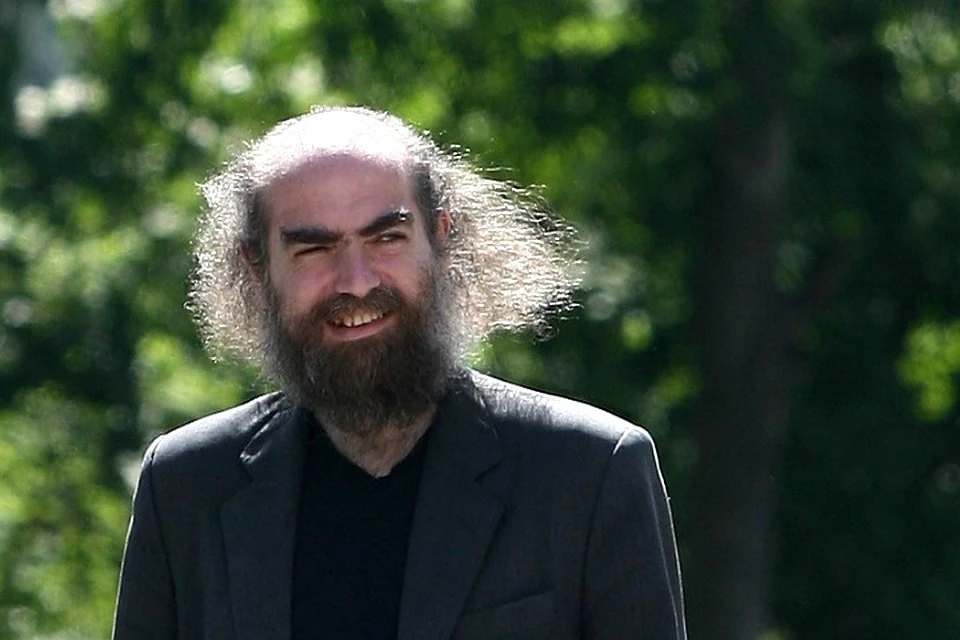
Осенью 2023 года в кинотеатрах России выйдет биографическая драма «Витринный экземпляр» об ученом Григории Перельмане, доказавшем гипотезу Пуанкаре, которая оставалась нерешенной математической проблемой около века.

Картина исследует жизнь Перельмана с юных лет, детали сюжета пока не раскрываются. Главную роль в фильме исполнил Марк Эйдельштейн («Страна Саша», «Монастырь», «Смычок»). Взрослого Перельмана сыграл Дмитрий Галдин, для которого участие в проекте стало дебютом в полнометражном кино.

Режиссером выступил Андрей Григорьев, чья документальная лента «Васенин» внесена в Список наследия ЮНЕСКО. Генпродюсером «Витринного экземпляра» стала Алена Кремер, работавшая над фильмами «Я худею», «Дракулов» и «Хочу замуж».

Чтобы воссоздать разные этапы биографии Перельмана, съемочная группа несколько лет исследовала архивы и общалась с учеными. Съемки проходят как в России, так и в США, где Перельман работал в начале 1990-х, пока не вернулся в родной Петербург.

Tuesday, April 18, 2023

UN Goals by Russian Entrepreneurship

Global Challenges and Risks on the Way to Achieving the UN Sustainable Development Goals by Russian Entrepreneurship

Alexander Tkachenko, 2022, Economics, taxes & law, DOI: 10.26794/1999-849X‑2022-15-5-6-16 

Russia fully fulfills its obligations to achieve the UN Sustainable Development Goals against the background of global instability in the world, risks and threats affecting the interests of society and the state, which cannot but affect the opportunities of Russian business and entrepreneurship, especially in their foreign economic activities. Therefore, the relationship between the Russian state and entrepreneurship should be based on the ability to negotiate and find compromises in solving the tasks facing them. The subject of the study is the impact of the fulfillment of state obligations undertaken within the framework of foreign policy agreements to achieve sustainable development goals on the development opportunities of Russian entrepreneurship, primarily small business, and its export — import activities. The purpose of the work is to analyze the opportunities of Russian entrepreneurs to develop their business within the framework of fulfilling their obligations to transition to environmentally friendly production and achieve other sustainable development goals based on the state policy of supporting small and medium — sized businesses. A special role in the implementation of the above tasks of Russian microenterprises, which survived the crisis associated with the coronavirus pandemic, is revealed more successfully than small businesses. Readers’ attention is drawn to the geographical orientation of Russian business, including the possibility of its reorientation in the East Asian direction, and a conclusion is drawn about the obvious lag and insufficiency of cooperation with many countries of the African continent. The necessity of financial and tax reform is justified for the successful development of not only local businesses under sanctions, but also the regions themselves in conditions of insufficient funding and narrowing of state support opportunities. The importance of transferring managerial skills and innovative knowledge available from large enterprises to local business is shown, as well as the expediency of significantly expanding the prerogatives of regional authorities in tax regulation of private business activities.

Wednesday, March 29, 2023

welcome an old one

В РПЦ предложили отказаться от классификатора болезней ВОЗ


По словам председателя Патриаршей комиссии по вопросам семьи, защиты материнства и детства Федора Лукьянова, МКБ-11 идет вразрез с курсом России на защиту традиционных ценностей


МОСКВА, 24 марта. /ТАСС/. Патриаршая комиссия по вопросам семьи, защиты материнства и детства предлагает отказаться от реализации в России положений Международного классификатора болезней (МКБ-11), поскольку они идут вразрез с курсом страны на защиту традиционных ценностей и законом о запрете ЛГБТ-пропаганды. Об этом сообщил в пятницу председатель комиссии, священник Федор Лукьянов на круглом столе в Госдуме.

МКБ-11 - одиннадцатый пересмотр Международной классификации болезней и проблем, связанных со здоровьем, документ был разработан Всемирной организацией здравоохранения (ВОЗ). В России МКБ-11 вступил в силу с 1 января 2022 года. Президент России Владимир Путин в декабре 2022 года подписал закон о запрете пропаганды нетрадиционных сексуальных отношений, смены пола и педофилии.

"Наше государство пока еще реализует МКБ-11 - Международный классификатор болезней, в котором различные формы извращений <...> обозначаются как некие уже не психические отклонения. <...> России обязательно надо, частично хотя бы, выйти уже из этого позорного механизма, который параллельно всем нашим усилиям продвигает совершенно чуждые, инородные нашему народу, нашим традиционным ценностям, вещи", - сказал Лукьянов.

В частности, он обратил внимание на то, что и сегодня в рамках реализации положений упомянутого МКБ-11 "под эгидой министерства здравоохранения создаются группы сопровождения "трансгендерных" людей, тренинги для тех людей, которые хотят сменить пол". "Под видом оказания профессиональной помощи людям проводятся неквалифицированные тренинги и семинары, изменяющие общественное мнение среди профессионального сообщества, в том числе медицинского, направленные на принятие девиантных форм поведения и психических отклонений", - сказал Лукьянов.

Как отмечают в патриархии, классификатор МКБ-11, в частности, вводит понятие "третьего пола" и расширяет понятие психической нормы, в которое теперь входит не только гомосексуализм (который уже считался нормой в рамках МКБ-10), но и транссексуализм, а также другие формы сексуальных девиаций.

Круглый стол, проведенный комитетом Госдумы по безопасности и противодействию коррупции, посвящен теме "Безопасность образовательных организаций в современных условиях".

Friday, February 3, 2023

HDR


Presentation to European Parliament continues global conversation on HDR


Since its global launch last September, the 2021/22 Human Development report (HDR), “Uncertain Times, Unsettled Lives: Shaping our Future in a Transforming World,” has garnered sustained interest around the world with its timely findings and hopeful messages on how human development could thrive in the face of uncertainty.

The conversation on these themes from the HDR continued on January 24 with a presentation to the European Parliament. Co-organized in Brussels by HDRO, UNDP’s Office in Brussels, and the SDG Alliance of the European Parliament, the event featured a briefing on key themes of the report, followed by a panel discussion with the two co-chairs of the SDG Alliance, MP Udo Bullman and MP Barry Andrews; HDRO Director Pedro Conceição; Georges van Montfort, Deputy Director of UNDP’s Office in Brussels; Blandine Bouniol, Director of Advocacy with Humanity and Inclusion and CONCORD Board member; and Virginia Barchiesi, INTPA Youth Sounding Member, Italy.

"The Human Development Report 2021/22 provides an agenda and conceptual framework for us all to build a just transition with universal values," said Andrews.

"Today's discussion about the Human Development Report was one of the most inspiring ones I ever had. Let's work together and push for change for the better," said Bullman regarding the event.

Read report


Two-day workshop at University of Arizona yields rich discussion on human development


From January 18-19, colleagues from the Human Development Report Office (HDRO) engaged in two days of discussions around the findings of the HDR 2021/22 at the University of Arizona.

Hosted by Prof. Tauhidur Rahman and the Initiative for Agency and Development at the University of Arizona, the workshop consisted of two segments: a public talk by HDRO Director Pedro Conceição and a series of presentations and a panel discussion with HDRO research and statistics team colleagues and academic experts:

  • Liesl Folks, Senior Vice President for Academic Affairs and Provost, University of Arizona
  • Tauhidur Rahman, Director of IfAD and Professor of Development Economics, Department of Agricultural and Resource Economics, University of Arizona
  • Russell Tronstad, University Distinguished Outreach Professor, Department of Agricultural and Resource Economics (AREC), University of Arizona
  • Erle Ellis, Professor of Geography & Environmental Systems, University of Maryland
  • Leandro Prados de la Escosura, Emeritus Professor at Universidad Carlos III, Madrid and Research Fellow at the Centre for Economic Policy Research
  • Ingvild Almås, Professor of Economics, Institute for International Economic Studies, Stockholm University
  • Charles Noussair, Professor of Economics, University of Arizona
  • Price Fishback, Professor of Economics, University of Arizona
  • Tim Finan, Professor of Anthropology, University of Arizona
  • Josefin Pasanen, Researcher, Human Development Report Office
  • Fernanda Pavez Esby, Researcher, Human Development Report Office
  • Christina Lengfelder, Research Specialist, Human Development Report Office
  • Yu-Chieh Hsu, Statistician, Human Development Report Office

The two-day workshop allowed a deep-dive discussion on what it would take to build a more hopeful future for human development in uncertain times. Some of the insights from discussions include:
  • Human development is about wellbeing achievements, but also human agency. Human freedoms, diversity and creativity is necessary to navigate this novel context of interacting uncertainties. Measurements of agency and freedoms show how expanding metrics uncovers new insights.
  • It is time to think of the Anthropocene context beyond environmental degradation, to recognize humans as a geological force shaping our planet. Although there is urgency in accelerating transformations towards a low carbon future, going beyond narratives of crisis and collapse can help us to act on the agency we have in shaping our planet. Human Development can be our "aspirational superpower" in navigating the uncertainties and challenges of the Anthropocene.
  • Beliefs and emotions, alongside preferences, shape behavior. Emotions such as happiness can have tangible impacts on important human development dimensions - such as education and productivity. People’s beliefs about how whether inequalities are fair determine their political stand on how to redress inequality.

UN training session sensitizes stakeholders and learners to HDR findings


On January 25, HDRO co-hosted a workshop with UNITAR on the 2021/22 HDR to sensitize stakeholders and interested learners to the many ways in which interacting layers of uncertainty – stemming from dangerous planetary change in the Anthropocene, transformations, and political polarization - are unsettling people’s lives.

HDRO colleagues presented the key findings of the report and interacted with the workshop participants, who also learned about topics including:
  • Harnessing human development to navigate uncertain times
  • Collective action in times of uncertainty
  • Charting paths to transformation

Details


In Memory of Dr. Inge Kaul (1944-2023)


HDRO was saddened to learn of the passing of dear colleague and friend Dr. Inge Kaul. She led the Human Development Report Office together with Mahbub ul Haq when it was first set up. In addition to her work on the first Human Development Reports, she published extensively on global public goods, effective multilateralism and international cooperation financing. We will treasure the memory of her warmth, dedication and contributions to human development that continues to inspire the development sphere.

Details


Food for thought: The optimists were right and can be so again


"The world can be a better place. But we cannot take for granted that it will be," said Martin Wolf of the Financial Times in his opinion piece.

Featuring findings from the 2021/22 HDR, Wolf argued that there is reason to be optimistic, as we have made real progress amidst converging shocks and crises that comprise the “uncertainty complex”. However, he emphasized thatwe cannot wait for another period of catastrophe before we attempt renewal.

"We have stumbled, often badly, on our road to the answers. If the optimistic view I still hold is to prove true, we have to stumble faster," Wolf said.

Full article

Coming up: More HDR events and a new-look newsletter!


The month of February is packed with exciting HDRO events that will enrich your understanding of human development and much more:
  • Wednesdays (1, 8, 15, 22 Feb): Viewing Multidimensional Poverty from Many Angles. RSVP HERE
  • 6 Feb: Side event for the 54th session of the Statistical Commission “Human Development During Uncertain Times”. RSVP HERE
  • 7 Feb: IIAS-SEAPP Doha Conference 2023, “Developmental States for Sustainable Development”. More info
  • 13 Feb: G-STIC Conference 2023 in Rio, Brazil: High-level plenary session: Toward an equitable and sustainable future. More info
  • 14 Feb: 150th anniversary of the International Law Association (ILA) Paris, Webinar. More info
  • 22 Feb: Regional Launch of the 2021/2022 HDR in Vienna, co-hosted by IIASA. RSVP HERE
  • 24 Feb: Health Capabilities Workshop - University of Pennsylvania. Details forthcoming.
  • 28 Feb – 1 March: Launch of a Human Development background paper on Public perceptions, subjective Well-being, and social trust in Colombia. 
Details forthcoming.

HDRO is also excited to announce that a new-look newsletter is on its way, with a brand-new visual identity and features to make your reading experience more enjoyable and interactive. Stay tuned!

Sunday, January 22, 2023

Changing the perspective on low birth rates: why simplistic solutions won’t work

BMJ 2022; 379 doi: https://doi.org/10.1136/bmj-2022-072670 (Published 15 November 2022)Cite this as: BMJ 2022;379:e072670


Stuart Gietel-Basten, Anna Rotkirch, and Tomáš Sobotka argue that policies responding to population decline and ageing should enable reproductive choice and maximise the potential of all citizens


The news that birth rates hit record low levels in many countries in Europe, Asia, and the Americas in the past decade was met with some alarm globally. More than half of the world’s population lives in countries with a total fertility rate below two children per woman. The rate is below 1.5 in 46 countries, and ranges from 1.3 to 1.8 in many middle income countries such as Brazil, Iran, China, Turkey, and India. Countries that, until recently, had fertility rates around 1.8-2.0 such as France, US, UK, and those in the Nordic region also now have declining birth rates. In South Korea the rate fell to 0.81 children per woman in 2021, an unprecedented low for any country in peacetime. Adversities and anxieties linked to the covid-19 pandemic, Russia’s invasion of Ukraine, and climate change may further contribute to fertility declines.

Countries with a total fertility rate below 2 in 2020

As a primary engine of population ageing and stagnation, low birth rates are often viewed as a threat to welfare systems, healthcare, and the economy. The concern is that lower birth rates imply that, in several decades, there will be fewer economically active people to fund health and welfare systems as well as increasing demands on these systems. Rather than reforming such stressed systems through, for example, altering the pension age or raising tax (which may be politically unpopular), many governments have sought to find a demographic solution by pursuing top-down, target driven policies to encourage childbearing. Such policy responses have questionable justifications, limited effect on fertility, and potentially harmful effects on sexual and reproductive health, human rights, and gender equality.

People in countries with low fertility rates desire, on average, to have more children than they do. Adopting a person centred, inclusive, rights based, and gender sensitive approach to fertility, following principles set out at the 1994 International Conference of Population and Development (ICPD), is more likely to deliver a sustainable response to low fertility.

читать дальше (по ссылке вверху)

Sunday, November 20, 2022

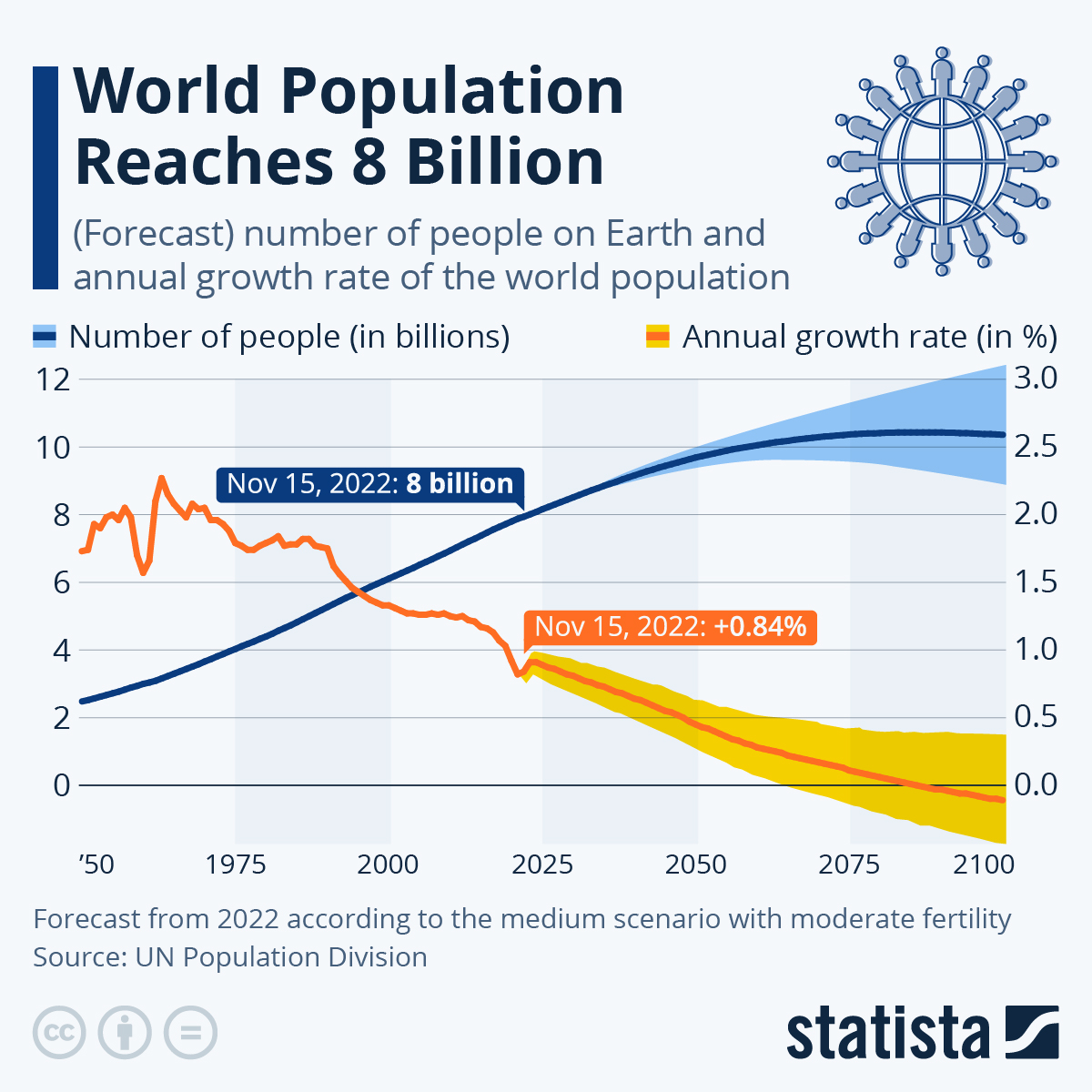
World Population Reaches 8 Billion

According to UN calculations [всё остальное — трын-трава], the number of people in the world will exceed the 8 billion mark today, November 15, 2022 - more than three times as many as in 1950. Looking ahead, the UN Population Division's forecast predicts that the world's population will already exceed ten billion by 2059. By the end of the century, however, the number will then decline slightly. The growth of the worldwide populace has already been slowing down for decades, as illustrated by the yellow line in our infographic.

According to UN analysts, the growth is due to the gradual increase in life expectancy as a result of improvements in healthcare, nutrition, personal hygiene and medicine. It is also the result of high and consistent birth rates in some countries, they add. The countries with the largest populations in 2022 are China (1.41 billion), India (1.41 billion) and the United States (333 million). In terms of population by continent, about 59.3 percent of people lived in Asia in mid-2021.

At present, the world population is growing by around 82.4 million people a year. The countries with the highest population growth in 2021 were Syria, Niger and Equatorial Guinea. Overall, the ranking is dominated by African countries. By contrast, the list of countries with the highest population decline is dominated by eastern and southeastern European states, which have to contend with high emigration figures due to the wage and development gap with western Europe.World Population Reaches 8 Billion

Saturday, September 24, 2022

The World Bank and the United Nations General Assembly (UNGA)

The 77th session of the UN General Assembly (UNGA 77) convened on September 13, 2022 and will run through September 26, 2022. This year’s event is focusing on maintaining international peace and security, tackling the climate crisis, fighting the ongoing pandemic, ensuring the delivery of humanitarian aid on a record scale, advancing education and skills development and reforming the global financial system. The World Bank Group is proud to join leaders from around the world to discuss these pressing development issues and work with its global partners to find solutions to these challenges. Read the President’s Remarks at Transforming Education Summit.

IN FOCUS - Immersive: Learning in Crisis: Prioritizing education & effective policies to recover lost learning

Children around the world have lost an enormous amount of classroom time. At the peak in April 2020, it is estimated that pandemic-related school closures disrupted education for over 1.6 billion children. Education is playing a pivotal role during the ongoing United Nations General Assembly (UNGA). Read the immersive story.

Saturday, September 10, 2022

population policy

Wednesday, May 18, 2022

simple

Умные арабы: пищевой кризис из-за Украины не опасен для стран Залива?


Нефтяные страны Персидского Залива подошли к глобальному продовольственному кризису, вызванному войной в Украине, весьма подготовленными, отмечается в аналитическом обзоре закрытого для широкой аудитории московского Института Ближнего Востока.

По состоянию на 2021 год все эти страны входят в 30-ку ведущих стран мира по индексу оценки национальной продовольственной безопасности. Высокая степень готовности арабских стран к кризисным угрозам в продовольственном секторе объясняется основательной подготовкой на национальном уровне к такого рода рискам и тщательным планированием. Они смогли за последние два десятилетия существенно диверсифицировать и упрочить сеть закупок продовольствия на мировых рынках, что позволяет им активно маневрировать для устойчивого и стабильного обеспечения поставок из других стран основных стратегических видов продовольственной номенклатуры.

Кроме того, ряд стран Персидского залива инвестировали в приобретение обширных пахотных земель в третьих странах, особенно в Африке, что позволило им выращивать необходимую монокультуру [почему не стерео?] на этих землях для последующего обеспечения своего внутреннего спроса.

▪️ Cаудовская Аравия с 2008 года последовательно приобретала дешевые пахотные земли в Судане, Кении и Эфиопии для производства зерновых, одновременно сокращая внутреннее производство пшеницы на 12% для сокращения нагрузки на собственные водные ресурсы.
▪️ В сформулированной Катаром в 2017 году новой национальной стратегии продовольственной безопасности особо подчеркивается важность превентивных мер планирования, cоздания резервов и воссоздания целого ряда ключевых отраслевых производств на случай кризиса (например, молочного производства).
▪️ В новой стратегии продовольственной безопасности ОАЭ от 2018 года содержится целевая задача по вхождению в десятку лидеров по глобальному рейтингу (индексу) продовольственной безопасности до 2051 года. Решением этой задачи займется специально созданное в ОАЭ министерство продовольственной безопасности.
▪️ Более амбициозные задачи ставит Кувейт в своей новой национальной стратегии по достижению устойчивых продовольственных систем до 2030 года, одобренной в конце 2021 года. Согласно этой стратегии, власти Кувейта рассчитывают выйти на уровень самообеспечения, хотя бы по некоторым стратегическим видам продовольствия, за счет массового внедрения современных технологий и инвестирования в малые и средние фермерские хозяйства.

UN family and cholera

ВОЗ боится распространения холеры в Мариуполе


Из-за разрушенной системы водоснабжения в Мариуполе возможно распространение инфекционных заболеваний, в частности, холеры, заявила региональный директор по чрезвычайным ситуациям Всемирной организации здравоохранения Дорит Ницан.

"Мы получили информацию от неправительственных организаций, которые там работают, что на улицах просто болото, и канализационная вода смешивается с питьевой", - сказала Ницан на пресс-конференции.

Она напомнила, что случаи холеры были зафиксированы в Мариуполе еще до 2011 года, поэтому ВОЗ готовится к возможности новых вспышек, в частности, готовит противохолерные комплекты и вакцины.

Стали понятны опасения РФ по поводу холеры, вспомнил ещё дружбанские времена и интервью украинского Онищенко телевизору:
— что вы собираетесь делать с холерой?
— ничего
— ???
— она идёт вверх по Днепру, а обещают заморозки — вибрион погибнет.

Monday, May 16, 2022

WHO excess death estimates

Sunday, April 17, 2022

с19 mortality

NYT: исследования ВОЗ показывают, что реальная смертность от коронавируса в несколько раз выше официальных данных


Исследования, проведенные Всемирной организацией здравоохранения и, в частности, израильским экспертом Ариэелем Карлински, показали, что реальная смертность от коронавируса в мире в несколько раз превышает официально публикуемые данные, пишет газета The New York Times.


По оценке ВОЗ, от коронавируса с весны 2020 года до конца 2021 года в мире умерли около 15 миллионов человек. По официальным данным, основанным на отчетах министерств здравоохранения различных стран, смертей от COVID-19 на сегодняшний день немногим более 6 миллионов.

Публикация этих данных в течение нескольких месяцев откладывается из-за возражений со стороны властей Индии, пишет NYT. ВОЗ приходит к выводу, что именно в этой стране было больше всего не учтенных смертей от коронавируса: не менее 4 миллионов, а вовсе не полмиллиона, как следует из отчетов индийского минздрава. Но власти Индии оказывают давление на ВОЗ, требуя не публиковать эти данные.

Пресс-секретарь ВОЗ Амна Смаилбегович заявила NYT, что организация планирует публикацию отчета в этом месяце (в апреле 2022 года).

В публикации NYT названы и другие страны, которые явно занижают данные по смертности от коронавируса. Это, в частности, Индонезия и Египет. Затруднен сбор данных в странах Африки.

Явным образом значительно занижены официальные показатели смертности от коронавируса в России, где минздрав заявляет о примерно 370 тысячах умерших, а Росстат отмечает избыточную смертность – более 1 млн человек (эти данные близки к оценке ВОЗ по РФ).

Весьма сомнительны и официально публикуемые данные о смертности от коронавируса по Китаю.

Израильский экономист Ариэль Карлински, создавший и поддерживающий базу данных о смертности в мире и работавший с ВОЗ, отмечает, что власти разных стран "очень разумно опасаются последствий" публикации точных данных о смертности от коронавируса. Огласка подобных сведений может привести к резкому росту недовольства властями, не справившимися с задачами по борьбе с эпидемией.