Showing posts with label брачность. Show all posts

Friday, March 7, 2025

outside

Доля детей, родившихся вне брака, по странам Европы


Наши 21.2% внебрачных детей - это один из самых низких показателей в Европе (хоть где-то мы живём по "скрепам"!). Ниже он только в Турции (2.8% - мусульманская страна всё же), Греции, Беларуси и Македонии (около 13%) и Молдове (около 20%).

А вот во Франции вне брака рождается 62% всех детей! А в Исландии и вовсе почти 70%...
 

Tuesday, February 4, 2025

wed lock

Доля детей, рожденных вне зарегистрированного брака в странах Северной Европы с 1749 по 2023


В Финляндии, Швеции, Норвегии и Дании до 1960-х вне зарегистрированного брака рождалось лишь 5-10% всех детей, в Исландии параметр был на уровне 15-20% новорожденных. С 1960-х начался пересмотр социальных норм, сравнимый с революцией ценностей. Ныне в официальном браке рождается меньшинство детей: от 30% в Исландии до 52% в Финляндии.

Контринтуитивно, но из 5 перечисленных стран самый высокий СКР в государстве с самой низкой долей рожденных в официальном браке детей — в Исландии. В стране в 2024 рождаемость составила около 1.53 ребёнка на женщину. Обратная ситуация в Финляндии: СКР 1.26 при сравнительном сохранении традиции заключения брака.

Friday, January 24, 2025

thai land

В Таиланде вступил в силу закон о легализации однополых браков. Ожидается, что на церемонии в Бангкоке сегодня в брак вступит более тысячи пар.


Король Таиланда Маха Вачиралонгкорн в сентябре подписал принятый парламентом закон, который легализует подобные союзы.

В законе брак определяется как партнерство двух лиц, а не мужчины и женщины, как было раньше. Однополые пары получат право пользоваться всеми льготами, а также усыновлять и удочерять детей.

Таиланд стал первым государством Юго-Восточной Азии, где легализованы союзы между людьми одного пола.

«Неважно, какого вы пола и кого вы любите, любовь не знает границ. Все будут защищены одними и теми же законами», — заявила на прошлой неделе премьер-министр страны Пхэтхонгтхан Чиннават.

Sunday, December 1, 2024

Problems and Prospects

Fertility, Nuptiality, and Family Planning in Russia


The dramatic 1988-1996 fertility decline and negative rate of natural increase in Russia after 1992 shocked public officials and many others around the world. As a result, these and other demographic phenomena have become the foci of unprecedented attention by politicians, the mass media, professionals, and dilettantes. Consequently, there are numerous population forecasts and various predictions, most of which predict and warn of depopulation-caused apocalypses and drastic deterioration of the nation's genetic pool. At the behest of Communists, self-proclaimed national patriots, and church fundamentalists, the Russian Duma is earnestly discussing legislation related to the "extraordinary demographic situation in the country." Among proposed measures "to salvage the nation" are laws to restrict abortion rights, to legally oblige married couples to deliver at least one child, to provide exorbitant benefits for giving birth to a second and third child, to ban family-planning associations, to ban advertisement of contraceptives, and to promote many other ideas, some of which have been tried in Italy, Spain, Germany, and the USSR during the times of Mussolini, Franco, Hitler, and Stalin. Amid this hullabaloo, professional judgments of the few and relatively quiet specialists who are engaged in collecting and analyzing population statistics are barely audible. I have expressed my view on long-term trends in the dynamics of Russian fertility and nuptiality and their short-term oscillations. I believe that adopting patterns of "Western" reproductive and matrimonial behavior in the 1990s stands behind life-cycle changes of advanced social groups in Russia. One cannot rule out that a new economic reality will also spur transition to a new fertility pattern in Russia. The responsibility for the consequences of marriage and its "economics" will undoubtedly grow and inevitably lead to an increase in the age of first marriage and of first childbirth. As a result, a new fertility pattern may take shape even sooner than current evolutionary changes.

Tuesday, November 5, 2024

Family Planning in Russia

Fertility, Nuptiality, and Family Planning in Russia: Problems and Prospects


The dramatic 1988-1996 fertility decline and negative rate of natural increase in Russia after 1992 shocked public officials and many others around the world. As a result, these and other demographic phenomena have become the foci of unprecedented attention by politicians, the mass media, professionals, and dilettantes. Consequently, there are numerous population forecasts and various predictions, most of which predict and warn of depopulation-caused apocalypses and drastic deterioration of the nation's genetic pool. At the behest of Communists, self-proclaimed national patriots, and church fundamentalists, the Russian Duma is earnestly discussing legislation related to the "extraordinary demographic situation in the country." Among proposed measures "to salvage the nation" are laws to restrict abortion rights, to legally oblige married couples to deliver at least one child, to provide exorbitant benefits for giving birth to a second and third child, to ban family-planning associations, to ban advertisement of contraceptives, and to promote many other ideas, some of which have been tried in Italy, Spain, Germany, and the USSR during the times of Mussolini, Franco, Hitler, and Stalin. Amid this hullabaloo, professional judgments of the few and relatively quiet specialists who are engaged in collecting and analyzing population statistics are barely audible. I have expressed my view on long-term trends in the dynamics of Russian fertility and nuptiality and their short-term oscillations. I believe that adopting patterns of "Western" reproductive and matrimonial behavior in the 1990s stands behind life-cycle changes of advanced social groups in Russia. One cannot rule out that a new economic reality will also spur transition to a new fertility pattern in Russia. The responsibility for the consequences of marriage and its "economics" will undoubtedly grow and inevitably lead to an increase in the age of first marriage and of first childbirth. As a result, a new fertility pattern may take shape even sooner than current evolutionary change.

Tuesday, December 5, 2023

Marriage and the Antichrist

Брак и антихрист: столетие противостояния браку среди крестьянок Спасова согласия 

Абы Саррафович Шукюров


https://doi.org/10.17323/demreview.v9i3.16473

Резюме: Рецензия на книгу Джона Бушнелла-американского историка, профессора Северо-Западного университета колледжа Вайнберга (США). В основе книги-описание практики безбрачия в XVIII-XIX веках у крестьянок из среды старообрядцев Спасова согласия и его влияние на жизнь крестьянских дворов. Автор серьезным образом дополняет и углубляет имеющиеся представления о разнообразии типов брачности среди крестьян в Российской империи. В какой степени ранняя и всеобщая брачность была универсальной моделью для представителей всех направлений православия? Книга будет полезна для широкого круга интерсующихся российской историей, начиная от крестьяноведов, демографов и историков периода Российской империи, и заканчивая рядовым читателем.

Thursday, November 2, 2023

Black–white intermarriage in global perspective

Background: Intermarriage is a leading indicator of racialized relations. Scholarly literature has focused on the United States and shows that black–white intermarriage is especially low within that country. Surprisingly, there are no studies that compare black–white intermarriage across a broad range of countries around the world.

Objective: How does black–white intermarriage compare in Brazil, Cuba, France, South Africa, the United States, and the United Kingdom circa 2010?

Methods: We use odds ratios of endogamy and log-linear analysis of large micro-level datasets for each country.

Results: Interracial marriage varies widely across countries. Despite increases in recent decades, US black–white intermarriage levels are the second lowest among the six countries, although they are markedly higher among cohabitors. Intermarriage rates (opposite of endogamy) are high in the Latin American countries, moderate in the European countries, low-moderate in the United States and extremely low in South Africa. Controls for structural factors have minor effects, suggesting that national differences are mostly related to cultural factors.

Conclusions: Our findings suggest that national differences are primarily from differences in racial attitudes and tolerance toward intermarriage, specifically the willingness of blacks and whites to cross racial boundaries in marriage. We also find that although the effects of historical laws prohibiting racial intermarriage have waned, they continue to account for especially strong taboos against intermarriage in the United States and especially South Africa.

Contribution: This is the first systematic comparison of black–white marriage across a broad set of countries around the world. We find that countries differ widely in the extent of black–white intermarriage.

Thursday, July 6, 2023

Suicide risk and immigration background

Suicide risk and immigration background of married couples in Sweden

July 3, 2023 Anna Oksuzyan, Sven Drefahl, Jennifer Caputo and Siddartha Aradhya

Is it better to intermarry? Using Swedish registry data, Anna Oksuzyan, Sven Drefahl, Jennifer Caputo, and Siddartha Aradhya investigate whether people married to someone from a different ethnic background (i.e., who are intermarried) have a different risk of suicide than those who are married to someone from their same ethnic background.


Suicide and marriage


Suicide ranks high among the causes of death worldwide, accounting for more than one in every 100 deaths globally in 2019 (WHO 2021). A famous study on the social predictors of suicide by the sociologist Emile Durkheim first documented that suicide was less common among married people in 1897 (Durkheim 1897), and more recent research has consistently found the same pattern. Studies broadly show that marriage benefits both physical and mental health through many mechanisms, including the companionship and economic resources it provides. However, they also find that the health benefits of marriage can vary across characteristics such as race/ethnicity (Martínez et al. 2016) and gender (Gove 1973). Less research has examined whether the health benefits of marriage are linked to the immigration background of a person’s spouse. The literature supports conflicting expectations.

Intermarriage and well-being


Intermarriage is widely considered to be one of the strongest indicators of an immigrant’s integration into a host country. Living with a native-born spouse may improve immigrants’ social integration and well-being by helping them learn the language, enhancing their understanding of the host country’s culture and social systems, and facilitating access to social networks and employment. Accordingly, intermarriage has been associated with better economic outcomes among immigrants in Sweden (Dribe and Lundh 2008). Intermarriage may also benefit native-born partners by increasing their cultural capital (Rodríguez-García 2015), which provides advantages in social life.

On the other hand, studies suggest that intermarriage predicts a greater likelihood of marital conflict. Intermarried couples may have sociocultural differences in values, norms, and communication styles. They may also be exposed to discrimination. These circumstances can reduce marital quality and may take a toll on intermarried persons’ well-being. Indeed, prior research shows that intermarriages are less stable than unions between people from the same ethnic background (Kalmijn, de Graaf, and Janssen 2005). A recent study showed that both partners in marriages between native German women and immigrant men had worse mental health than the partners in marriages involving two native-born Germans (Eibich and Liu 2021). These findings collectively imply that the relationship between marriage and mental health may differ by nativity.
 

Intermarriage and suicide risk


In a recent study (Oksuzyan et al. 2023), we investigated whether suicide risk in Sweden differs between intermarried people and those married to someone from their same ethnic background. The study used national Swedish registry data from the years 1991 to 2016. We included all married individuals aged 18 and older in our analysis (N = 6,249,727). A total of 18,116 deaths due to suicide occurred over the course of the study.

We found some evidence that intermarried people in Sweden were at greater risk of suicide. More precisely, in marriages between a native-born Swedish man and an immigrant woman, both partners were at higher risk of suicide death than in marriages where both partners were native-born Swedes (Figure 1). However, we did not find a similar elevated risk among partners in marriages between Swedish women and immigrant men. In addition, the increased suicide risk of immigrant women married to male Swedes was present only among those from non-Western countries (Figure 2). The suicide risk of intermarried immigrant women from Western nations was comparable to that of immigrant women married to other immigrants from their same country.
Why might people in marriages between a Swedish man and an immigrant woman be at greater risk of suicide? One possibility is that these marriages are characterized by more asymmetric power relations than marriages involving immigrant men and Swedish women. Immigrant men were more likely to marry “down” in terms of education when they married a native-born woman compared to when they married an immigrant woman, i.e., to trade-off their higher socioeconomic status with the “prestige” of marrying a native woman (Kalmijn and van Tubergen 2006). These unions follow the conventional gender norms that are still prevalent in Sweden and other European nations, where men are considered to be the breadwinners and women are expected to be homemakers. In contrast, there may be conflicting expectations about gender roles in binational marriages between immigrant women with a higher socioeconomic status than their local Swedish partner.

It may also be that native-born Swedish men and immigrant women with disadvantages that may increase their suicide risk, such as poorer health behaviors and mental health, are more likely to intermarry. To test for the possibility that people in these marriages have a health disadvantage and a greater risk of death more broadly, we analyzed differences in all-cause mortality by intermarriage group. However, we did not find the same elevated hazard of death for all-cause mortality among immigrant women married to native men as we did for suicide mortality.

We also found that immigrant men and women who marry an immigrant from their same origin country had a markedly lower risk of suicide relative to Swedes married to Swedes. This finding is consistent with our initial expectation that marriages involving partners from the same ethnic background share migration experiences and are healthier, on average, than native-born persons.

Conclusion


Our study provides preliminary evidence that some individuals in intermarriages between immigrants and native-born persons are at increased risk of suicide mortality. They signal the possibility that marrying someone with a different ethnic background may potentially introduce additional stressors to marriage, such as cultural conflict, marital discord, and relationship inequality, with long-term consequences for mental health and well-being.

References

Monday, June 19, 2023

cohort nuptiality

26 июня 2023 г. в очном формате состоится очередное заседание научного семинара Лаборатории экономики народонаселения и демографии.

С докладом по теме

"Рождаемость в брачных когортах и брачность в реальных поколениях: возможности оценки на основе ежегодной статистики"


выступит заведующий Сектором воспроизводства населения и демографической политики ЛЭНД, к.э.н. В.Н.Архангельский

Начало в 14 часов, аудитория 443.

Явка сотрудников ЛЭНД, не находящихся в отпуске, обязательна.

Wednesday, November 23, 2022

Key Demographic and Economic Characteristics of Same-Sex and Opposite-Sex Couples Differed

Written by: Zachary Scherer

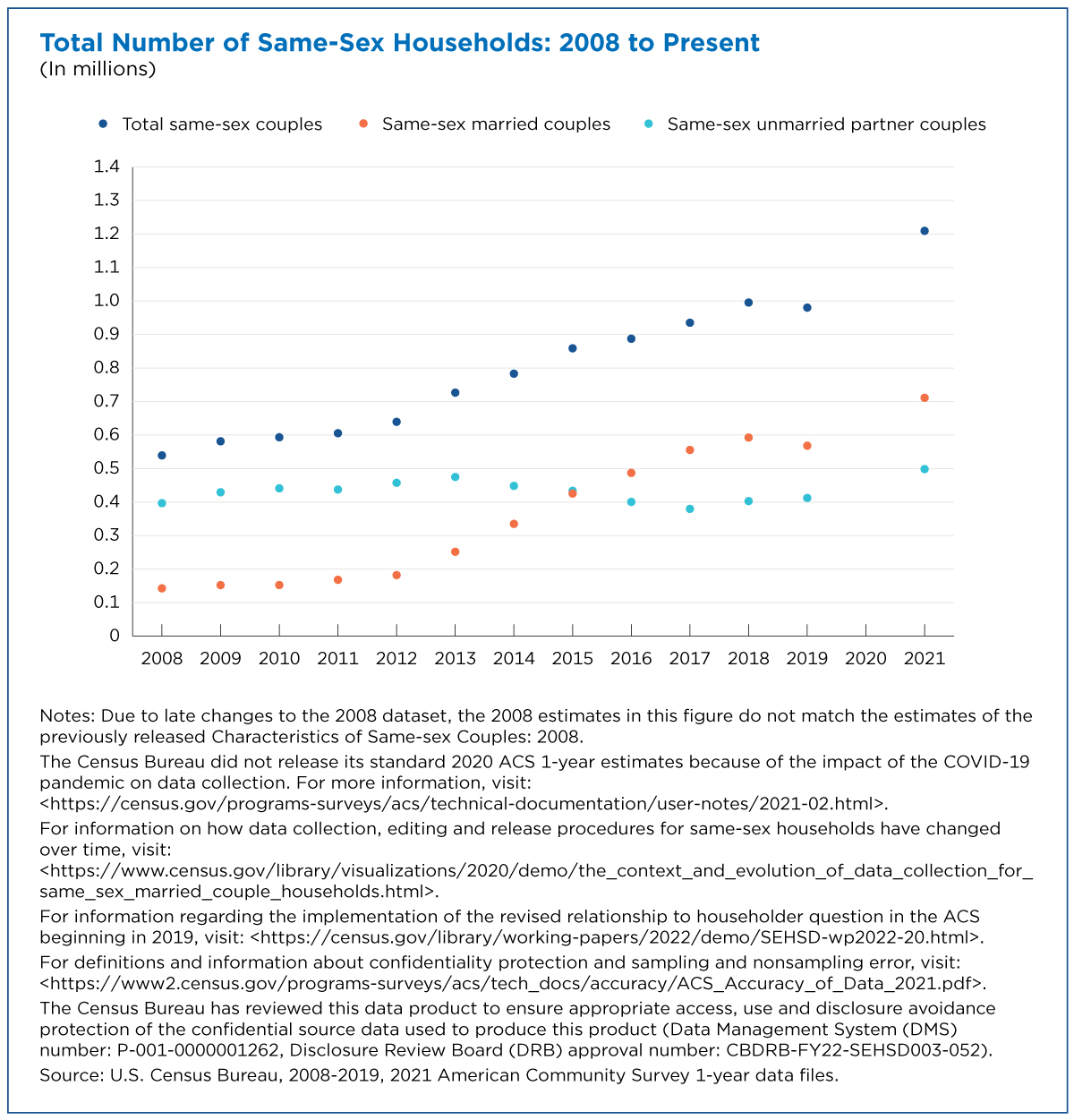
There were about 1.2 million same-sex couple households in the United States in 2021, according to recently released Census Bureau data. {если прорейтинговать РФ — получится  порядка 1/2 млн, поскольку пара это таки двое, получаем около 1 млн, то-есть, меньше 1%}

Roughly 710,000 of the same-sex couple households were married and about 500,000 were unmarried.

These and many other estimates can be found in the Census Bureau’s recently released package of tables and graphics about the characteristics of same-sex couple households, which are based on American Community Survey (ACS) data.

The package, which shows estimates from 2005 through 2021, was not released in 2020 due to the impact of COVID-19 on ACS data collection.

A larger share of same-sex (31.6%) than opposite-sex (18.4%) married couples were interracial.

Other highlights from the release:The average age of householders in same-sex married couples (48.9 years) was lower than in opposite-sex married couples (52.8 years). But the average age of householders in same-sex unmarried couples (42.0 years) was higher than in opposite-sex unmarried couples (39.9 years).

The share of female-female and male-male couples with both partners employed did not differ significantly, though median household income in female same-sex couple households ($92,470) was lower than in male same-sex couple households ($116,800).
Both partners had at least a bachelor’s degree in a larger share of same-sex (29.6%) than opposite-sex (18.1%) unmarried couples.

A larger share of same-sex (31.6%) than opposite-sex (18.4%) married couples were interracial.
The District of Columbia (2.5%) had the highest percentage of same-sex couple households of any state or state equivalent.

This is the second time the Census Bureau has released ACS estimates of same-sex couple households since revising the survey’s relationship to householder question to more accurately capture same-sex relationships.

The ACS does not identify all couples living together since it only collects information about each household member’s relationship to the householder, rather than about the relationships among all household members.

Further information regarding ways the Census Bureau has changed how it collects information about same-sex couples over time is available.

Zachary Scherer is a statistician in the Census Bureau’s Social, Economic, and Housing Statistics Division.

Friday, November 4, 2022

The educational hypogamy puzzle in India

October 31, 2022 Koyel Sarkar

Status exchange is a leading factor behind the rising share of educational hypogamy marriages in India (women marrying less educated men), says Koyel Sarkar. Lower caste women aspire to upward mobility by caste, while higher caste women look for husbands with good employment status. Men with these desirable characteristics may “qualify for the job”, even if their educational level is low.


Background


As the gender educational gap shrinks, homogamy, i.e. a woman marrying an equally educated husband, eventually takes over hypergamy (a woman marrying a higher educated husband) (Kalmijn and Flap 2001). Hypogamy (marrying a less educated husband), on the other hand, is a distinguishing feature of western societies, where the gender gaps have reversed and women have become more educated than men (Van Bavel 2012).

In India, female education has increased at a faster rate than men’s over recent decades: according to DHS estimates (2019–21), “no education” among women decreased from more than 54% in 1971 to less than 12% in 2003, and in the same period “secondary education” increased from 26% to 76%. However, women are still less educated than men: literacy rates, for instance, were 71.5% for females and 84.3% for males in the 2019–21 DHS Indian survey.

It is therefore surprising to observe that hypogamy has increased from 5% to 35% over four decades of marriage cohorts (Figure 1). How can this be explained?

Theoretical background


Relatively little is known about couple formation in India, and the question arises as to whether the “status-exchange” theory applies. According to this theory, individuals lacking a characteristic that they consider desirable tend to marry partners with precisely that characteristic – and as this quest for “improvement through marriage” applies to both genders, status exchange takes place, each partner bringing to the couple something that the other partner lacks and deems valuable (Davis 1941). In India, increasing educational hypogamy, particularly among the lower caste groups, and an overall rise in caste exogamy (Ahuja 2016; Sarkar and Rizzi 2020; Sarkar 2022) suggest that status exchange mechanisms could be the potential driver.

Caste, education and occupation


Caste is a unique, very ancient feature of the Indian society. Although formally abolished in 1947, in practice it continues to operate, especially in rural settings and for certain social practices, such as marriage. The system is very complex, with thousands of castes and sub-castes, characterized by endogamy and social hierarchy (Ahuja 2016).

For our purposes, let us just focus on four large groups:

1) general castes, i.e. all those not listed below. These are relatively affluent and at the top of this reduced hierarchy
2) the less privileged caste groups, which can be broken down into three categories, in decreasing hierarchical order:
2.a) other backward classes (OBC),
2.b) scheduled castes (SC), and
2.c) scheduled tribes (ST).

Female education in India seems to play a peculiar role. It is not of great help to women in the labour market, where their participation is limited and irregular, even when they do have some education (Chatterjee 2018). Instead, in the marriage market, educated women are preferred because of their greater abilities in caring for children and managing household health. Thus, trading higher educational status for upward caste mobility seems to be a profitable strategy, especially for women from lower castes. Women who belong to higher caste groups, on the other hand, have little incentive to marry a higher caste husband: in their case, a better-employed or a financially secure husband may be more attractive.

For men, given that the caste system is traditionally patrilineal, a highly educated wife is desirable, irrespective of her caste
Empirical data indeed show a positive correlation across marriage cohorts: greater proportions of women marrying low-educated husbands coincides with husbands belonging to higher castes, (Figure 2, left panel) and holding more prestigious (and better paid) jobs (Figure 2, right panel).

The general preference for all education-caste-occupation subgroups is to marry within the same caste. However, the odds of marrying a higher-caste husband are highest for educational hypogamy (Figure 3; ORs: 1.3**, secondary axis). Additionally, when all husband-wife caste pairs are considered for each caste-wise assorted group, the highest odds are for caste hypergamous pairs: among the ST (ORs: 2.5**), SC (ORs: 2.0**), and OBC (ORs: 2.0***), women “marrying up” to general caste husbands. In addition, higher caste women who “marry down” both by education and caste are actually “marrying up” by occupation, when the pairs are further decomposed by partner’s occupation (Sarkar 2022).

Conclusions


Socio-economic status exchange by caste, education, and occupation seems to be at work in the Indian marriage market, and it may explain the increase in educational hypogamy. Education-caste exchange applies to lower caste women while education-occupation exchange applies to higher caste women. As such, the social and/or economic incentives are specific to the caste rank to which the women belong.

Status exchanges in Indian marriages are blurring the traditionally rigid caste boundaries, thanks to women’s higher educational achievements. Unfortunately, however, the factors behind these exchanges run counter to the expectation that education leads to empowerment. Despite often being better educated than their partners, Indian women seek economic advantages through their prospective husbands rather than engaging in the labor market themselves. This is a consequence of the conservative norms that discourage Indian women from working. Secondly, the desire for upward social mobility by caste shows that social inequalities are not necessarily diminishing, and that they still play an important part in the workings of the marriage market.
 

References

  • Ahuja, A. and Ostermann, S.L. (2016). Crossing caste boundaries in the modern Indian marriage market. Studies in Comparative International Development. 51(3): 365–387. Doi:10.1007/s12116-015-9178-2.
  • Chatterjee, E., Desai, S., and Vanneman, R. (2018). Indian paradox: Rising education, declining women’s employment. Demographic Research 38(31): 855–871.doi:10.4054/DemRes.2018.38.31.
  • Davis, K. (1941). Intermarriage in caste societies. American Anthropologist 43(3): 376–395. Doi:10.1525/aa.1941.43.3.02a00030.
  • Kalmijn, M. and Flap, H. (2001). Assortative meeting and mating: Unintended consequences of organized settings for partner choices. Social Forces 79(4): 1289–1312. Doi:10.1353/sof.2001.0044.
  • Sarkar, K. and Rizzi, E.L. (2020). Love marriage in India. Démographie et sociétés. Louvain la Neuve, Université Catholique de Louvain. (Document de travail 14).
  • Sarkar, K. (2022). Can status exchanges explain educational hypogamy in India?. Demographic Research, 46(28), 809-848. Doi:10.4054/DemRes.2022.46.28.Van Bavel, J. (2012). The reversal of gender inequality in education, union formation and fertility in Europe. Vienna Yearbook of Population Research 10: 127–154. doi:10.1553/populationyearbook2012s127.

Wednesday, November 2, 2022

separation

Tuesday, March 8, 2022

How close to your mother?

Lifetime dynamics and racial differences

March 7, 2022 HwaJung Choi, Robert Schoeni, Hongwei Xu, Adriana Reyes and Deena Thomas

Spatial proximity among family members may profoundly affect people’s lives. What are the salient features of family dynamics over geographic distance? Hwa Jung Choi, Robert Schoeni, Hongwei Xu, Adriana Reyes, and Deena Thomas provide the first national estimates of intergenerational proximity over the life course in the United States and discuss dynamic patterns and racial differences.

Proximity to mother over the lifespan in the United States


Distance between parents and adult children is likely to influence in-person visits, childcare from grandparents, labor market outcomes, migration decisions, and care for aging parents (Compton & Pollak, 2014; Hank, 2007; Heylen et al., 2012; Longino et al., 2008; Mulder & van der Meer, 2009). The majority of older adults in the US have at least one adult child living “nearby,” less than 30 miles away (Choi et al., 2015). Some subgroups of the population live closer to each other than other groups. For example, Black children are much more likely to live close to their parents than White children are (Reyes et al., 2020).

In a recent paper, we examine data spanning nearly half a century for people born 1951–1968 and provide valuable insights into the life course patterns of spatial availability of mothers (Choi et al., 2021). Figure 1 illustrates the life-course patterns indicating that nearly 90% of the sample persons at age 35 and about three-quarters at age 45 had a living mother. The share of children living with or very close (within 5 miles) to their mother declines rapidly in the late teens and early twenties, as children leave their parental home seeking independence, education, and jobs. However, more than half still lived within five miles of their mother at age 25 and about 30% at age 40.
Adults born 1951-1968 spent a large share of their lives very close to their mother, with 44% of life-years during ages 18-54 (16 years out of 36 adult years) living within five miles, including co-residence.

Who moved: child, mother, or both?


The life-course proximity of a child to the mother is determined by residential relocation of the child, mother, or both. Not surprisingly, until age 50, changes in the distance were led by children’s moves, rather than mothers’ move, or both. For example, at age 25, about 12% of the sample with a living mother in a given year were farther from their mother because they themselves moved and their mother did not, while a much lower share (less than 2% at the child’s age of 25) were farther from their mother because only their mother moved, or both they and their mother moved (left in Figure 2). At a lower scale, similar patterns are observed for closer proximity (right in Figure 2).

Racial differences in residential proximity to mother over the life course


There is a stark difference in the distance to mother by race. Black children are much more likely than White children to live close to their mother if she is alive. For example, between ages 18-54 (i.e., 36 adult years), Black children spent 20.2 years, on average, living in the same house as their mother or living within 5 miles while White children spent 14.8 years (Choi et al., 2021).

As summarized in Figure 3, the median distance to mother is much lower for Black than for White children throughout the adult years. At age 45, for example, the median distance to mother is about 15 miles for White individuals but less than 3 miles for Black individuals. The gap between Black and White children increases up to about the child’s age of 40, when the median distance from the mother is relatively stable before decreasing at older ages for White children.

Our results in context


In interpreting these results, however, readers should keep in mind that mothers of Black children are much less likely to be alive, especially when children are middle-aged. Black children spend many more years without a living mother: 6.3 years vs. 2.6 years (White) between the ages 18-54 (Choi et al., 2021).

Among those whose mother is alive, poorer socioeconomic status for Black vs. White individuals (reducing career prospects and therefore also geographical mobility) plays a substantial role in explaining proximity – at least half, and in some cases, all of the difference between the two groups (Choi et al., 2021). Besides, while it was not tested explicitly in this study, institutional racism and systemic racial segregation are likely to have influenced parent-child proximity across the life course via socioeconomic pathways.

In summary, very close residential proximity (less than 5 miles) between an adult child and mother beyond co-residence is common across the life course even in the geographically large United States. However, socioeconomic status and race play an important part, both in terms of distance and in terms of survival.

References

  • Choi, H., Schoeni, R. F., Langa, K. M., & Heisler, M. M. (2015). Spouse and child availability for newly disabled older adults: Socioeconomic differences and potential role of residential proximity. The Journals of Gerontology Series B: Psychological Sciences and Social Sciences, 70(3), 462–469.
  • Choi, H., Schoeni, R., Xu, H., Reyes, A., & Thomas, D. (2021). Proximity to mother over the life course in the United States: Overall patterns and racial differences. Demographic Research, 45(23), 769–806. https://doi.org/10.4054/DemRes.2021.45.23
  • Compton, J., & Pollak, R. A. (2014). Family proximity, childcare, and women’s labor force attachment. Journal of Urban Economics, 79, 72–90.
  • Hank, K. (2007). Proximity and contacts between older parents and their children: A European comparison. Journal of Marriage and Family, 69(1), 157–173. https://doi.org/10.1111/j.1741-3737.2006.00351.x
  • Heylen, L., Mortelmans, D., Hermans, M., & Boudiny, K. (2012). The intermediate effect of geographic proximity on intergenerational support: A comparison of France and Bulgaria. Demographic Research, 27, 455–486. https://doi.org/10.4054/DemRes.2012.27.17
  • Longino, C. F., Bradley, D. E., Stoller, E. P., & Haas, W. H. (2008). Predictors of non-local moves among older adults: A prospective study. The Journals of Gerontology: Series B, 63(1), S7–S14. https://doi.org/10.1093/geronb/63.1.S7
  • Mulder, C. H., & van der Meer, M. J. (2009). Geographical distances and support from family members. Population, Space and Place, 15(4), 381–399. https://doi.org/10.1002/psp.557
  • Reyes, A., Schoeni, R. F., & Choi, H. (2020). Race/ethnic differences in spatial distance between adult children and their mothers. Journal of Marriage and Family, 82(2), 810–821. https://doi.org/10.1111/jomf.12614

Monday, December 20, 2021

What Tears Couples Apart

A Machine Learning Analysis of Union Dissolution in Germany


This study contributes to the literature on union dissolution by adopting a machine learning (ML) approach, specifcally Random Survival Forests (RSF). We used RSF to analyze data on 2,038 married or cohabiting couples who participated in the German Socio-Economic Panel Survey, and found that RSF had considerably better predictive accuracy than conventional regression models. The man’s and the woman’s life satisfaction and the woman’s percentage of housework were the most important predictors of union dissolution; several other variables (e.g., woman’s working hours, being married) also showed substantial predictive power. RSF was able to detect com- plex patterns of association, and some predictors examined in previous studies showed marginal or null predictive power. Finally, while we found that some personality traits were strongly predictive of union dissolution, no interactions between those traits were evident, possibly reflecting assortative mating by personality traits. From a methodo- logical point of view, the study demonstrates the potential benefts of ML techniques for the analysis of union dissolution and for demographic research in general. Key features of ML include the ability to handle a large number of predictors, the automatic detec- tion of nonlinearities and nonadditivities between predictors and the outcome, generally superior predictive accuracy, and robustness against multicollinearity.

Tuesday, November 23, 2021

Mothers’ dilemma at retirement across welfare regimes

November 22, 2021 Ester Rizzi and Kim Younga

Ester Rizzi and Younga Kim examine retirement intentions of 50-64 year-old mothers in Europe by family and employment trajectories. They find that experiencing work interruptions, having a higher number of children, being a single or widowed mother, and, to some extent, working part-time negatively affect retirement intentions. Results vary depending on welfare regimes and pension system rules.

Background


In the last several decades, women have gained emancipation in the labour market while retaining primary responsibility for the family. For mothers, this double burden often affects their working life, characterized by discontinuities, lower wages, and slower career advancement. These features are usually identified as the “opportunity costs of motherhood” and may produce lasting economic disadvantages for mothers, which oblige them to delay their retirement for economic reasons (Damman et al, 2015; Kim and Rizzi, 2020). Inactivity and career interruptions can especially penalize divorced or never-married single mothers, who lack a partner’s economic support.

Pension systems can partially compensate for the disadvantage experienced by mothers. Relatively high residence-based basic pensions are a characteristic of social democracies and of The Netherlands. The basic pension amounts to 25 percent of average earnings in the Netherlands and 20 percent in Sweden (OECD, 2015). Several countries also have family retirement benefits called “childcare credits” aiming to attenuate the impact of childrearing on future pensions (Lis & Bonthuis, 2020). Family policies also indirectly affect retirement intentions by shaping working careers and family choices, with social democratic countries offering the best support for mothers’ employment.

The retirement of working mothers


In a recent paper, we investigated how family and employment trajectories (and welfare state characteristics) affect mothers’ retirement intentions (Kim and Rizzi 2020). Using data from the first three waves of SHARE (Survey of Health, Ageing and Retirement in Europe), 2004-2009, we studied a sample of working mothers aged 50-64 years. Our dependent variable is the intention to retire as soon as possible, as declared when answering the following question: “Thinking about your present job, would you like to retire as early as you can from this job?”. A negative answer indicates a wish to continue working and could depend on:

a) the satisfaction (sense of fulfillment, intellectual stimulus, etc.) derived from work or
b) economic need, which may well include the need to compensate for the direct and opportunity costs of motherhood.

Since we want to explain the effect of opportunity costs on the intention to continue working, we need to control for mothers’ attachment to work through the variable “work continuity when the youngest child was less than six years old”.

Our main explanatory variables are years of employment, share of part-time versus full-time work, number of children, and marital status. We also control for a few standard variables (age, education, occupational status, household income, survey year), and for some additional variables that can be considered as directly related to retirement intentions: pension and early pension entitlements, health, having grandchildren, and presence of adult children in the household.

We studied mothers’ preferences for early retirement in 13 European countries classified by welfare regime following Esping-Andersen’s typology:
  • Social democratic (Denmark, Sweden),
  • Conservative (Austria, Belgium, Switzerland, Germany, France),
  • Mediterranean (Spain, Greece, Italy),
  • Post-Communist (Czech Republic, Poland), and
  • The Netherlands

While the Netherlands is usually included in the group of conservative countries, we considered it separately because of the universality of its pension system.

A few remarks are in order, since selectivity might be at play in our sample of working mothers. In several countries, a large share of women exit the labour market at relatively young ages, and are therefore not included in this analysis (Figure 1). Those who remain in the labour market are likely to be a selected sub-group, with over-representation of two typologies:

a) mothers working mostly full-time, with a strong attachment to work and/or with a career less affected by family responsibilities. However, controlling for “work continuity when the youngest child was less than six years old” and for the working hours should partially address this selection problem. Besides, to some extent, our statistical model (the random-intercept model) also controls for unobserved mothers’ characteristics.

b) mothers who need to work until later ages. However, as these are the mothers we are specifically interested in, their possible over-representation may even be beneficial, because it tends to reduce estimation errors.

Below we present the predicted probabilities of early retirement intentions for two groups of countries, the only ones with statistically significant coefficients. These probabilities are calculated holding all other variables constant at their mean values.
In Mediterranean countries, the predicted probability of early retirement intentions is as high as 82 percent for mothers who have worked mostly full-time and 30 percent for those who have worked mostly part-time during their work career (Figure 2). Working hours matter in conservative countries too: the predicted probability of early retirement intentions is 35 percent for mothers who have worked mostly full time and 26 percent for mothers who have worked mostly part-time. These results are in line with our expectations, although weakly statistically significant (90% confidence interval). Moreover, mothers’ working hours do not seem to affect early retirement intentions in other welfare regimes.
Marital status matters too, but, again, only in some groups of countries. In Mediterranean countries, the predicted probability of early retirement intentions is 85 percent for married/co-habiting mothers and only 5 percent for never married mothers, while in social democratic countries, the probability is 36 percent for married/cohabiting mothers and 17 percent for those who are widowed (Figure 3).

Finally, we found that in conservative countries the probability of preferring early retirement declines by 1 percent for each additional year spent out of the labour market, and by 6 percent for each additional child. Work interruptions and number of children do not seem to affect mothers’ early retirement intentions in social democratic countries, Mediterranean countries, post-communist countries, or the Netherlands.

Discussion


Retirement intentions of mothers aged 50-64 seem to depend, among other things, on their work and family history, although results vary across welfare regimes. This indicates that family policies and pension benefits matter a lot, and may counterbalance the negative impact of children’s opportunity costs on mothers’ earnings.

In the Mediterranean area, single mothers are the least likely to prefer early retirement, a result that does not emerge in other welfare regimes, probably due to differences in levels of welfare protection. In social democratic countries, on the other hand, it is widows who are less likely to opt for early retirement, probably because their survivor’s pension is small or non-existent.

In Mediterranean and conservative countries, although not elsewhere, part-time work seems to favour later retirement intentions. Mothers who worked mostly part-time might represent a fragile group, not able to work full-time but compelled to remain longer in the labour market for economic reasons.

The effects of the number of children and work interruptions are observed only in conservative countries. This may indicate that relatively high basic pensions, typical of social democratic countries and the Netherlands (where these effects do not emerge), may better compensate for the costs associated with children and interrupted careers than earnings-related benefits or minimum pensions. Note, however, that Sweden is now replacing its basic income pensions with targeted means-tested schemes (OECD, 2019).

The effects of the number of children and of work interruptions are not observed in Mediterranean or post-communist countries. Here, however, women frequently exit the labour market at an early age, a phenomenon known as the “exit or full-time work model” (Figure 1). Consequently, despite our efforts to correct for selectivity, the 50-64 year-old mothers who are still working might be a selected group whose retirement preferences are not, or less, affected by years worked or children.

Finally, it is important to note that the mothers in our study were all working at the time of the first wave. We therefore omitted the potentially most vulnerable group, that is, those who were already out of the labour market, although needing jobs (and money). Future studies on the long-term effects of motherhood should explicitly try to account for these women too.

References

  • Damman M., Henkens K. and Kalmijn. M (2015). Women’s retirement intentions and behavior: the role of childbearing and marital histories. European Journal of Population, 31, 339–363.
  • Kim Y. and Rizzi E. (2020). Who does not intend to retire? Mothers’ opportunity costs and compensation at later ages in Europe. Ageing & Society, 40(10), 2128-2154.
  • Lis M. and Bonthuis B. (2020). Drivers of the Gender Gap in Pensions: Evidence from EU-SILC and the OECD Pension Models. In Holzmann, Robert, Edward Palmer, Robert Palacios, and Stefano Sacchi. Progress and Challenges of Nonfinancial Defined Contribution Pension Schemes, Volume 2: Addressing Gender, Administration, and Communication. Washington, DC: World Bank. doi:10.1596/978-1-4648-1455-6. License: Creative Commons Attribution CC BY 3.0 IGO
  • Organisation for Economic Co-operation and Development (OECD) (2015) Pensions at a Glance 2015: OECD and G20 Indicators. Paris: OECD.

Wednesday, October 13, 2021

monarchy and same sex marriage

Премьер-министр Нидерландов: 

наследная принцесса сможет вступить в однополый брак и стать королевой


В настоящее время наследницей титула короля Виллема-Александра является его старшая дочь Амалия, которой скоро исполняется 18

Наследница трона Нидерландов сможет вступить в однополый брак и унаследовать при этом королевский титул, заявил премьер-министр страны Марк Рютте.

Однополые браки в Нидерландах законны с 2001 года, однако до недавнего времени не обсуждалось, применимы ли они к королевской семье.

Премьер-министр заявил, что члены королевской семьи смогут вступать в однополые браки так же, как и другие жители страны. Эта позиция изложена в письменном ответе премьера на вопрос от одного из депутатов парламента от его собственной партии.

Рютте оговорился, что на данный момент речь идет о сугубо теоретической ситуации.

"Кабинет министров не считает, что наследник престола или король должен отречься, если он или она вступит в брак с лицом своего пола", - написал премьер-министр.

В Нидерландах наследника престола назначает правительство. В конституции страны говорится, что наследником может быть "законный потомок" царствующего монарха.

В настоящее время наследницей престола является старшая дочь короля Виллема-Александра, принцесса Амалия, которой в декабре исполняется 18 лет.

Летом в стране большой резонанс вызвала книга, в которой ставился вопрос о том, сможет ли она унаследовать трон, если пожелает вступить в однополый брак.

При этом в книге ничего не говорилось о личной жизни принцессы Амалии. Никаких признаков грядущей свадьбы на данный момент нет.

Известно, что в будущем году принцесса собирается поступать в университет и отказалась от королевских доходов, которые ей положены на период учебы.

В любом случае парламент должен будет одобрить любой брак королевы или наследной принцессы, подчеркнул премьер-министр Рютте.

Если брак окажется однополым, пока не ясно, каков будет статус детей такой супружеской пары (приемных или от донора спермы), признал глава нидерландского правительства.

Wednesday, July 14, 2021

On the influence of marital status on fertility

О влиянии брачного статуса на рождаемость

М. С. Тольц

В работе (или тут) рассмотрено влияние добрачных зачатий и внебрачных рождений на рождаемость в России. В ней впервые проанализирована динамика внебрачных рождений с 1946 года до настоящего времени. Анализ региональных данных показал, что добрачные зачатия при близком уровне рождаемости могут иметь совершенно разное распространение, а их компоненты при этом быть совсем неодинаково представлены. Приведенный расчет обнаружил решающую роль увеличения рождаемости в браке в общем росте рождаемости в России с 2005 по 2015 годы. Российский опыт свидетельствует о том, что трансформация брака может идти без его деинституциализации, а главное – сопровождаться заметным ростом значения брака в сфере прокреации. 


В этих кратких заметках мне бы хотелось вернуться к рассмотрению добрачных зачатий и внебрачных рождений – к тематике, сквозной на всем протяжении моего пути как демографа, – а также оценить влияние пребывания в браке и вне его на динамику рождаемости в недавний период ее заметного роста в Российской Федерации. Надеюсь, что все это окажется полезным для лучшего понимания современного этапа демографического перехода в России. Другие аспекты влияния брачности на рождаемость, обусловленные распадением браков, мною рассматривались ранее[1]. Изучение этих проблем продолжается другими исследователями на постсоветском материале[2]. Тут мне нечего добавить.

1

Принятый менее чем за год до победы над Германией, 8 июля 1944 года, Указ Президиума Верховного Совета СССР ввел понятие «одинокая мать». Оно распространялось на всех женщин, родивших вне брака. Их дети регистрировались только по заявлению матери. Отец, при всем его желании, если он не состоял в браке с матерью ребенка, не мог быть записан в документах, удостоверяющих рождение сына или дочери. В метрике детей, рожденных вне брака, стал обязательно ставиться прочерк вместо сведений об отце. Инициатором этих узаконений был Н.С. Хрущев, который потом в годы своего правления препятствовал десталинизации в области брачно-семейных отношений в Советском Союзе[3].

В условиях огромной половой диспропорции в послевоенный период, доля внебрачных рождений среди всех рождений в Российской Федерации была высокой. Сразу после войны, в 1946 году, она составила 22,8%. Через пять лет после ее окончания, в 1950 году, доля этих рождений достигла 24,0% (см. Таблицу 1).

Таблица 1. Доля внебрачных рождений среди всех рождений в Российской Федерации, %

Годы

Все внебрачные рождения

из них зарегистрированные:

По заявлению матери

По совместному заявлению родителей*

1946

22,8

22,8

-

1950

24,0

24,0

-

1955

16,9

16,9

-

1960

13,1

13,1

-

1965

13,0

13,0

-

1970

10,6

6,3

4,3

1975

10,7

5,7

5,0

1980

10,8

6,7

4,1

1985

12,0

…

…

1990

14,6

8,4

6,2

1995

21,1

12,0

9,1

2000

28,0

14,8

13,2

2005

30,0

16,2

13,8

2010

24,9

13,7

11,2

2015

21,6**

10,4

11,2

2018

21,2**

10,5

10,7

* До 1968 года не было предусмотрено законодательством.
** Кроме того, в 2015 году 0,1% детей были зарегистрированы в органах ЗАГС по заявлению юридического лица (отказные, найденные, подкинутые дети), в 2018 году доля таких детей составила 0,6%.

Источники: Демографический ежегодник России. 2019. M.: Росстат, 2019. С. 68; Иванова Е., Михеева А. Внебрачное материнство в России // Население и общество. 1998. № 28. С. 2; архивные данные за 1946 и 1950 годы любезно предоставлены Д.Д. Богоявленским, за что автор благодарен ему.

В последующие годы, по мере смягчения половой диспропорции, доля внебрачных рождений постепенно падала. К 1970 году она снизилась до 10,6%. Но как раз до того по новому семейному законодательству, принятому в 1968-1969 годах, был отменен пресловутый прочерк в метрике. Теперь рождение ребенка вне брака могло быть зарегистрировано или по совместному заявлению его родителей, или только по заявлению матери. В последнем случае данные об отце заполнялись с ее слов, при этом для отца указывалась фамилия матери. В 1970 году только 6,3% российских новорожденных были записаны по заявлению матери, а 4,3% – по совместному заявлению родителей, не состоявших между собою в браке.

Новый существенный подъем внебрачной рождаемости начался в 1990-е годы. Доля внебрачных рождений среди всех рождений достигла максимума в 2005 году, когда она составила 30,0%, из них 16,2% были зарегистрированы по заявлению матери и 13,8% по совместному заявлению родителей, не состоявших между собою в браке. В последующие годы доля внебрачных рождений заметно снизилась и к 2018 году упала до 21,2%, из которых 10,5% были зарегистрированы по заявлению матери и 10,7% по совместному заявлению родителей.

Доля внебрачных рождений в России, в отличие от многих стран Запада, не только упала после 2005 года, но она в настоящее время ниже, чем была в Российской Федерации в первые послевоенные годы. Однако до 1968 года все внебрачные рождения регистрировались по заявлению матери. Сегодня половина внебрачных рождений регистрируется обоими родителями, и дети в них имеют отца, несущего по закону полную ответственность за них. Данные текущей статистики показывают, что в 2018 году доля детей, зарегистрированных по заявлению матери (10,5%), была заметно ниже, чем в 1965 году (13,0%), когда все внебрачные рождения записывались таким образом.

Долгое время для всей России отсутствовали сведения о распространении внебрачных зачатий, которые ведут к рождениям. Впервые полная информация о них была получена только в результате специальной разработки всех актов о рождениях за 2002 год[4]. Оказалось, что в этом году более половины детей (54%) в Российской Федерации были рождены в результате внебрачного зачатия. Однако только 29% всех детей появились вне зарегистрированного брака, а 25% были рождены в первые 9 месяцев брака. Более того, 14% всех новорожденных были зарегистрированы по совместному заявлению родителей, не состоявших в браке, т.е. имели «законного» отца. Выходит – для подавляющей части (39% из 54%) – отец изначально юридически присутствовал в их жизни.

Новая специальная разработка актов обо всех рождениях в России была выполнена за 2012 год[5]. Согласно ее данным, через десятилетие уже заметно меньшая часть детей (44%) была рождена в результате внебрачного зачатия, но при этом лишь немногим меньшая доля (23%) всех рождений появилась в первые 9 месяцев брака. Основная величина отмеченного снижения с 2002 по 2012 годы (8% из 10%) пришлась на внебрачные рождения.

2

Распространение добрачных зачатий, реализовавшихся в рождениях, в отдельных регионах Российской Федерации очень неодинаково. Это впервые показала разработка актов о рождениях за 2002 год, выполненная для всех из них. Крайние значения характерны для национальных республик. Такие рождения в целом были наиболее часты в Тыве, где внебрачные зачатия составляли 72% всех рождений. Напротив, в Ингушетии лишь 1% рождений регистрировался одной матерью без отца (см. Таблицу 2).

Однако и среди регионов с преобладающим русским населением наблюдался весьма значительный разброс показателей. Два столичных города – Москва и Санкт-Петербург – не лидировали ни по одному из них. Очень высокая доля внебрачных рождений была в Пермском крае – 46%. Тут просматривается определенная историческая преемственность, поскольку Пермская губерния (правда в более широких границах) в конце XIX века занимала лидирующее место по распространению внебрачных рождений в Европейской России[6]. Напротив, в Костромской области 80% детей были рождены в браке, но там из всех новорожденных 32% были зачаты до брака, оформленного позднее родителями. Это наиболее высокая доля таких рождений, которая была во всей Российской Федерации в 2002 году.

При этом оба региона имеют весьма близкие уровни рождаемости: в 2002 году коэффициент суммарной рождаемости составлял 1,44 в Пермском крае и 1,34 в Костромской области[7]. Приведенные данные хорошо показывают, что добрачные зачатия при близком уровне рождаемости могут иметь совершенно разное распространение, а их компоненты при этом быть совсем неодинаково представлены.

Таблица 2. Распределение всех детей, рожденных в 2002 году, по официальному (юридическому) брачному статусу матери, %

Регион*

Все рождения

Рождения в браке

в т.ч. добрачные зачатия**

Рождения вне брака

в т.ч. зарегистрированные:

Всего внебрачных зачатий среди всех рождений

По заявлению матери

По совместному заявлению родителей


(1)

(2)

(3)

(4)

(5)

(6)

(7)=(3)+(4)

Тыва 

100

38

10

62

39

23

72

Пермский край

100

54

19

46

20

26

65

Северная Осетия

100

64

20

36

32

4

56

г. Санкт-Петербург 

100

71

27

29

13

16

56

Костромская область

100

80

32

20

13

7

52

г. Москва 

100

73

23

27

9

18

50

Ингушетия

100

84

25

16

1

15

41

Кабардино-Балкария

100

85

20

15

10

5

35

Всего по Российской Федерации

100

71

25

29

15

14

54

* Регионы приведены в порядке снижения общей доли внебрачных зачатий среди всех рождений; жирным шрифтом выделены крайние значения для каждого показателя.
** Рождения в первые 9 месяцев после заключения брака.

Источник: Tolts M., Antonova O., Andreev E. Extra-Marital Conceptions in Contemporary Russia’s Fertility // Research Note Prepared for the European Population Conference. Liverpool, UK, 21-24 June 2006. Table 5.

К сожалению, изучению территориальной дифференциации распространения добрачных зачатий в России пока не уделяется должного внимания. Даже собираемые ежегодно по регионам данные Росстата о внебрачной рождаемости не стали пока объектом пристального систематического анализа. Отметим исключения, которые, однако, явно недостаточны. Известны результаты специальной разработки данных о добрачных зачатиях, которые выполнены для семи регионов на основе рождений за 2010 год[8]. Однако региональные данные новой специальной разработки актов обо всех рождениях в России за 2012 год, к сожалению, были весьма скупо представлены при их публикации[9]. Это и заставило меня при рассмотрении региональной дифференциации в основном опираться на данные за 2002 год. Впрочем, многие из них ранее были представлены только в заметке на английском языке, подготовленной для конференции европейских демографов, и оставались неизвестны широкому кругу читателей в России, которым они могут, прежде всего, быть интересны.

3

2005 год стал особенным для российской рождаемости по двум важнейшим признакам. После него начался непрерывный рост ее уровня, который продолжался до 2015 года. За десять лет коэффициент суммарной рождаемости увеличился с 1,29 до 1,78. И именно в 2005 году, как уже было отмечено, доля внебрачного компонента в рождаемости достигла максимума, а затем стала снижаться. 

Таблица 3. Динамика коэффициента суммарной рождаемости в Российской Федерации, разложенного по категориям родившихся, 2005-2015 годы

Категория родившихся

2005 год

2015 год

Прирост

1. Все родившиеся (2)+(3)

1,29

1,78

0,49

из них:

2. У матерей, состоявших в зарегистрированном браке

0,91

1,37

0,46

3. У матерей, не состоявших в зарегистрированном браке (4)+(5) 

0,38

0,41

0,03

   в том числе зарегистрированные:

4. По заявлению матери

0,20

0,20

0,00

5. По совместному заявлению родителей

0,18

0,21

0,03

Рассчитано с использованием оценок величин однолетних групп возраста для среднего женского населения за соответствующие годы, любезно предоставленных Е.М. Андреевым, за возможность работы с которыми автор признателен ему.

Коэффициент суммарной рождаемости широко используется в демографии для характеристики динамики рождаемости за календарные годы. Это стандартизованный показатель, что делает его пригодным для разнообразных сопоставлений. Рассматривая влияние брачности на рождаемость, естественно разложить этот показатель на соответствующие категории родившихся[10]. Результаты разложения коэффициента суммарной рождаемости показывают, что подавляющая часть его прироста за десять лет была вызвана увеличением уровня брачной рождаемости – 0,46 из 0,49 (см. Таблицу 3).

Вклад брачного компонента в коэффициент суммарной рождаемости за этот период возрос с 70,5% в 2005 году до 77,0% в 2015 году. При этом величина компонента, обусловленного внебрачными рождениями, зарегистрированными по заявлению матери, осталась без изменений – 0,20, а компонент, отражающий динамику рождений, зарегистрированных по совместному заявлению родителей, увеличился лишь с 0,18 до 0,21. Таким образом, приведенный расчет хорошо показывает решающую роль увеличения рождаемости в браке в общем росте рождаемости в России с 2005 по 2015 годы.

4

Долгое время в объяснении постсоветской динамики внебрачной рождаемости преобладало рассмотрение этого явления в рамках концепции «второго демографического перехода». Я и сам не избежал этого, когда при представлении результатов специальной разработки актов о рождениях за 2002 год эта концепция была упомянута[11]. Но случилось это в 2005 году, который, как оказалась, явился переломным, чего, кажется, никто предвидеть не мог. Сегодня, когда название самой концепции «второго демографического перехода» уже даже в авторитетной учебной литературе пишется в кавычках[12], накопленные данные требуют другой интерпретации.

Как уже отмечалось, Москва и Санкт-Петербург не лидируют по распространению внебрачных зачатий и рождений вне брака. Именно обращая внимание на последний факт, известный российский критик концепции «второго демографического перехода» метко подметил, что он противоречит постулированному данной теорией сдвигу потребностей в сторону «масловианского постматериализма», который, «казалось бы, должен быть наиболее сильным», именно в этих двух столичных городах[13].

Собранные в целом по России данные показывают, что внебрачные рождения, особенно у одиноких матерей, скорее, связаны с неблагополучием, они чаще распространены у женщин с низким уровнем образования[14]. Более того, анализ данных по субъектам Российской Федерации за 2008 год выявил тесную отрицательную корреляцию доли внебрачных рождений и величины ожидаемой продолжительности жизни (r = -0,763), а также положительную корреляцию этой доли с коэффициентом смертности мужчин трудоспособного возраста от внешних причин (r = 0,738)[15].

После 2005 года среди населения России продолжался рост значения базовых ценностей, относящихся к открытости изменениям[16]. Поэтому трудно согласиться с тем, что «мы имеем дело с признаками торможения или даже консервативного отката (выделено мною – М.Т.) в процессе деинституциализации брака в России»[17]. Ведь падение распространенности юридического брака и рост рождений вне его вряд ли тождественны прогрессу. Другое дело, что изменяется содержание брака[18]. Российский опыт показывает, что этот процесс может идти без деинституциализации брака, а главное – сопровождаться заметным ростом его значения в сфере прокреации.

[1] Тольц М.С. Разводы и современный уровень рождаемости // Проблемы воспроизводства и занятости населения / Под ред. В.А. Борисова. М.: Институт социологических исследований АН СССР, 1984. C. 18-30; Тольц М.С. Взаимосвязи брачного и репродуктивного поведения // Детность семьи: вчера, сегодня, завтра / Под ред. А.И. Антонова. М.: Мысль, 1986. С. 39-53.
[2] См., например: Захаров С.В., Чурилова Е.В., Агаджанян В.С. Рождаемость в повторных союзах в России: позволяет ли вступление в новый супружеский союз достичь идеала двухдетной семьи? // Демографическое обозрение. 2016. Т. 3. № 1. С. 35-51. URL: https://doi.org/10.17323/demreview.v3i1.1762.
[3] Тольц М. От абортного термидора к законодательному либерализму. Политика в области брачно-семейных отношений как зеркало истории СССР // Развитие населения и демографическая политика. Памяти А.Я. Кваши: Сборник статей / Под ред. М.Б. Денисенко, В.В. Елизарова. М.: МАКС Пресс, 2014. С. 157-169; Чернова Ж.В. Семья как политический вопрос: государственный проект и практики приватности. СПб.: Издательство Европейского университета в Санкт_Петербурге, 2013. С. 116-121, 125.
[4] Тольц М.С., Антонова О.И., Андреев Е.М. Рождаемость и трансформация института семьи в современной России // Вопросы статистики, 2005, № 7. С. 51-60.
[5] Чурилова Е.В., Чумарина В.Ж. Внебрачные рождения и добрачные зачатия в России: осознанное решение родителей? // Вопросы статистики. 2014. № 7. С. 43-49.
[6] См.: Coale A.J., Anderson B.A. and Harm E. Human Fertility in Russia Since the Nineteenth Century. Princeton, N.J.: Princeton University Press, 1979. P. 252-253.
[7] Демографический ежегодник России. 2005. M.: Росстат, 2005. Табл. 2.5.
[8] Бирюкова С.С., Тындик А.О. Регистрация брака и рождение ребенка в биографии россиян: анализ данных текущей статистики // Демографическое обозрение. 2015. Т. 1. № 3. C. 33-64. URL: https://doi.org/10.17323/demreview.v1i3.1809.
[9] Чурилова Е.В., Чумарина В.Ж. Внебрачные рождения и добрачные зачатия в России. С. 47-48.
[10] Мною использована методика, описанная в: Бондарская Г.А., Дарский Л.Е. Брачное состояние женщин и рождаемость // Демографические процессы в СССР / Отв. ред. А.Г. Волков. М.: Наука, 1990. С. 54-55.
[11] Тольц М.С., Антонова О.И., Андреев Е.М. Рождаемость и трансформация института семьи в современной России. С. 51.
[12] Вишневский, А.Г. Демографическая история и демографическая теория: курс лекций М.: Изд. дом Высшей школы экономики, 2019. С. 202.
[13] Клупт М.А. Демографическая повестка XXI века: теории и реалии // Социологические исследования. 2010. № 8. С. 64.
[14] Чурилова Е.В., Чумарина В.Ж. Внебрачные рождения и добрачные зачатия в России. С. 47.
[15] Клупт М.А. Демографическая повестка XXI века. С. 64.
[16] Магун В.С., Руднев М.Г. Динамика базовых ценностей российского населения: 2006–2018 // Будущее социологического знания и вызовы социальных трансформаций (к 90-летию со дня рождения В.А. Ядова). Международная научная конференция (Москва, 28–30 ноября 2019 г.). Сборник материалов / Отв. ред. М.К. Горшков. М.: ФНИСЦ РАН, 2019. С. 651-653; Магун В., Руднев М. За пределами «человека советского» – россияне в европейской ценностной типологии // Сайт экспертной группы «Европейский диалог». 2020. URL: http://www.eedialog.org/ru/2020/07/17/za-predelami-cheloveka-sovetskogo-rossijane-v-evropejskoj-cennostnoj-tipologii
[17] Захаров С.В. Брачная структура населения, заключение и прекращение браков в России в свете результатов микропереписи населения 2015 г. // Население России 2016: двадцать четвертый ежегодный демографический доклад / Отв. ред. С. В. Захаров. М.: Изд. дом Высшей школы экономики, 2018. С. 120.
[18] См., например: Кон И.С. Клубничка на березке: Сексуальная культура в России. 3-е изд. М.: Время, 2000; Гурко Т.А. Брак и родительство в России. М.: Институт социологии РАН, 2008.