In Australia, according to Ewa Jarosz, Anna Matysiak and Beata Osiewalska, mothers of one child are more likely to have a second birth if certain conditions are met, and notably when they are satisfied with how much leisure time they have. Lower-educated mothers, in particular, may delay or forego second births if they often feel exhausted by the demands of parenting.
Mothers of young children are an especially time-poor category (Milkie, Raley, and Bianchi 2009). They face multiple constraints to their leisure, and even when they have time to attend to their own needs, interruptions for domestic tasks and childcare are frequent (Chatzitheochari and Arber 2012). Maternal leisure, or lack of it, is a common focus of research in the field of time-use studies. In demographic literature, however, it has not received much attention. While the work-family conflict and its role in fertility decisions is widely recognized, the “family” part of this story resembles a black box containing everything and anything that is not paid work, and deserves further investigation.
The tired mother
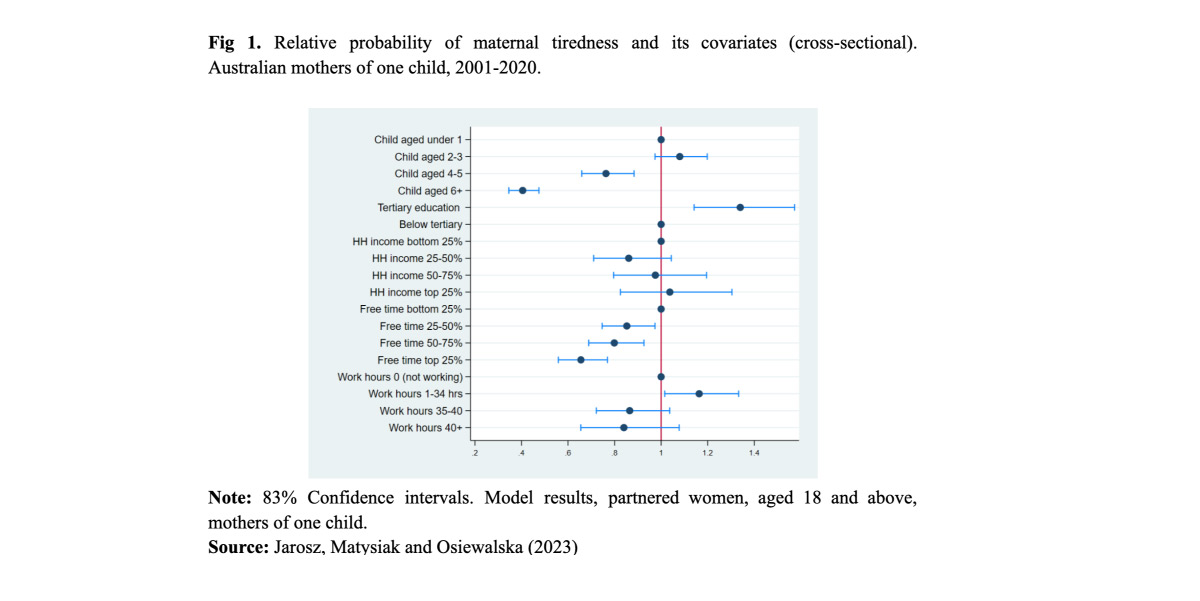
Shortage of time and tiredness among mothers are often seen as an unavoidable side-effect of having a young child at home. And indeed, mothers of young children are most likely to report often feeling tired, especially those with little free time and those who work part-time (but not full-time), compared to mothers not in paid employment. Overall, it seems that within the work-family axis, the “family” element or the private lives of mothers is just as exhausting as paid work, for mothers of young children in particular.
How could leisure be linked with fertility?
There are two main reasons why maternal leisure could matter for fertility. The first is biological: the fundamental need for time off to rest and recover. Evolutionary studies show that mothers are more likely to have children in circumstances where the personal costs of childbearing are lower (Coall et al. 2016; Raybould and Sear 2021). Conversely, if a mother is under high physical stress – due to tiredness and lack of rest, for example – she is more likely to prioritize her health and delay or forego childbearing.
The second possible reason derives from the concept of the second demographic transition, or SDT (Lesthaeghe 2010). In this perspective, maternal free time is a resource that allows a woman to pursue her personal goals. Consequently, mothers who feel they have too little free time may be unwilling to take on additional commitments, such as having another child. In line with the SDT assumption, this motivation might be more relevant for tertiary-educated women.
Mothers’ free time and progression to the second birth
In a recent study, using the data from the 2001-2020 waves of the Household, Income and Labour Dynamics in Australia (HILDA) Survey, we investigated whether maternal free time is associated with (subsequent) progression to second birth (Jarosz, Matysiak and Osiewalska 2023).
Free time was measured as the total free time remaining after deducting all paid and unpaid working hours (such as housework and errands) from the total time available in a week. A subjective measure of mothers’ satisfaction with their amount of free time was also included, together with maternal tiredness (represented by an item worded as: “I often feel tired/ exhausted by the demands of parenting”) as a proxy for physical or mental exhaustion, corresponding to the “biological” role of free time as time for recovery and necessary self-care. With regard to the other possible pathway between leisure and fertility, we included the frequency of meeting with friends and the frequency of doing sports as proxies for activities dedicated to pursuing (other) personal objectives and hobbies.
The results of the study indicate that an Australian mother’s free time is indeed associated with her risk of progression to the second birth. An association was found between objectively measured free time (time remaining after deducting paid and unpaid work hours) and second birth probability. The probability was highest for mothers who had relatively more time free from paid and unpaid work but otherwise spent sufficient time playing with their child (which is suggestive of self-selection). Net of this result, for mothers who expressed higher levels of satisfaction with their amount of leisure time, the probability of second birth transition rose in parallel with an increase in satisfaction with their leisure time.
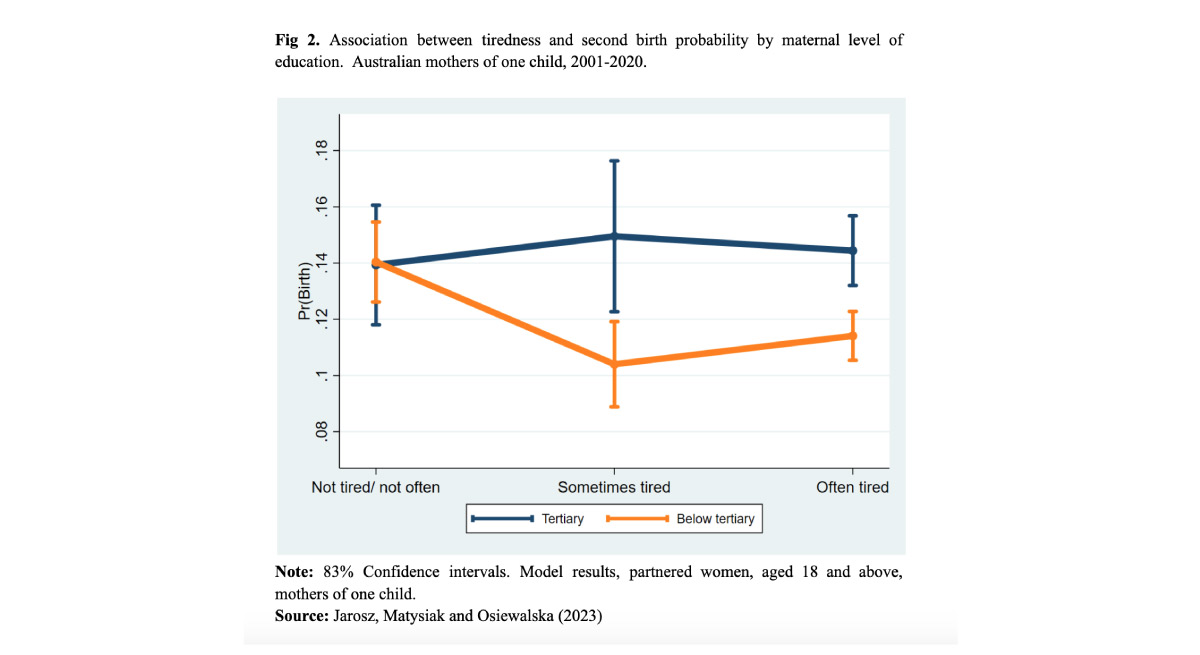
Probably the most interesting findings, however, concern educational differences. Interaction terms were used to explore which type of motivation (biological/evolutionary vs satisfying lifestyle needs) would be more important for tertiary- and lower-educated mothers, with the latter category representing over 60% of the sample. The study found that maternal tiredness was negatively associated with fertility but only for lower-educated women. Their exhaustion seems to be a significant barrier to progression to second birth. Conversely, tertiary-educated women were generally resilient in this regard (Figure 1).
Our analyses also showed that the association between participation in selected leisure activities and the probability of second birth was moderated by maternal education. Lower-educated mothers were more likely to proceed to a subsequent birth if they engaged in physical activity on a regular basis, while no such association emerges for tertiary-educated mothers. However, the latter were more likely to have another child if they socialized with their friends on a regular basis.

Conclusions
Our study on Australian data points to the importance of exploring the relationship between mothers’ lifestyle practices, their physical activity and childbearing. Maternal free time and leisure seem to be important factors underlying fertility choices, and they should be considered more attentively by demographers, taking social disparities into account. Physical factors seem to matter more for further childbearing among lower-educated individuals, at least in Australia, whereas among their highly-educated counterparts, social relations with their peers, more than physical activity, are associated with a higher probability of further childbearing.
References
- Chatzitheochari, S. and Arber, S. (2012). Class, gender and time poverty: a time-use analysis of British workers’ free time resources. The British Journal of Sociology 63(3):451–471. doi:10.1111/j.1468-4446.2012.01419.x.
- Coall, D.A., Tickner, M., McAllister, L., and Sheppard, P. (2016). Developmental influences on fertility decisions by women: an evolutionary perspective. Philosophical Transactions of the Royal Society B: Biological Sciences 371(1692):20150146. doi:10.1098/rstb.2015.0146.
- Jarosz, E., Matysiak A., Osiewalska B. (2023) Maternal Free Time: A Missing Element in Fertility Studies, Population and Development Review, online first. doi:10.1111/padr.12589
- Lesthaeghe, R. (2010). The Unfolding Story of the Second Demographic Transition. Population and Development Review 36(2):211–251. doi:10.1111/j.1728-4457.2010.00328.x.
- Milkie, M.A., Raley, S.B., and Bianchi, S.M. (2009). Taking on the Second Shift: Time Allocations and Time Pressures of U.S. Parents with Preschoolers. Social Forces 88(2):487–517. doi:10.1353/sof.0.0268.
- Raybould, A. and Sear, R. (2021). Children of the (gender) revolution: A theoretical and empirical synthesis of how gendered division of labour influences fertility. Population Studies 75(2):169–190. doi:10.1080/00324728.2020.1851748.

.jpg)