Showing posts with label ислам. Show all posts

Friday, April 14, 2023

Daughters of Persia

Representing Female Characters in Iranian Graphic Novels


Straddling the binary of us/them, literature produced within the Iranian diaspora is faced with representing the, often vilified, Muslim-“other” whilst engaging its audience to witness human rights violations in the Islamic Republic of Iran (IRI). Here, writers negotiate discourses of cultural relativity and condemnation. While a critique of the IRI provides a tangible form of reference for orientalist discourses within “the West”, attempts to ignore human rights violations here flirt with the apologetic discourse of cultural relativism. Undoubtedly, women and girls provide the most striking form of visual reference for “western” perceptions of Middle Eastern “otherness”. Here, notions of a particular form of gendered, Islamic oppression are centred around discourses of the oppressed hejabi v. the liberated, unveiled woman. Certainly, the Iranian graphic novel is, due to its emphasis on the visual, forced to contend with such discourses. Moreover, such texts are confronted with the white-feminist expectation of the veiled, Middle Eastern woman to be devoid of agency, while grappling with the emotional labour associated with persistence in both Iranian and European patriarchal society. This paper considers the renowned graphic novels of Marjane Satrapi alongside Parusa Bashi’s Nylon Road, Persia Blues by Dara Naraghi and Brent Bowman, and Amir and Khalil’s web-novel Zarah’s Paradise. In using these texts, this paper deliberates how women and girls are framed within Iranian graphic novels as mothers, daughters, and wives. Using these exemplary texts, this paper determines the ways in which the Iranian graphic novel is utilised to convey trauma, persistence, and representation inside Iran and within the diaspora. Moreover, in demonstrating the graphic novel’s ability to convey meaning through its aesthetic style, theses texts highlight the importance of this medium in providing a “western” readership with an insight into both a gendered struggle within the IRI and the racialisation of Iranian women and girlhoods within “the West”. Through these means, this paper challenges the elitist, white-feminist view of Iranian women and girls as oppressed and lacking agency. Moreover, this paper acknowledges both the female struggle against Iranian and “western” patriarchal societal models and the writers’ negotiation of character empowerment and the emotional labour of persistence.

Tuesday, November 29, 2022

Child survival in India

Hindus now catching up with Muslims

November 28, 2022 Dibyasree Ganguly and Srinivas Goli

Until recently, child survival in India was lower among Muslims than among Hindus, despite the lower average socio-economic status of the former. Dibyasree Ganguly and Srinivas Goli note that this was due to a compositional effect (more Scheduled Castes and Scheduled Tribes among Hindus) and that the gap has now virtually disappeared.


Despite being socially and economically disadvantaged (e.g., in terms of education and wealth), for decades, Muslims in India experienced lower child mortality than Hindus. This “paradox”, long discussed in the specialized literature (e.g. Bhalotra et al., 2010; Guillot & Allendorf, 2010), has been attributed to various socio-economic and religion-specific cultural factors, such as better sanitation practices and a higher percentage urban among Muslims, and son preference among Hindus. However, we argue below that this is, at best, only part of the explanation.
This child-mortality gap between Hindus and Muslims has shrunk over time, and is barely noticeable today (IIPS & ORC Macro, 1995; IIPS & ICF, 2017).

Why are Hindus catching up with Muslims?


In 1992-93, under-5 (or child) survival was markedly lower among Hindus than among Muslims and other religions (Figure 1). Over time, however, as child survival improved for all religions, Hindus (in blue) progressively caught up with other groups, and notably with Muslims (in brown), from whom they were virtually indistinguishable by 2015-16.

Part of the explanation must be sought in the caste system, a hierarchical social division of Indian society. People affiliated to lower caste groups such as Scheduled Castes (SCs) and Scheduled Tribes (STs) have historically been oppressed, and forced to live in socio-economically and geographically marginalized locations. Not surprisingly, child mortality is higher among lower caste children (Dommaraju et al., 2008).
Fortunately, under-five mortality has declined markedly among all Indian groups and castes in the past 30 years or so, and within-group differences have declined very strongly (Figure 2). The trend has been more favourable for Hindus than for Muslims, both within the General castes (also called Upper or Other castes) and within in the others (SCs/STs). Hindus lagged behind in 1992-93, but their situation is now comparable (SCs/STs) or even better (General castes) than that of Muslims.
However, the structural composition of the two religious groups is markedly different. Among Hindus, SCs/STs represent a large and increasing share of the population (39% at the end of the period). Conversely, among Muslims they represent a mere 6%. The two factors (differential mortality by caste and different structural caste composition of the two religious groups) explain both the initial difference in child mortality between Hindus and Muslims, and its evolution over time.
Maternal and child health programmes have played a key role in improving in child survival in India, especially among SCs/STs, and, for structural reasons, this has benefited Hindus in particular (Goli et al. 2020; Ganguly, Goli, & Rammohan 2022).

A few key maternal and child health indicators, for instance, while evolving favourably for all groups, have progressed most notably for SCs/STs, especially among the Hindus, whose internal differences in this respect have considerably shrunk. For instance, the gap between SC/STs and other castes in the share of pregnant women receiving at least four antenatal visits declined from 12.6% to 3.3% among Hindus between 1992 and 2021, but not among Muslims. During the same period, the caste-wise gap in births in a health facility fell more than three-fold among Hindus, but much less so among Muslims, and the same holds for full child immunization (Table 1).

To conclude


Progress in socio-economic and demographic factors, and in maternal and child health care utilization in India, especially after the launch of the Reproductive and Child Health programme in the mid-1990s, has been the driving force in closing the gap between Hindu and Muslim child survival. From a policy perspective, two important conclusions emerge.
First, in comparing child survival across different socio-economic or religious groups, the structural composition of these groups, e.g. in terms of castes, must be taken into account. Second, both socio-economic and maternal and child health care policies play a key role not only in improving standards of living on average, but also in closing the gaps across subpopulations.

References

  • Bhalotra, S., Valente, C., & Soest, A. V. (2010). The puzzle of Muslim advantage in child survival in India. Journal of Health Economics, 29(2): 191–204.
  • Dommaraju, P., Agadjanian, V., & Yabiku, S. (2008). The pervasive and persistent influence of caste on child mortality in India. Population Research and Policy Review, 27(4): 477–495.
  • Ganguly, D., Goli, S., & Rammohan, A. (2022). Explaining the diminishing of Muslim advantage in child survival in India. Genus, 78(1): 1–42.
  • Goli, S, Moradhvaj, James KS, Singh D, Srinivasan V. Road to family planning and RMNCHN related SDGs: Tracing the role of public health spending in India (2020.) Glob Public Health. Apr;16(4): 546–562.
  • Guillot, M., & Allendorf, K. (2010). Hindu-Muslim differentials in child mortality in India. Genus, 66(2).
  • International Institute for Population Sciences (IIPS) and ORC Macro. (1995). National Family Health Survey (NFHS-1), 1992–1993, IIPS, Mumbai, India.
  • International Institute for Population Sciences (IIPS) and ICF. (2017). National Family Health Survey (NFHS-4), 2015–2016, IIPS, Mumbai, India.

Tuesday, October 4, 2022

Abortion and Protection of Fetal Life

Abortion is one of the most widely discussed medical-ethical subjects in medical, legal, philosophical, and religious literature as well as in the lay press. There is hardly a religion or country in the world that is not currently concerned about this issue. In the religion of Islam, abortion is the killing of the fetus in the womb or by taking it out by the material or spiritual intervention of the mother or someone else. The fetus is the child in a pregnant woman's womb from the first day of pregnancy. Herein, we discuss abortion from Islamic perspective to emphasize the importance of fetal life.

Life is the most important part of the universe; its greatest result; the most brilliant light; its subtlest leaven; its distilled essence; its most perfect fruit; its most elevated perfection; its finest beauty; its most beautiful adornment; the secret of its undividedness; the bond of its unity; the source of its perfections; and regarding art and nature, a most wondrous being endowed with spirit. Protection of human life is one of the five basic principles and objectives of the religion of Islam (the other principles are the protection of generation, mind, religion, and property). Whoever slays a soul unless it is for manslaughter or mischief in the land, it is as though he slew all men, and whoever keeps it alive, it is as though he kept alive all men.

Allah began the creation of man from clay. Furthermore, he made his progeny from a quintessence of despised fluid. Nevertheless, he fashioned him in due proportion and breathed into him his spirit. And he gave him (the faculties of) hearing and sight and understanding. The Quranic descriptions of the development of a human embryo led scholars to differentiate between an initial biological entity and the human being into which it is developed later. Some scholars interpreted these references to mean that the fetus was ensouled sometime after conception. The traditions provided further justification for this view.

For this reason, all Muslim jurists forbade abortion after the fetus had been in the womb for 120 days, although the legal schools and individual scholars differed over the permissibility of abortion before this point. An Islamic law scholar, Karaman, whose fatwas are accepted and applied by most people in Türkiye, has noted the followings about this issue: Spirit is blown into the fetus when it is 40 days old. There is no relation between blowing the spirit into the fetus and being alive. Spirit does not mean giving life or animating, and it means man has a divine element (coming from Allah and attracting people to him). The fetus is alive and human before 40 days. Abortion is not permissible at any stage of pregnancy and for any reason because killing the fetus means killing a man, as mentioned in the Holy Quran.

In the case of a pregnancy that threatened the mother's life, most jurists prioritized preserving the fetus's life if it had already acquired a soul. More recently, some thinkers have come to advocate saving the mother's life in such cases. Karaman has noted that abortion is also not permissible in cases where the infant is to be born sick, disabled, malformed, mentally retarded, or short lived. However, if a reliable physician knows that the mother's life will be in danger if the pregnancy continues, it is permissible to take the fetus to save the mother. If both the mother and fetus will die, the fetus should be aborted and the mother saved. The mother should be considered if it is possible to save only one of the two lives.

On the contrary, if a woman sentenced to death is pregnant, she cannot be executed unless she gives birth to the child. It is not permissible for a woman who has been raped to have an abortion. The child and the mother are never responsible because of rape; the child and mother are innocent. Crime, responsibility, and punishment belong to the person who raped. Fatwa of The Turkish Presidency of the Supreme Council of Religious Affairs about abortion is as follows: Protection of human life is one of the five basic principles and objectives of the religion of Islam. Human, the most honorable asset, is respected and inviolable. The right to live is a fundamental right given by Allah from the moment the male sperm and female egg unite, and fertilization begins. From this stage onward, no one, including parents, has been right to interfere in this. Terminating the pregnancy without a justified and definite necessity, such as protecting the mother's life, is not permissible.

In clinical practice, we have observed many parents who do not have an abortion even if their fetuses are severely malformed because abortion is a cardinal sin in Islam. They regard their child's disorders as their “fate” and surrender to Allah. Some parents have also said that peace and prosperity came to their home after the disabled child was born. On the contrary, many parents, especially mothers, care for their disabled children patiently and affectionately for years since caring for the sick is a great reward in Islam.

In conclusion, the protection of human life is one of the basic principles of Islam because man is the most perfect fruit of the tree of creation, and among creatures, he is the most important and the most valuable, and a human person is equivalent to species of the other animals. Currently, according to many Islamic scholars, abortion is not permissible at any stage of pregnancy without a justified and definite necessity, such as protecting the mother's life.

Thursday, September 8, 2022

The Cost of Taking Away Girls’ Education

It’s been just over one year since the Taliban took control of Kabul and reinstated laws that have restricted the rights of women, including stopping girls over the age of 12 from going to school. While the cost to individuals’ freedoms and livelihoods are immense, so are the financial implications for the country as a whole.

UNICEF has released estimates that the country will lose a $5.4 billion contribution to its economy as a result of stopping girls from attending secondary education in Afghanistan. That’s the equivalent to 2.5 percent of the country’s GDP. The UN body warns that by preventing young women from completing their studies and entering the job market, the government is cutting down the future working population.

According to the latest report, each year of education amounts to an increased salary of 3.9 percent. This rises to an increase of 4.7 percent for those who have completed tertiary education.

The Taliban government has said that the school closures are only “temporary”, while a new rollout plan in line with Islamic law and Afghan culture is decided, as reported by the government’s Bakhtar News Agency. Schools briefly opened again in March 2022, but it was short lived, as they shut their doors once more just a few hours later, backtracking on the decision.

The country hit lows of only six percent of girls being enrolled in secondary education when the Taliban last took control of Kabul between 1996 and 2001, according to the World Bank. In the nearly two decades since, this figure steadily grew to reach around 40 percent in 2018. The administration has said that this time round, girls and women will have opportunities for education and employment, albeit with female and male students segregated.

Despite the restrictions, some students are finding ways to continue their studies. According to a report by The Telegraph, some 300 secret schools are reported as operating within the country, serving thousands of girls.The Cost of Taking Away Girls’ Education

Sunday, December 5, 2021

Fertility decline in Jordan

resumes after nearly 15 years of stall


November 29, 2021 Caroline Krafft, Elizabeth Kula and Maia Sieverding
Caroline Krafft, Elizabeth Kula and Maia Sieverding show that a long period of stall in the total fertility rate in Jordan has recently ended. Yet data sources disagree on the extent of the resumed decline and desired fertility remains high so it is unclear whether this trend will be sustained over the long term.


Fertility stalls: on the path to replacement level?


Projections of the world’s population are often built on the assumption that fertility rates in most countries will eventually converge towards replacement level. Yet for some countries where fertility rates remain relatively high, the path towards lower fertility may not be so linear. So-called “fertility stalls,” or periods of stagnation in the total fertility rate (TFR) of a country where fertility had been declining, have been observed in a number of countries in sub-Saharan Africa (Goujon, Lutz, and KC 2015; Schoumaker 2019). Fertility stalls are also occurring in several countries of the Middle East and North Africa region, including Egypt, Iraq and Morocco, but their dynamics are not well understood (Krafft, Kula, and Sieverding 2021). In Jordan, fertility remained stagnant at around 3.8 children per woman from 1998 until 2012, and then began to decline again (Krafft, Kula, and Sieverding 2021).

By how much did Jordan’s fertility rate decline?


Although it is clear that the TFR decline in Jordan has resumed, different data sources produce varying estimates of its extent (Figure 1). The analyses presented in this article focus only on the Jordanian population, since the large influx of Syrian refugees to Jordan during the study period would confound comparisons over time (for methodological details see Krafft, Kula and Sieverding 2021). Estimates based on the Jordan Labor Market Panel Survey (JLMPS) 2016 yield a TFR of 3.3 in 2016, whereas the Jordan Population and Family Health Survey (JPFHS) 2017 – part of the global Demographic and Health Surveys program – produces an estimate of 2.6 in 2017. Vital statistics from the Civil Status and Passports Department (CSPD) produce a TFR closer to that of the JLMPS.
Age-specific fertility rates show that the fertility decline is taking place across all age groups, but above all during the peak childbearing ages of 25-29. If postponement of births to later ages is taking place, it is not yet detectable; multivariate models do not show a significantly different hazard of having a birth for specific age groups over time. However, the JFPHS shows a lower proportion of women having a first birth within two years of marriage, and the proportion of women transitioning to a second birth also decreased between 2009 and 2017. In the context of Jordan, where remaining childless or having only one child is very rare, this likely indicates that women are spacing their births farther apart rather than stopping childbearing.

An uncertain fertility trend


The causes of the resumed fertility decline remain ambiguous. Multivariate hazard models show slight declines in the hazard of marriage during periods when Jordan was facing substantial economic challenges, namely during the global financial crisis in 2008-2009 and the height of the Syrian civil war from 2012-2016. However, the magnitude is not sufficient to explain the level of decline. More surprisingly, contraceptive use among married women decreased between 2012 and 2017, precisely in the period when fertility rates also fell (Figure 2). Current use of any contraceptive method fell from 61% of married women in 2012 to 53% in 2017. About half of this decrease concerned modern contraceptive users and the other half traditional method users.
In addition to the decline in contraceptive use, desired fertility among Jordanian women has remained high. Just over 40% of women say that the ideal number of children is four, with about 35% giving a lower number and 25% a higher one. The mean ideal number of children, ranging from 4.0 to 4.2, was consistent during the period of fertility stall, then fell somewhat to 3.8 in 2017. This decline of 0.4 births in the mean ideal number of children tracks closely with the actual decline in TFR observed in the JLMPS (0.5 children) during the same period. However, it is considerably smaller than the observed TFR decline in the 2017 JPFHS (1.2 children), which suggests that this sharp downturn may be temporary, resulting from some degree of postponement of lower-parity births. Women may later “catch up” on these births so that their completed family size converges towards ideals. Globally, it has been shown that reductions in desired family size are an important precursor to fertility decline (Bongaarts and Casterline 2018). As the majority of Jordanian women still report that they want four or more children, and in the absence of major shifts in the most influential proximate determinants of fertility, it is difficult to assert with confidence that TFR levels of around three births per woman will persist.

References

  • Bongaarts, John, and John B. Casterline. 2018. “From Fertility Preferences to Reproductive Outcomes in the Developing World.” Population and Development Review 44 (4): 793–809.
  • Goujon, Anne, Wolfgang Lutz, and Samir KC. 2015. “Education Stalls and Subsequent Stalls in African Fertility: A Descriptive Overview.” Demographic Research 33 (47): 1281–96.
  • Krafft, Caroline, Elizabeth Kula, and Maia Sieverding. 2021. “An Investigation of Jordan’s Fertility Stall and Resumed Decline: The Role of Proximate Determinants.” Demographic Research 45 (19): 605–52.
  • Schoumaker, Bruno. 2019. “Stalls in Fertility Transitions in Sub-Saharan Africa: Revisiting the Evidence.” Studies in Family Planning 50 (3): 257–78.

Tuesday, August 17, 2021

Iran hopes to defeat COVID with home-grown crop of vaccines

Nature talks to vaccine developer Kayhan Azadmanesh about efforts in Iran to develop ten or more COVID jabs, two of which have been approved for use.

Iran was among the first countries to be hit with an outbreak of COVID-19 in early 2020. It is currently battling its fifth wave, likely driven by the Delta variant. Official figures suggest that more than 4.3 million people have been infected and 97,000 have died since the pandemic began, but the true toll is potentially much higher.

Scientists say Iran is one of few Middle Eastern nations with the capacity to develop vaccines. It has been doing so in earnest: around ten are under development and one is already bolstering its vaccination drive, but little is known about these vaccines outside Iran.

Nature speaks to Kayhan Azadmanesh, a medical doctor and biotechnologist who is head of the virology research division at the Pasteur Institute of Iran in Tehran, about the nation’s vaccine landscape. Azadmanesh also advises the Iranian government and is developing two viral-vector vaccines through his spin-off company Humimmune Biotech.

How badly has the pandemic affected Iran?


Since January 2020, we’ve had five separates waves. We’re currently experiencing the highest number of new cases reported so far, with around 40,000 a day, and the most common variant we detect is Delta. But many more cases are likely going unreported. The outbreak is putting pressure on hospitals and the situation is not looking good.

Which COVID-19 vaccines are available in Iran?


So far, 18 million or so doses have been administered: some 12 million were China’s Sinopharm vaccine; 4 million were the Oxford–AstraZeneca vaccine; and 1 million were COVIran Barekat, developed by the Iranian state-owned Shifa Pharmed Industrial Group in Tehran. The remainder include doses of Russia’s Sputnik V and India’s Covaxin. More than half a million doses are being administered a day, and some 17% of Iran’s population of 85 million have received their first dose of a COVID-19 vaccine.

Could you tell us about COVIran Barekat?


It is an inactivated vaccine and is still undergoing phase III trials, but it received emergency-use authorization in June. It was approved on the basis of the levels of antibodies it induces, including those that can ‘neutralize’ SARS-CoV-2, or block it from entering cells. In early trials, the researchers found that more than 93% of vaccinated people produced neutralizing antibodies. We don’t know how long this protection will last, but I assume that it will be similar to that provided by other inactivated vaccines — such as CoronaVac, produced by the Chinese firm Sinovac Life Sciences — for which antibody levels have been shown to drop after six months1, suggesting that boosters are likely to be required.
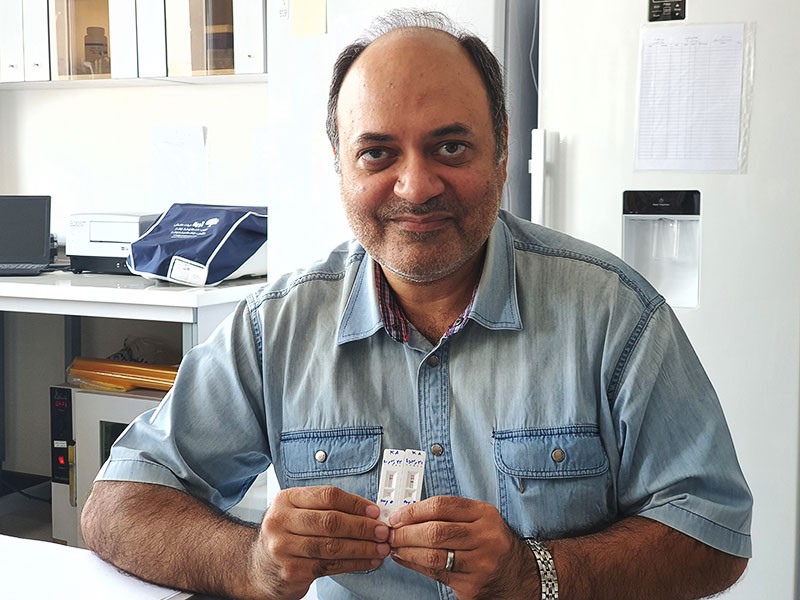
Kayhan Azadmanesh holding rapid-antibody tests that show a negative result before, and a positive result after, he received a COVID-19 vaccination.

What other vaccines are being developed in Iran?


Pasteurcovac is a recombinant-protein vaccine developed in a collaboration between Cuba’s Finlay Institute of Vaccines in Havana and the Pasteur Institute of Iran. The vaccine is known as Soberana 02 in Cuba. It also received emergency-use approval in Iran in June, despite still being in phase III trials. There are several other inactivated vaccines and recombinant-protein vaccines in clinical trials, and there is at least one mRNA vaccine, two adenovirus-vector vaccines and one measles-virus-vector vaccine in earlier stages of development. Vaccines developed outside Iran are also currently in clinical trials and being produced locally.

Tell me about the vaccines you are designing?


My company, Humimmune Biotech, has been working on two vaccine candidates. One uses the measles virus as a backbone to introduce a gene that encodes either the SARS-CoV-2 spike protein, which the virus uses to enter cells, or the nucleocapsid protein that it requires to replicate. That vaccine is being produced by the Iranian firm BioSun Pharmed in Tehran.

The other vaccine, which might be more promising, uses an adenovirus 5 backbone to deliver part of the sequence for the spike protein — a similar backbone to that used in the second dose of Sputnik V. We hope to start clinical trials early next year. Most of the COVID-19 vaccines used in Iran so far have been inactivated vaccines, which I expect will mean people will need booster shots next year. Our vaccine could be used as a booster, and a mix-and-match approach might even offer better protection. The technology can also be easily modified against new variants — we have already begun developing a version for Delta.

Why are Iranian scientists creating so many vaccines?


We have a long history of vaccine production in Iran. The Pasteur Institute of Iran was established in 1920, and has produced vaccines against tuberculosis and rabies. Vaccines have also been developed in Iran against measles, mumps and human papilloma virus.

We can’t rely on help from the international community with the pandemic. We are living under sanctions imposed by the United States; in our opinion, these are unjustified. The United States says that sanctions don’t affect humanitarian activities, but when your ability to transfer money is restricted, it is difficult to buy drugs and medicines. And we have the technology to produce vaccines, so why not use it? To ensure the safety of Iranians, it makes sense to develop a variety of vaccines using different research and development strategies, as China has done.
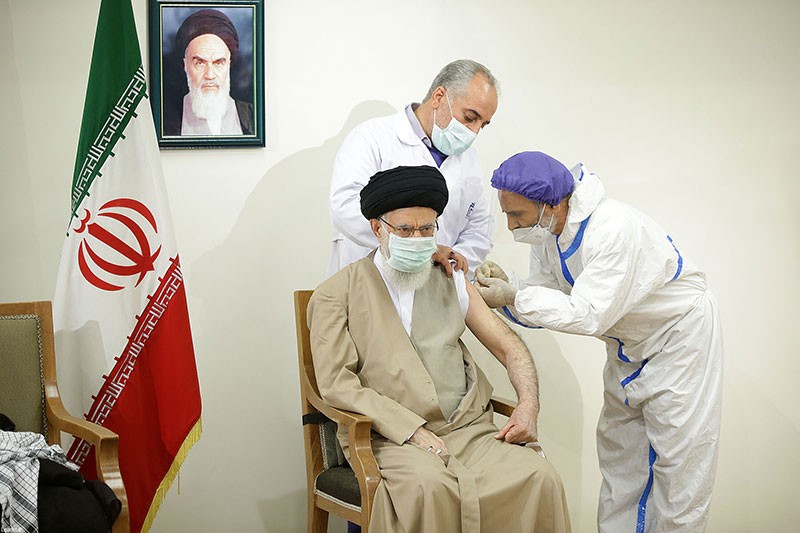
Iran's Supreme Leader Ayatollah Ali Khamenei receives a dose of the locally-made COVIran Barekat vaccine in June.

Why are Iranian researchers reluctant to publicize their work internationally?

This could be another side effect of the sanctions. Researchers in Iran might not want to draw too much attention to their work in case they put potential partnerships in jeopardy before they have achieved a final product, or they run the risk of losing access to raw materials and technologies they need for vaccines.

Researchers are also extremely busy, helping in the effort to fight the pandemic in Iran. They might not have time to publish results in international journals. But some have started to share results. In June, the researchers developing COVIran Barekat published a preprint of their preclinical results2, and they will share clinical results very soon. We also plan to share the results of our adenovirus-vector vaccine soon.

What have been the biggest challenges in developing COVID-19 vaccines?


The sanctions have caused a lot of difficulty, because they make it hard for us to buy materials and equipment. For example, chromatography resins we need to purify vaccines are mostly produced by multinational companies that are major suppliers to the United States, so they might be afraid of selling to us. The United States says that we can apply for exemptions, but, in our experience, that hasn’t worked. But somehow, we find a way. We modify our methods, find other providers, or look for local solutions. We search for the best we can get, but sometimes quality and efficiency are affected.

Also, one of the biggest challenges globally is scale. Prior to the pandemic, Iran primarily had to produce vaccines for children, with a production requirement for each vaccine of around 3 million doses a year. Now we need about 170 million doses to fully vaccinate the whole population.

What does the future hold for vaccine development in Iran?


The initial target for COVIran Barekat was to produce up to 30 million doses a month by September, which would have been enough to vaccinate the adult population. But they have not been able to achieve that, so we have had to import millions of doses of other vaccines. As many people have said, this will not be the last coronavirus pandemic that we face. I expect the vaccine production capacity will be used for years to come to develop new vaccines and drugs, for both coronaviruses and other diseases.

doi: https://doi.org/10.1038/d41586-021-02216-z

Wednesday, May 5, 2021

violations of the public decency law

Women arrested for viral naked Dubai photo shoot to be deported


By Yaron Steinbuch
”Vitaliy Grechin plays piano, surrounded by nude girls in the same location where the naked photo was shot in Dubai.

Dubai will deport the 11 Ukrainian women who were arrested for public debauchery after they turned heads in the emirate by posing nude on a high-rise balcony in a stunt that quickly went viral, according to reports.

Authorities in the United Arab Emirates detained the cheeky women along with a male Russian photographer on charges of public debauchery and producing pornography.

Images of the public display of nudity made waves across social media and shocked sensibilities throughout the sheikhdom, where a legal code based on Islamic law, or Shariah, has landed foreigners in the slammer for lesser offenses.

Dubai’s Attorney General Essam Issa al-Humaidan on Tuesday announced that those behind the controversial photoshoot would be sent back to their countries, without elaborating further. Eleven models who participate in a steamy nude photo shoot on a hotel balcony in Dubai are being deported. One woman was identified by her distinctive tattoo.

Dubai police have declined to name those detained, but one has been identified by the US Sun as Yana Graboshchuk, a 27-year-old model from Ukraine who was caught thanks to a distinctive tattoo on her butt that matches her social media images. Model Yana, from Kyiv, was recognized by the big tattoo on her left hip.

The green-eyed brunette stunner’s family said they thought she was on a holiday and expressed shock that she was involved in the headline-grabbing incident. Model Yana will be deported from Dubai.

“She went on holiday, and then I don’t know what came next,” Graboshchuk’s brother Taras, 20, told the news outlet. “Yes, she had planned a photoshoot there … But I had no more information about it. 

The rapid action announced by the attorney general is rare for the legal system in Dubai, where such cases typically go to trial or are otherwise adjudicated before deportation.

“The public prosecutor ordered the deportation of the accused of their behavior contrary to public morals,” al-Humaidan said, adding that the women had been charged with violating the public decency law. The women have been charged with violating public decency laws in Dubai.

The scandal arose just days before Ramadan, the holiest month of the Muslim calendar, and as Ukrainian President Volodymyr Zelensky landed in nearby Doha, Qatar, for an official state visit.

Dubai has increasingly promoted itself as a popular destination for Russians on holiday.

The generally pro-Kremlin newspaper Life identified the Russian man arrested as the head of an information technology company, though the firm denied he had anything to do with the incident.

Stanislav Voskresensky, the governor of the Ivanovo region where the company is based, asked the Russian Foreign Ministry and Russia’s ambassador to the UAE to offer the man their support.

“We don’t abandon our own,” Voskresensky wrote on social media.

Although the UAE has made legal changes to attract tourists and investors, allowing unmarried couples to share hotel rooms and residents to drink alcohol without a license, the country’s justice system carries severe penalties for violations of the public decency law.

The penalty for the rap the group faced is up to six months behind bars and a fine of nearly $1,500.

With Post wires

Thursday, January 21, 2021

not only Trump

Не только Трамп: 

Twitter заблокировал аккаунт посольства Китая в США за расчеловечивание уйгуров


Компания Twitter заблокировала аккаунт посольства Китая в США после твита, в котором утверждалось, что Пекин способствовал "раскрепощению" женщин в Синьцзяне.

В твите, размещенном 7 января, говорилось, что благодаря политике китайских властей женщины в Синьцзяне перестали быть "машинами по производству детей"; в подтверждение приводилась ссылка на статью в официальной англоязычной газете China Daily. Через 24 часа "Твиттер" скрыл это сообщение. Аккаунт @ChineseEmbinUS доступен, но новых сообщений в нем не было с 9 января, а до этого твиты публиковались в нем ежедневно.

"Мы предприняли действия в отношении твита, на который вы ссылаетесь, за нарушение нашей политики против расчеловечивания, которая гласит: мы запрещаем расчеловечивание группы людей по признаку вероисповедания, касты, возраста, инвалидности, тяжелого заболевания, государственного происхождения, расы или этничности", - заявил представитель компании агентству Рейтер. 

Такая политика действительно существует.


Посольство пока не комментировало этот инцидент, сообщает Рейтер.

Состояние аккаунта китайского посольства выглядит аналогично тому, что было с личным аккаунтом Дональда Трампа до того, как его забанили окончательно: на начальной стадии, после разгрома Капитолия 6 января, Twitter лишил Трампа возможности писать новые твиты до тех пор, пока он сам не удалит твиты, нарушавшие правила.

После того как Трамп это сделал, его аккаунт на некоторое время разблокировали; решение удалить его окончательно принималось в ручном режиме руководством Twitter во главе с Джеком Дорси, которые сочли, что Трамп нарушил правила снова.

Китай неоднократно обвиняли в массовых нарушениях прав уйгуров и других мусульманских этнических групп в Синьцзяне: это выражалось, среди прочего, в постоянной слежке, дискриминации и эксплуатации принудительного труда коренных жителей региона. Известны и случаи принудительной стерилизации уйгурских женщин.

19 января уходящая администрация Трампа объявила эту практику геноцидом. Будущий госсекретарь в новой администрации Энтони Блинкен на слушаниях в Сенате согласился с такой характеристикой.

Tuesday, November 10, 2020

religious nuptiality

Муфтии и мусульманские организации России
по-разному относятся к межконфессиональным бракам

Мусульманам России велели жениться только на мусульманках. Это вызвало бурные споры


Совет улемов Духовного управления мусульман России (ДУМ) опубликовал богословское заключение (фетву), в котором браки мусульман с женщинами, исповедующими другие религии, названы недопустимыми. Согласно документу, такие союзы возможны лишь в исключительных случаях по решению муфтия.

Под запрет подпадают в том числе браки с так называемыми "представительницами людей Писания" (христианками или иудейками).

В заключении отмечается, что в большинстве межконфессиональных браков возникают сложности с воспитанием детей в духе исламского вероучения или с привитием им исламского мировоззрения.

“Ведь в основном именно супруга, хранительница домашнего очага, мать и воспитательница детей, оказывает решающее влияние на свое чадо, прививая ему свои принципы и взгляды. Да, быть может, ребенок именем и внешностью будет походить на отца, но сутью и действиями - скорее на мать. Будущие поколения таковых вряд ли станут приверженцами религии своих отцов, что и приводит к исчезновению, вымиранию мусульманских корней”, - отмечает совет улемов ДУМ.

Как отмечается в богословском заключении, именно схожесть супругов в вопросах религии и духовности “является наиважнейшим условием их совместной счастливой жизни”.

Согласно выводам совета улемов, девушка имеет право выйти замуж за мусульманина, только если она “признает существование Одного Единого Бога, принимает Иисуса и Мухаммада, как Божьих посланников и выражает готовность следовать предписаниям Священного Корана”.

Тем не менее межконфессиональные браки все же возможны в “определенных единичных случаях”, каждый из которых должен рассмотреть местный муфтий, отмечается в документе.

О каких именно исключительных случаях идет речь, совет улемов не уточняет.

Позднее во вторник глава пресс-службы ДУМ Диляра Ахметова пояснила ТАСС, что фетва о недопустимости межконфессиональных браков на территории России была принята еще в 2019 году.

"Сама фетва принята, чтобы подчеркнуть, что в современных условиях именно Российской Федерации мы это не поощряем и не одобряем. Если вы поедете в Сирию, Египет и так далее, - там среди мужчин-мусульман это не такое массовое явление, но и не какая-то редкость музейная", - сказала она.

Критика и солидарность


Другая мусульманская организация - Духовное собрание мусульман России (ДСМР) – с выводами ДУМ не согласилась.

"Мы с уважением относимся к заключению наших братьев в совете улемов ДУМ РФ, но больше, чем сказано в Коране, добавить не можем. Всевышний разрешает браки с людьми Писания", - сказал агентству РИА Новости глава организации, муфтий Альбир Крганов.

При этом в ДСМР уточняют, что исламское право исключает брак женщины-мусульманки с мужчиной-немусульманином, поскольку "мужчина – главенствующий в семье, отвечает за семью перед Творцом и должен быть верующим".

Секретарь Совета улемов ДУМ Татарстана Рустам Нургалеев также отметил, что взгляды Духовного управления мусульман России не всегда отражают интересы всех мусульман страны.

"Мусульмане Республики Татарстан не ассоциируют себя с муфтиятом ДУМ РФ, и это решение точно не касается тех регионов, которые имеют свои духовные управления и других муфтиев… Мы, согласно ханафитской богословской традиции, позволяем заключать межконфессиональные браки, то есть мусульманин может заключить брак с иудейкой, христианкой, запрета на это нет", - сказал Нургалеев Интерфаксу.

Критика в отношении инициативы ДУМ прозвучала и со стороны российского парламента. Зампред комитета Госдумы по вопросам семьи, женщин и детей Оксана Пушкина в интервью радиостанции “Говорит Москва” отметила, что такое заключение разъединяет народы России.

“Непродуманные действия способны расколоть российское общество, посеять раздор и никому не нужные религиозные противоречия”, - считает она.

В иудейской общине к заключению ДУМ отнеслись с пониманием. Раввин московской синагоги на Малой Бронной Исаак Коган в беседе с изданием Daily Storm отметил, что "в иудейском законе тоже есть предписание, чтобы евреи женились на еврейках или тех, кто перешел в нашу веру".

Православный протодиакон и богослов Андрей Кураев, которому в апреле запретили проводить службы, в беседе с “Национальной службой новостей” сказал, что православные тоже должны относиться с осторожностью к межконфессиональным бракам.

“В современном обществе для молодых людей важны другие идентичности, а не национально-религозные. И когда русская девочка знакомится с парнем из Татарстана или Чечни, они в университетской тусовке, для них важнее, что они вместе в университете учатся. Но проходит лет 20, начинается кризис среднего возраста, появляются мысли - кто я такой, какая у меня идентичность, кроме профессиональной. Другими становятся отношения с родителями. И эта русская женщина себя вдруг обнаруживает совсем в другой культурной ситуации”, - пояснил он.

Вечером во вторник первый зампред ДУМ Дамир Мухетдинов пояснил, что, так как Россия является светским государством, то постановления Совета улемов носят внутриобщинный характер и обращены, прежде всего, к мусульманам, стремящимся соблюдать религиозные постулаты.

"Они не имеют юридической силы в прямом смысле этого слова, поскольку (в отличие от некоторых мусульманских стран с действующим правом на основе шариата), не предполагают какой-либо ответственности и наказания за их неисполнение. Богословские заключения Совета улемов апеллируют исключительно к ответственности человека перед Богом и никак иначе", - говорится в заявлении Мухетдинова, опубликованном на сайте ДУМ.

Saturday, January 25, 2020

The World's Largest Human Migration Is About To Begin

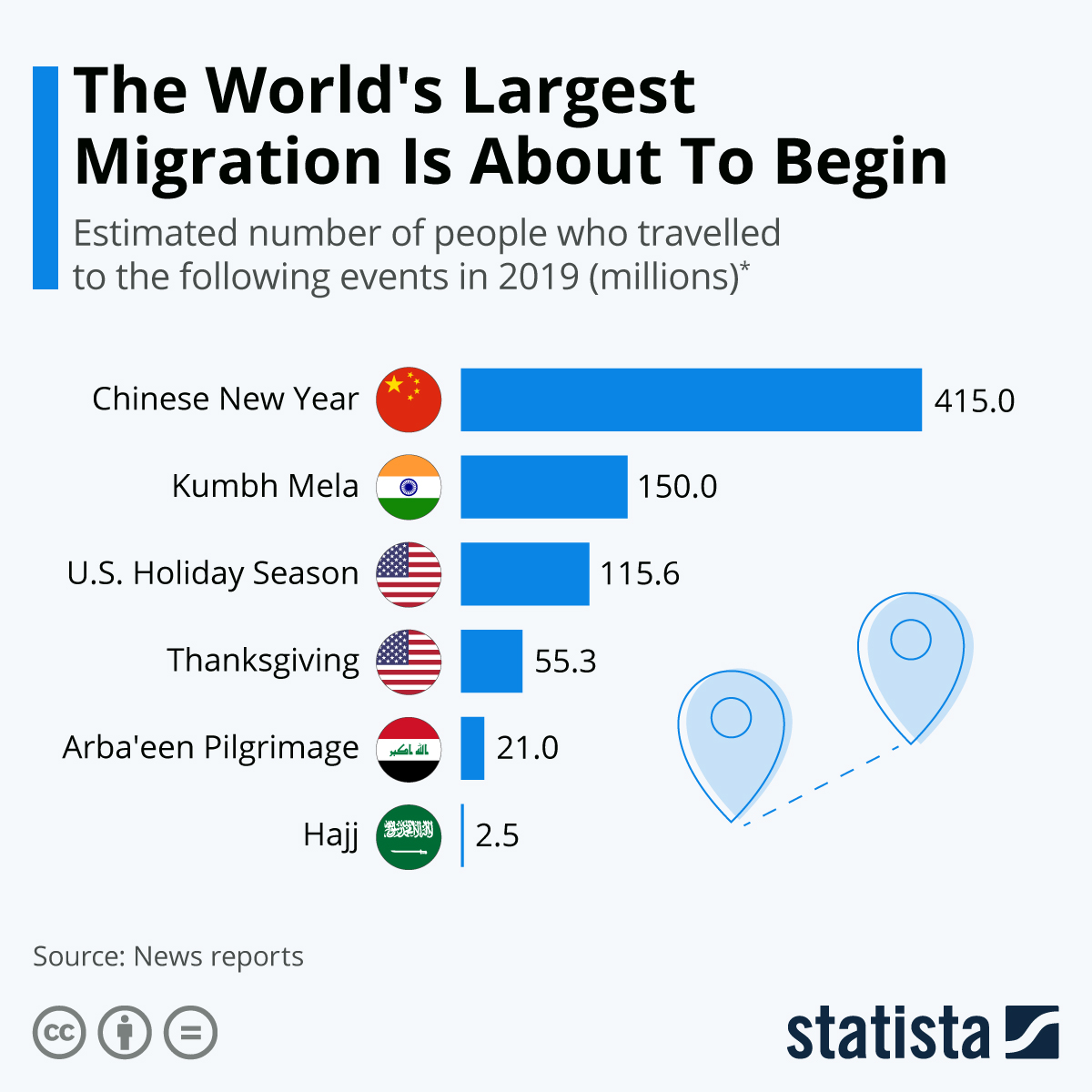
This Saturday, China is going to celebrate its new year, kicking off one of the planet's great migrations. Also known as Spring Festival or Lunar New Year, the event sees hundreds of millions of people leave their cities in order to visit their families in more rural parts of the country. In fact, practically all of China takes holiday at once, making the new year the biggest human event on earth. In 2019 the number who welcomed The Year of the Pig was approximately 415 million, according to the Chinese government.

Comparing China's largest annual migration with North America's two biggest movements of people is a good way to gauge its sheer size. An estimated 115.6 million Americans were on the move for Christmas and New Year in 2019 while 55.3 million people travelled during the Thanksgiving period. China's new year is still more than seven times bigger than Thanksgiving, though its massive population makes a big difference of course. Known as "chunyun", the annual new year migration in China also easily surpasses the world's biggest pilgrimages in scale with Arba'een and the Hajj not even coming close.
Infographic: The World's Largest Human Migration Is About To Begin | Statista

Monday, October 7, 2019

Rates of Induced Abortion in Iran:

The Roles of Contraceptive Use and Religiosity


Сто лет назад русская религиозная философия пыталась найти срединный путь развития общества, стать синтезом между двумя началами, удерживая общество от соблазнов фундаментализма.

Соблазн выглядит приблизительно так:
Total abortion rate per woman, selected countries and Iran
Relationship between the total abortion rate and
гоню про дробности, они тут

верхняя картинка тыцабельна, после этого видна лутшэ

Wednesday, September 25, 2019

legal polygyny

но с другой стороны, тёщи тоже три

Муфтий Москвы Ильдар Аляутдинов призвал узаконить многоженство в России. 

Об этом сообщает РИА «Новости».

По его словам, это позволило бы решить социальные проблемы, которые связаны со значительным численным преимуществом женщин относительно мужчин.

Он отметил, что данная практика имеет право на существование. В качестве примера он упомянул ряд религий, которые это допускают, в частности ислам.

Муфтий подчеркнул, в России женщин больше мужчин на 10 миллионов. Помимо этого, часть женщин являются вдовами или разведены, добавил он.

«Легализация многоженства стала бы гарантом соблюдения прав женщин», — подчеркнул Аляутдинов.

Он уточнил, что многоженство создаст механизм защиты женщин, по которому они смогут стать вторыми полноценными супругами.

Thursday, September 12, 2019

What You Need to Know About Post-9/11 Veterans

World Trade Center, NY - 2001-09-11 - Debris Impact Areas Today [yesterday or Sept 11] marks the 18th anniversary of the September 11 attacks which killed 2,977 people and eventually pulled the U.S. into its longest lasting war in history. Soldiers who deploy to Afghanistan in the future [не обратил внимания, пропустил по первости] may be born after the events that caused that very war [Tuesday, September 11, 2001] in the first place [unlikely, may be next years]. It also means that some Americans beginning college this month have never lived in a nation at peace.

A new Pew Survey took a look at the new crop of veterans who deployed to Afghanistan or Iraq following 9/11 in order to assess how their needs and feelings about their time in combat varied from those who served before the attacks. They found that around 20 percent of the 20 million military veterans alive today have served on active duty following September 11, 2001. These soldiers are more likely to have been deployed than their predecessors, about 77 percent of post-September 11 soldiers were deployed at least once, compared with 58 percent of those who served before them. Soldiers who served after the 2001 attacks were also nearly twice as likely as those before them to be deployed into a combat zone.

But that also means that more soldiers than ever are experiencing post-traumatic stress that can come after combat. While the Department of Veteran Affairs estimates that 11 to 20 percent of vets who did tours in Iraq and Afghanistan suffered Post-Traumatic Stress Disorder, Pew found that about half of those surveyed said they “had emotionally traumatic or distressing experiences related to their military service.” About one-third of those vets sought out professional help for it. Overall, nearly four in 10 respondents said they believe they’ve suffered from post traumatic stress disorder (PTSD).

And that makes it more difficult to acclimate back into civilian life. While nearly 90 percent of vets said the military trained them well for combat, they didn’t feel as great about returning home. About half of post-9/11 vets said it was difficult to adjust back to their lives compared with only one-in-five who served pre-9/11. One third of vets reported that they had trouble paying their bills upon their return and 20 percent said they struggled with alcohol or substance abuse.

The survey concluded that 9/11 vets are changing "what it means to be a military veteran” and that the survey shows more emphasis should be placed on returning to civilian life.

Two 2020 presidential candidates, South Bend, Indiana, Mayor Pete Buttigieg and Congresswoman Tulsi Gabbard served in the U.S. military after September 11. They are also the only two candidates who have committed to withdrawing all U.S. troops from Afghanistan within their first year, if elected.

Nicole Goodkind is a political reporter at Newsweek [пришло рассылкой]. You can reach her on Twitter @NicoleGoodkind or by email.

Tuesday, July 16, 2019

Climate change vs ISIS, cyberattacs, and Russian influence

More Countries Name Climate Change as Biggest Future Threat


In the latest edition of the Pew Research Center Global Attitudes Survey, people in 13 countries named global climate change as the biggest threat to their nation. In eight more out of the 26 countries that were part of the study, ISIS was named as the biggest concern. One year earlier, 18 out of 38 countries had pointed towards the so-called Islamic State as the biggest threat in the world.

South Korea was one of the countries pivoting towards perceiving climate change as a bigger threat in 2018, joining the UK, Germany, Hungary, Greece and Australia in a change of public opinion. In 2017, most Korean respondents had named "China's power and influence" as their biggest worry.

Awareness of cyperattacks was also on the rise, with respondents from the U.S., South Africa and the Netherlands naming them as the top threat, joining Japan.

Only one country, Poland, had a majority worried about "Russia's power and influence". The survey was conducted in mid-2018 and the results were released in February 2019.
Infographic: More Countries Name Climate Change as Biggest Future Threat | Statista

Tuesday, March 5, 2019

in the morning it was a shame

идиот
не единственный высер (точнее, чем бред)
Сидишь так вечерком в кресле и расслабоне, чаёк попиваешь. А тут бац — телевизор звонит, камент дай. И на что?

РПЦ заявила, что русских не станет к 2050 году.


Ну, что тут скажешь? — бред.

А с утра уже стало обидно. Почему, йопт, эксперт должен каментить бредятину. Вспомнил Зализняка, академика, между прочим, который грил: у нас тут пост-модерн, мнение двоешницы из 3Г класса рассматриваецо как текст, наряду с текстом, написанным академиком. Йопт, ещё раз, окодэмеги тоже иной раз напишут текстик.

Но таки, высер РПЦ должен каментить учитель арифметики.

Из Зализняка:

Мне хотелось бы высказаться в защиту двух простейших идей, которые прежде считались очевидными и даже просто банальными, а теперь звучат очень немодно:

1) Истина существует, и целью науки является ее поиск.

2) В любом обсуждаемом вопросе профессионал (если он действительно профессионал, а не просто носитель казенных титулов) в нормальном случае более прав, чем дилетант.

Им противостоят положения, ныне гораздо более модные:

1) Истины не существует, существует лишь множество мнений (или, говоря языком постмодернизма, множество текстов).

2) По любому вопросу ничье мнение не весит больше, чем мнение кого-то иного. Девочка-пятиклассница имеет мнение, что Дарвин неправ, и хороший тон состоит в том, чтобы подавать этот факт как серьезный вызов биологической науке.

Это поветрие — уже не чисто российское, оно ощущается и во всём западном мире. Но в России оно заметно усилено ситуацией постсоветского идеологического вакуума.

Monday, May 15, 2017

ISIS violence against Yazidis in Iraq

Valeria Cetorelli writes about results of a new survey that estimates the extent of ISIS violence against Yazidis in Iraq.
During the summer of 2014, ISIS subjugated the Nineveh governorate in northern Iraq, home to most of Iraq’s minority groups. These minorities were systematically targeted by ISIS in a violent campaign to ‘purify’ the region of non-Islamic influences. The Yazidis living in the area of Mount Sinjar were singled out for a particularly brutal attack.

According to lists compiled by local authorities and human rights organisations, between 2,000 and 5,500 Yazidis were killed and more than 6,000 were kidnapped during the ISIS attack on Mount Sinjar in August 2014, but the United Nations has not yet been able to independently verify these figures.

Our study, published in PLOS Medicine, provides the first population-based estimates of the number and demographic profile of Yazidis killed and kidnapped by ISIS. We report findings from a retrospective household survey of displaced survivors sheltered in camps in the Kurdistan Region of Iraq. The fieldwork was carried out in November and December 2015, interviewing a random sample of 1,300 displaced households. Each survey included a number of questions about killings and kidnappings of household members.

Using these data, we estimated that ISIS committed severe and sustained acts of violence against 9,900 Yazidis (margin of error: 7,000 – 13,900), amounting to approximately 2.5 per cent of the entire Yazidi population of Sinjar at the time of the attack.

Of this total, an estimated 3,100 Yazidis were killed (margin of error: 2,100 – 4,400), with nearly half of them executed by gunshot, beheading or being burned alive, while the remaining victims died from lack of water and food or injuries during the ISIS siege on Mount Sinjar. We estimate that 6,800 Yazidis were kidnapped (margin of error: 4,200 – 10,800), with over one third still missing at the time of the survey. Reports from escapees documented torture, sex slavery and forced religious conversion after being kidnapped.

Yazidi refugees DFID CC BY-SA 2.0

We also found that Yazidis were likely to be targeted irrespective of age and sex, but that children were disproportionately affected. Children accounted for nearly all those who died on Mount Sinjar during the ISIS siege, and were also much less likely to escape captivity following kidnapping compared to adults.

Because the attack was so indiscriminate, in many cases entire families were captured together if they didn’t escape in time. This means that our analysis may underestimate the actual number of killings and kidnappings. It is possible that no one managed to escape, so there are no survivors and zero possibility of being included in our survey.

Nevertheless, our survey documents the severity of the ISIS attack against the Yazidis and corroborates previous figures reported to the United Nations by local authorities and human rights organisations. Combined with other existing evidence, our findings can support a formal genocide investigation by an appointed judicial authority, and highlight the need for the international community to keep attention focused on the rescue, assistance and protection of the Yazidi community.

—

Mortality and Kidnapping Estimates for the Yazidi Population in the Area of Mount Sinjar, Iraq, in August 2014: A Retrospective Household Survey by Dr Valeria Cetorelli, Dr Isaac Sasson, Dr Nazar Shabila, Dr Gilbert Burnham was published in PLOS Medicine in May 2017.

Dr Valeria Cetorelli gave an LSE Works lecture earlier this year on ‘Documenting Genocide: survey evidence on ISIS violence against Yazidis’, the podcast and video of which can be found here.

The Yazidis practice an ancient religion that contains elements of Zoroastrianism, Judaism, Christianity and Islam. The total population is estimated to be less than 1.5 million, residing mainly in Iraq, Syria, Turkey and Armenia.

Friday, January 20, 2017

the winner team and loosers

новый презик
Трамп
Читаю характеристики команды Трампа.
Понять пока трудновато: кто победил? Но
кто проиграл вроде видно:
кто победил?
видимо, локалисты
что ожидать?
усиления глобального направления остатками демократов в исполнительной власти и
их чистки
посмотрим куда денецо global gag rule, вроде не первый указ
он как бе напрашиваецо и ожидаем, но противуречит победной локализации