Showing posts with label подростки. Show all posts

Thursday, December 21, 2023

NY gifts

Лучшие новогодние подарки для мужчин — деньги и гаджеты, для женщин — путешествия и обучение


Сервис по поиску высокооплачиваемой работы SuperJob узнал, о каких подарках на Новый год мечтают россияне. В опросе приняли участие экономически активные граждане из всех округов страны.

Самый желанный подарок на Новый год — деньги, «чтобы купить себе то, что хочется» (20%). О путешествии мечтают 18% опрошенных. 7% хотели бы получить на Новый год электронный девайс, 6% — сертификат на обучение. 5% россиян мечтают об инструментах для строительства и ремонта. По 3% респондентов в качестве подарка на Новый год хотели бы получить украшения, бытовую технику и товары для спорта. О новом наряде, элитном алкоголе, книге и билетах в театр или на концерт мечтают по 2% россиян. По 1% голосов набрали такие варианты подарков как косметика и парфюмерия, подарочный сертификат, посуда и кухонная утварь, компьютерные игры, подписка на электронные сервисы, товары для здоровья, мебель и предметы интерьера.

Мужчины на Новый год чаще мечтают получить деньги, инструменты для строительства и ремонта, а также товары для спорта и активного отдыха. Женщины же в подарок на Новый год чаще хотят получить путешествие, сертификат на обучение и украшения.

Респонденты старше 45 лет чаще более молодых россиян мечтают об отпуске и инструментах для строительства и ремонта (20 и 6% соответственно). Обзавестись электронными девайсами или получить в подарок сертификат на обучение чаще хотели бы россияне до 34 лет (11 и 13% соответственно).

Место проведения опроса: Россия, все округа
Населенных пунктов: 367
Время проведения: 15—19 декабря 2023 года
Исследуемая совокупность: экономически активное население России старше 18 лет
Размер выборки: 1600 респондентов

Подробнее

Saturday, November 18, 2023

loneliness

Порядка четверти молодых людей в мире чувствуют себя одинокими


Одиночество - настоящая эпидемия по всему мира: 27% опрошенных в возрасте от 19 до 29 лет сказали, что чувствуют себя одинокими. Среди соседних по возрасту когорт одиноких по 25%, а вот в более старших возрастных группах ситуация лучше, особенно в самой старшей: среди людей 65+ по всему миру (опрос проводился в 142 странах!) только 17% чувствуют себя одинокими

Wednesday, November 15, 2023

our future

Главные характеристики при выборе ВУЗа молодёжью


Интересная таблица из свежего исследования (выборка: студенты 1 курса Волгоградского государственного технического университета) о критериях выбора ВУЗа студентами. Важнее всего для молодёжи при выборе места для получения высшего образования оказалось наличие интересующей специальности, перспективы профессии, гарантия трудоустройства, надёжность и отзывы о ВУЗе.

Меньше всего внимания обращают на мнению родственников, рекламу и статус НИУ! Последнее, конечно, может быть вызвано особенностями выборки, но всё равно очень забавный результат с учётом того, сколько ресурсов у нас вкладывается в национальные исследовательские университеты (ну, на фоне других ВУЗов...)

Tuesday, July 4, 2023

data sources

Откуда современная молодёжь получает информацию о политических событиях


Из социальных сетей: 86.6% вошедших в исследование молодых людей узнают о политических событиях из социальных сетей. Ещё 76.5% - из интернет-СМИ, больше половины от родственников или друзей/знакомых.

А вот телевизор смотрит только 45% респондентов! И этот показатель очень сильно зависит от миграционных установок: среди желающих остаться жить в своём регионе телевизор смотрит почти 55%, а среди тех, кто собирается уезжать жить в другой регион или другую страну - всего 37%

Thursday, January 26, 2023

kids

Tuesday, January 17, 2023

simplification of the procedure for employment of minors

2 из 3 родителей подростков выступают за упрощение процедуры трудоустройства несовершеннолетних


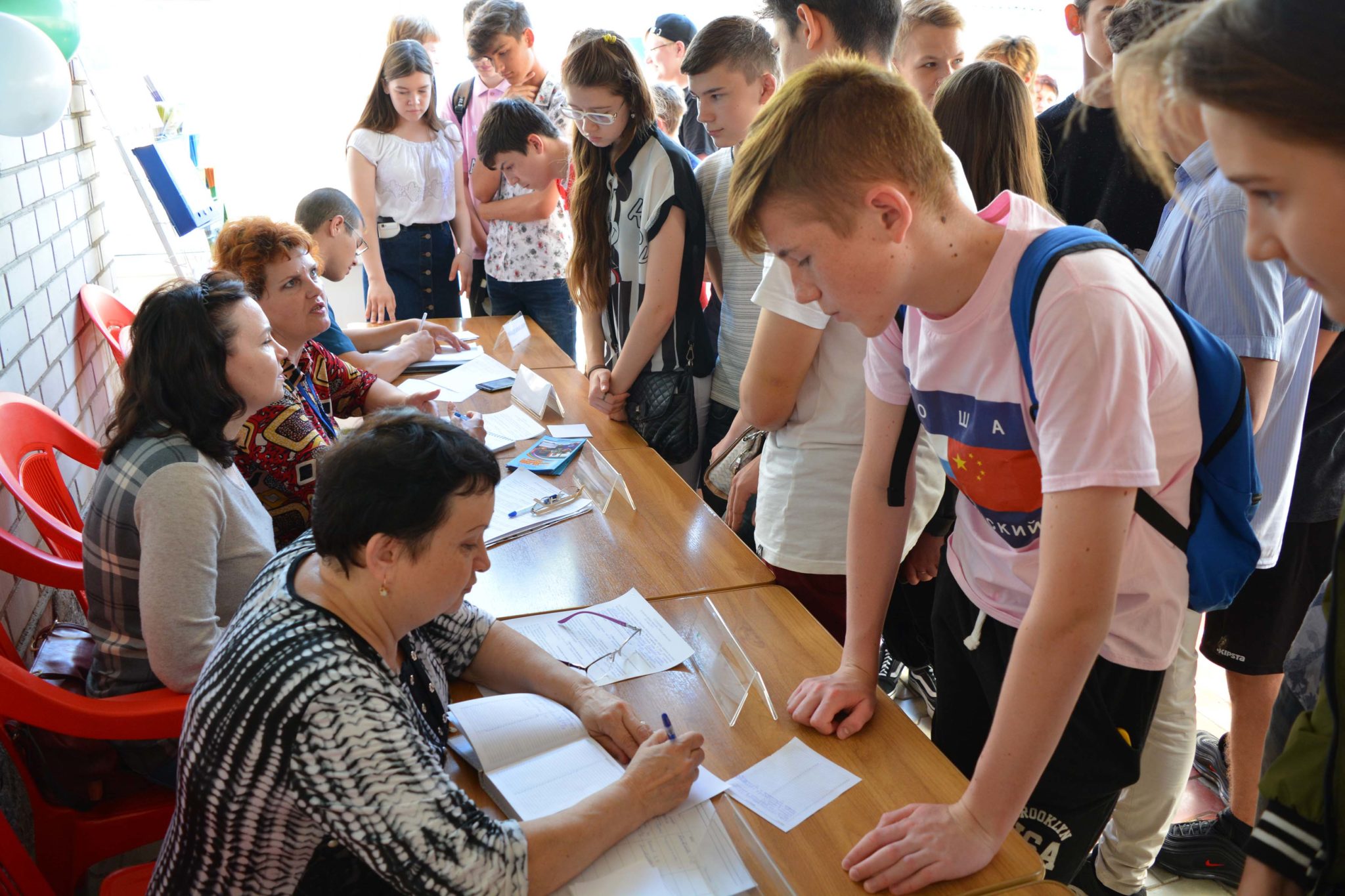
Законопроект об упрощении порядка трудоустройства несовершеннолетних поддерживает каждый второй россиянин. Сторонников этой инициативы среди родителей подростков заметно больше. В опросе сервиса по поиску высокооплачиваемой работы SuperJob приняли участие представители экономически активного населения и работодатели из всех округов страны.

В Госдуму внесен законопроект, упрощающий трудоустройство несовершеннолетних, — если он будет принят, то для заключения трудового договора с подростками от 14 лет больше не нужно будет получать согласие органов опеки. Каждый второй россиянин (49%) поддерживает эту идею: по мнению опрошенных, дети старше 14 лет уже вполне могут подрабатывать, тогда как лишние бюрократические процедуры усложняют их трудоустройство. Каждый четвертый (25%) выступает против: свою позицию респонденты аргументируют возможностью злоупотреблений детским трудом.

Сторонников упрощения процедуры подросткового трудоустройства больше среди россиян старше 45 лет (54%).

Еще активнее поддерживают законопроект родители подростков: 66% из них убеждены, что в разрешении органов опеки на детское трудоустройство нет необходимости («Согласия родителей достаточно»). При этом о наличии у их ребенка опыта подработки рассказали 18% родителей: 8% сообщили, что трудоустройство было оформлено официально (дети работали в отрядах губернаторов и мэров, библиотеках, оздоровительных лагерях, на выкладке товаров в магазинах), еще 10% — неофициально (промоутерами, курьерами, грузчиками, официантами, расклейщиками объявлений, продавцами и проч.).

Опрос представителей работодателей показал, что большинство не принимает на работу несовершеннолетних (83%). Трудоустраивают подростков лишь 4% компаний, еще 10% берут их только на стажировку.

О том, что сейчас должны знать родители о трудоустройстве подростков, читайте в статье SuperJob.

Место проведения опроса: Россия, все округа
Населенных пунктов: 374
Время проведения: 13—16 января 2023 года
Исследуемая совокупность: экономически активное население России старше 18 лет
Размер выборки: 1600 респондентов

Подробнее

Monday, December 5, 2022

Does culture influence the gender division of housework and childcare?

December 5, 2022 Elisa Brini, Anna Zamberlan and Paolo Barbieri

Gender inequality in the division of housework persists. Elisa Brini, Anna Zamberlan and Paolo Barbieri investigate if cultural heritage is resistant to changes in the socioeconomic and institutional environment by studying migrant families. Cultural roots are a factor of gender inequality in housework and childcare, but they fade over time in destination countries.


Women in the kitchen, men in the yard


Women today are more highly educated than men and increasingly present in the labour market; yet they continue to perform most of the household labour (Zamberlan, Gioachin, and Gritti 2021, 2022). Analysing Italian data from the Social Condition and Integration of Foreigners (SCIF) survey (ISTAT 2011–2012), this holds true for immigrant couples as well. Figure 1 shows the extent to which couples with an immigrant background and residing in Italy divide different domestic and childcare duties. The overwhelming majority of tasks such as preparing meals, laying the table, doing the dishes, keeping the house clean, or caring for children, are performed by women. Men do more than women only when it comes to typically male activities, such as doing repairs and dealing with administrative matters.

Looking for an explanation


Why is there still a gender gap in domestic work? While the time available to partners and individual resources such as education and income are key determinants of the unequal division of unpaid work, the relevance of cultural aspects is still a matter of debate. Traditional gender roles, inherited from the family or from the wider context of origin, could have a bearing on the behaviour of men and women by crystallizing gender inequality even within the home. The study of immigrant families in Italy offers an opportunity to tease out the role of cultural aspects. Upon moving to the same host country, immigrants share a common institutional and cultural environment while having different cultural heritages from their origin countries and different perceptions of gender equity. If the culture of origin matters, domestic and childcare tasks should be more (less) equally shared among couples coming from more (less) gender-egalitarian countries.

Culture matters


The World Bank’s Global Gender Gap Index (GGI) provides a useful indicator for measuring and comparing gender equality across countries. A value of 1 indicates a country with the highest possible score of gender equality, while a value of 0 indicates a country with the lowest possible score. Figure 2 shows the correlation between the GGI score of the female partner’s origin country and the share of male participation in household chores and childcare in the host country. Men assume a larger share of housework and, even more so, of childcare in couples where the woman comes from a more egalitarian country. Arriving from a context with a more egalitarian gender culture goes along with a more equitable division of household duties in the destination country.

A fading heritage?


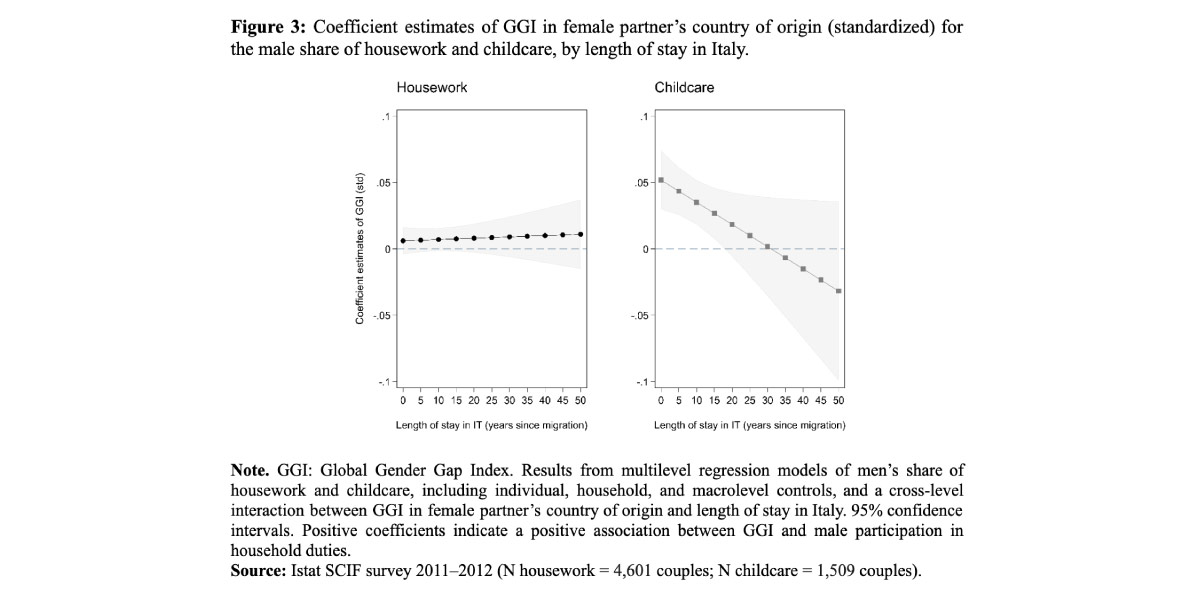
The families under investigation have different migration histories. As more time is spent in Italy, the gender culture inherited from the context of origin could lose relevance as a result of prolonged contact with a different institutional and cultural context. Figure 3 confirms this expectation, but only with regard to childcare activities. Indeed, the relationship between GGI and male participation in housework is positive but close to 0 and independent of the number of years spent in Italy. Conversely, the association between GGI and fathers’ involvement in childcare is positive at the beginning, but it gradually diminishes as time spent in the destination country (Italy) increases.

Conclusions


Studying how immigrant families divide housework and childcare tasks is informative for understanding the cultural component of gender inequality. While it is true that the culture of origin influences the behaviour of partners even in a different socioeconomic context, there are substantial differences based on the type of activity and the time spent in the host country. Cultural heritage is mainly relevant for explaining gender differences in childcare activities, while the role of culture is marginal with regard to other domestic tasks. In addition, the influence of culture weakens considerably, and eventually disappears as time spent in the destination country increases. The disappearance of cultural effects may suggest the presence of a cultural assimilation mechanism, although in the absence of longitudinal data, this can only be inferred.

References

  • Brini, E., Zamberlan, A. and Barbieri, P. (2022). Culture portability from origin to destination country: The gender division of domestic work among migrants in Italy. Demographic Research, (47)20, 577–614
  • Zamberlan, A., Gioachin, F., and Gritti, D. (2021). Work less, help out more? The persistence of gender inequality in housework and childcare during UK COVID- 19. Research in Social Stratification and Mobility 73: 100583. 
  • Zamberlan, A., Gioachin, F., and Gritti, D. (2022). Gender inequality in domestic chores over ten months of the UK COVID-19 pandemic: Heterogeneous adjustments to partners’ changes in working hours. Demographic Research 46(19): 565–580.

Thursday, November 24, 2022

DIY

This research considers the key actors and principles constituting the DIY [но твёрдой уверенности нет] scene in St. Petersburg. It traces the importance of independent music production, anti-commercialisation, anticonsumerism and creative self-realisation to the scene. It pays particular attention to the exploration of the diversity of young people involved in DIY scenes in the city and the evidence of differing narratives of DIY culture between musicians and activists within it.

Что такое DIY не понял, от слова совсем, гуголь не помог, видимо, что то с другой планеты.

Friday, November 18, 2022

Young people in Europe: Findings from the ESS


Substantive research that focuses specifically on the attitudes of young people will be presented at our online event from 1-3pm (GMT) on Wednesday 7 December.


Five papers will be presented during the event, with the first three showcasing analysis of our climate change and energy data.

Initial presentations will focus on climate change and wellbeing, environmental concerns and voting behaviours and attitudes towards reducing energy use.

Research to understand how the pandemic has helped shaped young people’s perspectives on the future, and attitudes towards digital technology, will also be presented.

Alina Cosma (Trinity College Dublin) and Gina Martin (Athabasca University) will examine whether young people’s mental health is negatively affected by concern about climate change and feeling a personal responsibility to prevent it.

Elisabetta Mannoni (Central European University) will tackle the question of whether young individuals are more likely to vote in line with their environmental concerns than older voters do.

Julian Reul (Institute of Energy and Climate Research at Forschungszentrum Jülich GmbH) will present research that assessed factors that influence the willingness to reduce the energy use of private households among three different age groups.

Laurène Thil (HIVA - Research Institute for Work and Society, KU Leuven) will reveal the results of a new survey conducted in 2022 to examine the impact of COVID-19 on young people’s opinions.

Maria Symeonaki (Panteion University of Social and Political Sciences) will present analysis of our newest available dataset measuring attitudes towards digital social contacts in work and family life.

To register for this Zoom Webinar, you must use an email address linked to a Zoom account.

Register to attend


Tuesday, October 25, 2022

American Students Have a Math Problem

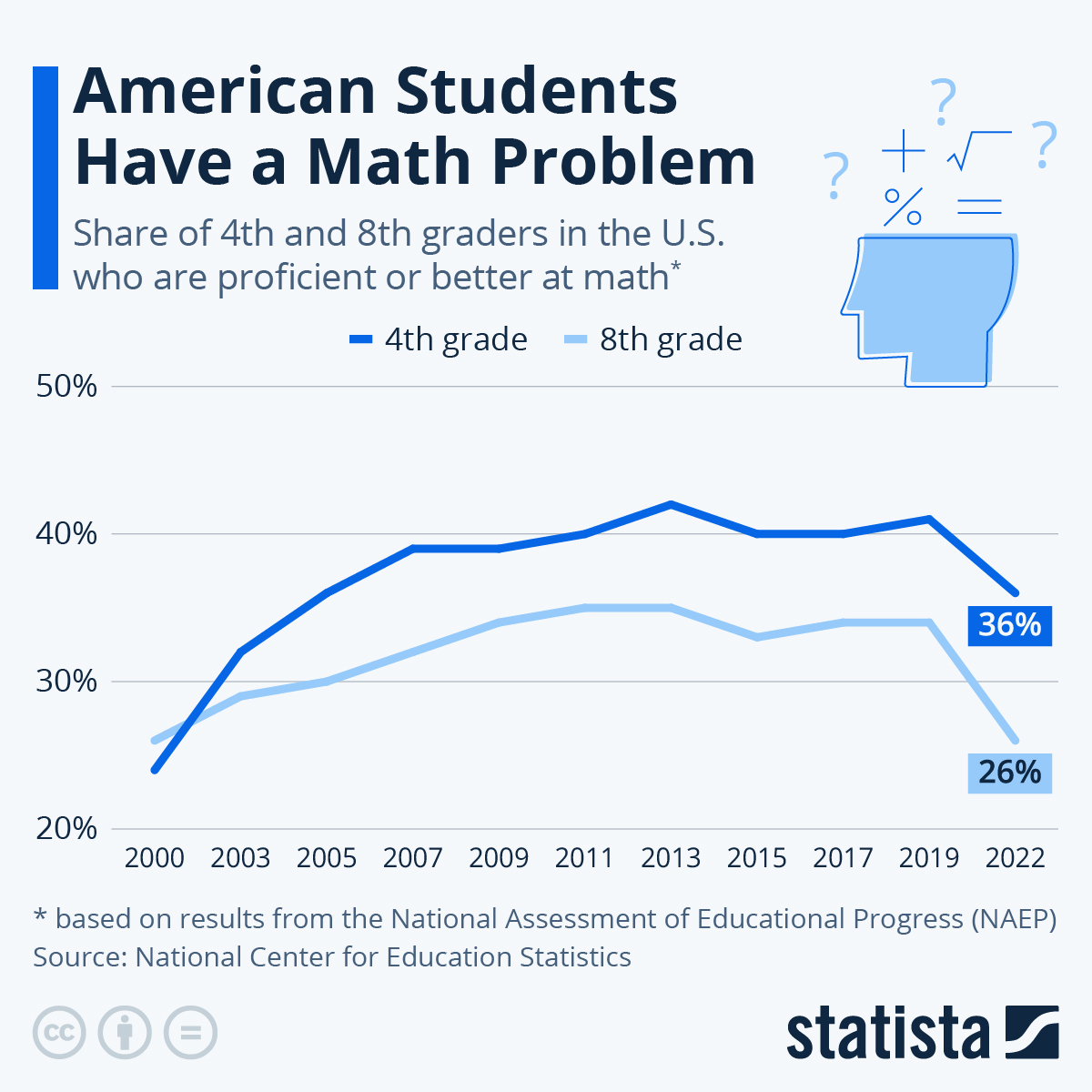
American students have a math problem. That’s according to the latest findings from the National Assessment of Educational Progress (NAEP), also known as The Nation’s Report Card. The new batch of results, published by the U.S. Department of Education’s National Center for Education Statistics on Monday, confirms fears about the pandemic’s disruptive effect on education, showing significant declines in mathematics and reading scores among fourth and eighth graders.

In fact, the decline in national average math scores was the largest ever recorded in the nationally representative assessment of student performance dating back to 1969. In the test’s first results since the pandemic began, just 26 percent of eighth graders showed proficiency in math, down from 34 percent in 2019. That’s the worst result since 2000, as math performance among eighth graders declined in 51 participating states and jurisdictions. Fourth graders fared just a little better with 36 percent achieving a proficient score, down from 41 percent three years earlier.

“The results show the profound toll on student learning during the pandemic, as the size and scope of the declines are the largest ever in mathematics,” NCES Commissioner Peggy G. Carr said in a statement on Monday, while her colleague Daniel J. McGrath, acting as NCES associate commissioner for assessment, warns of possible long-term effects. “Eighth grade is a pivotal moment in students’ mathematics education, as they develop key mathematics skills for further learning and potential careers in mathematics and science,” McGrath said. “If left unaddressed, this could alter the trajectories and life opportunities of a whole cohort of young people, potentially reducing their abilities to pursue rewarding and productive careers in mathematics, science, and technology.”American Students Have a Math Problem

Monday, October 17, 2022

more ambitions, but a decade ago

9 лет назад молодежь была более амбициозна, а сегодняшняя — сильна в IT


9 лет назад работодатели чаще называли молодежь амбициозной, а сейчас — компетентной в IT. В опросе сервиса по поиску высокооплачиваемой работы SuperJob приняли участие 300 менеджеров по персоналу из всех округов страны.

Представителям поколения Z в работе прежде всего свойственна активность: эту черту в сегодняшней молодежи отмечают 16% работодателей. Каждый девятый менеджер по персоналу (11%) считает, что сотрудников до 25 лет отличает безответственность. По 9% опрошенных подчеркивают их амбициозность и обучаемость, а новый тип мышления современной молодежи отметили 8%. По 7% работодателей видят у молодых сотрудников хорошие IT-навыки, целеустремленность, желание учиться, а также лень и легкомыслие. Самоуверенность, адаптивность и высокую работоспособность поколения Z подчеркивают по 5% респондентов.

Чем же отличается в работе поколение Z от поколения Y? Сравнивая ответы работодателей в 2013 году и сегодня, мы видим, что в зумерах значительно чаще, чем в миллениалах, отмечают хорошие IT-навыки. Сегодняшней молодежи больше свойственны обучаемость, свежий взгляд, легкомыслие, а также трудолюбие, ответственность и коммуникабельность. А вот амбициозность зумерам свойственна в гораздо меньшей степени, чем миллениалам (9 лет назад это была главная черта молодежи).

Место проведения опроса: Россия, все округа
Населенных пунктов: 89
Время проведения: 1—13 октября 2022 года
Исследуемая совокупность: менеджеры по персоналу и другие представители кадровых служб предприятий и организаций, ответственные за подбор персонала
Размер выборки: 300 респондентов [близко к Леваде, о молодёжи у всех своё мнение: раньше было лучше]


Подробнее

Monday, September 12, 2022

Reduced Abortion Access

The Impact of Reduced Abortion Access on Minor Adolescents

Abortion is a safe and essential component of comprehensive sexual and reproductive health (SRH) care. Following the United States Supreme Court ruling in June 2022 that struck down Roe v. Wade, the movement to restrict abortion access in many states will severely limit reproductive freedom for pregnancy-capable people. Individuals and communities, particularly those marginalized because of race/ethnicity, gender identity, income inequality, immigration status, and/or age, face barriers to reproductive health equity, and these policy changes exacerbate an already unjust reproductive health care landscape. This article highlights abortion access barriers specific to minor adolescents (those aged <18 years) and proposes strategic responses adolescent healthcare communities can enact.

The Society of Adolescent Health and Medicine and six other organizations stated opposition to restrictions on the reproductive rights and care of adolescents and young adults, including access to abortion. These statements recognize abortion as a basic human right [отлично от поездок в Европу, которые суть привилегия] and fundamental to adolescent SRH. They call to normalize abortion as an essential component of comprehensive SRH care, educate policymakers on adolescent developmental capacity to make safe and informed reproductive health decisions, and advocate for improved access to adolescent contraception, sexual health education, and structural initiatives to promote opportunity and health equity among marginalized adolescents.

Those who provide health care for minor adolescents must understand the great impact restricted abortion access will have on minors and provide strategic responses. Although pregnancy and birth rates declined over the past 30 years, adolescents aged ≤19 years (the standard age range reported by the US Centers for Disease Control and Prevention) account for approximately 9% of individuals who obtain abortions. Although these numbers represent a minority of those seeking abortions, this translates into at least 50,000 adolescents aged ≤19 years needing abortion services annually, with some estimates being nearly double that. Adolescents have the highest abortion ratio of any age group (851 per 1,000 live births for those aged < 15 years and 332 per 1,000 live births for 15- to 19-year-olds compared with 260 per 1,000 live births for 20- to 24-year-olds). When adolescents do not have access to comprehensive reproductive care, unmet needs lead to negative health and social consequences that may persist across the life course

читать цели.ком:

Elevating the Needs of Minor Adolescents in a Landscape of Reduced Abortion Access in the United States

по ссылке в верь.ху

Sunday, September 11, 2022

Launch of the EPF Survey on Knowledge and Attitudes of Young People on Contraception in Europe

28th September 2022 13:00 to 14:30 European Parliament - ASP 5 G 305

Dear Colleagues,

On the occasion of World Contraception Day 2022, the European Parliamentary Forum on Sexual and Reproductive Rights and MEPs for Sexual and Reproductive Rights would like to invite you to the Launch of the EPF Survey on Knowledge and Attitudes of Young People on Contraception in Europe.

About the event:

Access to contraception remains a challenge for young adults in many countries in Europe. While policies on access to contraception have already been studied extensively, little is known about the perspective of young people in Europe on contraceptives. Therefore, throughout the summer EPF has conducted an encompassing study covering 46 countries of the European continent on the young people’s awareness about contraception. Around 3000 young respondents answered the questionnaire, which looked into issues such as:
· What is the knowledge and the attitudes of European young people about contraception?
· What contraceptive methods are European young people using?
· What are the (perceived) barriers in accessing contraception in European countries
· Does this differ across countries, regions, sex, gender, age, educational status and socio-economic status?

To learn about the results of the Study we invite you to join us at the European Parliament:

Room: ASP 5 G 305
Date: 28 September 2022
Registration: 12.30 - Time: 13:00-14:30
Participants requiring assistance in entering the Parliament are kindly asked to arrive at the ASP Altiero Spinelli (Place du Luxembourg side) entrance by 12:30.

The event will be hosted by Hon. Robert Biedroń MEP (S&D, Poland), Chair of European Parliament’s Committee on Women’s Rights and Gender Equality, Member of the MEPs for Sexual and Reproductive Health.

Speakers feature:
· Neil Datta, European Parliamentary Forum on Sexual Rights and Reproductive Health Executive Director
· Antonina Lewandowska (Poland), Sexual and reproductive health and rights activist from Poland, Coordinator of ASTRA Network (Central and Eastern European Network for Sexual and Reproductive Health and Rights) and
· Petra Linčić (Croatia), Association PaRiter, educational expert and volunteer on teaching complete and inclusive sexual education
· Hon. Goedele Liekens, MP (Belgium)
· Mobile Lunch will be served

There will be contraception-themed chocolate tasting at the end of the event!
We look forward to welcoming you!

Kind regards,
EPF Secretariat

Monday, July 25, 2022

sexual education

Половое воспитание.
Нужно ли разговаривать с детьми о сексе

[знак вопроса отсутствует — так в оригинале]

Как в эпоху диджитализации и доступности любой информации разговаривать с детьми о сексе и отношениях — и нужно ли вообще это делать, разбирается Катерина Мурашова


После выхода материала о подростковой любви мне пришел отклик от Светланы из Москвы — очень интересное, на мой взгляд, письмо, в котором затрагивается близкая к предыдущей, важная и достаточно дискуссионная тема.

Привожу текст письма с небольшими сокращениями:

«Здравствуйте, Екатерина Вадимовна!

Любовь, безусловно, прекрасная вещь, может быть, самая прекрасная из всего, что есть на свете. Но вот очень было бы интересно узнать: что вы скажете о сексуальном или половом воспитании и просвещении детей? Ведь в значительной части от него зависит то, как они себя будут вести, когда станут подростками и взрослыми людьми, как будут строить любовные, а потом и супружеские отношения. Кто и когда, на ваш взгляд, должен это делать, с чего следует начинать и чем и когда заканчивать? Какова здесь в условиях интернета роль родителей и есть ли она вообще?

Этот вопрос меня волнует. Моему сыну сейчас пять лет. Я воспитываю его одна. Кто-то, может, скажет: рано тебе о таком думать, сын маленький еще. А я думаю. Потому что моя подруга, которая в таком же, как и я, семейном положении, недавно застала сына девяти лет за просмотром извращенной порнографии в интернете. Она читала много книг по психологии и не стала его ругать, а купила хорошую и дорогую книжку с картинками, где все подробно объясняется, и хотела ее с ним вместе рассмотреть и все ему объяснить, а он ей сказал: «Мама, спасибо, но я все это уже давно знаю, и мне с тобой неловко о таком говорить, давай не будем». Она тогда ему книжку, как прочитала в какой-то статье по психологии, оставила, чтобы он, может, сам все посмотрел, но потом видит: он ее к ней в комнату принес и на полку с другими книгами тихонько поставил. Она его спрашивает: «Почему так?» А он ей: «Ко мне же друзья приходят — увидят. Я этого не хочу».

Значит, получается, в ее случае уже поздно что-то предпринимать? А когда же вовремя и как об этом разговаривать?

В период моего взросления мама мне обо всем этом не рассказывала приблизительно ничего. Тогда я об этом не думала, а теперь считаю, что это было неправильно. Может, если бы я от родной мамы узнала побольше, сделала бы потом в своей любовной и сексуальной жизни поменьше ошибок и претерпела меньше всяких неловкостей. Мы с мамой после прочтения вашего материала (мы обе каждый понедельник читаем вас уже много лет) поговорили, и она призналась, что когда-то думала о том, чтобы со мной поговорить, но поскольку и с ней ее родители никогда о таком не разговаривали, то она просто не нашла слов и махнула рукой — пусть все идет как идет.

Но, может, это естественно — родителям с детьми о таком не разговаривать, если это воспроизводится из поколения в поколение? Узнают же как-то все. Хотелось бы узнать ваше мнение».


Тема, безусловно, важная. Светлана, на мой взгляд, абсолютно правильно поставила вопрос: от воспитания и просвещения детей в этой области очень многое зависит в обществе и жизни взрослых.

Как же сейчас обстоят дела с просвещением подростков? Первое, что приходит на ум, — это, конечно, интернет: здесь есть все что угодно по любой теме, читай и смотри, пока не надоест.

Однако качество найденной информации и тем более ее хотя бы приблизительное соответствие возрасту — насколько ребенок понимает, что он увидел или прочел, — вызывают сомнение. Это во-первых.

Во-вторых, со всеми, так сказать, «техническими» аспектами секса и вообще межполовыми отношениями неразрывно и органически связана психология. Понимание эмоций и психологических механизмов ну вот просто никак не станет доступно ребенку из интернета. Попробуйте сами в качестве эксперимента так сформулировать запрос, чтобы в ответ вам выпал грамотный и доступный литературно-психологический анализ повести Рувима Фраермана «Дикая собака динго, или Повесть о первой любви» (на мой взгляд, в русскоязычной литературе это одно из самых тонких и психологически точных произведений, описывающих пробуждение подростковой сексуальности).

В-третьих, нельзя забывать, что мы говорим и о совсем маленьких детях, которые вообще не очень владеют системой поиска интересующего их контента. Недавно одна из клиенток рассказывала мне, как она нашла в истории интернет-поиска своего семилетнего сына последовательно: девочки с большими попками / мальчики с большими письками / голые девочки и мальчики / секс с голой девочкой.

Забавно? Безусловно. Но моей клиентке почему-то было не смешно. Наверное, потому что она в красках представила себе, что именно выпало ее семилетнему сыну из интернета по этим его запросам. Ее вопрос ко мне: как это на него повлияло? Сможет ли он когда-нибудь все это «развидеть»? Что лично она теперь должна сделать — как и чем «разбавить» уже полученную сыном информацию?

Итак, давайте представим себе родителя, который решил: да, несмотря на интернет и СМИ, несмотря на то что мне самому никогда и никто ничего не объяснял, — я должен. Своих собственных детей. Просвещать и воспитывать. В этой самой сексуальной, половой и еще-как-хотите-ее-назовите области. Моя зона ответственности. Когда и с чего мне начать?

Сейчас изложу свое видение. Кто-то с ним не согласится, а для кого-то, возможно, эти размышления окажутся полезными. Но прошу помнить, к какому поколению отношусь я сама. Во время нашего взросления с нами очень много говорили о любви — к мужчине, к женщине, к детям, к Родине, к партии и так далее, но абсолютно ничего — о сексе.

Я бывший исследователь, поэтому искренне считаю, что любой исследовательский, просветительский или даже воспитательный проект должен начинаться с терминологии. Выберите на свой вкус в соответствии со своим образованием и воспитанием и сообщите ребенку, как все это называется и, следовательно, какими словами вы будете с ним об этом говорить все последующие годы в процессе этого самого полового просвещения и воспитания. Если затрудняетесь выбрать терминологию сами — возьмите из какой-нибудь научно-популярной детской книжки на эту тему. Главное, чтобы она была удобна лично для вас. Сами по себе слова не очень важны — важно, чтобы у вас с ребенком был язык, на котором все это можно — сейчас и потом — спокойно обсуждать. Не выбирайте слишком «детские» слова — берите «на вырост», сейчас ребенку все равно, что запомнить, а тема-то — на много лет вперед. Кстати, это может оказаться полезно и в медицинском аспекте — если, не дай бог, что, даже очень маленький ребенок сможет вразумительно объяснить врачу, где у него болит или чешется, например — в анусе или в вульве. Когда начинать? Я думаю, года в три при нормальном развитии речи ребенка — самое время.

Когда мы говорим о маленьких детях, с ними обязательно нужно обсудить тему безопасности. Что допустимо в интимной сфере (и где эта самая интимная сфера расположена на теле ребенка) со стороны родных, близких, друзей-сверстников. Что категорически недопустимо со стороны дальних, старших и едва знакомых. Когда и о чем нужно немедленно сообщить родителям или другим ответственным людям (помним, что терминология — как именно сообщить — у нашего ребенка уже есть, и значит, здесь проблем не будет). Время — те же самые три — три с половиной года.

Вопрос «откуда берутся дети» — беременность, роды, кормление младенца молоком и все такое прочее — обычно начинает вплотную интересовать девочек года в четыре, мальчиков — чуть позже. Подтолкнуть пробуждение интереса, разумеется, может рождение в семье младшего брата или сестры, появление младенца у близких родственников и так далее. Вот тут-то и надо все объяснять. Не особенно подробно (техника взрослого секса детей в этом возрасте не шибко интересует), но внятно и на достаточно высоком уровне (как младенец растет в животе у мамы, почему он сначала питается молоком, когда и как он переходит на другую пищу, кто еще из животных кормит детенышей молоком и кто рожает, а у кого они вылупляются из яиц и сразу клюют зерно, какую роль в уходе за детьми играют папы у человека и у разных видов животных и птиц и так далее). Качественное рассмотрение этой обширной и интереснейшей темы значительно расширяет кругозор нашего ребенка и поднимает его мировоззрение на новую ступень развития.

Где-то годам к шести-семи ребенок начинает умственно осваивать и осмыслять «культуральную сексуальность», черпая информацию из СМИ и непосредственного окружения — все эти бесконечные влюбленности, поцелуи, социальные объятия и прочее, которыми пронизана наша общественная повседневность. Именно в этом возрасте он может заявлять и о своей собственной, и о чужой влюбленности: «я влюблен в Соню, а Миша влюблен в Иру, а Ира влюблена в меня — все очень сложно». Параллельным пластом в этом же возрасте могут идти сексуализированные игры ровесников — «я буду доктор, ты снимешь трусы, и я как будто делаю тебе укол». Все это спокойно и уважительно обсуждается ребенком и родителем. Ребенку сообщают, что прямо сейчас он растет и развивается в важной области. Влюбленности рассматриваются как подготовка к будущей взрослой жизни. В контексте сексуализированных игр обязательно еще одно подробное разъяснение о вопросах безопасности.

В течение последующих двух-трех лет ребенок начинает с познавательной точки зрения интересоваться сексом и всеми его вариациями. К десяти годам, даже если родители поставят железный занавес на все имеющиеся в доме гаджеты, кто-нибудь из ровесников или детей постарше обязательно расскажет ему и покажет в интернете «как оно все на самом деле».

Наш родитель, который не склонен «пускать все на самотек», объясняет все ребенку сам. Что именно объясняет? Здесь есть тонкость: надо знать, что именно интересует ребенка в этом возрасте. Не «как мне это сделать самому», а «как это они все это делают» — то есть вот этот весь, до сих пор еще слегка табуированный, пласт взрослой и очень странной жизни. О нем и рассказываем. Общая тема «и это все о нем» — есть огромный кусок человеческой культуры, огромное здание, построенное на основании чуда воспроизводства жизни. Можно взять метафору дома. Вот фундамент, о нем ты уже много знаешь — встретились два существа (любого вида) и родили детей. Как именно они встречаются? Вот так. Если ребенок уже знаком с феноменом порнографии, то обязательно надо сообщить ему, что это не реальность, а кино. Как сцена из фильма «Александр Невский» или сериала «Игра престолов» не показывает нам реальную битву, а лишь ее художественный образ, так же и порнография имеет довольно далекое отношение к тому, что происходит в реальности. Подобная простенькая информация от значимого человека в дальнейшем убережет наших детей сразу от множества проблем и комплексов.

Кроме фундамента, который у нас общий с другими млекопитающими, в нашем здании есть еще множество этажей. Этаж романтической любви — это то, что ты уже сейчас можешь, сообщают ребенку и объясняют как. Этаж искусства, посвященного любви. Все прочие сублимации, которые сумеете найти и объяснить. Я в таких случаях очень люблю рассказывать про один из ленинградских областных, достаточно новых парков, который (я по обстоятельствам это доподлинно знаю) является памятником поздней любви одного областного чиновника к своей сравнительно молодой и экологически ориентированной возлюбленной. Они не смогли быть вместе (чиновник попросту умер), а оригинальным парком вот уже много лет наслаждаются жители нашего мегаполиса. Обязательно ответьте на все вопросы, которые у ребенка по поводу этого величественного здания и своего (и вашего) места в нем возникнут. Если все получилось, ребенок сам (с вашей помощью) поднялся на следующую ступень миропонимания.

Десять-четырнадцать лет — перерыв, реакция подросткового группирования, там (и в интернет-общении) набирается информация по нашей теме. Если вы все до того сделали честно и правильно, то можете быть пока свободны и только отвечать на возникающие вопросы.

Четырнадцать-пятнадцать. Вот здесь последний аккорд вашего проекта. Вы констатируете просто: ты на пороге. Вот что, на мой взгляд, тебе еще нужно обо всем этом знать. И сообщаете все, что сочтете нужным, важным и полезным. Как можно предохраняться и как об этом говорить. Вопросы безопасности на новом уровне — заболевания, передающиеся половым путем, куда вообще не следует ходить, как распознать опасное развитие событий в компании сверстников и так далее. Обязательно — подробно описать и разъяснить различия в этом возрасте девичьей и юношеской сексуальности, психологические и физиологические. Причем юношам обязательно разъясняют про девушек (чего она вообще хочет и о чем говорит), а девушкам — про юношей (чего он может и чего от него, скорее всего, ждать не приходится). Как оно сейчас принято в вашей национальной культуре (если есть особенности) и в нынешнем обществе в целом. Какие есть тенденции развития — если вы их чувствуете. Обязательно внятно сообщите подростку о его ресурсах, которые, с вашей точки зрения, помогут ему успешно сыграть на этом поле. И о ловушках и сложностях, которые могут ему, с его личностными особенностями, встретиться, о возможных способах их преодоления.

Ну вот приблизительно и все. Ваша задача выполнена. Констатируете сыну или дочери, что сказали все, что хотели, торжественно передаете ответственность. Сообщаете, что в любой момент готовы еще на что-то ответить, что-то посоветовать и обсудить, в чем-то помочь. Искренне желаете своему подростку удачи и счастья в личной жизни. Вам, конечно, страшно, но в этой области воспитания вы сделали все, что могли

Monday, August 30, 2021

why carry out a census?

«Скорей всего, министерству придется начать с простого подсчета детей мигрантов, — полагает Ирина Белоусова. — Я, честно говоря, надеялась, что у них есть эти данные, просто для нас они недоступны [очень многие полагают, что милиция и кгб всё знают]. Но их нет. В министерстве называли цифру 140 тысяч, но я не знаю, откуда она взялась. Имело бы смысл, чтобы на федеральном уровне посчитали детей с точки зрения гражданства, а в регионах — именно инофонов: ведь у детей, которые не знают русского языка, может быть российское гражданство или они могут быть из республик России. Знание языка и гражданство, гражданство и образовательные потребности — разные вещи. Следующий шаг — открыть курсы повышения квалификации на базе московских университетов — и хорошо бы вместе со всеми институциями и НКО, которые этим занимаются, — и передать в институты развития образования в регионы.
...
«Нужна организация специальных курсов и классов на базе школ, причем нормальных масштабов, чтобы охватить все количество нуждающихся. А для этого нужна определенная государственная политика. Детям, которые идут в школу, не должны предъявляться требования по регистрации, документам, знанию русского языка. Люди, которые приезжают работать, должны иметь возможность нормально устроиться, не должны иметь проблем с документами. Сейчас система регистрации и получения права на работу — это долго, дорого, неудобно, поэтому количество нелегальных мигрантов и беженцев очень велико. Конечно, надо бороться с корнями проблемы — но важно помнить, что даже если проблема нелегальной миграции не решена, отношение к детям все равно должно быть иным, чем сейчас».
...
Не всем очевидно, что проблема детей, которые находятся за бортом школы в Москве, достаточно серьезна. По оценкам социологов [!!!], таких детей в Москве от 5 до 10 тысяч, но их никто не считает.
...
Работа, как видим, делается. Она потихоньку идет. Детей пересчитают [лично я, полечу прямо на солнце не уверен], программы напишут, учебники издадут и внедрят — все своим чередом.


у меня отец работал в научно-методическом центре русского языка (из него потом организовали академический институт русского языка, могу соврать), одна из функций центра — подготовка иностранных студентов к обучению на русском языке
изобретение велосипеда — народная забава?

Thursday, May 13, 2021

Tatiana

Tatiana Nikonova

Татьяна Никонова (1978 - 2021): рациональный феминизм и неоконченный учебник гедонистического секса

Цветы из холодной земли
Поднимает поздняя весна
Но нам уже не поспорить...

"феминистка и гедонистка"
. Она была, возможно, самым неординарным публицистом в русскоязычном фем-секторе. 43 года - сейчас для журналиста это уже зрелость, однако для автора объемной литературы (художественной, технической, или учебной) это приблизительно возраст старта. Момент, когда накопленные знания и опыт начинают трансформироваться в текст. 

4 года назад Татьяна Никонова взялась за проект бесплатного учебника "Наука секса для подростков". Поскольку она вела блог - процесс формирования учебника стал в значительной мере публичным. Это важно, поскольку в инфосфере шло обсуждение тех неизбежно-противоречивых тезисов, которые предполагалось включить в текст. Из них ключевым был такой: "необходимо уметь радостно и безвредно использовать возможности собственного тела". Собственно, это кредо гедонистического секса.
Объявить такое кредо - сильное решение, сразу обозначающее конфликт между двумя частями общества, двумя корневыми идеологиями, которые диаметрально расходятся в ответе на вопрос: что для чего?

Фундаментализм [он же пронатализм] заявляет, что тело человека - это машина на службе у социальной пирамиды, и нужная лишь для обслуживания пирамиды. Человек должен ставить целью своей жизни - возвышение пирамиды, и порождение новых поколений людей для пирамиды.  

Гедонизм заявляет, что тело человека - это машина на службе у самого человека, машина для его индивидуальной жизни в его интересах, т.е. для получения им максимального удовольствия от жизни. 

По фундаментализму: человек с момента рождения должен пирамиде, просто потому, что в фундаменталистской идеологии человек сам по себе (вне его функций в пирамиде) это бессмысленное ничтожество, вообще не имеющее права на удовольствие.
По гедонизму: человек априори никому ничего не должен, и все его обязанности возникают лишь из соглашений с другими людьми о кооперации и регламентации, с целью получения каждым - удовольствия от жизни.  

Татьяна Никонова никогда не была аналитиком, ее интеллект относился скорее к эмоциональной области, именно поэтому она могла не замечать противоречий в своих воззрениях (сформированных отчасти классической культурой, в которой доля фундаментализма составляет не менее половины). Но поскольку ее учебник создавался в значительной мере публично, по следам заявленных тезисов - и реакций оппонентов, ее эмоционально-культурный уклон не был проблемой. В споре она получала сообщения о противоречиях, и могла работать над их устранением. Этим она занималась в ходе работы над книгой. Но не успела. Теперь, если учебник "Наука секса для подростков" все-таки будет издан, то с именем инициатора в черной рамке.  

...Такие дела... 

https://ru.wikipedia.org/wiki/Никонова,_Татьяна_Николаевна
https://ria.ru/20210512/nikonova-1732048351.html
https://www.bbc.com/russian/news-57095807
https://paperpaper.ru/science-of-sex/
https://planeta.ru/campaigns/nikonovabook
https://www.bbc.com/russian/features-42496653
https://www.wonderzine.com/wonderzine/life/sex/224047-sex-ed
https://paperpaper.ru/papernews/2021/5/12/umerla-seks-blogerka-i-zhurnalistka-ta/
https://t.me/nikonovaonline2/5773

Monday, April 12, 2021

Plaisir et fidélité : la sexualité de la génération du millénaire en Italie

Published on N-IUSSP.ORG April 12, 2021

Pleasure and fidelity: Italian millennials and sex


Gianpiero Dalla Zuanna, Daniele Vignoli

Sexual intercourse is starting earlier than before among Italian adolescents, whose behaviour is converging towards the norms of their European peers. As noted by Gianpiero Dalla Zuanna and Daniele Vignoli, this precocity and the growing importance attached to romantic love are not affected by either the intense material and symbolic exchanges with parents or the (increasingly) delayed transition to adulthood.

Recent studies comparing different aspects of youth sexuality between countries and over time are relatively rare. In Italy, for instance, the latest national research based on a large statistical sample dates back to 2006 (Barbagli et al. 2010). The Sexual and Emotional Life of Youths (SELFY) survey—coordinated by Marcantonio Caltabiano, Gianpiero Dalla Zuanna, Alessandra Minello and Daniele Vignoli—aims to fill this gap, at least in part (Minello et al. 2020).

In 2017, a questionnaire was administered to 8,000 economics and statistics undergraduates, born around 1998, at 28 Italian universities. SELFY replicates an identical survey, Sexuality of Italian Students (SIS), conducted in 2000, in which 5,000 economics and statistics students born around 1980 self-completed the same closed-ended questionnaire during an hour of class time. The comparison between SIS and SELFY sheds light on many aspects of the emotional and sexual behaviour of contemporary Italian youth. The main findings are presented in a recent publication (Dalla Zuanna and Vignoli 2021), and summarized below.

The sexualization of adolescence


Sex is more important in the lives of millennials than it was among their parents and older siblings, and the emotional experiences of adolescents have become sexualized. For half of the students in all Italian regions, first sexual intercourse takes place before their 18th birthday, one or two years earlier than their parents, and only a small fraction of students are still virgins on their 21st birthday. The frequency of sexual intercourse has also increased. Discussing sex with friends and exchanging explicit erotic images via smartphone or computer is more common, and fewer young people consider virginity and chastity to be important values. It is also likely that all these behaviours and attitudes are more strongly sexualized in the population as a whole, as the students of the SIS and SELFY surveys are less sexually precocious and have less intense sexual lives than their peers (Minello et al. 2020).

These changes are consistent with the trends observed in the generations of the millennials’ grandparents, parents, and older siblings, and in Northern and Central Europe (Barbagli et al. 2010, 297; Kontula 2009; Mercer 2013). The sexual debut of Italian youth no longer occurs at a later age than their European peers, and differences between the Italian regions have narrowed considerably. Other internal differences within the Italian population have also diminished, starting with religiosity, until recently a strongly discriminating factor (Barbagli et al. 2010, chap. 9). Not only has the religious practice of young people decreased drastically over the last twenty years, but many millennials close to the church also behave similarly to non-religious people, no longer attaching importance to chastity or seeing sexuality solely in terms of its reproductive function. This process of convergence—across the countries of Europe and across different social groups and territories within Italy—is similar to that observed for other components of the Second Demographic Transition such as nonmarital cohabitation and childbearing (Lesthaeghe 2020).

The revival of romantic love


Less obvious is the revival of romantic love in the context of intimate relationships. There are several signs of this new trend. Being unfaithful is rarer among millennials than among previous generations, and the vast majority of surveyed students believe that infidelity is incompatible with being in a couple. Frequency of sexual intercourse is much higher among couples than among singles. Both single men and women who are no longer virgins practice casual intercourse, but only a small minority of singles adopt casual sex as a lifestyle. Compared to previous generations, the average annual number of partners has decreased in the first stages of sexual life.

While single non-virgins are, on average, sexually dissatisfied, almost all of those in a relationship report being sexually satisfied. In short, in the first years of sexual life, millennials do not assign a predominantly hedonistic meaning to sexuality as may have been the case among older male generations (Barbagli et al. 2010, 296). On the contrary, in their emotional lives, sex and love are closely interrelated from the moment of first sexual intercourse.

Both in Italy and elsewhere in Europe (Kontula 2009, chap. 8), the revival of romantic love seems to be part of a more general revolution in intimacy. One of the key changes in contemporary intimate life is the emphasis placed on attraction between partners as the constitutive basis of the couple relationship, which goes hand in hand with the de-institutionalization of the relationship itself (Van de Kaa 1987). This emphasis is also the basis of other features of the Second Demographic Transition, such as the disappearance of arranged marriages, the spread of cohabitation, extra-nuptial births, and union dissolution. If mutual attraction is a precondition for the very existence of a couple relationship, everything else takes a back seat: “If we love each other, what is the point of getting married?” “If we don’t love each other anymore, what’s the point of being together?” and so on. Even if marriage represents a distinct arrangement as compared to cohabitation due to its higher level of commitment, infidelity becomes difficult to justify, irrespective of the type of union, because it testifies to a weakening or lack of mutual attraction. Sex with occasional partners also loses much of its charm because physical attraction is only one of the components of attraction between partners, necessary but not sufficient to achieve complete sexual satisfaction.

Becoming adults


What is the place of sexuality in the larger context of emerging adulthood in Italy (Arnett 2014)? In many ways, the sexual behavior of young Italians is converging with that of their European peers, similarly to what is happening in other aspects of the Second Demographic Transition, such as the practice of living together before (or instead of) getting married, or having children outside marriage (Pirani and Vignoli 2016).

In our book (Dalla Zuanna and Vignoli 2021), we also show that the sexuality and attachment to romantic love of Italian adolescents, whose behavior is converging towards the norms of their European peers, is not affected by either the tradition of strong material and symbolic family bonds, which persists, or the postponement of independent living that characterizes emerging adulthood in the Bel Paese.

References

  • Arnett, J.J. 2014 Emerging adulthood: the winding road from the late teens through the twenties, Oxford, Oxford University Press.
  • Barbagli, M., Dalla Zuanna, G. and Garelli, F. 2010 La sessualità degli italiani, Bologna, Il Mulino.
  • Billari, F.C., Caltabiano, M. and Dalla Zuanna, G. (a cura di) 2007 Sexual and affective behaviour of students. An international research, Padova. Cleup.
  • Dalla Zuanna, G. and Vignoli, D. 2021 Piacere e fedeltà. I millennials italiani e il sesso, Bologna, il Mulino.
  • Kontula, O. 2009 Between sexual desire and reality. The evolution of sex in Finland, Helsinky, Publications of the Population Research Institute, D49.
  • Lesthaeghe, R. 2020 The second demographic transition, 1986–2020: sub-replacement fertility and rising cohabitation – a global update, Genus, 76, 10: on-line.
  • Mercer, C.H. et al. 2013 Changes in sexual attitudes and lifestyles in Britain through the life course and over time: findings from the National Surveys of Sexual Attitudes and Lifestyles (Natsal), Lancet, 382: 1781-1794.
  • Minello, A., Caltabiano, M., Dalla Zuanna, G. and Vignoli, D. 2020 Catching up! The sexual behaviour and opinions of Italian students (2000-2017), Genus, 76, 16: on-line.
  • Pirani, E. and Vignoli, D. (2016). Changes in the satisfaction of cohabitors relative to spouses over time, Journal of Marriage and Family, 78(3): 598-609.
  • Van de Kaa, D.J. 1987 Europe’s second demographic transition, Population Bulletin, 42(1): 1-57.
любопытно: в РФ (и др.местах) ситуёвина противо по ложная

Friday, January 1, 2021

A new kind of human sexual existence

Новый вид сексуального существования людей


Эпиграф: 
«Она сказала: 'А теперь закрой глаза, сейчас ты улетишь'... Ничего себе! А я все по старинке пытался»
Новое поколение выбирает
Мало того, что нынешняя молодежь меньше занимается сексом, так еще и среди тех, кто продолжает (по старинке) им заниматься, произошли колоссальные изменения. И, если вы все еще не в курсе новых тенденций в этой сфере, то вас ожидают проблемы и разочарования.

О том, что молодежь стала меньше заниматься сексом, уже несколько лет говорят разные исследования. Например:
в основном это данные западных социологических исследований. Скупые цифры, впрочем, никому не важны, важна их интерпретация, но об этом дальше. Согласно государственному соцопросу, опубликованному в 2012 году, 25 лет назад подростки намного охотнее занимались сексом. О том, что они ведут половую жизнь, заявили 44 процента тинейджеров женского пола и 47 — мужского, тогда как 25 лет назад эти показатели составляли 58 и 69 процентов соответственно. То же исследование показало, что у современной молодежи в целом меньше половых партнеров.

1. Итак, первая тенденция, но не главная. Молодежь стала заниматься меньше сексом. Причин для этого несколько, и одна из них — наличие легкого доступа к медиа-контенту для самоудовлетворения. А так же, снятие моральных запретов на удовольствие в одиночестве. Жизнь в смартфоне все больше отвоевывает себе место в жизни людей.

С другой стороны, жизнь в смартфонах способствует тому, что «среди молодежи падает уровень преступности, количество случаев подростковой беременности и абортов, опасного вождения и употребления наркотиков...»

2. Вторая тенденция. Эксперименты с ориентацией, гендером и тому подобное. Новая степень свободы и снятия ограничений.

3. Эксперименты с теми фантазиями, которые находятся в подсознании людей. Значительно бОльшая степень терпимости к наличию в людях странных желаний выливается не только в ролевые игры, использование игрушек из секс-шопа и подыгрывание фантазиям партнера.

Из третьего пункта выросла новая тенденция: сам по себе генитальный контакт стал необязательным. Партнеры доставляют друг другу удовольствие, используя руки и игрушки. Для получения удовольствия стал необязательным тот половой акт, который считается традиционным и связан с генитальным проникновением. А степень эмоциональной близости и вовлеченности в интимное общение увеличилась.

В какой-то степени, партнеры во время такого полового общения, находятся каждый в своем виртуальном мире фантазий. Люди живут в своих виртуальных мирах не только тогда, когда играют в виртуальные игры на компьютере, зависают в сериалах или слушают музыку в наушниках. Люди теперь улетают в свои виртуальные миры, взаимодействуя внешне с партнером. И партнер не имеет ничего против этого, потому что всем так удобнее и кайфовее.

Вот такие тенденции происходят с людьми. И движение продолжается.

демографический? переход

Friday, December 4, 2020

ARMED CONFLICT AND FAMILY FORMATION

HOW THE NAGORNO-KARABAKH CONFLICT AFFECTED FERTILITY AND EARLY MARRIAGE IN AZERBAIJAN

With levels of political violence spiking dramatically in the last decades, addressing the consequences of armed conflict for population dynamics is of paramount importance. In this post, Orsola Torrisipresents findings from research on family formation in Azerbaijan, a country embroiled in a violent, yet mostly forgotten conflict with Armenia since the early 1990s.

In the morning of 27 September 2020, media reporting on Covid-19 statistics was interrupted abruptly by the news that intense fighting had resurfaced between Armenia and Azerbaijan in and around the mountainous region of Nagorno-Karabakh. If nothing else, this severe escalation in violence has revived interest in a region – the South Caucasus – where complex conflict dynamics are rarely discussed in relation to demographic research.

The literature on recent population change in this part of the world is thin (for instance, one of the few detailed and up-to-date accounts of Georgia’s demographic transformation can be found in another post in this blog), and has largely overlooked the consequences of antagonisms that, while kept dormant under communism, degenerated into armed conflicts as the USSR collapsed.

In my PhD project, I seek to fill part of this gap by examining how armed violence has affected fertility and early marriage patterns in Azerbaijan after its regained independence.


Does armed conflict affect childbearing transitions?


An intriguing question about the link between armed violence and family formation is whether, and how, conflict influences fertility. Theoretical expectations are ambiguous. On the one side, people in conflict settings may expedite the transition to childbearing and, hence increase overall fertility, for various direct and indirect reasons, for instance to buffer future economic uncertainty, compensate for child loss or because of macro-level factors like nationalist pro-natalism. Increases in childbearing may also be expected if sexual violence is used as a weapon of war. One the other side, there is reason to think that forced displacement, couple separation or intentional trade-offs between child quantity and quality (i.e. waiting until child-rearing conditions are favourable) may lead to postponement and declining birth rates.

Existing empirical evidence is inconclusive, perhaps because different types of conflict (e.g. interstate vs. intrastate) induce diverse fertility responses. Yet prior research has generally been limited to aggregate trends and has ignored the possibility that relationships between conflict and childbearing may depend on the fertility transition (i.e. the stage of the transition for a given context), and that responses to conflict might therefore vary by parity.

In my own study, recently published in Population and Development Review, I explored this hypothesis in the context of the Nagorno-Karabakh conflict between Azerbaijan and Armenia. First, given the absence of detailed previous studies, I retraced the evolution of Azerbaijan’s fertility history to determine its stage in the fertility transition. Then I employed event history models to explore the association between transitions to first, second, and third birth – and Azerbaijani women’s exposure to the conflict.

Fig 1 Total fertility rate estimated from various sources, Azerbaijan 1991–2005Source: 2006 Azerbaijan DHS (women aged 15-39), TrasMonEE vital registration data (women age 15-49), Human Fertility Collection (ODE Collection). Shaded area highlights key conflict years.zerbaijan 1991–2005

Azerbaijan’s period TFR (Total Fertility Rate) dropped from above 3 children per woman before full-scale hostilities in Nagorno-Karabakh (which resurged in 1992), to slightly below replacement (around 2) at the start of the 21st century (Fig.1, DHS estimates). The decline was essentially in two phases. The first phase occurred during years of deteriorating economic conditions and conflict violence. As in several other ex-Soviet republics that were hardly hit by the transition to the market economy, this stage was characterised by a “stopping-sooner” behaviour, where declines mainly concerned third-order fertility. The second phase of the decline, which surfaced only a decade later (after the fall of the USSR and onset of the Karabakh conflict), is characterised by delayed first birth (Fig.2).

Fig 2 Parity progression ratios, Azerbaijan 1991–2005Source: 2006 Azerbaijan DHS (ever married women). 3-year moving average. Shaded area highlights key conflict years.

This (pre-conflict) reduction in the propensity to have a third child, accompanied by almost universal motherhood in the early re-independence period, led me to hypothesise that – if the conflict with Armenia had any influence on different parities then – the conflict was likely to have its strongest effect on the transition to second birth. Effectively, this was what I observed in my next analyses. In particular, the risk of a second birth was around 40 percent higher for women who were exposed to the conflict (both those who never migrated from the contested territories and those who were forcibly displaced). Conflict-affected women also had a greater risk of having a second birth in highly violent years (1993-1994), while for the Azerbaijani population as a whole the hazard had already started to decline soon after regaining independence.

Plausible explanations


What might explain these results? One explanation is household risk-insurance strategies. Children may have been viewed as a long-run investment (and future resource for the household, e.g. via paid work). At the same time, the considerable economic assistance provided by the Azerbaijani government to all individuals in conflict-affected households may have exerted short-term influence over the propensity of displaced families to transition to ‘average parity’ (i.e. two children) sooner rather than later. Risk-insurance mechanisms may have also operated at the macro-level through dominant nationalist discourses on the need to maintain a demographic balance with the opposing faction. Alternatively, these results may be explained by replacement-effects. The fact that I observed a robust positive relationship between child loss during conflict years and the transition to childbearing, irrespective of the sex of the prior birth, provides some evidence in support of this mechanism.

Teen marriage?


Changes in the timing of childbearing are often preceded by shifts in marriage patterns in many low- and middle-income countries. A particularly pressing issue in conflict settings, and Azerbaijan in particular, relates to early marriages. The harmful consequences of adolescent unions are well-documented, and most countries with the highest levels of early unions are also involved in armed conflicts. This is notable for Azerbaijan because, despite data fragmentation and underreporting, official figures still indicate a considerable increase in marriages involving teenagers in the last decades (although reliable quantitative or causal evidence on the relationship is again scarce).

By exploiting spatial and cohort variation in exposure to the Nagorno-Karabakh conflict, and adopting a difference-in-difference logic, I then examined whether war affected women’s likelihood of marrying as teenagers. Women exposed to intense and frequent fighting during adolescence were significantly less likely to form unions in their teenage years, with the largest effect for women who spent most of their teens under active conflict conditions (Fig.3).

Fig 3 Predicted probabilities of teen marriage by conflict-related migration status and granular cohortsSource: 2006 Azerbaijan DHS. As per discrete-time models with ‘frailty’ terms estimating the probability of marrying in teen ages. Notes: Sample consists of women born 1957–1984 (ages 22–49 in 2006), excluding women born 1972–1973. Subjects enter analysis at age 12. Women born 1974–1984 are considered in the “conflict cohort”. Estimates are weighted using provided survey weights.
* p<0.05, ** p<0.01, *** p<0.001.


Conclusion


Although we should be cautious in generalising these findings, they provide some evidence on households’ family formation decision-making in times of violence. Further, they stress the importance of taking into account the ages at exposure to violence and the duration of the experience. While conflict-induced declines in early unions appear as surprising as they are desirable for girls in violent contexts, this does not preclude adverse marriage outcomes occurring, perhaps after adolescence (e.g., Azerbaijan DHS data indicate that more than twice as many conflict-affected women who were teenagers during the conflict period married a man aged 10+ years older). Similarly, while armed violence may not seem to affect aggregate fertility trends, my research demonstrates that it can accelerate the transition to specific parities. Analysing the demographic consequences of violent conflict is of clear academic interest. Perhaps more importantly, in neglected geographical settings, demographic research is essential to guide policy and to understanding the ways that historical events shape society.

Armed Conflict and the Timing of Childbearing in Azerbaijan by Orsola Torrisi was published in Population and Development Review in September 2020.


Orsola Torrisi is a doctoral student at the London School of Economics Social Policy Department. Besides studying the effects of conflict violence on family formation outcomes, her PhD research also looks into the long-term relationship between early-age exposure to armed conflict and intimate partner violence in later life in post-Soviet Eurasia. More information on Orsola’s work can be found here.

Tuesday, September 22, 2020

self esteem

«Подлецы любят честных людей; вы этого не знали?» - фраза из «Подростка» Достоевского, поразившая меня в 17 лет. Я не сразу смог врубиться в ее смысл… Ну как – любят? Не то что прям совсем «любят» - догадался я со временем; честный человек для подлеца – и постоянный укор, и постоянный соблазн. Любит ли худеющий толстяк сладкий торт? С одной стороны – очень; с другой – ненавидит и мечтает, чтобы их вообще никогда не существовало; с третьей – мечтает их съесть, почувствовать их вкус на своих зубах.

подлец и проститутка