Showing posts with label Германия. Show all posts

Thursday, December 26, 2024

age

Фактический максимальный возраст некоторых государственных деятелей России/СССР и тот же возраст, стандартизованный по смертности на начало 2024 г. методом проспективной продолжительности жизни.
(т.е. тот нынешний возраст, в котором среднему российскому мужчине остается жить столько же, сколько оставалось жить в максимальном возрасте государственных деятелей среднему россиянину в год их смерти).

Не только лишь в США народ обеспокоен наступающей геронтократией.

(+ 3 поста до этого, включая, тоже любопытны)

В России, несмотря на очевидную бесконечность национального лидера, многие, вопреки его увещеваниям, рыскают глазами в поисках возможных исторических аналогий.

Но применение более объективного демографического подхода с позиции проспективной продолжительности жизни говорит, что победители советской гонки на лафетах, на самом деле, по стандартам современной смертности российских мужчин, умерли в более старшем возрасте, чем принято считать.

Saturday, September 14, 2024

Beer consumption is falling

Гермвния ???

В Баварии закрывается одна из старейших пивоварен, которая проработала 334 года


Пивоварня Schlössle-Bier из города Ной-Ульм остановит производство в конце декабря. Глава пивоварни Криста Цоллер объясняет, что ее компания не может выдержать конкуренции с промышленными гигантами.

Пивоварня Schlössle-Bier появилась в 1690 году, когда трактиру на границе с Баден-Вюртембергом впервые разрешили варить собственное пиво. Вскоре пивоварня стала процветающей и разливала до 150 тысяч литров пива в год. Однако сейчас ее содержание стало нерентабельным.

«Потребление пива падает, но цены на сырье и энергию растут. Вот уже десять лет пивоварня приносит нам убытки», — сказала Цоллер.

В настоящее время объем производства пива на пивоварне Schlössle-Bier приближается к отметке в 100 тысяч литров — это на треть меньше, чем в 2018 году. В последнее время Schlössle-Bier варила десять сортов пива, в том числе пять крафтовых.

«Цена должна быть почти в два раза выше, тогда мы могли бы снова потратить деньги на новое оборудование. Но сейчас на рынке это не представляется возможным. Бюрократия также осложняет нам жизнь. В таких условиях каждый предприниматель задумывается о том, хочет ли он продолжать свой бизнес», — добавила Цоллер.

@BILD_Russian

Friday, August 16, 2024

help

данные

Всё больше людей говорят, что США, ЕС и НАТО оказывают слишком много помощи Украине


Популярность этого ответа в среднем по вошедшим в опрос странам выросла с 11% в 2022 до нынешних 19%. Самый популярный ответ - что помощи оказывается сколько нужно, 46% голосов. О том, что помощи не хватает, говорит 34% (и это заметно меньше, чем 46% в 2022)

При этом по разным странам картина очень разнится. В Германии самая популярная позиция сейчас - это что помощи уже слишком много (так говорит 40% респондентов, рост в три раза с 2022 года). В США об избыточности помощи говорит 27% (против 11% в 2022), но самый популярный ответ всё ещё что помощь оказывается в оптимальном объёме.

Wednesday, June 26, 2024

Gernan census

В Германии проживает всего 82,7 млн человек, на 1,4 млн меньше, чем предполагалось 

— таковы результаты переписи населения 2022 года


Согласно представленным сегодня результатам переписи населения, количество иностранцев, проживающих в ФРГ, тоже значительно ниже, чем предполагали власти — почти на миллион. Оказывается, всего в Германии проживает 10,9 млн иностранцев.

В целом, по сравнению с последней переписью 2011 года население выросло на 2,5 млн человек.

Возможными причинами разницы в подсчётах является то, что многие люди, возвращающиеся в страны происхождения, не снимаются с регистрации. Кроме того, существует высокая мобильность из-за движения беженцев, вызванного войнами в Сирии и в Украине.

В ходе переписи также учитывалось количество жилых домов и квартир. По состоянию на 15 мая 2022 года в стране насчитывалось 20 млн зданий с 43,1 млн квартир. Это значительно больше, чем в 2011 году: в общей сложности на 1 млн зданий и 2,5 млн квартир больше, чем тогда.

Изменился и размер квартир. С 2011 года они стали в среднем на три квадратных метра больше по всей стране. Это означает, что площадь квартир в среднем составляет 94,4 квадратных метра.

Также выяснилось, что 75% жителей Германии, то есть три четверти населения, по-прежнему отапливают свои дома «ископаемым топливом». На централизованное отопление приходится лишь около 15% отопительных систем.

Альтернативные источники энергии играют лишь второстепенную роль. Только 3% квартир оснащены тепловыми насосами.

Тем не менее, в квартирах в новостройках ситуация иная: с 2016 года каждая четвёртая квартира в новостройках (25%) оснащена тепловым насосом, говорится в сообщении.

Thursday, May 23, 2024

life expectancy

Продолжительность жизни в Германии оказалась самой низкой в Западной Европе


Такие данные опубликовал Евростат. По его подсчётам, средняя продолжительность жизни в ФРГ — 81,2 года. Это меньше, чем во всех других странах Западной Европы и Скандинавии. Ещё ниже этот показатель только у стран бывшего соцлагеря. По данным немецких властей, сейчас Германия отстаёт по уровню жизни от среднего показателя Западной Европы на 1,7 года. Четверть века назад этот разрыв составлял 0,7 года.

По словам врачей, основная причина более ранней смертности в Германии — сердечно-сосудистые заболевания. Их вызывает высокий уровень курения и потребления алкоголя в стране, а также недостаточно здоровое питание.

Friday, March 22, 2024

hamburg

В Гамбурге многодетная мать родила четверню


Врачи клиники «Альтона» приняли уникальные роды: у матери четырёх детей появились на свет ещё три мальчика и девочка. Разнояйцевые близнецы Аман (1190 грамм), Аван (1400 грамм), Арина (1180 грамм) и Арин (1170 грамм) родились на 30-й неделе беременности, на 11 недель раньше срока. Они помещены в инкубатор с аппаратом искусственного дыхания (на фото). Их состояние стабильное.

Роды принимала команда из 15 врачей. Кесарево сечение матери провёл лично главврач клиники, доктор медицинских наук Аксель фон дер Венсе. Для «Альтоны» это первая четверня за 20 с лишним лет, для Гамбурга — первая с 2016 года.

fertility

Рождаемость в Германии упала до минимума с 2009 года


Такие данные опубликовал сегодня Федеральный институт динамики населения. К осени 2023 года рождаемость снизилась до 1,36 ребёнка на одну женщину. В 2021 году этот показатель составлял 1,57. Уровень рождаемости упал до самого низкого уровня с 2009 года. Степень падения стала рекордной за последние десятилетия. Как рассказал BILD профессор, доктор социологических наук и соавтор исследования Мартин Бужар, немцы рожают меньше из-за «множества кризисов».

«Есть два момента времени с необычайно сильным падением, — сказал Бужар. — Первый — январь 2022 года. Кампания вакцинации подавляющего большинства началась девятью месяцами ранее. А поскольку беременные женщины не прививаются, многие пары отложили желание завести детей. Через девять месяцев это отразилось на рождаемости. Второй — конец 2022 года, примерно через девять месяцев после начала российского вторжения в Украину. <...> Этот спад представляет собой новое измерение. В прошлом случались сильные спады, такие как “спад из-за приёма таблеток” в 1960-х и 1970-х, после распространения противозачаточных и культурных изменений. Тогда в Германии отправной точкой было 2,5 ребёнка на женщину, затем этот показатель упал до 1,5. Сейчас он падает с 1,5 до 1,3 за короткое время — это крайне низкая величина. Рождаемость падает во всех европейских странах. Это минимум, которого не было никогда раньше в истории. Такие показатели не могут быть компенсированы внутренней европейской миграцией. В долгосрочной перспективе Европа постареет и значительно сократится количественно. Это также создаст нехватку квалифицированных рабочих в Германии».

Monday, February 12, 2024

Mobilisierte Nation

такой книги нет,  Mobilisierte Nation

«Мобилизованная нация»

 — книга об отношении простых немцев к Гитлеру, ставшая хитом в РФ после начала войны. Мы поговорили с ее автором Николасом Старгардтом

Старгардт, историк из Оксфордского университета, проанализировал для своей книги сотни писем и дневников простых немцев, чтобы понять, как Вторую мировую войну, этнические чистки и нацистскую власть осмысляли не военные, чиновники и пропагандисты, а обычные люди.

После начала полномасштабного вторжения армии РФ в Украину многие стали проводить параллели между идеологией Третьего рейха и путинской России.

«Медуза» поговорила со Старгардтом о пропаганде агрессивной войны, людях, которые выбирают быть «вне политики», и коллективной ответственности. А также о том, есть ли смысл в сравнении двух войн — и двух диктаторов.

Tuesday, January 30, 2024

vaginal flutist

«Вагинальная флейтистка». 

В Германии обсуждают непристойный номер на шоу талантов


В выходные на немецком телеканале RTL показали очередной выпуск шоу талантов Supertalent. Среди членов жюри были танцовщица российского происхождения Екатерина Леонова и модель Анна Ермакова. На сцену поднялась 41-летняя австралийка Беатрис Маккуиф. Она врач по профессии, а в школе училась играть на флейте. Уже 10 лет она выступает по миру как «вагинальная флейтистка», исполняя несколько нот на флейте детородным органом. Теперь она продемонстрировала это умение и перед миллионами немецких телезрителей. RTL заретушировал часть тела женщины. Члены жюри, ведущие и гости телестудии восприняли номер крайне неоднозначно.

Обозреватели BILD Николь Рихтер и Михаэль Шахт называют выступление «безвкусицей», «чистой порнографией» и «позором ниже пояса». Немецкий медиапсихолог Йо Грёбель заявил, что оно свидетельствует о смене стратегии телеканала. «Серьёзность, которую RTL провозглашала несколько лет назад, оказалась не такой успешной, как нарушение табу», — считает он.

«Мы знали, что этот номер может вызвать разную реакцию. Вот почему мы приняли соответствующие меры для защиты несовершеннолетних при трансляции, — заявили BILD на телеканале. — Её, по общему признанию, необычный талант играть на блокфлейте посредством акробатики и мышц тазового дна уникален и показывает, что Supertalent даёт пространство для разнообразия выступлений»

@BILD_Russian

condom nation

«Презервативная нация». 

Немецкий производитель контрацептивов заявил о рекорде продаж


Интервью BILD дал 43-летний Роберт Рихтер — глава компании Ritex по производству презервативов. Он заявил о росте продаж в 2023 году на 20% до 100 млн штук. Это рекорд за всю историю фирмы, основанной в 1948 году. Впервые с 2007 года презервативы использовались в ФРГ чаще (53%), чем таблетки (36%). «Нас самих немного удивил такой рост», — говорит менеджер. Сам он объясняет это так:
  • Презервативы из резины изобрёл немецкий предприниматель Юлиус Фромм (1883-1945). «На самом деле, Германия всегда была сильной презервативной нацией. Это благодаря Фромму, — говорит Рихтер. — В то время он более или менее развил промышленное производство презервативов, по крайней мере в Европе».
  • Всё меньше женщин хотят подвергать себя гормональной терапии, принимая таблетки. «Мы видим это так: более критический взгляд на таблетки сегодня положительно влияет на наши продажи», — считает Рихтер
  • Ritex наладила производство без вредных выбросов и поддерживает инициативы по защите климата. «Особенно хорошо эта тема воспринимается в Германии и Западной Европе», — сказал глава компании.
  • Пандемия прервала цепочки поставок из Азии, поэтому немецкий производитель смог увеличить долю на рынке.
@BILD_Russian 

Monday, January 15, 2024

BERLIN DEMOGRAPHY DAYS

BERLIN DEMOGRAPHY DAYS | 23 - 25 JANUARY 2024

TWO WEEKS TO GO
Start the year off right by attending Berlin Demography Days 2024! This year’s theme is:

Overcoming Crises. Shaping Policy for an Uncertain Future.


From January 23-25, Berlin Demography Days will host 13 public panel discussions with eminent experts and decision-makers from politics, business, science and civil society.

They will exchange visions for future crisis resilience. Panel discussions will look at best practice responses to shocks caused e.g. by violent conflicts, climate change and pandemics, and to population trends.

Join us! Attendance is free, but registration is required.

Please register here:

https://survey.demogr.mpg.de/index.php/972861?lang=en

All panels will be online, except for the opening event, which you can also attend in-person on January 23 (18-21 CET) at the Futurium Museum in Berlin. The evening will include the presentation of the European Demographer Awards 2023.

View the Berlin Demography Days 2024 programme here:

https://population-europe.eu/events/berlin-demography-days-berliner-demografie-tage/berlin-demography-days-2024-overcoming

Follow Berlin Demography Days 2024 on Linkedin and X through #DemographyDays2024 and #OvercomingCrises for updates and more information.

For any questions about the event, please contact: events@population-europe.eu

We look forward to you joining us!

Andreas Edel Executive Secretary, Population Europe / Max Planck Institute for Demographic Research
Ulrich Lilie President of Diakonie Germany 2014-2023

Berlin Demography Days 2024 Speakers List


23 January | Day 1 | Understanding Crisis Management

Bruno Arpino, Professor of Social Statistics at the Department of Statistical Sciences, University of Padua, Italy
Bеrando Benifei, Member of the European Parliament
Eugen Brysch, Chair of the German Foundation for Patient Rights (Deutsche Stiftung Patientenschutz)
Agnieszka Chłoń-Domińczak, Director of the Institue of Statistics and Demography, Warsaw School of Economics
Fernand de Varennes, Former UN Special Rapporteur on minority issues (2017-2023)
Antje Draheim, State Secretary at the German Federal Ministry of Health
Pearl Dykstra, Professor Emerita of Empirical Sociology, Erasmus University Rotterdam, member Chief Scientific Advisors group to the European Commission
Andreas Edel, Executive Secretary, Population Europe
Julia Fitzner, Unit Head, Insights and Analytics, the World Health Organization (WHO)
Hermann Gröhe, Member of Parliament, German Minister of Health 2013-2018
Yasmine Hamdar, AI Specialist, UNDP
Lorence Kabasele Birungi, President of the African Youth and Adolescent Network on Population and Development, Eastern and Southern region (AfriYAN)
Hill Kulu, Professor of Human Geography and Demography, University of St Andrews, UK, President of the European Association for Population Studies
Susan Michie, Professor of Health Psychology and Director of the Centre for Behaviour Change, University College London, UK
Alice M. Reid, Professor of Demography & Co-Director of Campop, University of Cambridge, UK
Jürgen Renn, Founding Director, Max Planck Institute of Geoanthroplogy, Director of the Max Planck Institute for the History of Science
Magdalena Rogl, Head of Diversity and Inclusion at Microsoft Germany
Georg Schütte, General Secretary, Volkswagen Foundation
Juliane Seifert, State Secretary at the German Federal Ministry of the Interior and Community
Dubravka Šuica, the European Commission Vice-President for Democracy and Demography
Rita Süssmuth, former German Minister of Health and President of the German Bundestag (1985-1998)
Manuela Verduci, Managing Director of Kiron Digital Learning Solutions
Ingmar Weber, Alexander von Humboldt Professor for Artificial Intelligence at Saarland University, Germany
Sigrid Weigel, former Director of the Leibniz-Centre for Literature and Cultural Research (ZfL), Germany

24 January | Day 2 | Global Crisis – Local Responses

Mumuni Abu, Demographer and Senior Lecturer at the Regional Institute for Population Studies of the University of Ghana
Andreas Backhaus, Researcher, Ageing, Mortality and Population Dynamics, Federal Institute for Population Research (BiB), Germany
Kai Bergmann, Senior Advisor on German Low-Carbon Policy, Germanwatch
Jane C. Falkingham, Professor of Demography and International Social Policy, University of Southampton, UK, and Director of the ESRC Centre for Population Change
Thiago Herick de Sa, Technical Officer for Age-friendly Environments, World Health Organization
Øyvind Ihlen, Professor, Department of Media and Communication, University of Oslo, Norway
Sebastian Klüsener, Head of Research Department "Ageing, Mortality and Population Dynamics" at the Federal Institute for Population Research (BiB), Germany
Nataliia Levchuk, Chief Researcher at the Ptoukha Institute for Demography and Social Studies in Kyiv
Raya Muttarak, Professor of Demography at the University of Bologna, Italy
Amy Neumann-Volmer, Medical Doctor and Board member of Doctors Without Borders Germany
Adam Rogalewski, Policy Officer Health and Social Services, The European Federation of Public Service Unions
Doris Schaeffer, Professor in the Faculty of Health Sciences and Co-director of the Center for Interdisciplinary Health Literacy Research (IZGK) at Bielefeld University
Daniele Vignoli, Professor of Demography at the University of Florence, Italy
Virginia Wangare Greiner, CEO of the NGO Maisha
Lukas Welz, Executive Director at BAfF Federal Association of Psychosocial Centers for Survivors of Torture, War and Flight, Germany
Caroline Zickgraf, Deputy Director of the Hugo Observatory: Environment, Migration, Politics, the University of Liège

25 January | Day 3 | How We Can Better Prepare for Crises

Arnstein Aassve, Professor of Demography, Bocconi University, Italy and PI of FutuRes Project
Alexia Fürnkranz-Prskawetz, Professor of Mathematical Economics, Technical University of Vienna, Austria
Donya Gilan, Psychologist and Head of the Science Communication Department at the Leibniz Institute for Resilience Research (LIR) in Mainz, Germany
Anica Heinlein, Director of Communications & Advocacy and Head of Office Berlin at CARE Deutschland
Shelley Kupferberg, Journalist
Maja Lunde, Author, screenwriter and lecturer
Geoff Mulgan, Professor of Collective Intelligence, Public Policy and Social Innovation, University College London, UK
Claudia Neu, Professor for Rural Sociology at the Universities of Goettingen and Kassel, Germany
Bernard O. Onyango, Senior Research and Policy Analyst, African Institute for Development Policy
Andreas Schulze, Head of Department of Demographic Change, Older People, Welfare of the Federal Ministry for Family Affairs, Senior Citizens, Women and Youth
Yanina Taneva, Strategy Director and Co-Founder, Ideas Factory Bulgaria
Jörn Thiessen, Head of the Community, Cohesion and Democracy Department at the Federal Ministry of the Interior and Community
Cordula Weimann, founder of “Omas for Future”

Organisers and Partner Organisations of the Berlin Demography Days:


African Institute for Development Policy
Association Internationale des Démographes de Langue Française
Associazione Italiana per gli Studi di Popolazione
Bocconi University | FutuRes: Towards a Resilient Future of Europe
British Society for Population Studies | London School of Economics and Political Science
Deutsche Gesellschaft für Demographie
Diakonie Deutschland
European Association for Population Studies
Federal Institute for Population Research (BiB)
International Union for the Scientific Study of Population
Nederlandse Vereniging voor Demografie
Population Europe | Max Planck Institute for Demographic Research
United Nations Population Fund

The organisers would like to thank the following partners for their support of the Berlin Demography Days:


European Union (Horizon Europe research and innovation programme under grant agreement 101094741)
Förderfonds Wissenschaft in Berlin
German Federal Ministry for Family Affairs, Senior Citizens, Women and Youth
German Federal Ministry of Health
German Federal Ministry of the Interior and Community
Stifterverband

Sunday, December 17, 2023

diutisciu land

Die Frauen der Teutonen verteidigen die Wagenburg by Heinrich Leutemann
The Women of the Teutones Defend the Wagon Fort

К 2070 году лишь 20% новорождённых в Германии будут этническими немцами — Тило Саррацин


С таким прогнозом он выступил в интервью BILD. Сарацин долго работал чиновником, в т.ч. на высоких постах в Deutsche Bahn и Центробанке Германии, был отвечавшим за финансы сенатором (министром) в Берлине. В 2010 г. он выпустил книгу «Германия. Самоликвидация», где резко раскритиковал политику властей ФРГ, в первую очередь в сфере миграции. Книга стала бестселлером, но автор лишился всех постов и подвергся резкой критике за неполиткорректные взгляды. Ангела Меркель обвинила его в клевете, а СДПГ исключила из своих рядов после 47 лет в партии. По словам Сарацина, многие прохожие на улице до сих пор отводят взгляд, когда встречают его.

«Конечно, я ошибался, — признаётся он. — Но только потому, что всё оказалось гораздо хуже, чем я изобразил. <...> Как и везде на Западе, немецкое общество испорчено долгим периодом мира и большого процветания. <...> Недостаточно быть миролюбивым самому по себе. Римляне выжили так долго, потому что знали: Si vis pacem, para bellum. Мы это упустили, а заметили лишь после нападения России на Украину. Мы по-прежнему носим с собой много подобной лжи, и это мешает обществу. Например, продвигаемая властями иллюзия, что друг с другом легко сочетаются эффективное и доступное государство всеобщего благосостояния и неконтролируемая культурно чуждая массовая иммиграция».

Сарацин отрицает обвинения в расизме, говоря, что «не обесценивает или превозносит других из-за их этнического происхождения».

«Я говорю об иммиграции из Африки и Ближнего и Среднего Востока. Как показывает статистика, в 2023 г. 78,6% [мигрантов] — это мусульмане с другими традициями. Учитывая масштаб нынешней иммиграции, мы получаем культурный разрыв, — говорит он. — Я не пророк. Прогнозировать можно лишь то, где можно что-то измерить и где видны стабильные тренды. К 2070 г. из рождённых здесь лишь 20% будут иметь этнически немецкое происхождение. Другой вопрос, что будет представлять из себя культура в целом».

@BILD_Russian

Monday, December 4, 2023

thinking

Социологи спрогнозировали будущее правительство Германии на фоне требований досрочных выборов


[как мне не нравится слово спрогнозировали, но ничего не попишешь]

В последнее время всё больше политиков Германии требуют провести досрочные выборы в Бундестаг, не дожидаясь осени 2025 года. Сначала с таким призывом выступил премьер-министр Баварии и лидер партии ХСС Маркус Зёдер. Недавно о том же заявила депутат Бундестага Сара Вагенкнехт, создающая собственную партию.

Специально для BILD социологический институт INSA провёл опрос о том, каким граждане хотели бы видеть новое коалиционное правительство Германии. Большинство участников (26%) считают, что его должен возглавить консервативный блок ХДС/ХСС, 14% — правящая Социал-демократическая партия Германии (СДПГ), 13% — ультраправая «Альтернатива для Германии». Как считают социологи, сейчас наиболее вероятно формирование новой «большой коалиции» из крупнейших партий — ХДС/ХСС и СДПГ. Именно они правили вместе в 2005-2009 и 2013-2021 гг.

Что касается непосредственной поддержки каждой из партий, то наиболее популярны находящиеся в оппозиции консерваторы (30%, на графике) и ультраправые (22%). Совокупный рейтинг СДПГ, «Зелёных» и СвДП, составляющих правящую коалицию, составляет лишь 35%.

@BILD_Russian

Sunday, November 26, 2023

Career Compromises and Dropout from Vocational Education and Training in Germany

By Janina Beckmann, Alexandra Wicht, Matthias Siembab

This study investigates the relevance of career compromises (i.e., the discrepancy between the expected and the actually attained training position) to the decision to drop out of vocational education and training (VET), focusing on compromises in terms of social status and gender type. We pay particular attention to upward and downward compromises. Using longitudinal data on 7205 apprentices from the German National Educational Panel Study (Starting Cohort 4), the results of discrete event history models show that both dimensions of compromise are crucial to the decision to drop out of a first VET position. In particular, downward gender-type discrepancies increase the probability that female apprentices will drop out. These findings draw attention to the role of pre-entry VET policies, such as career counseling, in minimizing the incidence of career compromises.

Wednesday, October 25, 2023

How long do older Germans work?

October 23, 2023 Christian Dudel, Elke Loichinger, Sebastian Klüsener, Harun Sulak and Mikko Myrskylä

Rapid population aging may undermine the viability of the German pension system. Is working longer a remedy? Christian Dudel, Elke Loichinger, Sebastian Klüsener, Harun Sulak, Mikko Myrskylä analyse what is known about employment in later adult life in Germany. Employment trends are on the increase, but with considerable socioeconomic differences.


Germany is aging


The German population is among the oldest in the world and is aging rapidly. Projections of the German Federal Statistical Office (Statistisches Bundesamt, 2022) indicate that in 2050 around 26% of the population will be over age 67, which will be the statutory retirement age by 2031. As the number of retirees increases and the workforce shrinks (Fuchs et al. 2018), this rapid population aging will be a challenge for the German social security system, and for the German pension system in particular.

Extending the length of working life has been proposed as a remedy, as it increases the size of the workforce while reducing the number of retirees. Several institutions, such as the European Commission and the OECD, have been advocating for this shift (e.g., European Commission, 2010; OECD 2015). Meanwhile, many countries, including Germany, have implemented reforms with the major goal of prolonging working life. For instance, the statutory retirement age in Germany is currently being increased from 65 to 67.

Inequalities in the length of working life


Policies aimed at extending working life often follow a one-size-fits-all approach. As these policies are frequently applied with few or no exceptions, or are aimed at workers in stable employment (e.g., Phillipson 2019), they might have negative effects on more economically insecure and vulnerable groups. For instance, increasing the retirement age for almost everyone, as is currently the case in Germany, may increase the duration of working life for highly educated men with high employment rates, while low educated individuals face a high risk of unemployment during the additional years they are forced to stay in the labor market.

A series of studies in several countries have revealed substantial socioeconomic inequalities in the length of working life (e.g., Dudel & Myrskylä 2017). In a recent paper (Dudel et al. 2023), we provide new evidence of such inequalities for older workers in Germany, and focus on several dimensions of inequality: gender, occupation, education, and region (distinguishing between the former socialist eastern Germany and western Germany). Below we provide an overview of some of the key findings, focusing on general trends and inequalities by education.

General trends in Germany


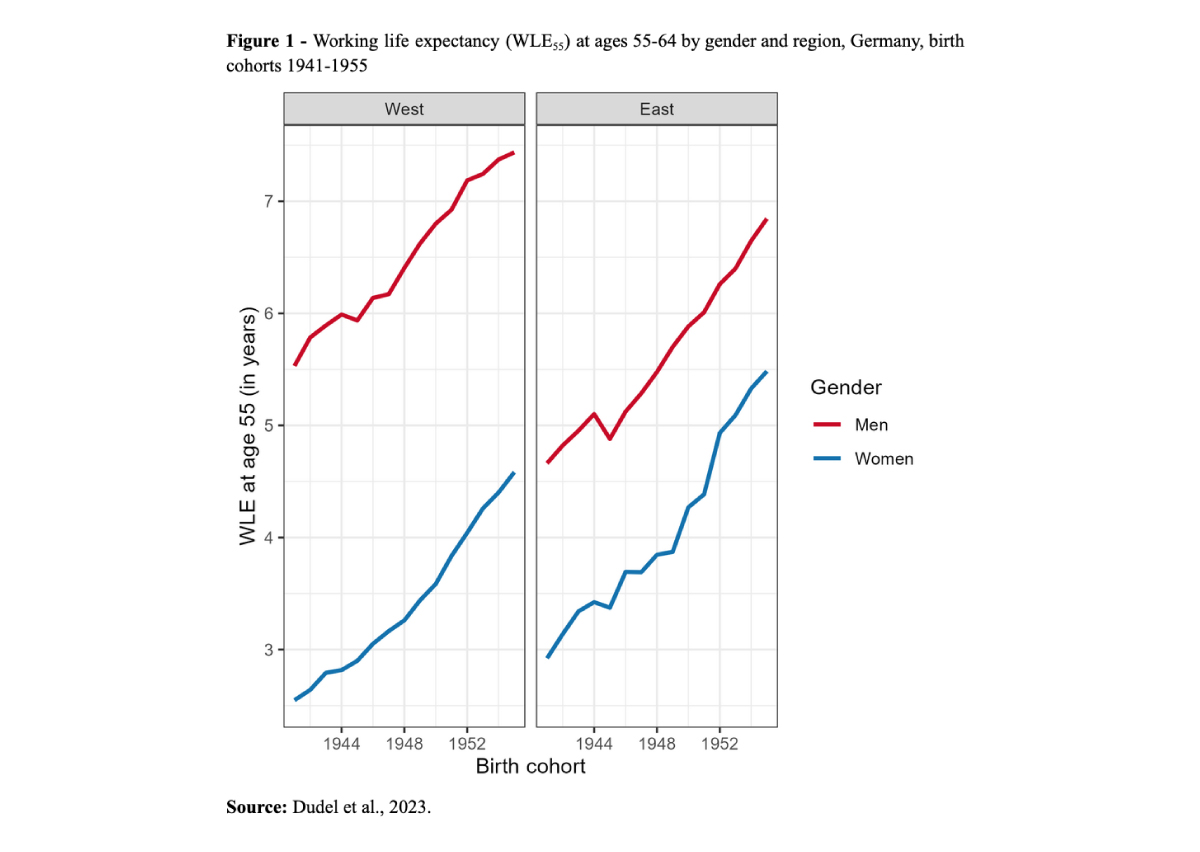
Our key indicator is working life expectancy (WLE55), defined as the average remaining lifetime spent in work. It is measured in years and, for our study, we computed it between ages 55 and 64, adjusting it for working hours. This means that our results are based not only on whether individuals are or are not gainfully employed, but also on whether they are working full- or part-time. We used data from the German Microcensus for the years 1996 to 2019, and calculated WLE55 for the cohorts born between 1941 and 1955 (Fig. 1).
For instance, the number of additional years western German men could expect to remain employed at age 55 rose from 5.5 years for those born in 1941 to 7.4 years for those born in 1955. For all groups, WLE55 increased by around 2.0 to 2.5 years over the observed birth cohorts. This shift is likely attributable to several factors, including pension reforms aimed at extending working life and better health among younger cohorts.

In both western and eastern Germany, men worked for longer than women. However, the gender gap was always smaller in the east than in the west, and it decreased somewhat in eastern Germany, while remaining roughly constant in western Germany. Similarly, eastern German women worked longer than their western German counterparts. Among men, by contrast, the opposite pattern is observed, with western German men working longer. These regional and gender differences are legacies of eastern Germany’s socialist past and the unification process. When the east was socialist, policies aimed at integrating women into the labor market led to higher female employment rates in eastern Germany than in the west. This pattern continued after German unification, even during periods when unemployment rates in eastern Germany were high.

Educational inequalities in Germany


Employment in late adult life depends also on education, for which, in our paper, we considered three levels:
• low (equivalent to ISCED levels 0 to 2),
• medium (ISCED levels 3 to 4), and
• high (ISCED levels 5 to 6).

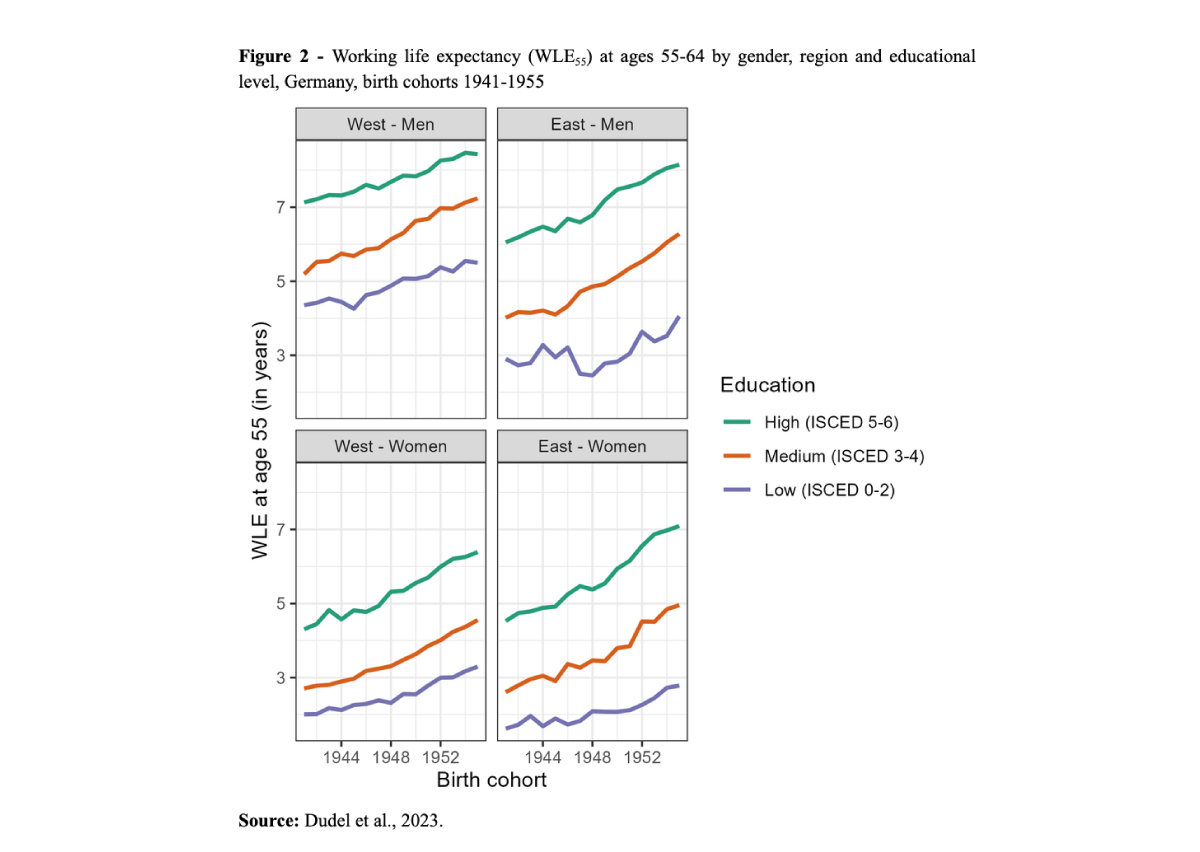
Results are displayed in Figure 2. When interpreting them, it is important to keep in mind that the lowest educational group is smaller and more selective in eastern than in western Germany, as less than 10% of the population aged 55 to 64 in eastern Germany have low educational attainment.
On average, WLE55 increased for all educational groups, but with considerable heterogeneity in both level and pace. For instance, beyond age 55, low-educated eastern German women worked, on average, only three additional years, while highly educated western German men worked almost nine. Moreover, in eastern Germany, the increase in WLE55 was notably smaller for low-educated individuals than for the other educational groups. For example, the gap between highly educated and low-educated eastern German men increased from roughly three to four years.

Conclusions


In summary, the length of late working life has been steadily increasing in Germany for all the socioeconomic groups we considered. This trend is in line with the aim of many recent policy reforms to increase retirement age. However, our findings show that there are substantial and increasing socioeconomic inequalities in the length of working life after age 55 among older workers. Researchers and policymakers should focus more on these inequalities, as they might be outcomes of systematic social disadvantages among specific groups of older workers. To help us better understand inequalities in WLE55, we are currently extending our calculations of WLE to cover all working ages. If, for instance, low-educated workers start working at earlier ages than highly educated workers, inequalities in total WLE might be smaller than inequalities in just WLE55, i.e. among older workers only.

References

  • Dudel, C., Myrskylä, M. (2017): Working Life Expectancy at Age 50 in the US and the Impact of the Great Recession. Demography 54: 2101-2123.
  • Dudel, C., Loichinger, E., Klüsener, S., Sulak, H., Myrskylä, M. (2023): The extension of late working life in Germany: trends, inequalities, and the East-West divide. Demography. https://doi.org/10.1215/00703370-10850040
  • European Commission (2010): Annual growth survey: Advancing the EU’s comprehensive response to the crisis.
  • Fuchs J., Söhnlein D., Weber B., Weber E. (2018). Stochastic forecasting of labor supply and population: an integrated model. Population Research and Policy Review, 37, 33-58.
  • OECD. (2015): Pensions at a glance 2015. Available at OCED.
  • Phillipson C. (2019). “Fuller” or “extended” working lives? Critical perspectives on changing transitions from work to retirement. Ageing & Society, 39, 629-650.
  • Statistisches Bundesamt, 2022: 15. koordinierte Bevölkerungsvorausberechnung – Deutschland. Available online.

Sunday, April 30, 2023

Accused of Witchcraft

Waldrada, illustration by Pollie Scott

I have enlisted the help of my esteemed colleague Dr Chris Halsted, a lecturer at the University of Maryland College Park, to tell you about a fascinating woman who lived across the sea in the kingdom of Lotharingia. Chris researches gender, ethnicity, and geography in early medieval texts and is particularly interested in women who have been accused of magic and witchcraft - like Waldrada, the subject of this month’s newsletter.


Waldrada: The Woman Accused of Witchcraft during a Medieval Divorce Scandal


Guest Author: Dr Chris Halsted

In the middle of the ninth century, a woman named Waldrada was wrapped up in a royal divorce scandal that could rival that of Henry VIII. Waldrada was the mistress of King Lothar II, who ruled over a Frankish kingdom at the center of the former Carolingian empire. The scandal ensued when Lothar attempted to divorce his wife, Theutberga, and marry Waldrada instead. During Lothar’s campaign for a divorce, these two women both faced wild and scandalous accusations from those with political and religious interests in the fate of the royal marriage. What we know about Waldrada comes almost entirely from this highly charged and high-profile divorce case, making her one of the most consequential yet mysterious figures of the middle ages.

Very little is known about Waldrada’s early life. From what we can tell, her background was aristocratic but not especially distinguished. She was likely already in a relationship with Lothar when he became king in 855 at the age of eighteen. However, Lothar did not marry Waldrada, but a woman named Theutberga, the sister of a powerful magnate. Lothar would later claim that he only married Theutberga because her brother had threatened to obstruct his rise to kingship if he refused.

Though Lothar married another woman, Waldrada was not cast aside. Lothar and Waldrada probably already had children by the time of his marriage, and they would go on to have at least four illegitimate children: a son and three daughters. This was of vital importance to the divorce scandal: Lothar’s marriage to Theutberga was childless, and so he had no legitimate heir.

Obtaining a divorce was no simple matter. Churchmen from the time of Lothar’s grandfather Charlemagne onwards had standardized rules surrounding marriage. Not only had it been decided that the keeping of a ‘concubine’ was unlawful, but remarriage after repudiating one’s wife (which could only be done in the case of adultery) was also forbidden. By the 850s, these strict rules on remarriage had come crashing up against the realities of political life among the imperial elite: Lothar’s attempt to divorce his wife and marry Waldrada is only the most famous among several marriage scandals that engulfed his extended family, including his cousin Judith’s marriages to the Kings of Wessex.

These rules motivated Lothar to levy scandalous accusations against his wife Theutberga in an attempt to secure a divorce. The young king accused her of having an incestuous relationship with her brother Hucbert before their marriage, in which they had coupled ‘as men do with men’. This had apparently resulted in a pregnancy that had then been aborted. The reasons for these extreme accusations were twofold: first, incest and ‘sodomy’ were both crimes that made a marriage unlawful; if Lothar could successfully convince the broader political community that his marriage to Theutberga had been unlawful in the first place, he would be then free to marry Waldrada. The second reason was political: by dragging Hucbert into it, Lothar made Theutberga’s most powerful ally complicit in her supposed crimes.

In response to these accusations, voices from Theutberga’s camp accused Waldrada of witchcraft, saying she had bewitched the king as part of a plot to seize power. This was something of a trope in Carolingian gender discourse: a similar accusation had been levied against the Empress Judith in the 830s, for example, and it is possible that something similar befell Arnulf of Carinthia’s queen Uota.

Lothar’s plan to set Theutberga aside and marry Waldrada failed. Under pressure from his bishops, his uncles who ruled the neighboring kingdoms, and Pope Nicholas II, he took Theutberga back in 858. A second attempt at divorce, in 862, was temporarily successful, and Waldrada was even presented to the court as Lothar’s queen, but in 863 her fortunes turned again. Nicholas annulled the divorce and excommunicated Waldrada.

By this point even Theutberga wished for divorce, wanting to rid herself of her troublesome involvement with Lothar and retire to a convent. Both Waldrada and Theutberga’s fortunes had risen and fallen tumultuously alongside Lothar’s campaign for divorce. The political wrangling with Pope Nicholas ended with his death in 867. Nicholas’ successor, Adrian II, was more generous to the women involved, giving Theutberga permission to live without Lothar, and lifting Waldrada’s ex-communication.

In 869, Lothar made the journey to Italy to try to convince the pope that he should be allowed to once more marry Waldrada, but on the way there he fell ill and died, the issue of his marriage still unresolved. His uncles immediately divided his kingdom between them — Lothar still had no legitimate heirs. Lothar’s failed marriage politics had led to the failure of his kingdom.

For a variety of reasons — the sensational nature of the accusations, the novelty of a royal divorce and remarriage, and the political importance of reproduction by the heirless Lothar — this crisis became possibly the best-documented Carolingian scandal. Kings and popes wrote letter after letter, bishops and churchmen compiled manuscripts on church law, historians marked down their opinions both during and after the crisis. Perhaps our best source for the crisis is De Divortio, a lengthy treatise on the matter by Archbishop Hincmar of Rheims, one of the most eminent churchmen of the day. Hincmar’s work provides a primer through which modern historians can understand the issues at stake — up to and including a discussion of love potions, succubi, and other relevant supernatural issues.

Although Lothar died with the issue still unresolved, it was the anti-Waldrada camp that won out in the history books. Later writers remember Waldrada as a seducer and tyrant, the archetype of the scheming woman trying to supplant the rightful queen Theutberga. The later chronicler Regino of Prüm would blame the entire downfall of the Carolingian dynasty on Waldrada and Lothar’s relationship, arguing that the sexual sin of their relationship prompted God to curse the family with sterility. The Life of St. Deicolus, written in the tenth century, blames Waldrada for the mismanagement of the monastery of Lure, implying that her sins caused it to be attacked by Hungarians some eighty years later. Over the course of the long Carolingian era, Waldrada became a scapegoat, blameable for seemingly anything that went wrong which could be even vaguely connected to her.

But the person of Waldrada gets lost in the scandal that surrounded her. Among the accusations and slanders, the arguments about canon law, politics and magic, we get very little sense of her actual personality. What was her relationship with Lothar like? Was she eager to be a queen, or horrified by the continent-wide drama her relationship had catalyzed? Modern historians have often followed medieval ones in blaming Waldrada for the entire affair, portraying her as a power-hungry and ambitious woman — this is surely nothing more than misogyny, as the polemic sources surrounding the case give us very little reason to trust them.

Against the backdrop of a century of royal marriage controversies, starting with Wallis Simpson and refusing to relent since, it’s worth taking a moment to consider the person in the midst of the chaos. Very shortly, we will witness the coronation of a king and queen with at least a superficially similar story — marriage, affair, divorce, and remarriage, though this one without the accusations of witchcraft. We know the players in the modern case all too well — but who Waldrada was, and the actual facts and events of the relationship at the center of her sensational case, have become swallowed up in history.

Wednesday, April 26, 2023

LEX in Germany

Friday, April 14, 2023

Differential educational consequences of parental separation in West Germany

April 3, 2023 Wiebke Schulz

Children are not all equally influenced by parental separation. Wiebke Schulz shows that children with parents from a lower educational background have fewer chances of completing mid-secondary education. This is less true, however, for higher-secondary education.


Children who experience parental divorce or separation tend to attain lower levels of education. Upon separation, children may lose out on the social, financial, informational and relational resources that foster their learning and hence their educational attainment (Amato 2000). The extent to which this occurs, however, is known to depend on their socioeconomic background (Grätz 2015). In a recent study (Schulz 2022), I show that it also depends on the outcome of interest: completion of mid- or higher-secondary education.

A synthetic theoretical perspective


For lower educational outcomes, children from higher educational backgrounds may experience smaller penalties, because parental resources are sufficient to compensate for the losses incurred upon divorce. For instance, children with better educated parents are less likely to experience crucial changes in their environment and in their relationship with their parents, and thus might be less disturbed by the experience of parental separation. According to this “compensation perspective”, children from lower status backgrounds should suffer more from parental separation than children of better-educated parents (Bernardi 2014; Boudon 1998).

The compensation hypothesis may not be applicable to higher educational outcomes, however, where the consequences of parental separation may even be more severe for “privileged” children. Lower status children typically have less access to social origin resources that improve their chances of attaining higher levels of schooling in the first place, including information on the returns of higher education. This means that children from lower social backgrounds who successfully transition to advanced tracks are especially selected in terms of ability and motivation. The disturbances caused by parental separation may have fewer adverse effects on the educational career of this highly selected group. Conversely, higher status children, for whom completion of higher secondary education is the norm, may feel more harshly the loss of resources that would have been available if their parents had not separated: they have “more to lose”.

A case in point: West Germany


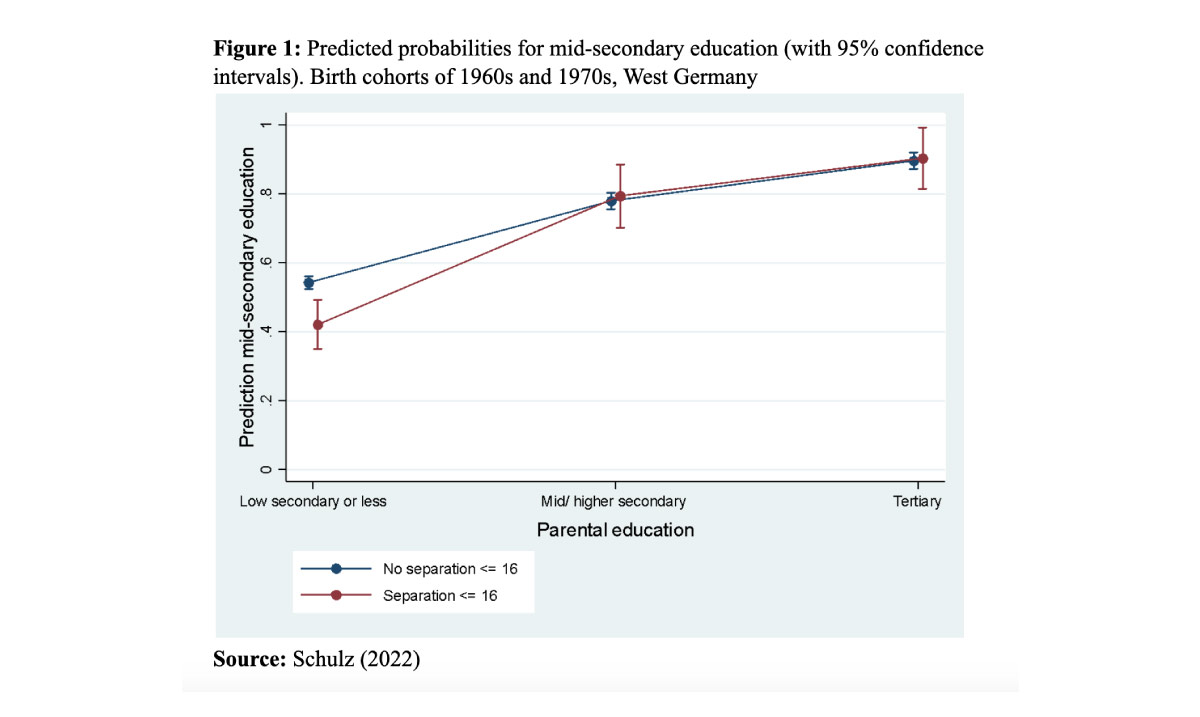
My analysis is based on a sample of 6,855 children born in the 1960s and 1970s in West Germany (German Life History Study). My main finding is that variations in parental separation consequences by parental educational background (the highest level of educational attainment of either mother or father) are in line with the compensation perspective: the consequences of parental separation on completion of mid-secondary education – and also to a certain extent higher-secondary education – were more severe for disadvantaged children, and indeed limited to this group.

Children from low educational backgrounds who experienced parental separation had considerably lower chances of completing mid-secondary education (Figure 1), while for children from mid- and high-educational backgrounds the chances did not vary meaningfully according to separation experience. Hence, for the case of mid-secondary education, the consequences of parental separation were limited to children from low status backgrounds, which provides support for the compensation perspective.
Children from lower educational backgrounds who experienced parental separation were likewise disadvantaged in their chances of completing higher-secondary education, although, in this case, to a much lesser extent. For children from higher status background, parental separation was much less strongly related to their chances of completing higher-secondary education and estimates are statistically insignificant. My conclusion, therefore, is that the “compensation hypothesis” also holds, albeit less so, for higher educational outcomes (see also Figure 2).

Conclusions


Considering more than one educational outcome highlights dynamics linking family processes and inequality that might otherwise go unrecognized. In Germany, a context with a strongly stratified and hierarchically organized education system, only disadvantaged children are adversely affected by separation, particularly at a low threshold (mid-secondary education). These unequal heterogeneous consequences could be missed in studies that focus only on higher levels of educational attainment. More broadly, this suggests that studies examining heterogeneous consequences, for example, regarding well-being and cognitive abilities, should move beyond mean effects and look at various points of the outcome distribution.

References

  • Amato, P.R. (2000). The consequences of divorce for adults and children. Journal of Marriage and Family 62(4): 1269–1287. doi:10.1111/j.1741-3737.2000.01269.x.
  • Bernardi, F. (2014). Compensatory advantage as a mechanism of educational inequality: A Regression Discontinuity based on month of birth. Sociology of Education 87(2): 74–88. doi:10.1177/0038040714524258.
  • Boudon, R. (1998). Social mechanisms without black boxes. In: Hedström, P. and Swedberg, R. (eds.). Social mechanisms: An analytical approach to social theory. Cambridge University Press: 172–203. doi:10.1017/CBO9780511663901.008.
  • Grätz, M. (2015). When Growing Up Without a Parent Does Not Hurt: Parental Separation and the Compensatory Effect of Social Origin. European Sociological Review 1–12. 10.1093/esr/jcv057
  • Schulz, W. (2022). Do the consequences of parental separation for children’s educational success vary by parental education? The role of educational thresholds, Demographic Research, 47, S. 883 – 918. doi:10.4054/DemRes.2022.47.28

Saturday, March 25, 2023

China's Rise to Russia's Most Important Trade Partner

Today [время не стоит на месте], Chinese President Xi Jinping is visiting Putin in the Kremlin as formal talks take place as part of a three-day visit. With the strength of Sino-Russian under strong focus, this infographic shows how crucial China has become to the Russian economy over the last two decades.

Over this period, Russia has continuously expanded the share of its imports from China. As data from the trade portal Germany Trade & Invest (GTAI) shows, the share of the total value of Russia's imports coming from China was around 24 percent before the start of the war. At the beginning of the millennium, Russia still sourced most of its imports from Germany (13.8 percent).

The most important import goods in 2020 included equipment from the field of communications technology as well as equipment for recording and reproducing images and sound. Russia also imports a lot of office machines and machines for automatic data processing. China, for its part, mainly imports crude oil and petroleum products from Russia.China's Rise to Russia's Most Important Trade Partner

Saturday, February 25, 2023

Ukrainians in Germany


Heute jährt sich der Beginn des russischen #Angriffskrieg|s auf die #Ukraine zum ersten Mal. Über 1 Millionen #Geflüchtete haben seit dem Ausbruch in Deutschland Schutz gesucht. Viele von ihnen stammen aus den Regionen Charkiw, Donezk und der Stadt Kiew. #UKRBefragung