Showing posts with label Япония. Show all posts

Monday, March 18, 2024

infection

В Японии распространяется опасная бактериальная инфекция


С начала этого года в Японии было зафиксировано почти 400 случаев «стрептококкового синдрома токсического шока» (STSS). Эта редкая, но крайне опасная бактериальная инфекция распространяется в Японии с рекордной скоростью. В некоторых случаях (около 30%) болезнь заканчивается летальным исходом.

Власти Японии опасаются, что эта тяжелейшая форма стрептококкового заболевания будет распространяться и дальше, пишет Guardian.

«Механизмы, лежащие в основе тяжелых и внезапных форм стрептококковой инфекции, до сих пор остаются неизвестными, и мы еще не достигли той стадии, когда сможем их объяснить», — отмечают в Национальном институт инфекционных заболеваний (NIID).

По данным NIID, в прошлом году в Японии был зарегистрирован 941 случай заболевания STSS. Больше всего подвержены риску пожилые люди, однако штамм этой инфекции приводит к большему количеству смертей и у пациентов моложе 50 лет. В прошлом году из 65 заболевших в возрасте до 50 лет около трети умерли, сообщает японская газета Asahi Shimbun.

Пожилые люди, заболевшие STSS, могут испытывать симптомы, похожие на обычную простуду. В редких случаях симптомы могут усугубляться и приводить к боли в горле, пневмонии или менингиту. В самых тяжёлых случаях может наступить отказ органов.

Стрептококковые инфекции передаются капельным путем и при физическом контакте. Министерство здравоохранения Японии рекомендует соблюдать те же меры предосторожности, которые были частью повседневной жизни во время пандемии коронавируса.

Sunday, December 3, 2023

A new era of opportunities and challenges in aligning with global standards

Japan’s approval of oral abortion pills

Yudai Kaneda https://doi.org/10.1177/17455057231216533

On 28 April 2023, an oral abortion pill was approved for the first time by the Japanese government and is expected to be used to induce abortion care shortly. The prescription of this medication requires an in-hospital waiting period, and for the time being, until an appropriate system for its use is established, it may only be prescribed at medical institutions where inpatient or outpatient care is available. In addition, only obstetricians and gynecologists certified by prefectural medical associations as designated physicians under the Maternal Health Act (MHA) can prescribe this medication to their patients. Induced abortions have been performed so far under the MHA in cases where there is a risk of serious harm to the mother’s health due to physical or financial reasons or when the pregnancy is the result of violent acts or coercion, under the condition that the consent of the spouse is obtained within 22 weeks of conception. It was, therefore, difficult for Japanese mothers to decide whether or not to deliver a baby based solely on their judgment.

The number of abortions in Japan reported in the fiscal year 2021 was 126,174, and early pregnancy terminations have been primarily conducted through curettage and vacuum aspiration, and it has been reported that more than half of abortions in Japan performed are by curettage. However, the World Health Organization (WHO) recommends using vacuum aspiration or abortion pills instead of curettage when performing surgeries associated with abortion or miscarriage. This is because, although rare, there have been reports of significant risks associated with curettage, including heavy bleeding, infections, and uterine wall or intestine perforation. In response, the WHO-recommended plastic manual vacuum aspirator has been approved in Japan, and insurance coverage was applied to miscarriage surgeries using this method in 2018. The approval of the oral abortion pill this time is a catch-up to global standards following the ongoing trend of abortion care.

The approved medication this time was Mefeego Pack, which WHO also designates as an essential medicine for its safety and efficacy. It involves the administration of mifepristone, an anti-progesterone that inhibits the action of progesterone, essential for the maintenance of pregnancy, on the reproductive tract, followed by the intake of misoprostol 36 to 48 h later, which promotes uterine contractions. The target population for this treatment is those with pregnancies less than 9 weeks along, and it is expected to be generally ineligible for insurance coverage. Indeed, the use of oral abortion pills is growing rapidly worldwide thanks to its reported efficacy of more than 97%. For example, in the United States, the Food and Drug Administration approved its use in 2000, and it was reported that in 2020, 53% of abortions in the country were by oral pills. In many European countries, medical abortion is even more prevalent; for instance, in the United Kingdom, 87% of abortions in England and Wales were medically induced, according to the UK Government statistics for 2021. Concerns about side effects such as bleeding and failed abortion exist, but these frequencies are less than 0.05%, and this method is expected to become more common in Japan in the future, given that it imposes less burden on the mother than surgical procedures.

However, there are two concerns at the current stage. The first is the issue of cost. As induced abortions are typically not covered by public insurance and are treated as elective care in Japan, the cost of medication-induced abortions will be determined by individual medical institutions. Therefore, the Japan Society of Obstetrics and Gynecology has reported that the price of the medication is expected to be around $370, and when combined with consultation and hospitalization fees, the total cost could reach a substantial sum of approximately $740. The second is the barrier to access to medical services for performing abortions. In Japan, obstetrician-gynecologists who meet the criteria to be designated under the MHA to prescribe Mefeego Pack are facing a severe shortage, and there is even a trend of obstetrics and gynecology hospitals in rural areas closing down. As a result, it may be difficult, especially in rural areas, to access appropriate medical services nearby. Furthermore, the social stigma surrounding abortion, independent of the method used to induce it, could potentially lead to psychological distress and fears of being stigmatized, causing those seeking abortions to hesitate to visit hospitals. Therefore, prompt efforts to address these issues are required.

One potential solution to these problems is the introduction of online medical consultations. This is because telemedicine is less constrained by distance and time, allowing it to expand access to healthcare in rural areas and bridge the gap between rural areas and specialized healthcare providers. Indeed, telemedicine can reduce labor costs, travel expenses, and other costs; an average saving of around $230 per abortion has been reported in the United Kingdom, where the process involves assessment and counseling by telephone or virtual consultation, followed by prescription by a doctor and delivery by post or collection. Likewise, in countries such as France and the United States, similar methods of remote consultation are used, rather than prescribing abortion pills directly online, and as shown in Forward Midwifery, where services are offered for as low as $150, this approach can be a viable option for those with low or no income. In addition, telemedicine provides a simple and private way to access abortion care, helping to lower the psychological barriers to visiting a hospital for an abortion. Therefore, with an appropriate healthcare system, telemedicine abortion is a potentially cost-effective, safe, and secure means of providing care; thus, the Japanese government must raise awareness of these advantages.

On the other hand, it is also important to recognize that online medical consultations possess certain limitations. Abortion often involves intense psychological suffering, for which the physical presence of a healthcare provider or in-person care may be preferable. In this context, alternatives must be considered, such as the provision of services by other trained health professionals or the establishment of medical centers in isolated regions. 

Nevertheless, despite these inherent challenges, telemedicine offers clear advantages in terms of accessibility and cost-effectiveness, and these strengths may be especially  advantageous in Japan, where rising healthcare costs and uneven distribution of healthcare providers, particularly physicians, are major issues, and therefore, an active discussion is needed for its introduction.

Fortunately, online medical consultations have evolved and become widely accepted over the 3 years of the COVID-19 pandemic. Expanding appropriate prescription of abortion medication not only protects the health of women who have no choice but to choose abortion but also safeguards the right to self-determination whether or not to give birth. Of note, approximately 73 million abortions are performed worldwide annually, and global estimates suggest that 45% of induced abortions are unsafe. Therefore, it is essential for Japan and other countries to build a consensus for telemedicine abortion based on recommendations and scientific evidence within international coordination and to find ways to prudently expand its practical use so that any person can choose an oral abortion.

тут со сносками и ссылками

Tuesday, February 21, 2023

Japan plans to raise age of consent

В Японии планируют поднять возраст сексуального согласия с 13 до 16 лет


Это предложение содержится в пакете дополнений и поправок к законам о сексуальных преступлениях, который одобрила рабочая группа министерства юстиции.

Нынешний возраст согласия в Японии - самый низкий среди развитых стран, в том числе стран "большой семерки", куда входит и Япония.

В большинстве этих стран возраст согласия установлен на уровне 14-16 лет. В Германии и Италии, например, возраст согласия - 14 лет, во Франции и Греции - 15, в Британии и многих штатах США - 16. В России - тоже 16 лет.

В Японии, подняв возраст согласия, собираются оставить одно исключение: наказуемым не будет секс между людьми, которым не меньше 13 лет, и у которых разница в возрасте составляет не больше пяти лет - то есть, речь прежде всего о сексе между тинейджерами.

Среди других изменений, которые Япония готовится внести в свои законы о сексуальных преступлениях - криминализация сексуальной эксплуатации несовершеннолетних и расширение понятия "изнасилование".

Monday, December 6, 2021

Inside the 80-Year Quest to Name Pearl Harbor's Unknown Victims

Eighty Years After Pearl Harbor, Two Brothers Are Identified By DNA

BY W.J. HENNIGAN NOVEMBER 23, 2021

The seven sailors point their rifles skyward and fire three times in unison, shattering the silence at the National Memorial Cemetery of the Pacific. The military salute signifies the end of an 80-year-old mystery that traces back to Dec. 7, 1941, the beginning of America’s involvement in World War II.

Navy sailors Harold and William Trapp were presumed killed when their battleship U.S.S. Oklahoma was hit by Japanese torpedoes and capsized in Pearl Harbor. The Trapp family waited for weeks, months, then years as the military worked to find the brothers’ remains and send them home. But there were few intact bodies left in the water that day, and as time went on, the remains aboard the Oklahoma mixed together.

The U.S. Navy declared the brothers dead despite never identifying them, a fate shared by most of the 429 sailors and Marines killed aboard the ship. Bound by the forensic limitations of the era, the military collected their remains and buried them in 46 common graves in the Honolulu cemetery under granite headstones that read: UNKNOWN.

Now, eight decades later, the Trapp brothers and their shipmates are being laid to rest in graves bearing their own names. Over the past six years, an obscure unit inside the Pentagon called the Defense POW/MIA Accounting Agency (DPAA) has identified 361 men killed aboard the Oklahoma. One by one, the graves have been exhumed, the remains analyzed and identified with advances in DNA technology and science. The military hopes the Oklahoma project, completed this year, could serve as a model for identifying remains of other soldiers, killed in other wars. Based on its success, the DPAA believes there could soon be a day without any “unknown” military graves.

On June 15, a bright, clear day at the cemetery known as the Punchbowl, the Trapp brothers are buried with full military honors in a ceremony attended by family members never given the chance to meet Harold and William. “I don’t think people understand what it means to have somebody who has been unidentified,” says Carol Sowar, the brothers’ niece. “Unless you go through it personally, you just have no idea what it means to have this closure.”

Carol Sowar receives an American flag at her uncles’ funeral at the national cemetery in Honolulu Tech. Sgt. Rusty Frank—U.S. Air Force/Department of Defense

Harold was born in December 1916 on the northside of Chicago. William came 13 months later. They, along with their kid sister and Sowar’s mother, Irene, were raised 65 miles east in the rural town of La Porte, Ind., after their parents sought a slower pace of life for their family. Harold was serious and thoughtful, with aspirations of becoming an engineer. William, meanwhile, was more happy-go-lucky and free-spirited.

The brothers were inseparable. Nearly every family photo shows them together—Harold, a head-taller than William—and if one of them isn’t in the picture, it’s usually because he’s the one taking it. The brothers took odd jobs together, picking fruit, caddying at the local golf club or trapping muskrats and selling the fur. So, on May 4, 1939, when William chose to enlist in the Navy, Harold joined him.

It wasn’t uncommon at the time for family members who enlisted together to serve in the same unit or on the same ship. The brothers each went through training in their respective specialties. William, an electrician’s mate, reported for duty aboard the Oklahoma in August 1939 and Harold, a fire controlman, followed eight months later. By that time, the ship was beginning to conduct exercises off Hawaii. The brothers sent photos back home showing their delight with their new island life: wearing leis around their necks, balancing pineapples in the palms of their hands or standing triumphant atop a windswept mountain.

On the morning of Dec. 7, 1941, Harold, 24, was on deck of the Oklahoma while William, 23, was working below, according to their family. The ship was moored in the shallows of Pearl Harbor’s “Battleship Row,” and unbeknownst to the brothers, formations of Japanese dive bombers, torpedo planes and fighters were already headed their way.

A little before 8 a.m., the first torpedo exploded into the side of the ship. Plumes of water climbed into the air as more torpedoes tore into the ship’s steel hull. The Oklahoma’s crew manned battle stations and tried to fight back, but it had been hit eight times within the first ten minutes. The ship listed and capsized when the ninth—and final—torpedo struck.

Sailors jumped into the scalding, oil-slick water to avoid strafing runs. Some climbed across mooring lines to reach the nearby U.S.S. Maryland. When the bombs stopped finally dropping, the Japanese damaged or sank 21 ships. A total of 2,403 Americans died, 429 of which had been aboard the Oklahoma and 1,177 on the U.S.S. Arizona, the wreckage of which still lies in Pearl Harbor to this day.

Typically, the Navy would not have attempted to recover the victims. The remains aboard the sunken Arizona, for instance, stayed with the ship. “That becomes their final resting place. It’s kind of like being buried at sea,” says Johnie Webb, director of outreach at DPAA. But because much of the Oklahoma was intact and there were sailors trapped alive inside, Webb explains, the Navy believed it might be able to salvage the ship and save the survivors.

Indeed, rescuers drilled holes and saved 32 men. Later, Navy personnel worked to recover the fallen crew from December 1941 to June 1944. But as the remains came in, laboratory staff was only able to identify 35 men. The rest were ultimately buried in mass graves at the Punchbowl. The Trapps were one of at least eight sets of brothers killed aboard the Oklahoma. “I just felt for those families,” Webb says. “It’s bad enough to lose one son, but to lose two or three in some cases… I can’t imagine the grief that they had to live with.”

From left: Harold Trapp, mother Lillie Trapp, father William E. Trapp, William Trapp, and family friend Lambert Zeephat in August 1939

The attack on Pearl Harbor occurred nine years before Carol Sowar was born, but in many ways, it shaped the course of her life. An entire side of the family was simply wiped out: no aunts, uncles nor cousins. There was a lasting sadness. Her mother, Irene Louise Trapp, grieved her older brothers’ deaths until she, herself, died in 2007.

After their deaths, the family revered Harold and William. Photos of them were preserved like relics. They were gone, no doubt. But where? Were they at the bottom of Pearl Harbor? Or in an anonymous grave?

The questions loomed for decades over Ray Emory, a Pearl Harbor survivor aboard the U.S.S. Honolulu hit the same day the Trapp brothers likely died. He spent much of his life pushing the U.S. military to identify the unknown remains. In 2003, after years of research, Emory approached the military with folders containing sailors’ personal information. Armed with service records, dental scans and other evidence, he was convinced that modern science could identify remains of at least one of the buried service members. The military agreed to investigate.

The first grave was exhumed that year and researchers were stunned to discover DNA signatures of more than 100 people in a single casket. The military made its first individual identification in 2008 and ID’d four more sailors over the next two years.

The findings showed the promise of DNA and advances in dental, anthropological and genetic evidence in identifying the lost sailors, giving hope to hundreds of families living in limbo. But the Navy was against DNA testing on the Oklahoma, not wanting to raise the expectations of gold-star families only to let them down. Over time, the innovations and reliability in DNA technology could not be ignored. In 2015, the Pentagon overruled the service and instructed the caskets to be disinterred and identified using the latest DNA technology.

The exhumation of the Oklahoma victims took place between June and November 2015 and went through analysis at the DPAA laboratories at Joint Base Pearl Harbor-Hickam, Hawaii, and at Offutt Air Force Base in Nebraska. The two labs, staffed by anthropologists, archaeologists and forensic odontologists, comprise the largest skeletal identification facilities in the world.

Forensic scientists cut postage stamp–size samples in bones and Tic Tac–size wedges from teeth and send them to the Armed Forces DNA Identification Laboratory in Dover, Del., for testing. Once extracted, the DNA is compared to reference samples from cheek swabs provided by living family members who are maternally related to the missing service member. The DPAA, which has been at work identifying remains not just from Pearl Harbor but all American wars beginning with World War II, maintains massive DNA banks. The agency uses DNA in about three-quarters of its cases.

The agency did not have all the family reference samples from the Oklahoma. Some of the service members had no living descendants or were adopted; or family members simply never submitted. The DPAA ultimately identified 361 of the 394 unknown service members aboard, which is a 92% success rate. Most of the identified sailors and Marines were buried in the Punchbowl or in their hometowns.

To identify William and Harold’s remains, DPAA researchers used mitochondrial DNA from Sowar, her brother and her two children, who all gave samples. Scientists then had to tell how each of bones that was a DNA match to the family belonged to each brother. “We were able to use dental as well as anthropological methods to individuate the brothers,” says Debra Prince Zinni, the DPAA laboratory deputy director. “We knew dentally, which skull belonged to which brother. And then the stature really came into play. Harold is several inches taller than William, so just from the length of the bones, we were able to determine which brother was which.”

When the call finally came to Sowar in November 2020, she was dumbfounded. She was sad, of course, but also relieved to have certainty about her uncles’ fates. She thought of her mother, who would never have that satisfaction, and of her grandmother, who lived out the rest of her life without her two boys. “I just cried and cried and cried from relief,” Sowar says.

After she watches her uncles laid to rest under their own headstones at the Punchbowl, Sowar feels as though she’s reached the finish line of a marathon. “I don’t know how I can explain it better than I feel… that this is where they belong,” she says. “And yes, it’s 80 years, and it took a long time to come home, but they’re home.”

Shortly after the ceremony, Sowar walks into the cemetery’s Courts of the Missing, which documents each service member who went missing-in-action fighting America’s wars throughout the Pacific. Standing in the afternoon sunlight, she scans the thousands of names chiseled into the stone walls until her eyes fall on her uncles’. There, next to each one, she places a gold rosette. The two men are now accounted for.

With reporting by Nik Popli

Monday, August 16, 2021

The Biggest Gold Medal Hauls at the Tokyo Olympics

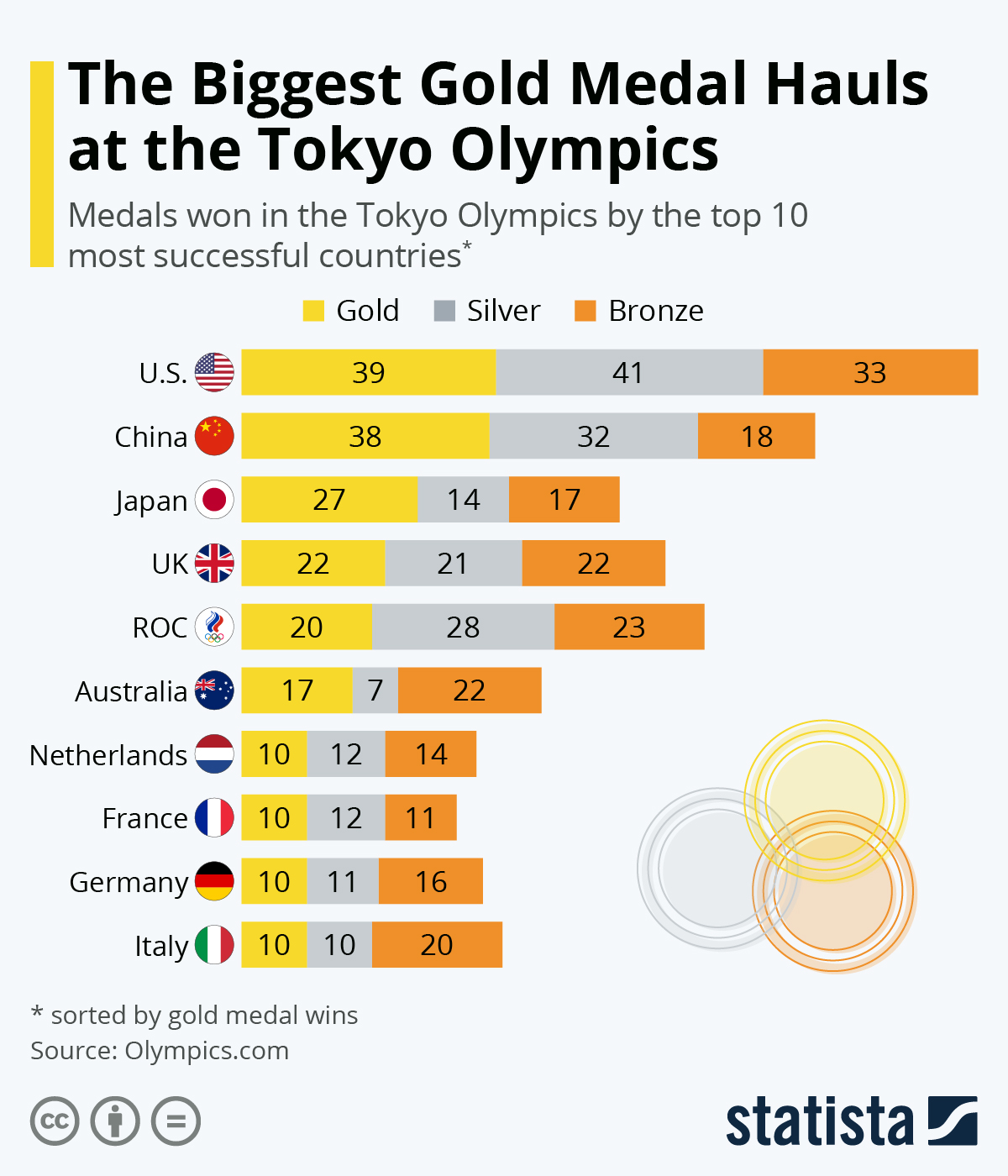
After the two countries had been going head-to-head for the last week of the Tokyo Olympics, the U.S. beat China as the most successful nation at this year’s Olympic Games. The country clenched 113 medals in total, 39 of them gold medals, ahead of China's 88 medals (38 golden ones).

China has only once become the most successful nation at a Summer Olympic Games. At home in Beijing in 2008, Chinese athletes dominated gold medal wins, but even then, the U.S. won more medals in total - 112 - over China's 100.

China won most gold medals this year in weightlifting (7), followed by diving (5), shooting (4) and table tennis (4). The medal count also includes surprise wins, like Zhang Yufei’s gold in the 200m butterfly competition or another swimming victory in the 4x200m freestyle relay.

The United States' strong suits continue to be swimming and athletics with eleven and seven gold medals won, respectively.

Host Japan comes third for most gold medals, but fifth behind Russia and the UK for overall medals. After three gold medals for skateboarding, the country won both the baseball and the softball finals as well as hauling home nine gold medals in judo, five in wrestling and one in karate.Infographic: The Biggest Gold Medal Hauls at the Tokyo Olympics | Statista

Monday, April 26, 2021

MARRIAGE COUNTERFACTUALS IN JAPAN

VARIATION BY GENDER, MARITAL STATUS, AND TIME


Family demographers have long been interested in the debate surrounding changes in the marriage institution, associated with concepts such as the deinstitutionalization of marriage and the Second Demographic Transition. These perspectives focus on alternatives to traditional heterosexual marriage (what can be termed the external context of marriage), such as lifetime singlehood, same-sex marriage, and non-marital cohabitation. In research co-authored with Erik Bond and Ann Beutel, recently published in Demographic Research, we take a different perspective on this debate by focusing on what we term the internal context of marriage, or how social, economic, psychological, and personal dimensions of the marriage experience are perceived by relevant stakeholders (i.e., men and women, comparing those currently married vs. never married).

Using cross-sectional Japanese data from the 1994 National Survey on Work and Family Life and the 2000 and 2009 National Survey of Family and Economic Conditions (NSFEC) (combined N = 8,467), we construct unique measures of this internal context, which we call “marriage counterfactuals”. These measures gauge how people perceive that marriage, or the lack thereof, may have altered their lives.

Why Japan?


Japan is an interesting setting for several reasons. Being the first non-Western country to industrialize, it experienced many of the same economic changes and some similar demographic changes as those in the West (e.g., increasing delays in marriage and rates of lifetime singlehood). However, unlike Western countries, Japan witnessed limited changes in some other social spheres. One notable example here is the family sphere – engagement in alternatives to traditional marriage remains rather culturally limited or legally unavailable (as in the case of same-sex marriage).

Japan is also an interesting setting because it maintains a highly gendered division of household labor within marriage, with men still playing the role of intensive breadwinner and women the role of homemaker. Starting in the 1990s, a time period covered by our data, the Japanese economy experienced a significant downturn and prolonged recession. Ensuing changes in the labor market made it difficult for young men to find suitable employment to realize the breadwinner role.

Because marriage and fertility in Japan are closely related, failure to realize marital intentions is concomitantly linked to failure to meet fertility intentions. Having a fertility rate that is well below replacement level for many decades, and facing the reality of having one of the oldest population age structures in the world has significant implications for Japan’s demographic future. Thus, understanding how relevant stakeholders perceive marriage in Japan’s marriage market (especially during a period of considerable economic change and labor market restructuring) is of considerable interest.

Analytical Strategy for the Study


Our sample consisted of people aged 20 to 49. The marriage counterfactual measures used for our study came from a series of survey items that asked respondents to indicate how they perceived that their life would be different (on five dimensions, captured by separate survey items) if they had a marital status that differed from the one they held at the time of the survey. These items concerned change in dimensions such as social respect, emotional security, living standard, freedom, and overall satisfaction. Specifically, married respondents were asked to imagine their life (on the above dimensions) if they had gone unmarried. Non-married respondents, in turn, were to imagine what it would be like to be married. Previously-married respondents were not used in the analysis as they were not asked these questions.

These variables were measured on a 5-point Likert scale, with the following categories: “Much Worse,” “Somewhat Worse,” “Same,” “Somewhat Better,” and “Much Better.” To facilitate the analysis of the pooled data, we coded the variables so that higher values indicate that married life is viewed more as a benefit than single life, and lower values indicate the reverse (that married life is viewed more as a cost than single life). To avoid awkward phrasing, as a shorthand, we use terminology related to the idea of “benefits of marriage” to describe our results.

Findings Related to Marriage Counterfactuals


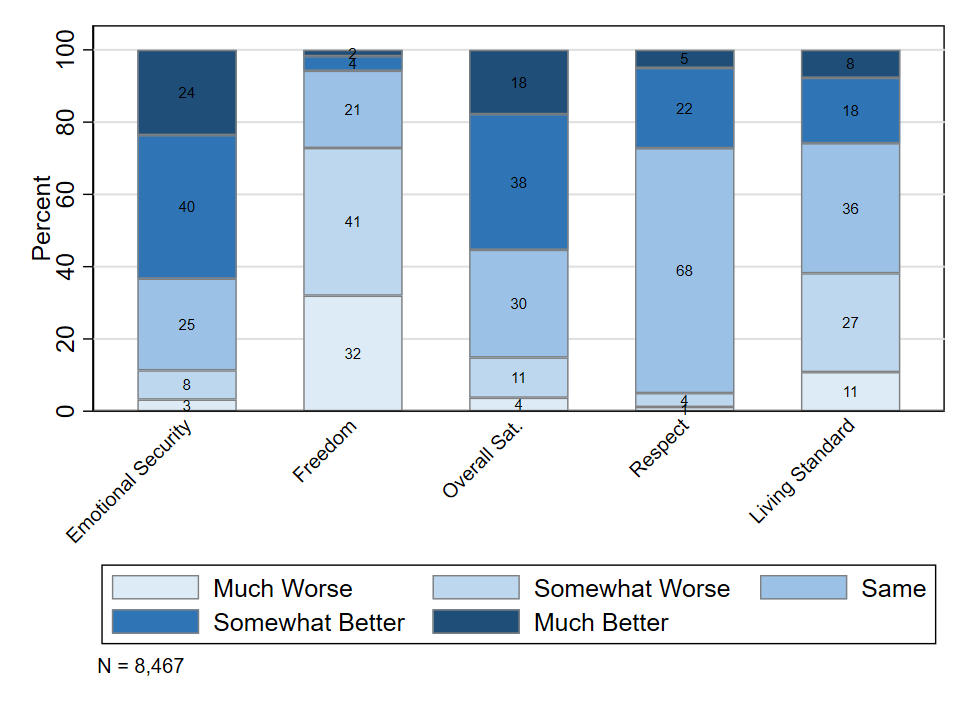
Figures 1 through 3 show the distribution of marriage counterfactual measures for, respectively, the full sample, by marital status, and by gender.

For the entire sample (Figure 1), as well as across marital statuses and genders, respondents generally perceived ’emotional security’ and ‘overall satisfaction’ as benefits of being married, ‘personal freedom’ as a cost of being married, and ‘respect from others’ as unaffected by marriage. Compared to never-married respondents, currently married respondents were more likely to see ‘living standard’ as a marriage benefit (Figure 2). In comparison to women (Figure 3), men were more apt to view ‘respect’ and ‘emotional security’ as marriage benefits, while women perceived ‘standard of living’ as more of a benefit (consistent with the prevalence of the man-as-breadwinner/woman-as-homemaker household division of labor and the Japanese labor market’s general discriminatory environment toward women).

Figure 1. Distribution of Counterfactual Marriage Measures

Figure 2. Distribution of Marriage Counterfactual Measures by Marital Status

Figure 3. Distribution of Marriage Counterfactual Measures by Gender

Logistic Regression Analysis


We also conducted a series of ordered logistic regression models to examine the determinants of the marriage counterfactual measures, the dependent variables in our analysis. The main independent variables of interest were measures of gender, marital status, and time period; we also controlled for education, employment status, urban upbringing, and home-ownership. We estimated models for the pooled sample as well as separate models by gender and by marital status. More detailed results are available in the article version of our research.

Our main findings were that perceptions of the marital benefits worsened over time. This is consistent with deteriorating economic conditions and the general assertion that marriage and work/the division of labor are deeply connected in Japanese society. Furthermore, never-married respondents tended to view marriage in more favorable terms than their married counterparts (particularly with regard to freedom and respect from others). Finally, with the exception of the standard of living dimension, men viewed marriage benefits more favorably than women. However, to our surprise considering the man-as-breadwinner role, we find that both men and women viewed marriage benefits less favorably. This may be a result of the general worsening of the marriage market in Japan related to the deteriorating economic situation or to rising income among single women.

Conclusions


Based on our research, we end with four concluding thoughts.

First, despite some dimensions of marriage continuing to be viewed in favorable terms, the key change is that marriage benefits are being viewed less positively over time. In conjunction with other research on family-related attitudes in Japan, this suggests that ideas about marriage there are experiencing substantive change. Thus, it is especially important to consider, as we have, the marital perceptions not only of those who are already married, but also of those who will shape the future of the institution: the not-yet-married.

Second, the internal context of marriage – perceptions of standard of living, respect from others, emotional security, freedom, and overall satisfaction – are important and generally overlooked aspects of the marriage institution. The focus on the external context of marriage and the preoccupation with marriage deinstitutionalization, as well as diversity in family forms, largely ignores these factors, giving an incomplete picture of changes in modern marriage.

Third, gender differences in our analysis make it clear that the traditional division of household labor (i.e., the man-as-breadwinner/woman-as-homemaker model) continues to be influential in Japan.

Fourth, relatedly, in spite of structural changes to the economy and labor market, cultural beliefs regarding traditional marriage persist. We wonder whether this situation will continue or whether, conversely, new partnership forms will begin to gain ground in Japan, a place where such alternatives currently go against the cultural grain.

Authres' Short Bio


Martin Piotrowski is an Associate Professor of Sociology at the University of Oklahoma. He received his PhD in sociology from the University of North Carolina at Chapel Hill and was trained at the Carolina Population Center (CPC). His research focuses on aspects of rural-to-urban migration, marriage and fertility, and familial and gender attitudes especially in parts of Asia and most recently parts of Europe. He has done research in several countries including Thailand, Nepal, China, Japan, and Poland and has explored topics involving inter-generational and family relations, household structures, and life course transitions. He has published widely in sociology, family, and demography journals.

Erik Bond is an Assistant Professor of Sociology at Miyazaki International College. He received his PhD in sociology from the University of Oklahoma. His research has focused on marital and gender attitudes in Japan and international-comparative contexts, particularly as they interplay with macro cultural, labor, and policy regimes over time. He has special interest in the use of novel statistical methods for revealing latent values in large data sets. He also works as an LGBTQ+ and diversity advocate in southern Japan.

Ann M. Beutel is an Associate Professor of Sociology at the University of Oklahoma. She received her PhD in sociology from the University of Minnesota. Her research has focused on the influence of social location on values, attitudes, and expectations of adolescents and adults and on the relationship between gender and experiences in education and the labor market. She has carried out her research using data from a number of countries, including the United States, Nepal, South Africa, and Japan.

Monday, April 19, 2021

Demographic transition in Japan

Демографическая контрреволюция в Японии


[название оригинальное, но почему контрреволюция — не понял, видимо, неспециальный смысл]
Троицкий вариант, 06.04.2021 / № 326 / с. 13 / Александр Мещеряков

Япония сейчас входит в число стран c наиболее высокой продолжительностью жизни (81 год для мужчин и 87 для женщин) и наиболее низкой рождаемостью в мире (1,4 ребенка на одну женщину). Однако в совсем недалекое по историческим меркам время эти показатели были совершенно другими. Почему же Япония превратилась в страну малодетных?

В результате поражения во Второй мировой войне Япония в одночасье лишилась колоний и отказалась от экспансионистских устремлений. Страна была оккупирована американской армией, лежала в руинах, большинство крупных городов было разбомблено, ощущалась острая нехватка всех жизненно важных ресурсов. Люди подголадывали. Если бы не поставки из Америки, в стране разразился бы настоящий голод.

Продовольственный кризис осложнялся демографической ситуацией. Из бывших колоний и с линии фронта на родину вернулось около 7 млн человек (конечно, в основном мужчины). Перепись 1947 года насчитала 78 101 473 японца. Их количество стремительно увеличивалось: с 1947 по 1949 год появлялось на свет около 2 млн 700 тыс. младенцев ежегодно. Эти «отложенные рождения» быстро компенсировали военные потери Японии (около 3 млн человек), но значительно влияли на уровень благосостояния (а в то время — скорее бедности) людей.

В других странах, принимавших участие в войне, рождаемость тоже резко повысилась. Поскольку это происходило на фоне экономической разрухи и нехватки продовольствия, стали часто говорить о перенаселенности земного шара. Это мнение активно обсуждалось и в Японии. В предвоенные и военные годы деятельность активистов движения за снижение рождаемости находилась под запретом. Официальная демографическая политика тоталитарной Японии состояла в поощрении рождаемости, ибо экспансионистские проекты государства требовали всё больше людей. Однако теперь обстоятельства изменились.

Решением стран антигитлеровской и антияпонской коалиции выезд за пределы страны был строго ограничен, поэтому Япония была лишена возможности решать свои демографические проблемы за счет эмиграции. Американская оккупационная администрация во главе с генералом Дугласом Макартуром внимательно следила за всем, что происходило в стране. Демографическая ситуация не была исключением. Во время неформальных контактов с местной политической элитой американцы убеждали ее в необходимости активной демографической политики, направленной на ограничение рождаемости.

Американцы не проводили масштабной чистки среди японских государственных служащих, многие сохранили свои должности и в государственном аппарате «новой» Японии. Хотя совсем недавно они ратовали за увеличение рождаемости, большинство из них поддалось уговорам и согласилось, что насущной необходимостью является совсем иная демографическая политика. Государственный Институт демографических проблем тоже не стал упрямиться: изменил свою демографическую ориентацию и приступил к разработке мер по сокращению рождаемости. Менялись времена, менялись и люди.

В 1948 году были разрешены аборты (раньше они допускались только в случае ограниченного круга наследственных заболеваний, главным образом психических). В 1949 году этот закон был дополнен: он разрешал прерывание беременности «по экономическим основаниям». Таким образом, Япония продемонстрировала небывалую смелость и стала первой страной в мире, где бедность признавалась достаточным основанием для аборта. С самых высоких трибун утверждалось, что снятие запрета на аборты самым благоприятным образом повлияет на состояние нации. Раньше дети рассматривались как будущие солдаты и рабочие, теперь на них стали смотреть как на обузу и иждивенцев, помеху для экономического развития и завтрашних нищих, требующих расходов и опеки со стороны государства.

Японкам в одночасье было даровано сверху то право, за которое на Западе феминистские движения боролись десятилетиями. Законопроект был одобрен единогласно, хотя в то время политические партии редко соглашались друг с другом. Одновременно развернулась и мощная пропагандистская кампания в пользу ограничения рождаемости.

Американская оккупационная администрация воздерживалась от официальных заявлений по поводу демографических вопросов, утверждая, что они находятся в компетенции самих японцев. По всей вероятности, такая «нейтральная» позиция была обусловлена особой деликатностью проблемы, решение которой предполагало не просто сокращение рождаемости, а разрушение дорогих сердцу японца поведенческих стереотипов. Главный из них состоял в том, что много детей — это хорошо.

В качестве советника американской администрации привлекли знаменитого ученого Уоррена Томпсона, одного из основных авторов теории демографического перехода, согласно которой индустриализация приводит к одновременному падению рождаемости и смертности. В марте 1949 года Томпсон выступил в Японии с заявлением о необходимости контроля над рождаемостью. Главный аргумент состоял в том, что многодетность мешает развитию страны, а именно развитие экономики и сопутствующее ей повышение жизненного уровня стали стержнем новой «демократической» Японии. Томпсон высказал и прямые угрозы: если японцы не снизят рождаемость, это может привести или к прекращению продовольственной помощи США, или к коммунизму, или к возрождению милитаризма.

Заявление Томпсона преподносилось оккупационной администрацией как «личное мнение», но справедливо воспринималось японцами как ее официальный курс. Если до этого времени крупные газеты позволяли себе публиковать разные точки зрения по демографическим проблемам, то теперь право голоса предоставлялось по преимуществу проповедникам идеологии «планирования семьи». Все они исходили из тезиса о перенаселенности Японии, которое имеет множество отрицательных последствий. Утверждалось, что понижение рождаемости предотвратит безработицу, поможет женщине обрести свое «я», лишит жадных капиталистов избыточной рабочей силы и избыточной прибыли, предотвратит «отрицательный отбор» (ввиду того, что «низы общества» сократят свое неконтролируемое размножение) и т. д. Иными словами, мыслители самого разного толка были уверены в окончательном выводе, но обосновывали его по-разному.
japanese family
Японская семья (1950-е годы). Vintage Japan-esque/Flickr, CC BY-NC-SA 2.0

Реклама противозачаточных средств заняла видное место на страницах газет и журналов. Супружеские пары с двумя детьми ставились в образец, их называли «культурными людьми». Тех же, кто противился сокращению рождаемости, квалифицировали как «безответственных». Средства массовой информации утверждали: важен не размер семьи, а ее финансовая стабильность, здоровье, культурный и образовательный уровень детей. До войны многодетные семьи награждали грамотами, теперь эта практика была упразднена. Пособия и льготы для многодетных тоже отменили.

Пропагандистская кампания предусматривала участие акушерок и медсестер, которые обходили дома жителей, убеждая их в необходимости «планирования семьи». На крупных предприятиях в конверт с зарплатой вкладывали материалы, разъясняющие преимущества маленькой семьи. Члены движения за ограничение рождаемости торговали презервативами по оптовым ценам и рисовали образ счастливой семьи, состоящей из двух родителей и двух детей. Иными словами, произошел колоссальный отход от ценностей довоенного и военного времени. Тогда ценилась мощь государства, а «эгоистичного» японца пугали лозунгом: «Роскошь — наш враг». Те годы характеризовались в государственном дискурсе презрением к «гнилой» интеллигенции: считалось, что здоровые, послушные, многодетные и малообразованные крестьяне являются стержнем государства. Теперь же во главу угла поставили образование, а в экономической сфере был взят курс на уничтожение сельского хозяйства и крестьянства. Ставку сделали на развитие науки и наукоемкого производства с высокой добавленной стоимостью.

До войны рождение ребенка рассматривалось как служение родине, теперь же говорили о совпадении интересов семьи и государства. Разница в подходах была колоссальной, но не вызывает сомнения и преемственность: и в том и в другом случае государство выступало в качестве «мудрой» направляющей и дисциплинирующей силы.

Разумеется, разрушение привычного порядка не могло не вызвать и определенного противодействия.

Японские коммунисты поначалу поддерживали новую демографическую политику, но затем склонились к точке зрения, которая была распространена в СССР. Учение Маркса и Ленина предполагало, что абсолютной перенаселенности, о которой говорил еще Мальтус, не существует, есть лишь «относительная» перенаселенность, обусловленная «звериной» природой капитализма, заинтересованного в безработице. Эта перенаселенность легко преодолевается в «передовом» социалистическом обществе с помощью установления «справедливых» общественных отношений и «справедливого» распределения материальных благ. Понятие «мальтузианство» употреблялось в советском дискурсе исключительно как бранное и квалифицировалось как «система человеконенавистнических взглядов». На этом основании японские коммунисты, которые в то время еще смотрели на Кремль как на светоч, стали обвинять японскую политическую элиту в мальтузианстве, настаивая на том, что вопрос о количестве детей в семье является делом свободного выбора.

Однако курс правительства оставался прежним. Задачей номер один считался срочный подъем жизненного уровня. Он воспринимался не только как важнейший показатель «цивилизованного» государства, но и как щит против коммунистов, которые пользовались тогда большим влиянием.

Некоторые уважаемые и вполне «системные» люди тоже высказывали опасения относительно новшеств в семейной политике. Однако если рассматривать ситуацию в целом, оппонентов политики снижения рождаемости оказалось на удивление мало, и японцы в очередной раз продемонстрировали уникальную подверженность правительственной пропаганде. Даже после вчистую проигранной войны среди населения сохранялась исключительно высокая степень доверия к правительству и его инициативам — независимо от их качества.

Разъяснительная работа и пропаганда принесли ошеломляющие результаты: беби-бум удалось остановить по историческим меркам почти мгновенно. Всего через три года с начала кампании за малодетность, в 1952 году, суммарный коэффициент рождаемости (средняя фертильность женщины) упал с 4,6 до менее чем трех детей. Если в 1947 году рождаемость составляла 34 промилле, то в 1957-м — ровно вдвое меньше, а рождаемость к этому времени упала до уровня простого воспроизводства и составила чуть более двух детей на одну женщину.

Внедрение противозачаточных средств в повседневную жизнь происходило медленно. Так что уменьшение рождаемости произошло в первую очередь за счет увеличения числа абортов: их ежегодное количество возросло со 101 тыс. в 1949 году до 1 млн 170 тыс. в 1955 году. Злые языки утверждали, что молодые женщины расценивают поход в абортарий точно так же, как визит к парикмахеру.

Постепенно увеличивалось и применение противозачаточных средств, которые стали вытеснять аборты как средство планирования семьи. Если в 1950 году их использовали 19,5% женщин в возрасте до 50 лет, то в 1957 году таковых стало 40%. В основном они полагались на крайне ненадежные презервативы. Противозачаточные пилюли были разрешены только в 1999 году.

Ни в одной стране мира переход к обществу с низкой рождаемостью и низкой смертностью не произошел с такой скоростью, как в Японии. При этом правительство не прибегало ни к каким запретительным мерам (как это произошло впоследствии в Китае), дискриминации многодетных семей тоже не проводилось. Управление репродуктивным поведением населения ограничивалось словесным воздействием, своего рода лингвистическим программированием. «Демографической революцией» принято именовать стремительный рост населения. Под это определение подпадает Япония конца XIX — начала ХХ веков, когда всего за три десятка лет ее население возросло с 35 до 55 млн человек. В послевоенной же Японии случилась демографическая контрреволюция.

Радикальное снижение рождаемости сопровождалось экономическим подъемом, ростом благосостояния и продолжительности жизни. Если в 1947 году продолжительность жизни составляла 50 лет (мужчины) и 54 года (женщины), то в 1957 году эти показатели возросли до 64 и 68 лет. Япония совершила фантастический рывок в экономике. Но сама жизнь стала совсем другой.

Демографическая контрреволюция привела к колоссальным изменениям в японском обществе. Это касается не только численного состава семьи, но и картины мира в целом. В 1950 году 67% родителей рассчитывали на помощь детей в пожилом возрасте, в 1963-м — 33%, а в ­1975-м — 26%. Поскольку детей становилось всё меньше, они становились всё более эгоистичными. Если раньше в паре родители — дети главенствующее положение занимали родители, о которых были обязаны заботиться выросшие дети, то теперь родители вкладывали всё больше средств в немногочисленных детей, главной обязанностью которых было хорошо учиться.

Прогресс восторжествовал, «косные» ценности были побеждены, количество домов престарелых постоянно увеличивалось. Послевоенная демографическая политика предполагала сокращение числа иждивенцев за счет снижения рождаемости. Однако в настоящее время число иждивенцев всё равно стремительно растет ввиду быстрого старения нации.

Распад традиционной семьи не означал, что семья как высочайшая идеологическая ценность перестала быть идеалом. Государство перестало восприниматься как семья во главе с императором (что было характерно для довоенной Японии), но эта семейная метафора перекочевала в производственные отношения. Именно после войны расцвела японская концепция менеджмента: фирма — это семья с пожизненным наймом и «родственным» участием в прибылях. Поскольку метафора распространялась прежде всего на мужчин (участие женщин в производственной деятельности оставалось ограниченным), то это было лишь подобие семьи, ее суррогат. Предназначение традиционной семьи — принесение потомства; псевдосемья порождает товары и услуги. В том числе и для детей, которые все-таки увидели этот свет.

Sunday, September 15, 2019

traditional values

Ах, если бы знать,
Что старость идёт по пятам...
Закрыть бы ворота,
Ответить, что дома нет никого —
И с ней никогда б не встречаться

老いらくの 来むと知りせば 門さして なしと答へて あはざらましを
оираку-но/ кому-то сирисэба/ кадо саситэ/ наси-то котаэтэ/ авадзарамасио

Главной эстетической категорией в поэзии того времени было «моно-но аварэ» — очарование вещей. Изящное и утончённое созерцание.

Считается, что это стихотворение принадлежит к циклу из трёх стихов, созданных неизвестными, но почитаемыми старцами.
На фото: Красавица и старик. Работа Томиока Эйсэн, 1901. Иллюстрация к новелле «Краски осени». Старик алкоголик продаёт свою дочь в бордель, чтобы на вырученные деньги предаваться пьянству. Здесь запечатлён момент совершения сделки

источник: телеграм "Haiku daily"

Monday, June 10, 2019

Demographic Changes and Macroeconomic Challenges

Haruhiko Kuroda
Keynote Speech at the G20 Symposium in Tokyo

日本語
Haruhiko Kuroda
Governor of the Bank of Japan
January 17, 2019

Introduction


I would like to express my sincere gratitude to G20 finance and central bank deputies and distinguished academics from around the world for attending this G20 Symposium organized by the Bank of Japan and the Ministry of Finance of Japan. This year, Japan assumes the G20 presidency for the first time. It is my great pleasure to co-host this symposium as one of the kick-off events of Japan's G20 presidency.

When considering the relationship between demographic changes and economic developments, the work of Malthus naturally comes to mind. In the late 18th century, Malthus argued that the means of substance, particularly agricultural production, would limit population growth. Later, for some time, the population issue remained a minor topic in economics. However, as economic growth theory regained its central role in economics, the relationship between population and economic developments attracted increased attention once again. Furthermore, policy makers and the business community have increasingly been interested in the impact of demographic changes on the economy, as advanced and some emerging economies have experienced, or are expected to experience, declining and aging populations.

In Japan, the working age population peaked in 1995 and the total population in 2008, and both have been declining since then. The share of the elderly population in the total population was 10 percent in 1985, but this increased to 28 percent in 2017. Among the G20 members, Japan is the most affected by the population issue. While some emerging economies in the G20 are now seeing an increase in their young-age labor force, these countries will also face the aging problem sooner or later. I believe it is important for G20 members to learn from each other's demographic conditions, institutional settings, and policy responses. Such mutual learning would be beneficial for member countries when conducting policy management in the future. This is one of the reasons why we chose aging as one of the G20 agenda items this year.

As is obvious from the discussions this morning -- and this will no doubt be confirmed this afternoon -- there are a number of issues to be considered when tackling the demographic problem. I assume that staff members in charge of this symposium have had much difficulty in framing the discussion with a focus on critical issues since there are so many different angles from which they can even begin approaching this problem. As I cannot touch upon all the issues in a limited time, I would like to concentrate on three basic questions here.

I. Impact on the Macroeconomy


The first question is: "Does an aging and declining population hinder economic growth?" Many people might intuitively answer "yes." However, given the impact technological innovation can have, for example, the answer could be "yes" or "no." As policy makers, we are obliged to pursue appropriate policy measures so that the answer can become "no."

Needless to say, an aging and declining population leads to a decrease in the labor force population and puts downward pressure on economic growth from the supply side. In addition, a simple back-of-the-envelope calculation suggests that per capita growth would be lower. This is because the reduced production of a declining labor force is shared with an increasing proportion of retired elderly people. If pessimism about future economic growth prevails, not only future but also present demand could be stifled as people are discouraged from current investment and consumption.

An aging and declining population, however, does not necessarily push down macroeconomic and per capita growth rates. Based on growth accounting, the economic growth of a country is affected not only by demographic changes but also by capital accumulation and changes in total factor productivity. Even though demographic changes have a negative impact on economic growth, economic growth could be stimulated by promoting capital accumulation and innovation. In fact, we have seen recently in Japan how active investment in equipment and software has been substituting for human labor amid a declining labor force. There have been major innovations in areas such as AI and IoT, and in drug developments to tackle serious diseases. In order to promote such innovations, it is important to provide the best possible education for young people, and for middle-aged and elderly people to have access to recurrent educational opportunities. This will lead to increased labor productivity across all generations and to improvements in macroeconomic growth and per capita living standards.

Changes in demography could encourage changes in a country's industrial structure. As aging proceeds, demand for labor-intensive services such as health care will increase. In Japan, the labor share of medical and care services in 2002 was about 7 percent, but it increased to about 12 percent in 2017. As a population ages and declines, the labor force also declines and labor market conditions in the medical and care service industries become very tight. Appropriate policy measures must be implemented to promote smooth labor movement between industries and to encourage innovation so that more people can receive proper medical and care services.

Since demographic changes have an impact on a country's saving and investment patterns, they will also affect international capital flows and current account developments. Savings will generally decline as the working-age population declines and the elderly population increases. This is because the working-age population is likely to accumulate savings from a life-cycle perspective, while the elderly population is likely to dissave accumulated assets. However, the longevity of elderly people has also increased, due to advances in medical technology. Therefore, we must not simply assume that all elderly people dissave their assets. If the elderly assume that their life expectancy will be much longer than before, they could hesitate to dissave and choose to continue working in order to save more in the early stages of their elderly lives. Saving patterns may differ from country to country due to differences in social security systems. Regarding investment patterns, a country with an increasing working-age population tends to have abundant investment opportunities with higher growth potentials. However, there could be differences in investment developments among aging countries due to advances in innovation.

II. Impact on Fiscal Conditions and Social Security Systems


The second question introduces a practical but most pressing agenda: "How do we maintain a social security system with an aging population and fewer children?"

Many countries maintain pay-as-you-go pension systems. Regarding medical and care services, most countries have public insurance systems, except for the United States, where private insurance is dominant. As aging proceeds, expenditure on medical and care services and pension payments increase, while tax revenues and social security premiums decline. This raises concerns about fiscal balances. When many countries around the world established their medical, elderly care, and pension systems after World War II, it was assumed that the demographic structure of these countries was pyramid-shaped, that is, a small elderly population was supported by a much greater working-age population. However, as social security systems are commonly constructed on a pay-as-you-go basis, a decline in fertility rates and increased longevity has altered the demographic structure and put pressure on fiscal balances. Public debt continues to rise in many countries due to increased medical, elderly care, and pension expenditures. This continuous increase in public debt prompts people to defensively save more money in anticipation of increased burdens as well as decreased public payments in the future.

Pension payments, as well as medical and care expenditures for the elderly, are supported by payments made by the working-age population. Demographic structures are now totally different from when the social security systems were initially established. Since World War II, the fertility rate has declined, and the longevity of the elderly has increased due to medical developments. These significant changes to demographic structures must be taken into account as we continuously assess the most appropriate public social security systems.

In addition, it is worth considering a division of labor between the public and private sectors for medical treatment, elderly care, and pension systems. Several decades ago, capital and financial markets and asset management businesses were still in the process of development. Households had limited opportunities to manage their portfolios at their own discretion when planning for their retirement. However, we now have various investment assets available and households can manage their portfolios in accordance with their risk profiles and needs. Now we need to consider what combination would be the most appropriate between public and private pensions, and what mix would be the most desirable between pay-as-you-go and funded pensions, and between defined benefit and defined contribution systems.

III. Impact on Monetary Policy and the Financial System


The third question is: "Does aging make our job more difficult?" That is, how does an aging population affect monetary policy and the financial system?

As was mentioned in the discussion of the impact on the macroeconomy, the natural rate, which is consistent with potential growth rates, will decline if long-term growth rates decline together with a declining and aging population. There will be downward pressure on real interest rates as the natural rate declines. As a result, nominal interest rates consistent with their economic potential decrease, given that the inflation rates are constant. In a low interest rate environment, there is a greater risk that central banks will face the zero lower bound problem, as the starting point of monetary easing is to lower market interest rates below the neutral level of interest rates. We have invented various unconventional monetary policy measures to tackle this issue, such as negative interest rate policies, lowering of longer-term interest rates, and depressing risk premiums by purchasing various assets based on experiences of past financial crises. Therefore, we now know we have the tools to stimulate the economy even when we face the zero lower bound problem. However, we need to carefully monitor and evaluate the effects of these unconventional measures on economic developments, prices, and financial conditions since the transmission mechanisms, benefits, and side-effects of these measures could be different from those of conventional monetary policy measures based on controlling short-term interest rates.

Following the experience of the Global Financial Crisis, in which central banks in many advanced economies faced the zero lower bound of short-term interest rates, some economists have proposed that central banks should set higher inflation targets and maintain higher nominal interest rates during normal economic periods in preparation for times of crisis. This suggestion has been discussed at various conferences, but no central bank has moved away from a global standard of the inflation target of 2 percent. It has been pointed out that one reason for this is the possibility that, since fluctuations in the inflation rate become more pronounced as inflation becomes higher, households and firms would find it difficult to make economic decisions. {1,2}

In the face of an aging and declining population, a low-interest rate environment may promote changes within financial systems and in the business models of financial institutions. {3} As a low interest rate environment persists and credit demands become stagnant amid declining population, banks might accelerate their search-for-yield activities such as expanding their exposures to overseas assets and increasing loans and investments to firms with higher credit risks. If that were the case, the entire financial system could become less stable. From a longer-term perspective, there is a possibility that supply-side adjustments such as mergers and acquisitions might proceed.

On the other hand, demographic changes also promote innovation and positive changes within firms as they try to keep abreast of new trends. This creates new financial service needs, such as merger and acquisition activities and lending. A growing elderly population will lead to increased business opportunities for life insurance companies, pension funds, and asset management firms since elderly people need good financial management for their retirement. Policy makers need to manage prudential policy appropriately, taking into account the fact that the risk profiles of financial institutions could be dramatically transformed during times of demographic change.
The Bank of Canada considered the costs and benefits of increasing the inflation target above 2 percent when it renewed its inflation target in 2016. There was the benefit of reducing the risks facing the zero lower bound of nominal interest rates by setting higher inflation targets. The Bank, however, considered that this benefit is lower than the potential costs, such as misallocation of resources due to the higher inflation rate and losing credibility by changing inflation targets when other central banks of advanced economies maintained a two percent inflation target. Therefore, the Bank concluded that it would retain the inflation target of 2 percent.
Bank of Canada, "Renewal of the Inflation-Control Target," Background Information, October 2016.

Concluding Remarks


As I have explained so far, there are various issues to be considered regarding demographic changes. Japan, the host of this year's G20 meetings, is facing the most aged society in the world. I consider it an important opportunity for us all, including Japan, to share and learn from each other's experiences and knowledge.

I would like to conclude my speech, with the hope that today's symposium will provide valuable input for subsequent meetings of the G20.

Thank you very much for your attention.


1 Okun (1971) pointed out that there is a positive correlation between inflation rates and inflation variations.
2 Okun, Arthur M. (1971), "The mirage of steady inflation." Brookings Papers on Economic Activity, 1971: 485-498, 1971.
3 See the following speech for details of changes within the financial sector in an aging society. "Demographic Changes and Challenges for Financial Sector," remarks at the Paris EUROPLACE Financial Forum in Tokyo, November 19, 2018.


  • Full Text [PDF 175KB]
  • По-руски
  • Для сравнения
  • Наша стратегия
  • Communiqué,G20 Finance Ministers and Central bank Governors Meeting, Fukoka.(Jun.8-9,2019)
  • Tuesday, May 14, 2019

    support networks

    Playcentres
    Playcenter
    Breaking Out of the Child-rearing Cell: Parental Outcomes from Participation in Japanese Playcentres

    New Zealand Research in Early Childhood Education, 2010


    Suzanne Manning


    An overview of Junko Satoh's study in Japanese Playcentres: Changing demographics of Japanese society since World War II has meant that fewer mothers of young children could rely on extended family networks to provide parenting advice and practical support. This has resulted in increasing isolation for these mothers or, as it has been termed in Japan, ‘child-rearing in a cell’. Playcentres were introduced to Japan in 2002 as parent support initiatives to address this issue and help isolated mothers build support networks. This paper reports on a recent study which looked at the impact on Japanese mothers of participation in a Playcentre. The results showed the mothers were motivated to attend by the opportunity to participate alongside their children and it was this active involvement that resulted in the formation of strong social and support networks. Their parenting confidence was also increased through the formal and informal education opportunities offered. These are indications that Playcentre can be viewed as successful in providing a tool for a Japanese mother to ‘break out of her cell’ and re-connect with the community. The results were compared with the New Zealand study of adult participation in Playcentre (Powell et al., 2005) and found to be similar in the way support networks were generated. There were some differences in emphasis between the two countries due to the collectivist nature of the Japanese culture versus the more individualist New Zealand culture, and the nature of the different parenting discourses. Ongoing research on the impact of Playcentres in Japan would be useful to confirm these preliminary results.

    Volume: 13
    Page Numbers: 17-28
    Publication Date: 2010
    Publication Name: New Zealand Research in Early Childhood Education

    Sunday, January 20, 2019

    the eldest man died

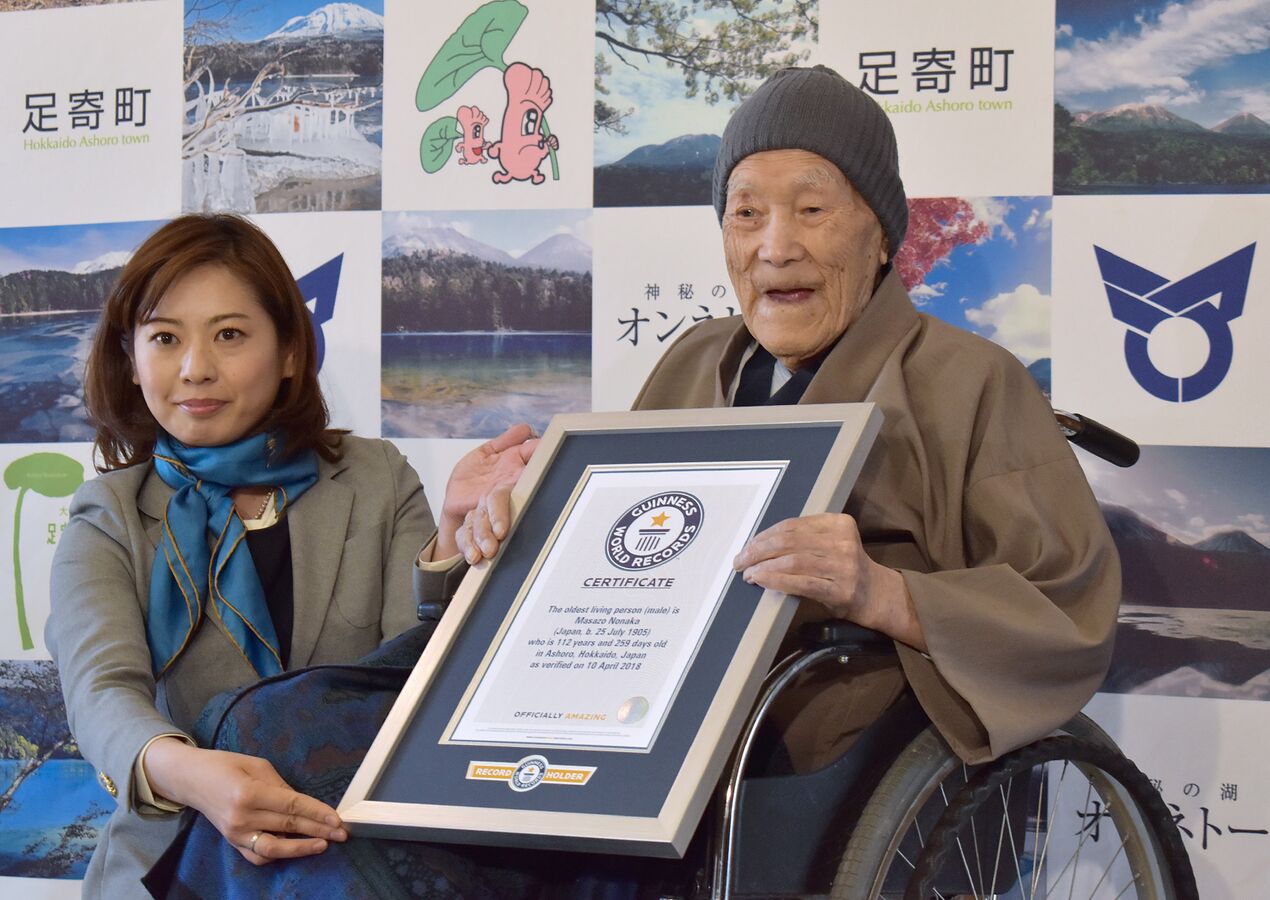
    Житель Японии Масадзо Нонака, признанный самым старым мужчиной в мире, умер в возрасте 113 лет и 179 дней, сообщает tv.asahi.
    Нонака родился 25 июля 1905 года. У него пятеро детей, двое из которых в 2018 году были еще живы. 
    сертификат соответствия: старее.нет
    В последние годы Нонака проживал вместе с внуками на горячих источниках у подножия горя Мэакан на острове Хоккайдо. Он любил читать газеты, смотреть поединки сумо и оперные представления.
    Статус самого старого мужчины в мире, скорее всего, перейдет к немцу Густаву Гернету, родившемуся 15 октября 1905 года.

    Wednesday, September 5, 2018

    Monday, August 6, 2018

    war resource

    I have heard the Soviets were on their last reserves at the Battle of Berlin. Could Germany ever realistically, after Stalingrad, have led the Soviets to the point where they had no more offensive capacity?


    John Cate, studied at Strayer University
    Answered Jul 28


    I mentioned this in a post about a week ago. Before the final attack on Berlin, Stalin told Zhukov and Koniev that there were no more reserves, and they had to take the German capital with what they had.

    The reduced manpower available to the Red Army is one reason why the Soviets made peace with Finland with the frontline about where it had started in 1941, rather than go all the way to Helsinki. The Finns had inflicted severe casualties on the Soviets at Ilomantsi, and Stalin rescinded his demand for unconditional surrender, so he could stop the fighting there and move the troops to fight the Germans.

    This doesn’t mean the Soviets were bereft of offensive capability, though. They had more than 6.4 million men under arms at the time and were still able to carry out a successful attack on Japanese-ruled Manchukuo a few months after the Battle of Berlin. Stalin simply knew that the Allied coalition would break up as soon as the war ended, and he had to ensure that the USSR’s military capability wasn’t completely wrecked.

    As far as the other part of your question, it’s very possible that the Wehrmacht could have stalemated the Soviets in 1943–44, but that would have required intelligent use of the remaining German military resources, including better decisions both by the high command (read: Feldmarschall Manstein makes all the decisions, not the Austrian Gefreiter) and in the production sector, with no wasting time and money on “super-weapon” projects that didn’t bear fruit. More Panzer IV’s and StuG’s instead of fewer unreliable “super-tanks,” and a much earlier Me 262 would have made a huge difference.

    There were numerous discussions in neutral countries about a separate Nazi-Soviet peace, but both sides always put forward terms that were unacceptable to the other. (John Cate's answer to Why didn't Hitler make a peace deal with Stalin when he was losing the war? Perhaps offer him Poland and the Baltic states in exchange for peace. Then he could focus his attention on the West to stop the D-day attacks.) If Germany had mounted a better defense, then there is a likelihood that Stalin would have agreed to peace on terms more favorable and acceptable to the Germans.

    это с кворы

    Saturday, July 28, 2018

    THE GAP BETWEEN FERTILITY IDEALS AND INTENTIONS

    Low fertility has been at the forefront of demographers’ research agendas in recent decades. Fertility rates in many developed societies have quickly fallen below 1.5 children per woman. However, the ideal number of children remains centered at two children in most postindustrial countries. Many young adults say they would like to have two children, but they expect to have fewer. What explains this gap between fertility ideals and intentions?

    Динамика рождаемости (TFR)
    Разрыв между идеалом и планом, по полу
    Распределение по идеальному и планируемому числу детей
    читать целиком:
    UNDERSTANDING THE GAP BETWEEN FERTILITY IDEALS AND INTENTIONS IN FOUR POSTINDUSTRIAL SOCIETIES

    Wednesday, July 4, 2018

    global fertility dynamics

    демографический переход рождаемости
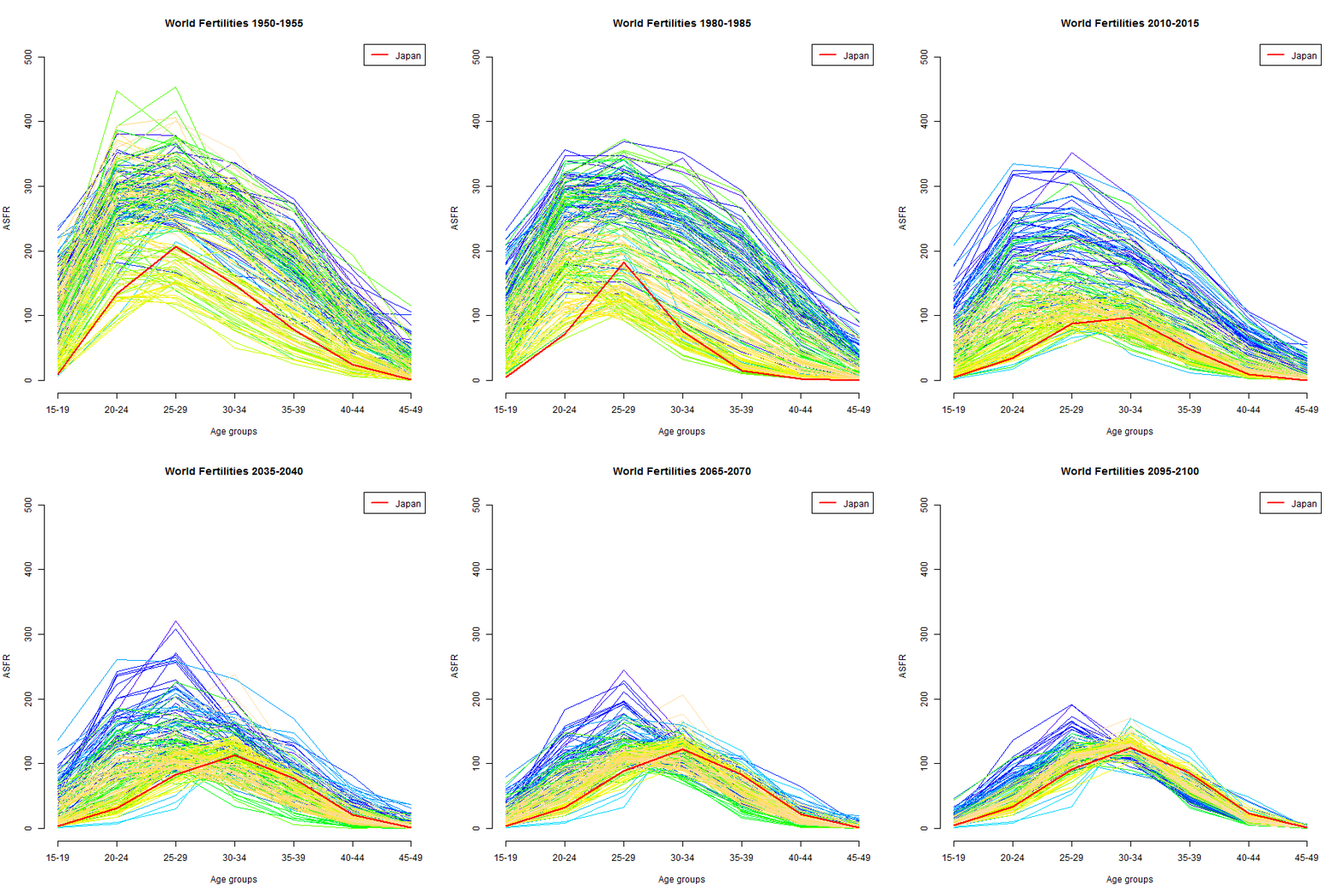
    демографический переход рождаемости в мире, а в Японии и других местаз уже и второй
    заметно уменьшение глобальной неоднородности, всё становится б-м одинаковым, ИКЕА рулит макдональдсом
    по ссылке много полезных ништяклв для препод давателей

    Sunday, June 10, 2018

    Russia is not Japan

    найдите три отличия

    Sunday, April 8, 2018

    family planning in Japan

    планирование семьи в Японии
    Когда молодая пара из префектуры Айти на западе Токио обнаружила, что у них в семье ожидается прибавление, настроение будущих родителей упало, их охватили тревога и уныние.

    Сейчас не их очередь беременеть, и теперь им придется извиняться.

    У директора частного центра по уходу за детьми, где работала девушка, был строгий график с расписанием того, когда сотрудники могут заключать браки или беременеть.

    Любое отклонение от графика рассматривалось как проявление эгоизма.

    Законодательство Японии запрещает дискриминацию в отношении сотрудников, которые ждут ребенка или же берут отпуск или больничный по уходу за детьми.

    Однако женщины редко подают в суд на работодателей. В итоге, в японских социальных сетях регулярно возникают обсуждения эпизодических свидетельств подобной практики.

    .... в японской культуре не принято подвергать сомнению действия старших ....


    про дробности на бебеси

    Saturday, July 1, 2017

    urbanina


    то-есть, если собрать все столицы всех (бывшых) союзных республик, наскребём где-то на треть ?

    Wednesday, April 1, 2015

    death day of the eldest in the world

    В Японии на 118-м году жизни в среду скончалась старейшая жительница планеты Мисао Окава.

    Мисао Окава родилась 5 марта 1898 года в деревне неподалеку от Осаки, в семье владельцев магазина традиционного японского кимоно. За свою долгую жизнь она родила трех детей. Двое из них поддерживают семейные традиции долголетия: им уже больше 90 лет.

    Окава получила звание самой пожилой жительницы Земли после того как в 2013 году на 117-м году жизни скончался Дзироэмон Кимура, также гражданин Японии. Статус Окавы был зафиксирован в Книге рекордов Гиннесса.