Sexism in academia is bad for science and a waste of public funding
Nicole Boivin, Susanne Täuber, Ulrike Beisiegel, Ursula Keller & Janet G. Hering
Nature Reviews Materials (2023)
Before she helped develop COVID-19 vaccines, going on to jointly win the Nobel Prize for Medicine, Katalin Karikó’s story was one that was familiar to many women: she faced lack of funding and recognition, demotion and was ultimately pushed out of her university. Although Karikó managed to overcome these extraordinary barriers, many more women respond to pervasive gender discrimination and harassment by departing academia. A huge study of a quarter of a million US academics adds to the growing weight of evidence for this gender-based attrition.
As current and former institutional heads and research leaders, we make the case that such departures, and the associated loss of female talent, exact a massive scientific and economic toll, and outline reforms to promote efficiency in the academic sector.
Across many academic disciplines, women and men are increasingly graduating at similar rates. In spite of this improvement, academic stages beyond the graduate level remain persistently gender imbalanced across all disciplines (Fig. 1), a pattern seemingly impervious to change. This ‘gender filtering’ (Supplementary Fig. 1) leads to progressively fewer women at increasingly advanced career stages (a phenomenon referred to as the ‘leaky pipeline’).
Fig. 1: The gradual attrition of women from the academic career path.
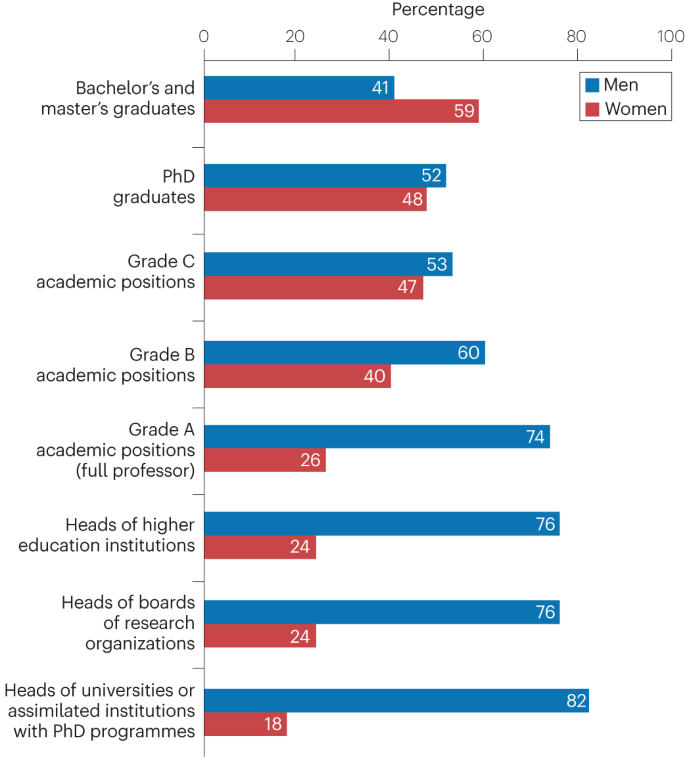
Proportion of women and men at different stages of the typical academic career trajectory. Data are 2021 cross-European Union data from ref. 3. Full size image
High rates of female attrition are hardly surprising in light of research demonstrating the hostile workplace environments frequently encountered by early-career female academics (Supplementary Fig. 1). Sexual harassment — including sexual coercion, unwanted sexual attention and gender harassment — remains pervasive in academic workplaces, with rates trailing only behind those in the military. Higher education and research institution (HERI) environments are perceived as permissive environments because when targets report harassment, they are either ignored or retaliated against. Biased performance assessment and lack of acknowledgement of research contributions remain entrenched problems. Early-career academic women also experience a range of additional, more subtle forms of sexism, from microaggressions to patronization and paternalism, that downplay their capabilities, hinder their advancement and render their experience of academia isolating. The outcome is the severe attrition of female academics in whom substantial investment towards specialized education, training and career development has been made (Supplementary Fig. 2).
As women progress to more advanced academic career stages, there is often an expectation of greater career stability. Yet the experience of hostile workplaces for academic women continues throughout their careers (Supplementary Fig. 1) and can even intensify after they have achieved tenure and/or substantial grant success.
Women at later career stages report being tasked with excessive service and experiencing a lack of supportive social networks, both of which may, in part, reflect their under-representation. Experiences of incivility, ostracism, online abuse, stalled promotions, academic sabotage, unequal or limited access to resources, malicious allegations, and sexual harassment and discrimination, however, imply more active mistreatment of women by their colleagues and superiors. Women also continue to contend with important double standards. They receive less recognition and fewer awards, and those awards granted to them are associated with less money, public attention and career advancement than those of male scholars7. Furthermore, behaviour viewed positively for male academic leaders — such as assertiveness — is viewed negatively for female ones. These problems are generally compounded when women’s under-representation is greater, with substantial backlash as women enter arenas in which male dominance is most entrenched.
These problems lead to the continued attrition of female scholars. Such departures can happen through burn out and voluntary departure. In more extreme cases, they can occur as a result of processes of demotion and dismissal when women are targeted with severe hostility, defamation and even institutional retaliation when they speak out about their experiences. Research suggests that after establishing their academic careers in STEM, women are two times more likely to leave compared with men. This low retention rate means that paradoxically, although we expect women to become more empowered over time, female precarity actually increases in later career stages. Given the sizeable public funding investment in many female academics by the time they have reached a late career stage (Supplementary Fig. 2), as well as the substantial accumulated scientific knowledge they possess, the drain represents a massive inefficiency within the higher education and research sector.
Economic losses stemming from discriminatory science are especially harmful given that at all career stages, high-achieving women may be particularly targeted for incivility, harassment and take-down. Also facing exceptional impacts are women of colour and sexual- and gender-minority women. These trends compound direct economic losses since abundant research reveals that diverse teams produce better and more impactful science. Even when the cumulative hostilities do not push women entirely out of research and higher education, they nonetheless exact a physical, mental, financial and professional toll. The career obstruction women face has a broader toxic effect on academic culture, reducing productivity, education quality and research output, and lowering return on public investment. Sexism is not only bad for women, it is bad for science.
The loss, misuse, obstruction and sabotage of female talent in academia represents a stunning drain on the public purse. Although research clearly demonstrates the role of organizational climate as the primary predictor of sexism in research and higher education, academic organizations have broadly failed to take the steps necessary to dismantle entrenched structural biases. Albeit becoming skilled at diversity rhetoric, their resistance to real change means that progress in tackling sexism has been frustratingly slow, and in some cases non-existent. Many HERIs have developed training and mentoring programmes that essentially place the onu s on women to change (by, for example, ‘leaning in’), ignoring mounting evidence that what is instead required is broad, system-level transformation.
Accordingly, it is time to overhaul systems that reward entrenched sexism with public funding, protect perpetrators of sexism, discrimination and harassment, and have a destructive effect on the advancement of science. Undertaking genuine systemic transformation will require academic stakeholders to commit to transparency and take responsibility for outcomes. Here we examine how this might translate into action and accountability for some of the key stakeholders in higher education and research.
At the first level are HERIs themselves. An ethos of transparency would require that HERIs annually collect and publish gender-disaggregated data pertaining to recruitment, appointment, pay, workload allocation, promotion, discrimination, harassment, misconduct, demotion, dismissal and departure. Equity metrics should become a critical measure of institutional performance. Responsibility for equity performance must lie with managers at all HERI levels, with ultimate responsibility at the top of the organization. These individuals should have responsibility for integrating gender equality into all processes and decisions made within an organization. In accordance with these principles, the Irish Higher Education Authority has recommended that demonstrable experience of leadership in advancing gender equality should become a condition for top level appointments within higher education institutions.
HERIs need to ensure that workload allocation models are transparent and monitored for gender bias. Transparency regarding resource distribution within HERIs is furthermore essential to reduce the power of informal networks and give women fairer access to such resources. Additionally, and perhaps critically, rates of hiring, promoting and retaining women need to become key measures of the success of HERIs. Linked to this, gender balance must be achieved across all levels of decision-making. An increasing number of organizations, including the European Parliament, recommend or require that decision-making bodies (and their chairs) consist of at least 40% women. Such approaches have been shown to work: Sweden introduced the statutory requirement that both male and female candidates be proposed when recruiting for the position of Vice Chancellor, and further that a gender-equitable recruitment policy be presented to the Swedish Government. By 2016, women accounted for 50% of the heads of higher education institutions in Sweden. But promotion must be balanced against retention; organizations that fail to support, mentor and retain women, simply replacing them with new hires when departure follows mistreatment or lack of support, must come under scrutiny.
At the next level is the government. As the primary funders of higher education and research, governments are responsible for the regulation of HERIs. Achieving gender equity will require that relevant national statutory bodies provide more effective oversight of HERI governance, monitoring implementation of equality policies, reviewing equality measures and ensuring compliance. Funding offers an essential tool for achieving real change. Government authorities can link funding to institutional performance in achieving gender equity, and withhold it when HERIs fail to meet agreed performance indicators and targets. In Norway and Sweden, specific gender equality requirements have been integrated into government legislation, providing opportunities for governments to sanction universities that do not fulfill institutional obligations for regular reporting of gender equality issues.
Issues of gender-based harassment require particular oversight. As HERIs globally compete for students, awards, recognition, funding and league table ranking, and operate increasingly within a corporate and neo-liberal environment, there is a strong incentive to avoid institutional damage when discrimination or harassment is reported, resulting in major potential for organizational minimization, silencing, collusion and retaliation. Organizations must deal openly and transparently with cases of discrimination and harassment, and ensure due protection of those affected, including whistleblowers, or face strong sanctions.
Research funding agencies offer an additional line of defence against sexism. With increased auditing of gender equity and bias, as well as the establishment of various accreditation programmes, it becomes possible to link gender-related performance with research funding. Such efforts have already been successfully implemented in the UK, where requirement of Silver level accreditation through the Athena SWAN gender equity programme for funding by the National Institute of Health and Care Research was influential in changing the gender equality landscape. Funding can also be used to empower grant recipients, by enabling full flexibility to move grants between HERIs, as well as by surveying grantholders, and enabling whistleblowers to report problems.
The high cost of sexism cannot continue to be ignored. With both problems and solutions clearly identified, there is little excuse not to act. It is now on stakeholders to take urgent measures to ensure the credibility of the research and higher education sector, to prevent the continued use of public funding to perpetuate sexism and harassment, and to start to demonstrate real value for money.
Nature Reviews Materials (2023)
Higher education and research institutions are critical to the well-being and success of societies, meaning their financial support is strongly in the public interest. At the same time, value-for-money principles demand that such investment delivers. Unfortunately, these principles are currently violated by one of the biggest sources of public funding inefficiency: sexism.
Before she helped develop COVID-19 vaccines, going on to jointly win the Nobel Prize for Medicine, Katalin Karikó’s story was one that was familiar to many women: she faced lack of funding and recognition, demotion and was ultimately pushed out of her university. Although Karikó managed to overcome these extraordinary barriers, many more women respond to pervasive gender discrimination and harassment by departing academia. A huge study of a quarter of a million US academics adds to the growing weight of evidence for this gender-based attrition.
As current and former institutional heads and research leaders, we make the case that such departures, and the associated loss of female talent, exact a massive scientific and economic toll, and outline reforms to promote efficiency in the academic sector.
The cost of losing women at early career stages
Across many academic disciplines, women and men are increasingly graduating at similar rates. In spite of this improvement, academic stages beyond the graduate level remain persistently gender imbalanced across all disciplines (Fig. 1), a pattern seemingly impervious to change. This ‘gender filtering’ (Supplementary Fig. 1) leads to progressively fewer women at increasingly advanced career stages (a phenomenon referred to as the ‘leaky pipeline’).
Fig. 1: The gradual attrition of women from the academic career path.
Proportion of women and men at different stages of the typical academic career trajectory. Data are 2021 cross-European Union data from ref. 3. Full size image
High rates of female attrition are hardly surprising in light of research demonstrating the hostile workplace environments frequently encountered by early-career female academics (Supplementary Fig. 1). Sexual harassment — including sexual coercion, unwanted sexual attention and gender harassment — remains pervasive in academic workplaces, with rates trailing only behind those in the military. Higher education and research institution (HERI) environments are perceived as permissive environments because when targets report harassment, they are either ignored or retaliated against. Biased performance assessment and lack of acknowledgement of research contributions remain entrenched problems. Early-career academic women also experience a range of additional, more subtle forms of sexism, from microaggressions to patronization and paternalism, that downplay their capabilities, hinder their advancement and render their experience of academia isolating. The outcome is the severe attrition of female academics in whom substantial investment towards specialized education, training and career development has been made (Supplementary Fig. 2).
The cost of losing women at advanced career stages
As women progress to more advanced academic career stages, there is often an expectation of greater career stability. Yet the experience of hostile workplaces for academic women continues throughout their careers (Supplementary Fig. 1) and can even intensify after they have achieved tenure and/or substantial grant success.
Women at later career stages report being tasked with excessive service and experiencing a lack of supportive social networks, both of which may, in part, reflect their under-representation. Experiences of incivility, ostracism, online abuse, stalled promotions, academic sabotage, unequal or limited access to resources, malicious allegations, and sexual harassment and discrimination, however, imply more active mistreatment of women by their colleagues and superiors. Women also continue to contend with important double standards. They receive less recognition and fewer awards, and those awards granted to them are associated with less money, public attention and career advancement than those of male scholars7. Furthermore, behaviour viewed positively for male academic leaders — such as assertiveness — is viewed negatively for female ones. These problems are generally compounded when women’s under-representation is greater, with substantial backlash as women enter arenas in which male dominance is most entrenched.
These problems lead to the continued attrition of female scholars. Such departures can happen through burn out and voluntary departure. In more extreme cases, they can occur as a result of processes of demotion and dismissal when women are targeted with severe hostility, defamation and even institutional retaliation when they speak out about their experiences. Research suggests that after establishing their academic careers in STEM, women are two times more likely to leave compared with men. This low retention rate means that paradoxically, although we expect women to become more empowered over time, female precarity actually increases in later career stages. Given the sizeable public funding investment in many female academics by the time they have reached a late career stage (Supplementary Fig. 2), as well as the substantial accumulated scientific knowledge they possess, the drain represents a massive inefficiency within the higher education and research sector.
Compounding the economic losses of discriminatory science
Economic losses stemming from discriminatory science are especially harmful given that at all career stages, high-achieving women may be particularly targeted for incivility, harassment and take-down. Also facing exceptional impacts are women of colour and sexual- and gender-minority women. These trends compound direct economic losses since abundant research reveals that diverse teams produce better and more impactful science. Even when the cumulative hostilities do not push women entirely out of research and higher education, they nonetheless exact a physical, mental, financial and professional toll. The career obstruction women face has a broader toxic effect on academic culture, reducing productivity, education quality and research output, and lowering return on public investment. Sexism is not only bad for women, it is bad for science.
Securing value for money
The loss, misuse, obstruction and sabotage of female talent in academia represents a stunning drain on the public purse. Although research clearly demonstrates the role of organizational climate as the primary predictor of sexism in research and higher education, academic organizations have broadly failed to take the steps necessary to dismantle entrenched structural biases. Albeit becoming skilled at diversity rhetoric, their resistance to real change means that progress in tackling sexism has been frustratingly slow, and in some cases non-existent. Many HERIs have developed training and mentoring programmes that essentially place the onu s on women to change (by, for example, ‘leaning in’), ignoring mounting evidence that what is instead required is broad, system-level transformation.
Accordingly, it is time to overhaul systems that reward entrenched sexism with public funding, protect perpetrators of sexism, discrimination and harassment, and have a destructive effect on the advancement of science. Undertaking genuine systemic transformation will require academic stakeholders to commit to transparency and take responsibility for outcomes. Here we examine how this might translate into action and accountability for some of the key stakeholders in higher education and research.
At the first level are HERIs themselves. An ethos of transparency would require that HERIs annually collect and publish gender-disaggregated data pertaining to recruitment, appointment, pay, workload allocation, promotion, discrimination, harassment, misconduct, demotion, dismissal and departure. Equity metrics should become a critical measure of institutional performance. Responsibility for equity performance must lie with managers at all HERI levels, with ultimate responsibility at the top of the organization. These individuals should have responsibility for integrating gender equality into all processes and decisions made within an organization. In accordance with these principles, the Irish Higher Education Authority has recommended that demonstrable experience of leadership in advancing gender equality should become a condition for top level appointments within higher education institutions.
HERIs need to ensure that workload allocation models are transparent and monitored for gender bias. Transparency regarding resource distribution within HERIs is furthermore essential to reduce the power of informal networks and give women fairer access to such resources. Additionally, and perhaps critically, rates of hiring, promoting and retaining women need to become key measures of the success of HERIs. Linked to this, gender balance must be achieved across all levels of decision-making. An increasing number of organizations, including the European Parliament, recommend or require that decision-making bodies (and their chairs) consist of at least 40% women. Such approaches have been shown to work: Sweden introduced the statutory requirement that both male and female candidates be proposed when recruiting for the position of Vice Chancellor, and further that a gender-equitable recruitment policy be presented to the Swedish Government. By 2016, women accounted for 50% of the heads of higher education institutions in Sweden. But promotion must be balanced against retention; organizations that fail to support, mentor and retain women, simply replacing them with new hires when departure follows mistreatment or lack of support, must come under scrutiny.
At the next level is the government. As the primary funders of higher education and research, governments are responsible for the regulation of HERIs. Achieving gender equity will require that relevant national statutory bodies provide more effective oversight of HERI governance, monitoring implementation of equality policies, reviewing equality measures and ensuring compliance. Funding offers an essential tool for achieving real change. Government authorities can link funding to institutional performance in achieving gender equity, and withhold it when HERIs fail to meet agreed performance indicators and targets. In Norway and Sweden, specific gender equality requirements have been integrated into government legislation, providing opportunities for governments to sanction universities that do not fulfill institutional obligations for regular reporting of gender equality issues.
Issues of gender-based harassment require particular oversight. As HERIs globally compete for students, awards, recognition, funding and league table ranking, and operate increasingly within a corporate and neo-liberal environment, there is a strong incentive to avoid institutional damage when discrimination or harassment is reported, resulting in major potential for organizational minimization, silencing, collusion and retaliation. Organizations must deal openly and transparently with cases of discrimination and harassment, and ensure due protection of those affected, including whistleblowers, or face strong sanctions.
Research funding agencies offer an additional line of defence against sexism. With increased auditing of gender equity and bias, as well as the establishment of various accreditation programmes, it becomes possible to link gender-related performance with research funding. Such efforts have already been successfully implemented in the UK, where requirement of Silver level accreditation through the Athena SWAN gender equity programme for funding by the National Institute of Health and Care Research was influential in changing the gender equality landscape. Funding can also be used to empower grant recipients, by enabling full flexibility to move grants between HERIs, as well as by surveying grantholders, and enabling whistleblowers to report problems.
The high cost of sexism cannot continue to be ignored. With both problems and solutions clearly identified, there is little excuse not to act. It is now on stakeholders to take urgent measures to ensure the credibility of the research and higher education sector, to prevent the continued use of public funding to perpetuate sexism and harassment, and to start to demonstrate real value for money.