Showing posts with label Китай. Show all posts

Saturday, September 28, 2024

Effects of forest environment construction on physical activity

September 16, 2024 Huameng Tang, Dianqi Yuan and Chao Guo

The Chinese government attaches great importance to the construction of National Forest Cities, which have proved effective not only as part of the national low-carbon environmental strategy, but also as a stimulus to physical activity in mainland China. Huameng Tang, Dianqi Yuan and Chao Guo describe their positive impact.


Forests around the world are increasingly affected by factors related to climate change, along with industrialization and lifestyle changes. Among other consequences, this diminishes opportunities for human contact with nature and results in worse health outcomes. With the aim of reducing vulnerability to increasing threats from climate change as well as improving population health and well-being, China has implemented multiple measures since 2004 to improve forest management, including promoting the construction of National Forest Cities.

National Forest Cities in China…


After approval of the national forestry authorities, a city can be awarded the title of National Forest City if both its urban and rural areas meet all the necessary criteria. These include urban forest coverage, greening along water bodies and roads, nature reserves and major forest and wetland ecosystems, as well as residential recreational greenspaces, which must be public and easily accessible (i.e. in close proximity to most citizens, within 500 meters, on average). By the end of 2022, there were 219 National Forest Cities in China in 25 provinces, forming a cross-regional and urban‒rural construction system.

Although intended primarily for environmental improvement, these forest cities also include sites and facilities that encourage physical activities. However, despite the rapid increase in research on environmental features and physical activity behaviors over the last few decades, there is still a lack of reliable empirical evidence on the effect of these forest cities on residents’ physical well-being.
 

… and their effect on physical activity: a quasi-experimental study


We attempted to fill this knowledge gap in a recent paper (Tang et al 2024), using a difference-in-difference, or DID, model, which, in our case, focused on differences in the frequency of physical activity before and after the construction of the forest cities, comparing regions with different densities of forest cities. The DID model circumvents otherwise difficult-to-treat issues such as time trends and individual characteristics.

Our data come from the nationally representative 2010 China Family Panel Studies (CFPS), and its 2018 follow-up. This is a multistage, stratified cluster sampling representing 95% of the population in mainland China. Among other things, respondents were asked to specify the number of physical activities they had engaged in during the preceding week, which is our variable of interest.

Living in a forest city can be considered exogenous (it does not depend on individual choices), and we measured exposure to this exogenous intervention in terms of both degree (number of forest cities by area at the provincial level) and duration (time elapsed since the City was awarded the title of National Forest). This proved possible because respondents were interviewed in areas with different degrees of forest environment construction, as measured by the number of forest cities, and different construction timelines. During the survey windows (i.e. between 2010 and 2018), 11 provinces established 1-3 forest cities, 13 provinces established more than three, and the remaining six provinces did not establish any.

Results


The DID estimates revealed that forest environment construction significantly promotes residents’ physical activities. After the construction of forest cities, the number of physical activities per week increased by 1.35 units (β = 1.35, 95% CI: 0.73–1.98) compared to provinces without forest cities (Table 1). An increase of 1.35 may seem small, but first, it is statistically significant, even after adjusting for covariates such as age, area of residence, province, marital status, income, educational level, employment, chronic disease and self-rated health, and second, it represents a considerable step forward given the relatively low initial levels.
Perhaps not surprisingly, there were notable disparities across age groups and areas of residence. The positive effect of forest environment construction on physical activity was particularly strong among middle-aged and older adults (aged 45 and above), and people living in urban areas.

Among younger adults aged (up to 44 years of age), the frequency of physical activity also increased after forest environment construction, but the difference was not statistically significant.

Behavioral changes facilitated by environmental construction


To the best of our knowledge, this study is the first to provide insights on the impact of forest environment construction on physical activity among Chinese residents. The main finding is that the construction of a forest environment promotes physical activity, especially among middle-aged and older adults, and people living in urban areas.

Although urbanization and land use change are irrevocably altering the environment in which many residents live, forest-environment construction has succeeded in reducing the distance between people and the natural environment and plays a role in improving population fitness. However, considering the heterogeneity of these effects, more should be done to make sure that everybody benefits from the construction of forest cities, for instance in terms advertising their existence and promoting their potential for “green exercise”.

References

Tang, H. M., Yuan, D. Q., Yang, P. S., Yang, H. B., & Guo, C. (2024) The effect of forest-environment construction on the physical activity among Chinese adults. Environmental Research Letters, 19

Tuesday, August 6, 2024

China Is the World’s Biggest Producer of Beer

by Anna Fleck, Aug 2, 2024

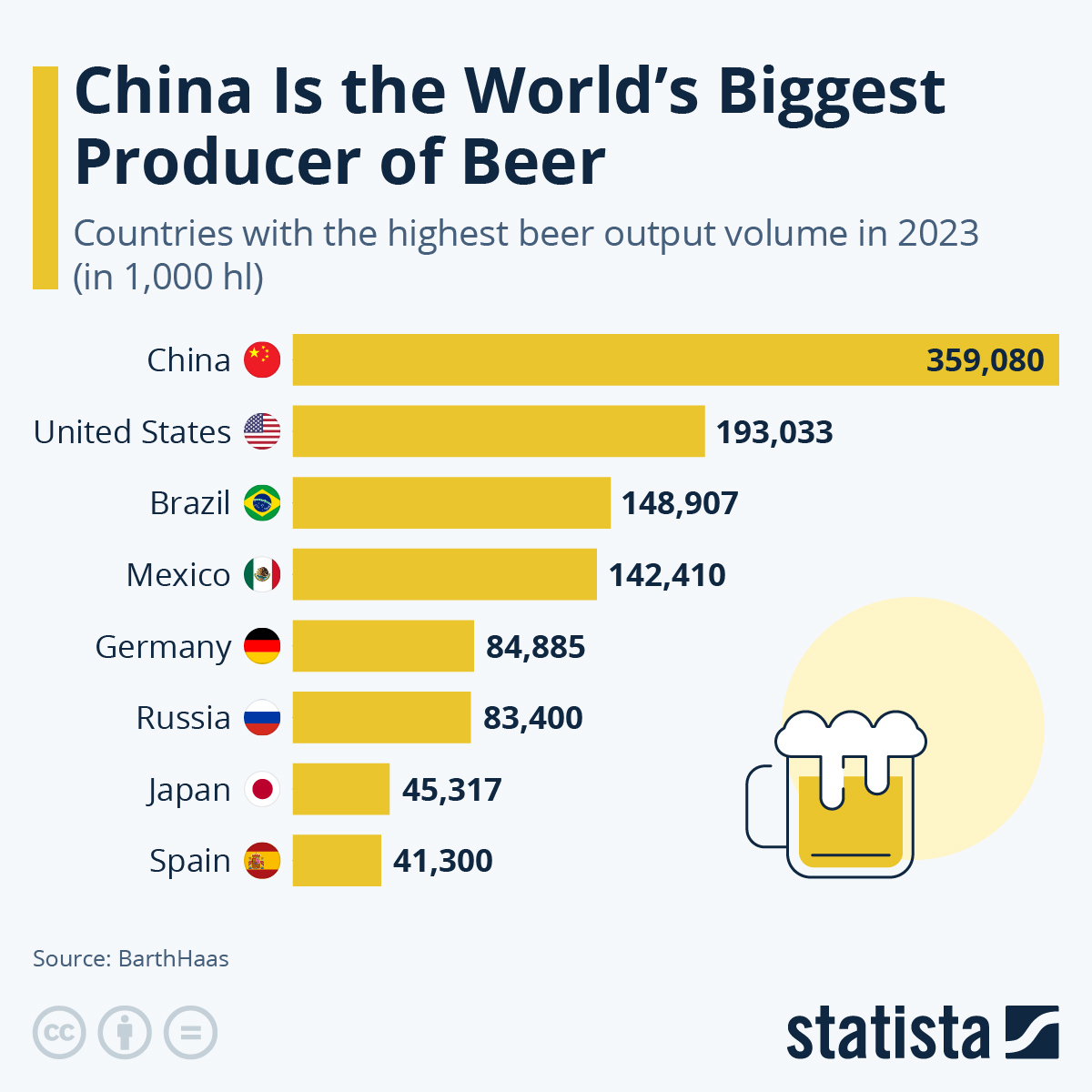
China is the world’s leading producer of beer, according to the BarthHaas Report released today. In 2023, the country’s output stood at 360 million hectoliters of beer. A hectoliter is equivalent to one hundred liters. As the following chart shows, the United States is the second biggest producer of beer with an output of 193m hl in 2023.

Rounding off the top ten countries are Poland in ninth place with 36m hl and South Africa in tenth position with an estimated 35m hl. Across Europe, beer production decreased by a total of 9m hl.

In the Americas, output fell by 7.2m hl. This figure hides the fact that while the U.S. saw a drop in output of -9.9m hl, South America saw growth of 2.4m hl and Central America and the Caribbean saw an increase of 0.2m hl.

Asia showed more of a mixed picture with production increasing significantly in India (+3.8m hl) and Cambodia (+2m hl), while it fell in Vietnam (-8m hectolitres), as well as declines of over 1m hl in South Korea, Thailand, China and Kazakhstan.

Meanwhile, the African continent saw a 4.6m hl increase in output, with the most significant growth in South Africa (+1.4m hl), Ethiopia (+1.1m hl) and Cameroon (+1.1m hl).

In 2023, world beer production decreased by nearly 17m hl to 1.88 billion hl. In Europe, production fell by 9m hl, largely driven by a drop in output from the United Kingdom (-3.3m hl), Germany (-2.9m hl) and Poland (-2m hl).
China Is the World’s Biggest Producer of Beer

Saturday, September 2, 2023

real Uvarov

Портрет графа С.С. Уварова, президента Императорской академии наук. 1844

Идеи «суверенной демократии», «глубинного народа», устремленность к традиционным ценностям прямо наследуют антизападную «теорию официальной народности» графа Уварова. Ян Ксаверий Каневский.

В условиях информационного века, замещая реалии иллюзиями, Россия словно застыла в прошлом, все еще уповая на царя-батюшку или иную твердую руку верховной власти, пытаясь при этом безуспешно вернуть себе былое величие, утраченные владения и мировое влияние.

Friday, April 28, 2023

patria or langue

Родители не хотят замены английского языка на китайский в школах


80% родителей школьников выступают против исключения английского языка из школьной программы. К обязательному изучению китайского общественность тоже относится настороженно: 59% против. В опросе сервиса по поиску высокооплачиваемой работы SuperJob приняли участие 1600 родителей школьников из всех округов страны.

Депутат Госдумы РФ Султан Хамзаев предложил исключить английский язык из перечня обязательных предметов в школе. По его мнению, это позволит уйти от прозападного вектора в российской системе образования.Инициативу одобряет лишь 9% родителей школьников, тогда как 8 из 10 выступают против такого решения. В комментариях респонденты напоминают, что английский остается языком международного общения, а методика его преподавания отработана годами.

Следует ли сделать китайский язык обязательным для изучения? Общество относится к этой идее осторожно: 6 из 10 опрошенных (59%) против такого нововведения. В числе их аргументов — сложность китайского языка, неуверенность в состоятельности отечественных методик его преподавания, а также отсутствие массовой потребности: «Все инженерные специальности по-прежнему требуют знания английского». Сторонником изучения китайского языка в системе среднего образования выступают только 19%. С их точки зрения, стратегическое партнерство России с КНР обязательно приведет к востребованности специалистов, владеющих китайским.

Место проведения опроса: Россия, все округа
Населенных пунктов: 349
Время проведения: 20—27 апреля 2022 года
Исследуемая совокупность: родители школьников
Размер выборки: 1600 респондентов


Подробнее

Tuesday, March 7, 2023

China today

1 семья = 1 ребёнок
Сильвия Чанг Китайская служба Би-би-си

Почему многие женщины в Китае отказываются от материнства


В соответствии с новыми статистическими данными, женщины в Китае готовы рожать только одного ребенка, или вообще отказываются от материнства. Би-би-си поговорила с тремя китаянками, попросив их поделиться взглядами на семейную жизнь.

"Я не могу позволить себе ребенка", - говорит Глория. Она замужем, и ей уже за 30.

Она прикинула, что ребенок обойдется ей в 2400 долларов в месяц, и это не считая ее остальных ежемесячных расходов.

"Придется тратить 3000 юаней (436 долларов) на ежедневные расходы, такие как питание. 2000 юаней (291 доллар) на детский сад, 1000 юаней ($145) на оплату неполного рабочего дня няни, если ее услуги потребуются, и не менее 10 тыс. юаней ($1456 долларов) на обучение ребенка", - объясняет она.

Глория работает учителем начальных классов на неполную ставку в провинции Гуандун, расположенной на юге Китая.

В этой части страны средняя зарплата в частном секторе составляет около 6000 юаней в месяц (873 доллара).

А поскольку Глория - единственный ребенок в своей семье (следствие политики "одна семья - один ребенок"), она хочет выплатить ипотеку и начать откладывать деньги на содержание своих стареющих родителей. Пенсии есть не у всех, и забота о стариках часто ложится на их детей.

Уменьшающееся население


Китай оказался в демографической ловушке: после нескольких десятилетий государственной политики, жестко ограничивающей число детей в семье, население страны стало сокращаться - впервые за 60 с лишним лет.


В 2016 году власти КНР разрешили семьям иметь до двух детей, еще через пять лет допустимое количество детей в семье было увеличено до трех.

Но несмотря на отмену ограничений на число детей в семье, большинство женщин готовы рожать только одного ребенка, либо вообще отказываются от материнства.

Согласно недавнему исследованию, проведенному Китайским центром народонаселения и развития, процент бездетных китаянок вырос с 6% в 2015 году до 10% в 2020-м.

Оно также показало, что китайские женщины детородного возраста, даже если и могут позволить себе несколько детей, этого просто не хотят: в 2021 году среднее желаемое количество детей упало до 1,64 по сравнению с 1,76 в 2017-м.

В то время как в других странах юго-восточной Азии, таких как Сингапур, Япония и Южная Корея, коэффициент фертильности тоже ниже двух, большинство женщин говорят, что все-таки хотели бы завести двоих детей. Однако в Китае это не так.

"В этом смысле Китай является исключением, потому что не только фактическая рождаемость невелика, но и желаемое количество детей очень низкое", - говорит доктор Шуан Чен, доцент кафедры международной социальной и государственной политики Лондонской школы экономики и политических наук.

В эти дни в Пекине проходят традиционные "две сессии" - одновременные, но не совместные съезды Народного политического консультативного совещания Китая (НПКСК) и Всекитайского собрания народных представителей (ВСНП). 

На их фоне различные политические советники представляют собственные планы по повышению рождаемости в стране. Идеи выдвигаются самые разнообразные: от помощи незамужним женщинам в том случае, если они захотят заморозить свои яйцеклетки на будущее, до отмены платы за обучение и бесплатные учебники для детей от детского сада до университета.

Есть и другие идеи - например, дать незамужним женщинам и их детям те же права, что женатым родителям и детям, рожденным в браке. Эти изменения уже были введены в провинции Сычуань. Китайское законодательство не запрещает незамужним женщинам рожать детей, но в нем указывается, что, с точки зрения закона, матерью является "женщина, состоящая в браке". Отныне в провинции Сычуань любая незамужняя женщина, если она захочет родить ребенка, может рассчитывать на медицинскую помощь, место для ребенка в школе и социальные выплаты.

Конкуренция с пеленок 


Одна из главных причин, по которой китаянки отказываются от материнства - это высокая стоимость образования и ухода за детьми.

В Китае конкуренция со сверстниками начинается практически сразу после рождения ребенка. Родители пытаются устроить детей в хорошую школу, для чего покупают дома рядом с такими учебными заведениями, а также записывают детей в различные кружки и на внеклассные занятия, большая часть которых стоит денег.

"Я не хочу, чтобы рожденный мною ребенок сразу же окунулся в эту беспощадную конкуренцию", - говорит 22-летняя студентка университета по имени Миа.

Она родилась в небольшом городке на севере Китая и довольно быстро обнаружила, что учеба сфокусирована на успешной сдаче экзаменов. Ей удалось сдать непростой вступительный национальный экзамен и попасть в престижный университет в Пекине. Но даже с получением образования конкуренция не заканчивается, потому что выпускникам китайских университетов приходится конкурировать с теми, у кого были средства для обучения за границей.

"Любое дополнительное образование требует денег, - говорит Миа, которая сомневается, что сумеет зарабатывать достаточно для того, чтобы ее будущие дети могли получить такие возможности. - А если я не могу обеспечить своему ребенку процветание, зачем тогда давать ему жизнь?"

Личная жизнь или карьера? 


Женщины, с которыми поговорили журналисты Китайской службы Би-би-си, рассказывали и о том, что им пришлось выбирать между детьми и карьерой, и в итоге они решили остаться бездетными.

На собеседованиях при приеме на работу их спрашивали, не собираются ли они в ближайшее время рожать детей. Если бы они ответили положительно, шансов получить работу у них было бы меньше, не говоря уже о возможном повышении в дальнейшем.

"Баланс между жизнью и работой - это фактор, на который обращают внимание китайские женщины в высших учебных заведениях, когда размышляют, готовы ли они к рождению ребенка", - сказала Би-би-си Юнь Чжоу, доцент кафедры социологии Мичиганского университета.

"Работа для них - это самореализация, - пояснила она. - На рынке труда и так хватает гендерной дискриминации, и женщинам приходится делать непростой выбор между карьерой и рождением ребенка".

"Эгоистка" и "иностранный агент"


Миа, как и подавляющее большинство ее сверстников, привыкла делиться своими мыслями в соцсетях. Однажды она записала небольшое видео, в котором объяснила, почему собирается остаться бездетной.

К немалому ее удивлению, оно вызвало целый шквал оскорбительных комментариев.

Многие говорили, что она эгоистка. Другие - что она еще слишком молода, поэтому просто не может принимать такие важные решения. "Тебе еще рано подобное говорить, посмотрим, как ты запоешь, когда тебе будет 40!" - было написано в одном комментарии. "Ставлю 10 000 долларов, ты пожалеешь об этом", - гласил другой.

Некоторые дошли до того, что назвали ее "иностранным агентом", который "подстрекает" женщин не рожать. 

В мае 2021 года правительство Китая в очередной раз ослабило контроль над рождаемостью, разрешив семьям иметь до трех детей. Эта мера была принята после того, как по результатам переписи стало известно, что в 2020 году в стране родилось всего 12 млн детей, что является самым низким показателем с 1961 года.

Поэтому-то некоторые граждане Китая и считают, что женщина, отказывающаяся рожать детей, "подводит" страну.

"Это мой личный выбор. Я не говорю, что надо запретить рожать детей. Я уважаю тех, кто этого хочет", - возражает Миа.

"Мне пришлось выдержать настоящее сражение"


Но сражаться с собственной семьей может быть еще сложнее, чем с недоброжелателями в соцсетях.

Семья Юань Сюэпин ожидала, что она выйдет замуж и родит детей, вместо того чтобы учиться

"Мне пришлось нелегко", - рассказывает 34-летняя Юань Сюэпин. Она родилась и выросла в сельской местности, где в семьях от каждой женщины ожидается, что она выйдет замуж и родит мальчика для продолжения рода. Она же с самого начала говорила, что рожать детей не намерена.

Ни она, ни ее старшая сестра не смогли получить высшее образование, несмотря на то, что Сюэпин была одной из лучших учениц в школе. Только их младшему брату родители оплатили обучение в университете.

"Мои родители всегда говорили: "Какой смысл девушке учиться? Рано или поздно ты выйдешь замуж и останешься дома, чтобы воспитывать своих детей", - вспоминает Юань Сюэпин.

Когда ее тетя того же возраста развелась и была вынуждена в одиночестве воспитывать двоих детей, Юань окончательно разочаровалась в замужестве.

"Я больше не верю в институт брака", - говорит она. Юань уехала из дома в город и теперь наслаждается независимостью: "Я читаю и встречаюсь с друзьями в свободное время. Я чувствую себя свободной".

"Лучше поздно, чем никогда". В Сычуани сняли ограничения на число детей в семье

Материал подготовлен при участии Лары Оуэн.

Wednesday, March 1, 2023

China's Population Shift

“It’s Like Trying to Stop a Moving Train.”

Unpacking China’s Population Shift With Demographer Kristin Bietsch

Last Tuesday, major news outlets reported the onset of a demographic crisis in China after the government released data showing that in 2022, for the first time since the 1960s, deaths outnumbered births in the country.

Births in China fell for a sixth straight year, from 10.6 million in 2021 to 9.56 million in 2022, the New York Times reported, while 10.41 million people died. China is growing older, too; by 2035, 400 million of its residents are expected to be over age 60, making up almost a third of its population.

What forces spurred these shifts, and what can China do now to bring on demographic—and therefore economic—prosperity? We talked to Kristin Bietsch, Senior Demographer at Avenir Health, who forecast China’s population growth during her time as a researcher at PRB.

PRB: What's your reaction to this news?

Bietsch: China’s decline in population is not a surprise. In 1991 China’s total fertility rate dropped below replacement level (2.1 children per woman) for the first time, and [it] has never rebounded. Every year since 1950 (when the United Nations modeled estimates begin), more people emigrated from China than migrated to China. While Chinese life expectancy continues to increase, it is not enough to offset the changes due to fertility and migration.

PRB: In 2015 after China ended its one-child policy, your projections were a bit more optimistic in terms of China’s population growth. What was your thinking then?

Bietsch: When I make projections, as demographers always say, “We’re not saying what’s going to happen, we’re saying, 'If these certain things happen, then this will be the outcome.'” I projected population change for several scenarios; if there was a gradual increase to 2 children per woman by 2030, then this would be the effect on the population, if it changed overnight, then this would be the effect. The population was always going to decline, it was just a question of when. It’s like trying to stop a moving train.

PRB: OK, so it wasn’t a surprise—but did the shift happen sooner than you expected?

Bietsch: It did, and I think COVID is a major reason for that. Fertility rates are often lower in times of economic stress because couples or individuals feel uncertain about the future and decide to delay births. Some couples may have these births in the future, but others may forgo these births altogether. Maybe it’s come a few years earlier, but everyone has been expecting this, with China being below replacement fertility for about 30 years.

In demography, when fertility goes below replacement level, you generally have time before the population declines because higher fertility populations look like a pyramid; you have bigger and bigger cohorts at each age group; once fertility declines below replacement, it still takes a long time for the total number of people to decline because you have more and more people of reproductive age who are having children. China has already passed the peak of women of reproductive age, and now women of reproductive age are [having fewer children] than previous cohorts.

And now there are more older people in China, and in general, people are living longer. In a lot of countries, like the United States, we have a large immigrant population, especially people of working age, which helps us keep the working- to retiring-age ratio from declining too quickly. But China is a net emigration country—more people leave than enter—so they don’t have that buffer. Below-replacement fertility for 30 years and net out migration for as long as we have records… It comes down to math. Fewer people are born, older people start dying, and no one is coming in to replace them.

PRB: What challenges is China facing as the age structure of its population shifts from younger to older?

Bietsch: When countries make that shift... Read the full interview in our blog.

Kristin Bietsch, Ph.D., is Senior Demographer at Avenir Health. Her research focuses on fertility rates around the globe. She was formerly a Research Associate at PRB who worked on the World Population Data Sheet.

Follow her on Twitter.


Friday, December 23, 2022

Olympic Games help children grow up healthy

December 12, 2022 Chao Guo

The benefits of the Olympic Games may be numerous and long lasting. Chao Guo highlights the positive role of the 2008 Beijing Olympic Games in reducing the risks of both under- and over-nutrition of children in China.


Shortly after the Tokyo Olympic Games, the Beijing Winter Olympic Games and Paralympic Games were held in February 2022. Previously, public health experts had expressed great concerns over the safety of the Tokyo Olympic Games amid the COVID-19 pandemic and appealed for a global conversation on this issue (The Lancet 2021).

Mass gatherings have potential risks, especially amid a global health crisis. However, the benefits of the Olympic Games may be wide-ranging, including economic growth, urban development and expansion of sports infrastructure. They may also help improve public health services and risk management, public health surveillance and reporting systems (e.g. of air quality), as well as individual health awareness and behaviours. Several previous studies have investigated the association between the Olympic Games and health outcomes such as exposure to respirable particulate matter, adolescent psychological health, and asthma, but apparently none have studied the long-term association between the Olympic Games and child growth.

Underweight and overweight among Chinese children. A triple difference-in-difference analysis


In a recent study (Guo et al., 2022), we estimated the association between the 2008 Beijing Olympic Games (BOG) and child growth in China. We used the BOG as a natural experiment to capture the potential long-term effect of the Olympic Games on child growth at the population level. Individual-level data were obtained from the China Family Panel Studies (CFPS). Children aged 3–10 years during the survey window in 2014 and in 2018 were pooled into a dataset and included for analysis.

Exposure to the BOG was measured by triple difference-in-difference analysis. First, children aged 7–10 years were identified as the treated group, as they were born either before the 2008 BOG (in 2004–2007) if surveyed in CFPS wave 2014, or after the BOG (in 2008–2011) if surveyed in wave 2018. Children aged 3–6 years were identified as the control group, as they were born after the 2008 BOG in both survey waves. The difference observed between two waves within the control group (D1) can be interpreted as a common temporal change, due, for example, to the general socio-economic development. Conversely, the difference between two waves within the treated group (D2) includes this common trend plus the effect of being born either before or after the 2008 BOG. This means that the variation “caused” by being born after the 2008 BOG and not before can be identified through the difference between the treated group and control group in the difference between two waves (D2–D1).

Additionally, although the Olympic Games is an event of national and even world significance, we assume that it affected mainly those living close to the venue of the Games and its surrounding areas. The host city of the 2008 BOG was Beijing, together with five mainland cities: Shanghai, Tianjin, Shenyang (Liaoning province), Qinhuangdao (Hebei province) and Qingdao (Shandong province), as co-host cities. (Hong Kong, the sixth co-host city, was not included in our analysis due to data limitations.) We thus categorized the areas of residence of our child participants into a binary variable: BOG areas or non-BOG areas. The rate of child growth is not the same at 3–6 years or at 7–10 years, and this is something that the D2–D1 estimator mentioned above does not control for. However, we can assume that the trend differential between the two groups of children is the same in BOG and in non-BOG areas. Thus, the association between the BOG and child growth can be identified through the difference between areas in the difference between age groups in the difference between waves: (D3–D2–D1), or DDD.

Child growth was assessed via four binary variables: stunting, underweight, overweight, and obesity. We generated standardizing anthropometric measures for children including z-score of height-for-age (HAZ) and z-score of weight-for-age (WAZ) according to the WHO growth charts, and derived indices of stunting if HAZ ≤ 2 and underweight if WAZ ≤ 2, respectively. Furthermore, overweight and obesity were measured by binary variables according to the international body mass index (BMI) thresholds for children aged 2–18 years (BMI ≥ 25 for overweight and BMI ≥ 30 for obesity).

The study included 6,951 Chinese children aged 3–10 years, among whom 3,201 were interviewed in 2014 and 3,750 in 2018. The pooled prevalence rates of stunting, underweight, overweight, and obesity were 7.8%, 26.4%, 14.10%, and 20.9% (Figure 1).

The health(y) effects of 2008 Beijing Olympic Games


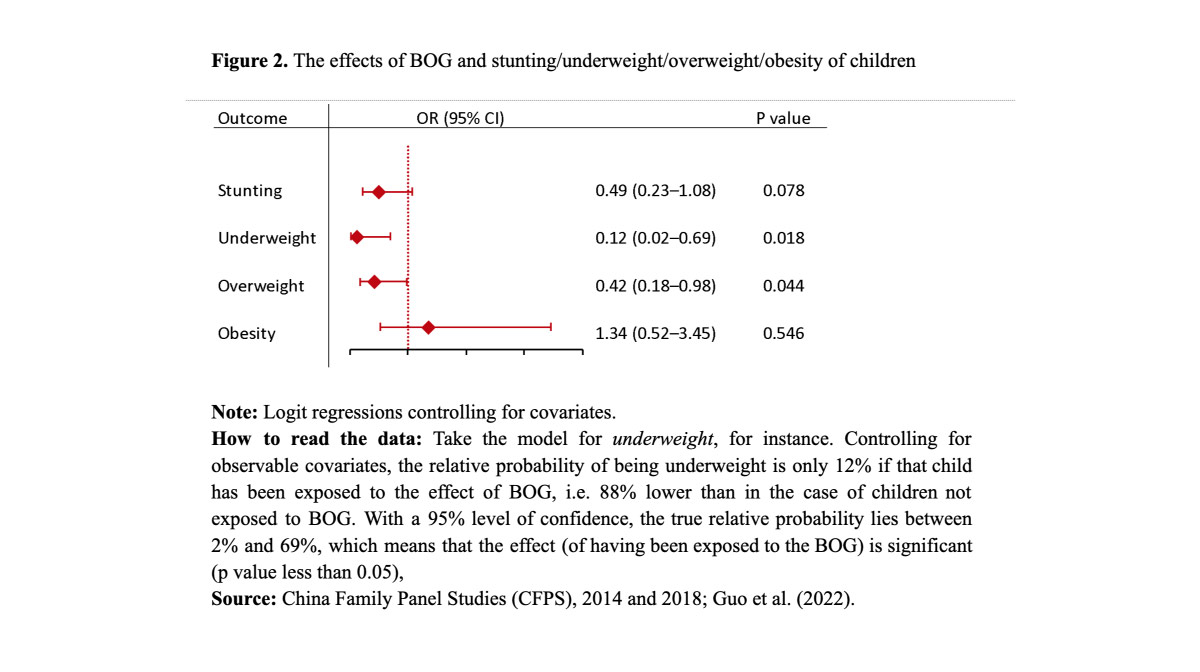
Our DDD estimates reveal that BOG exposure decreased the risk of underweight by 88% among Chinese children, and that of overweight by 58% (Figure 2). The effects of BOG on the odds of stunting and obesity were not statistically significant.

We did not detect sex heterogeneity of associations between the BOG and stunting, underweight or overweight. However, we did find a sex difference for the association between the BOG and child obesity, with a significantly lower risk of obesity found in the female, but not in the male sample. In girls, the risk of obesity was 21% (95% CI: 5%-88%) for those exposed to the BOG compared with those not exposed, after controlling for observable covariates.

Long-term health legacy planning before mega-events


To the best of our knowledge, this is the first attempt at estimating the effect of the Olympics on child growth. Our findings are that the 2008 Beijing Olympic Games decreased their risk of underweight and overweight, and, for girls only, also the risk of obesity.

This may have happened through several potential mechanisms. First, children of the post-Olympic generation might have benefited from a variety of favourable conditions related to the Olympic Games during the fetal period. This may be because, according to the International Organizing Committee, the Games had a positive impact on several social, urban, environmental, and economic criteria, such air quality, food and water safety, regeneration of the physical environment, Anti-smoking measures and the development of venues and training facilities promoting mass sport. Second, the Games may have also prompted active participation in sports, at all levels and at all ages, among children born shortly after the Games and their families.

While the mechanisms may be unclear, and not necessarily replicable elsewhere in the world, the results, as highlighted by our DDD research design, seem clear enough: children’s health improved in China following the 2008 Beijing Olympic Games.

References

  • The Lancet. (2021). We need a global conversation on the 2020 Olympic Games. Lancet 397:2225. doi: https://doi.org/10.1016/S0140-6736(21)01293-9.
  • Guo, C., Hu, X., Xu, C., & Zheng, X. (2022) Association between Olympic Games and children’s growth: evidence from China. British Journal of Sports Medicine 56(19): 1110–1114. doi: 10.1136/bjsports-2021-104844.

The effect of migration on the fertility

of Chinese women in the USA

January 13, 2022 Wanli Nie and Pau Baizan

In the years between 1975 and 2005, migrants from China to the US were more likely to have a second and third birth than non-migrant Chinese. Wanli Nie and Pau Baizan argue that both “emancipation” (i.e., liberation from the constraints of the Chinese restrictive family policy of the time) and adaptation to the new context played a role. In all cases, the fertility enhancing effect of migration decreased for younger birth cohorts.


Those who migrate from high- to low-fertility countries typically reduce their fertility over time, as was the case, for instance, among Indians, Bangladeshis and Pakistanis who moved to the UK (Dubuc 2012). But what happens in different scenarios, when people move from low to (relatively) high fertility countries?

In a recent paper, we focused on the Chinese birth cohorts of 1960‒1990, and among them, on those who migrated to the United States. We measured their fertility between 1975 and 2005 tapping several data sources: the 2000 US census, the 2005 American Community Survey, the 2000 Chinese census, and the 2005 Chinese 1 percent Population Survey, with data for the first three sources taken from the IPUMS dataset (Nie and Baizan, 2021).

In particular, we tested four hypotheses on the influence of migration on fertility:

• Emancipation: “the fertility of Chinese women, which was kept low by Chinese fertility policies, should bounce back after emigration to the United States” (Hwang and Saenz 1997:50).
• Adaptation: immigrants progressively converge towards the fertility standard of the hosting country.
• Disruption: migration breaks the natural process of family formation and drastically reduces fertility.
• Selection: those who migrate differ from those who do not in several respects. Among other things, they prefer lower fertility.

We analyzed three groups of Chinese:

1) those who remained in China (non-migrants),
2) those who migrated to the United States after their 15th birthday (first generation migrants) and
3) those who migrated to the United States before their 15th birthday (1.5-generation migrants).

To better understand our results, keep in mind that in the period under consideration, between 1975 and 2005, three phases of family policy in China can be distinguished:

1) the “Later, Longer, Fewer” policy of 1975-1979, which imposed later marriage, a longer interval between births, and a maximum of two or three children per couple (in urban and rural areas, respectively),
2) the first and strictest phase of the one-child policy, between 1980 and 1985 (although implementation was somewhat uneven, and the timing of relaxation varied slightly across provinces), and
3) the progressive relaxation of the one-child policy, between 1985 and 2005.

A noticeable, but declining, emancipation effect


Not surprisingly, Chinese migrants to the US had a markedly higher fertility than non-migrants, especially in the case of the second child (Figure 1), the main target of China’s one-child policy, under which second births were allowed only in special cases (e.g. for ethnic minorities, or if the first born was a female, but only in rural areas).
The higher fertility of Chinese migrants was therefore largely due to an “emancipation” effect: the constraints of China’s strict family policy were no longer valid for them. Surprisingly however, Chinese migrants rarely went for a third child, which suggests that their preferred family size was already relatively low, not far from two (Gietel-Basten 2019).

Probably our most important finding is that this emancipation effect declined across birth cohorts, especially for second births (Figure 2). While the constraints of China’s one-child policy were slowly relaxed, starting in mid-1980s, the ideal number of children likely declined for Chinese couples due to a complex set of circumstances, such as rapid economic development, higher female employment, increasing urbanization and rising childcare costs.

Adaptation? Not really…


Our results also shed light on the adaptation hypothesis, which argues that migrants’ fertility should gradually converge towards that of natives (Milewski 2010). In the China-US migration context, if the adaptation hypothesis held, one should observe that migration’s positive effect on second births increases across birth cohorts as the gap between China and US fertility levels widens (China’s fertility was higher than that of the US before the 1990s, but later fell below it). In our case, this did not happen. However, Chinese migrants seem to have “adapted” to a cultural context with less (and possibly no) son preference. Compared with non-migrants, Chinese migrants are less likely to have an extra child if they only have daughters.

Migration, education and fertility


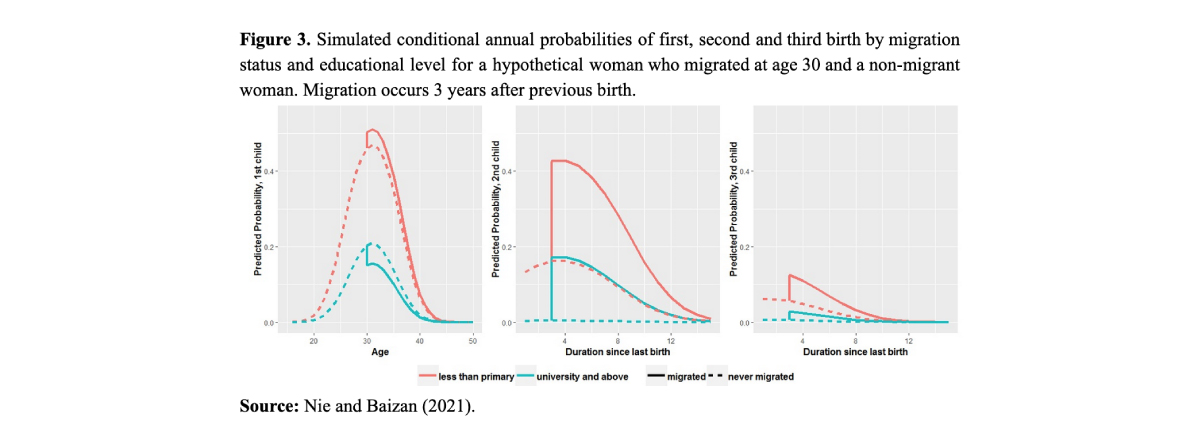
Migration to the USA had a positive effect on second and third births for women at all levels of education. For reasons of clarity, Figure 3 shows only two extreme cases: very high (university level) and very low (less than primary) education. Note, however, that highly educated migrant women are more likely to postpone their first birth or remain childless: at age 40, childlessness among them is much higher (25%) than among well-educated non-migrants (6%).

Conclusion


In short, while migration has had an overall positive effect on the fertility of Chinese migrants to the US, this is less true for younger and highly educated migrants. This can probably be explained by the selection hypothesis: migrants (in general, not just in this case) tend to have lower fertility because they have other life goals, such as pursuing a career and having less constraining family ties.

As fertility decline continues in several Asian countries (Jdanov and Sobotka 2019) while remaining close to replacement levels in some western countries (at least, until recently), more examples of migration from low- to high(er)-fertility settings may be observed in the future. We predict that this will result in increased fertility among migrants. However, this effect is likely to be limited in extent and short-lived.
 
References
  • Dubuc, S. 2012. Immigration to the UK from High-fertility Countries: Intergenerational Adaptation and Fertility Convergence. Population and Development Review 38(2): 353–68.
  • Gietel-Basten, S. 2019. The Population Problem in Pacific Asia. Oxford, UK: Oxford University Press.
  • Hwang, S.-S., and R. Saenz. 1997. “Fertility of Chinese Immigrants in the U.S.: Testing a Fertility Emancipation Hypothesis.” Journal of Marriage and Family 59(1): 50–61.
  • Jdanov, D., and T. Sobotka. 2019. Human Fertility Collection. Max Planck Institute for Demographic Research (Germany) and Vienna Institute of Demography (Austria).
  • Milewski, N. 2010. Fertility of Immigrants: A Two-generational Approach in Germany in Demographic Research Monographs. Berlin/Heidelberg, Germany: Springer-Verlag Berlin Heidelberg.
  • Nie, W., & Baizan, P. (2021). Does Emancipation Matter? Fertility of Chinese International Migrants to the United States and Non-migrants during China’s One-child Policy Period. International Migration Review. Online first

Wednesday, October 5, 2022

the 2nd DT in PRC?

Announcing a forthcoming special issue of the China Population and Development Studies on the applicability and evidence of the Second Demographic Transition in Asian contexts. The issue is edited by Baochang Gu, Stuart Gietel-Basten and myself [Ron Lesthaeghe, emeritus prof. Vrije Univ. Brussels // Kon. Vlaamse Academie van België/ Royal Flemish Academy of Belgium Arts & Sciences.Bredene, Flemish Region, Belgium]. It contains three commentaries and four country-specific articles on Japan, P.R. China, Indonesia and India. Further articles on SDT aspects will be forthcoming in subsequent issues of CPDS.

Attached here is the abstract of my introductory commentary
[камент см по ссылке, извиняюсь за грубое слово]

Thursday, September 1, 2022

The Countries Most in Debt to China

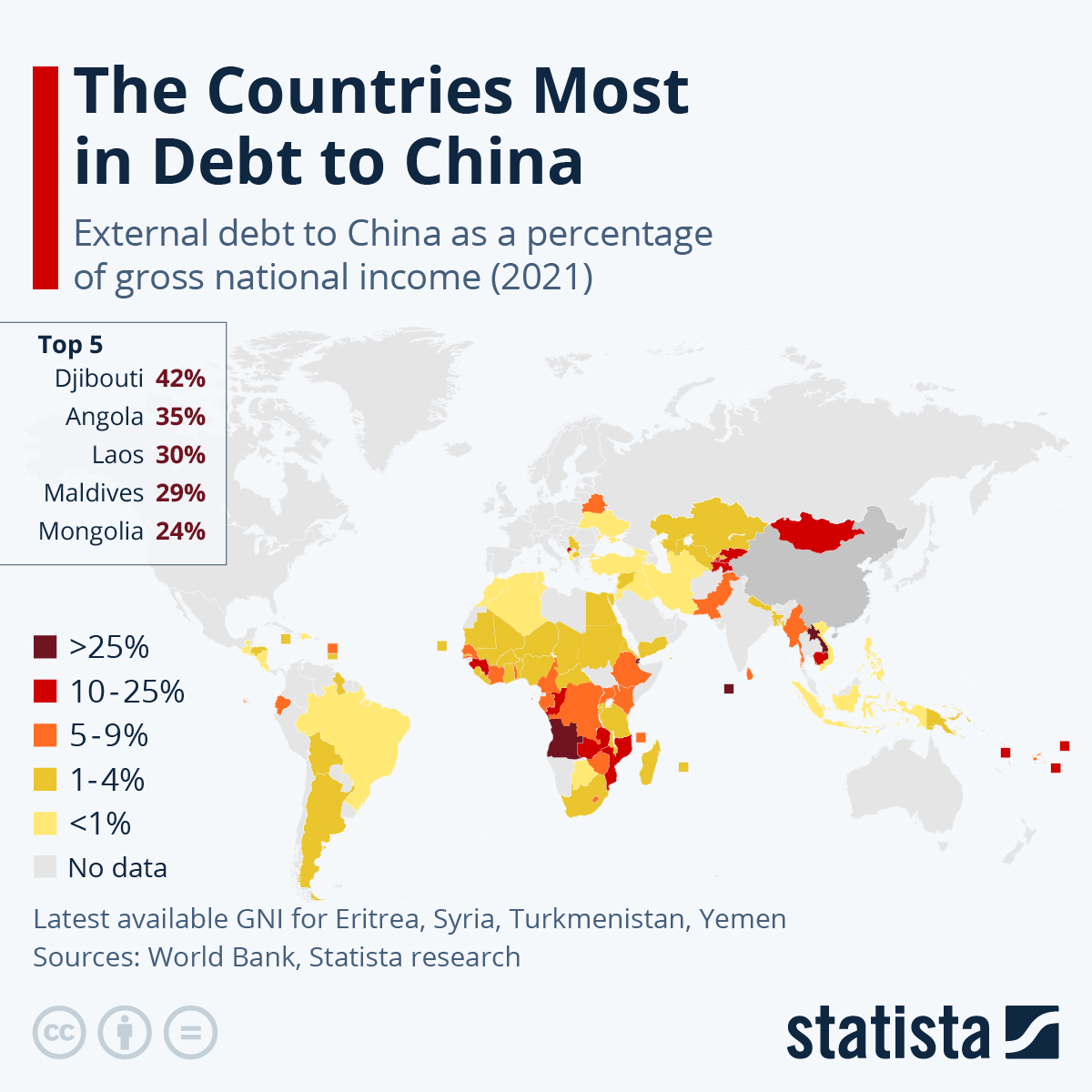
According to World Bank data analyzed by Statista, countries heavily in debt to China are mostly located in Africa, but can also be found in Central Asia, Southeast Asia and the Pacific. As the new preferred lender to low-income countries, China now holds 37 percent of these nations' debt. Just 24 percent of the countries' bilateral debt comes from the rest of the world in 2022.

The "New Silk Road" project, which finances the construction of port, rail and land infrastructure across the globe, has created much debt to China for participating countries. At the end of 2020, of the 97 countries for which data was available, Pakistan ($77.3 billion of external debt to China), Angola (36.3 billion), Ethiopia (7.9 billion), Kenya (7.4 billion) and Sri Lanka (6.8 billion) held the biggest debts to China. The countries with the biggest debt burdens in relative terms were Djibouti and Angola, followed by the Maldives and Laos, which has just opened a debt-laden railway line to China. The President of the World Bank, David Malpass, called the level of debt many countries once again hold “unsustainable” in January.

The Paris Club used to hold the majority of low-income countries’ debt before it was restructured and largely forgiven after the turn of the millennium for qualifying, developing countries. Whether such a process will be available for Chinese debt is unclear. As of 2020, China had officially lent around $170 billion to low and middle-income countries, up from just around $40 billion in 2010.

Chinese loans have higher interest rates than those from international institutions like the International Monetary Fund or The World Bank or bilateral loans from Paris Club countries, and also have shorter repayment windows. Their setup is closer to commercial loans concerning their conditions of repayment, confidentiality as well as their objectives of funding specific infrastructure projects instead of pursuing development goals in general.

The Covid-19 pandemic has now complicated the already difficult repayment of Chinese loans even more. According to the Financial Times, the country had to renegotiate loans worth $52 billion in 2020 and 2021 - more than three times the amount that met this fate in the two previous years. One such case was Sri Lanka - also among China’s biggest debtors - which in May was the first Asian country in two decades to default on its debt.The Countries Most in Debt to China

Saturday, August 27, 2022

A tendency towards attenuation of regional sex ratio imbalances in China

August 22, 2022 Wanru Xiong

Through a detailed analysis of the dynamics of regional sex ratios at birth and, separately, at prime marriageable ages in China, Wanru Xiong finds that regional sex ratios tend to self-correct, and to revert to their “natural” values by inducing responsive behaviours in internal migration and sex selection at birth.


Sex imbalance is a big problem in China. At birth, the “natural” sex ratio is about 103–107 males per 100 females, but it is higher in China: above 110 in the mid-1980s and up to 120 in the late 2000s (Figure 1). Consequently, in 2020 men outnumbered women by 17.5 million among people aged 20–39 (National Bureau of Statistics of China, 2021).
The imbalance results from the combination of son preference entrenched in the traditional patriarchal culture and the family planning (one-child) policy introduced in the early 1980s, which restricted the number of births per couple. This imbalance leads to intense competition among men for brides, as reflected by soaring “bride prices” (betrothal gifts, from the groom’s to the bride’s family) and, possibly, greater bargaining power of women within couples. It may also be a factor in certain social problems such as violence (Cameron, Meng, and Zhang, 2019) and high-risk sexual activities (Tucker et al. 2019). One feature of the sex ratio imbalance is the time gap of around twenty years between its causes (when the cohort is born) and its major consequences (when the cohort enters marriageable ages). It is therefore opportune to differentiate between the sex ratio at birth (SRB) and the sex ratio at prime marriageable ages (SRM). As Figure 1 shows, the national SRB and the SRM have moved in the opposite directions since 2000.

Two sex ratios


At national level, the SRB and SRM of a given cohort are similar, with slight differences due to differential mortality and net international migration. However, at the regional level, they can be significantly different because young men and women move between regions. Of course, the two sex ratios can also differ at any given time due to cohort differences.

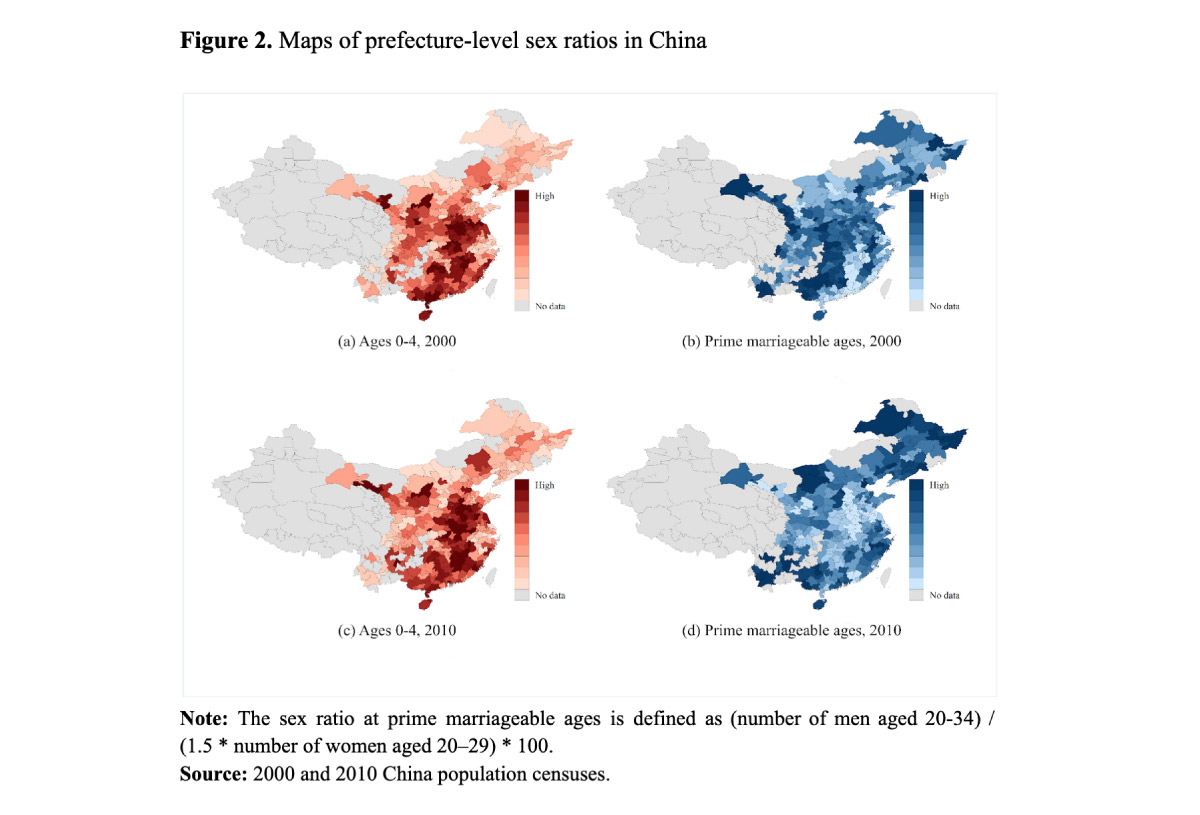
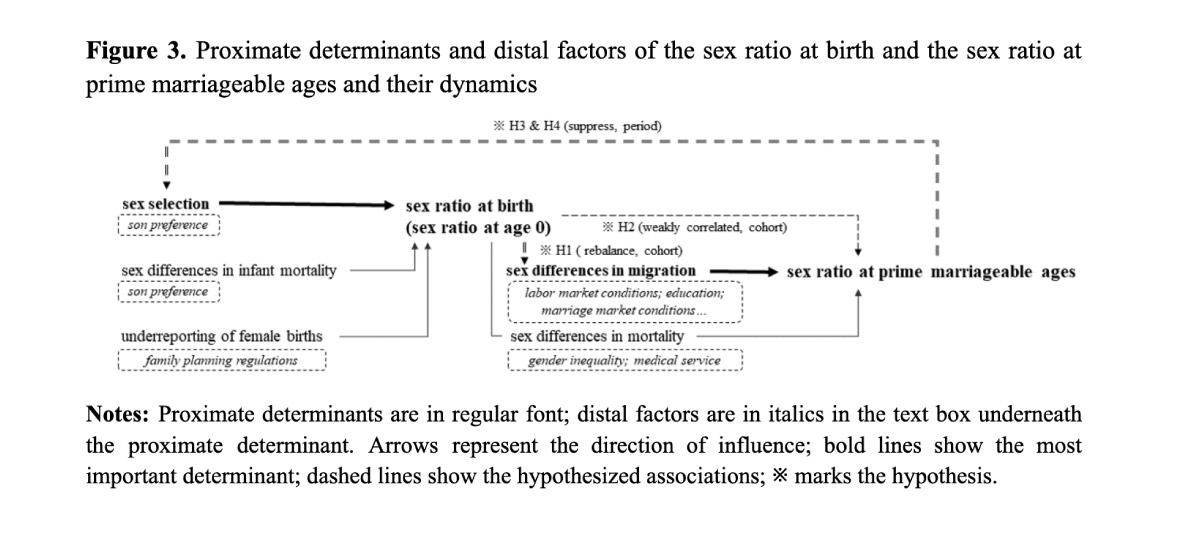
Figure 2 shows the maps of prefecture-level sex ratios at ages 0–4 (SR 0–4, a proxy for SRB) and SRMs according to the 2000 and 2010 Chinese censuses in prefectures with a majority of Han Chinese residents. Higher SRs 0–4 are consistently observed in the southern coastal areas and the inner central areas, whereas the regional distribution of SRMs is different, with higher values appearing in the southwest, northwest, northern, and part of the eastern coastal areas.Figure 3 shows the diagram of the mechanism. As the bold lines indicate, the most important direct determinant of SRB and SRM are prenatal sex selection and internal migration, respectively. The key to the mechanism is the connection between each sex ratio and the main determinant of its counterpart (dashed lines): high SRBs induce internal migration while high SRMs remove incentives for parental sex selection. The two links constitute a negative feedback loop that corrects the regional sex ratios. In other words, the consequences of one high regional sex ratio become the causes of changes in the other sex ratio.

Self-corrective mechanism


In a recent study, I proposed a self-corrective mechanism to model the dynamics between regional SRBs and SRMs in China (Xiong, 2022). The mechanism consists of two pathways:
• First, internal migration redistributes men and women across regions in a way that reduces highly skewed regional SRMs; 
• Second, a competitive marriage market for men reduces parental incentives for son-biased sex selection, thus lowering regional SRBs.  
Figure 3 shows the diagram of the mechanism. As the bold lines indicate, the most important direct determinant of SRB and SRM are prenatal sex selection and internal migration, respectively. The key to the mechanism is the connection between each sex ratio and the main determinant of its counterpart (dashed lines): high SRBs induce internal migration while high SRMs remove incentives for parental sex selection. The two links constitute a negative feedback loop that corrects the regional sex ratios. In other words, the consequences of one high regional sex ratio become the causes of changes in the other sex ratio. 

If the proposed self-corrective mechanism is working, the following consequences should be observed:
• H1. Regions with higher SRBs experience greater declines in sex ratios of residents from birth to prime marriageable ages as the cohort ages and migrates.
• H2. Regional SRMs and SRBs 20 years before are weakly correlated.
• H3. Regional SRBs are negatively correlated with contemporary regional SRMs.
• H4. Changes in regional SRBs are negatively correlated with changes in regional SRMs over the same period.

Empirical evidence


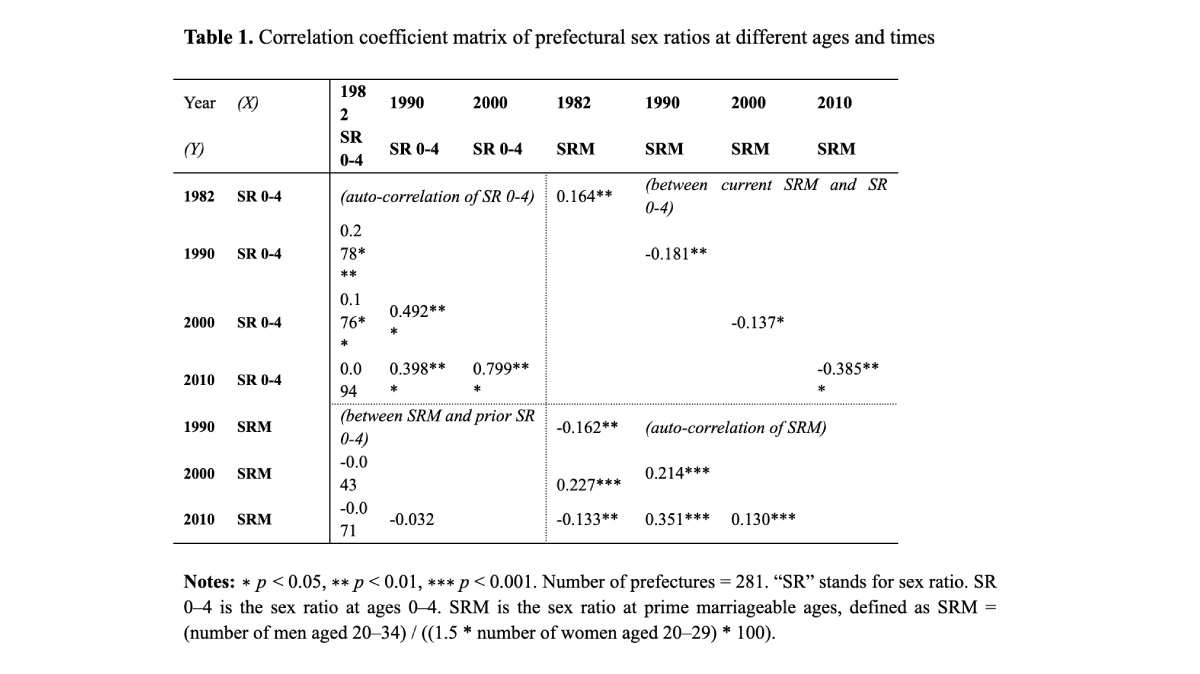
There is some evidence for the self-corrective mechanism outlined above. Table 1 shows the association coefficients between the SR 0–4 and the SRM of a cohort or in a given year. The lower left panel supports H2, in that there is no significant linear relationship between SRs 0–4 and SRMs in the same prefecture after about 20 years. The upper right panel shows a significant negative correlation between contemporary SRs 0–4 and SRMs in the same prefecture except in 1982, which supports H3.
More advanced analysis shows that prefectures with higher SRBs in 1982 and 1990 experienced a greater decline in sex ratios of residents when the birth cohort reached marriageable ages in 2000 and 2010 respectively, resulting in a weak correlation between SRBs and subsequent SRMs in the same prefecture. Prefectural SRBs in 2000 and 2010 were negatively correlated with contemporary SRMs: a one-unit higher prefectural SRM was associated with an approximately 0.3-unit lower SRB in 2000 and 0.2-unit lower SRB in 2010. Changes in prefectural SRBs between 1990 and 2010 are negatively correlated with changes in SRMs during the same period.

Conclusion


We find some evidence for the two conjectured self-corrective forces of regional sex ratios. First, internal migration from birth to marriageable ages helps to redress the prefectural sex ratios and achieve a more balanced distribution of SRMs than SRBs. Second, the shortage of women in the local marriage market removes incentives for parental son-biased sex selection and thus lowers SRBs. Prefectures with higher SRBs continue to have relatively higher SRBs than other places; this happens in part because son preference persists over time and in part because these prefectures do not necessarily experience the negative consequences of skewed SRMs. The two forces work together to generate a slow but smooth transition of SRBs toward the natural level in the total population.

The self-corrective mechanism connects the macro demographic context with the micro intentions of migration and sex selection, generating a feedback that helps to correct sex-ratio imbalances. The suggested mechanism emphasizes the presence of endogenous correcting forces within the population system which function independently of the exogenous changes in cultural and socioeconomic contexts that also influence the SRB, such as increasing educational and employment opportunities for women (Guilmoto, 2009). In other words, a population is a complex system, capable of self-regulation. Both endogenous and exogenous forces lead to the prediction that the trajectory of the SRB will continue to converge towards normal levels in China, as it has done since 2010 (Figure 1).

References

  • Cameron, Lisa, Xin Meng, and Dandan Zhang. 2019. “China’s sex ratio and crime: Behavioural change or financial necessity?.” The Economic Journal 129(618): 790-820.National Bureau of Statistics of China. 2021. “National data.” Beijing: National Bureau of Statistics of China. http://data.stats.gov.cn/index.htm.
  • Guilmoto, Christophe Z. 2009. “The sex ratio transition in Asia,” Population and Development Review 35(3): 519–549.
  • Tucker, Joseph, Dudley L. Poston Jr, Qiang Ren, Baochang Gu, Xiaoying Zheng, Stephanie Wang, and Chris Russell, eds. 2009. Gender policy and HIV in China: catalyzing policy change. Vol. 22. Springer Science & Business Media.
  • Xiong, Wanru. “Dynamics between Regional Sex Ratios at Birth and Sex Ratios at Prime Marriageable Ages in China.” Population and Development Review.

Monday, August 22, 2022

The World's Manufacturing Superpowers

China – 28.7% Global Manufacturing Output (любопытно: почему кортинку не видно?)

While China’s status as the world’s largest manufacturing hub seems to be a given these days, that hasn’t always been the case. In fact, as recently as 2009, the U.S. trumped China in manufacturing output as measured by total value added in the sector.

As our latest racing bar video shows, China’s manufacturing output (measured in constant 2015 dollars) climbed from roughly $200 billion in 1990 to more than $4 trillion thirty years later. During that time, China’s share of global manufacturing output climbed from 3 percent to more than 30 percent, while former manufacturing leader the United States saw its share drop from 23 to 17 percent. In 2000, the U.S. share of global manufacturing had been even higher at 26 percent, but China’s accession to the WTO in 2001, which opened the country up to the world economy, quickly changed the balance of power.

China’s current status as “the world’s factory” is one of the reasons why the economic fallout of the ongoing Covid-19 pandemic was felt around the world, and still is. Many of the world’s largest consumer brands are relying on Chinese manufacturing and are still grappling with supply constraints caused by lockdowns and factory closures across the country.

кино (изменение value added) см тут

Saturday, August 6, 2022

Taiwan’s Thinly Weaved Diplomatic Web

The past week has been one of suspense as U.S. Speaker of the House Nancy Pelosi deliberated over whether or not to stop in Taiwan on her tour of Asia. After arriving, the US legislator said that the United States "will not abandon" the island, which is autonomous and democratically governed, but as a part of China is at risk of having that right revoked. With the Russian War in Ukraine and the Chinese government’s relatively restrained stance on the issue, many international analysts wonder whether Beijing plans to regain control of the province, only separated from mainland China by the Strait of Taiwan.

With the power that China holds on the international stage, the Taiwanese government can only count on the official support of a few small states around the world. Currently, only 14 independent countries recognize the Taipei government and dare to challenge mainland China's position by establishing diplomatic relations with the island, according to Taiwan's Ministry of Foreign Affairs. The majority (eight states) are located in Latin America and the Caribbean, including Paraguay, Guatemala, Honduras and Haiti. Taiwan's other four allies are island nations in Southeast Asia, namely Nauru, Palau, Tuvalu and the Marshall Islands. This list is rounded off with the Kingdom of Eswatini [страна между Мозамбиком и Южной Африкой, бывший Свазиленд], located in Africa, and the Vatican City State, in Europe.Taiwan’s Thinly Weaved Diplomatic Web

Friday, July 1, 2022

Induced abortion among unmarried women in China

this is also a link, just use it
This studyпредыдущем посте ссылка с картинки] uses a literature review to probe the prevalence and trends of induced abortions among unmarried women since the 1980s. Premarital pregnancy has become more and more common, and this has pushed the premarital abortion rate still higher. With the premarital abortion rate remaining markedly high in China, the percentage of women who have experienced premarital abortions has risen steadily with the passage of time. Not only has the prevalence of premarital abortions increased in China on the whole, but there is evidence that some young women have had multiple abortions. Premarital abortion is more prevalent in urban areas and among migrants and less-educated women. The huge number of premarital abortions not only signifies a palpable, unmet need for contraceptives, but also represents an immense number of unrealized births [это святая вера докторов и обывателей вообще: что аборты лехко превратить в рождения, жизнь же начинается с зачатия]. In the years to come, it is imperative to strengthen research into premarital abortions, to optimize the approaches to data collection and analysis, and to improve reproductive health services for unmarried women.


но мир 1 полярный, и главные события в США
на пресс-конфе Байден обещал побороться с Верховным Судом
посмотрим, таки президент земного шара

Tuesday, May 24, 2022

U.S. Leadership Approval High in Asia

According to surveys in 32 Asian countries, the approval of U.S. leadership has substantially recovered during the tenure of President Joe Biden. Gallup found that 41 percent of Asians approved of U.S. leadership in 2021, up from just 31 percent in 2020. Biden is currently on a tour of Asia and will meet the leaders of Japan, South Korea and Australia on Tuesday. The grouping is part of a strategy to strengthen U.S. influence in the region as a counter to China.

Only German leadership was regarded slightly higher in Asia. 43 percent of respondents said they approved of it, with 2021 surveys carried about during Angela Merkel's and her successor Olaf Scholz's time in office. Chinese leadership, on the other hand, has seen falling approval recently. Ratings reached a low of just 27 percent last year.

Close U.S. allies in the region, like those in the aforementioned Asian "Quad" group, were among those rating U.S. leadership above average – with ratings of 50 percent and higher – as did respondent from historical ally the Philippines (71 percent). More favorable ratings came out of Taiwan (45 percent), Vietnam (45 percent), New Zealand (48 percent) and Thailand (49 percent). Low ratings came out of Pakistan, Indonesia, Singapore and Hong Kong.Германия — такая маленькая, сравнительно

Friday, November 19, 2021

the Esperanza Patient

Scientists report finding a second person to be ‘naturally’ cured of HIV, raising hopes for future treatments

Xu Yu, an immunologist at the Ragon Institute of MGH, MIT, and Harvard and senior author of a new report on a second person to be "naturally" cured of HIV.

One evening in March 2020, a doctor walked out of a hospital in the Argentine city of Esperanza cradling a styrofoam cooler. He handed it to a young man who’d been waiting outside for hours, who nestled it securely in his car and sped off. His destination, a biomedical research institute in Buenos Aires, was 300 miles away, and he only had until midnight to reach it. That day, while his sister was inside the hospital giving birth to her first child, Argentina’s president had ordered a national lockdown to prevent further spread of the coronavirus, SARS-CoV-2, including strict controls on entering and leaving the nation’s capital. If the brother didn’t make it, the contents of the cooler — more than 500 million cells from his sister’s placenta — would be lost, along with any secrets they might be holding.

The woman was a scientific curiosity. Despite being diagnosed with HIV in 2013, she’d never shown any signs of illness. And traditional tests failed to turn up evidence that the virus was alive and replicating in her body. Only the presence of antibodies suggested she’d ever been infected. Since 2017 researchers in Argentina and in Massachusetts had been collecting blood samples from her, meticulously scanning the DNA of more than a billion cells, searching for signs that the virus was still hiding out, dormant, ready to roar to life if the conditions were right. They wanted to do the same with her placenta because even though it’s an organ of the fetus, it’s loaded with maternal immune cells — a target-rich environment to mine for stealth viruses.

As the scientists reported Monday in Annals of Internal Medicine, they didn’t find any. Which means that the woman, who they are calling the “Esperanza Patient” to protect her privacy, appears to have eradicated the deadly virus from her body without the help of drugs or a bone marrow transplant — which would make her only the second person believed to have cured herself of HIV, without drugs or any other treatment.

“This gives us hope that the human immune system is powerful enough to control HIV and eliminate all the functional virus,” said Xu Yu, an immunologist at the Ragon Institute of MGH, MIT, and Harvard and senior author on the new report. “Time will tell, but we believe she has reached a sterilizing cure.” The discovery, which was previously announced at the Conference on Retroviruses and Opportunistic Infections in March, could help identify possible treatments, researchers said.

Only two times in history have doctors effectively cured HIV — in 2009 with the Berlin Patient and in 2019 with the London Patient — both times by putting the virus into sustained remission with a bone marrow transplant from a donor with a rare genetic mutation that makes cells resistant to HIV invasion. Those cases proved a cure was feasible, but transplants are expensive and dangerous, and donors difficult to find.

“Curing HIV was always assumed to be impossible,” said Steven Deeks, a longtime HIV researcher and professor of medicine at the University of California, San Francisco who was not involved in the study. He and Yu have teamed up in the past to study HIV patients whose immune systems put up a fiercer fight than most. In a Nature study published last year, they found that such individuals had intact viral genomes — meaning the virus is capable of replicating — but they were integrated at places in the patients’ chromosomes that were far from sites of active transcription. In other words, they were squirreled away and locked up inside a dusty corner of the DNA archives.

In one patient they examined, a 67-year old California woman named Loreen Willenberg, the researchers didn’t find any intact virus in more than 1.5 billion of her cells. Willenberg had maintained control of the virus for nearly three decades without the use of antiretroviral drugs. If the Esperanza Patient is the second person known to have been naturally cured of HIV, Willenberg is the first.

“With these possible natural cures providing a roadmap for a cure, I am hoping we can come up with an intervention that one day might work for everyone,” said Deeks.

About a decade into the AIDS pandemic, doctors began to find a handful of patients who tested positive for the HIV virus but experienced no symptoms, and were later found to have vanishingly low levels of the virus in their bodies. At the time, these case studies were presumed to be one-offs; maybe these fortunate few caught a glitchy strain of HIV that wasn’t particularly good at replicating, giving their immune systems a rare edge against a disease that was considered universally deadly until the first antiretroviral drugs were developed.

But the more doctors looked, the more such patients they discovered. The past few decades have revealed that people with unusually potent immune responses make up about 0.5% of the 38 million HIV-infected people on the planet. Scientists call these people “elite controllers,” and in recent years they have become the subject of intense international study.

Because their bodies represent a model of a cure for HIV, if researchers can figure out what makes them special, they might be able to bottle it up into medicines, gene therapies or other one-time treatments that could free millions from a lifetime of antiretroviral drug-taking. They might even find ways to boost the immune systems of non-responders — people whose natural defenses were so ravaged by HIV that they’re now hyper-susceptible to a host of other health woes.

One of HIV’s dirtiest tricks is that when it enters a cell — usually a T cell or other immune cell — it makes a DNA copy of itself that integrates into that cell’s genome. So when that cell’s protein-making machinery comes across that bit of viral code, it unwittingly builds more copies of the HIV invader. Antiretroviral drugs disrupt this process, buying patients’ immune systems time to find and kill these hijacked cellular factories. But some DNA copies of the viral blueprint persist — scientists call them proviruses. In theory, they could wake up and start making a virus at any time.

Paula Cannon, a molecular microbiologist who studies HIV and gene editing at the University of Southern California’s Keck School of Medicine, compares proviruses to embers lingering behind the fire of first infection, smoldering for years. If the wind kicks up just right, the fire rages to life. That’s why people need to take antiretroviral drugs for life and why they can never be cured; we have no way of attacking or wiping out these latent integrated HIV genomes. And until recently, there weren’t even good methods for detecting them. But Yu’s group has been at the forefront of developing methods that allow scientists to crack open billions of immune cells and sort through their DNA looking for the smoking remains of infections past.

“This paper is a nice showcase of the level of sophistication of the analyses that can be done now,” said Cannon. “Finding somebody who is an elite controller who not only is currently not exhibiting any HIV RNA viruses in her body, but also doesn’t look like she has the potential to do that any time in the future, isn’t exactly surprising, but it is exciting. The more we study people like this, the more I think some clues are going to come out that we’ll be able to apply to HIV-infected individuals more broadly.”

Deeks said he’s most curious to learn more about what happened during the first few days and weeks after the Esperanza Patient was infected. For some reason, her body didn’t develop antibodies to all the various HIV proteins one might expect. That suggests her natural defenses slammed the brakes on viral replication early, before the virus could spread and overwhelm her immune system. Usually, that only happens if someone starts antiretroviral drugs very early.

It can be a little tricky to study what happened in someone’s body nearly a decade ago. What’s left is the memory of the immune response the Esperanza Patient once mounted. Many of the immune system’s players are transient molecules, and unearthing evidence of them now may prove nearly impossible — like trying to find a fossil of a jellyfish or a flatworm. But Deeks said comparing her DNA or immune cell gene expression to other patients’ might reveal something interesting.

Those are the types of analyses Yu’s group is now working on, together with the Esperanza Patient’s physician, Natalia Laufer, an HIV researcher at El Instituto de Investigaciones Biomédicas en Retrovirus y SIDA in Buenos Aires who studies elite controllers. Their hope is that by combining data from their cohorts with others from around the world — including children in South Africa whose bodies have begun to control the virus after being on HIV drugs for most of their lives — that patterns of protection will begin to emerge that might one day be harnessed to produce cures.

In an email, the Esperanza Patient told STAT that she doesn’t feel special, but rather, blessed for the way the virus behaves in her body. “Just thinking that my condition might help achieve a cure for this virus makes me feel a great responsibility and commitment to make this a reality,” she wrote. Her first child is healthy and HIV-free, and she and her partner are now expecting a second, said the woman, who did not want to be named.

“It is such a beautiful coincidence that Esperanza is where she lives,” said Laufer. “Esperanza” translates, literally, to “hope.” That’s what Laufer said she felt when she met her patient in 2017.

“That individuals can be cured by themselves is a change in the paradigm of HIV,” Laufer said. She added the caveat that scientists may never be able to say “cure” for sure, because that would require the impossible task of sequencing every one of the patient’s cells. But, Laufer said, “we are seeing indications that it’s possible for some individuals to completely control infection with HIV. And that’s very, very different from what we thought 40 years ago.”

This story has been updated with the correct year doctors reported on the successful treatment of the Berlin Patient, Timothy Ray Brown.

About the Author

Megan Molteni
Science Writer
Megan Molteni is a science writer for STAT, covering genomic medicine, neuroscience, and reproductive tech. megan.molteni@statnews.com@MeganMolteni 

Tuesday, September 21, 2021

Han Chinese population shares in Tibet:

Early insights from the 2020 census of China

September 20, 2021 Andrew M. Fischer
ASIA, CHINA, MOBILITY, POPULATION, TIBET


The early results of the 2020 Census of the People’s Republic of China shed light on the highly politicised issue of Han Chinese population shares in the Tibetan areas of western China. Andrew M. Fischer highlights two contrasting patterns. Han shares increased in the Tibet Autonomous Region (TAR) but from a small base, reaching 12 percent in 2020. However, they fell in the other Tibetan areas.


As snippets of the 2020 Census of China are slowly being released, we can already gain valuable insights into the population dynamics of the minority regions in Western China. It is worth highlighting these insights now, given that the release of the detailed census will probably take much more time (the 2010 census was not released for over two years), and because Chinese migration to Tibetan areas has resurfaced as an object of international concern and scrutiny.

The officially recognised and indigenous Tibetan areas in China cover a region about the size of Western Europe. About half of these areas and half the Tibetan population are in the Tibet Autonomous Region (TAR), which is entirely composed of Tibetan areas and often referred to simply as ‘Tibet’. The other half of the population lives in Tibetan ‘autonomous areas’ spanning four other western provinces: Gansu, Qinghai, Sichuan and Yunnan.

The initial census data on all these areas were compiled from provincial and prefecture level statistical communiqués, some of which are online, and others only reported in local newspapers (such as with the Qinghai communiqués).1

The level of detail varies across the communiqués. Many – especially at prefectural level – do not divulge ethnic decompositions. Those that do only present a binary of Han and minority, not differentiating between various minority groups (such as Tibetans and Hui Muslims), except for the TAR communiqué, which specifies Tibetans. Nonetheless, parsing through the data can reveal several important trends that confirm previous demographic studies (e.g., Fischer 2008, 2014; Childs 2008; Ma 2011).

Regional distinctions


Interestingly, trends are opposite across the two halves of Tibet, particularly between the TAR and Qinghai, the province with the next highest Tibetan population share and the second most subsidised province in China after the TAR. Moreover, the difference has intensified since the 2000s (Figure 1). The Han Chinese population share has increased sharply in the TAR, encouraged by massive subsidies from the central government that exceeded 100 percent of the TAR GDP from 2010 onwards (Fischer 2015). The increase has also accelerated with respect to the 2000s, but from a small base, and the Han remain a small minority.
Outside of the TAR, Han Chinese shares have fallen (or remained stable in Yunnan). The fall is sharpest in Qinghai, where it is also faster than in the 2000s. If these trends continue, minorities in Qinghai will become the majority within a few years.

Table 1 shows the differences in population dynamics that underlie these trends. The TAR population grew by almost two percent a year during the 2010s, through a combination of relatively high natural growth rates (NGR) and net in-migration.
In contrast, in the provinces with Tibetan areas outside of the TAR, populations either stagnated or declined due to net out-migration (difference between total and natural rates of change). The stagnation or decline was mostly attributed to Han Chinese, due to strong out-migration combined with low NGRs. Conversely, NGRs among minorities were higher than the average provincial rates in all areas besides Yunnan, thereby compensating for the Han.

Peripheral structural tendencies


These data reflect a general tendency facing relatively poor peripheral areas, that of net population outmigration to more central locations. This is all the more problematic in the heavily subsidised context of the TAR. Moreover, such emigration is more prominent among non-indigenous Han Chinese, who are more urban, educated, and mobile in these western regions, and more culturally connected to other parts of China, whereas local Tibetans (and other minorities) are less mobile and have higher NGRs (Iredale et al 2003; Fischer 2008, 2014; and Ma 2011).

This tendency is best exemplified by Gansu, currently the poorest province in China (see a note below), where the population declined over the decade despite a positive NGR. Similarly, even though Qinghai and Yunnan grew, their annualised growth rates were also significantly lower than their NGRs. Only Sichuan managed to register slightly higher annual total growth rates than natural growth rates.

Obviously, these provincial aggregates do not capture the dynamics in sub-provincial Tibetan areas outside the TAR. However, there are strong indirect indications that general tendencies are similar, or even more pronounced in these areas. Examples are given in Table 2, focusing on several of the larger Tibetan autonomous prefectures outside of the TAR.
The strongest population growth was in the two remotest prefectures in Qinghai, namely Guoluo and Yushu, both of which are almost entirely Tibetan and do not border any non-Tibetan areas. Using the proportion of the population aged 0-14 years old as a rough proxy for NGR data (which are not available for these prefectures), it is clear that their growth rates have been driven by relatively high NGRs among local Tibetans, whose age structure is the youngest in China. The less remote prefectures that border Han areas, and that have lower minority shares and older population structures – Gannan, Aba and Ganzi – exhibit low or negative population growth, closer to their respective provincial trends.

The TAR exception and development implications


The TAR is the exception to the rule. Yet even despite doubling over two decades, its low Han share in 2020 will still probably be greeted with incredulity by those who claim the government has been swamping the local population with Han in-migrants. This may partly owe to the fact that journalists and other observers mostly visit these areas in the summer, when the Han Chinese population swells from tourism, which may bias the picture of who the local residents really are.

Moreover, we know from previous censuses that the Han are disproportionately concentrated in the urbanised core of Lhasa and to a lesser extent in other major towns, and that very few reside in rural areas (Fischer 2008; Ma and Lhundup 2008; Yeh and Henderson 2008; Ma 2011). And that is precisely why their presence is so sensitive – not because of their population share, but because they dominate economic opportunities in these urban centres, where they are also most visible. They also have strong competitive advantages over locals, given the Chinese linguistic biases in the state-dominated urban economies.

Hence, the key issue around Han in-migration to these Tibetan areas is the strong competitive pressures that it brings at a key moment of socio-economic transition for locals. These pressures may arguably persist even when Chinese population shares are declining if urban employment opportunities do not keep up with the needs of the rapidly urbanising local population. These subtleties need to be assessed to have a better understanding of the grievances that in-migration might exacerbate in such contexts.

References

  • Childs, Geoff (2008). Tibetan Transitions: Historical and Contemporary Perspectives on Fertility, Family Planning and Demographic Change. Leiden: Brill.
  • Fischer, A. M. (2008). ‘“Population Invasion” versus Urban Exclusion in the Tibetan Areas of Western China.’ Population and Development Review 34 (4): 631-662.
  • Fischer, A. M. (2014). The Disempowered Development of Tibet in China: a study in the economics of marginalisation. Lanham, MD: Lexington, pp. 83-126.
  • Fischer, A. M. (2015). ‘Subsidising Tibet: an interprovincial comparison of western China up to the end of the Hu-Wen administration.’ China Quarterly 221 (March 2015): 73-99.
  • Fischer, A. M. (2021). ‘Chinese Population Shares in Tibet Revisited: Early insights from the 2020 census of China and some cautionary notes on current population politics.’ ISS Working Paper No. 684, July 2021.
  • Iredale, Robyn, Naran Bilik, and Fei Guo (2003). China’s Minorities on the Move: Selected Case Studies. Armonk, NY: M. E. Sharpe.
  • Ma, Rong (2011). Population and Society in Contemporary Tibet. Hong Kong: Hong Kong University Press.
  • Ma, Rong, and Tanzen Lhundup (2008). ‘Temporary Migrants in Lhasa in 2005.’ Journal of the International Association of Tibet Studies 4: 1-42.
  • Yeh, Emily T., and Mark Henderson. 2008. ‘Interpreting Tibet’s Urbanization: Administrative Scales and Discourses of Modernization.’ Journal of the International Association of Tibetan Studies4: 1-44.
notes below (unclear since both are 2)
See Fischer (2021) for a detailed list. These communiqués were collected and sent to me by a local researcher, who prefers to remain anonymous.

In 2018 Gansu had a per capita GDP of 31,336 yuan, less than half the national average of 64,644 yuan (4,490 USD and 9,260 USD, respectively, converted at the average nominal exchange rate for 2018 of 6.98 yuan/USD).

Friday, August 13, 2021

miracles do not happen

Китай ужесточает регулирование частного бизнеса. Рынок заволновался

12 августа 2021

В этом году Китай отмечает 100-летие Коммунистической партии

Китайское правительство обнародовало пятилетний план, предусматривающий более жесткое регулирование большей части экономики страны.

План из 10 пунктов, рассчитанный до конца 2025 года, вечером в среду опубликовали Государственный совет Китая и Центральный комитет Коммунистической партии.

Согласно этому документу, вскоре появятся новые правила, охватывающие такие области как национальная безопасность, технологии и монополии во второй по величине экономике мира.

Последние годы внимание официального Пекина все больше привлекают технологическая и образовательная отрасли.

Обвал на биржах


В июле этого года акции китайских компаний, котирующихся в США, уже опускались до самой низкой отметки с 2008 года: индекс Nasdaq Golden Dragon China, на котором котируются акции 98 компаний, зарегистрированных в США, за две торговые сессии упал почти на 15%.

Спад начался после серии репрессивных, по мнению инвесторов, мер, принятых правительством Китая против компаний в сфере технологий и образования.

Пекин провел масштабную реформу сектора частного репетиторства (этот рынок оценивается в 120 млр долларов), в соответствии с которым все учебные заведения, предлагающие обучение по школьной программе, будут зарегистрированы как некоммерческие организации.

В новых правилах также сказано: "Учебным заведениям, занимающимся предметными учебными программами, не разрешается публиковать финансирование; зарегистрированные на бирже компании не должны инвестировать в эти учебные заведения, а участие иностранного капитала в таких учебных заведениях запрещено".

Китайские власти также взялись за онлайн-сервисы, от приложений для доставки еды до стриминговых платформ.

В конце июля Государственная администрация Китая по регулированию рынка обнародовала новые правила, направленные на улучшение условий занятости работников доставки: работники служб доставки должны как минимум получать минимальную заработную плату, более качественное профессиональное обучение и сокращенную нагрузку.

Акции Tencent обвалились на бирже в Гонконге после того, как Пекин приказал технологическому гиганту прекратить эксклюзивные сделки по лицензированию музыки с крупными звукозаписывающими компаниями по всему миру.

Регуляторы объяснили свое решение доминирующим положением компании на рынке музыкального стриминга.

Государственное регулирование


В документе упоминается и председатель Мао: Китай празднует 100-летие Коммунистической партии страны.

В нем говорится, что для важных областей, таких как наука и технологические инновации, культура и образование, государственное регулирование будет усилено, а китайское правительство собирается бороться с монополиями и "верховенством закона иностранного происхождения".

Новые правила коснутся и цифровой экономики Китая, включая интернет-финансы, искусственный интеллект, обработку "больших данных" и облачные вычисления.

Рынок заволновался, что в ближайшие годы Пекин продолжит ужесточать регулирование технологических и частных образовательных компаний.

Пекин уже начал антимонопольные расследования в отношении некоторых из крупнейших технологических компаний страны.

В феврале этого года в стране заработали новые антимонопольные правила.

В частности, правила не позволяют электронным торговым площадкам заставлять поставщиков заключать с ними эксклюзивные контракты.

Государственная администрация по регулированию рынка Китая таким образом пытается прекратить фиксацию цен, хищническое ценообразование и невыгодные торговые условия.

Также введены правила против ограничения технологий и использования данных и алгоритмов для манипулирования рынком.

Новые правила также будут применяться к компаниям, занимающимся финансовыми технологиями и платежами.

Рекордный штраф


В апреле технологический гигант Alibaba получил рекордный штраф в 2,8 млрд долларов по результатам расследования, показавшего, что компания годами злоупотребляла своим доминирующим положением на рынке. Это 4% от выручки компании за 2019 год.

Давление на Alibaba усилилось в октябре прошлого года после того, как соучредитель Джек Ма раскритиковал регулирующие органы, заявив, что они сдерживают инновации.

Вскоре после этого выступления китайские регуляторы запретили вывод на рынок акций Ant Group, дочерней компании Alibaba и крупнейшего оператора электронных платежей в Китае.

Правда, некоторые комментаторы тогда отмечали, что по поводу работы подразделения Ant Group в сфере потребительского финансирования у властей существуют вполне оправданные опасения.

Борьба с монополиями


Alibaba - не единственная китайская компания, на которую положили глаз китайские регуляторы.

Весной этого года Государственная администрация по регулированию рынка Китая заявила, что оштрафовало 12 компаний за 10 сделок, нарушающих антимонопольные правила.

В их числе - Tencent, Baidu и Didi Chuxing, которые входят в число крупнейших технологических компаний страны.

В июле некоторые из крупнейших онлайн-платформ страны - Kuaishou, инструмент обмена сообщениями Tencent QQ, Taobao и Weibo - получили приказ удалить неприемлемый детский контент.

В рамках реформы образовательных организаций в ходе недавней проверки один человек и шесть учебных заведений были наказаны за то, что предлагали нелицензированное внеклассное дополнительное обучение, которое нарушало правила. Об этом в понедельник сообщила муниципальная комиссия по образованию Пекина.


Рыночная стоимость Ant Group накануне несостоявшегося IPO оценивалась в 150 млрд долларов

Таким образом правительство ответило на изменения в форме деятельности репетиторских фирм, которые те предприняли после июльских заявлений официального Пекина.

На этой неделе китайская банковская и страховая служба ужесточила регулирование деятельности онлайн-страховых компаний.

Комиссия по регулированию банковской и страховой деятельности Китая предписала фирмам прекратить ненадлежащие маркетинг и ценообразование, пригрозив им суровым наказанием.


Ждать ли в РФ китайских мигрантов? Или их ждать в США?