Showing posts with label пенсия. Show all posts

Sunday, October 6, 2024

svet lana

свелана

Если у россиян маленькая пенсия — они мало работали, заявила депутат Госдумы Светлана Бессараб


Она отметила, что низкий уровень пенсионных выплат может свидетельствовать о работе за серую зарплату или отсутствии трудового стажа. Согласно текущим данным, средняя пенсия в России превышает 23 тысячи рублей.

🔵 Bloomberg

Monday, July 29, 2024

pensioneer

Пожилые россияне чаще оказывают финансовую помощь своим близким, чем получают её


По данным исследования, 15.5% пожилых россиян получают финансовую помощь от близких - а оказывают финансовую помощь 22.6% пожилых! С получением и оказанием инструментальной (бытовой) помощи ситуация более симметричная: получают и оказывают её по 19% пожилых

Помимо этого, 30% пожилых каждый или почти каждый день присматривают за внуками, ещё 29.5% делают это каждую неделю.


по кортинко тыц 
по кортинко же

Monday, May 13, 2024

Low mortality drives population ageing in the long run

March 25, 2024 Gustavo De Santis and Giambattista Salinari

Higher survival, not low fertility, is the main long-term driver of population ageing. Adding some new elements to an old debate among demographers, Gustavo De Santis and Giambattista Salinari illustrate how they arrived at this conclusion and highlight some of the practical implications of their findings.


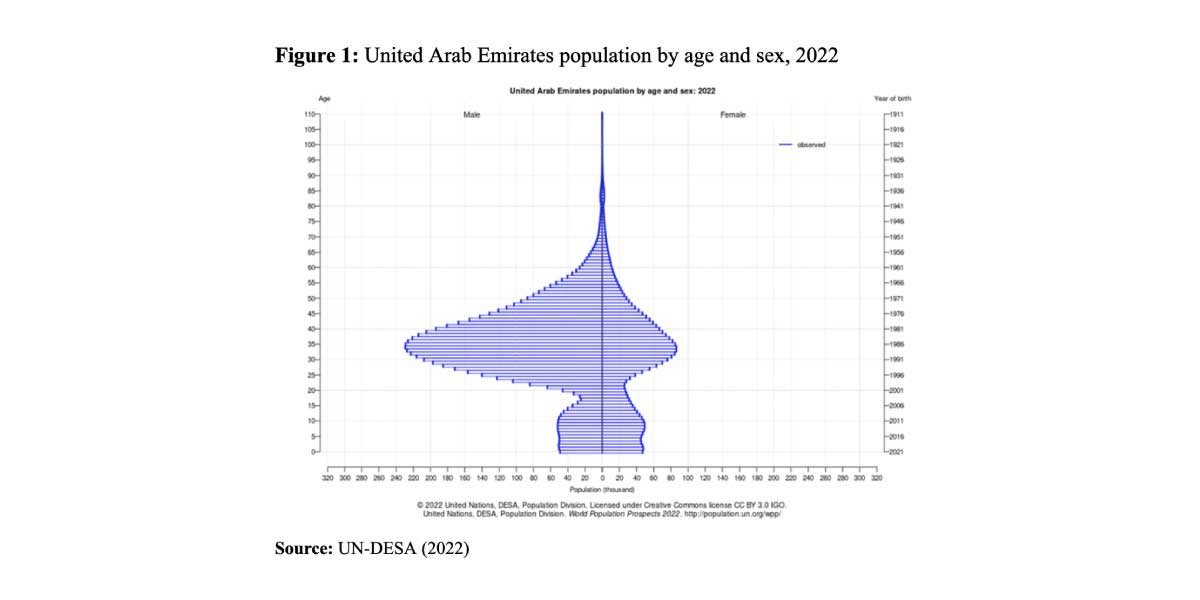
Demographers have long debated about the main drivers of population ageing. The contest is really only between fertility and mortality, as migration is known to play but a minor role, with the exception of small and peculiar realities (e.g. the United Arab Emirates in 2022 – Figure 1), and even then, usually just for limited periods of time.
The two opposing points of view are well summarized in these words:

Why are populations of rich countries so much older today than they were a century or two ago? … Common sense suggests that longer life is responsible for population ageing, but decades ago the work of demographers such as Coale (1956, 1957) and Keyfitz (1975) persuaded us that in fact fertility decline was more important. More recently, a new wave of demographic analysis suggests that mortality decline is the main demographic source of continuing population ageing. Here we … consider this possibility, but reject it.
(Lee and Zhou, 2017, pp. 285-287).

What do you think about it? And why should non-demographers care?

Levels and variations of old age measures


We recently addressed this issue in two distinct publications (De Santis and Salinari 2023, 2024). Our main conclusion is much closer to the “common sense” evoked in the above quote: the culprit of population ageing is longer average life spans. This is not particularly surprising, all in all, because the reason we can observe individuals living up to 40 years, for instance (which is not the case for mosquitoes), but not to the age of 1,000 (as it happens with sequoias), is that human mortality has certain characteristics, which translate into and shape population age structures (De Santis and Salinari, 2024).

Note, however, that there is a small ambiguity in this debate. Imagine you are interested in measuring the depth of the water of a large lake, where waves are frequent and high. Your indicator, an anchored cork in this example, will go up and down “erratically”, and predictions on direction and amount of change between two short-spaced instants depend on whether the cork is currently on the peak or a trough of a wave, how big the wave is, and when the next waves are due. On average, however, the cork will indicate the “normal” water level in that lake, which depends on the underlying structural and climatic conditions (e.g. average rainfall and its tendency to increase or decrease over time).

If we transpose this metaphor to the field of demography we can think of waves as “short-term disturbances” to the lake surface (=population age structure) produced by changes in number of births and, to a lesser degree, migrants. However, the underlying tendency towards higher or lower water level is due to more structural conditions (average rainfall).

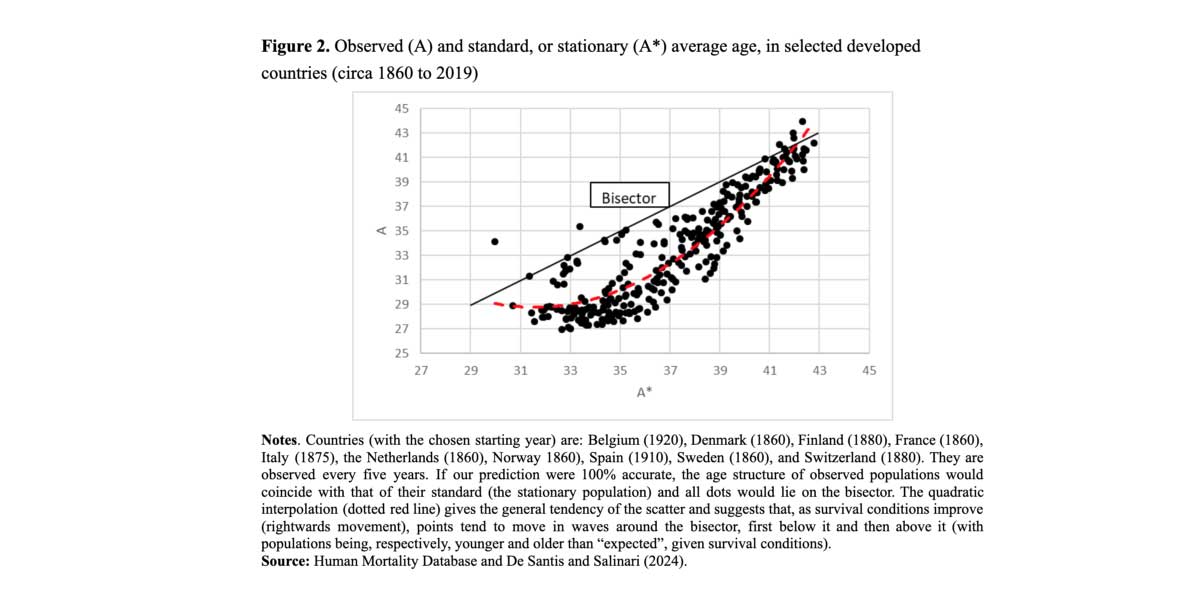
Let us consider the average age as an indicator of population ageing. Alternatives are possible, of course, such as the old age dependency index, OADI, but nothing changes in practice (not shown here). We can calculate two versions of the average age. The “standard” one, At, is based on the observed population of age x at time t, Px,t. The “reference” one, A*t, is calculated instead on the stationary population at time t, Lx. As the stationary population derives from a (period) life table, which depends only on survival conditions (not fertility or migration), we can use it as a measure of what would happen to ageing (as measured by the average age At) if only current mortality mattered. All the rest (previous mortality, fertility and migration) goes into the difference between the expected (by us) value A*t and the observed value At.
Figure 2 shows what can be observed in practice in a few selected developed countries, over a long time span. If the “waves” (fertility, migration and past mortality) had no effect on the observed age structure, all the points would lie on the bisector, where At=A*t, and where, in other words, 100% of ageing depends on survival. Moving rightwards (from low to high survival, so from low to high levels of ageing in the corresponding stationary populations), we observe instead that points move “in waves”. There is a rather large trough when A* is about 36 years (corresponding to an average length of life e0 of some 55/60 years), which historically occurred in the middle of the demographic transition – a very impressive wave indeed. For higher values of A*, however, after the end of the demographic transition, and up to today, things tend to return to “normal”. Our prediction is that new waves will hit the lake (starting from the ongoing second demographic transition), with new peaks and troughs, that will propagate and intersect with occasional new disturbances of all kinds. But A*t will always be a fairly good guide to the expected value of At.

Why should non-demographers care about all this?


If the age structure has effects on the socio-economic life of a community, understanding what drives its levels and change, both in the short and in the long run, matters for everybody, not just for population specialists and their academic discussions. The demographic bonus and pension systems, for example, are two areas where these ideas could potentially be applied.

The demographic bonus (or dividend, or window of opportunity) has traditionally been defined as a phase of “structural improvement” over a recent past. For instance, Lee and Mason (2010, p. S159) call it a “phase of … three to five decades … [when] support ratios rise well above their pre-transition levels”. We suggest that the comparison be made also with the stationary age structure of that time. This means that a demographic dividend can be considered to exist as long as the observed age structure is “better” than that of the corresponding stationary population.

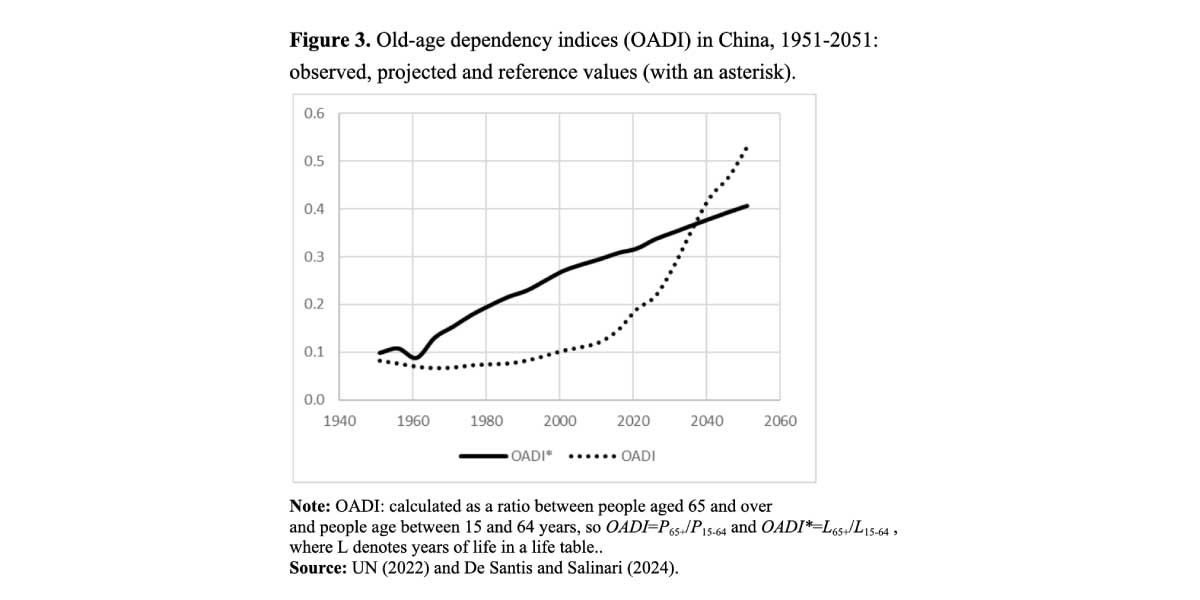
Let us refer to Figure 3, for instance. Due to its impressive fertility decline, China’s old-age dependency index (OADI) started to worsen (i.e. to increase) in the 1980s, and is now deteriorating rapidly. However, until about 2036, the observed OADI in China will be lower than its standard equivalent OADI*. In our interpretation, this means that, until then, China will still benefit from a demographic bonus, which means that it will be younger than what would be expected, based on survival level, although this advantage will shrink progressively as time passes.
Most pension systems have been reformed (retrenchments) in recent years due to population ageing. In several cases, these adjustments have been pegged to recent life tables and current survival conditions, and translate into higher retirement ages, or lower pension benefits (because retirees are expected to draw resources from the system for a longer period of time). Our findings suggest that this is the right approach, that it should become more widespread and systematic than is currently the case, and that it should be explicitly presented to the general public as a (comparatively small) price to pay for the great success of ever longer survival that benefits everyone.

Funding


We acknowledge co-funding from two sources: 1) Next Generation EU, in the context of the National Recovery and Resilience Plan, Investment PE8—Project Age-It: “Aging Well in an Aging Society’. This resource is co-financed by the Next-Generation EU (DM 1557 11.10.2022). 2) the Italian MUR (PRIN 2022–No. 2022CENE9F, “The pre-Covid-19 stall in life expectancy in Italy: looking for explanations”). The views and opinions expressed are only those of the authors and do not necessarily reflect those of the funding agencies.

References

  • Coale A.J. 1956. The effects of changes in mortality and fertility on age composition, Milbank Memorial Fund Quarterly, 34:79–114.
  • Coale A.J. 1957. How the age distribution of a human population is determined, Cold Spring Harbor Symposia on Quantitative Biology, 22.
  • De Santis G., Salinari G. 2023. “What drives population ageing? A cointegration analysis”, Statistical Methods and Applications, 32:1723–1741. https://doi.org/10.1007/s10260-023-00713-1
  • De Santis G., Salinari G. 2024. Long-term impact of mortality on population age structures. International Journal of Population Studies, https://doi.org/10.36922/ijps.377
  • Keyftz N. 1975. How do we know the facts of demography?, Population and Development Review, 1 (2): 267–288.
  • Lee R., Zhou Y. 2017. Does fertility or mortality drive contemporary population aging? The revisionist view revisited. Population and Development Review, 43:285–301. https://doi.org/10.1111/padr.12062.
  • United Nations. 2022. World Population Prospects: The 2022 Revision. New York, United Nations Publications.

Monday, December 4, 2023

retirement policies and demographic change

How retirement policies and demographic change influence China’s gender labor force gap

December 4, 2023 Feng Kai

The gender gap in labor force participation is expanding in China, for various reasons, among which scarcity of affordable public childcare and growing discrimination against women in the labor market. Part of the explanation, Kai Feng argues, lies in the rigidities and discrimination of the Chinese pension system, which forces women to retire earlier than men.


China, once renowned for its high women’s labor force participation, is now experiencing an unexpected downturn. While the gender gap in labor force involvement is narrowing at global level, it is expanding in China (Figure 1)

During Mao’s era, the labor force participation rate for women was exceptionally high, driven by the radical ideology that “women hold up half the sky” and by massive social mobilization to promote female employment. The planned economy of the time also meant that both women and men had little choice but to work for a living. With the advent of market reforms in 1978, not working became a viable option for many. In addition, subsequent institutional shifts have erected significant barriers for women seeking to join or stay in the workforce.

Why has the gender gap in labor force participation widened in China?


Numerous studies, as summarized in Ji et al (2017), suggest that the reduction in affordable public childcare —previously widely available — combined with escalating discrimination against women since the economic reforms, are contributing to this widening gap. Drawing from these findings, researchers recommend policies to enhance access to cost-effective childcare, to curb workplace discrimination against women, and ensure equal rights for women and men, irrespective of women’s fertility behaviors or intentions.

In a recent study (Feng 2023) I highlight an often-overlooked factor: China’s gender-based retirement policy. Under this policy, established in the 1950s with the intention of “protecting” female workers (some argue it was a legacy of the Soviet model), women are expected to retire at either age 50 or 55, depending on their occupations, while men retire at 60. This policy has remained untouched, even as women’s life expectancy has risen and their presence in higher education and the workforce has significantly expanded.
 

Increased women’s labor force participation after age 50, but composition effects prevail


A significant factor contributing to the observations is the shift in population age composition. As a larger portion of the population reaches retirement age, a higher number of women than men exit the workforce (Figure 2).

Women’s labor force participation rate above age 50 actually increased between 1990 and 2010, (as shown by the percentage on the top of the bar), together with the population aged 50 and over. In 1990, the majority of the working-age population consisted of younger age groups, with women aged between 50 to 64 represented only 19% of the entire workforce (ages 20 to 64). This percentage grew to 24.5% in 2010 and is anticipated to reach 37.2% by 2030.

These demographic shifts are expanding the gender gap in labor force participation over the years. If labor force participation rates remain consistent with the 2010 data, the projected age structure for 2030 suggests an even more pronounced gender disparity in labor force participation.

This study does not necessarily contradict previous findings, however. Figure 3 presents the contribution of caregiving and retirement to the change in women’s labor force participation between 1990 and 2010.

Among younger women, the rate of non-participation in the labor force due to caregiving rose, aligning with the explanations of increased work-family conflict and gender discrimination. Compared to 1990, the rise in caregiving rates among younger women in 2010 was offset by a decrease among older age groups. However, this does not imply that women undertake fewer caregiving responsibilities in their older years now than in the past. Rather, women now are more likely to cite retirement as their reason for not participating in the labor force.

Is early statutory retirement age a good thing for women?


The topic of women’s early retirement is hotly debated in China. While many men argue that the system is unfair because men are required to work for more years than women before they can retire, the question remains: is an early statutory retirement age truly beneficial for women?

On the surface, early retirement may seem advantageous, but being able to retire with financial independence is another story: the gender-based retirement system contributes to a gender pension gap, with women receiving fewer pension benefits (Giles et al 2023). An institutionalized policy that requires women to retire earlier than men may further hinder women from advancing to senior positions on the professional ladder.

Within a household, men and women often pool resources, including pensions, savings, housing, and assistance from their children. However, as singlehood and childlessness rates increase, early retirement may put single and childless women in precarious financial situations. Moreover, as the population continues to age, there are growing concerns about the long-term sustainability of the current pension system (Cai, Wang, Shen 2018). The upcoming generation might not receive the same pension benefits as their parents. Consequently, for many people, labor earnings might emerge as a more reliable income source than a pension. Thus, ensuring equal labor rights for women and men at older ages is becoming imperative.
 

Rising retirement age


Discussion on retirement age should distinguish between effective retirement age and statutory retirement age. Even with a new pension system that includes rural residents, the retirement age holds minimal weight for millions of low-skilled migrant workers, as many will continue working as long as they physically can. The pension disparity between urban hukou holders and their rural counterparts is huge (Giles et al., 2023). Still, a static and gender-based retirement age could place additional strain on these workers. The current retirement system might leave many workers above retirement age, especially a higher proportion of women, vulnerable due to inadequate labor protections, such as accident and injury insurance. This could also make employers hesitant to hire older individuals due to associated risks.

For years, raising the retirement age has been considered a policy strategy to boost the workforce and, more importantly, to address the looming pension deficit. Considering that, after years of economic development, China currently has the most educated and healthiest population in its history (Wang 2023), the country appears well-positioned to enact this policy. However, alongside the widely discussed urban-rural divide, it is important to integrate a gender perspective into ongoing discussions about retirement and pension reform to avoid maintaining or even exacerbating the inequality in middle and later life stages.

References

  • Cai, Y., Wang, F., & Shen, K. (2018). Fiscal implications of population aging and social sector expenditure in China. Population and Development Review, 811-831.
  • Feng, K. (2023). Unequal Duties and Unequal Retirement: Decomposing the Women’s Labor Force Decline in Postreform China. Demography, 60(5), 1309-1333.
  • Giles, J., Lei, X., Wang, G., Wang, Y., & Zhao, Y. (2023). One country, two systems: evidence on retirement patterns in China. Journal of pension economics & finance, 22(2), 188-210.
  • Ji, Y., Wu, X., Sun, S., & He, G. (2017). Unequal care, unequal work: Toward a more comprehensive understanding of gender inequality in post-reform urban China. Sex Roles, 77, 765-778.
  • Wang, F, 2023, Should or should not China be afraid of population decline?, Neodemos

Wednesday, November 22, 2023

career peak

Matterhorn

Пик продуктивности и карьеры — в 47. Пенсионеры оценили, в каком возрасте они работали лучше всего


Возраст наибольшей продуктивности женщин наступает на 3 года позднее, чем у мужчин. В опросе сервиса по поиску высокооплачиваемой работы SuperJob приняли участие 1600 респондентов пенсионного возраста из всех округов страны.

Пик карьеры и продуктивности среднестатистического россиянина приходится на 47 лет. Причем средний возраст, когда женщины и мужчины находятся на вершине карьеры, одинаков (по 47 лет), а вот средний возраст наивысшей продуктивности отличается: 46 лет у мужчин и 49 лет у женщин. «Дети выросли, муж сбежал — появился большой простор для деятельности!» — поясняют россиянки.

Чаще всего временем, на который, по оценкам россиян, пришелся пик их карьеры (т. е. наиболее высокой должности и зарплаты) называют период от 46 до 50 лет (21%), причем примерно поровну респондентов добились успеха раньше или позже этого. А вот пик их продуктивности, как чаще всего считают россияне, пришелся непосредственно на предпенсионный период (23%).

Рынок труда сейчас переживает период «старения» кадров. Работодатели постепенно отказываются от негласных предубеждений против возрастных соискателей (официально возрастная дискриминация запрещена законом). Особенно это касается сегмента квалифицированной рабочей силы. Период наибольшей продуктивности представителей рабочих специальностей, по их оценкам, наступает после 50 лет (42%): «Это тот возраст, когда всё знаешь и умеешь, принимаешь быстрые и грамотные решения».

Место проведения опроса: Россия, все округа
Населенных пунктов: 326
Время проведения: 4—21 ноября 2023 года
Исследуемая совокупность: мужчины старше 62 лет и женщины старше 57 лет
Размер выборки: 1600 респондентов

Подробнее

Saturday, November 18, 2023

loneliness

Порядка четверти молодых людей в мире чувствуют себя одинокими


Одиночество - настоящая эпидемия по всему мира: 27% опрошенных в возрасте от 19 до 29 лет сказали, что чувствуют себя одинокими. Среди соседних по возрасту когорт одиноких по 25%, а вот в более старших возрастных группах ситуация лучше, особенно в самой старшей: среди людей 65+ по всему миру (опрос проводился в 142 странах!) только 17% чувствуют себя одинокими

Wednesday, October 25, 2023

How long do older Germans work?

October 23, 2023 Christian Dudel, Elke Loichinger, Sebastian Klüsener, Harun Sulak and Mikko Myrskylä

Rapid population aging may undermine the viability of the German pension system. Is working longer a remedy? Christian Dudel, Elke Loichinger, Sebastian Klüsener, Harun Sulak, Mikko Myrskylä analyse what is known about employment in later adult life in Germany. Employment trends are on the increase, but with considerable socioeconomic differences.


Germany is aging


The German population is among the oldest in the world and is aging rapidly. Projections of the German Federal Statistical Office (Statistisches Bundesamt, 2022) indicate that in 2050 around 26% of the population will be over age 67, which will be the statutory retirement age by 2031. As the number of retirees increases and the workforce shrinks (Fuchs et al. 2018), this rapid population aging will be a challenge for the German social security system, and for the German pension system in particular.

Extending the length of working life has been proposed as a remedy, as it increases the size of the workforce while reducing the number of retirees. Several institutions, such as the European Commission and the OECD, have been advocating for this shift (e.g., European Commission, 2010; OECD 2015). Meanwhile, many countries, including Germany, have implemented reforms with the major goal of prolonging working life. For instance, the statutory retirement age in Germany is currently being increased from 65 to 67.

Inequalities in the length of working life


Policies aimed at extending working life often follow a one-size-fits-all approach. As these policies are frequently applied with few or no exceptions, or are aimed at workers in stable employment (e.g., Phillipson 2019), they might have negative effects on more economically insecure and vulnerable groups. For instance, increasing the retirement age for almost everyone, as is currently the case in Germany, may increase the duration of working life for highly educated men with high employment rates, while low educated individuals face a high risk of unemployment during the additional years they are forced to stay in the labor market.

A series of studies in several countries have revealed substantial socioeconomic inequalities in the length of working life (e.g., Dudel & Myrskylä 2017). In a recent paper (Dudel et al. 2023), we provide new evidence of such inequalities for older workers in Germany, and focus on several dimensions of inequality: gender, occupation, education, and region (distinguishing between the former socialist eastern Germany and western Germany). Below we provide an overview of some of the key findings, focusing on general trends and inequalities by education.

General trends in Germany


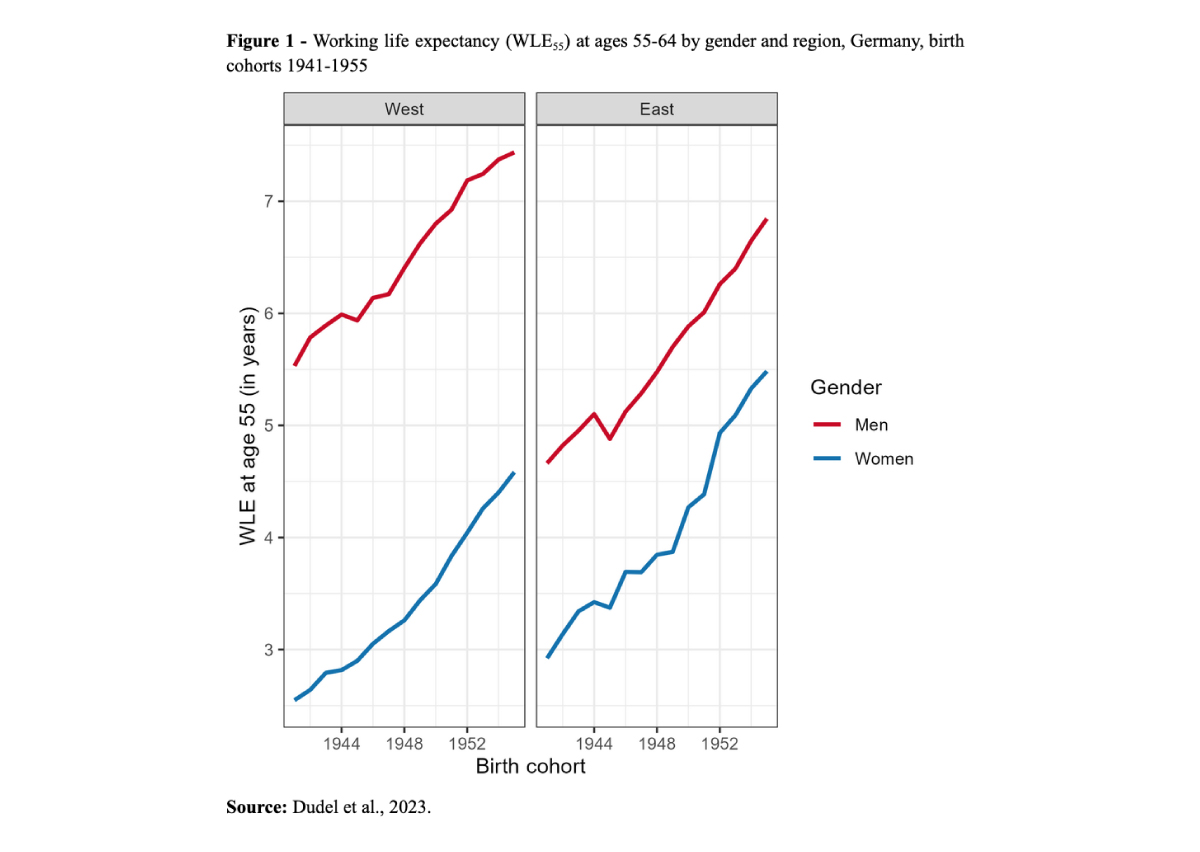
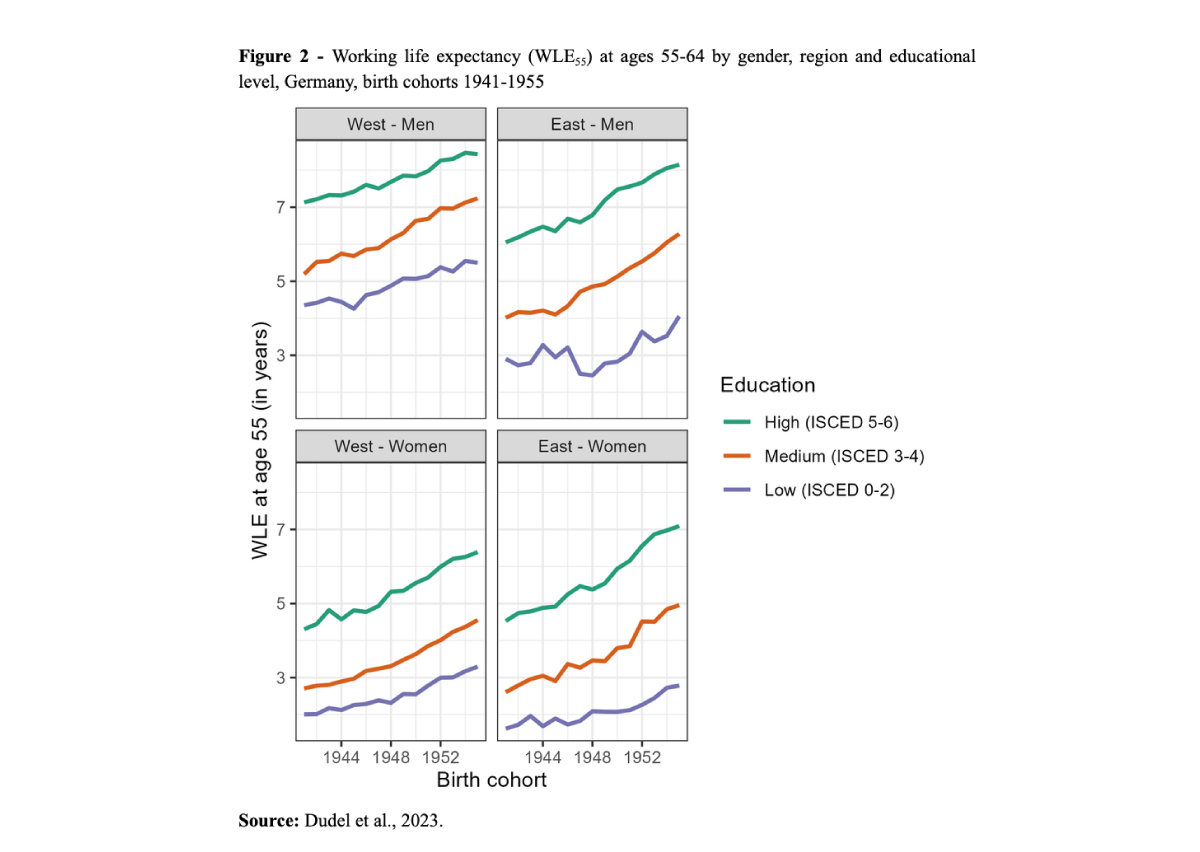
Our key indicator is working life expectancy (WLE55), defined as the average remaining lifetime spent in work. It is measured in years and, for our study, we computed it between ages 55 and 64, adjusting it for working hours. This means that our results are based not only on whether individuals are or are not gainfully employed, but also on whether they are working full- or part-time. We used data from the German Microcensus for the years 1996 to 2019, and calculated WLE55 for the cohorts born between 1941 and 1955 (Fig. 1).
For instance, the number of additional years western German men could expect to remain employed at age 55 rose from 5.5 years for those born in 1941 to 7.4 years for those born in 1955. For all groups, WLE55 increased by around 2.0 to 2.5 years over the observed birth cohorts. This shift is likely attributable to several factors, including pension reforms aimed at extending working life and better health among younger cohorts.

In both western and eastern Germany, men worked for longer than women. However, the gender gap was always smaller in the east than in the west, and it decreased somewhat in eastern Germany, while remaining roughly constant in western Germany. Similarly, eastern German women worked longer than their western German counterparts. Among men, by contrast, the opposite pattern is observed, with western German men working longer. These regional and gender differences are legacies of eastern Germany’s socialist past and the unification process. When the east was socialist, policies aimed at integrating women into the labor market led to higher female employment rates in eastern Germany than in the west. This pattern continued after German unification, even during periods when unemployment rates in eastern Germany were high.

Educational inequalities in Germany


Employment in late adult life depends also on education, for which, in our paper, we considered three levels:
• low (equivalent to ISCED levels 0 to 2),
• medium (ISCED levels 3 to 4), and
• high (ISCED levels 5 to 6).

Results are displayed in Figure 2. When interpreting them, it is important to keep in mind that the lowest educational group is smaller and more selective in eastern than in western Germany, as less than 10% of the population aged 55 to 64 in eastern Germany have low educational attainment.
On average, WLE55 increased for all educational groups, but with considerable heterogeneity in both level and pace. For instance, beyond age 55, low-educated eastern German women worked, on average, only three additional years, while highly educated western German men worked almost nine. Moreover, in eastern Germany, the increase in WLE55 was notably smaller for low-educated individuals than for the other educational groups. For example, the gap between highly educated and low-educated eastern German men increased from roughly three to four years.

Conclusions


In summary, the length of late working life has been steadily increasing in Germany for all the socioeconomic groups we considered. This trend is in line with the aim of many recent policy reforms to increase retirement age. However, our findings show that there are substantial and increasing socioeconomic inequalities in the length of working life after age 55 among older workers. Researchers and policymakers should focus more on these inequalities, as they might be outcomes of systematic social disadvantages among specific groups of older workers. To help us better understand inequalities in WLE55, we are currently extending our calculations of WLE to cover all working ages. If, for instance, low-educated workers start working at earlier ages than highly educated workers, inequalities in total WLE might be smaller than inequalities in just WLE55, i.e. among older workers only.

References

  • Dudel, C., Myrskylä, M. (2017): Working Life Expectancy at Age 50 in the US and the Impact of the Great Recession. Demography 54: 2101-2123.
  • Dudel, C., Loichinger, E., Klüsener, S., Sulak, H., Myrskylä, M. (2023): The extension of late working life in Germany: trends, inequalities, and the East-West divide. Demography. https://doi.org/10.1215/00703370-10850040
  • European Commission (2010): Annual growth survey: Advancing the EU’s comprehensive response to the crisis.
  • Fuchs J., Söhnlein D., Weber B., Weber E. (2018). Stochastic forecasting of labor supply and population: an integrated model. Population Research and Policy Review, 37, 33-58.
  • OECD. (2015): Pensions at a glance 2015. Available at OCED.
  • Phillipson C. (2019). “Fuller” or “extended” working lives? Critical perspectives on changing transitions from work to retirement. Ageing & Society, 39, 629-650.
  • Statistisches Bundesamt, 2022: 15. koordinierte Bevölkerungsvorausberechnung – Deutschland. Available online.

Sunday, October 15, 2023

age at retirement

тыцабельно

Пенсионный возраст в разных странах мира


Интересная инфографика, показывающая не только законодательно установленный возраст выхода на пенсию (красные кружки), но и эффективный - возраст, когда люди фактически перестают работать (синие кружки)

И местами эти два возраста очень сильно отличаются! В Саудовской Аравии, к примеру, работают в среднем до 59, хотя на пенсию можно выйти... в 47! В Индонезии разница тоже составляет 12 лет, только оба возраста - на десять лет больше (в 57 можно выйти на пенсию, в 69 в среднем выходят). Работа в возрасте, когда уже можно по закону выйти на пенсию, в целом характерна для азиатских стран и для стран с низкими доходами (многие страны Латинской Америки, Россия, Турция)

А вот в большинстве стран Европы, напротив, эффективный возраст выхода на пенсию ниже законодательно установленного! Во Франции, к примеру, перестают работать в среднем в 60, хотя пенсионный возраст начинает с 65 лет! В большинстве других стран разница составляет 3-4 года. Живут же люди!

Tuesday, September 19, 2023

Retirement Crisis

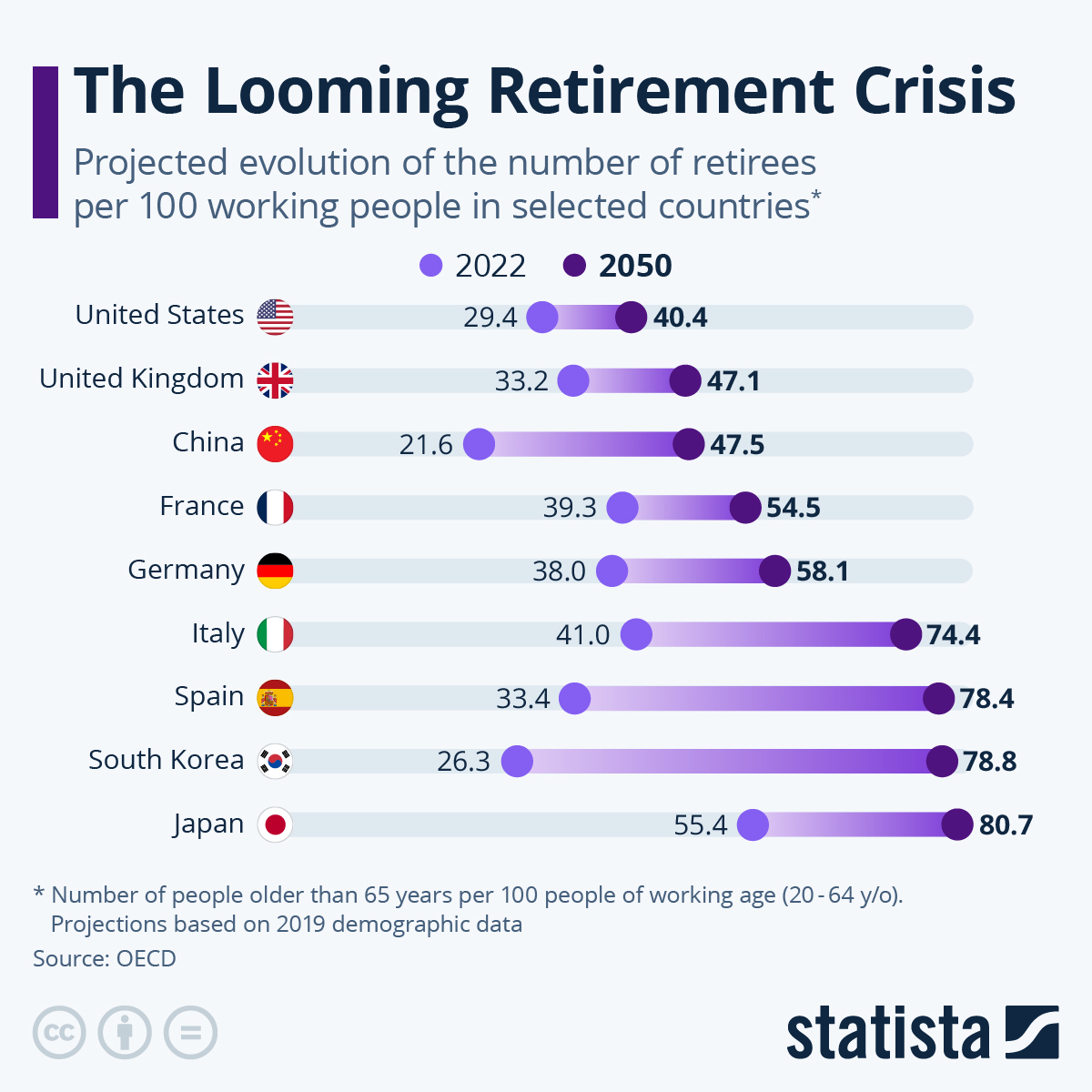
An aging population represents a major challenge for many countries around the world. Falling birth ratescoupled with rising life expectancies are likely to place significant pressure on labor markets, healthcare and pension systems. OECD data reveals how a number of countries are facing particularly rapid aging. Where the number of retirees for every 100 workers already stood at 52 in Japan and 40 in Italy in 2020, projections say this could hit 81 and 74 by 2050.

The challenges posed by such demographic changes will affect a growing number of countries in the coming decades, including China and the United States, whose populations currently remain younger than those of the other nations on this chart.
Retirement Crisis

Tuesday, June 20, 2023

Loneliness and social exclusion among older Europeans before and during the COVID-19 pandemic

June 19, 2023 Bruno Arpino, Giuseppe Gabrielli and Heidrun Mollenkopf

Launched in 2009, the Joint Programming Initiative “More Years Better Lives” (JPI-MYBL) brought together several EU and non-EU countries to create a common research framework aiming to better coordinate, harmonize, and synchronize the research programmes of the participating countries on the topic of demographic change. In 2022, JPI-MYBL launched a knowledge-sharing process on isolation and loneliness among older people during the COVID-19 pandemic.

This resulted in a few workshops, which later led to a series of short papers and, ultimately, to the production of the e-book Loneliness and social exclusion among older Europeans before and during the COVID-19 pandemic that is now available on the N-IUSSP website. Here is an excerpt from Bruno Arpino, Giuseppe Gabrielli and Heidrun Mollenkopf’s introduction.


The demographic changes of the past and coming years will profoundly modify the population structure in Europe. These transformations are associated with changes in the distribution of resources and opportunities across Europe and beyond – changes that require adjustments in all areas of life, both at individual level and across society as a whole. Among these changes, population ageing is a long-term trend, which began several decades ago in Europe. Increased life expectancy is a triumph for humanity but, coupled with fertility reduction and postponement, it causes population ageing.

Social isolation and feelings of loneliness among older people are among the challenges posed by population ageing and shrinking family networks. Isolation and loneliness have negative consequences on individuals that may result in poor physical health, unhealthy behaviours, poor wellbeing and, ultimately, depression.

Loneliness also has an economic cost for individuals and society; it reduces interpersonal interactions, and thus social capital, and adversely affects physical and mental health. Research has estimated that the annual cost of loneliness is about 1,000 euros per capita. Individuals who feel lonely also tend to use healthcare services more than others, with negative consequences on public health expenditures.

Loneliness and social isolation among older adults were already important research and policy topics before the onset of the COVID-19 pandemic. However, the spread of COVID-19 and the social distancing measures to limit transmission of the virus exacerbated pre-pandemic vulnerabilities linked to isolation and loneliness in ageing societies.

Isolation, loneliness, and the COVID-19 pandemic


In the decades preceding the COVID-19 pandemic, scholars and public health officials became increasingly concerned about the growing risks of loneliness driven by societal shifts such as fertility decline, the increase in one-person households and other factors, especially in the United States and Europe.

After the outbreak of the pandemic, physical distancing was imposed or encouraged at national, regional, and local levels, to mitigate the spread of COVID-19. People were asked to avoid public social spaces and minimize physical contact with others. Measures also included stay-at-home orders, and full physical isolation of high-risk individuals, such as older adults with pre-existing conditions. While these mitigation measures were effective in slowing the spread of COVID-19 and reducing mortality, they may have increased isolation among older adults, possibly exacerbating the “loneliness pandemic” and the risk factors for loneliness.

Studies have suggested that older adults were more resilient to loneliness than younger adults during COVID-19. Thus, increased physical isolation due to the anti-COVID restrictions does not seem, on the whole, to have exacerbated feelings of loneliness among older adults. This finding may reflect a combination of factors, including lowered expectations for social interaction during the pandemic or increased contact at a distance.

Although possibly more resilient than younger adults, it is unclear whether, and to what extent, older adults across Europe experienced increases in loneliness during COVID-19. Existing evidence offers mixed results. In addition, although some studies showed unchanged feelings of loneliness among older adults overall, relevant heterogeneities may exist. Along this line, Arpino et al. (2022) show that individuals who lack certain close family ties (e.g., unpartnered people) have been at higher risk of reporting increased feelings of loneliness since the onset of the pandemic. This suggests that older people who lacked emotional and practical support might have been particularly exposed to its direct and indirect consequences. Van Tilburg (2022) shows that loneliness, and particularly emotional loneliness, increased between 2019 and 2020, although having a partner before the pandemic provided some protection.

Given that informal caregiving is mostly provided by close family members, childless and unpartnered individuals were, in principle, those at highest risk of experiencing unmet care needs during the pandemic. In fact, research has shown that family caregiving continued during the pandemic, in some cases replacing formal care services to avoid possible contagion by care professionals. Studies have also reported higher anxiety and depression among family caregivers during the pandemic.

The increased need of care and the heavier burden placed on family caregivers call for new policy and practice solutions. Older people in residential care are at a particularly high risk of isolation, loneliness and reduced care. COVID‑19 has pointed up an urgent need for higher standards of care in nursing homes in Europe, and for the development of community-based alternatives and services to support persons with care needs and families with care responsibilities.

These alternatives and services could be inspired by the principles outlined in a UN (2020) policy brief launched in the early phases of the pandemic. The development of good quality, affordable, available, and accessible community-based services being paramount for meaningful inclusion in the community, these services should be developed in collaboration with all stakeholders, from users to practitioners, including persons with care needs and their families. In parallel, broader-scope interventions to reduce isolation and loneliness among the general population can, and need to be, implemented, e.g. by improving public transport and through laws and policies to address ageism, inequality and the digital divide (WHO 2021).

References

  • Arpino B., Mair C. Quashie N., and Antczak R. (2022) Loneliness Before and During the COVID-19 Pandemic: Are Unpartnered and Childless Older Adults at Higher Risk? European Journal of Ageing. 19, 1327–1338.
  • United Nations (UN) (2020) The Impact of COVID-19 on older persons.
  • Van Tilburg, T. G. (2022). Emotional, social, and existential loneliness before and during the COVID-19 pandemic: Prevalence and risk factors among Dutch older adults. The Journals of Gerontology: Series B, 77(7), e179-e184.
  • World Health Organization (WHO) (2021). Social isolation and loneliness among older people: advocacy brief. WHO: Geneva.

Thursday, June 8, 2023

a number of retired

Сколько пенсионеров приходится на 100 людей трудоспособного возраста в разных регионах Европы


Тяжелее всего ситуация с соотношением людей пенсионного и трудоспособного возраста оказалась в немецком городе Хемниц: там на 100 человек от 15 до 64 лет (трудоспособный возраст - хотя и сильно не все эти люди работают) приходится 51 пенсионер! В итальянской Лигурии это соотношение держится на уровне 47.6 пенсионеров на 100 трудоспособных, во французском Лимузине оно составило 47.3

В целом же, самая большая нагрузка пенсионерами зафиксирована в восточной части Германии, Италии (особенно северной и центральной), Финляндии, Швеции, Греции и Франции

Thursday, May 11, 2023

kids on dacha

Самый большой отпускной бюджет — у жителей Москвы, Красноярска и Екатеринбурга


Среднестатистический отпускной бюджет за год вырос до 46 тыс. руб. на человека за неделю. Самые большие расходы на отпуск — у жителей Москвы, Красноярска и Екатеринбурга. В опросе сервиса по поиску высокооплачиваемой работы SuperJob приняли участие 13 тыс. представителей экономически активного населения из всех округов страны.

Планируя недельный отпуск, среднестатистический россиянин может позволить себе потратить 46 тыс. руб. на одного члена семьи. На идеальный отпуск такой же продолжительности респондентам требуется в среднем 157 тыс. руб. на человека. Почти каждый третий (30%) сообщил, что не может позволить себе отдых из-за отсутствия средств.

Женские запросы скромнее мужских: и для реального, и для идеального отпуска представителям сильного пола нужно больше, чем женщинам. Чем старше респонденты, тем меньше их отпускной бюджет и тем меньше им нужно для отпуска мечты. При этом отпускные запросы ожидаемо растут вместе с уровнем дохода.

По сравнению с прошлым годом, среднестатистический отпускной бюджет вырос на 9 тыс. руб., тогда как запросы к отпуску мечты, напротив, чуть снизились. Число россиян, которые не могут позволить себе отпуск, уменьшилось на 5 п.п. и вернулось к уровню 2021 года.

Больше всего могут позволить себе потратить на отпуск жители Москвы — в среднем 55 тыс. руб. на одного человека на неделю. На втором месте — Красноярск (50 тыс. руб.), на третьем — Екатеринбург (48 тыс. руб.). За год среднестатистический отпускной бюджет вырос во всех мегаполисах, кроме Нижнего Новгорода и Омска. При этом самый заметный рост предполагаемых расходов на отдых зафиксирован в Краснодаре (в среднем на 7 тыс. руб. по сравнению с прошлым годом и на 12 тыс. руб. по сравнению с 2021-м) и Казани (на 7 тыс. руб. за год и на 8 тыс. руб. за 2 года).

Что касается отпуска мечты, то самые большие запросы — у жителей Москвы и Красноярска (по 170 тыс. руб. на человека за неделю), а также Ростова-на-Дону (167 тыс. руб.). Стоимость идеального отдыха больше всего выросла в Уфе (на 10 тыс. руб. по сравнению с прошлым годом).

Место проведения опроса: Россия, все округа
Населенных пунктов: 620
Время проведения: 12 апреля — 10 мая 2023 года
Исследуемая совокупность: экономически активное население России старше 18 лет
Размер выборки: 3000 респондентов в общем опросе, 10000 респондентов в опросе населения городов-миллионников — по 1500 респондентов из Москвы и Санкт-Петербурга, по 500 респондентов из других городов-миллионников

Подробнее

Wednesday, May 3, 2023

health after retirement

Сколько "здоровых" лет жизни проживают люди после выхода на пенсию [по всей видимости речь не о пенсии, а о фиксированном возрасте, но написано то, что написано, но см маленькие буквы на рисунке, там написано 65] в разных странах Европы


Лучше всего живётся на пенсии жителям Мальты: средний житель этой страны после выхода на пенсию проживает в добром здравии 15.6 лет, средняя жительница - 16 лет. В Швеции эти числа составляют 15.4 и 16.4 лет соответственно, в замыкающей тройку лидеров Норвегии уже заметно - около 13 лет. Меньше всего шансов пожить себе в удовольствие на пенсии у живущих в Латвии - чуть больше 4 лет и у мужчин, и у женщин

Свойственная России картина с катастрофически разной продолжительностью жизни мужчин и женщин наблюдается и во многих странах Восточной Европы, пусть и не в столь экстремальной форме. В Польше мужчины на пенсии имеют возможность пожить здоровыми чуть больше 7 лет, женщины - больше 13 (на уровне богатейших стран Европы!); в Румынии разрыв около 5 лет, в Хорватии - почти 4. Внезапно, Австрия по этим показателям выглядит страной Восточной Европы: 8 "здоровых" лет жизни на пенсии и мужчин против 13.3 - у женщин

Sunday, April 23, 2023

life after retirement

Россияне стали реже планировать работать после выхода на пенсию


Задумываясь о пенсии, россияне вдвое реже, чем в 2021 году, говорят о желании посвятить себя воспитанию внуков. Число тех, кто собирается работать до старости, тоже сократилось на треть. В опросе сервиса по поиску высокооплачиваемой работы SuperJob приняли участие 2000 представителей экономически активного населения старше 45 лет из всех округов страны.

На пенсии каждый четвертый россиянин (26%) хотел бы путешествовать. Выйдя на заслуженный отдых и имея возможность не работать, 15% занялись бы дачей или огородом, 13% — любимым хобби, 12% просто жили бы в свое удовольствие. Посвятить себя внукам мечтают лишь 5% опрошенных, столько же хотели бы сделать своим главным занятием после выхода на пенсию спорт. Читать книги на пенсии собираются 3%, заниматься здоровьем, ходить на экскурсии, в театры и музеи — по 1%. Каждый десятый сообщил о других планах на этот жизненный период: в их числе саморазвитие, благотворительность, литературное творчество, ремонт, предпринимательство и т. д.

Еще 13% россиян намерены продолжать работать в пенсионном возрасте, даже если средств для комфортной жизни будет достаточно: по их словам, они просто не представляют себя без работы.

О путешествиях и воспитании внуков на пенсии чаще мечтают женщины (7% против 4% среди мужчин). Тех, кто планирует продолжать трудиться до старости, в том числе и при отсутствии финансовой необходимости, вдвое больше среди мужчин (16% против 8% среди женщин).

За последние 2 года число россиян, собирающихся работать на пенсии, сократилось на треть. Этот тренд особенно заметен среди женщин: о том, что они не представляют себе жизнь без работы, представительницы прекрасного пола стали сообщать вдвое реже. По сравнению с 2021 годом, женщины чаще хотят на пенсии жить в свое удовольствие и реже мечтают посвятить себя внукам.


Место проведения опроса: Россия, все округа
Населенных пунктов: 440
Время проведения: 12—21 апреля 2023 года
Исследуемая совокупность: экономически активное население России старше 45 лет
Размер выборки: 2000 респондентов — по 1000 мужчин и женщин

Подробнее

Sunday, March 19, 2023

France Enjoys Comparably Low Retirement Age

Protests and strikes that have disrupted France for weeks have grown more intense after the government yesterday decided to force through a controversial reform raising the minimum standard retirement age from 62 to 64. The change has been in the making for years and has been postponed time and time again following fierce opposition among the population – for example in the form of the country’s longest-ever transport strike in early 2020.

French President Emmanuel Macron will evoke special constitutional powers to pass the law that the French Senate on Thursday signed off on, but that was expected to hit a roadblock in the lower house. French Prime Minister Elisabeth Borne, who announced the plan, called the reform necessary to prevent a major deficit in the pension system. Like many aging societies in Europe, France is looking to support a growing share of retirees among its population, but unlike many of its neighbors has not raised the retirement age so far.

The change is scheduled to be finalized by 2030. Likewise, other developed countries around the world have been in the process of raising the retirement age of their public pensions, but most have gotten a lot further than France will have come in this decade. The Netherlands, Spain, Germany and the U.S. (through the Social Security Administration) are inching up to their joint new retirement age of 67. The newest cohorts eligible for a standard pension as of January 1, 2023 are now between 65 years and 10 months and 66 years and 10 months of age in these countries. The new retirement age of 67 for newly eligible cohorts will be reached between 2024 and 2030. The UK, meanwhile, will start inching up to 67 between 2026 and 2028, while Belgium will raise the minimum retirement age to 66 in 2025 and 67 in 2030.

In addition to an age requirement, countries also apply minimums for the length of a person’s work life in order to retire with a standard pension. Exceptions are sometimes made for people who majorly overshoot that work life requirement ahead of minimum pension age. In most countries, it is also possible to retire from an earlier age and accept deductions. Diverging rules apply to occupational pensions, basic benefit pensions, individual pension accounts and of course, private pensions.

Countries that have been more timid in raising the retirement age include Canada, where plans to change it beyond 65 were scrapped, and Switzerland, which is still mulling a further raise. However, the retirement age will be 65 for both sexes starting in 2025 in the country. Sweden raised the retirement age to 63 this year from 62 and might increase again as life expectancy rises.France Enjoys Comparably Low Retirement Age

Where People Are Working Beyond 65

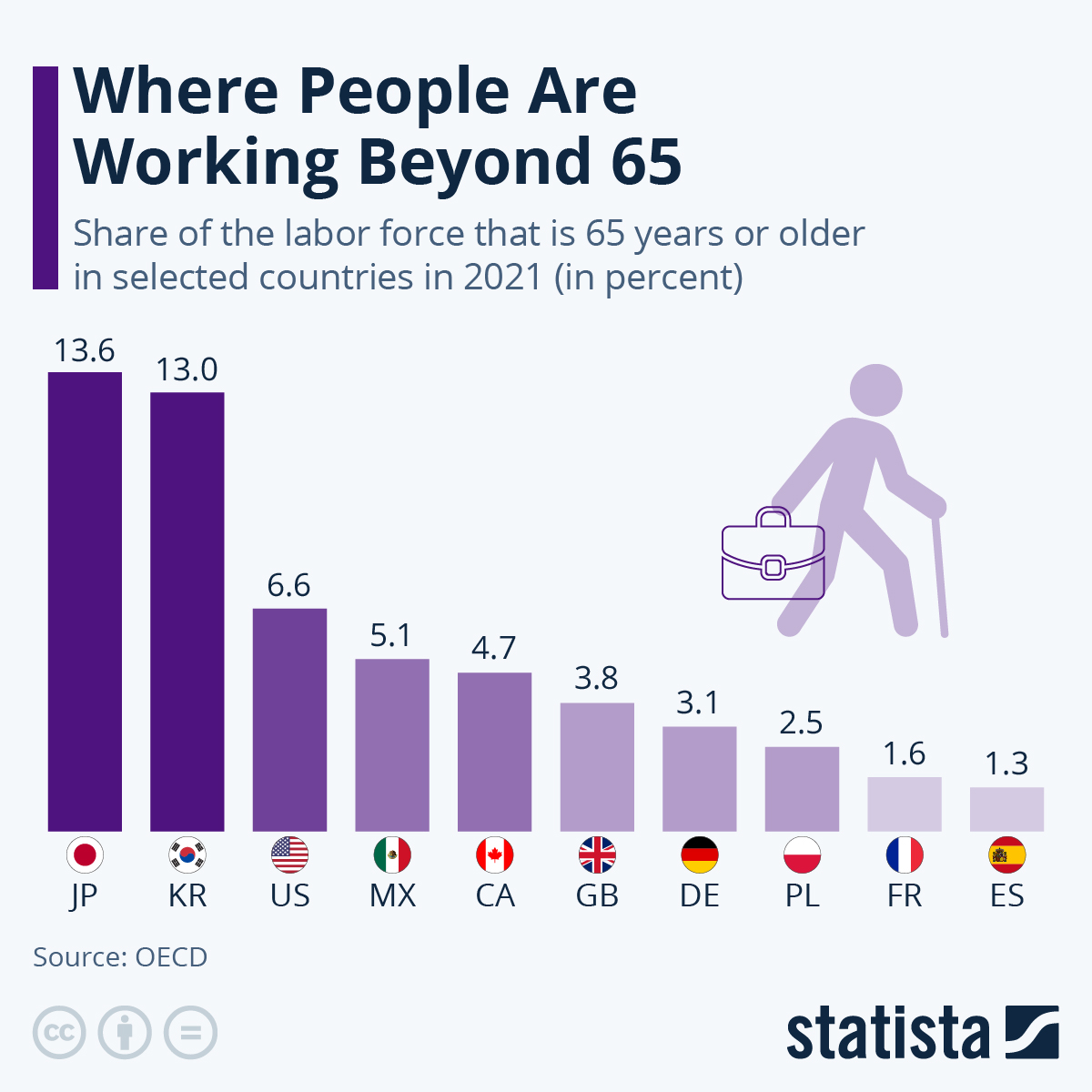
There is a huge disparity in labor force participation among over 65-year-olds across different OECD countries. According to data from the organization, Japan and Korea are the places where those aged 65 and over are making up the biggest share of the labor force - between 13 and 14 percent. In contrast, Europe, where aging societies are also common, is seeing much fewer people work beyond 65. The number ranged from 3.8 percent of the labor force in the United Kingdom and just 1.3 percent in Spain. This is despite the fact that both countries - like most developed nations - are raising the retirement age, have a current minimum retirement age around 66 years and will reach 67 years before the end of the decade.

In the United States, the minimum retirement age is about the same, but still, the share of older workers is higher at 6.6 percent of the labor force - above that of Mexico. This fact signals that older Americans can feel the need to work longer in a country that relies heavily on individual pension accounts and offers little in regards of public pension benefits to lower-wage earners.Where People Are Working Beyond 65у нас ?

Sunday, March 12, 2023

french pension

Emmanuel Macron

"Поставить экономику на колени"

во Франции массово бастуют против пенсионной реформы

Во Франции прекратились поставки бензина со всех НПЗ, почти не ходит общественный транспорт и закрыты многие школы. По разным оценкам, на улицы вышло от 1,1 до 1,4 млн человек. Общенациональная забастовка и протесты - возможно, самые крупные за последние десятилетия - связаны с президентской пенсионной реформой.


"Сегодня начинается бой. Мы можем сказать, что через несколько часов вся страна остановится по мере того как к бою присоединяются представители одной профессии за другой. В большом количестве секторов, которые играют решающую роль в жизни нашей страны, забастовка может быть продлена. Мы ожидаем, что завтрашний и послезавтрашний дни будут днями очень интенсивной и справедливой социальной мобилизации", - заявил утром во вторник бывший депутат от левой партии "Непокоренная Франция" Жан-Люк Меланшон.

Вторая массовая забастовка против повышения пенсионного возраста во Франции: поезда не ходят, школы не работают

Лидеры профсоюзов настроены очень решительно. Накануне один из них, Эммануэль Лепен, сказал, что цель забастовок - "поставить французскую экономику на колени". На фоне забастовки в стране начались первые уличные протесты. В конфедерации профсоюзов планируют 260 демонстраций по всей Франции, к которым, как они рассчитывают, присоединятся миллионы людей. Однако по оценке источников AFP в полиции, там ожидают, что на улицу во вторник выйдет от 1,1 до 1,4 млн человек.

Самая уязвимая для забастовок и важная для французской экономики областей это поставка топлива с восьми французских нефтеперерабатывающих заводов, принадлежащих таким компаниям как Total и Esso-ExxonMobil. Утром во вторник Всеобщая конфедерация труда (CGT) заявила, что члены ее профсоюзов заблокировали все выезды с НПЗ и поставка топлива с них полностью прекращена.

Это уже пятый одиночный день забастовок во Франции с начала января. Профсоюзы требуют отозвать законопроект, повышающий пенсионный возраст с 62 до 64 лет к 2030 году. Правительство ранее согласилось снизить пенсионный возраст до 64 вместо 65, как изначально предлагалось в проекте закона, и согласилось гарантировать минимальную пенсию в размере 1200 евро для всех. [думал: у них лет 70]

Законопроект, который был основой предвыборной платформы Эммануэля Макрона в апреле прошлого года, крайне важен для президента, и власти не намерены его отзывать. Поддержка Макрона слаба: после победы он сам признал, что многие из проголосовавших поддержали его только потому, что не хотели видеть у власти лидеры правых Марин ле Пен. В этой ситуации отзыв законопроекта был бы для президента равносилен раннему концу его второго срока.

Положение Макрона


Даже если во Франции поднимут пенсионный возраст до 64 лет, он останется одним из самых низких Европе. Для сравнения - пенсионный возраст в Италии и Германии составляет 67 лет, в Великобритании - 66, в Испании - 65.

Эммануэль Макрон неоднократно повторял, что жителям Франции нужно "больше работать", и сделал повышение пенсионного возраста частью своего политического манифеста на выборах в прошлом году.

Несмотря на предупреждения советников о том, что непопулярная реформа почти сразу после коронавирусного карантина может привести к резкой реакции общества, в январе проект реформ был представлен премьер-министром Элизбет Борн. После этого левые партии внесли на обсуждение больше 7000 поправок в проект, что замедлило его прохождение в парламенте.

Сейчас цель правительства - заручиться поддержкой парламента к середине марта, или, самое позднее, к концу месяца.

"Для Эммануэля Макрона повернуть назад было бы равносильно отречению, - заявил в воскресенье сторонник реформы, правый сенатор Брюно Реталье. Если он отзовет законопроект сейчас, то не сможет дальше проводить реформы. Его срок закончится".

Судя по опросам общественного мнения, большинство французов поддерживают профсоюзы и забастовку и выступают против повышения пенсионного возраста. Однако в то же время две трети опрошенных считают, что пенсионный возраст в итоге будет повышен.

Несмотря на то, что против реформы часто выступают в небольших и среднего размера городах, где также традиционно проживают сторонники правых, в парламенте правые Макрона скорее всего поддержат, и законопроект будет принят, считают аналитики.

"Повернуть вспять такой проект - очень сложно и маловероятно. Даже лидеры оппозиции вряд ли в это верят", - заявил аналитик исследовательского института Cevipof в интервью французскому телевидению в понедельник.

Пока французские забастовки не причиняли серьезного экономического ущерба, законопроект о пенсионной реформе все же продвигается в парламенте. Однако если блокировка НПЗ продолжится, это может отразиться на ценах на продукты.

Глава сети супермаркетов Les Mousquetaires Тьери Котийяр заявил, что в ее запасах бензин может кончиться к концу недели. Официальный представитель правительства Оливье Веран во вторник заявил, что власти "не хотят, чтобы французы становились жертвами долгосрочной блокады" .

Thursday, February 2, 2023

French pension

Выходить на пенсию на два года позже могут начать французы, но не хотят


Общенациональная забастовка против пенсионной реформы во Франции продолжается. 31 января против повышения пенсионного возраста на улицы вышли сотни тысяч людей. Лидеры профсоюзов намерены продолжать митинги, в то время как премьер-министр Франции Элизабет Борн заявила, что проект реформы является окончательным и «не может быть предметом переговоров».

Какие изменения он предполагает и удастся ли митингующим повлиять на решение правительства — разбирались в видео RTVI

Friday, December 30, 2022

el pueblo unido

Объединение ПФР и ФСС: что изменится с 1 января


Здравствуйте

С 1 января 2023 г. начнёт работать Социальный фонд (СФР), который объединит два других фонда — Пенсионный (ПФР) и социального страхования (ФСС)
В одном месте на Госуслугах собраны более 100 социальных сервисов СФР (ПФР и ФСС)
Ищите услуги на портале и получайте социальную помощь дистанционно
Подробнее о СФР
Госуслуги проще чем кажется

Friday, December 23, 2022

Late-career employment trajectories and postretirement mortality

among Italian retirees

December 19, 2022 Benedetta Scotti

Benedetta Scotti examines the relationship between late-career trajectories and post-retirement mortality in Italy. She finds that exposure to employment instability in later working life, an increasingly prevalent phenomenon in many advanced economies, is related to poorer postretirement survival chances. The relationship is stronger if unemployment spells are prolonged and not covered by social allowances.


Employment trajectories, retirement and health


In the last decade, the relationship between employment and retirement has changed radically in many advanced economies. The long-standing post-war regime of stable and predictable careers ending directly with retirement has changed. Retirement patterns have become increasingly complex and diversified (Fasang 2010). Indeed, for an increasing share of mature workers, the period between the end of stable employment and eligibility for retirement can be quite discontinuous, marked by frequent job searches, displacement, unemployment spells, or reemployment under less advantageous occupational conditions.

Many studies have analysed the relationship between employment instability and health among young and middle-aged workers, concluding rather unanimously that weak labour market attachment and trajectories marked by spells of short- and long-term unemployment have a negative impact on self-reported health and survival (Clark and Lepinteur 2019; Devillanova et al. 2019). Little is known, however, about the relationship between employment trajectories in later working life, just before retirement, and subsequent health outcomes. In a recent study based on a large sample of Italian retirees previously employed in the private sector (Scotti 2022), I addressed this issue by examining how late-career employment trajectories shape postretirement all-cause mortality..

Empirical approach and main results


I used longitudinal register data extracted from the archives of the Italian Social Security Institute to examine late-career trajectories of a sample of 224,498 individuals who retired between 2001 and 2018, for whom mortality can be observed until the end of 2018.

I constructed sequences of employment statuses for each individual in the sample, focusing on the 10 years prior to retirement, and coding each individual annual observation according to the main employment status of that specific year (e.g., full-time or part-time dependent work, unemployment with or without social benefits). I then used cluster analysis to classify individuals into groups based on sequence similarity, separately by gender. Figure 1 shows a set of representative sequences for each cluster: for instance, men in Group 5 are characterized by employment trajectories where full-time dependent work gives way to unemployment spells not covered by social allowances.
I then examined the relationship between late-career employment trajectories and postretirement mortality, using the identified clusters as explanatory variables in survival analysis, and controlling for a set of factors that may influence both occupational trajectories and survival chances (e.g., geographical area of residence).

Among men, individuals exposed to unemployment spells prior to retirement display a higher postretirement mortality risk than those in the reference cluster (i.e., full-time employment trajectories). This relationship is stronger if unemployment spells are prolonged and not covered by social allowances, and is particularly pronounced among men living in the North of Italy, where unemployment instability is rarer, implying possibly greater social stigma with adverse consequences on health and wellbeing.

With regard to women, the employment trajectories associated with the greatest increase in postretirement mortality risk are those dominated by self-employment spells, followed by those characterized by transition from full-time private employment to unemployment, especially for women with a blue-collar employment background. That said, mortality differentials across clusters are less pronounced than for men.

A policy-relevant question could then be: what is the human cost of this increased postretirement mortality risk? To answer this question, I estimated cluster-specific survival rates using parameters from sex-specific survival models, setting control factors at sex-specific mean values. As shown in Figure 2, upon retirement, the 10-year survival rate of a man in the “Full-time employment” cluster is about 93%, falling to about 90% for men exposed to prolonged unemployment and for those who transition from full-time employment to unemployment without allowances. Among women, on the other hand, mortality disparities are markedly less pronounced. Their survival rates oscillate between 96.5% for women in the reference cluster and 95.6% for those transitioning to part-time employment.

Conclusions and policy implications


These findings suggest that late-career trajectories marked by periods of unemployment, especially if prolonged and not covered by social allowances, are related to lower postretirement survival chances, especially among men. It is important, though, to stress that such results cannot and should not be interpreted in terms of causality: while I try to attenuate reverse causality concerns by excluding individuals who experienced prolonged sickness- or injury-related leaves in any of the 10 years prior to retirement and by controlling for the receipt of pension benefits related to mental or physical impairment, health selection dynamics might still be at work.

With this limitation in mind, while referring to the specific Italian context, these results may be of interest to countries facing the challenge of extending working life to alleviate the pressure on their social security systems resulting from increased longevity. This study highlights the importance of policies to improve the employment opportunities of displaced senior workers and to ensure adequate welfare assistance in case of prolonged unemployment. It also points to the need for policy solutions that provide alternatives to labour market withdrawal before retirement age for senior workers who may struggle with full-time employment commitments. More generally, the study calls for life-course-oriented labour market policies, whereby workloads can be calibrated to age-specific skills and needs.

The opinions expressed in this article are solely those of the author and may not reflect those of Cassa Depositi e Prestiti or any of its members.

References

  • Clark, A. E., & Lepinteur, A. (2019). The causes and consequences of early-adult unemployment: Evidence from cohort data. Journal of Economic Behavior & Organization, 166, 107–124
  • Devillanova, C., Raitano, M., & Struffolino, E. (2019). Longitudinal employment trajectories and health in middle life: Insights from linked administrative and survey data. Demographic Research, 40, 1375–1412.
  • Fasang, A. E. (2010). Retirement: Institutional path­ways and indi­vid­ual tra­jec­to­ries in Britain and Germany. Sociological Research Online, 15(2), 1–16.
  • Scotti, B. (2022). Late-Career Employment Trajectories and Postretirement Mortality: Evidence From Italy. Demography, Advance online publication. doi: https://doi.org/10.1215/00703370-10291269