Showing posts with label родители. Show all posts

Wednesday, February 21, 2024

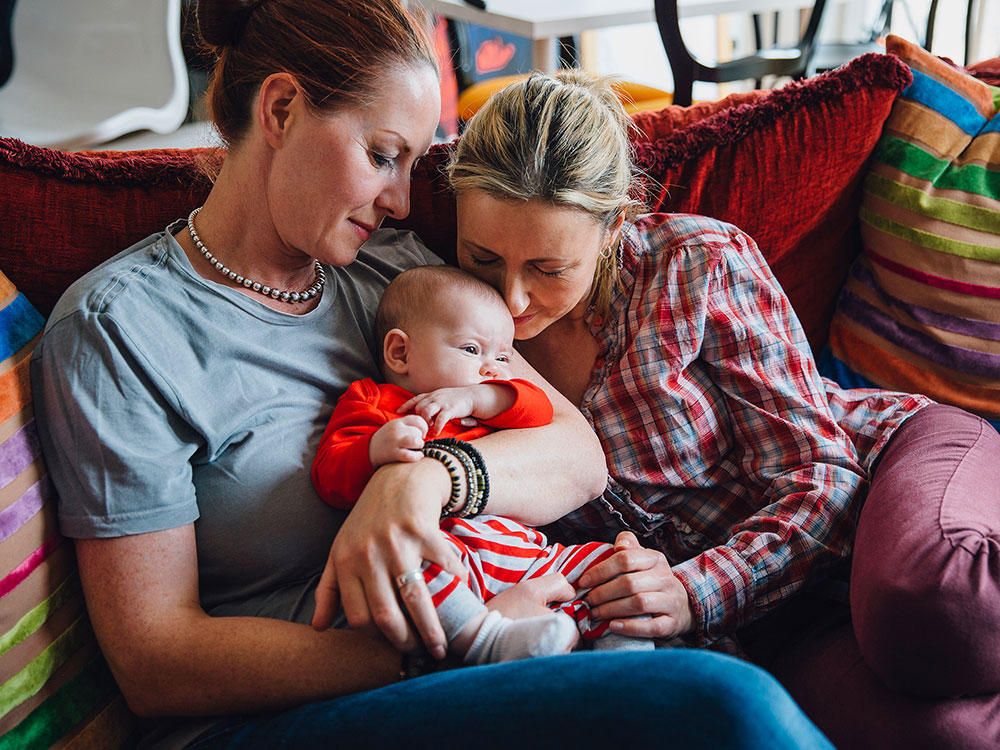
Sexual minority women and parenthood

Martin Van Maele - La Grande Danse macabre des vifs - 33

Sexual minority women and parenthood: Perceptions of friendship among childfree and new parents


Kay A. SimonSamantha L. TornelloHenny M. W. Bos

Many individuals experience shifts in their friendship networks after becoming parents. The current study investigated the narratives of how a sample of sixty-six sexual minority women, most of whom do not yet have children but who expect to be parents in the future, perceive the changes in friendship networks following becoming parents. A thematic analysis uncovered three themes: (1) general expectations surrounding future parenthood and friendships; (2) changes in lifestyle and priorities; and (3) LGBTQ + community attachment. Further, the theme of general expectations surrounding future parenthood and friendships was largely represented among lesbian and queer women, while the theme of changes in lifestyle and priorities was predominately represented among lesbian women, and finally, the theme of LGBTQ + community attachment was shared among all sexual minority women in our sample across different sexual identities. We discuss the diversity of shared and non-shared narratives among sexual minority women, the intentionality in how friendship during parenthood is perceived, as well as why some themes were particularly prevalent among women with specific sexual identities.

Kay A. Simon , M.S., is a doctoral candidate at the University of Kentucky in the Department of Psychology. Their work focuses on LGBTQ + families, intended parenthood, identity development, and ambiguous loss.

Samantha L. Tornello , Ph.D., is an Assistant Professor at Pennsylvania State University in the Human Development and Family Studies Department. The majority of her work has focused on the role of family composition, sexual orientation, and parental gender in the family system.

Henny M. W. Bos , Ph.D., is full professor at the Research Institute of Child Development and Education, Faculty of Social and Behavioral Sciences, University of Amsterdam. Her research focuses on: (1) lesbian and gay parent families; (2) lesbian, gay, and bisexual identities; and (3) gender nonconforming individuals in relation to mental health.

Wednesday, September 13, 2023

Childhood internal migration and the intergenerational transmission of socioeconomic inequalities

September 11, 2023 Aude Bernard

Using lifetime data for baby boomers from 15 European countries, Aude Bernard shows that (i) children from higher socioeconomic backgrounds are more likely to migrate and (ii) individuals who migrated in childhood are more likely to migrate in adulthood. Thus, poorer children are doubly disadvantaged in coming from a lower socioeconomic background and being less migratory, which limits the economic benefits of changing region of residence in adulthood and exacerbates social reproduction.


The widening of income inequalities has stimulated research on the intergenerational transmission of advantage and disadvantage. We now know that social reproduction is a multidimensional process underpinned by various mechanisms, including parental time and resource investments, parental socialisation, wealth assortative mating and neighbourhood effects. Internal migration may be an additional mechanism.

In a recent paper, I used retrospective data from the Survey of Health and Ageing in Europe (SHARE), which, at Wave 7 in 2017, collected complete migration histories from birth to age 50 in 15 European countries: Austria, Belgium, Croatia, the Czech Republic, Denmark, Estonia, France, Germany, Greece, Italy, Luxembourg, Slovenia, Spain, Sweden, and Switzerland (Bernard 2023). I defined migration as a change of NUTS-2 region (i.e., regions in France, Hungary, and Italy; provinces in Belgium; national areas in Sweden; and autonomous communities in Spain), which means that I focused on relatively long-distance internal migration and on its role in the perpetuation of socioeconomic inequalities

Migration is intergenerationally transmitted


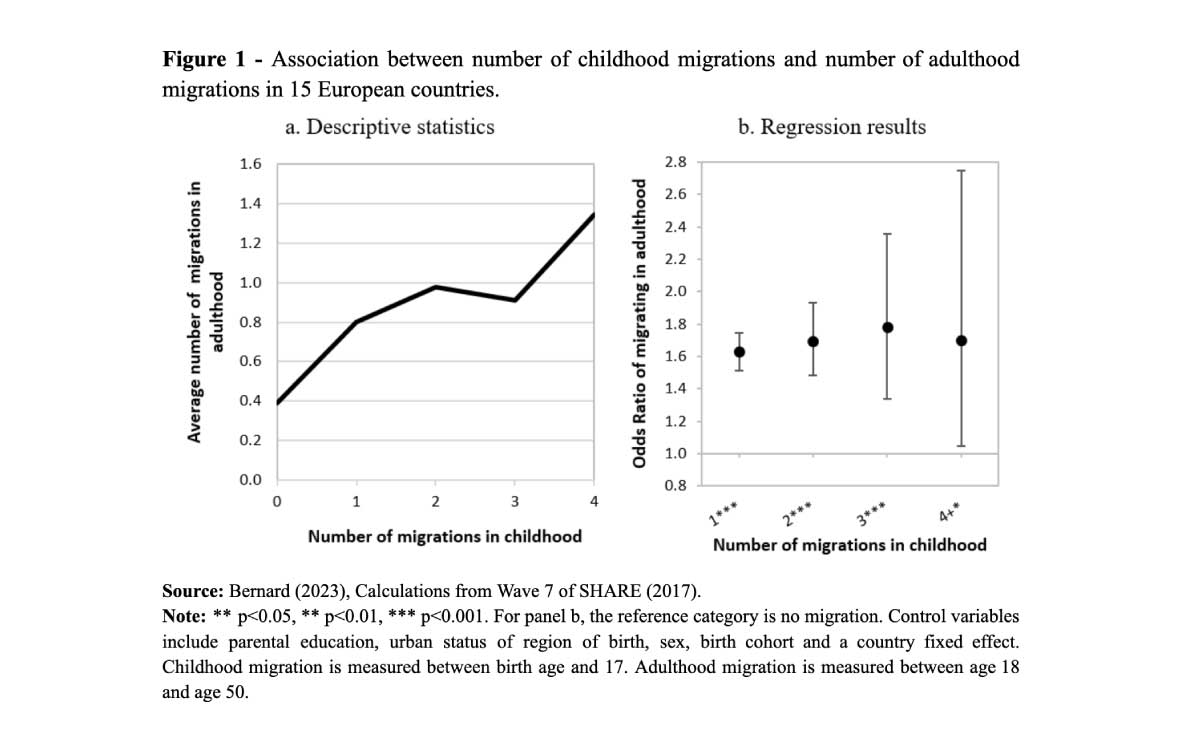
Mounting evidence indicates that migration is transmitted from parents to children (Bernard and Vidal 2020; Myers 1999): individuals who migrated in childhood and adolescence (0‒17 years) are more likely to migrate throughout adulthood (18‒50 years). By leaving and entering new social contexts, children are likely to develop social skills that they can mobilise for future migration. Panel a in Figure 1 shows a clear linear association between the number of childhood internal migrations and the number of adulthood migrations. Individuals who did not migrate in childhood report an average of 0.40 migrations in adulthood, compared with one or more migrations among individuals who migrated at least twice in childhood. This association holds when parental socioeconomic background is controlled, as in Panel b.
This finding supports the idea that internal migration is intergenerationally transmitted. More importantly, panel b shows that migrating at least once in childhood is paramount to increasing the odds of migrating in adulthood. The overlapping confidence intervals imply that the number of childhood migrations is not relevant to subsequent migration decisions in adulthood.

Migration is socioeconomically beneficial


Children who migrated in childhood are more likely to reside in large cities which provide greater educational and employment opportunities. Considering sociospatial inequalities, this means that childhood migration can promote upward social mobility without the need to migrate in adulthood. However, individuals who migrated in childhood are more likely to migrate in adulthood than stayers even if they reside in large cities (results not reported here).

This is important because internal migration in adulthood promotes upward occupational mobility (Fielding 1992; Mulder and Van Ham 2005). Panel a in Figure 2 depicts a positive linear association between the number of adulthood internal migrations and SES at age 50: individuals who migrate in adulthood multiple times are more likely to report higher SES at age 50. Regression coefficients in panel b confirm this association when controlling for possible cofounders. Migrating in adulthood promotes all three components of SES: homeownership, tertiary education and higher occupational prestige. The effect of migration on the latter two is particularly pronounced for migration to large urban centres (Results not reported here).

Migration is selective


The results so far mean that individuals exposed to internal migration early in life are more likely to migrate in adulthood and thus more likely to report a higher socioeconomic status at age 50. This finding has important implications for understanding social mobility and social reproduction. On the one hand, internal migration could be an important mechanism for individuals to achieve intergenerational upward social mobility. On the other hand, because migration likelihood increases with educational level (Wagner 1990) and because this relationship is nearly universal (Abel and Muttarak 2017), children from lower socioeconomic backgrounds are less likely to migrate than children from higher socioeconomic backgrounds.

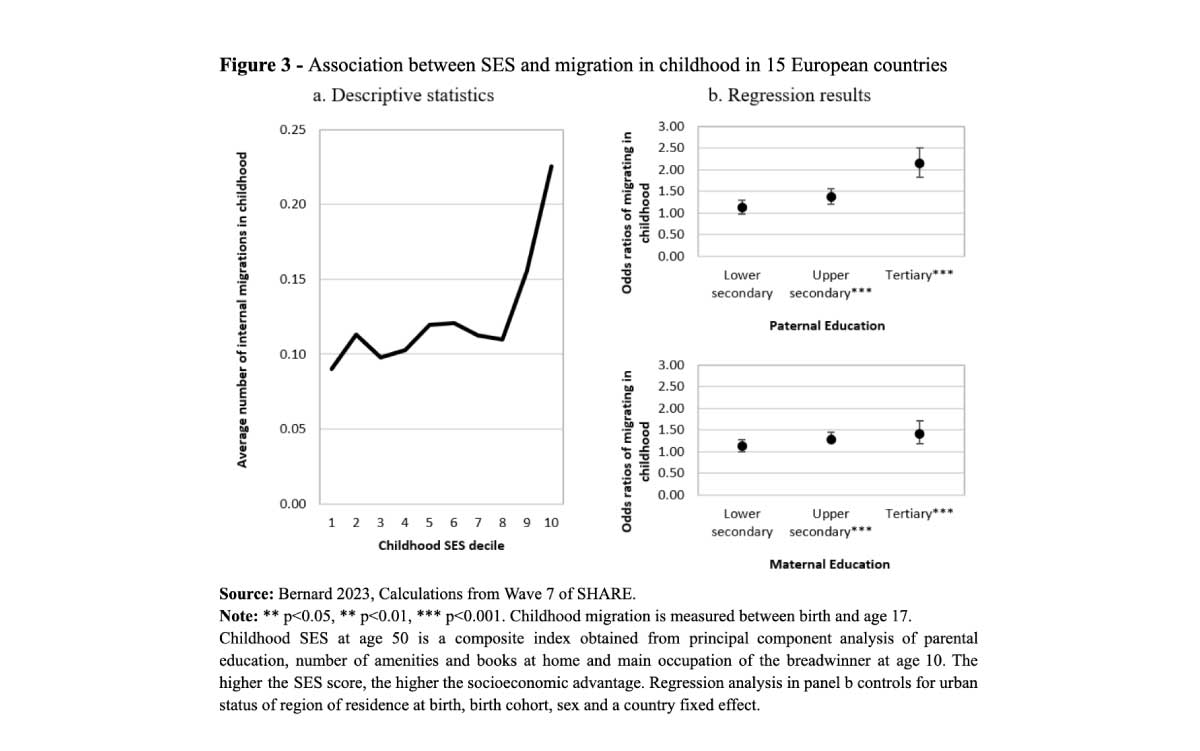
Panel a of Figure 3 shows that European children from the top two deciles report more than twice as many internal migrations, on average, as children from the lower deciles, suggesting that the propensity to migrate internally in childhood is socially determined.
This association holds when country, birth cohort and sex are controlled for in panel b: the higher the level of parental education, the greater the odds of migrating in childhood. The effect of education is gradual and holds for both paternal and maternal education.
Implications

Collectively, my results show that European children from lower socioeconomic backgrounds are doubly disadvantaged in having a disadvantaged background and being less migratory, which exacerbates social reproduction by limiting their mobility in adulthood and the economic benefits of changing region of residence.

The relevance of the processes described here for international migration deserves to be explored. Growing evidence suggests that international migration is also transmitted intergenerationally (de Jong and de Valk 2023). A continued increase in cross-country migration within Europe points to the importance of understanding its potential role in the transmission of inequalities between generations.

References

  • Abel, G. and R. Muttarak. 2017. “Who is moving? Exploring internal migration by gender and occupation across 58 countries.” in IUSSP conference. Cape Town, South Africa.
  • Bernard, A. 2023. “Does Internal Migration Contribute to the Intergenerational Transmission of Socioeconomic Inequalities? The Role of Childhood Migration.” Demography: 10826486-10826486.
  • Bernard, A. and S. Vidal. 2020. “Does moving in childhood and adolescence affect residential mobility in adulthood? An analysis of long-term individual residential trajectories in 11 European countries.” Population, Space and Place 26(1): 1-16.
  • de Jong, P.W. and H.A. de Valk. 2023. “Emigration of the Western European second generation: is having immigrant parents a predictor of international migration?” Journal of Ethnic and Migration Studies: 1-22.
  • Fielding, A.J. 1992. “Migration and social mobility: South East England as an escalator region.” Regional Studies 26(1): 1-15.
  • Mulder, C.H. and M. Van Ham. 2005. “Migration histories and occupational achievement.” Population, Space and Place 11(3): 173-186.
  • Myers, S.M. 1999. “Residential mobility as a way of life: Evidence of intergenerational similarities.”Journal of Marriage and the Family 61: 871-880.
  • Wagner, M. 1990. “Education and migration.” in Event History Analysis in the Life Course Research, edited by K.U. Mayer and N.B. Tuma. Madison: The University of Madison.

Tuesday, August 15, 2023

school fees

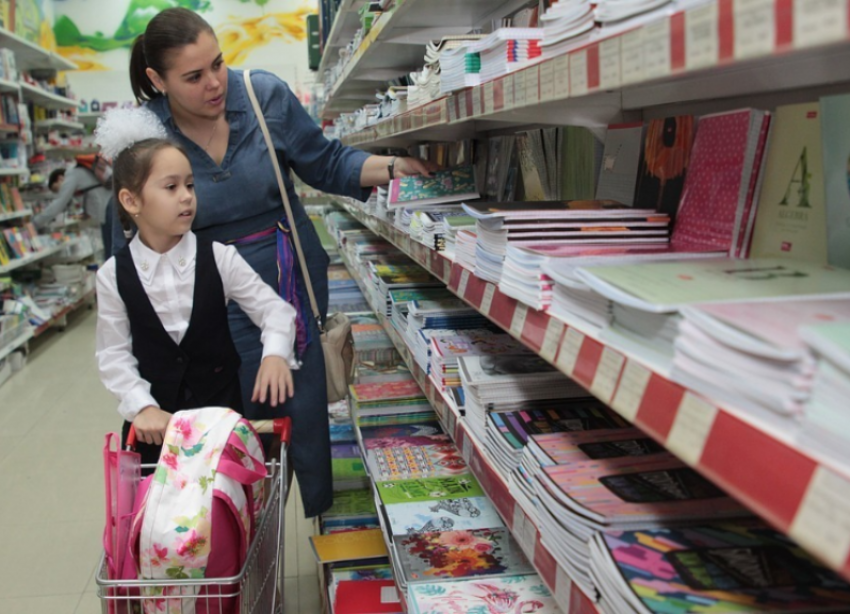
Расходы на сборы ребенка в школу в мегаполисах за год выросли в среднем на 9%


Одежда, обувь, спортивная форма, канцелярия, рюкзак — подготовка ребенка к школе дороже всего обходится родителям из Москвы и Санкт-Петербурга. Траты за год больше всего выросли в Екатеринбурге и Казани. В опросе сервиса по поиску высокооплачиваемой работы SuperJob приняли участие родители школьников из городов-миллионников.

На подготовку ребенка к учебному году родители из Москвы в среднем потратили 15 000 руб., Санкт-Петербурга — 13 700 руб. В Екатеринбурге сборы в школу обошлись семьям в 13 600 на ребенка, в Казани — в 13 500 руб. Наиболее экономными в этом году оказались родители из Волгограда: сборы ребенка в школу обошлись в 11 300 руб. Чуть больше расходы в Уфе и Воронеже — по 11 500 руб.

Средние расходы на подготовку детей к школе наиболее заметно выросли в Казани и Екатеринбурге — плюс по 13% к прошлом году. В Воронеже и Волгограде подготовка к учебному году стоит на 11% дороже, чем год назад.

Бюджеты на подготовку ребенка к учебному году жителей Москвы, Санкт-Петербурга, Новосибирска, Омска и Уфы подросли на 5% по сравнению с 2022 годом.

Место проведения опроса: Москва, Санкт-Петербург, Новосибирск, Екатеринбург, Нижний Новгород, Казань, Челябинск, Омск, Самара, Ростов-на-Дону, Уфа, Краснодар, Красноярск, Пермь, Воронеж, Волгоград
Время проведения: 21 июля — 14 августа 2023 года
Исследуемая совокупность: родители школьников
Размер выборки: 9000 респондентов — по 1000 респондентов из Москвы и Санкт-Петербурга, по 500 респондентов из других городов-миллионников

Подробнее

Friday, June 2, 2023

kids are happy

В том, что детство современных детей счастливее их собственного детства, убежден лишь 1 из 5 россиян


1 июня — Международный день защиты детей. Лишь 1 из 5 россиян считает, что детство нынешнего подрастающего поколения счастливее, чем их собственное. В опросе сервиса по поиску высокооплачиваемой работы SuperJob приняли участие 1600 представителей экономически активного населения из всех округов страны.

Каждый второй россиянин (51%) не считает детство нынешних детей более счастливым, чем свое. Эту позицию опрошенные чаще всего объясняют чрезмерной увлеченностью подрастающего поколения гаджетами, нехваткой живого общения со сверстниками и подвижных игр на свежем воздухе. Напротив, каждый пятый (22%) убежден, что сегодняшние дети счастливее: родители уделяют им больше внимания, чем это было принято у предыдущих поколений, а современные информационные технологии предоставляют немыслимые ранее возможности. Затруднились оценить, какое поколение детей более счастливо, 27% россиян: «В материальном смысле они благополучнее нас, но в нашем детстве мир был безопаснее, и мы были свободнее».

Чем старше респонденты, тем чаще они склонны идеализировать свое детство и критиковать душевное состояние современных детей. Так, если среди опрошенных в возрасте до 34 лет такую позицию разделяют 46%, то среди россиян старше 45 лет — уже 56%. Убежденность в том, что нынешнее поколение детей ничуть не счастливее предыдущих, наиболее характерно для респондентов с доходом от 80 тыс. руб. в месяц (58%).

Необходимо отметить, что склонность идеализировать свое детство была присуща россиянам и ранее: так, и в 2007, и 2009 году, отвечая на аналогичный опрос SuperJob, большинство не считало современных им детей более счастливыми. За 16 лет выросло число россиян, которые затрудняются оценить, чье детство счастливее.

Место проведения опроса: Россия, все округа
Населенных пунктов: 375
Время проведения: 30—31 мая 2023 года
Исследуемая совокупность: экономически активное население России старше 18 лет
Размер выборки: 1600 респондентов

Подробнее

Friday, April 28, 2023

patria or langue

Родители не хотят замены английского языка на китайский в школах


80% родителей школьников выступают против исключения английского языка из школьной программы. К обязательному изучению китайского общественность тоже относится настороженно: 59% против. В опросе сервиса по поиску высокооплачиваемой работы SuperJob приняли участие 1600 родителей школьников из всех округов страны.

Депутат Госдумы РФ Султан Хамзаев предложил исключить английский язык из перечня обязательных предметов в школе. По его мнению, это позволит уйти от прозападного вектора в российской системе образования.Инициативу одобряет лишь 9% родителей школьников, тогда как 8 из 10 выступают против такого решения. В комментариях респонденты напоминают, что английский остается языком международного общения, а методика его преподавания отработана годами.

Следует ли сделать китайский язык обязательным для изучения? Общество относится к этой идее осторожно: 6 из 10 опрошенных (59%) против такого нововведения. В числе их аргументов — сложность китайского языка, неуверенность в состоятельности отечественных методик его преподавания, а также отсутствие массовой потребности: «Все инженерные специальности по-прежнему требуют знания английского». Сторонником изучения китайского языка в системе среднего образования выступают только 19%. С их точки зрения, стратегическое партнерство России с КНР обязательно приведет к востребованности специалистов, владеющих китайским.

Место проведения опроса: Россия, все округа
Населенных пунктов: 349
Время проведения: 20—27 апреля 2022 года
Исследуемая совокупность: родители школьников
Размер выборки: 1600 респондентов


Подробнее

Wednesday, February 1, 2023

paternity leave

paternity leave

Взять отпуск по уходу за ребенком вместо жены согласились бы 43% российских мужчин


Не исключают возможности воспользоваться правом отпуска по уходу за ребенком 43% представителей сильного пола. В течение последнего года отпуск по уходу за ребенком для сотрудника-мужчины оформляли в каждой шестой российской компании. В опросе сервиса по поиску высокооплачиваемой работы SuperJob приняли участие 1600 трудоустроенных мужчин, состоящих в браке и планирующих детей, и 1000 работодателей из всех округов страны.

Большинство мужчин по-прежнему не представляет себя в роли отца-декретника. Каждый третий (34%) ни в коем случае не согласится взять отпуск по уходу за ребенком вместо жены, еще 23% скорее исключают такую возможность. Свою позицию опрошенные аргументируют не только финансовыми причинами, но и традиционным восприятием семейного уклада. Напротив, 27% в случае рождения малыша однозначно готовы воспользоваться своим правом уйти в декрет, еще 16% скорее согласились бы на это. «Почему бы и нет, если по доходам это выгоднее для семьи»; «Я уже уходил в отпуск до трех лет вместо жены. Только человек с глубоким чувством юмора дал определение этому действу как отпуск. Никакой это не отпуск по уходу за ребенком. Это сущая каторга по уходу за ребенком», — комментируют опрошенные.

По сравнению с 2020 годом общее число тех, кто не против взять на себя многочисленные обязанности по присмотру за младенцем, выросло на 4 процентных пункта.

О том, что в течение последнего года им доводилось предоставлять сотруднику-мужчине отпуск по уходу за ребенком, сообщил каждый шестой российский работодатель (17%). По сравнению с ковидным 2020 годом их число не изменилось.

Место проведения опроса: Россия, все округа
Населенных пунктов: 357
Время проведения: 9—31 января 2023 года
Исследуемая совокупность: мужчины, состоящие в браке и планирующие детей, имеющие постоянную работу
Размер выборки: 1600 респондентов


Подробнее

Tuesday, January 17, 2023

simplification of the procedure for employment of minors

2 из 3 родителей подростков выступают за упрощение процедуры трудоустройства несовершеннолетних


Законопроект об упрощении порядка трудоустройства несовершеннолетних поддерживает каждый второй россиянин. Сторонников этой инициативы среди родителей подростков заметно больше. В опросе сервиса по поиску высокооплачиваемой работы SuperJob приняли участие представители экономически активного населения и работодатели из всех округов страны.

В Госдуму внесен законопроект, упрощающий трудоустройство несовершеннолетних, — если он будет принят, то для заключения трудового договора с подростками от 14 лет больше не нужно будет получать согласие органов опеки. Каждый второй россиянин (49%) поддерживает эту идею: по мнению опрошенных, дети старше 14 лет уже вполне могут подрабатывать, тогда как лишние бюрократические процедуры усложняют их трудоустройство. Каждый четвертый (25%) выступает против: свою позицию респонденты аргументируют возможностью злоупотреблений детским трудом.

Сторонников упрощения процедуры подросткового трудоустройства больше среди россиян старше 45 лет (54%).

Еще активнее поддерживают законопроект родители подростков: 66% из них убеждены, что в разрешении органов опеки на детское трудоустройство нет необходимости («Согласия родителей достаточно»). При этом о наличии у их ребенка опыта подработки рассказали 18% родителей: 8% сообщили, что трудоустройство было оформлено официально (дети работали в отрядах губернаторов и мэров, библиотеках, оздоровительных лагерях, на выкладке товаров в магазинах), еще 10% — неофициально (промоутерами, курьерами, грузчиками, официантами, расклейщиками объявлений, продавцами и проч.).

Опрос представителей работодателей показал, что большинство не принимает на работу несовершеннолетних (83%). Трудоустраивают подростков лишь 4% компаний, еще 10% берут их только на стажировку.

О том, что сейчас должны знать родители о трудоустройстве подростков, читайте в статье SuperJob.

Место проведения опроса: Россия, все округа
Населенных пунктов: 374
Время проведения: 13—16 января 2023 года
Исследуемая совокупность: экономически активное население России старше 18 лет
Размер выборки: 1600 респондентов

Подробнее

Tuesday, December 27, 2022

How To Co-Parent Effectively After a Divorce

A 5-point parenting plan and Google Docs finally made us better parents to our twin boys

Photo by Mick Haupt on Unsplash

If my ex and I had focused less on ourselves, then we could have come to a better co-parenting model earlier. Thankfully, we did improve.

The rollercoaster ride for us isn’t over, but the ups and downs have gotten much smoother. This is what I learned along the way—including the advice I was given but didn’t take at the time.

Last month, I texted my ex-partner. The twins want gaming laptops. I think we should buy them one each for Christmas.

Within seconds she replied. Great idea. Perhaps we can meet up and select them together.

This is a fairly mundane text exchange. But for me and my ex, this was a huge step. And it showed the progress made over a long 10-year battle. One that involved anger, resentment, jealousy, and frustration. Plus several abusive messages.

After 10 years, we had finally learned to co-parent. And through this, I hope that anyone in a similar situation will be able to follow what I did and do likewise.

The Breakdown


In May 2010, with our twin boys just three years old, my wife Heather and I decided to separate. It was an extremely tough decision, but we had grown so far apart, the relationship was barely functioning.

I had held on as long as I could, purely for my sons. I didn't want them to be part of a broken home. To be destined to move between their parents' houses for the rest of their childhood.

From a selfish perspective, I couldn't imagine not seeing them every day. Being apart and wondering what they were up to. I was worried this would make me less of a father. I wanted to be as involved in their lives as possible.

I didn't know how to tell them the news or if they would even understand. How could we bring up the subject and tell them mummy and daddy would no longer live together.

What followed next was the first sign that co-parenting after a separation would be hard. And it is something many people go through. According to the Stepfamily Foundation, “Sixty-six percent of couples who live together or are remarried will break up when children are involved. The majority of American families have shifted from the original biologically connected mother, father, and child.”

Two parents, two different paths


My day at work had been one of aimless procrastination, stressing how about to tell my children the news.

When I returned home to give the heartbreaking news, I saw the two playing happily together. I was teary-eyed, and with a deep breath, I told Heather that we needed to talk to them, and then I would pack my bags and leave.

With a dismissive tone, she said, “I’ve told them already. You can pack and leave now.”

I felt like I had been stabbed in the heart. Such an important family discussion had been held without me being present. What had she said? What were their reactions? Did she blame me? As a writer, I was used to controlling the narrative, but I had no idea what was said about me.

Furious and hurt, I packed my bags and left. Divorce is tough, but surely this was the worst possible start. And it was only going to get worse due to my inexperience in dealing with relationship conflict.

Co-Parenting — What NOT To Do


The first year of our separation was full of anger, resentment, and legal fights. Where we live, counseling is compulsory before any divorce is granted. We did the mandated sessions, which were futile. There was so much anger that the sessions weren't the least bit productive.

They descended into arguing and pointing the blame at each other before ending in frosty silence. Outside of the sessions were even worse.

I wanted equal time with my children, but Heather would only agree to a 70/30 share in her favor. On top of this, she was demanding hefty financial payments, which led to even more anger. I felt like I was being punished financially and emotionally.

This led to many angry text exchanges. I was letting emotion get the better of me, and this showed in my communication. Heather took a passive-aggressive approach, which led to me fuming and wallowing in self-pity.

We were both wrong, but neither would admit this or try anything different. The anger at each other was too deep, and this affected our parenting. Picking up the children from each other’s houses was an awkward experience for all four of us. The children would run from the car to inside the house to get the exchange over as quickly as possible. Every time I saw this, my heart broke.

Marriage and family therapist Dr. Juliana Morris gives the following advice: “Self-reflect and own your role in ending the relationship. When you are happier individually, it’s easier to co-parent with focus and intention.”

It is great advice and one that we wrongly ignored. We were stuck in a cycle of angry text messages and awkward drop-offs—a cycle that seemed to have no end.

Subsequently, we were each doing our own thing, independently of what the other thought or felt. And this is quite common. According to a study by the American Psychological Association, parents that share custody are “more likely to have detached, distant, and ‘parallel’ parenting relationships than to have ‘co-parenting’ relationships where they work closely together, communicate often, interact regularly, coordinate household rules and routines, or try to parent with the same parenting style.”

How We Changed Our Communication — The 5 Point Vision Statement


Breaking the vicious cycle was hard, but we needed to do it. I spoke to friends who had been through similar circumstances. I showed them the texts. They were shocked. It needed to change, and one of us had to be the first to do it. I decided to focus on five key factors that we could both work on.

1. Move past the hate


The first step was to overcome my hate for Heather. It wasn’t productive for anyone. I was angry, very angry, but I needed to let it go. Holding onto the anger was holding the co-parenting back.

The focus had been on my hate for Heather rather than my love for my children. Jennifer Hurvitz, the author of “One Happy Divorce,” advises that “when you are in a co-parent relationship, you have to love your children more than you hate your spouse.”

I decided to change my mindset for my kids.

2. Implement a business relationship


I decided to treat my relationship with Heather as a business relationship. It will be based on appointments, meetings, and updates, all without any emotion at all.

I needed to remove any hint of emotion from communication; anything that could be interpreted negatively or a perceived attack. It would be just the same way I would take to a client or work colleague.

I will pick them up at 3 p.m. on Monday.

Sam is unwell and is not at school today.

Noah has a party to attend on June 13

Short, simple, and factual. They would usually be met with replies of OK.

As ‘business colleagues’ we had a shared mission and goal and both agreed to work toward it.

3. Say YES more


Part of the negative cycle was spurred by my need to win every argument, every discussion, every point raised. It was like there was a fictitious scoring system, and I had to be ahead on the scorecard.

If Heather asked to drop the boys off at 5 p.m. instead of 3 p.m., I would say no, just for the sake of it. If I wanted to change days with her, she would say no. Our first and only reply to most requests was no.

Even for the small requests, we would say no. We needed a circuit breaker, so we decided to say yes unless there was a major reason not to.

This was the hardest step for us to implement. After years of saying no, it was a major change. At college, I had performed improv and the first rule we learned was to always say agree and say yes. I needed to remember my old improv ways and agree with Heather more.

4. Never criticize


One thing that flows from hate is the need to criticize each other. All this resulted in was the boys seeing their parents in a negative light.

Divorce and Parenting Coach, Rosalind Sedacca says, “When you put down their other parent, your children are likely to interpret it as a put-down of part of them. When both parents are guilty of this behavior, it can create great confusion along with a sense of unworthiness and low self-esteem. “Something’s wrong with me” becomes the child’s unconscious belief.”

We both agreed not to criticize each other in any way in front of the boys. Pointing out flaws in their mother was an easy game to play for me. Not saying anything or actually saying something positive was hard. But we agreed to try.

5. Children come first, second, and third


This should go without saying, but sadly we needed to say it. Sam and Noah's needs always had to come first, no matter how inconvenient it was for either of us. Once we learned to say YES more, this seemed to happen naturally, but we had to agree to write this down. Not just say these words but act on them.

As an example, I needed to make the changeovers a more positive experience. Excited to see your mother today? I bet she has some great activities planned! I promised to walk them to the front door and greet their mother with a polite hello and a smile.

I didn't want to, but their needs had to come above mine. And me sitting in the car and driving off as they ran to the door wasn’t a positive experience for them.

Sherrill A. Ellsworth, a former judge and co-founder of coParenter, says “Co-parents need to suck it up and become a collaborative team for the sake of the child.”

We both needed to suck it up.

And so, based on these five non-negotiables (and several weeks of messaging), we had a basic co-parenting plan in place that we both agreed to.
Our brief, succinct plan. Source: Author

In business terms, it could be classified as our vision statement. Importantly, it was short and easy to follow.

The First Test of the New Plan


It was a few weeks later when the first test of the new plan came into play. I was driving my children to school when Noah said he had a joke for me.

“Great, tell me,” I said. He then told me an anti-Semitic joke. I was crushed. I am Jewish, and Heather isn't, which makes my son half Jewish. This joke was offensive to all of us. I asked Noah who told him the joke, and he said it was Heather’s partner, whom she was now living with.

I pulled to the side of the road, blood boiling, ready to send a lengthy text berating her and the ‘Nazi’ she lived with. I had to pull back and remember our new plan. I dropped the boys at school and went for a short walk to compose myself. I then went through our non-negotiables and decided to send a text.

Factual without emotion. No hate toward her or criticisms. A simple text requiring a simple action.

Noah told me an anti-Semitic joke that Bruce told him. Please find out if true and what happened.

I hit send and waited. Normally I would either get no reply or a reply saying I was wrong and causing problems.

OK. I will speak to him and the boys after school.

I was surprised and relieved. What could have been an inflammatory situation descending into insults and arguments was handled swiftly.

The next day I received:

I spoke to Bruce and told him what he did was wrong. I also explained to the boys why it was wrong. It will never happen again.

It was a big step forward for our new co-parenting attitude. And a big thumbs up to our process.

One small step for Ash and Heather. One giant leap for co-parenting.

Our Co-Parenting Bible


I never thought Google would make the best co-parenting tool we could use, but it did. Google Docs took us to the next level.

With a large volume of texts and emails being sent, it often led to schedule conflicts and the potential to get back to the negative cycle. Taking on the business relationship model, Heather suggested we move everything to Google Docs. We would have one Master Schedule that was rolling 12 months in advance.

It would list all major dates, where the boys needed to be, and any comments that needed to be made by either of us. Any requests to change the schedule would be made here in red. The other parent would then comment and (usually) approve in green.
Source: Author Google Doc

It is a simple method but works very well. We now have spreadsheets for 2018, 2019, 2020, and 2021. We can also easily go back and see who the boys were with at any date and any past requests. Everything is tracked.

This helps diffuse arguments — for example, we can see who the boys spent their birthday with each year (something we rotate) or any other special occasion. Before we started using the Master Google Doc, there were enormous fights over this. It has removed any emotion as it is treated as a business document. Better still it has cut down on the incessant texts and emails

Now everything is recorded in perpetuity. It is a one-stop-shop for all our parenting requirements. I have a new partner who has become stepmother to my sons, and she also has access and input into the Document.

It isn't an understatement to say that this Google Doc has allowed us to become successful co-parents after years of frustration. When I win Father of the Year I will thank Google in my acceptance speech.

Two Parents, One Path to Success


The model has worked better than I could have imagined. It has cut down on texts and emails, and in turn, any arguments.

It has provided consistency for our children who are settled and performing well in school and their sports. They see parents united rather than divided.

We now share custody 50/50, which has been a big positive for my partner and me. I know many parents don’t get enough time with their children (I was one), so this is the biggest win.

We now also split all costs evenly, which in turn eliminates many of the arguments.

An example of success


Before our plan, we did parent-teacher interviews separately. Our hatred for each other on full display for teachers to see. They would meet with one of us to discuss our child's school results. And then on the next day meet with the other. It was a waste of the teachers' time to double up and illustrate that we weren’t on the same page.

Now we attend parent-teacher interviews together. Admittedly our chairs are as far apart from each other as the room allows (we were social distancing before there was social distancing!), but we’re present in the same room together.

Our pinnacle of success


The high point for our co-parenting was the four of us heading to a computer store in December to choose laptops for the boys. It was the first time we had done something like this for over 10 years. The boys were so happy to receive new laptops and see all of us involved in the purchasing and buying.

It was a simple thing that many families across the world do each day, but it was akin to scaling Mount Everest for us. Something that the four of us could never have imagined a few years ago.

It had taken 10 years, but we had a successful co-parenting model in place.

Key Factors in Our Success


It was a decade long process for us; I hope that anyone reading this going through a relationship breakup with children involved doesn't take this long. In summary, the factors that led us to success and I would recommend are:
  • Moving past the hate and viewing your relationship as completed rather than failed.
  • Remove all emotion from communication. Treat the relationship as a working relationship. You don’t need to be friends just amiable colleagues with the same ‘work’ goal.
  • Always put the children's’ needs above your own.
  • Pick your battles. Don’t focus on the small things.
  • Have an easy to update system for communication. Google Docs is perfect for this.
  • Keep it simple. Our plan had five key planks to the agreement that were easy to follow. And the Google Doc eliminated the need for messages and emails and made for an easy-to-follow schedule.
I will never be friends with Heather. But I will be a co-parent. And that, to me, is the most important relationship I can have with her.

Monday, September 19, 2022

caregiving by adult only children in UK

Looking after mum and dad


September 19, 2022 Jenny Chanfreau and Alice Goisis

Adult children with siblings can share caring for ageing parents but only children face this responsibility alone. Jenny Chanfreau and Alice Goisis find that adult only children are more likely than those with siblings to provide care. However, although caregiving is related to lower well-being, there is no evidence that only child parent-carers are more adversely affected.


Helping and caring for parents


The confluence of increasing longevity, declining family sizes and the projected informal care gap raises concerns about the future demand on a potentially shrinking pool of kin carers, yet little is known about the caregiving offered by adult only children. In a recently published article, we compare patterns of help and care given to ageing parents by only children and children with siblings at different ages in middle adulthood using data from three large-scale British birth cohorts, born in 1946, 1958 and 1970 (Chanfreau and Goisis 2022a). A key strength of these studies is that they have surveyed the same individuals from birth to middle age, so we were able to use information collected during childhood to identify those who did not grow up with siblings (Chanfreau and Goisis 2022b). As expected, among adults with at least one living parent, caregiving increases with age for everybody, in terms of both likelihood and intensity. Only children are, however, more likely to provide parent-care, especially at relatively older ages (e.g. 55 and 63 years). Thus, the pattern we find is consistent with an interpretation that differences by sibling status might increase with age. Nevertheless, when we focus on caregivers, the average weekly time only children spend providing assistance is similar to that of siblings who provide care.

Unfortunately, these studies do not collect information about, or directly from, other family members. This means we do not know about the parents’ other sources of care, including how much assistance is provided by other siblings. So, what can we infer from Table 1?

The differences by sibling status in rates of caregiving are compatible with some sibling groups adopting a “main carer” arrangement rather than sharing equitably, in that having a sibling reduces the chance of a given child providing care. If it was a common arrangement for siblings to share care concurrently, for example by alternating days of the week or dividing up tasks between them, we would expect lower intensity among those with siblings than among only children. However, among caregivers, we can test whether caregiving affects only children and those with siblings differently, for example by analysing caregivers’ well-being.

Carers’ mental health and well-being


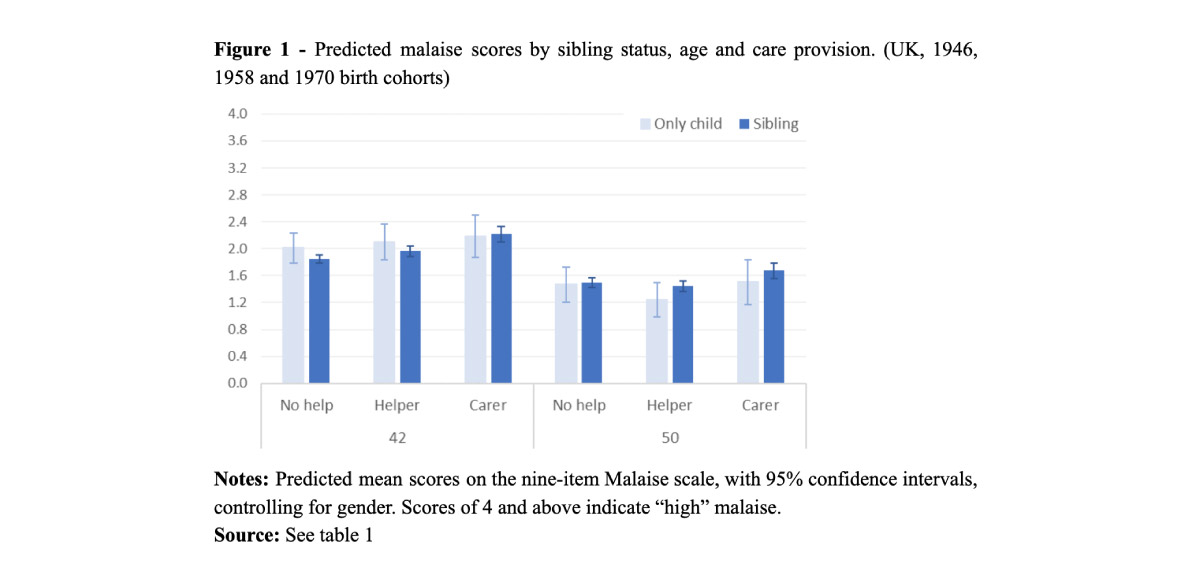
Caregivers in larger care networks tend to report less stress; conversely, being a sole caregiver is linked to poorer mental health, but little is known about only children (Tolkacheva et al. 2011, Heger 2017). We may therefore hypothesise that assistance to ageing parents is more stressful or detrimental to caregiver well-being for those who are their parents’ only child, and thus the sole potential parent-carer. We find that both care status and intensity of assistance are associated with worse mental health and well-being but also that these differences are small (Figure 1). The predicted mean malaise scores range between 1.8 and 2.2 at age 42 and between 1.2 and 1.7 at age 50, on a 0–9 scale where scores of 4 and above indicate “high” malaise. We interpret the small magnitude of this finding as a reflection of the relatively low intensity of care provided by most filial caregivers. Further, as can be seen from the overlapping confidence intervals in Figure 1, we found no evidence that the association between caregiving and well-being differs by presence or absence of siblings.
We conclude that although as a group only children are more likely to provide parent-care and this is linked to lower well-being, we do not find patterns that would be consistent with their mental health being further affected by being an only child parent-carer.

This is a potentially reassuring finding. However, because the existing literature on only children has predominantly focused on outcomes in childhood and little is known about their adult lives, we emphasise that there is ample room for future research. Mental health is only one aspect of life potentially affected by parent-care; longitudinal evidence from England has suggested that informal caregiving in middle age can have negative consequences for employment even at fairly low intensities (King and Pickard 2013).

In institutional contexts that rely heavily on kin for eldercare, informal caregiving could thus represent a burden for only children that affects other aspects of life. Our analysis of patterns of caregiving across multiple ages shows that not only did higher rates of help and care among only children emerge at earlier ages but this was then maintained and increased at later ages. Siblings, conversely, can share care by alternating periods of main carer status, or share in the responsibility for ageing parents by emotionally supporting the main carer (Leinonen 2011).

References

  • Chanfreau, J. and A. Goisis (2022a). “Patterns of help and care by adult only children and children with siblings.” Ageing & Society.
  • Chanfreau, J. and A. Goisis (2022b). Research decisions regarding the concept and measurement with survey data. CLS working paper number 2022/3. https://cls.ucl.ac.uk/wp-content/uploads/2017/02/CLS-Working-Paper-2022-3-Defining-and-Identifying-Only-Children.pdf
  • Heger, D. (2017). The mental health of children providing care to their elderly parent. Health Economics 26(12): 1617-1629.
  • King, D. and L. Pickard (2013). When is a carer”s employment at risk? Longitudinal analysis of unpaid care and employment in midlife in England. Health Soc Care Comm 21(3): 303-314.
  • Leinonen, A. M. (2011). Adult children and parental care-giving: making sense of participation patterns among siblings. Ageing and Society 31(2): 308-327.Tolkacheva, N., M. B. Van Groenou, A. De Boer and T. Van Tilburg (2011). The impact of informal care-giving networks on adult children”s care-giver burden. Ageing and Society 31(1): 34-51.

Notes table 1

Notes: Datasets used: 1970 British Cohort Study (BCS70); 1958 National Child Development Study (NCDS); 1946 National Survey of Health and Development (NSHD).Multiple imputation used to adjust for attrition; estimates based on 50 imputed datasets. Sample excludes individuals with both parents known to have died.
1 The 1970 and 1958 studies asked respondents which tasks they did “regularly or frequently” for their parent(s). We grouped individuals reporting “providing or cooking meals”, “help with basic personal needs” or “washing, ironing or cleaning” together as “Carers” (without such help a parent might struggle to cope with daily tasks). We designated those doing none of the above but reporting assistance with “personal affairs”; “decorating, gardening or repairs” and “financial help” (not asked at age 42), or “other help” as “Helpers”, as the activities may in part reflect more general socialising. The 1946 cohort members were asked whether they “look after or give special help to anyone who is sick, frail, or has a disability”, and their relationship to the care-recipient, allowing us to identify parent-carers.
2 Care intensity refers to weekly hours spent assisting parent(s). Care intensity in the 1946 cohort includes all caregiving to any recipient, and thus for the small minority (<10%) who cared for someone else as well as a parent the hours reported would be higher than the time spent on parent-care.

Sunday, September 18, 2022

semantic field of modern Russian parenthood

Реконструируется смысловое поле современного российского родительства. На материалах эмпирического исследования выделяются идеал-типические модели родительства: родительство как репродукция, как подтверждение гендерной нормативной роли, как обязанность, как один из жизненных проектов, как сфера самореализации. Представлены основные содержательные характеристики каждой из реконструированных моделей.

Saturday, June 18, 2022

Father's Day Fun Facts

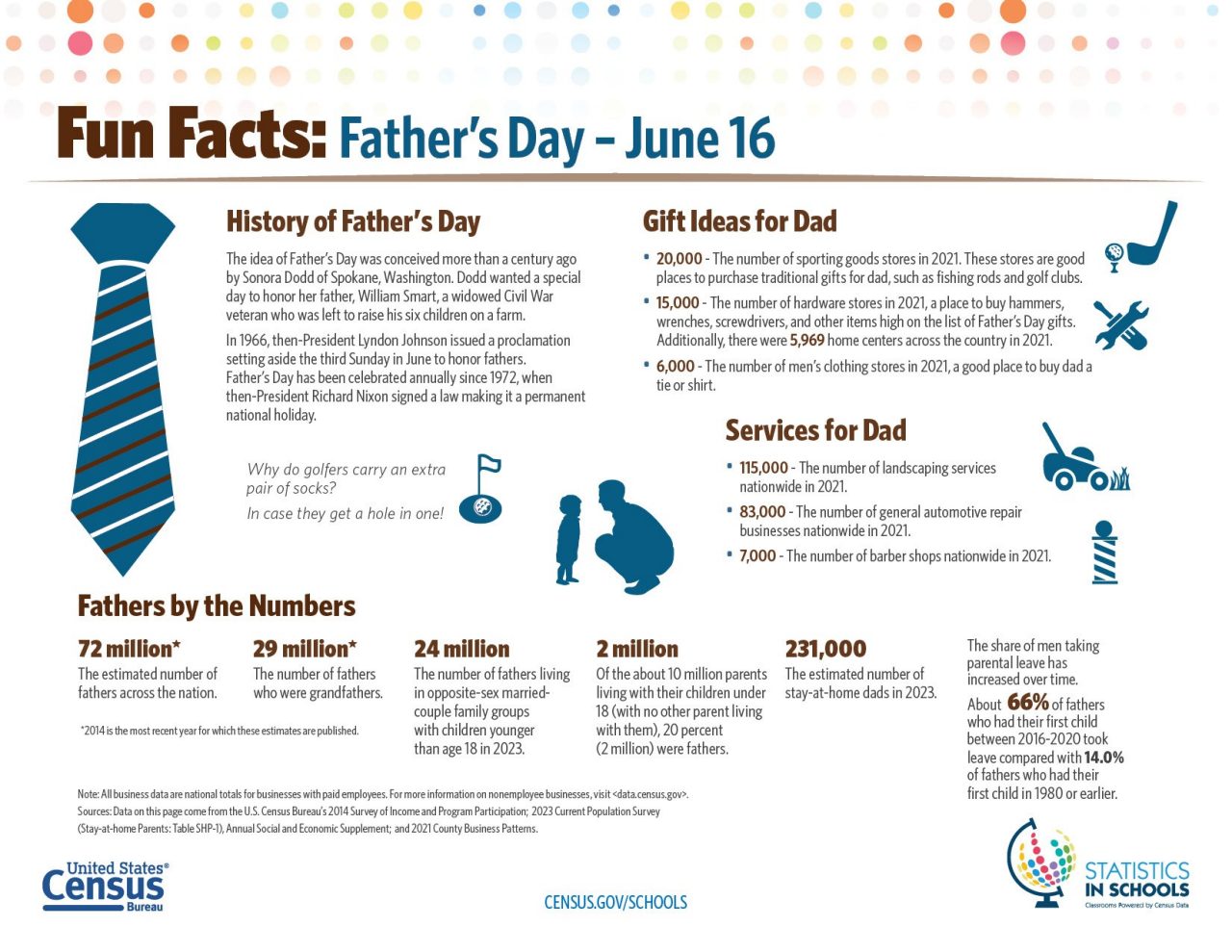
Father's Day is a time for us to celebrate the importance of fatherhood and honor the special men in our lives. There are an estimated 72 million fathers across the nation; 29 million of those fathers also being grandfathers. Use our Father's Day Fun Facts and Teaching Guide to celebrate the occasion with your students. Teachers can use the teaching guide for ideas on how to incorporate Father's Day Fun Facts in the classroom.
картинки являются линьками (имейте в виду)

Thursday, January 27, 2022

parents to children ?

same sex family

Передаётся ли гомосексуальность родителей их детям?


В общественном сознании, как в России, так и на Западе, довольно глубоко укоренилось мнение, что ребёнок, воспитываемый гомосексуальными родителями, непременно станет гомосексуалом, даже если он приёмный и биологически к этому не предрасположен. Насколько это интуитивное мнение соответствует реальности? Нет сомнений, что есть геи и лесбиянки, чьи родители также гомосексуалы. Но единичные примеры это не доказательство, к тому же подавляющее большинство гомосексуалов имеет гетеросексуальных родителей. Чтобы подтвердить или опровергнуть данное мнение нужно сравнить частоты геев и лесбиянок среди взрослых детей, выросших в гетеросексуальных и гомосексуальных семьях. Такие исследования проводились и, вопреки ожиданиям, оказалось, что частоты гомосексуальности были сходны в сравниваемых группах. Причём данный результат проявился уже в ранних работах, когда отношение к гомосексуальности было более чем неодобрительным и заранее предполагалось негативное влияние гомосексуальности родителей на их детей. 

Так что мнение о неизбежности гомосексуальной ориентации детей геев и лесбиянок явно не соответствует действительности.

Wednesday, January 26, 2022

mothers and fathers

parents

Матери чаще стремятся помочь детям с трудоустройством, отцы — обеспечить стартовым капиталом


Нематериальные составляющие понятия «поставить ребенка на ноги» — помощь с выбором профессии и поиском работы, воспитание, формирование ответственности — более значимыми считают матери. Отцы же чаще убеждены в необходимости обеспечить детей стартовым капиталом и помогать материально. Покупка жилья для дочери важнее с точки зрения женщин, а для сына — с точки зрения мужчин. Но главное — помочь детям с выбором профессии и дать образование. В открытом опросе сервиса по поиску высокооплачиваемой работы SuperJob приняли участие по 1000 родителей сыновей и дочерей из всех округов страны.

Для большинства россиян поставить ребенка на ноги — значит прежде всего помочь ему с выбором профессии и дать образование: так рассуждают 72% родителей дочерей и 69% родителей сыновей. В том, что важно суметь воспитать человека, убеждены 24% родителей девочек и 23% родителей мальчиков. Обеспечить собственным жильем или хотя бы помочь в его покупке важно для каждого девятого респондента, воспитывающего дочь (11%), и для каждого десятого опрошенного, который растит сына (10%). Для 10% родителей девочек и для 8% родителей мальчиков поставить ребенка на ноги означает обеспечить его стартовым капиталом или помогать материально. Устроить вчерашнего выпускника на работу или помочь в трудоустройстве важнее для тех, кто воспитывает сыновей, чем дочерей (13% против 9%). Помощь родителей в трудоустройстве — дело достаточно распространенное, но большинство рекрутеров отказывается рассматривать таких кандидатов.

По 7% родителей сыновей и дочерей убеждены, что нужно привить им самостоятельность и ответственность. Накормить, одеть и обуть, а также поддерживать во всем считают важнейшей частью родительского долга по 5% респондентов, воспитывающих девочек, и по 4% тех, кто растит мальчиков. В том, что «поставить дочь на ноги» — значит выдать ее замуж, уверены 5% родителей, а вот женить сына считает частью своих обязанностей лишь 1% опрошенных. Поддерживать и укреплять здоровье, привить любовь к спорту одинаково актуально и в отношении девочек, и в отношении мальчиков (по 3%). В том, что дочь важно подготовить к взрослой жизни, убеждены 3% родителей, в отношении сыновей это считает актуальным только 1%. Научить домоводству дочерей и сыновей считают необходимым по 2% опрошенных. «Поднимать ребенка» — значит развивать его таланты и способности, считают по 1% тех, кто воспитывает девочек, и тех, кто растит мальчиков. По 1% родителей сыновей уверены в необходимости научить их мыслить и отправить в армию. Чтобы «поставить ребенка на ноги», важно просто любить его, считают 2% родителей сыновей и 1% родителей дочерей.

За 7 лет, минувших с момента аналогичного исследования SuperJob, в россияне стали чаще говорить о необходимости обеспечить дочерей стартовым капиталом, и напротив, выдать замуж и научить девушек домоводству считают важным значительно меньшее количество родителей. Понятие «поставить на ноги сына» стало чаще включать в себя устройство его на работу.

Хотите, чтобы дети осознанно выбрали сферу деятельности и определились, по каким предметам сдавать ОГЭ и ЕГЭ, — обращайтесь к экспертам профориентации SuperJob. Мы поможем определиться с выбором профессионального пути и подскажем школьникам, куда поступать.


Место проведения опроса: Россия, все округа
Населенных пунктов: 403
Время проведения: 19—24 января 2022 года
Исследуемая совокупность: экономически активное население России старше 18 лет, имеющее детей
Размер выборки: 2000 респондентов — по 1000 родителей сыновей и дочерей

Friday, September 11, 2020

Majority Live With Their Parents

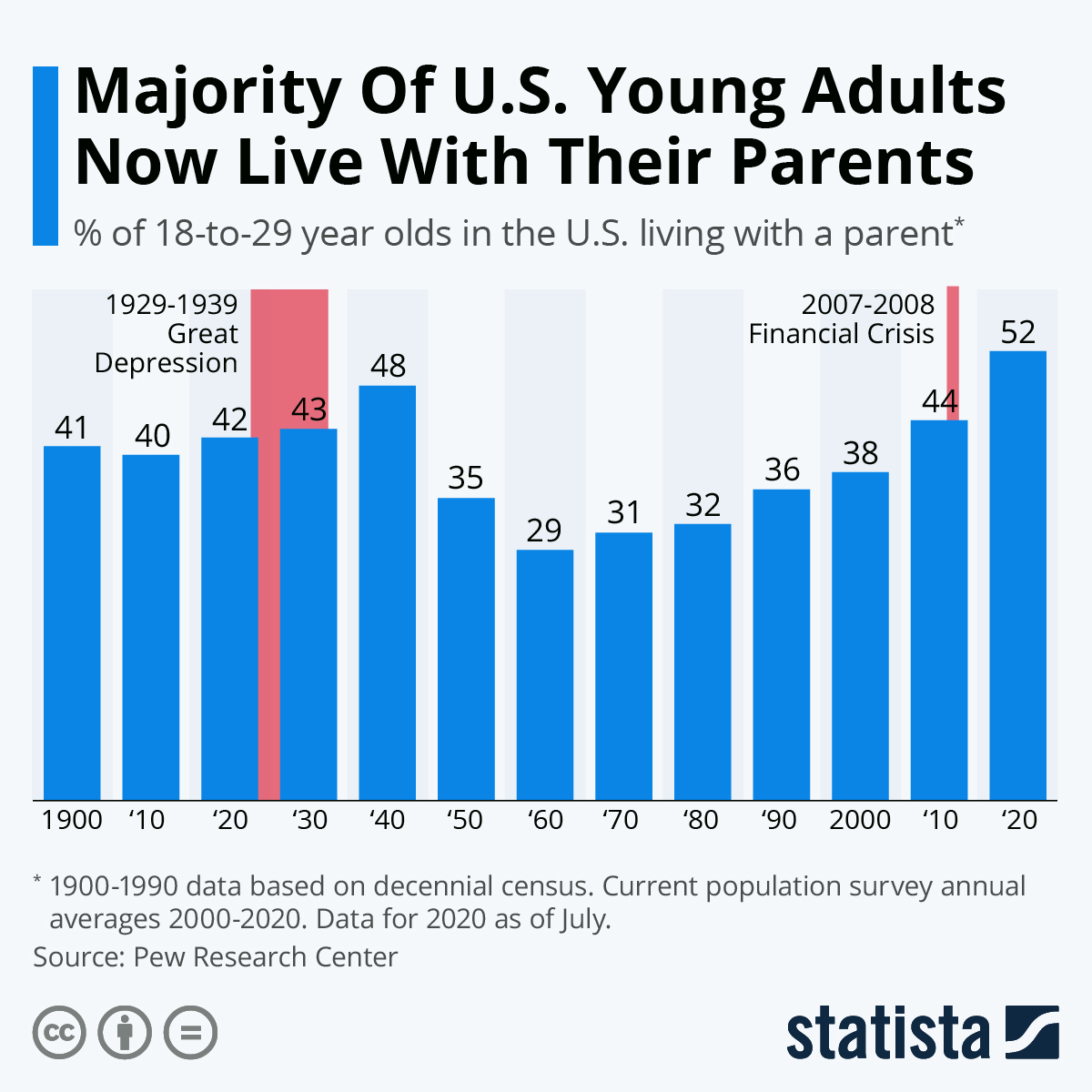
The devastating economic impact of the pandemic in the United States is pushing increasing numbers of young people to move back in with their parents. A recently released Pew Research Center analysis has found that a majority of 52 percent of Americans aged between 18 and 29 now live with a parent, the highest share recorded since the Great Depression era. That figure looked set to rise even further as an estimated 30 to 40 million people across the U.S. were thought to be at risk of eviction. Now that the Centers for Disease Control and Prevention has moved to provide tenants with protection until the end of this year, the likelihood of a catastophic homelessness crisis has subsided, temporarily at least.

The share of young adults currently living with their parents is higher than any previous measurement recorded in surveys and decennial censuses. The highest historical value was previous recorded in the 1940 census towards the end of the end of the Great Depression when 48 percent of young adults lived with a parent. The share reached its lowest point in 1960 at 29 percent but it has grown steadily ever since, hitting 49 percent by February 2020. The Pew Research Center states that the number of 18-29 year olds living with a parent increased by 2.6 million since February and the total number stood at 26.6 million in July.Infographic: Majority Of U.S. Young Adults Now Live With Their Parents | Statista

Wednesday, July 8, 2020

The percentage of 18-30 year olds living with their parents

Wednesday, March 4, 2020

Stratégies d'emploi des parents à double revenu en Belgique

Published on N-IUSSP.ORG March 2, 2020

Dual earners’ parental employment strategies in Belgium


Jonas Wood, Leen Marynissen

Even in Belgium, despite its strong work-family reconciliation policies, childbearing pushes couples towards more traditional gender roles: when one member of a couple exits the labour market or takes parental leave (which is relatively rare), it is generally the woman. Jonas Wood and Leen Marynissen argue that this parental employment strategy is only partly determined by the characteristics of the couple: gendered norms and institutional settings are the main drivers.

The birth of a child often entails adjustments to one or both parents’ employment position(s). These changes are not gender neutral as the share of women exiting the labour market or taking up parental leave in response to a birth consistently exceeds the share of men that do so. What are the reasons for this persistent gender asymmetry? To what extent is it determined by gender differences in partners’ pre-birth employment characteristics? As men more often have a higher wage and work more hours than their female partner, the higher incidence of female labour market exit and leave uptake at the aggregate level does not appear surprising. However, in our recent study (Wood & Marynissen, 2019) we show that while gendered employment exits are linked to within-couple differences in pre-birth employment positions such as wages, employment attachment and workplace size, the link between gender differences in parental leave uptake and pre-birth employment characteristics is much less clear.

In both cases, a question remains: would this gender asymmetry in parental employment strategies at the aggregate level change, or even reverse if pre-birth employment characteristics were switched between male and female partners? The results of such a simulation indicate that strategies would remain largely gendered at the aggregate level, in particular with respect to parental leave uptake. This suggests that the gender division of partners’ pre-birth employment characteristics cannot (fully) account for persistently gendered parental employment strategies: other factors, such as gendered parenting norms and gendered institutions are probably at play.

The incomplete gender revolution: potential causes


The unprecedented rise of the dual-earner model in Western countries has undoubtedly transformed the organisation of paid and unpaid work within households since the mid-twentieth century. However, it is often asserted that the shift towards gender equality has stalled or remains incomplete (England, 2010; Esping-Andersen, 2009). For example, labour market studies show that the negative impact of childbearing on employment is stronger for women. Potential explanations for this observation can be divided into two distinctive yet complementary strands. According to microeconomic theory, gendered divisions of labour reflect relative labour force potential. The partner with higher returns from employment is more likely to specialise in paid work, and – unless outsourcing is an option – the other partner in domestic work (Becker, 1991; Lundberg & Pollack, 1996). The second strand emphasises the importance of contextual factors, claiming that persistently gendered parenting norms and institutional setups yield gendered labour market responses to childbearing (Coltrane, 2000; Saxonberg, 2013).

Using unique longitudinal register-based Belgian panel data for 1999–2010, we ran multinomial regression models to study the development of parental employment and leave uptake strategies among 8,391 heterosexual couples who were dual earners prior to birth. The analyses distinguish between paid work reorganisation after first or higher-order births. The aim of our study is twofold:
  • to assess the degree to which partners’ relative pre-birth employment characteristics determine dual-earner couples’ gendered paid work strategies after childbirth, which might suggest an economic cost-benefit rationale;
  • to assess how the aggregate-level gendered nature of parental employment strategies would be altered if all within-couple gender differences in pre-birth employment characteristics were reversed.

The role of pre-birth employment characteristics in the reorganisation of paid work


The bars on the left side of Figure 1 illustrate the observed parental employment and leave uptake strategies (the simulation results on the right-hand side of the graphs will be discussed below). First, the overwhelming majority of dual-earner couples continue the dual earner model after childbearing, as all probabilities of employment exit are very low. Furthermore, for all parities, the probabilities of both employment exit and leave-taking are clearly differentiated by gender, with higher probabilities for women in both cases. The multinomial regression models assess the degree to which variations in these global patterns can be related to variations in couples’ relative pre-birth employment characteristics.

With respect to employment exits, in couples where the male partner has a higher pre-birth wage, more working hours, and a higher employment intensity (i.e. share of quarters in paid work in the 2 years preceding birth) than the female partner, a male exit is less likely than a female exit. In contrast, for couples in the reverse situation, a male exit is more likely. These findings suggest that couples’ parental employment strategies, more specifically regarding employment exits, are path-dependent upon previous employment positions.

In addition, an equivalent model assessing parental leave uptake was estimated. We expected that leave uptake would be encouraged by:
  • a) lower relative pre-birth wages, which decrease the opportunity cost of leave use,
  • b) more work hours and/or
  • c) a higher employment intensity which suggests a more stable position and a greater need for parental leave, and
  • d) employment in a larger workplace, which potentially facilitates temporary replacements and provides standard leave-taking procedures.

Our findings provide only limited and mixed support for these hypotheses, however, suggesting that couples typically adopt the general strongly gendered pattern in leave uptake (Figure 1, Panel B), regardless of their pre-birth employment characteristics.

What if gender differences in employment characteristics were reversed?


As dual earners’ parental employment strategies seem to be path-dependent on previous employment positions, at least to some degree, would they change substantially if the gender distribution of partners’ pre-birth employment characteristics were reversed? Simulating parental strategies for a sample in which all parents are assigned their partner’s pre-birth employment characteristics, the right part of the graphs in Figure 1 indicates that the labour market response to childbearing would become considerably more gender equal. This finding is illustrated by the decreasing gender gap in employment exits (Panel A) in the simulation. However, even under this extreme hypothetical situation, our models predict that the male breadwinner model would still prevail. They also indicate that parental leave uptake (Panel B) would remain almost unchanged and highly unequal. Hence, even in a context like Belgium, with its relatively strong work-family reconciliation policies, childbearing exacerbates the traditional gender roles that embrace male-oriented employment strategies and female leave-taking. This finding suggests not only that gendered parenting norms persist but also that genderising design features of parental leave may play a role, for instance when parental leave benefits are low or when maternity and paternity leave are of different durations (Saxonberg, 2013).

References

  • Becker, G. (1991). A Treatise on the Family: Enlarged Edition: Harvard University Press.
  • Coltrane, S. (2000). Research on household labor: Modelling and measuring the social embeddedness of routine family work. Journal of Marriage and Family, 62, 1208-1233.
  • England, P. (2010). The Gender Revolution: Uneven and Stalled. Gender & Society, 24(2), 149-166. doi:10.1177/0891243210361475
  • Esping-Andersen, G. (2009). The Incomplete Revolution: Adapting to Women’s New Roles. . Malden, MA: Polity Press.
  • Lundberg, S., & Pollack, R. (1996). Bargaining and distribution in marriage. Journal of Economic Perspectives, 10(4), 139-158.
  • Saxonberg, S. (2013). From Defamilialization to Degenderization: Toward a New Welfare Typology. Social Policy & Administration, 47(1), 26-49.
  • Wood, J., & Marynissen, L. (2019). Who steps back? Dual-earner couples’organization of paid work and leave uptake after childbearing in Belgium. [Qui reste à la maison ? Organisation du travail rémunéré et des congés après une naissance au sein des couples bi-actifs en Belgique]. Population, 74(3), 303-332.

Saturday, December 28, 2019

Leaving home

Leaving the parental home is a milestone in the transition to adulthood. Historical changes in leaving home have been well documented in the literature. However, research investigating the consequences associated with the timing and pathway of leaving (and returning) home is still scant. Building mainly on capital accumulation and life course theories, we analyze data from the National Longitudinal Survey of Youth 1997 on young Americans born between 1980 and 1984, who are 27–31 years old in 2011. We find an M‐shaped relationship between age at leaving home and working and economic conditions later on: Leaving “too early,” “too late,” or at nonnormative ages is negatively associated with labor market outcomes. Also, among those who have been enrolled in college, leaving home to go to college, during college, or after college is positively associated with subsequent income, compared with leaving before college. Moving back in with parents is negatively associated with economic outcomes.

Thursday, December 12, 2019

Human Rights Council gives Putin proposals to remove parents from family

голова СПЧ

Слава-слава СПЧ


Президенту России переданы предложения экспертов, как реорганизовать систему семейного устройства детей, оставшихся без попечения родителей. В них допускается изъятие взрослых из семьи и возможность временного устройства


10 декабря во время ежегодной встречи Владимира Путина с членами президентского Совета по правам человека ему были переданы предложения фонда «Волонтеры в помощь детям-сиротам», как реформировать систему опеки и семейного устройства людей, оставшихся без попечения родителей. В этом документе (есть у РБК) предлагается создать единый алгоритм для профилактики социального сиротства.

Эксперты предлагают изменить законодательство следующим образом.
  • Изъятие ребенка из семьи сделать крайней мерой, применяемой, «только если угроза исходит от родителя и неустранима».
  • Функции помощи семье и выявления нарушения прав детей организационно разделить.
  • Ориентировать органы опеки на помощь семье в преодолении кризиса, устранение угрозы и на возвращение ребенка в семью, если родители не совершали преступлений против его жизни, здоровья или половой неприкосновенности. Сейчас Семейный кодекс при изъятии ребенка из семьи предусматривает только возможность в семидневный срок подать иск о лишении родительских прав, о помощи семье в нем ничего не сказано, пояснила РБК заместитель председателя комитета Госдумы по делам семьи Оксана Пушкина.
  • Удалять из семьи не ребенка, а взрослого, который представляет для него угрозу, или переместить ребенка с родителем, который для него угроз не представляет. «Нормы по изъятию родителя сейчас нет, и даже когда мы пытаемся выселить из квартиры родителя-алкоголика, лишенного прав, суды отказывают в принудительном выселении», — прокомментировала это предложение Пушкина.
  • В случае если ребенка все же изъяли из семьи, перемещать его не в детский дом, а к родным и близким семьи, а если таковых нет, то во временную приемную семью, пока ведется работа с его кровной семьей.
  • Решение о перемещении ребенка должно приниматься в течение 12 часов.

На фоне новой драмы

Дискуссия о работе органов опеки активизировалась после публикации онлайн-ресурса «Медуза» о пятилетней девочке, которая с рождения живет в перинатальном центре «Мать и дитя». Ее мать Татьяна Максимова считает ребенка неизлечимо больным, однако врачи утверждают, что девочка совершенно здорова. Несмотря на соответствующее решение суда, родители девочку так и не забрали, хотя формально она выписана. По данным «Медузы», родители пять лет оплачивали услуги нянь и нахождение ребенка в отдельной палате.
После публикации в департаменте труда и социальной защиты Москвы заявили, что подадут исковое заявление об ограничении отца и матери ребенка в родительских правах. Столичные власти подготовили ходатайство о проведении судебно-медицинской экспертизы ребенка и ее родителей и направили в перинатальный центр специалистов опеки и попечительства.
Родители девочки после этого обратились к уполномоченному по правам ребенка Анне Кузнецовой с просьбой повлиять на органы опеки и помешать им вмешиваться в семью. Омбудсмен посчитала, что у родителей были основания сделать такое заявление, потому что «они не лишены родительских прав, все обязательства исполняют и заботятся о своем ребенке». Кузнецова уверена, что мать девочки искренне тревожится за ее здоровье, поэтому «поместила ее в одну из лучших больниц и продолжает заботиться».

Профессиональные замещающие семьи


Правозащитники предлагают также разработать отдельные программы подготовки и сопровождения для создания профессиональных замещающих семей.

Замещающие семьи должны будут проходить специальную подготовку для работы со сложными детьми и обеспечивать их контакты с родственниками, если они перемещены во временную семью на ограниченный срок. Как считают в фонде, необходимо выстроить систему сопровождения таких семей, доступную по всей стране.

Потенциальные усыновители и опекуны должны будут проходить полноценное обследование у психиатра в амбулаторном режиме, а не краткую проверку. Подготовка людей, готовых принять ребенка в семью, должна будет различаться в зависимости от того, временно или постоянно его планируется переместить. Подготовку опекунов также нужно варьировать в зависимости от особенностей ребенка — возраста, здоровья и так далее.

Также фонд предложил наладить подготовку и переподготовку специалистов, работающих с оказавшимися в кризисной ситуации детьми. Их подготовка должна быть практико-ориентированной, сказано в документе. В общеобразовательных учреждениях предлагается ввести для педагогов курсы и модули по работе с сиротами и детьми, оставшимися без попечения родителей.

Вопрос квалификации работников органов опеки и попечительства стоит крайне остро, сказал РБК депутат Мосгордумы Евгений Бунимович, в 2009–2019 годах уполномоченный по правам детей в Москве. «В отличие от учителей, которые получают образование, непонятно, кто работает в органах опеки и попечительства, — пояснил он. — Нет ни одного учебного заведения, которое готовит такого рода людей, социальных работников, в органы опеки и попечительства, которые решают серьезнейшие вопросы для ребенка и семьи». По словам Бунимовича, в столице открылись курсы переподготовки для сотрудников опеки, но в других регионах пока такого обучения нет. «Но это не заменяет базового образования людей, связанных с социальными вопросами», — уверен эксперт.

Также, по мнению Бунимовича, необходимо работать с общественным мнением, формируя верный образ социальных работников. «Очень часто они воспринимаются как эрзац-прокуратуры — пришли, отняли ребенка, залезли в холодильник, хотя сегодня главная задача эти служб — профилактика и сопровождение», — пояснил он. По словам Бунимовича, необходимо сделать так, чтобы люди понимали, что опека — «это те, кто первым придет на помощь в случае чего».

Что еще СПЧ обсуждал с президентом

Владимир Путин встретился с представителями СПЧ в День прав человека. Это была первая встреча в новом составе и с новым главой Валерием Фадеевым. Во время мероприятия обсуждались дело «Нового величия», ликвидация движения «За права человека» правозащитника Льва Пономарева, ситуация в Донбассе
Путин согласился с идеей наказывать чиновников, которые оскорбляют граждан. Отвечая на реплику Фадеева: «брошенный в сторону полиции бумажный стаканчик не должен приводить к тюремному сроку», президент заявил, что каждый имеет право высказывать свою точку зрения, но только законными средствами. «Бросил какой-то там стаканчик в представителя органов власти. Бросил — ничего, потом пластиковую бутылку — опять ничего, потом уже бросит и стеклянную бутылку, а потом и камень, а потом стрелять начнут и громить магазины. Мы не должны допустить вот этого», — прокомментировал «московское дело» глава государства. 

Новый глава СПЧ заявил также, что летние акции оппозиции в Москве привели к массовым беспорядкам и он выступил против внесения фигурантов «московского дела» в списки на амнистию к 75-летию Победы, как предлагали члены совета.

РБК