Showing posts with label инфекции. Show all posts

Wednesday, September 25, 2024

Europe’s COVID-19 death toll in 2020 and 2021: stark regional differences September 2, 2024

By Florian Bonnet, Pavel Grigoriev, Markus Sauerberg, Ina Alliger, Michael Mühlichen and Carlo-Giovanni Camarda

Europe was hard-hit by the COVID-19 pandemic in 2020 and 2021. While its effects at national level are now well known, intranational differences have been less frequently investigated. Florian Bonnet, Pavel Grigoriev, Markus Sauerberg, Ina Alliger, Michael Mühlichen and Carlo-Giovanni Camarda fill this knowledge gap and show that considerable heterogeneity exists at regional level, even within the same country.


In 2020 and 2021, drastic measures were taken to combat the COVID-19 pandemic, contain the spread of the virus and limit the number of deaths. The efficacy of these measures, initially hard to evaluate (Caporali et al 2022), can be better assessed today, as reliable estimates of deaths caused by this pandemic are now being published by major research institutes in scientific journals and by international organizations. In a report issued in May 2024, for instance, the World Health Organization (WHO) estimated that life expectancy dropped by 1.8 years between 2019 and 2021 globally, erasing a decade of progress.

COVID-19-related excess mortality


These estimates are derived from what is known as excess mortality, which represents the difference between observed mortality during the pandemic years and the mortality that would have been expected in its absence. Excess mortality can be quantified using different indicators, such as the number of excess deaths. However, comparing this indicator between countries of different sizes and age structures can be misleading. Another informative metric is the loss of life expectancy at birth, calculated globally by organizations like WHO.

The regular calculation, publication, and dissemination of excess mortality indicators serve as crucial tools for comparing the pandemic’s impact across different countries at national level. However, the pandemic did not have a homogeneous impact at subnational level, primarily due to the varying confinement strategies implemented to curb the spread of the virus. This variability underscores the importance of quantifying these indicators at a more granular geographical level to highlight the pandemic’s impact in the regions most severely affected. Detailed geographical analysis of excess mortality can thus localize the effect of the pandemic and help tailor response strategies accordingly.

Mortality in Europe at subnational level: 2020 and 2021


In a series of studies published in 2024, we first proposed an innovative method to calculate excess mortality at a fine regional level (Bonnet and Camarda 2024), then used this method to estimate the levels of excess mortality in 561 European regions covering 21 countries in 2020 (Bonnet et al 2024a). We finally expanded our geographical scope to 569 regions covering 25 European countries, differentiating between the two pandemic years, 2020 and 2021 (Bonnet et al. 2024b). These estimates are the outcome of a thorough process involving the collection of data from a wide array of national statistical institutes. Here, we present our findings based on loss of life expectancy at birth for both sexes combined.
Figure 1 depicts the spatial distribution of the estimated life expectancy losses in 2020. Losses were highest in northern Italy and central Spain, with values close to 4 years in the regions of Bergamo and Cremona, 3.5 years in Piacenza, and 3 years in the Spanish regions of Segovia, Ciudad Real, Cuenca, and Madrid. They are even higher when considering only men (not shown here), who were more severely affected by the pandemic: life expectancy loss is close to 5 years in Cremona and 4.5 years in Bergamo. Losses in 2020 were more moderate, though still dramatic, in eastern Europe (notably in Poland), eastern Sweden, and northern and eastern France. In the latter, the Paris region and areas near the German border showed the highest values, ranging from 1.5 to 2 years. Conversely, the losses were much lower in other geographical areas, such as southern Italy, much of Scandinavia and Germany, and western France, where life expectancy remained close to what would have been expected in the absence of the pandemic.

Figure 2 presents the estimated life expectancy losses in 2021. At first glance, the regions affected by excess mortality were not the same as in 2020. The most significant losses were predominantly in eastern Europe. More broadly, among the regions where life expectancy losses exceed 2 years, we find 61 of the 73 Polish regions, 12 of the 14 Czech regions, all eight Hungarian regions, seven of the eight Slovak regions, but only one Italian region and one Spanish region, even though these two countries were also heavily impacted in 2020. Moreover, the life expectancy losses were much greater in Germany in 2021 than in 2020, especially in the eastern part of the country where values often exceed 1.5 years. In southern Saxony, Halle, and Lusatia, losses were nearly 2 years. Conversely, the lowest values were observed in Spain and Scandinavia. In France, life expectancy losses were more uniform than in 2020, generally ranging between 0 and 1.5 years, with the highest loss in the Parisian 
suburbs (Seine-Saint-Denis) where it reached 1.5 years (2 years for men).

Ranking European regions


Combining the data from both years, an overall assessment of the mortality impact of COVID-19 is possible (Bonnet et al 2024b). The regions where mortality increased the most in 2020 and 2021 are Pulawy, Bytom, and Przemyski in south-eastern Poland, and Kosice and Presov in eastern Slovakia. More broadly, eastern European regions predominate among the top 50 regions, which include 36 Polish regions, six Slovak regions, two Czech regions, one Hungarian region, and the two Lithuanian regions. Notably, the Italian regions of Cremona, Bergamo, and Piacenza complete this panel, ranging between the 15th and 30th places. In France, Seine-Saint-Denis ranks 81st, while all other French regions rank below the 100th place.

Conclusions


In conclusion, analyzing the impact of a crisis like the COVID-19 pandemic on longevity at a fine geographical scale is essential, as within-country disparities can be significant. This was notably true for Italy in 2020 (between the South and the North), and for Germany in 2021 (between the west and the east). Our study highlighted the severe impact of the pandemic in certain European regions, where the loss of life expectancy exceeded 3 years. The most affected regions shifted between 2020 and 2021, moving from areas with traditionally high life expectancy (northern Italy, central Spain, Greater Paris) to those with traditionally low life expectancy (Eastern Europe). France was relatively spared compared to the rest of Europe except for Seine-Saint-Denis. The coming years will be crucial for determining whether life expectancy levels return to their long-term trajectory or whether the pandemic has caused a structural impact in certain regions.

References

  • Caporali, A., Garcia, J., Couppié, É., Poniakina, S., Barbieri, M., Bonnet, F., … & Torres, C. (2022). The demography of COVID-19 deaths database, a gateway to well-documented international data. Scientific Data, 9(1), 93.
  • Bonnet, F., & Camarda, C. G. (2024). Estimating subnational excess mortality in times of pandemic. An application to French départements in 2020. PLoS ONE, 19(1), e 0293752.
  • Bonnet, F., Grigoriev, P., Sauerberg, M., Alliger, I., Mühlichen, M., & Camarda, C. G. (2024a). Spatial variation in excess mortality across Europe: a cross-sectional study of 561 regions in 21 countries. Journal of Epidemiology and Global Health, 1-10.
  • Bonnet, F., Grigoriev, P., Sauerberg, M., Alliger, I., Mühlichen, M., & Camarda, C. G. (2024b). Spatial disparities in the mortality burden of the covid-19 pandemic across 569 European regions (2020-2021). Nature Communications, 15(1), 4246.

Tuesday, April 16, 2024

LEX during covid pandemic


COVID-19 exacerbated inequalities in life expectancy in Den mark


Social inequalities in mortality expanded during the COVID-19 pandemic in Denmark. Cosmo Strozza, Serena Vigezzi, Julia Callaway, and José Manuel Aburto quantified life expectancy changes in 2020 and 2021 and underlying causes of death. COVID-19, as well as other causes, contributed to these changes.


The COVID-19 pandemic disrupted life expectancy trends in most high-income countries. In Denmark, while overall life expectancy returned to 2019 levels after the initial two pandemic years (2020 and 2021), this pattern was not observed across all the socioeconomic strata of the Danish population. Indeed, contrary to what many people outside the Nordic countries believe, large social inequalities in life expectancy persist in the Nordic countries (Brønnum-Hansen et al. 2021). In a recent publication (Strozza et al. 2024), using Danish registry data from 2014 to 2021 for all individuals aged 30 years and over, we investigated whether the COVID-19 pandemic magnified social inequalities in life expectancy in Denmark, and examined what causes of death contributed most to the observed changes.
 

Life expectancy changes during the COVID-19 pandemic


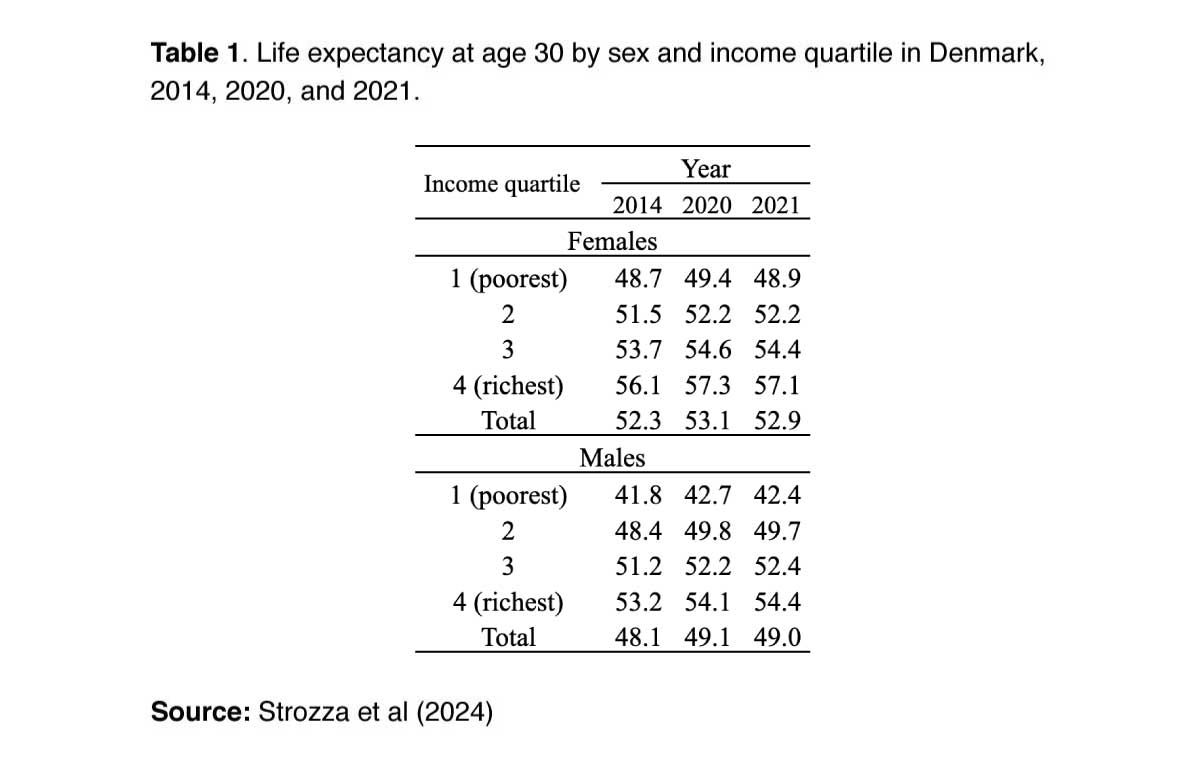
Life expectancy can be calculated in different years and at various ages. Table 1, for instance, shows life expectancy at 30 years at the beginning of the period and for the first two pandemic years by sex and income quartile, used as a proxy of socioeconomic status (SES).

Life expectancy is a snapshot of mortality conditions, and not a forecast of any individual’s lifespan. Therefore, its decline does not represent the number of years that will be deducted from the lifespans of individuals; rather, it provides a comparable measure of the impact of the mortality shock generated by the pandemic.

Table 1 shows yearly changes in life expectancy by sex and income quartile for the five years prior to the pandemic (2014-2019) and the initial two pandemic years (2020-2021).

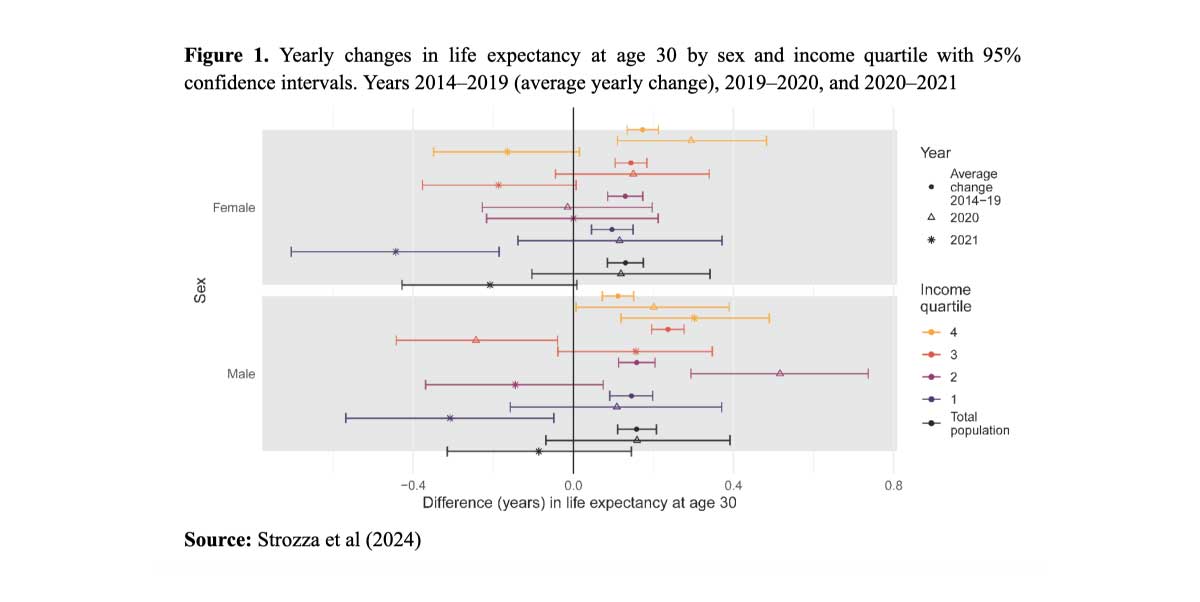
Before the pandemic, yearly female life expectancy gains followed a social gradient. In other words, life expectancy was increasing faster for women in the highest socioeconomic groups than in the lowest. However, the confidence intervals shown in Figure 1 suggest that these results should be interpreted with caution. This was the case, to some extent, for men too, with the exception of the highest income group, where survival improvements were relatively limited. However, the differences in life expectancy changes were small, and the gap in life expectancy between the highest and lowest income groups remained large.

Figure 1 illustrates the Danish COVID-19 success story of 2020, when small gains in life expectancy were observed in the overall population (Aburto et al. 2021), as well as for most sub-populations, possibly due to the timing of policy interventions. However, the situation changed in 2021, and life expectancy losses were observed for the overall population (Schöley et al. 2022) and for most sub-populations.
Focusing on 2021, we observe a social gradient in life expectancy changes for both men and women. Among women, all sub-populations experienced a loss in life expectancy, with those in the highest income group experiencing the smallest loss, less than two and a half months, compared to those in the lowest income group, who lost almost six months. Among men, those in the highest income groups experienced gains in life expectancy, while those in the lowest income groups experienced losses, the extent of which spanned from of almost four months gained to almost four months lost between 2020 and 2021. To summarize, inequalities in life expectancy increased across socioeconomic groups for both women and men. While the confidence intervals for the 2020 results mostly overlap, in 2021 this is the case for women but not for men, at least not when the top and the bottom quartiles are compared.

Causes of death contributing to changes in life expectancy


COVID-19 was not the only factor that contributed to changes in life expectancy over this period. Mortality from other leading causes of death changed too, illustrating socioeconomic inequalities in health caused indirectly by the pandemic.

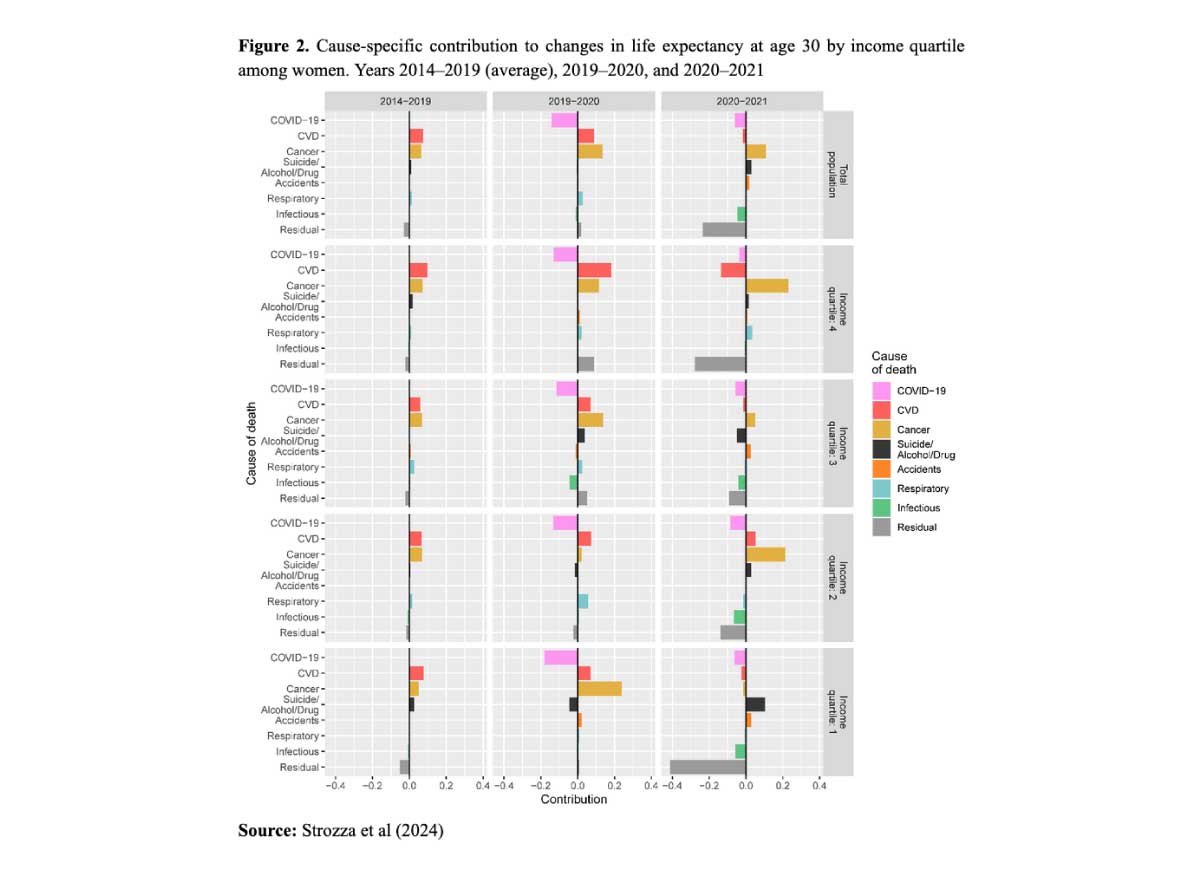
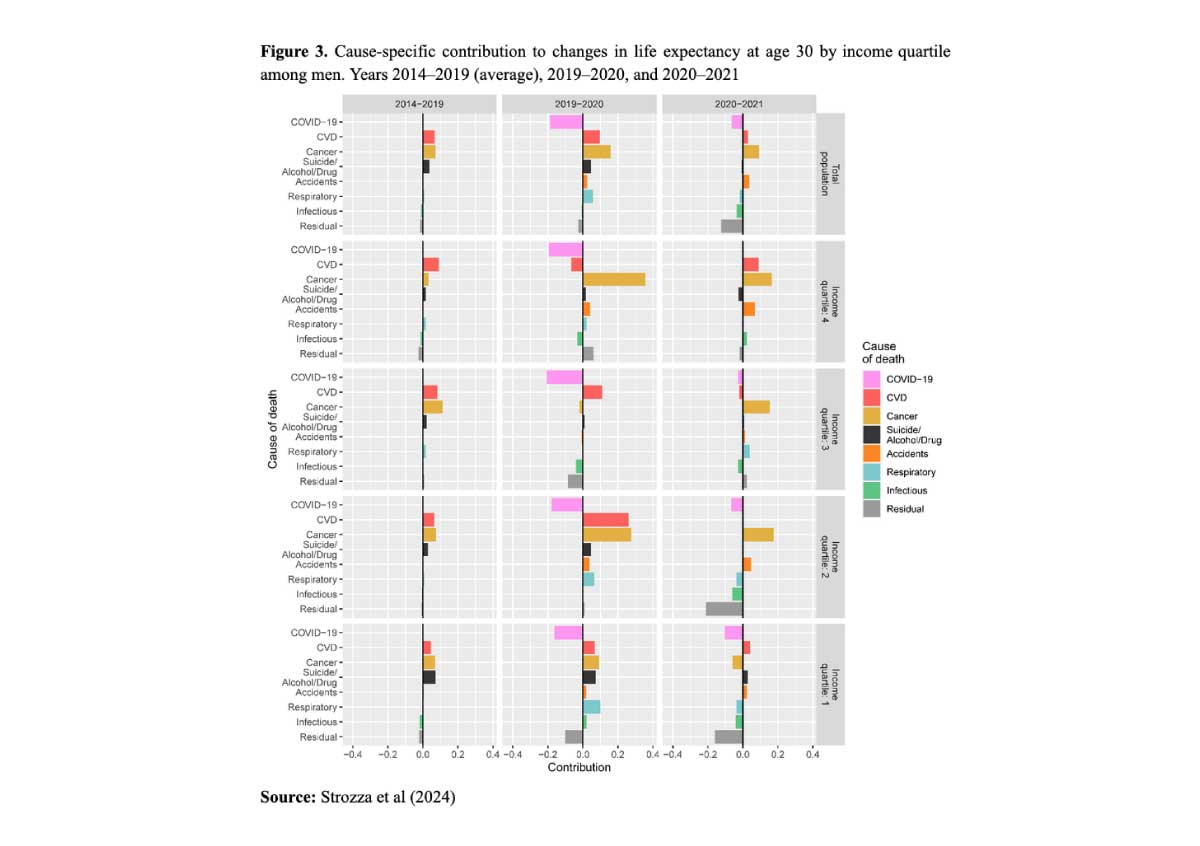
Figures 2 and 3 show cause-specific contributions to changes in life expectancy at age 30 by income quartile for women and men, respectively. Note that individual year-on-year changes include random variability, and thus require caution in their interpretation. The positive trend in 2020 was due to a decrease in cardiovascular disease and cancer mortality across income quartiles, which counterbalanced the negative contributions of COVID-19. The smaller losses among women in the highest income group in 2021 were explained by decreases in cancer mortality and a smaller negative contribution of COVID-19 and residual causes. For those in the lowest income group, cancer mortality increased slightly, contributing to small negative changes in life expectancy. Slightly higher COVID-19 mortality, together with a high contribution from residual causes and infectious diseases accounted for the rest. Analyzing changes in other causes of death, in conjunction with COVID-19 deaths, gives a more complete picture of the indirect impacts of the pandemic.
Among men, reductions in cardiovascular disease and cancer mortality also counteracted the emergence of COVID-19 in 2020, as they did for women, although other causes, such as accidents, deaths caused by suicide, drugs, or alcohol abuse, and deaths due to respiratory diseases had negative effects on changes in life expectancy in the lowest income groups. In 2021, cardiovascular disease and cancer mortality continued to decrease in high-income groups, leading to positive contributions to changes in life expectancy, while COVID-19 had practically no impact. Low-income groups, on the other hand, experienced increased mortality from COVID-19 as well as from respiratory diseases, infectious diseases, and other residual causes. For both women and men, this shows how the direct and indirect effects of COVID-19 contributed to the increasing life expectancy gap across socioeconomic groups.
 

Conclusions


Disparities in life expectancy across income groups in Denmark increased after the initial two pandemic years. The well-established mortality gaps were exacerbated by the dual impact of the pandemic, both directly through COVID-19 mortality, and indirectly through greater social inequalities in mortality from other causes of death. Our findings emphasize the critical need for more focused interventions for socially disadvantaged sub-groups during health emergencies. These interventions should not be restricted to the cause of the crisis itself, but are key to preventing a further widening of the gap between the most and least vulnerable sub-groups. Ultimately, this approach will foster a more equitable response to health crises.

References

  • Aburto JM, Schöley J, Kashnitsky I, Zhang L, Rahal C, Missov TI, et al. Quantifying impacts of the COVID-19 pandemic through life-expectancy losses: a population-level study of 29 countries. Int J Epidemiol. 2021;51(1):63-74. https://doi.org/10.1093/ije/dyab207
  • Brønnum-Hansen H, Östergren O, Tarkiainen L, Hermansen Å, Martikainen P, van der Wel KA, et al. Changes in life expectancy and lifespan variability by income quartiles in four Nordic countries: a study based on nationwide register data. BMJ Open. 2021;11(6): e048192. doi.org/10.1136/jech-2020-214108
  • Schöley J, Aburto JM, Kashnitsky I, Kniffka MS, Zhang L, Jaadla H, et al. Life expectancy changes since COVID-19. Nat Hum Behav. 2022;6(12):1649–59. doi.org/10.1038/s41562-022-01450-3
  • Strozza, C., Vigezzi, S., Callaway, J., and Aburto J.M. (2024). The impact of COVID-19 on life expectancy across socioeconomic groups in Denmark. Population Health Metrics 22, 3. doi.org/10.1186/s12963-024-00323-3

Saturday, March 30, 2024

A Shift in Hunger: U.S. Food Policy and What We Learned from the Pandemic

Food insecurity rates increased as pandemic-backed support came to a halt.

March 27, 2024

Nurfadila Khairunnisa
Research Analyst


Changes in public assistance during the COVID-19 pandemic lifted thousands of Americans out of hunger. Households with children and those receiving food stamps were the main beneficiaries of increased tax credits, funding for social programs, and food assistance.

But in 2022, as such supports expired, food security—or sufficient food access for individuals or households—dropped significantly. Pandemic financial benefits ended, 17 states withdrew from receiving extra support from the Supplemental Nutrition Assistance Program (SNAP), and food prices spiked across the country.

What does this mean for Americans in 2024? Food policy plays a significant role in minimizing hunger, and the Farm Bill—set to be renewed this year—is in the spotlight. Typically, most Farm Bill funds are allocated to nutritional assistance programs, the largest of which is SNAP. But there are growing concerns that SNAP funds are in jeopardy in the new bill.

In light of these developments, it’s helpful to revisit the facts around food security and SNAP, and what they mean for the well-being of low-income households and households with children. Based on pre- and post-pandemic data, here are three findings that elevate the importance of SNAP funding.

At the height of the pandemic, food security improved for SNAP households and those with children


Food security among SNAP households improved in 2020 and 2021 compared with 2019. Similarly, a smaller share of households with children faced food insecurity in 2021, meaning there were lower rates of children being hungry, skipping a meal, or not eating any food for a day.

Emergency financial assistance, particularly extensions to existing programs, played an important part in boosting food security. In most states, SNAP allotments increased and program access was streamlined from March 2020 through February 2023.

These infusions of funds worked, data show. Federal assistance programs lifted 45.4 million people out of poverty in 2021. And more children benefited: In 2021, 27% of U.S. children were in families receiving public assistance, up from 23% in 2019.

Additional emergency provisions during the pandemic also helped with food security. Most U.S. households receiving the child tax credit (CTC) in 2021 used it to cover food expenses. Thus, a range of federal assistance programs helped improve children’s food security at the height of the pandemic.

But in 2022, food insecurity rebounded, as financial assistance stopped and costs of living surged


Very low food security increased for households with children from 2021 (0.7%) to 2022 (1%), and many attribute the additional hardships to higher food prices and inflation. The Consumer Price Index (CPI) is a measure of inflation for all consumer goods, including food. Observing CPI data for all consumer items (gasoline, utilities, food, etc.) from 2013 to 2023, the highest month-over-month increase occurred in mid-2022, presenting a 1.2% change from May 2022 to June 2022 (Figure 1). Similarly, the CPI for food alone increased every 
month in the first half of 2022, jumping over 1% from both April to May and June to July.


FIGURE 1. SIGNIFICANT PRICE INCREASES HIT CONSUMERS IN THE FIRST HALF OF 2022
ONE-MONTH PERCENTAGE CHANGE IN CONSUMER PRICE INDEX FOR ALL CONSUMER ITEMS AND FOOD, SEASONALLY ADJUSTED

Source: U.S. Bureau of Labor Statistics, Consumer Price Index (CPI) Databases, “All items in U.S. city average, all urban consumers, seasonally adjusted” and “Food in U.S. city average, all urban consumers, seasonally adjusted.”


Food prices are known to be volatile and are often excluded in CPI calculations. However, significant volatility can cause economic disruption that harms consumers, especially vulnerable groups. While food prices have since leveled out, they remain high, creating long-lasting effects for low-income households. Families that depend on weekly wages, work minimum wage jobs, and have unsteady employment have a harder time recovering from increased costs of living.

In addition, during the high-inflation period in 2022, families no longer received the CTC, which was halted at the beginning of year. While the tax credit targeted all households with children, it benefited vulnerable families the most in recovering from the pandemic.

Racial and regional disparities in child hunger persist


Racial disparties persist in child well-being and hunger, data show. Most households that were lifted from poverty via the CTC were families of color. Pandemic survey data between July 2021 and February 2022 show that an average of 60% of Black households with children received CTC payments, the highest rate of all racial groups (Figure 2). Additional data from the KIDS COUNT Data Center show that the only racial group to experience a decline in poverty during this period was Black children. Perhaps surprisingly, the pandemic time period—buffered by extra financial assistance—was beneficial to many in poverty, especially Black children and their families.

FIGURE 2. 60% OF BLACK HOUSEHOLDS WITH CHILDREN RECEIVED CTC PAYMENTS DURING THE PANDEMIC
AVERAGE PERCENTAGE OF HOUSEHOLDS WITH CHILDREN THAT RECEIVED CTC PAYMENTS, JULY 2021–FEBRUARY 2022

Note: Racial and ethnic groups represented in this figure are not mutually exclusive.

Source: KIDS COUNT Data Center, “Households with children that received a CTC payment in the past four weeks by race and ethnicity in the United States.”

Regional differences are also notable. According to 2019-2021 CPS data, in Southern states, significantly higher shares of children lived in food-insecure households than in other regions. On average, 15.9% of children in the South were in food insecure households, compared to 11.4% of children in the Northeast. In 2021, about 83% of the nation’s most food-insecure counties were in the South. These findings reveal that Black children in the South are doubly disadvantaged with respect to food security.

The policymaker’s role in reducing hunger


Prior to the pandemic, food security among households with children steadily decreased. And, the past four years have further demonstrated the significance of policy in combatting food insecurity (Figure 3). During the 2020-2022 period, covering both early and late stages of the pandemic, the rate of food insecure households with children was 16%—up slightly from 15% in 2019-2021.

FIGURE 3. FOOD INSECURITY FOR HOUSEHOLDS WITH CHILDREN HAS BEEN ON THE DECLINE—BUT IT INCREASED LATE IN THE PANDEMIC
PERCENTAGE OF HOUSEHOLDS WITH CHILDREN THAT WERE FOOD INSECURE IN THE PAST YEAR, 2011–2013 TO 2020–2022

Source: KIDS COUNT Data Center, “Children living in households that were food insecure at some point during the year in the United States.”

Reacting to the economic uncertainty of the pandemic, policymakers administered emergency financial assistance that improved food security for vulnerable households, even during a historically difficult time. But in 2022, food insecurity in these households rebounded, as COVID-era supports expired, food prices rose, and costs of living soared.

In light of this evidence, policymakers recommend:
  1. Protecting funding for nutritional assistance programs and improving these programs to meet meal costs. [1]
  2. Expanding the CTC and the earned income tax credit for low-income households. [2]

SNAP benefits, even with increases in 2021, failed to meet meal costs in both urban and rural areas nationwide. Increased funding in nutritional programs—a possibility in the new Farm Bill—would help fill these gaps, providing households with appropriate allowances to meet food costs where they live.

Higher tax credits for low-income households and households with children directly increase household spending on food, data show. Expansion of such tax credits directly affects workers who earn poverty-level wages and those who identify as Black or Latino.

But, the real beneficiaries are children, for whom important outcomes—including school success and health—are linked to have reliable access to sufficient, safe, and nutritious food at home. And evidence from the pandemic shows that minimizing hunger is achievable by strengthening existing programs.


References

  1. Urban Institute, “The Gap Between SNAP Benefits and Meal Costs, 2020–2021,” November 18, 2021.
  2. The Annie E. Casey Foundation, Race for Results: Building a Pathway to Opportunity for All Children, January 2024.
Кортински тыцабельны, качество лучшэ

Friday, March 29, 2024

Racial disparities in disability and in long and happy living in America

February 26, 2024 Anthony R. Bardo and Jason L. Cummings

The racial divide is still profound in the U.S., in terms not only of survival, and survival without disabilities, but also of happiness. Anthony R. Bardo and Jason L. Cummings document some of these disparities.


Now that they are growing old, have US baby boomers fulfilled the aspirations towards more positive and equitable life circumstances that characterized their youth, especially through the Civil Rights movement? One way to address this question is to focus on life expectancy, the number of remaining years that an average person can expect to live, and to analyze racial disparities in length of life.

Trends in American longevity and physical disability


In 1970, life expectancy at birth in the US was approximately eight years longer for Whites than for Blacks: 71.7 vs 64.1 years, respectively. By 2010 this racial gap had narrowed to slightly less than four years: 78.9 vs. 75.1 years, respectively. More recent data are difficult to compare because of the pervasive effects of the COVID-19 pandemic, but national vital statistics suggest that some progress seems to be underway.

Both survival increase and convergence are good news, of course, but it is also important to consider if these additional years are lived in good health, both in general and by subgroup. For instance, let us consider active life expectancy at age 65, or remaining years of life past the 65th birthday expected to be lived without a disability. Between the 1980s and 2010s, it increased by 2.8 years for White Americans (from 12.2 to 15.0 years) and 2.2 years for Black Americans (from 9.8 to 12.0 years). This means that the percentage of remaining years of life expected to be lived without a disability remained approximately constant, but at different levels: 76% for White people but only 67% for Blacks (Freedman & Spillman, 2016). In other words, increases in life expectancy were accompanied by an equivalent number of healthy and unhealthy years, and racial disparities remained unchanged.

Racial disparities in long and happy living


While life expectancy and active life expectancy are key objective indicators of quality of life, at high levels of development, additional indicators of well-being can also be considered. One such indicator links this survival to subjective well-being, a facet of societal progress that has recently garnered wide-spread attention (Layard, 2010). Until now, few researchers have tried to determine happy life expectancy, i.e., how many years an individual can expect to live happily. This is precisely what we did in a recent study, breaking our results down by physical disability status, sex, and race (Bardo and Cummings 2023) based on representative data from the 2010 and 2012 waves of the Health and Retirement Study (n = 16,614) of the U.S. population aged 50 years and older.

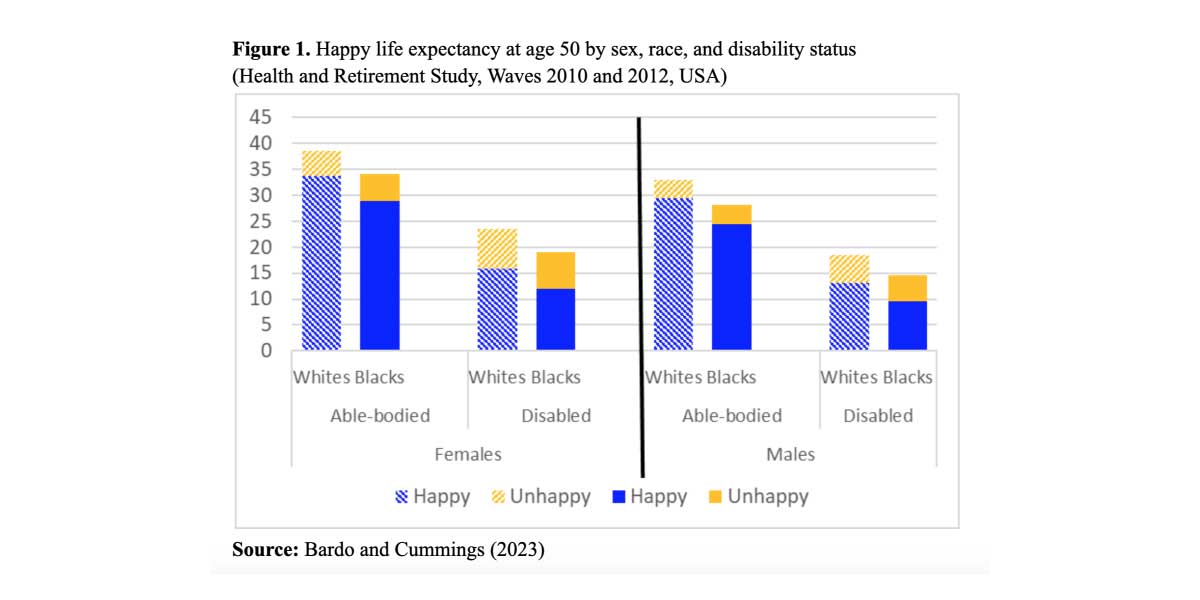
The emergence of health problems is, of course, a normal and anticipated part of the aging process, and, within limits, worsening health is not a strong determinant of happiness in later life, because individuals assess their quality of life based on their expectations and ability to adapt or adjust to changing circumstances. However, the development of a disability reflects a major life change, with clear and negative consequences for both quality of life and longevity. For example, at age 50, White Americans with a disability can expect to live happily for 50% fewer years of their remaining life than their able-bodied peers. The negative influence of disability on happy life expectancy is exacerbated for Black Americans who experience a 60% reduction in remaining happy years of life when faced with a disability. These findings portray the compounding effects of cumulative (dis)advantage and circumstances that people with multiple intersecting identities (e.g., Black, male, disability) uniquely experience (Figure 1).
Unfortunately, in the USA, racial disparities in key resources that promote health, happiness, and longevity remain as wide today as they were in the 1970s, as, for example, in the case of the Black-White gap in median household income. Do socioeconomic differences account for racial disparities in happy life expectancy? As our analyses indicate, they do for healthy Black women but not for healthy Black men. The reasons behind this unexpected result are not self-evident, and merit further analysis.
 

Conclusion


There is no simple solution for achieving equity in opportunities to live a long, healthy and happy life. We focused on later life outcomes, but these are the consequences of cumulative chronic exposure to various race-related forms of stress and discrimination experienced throughout life, including uneven access to high quality primary/secondary education and safe housing in childhood, unequal access to quality jobs and affordable and safe housing during adulthood, and likely the high risk of imprisonment for young Black males (Gilbert et al., 2016).

It is high time that America turned attention towards the disparities in length and quality of life that persist in the land where the pursuit of life, liberty, and happiness is a supposedly unalienable right.

References

Friday, March 22, 2024

fact check

Social media posts have cited selective statistics to revive the misleading narrative that COVID-19 vaccines do more harm than good.


The posts, opens new tab highlight the nearly one million fatalities in England among the vaccinated between July 2021 and May 2023, as compared with 61,000 deaths among the unvaccinated, to fuel the baseless narrative that COVID-19 vaccinations kill people.

The Facebook posts either link to or carry similar text to articles by Chemical Violence and Natural News, which cite figures from Britain’s Office for National Statistics, opens new tab (ONS).

Monday, March 18, 2024

infection

В Японии распространяется опасная бактериальная инфекция


С начала этого года в Японии было зафиксировано почти 400 случаев «стрептококкового синдрома токсического шока» (STSS). Эта редкая, но крайне опасная бактериальная инфекция распространяется в Японии с рекордной скоростью. В некоторых случаях (около 30%) болезнь заканчивается летальным исходом.

Власти Японии опасаются, что эта тяжелейшая форма стрептококкового заболевания будет распространяться и дальше, пишет Guardian.

«Механизмы, лежащие в основе тяжелых и внезапных форм стрептококковой инфекции, до сих пор остаются неизвестными, и мы еще не достигли той стадии, когда сможем их объяснить», — отмечают в Национальном институт инфекционных заболеваний (NIID).

По данным NIID, в прошлом году в Японии был зарегистрирован 941 случай заболевания STSS. Больше всего подвержены риску пожилые люди, однако штамм этой инфекции приводит к большему количеству смертей и у пациентов моложе 50 лет. В прошлом году из 65 заболевших в возрасте до 50 лет около трети умерли, сообщает японская газета Asahi Shimbun.

Пожилые люди, заболевшие STSS, могут испытывать симптомы, похожие на обычную простуду. В редких случаях симптомы могут усугубляться и приводить к боли в горле, пневмонии или менингиту. В самых тяжёлых случаях может наступить отказ органов.

Стрептококковые инфекции передаются капельным путем и при физическом контакте. Министерство здравоохранения Японии рекомендует соблюдать те же меры предосторожности, которые были частью повседневной жизни во время пандемии коронавируса.

Sunday, January 28, 2024

high mortality

Высокая смертность среди европейской молодёжи после вакцинации от COVID


Замечен резкий рост смертности в возрастной группе от 20 до 44 лет в целых 13 странах Западной Европы. Такая статистика была зафиксирована после массовой вакцинации от covid-19. При этом смертность значительно выше, чем во время пандемии коронавируса.

Saturday, December 23, 2023

covid-19, not 24

ВОЗ: Россия — на первом месте в мире по росту заболеваемости Covid-19


В России за последние четыре недели (с 20 ноября по 17 декабря) было зарегистрировано почти 280 тысяч новых случаев заболевания ковидом, сообщает ВОЗ. Таким образом, число заболевших возросло на 130%.

По числу новых случаев ковида и по темпам распространения заболевания Россия обогнала все остальные страны, следует из данных Всемирной организации здравоохранения (ВОЗ).

Самая высокая смертность от ковида за этот период — в Италии: там зарегистрировано 510 смертей. За Италией следует Швеция (396 человек скончались от ковида) и Россия (376 смертей).

Российский оперативный штаб по борьбе с ковидом ранее заявил, что на минувшей неделе было диагностировано почти 97 тысяч случаев заболевания, при этом были госпитализированы 8,7 тысяч пациентов, 161 человек скончались от этой инфекции.

В целом в мире заболеваемость Covid-19 выросла на 52% по сравнению с предыдущим 28-дневным периодом. С 20 ноября по 17 декабря было зарегистрировано более 3000 смертей от ковида, что на 8% меньше, чем в предыдущие четыре недели.

Saturday, November 11, 2023

Out of Office

Out of Office: Global Office Space Vacancies at Record High
Fresh rumors about a possible bankruptcy of WeWork sent shockwaves around the commercial real estate market last week, leaving office landlords around the world trembling with fear at the prospect of losing one of their largest tenants. Especially in prime markets such as New York City, San Francisco, London and Paris, WeWork played an outsized role in the office rental market, occupying large swaths of premium office space.

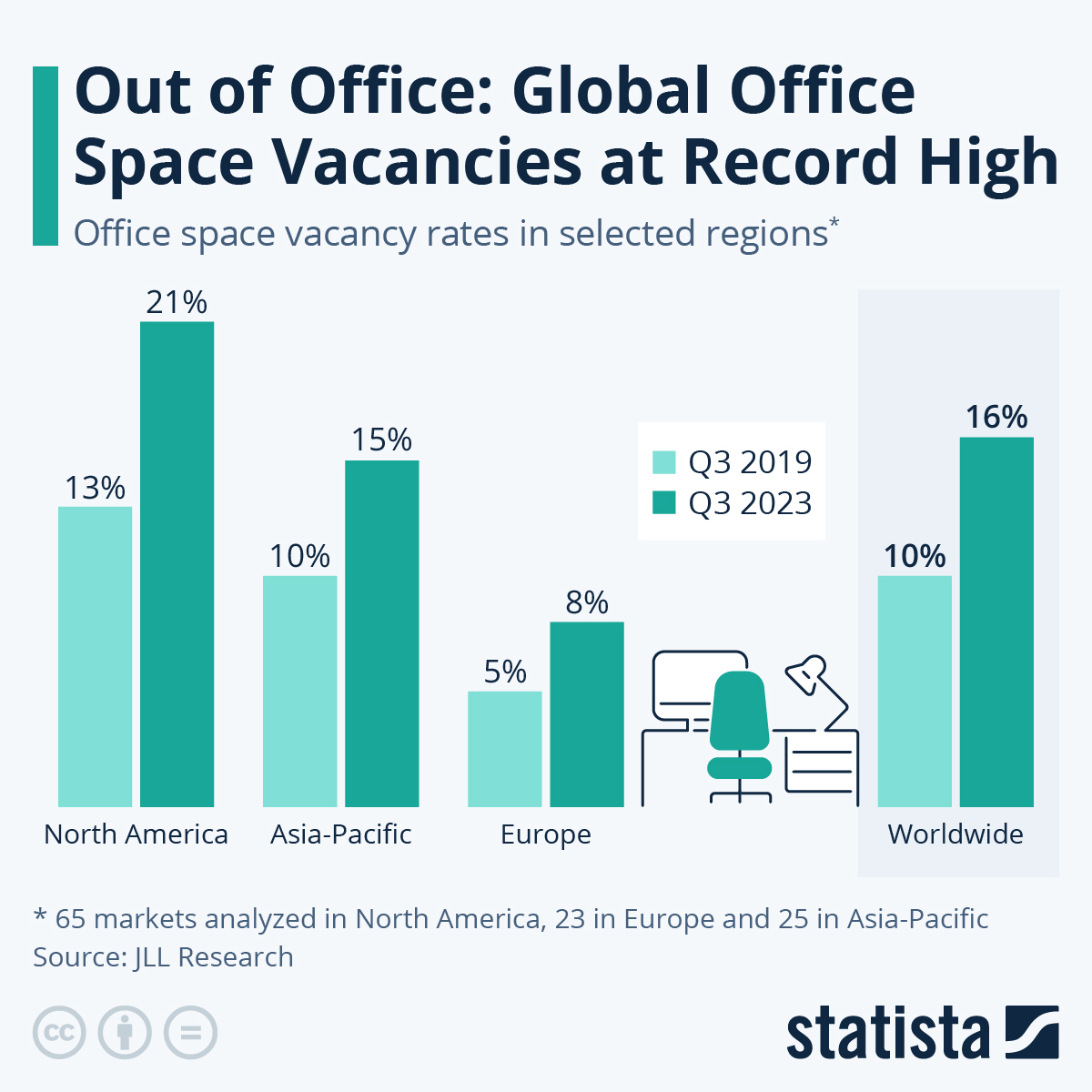
The reports of WeWork’s imminent demise come at the worst possible time for landlords, who are already struggling to find tenants, as many companies are reducing their office footprint to reduce costs and adapt to the post-pandemic world of hybrid work. According to real estate specialist Jones Lang LaSalle (JLL), office vacancy rates are higher than ever, reaching 21 percent in the U.S. and Canada in Q3 2023 and 16 percent globally, i.e. in the 100+ markets analyzed by JLL Research. In both cases, that’s an increase of 60 percent compared to pre-pandemic vacancy rates, which stood at 13 and 10 percent in North America and globally in Q3 2019, respectively.

At the end of June, WeWork operated 906,000 workstations in 777 locations across 39 countries, with total (current and long-term) lease obligations amounting to $14.2 billion. While it’s unclear what will happen to these locations in case of bankruptcy, landlords look certain to lose out on a large chunk of their agreed-upon leases and to end up with even more excess supply of prime office space.

Monday, November 6, 2023

The impact of the COVID-19 pandemic on life expectancy in the US Hispanic population

November 6, 2023    Elizabeth Arias and Betzaida Tejada-Vera

In the United States, the Hispanic population was hit harder by the COVID-19 pandemic than the majority (non-Hispanic White) population. Elizabeth Arias and Betzaida Tejada-Vera investigate the matter and highlight a high, but often neglected level of heterogeneity.


The COVID-19 pandemic had a major impact on life expectancy at birth in the United States. In 2020 it fell by 1.8 years, but the drop varied markedly by race and ethnicity, with the Hispanic/Latino (henceforth “Hispanic”) population losing substantially more than other race and ethnicity groups (Arias and Xu, 2022). Before the pandemic, the Hispanic population was characterized by better survival chances than the majority (non-Hispanic White) population, despite having lower levels of educational attainment, higher levels of poverty, and lower access to health insurance and quality care. This advantage, known as the “Hispanic Mortality Paradox”, was almost completely cancelled out by the pandemic, declining from 3.1 years in 2019 to 0.5 years in 2020 (Arias and Tejada-Vera, 2023).

The terms “Hispanic” or “Latino” were created in the US to classify persons from Spanish speaking countries and, as a result, they mask the great diversity of this population (Arias, et al. 2020). Hispanic people have origins in countries representing diverse cultural, economic, social, and political characteristics, and have distinct histories of immigration and patterns of assimilation in the US. Prior to the pandemic this diversity was also evident in differences in life expectancy at birth by country of origin (Arias and Tejada-Vera, 2023). To better understand why the pandemic disproportionately affected the Hispanic population, we examined changes in life expectancy at birth between 2019 and 2020 and the impact of changes in age and cause-specific mortality in Hispanic sub-groups across different countries of origin.
 

Decline in life expectancy


Figure 1 shows life expectancy at birth in 2019 and 2020 by Hispanic sub-group. The figure highlights differences in both levels and losses in the period, particularly among males. The overall loss of life expectancy among the Hispanic population was 4.5 years for males and 3.1 years for females, ranging from 0.6 (Other Hispanic) to 6.7 years (Central and South American) among males and from 0.6 (Other Hispanic) to 3.6 years (Mexican) among females.

Age-specific variation in the probability of dying


The COVID-19 pandemic increased the age-specific probability of dying during 2020, compared to 2019, differently by age and across the Hispanic sub-groups (Figure 2). For example, Central and South American males experienced probabilities of dying up to 2.5 times greater in 2020 than in 2019, concentrated in the working ages (30 to 70 years), while Cuban females experienced increases close to two times greater, concentrated in the oldest ages (75 and older).

The impact of age and cause-specific changes in mortality on the decline in life expectancy


We used a decomposition technique to explore the effects of changes in age-specific mortality on changes in life expectancy between 2019 and 2020 (see Arias and Tejada-Vera, 2023 for details). For all groups, the effects of increases in mortality below age 20 were minimal. The effects in working ages (20-69) were greater among males across all groups and, conversely, the effects in the oldest ages (70 and older) were greater among females in all groups. There were important differences across Hispanic sub-groups. Among males, increases in mortality at working ages (20-69) were largest for Mexicans (57.4%) and smallest for Cubans (39.5%). Conversely, increases at the oldest ages (70 and older) ranged from 41.3% for Mexicans to 58.4% for Cubans.

Among females, increases in mortality at working ages were smallest for Other Hispanics and Cubans (6.8% and 17.9%, respectively). The largest effects of increased mortality at the oldest ages occurred among Cubans and Other Hispanics (81.4% and 87.1%, respectively).

Figure 3 presents the contributions of increases in the five causes of death with the largest impact on the decline in life expectancy between 2019 and 2020. For all groups, increases in mortality due to COVID-19 had the largest effect on life expectancy loss and its impact was greater among the Hispanic population than among the majority population. There was variation within the Hispanic population, however. The percent contributions of increases in mortality due to COVID-19 were smallest for Puerto Rican (53.6%) and Cuban (55.3%) males compared to Central and South American (74.2%) and Mexican (72.5%) males. Among females, the impact of COVID-19 mortality ranged from 41.8% among Cubans to 77.5% and 98.2% among Central and South Americans and Other Hispanics, respectively.

Conclusions


The impact of the COVID-19 pandemic on life expectancy in the Hispanic population varied by country of origin and sex. This differential impact was also linked to differences in the age distribution of excess mortality due to COVID-19 and in the relative impact of COVID-19 in comparison to other causes of death. These results suggest that for some groups, the excess burden of COVID-19 mortality was an outcome of the over-representation of some Hispanic sub-groups in essential industries with higher risks of exposure to the virus (Riley et al., 2021). For other groups, it may have been the over representation of multigenerational households where older adults were at greater risk of intergenerational transmission of the virus (Riley et al., 2021). These results highlight the importance of population disaggregation in studies of the disproportionate impact of the COVID-19 pandemic on the Hispanic population in the US.

References

  • Arias E, Johnson NJ, Tejada-Vera B (2020). Racial disparities in mortality in the adult Hispanic population. SSM – Population Health 11.
  • Arias E, Xu JQ (2022). United States life tables, 2020. National Vital Statistics Reports 71 (1). National Center for Health Statistics.
  • Arias E, Tejada-Vera B (2023). Differential impact of the COVID-19 pandemic on excess mortality and life expectancy loss within the Hispanic population. Demographic Research 48, 339-352.
  • Do DP, Frank R. (2021). Using race- and age-specific COVID-19 case data to investigate the determinants of the excess COVID-19 mortality burden among Hispanic Americans. Demographic Research 44, 699-718.
  • Riley AR, Chen YH, Matthay EC, Glymour MM, Torres JM, Fernandez A, Bibbins-Domingo K (2021). Excess mortality among Latino people in California during the COVID-19 pandemic. SSM-Population Health 15

Saturday, October 28, 2023

inflation

Инфляция в Европе в сентябре 2023


Наш ЦБ вчера в очередной раз повысил ставку для борьбы с инфляцией - но, что интересно, даже наши текущие 6% (официальные 6%, у кого как дорожает его личная потребительская корзина - большой-большой вопрос) выглядят довольно неплохо на фоне других стран Европы, прежде всего - Восточной Европы. В Польше инфляция приблизилась к 8%, в Чехии и Словакии перешагнула этот уровень, а в Венгрии она оказалась больше 12%. О Турции и говорить не приходится

Для стран Западной Европы сейчас тоже характерна достаточно высокий уровень инфляции: в Великобритании она составила 6.3% (чуть выше, чем у нас!), во Франции - 5.7%, немногим ниже наших цифр

Tuesday, September 26, 2023

How Covid Changed the World's Top Tourist Destinations

The tourism industry is slowly recovering from the pandemic after having experienced its deepest shock in history, according to a newly published UN World Tourism Organization report.

Needless to say, a lot has changed in the industry since the pre-pandemic year of 2019, including which countries have been able to attract the most tourists. As the following chart shows, where France, Spain and the United States have managed to retain their places as the top three travel destinations worldwide, China and Thailand have disappeared from the roundup, so that all top ten ranks are now taken by countries in Europe and the Americas.

According to the report, reasons for the countries’ changes in performance include the varying impacts of the health crisis per country, the travel restrictions policies put in place there and the "inherent brand strength and resilience"' of each destination.How Covid Changed the World's Top Tourist Destinations

Monday, July 10, 2023

excess mortality 22

избыточная мужская смертность в 2022


На Медузе и Медиазоне сегодня вышло ГИГАНТСКОЕ расследование о мужской избыточной смертности в России за время войны (спойлер: ~25 тыс. в 2022; ~50 тыс. до конца мая 2023). Уникальные данные (реестр наследственных дел!) и огромная работа. Рекомендую. (Самая подробная версия -- по-русски на Медузе.)

https://meduza.io/feature/2023/07/10/47-tysyach-pogibshih-rossiyskih-soldat
https://zona.media/article/2023/07/10/stats
https://meduza.io/en/feature/2023/07/10/bring-out-your-dead
https://en.zona.media/article/2023/07/10/stats

Напишу здесь о небольшой части расследования: по годовым данным Росстата за 2022. Предыдущая запись на эту тему: https://kobak.livejournal.com/130289.html; тогда данных за 2022 еще не было. Некоторые говорили, что Росстат не выдаст данные за 2022, но ничего подобного: я в июне сделал запрос, и мне все прислали. Данные и анализ лежат тут: https://github.com/dkobak/excess-mortality-war.

Сырые данные выглядят так:

Избыточная смертность среди мужчин 20-24 и 25-29 очевидна, и ее несложно оценить на глазок. Но в более старших группах это труднее. Посмотрим, например, на 35-39:

а) Кол-во мужских смертей в 2022 меньше, чем в 2021. Но в 2021 был пик эпидемии ковида, это увеличило смертность в 2021; а в 2022 ковид уже почти закончился. Так что, чтобы посчитать военную избыточную смертность, сравнивать с 2021 нет смысла.
б) Можно взять доковидный тренд (2015-2019) и продолжить его вперед на 2022. Проблема в том, что в 2022 ковид все-таки закончился не совсем; в начале года была мощная волна омикрона. Может быть, часть избыточной смертности относится на его счет. И действительно, среди женщин кол-во смертей немного повышено относительно доковидного тренда.

Что же делать? Гениальная идея коллег из Медузы -- смотреть на ОТНОШЕНИЕ мужских смертей к женским. Оно выглядит так:

Отношение явно скакнуло вверх во всех группах до 50 лет. Считаем "избыточное отношение" и переводим его в "избыточные мужские смерти". Потом суммируем по группам. В итоге получается 24 тысячи:

Под катом -- эти же графики, но с 1990, а не с 2015, а также парочка любопытных регионов.


Saturday, July 8, 2023

memories of Covid-19 restrictions are quickly fading

As memories of Covid-19 restrictions are quickly fading, Americans are looking forward to proper, carefree Fourth of July celebrations this year. According to AAA, more than 50 million Americans will travel at least 50 miles this Independence Day weekend in order to celebrate with their friends and families – a new record.

Aside from the obligatory fireworks, a proper cookout is the key ingredient for a real Independence Day celebration in many households. Speaking of ingredients: how much will a typical Fourth of July menu set you back these days? Well, there’s good news and there’s bad news. The bad news is that inflation makes no exception for national holidays, so expect your feast to be more expensive than a couple of years ago. The good news is that the prices for some food staples have eased over the past 12 months.

According to the American Farm Bureau’s annual Fourth of July market basket survey, a 10-person cookout involving cheeseburgers, chicken breasts, pork chops and several sides and dessert options will cost $67.73 this year. That’s up roughly 14 percent from 2021, but down by almost 3 percent compared to last year. One reason for the year-over-year decline in the overall price is the easing of chicken and pork prices, which were down 9 and 6 percent from last year’s survey, respectively, and account for a sizeable chunk of the overall costs.The Price of a July 4 Cookout

Tuesday, June 20, 2023

Loneliness and social exclusion among older Europeans before and during the COVID-19 pandemic

June 19, 2023 Bruno Arpino, Giuseppe Gabrielli and Heidrun Mollenkopf

Launched in 2009, the Joint Programming Initiative “More Years Better Lives” (JPI-MYBL) brought together several EU and non-EU countries to create a common research framework aiming to better coordinate, harmonize, and synchronize the research programmes of the participating countries on the topic of demographic change. In 2022, JPI-MYBL launched a knowledge-sharing process on isolation and loneliness among older people during the COVID-19 pandemic.

This resulted in a few workshops, which later led to a series of short papers and, ultimately, to the production of the e-book Loneliness and social exclusion among older Europeans before and during the COVID-19 pandemic that is now available on the N-IUSSP website. Here is an excerpt from Bruno Arpino, Giuseppe Gabrielli and Heidrun Mollenkopf’s introduction.


The demographic changes of the past and coming years will profoundly modify the population structure in Europe. These transformations are associated with changes in the distribution of resources and opportunities across Europe and beyond – changes that require adjustments in all areas of life, both at individual level and across society as a whole. Among these changes, population ageing is a long-term trend, which began several decades ago in Europe. Increased life expectancy is a triumph for humanity but, coupled with fertility reduction and postponement, it causes population ageing.

Social isolation and feelings of loneliness among older people are among the challenges posed by population ageing and shrinking family networks. Isolation and loneliness have negative consequences on individuals that may result in poor physical health, unhealthy behaviours, poor wellbeing and, ultimately, depression.

Loneliness also has an economic cost for individuals and society; it reduces interpersonal interactions, and thus social capital, and adversely affects physical and mental health. Research has estimated that the annual cost of loneliness is about 1,000 euros per capita. Individuals who feel lonely also tend to use healthcare services more than others, with negative consequences on public health expenditures.

Loneliness and social isolation among older adults were already important research and policy topics before the onset of the COVID-19 pandemic. However, the spread of COVID-19 and the social distancing measures to limit transmission of the virus exacerbated pre-pandemic vulnerabilities linked to isolation and loneliness in ageing societies.

Isolation, loneliness, and the COVID-19 pandemic


In the decades preceding the COVID-19 pandemic, scholars and public health officials became increasingly concerned about the growing risks of loneliness driven by societal shifts such as fertility decline, the increase in one-person households and other factors, especially in the United States and Europe.

After the outbreak of the pandemic, physical distancing was imposed or encouraged at national, regional, and local levels, to mitigate the spread of COVID-19. People were asked to avoid public social spaces and minimize physical contact with others. Measures also included stay-at-home orders, and full physical isolation of high-risk individuals, such as older adults with pre-existing conditions. While these mitigation measures were effective in slowing the spread of COVID-19 and reducing mortality, they may have increased isolation among older adults, possibly exacerbating the “loneliness pandemic” and the risk factors for loneliness.

Studies have suggested that older adults were more resilient to loneliness than younger adults during COVID-19. Thus, increased physical isolation due to the anti-COVID restrictions does not seem, on the whole, to have exacerbated feelings of loneliness among older adults. This finding may reflect a combination of factors, including lowered expectations for social interaction during the pandemic or increased contact at a distance.

Although possibly more resilient than younger adults, it is unclear whether, and to what extent, older adults across Europe experienced increases in loneliness during COVID-19. Existing evidence offers mixed results. In addition, although some studies showed unchanged feelings of loneliness among older adults overall, relevant heterogeneities may exist. Along this line, Arpino et al. (2022) show that individuals who lack certain close family ties (e.g., unpartnered people) have been at higher risk of reporting increased feelings of loneliness since the onset of the pandemic. This suggests that older people who lacked emotional and practical support might have been particularly exposed to its direct and indirect consequences. Van Tilburg (2022) shows that loneliness, and particularly emotional loneliness, increased between 2019 and 2020, although having a partner before the pandemic provided some protection.

Given that informal caregiving is mostly provided by close family members, childless and unpartnered individuals were, in principle, those at highest risk of experiencing unmet care needs during the pandemic. In fact, research has shown that family caregiving continued during the pandemic, in some cases replacing formal care services to avoid possible contagion by care professionals. Studies have also reported higher anxiety and depression among family caregivers during the pandemic.

The increased need of care and the heavier burden placed on family caregivers call for new policy and practice solutions. Older people in residential care are at a particularly high risk of isolation, loneliness and reduced care. COVID‑19 has pointed up an urgent need for higher standards of care in nursing homes in Europe, and for the development of community-based alternatives and services to support persons with care needs and families with care responsibilities.

These alternatives and services could be inspired by the principles outlined in a UN (2020) policy brief launched in the early phases of the pandemic. The development of good quality, affordable, available, and accessible community-based services being paramount for meaningful inclusion in the community, these services should be developed in collaboration with all stakeholders, from users to practitioners, including persons with care needs and their families. In parallel, broader-scope interventions to reduce isolation and loneliness among the general population can, and need to be, implemented, e.g. by improving public transport and through laws and policies to address ageism, inequality and the digital divide (WHO 2021).

References

  • Arpino B., Mair C. Quashie N., and Antczak R. (2022) Loneliness Before and During the COVID-19 Pandemic: Are Unpartnered and Childless Older Adults at Higher Risk? European Journal of Ageing. 19, 1327–1338.
  • United Nations (UN) (2020) The Impact of COVID-19 on older persons.
  • Van Tilburg, T. G. (2022). Emotional, social, and existential loneliness before and during the COVID-19 pandemic: Prevalence and risk factors among Dutch older adults. The Journals of Gerontology: Series B, 77(7), e179-e184.
  • World Health Organization (WHO) (2021). Social isolation and loneliness among older people: advocacy brief. WHO: Geneva.

Sunday, May 28, 2023

Who felt lonely during the COVID-19 pandemic among European older adults?

May 22, 2023 Omar Paccagnella, Veronica Cassarà, Maria Iannario and Cosmo Strozza

Feelings of loneliness are not very widespread among European older adults (aged 50 years and over) according to SHARE data. And, surprisingly enough, according to the analysis of Omar Paccagnella, Veronica Cassarà, Maria Iannario, and Cosmo Strozza, the COVID-19 pandemic did not affect these feelings very much: those whose self-reported status worsened broadly match those who reported an improvement.


Introduction


The COVID-19 pandemic has caused enormous psychological, social, and economic harm worldwide. Public health measures adopted to fight the spread of the virus, such as limitations of social and physical contacts, may have exacerbated loneliness and social isolation among younger and older adults. Loneliness is a state of emotional distress arising from a discrepancy between desired and actual social interactions. It should not be confused with social isolation, as not all individuals with limited social interactions feel lonely.

Several studies suggest that older adults, despite a higher risk of social isolation, were more resilient to loneliness during the COVID-19 outbreak than younger people (Arpino et al., 2020; Luchetti et al., 2020). However, research is needed to correctly identify who felt lonely during the COVID-19 pandemic and who felt lonely because of the COVID-19 pandemic.

Who feels lonely?


To provide a clearer picture of this issue, we exploited data collected by the Survey of Health, Ageing and Retirement in Europe (SHARE) before and during the COVID-19 outbreak. More specifically, we analysed data collected in the eighth wave of SHARE, carried out in 2019/2020 (Börsch-Supan, 2022a), the first SHARE Corona survey, carried out in 2020 (Börsch-Supan, 2022b), and the second SHARE Corona survey, carried out in 2021 (Börsch-Supan, 2022c).

In these waves, the same question (“How often do you feel lonely?”) was asked with three possible answers:
1) Often
2) Some of the time
3) Hardly ever or never.
Figure 1 displays the distribution of self-reported loneliness before and during the COVID-19 pandemic, selecting only the respondents who participated in all of these waves (n=31,250). It shows that the proportion of individuals never (or hardly ever) reporting loneliness was very large (more than two thirds of respondents) and declined over time. However, while this comparison highlights who feels lonely in different periods of time, it cannot be conclusive about the role of the pandemic in causing loneliness.

To further investigate this issue, we exploited the additional question asked in both SHARE Corona surveys: “Has that been more so, less so or about the same [as before the outbreak of Corona/than during the first wave]?”. Here, the possible answers were:
1) Less so
2) About the same
3) More so.
Unfortunately, this question was asked only to those who reported feeling lonely “often” or “some of the time” in the first SHARE Corona survey and to all respondents (whatever their feeling) in the second Corona survey, so the results cannot be compared. Moreover, they should be interpreted with caution since these are self-assessments of loneliness status and answers may suffer from individual heterogeneity in reporting feelings.

A different view: changes in loneliness


To identify those who felt lonely because of the COVID-19 pandemic, we focused on respondents who reported a change with respect to their pre-pandemic status, although even this strategy may not be flawless, as for some of these respondents the change may be due to other reasons (e.g., the loss of a loved one). However, this approach has the advantage of removing individual heterogeneity and allows us to identify both deterioration and improvement of self-reported loneliness resulting from different reactions to the measures put in place to contain the virus.

Tables 1 and 2 summarise the results obtained with our strategy. More than 70% of the older respondents show no change in loneliness with respect to the 2019 evaluation (the total percentages in the main diagonal). This does not mean that they did not feel lonely, but rather that their reported level of loneliness did not change during the pandemic period. Indeed, it is interesting to note that about 2.7% of the respondents (combining the two surveys) rated themselves as often lonely both before and during the COVID-19 outbreak.


The proportion of individuals who reported any type of deterioration of their status (14.5% and 16.7%, respectively, during the first and the second COVID-19 waves) is somewhat low and comparable with the proportion of those reporting improvement (13.2% during the first wave and 12.4% in the second wave). Moreover, only about 2% of respondents (slightly more in the second wave) reported a strong increase in their feelings of loneliness.

Summing up, this brief discussion can help to identify people whose feelings of loneliness really changed during the COVID-19 outbreak. In future research, we will investigate the characteristics of those who did not report any change. Our conjecture is that they represent a group of individuals whose feelings were barely affected by the pandemic, and this could provide a first step towards studying resilience to the COVID-19 crisis among older people.

References

  • Arpino B, Mair CA, Quashie NT, Antczak R (2022). Loneliness before and during the COVID-19 pandemic – are unpartnered and childless older adults at higher risk? European Journal of Ageing19, 1327-1338
  • Börsch-Supan A (2022a). Survey of Health, Ageing and Retirement in Europe (SHARE) Wave 8. Release version: 8.0.0. SHARE-ERIC. Data set. DOI: 10.6103/SHARE.w8.800
  • Börsch-Supan A (2022b). Survey of Health, Ageing and Retirement in Europe (SHARE) Wave 8. COVID-19 Survey 1. Release version: 8.0.0. SHARE-ERIC. Data set. DOI: 10.6103/SHARE.w8ca.800
  • Börsch-Supan A (2022c). Survey of Health, Ageing and Retirement in Europe (SHARE) Wave 9. COVID-19 Survey 2. Release version: 8.0.0. SHARE-ERIC. Data set. DOI: 10.6103/SHARE.w9ca.800
  • Luchetti M, Lee JH, Aschwanden D, Sesker A, Strickhouser JE, Terracciano A, Sutin AR (2020). The trajectory of loneliness in response to COVID-19. American Psychologist 75, 897-908
за одиночество специальный тэг, см. слева; там и старение есть

Tuesday, May 23, 2023

Pandemic Winners Struggle in the Post-Pandemic World

Zoom Video Communications, the company that rose to fame during the early days of the pandemic, reported better-than-expected results for its first fiscal quarter ended April 30, 2023. With total revenue of $1.11 billion and enterprise revenue of $630 million in the first quarter, Zoom raised its full-year guidance as well, expecting around 2 percent revenue growth for the year ending January 31, 2024. That’s obviously a far cry from the growth figures it posted during the pandemic, as the end of working-from-home requirements and stiff competition from Microsoft Teams, Cisco’s Webex and Salesforce’s Slack have brought the former pandemic high-flyer down to earth.

Zoom isn’t the only pandemic winner struggling to maintain its momentum in the post-pandemic world. Other companies that soared under the special circumstances created by Covid-19 have also come crashing down over the past year, as normal life gradually returned. Home fitness company Peloton and DIY marketplace Etsy, which profited from a large volume of mask sales on its platform during the pandemic, are two such examples, along with vaccine maker Moderna and DocuSign, a company that allows companies to manage agreements electronically.

As the following chart shows, all of these companies saw their stock price surge during the Covid crisis, but all of them have come down at least 70 percent from their peak pandemic valuation. $1,000 invested in Moderna shares on March 11, 2020, the day the WHO declared the Covid-19 outbreak a pandemic, would have appreciated to more than $20,000 by August 2021 and would still be worth more than $5,000 today. Investors who bought shares of DocuSign, Zoom or Peloton at the onset of the pandemic and held on to them until now are suffering from a severe pandemic hangover, as the shares of these companies are now worth (significantly) less than they were in March 2020.Pandemic Winners Struggle in the Post-Pandemic World

Sunday, May 7, 2023

Measles

В России вспышка заболеваемости корью. Так бывает каждые несколько лет

 - BBC News Русская служба


В России за последние месяцы зафиксированы тысячи случаев заболевания корью - это во много раз больше обычных показателей. Эксперты подчеркивают, что подъем заболеваемости не является чем-то необычным, но призывают не ослаблять мер контроля и советуют непривитым прививаться, если есть подозрения на контакт с заболевшим.


Сообщения о заболеваниях корью участились еще в конце 2022 года, однако ограничения стали вводить недавно: 12 апреля на внеплановые каникулы отправили студентов Московского университета нефти и газа, затем один за другим стали вводить "дистант" другие столичные вузы: Политех, МАИ, МИРЭА. 2 мая о дистанционном обучении на трех факультетах на Ленинских горах объявил МГУ. Все изменения в расписании ограничивают тремя неделями - именно столько длится максимальный инкубационный период возбудителя кори.

Растет заболеваемость и в регионах России. 3 мая власти Краснодарского края сообщили, что с начала года выявили 31 случай кори (против шести случаев заболевания за весь прошлый год). Как сообщил РБК со ссылкой на управление Роспотребнадзора в Самарской области с января по март заболели 118 человек.

В Петербурге на середину весны зарегистрировали 31 случай кори, в то время как в предыдущие два года фиксировали лишь единичные случаи. В середине апреля Роспотребнадзор фиксировал подъем заболеваемостью в половине регионов России, всего, по заявлению главы агентства Анны Поповой, на 26 апреля были зафиксированы более 1 тысячи случаев заражений. Это в 10 с лишним раз больше, чем все выявленные заболевания корью в 2022-м.

Данных о том, сколько заболеваний послужили причиной для ограничений в московских вузах, нет, но известно, что тревогу в МГУ подняли из-за подозрения на корь у одного-единственного студента. "Корь - самая заразная вирусная инфекция, которая есть в человеческой популяции, - подчеркивает Наталья Тураева руководитель лабораторий профилактики вирусных инфекций в Московском научно-исследовательский институте эпидемиологии и микробиологии им. Габричевского Роспотребнадзора РФ. - Индекс контагиозности, заразности, почти 100%. Все восприимчивые к кори заболеют при контакте. Это и затрудняет борьбу с корью - достаточно незначительного контакта с больным, чтобы заболеть самому. Именно поэтому противоэпидемические меры так активны. У нас есть 72 часа. Как только человеку ставится диагноз "Корь под вопросом" тут же начинается вакцинация "контактных" в очагах заболевания, а источник заболевания изолируется".

Рост заболеваемости корью цикличен. Сильные всплески инфекционной статистики были отмечены в России в 2014-м и 2019-м годах (4711 и 4491 заболевший соответственно). "Во время вспышки часть населения переболевает и приобретает таким образом иммунитет. Где-то проводят "подчищающую" иммунизацию - вакцинируют тех, кто не был привит вовремя, но может быть привит, чтобы не заразиться "здесь и сейчас". Повышается иммунная прослойка, вспышка прекращается, - объясняет динамику этого процесса Антонина Обласова, руководитель АНО "Коллективный иммунитет". - Потом происходит постепенное накопление людей без иммунитета (хотя бы за счет рождения новых детей). В популяции появляется кормовая база для вируса и если он соприкасается с этими восприимчивыми, то они, ожидаемо, заболевают и начинается новый виток".

Антиваксеров не посчитали


Нюансы в эпидемиологическую картину вносит существование прослойки антиваксеров, убежденных, что прививаться от кори не стоит и болезнь эта не так опасна, как утверждают врачи.

Еще до ковида Би-би-си подробно разбирала взгляды и поведение таких людей в России. При том, что в целом Россия охвачена вакцинацией против кори неплохо и заболеваемость даже на пиках не такая высокая, как во многих других странах, скептическое отношение к вакцинации в родительской среде встречается и приводит к тому, что многие дети (в национальном календаре прививок вакцину от кори они должны получать дважды - в год и в шесть лет) не защищены от этой инфекции.

Российские власти уверены, что последствия вакцинного скепсиса статистически ничтожны. "В РФ, если говорить о детях, охват прививками составляет 97%... практически все привиты", - заявила 26 апреля глава Роспотребнадзора Анна Попова в телеэфире. В среднем по России по данным РПН, оглашенным в середине апреля, иммунизировано против кори 95% населения.

Насколько достоверны данные, которыми оперируют медицинские чиновники, проверить трудно. Проблемы с вакцинацией против ковида в России оживили разговоры о том, как несложно - при нежелании вакцинировать себя или ребенка - сделать поддельную справку о прививке. До последнего времени не было даже учета привитых в федеральных компьютерных базах.

"Мы чаще других требуем справку о вакцине против кори, которая представляет опасность с точки зрения заразности и требует карантина, если вспышка заболевания произойдет. Вот корь и подделывают", - рассказывал Би-би-си Валентин Ковалев, инфекционист в петербургском Детском научно-клиническом центре инфекционных болезней ФМБА России.

"Мне кажется, эти 97% не имеют никакого отношения к реальности, - говорит Антонина Обласова из АНО "Коллективный иммунитет. - Было бы 97%, не было бы никаких вспышек, потому что очень маловероятно, что оставшиеся 3%, размазанные по территории страны, встретились бы. Были бы единичные завозные случаи. Сегодняшняя ситуация - доказательство того, что статистика в нашей стране недостоверна. И это - вина системы, а не отдельных учреждений".

Когда гром грянет


Наталья Тураева из института им. Габричевского, уверена, что ведомственная статистика верна и подчеркивает, что в экстренной ситуации непривитые часто меняют точку зрения. "Когда поднимается шумиха, люди более охотно откликаются на вакцинацию, мы это отмечаем по тому, как люди начинают прививаться в очагах болезни, - говорит она. - Им объясняешь: ваш ребенок может заболеть и заболеть тяжело, а если сейчас его привьем, то с вероятностью в 95% ваш ребенок не заболеет. И люди охотно на это идут. В очагах более 70% подлежащих вакцинации (а это те, кто не привился раньше) прививаются".

Где-то, однако, вакцинный скепсис не сдается - даже когда болеют родные, знакомые и коллеги. Недавно Залимхан Омариев, руководитель дагестанского управления Роспотребнадзора, сообщил, что даже на фоне роста заболеваемости убедить сограждан срочно сделать прививку не удается. "Речь на самом деле даже не о числе случаев заболевания, хоть это и важная характеристика, а именно о том, что люди в ходе проведения противоэпидемических мероприятий зачастую не идут на контакт и отказываются прививаться", - сокрушался Омариев в интервью РИА "Новости".

Собеседники Би-би-си сходятся в том, что санкции против России никак не повлияют на вакцинацию против кори, так как абсолютное большинство иммунизаций проводятся отечественными препаратами. Но при скачке заболеваемости дефицит возможен.
  
"В целом, если нет пиковой нагрузки, отечественного производства вакцины вполне хватает. А вот когда начинается вспышка, резко растет спрос, сразу возникают перебои, - отмечает Антонина Обласова. - Невозможно просто взять и сделать еще несколько партий вакцин, как нельзя просто взять и вырастить дополнительный урожай картошки, если весной не были произведены посадки. Ситуацию серьезно осложняют недобросовестные СМИ, которые дают слово не очень грамотным медикам, вещающим о том, что от кори нужно делать регулярную ревакцинацию. Это чистой воды отсебятина. 
От кори нужно делать две прививки за всю жизнь".

Опасаясь дефицита, медики в некоторых регионах ограничивают иммунизацию теми, кто - при отсутствии прививки от кори - находится в очагах заболевания. Так, о том, что вакцинация здоровых непривитых временно поставлена на паузу в Екатеринбурге недавно сообщало издание Е1.ru.

"Пока в городе [вакцину] придерживают для экстренного реагирования при выявленных случаях кори. В той ситуации, что сложилась, нужно иметь запас, который позволит спокойно провести массовую вакцинацию, если это понадобится", - сообщили изданию в областном Центре общественного здоровья и медицинской профилактики.

Чтобы продолжать получать новости Би-би-си, подпишитесь на наши каналы:
Подпишитесь на нашу рассылку "Контекст" : она поможет вам разобраться в событиях.