Showing posts with label наука. Show all posts

Thursday, February 27, 2025

valentei

Международная конференция XII Валентеевские чтения 
«Демографические процессы в условиях глобальных вызовов»


22-23 октября 2025 года
Информационное письмо №1

Уважаемые коллеги,

Лаборатория экономики народонаселения и демографии и кафедра народонаселения экономического факультета МГУ имени М.В.Ломоносова сообщают, что 22-23 октября 2025года состоится международная конференция XII Валентеевские чтения

«Демографические процессы в условиях глобальных вызовов».


Приглашаем специалистов, занимающихся изучением проблем народонаселения – в самом широком контексте – принять участие в конференции. Работа будет организована в смешанном (очном и онлайн) формате по следующим направлениям:

1. Факторы и динамика рождаемости, смертности, международной и внутренней миграции
2. Демографическая и миграционная политика
3. Данные о народонаселении и миграции – состояние и потребности исследователей
4. Новые подходы и методы сбора, анализа и обработки данных
5. Историческая демография
6. Междисциплинарные исследования – экономика народонаселения (и миграции), население и здоровье, образование, социальное обеспечение, географиянаселения и пр.

До 30 июня 2025 г. производится регистрация на портале конференции и подача тезисов (или докладов) по ссылке: https://conf.msu.ru/rus/event/9443/

Заявки, отправленные по электронной почте, не рассматриваются.


До 1 сентября Программный комитет производит отбор тезисов, секретариат конференции делает рассылку приглашений к участию в конференции с выступлением илипостером. Доклады, признанные Программным комитетом лучшими, будут приглашены к публикации в двуязычном реферируемом научном журнале Population and Economics(«Население и экономика») в 2026 году (журнал РИНЦ, Скопус: https://populationandeconomics.pensoft.net/).

До 10 октября возможна регистрация на портале конференции в качестве участника конференции без доклада и постера.

• Вопросы направляются на адрес электронной почты Оргкомитета конференции: Valentey.econ@conf.msu.ru
• Допускается не более одной заявки на участие в конференции в качестве единственного или основного докладчика.
• Регистрационный сбор для участия в конференции не предусмотрен.

Требования к оформлению текстов тезисов и докладов


Объём тезисов должен быть не менее 5 000 знаков, включая пробелы и сноски (без учета списка литературы); полные доклады – без ограничения объема.

Формат текста


Шрифт: Times New Roman, размер шрифта – 12 pt, положение на странице – по ширине текста.
Межстрочный интервал – 1,15 pt.
Рисунки вставляются в процессе подачи заявки в формате JPEG.

Обязательные элементы (располагаются перед текстом)


Заглавие: (размер шрифта 14, полужирный, положение по центру страницы. НЕ ИСПОЛЬЗОВАТЬ ПРОПИСНЫЕ БУКВЫ!);
Ключевые слова (от 1 до 5, шрифт Times New Roman, размер шрифта 12, положение по левому краю через строку после «Информации об авторе»)
Коды JEL (от 1 до 5, шрифт Times New Roman, размер шрифта 12, положение по левому краю).

Образец


Стратегические задачи демографического развития: приоритеты и региональные особенности

Ключевые слова: демографическая ситуация, демографическое развитие, региональная демография

Коды JEL : J10, J11

Информация об авторах загружается в процессе заявки: Ф.И.О. автора полностью, сведения об авторе – ученая степень, ученое звание, должность, место работы/учебы (название учреждения), город, страна, адрес электронной почты. Например, Иванов Иван Петрович, к.э.н., доцент, экономический факультет МГУ имени М.В.Ломоносова,кафедра экономической теории, Москва, Россия. E-mail : ivanov@mail.ru

Основной текст (оформлен по правилам, указанным выше)

Обязательные элементы (располагаются после основного текста)


• Список литературы. Список оформляется в соответствии с ГОСТ

Оформление ссылок


При ссылках на литературу в тексте указываются фамилии авторов и год издания (в круглых скобках); например, (Кузнецов, 1999), или (Smith, 2003), или (Petrov, Johnson, 1997).При цитировании источник указывается в круглых скобках после кавычек, с указанием страниц, например, «Институты — это «правила игры» в обществе» (Норт, ч1, 1997, с.17).

Monday, February 24, 2025

 seminar

ВХ

Уважаемые коллеги


10 марта 2025 г. состоится очередной Научный семинар лаборатории экономики народонаселения и демографии экономического факультета МГУ имени М.В. Ломоносова.
С докладом по теме

«Продолжительность жизни людей старшего возраста в РФ: региональный аспект»
выступит 
Эченикэ Владимир Хосе, к.э.н., зав. сектором региональной демографии, расселения и миграции ЛЭНД, доцент экономического факультета МГУ.


Начало в 14 часов.
Номер аудитории будет известен в ближайшее время. Присутствие сотрудников ЛЭНД обязательно.
По окончании семинара - дружеское чаепитие по поводу прошедших (к тому времени) гендерных праздников.
 
С уважением,

секретариат Лаборатории 
экономики народонаселения и демографии
экономического факультета МГУ имени М.В. Ломоносова

119991 г. Москва, Ленинские Горы д. 1, МГУ, 3-й новый учебный корпус, комн. 454-460 тел. +7 (495) 939-29-93 https://www.econ.msu.ru/departments/cps/


Help panel header selected. To move the Help panel, press space bar to grab it. Use arrow keys to move, and space bar to drop.

Saturday, February 1, 2025

dear colleagues

Уважаемые коллеги,

в октябре 2025 г. мы проводим очередные Валентеевские чтения.
Приглашаем всех к участию.

С уважением,
секретариат Лаборатории экономики народонаселения и демографии экономического факультета МГУ имени М.В. Ломоносова
119991 г. Москва, Ленинские Горы д. 1, МГУ, 3-й новый учебный корпус, комн. 454-460
тел. +7 (495) 939-29-93
https://www.econ.msu.ru/departments/cps/


Международная конференция XII Валентеевские чтения

«Демографические процессы в условиях глобальных вызовов»

22-23 октября 2025 года


Информационное письмо No1

Уважаемые коллеги, Лаборатория экономики народонаселения и демографии и кафедра народонаселения экономического факультета МГУ имени М.В.Ломоносова сообщают, что 22-23 октября 2025 года состоится международная конференция XII Валентеевские чтения «Демографические процессы в условиях глобальных вызовов».

Приглашаем специалистов, занимающихся изучением проблем народонаселения – в
самом широком контексте – принять участие в конференции. Работа будет организована в смешанном (очном и онлайн) формате по следующим направлениям:  

1. Факторы и динамика рождаемости, смертности, международной и внутренней миграции
2. Демографическая и миграционная политика
3. Данные о народонаселении и миграции – состояние и потребности исследователей
4. Новые подходы и методы сбора, анализа и обработки данных
5. Историческая демография
6. Междисциплинарные иссл едования – экономика народонаселения (и миграции), население и здоровье, образование, социальное обеспечение, география населения и пр.

До 30 июня 2025 г. производится регистрация на портале конференции и подача тезисов (или докладов) по ссылке: https://conf.msu.ru/rus/event/9443/ 

Заявки, отправленные по электронной почте, не рассматриваются.


До 1 сентября Программный комитет производит отбор тезисов, секретариат конференци делает рассылку приглашений к участию в конференции с выступлением или постером.

Доклады, признанные Программным комитетом лучшими, будут приглашены к публикации в двуязычном реферируемом научном журнале Population and Economics(«Население и экономика») в 2026 году (журнал РИНЦ, Скопус:
https://populationandeconomics.pensoft.net/).

До 10 октября возможна регистрация на портале конференции в качестве участника конференции без доклада и постера.

• Вопросы направляются на адрес электронной почты Оргкомитета конференции
Valentey.econ@conf.msu.ru
• Допускается не более одной заявки на участие в конференции в качестве единственного или основного докладчика.
• Регистрационный сбор для участия в конференции не предусмотрен.

Требования к оформлению текстов тезисов и докладов


Объём тезисов должен быть не менее 5 000 знаков, включая пробелы и сноски (без учета списка литературы); полные доклады – без ограничения объема.

Формат текста      
• Шрифт: Times New Roman, размер шрифта – 12 pt, положение на странице – по ширине текста.
• Межстрочный интервал – 1,15 pt.
• Рисунки вставляются в процессе подачи заявки в формате JPEG.

Обязательные элементы (располагаются перед текстом)
• Заглавие: (размер шрифта 14, полужирный, положение по центру страницы. НЕ ИСПОЛЬЗОВАТЬ ПРОПИСНЫЕ БУКВЫ!);
• Ключевые слова (от 1 до 5, шрифт Times New Roman, размер шрифта 12, положение по
левому краю через строку после «Информации об авторе»)
• Коды JEL (от 1 до 5, шрифт Times New Roman, размер шрифта 12, положение по левомукраю).

Образец
Стратегические задачи демографического развития: приоритеты и региональные особенности
Ключевые слова: демографическая ситуация, демографическое развитие, региональная демография
Коды JEL : J10, J11

Информация об авторах загружается в процессе заявки: Ф.И.О. автора полностью, сведения об авторе – ученая степень, ученое звание, должность, место работы учебы (название учреждения), город, страна, адрес электронной почты. Например, Иванов Иван Петрович, к.э.н., доцент, экономический факультет МГУ имени М.В.Ломоносова, кафедра экономической теории, Москва, Россия. E-mail : ivanov@mail.ru

Основной текст (оформлен по правилам, указанным выше)

Обязательные элементы (располагаются после основного текста)

Список литературы. Список оформляется в соответствии с ГОСТ

Оформление ссылок


При ссылках на литературу в тексте указываются фамилии авторов и год издания (в круглых скобках); например, (Кузнецов, 1999), или (Smith, 2003), или (Petrov, Johnson, 1997). При цитировании источник указывается в круглых скобках после кавычек, с указанием страниц, например, «Институты — это «правила игры» в обществе» (Норт, 1997, с.17).

Sunday, September 8, 2024

british

Мужчины из поколения Z не могут отыскать у женщин клитор.


Они по-всякому пробуют, но не получается. Таковы шокирующие результаты исследования, проведенного по заказу Ассоциации урологов Великобритании

🔵 Bloomberg

Sunday, August 18, 2024

aging victory

aging like a boss

Учёные близки к победе над старением. 


Исследователи из США разработали препарат, который регенерирует клетки и замедляет старение в несколько раз за счёт удлинения теломерных участков стволовых клеток.


Благодаря препарату уже удалось вылечить 12-летнюю овчарку от рака, а другой пожилой собаке вернули возможность ходить. Испытания на людях начнутся в 2025 году.

Tuesday, December 26, 2023

Crossing the generational divide

what established scientists and early-career researchers can learn from each other

Astrophysicist and Shaw prizewinner Victoria Kaspi describes how science forums can help researchers of all ages to share ideas and career concerns.

By Kamal Nahas

In November, Victoria Kaspi attended the first Hong Kong Laureate Forum, which aims to foster relationships between established researchers and those just starting their career in science.

Victoria Kaspi scans the night sky for X-ray signals in search of clues about astronomical phenomena. The astrophysicist, who is based at McGill University in Montreal, Canada, led the research team that solved the mystery of the source of X-ray pulsars that produce erratic, outbursts that are also brighter than usual. Kaspi and her colleagues discovered that the signals originate from magnetars, highly magnetized neutron stars. The Shaw Prize Foundation awarded Kaspi and astrophysicist Chryssa Kouveliotou at George Washington University in Washington DC the US$1.2-million 2021 Shaw Prize in Astronomy for their work on magnetars. Last month, Kaspi attended the inaugural Hong Kong Laureate Forum alongside early-career researchers and 22 other Shaw laureates. The forum is designed to nurture connections and discussions between researchers at different stages of their careers through panel discussions, talks and social events. Kaspi spoke to Nature about the forum and how it helped to foster communication between different generations of scientists.

Tell us about the conversations you had with early-career researchers at the forum.


I attended a breakfast at which each laureate was assigned to a table with seven or eight undergraduate and graduate students from around the world. At first, they seemed nervous. Everyone looked at each other from around the table and there was a bit of a chasm, but as we went along, the conversations got very animated. I shared my experiences as a researcher and the challenges I faced. They shared their concerns, one of which was how to identify research questions worth exploring. The answer I gave, which other laureates echoed, was that first, they should find something that interests them enough to sustain the focus needed to make progress. Second, they should consider whether their interests are practical and tractable with current technology. In my field, I have to ask myself whether recent or upcoming technological innovations will allow me to observe specific signals in the Universe.

Newcomers to science can perceive the academic career path as complex and hard to manoeuvre, so I thought it was helpful to reflect on my career with them.

You mention your career challenges. What are the biggest hurdles you’ve faced?


Sometimes my laboratory members and I struggled to convince other scientists that we were detecting actual signals in the Universe and not just noise. For instance, we monitored bright X-ray emissions from pulsars for years, but found that this wasn’t telling us much more than we already knew. So one of my graduate students, Fotis Gavriil, tackled the data from a different angle and quantified tiny X-ray bursts that were only slightly above background levels in the night sky. We were reasonably confident that these signals were real, but it was hard to convince the community. We had to stick our necks out, but eventually we showed that these bursts were significant and we published our findings. We were right all along, but it’s easy to doubt yourself.

Which of your discussions at the forum were the most memorable?


We talked about the importance of communicating research to a broad audience. We discussed the fact that effectively communicating science to laypeople, the press, politicians and students is vital for both combating mistrust of science and ensuring funding continues to be provided. It’s not always easy to make science accessible; two of the mathematics students I spoke to had attended mathematics talks at the forum but said that they didn’t really understand them. We talked about how communication can be more of a challenge in some fields, and I contrasted mathematics with astrophysics, in which the subject matter is more amenable to communication with non-specialists. By coincidence, an excellent speaker then came on stage and delivered a talk about his research that resonated with all of us.

We also discussed the importance of meeting scientists abroad. The students came from around the world, and one had never previously left their home country — Brazil, I think. I told them that when your research covers a narrow scope, the experts who can help you might live abroad, and you should seize opportunities to travel and meet them.

Do you notice any differences in attitudes and career goals between early-career scientists and more-senior researchers?


One of the biggest shifts I see between generations is younger workers’ stance on maintaining a good work–life balance. I don’t place any value judgements on that, though. I worked 18 hours a day when I was a student — something I’m not necessarily proud of.

The younger generation tend to do a better job of communicating their work. They ingest unfamiliar information more often and can better appreciate how it feels to not understand something. Exposure to social media might also mean that communication comes more naturally to them. However, some ideas are too complex to be distilled into a meme or conveyed with few words. I think the older generation is more accustomed to longer, more-nuanced ways of communicating. Both groups can learn from each other, which is great.

It’s possible that the younger generation will be less inclined to travel for work now that everybody uses Zoom. They might also be more inclined to raise valid concerns about the carbon footprint of travel, but there really is no substitute for being in the same room as somebody for networking and socializing.

What was the most common question students asked at panel discussions?


There were a lot of conversations about how the Shaw laureates made their big breakthroughs. The key point was that you really have to work at a problem for a long time and not expect instant results. Not every publication has to be a big breakthrough. Often, advances are incremental. I’m candid about the challenges and self-doubt I’ve experienced, thinking, ‘Am I really good enough? Can I really do this?’ I was impressed to hear many of the other Shaw laureates saying the same thing. Maybe winning the Shaw prize gives you the confidence to share your lack of confidence.

What did you learn from younger attendees at the forum?


On a personal level, I learnt how important it is to appreciate my career, seeing all these young students aspiring to become researchers. It’s easy to get mired in the complexities of our work, and my peers and I often forget to be thankful for the opportunity we have to lead rewarding careers that we love. On a professional level, I learnt that students benefit from attending a forum like this one because it is tremendously interdisciplinary, which is rare in the academic landscape. I would absolutely encourage students to attend conferences like this one, should the chance arise.

What advice would you give early-career researchers pursuing academia?


It takes perseverance and tenacity. You pursue academia because you love it and can’t imagine doing anything else. Don’t let a few challenges deter you. That being said, you should find a good mentor and supportive environment to help you through bleak times.

doi: https://doi.org/10.1038/d41586-023-04069-0

Saturday, December 23, 2023

Sexism is a waste of money

Sexism in academia is bad for science and a waste of public funding

Nicole BoivinSusanne TäuberUlrike BeisiegelUrsula KellerJanet G. Hering  

Nature Reviews Materials (2023)

Higher education and research institutions are critical to the well-being and success of societies, meaning their financial support is strongly in the public interest. At the same time, value-for-money principles demand that such investment delivers. Unfortunately, these principles are currently violated by one of the biggest sources of public funding inefficiency: sexism.


Before she helped develop COVID-19 vaccines, going on to jointly win the Nobel Prize for Medicine, Katalin Karikó’s story was one that was familiar to many women: she faced lack of funding and recognition, demotion and was ultimately pushed out of her university. Although Karikó managed to overcome these extraordinary barriers, many more women respond to pervasive gender discrimination and harassment by departing academia. A huge study of a quarter of a million US academics adds to the growing weight of evidence for this gender-based attrition.

As current and former institutional heads and research leaders, we make the case that such departures, and the associated loss of female talent, exact a massive scientific and economic toll, and outline reforms to promote efficiency in the academic sector.

The cost of losing women at early career stages


Across many academic disciplines, women and men are increasingly graduating at similar rates. In spite of this improvement, academic stages beyond the graduate level remain persistently gender imbalanced across all disciplines (Fig. 1), a pattern seemingly impervious to change. This ‘gender filtering’ (Supplementary Fig. 1) leads to progressively fewer women at increasingly advanced career stages (a phenomenon referred to as the ‘leaky pipeline’).
Fig. 1: The gradual attrition of women from the academic career path.
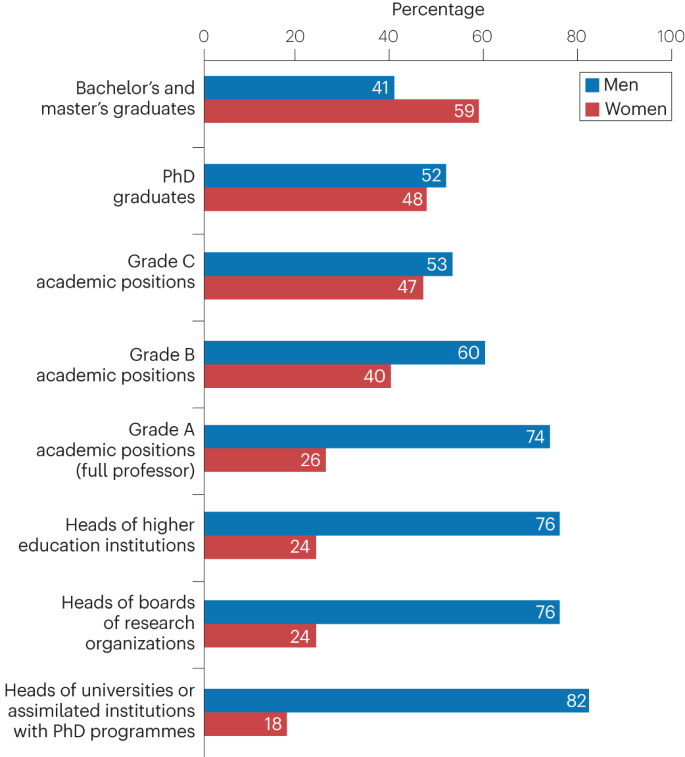
Proportion of women and men at different stages of the typical academic career trajectory. Data are 2021 cross-European Union data from ref. 3Full size image

High rates of female attrition are hardly surprising in light of research demonstrating the hostile workplace environments frequently encountered by early-career female academics (Supplementary Fig. 1). Sexual harassment — including sexual coercion, unwanted sexual attention and gender harassment — remains pervasive in academic workplaces, with rates trailing only behind those in the military. Higher education and research institution (HERI) environments are perceived as permissive environments because when targets report harassment, they are either ignored or retaliated against. Biased performance assessment and lack of acknowledgement of research contributions remain entrenched problems. Early-career academic women also experience a range of additional, more subtle forms of sexism, from microaggressions to patronization and paternalism, that downplay their capabilities, hinder their advancement and render their experience of academia isolating. The outcome is the severe attrition of female academics in whom substantial investment towards specialized education, training and career development has been made (Supplementary Fig. 2).

The cost of losing women at advanced career stages


As women progress to more advanced academic career stages, there is often an expectation of greater career stability. Yet the experience of hostile workplaces for academic women continues throughout their careers (Supplementary Fig. 1) and can even intensify after they have achieved tenure and/or substantial grant success.

Women at later career stages report being tasked with excessive service and experiencing a lack of supportive social networks, both of which may, in part, reflect their under-representation. Experiences of incivility, ostracism, online abuse, stalled promotions, academic sabotage, unequal or limited access to resources, malicious allegations, and sexual harassment and discrimination, however, imply more active mistreatment of women by their colleagues and superiors. Women also continue to contend with important double standards. They receive less recognition and fewer awards, and those awards granted to them are associated with less money, public attention and career advancement than those of male scholars7. Furthermore, behaviour viewed positively for male academic leaders — such as assertiveness — is viewed negatively for female ones. These problems are generally compounded when women’s under-representation is greater, with substantial backlash as women enter arenas in which male dominance is most entrenched.

These problems lead to the continued attrition of female scholars. Such departures can happen through burn out and voluntary departure. In more extreme cases, they can occur as a result of processes of demotion and dismissal when women are targeted with severe hostility, defamation and even institutional retaliation when they speak out about their experiences. Research suggests that after establishing their academic careers in STEM, women are two times more likely to leave compared with men. This low retention rate means that paradoxically, although we expect women to become more empowered over time, female precarity actually increases in later career stages. Given the sizeable public funding investment in many female academics by the time they have reached a late career stage (Supplementary Fig. 2), as well as the substantial accumulated scientific knowledge they possess, the drain represents a massive inefficiency within the higher education and research sector.

Compounding the economic losses of discriminatory science


Economic losses stemming from discriminatory science are especially harmful given that at all career stages, high-achieving women may be particularly targeted for incivility, harassment and take-down. Also facing exceptional impacts are women of colour and sexual- and gender-minority women. These trends compound direct economic losses since abundant research reveals that diverse teams produce better and more impactful science. Even when the cumulative hostilities do not push women entirely out of research and higher education, they nonetheless exact a physical, mental, financial and professional toll. The career obstruction women face has a broader toxic effect on academic culture, reducing productivity, education quality and research output, and lowering return on public investment. Sexism is not only bad for women, it is bad for science.

Securing value for money


The loss, misuse, obstruction and sabotage of female talent in academia represents a stunning drain on the public purse. Although research clearly demonstrates the role of organizational climate as the primary predictor of sexism in research and higher education, academic organizations have broadly failed to take the steps necessary to dismantle entrenched structural biases. Albeit becoming skilled at diversity rhetoric, their resistance to real change means that progress in tackling sexism has been frustratingly slow, and in some cases non-existent. Many HERIs have developed training and mentoring programmes that essentially place the onu s on women to change (by, for example, ‘leaning in’), ignoring mounting evidence that what is instead required is broad, system-level transformation.

Accordingly, it is time to overhaul systems that reward entrenched sexism with public funding, protect perpetrators of sexism, discrimination and harassment, and have a destructive effect on the advancement of science. Undertaking genuine systemic transformation will require academic stakeholders to commit to transparency and take responsibility for outcomes. Here we examine how this might translate into action and accountability for some of the key stakeholders in higher education and research.

At the first level are HERIs themselves. An ethos of transparency would require that HERIs annually collect and publish gender-disaggregated data pertaining to recruitment, appointment, pay, workload allocation, promotion, discrimination, harassment, misconduct, demotion, dismissal and departure. Equity metrics should become a critical measure of institutional performance. Responsibility for equity performance must lie with managers at all HERI levels, with ultimate responsibility at the top of the organization. These individuals should have responsibility for integrating gender equality into all processes and decisions made within an organization. In accordance with these principles, the Irish Higher Education Authority has recommended that demonstrable experience of leadership in advancing gender equality should become a condition for top level appointments within higher education institutions.

HERIs need to ensure that workload allocation models are transparent and monitored for gender bias. Transparency regarding resource distribution within HERIs is furthermore essential to reduce the power of informal networks and give women fairer access to such resources. Additionally, and perhaps critically, rates of hiring, promoting and retaining women need to become key measures of the success of HERIs. Linked to this, gender balance must be achieved across all levels of decision-making. An increasing number of organizations, including the European Parliament, recommend or require that decision-making bodies (and their chairs) consist of at least 40% women. Such approaches have been shown to work: Sweden introduced the statutory requirement that both male and female candidates be proposed when recruiting for the position of Vice Chancellor, and further that a gender-equitable recruitment policy be presented to the Swedish Government. By 2016, women accounted for 50% of the heads of higher education institutions in Sweden. But promotion must be balanced against retention; organizations that fail to support, mentor and retain women, simply replacing them with new hires when departure follows mistreatment or lack of support, must come under scrutiny.

At the next level is the government. As the primary funders of higher education and research, governments are responsible for the regulation of HERIs. Achieving gender equity will require that relevant national statutory bodies provide more effective oversight of HERI governance, monitoring implementation of equality policies, reviewing equality measures and ensuring compliance. Funding offers an essential tool for achieving real change. Government authorities can link funding to institutional performance in achieving gender equity, and withhold it when HERIs fail to meet agreed performance indicators and targets. In Norway and Sweden, specific gender equality requirements have been integrated into government legislation, providing opportunities for governments to sanction universities that do not fulfill institutional obligations for regular reporting of gender equality issues.

Issues of gender-based harassment require particular oversight. As HERIs globally compete for students, awards, recognition, funding and league table ranking, and operate increasingly within a corporate and neo-liberal environment, there is a strong incentive to avoid institutional damage when discrimination or harassment is reported, resulting in major potential for organizational minimization, silencing, collusion and retaliation. Organizations must deal openly and transparently with cases of discrimination and harassment, and ensure due protection of those affected, including whistleblowers, or face strong sanctions.

Research funding agencies offer an additional line of defence against sexism. With increased auditing of gender equity and bias, as well as the establishment of various accreditation programmes, it becomes possible to link gender-related performance with research funding. Such efforts have already been successfully implemented in the UK, where requirement of Silver level accreditation through the Athena SWAN gender equity programme for funding by the National Institute of Health and Care Research was influential in changing the gender equality landscape. Funding can also be used to empower grant recipients, by enabling full flexibility to move grants between HERIs, as well as by surveying grantholders, and enabling whistleblowers to report problems.

The high cost of sexism cannot continue to be ignored. With both problems and solutions clearly identified, there is little excuse not to act. It is now on stakeholders to take urgent measures to ensure the credibility of the research and higher education sector, to prevent the continued use of public funding to perpetuate sexism and harassment, and to start to demonstrate real value for money.

white

Earlier this month, climate scientist Daniel Swain described how he put his research on hold to answer journalists’ questions when wildfires engulfed California in 2020. He suggests that many others with relevant expertise would be prepared to do the same, but that a lack of support from institutions is holding them back.

Three-quarters of readers, both researchers and non-researchers, agreed that public engagement should be part of scientists’ responsibilities. Many cautioned that researchers shouldn’t be put under pressure: those who want to share their expertise should receive support and training, but it shouldn’t be mandatory.

Public engagement “should be compensated and incentivized in recruitment and career progression, rather than frowned upon or seen as yet another unpaid set of tasks over and above an already heavy workload”, adds environmental scientist Helen Avery.

“I would love it if my role didn’t need to exist,” says climate-science communicator Brian Barnes. “The countless scientists and researchers I have worked with have demonstrated that we desperately need dedicated science communication courses within any science based degree. The principles aren’t difficult but they are counter to what so many researchers are taught.”

Wednesday, October 11, 2023

beer

Пиво грозит стать менее вкусным и более дорогим. 

Виноват климат, говорят ученые


Глобальное потепление может сказаться на этом любимом напитке миллионов, потому что излишне теплая погода вредно влияет на содержание в хмеле так называемых альфа-кислот, которые и придают ему характерные аромат и горьковатый вкус.

Группа ученых из Чешской академии наук и Кембриджского университета сравнила метеорологические данные за прошлые годы с соответствующим процентным содержанием альфа-кислот в шишках хмеля, выросшего на полях Германии, Чехии и Словакии, и пришла к неутешительному выводу: если все так пойдет и дальше, то к 2050 году урожайность хмеля при худшем сценарии может снизиться на 18%, а содержание альфа-кислот – на треть.

В сухом остатке это означает, что пиво может стать не таким вкусным (если вы предпочитаете разновидности с горчинкой) и более дорогим.

Больше всего, кроме, конечно, потребителей, от подорожания и ухудшения качества хмеля пострадают небольшие пивоварни, производящие крафтовое пиво.

Для них комбинация шишек хмеля с различным содержанием альфа-кислот и разными ароматами является ключевым элементом бизнеса.

И если пивоваренные гиганты смогут как-то приспособиться к хмелевому дефициту, подождать, пока наука и фермеры не найдут путей выхода из этой ситуации или придумают какие-то замены, то для мини-производителей это может означать банкротство и закрытие пивоварни.

Подробнее читайте здесь

Tuesday, October 10, 2023

leaders in science

Страны-лидеры по числу научных статей на 100 тысяч жителей


Швейцария не только занимает первое место в Европе (и в мире) по числу научных статей на 100 тысяч жителей, но и делает это стабильно на протяжении уже 20 лет! Впечатляет!

Из интересного: за последние 20 лет заметно укрепили свои позиции Дания и Норвегия, несколько потеряли позиции - Сингапур, Швеция и Финляндия, а Великобритания скатилась с 5-ой строчки сразу на 15-ую!

Но при этом в целом топ-15 на диво стабилен!

исчадие ада в лидеры не входит, можно вздохнуть свободно :) 

science

Количество научных статей на 100 тысяч населения


По данным за 2020 год, российские учёные публиковали 63 научные статьи (учитываются только точные и естественные науки, не учитываются общественные, но с ними у нас всё ещё хуже, скорее всего) в пересчёте на 100 тысяч жителей страны. Это не худший результат в Европе: гораздо выше, чем в Албании (6!), Молдове (10) и ряде других бедных стран Восточной Европы.

Но и далеко не лучший! Сравните с 267 статьями на 100 жителей Швейцарии, 263 - в Дании, даже Сербия нас немного обгоняет!

Из интересного - во Франции, большой, богатой и развитой стране, публикуется меньше научных статей, чем в крошечной Мальте или небогатой Хорватии! Правда, с учётом общественных и гуманитарных областей результат её, скорее всего, стал бы заметно лучше

нет исчадия ада

Saturday, September 23, 2023

what do you need ?

Японские вузы отказываются от гуманитарных наук


Более двух десятков японских университетов объявили о сокращении или полном закрытии обучения по гуманитарным и социальным дисциплинам, сообщает Time. Это сделано после призыва властей страны сосредоточиться на преподавании дисциплин, которые «лучше всего соответствуют потребностям общества».

По данным мониторинга Times Higher Education, из 60 японских вузов 26 исполнят требование министра образования, прозвучавшее 8 июня. 17 университетов больше не будут набирать студентов на юридические и экономические специальности. Два университета – Токио и Киото – заявили, что не будут подчиняться требованиям правительства.

Решение правительства вызвало волну протестов в вузовской среде. «Ученые вносят вклад в создание интеллектуально и культурно обогащенного общества. Мы считаем нашей обязанностью создавать, увеличивать и передавать знания о природе, человеке и обществе», — говорится в заявлении Совета японских ученых.

Будет ли демография? Соответствует ли она?

Wednesday, September 13, 2023

migration in Arctica

Семинар "Цифровые следы и методы сетевого анализа в изучении арктической миграции"


Международная лаборатория исследований населения и здоровья приглашает принять участие в семинаре "Цифровые следы и методы сетевого анализа в изучении арктической миграции".


Смирнов Андрей Владимирович, кандидат экономических наук, старший научный сотрудник лаборатории демографии и социального управления Института социально-экономических и энергетических проблем Севера ФИЦ Коми НЦ УрО РАН (г. Сыктывкар).

Выступление посвящено использованию цифровых технологий в изучении миграции населения. В первой части доклада будут рассмотрены цифровые следы – информация о населении, которая накапливается в интернет-среде. Будет уделено внимание таким источникам данных о миграции, как социальные медиа, анализаторы поисковых запросов и сайты по продаже билетов. Вторая часть доклада будет сфокусирована на получении выводов из собранных данных с помощью методов сетевого анализа. Будет рассмотрен инструментарий для анализа и визуализации миграционных сетей, реализованный на языках программирования Python и Julia. С его помощью выявлены основные характеристики сетей миграции Арктической зоны Российской Федерации, миграционные хабы (крупнейшие узлы) и кластеры.

Рабочий язык: русский
Время проведения: 21 сентября в 15:00
Место проведения: Б. Трехсвятительский переулок, 3, ауд. 526

Регистрация на семинар по ссылке.

Если у Вас возникнут вопросы, пожалуйста, обращайтесь к менеджеру Вере Соколовой: vsokolova@hse.ru

Sunday, April 30, 2023

Microsyllabus: Anarchism

Compiled by Andrew Cornell

There was a period, about a decade ago, in the years surrounding Occupy Wall Street, when a variety of commentators asserted that anarchism had become the predominant ideological tendency within the U.S. Left. The resurgence of democratic socialism since 2016 suggests that was a brief window, yet anarchist styles of organizing and strategies of change continue to inform an array of contemporary movements, from Black Lives Matter to the Yellow Vest uprisings in France. The past twenty years have also seen a marked uptick in English-language scholarship on anarchism in disciplines ranging from philosophy to sociology, aided by interdisciplinary organizations such as the North American Anarchist Scholars Network and the UK’s Anarchist Studies Network. Anarchism is a political ideology and practice – some say “a way of life” – with mid-19th century origins that opposes all forms of social domination and promotes the values of equal liberty and mutual aid. The following microsyllabus is intended to help those relatively new to anarchism gain historical footing in this complex and often misunderstood political tradition.


Robert Graham, ed., Anarchism: A Documentary History of Libertarian Ideas, Volume One (Black Rose, 2005).


Broad historical overviews of anarchism, such as Peter Marshall’s Demanding the Impossible, often prove overwhelming or tedious to those getting their feet wet. Thankfully, the 19th and early 20th century anarchists tended to write in a punchy, straightforward style, equally accessible to the working people of their day and to curious activists and scholars in the 21st century. So, start by reading some primary sources in the first of Robert Graham’s three volume compendium, which covers what is often called anarchism’s “classical period” – the century ending in 1939. Graham’s editing skills are adroit – he includes the key sections of a huge range of texts, organized loosely chronologically, but grouped into themes, such as “Anarchy and Education” and “The Spanish Revolution.” Graham overcomes the tendency of previous anthologists to focus on a few European master theorists (e.g. Proudhon, Kropotkin), by including lesser-known writings by anarchist militants the world over, including dozens of entries from Latin America and Asia. Graham concludes the third volume of the collection with an original 100-page essay that succinctly, but quite comprehensively, summarizes the trajectory of anarchist ideas and activity up to the present, with call outs to the relevant excerpts. Use this as narrative guide as you pick your way through the collection. Alternately, watch Tancrède Ramonet’s fast-paced recent documentary film series, No God’s, No Masters, as you read.

Kirwin R. Shaffer, Black Flag Boricuas: Anarchism. Antiauthoritarianism, and the Left in Puerto Rico, 1897-1921 (University of Illinois Press, 2013).


This book, as well as Shaffer’s earlier work on Cuban anarchism, exemplifies many recent, positive developments in the field. He begins with a useful historiographic essay that criticizes previous generations of scholars for their Eurocentrism, construal of anarchism as irrational, and their narrow focus on labor politics. Shaffer rightly asserts, however, that “Studies of anarchist migration, anarchist activism in colonial settings, and anarchist cultural politics are central to emerging lines of inquiry into the history of global anarchism.” The ideology was just gaining a footing in Puerto Rico when the U.S. took possession of the island from Spain in 1898. In the following decades, anarchists were an important influence, among others, within the broader worker’s movement. Shaffer captures the confusions, compromises, and impurities of Puerto Rican anarchists as they navigated the complicated terrain of anti-colonialism, nationalism, and their relationship to not only the U.S. government, but also the American Federation of Labor and U.S. socialist organizations that intervened in local struggles. Experimenting with coalitions, anarchists on the island simultaneously forged alliances with feminists, “freethinking” liberal professionals, and “spiritists” to challenge the power of the Catholic church and patriarchal social relations. Like their counterparts elsewhere, they established educational centers that provided access to the international anarchist press, staged political plays, hosted speakers and hosted an alternative school for workers and their children. Tracking the ways anarchists moved between Puerto Rico, Spain, New York, Florida, and other Latin American destinations, Shaffer highlight the movement’s deeply transnational character while remaining attentive to the ways anarchists had to adapt to particular national cultures and legal frameworks.

Alice Wexler, Emma Goldman in America (Beacon, 1986).


Emma Goldman remains the best known, and most-studied anarchist in the history of the United States. A powerful orator, prolific essayist, and intrepid organizer, she popularized anarchist ideas among English-speaking audiences and built unique coalitions between the movement and middle-class feminists, civil libertarians, and avant-garde writers. New studies of her life and politics appear almost yearly. But I recommend starting with Wexler’s biography, which astutely places Goldman in her Gilded Age – Progressive Era context. Wexler writes beautifully, and strikes a useful balance in her coverage of Goldman’s political work and controversial intimate life, where some other scholars have tended to highlight one over the other. Those interested in Goldman’s experiences with the Russian Revolution and Spanish Civil War can move on to Wexler’s companion volume, Emma Goldman in Exile. However, to offset the impression that Goldman was the U.S. anarchist movement in the early 20th century, see Paul Avrich’s bountiful collection, Anarchist Voices: An Oral History of Anarchism in America.

Alan Antliff, ed., Only A Beginning: An Anarchist Anthology (Arsenal Pulp Press, 2004).


Anarchism experienced a global revival in the wake of the mass anti-system movements of the 1960s. Anarchist strategies, theories of power, and aesthetics evolved quickly in this period, but few histories have emerged yet to analyze these important developments. This edited collection, which documents the Canadian anarchist movement between 1976 and 2004, serves as an invaluable resource in this context. It’s a huge book – 400 9”x13” pages – richly illustrated with photographs and reproductions of pages from the anarchist press. Readers are first introduced to important periodicals, such as Open Road, Bevy of Anarcha-Feminists, and Kick It Over!, via short reflections by their former editors. Subsequent sections reprint material from these journals to highlight the issues anarchists of the period prioritized – indigenous sovereignty, mass incarceration, and ecology, among them – as well as the new tactics they developed and biggest actions they mounted. These ranged from squatting empty property, a firebombing campaign against weapons manufacturers, and mass blockades to resist corporate globalization. The book also documents the range of institutions and spaces, such as book fairs, free schools, and infoshops, that Canadian anarchists created during this period. Only a Beginning demonstrates that long before internet memes became an important mode of political discourse, anarchists combined text and repurposed images to powerful effect. (One striking page from 1991 frames a close up of a man with his jaw blown open with the words, “Going to the Gulf? See you when you get back!”) Antliff’s other work, which recovers anarchist ties to modernist art, is also highly recommended.

L.A. Kauffman, Direct Action: The Reinvention of Radicalism since the Sixties (Verso, 2016).


Understanding the impact of anarchism in recent decades requires one to think about the ways anarchists and their ideas have intertwined with broader egalitarian movements and other Left intellectual traditions. Kauffman’s book traces the use of nonviolent civil disobedience, consensus decision-making, and prefigurative politics (embodying the world you are seeking to win in the movement itself) within U.S. anti-war, feminist, queer, anti-nuclear, environmental, anti-corporate, and racial justice struggles. While not a study of anarchism per se, anarchists are explicitly named as key actors throughout the text, and readers will find uncanny connections to debates anarchists were staging as early as the 1870s. With an incredible economy of words, Kauffman illuminates the connections between movement organizations operating simultaneously, but typically studied in isolation, such as Earth First! and ACT-UP. She reveals the crucial roles that lesbian activists have played in forming, maintaining, and linking these efforts, and traces the slow processes by which white activists integrated antiracist principles into their work, and activists of color re-embraced direct-action strategies after making defining contributions to the tradition in the 1950s and ‘60s. Pair Kauffman’s history with a few chapters of Chris Dixon’s Another Politics: Talking Across Today’s Transformative Movements. Dixon combines historical analysis and interviews with dozens of activists to describe the ways a “reconfigured anarchism” has dovetailed with Zapatismo, women of color feminism, and prison abolitionist politics to create a broader “anti-authoritarian current” vital to radical change efforts in United States and Canada in recent decades.

Jesse Cohn, Underground Passages: Anarchist Resistance Culture, 1848-2011 (AK Press, 2015).


Cohn is a literary scholar and translator, rather than a historian, but this path-breaking book will prove foundational to anyone looking to study the history of anarchist cultural production. Drawing from scholarship published in four languages and literary works translated from many more, Cohn surveys the diversity and coherency of anarchist cultural production across four continents and more than 160 years. Poetry, music, fiction, film, comics, and magazine illustrations are each investigated in turn. Taking a cultural studies approach, the author investigates the modes of production, circulation, and consumption of this material, as well as common themes and formal qualities. Cohn argues that while anarchist artists hoped to change the minds of non-anarchist audiences, their work often served a different function: helping anarchists survive the contradictions of living in a world organized almost entirely in contradiction to their values and desires. Highlights include his analysis of the transformation of anarchist poetic forms in the mid-20th century and fascinating short chapter on early 20th century anarchist anti-colonial literary strategies. Cohn’s book suggests both the scope of anarchist history and linkages between the studies suggested above. You’ll be well positioned – and hopefully inspired – to dive into the intellectual, movement, and cultural history of anarchism in the specific periods and locales you find most fascinating after imbibing these crucial gateway texts.

AUTHOR BIO


Andrew Cornell is a precariously employed scholar and organizer currently teaching at Williams College. He is the author of Unruly Equality: U.S. Anarchism in the 20th Century (University of California Press, 2016), a book that tracks the ways anarchists related to the Great Depression, atomic warfare, the Black freedom movement, and other key developments of the mid-20th century, explaining how their movement evolved as a result. His work also includes Oppose and Propose! Lessons from Movement for a New Society (AK Press, 2011) and the essay “Occupy Wall Street and Consensus Decision Making: Historicizing the Preoccupation with Process.”

Tuesday, April 25, 2023

Is Anti-Immigrant Sentiment Owned by the Political Right

European Studies, Postsocialism, Migration Studies,Politics of Knowledge, Anti-Immigrant Attitudes
https://doi.org/10.1177/00380385231161206
Publication Date: 2023 | Publication Name: Sociology

In political and social scientific discourses, the link between right-wing political orientation and anti-immigrant sentiment is often presented as a universal social fact. Based on a systematic examination of the association between left-right political orientation and attitudes towards migrants, the article demonstrates a clear inconsistency in the strength and direction of this presumed association in postsocialist European countries. We provide two analytical explanations for this inconsistency. The first challenges the western-centric idea that people leaning towards the political right tend to hold conservative views that shape their tendency to express antiimmigrant sentiment. The second explanation pertains to the limited relevance of the left-right political orientation scale for postsocialist subjects, making it difficult to attribute anti-immigrant sentiment to specific political orientations. In conclusion, we discuss specific social identities of the holders of hostile attitudes towards outsiders in postsocialist Central and Eastern Europe, which western-centric analytical models do not capture.

Monday, April 17, 2023

People ageing without children or family out of sight, out of mind

In the Western world, childlessness affects one in four men and one in five women. In the UK the numbers of people ageing without children aged over 65 years is projected to rise to above 2 million by 2030. Although precarity in ageing is increasingly recognised in academia, people ageing without children are not acknowledged as a group and dismissed as a ‘non-category.’ This means they are in danger of being invisible to academia, policymakers and other institutional stakeholders.

бездетность бывает разная (по причинам), картинка от туда.

Шоп перейти — в кортаинко тыц.

Saturday, March 18, 2023

Where Students Choose STEM Degrees

Graduates in the fields of science, technology, engineering and mathematics - STEM for short - are sought after globally, but are often in short supply. Many countries have tried to bolster enrollment in STEM to aid important growth industries like medtech, digital services, mobility or computer sciences. However, countries have had varying success in the matter.

According to numbers collected by the UNESCO Institute for Statistics, tertiary students in Malaysia and Tunisia are among the most likely to graduate in a STEM field, with between 43.5 and almost 40 percent of students there receiving a respective degree, out of all countries where recent data was available. India, with a still high share of 34 percent of students picking STEM, is however producing the most graduates in total in the field due to its population of around 1.4 billion people - the largest in the world.

UNESCO did not publish data for China. In 2016, the World Economic Forum said that China actually produced 4.7 million STEM graduates a year, which would actually exceed India’s number. Yet, according to the National Science Foundation, China classifies engineering and science fields quite broadly, leading to a lack of comparability in the data. The U.S. government agency counted 1.6 million Chinese science and engineering graduates in 2014, which would be fewer than Indian graduates.

Other countries with a strong showing of STEM graduates are the United Arab Emirates, Germany, Belarus and South Korea – all producing more than 30 percent STEM graduates. In general, countries that have managed to produce a higher share of STEM graduates than elsewhere are more likely to be found in the Arab world, in Eastern Europe and also in East Asia. After Tunisia, the share of STEM degree recipients is also upwards of 29% in Algeria, Mauretania and Morocco, all due to the prevalence of computer engineering in the region. The Arab Gulf - a place that has recently been pushing to innovate its economies - is producing an above-average number of STEM grads in some places, namely the UAE and Oman.

With the exception of Germany, Western Europe is not a STEM hotbed, however. Only 26 percent of UK graduates come from STEM courses, as do 25 percent in France and 23 percent in Spain. Even fewer graduate in the Americas, with shares of 19.6 percent and 17.5 percent in the U.S. and Brazil, respectively.Where Students Choose STEM Degrees
РБ таки вхолит в топ-5, но по доле 

Thursday, December 22, 2022

transdisciplinarity

trans — это модно, не то, что интер — почуйствуй разницу


This discussion paper aims at presenting the theoretical roots of the transdisciplinary research mode, which is widely used today to address societally relevant research questions. We offer an overview of the literature, the facets that need to be observed and taken into account when research is designed in a transdisciplinary way, and the problems and limitations of this holistic approach. We illustrate how results are generated in transdisciplinary research projects, mainly using the concept of co-creation, which means expanding the expert network to engage practitioners, citizens, or other stakeholders in the research process. We provide an overview of the most popular tools and methods. In the remaining part, we present best practice examples for transdisciplinary research to assess common features of success. We collect a number of approaches for stakeholder engagement and policy advice, not neglecting the challenges such an approach entails. Throughout the manuscript, contributions from eminent scholars in the field of transdisciplinary research offer valuable insights on key topics.

Kluge, Fanny A. (2022). Transdisciplinarity. A Research Mode for Real-World Problems. Discussion Paper No. 16, Berlin: Max Planck Society/Population Europe.
Editor:
Fanny A. Kluge
Author(s): Kluge

Sunday, December 11, 2022

A Demographer in Spite of Himself

The Migrant's Destiny of Miron Kantorowicz (Myron K. Gordon)


This paper is devoted to the scholarly career of Miron Kantorowicz (1895 - after 1977), the German-educated Russian-Jewish refugee. Kantorowicz spent fifteen years, from 1919 to 1934, in Berlin. He is best known in contemporary Germany as “Alfred Grotjahn’s librarian”, as he was a long-time assistant to Grotjahn, the founder of social hygiene, and his name is often mentioned among scholars expelled by the Nazis from Berlin University. However, Kantorowicz’s scholarly career and contributions to demography after his flight from Germany to England and his subsequent emigration to the United States are much less studied and understood. One of the reasons is that he changed his name several times. In June 1934 he immigrated to Great Britain with a provisional visa. The spelling of his family name in this country was changed to Kantorowitsch and his publications were accordingly credited. In London, he found temporary work as a statistician at the Jewish Health Organisation of Great Britain (JHOGB), where his good knowledge of general British population statistics and his previous interest in Jewish demography were combined and properly utilized. In 1936, Kantorowicz published two seminal articles resulting from the reports he had prepared for JHOGB. His findings were highly acclaimed by later generations of demographers of Anglo-Jewry. Later, in the course of his migrations, he became a co-founder of American demographic Sovietology. When he became a U.S. citizen, he finally settled on the name Myron K. Gordon. The paper shows how Kantorowitz’s scholarly career was re-molded in the course of successive migrations.

Wednesday, September 21, 2022

murder and suicide

2019, Социологические исследования
https://doi.org/10.31857/S013216250003753-1
Publication Date: 2019

Уровни смертности от убийств и самоубийств – индикатор благополучия общества и ценности человеческой жизни. После 2000-х гг. в России они демонстрируют уверенное снижение. Однако другой блок причин смерти, повреждения с неопределенными намерениями, являющийся резервуаром латентных убийств и самоубийств, стремительно растет и с 2014 г. превышает совокупный уровень смертности от убийств и самоубийств. В результате фактические данные об убийствах и самоубийствах оказываются недооцененными. Ситуация усугубляется, поскольку региональные практики кодирования причин смерти могут в значительной степени деформировать структуру смертности, отчего недостаточно простого пропорционального перераспределения повреждений с неопределенными намерениями внутри класса «Внешние причины заболеваемости и смертности» МКБ-10. Цель данной работы – оценить реальный уровень смертности от убийств и самоубийств с использованием модельного региона, в котором доля повреждений с неопределенными намерениями минимальна. Предложен алгоритм, позволяющий существенно уточнить решение задачи. Для отдельных регионов в зависимости от принятой гипотезы перераспределения повреждений с неопределенными намерениями продемонстрирован значимый недоучет конкретных причин смерти.