Raquel Wojnar
Communications Manager
How can South Korea address the causes and consequences of its record-low fertility rates? Its leaders must first untangle some deep-rooted cultural issues around gender, argues PRB President and CEO Jennifer D. Sciubba.
“Korea should acknowledge that its population issues are primarily gender issues,” Sciubba said. “Leaders in the public and private sectors seem to fully accept this idea, but they say the broader public isn’t on board. So, what to do?”
Sciubba addressed Korea’s low fertility on June 19 during her remarks at the 15th EDAILY Strategy Forum in Seoul, which brought together policymakers, business leaders, and researchers to discuss the country’s demographic future. She spoke alongside former Prime Minister of Finland Esko Aho and Ha-nam Bang, South Korea’s former Minister of Employment and Labor.
In June, South Korean President Yoon Suk Yeol declared a “national emergency” over the country’s plummeting birth rates and a shrinking population. The country has had the world’s lowest fertility rate for years; the average woman has 0.72 children, and South Korea sees more deaths than births each year, leading to population declines.
Over the years, the government has used various incentives to try to encourage young people to have children. While Yoon is creating a new government ministry, tentatively called the Ministry of Population Strategy and Planning, to address its demographic challenges, some new policies continue to paint low fertility as an economic issue and thus are unlikely to move the needle, Sciubba said.
The government has cited high housing prices, education costs, and long working hours as factors contributing to the low fertility rate. But a growing number of Korean women are eschewing dating, marriage and childbirth, citing pervasive sexism and chauvinism in Korean culture.
But cultures do change, Sciubba noted. “South Korea’s leaders successfully corrected the country’s egregious gender imbalance at birth in less than a generation by reforming patriarchal laws, trumping cultural practices,” she said. Some of Yoon’s new measures address inequalities between men and women—for example, aiming to increase uptake of paternity leave, now at 6.8%, to 50%, and implementing flexible working hours. But Sciubba worries the government won’t be able to enforce such policies without putting undue pressure on businesses.
Describing low fertility as a national emergency is a way to mobilize resources but risks putting undue pressure on couples, particularly women, to have more babies as the primary solution to the country’s shifting demographics instead of focusing on broader issues with work, caregiving, and gender equity, Sciubba added.
South Korea is not alone in experiencing low fertility and depopulation—the UN reports that 63 countries and areas have already passed peak population, and fertility in the United States is at a historic low. The question many world leaders should now be asking is how to plan for the strain that an aging and shrinking society puts on the care economy and the workforce, Sciubba says. PRB recently explored how the United States could develop policies to address its care worker shortage and promote gender equity in care work. Meanwhile, countries on the other side of the demographic divide must take steps to capitalize on a booming working-age population, Sciubba said; PRB and partner CREG will dive into this issue with leaders from Burkina Faso, Gambia, Mali, Senegal, and Togo in a public event on August 6
Showing posts with label кризис. Show all posts
Thursday, October 10, 2024
Friday, September 13, 2024
The crisis-driven shifts of Venezuelan migration patterns
September 12, 2024 Jenny Garcia Arias
![]() |
The Venezuelan exodus stands as the largest displacement in recent Latin American history, with around 22.5% of the population now living abroad. Drawing on data from seven of the main destination countries for Venezuelans, Jenny Garcia estimates the demographics of recent outflows, the chronology of associated changes, and the implications for those remaining in the country.
When a crisis occurs, demographic patterns can shift dramatically, leading to rapid changes in outward migration and local population compositions. As the crisis progresses, the likelihood of migration varies across individuals, influenced by the evolving costs and benefits of this choice. Accurately assessing population at risk is crucial for understanding levels and trends in demographic phenomena, and precise age and gender estimates are essential for evaluating the full impact of the ongoing crisis on both migrants and the remaining population.
The Venezuelan crisis
The recent Venezuelan migration crisis exemplifies how socio-economic and political instability can precipitate significant demographic shifts. The situation in Venezuela, formerly a destination for migrants, has undergone a dramatic reversal, resulting in one of the largest population exoduses in recent history, and the largest in recent Latin American history. According to the Inter-Agency Coordination Platform for Refugees and Migrants from Venezuela (R4V), as of June 2024, 7.7 million Venezuelans are living abroad, constituting approximately 22.5% of the estimated population (R4V, 2024).
The roots of the Venezuelan migration crisis are deeply embedded in the country’s economic collapse. A pivotal moment occurred in 2015, following the decline in oil prices that plunged Venezuela into a profound recession. The period from 2018 to 2019 was especially devastating, marked by hyperinflation, above 65%, and a 35% contraction in GDP. These economic adversities were compounded by extreme poverty, with 75% of the population living in severe hardship and nearly 90% of households unable to meet basic food needs (ENCOVI, 2022). The deteriorating quality of life, characterized by rampant crime, food scarcity, and human rights violations, forced many Venezuelans to flee.
Current research on Venezuelan migrants focuses on analyses conducted in receiving countries, and most estimates have highlighted the fluctuating size of the emigrant population throughout the crisis. However, there is limited understanding of the demographic characteristics of these crisis-driven outflows. This gap in knowledge is primarily attributed to the lack of available data, as Venezuela does not maintain emigration records, and data collection practices differ across receiving countries.
In a recent study (Garcia Arias, 2024) I explored the demographic dynamics of the emigrant Venezuelan population by estimating annual age and gender-specific outflows between 2011 and 2021 and summarizing the demographic implications for both emigrants and those remaining in the country. To do this, I exploited data from seven major destination countries, accounting for approximately 90% of the Venezuelan-born population residing abroad as of April 2022. The data sources included administrative records, population censuses, migrant surveys, continuous household surveys, and population registries.
The changing demography of outflows
In the 1990s, the number of Venezuelans living abroad was slightly over 185,000, increasing to 317,000 by 2000 and approximately 560,000 by 2010 (UN DESA 2020). These emigrants were predominantly members of Venezuela’s middle and upper classes, including businesspeople, highly skilled professionals—especially former oil industry employees—and first or second-generation descendants of immigrants to Venezuela. Their primary destinations included the United States, Spain, Italy, and Portugal (Freitez 2011). These outflows were predominantly female (55%), with a mean age of about 28.2 years.
Three key phases have since marked the crisis-induced changes in the demographics of Venezuelan emigration:
1) The onset of the crisis (2014-2017) marked a shift from highly skilled labor migration to family migration. The Venezuelan diaspora increased from 800,000 nationals abroad in 2014 to 2 million in 2017. The average age of these additional 1.21 million migrants dropped to its lowest level in 2015 (24.9 years for men and 25.4 years for women), and about 26% were under 15 years of age. These outflows largely consisted of entire families, often binational, seeking nearby destinations. Countries such as Colombia, Chile, Peru, and Ecuador emerged as primary destinations for Venezuelans. The incipient crisis also prompted a large number of young men to migrate; for the first time, the number of migrating men surpassed that of women (102 men per 100 women).
2) Acute phase of the crisis (2018-2020): During this period, 3.52 million Venezuelans left the country. Adults aged 20 to 45 constituted 54% of outflows, with women outnumbering men (95 men per 100 women). Only 18% of emigrants were under 15 years old. This phase was marked by a large portion of young women traveling alone. Migration patterns diversified, with an increasing number of middle- and lower-income individuals among outflows. People from across the entire country migrated; medium-sized and small towns replaced the historical role of the major cities as the main sources of migrants (ENCOVI 2022).
3) Impact of the COVID-19 pandemic (2021): The pandemic influenced migration trends, with continued, albeit reduced, emigration driven by family reunification. The proportion of older adults over 55 years, particularly women, among total outflows increased from 5% (2014-2017) to 12%. Additionally, Venezuelan migrants previously settled in southern countries of the American continent started redirecting their destinations towards the north.

By 2021, 63.6% of Venezuelans living abroad were between 15 and 45 years old, 16.1% were under 15 years old, and the remaining 20.3% were aged 46 years or older. Among this population, 49% were men and 51% were women.
The demography of those who remain
The mass emigration from Venezuela has profound implications for those who remain. The migration-induced changes have resulted in an 18% loss of the population aged 15 to 64 and a 20% loss of women of reproductive age (15 to 49 years). Consequently, the proportion of the elderly population (65 years or older) is 10% larger than it would otherwise have been. Furthermore, the large-scale emigration of women of reproductive age has led to a cumulative birth deficit since 2014 exceeding 500,000, equivalent to about a year without births in the country.

The repercussions of outmigration will extend beyond a mere reduction in the working-age population and accelerated population aging in coming years; the future functionality of Venezuela’s labor market is also profoundly affected. At the micro level, families left behind face additional challenges, including increased caregiving responsibilities.
The demographic characteristics of this crisis-driven migration, coupled with its prolonged duration, significantly reduce the likelihood of substantial return migration in the coming years. This situation is further compounded by the widespread lack of confidence in national institutions and political freedoms. To date, only negligible return migration has been reported, and when it does occur, it often serves as a strategy to redirect migration toward another destination. Thus, migration has surpassed both fertility and mortality as the primary driver of demographic change in Venezuela.

References
- Garcia Arias, J. (2024), The Demography of Crisis-Driven Outflows from Venezuela. Population and Development Review. https://doi.org/10.1111/padr.12651
- Encuesta de Condiciones de Vida- ENCOVI. 2022. “Informe de resultados.” Caracas: UCAB-Universidad Católica Andrés Bello.
- Freitez, A. 2011. “La emigración desde Venezuela durante la última década.” Temas De Coyuntura, 63 (January): 11–38.
- R4V. 2024. Coordination platform for refugees and migrants from Venezuela.
- United Nations (2020). International Migrant Stock 2020: Highlights. New York. Department of Economic and Social Affairs. Population Division.
Wednesday, April 26, 2023
Crisis Over? Small Banks Stop the Bleeding After Deposit Run
Last month, as news of Silicon Valley Bank’s imminent collapse spread like wildfire, so did the fear that other banks could fall like dominoes, resulting in a run on deposits, especially at smaller banks. In the week ended March 15 – SVB had collapsed on March 10 – deposits at small U.S. banks, i.e. those outside the top 25 in terms of domestic assets, declined by a record-breaking $192 billion, while large banks initially benefited from the panic, gaining $67 billion in deposits that week. Overall, commercial banks in the U.S., including U.S. branches of foreign banks, saw deposits decline by $170 billion in the week ended March 15, as fears of a broader banking crisis were still imminent.
Despite the Fed and the FDIC stepping in quickly and decisively to contain the damage, making customers of failed SVB and Signature Bank whole and promising additional liquidity to other banks struggling to keep up with withdrawal requests, the deposit flight from U.S. banks continued the following week, as Credit Suisse’s collapse further rattled confidence in the banking sector. According to the Fed, U.S. commercial banks lost $172 billion in deposits in the week ended March 22, as large, small and non-U.S. banks saw deposits decline by $90, $40 and $42 billion that week, respectively.
Since then, things have calmed down notably though, and, in the absence of further bank failures, confidence in the financial system is slowly returning. As the following chart shows, small banks have managed to stop the bleeding in recent weeks, with deposits even increasing in two of the past three weeks. There remain some doubts about the banking system’s health, however, as U.S. banks still sit on a large pile of unrealized losses that could come back to haunt them if they ran into liquidity issues in the future.
Despite the Fed and the FDIC stepping in quickly and decisively to contain the damage, making customers of failed SVB and Signature Bank whole and promising additional liquidity to other banks struggling to keep up with withdrawal requests, the deposit flight from U.S. banks continued the following week, as Credit Suisse’s collapse further rattled confidence in the banking sector. According to the Fed, U.S. commercial banks lost $172 billion in deposits in the week ended March 22, as large, small and non-U.S. banks saw deposits decline by $90, $40 and $42 billion that week, respectively.
Since then, things have calmed down notably though, and, in the absence of further bank failures, confidence in the financial system is slowly returning. As the following chart shows, small banks have managed to stop the bleeding in recent weeks, with deposits even increasing in two of the past three weeks. There remain some doubts about the banking system’s health, however, as U.S. banks still sit on a large pile of unrealized losses that could come back to haunt them if they ran into liquidity issues in the future.
Tuesday, March 21, 2023
bank crisis, The Long Demise of Credit Suisse
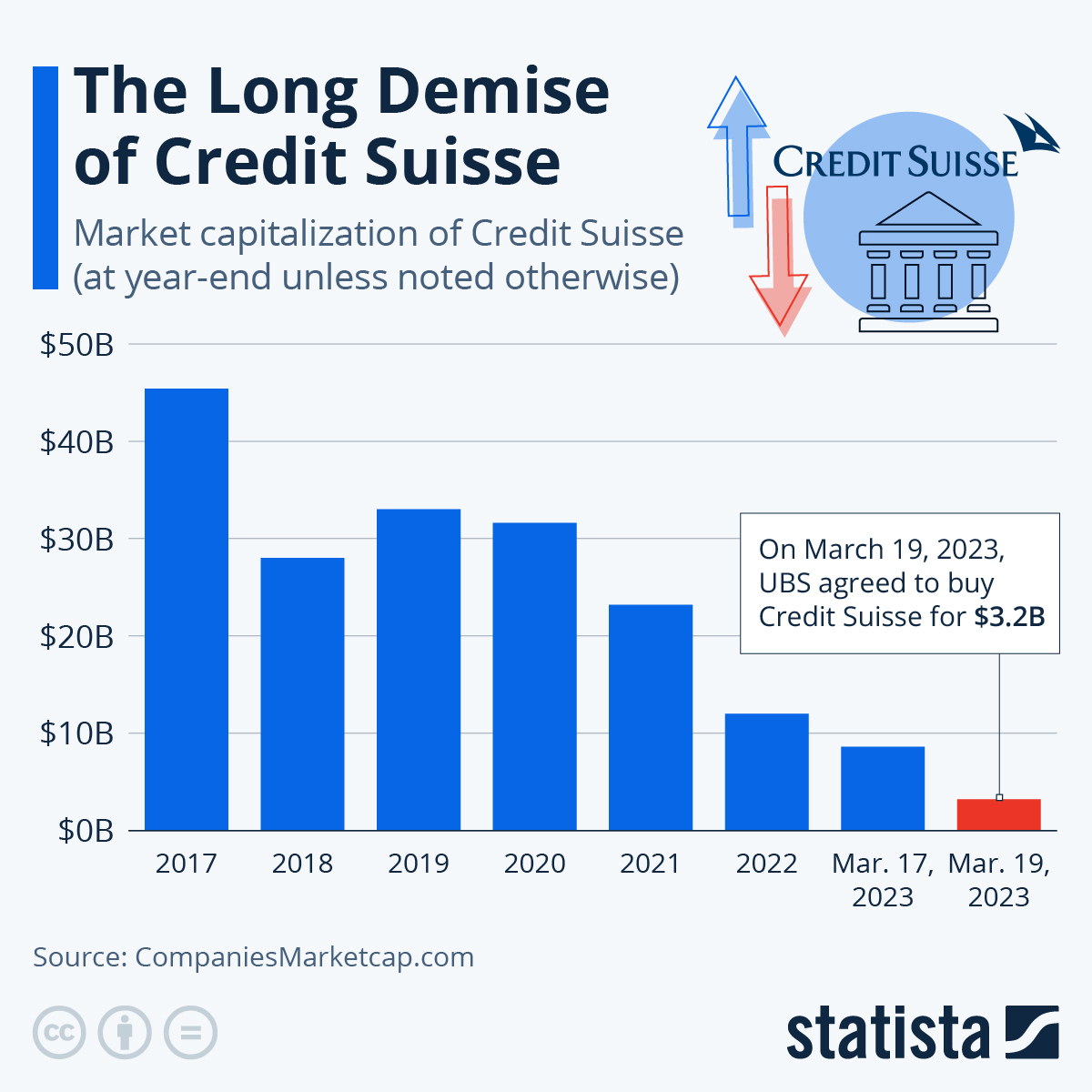
Little more than a week after the collapse of Silicon Valley Bank, the banking crisis has officially made its way across the Atlantic. In a deal hastily brokered by regulators, Switzerland’s largest bank UBS agreed to buy its longtime rival Credit Suisse for about $3.2 billion on Sunday, after the latter had found itself under severe pressure last week.
The deal, priced a staggering 60 percent below Credit Suisse’s market capitalization at Friday’s market close, marks the end of the 166-year-old institution and cements UBS’s status as the largest Swiss bank and one of the largest financial institutions in Europe. While not directly linked to the collapse of SVB and Signature Bank, Credit Suisse ultimately fell victim to the acute loss of confidence in the banking system, which turned the bank’s latest annual report into a giant red flag for clients and investors.
In the report published last Tuesday, the Zurich-based banking group not only acknowledged “material weakness” in its financial reporting, but it also posted a $7.9 billion loss for 2022 and confirmed substantial outflows of deposits and other assets under management that “have exacerbated and may continue to exacerbate” liquidity risks. Against the backdrop of the U.S. banking crisis, it’s no surprise that clients and shareholders were equally spooked, sending the bank’s stock price tumbling. By the end of week, it was down another 25 percent after having plummeted almost 70 percent in 2022.
Having been involved in a series of scandals and catastrophic deals in recent years, Credit Suisse has been on a downward trajectory for a while, seeing its market capitalization drop from $45 billion in 2017 to $12 billion by the end of last year. The bank’s acquisition by UBS marks the end of that development and what UBS Chairman Colm Kelleher called “an emergency rescue”.
The deal, priced a staggering 60 percent below Credit Suisse’s market capitalization at Friday’s market close, marks the end of the 166-year-old institution and cements UBS’s status as the largest Swiss bank and one of the largest financial institutions in Europe. While not directly linked to the collapse of SVB and Signature Bank, Credit Suisse ultimately fell victim to the acute loss of confidence in the banking system, which turned the bank’s latest annual report into a giant red flag for clients and investors.
In the report published last Tuesday, the Zurich-based banking group not only acknowledged “material weakness” in its financial reporting, but it also posted a $7.9 billion loss for 2022 and confirmed substantial outflows of deposits and other assets under management that “have exacerbated and may continue to exacerbate” liquidity risks. Against the backdrop of the U.S. banking crisis, it’s no surprise that clients and shareholders were equally spooked, sending the bank’s stock price tumbling. By the end of week, it was down another 25 percent after having plummeted almost 70 percent in 2022.
Having been involved in a series of scandals and catastrophic deals in recent years, Credit Suisse has been on a downward trajectory for a while, seeing its market capitalization drop from $45 billion in 2017 to $12 billion by the end of last year. The bank’s acquisition by UBS marks the end of that development and what UBS Chairman Colm Kelleher called “an emergency rescue”.
Tuesday, September 20, 2022
The U.S. Has a Jails Suicide Crisis
Suicide is one of the leading causes of death in jails in the United States, with a rate more than three times higher to that of the general public, according to the latest available data from the U.S. Bureau of Justice Statistics (BJS). As our chart shows, there is also a disparity between jails and federal or state prisons. In the U.S, a jail is where people are held before they are sentenced in court. It is also a place where people are sent after receiving a sentence, usually for lighter crimes. A prison is where people go to carry out longer sentences.
The gap in suicide rates comes down to a number of reasons. In a state prison, officials have more detailed information when trying to assess inmates for suicide risks and there is greater focus on educational programmes. By comparison, jails are considered to have worse conditions, uncertainty over pending sentences, and according to reporting in NPR, are more likely to receive first-time offenders who might experience a traumatic “shock of confinement”, as they are suddenly cut off from social support.
Leah Wang of The Prison Policy Initiative writes that the increase of suicides in jails can also be mapped onto the rising number of women being incarcerated, often in rural, smaller jails. She adds that mental health issues and drug or alcohol disorders are significantly more likely among this group, although often not identified at the time, and that jails' policies do not reflect the needs of women. Wang writes: “Jails are shameful replacements for key social and medical services, and too often low-level offenses are used to justify locking people up, out of sight, when they simply need help.”
As our chart shows, the suicide gap goes back at least two decades - when BJS reports on the topic first began - and is getting worse. And where federal and state prisons have had historically lower suicide rates than jails, their rates have been climbing in recent years too.
Delays with data reporting mean we do not yet have the numbers on jail and prison suicides from 2020 to 2022. These will likely be impacted by the pandemic, whether through fears of the virus itself, the trauma of losing loved ones and fellow inmates, limited visiting times or with staffing shortages making it hard to monitor inmates.
The gap in suicide rates comes down to a number of reasons. In a state prison, officials have more detailed information when trying to assess inmates for suicide risks and there is greater focus on educational programmes. By comparison, jails are considered to have worse conditions, uncertainty over pending sentences, and according to reporting in NPR, are more likely to receive first-time offenders who might experience a traumatic “shock of confinement”, as they are suddenly cut off from social support.
Leah Wang of The Prison Policy Initiative writes that the increase of suicides in jails can also be mapped onto the rising number of women being incarcerated, often in rural, smaller jails. She adds that mental health issues and drug or alcohol disorders are significantly more likely among this group, although often not identified at the time, and that jails' policies do not reflect the needs of women. Wang writes: “Jails are shameful replacements for key social and medical services, and too often low-level offenses are used to justify locking people up, out of sight, when they simply need help.”
As our chart shows, the suicide gap goes back at least two decades - when BJS reports on the topic first began - and is getting worse. And where federal and state prisons have had historically lower suicide rates than jails, their rates have been climbing in recent years too.
Delays with data reporting mean we do not yet have the numbers on jail and prison suicides from 2020 to 2022. These will likely be impacted by the pandemic, whether through fears of the virus itself, the trauma of losing loved ones and fellow inmates, limited visiting times or with staffing shortages making it hard to monitor inmates.
Thursday, March 24, 2022
auto parts and cosmetics
Мужчины скупают автозапчасти, женщины — косметику: россияне поделились списками антикризисных закупок
В последние дни каждый четвертый россиянин, ожидая повышения цен и исчезновения из магазинов некоторых товаров, делал покупки впрок. Чаще всего запасаются бакалеей. В опросах сервиса по поиску высокооплачиваемой работы SuperJob приняли участие 3000 представителей экономически активного населения из всех округов страны.
Опасаясь роста цен и проблем с поставками в условиях санкций, закупки «на будущее» в последние дни делал каждый четвертый россиянин (25%). Напротив, 75% не покупали ничего впрок. Чаще всего респонденты объясняют это нежеланием поддаваться панике: «Еще коронавирусную гречку не доели».
Закупать товары в кризисной ситуации больше всего свойственно респондентам старше 45 лет (27%). Реже всего так поступают россияне с доходом свыше 80 тыс. руб. (21%).
Что именно чаще всего приобретали россияне в последние дни? Крупы, макароны, масло, сахар, соль, чай, кофе, муку и другую бакалею купили 44% опрошенных. Бытовой химией запаслись 16%, предметами личной гигиены — 14%, всеми привычными продуктами — 12%. Каждый десятый (10%) купил лекарства. В том, что покупали впрок все подряд, признались 8% респондентов. По 5% закупили консервы и товары для животных, 4% обновили одежду и обувь, по 3% сходили в магазин за электроникой и бытовой техникой, автозапчастями и косметикой.
Скупать в панике все подряд и заготавливать впрок все привычные семье продукты больше свойственно мужчинам: они сообщали об этом вдвое чаще женщин. Женщины чаще покупают бакалею, бытовую химию, предметы гигиены, лекарства и товары для животных. Тех, кто запасает автозапчасти и расходные материалы для авто, больше среди представителей сильного пола, а тех, кто сделал «заначку» косметики, — среди женщин.
Место проведения опроса: Россия, все округа
Населенных пунктов: 588
Время проведения: 15—22 марта 2021 года
Исследуемая совокупность: экономически активное население России старше 18 лет
Размер выборки: 3000 респондентов
Опасаясь роста цен и проблем с поставками в условиях санкций, закупки «на будущее» в последние дни делал каждый четвертый россиянин (25%). Напротив, 75% не покупали ничего впрок. Чаще всего респонденты объясняют это нежеланием поддаваться панике: «Еще коронавирусную гречку не доели».
Закупать товары в кризисной ситуации больше всего свойственно респондентам старше 45 лет (27%). Реже всего так поступают россияне с доходом свыше 80 тыс. руб. (21%).
Что именно чаще всего приобретали россияне в последние дни? Крупы, макароны, масло, сахар, соль, чай, кофе, муку и другую бакалею купили 44% опрошенных. Бытовой химией запаслись 16%, предметами личной гигиены — 14%, всеми привычными продуктами — 12%. Каждый десятый (10%) купил лекарства. В том, что покупали впрок все подряд, признались 8% респондентов. По 5% закупили консервы и товары для животных, 4% обновили одежду и обувь, по 3% сходили в магазин за электроникой и бытовой техникой, автозапчастями и косметикой.
Скупать в панике все подряд и заготавливать впрок все привычные семье продукты больше свойственно мужчинам: они сообщали об этом вдвое чаще женщин. Женщины чаще покупают бакалею, бытовую химию, предметы гигиены, лекарства и товары для животных. Тех, кто запасает автозапчасти и расходные материалы для авто, больше среди представителей сильного пола, а тех, кто сделал «заначку» косметики, — среди женщин.
Место проведения опроса: Россия, все округа
Населенных пунктов: 588
Время проведения: 15—22 марта 2021 года
Исследуемая совокупность: экономически активное население России старше 18 лет
Размер выборки: 3000 респондентов
Monday, February 7, 2022
Ukraine: The Crisis on the Verge of Catastrophe
Since Russia annexed Crimea and Sevastopol from Ukraine in 2014, military conflict between the self-declared Donetsk and Luhansk Republics, supported by Russia, and the Ukrainian government have held the East of the country in a state of crisis. As the UN's Office for the Coordination of Humanitarian Affairs (OCHA) summarized in a February 2021 report: "The continuing conflict and the prevailing absence of a political solution have taken a heavy toll on the lives of millions of ordinary Ukrainians living on both sides of the “contact line”. It has also severed previously interdependent networks of services and markets and cut people off from the cities upon which they depended for social benefits and essential services."
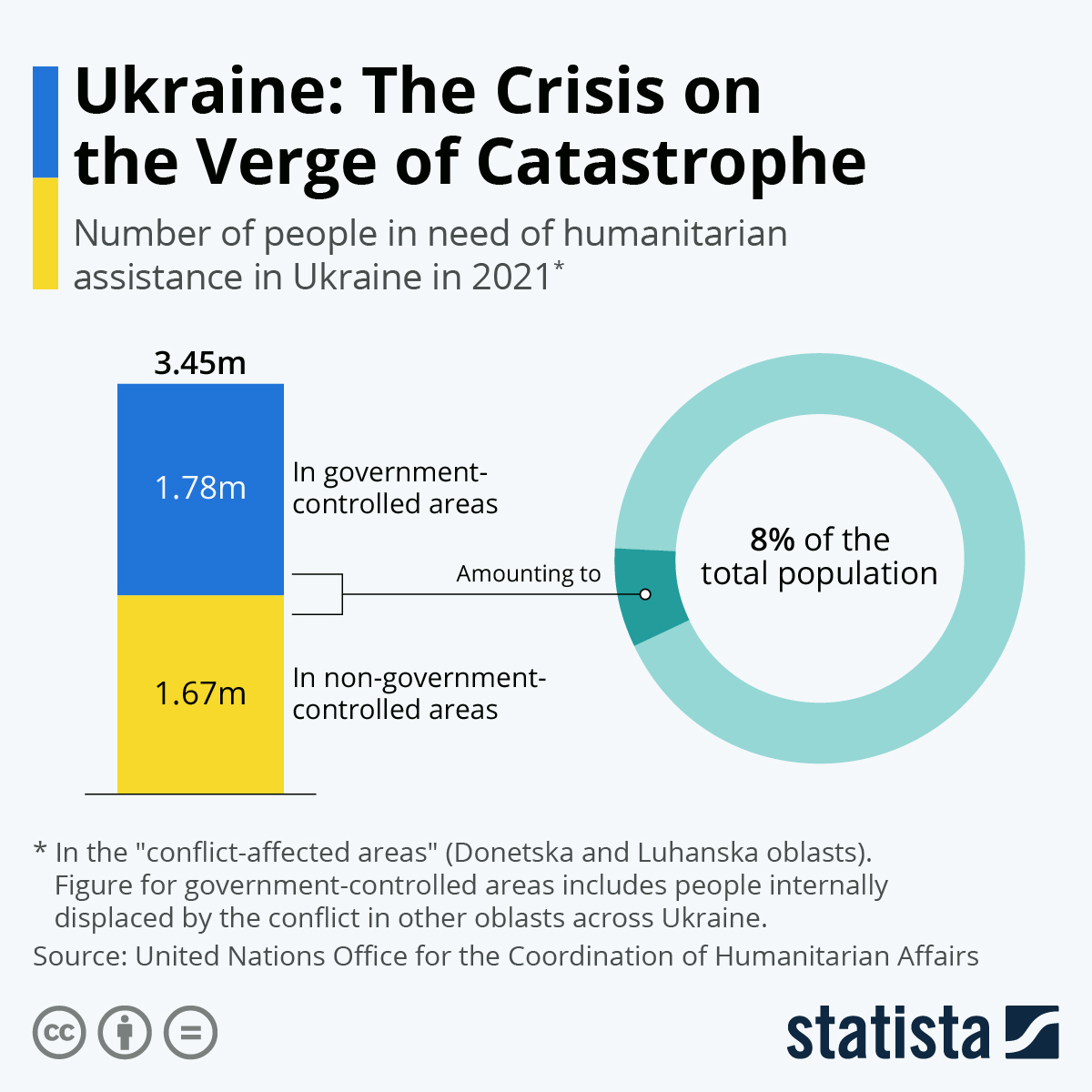
In 2021, the OCHA estimated that 3.4 million people in the 'conflict-affected areas" were in need of humanitarian assistance - representing 8 percent of the total Ukraine population. Although this is a significant reduction from the 2015 figure of 5 million, the crisis is far from over. With the growing threat of a Russian invasion, the risk of it turning into a flat-out catastrophe has rarely been larger. Russia is believed to have vastly increased its military presence on the Ukrainian border in recent weeks, with troop levels now estimated to exceed 100,000.
If, and to what extent, this situation will escalate is still unclear and, in what some commentators have likened to the levels of denial represented in the Netflix drama 'Don't Look Up', Ukraine President Zelenskiy has been eager to play down the immediate risk posed by the military build-up: “We are looking up. We do understand what is happening. But we have been in the situation for eight years. We should not only be looking up but also at the ground...The threat is constant.” Zelenskiy said in a briefing to foreign media organizations, adding: “We can’t say the war will happen tomorrow or by the end of February. Yes, it may happen, unfortunately. But you have to feel the pulse on a day-to-day basis.”
Russia continues to deny it is planning an invasion, but has been very clear in voicing the Kremlin's outright opposition to a further eastward expansion of NATO - something which the organization has refused to rule out, and with the Ukraine openly aspiring to membership of the alliance. Diplomatic efforts have so far failed to resolve the crisis. In the meantime, the OCHA's humanitarian partners "aim to assist 1.8 million people (in 2022), with a funding requirement of $190 million", focusing on "saving lives, ensuring access to basic services, and strengthening the protection of those affected by the conflict and Covid-19." а с другой стороны при таких делах:
The Specious Reasoning Behind Claims the US Thwarted an Invasion of Ukraine At no time has any consideration been given to the possibility of a far simpler explanation for the missing Russian invasion: that Russia never intended to invade.
By Caitlin Johnstone
In 2021, the OCHA estimated that 3.4 million people in the 'conflict-affected areas" were in need of humanitarian assistance - representing 8 percent of the total Ukraine population. Although this is a significant reduction from the 2015 figure of 5 million, the crisis is far from over. With the growing threat of a Russian invasion, the risk of it turning into a flat-out catastrophe has rarely been larger. Russia is believed to have vastly increased its military presence on the Ukrainian border in recent weeks, with troop levels now estimated to exceed 100,000.
If, and to what extent, this situation will escalate is still unclear and, in what some commentators have likened to the levels of denial represented in the Netflix drama 'Don't Look Up', Ukraine President Zelenskiy has been eager to play down the immediate risk posed by the military build-up: “We are looking up. We do understand what is happening. But we have been in the situation for eight years. We should not only be looking up but also at the ground...The threat is constant.” Zelenskiy said in a briefing to foreign media organizations, adding: “We can’t say the war will happen tomorrow or by the end of February. Yes, it may happen, unfortunately. But you have to feel the pulse on a day-to-day basis.”
Russia continues to deny it is planning an invasion, but has been very clear in voicing the Kremlin's outright opposition to a further eastward expansion of NATO - something which the organization has refused to rule out, and with the Ukraine openly aspiring to membership of the alliance. Diplomatic efforts have so far failed to resolve the crisis. In the meantime, the OCHA's humanitarian partners "aim to assist 1.8 million people (in 2022), with a funding requirement of $190 million", focusing on "saving lives, ensuring access to basic services, and strengthening the protection of those affected by the conflict and Covid-19." а с другой стороны при таких делах:
The Specious Reasoning Behind Claims the US Thwarted an Invasion of Ukraine At no time has any consideration been given to the possibility of a far simpler explanation for the missing Russian invasion: that Russia never intended to invade.
By Caitlin Johnstone
Thursday, August 19, 2021
Moral dilemmas and trust in leaders during a global health crisis
Trust in leaders is central to citizen compliance with public policies. One potential determinant of trust is how leaders resolve conflicts between utilitarian and non-utilitarian ethical principles in moral dilemmas. Past research suggests that utilitarian responses to dilemmas can both erode and enhance trust in leaders: sacrificing some people to save many others (‘instrumental harm’) reduces trust, while maximizing the welfare of everyone equally (‘impartial beneficence’) may increase trust. In a multi-site experiment spanning 22 countries on six continents, participants (N = 23,929) completed self-report (N = 17,591) and behavioural (N = 12,638) measures of trust in leaders who endorsed utilitarian or non-utilitarian principles in dilemmas concerning the COVID-19 pandemic. Across both the self-report and behavioural measures, endorsement of instrumental harm decreased trust, while endorsement of impartial beneficence increased trust. These results show how support for different ethical principles can impact trust in leaders, and inform effective public communication during times of global crisis.
The Stage 1 protocol for this Registered Report was accepted in principle on 13 November 2020. The protocol, as accepted by the journal, can be found at https://doi.org/10.6084/m9.figshare.13247315.v1.
Protocol Registration Statement
The Stage 1 protocol for this Registered Report was accepted in principle on 13 November 2020. The protocol, as accepted by the journal, can be found at https://doi.org/10.6084/m9.figshare.13247315.v1.
Wednesday, October 7, 2020
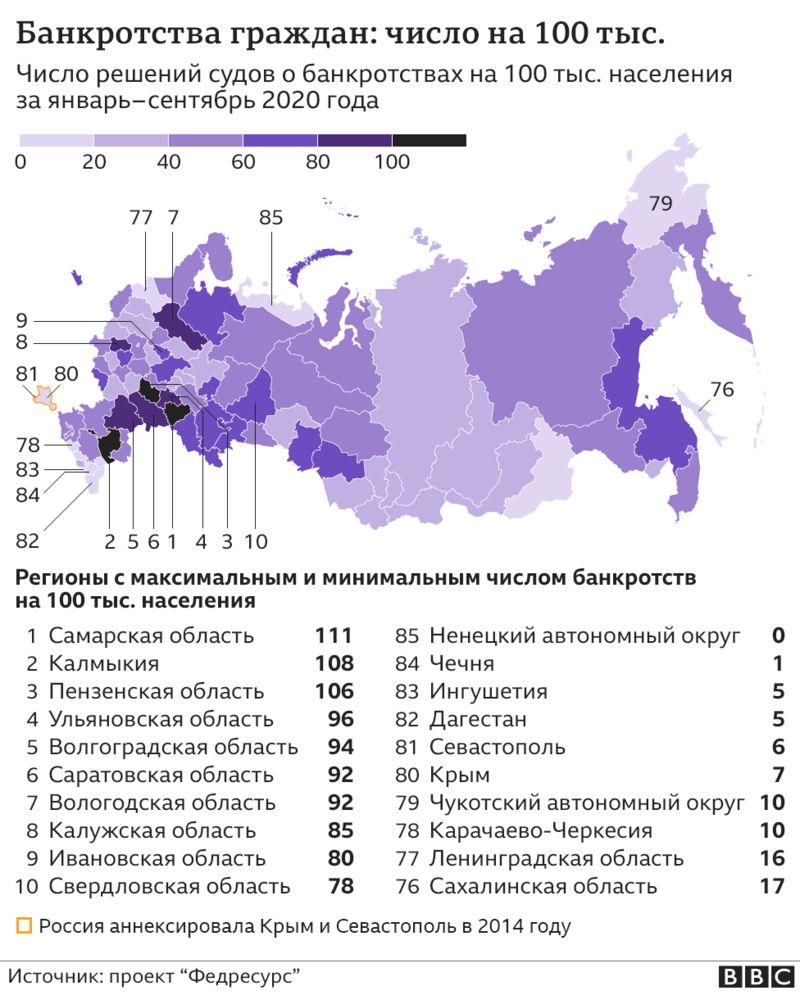
bankruptcies
что за федресурс? — не знаю
инфа с бебеси
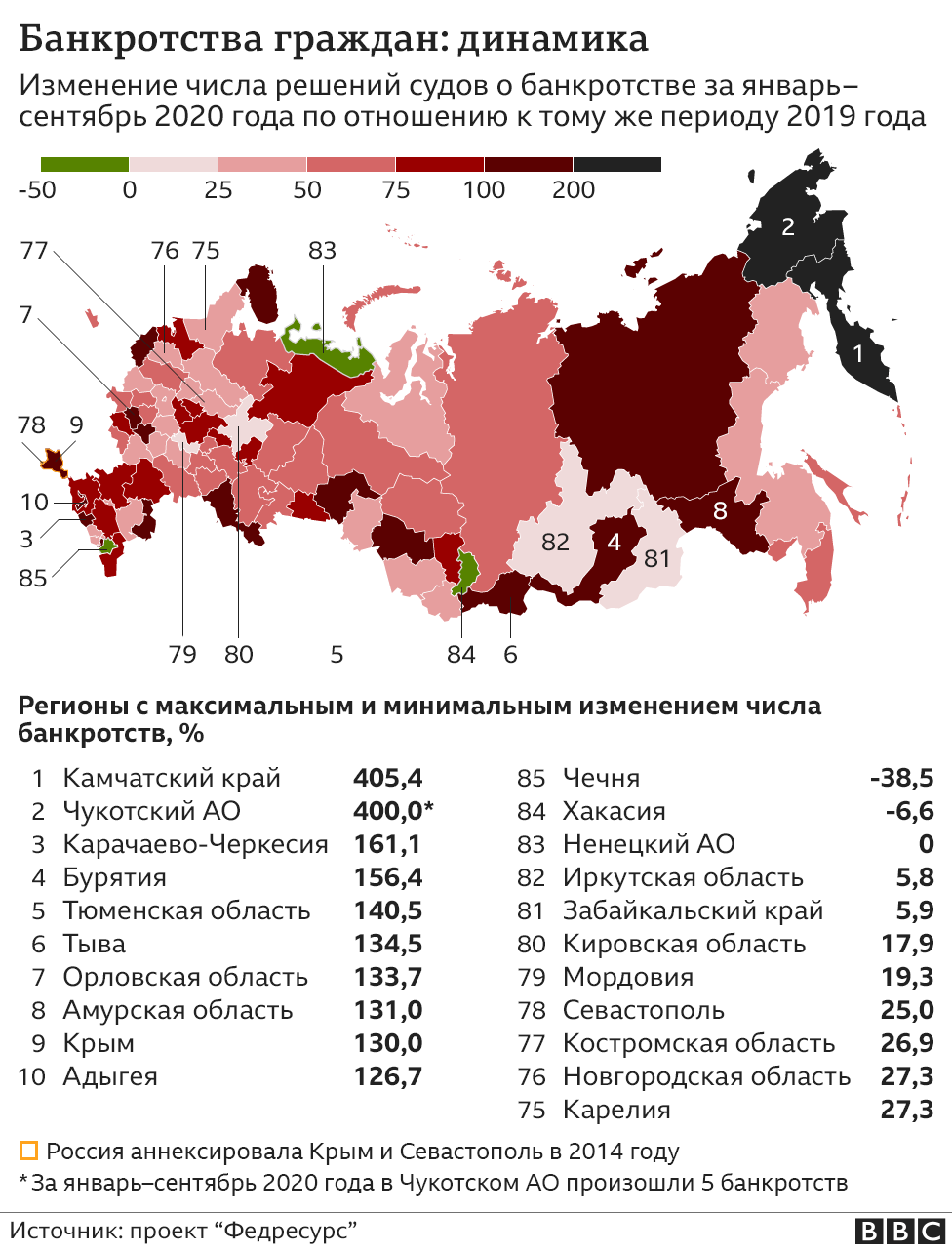
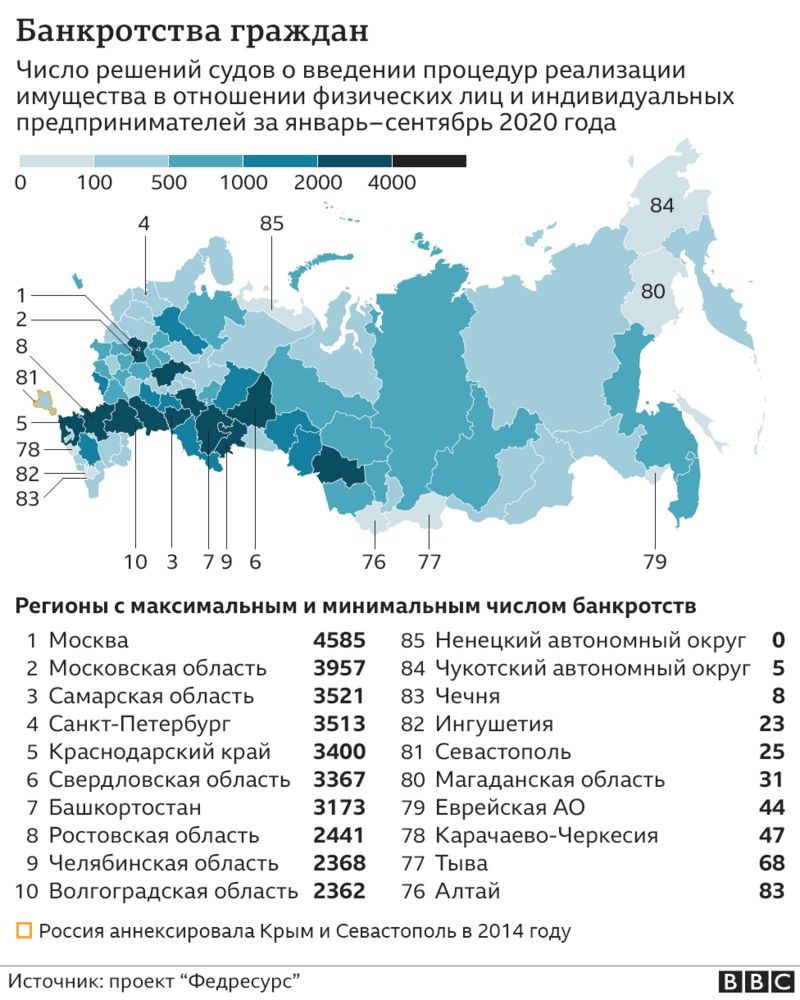
С 1 сентября в России заработал механизм внесудебного банкротства граждан, рассчитанный на тех, у кого долги не превышают 500 тысяч рублей (но не меньше 50 тысяч рублей). При этом у должника не должно быть никакого имущества, подходящего для реализации (единственное жилье не считается таким имуществом).
Для того, чтобы списать долги, гражданину достаточно обратиться в МФЦ по месту жительства или пребывания с заявлением и указать перечень своих кредиторов.
Потенциальных банкротов, которые могут рассчитывать на внесудебную процедуру банкротства, по данным Национальной ассоциации профессиональных коллекторских агентств, около 4 млн человек.
С 1 сентября в России заработал механизм внесудебного банкротства граждан, рассчитанный на тех, у кого долги не превышают 500 тысяч рублей (но не меньше 50 тысяч рублей). При этом у должника не должно быть никакого имущества, подходящего для реализации (единственное жилье не считается таким имуществом).
Для того, чтобы списать долги, гражданину достаточно обратиться в МФЦ по месту жительства или пребывания с заявлением и указать перечень своих кредиторов.
Потенциальных банкротов, которые могут рассчитывать на внесудебную процедуру банкротства, по данным Национальной ассоциации профессиональных коллекторских агентств, около 4 млн человек.
Tuesday, April 21, 2020
no more sales and more of socialism
В России попросили запретить скидки на продукты в магазинах
Такое решение, говорится в письме, позволит поддержать доходность поставщиков, которая находится под угрозой из-за роста расходов на фоне экономического кризиса в России.
В обычных условиях торговые сети борются за покупателей с использованием промоакций. Такие скидки позволяют вывести на рынок новые продукты и поддержать спрос при низкой покупательной способности, но в настоящее время их активное использование нанесет существенный вред участникам рынка.
Свое участие в обращении подтвердили Союзмолоко, Союз производителей безалкогольных напитков и минеральных вод, Национальный союз птицеводов и Союзроссахар.
Ранее исследовательская компания Neilsen установила, что в последние годы доля акционных продаж в России неизменно растет. Так, в 2019 году она выросла на 3 процентных пункта до 56 процентов в натуральном выражении.
Среди других мер поддержки предприятия отрасли просят увеличить объем краткосрочного льготного кредитования и отказаться от дополнительных требований по цифровой маркировке на молочной продукции и бутилированной воде, пока кризис не завершится. Отдельно авторы обращения предлагают Мишустину обязать торговые сети отказаться от применения штрафов и неустоек за проблемы с поставками продуктов питания.
Ранее глава Минпромторга Денис Мантуров рассказал, что в России не отмечено существенное изменение цен на продукты, а рост замечен только в тех категориях, которые не производятся в России, например, чая или кофе.
До этого производители и поставщики продовольствия призвали российские власти оперативно вернуть советскую практику продуктовых карточек, которые предоставляются наименее обеспеченным слоям населения.
Thursday, April 16, 2020
Swift Recovery After COVID-19
When it comes to the economic fallout of the COVID-19 pandemic, we‘ve been confronted with several negative superlatives in recent weeks (although it feels much longer than that). We’ve seen some of the worst single-day losses in stock market history, jobless claims that are literally off the charts and what is likely the steepest and fastest decline in economic activity on record.
And while all these figures are certainly cause for concern, there is one thing that separates the economic crisis brought about by the coronavirus from past crises. As opposed to say the financial crisis of 2009, the current downturn wasn’t caused by something fundamentally wrong with the financial system or the overall economy, but by the measures necessary to contain a public health crisis. When asked about the frequently drawn comparison to the Great Depression of the 1930s, former Fed Chairman Ben Bernanke told CNBC that the current crisis “is really much closer to a major snowstorm or a natural disaster than it is to a classic 1930s-style depression,” which leaves hope for “fairly quick rebound.” That is if the aid package passed by Congress last month proves effective in keeping affected businesses and households afloat during the shutdown period.
The International Monetary Fund updated its World Economic Outlook on Tuesday, fueling hopes of such a V-shaped recovery. The IMF revised its GDP growth forecast for the global economy from 3.3 percent to -3.0 percent for this year but expects a return to growth in 2021. That’s assuming “that the pandemic fades in the second half of 2020 and containment efforts can be gradually unwound.” However, “the risks for even more severe outcomes are substantial,” the IMF notes. “Effective policies are essential to forestall the possibility of worse outcomes, and the necessary measures to reduce contagion and protect lives are an important investment in long-term human and economic health.”
What’s arguably the biggest question in terms of long-term economic effects of the ongoing pandemic is how well debt-ridden countries such as Italy, Spain and the United States for that matter can stomach the hundreds of billions in additional debt necessary to safeguard acutely affected sectors and people during the lockdown period. The IMF calls for strong multilateral cooperation to “help financially constrained countries facing twin health and funding shocks.”
And while all these figures are certainly cause for concern, there is one thing that separates the economic crisis brought about by the coronavirus from past crises. As opposed to say the financial crisis of 2009, the current downturn wasn’t caused by something fundamentally wrong with the financial system or the overall economy, but by the measures necessary to contain a public health crisis. When asked about the frequently drawn comparison to the Great Depression of the 1930s, former Fed Chairman Ben Bernanke told CNBC that the current crisis “is really much closer to a major snowstorm or a natural disaster than it is to a classic 1930s-style depression,” which leaves hope for “fairly quick rebound.” That is if the aid package passed by Congress last month proves effective in keeping affected businesses and households afloat during the shutdown period.
The International Monetary Fund updated its World Economic Outlook on Tuesday, fueling hopes of such a V-shaped recovery. The IMF revised its GDP growth forecast for the global economy from 3.3 percent to -3.0 percent for this year but expects a return to growth in 2021. That’s assuming “that the pandemic fades in the second half of 2020 and containment efforts can be gradually unwound.” However, “the risks for even more severe outcomes are substantial,” the IMF notes. “Effective policies are essential to forestall the possibility of worse outcomes, and the necessary measures to reduce contagion and protect lives are an important investment in long-term human and economic health.”
What’s arguably the biggest question in terms of long-term economic effects of the ongoing pandemic is how well debt-ridden countries such as Italy, Spain and the United States for that matter can stomach the hundreds of billions in additional debt necessary to safeguard acutely affected sectors and people during the lockdown period. The IMF calls for strong multilateral cooperation to “help financially constrained countries facing twin health and funding shocks.”

Thursday, March 12, 2020
the Longest Growth Cycle in U.S.
On September 20, 2010, the National Bureau of Economic Research (NBER), the semi-official chronicler of economic cycles in the United States, announced that June 2009 marked a trough in business activity signaling the end of the recession that began in December 2007 and the beginning of an expansion. Identifying the date of a trough/peak in economic activity is a complex task carried out by the Business Cycle Dating Committee, a panel of 10 renowned economic researchers, that involves weighing the behavior of various indicators to pinpoint turning points in economic activity as accurately as possible.
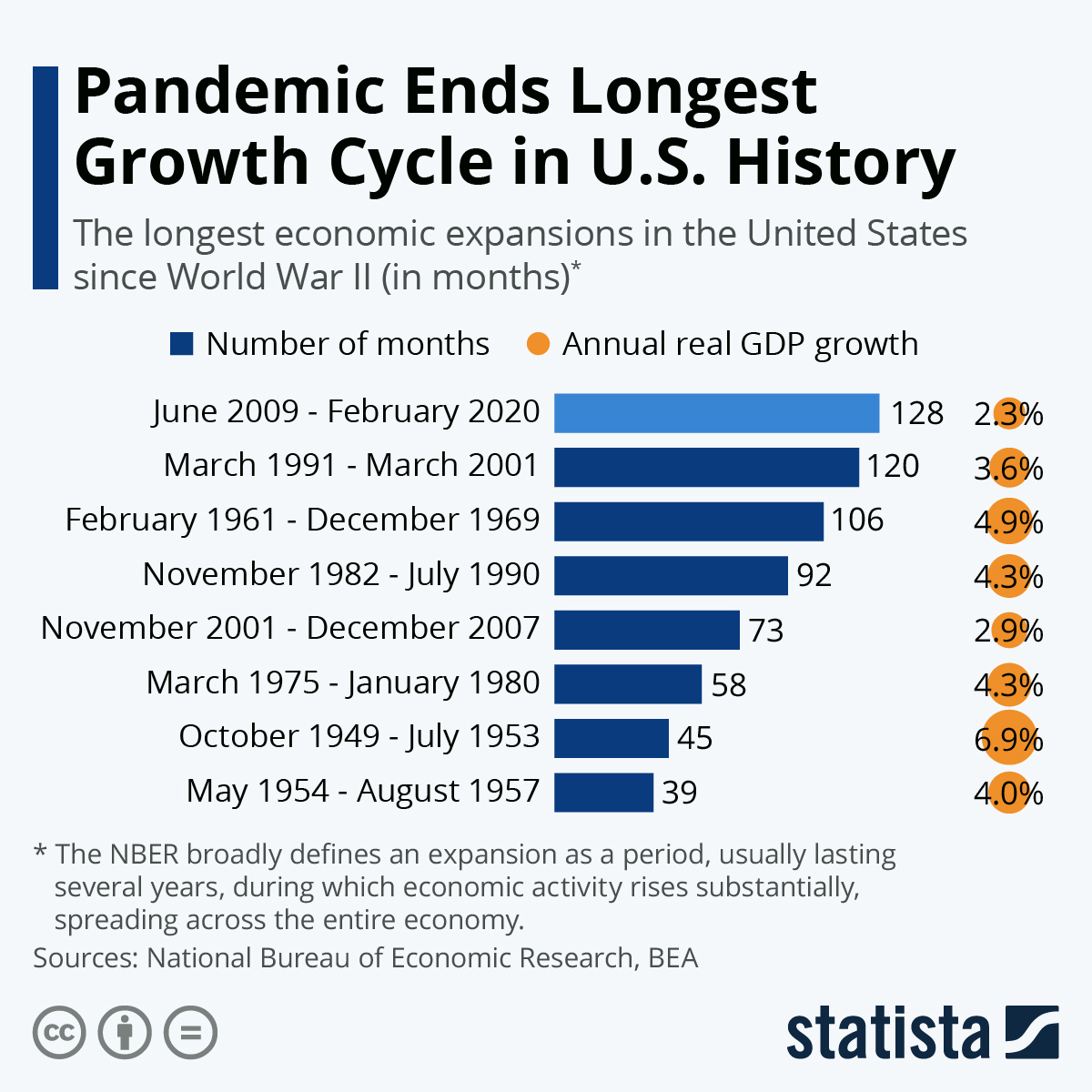
Ever since the September 2010 announcement, the Committee has been remarkably quiet, mainly thanks to the fact that the expansion that started in June 2009 is still ongoing and officially became the longest growth cycle in the history of the United States in July 2019. As the coronavirus continues to spread in the United States and worldwide, fears of a global recession are mounting, however, threatening to end the unprecedented growth streak. Even if the outbreak hits the world economy significantly, the U.S. might still avoid sliding into a recession though. Compared to the euro area, which has been drifting towards recession before the outbreak, the U.S. economy looks robust, and the fact that the Fed still has room to cut rates could prove crucial in preventing a downturn.
As the following chart shows, the current expansion is the longest ever, trailed by the growth cycle that lasted from March 1991 to March 2001 and culminated in the bursting of the dot-com bubble. As opposed to many shorter growth periods of the past, the current expansion is one of moderate growth. With an average annual GDP growth of 2.3 percent, the ongoing upturn is, in fact, the second slowest since the end of World War II.
Ever since the September 2010 announcement, the Committee has been remarkably quiet, mainly thanks to the fact that the expansion that started in June 2009 is still ongoing and officially became the longest growth cycle in the history of the United States in July 2019. As the coronavirus continues to spread in the United States and worldwide, fears of a global recession are mounting, however, threatening to end the unprecedented growth streak. Even if the outbreak hits the world economy significantly, the U.S. might still avoid sliding into a recession though. Compared to the euro area, which has been drifting towards recession before the outbreak, the U.S. economy looks robust, and the fact that the Fed still has room to cut rates could prove crucial in preventing a downturn.
As the following chart shows, the current expansion is the longest ever, trailed by the growth cycle that lasted from March 1991 to March 2001 and culminated in the bursting of the dot-com bubble. As opposed to many shorter growth periods of the past, the current expansion is one of moderate growth. With an average annual GDP growth of 2.3 percent, the ongoing upturn is, in fact, the second slowest since the end of World War II.
Monday, November 18, 2019
Monday, September 23, 2019
all right
Кризис, которого не было:
Росстат переписал всю статистику с 2014 года
Росстат провел радикальный пересмотр макростатистики за период с 2014 года и пришел к выводу, что потери российской экономики от санкций Запада и обвала цен на нефть были существенно преувеличены.
По новой официальной оценке, ни самой продолжительной в 21-м веке рецессии, которая, как считалось, продолжалась два года подряд, ни падения промышленности, ни обвала в строительстве - на самом деле не было.
Согласно пересчитанным данным, единственным годом, когда экономика сокращалась, стал 2015-й. Причем масштабы спада теперь оцениваются вдвое скромнее, чем изначально.
Первые оценки Росстата показывали падение ВВП на 3,7%, затем цифру улучшили до 3%, потом до 2,8%. Последний и окончательный пересчет показал уже лишь 2,3%.
Рецессии в 2016 году, по новым данным, не было вовсе: изначально спад оценили в 0,2%, а теперь довели цифру до роста в 0,3%. В 2017-м году экономика ускорилась в 5 раз, показав рост на 1,6% (вместо 1,5% по изначальным данным), а прошлом - еще почти в 1,5 раза, до рекордных с 2012 года 2,3%.
«Наиболее фантастическим выглядит пересмотр по обрабатывающей промышленности», - отмечает директор аналитического департамента «Локо-Инвест» Кирилл Тремасов.
По изначальным данным Росстата, несырьевое производство рухнуло на 3,4% в 2015 году, а затем два года стагнировало, оставаясь примерно на 3% ниже докризисных отметок: рост в 2016-м оценили в 0,5%, а в 2017-м в 0,2%.
По новой оценке, спад в 2015 году был вдвое меньше заявленного (1,8%), а уже в 2016-м начался «рывок», после чего в течение трех лет отрасль показала рост на 5,6%.
«Не менее фееричный пересмотр», продолжает Тремасов, состоялся в строительстве, которое еще недавно считалось одной из немногих отраслей, так и не сумевшей выбраться из рецессии. Теперь это в прошлом: вместо 3% падения за три года строительство показывает 3% роста.
Неожиданно в плюс вышло образование: объем услуг, предоставленных в этом секторе, падавший на 2% за время кризиса, теперь растет на 3% (по сравнению с 2015 годом).
В результате тотального пересмотра статистики «как-то так получилось, что практически все виды экономической деятельности пересчитали вверх», констатирует Тремасов: «Единственная отрасль, которая была пересчитана вниз - это здравоохранение».
«Можно, конечно, придумать множество гипотез, объясняющих столь удивительные цифры. Но, наверное, пора уже перестать удивляться. <...> Чудеса стали обыденностью», - иронизирует Тремасов.
«Сейчас и в крупнейших мировых финансовых структурах типа Всемирного банка и МВФ, агентствах ООН, аналитических структурах, консультирующих инвесторов, чешут в затылках, не понимая, что делать с публикуемыми Россией данными», - пишет экономист Евгений Гонтмахер.
Налицо открытый конфликт интересов, считает он: Росстат находится под кураторством Министерства экономического развития, которое как раз и отвечает за «обеспечение темпов экономического роста выше мировых».
Решением проблемы мог бы стать вывод Росстата из структур исполнительной власти, предлагает Гонтмахер: ведомство могло бы получить статус, которым обладает, например, Счетная палата. Ее руководство формируется с участием президента и Федерального собрания.
В противном случае статистический «прорыв» грозит обернуться для России новыми потерями. Вызывающая все большее удивление статистика «тоже вносит свою лепту в процесс уничтожения инвестиционной привлекательности страны - и без того находящейся в зоне отрицательных значений», предупреждает Гонтмахер.
В пятницу состоялось собрание, пришедшее к аналогичному выводу
Материалы по теме
- Росстат прекращает публикацию ежемесячных данных по доходам россиян
- Медведев сменил главу Росстата после резкого ухудшения статистики [Вряд ли Медведев кого-то назначает]
Wednesday, February 27, 2019
staff reduction
![]() |
| видимо, не очень помогает |
В общей сложности весной могут сократить 115,7 тыс. человек. Большая часть из них работает в столице, Санкт-Петербурге или Свердловской области. Основные причины — санация банков, низкая конкурентоспособность компаний и остановка производства из-за переизбытка продукции на рынке, полагают эксперты.
По закону работодатель обязан предупредить сотрудника о сокращении не менее чем за два месяца до увольнения. При этом ему необходимо предложить работнику альтернативные вакансии в организации. В случае ухода гражданину выплачивается выходное пособие в размере месячной зарплаты. Тот, кто не смог устроиться на новое место в течение последующих двух месяцев, получает в этот период среднемесячный оклад.
Подробнее — в эксклюзивном материале «Известий»:
Машина сокращений: кому весной грозит увольнение
бегущая строка на сайте Известий сообщает: Минтруд опроверг, видимо 100 тыщ недостаточно массово
Tuesday, December 25, 2018
money down the drain
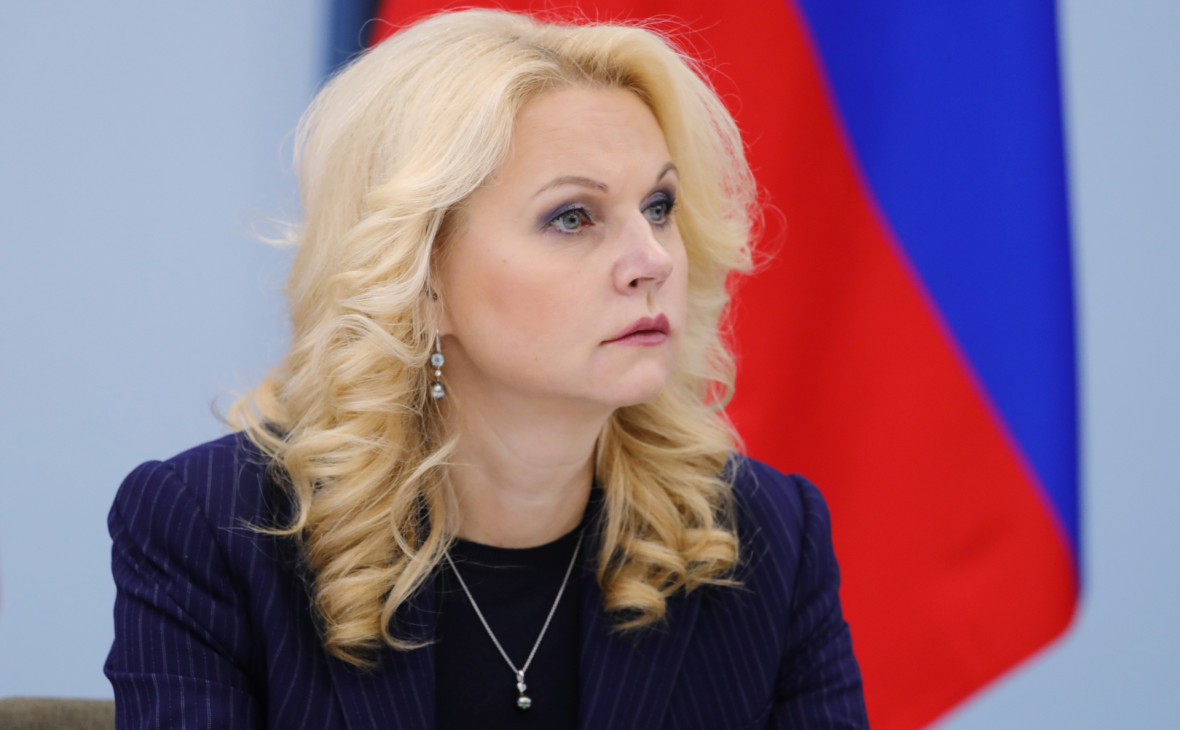
МОСКВА, 24 декабря. /ТАСС/. Россиян, прошедших диспансеризацию или профосмотр, врачи будут в обязательном порядке ставить на учет и вести наблюдение за ними. Об этом заявила в понедельник вице-премьер РФ Татьяна Голикова на заседании Совета при правительстве РФ по вопросам попечительства в социальной сфере. [каких только нет советов]
"В рамках программы государственных гарантий и соответствующего письма, которое, я надеюсь, Министерство здравоохранения уже направило в регионы, предполагается, что диспансеризация и профосмотры не будут просто заканчиваться ничем. Теперь это должно заканчиваться в обязательном порядке постановкой на учет и дальнейшим ведением больного, чего в принципе раньше не делалось", - сказала Голикова.
Она добавила, что проект реализации нововведения в регионах пока не разработан. "Как это будет работать, как субъекты это исполнят, мы пока не знаем, но в любом случае за Фондом обязательного медицинского страхования здесь будет контроль", - подчеркнула вице-премьер.
Голикова также отметила, что с 2020 года также будут предусмотрены дополнительные [деньги на ветер] скрининги взрослого населения. "Мы сейчас тоже находимся в обсуждении с тем, чтобы понять, что будет эффективно, что неэффективно, но такие предложения будут сформулированы", - заключила Голикова.
"В рамках программы государственных гарантий и соответствующего письма, которое, я надеюсь, Министерство здравоохранения уже направило в регионы, предполагается, что диспансеризация и профосмотры не будут просто заканчиваться ничем. Теперь это должно заканчиваться в обязательном порядке постановкой на учет и дальнейшим ведением больного, чего в принципе раньше не делалось", - сказала Голикова.
Она добавила, что проект реализации нововведения в регионах пока не разработан. "Как это будет работать, как субъекты это исполнят, мы пока не знаем, но в любом случае за Фондом обязательного медицинского страхования здесь будет контроль", - подчеркнула вице-премьер.
Голикова также отметила, что с 2020 года также будут предусмотрены дополнительные [деньги на ветер] скрининги взрослого населения. "Мы сейчас тоже находимся в обсуждении с тем, чтобы понять, что будет эффективно, что неэффективно, но такие предложения будут сформулированы", - заключила Голикова.
о вреле диспансеризации ещё в СССР лекцию слушал
Monday, April 23, 2018
Working Life Expectancy at Age 50 in the United States
Working Life Expectancy at Age 50 in the United States and the Impact of the Great Recession
A key concern about population aging is the decline in the size of the economically active population. Working longer is a potential remedy. However, little is known [more here] about the length of working life and how it relates to macroeconomic conditions. We use the U.S. Health and Retirement Study for 1992–2011 and multistate life tables to analyze working life expectancy at age 50 and study the impact of the Great Recession in 2007–2009. Despite declines of one to two years following the recession, in 2008–2011, American men aged 50 still spent 13 years, or two-fifths of their remaining life, working; American women of the same age spent 11 years, or one-third of their remaining life, in employment. Although educational differences in working life expectancy have been stable since the mid-1990s, racial differences started changing after the onset of the Great Recession. Our results show that although Americans generally work longer than people in other countries, considerable subpopulation heterogeneity exists. We also find that the time trends are fluctuating, which may prove troublesome as the population ages. Policies targeting the weakest performing groups may be needed to increase the total population trends.
Keywords
Working life expectancy Health and Retirement Study Great Recession Multistate life table
Wednesday, December 13, 2017
Van slecht naar slechter
Почти половина россиян (47 процентов) оценивают свой ущерб от экономического кризиса 2014–2016 годов как «существенный» или «катастрофический». Об этом со ссылкой на данные доклада Социологического центра РАН «Российское общество в 2017-м: социальное самочувствие, тревоги, надежды на будущее»
40 процентов россиян оценили нанесенный им кризисом ущерб как «существенный, но не катастрофический» (это значение совпадает с данными по 2015–2016 годам). 39 процентов назвали ущерб «умеренным», что стало максимумом с осени 2015 года. Отказались себя считать пострадавшими от кризиса 14 процентов населения, еще семь процентов назвали ущерб «катастрофическим».
Другими словами: всё=хорошо, а будет ещё лутше (читай имя ссылки адресной строкой)
Авторы доклада указывают, что экономия смещается от базовых потребностей к дополнительным и отмечают, что доля экономящих на всех статьях, кроме товаров длительного пользования, сократилась на 5–15 процентных пунктов.
Tuesday, November 14, 2017
business demography
русский крест (по ведомостям через бебеси):
Затяжная стагнация после экономического спада привела к росту темпов банкротств компаний, пишет в свежем номере газета "Ведомости" со ссылкой на исследования Центра макроэкономического анализа и краткосрочного прогнозирования. Их число растет четвертый квартал подряд и превысило даже показатели кризисного 2015 года. Наиболее уязвимыми оказываются компании, работающие непосредственно для конечного потребителя в сфере строительства, торговли и пищевой промышленности, что указывает на нездоровые тенденции в экономике.
Только за июль-сентябрь 2017 года, по данным "Ведомостей", в России обанкротилось 3227 компаний. Газета отмечает, что рост числа банкротств начался в 2014-2015 годах, и сейчас идет вторая волна. По мнению издания, такая динамика связана с отмиранием старой модели бизнеса, с фокусом на быстрый рост потребления и экономики.
эти данные есть в росстате, если кто знает ссылку — киньте, пож
Затяжная стагнация после экономического спада привела к росту темпов банкротств компаний, пишет в свежем номере газета "Ведомости" со ссылкой на исследования Центра макроэкономического анализа и краткосрочного прогнозирования. Их число растет четвертый квартал подряд и превысило даже показатели кризисного 2015 года. Наиболее уязвимыми оказываются компании, работающие непосредственно для конечного потребителя в сфере строительства, торговли и пищевой промышленности, что указывает на нездоровые тенденции в экономике.
Только за июль-сентябрь 2017 года, по данным "Ведомостей", в России обанкротилось 3227 компаний. Газета отмечает, что рост числа банкротств начался в 2014-2015 годах, и сейчас идет вторая волна. По мнению издания, такая динамика связана с отмиранием старой модели бизнеса, с фокусом на быстрый рост потребления и экономики.
эти данные есть в росстате, если кто знает ссылку — киньте, пож
Monday, August 14, 2017
crisis is over
а был ли мальчег?
ВЦИОМ ЖЖотъ (не взирая налит са):
| Какие проблемы Вы считаете наиболее важными для страны в целом? Можете назвать до пяти проблем(открытый вопрос, не более 5-ти ответов, %) ТОП-10 проблем | |||||||||
| ответ | VII.15 | VII.16 | I.17 | II.17 | III.17 | IV.17 | V.17 | VI.17 | VII.17 |
| Низкие зарплаты, низкий уровень жизни | 16 | 14 | 18 | 13 | 19 | 22 | 23 | 27 | 24 |
| Экономика (экономический кризис, бюджет пустой, бездарная экономическая политика) | 12 | 17 | 16 | 20 | 23 | 24 | 21 | 16 | 21 |
| Социальная политика | 6 | 9 | 10 | 19 | 18 | 18 | 15 | 20 | 18 |
| Здравоохранение | 8 | 10 | 17 | 19 | 20 | 18 | 20 | 21 | 17 |
| Безработица | 13 | 11 | 15 | 12 | 15 | 12 | 16 | 14 | 14 |
| Проблемы в сфере образования | 5 | 8 | 11 | 10 | 14 | 14 | 13 | 13 | 12 |
| Низкие пенсии, пенсионная реформа | 6 | 7 | 11 | 7 | 10 | 9 | 10 | 9 | 12 |
| Высокая инфляция, рост цен | 20 | 12 | 14 | 10 | 10 | 10 | 11 | 10 | 10 |
| Коррупция | 8 | 6 | 7 | 1 | 11 | 10 | 11 | 8 | 10 |
| ЖКХ | 7 | 7 | 10 | 7 | 9 | 8 | 7 | 12 | 8 |
Subscribe to:
Posts (Atom)