Showing posts with label демографический переход. Show all posts

Thursday, November 9, 2023

Attitudes toward work and parenthood following family-building transitions in Sweden: Identifying differences by gender and education

BY Eva Bernhardt, Frances Goldscheider, Malgorzata Switek

Objective: This paper examines how family-building transitions (union formation and first birth) affect the attitudes of Swedes toward work and parenthood. The literature finds that these life course transitions have a traditionalizing effect on gender roles. Is this also the case in Sweden, one of the most gender-equal countries in the world?

Methods: Our study uses the longitudinal Young Adult Panel Study database. We run first-difference OLS regressions on the relationship between family-building transitions and work and parenthood attitudes, distinguishing men from women, and those with more education from those with less.

Results: We find that family transitions do slightly traditionalize attitudes toward work and parenthood, but differences by gender and education are very small.

Contribution: The overall pattern is one of striking similarity between men and women, suggesting that the gender revolution is well advanced in Sweden; traditional gender differences remain primarily among those with less education.

Wednesday, November 9, 2022

Fertility has been relatively high in Nigeria for several years

[по-моему, она была очень высокой]

This paper has three major objectives. The first is to demonstrate that a sustained fertility transition has begun in Nigeria. The second is to identify some factors that might have contributed to the decline and the third objective is to argue in favor of further declines in fertility and propose a level of fertility by the time the fertility transition is completed [как думаете? можно ли предвидеть это?]. None of the objectives is easy to achieve considering the dearth of comparable nationally representative data.

Wednesday, October 5, 2022

the 2nd DT in PRC?

Announcing a forthcoming special issue of the China Population and Development Studies on the applicability and evidence of the Second Demographic Transition in Asian contexts. The issue is edited by Baochang Gu, Stuart Gietel-Basten and myself [Ron Lesthaeghe, emeritus prof. Vrije Univ. Brussels // Kon. Vlaamse Academie van België/ Royal Flemish Academy of Belgium Arts & Sciences.Bredene, Flemish Region, Belgium]. It contains three commentaries and four country-specific articles on Japan, P.R. China, Indonesia and India. Further articles on SDT aspects will be forthcoming in subsequent issues of CPDS.

Attached here is the abstract of my introductory commentary
[камент см по ссылке, извиняюсь за грубое слово]

Tuesday, September 27, 2022

nice journal

Итак, пора же наконец посмотреть, к чему я так долго и упорно шёл. Процесс был дико изматывающим и меня начинает пугать то, что данные по переписи 2021 года всё же появляются (я до сих пор не уверен, что они будут доступны в той же полноте, что и раньше, однако пока что всё двигается к этому). Это налагает на меня в перспективе определённые обязательства в сравнении уже 2010 и 2021 годов.

C переписью не всё понятно. Понятно, что чел, её проведший стал губернатором и, сразу начались пожары. Пожалуй, больше ничего непонятно.

Monday, September 26, 2022

Shrinking smartly and sustainably

Join our upcoming workshop at The European Week of Regions and Cities.

When: Monday, 11 October 2022 4:30 PM to 6:00 PM CEST
Where: Online


Population Europe, hosted by the Max Planck Society, and OECD Centre for Entrepreneurship, SMEs, Regions and Cities are organising the session ‘Shrinking smartly and sustainably’ at the 20th European Week of Regions and Cities during 10-13 October 2022. We invite you to exchange smart and sustainable solutions to the increasing population losses.

The online-workshop brings together policy-makers and experts to discuss policies on adapting to shrinking populations in regions and countries experiencing sustained and strong population losses. Prominent experts will be asked for a short review of the current depopulation and ageing trends as well as the local and European perspectives to act upon the demographic challenges. In the second round, the OECD and Population Europe will propose a number of ‘imagined futures’ based on foresight analysis to stir debate and identify policy trade-offs and challenges for different types of regions. The participants following the session online will have the chance to comment and ask questions live via multiple platforms.

Register now


Speakers

    • Fabrice Dalongeville, Mayor, Municipality of Auger-Saint-Vincent, France
    • Anne Goujon, Population and Just Societies (POPJUS) Program Director, International Institute for Applied Systems Analysis (IIASA), Austria
    • Patrik Johansson, Deputy director at the Division for Regional and Rural Development, Ministry of Enterprise and Innovation, Sweden
    • Sebastian Klüsener, Research Director on Demographic Change and Ageing, The Federal Institute for Population Research (BiB), Germany
    • Pedro Ribeiro, Mayor, Municipality of Almeirim, Portugal
    • Lewis Dijkstra, Head of the Economic Analysis Sector of the Directorate-General for Regional and Urban Policy, European Commission

Monday, September 12, 2022

repro

Macro-level comparisons show that both higher fertility and female employment rates are simultaneously found in countries where institutional support for working parents is comparatively comprehensive, although the patterns of support differ from country to country. Thus, schematically speaking, Nordic European countries (and France) provide a relatively high level of balanced and continuous support to working parents. In these countries, high fertility rates go along with relatively high female full-time employment rates. However, the impact of policies was found to be modest or non-existent with respect to the fertility level, while it is more pronounced with respect to the timing of childbearing. In particular cash benefits and financial support have a limited impact on the level of fertility, whereas work-related policies tend to be more effective. 

Fertility intentions are a main component of reproductive decision-making. REPRO studies them from the viewpoint of the social psychological theory of planned behaviour (TPB), which has been used to analyse intentions that lead to demographic events. Applying the TPB to childbearing intentions will significantly extend the demographic research on fertility intentions, which has mainly relied on the direct empirical relationship between intentions and subsequent behaviour until now. The TPB comprises three blocks of determinants of intentions: (1) attitudes towards childbearing, (2) subjective norms and influence of important others and (3) perceived control over the behaviour. Each of these blocks includes several components. Applying the theory will therefore expand our knowledge on the importance of a large variety of proximate determinants of fertility intentions, which per se are proximate determinants of childbearing. 

The TPB sets rigorous standards for the definition and measurement of intentions. First, the behaviour itself requires a clear and precise measurement. Next, the researcher must clearly define the intention’s target and the action that needs to be taken to reach the target. In the case of childbearing, intentions have to be explicitly specified for the order of the intended birth and for the union status of the person. Moreover, the certainty of intentions also has to be explicitly measured. To be certain, intentions have to refer to a short time interval in order to diminish the impact of external factors that might cause a revision. For this reason, REPRO mainly focuses on explaining short- to mid-term intentions. The REPRO project will make use of an operationalisation of the TPB included in the Generations and Gender Surveys, which became available recently. 

Qualitative research on reproductive decision-making in low fertility contexts can be divided into two major streams: (1) studies which refer to elements of the decision process (attitudes, norms, values and conditions related to becoming parents, family size and childbearing timing) and (2) studies which focus on the decisional process itself (phases, rank in the priority of decisions, deferral and activation). The value of qualitative analysis is its ability to reveal the variability and complexity of decision-making, actions and behaviour. Recently, a large number of qualitative studies on attitudes, values, norms and social influences as well as on the way the latter are exercised in conjunction with individually perceived constraints and priorities related to childbearing decision-making were carried out in different parts of Europe. However, systematic comparative qualitative analyses of such data across contexts and generations are as rare as they are pivotal for interpreting the correlation between fertility intentions and fertility behaviour across population subgroups. 

The realisation or non-realisation of childbearing intentions is a key issue in the REPRO project. Contemporary research reports controversial facts about the reliability of fertility intentions as a predictor of fertility behaviour. While some authors note a good relationship between intentions and subsequent births, others find this relationship poor and insufficient for fertility forecasts. Most of the research was, however, based on macro-level data and only a few studies analyse the realisation of individual intentions. 

So far, we have discussed macro-level correlations between fertility, on the one hand, and economic, institutional, societal and cultural factors, on the other hand. We also addressed micro-level studies of fertility intentions and behaviour. The third and definitely smallest set of empirical studies available so far pools micro-level data from a variety of macro contexts, analyses these jointly and tries to account for variation across countries by including macro-level characteristics. In these macro-micro studies, information from both analytical levels is combined in one statistical model. The macro contexts could be countries (to study differences across countries) or years (to study change within countries). Only very few studies have used this macro-micro strategy to examine the influence of macro factors on fertility behaviour or fertility desires. Moreover, most of these studies are so recent that they have not (yet) been published in peer-reviewed journals but only circulated as working papers. At least two reasons account for the lack of this type of studies. First, we need statistical models that allow us to account for the fact that individual-level data are clustered within a hierarchical structure. Multi-level models that can handle this kind of data have only recently become more common in the social sciences. Second, we need datasets that (a) are highly comparable across countries or across periods if we study changes in fertility decision-making across time and (b) include a sufficiently large number of countries to make multi-level modelling feasible. Only recently have such datasets as the Fertility and Family Surveys, the European Community Household Panel or the European Social Survey become available. 

The REPRO project [you need vpn] shares some aims with several other research projects funded by the European Commission. Opportunities for syncretism exist and will be used extensively.

Tuesday, September 6, 2022

Fertility Trends in the Developing World, 1950–2020

In 1950 the world’s “less developed regions,” containing 1.72 billion people (68% of the world’s population), had a total fertility rate of 6 births per woman. This chapter focuses on tracing how by 2020 that population grew into 6.5 billion people (84% of the world’s population), with a total fertility rate of just 2.6 births per woman. The mid-century political and economic situations of the developing world are briefly described. Using UN fertility data, the movement of the developing world through three phases of its fertility transition is traced, and the distinctive patterns of the populations of Asia, Latin America, and Africa are discussed. An analytical framework to understand the fertility transition is described, and its theoretical basis is summarized. Three major drivers of fertility decline are identified: socio-economic development, voluntary family planning programs, and coercive antinatalist policies. The paths by which these drivers affect desired family size as well as demand for and use of birth control are outlined.

John BongaartsDennis Hodgson Book Chapter Open Access [в ссылке есть ссылка не на главу, а книжка целиком]
месячные тренды — это не тренды, когда что-то меняется: для этого нужно поколение (минимум), астрономически — это 25 лет, нижняя оценка

Monday, August 15, 2022

for the first time

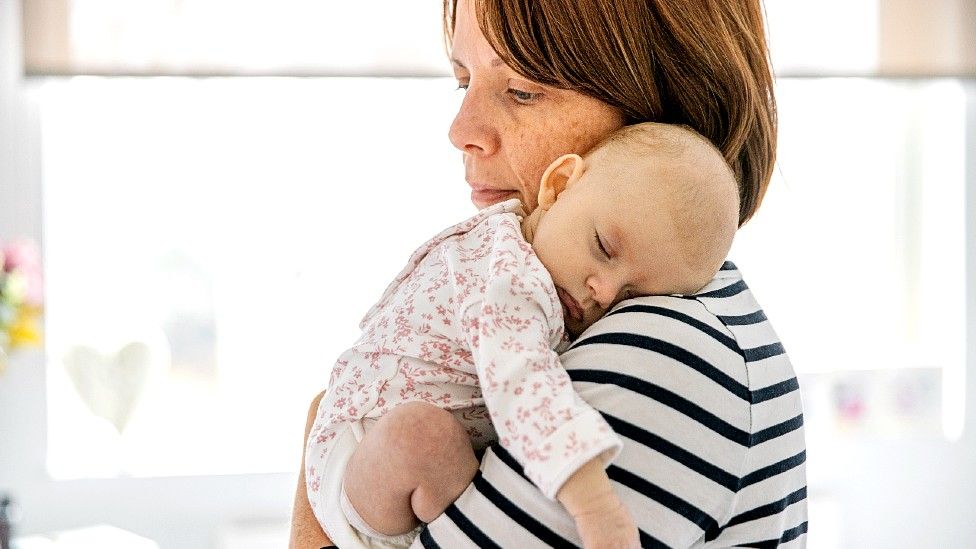
More new mothers over 40 than under 20 in Wales


The age of motherhood is shifting relentlessly upward

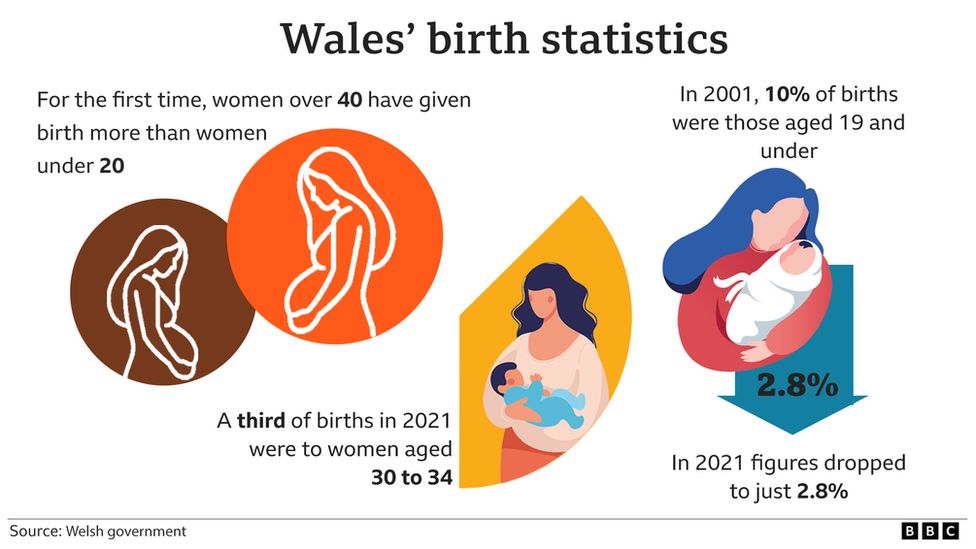
The number of women giving birth aged over 40 has overtaken the number under 20 years of age for the first time.


The change is part of a general rise in maternal age, with more births also among 35-39 year olds than 20-24 year olds for the first time.

A third of births in 2021 were to women aged 30 to 34, the largest category, figures from the Welsh government show.

A health expert said policies would need to be put in place if governments wanted people to have children earlier.

Since the turn of the millennium, there has been a steady downwards trend in births among younger women.

In 2001, just over 10% of births in Wales were to those aged 19 and under. This number has fallen every year since 2004, with last year's figures showing just 2.8% of births were to teenagers.
Increased education and career roles are big factors in later motherhood

However, it is still the case that in certain areas, teenage motherhood remains a normalised experience for a significant number.

Although figures from the 2021 census show the population of Wales and England has grown since the previous one a decade before, it also shows that the population as a whole - like its mothers - is getting older, with the percentage of people aged over 65 at 21.3%, up from 18.4% in 2011.

Wales has a lower number of under-15s than any part of England, except the south-west, at 16.5%, which has implications for future populations both in terms of looking after today's expanding numbers of elderly and for the future impact on workforce size.

Is this something society should be concerned about looking to the future?

Wales is catching up with birth trends elsewhere, Prof Jacky Boivin says

Prof Jacky Boivin, a professor in health psychology at Cardiff University, said one of the clear impacts of moving towards an older age of motherhood is that women have fewer children overall.

She said: "Wales is catching up to the rest of the world. These are trends that have been happening in other countries and it's just taken a little longer in Wales.

"As people get older and they postpone having children, the number of children they have drops off. It's rare that people who want to have a child will decide not to have a child at all; they'll have fewer children.

"That's the impact of waiting a long time."

She said there were multiple factors contributing to the rise of older mothers.

"It takes longer to be in education and therefore people kick the can of parenthood [further down the road] and that could be just education per se takes a long time, or it could be the choices people are making, so certain courses are more difficult to make more compatible with parenthood," she said.

"Because education is time intensive and more people are going through higher degrees, and those are also time intensive, then more people are postponing having children.

"People want their career to be at the right stage in order to start having children and ostensibly it's just for stability, especially for women, because they could lose opportunities for advancement or if they're out of the market, completely lose opportunities for training and so on."

The changing role of women had meant more options for them might also make having children a harder choice than it once was.

And, with the increased likelihood that women are equally or more educated than men, finding a suitable partner can be a barrier, as traditionally women like to "marry up", according to the professor.

"As women have become more and more educated, there are fewer men to marry up to, and so we need a cultural shift in the fact that women ought to marry up. There's no need for this now anymore but it still exists," she explained.

Are screens stopping young people having sex?


Young people have lost opportunities to socialise because of increased time online

The cost of childcare in the UK could also be a factor.

"In countries where you have very liberal policies about childcare, where you get the money at an early age, like in Scandinavia under the age of three, more women will have children sooner," said Prof Boivin.

"But in countries like Germany where they don't provide any childcare until the baby is five, it's because they have a pro-natalist policy that says you should have your children at an early age and we want the mother to stay home, basically.

"So obviously, these women are even more likely to postpone for reasons to do with that."

At the other end of the age spectrum, early stage research being done at the Vienna Institute of Demography is pointing to two things, Prof Boivin says: one being the relative ease of access to contraception for teenagers to help them avoid unwanted pregnancy.

The other will come as no surprise to parents of teenagers everywhere.

"Young people have got out of the socialisation style that could lead to sexual encounters and unplanned births, basically which is usually when we say less than 20 is what we're thinking about," she said.

"[My colleague in Vienna] relates that back to screen time and a loss of opportunity for young people to meet, and to want to meet."

What are her solutions to encourage more people to have children earlier?

"We need to destigmatise things like solo parenthood or sufficient policies like being a parent while in [higher] education," she said.

"There may need to be policies around that facilitate people starting early, despite not having reached their career stages and not completed their education."

Tuesday, June 7, 2022

Cognition-driven demographic transition

June 6, 2022 Wolfgang Lutz

The concept of demographic transition is a century old, but there is still no consensus about its drivers. Wolfgang Lutz highlights a recent reassessment of the theory, which adds cognition – the degree of rationality in our choices and our perception of the world – as a third element, in addition to socioeconomic and proximate determinants.

The future of global population trends will greatly depend on progress in the universal process of demographic transition. Although the concept of demographic transition, introduced by Warren Thompson (1929) and Alfred Landry (1934), is almost a century old, there is still little consensus about what drives this progressive decrease in death and birth rates from high and largely uncontrolled levels to low and controlled levels. Many partial explanations exist in the literature, focusing on economic costs and benefits, social value changes, or (reproductive) health-related public policies.

Reassessing demographic transition theory


In a recent book that attempts to reassess demographic transition as a theory with predictive power, I highlighted the importance of cognitive empowerment and abstraction skills associated with education as an essential factor in the onset of both mortality and fertility transitions (Lutz 2021). This book points at new evidence concerning the conditions of the first lasting mortality decline in Sweden and fertility decline in France: in both cases, rapidly increasing literacy among the female populations seemed to play a decisive role. In addition to individual-level cognitive empowerment, societal-level consequences of enlightenment also contributed to these behavioral innovations in the form of early public health measures in Sweden and general secularization in France.

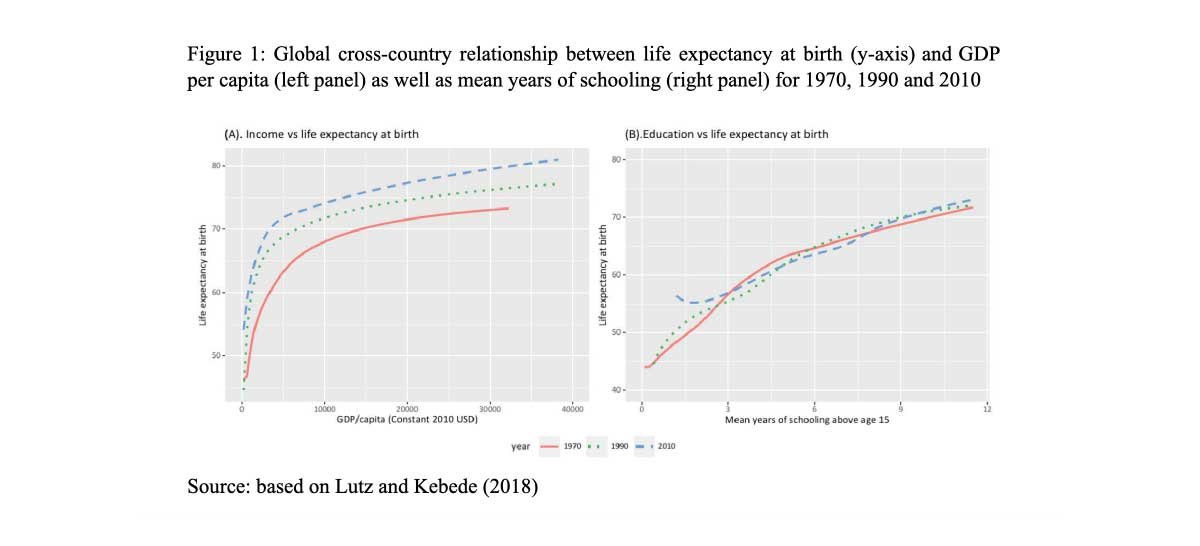
A summary of global fertility and mortality declines around the world over the past half-century also leads to the conclusion that education can explain the trends better than any other driver. Figure 1 illustrates this by revisiting the “Preston curve” that plots life expectancy against GDP per capita for different periods, revealing strongly diminishing returns to income as well as an unexplained upward shift over time (Preston 1975). When replacing income with education on the x-axis the pattern becomes almost linear, with no unexplained shift (Lutz and Kebede 2018). A press release summarized this by stating: “When it comes to survival, mind matters more than money”.

Three levels of determination


Based on his insights from the comprehensive Princeton European fertility project, Ansley Coale specified three necessary preconditions for a lasting fertility decline, the first of which says that “fertility needs to be within the calculus of conscious choice” (Coale 1973). This is a very clear reference to the decisive cognitive precondition of demographic transition. The other two preconditions are that lower fertility needs to be advantageous, and that acceptable means of birth control need to be available. In this context, the widely used distinction between proximate determinants and socioeconomic determinants, proposed by Bongaarts (1978), has become important: forces operating at these different levels of determination are not in competition with each other. Rather, they come in a sequence, such as contraception being a consequence of not wanting another birth. What I propose is to add a third, still deeper layer of explanation, referring to the changes in the way humans think.

One can generally distinguish between three different levels of determination:

  1. Cognition (in the mind/brain): degree to which choices are based on rational calculation rather than fatalistic behavioral patterns;
  2. External conditions (in the environment): motivation for behavioral choices depending on the costs and benefits implied by social, economic, and environmental living conditions;
  3. Proximate determinants: availability and acceptability of physical/technological means of implementation, such as contraceptives for fertility or vaccination/medication for health.

While demographers and social scientists in general tend to be familiar with the second and third level of determination and structure their analyses around them, the first is rarely mentioned. This is surprising, given the prominence of Ansley Coale and the fact that Etienne van de Walle in his PAA presidential address (1992) explicitly focused on this cognitive level. Under the title “Fertility Transition, Conscious Choice and Numeracy” he criticized much of the demographic and economic analysis for assuming that the choice for a particular family size is conscious and rational. He pointed to empirical studies in Africa where he had found high proportions of women who were not able to say how many children they wanted and rather referred to “God’s will”. He convincingly argued, both for historical Europe as well as for contemporary Africa, that numeracy about children and the norm of an ideal family size did not exist traditionally and only appeared shortly before the onset of the fertility transition. He concluded that there cannot be modern family limitation without such conceptualization of family size, which is indeed a deeply cognitive process. It requires abstraction skills that tend to be associated with numeracy and literacy. Several other influential papers on demographic transition – such as Cleland and Wilson (1987) – also point to ideational changes as drivers of the fertility transition rather than changing economic conditions or contraceptive methods.

Education as a proxy for cognition


In most demographic studies, education is seen merely as a proxy for socioeconomic status (SES). This is not entirely wrong since more education typically leads to more income and higher SES. But it is incomplete since there is much more to education than its impact on SES. Education literally changes our brains for the rest of our life. Every repeated learning experience makes us anatomically different people – as stressed by the Nobel laureate in medicine Erik Kandel (2007) – by building new synapses in our brains. All further learning and all choices made will build on these established synaptic structures. In developmental psychology, it has also been shown beyond doubt that education alters the way we perceive the world, changes our planning horizon, the degree to which we think abstractly and can imagine counterfactual scenarios, all things that matter for our choices and our behavior. This is true in general, but also specifically for choices in reproductive and health-related behavior.

Postscript: While economists have started to acknowledge bounded rationality in their models, to my knowledge there is still little work that tries to distinguish quantitatively between different degrees of rationality as captured by education categories, accounting for the changing proportions of individuals in the different education categories over time. Maybe, demographers could help with such efforts.

References

  • Bongaarts, J. (1978). A framework for analyzing the proximate determinants of fertility. Population and Development Review, 4(1), 105–132. https://doi.org/10.2307/1972149
  • Cleland, J. and C. Wilson (1987). Demand Theories of the Fertility Transition: An iconoclastic view. Population Studies 41:5-30.
  • Coale, A. J. (1973). The demographic transition reconsidered. Proceedings of the International Population Conference, 1, 53–72.
  • Kandel, E. R. (2007). In search of memory: The emergence of a new science of mind. W.W. Norton & Co.
  • Landry, A. (1934). La révolution démographique. Études et essais sur les problèmes de la population. Recueil Sirey.
  • Lutz, W. (2021). Advanced introduction to demography. Edward Elgar Publishing.
  • Lutz, W., & Kebede, E. (2018). Education and health: Redrawing the Preston curve. Population and Development Review, 44(2), 343–361. https://doi.org/10.1111/padr.12141
  • Preston, S. H. (1975). The changing relation between mortality and level of economic development. Population Studies, 29(2), 231–248. https://doi.org/10.2307/2173509
  • Thompson, W. (1929). Population. American Journal of Sociology, 34(6), 959–975.
  • van de Walle, E. (1992). Fertility transition, conscious choice, and numeracy. Demography, 29(4), 487–502.

Thursday, May 5, 2022

demographic transition in Africa

Wednesday, March 23, 2022

A LITTLE LESS

Although population growth in the 20th and 21st centuries has skyrocketed, it can be slowed, stopped and reversed through actions which enhance global justice and improve people's lives. Under the United Nations’ most optimistic scenario, a sustainable reduction in global population could happen within decades.


We need to take many actions to reduce the impact of those of us already here – especially the richest of us who have the largest environmental impact – including through reducing consumption to sustainable levels, and systemic economic changes.

One of the most effective steps we can take to reduce our collective environmental impact is to choose smaller family size, and empower those who can't make that choice freely to do so.

A LITTLE LESS MAKES A LOT OF DIFFERENCE


The United Nations makes a range of projections for future population growth, based on assumptions about how long people will live, what the fertility rate will be in different countries and how many people of childbearing age there will be. Its main population prediction is in the middle of that range – 9.7bn in 2050 and 10.9bn in 2100.

It also calculates that if, on average, every other family had one fewer child than it has assumed (i.e. 'half a child less' per family), there will be one billion fewer of us than it expects by 2050 – and nearly four billion fewer by the end of the century (within the lifetimes of many children born now). If that happens, our population will be smaller than it is today.

WE CAN BRING BIRTH RATES DOWN


Many countries have had success in reducing their birth rates. Thailand, for instance, reduced its fertility rate (the average number of children per woman) by nearly 75% in just two generations with a targeted, creative and ethical family planning programme.

In the last ten years alone, fertility rates in Asia have dropped by nearly 10%.


1) EMPOWERING WOMEN AND GIRLS


Where women and girls are empowered to choose what happens to their bodies and lives, fertility rates plummet. Empowerment means freedom to pursue education and a career, economic independence, easy access to sexual and reproductive healthcare, and ending horrific injustices like child marriage and gender-based violence. Overall, advancing the rights of women and girls is one of the most powerful solutions to our greatest environmental and social crises. Solutions 2 and 3 below are both tightly linked with female empowerment.

2) REMOVING BARRIERS TO CONTRACEPTION


Currently, more than 200 million women who want to avoid pregnancy are not using modern contraception. There are a variety of reasons for this, including lack of access, concerns about side-effects and social pressure (often from male partners) not to use it. These women mostly live in some of the world’s poorest countries, where population is set to rise by 3 billion by 2100. Overseas aid support for family planning is essential – both ensuring levels are high enough and that delivery of service is effective and goes hand-in-hand with advancing gender equality and engaging men.

Across the world, some people choose not to use contraception because they are influenced by assumptions, practices and pressures within their nations or communities. In some places, very large family sizes are considered desirable; in others, the use of contraception is discouraged or forbidden. Work with women and men to change attitudes towards contraception and family size has formed a key part of successful family planning programmes. Religious barriers may also be overturned or sidelined. In Iran, a very successful family planning campaign was initiated when the country’s religious leader declared the use of contraception was consistent with Islamic belief. In Europe, some predominantly Catholic countries such as Portugal and Italy have some of the lowest fertility rates.

3) QUALITY EDUCATION FOR ALL


Ensuring every child receives a quality education is one of the most effective levers for sustainable development. Many kids in developing countries are out of school, with girls affected more than boys due to gender inequality. Education opens doors and provides disadvantaged kids and young people with a "way out". There is a direct correlation between the number of years a woman spends in education and how many children she ends up having. According to one study, African women with no education have, on average, 5.4 children; women who have completed secondary school have 2.7 and those who have a college education have 2.2. When family sizes are smaller, that also empowers women to gain education, take work and improve their economic opportunities.

A UN survey showed that the more educated respondents were, the more likely they were to believe that there is a climate emergency. This means that higher levels of education lead to the election of politicians with stronger environmental policy agendas.

Only 39% of countries have as many girls as boys enrolled in secondary education.

4) GLOBAL JUSTICE AND SUSTAINABLE ECONOMIES


The UN projects that population growth over the next century will be driven by the world’s very poorest countries. Escaping poverty is not just a fundamental human right but a vital way to bring birth rates down. The solutions above all help to decrease poverty. In addition, lower child mortality through improved access to health care and better economic opportunities lead to smaller family size also. International aid, fair trade and global justice are all tools to help bring global population back to sustainable levels. A more equal distribution of resources and transitioning away from our damaging growth-dependent economic systems are key to a better future for people and planet.

5) EXERCISING THE CHOICE


In the developed world, most of us have the power to choose the size of our families – although we may also face pressures of all kinds over the size of the families we choose to have. When making choices about that, it's important to remember that people in the rich parts of the world have a disproportionate impact on the global environment through our high level of consumption and greenhouse gas emissions – in the UK, for instance, each individual produces 70 times more carbon dioxide emissions than someone from Niger. When we understand the implications for our environment and our children’s futures of a growing population, we can recognize that choosing smaller families is one positive choice we can make.

Friday, January 28, 2022

the transition to where?

Thursday, October 14, 2021

Minor contribution of migration to urbanization in low- and middle-income countries

September 27, 2021 Ashira Menashe-Oren and Philippe Bocquier

In contrast to the prevalent notion that rural-to-urban migration drives urbanization, Ashira Menashe-Oren and Philippe Bocquier find that the role of migration (and reclassification) in urbanization was small between 1985 and 2015 across low- and middle-income countries. The main push to urbanization came from differential rural/urban natural increase.

Urbanization involves a shift of populations from one area to another, and is associated with changing social and economic structures. Here, we use the term “urbanization” to refer to the difference between urban and rural rates of growth (a differential rate of growth). In contrast, we refer to the proportion of people living in the urban sector, and its change over time as the “proportion or percent urban”.

Urbanization is determined by four possible proximate causes, often occurring together:

  1. faster urban than rural natural growth,
  2. internal migration (between rural and urban areas),
  3. international migration, and
  4. reclassification (administrative changes in boundaries or in the definition of “urban”).
Historically, in 19th century Europe, internal migration played a major role in the urban transition, which occurred in parallel with the demographic transition (de Vries 1990; Dyson 2011). Initially, as deaths outnumbered births in the urban sector, migration was the sole driver of urban growth. Later on, however, with the rapid mortality decline in cities, the picture began to change. In Sweden, for example, it was urban mortality reduction between 1840 and 1880 that unleashed the urban transition (Bocquier and Costa 2015; Bocquier and Brée 2018). Later still, when mortality also declined in rural areas, better survival created larger pools of potential migrants.

In the late 20th century , internal migration accounted for just 40% of urban growth, on average, in low- and middle- income countries, although regional variability was high (Chen et al. 1998; Preston 1979):
  • In sub-Saharan Africa, still predominantly rural today, migration to the urban sector slowed down from the 1980s, partly as a consequence of the structural adjustment programs that imposed a drastic reduction of public spending. Cities, which were the main beneficiaries of public spending, suddenly became less attractive for migrants.
  • In Asia, where levels of urbanization are also still relatively low today, the economic success of cities, megacities in particular, has proved attractive for migrants.
  • In contrast, in Latin America, where urbanization levels are now high (a large majority of the population lives in cities), secondary cities have attracted more migrants than large cities.

Indirect estimation of internal migration


To assess the contribution of demographic factors to urbanization, estimates of internal migration are needed. However, such data are rarely available in low- and middle-income countries, and when they are, serious issues of comparability arise, including the lack of a standardized definition of “urban”. To overcome these limitations, in our recent research we applied an indirect method to determine the role of internal migration in urbanization based on harmonized UN population data (Menashe-Oren and Bocquier 2021). For each rural/urban sector within each country and each period, migration was estimated indirectly as follows:
  1. starting from the initial population, a theoretical final population was calculated, based exclusively on fertility and survival,
  2. the actual final population was then compared with the theoretical one, and
  3. the difference was attributed to migration (or to reclassification of a sector from rural to urban, but here we will not try to distinguish between the two).

This so-called residual method is subject to a few limitations (such as assumptions about survival rates and disregard for international migration), but when the order of magnitude of the estimated components is high, and the data of decent quality, it leads to reasonable results.
The contribution of migration to urbanization depends on the stage of urban transition

As urbanization progressed, between 1985-2015, net migration from the rural to the urban sector declined in low- and middle-income countries, and national trajectories became more diversified. Figure 1 illustrates regional variations in urbanization (difference between urban and rural growth). In the countries of North Africa and West Asia where the proportions urban were already high in 1985 (70% and over), urbanization declined without much change in the proportion of people living in the urban sector. Urbanization also clearly slowed down in West and Central Africa, although the proportions urban increased substantially over the 30-year period. By contrast, in East and South Africa, urbanization increased in many (although not in all) countries.

Overall, while all countries have become increasingly urban, each country seems to have done so differently, with some commonalities within certain regions.
From the early stages of the urban transition, when about 30% of the population was urban, the contribution of natural increase to urbanization was greater than that of internal migration and reclassification (Figure 2, right panel). This is likely because of mortality decline, which occurred earlier in urban areas and led to greater urban natural growth. Fertility may also have played a role, as in sub-Saharan Africa where it has stalled, in the urban sector especially (Sánchez-Páez and Schoumaker 2020).

Conclusions


Although most people commonly think of migration as the leading cause of urbanization, this has not, in fact, been the case in low- and middle-income countries over the past 30 years or so. Natural increase has played a larger role, mostly due to lower under-five mortality in the urban than in the rural sector. We also show that the contribution of migration to urbanization tends to decline as countries become more urban.

References

  • Bocquier, P., & Brée, S. (2018). A regional perspective on the economic determinants of urban transition in 19th-century France. Demographic Research, 38(1), 1535–1576. doi:10.4054/DemRes.2018.38.50
  • Bocquier, P., & Costa, R. (2015). Which transition comes first ? Urban and demographic transitions in Belgium and Sweden. Demographic Research, 33(December), 1297–1332. doi:10.4054/DemRes.2015.33.48
  • Chen, N., Valente, P., & Zlotnik, H. (1998). What do We Know about Recent Trends in Urbanisation? In R. E. Bilsborrow (Ed.), Migration, Urbanisation and Development: New Directions and Issues (pp. 59–88). United Nations Population Fund and Kluwer Academic Publishers.
  • de Vries, J. (1990). Problems in the Measurement, Description and Analysis of Historical Urbanization. In A. M. Van Der Woude, A. Hayami, & J. De Vries (Eds.), Urbanization in history: A process of dynamic interactions (pp. 43–73). Oxford: Clarendon Press.
  • Dyson, T. (2011). The role of the demographic transition in the process of urbanization. Population and Development Review, 37(Suppl 1), 34–54.
  • Menashe-Oren, A., & Bocquier, P. (2021). Urbanization Is No Longer Driven by Migration in Low- and Middle-Income Countries (1985 – 2015). Population and Development Review, 0, 1–25. doi:10.1111/padr.12407
  • Preston, S. H. (1979). Urban Growth in Developing Countries : A Demographic Reappraisal. Population and Development Review, 5(2), 195–215.
  • Sánchez-Páez, D. A., & Schoumaker, B. (2020). What do we know about fertility stalls in Africa? A literature review (No. 16).

Wednesday, September 8, 2021

Slower population growth signals successes and benefits

September 2, 2021 by Joel E. Cohen and Joseph Chamie

Results from 2020 population censuses for the United States and China made headlines about population collapse, baby busts and demographic decline. Lopsided lamentations have given little attention to the social, economic and environmental benefits of slower growth. Joel E. Cohen and Joseph Chamie argue instead that the slowdown in population growth signals successes and benefits for America, China, and the Earth.

The past


Results from the 2020 population censuses in the United States and China recently made headlines. But rather than recognizing the social, economic, environmental and climatic benefits of slower rates of population growth for the U.S., China and the planet, much of the print and broadcast media in the U.S. stressed the downsides of slower growth and chose to write about population collapse, baby bust and demographic decline.

The U.S. population increase of 7.4 percent from 2010 to 2020 was the second lowest rate of growth since the country’s first census in 1790, and half the typical growth rates since 1790. Only during the Great Depression of the 1930s did U.S. population grow more slowly, by 7.3 percent. Even slower rates of growth are expected in the coming decades (Figure 1).

China’s population grew 5.3 percent in the decade ending in 2020, the lowest decadal growth rate since the catastrophic famine of the late 1950s. India projects for 2011-2021 its lowest decadal rate of population growth, 12.5 percent, since its independence.

The present


Lopsided lamentations have focused on the downsides of slower population growth. For example, some commentators who favor more rapid U.S. population growth contend that Americans would like to have more children than they are presently having. However, while this is the case for some American couples, others want fewer children. In 2011 (the latest available year), of the 6.1 million pregnancies in the United States, 1.6 million (27 percent) were mistimed and 1.1 million (18 percent) were unwanted at any time. Of all U.S. pregnancies in 2011, 45 percent were not intended (Guttmacher Institute 2019).

Some public handwringers maintain that a large population size aids the United States’ competition for economic and geopolitical dominance with China. But the mercantilist view that there is strength in numbers alone is obsolete by centuries. A large or rapidly growing population is hardly necessary or sufficient for prosperity.

Finland, ranked the happiest country in the world, has a total fertility rate of 1.4, compared to 1.6 in the U.S., 0.8 in South Korea, 1.1 in Singapore, 1.3 in Italy, 1.4 in Japan, 1.5 in Norway and 1.7 in Denmark. Women in China currently have 1.3 children on average, markedly fewer than in the United States (Figure 2).

The future


Some advocates of more rapid population growth argue that it would permit more people who want to migrate to the U.S. to do so. About 158 million adults in other countries would like to move and settle permanently in the U.S., according to the Gallup poll in 2018 (Esipova, Pugliese and Ray 2018). Would the U.S. willingly accept many or most of these would-be migrants?

More rapid population growth, especially through increased immigration of working-age adults, would temporarily ease the pressures on pay-as-you-go public programs for the elderly, particularly Social Security and Medicare in the U.S., by broadening the country’s tax base. But there’s a catch: in the future, those additional workers would retire, requiring additional workers to broaden the tax base again for the retiring workers. This demographic expansion would need to continue indefinitely.

Public discussion in the U.S. has largely ignored the notable social, economic and environmental upsides of slower American population growth. Slower population growth increases economic opportunities for women and minority groups, and exerts upward pressures on wages, especially for unskilled labor. For a given rate of capital investment, slower population growth also raises capital per person, raising productivity. The Gross Domestic Product (GDP) grows more slowly, but GDP per person grows faster.

All else equal, slower population growth lessens America’s contributions to climate change, biodiversity loss, deforestation, and pollution from commercial, industrial, agricultural, and domestic activities, such as heating and cooling buildings and fueling transport. Slower population growth makes it easier for governments, schools, and civic and religious organizations to respond more fully to increasing demands.

Worries about impending demographic doom for the U.S. seem decidedly misplaced. The United Nations (2019) projects that the populations of 55 countries or areas will decrease by 1 percent or more between 2020 and 2050. China’s population is projected to fall by almost 3 percent, Italy’s by 10 percent and Japan’s by 16 percent (Figure 3). By contrast, the population of the United States, currently at 333 million, is projected to grow by nearly 14 percent, largely through immigration, to 379 million by 2050.

The world’s population growth rate peaked in the 1960s and is falling in most regions except sub-Saharan Africa, which is the last major region to go through the demographic transition from high rates of mortality and fertility to relatively low rates. Whereas the U.S. population increased nearly four-fold during the 20th century, it is expected to increase by roughly 50 percent in the 21st century.

Conclusions


The United States and many other countries, including China, face real population challenges, but not principally slower population growth or even gradual population decline. These include addressing the needs of a rapidly aging population, managing cities and economies in recognition of climate change and environmental degradation, regulating and responding to migration, enabling people to have the children they want through reproductive health care and child-care support, and maintaining competitive technological change with better investments in education and worker training.

As COVID-19 has clearly demonstrated worldwide, real population challenges include protecting people against future pandemics and raising the value placed on today’s children, who are tomorrow’s problem solvers. In 2021, 22 percent of all children under age 5 years were stunted from chronic undernutrition (UNICEF, WHO, World Bank Group 2021), despite record cereal production globally (FAO 2021).

The global slowdown in population growth rates is not a transitory demographic problem: it signals important durable successes. It has encouraging implications for climate change and the environment. Couples are having fewer children in an increasingly urbanized world while men and women pursue education, employment and careers and live longer than ever before.

It is time to recognize that slower population growth benefits America, China, and the Earth.

References


Monday, April 19, 2021

Demographic transition in Japan

Демографическая контрреволюция в Японии


[название оригинальное, но почему контрреволюция — не понял, видимо, неспециальный смысл]
Троицкий вариант, 06.04.2021 / № 326 / с. 13 / Александр Мещеряков

Япония сейчас входит в число стран c наиболее высокой продолжительностью жизни (81 год для мужчин и 87 для женщин) и наиболее низкой рождаемостью в мире (1,4 ребенка на одну женщину). Однако в совсем недалекое по историческим меркам время эти показатели были совершенно другими. Почему же Япония превратилась в страну малодетных?

В результате поражения во Второй мировой войне Япония в одночасье лишилась колоний и отказалась от экспансионистских устремлений. Страна была оккупирована американской армией, лежала в руинах, большинство крупных городов было разбомблено, ощущалась острая нехватка всех жизненно важных ресурсов. Люди подголадывали. Если бы не поставки из Америки, в стране разразился бы настоящий голод.

Продовольственный кризис осложнялся демографической ситуацией. Из бывших колоний и с линии фронта на родину вернулось около 7 млн человек (конечно, в основном мужчины). Перепись 1947 года насчитала 78 101 473 японца. Их количество стремительно увеличивалось: с 1947 по 1949 год появлялось на свет около 2 млн 700 тыс. младенцев ежегодно. Эти «отложенные рождения» быстро компенсировали военные потери Японии (около 3 млн человек), но значительно влияли на уровень благосостояния (а в то время — скорее бедности) людей.

В других странах, принимавших участие в войне, рождаемость тоже резко повысилась. Поскольку это происходило на фоне экономической разрухи и нехватки продовольствия, стали часто говорить о перенаселенности земного шара. Это мнение активно обсуждалось и в Японии. В предвоенные и военные годы деятельность активистов движения за снижение рождаемости находилась под запретом. Официальная демографическая политика тоталитарной Японии состояла в поощрении рождаемости, ибо экспансионистские проекты государства требовали всё больше людей. Однако теперь обстоятельства изменились.

Решением стран антигитлеровской и антияпонской коалиции выезд за пределы страны был строго ограничен, поэтому Япония была лишена возможности решать свои демографические проблемы за счет эмиграции. Американская оккупационная администрация во главе с генералом Дугласом Макартуром внимательно следила за всем, что происходило в стране. Демографическая ситуация не была исключением. Во время неформальных контактов с местной политической элитой американцы убеждали ее в необходимости активной демографической политики, направленной на ограничение рождаемости.

Американцы не проводили масштабной чистки среди японских государственных служащих, многие сохранили свои должности и в государственном аппарате «новой» Японии. Хотя совсем недавно они ратовали за увеличение рождаемости, большинство из них поддалось уговорам и согласилось, что насущной необходимостью является совсем иная демографическая политика. Государственный Институт демографических проблем тоже не стал упрямиться: изменил свою демографическую ориентацию и приступил к разработке мер по сокращению рождаемости. Менялись времена, менялись и люди.

В 1948 году были разрешены аборты (раньше они допускались только в случае ограниченного круга наследственных заболеваний, главным образом психических). В 1949 году этот закон был дополнен: он разрешал прерывание беременности «по экономическим основаниям». Таким образом, Япония продемонстрировала небывалую смелость и стала первой страной в мире, где бедность признавалась достаточным основанием для аборта. С самых высоких трибун утверждалось, что снятие запрета на аборты самым благоприятным образом повлияет на состояние нации. Раньше дети рассматривались как будущие солдаты и рабочие, теперь на них стали смотреть как на обузу и иждивенцев, помеху для экономического развития и завтрашних нищих, требующих расходов и опеки со стороны государства.

Японкам в одночасье было даровано сверху то право, за которое на Западе феминистские движения боролись десятилетиями. Законопроект был одобрен единогласно, хотя в то время политические партии редко соглашались друг с другом. Одновременно развернулась и мощная пропагандистская кампания в пользу ограничения рождаемости.

Американская оккупационная администрация воздерживалась от официальных заявлений по поводу демографических вопросов, утверждая, что они находятся в компетенции самих японцев. По всей вероятности, такая «нейтральная» позиция была обусловлена особой деликатностью проблемы, решение которой предполагало не просто сокращение рождаемости, а разрушение дорогих сердцу японца поведенческих стереотипов. Главный из них состоял в том, что много детей — это хорошо.

В качестве советника американской администрации привлекли знаменитого ученого Уоррена Томпсона, одного из основных авторов теории демографического перехода, согласно которой индустриализация приводит к одновременному падению рождаемости и смертности. В марте 1949 года Томпсон выступил в Японии с заявлением о необходимости контроля над рождаемостью. Главный аргумент состоял в том, что многодетность мешает развитию страны, а именно развитие экономики и сопутствующее ей повышение жизненного уровня стали стержнем новой «демократической» Японии. Томпсон высказал и прямые угрозы: если японцы не снизят рождаемость, это может привести или к прекращению продовольственной помощи США, или к коммунизму, или к возрождению милитаризма.

Заявление Томпсона преподносилось оккупационной администрацией как «личное мнение», но справедливо воспринималось японцами как ее официальный курс. Если до этого времени крупные газеты позволяли себе публиковать разные точки зрения по демографическим проблемам, то теперь право голоса предоставлялось по преимуществу проповедникам идеологии «планирования семьи». Все они исходили из тезиса о перенаселенности Японии, которое имеет множество отрицательных последствий. Утверждалось, что понижение рождаемости предотвратит безработицу, поможет женщине обрести свое «я», лишит жадных капиталистов избыточной рабочей силы и избыточной прибыли, предотвратит «отрицательный отбор» (ввиду того, что «низы общества» сократят свое неконтролируемое размножение) и т. д. Иными словами, мыслители самого разного толка были уверены в окончательном выводе, но обосновывали его по-разному.
japanese family
Японская семья (1950-е годы). Vintage Japan-esque/Flickr, CC BY-NC-SA 2.0

Реклама противозачаточных средств заняла видное место на страницах газет и журналов. Супружеские пары с двумя детьми ставились в образец, их называли «культурными людьми». Тех же, кто противился сокращению рождаемости, квалифицировали как «безответственных». Средства массовой информации утверждали: важен не размер семьи, а ее финансовая стабильность, здоровье, культурный и образовательный уровень детей. До войны многодетные семьи награждали грамотами, теперь эта практика была упразднена. Пособия и льготы для многодетных тоже отменили.

Пропагандистская кампания предусматривала участие акушерок и медсестер, которые обходили дома жителей, убеждая их в необходимости «планирования семьи». На крупных предприятиях в конверт с зарплатой вкладывали материалы, разъясняющие преимущества маленькой семьи. Члены движения за ограничение рождаемости торговали презервативами по оптовым ценам и рисовали образ счастливой семьи, состоящей из двух родителей и двух детей. Иными словами, произошел колоссальный отход от ценностей довоенного и военного времени. Тогда ценилась мощь государства, а «эгоистичного» японца пугали лозунгом: «Роскошь — наш враг». Те годы характеризовались в государственном дискурсе презрением к «гнилой» интеллигенции: считалось, что здоровые, послушные, многодетные и малообразованные крестьяне являются стержнем государства. Теперь же во главу угла поставили образование, а в экономической сфере был взят курс на уничтожение сельского хозяйства и крестьянства. Ставку сделали на развитие науки и наукоемкого производства с высокой добавленной стоимостью.

До войны рождение ребенка рассматривалось как служение родине, теперь же говорили о совпадении интересов семьи и государства. Разница в подходах была колоссальной, но не вызывает сомнения и преемственность: и в том и в другом случае государство выступало в качестве «мудрой» направляющей и дисциплинирующей силы.

Разумеется, разрушение привычного порядка не могло не вызвать и определенного противодействия.

Японские коммунисты поначалу поддерживали новую демографическую политику, но затем склонились к точке зрения, которая была распространена в СССР. Учение Маркса и Ленина предполагало, что абсолютной перенаселенности, о которой говорил еще Мальтус, не существует, есть лишь «относительная» перенаселенность, обусловленная «звериной» природой капитализма, заинтересованного в безработице. Эта перенаселенность легко преодолевается в «передовом» социалистическом обществе с помощью установления «справедливых» общественных отношений и «справедливого» распределения материальных благ. Понятие «мальтузианство» употреблялось в советском дискурсе исключительно как бранное и квалифицировалось как «система человеконенавистнических взглядов». На этом основании японские коммунисты, которые в то время еще смотрели на Кремль как на светоч, стали обвинять японскую политическую элиту в мальтузианстве, настаивая на том, что вопрос о количестве детей в семье является делом свободного выбора.

Однако курс правительства оставался прежним. Задачей номер один считался срочный подъем жизненного уровня. Он воспринимался не только как важнейший показатель «цивилизованного» государства, но и как щит против коммунистов, которые пользовались тогда большим влиянием.

Некоторые уважаемые и вполне «системные» люди тоже высказывали опасения относительно новшеств в семейной политике. Однако если рассматривать ситуацию в целом, оппонентов политики снижения рождаемости оказалось на удивление мало, и японцы в очередной раз продемонстрировали уникальную подверженность правительственной пропаганде. Даже после вчистую проигранной войны среди населения сохранялась исключительно высокая степень доверия к правительству и его инициативам — независимо от их качества.

Разъяснительная работа и пропаганда принесли ошеломляющие результаты: беби-бум удалось остановить по историческим меркам почти мгновенно. Всего через три года с начала кампании за малодетность, в 1952 году, суммарный коэффициент рождаемости (средняя фертильность женщины) упал с 4,6 до менее чем трех детей. Если в 1947 году рождаемость составляла 34 промилле, то в 1957-м — ровно вдвое меньше, а рождаемость к этому времени упала до уровня простого воспроизводства и составила чуть более двух детей на одну женщину.

Внедрение противозачаточных средств в повседневную жизнь происходило медленно. Так что уменьшение рождаемости произошло в первую очередь за счет увеличения числа абортов: их ежегодное количество возросло со 101 тыс. в 1949 году до 1 млн 170 тыс. в 1955 году. Злые языки утверждали, что молодые женщины расценивают поход в абортарий точно так же, как визит к парикмахеру.

Постепенно увеличивалось и применение противозачаточных средств, которые стали вытеснять аборты как средство планирования семьи. Если в 1950 году их использовали 19,5% женщин в возрасте до 50 лет, то в 1957 году таковых стало 40%. В основном они полагались на крайне ненадежные презервативы. Противозачаточные пилюли были разрешены только в 1999 году.

Ни в одной стране мира переход к обществу с низкой рождаемостью и низкой смертностью не произошел с такой скоростью, как в Японии. При этом правительство не прибегало ни к каким запретительным мерам (как это произошло впоследствии в Китае), дискриминации многодетных семей тоже не проводилось. Управление репродуктивным поведением населения ограничивалось словесным воздействием, своего рода лингвистическим программированием. «Демографической революцией» принято именовать стремительный рост населения. Под это определение подпадает Япония конца XIX — начала ХХ веков, когда всего за три десятка лет ее население возросло с 35 до 55 млн человек. В послевоенной же Японии случилась демографическая контрреволюция.

Радикальное снижение рождаемости сопровождалось экономическим подъемом, ростом благосостояния и продолжительности жизни. Если в 1947 году продолжительность жизни составляла 50 лет (мужчины) и 54 года (женщины), то в 1957 году эти показатели возросли до 64 и 68 лет. Япония совершила фантастический рывок в экономике. Но сама жизнь стала совсем другой.

Демографическая контрреволюция привела к колоссальным изменениям в японском обществе. Это касается не только численного состава семьи, но и картины мира в целом. В 1950 году 67% родителей рассчитывали на помощь детей в пожилом возрасте, в 1963-м — 33%, а в ­1975-м — 26%. Поскольку детей становилось всё меньше, они становились всё более эгоистичными. Если раньше в паре родители — дети главенствующее положение занимали родители, о которых были обязаны заботиться выросшие дети, то теперь родители вкладывали всё больше средств в немногочисленных детей, главной обязанностью которых было хорошо учиться.

Прогресс восторжествовал, «косные» ценности были побеждены, количество домов престарелых постоянно увеличивалось. Послевоенная демографическая политика предполагала сокращение числа иждивенцев за счет снижения рождаемости. Однако в настоящее время число иждивенцев всё равно стремительно растет ввиду быстрого старения нации.

Распад традиционной семьи не означал, что семья как высочайшая идеологическая ценность перестала быть идеалом. Государство перестало восприниматься как семья во главе с императором (что было характерно для довоенной Японии), но эта семейная метафора перекочевала в производственные отношения. Именно после войны расцвела японская концепция менеджмента: фирма — это семья с пожизненным наймом и «родственным» участием в прибылях. Поскольку метафора распространялась прежде всего на мужчин (участие женщин в производственной деятельности оставалось ограниченным), то это было лишь подобие семьи, ее суррогат. Предназначение традиционной семьи — принесение потомства; псевдосемья порождает товары и услуги. В том числе и для детей, которые все-таки увидели этот свет.

Friday, March 26, 2021

Julius Wolf

Julius Wolf 1913
Julius Wolf
Сейчас читаю книжку, там ссылка на Julius Wolf Die neue Sexualmoral und das Geburtenproblem unserer Tage, G. Fischer, 1928 - Всего страниц: 182

Я бы перевёл: Новая половая мораль и проблема рождаемости в наше время, наше время — это начало 20х годов 20 века, или 100 лет тому, приблизительно.

Так вот автор цитирует: Вольф на 6й странице пишет, что в Германии проведено около 600 тысяч абортов, и!!! что главным инструментом перехода к низкой рождаемости послужила не контрацепция (как в Англии, откуда автор), а аборты, точнее, их широкое распространение: доступность, включая дешевизну (это отсебятина), и качество. 

Так вот в 1925 году в Германии было 63 млн чел, для простоты 60 млн, половина из них (меньше конечно, но условно) — мужчины, и ещё половина женщины репродуктивного возраста, относительно которых можно говорить об аборте, получается 15 млн.

600 тыс/15 млн=.04 или 40 на 1000, то-есть, в 4! раза больше, чем сейчас в РФ, а 40 у нас было в 2004 году, при этом в Германии на 1 аборт приходилось 2 рождения. У нас ситуация 2004 года была около 1 к 1, но и рождаемость поменьше. Тем не менее, переход на лице, вполне возможно ситуация и 1 к 1 и 2 к 1, если не вру, об этом и Садвокасова писала.

Автор, как оказалось, левый (политически), верить особо нельзя, но х.з, 1.х любопытно
Ксенофобия и любовь к немцам возложим на лорда, оно и понятно — межвоенное время


Thursday, November 26, 2020

Does population aging erode democratic support?

Published on N-IUSSP.ORG November 23, 2020
Uwe Sunde

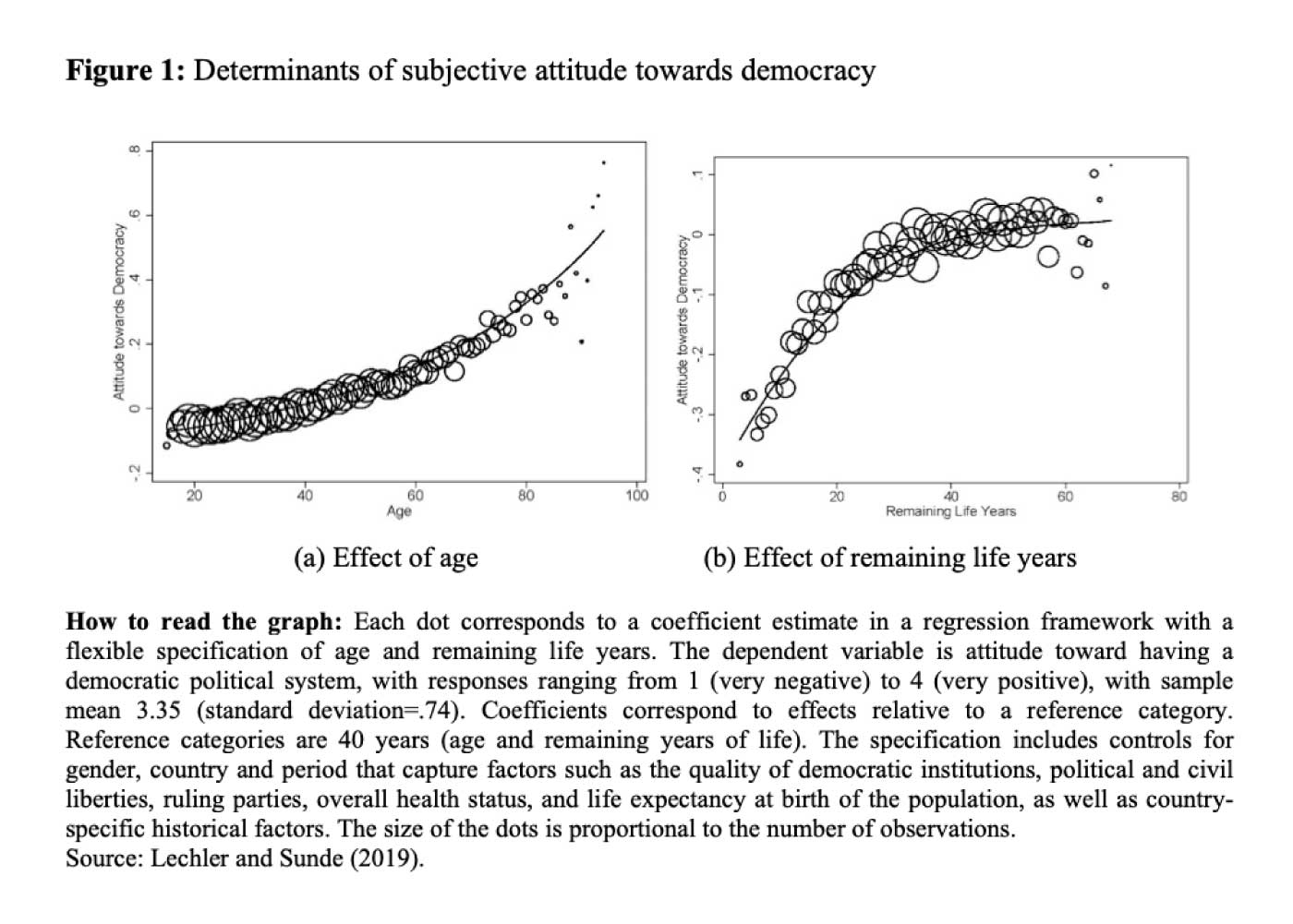
Individual support for democracy in the population is essential for the stability of democracies. However, not much is known about how demographic change, such as population aging, affects attitudes in this respect. Uwe Sunde shows that support for democracy increases with age, but declines with expected proximity to death. This suggests that a reduction in life expectancy at given ages, for instance in the context of epidemics, might weaken this support.

After decades of worldwide expansion, the model of Western democracy seems to be slipping into recession. Traditionally, the emergence of democracy has been explained by socio-economic determinants at the country levels, such as income, education, or inequality (Lipset, 1959, Inglehart and Welzel, 2005). Only recently has attention shifted to the determinants of individual preferences for democracy, and here too, socioeconomic factors have been identified (Inglehart and Welzel, 2010). Individual experiences, such as lifetime exposure to democracy, have also been shown to affect institutional preferences (Fuchs-Schündeln and Schündeln, 2015).

Much less is known about the role played by demographic factors. Political scientists have only recently pointed up the close links between demographic change and support for democracy, focusing mainly on population aging related to the demographic transition, and migratory pressure (Goldstone and Diamond, 2020).

An interesting yet subtle point in this context is the role of individual age for democratic support. Do young individuals have less interest in a democracy than older individuals who have a richer set of lifetime experiences? Or are the elderly more indifferent to the political regime, potentially because of a shorter expected life span? Do age and remaining length of life affect preferences for democracy in different ways?

From a conceptual perspective, it is natural to assume that the individual life horizon – the expected length of remaining life – should matter more for attitudes or preferences toward a particular political regime than age, simply because the related costs and benefits will be borne by individuals in the future. Historically, life expectancy indeed seems to have influenced institutional development. For instance, the mortality of colonizers has been isolated as a critical determinant of the quality of institutions, which tended to be more exploitative where survival was lower. Based on the conventional indices of political institutions, this differential still exists today (Acemoglu, Johnson and Robinson, 2001).

Disentangling age and individual life horizon


To explore the distinct roles of age and length of life for attitudes toward democracy, recent work has used data from surveys of more than 260,000 respondents from 93 countries across the world conducted between 1994 and 2014 (Lechler and Sunde, 2019). The individuals responded to a question on their attitudes toward democracy as a way of governing their country. These data were linked to life table information to obtain an objective measure of the length of remaining life for individuals of a particular age and sex in a given country. Life table data provide a source of variation in the length of life that is credibly exogenous from the individual perspective. At the same time, the use of repeated observations for particular age cells allows identifying the differential effects of age and life horizon by exploiting variation in expected remaining years of life across age-gender cells over time within the same countries.

Demographics Matter


The findings show that age and remaining life years both matter for demographic attitudes. Figure 1(a) reveals that individual inclination toward democracy increases with age when holding remaining life years constant. Figure 1(b) shows that, conversely, a decline in remaining life years (i.e., moving leftwards along the x-axis) is associated with a lower support for democracy when holding age fixed. These results turn out to be robust to an extensive set of controls and robustness checks. In particular, they are robust to the inclusion of sex-specific age effects, controls for household size, education, income self-rated health, and years of experience with democracy.

These findings suggest that support for democracy increases with age, but declines with a greater proximity to death. Thus, individuals who anticipate a longer expected life span are more inclined to support democracy. Conversely, support is weakest among young adults with only a short life expectancy, as is the case in many developing countries. This might explain the difficulties in establishing democracies in environments where the population is exposed to poor health conditions or permanent threats due to civil conflict. At the same time, these results suggest that epidemics may threaten the stability of democracies through an erosion of popular support, particularly if the democratic institutions are unable to contain the health consequences in terms of declining life expectancy.

References

  • Acemoglu, Daron, Simon Johnson, and James A. Robinson. 2001. “The Colonial Origins of Comparative Development: An Empirical Investigation.” The American Economic Review 91 (5): 1369–401.
  • Fuchs-Schündeln, Nicola, and Matthias Schündeln. 2015. “On the Endogeneity of Political Preferences: Evidence from Individual Experience with Democracy.” Science 347 (6226): 1145–8.
  • Goldstone, Jack A. and Larry Diamond. 2020. “Demography and the Future of Democracy”, Perspectives on Politics, 18(3), 867-880.
  • Inglehart, Ronald and Christian Welzel. 2005. Modernization, CulturalChange and Democracy: The Human Development Sequence. Cambridge: Cambridge University Press.
  • Inglehart, Ronald, and Christian Welzel. 2010. “Changing Mass Priorities: The Link between Modernization and Democracy.” Perspectives on Politics 8 (2): 551–67.
  • Lechler, Marie and Uwe Sunde. 2019. “Individual Life Horizon Influences Attitudes Toward Democracy.” American Political Science Review 113(3), 860-687.
  • Lipset, Seymour Martin. 1959. “Some Social Requisites of Democracy: Economic Development and Political Legitimacy.” American Political Science Review 53 (3): 69–105.

Saturday, November 7, 2020

Demographic self-regulation and low fertility

Александр Борисович Синельнико

Семинар ИДЕМ НИУ ВШЭ и ЦДУ РАН на тему «Демографическая саморегуляция и низкая рождаемость»


Приглашаем в принять участие в совместном заседании Демографической секции Центрального дома ученых РАН и Научного семинара Института демографии НИУ ВШЭ «Демографические вызовы XXI века». В программе заседания дискуссия на тему: «Демографическая саморегуляция и низкая рождаемость». Дискутанты: д.соц.н., проф.кафедры социологии семьи и демографии социологического факультета МГУ им. М. В. Ломоносова Александр Борисович Синельнико и д.э.н., директор Института демографии, проф. кафедры демографии Высшей школы экономики Анатолий Григорьевич Вишневский

Заседание состоится online в формате ZOOM-конференции (см. инструкцию ). 13 ноября 2020 года в 17:00. С позицией сторон вы можете предварительно ознакомиться в прилагаемых статьях, которые были опубликованы в Социологическом журнале, 2019, том 25, № 4. С. 84–92, 93-104

Всех, кто планирует принять участие в семинаре, просим подтвердить участие до 12:00 13 ноября, заполнив форму: https://zoom.us/meeting/register/tJAkcOmupjwuE9QFhHYj4wdc-ZqIQVn86k4H

После регистрации вы получите электронное письмо с подтверждением, содержащее информацию о входе в конференцию.
При возникновении проблем при регистрации и подключению к семинару вы можете написать по e-mail: valergany@gmail.com

Статья Вишневского (PDF, 748 Кб) Статья Синельникова (PDF, 539 Кб)

Friday, July 17, 2020

pronatalist policies review

Hardcover $35.00 X | £7.99
ISBN: 9780262014519

Experts discuss the appropriateness and effectiveness of using public policy to influence fertility decisions.


In 2050, world population growth is predicted to come almost to a halt. Shortly thereafter it may well start to shrink. A major reason behind this shift is the fertility decline that has taken place in many developed countries. In this book, experts discuss the appropriateness and effectiveness of using public policy to influence fertility decisions. Contributors discuss the general feasibility of public interventions in the area of fertility, analyze fertility patterns and policy design in such countries as Japan, South Korea, China, Sweden, and France, and offer theoretical analyses of parental fertility choices that provide an overview of a broad array of child-related policy instruments in a number of OECD and EU countries.

The chapters show that it is difficult to gauge the effectiveness of such policy interventions as child-care subsidies, support for women's labor-force participation, and tax incentives. Data are often incomplete, causal relations unproved, and the role of social norms and culture difficult to account for. Investigating reasons for the decline in fertility more closely will require further study. This volume offers the latest work on this increasingly important subject.

Takayama and Werding have assembled a high-quality volume on a topic of paramount importance. Fertility and Public Policy brings together modern theoretical and empirical literature on the causes and consequences of low birth rates around the world. All policymakers, social scientists, and interested citizens should read this book as a prerequisite to any attempt to understand fertility patterns or to create pro-natalist policies and child subsidies.

Bruce Sacerdote Department of Economics, Dartmouth College