Showing posts with label гомосексуализм. Show all posts

Sunday, November 24, 2024

Sexual Orientation

Generational Differences in U.S. Sexual Orientation
A total of 9 percent of U.S. adults aged 18-64 identify as homosexual or bisexual, while another 1 percent prefer pansexual as their self-identification. This is according to data from Statista Consumer Insights and, as our chart shows, the proportion of people who do not identify as heterosexual is significantly lower among the older generations.

In the Baby Boomer group of participants, 96 percent see themselves as heterosexual. In Generation X, the figure is 94 percent. The first major generational shift can be observed among Millennials. For those born between 1980 and 1994, the figure is 88 percent. Another jump is then made when looking at the Generation Z results - here just 79 percent identify as heterosexual. The most common non-heterosexual response among Generation Z participants was bisexual, at 11 percent. The differences between the generations for those identifying as homosexual was minimal - three percent for all except Generation Z, with four percent.

Tuesday, April 30, 2024

Decriminalization of homosexuality

since the 18th century


April 29, 2024 Jean-François Mignot

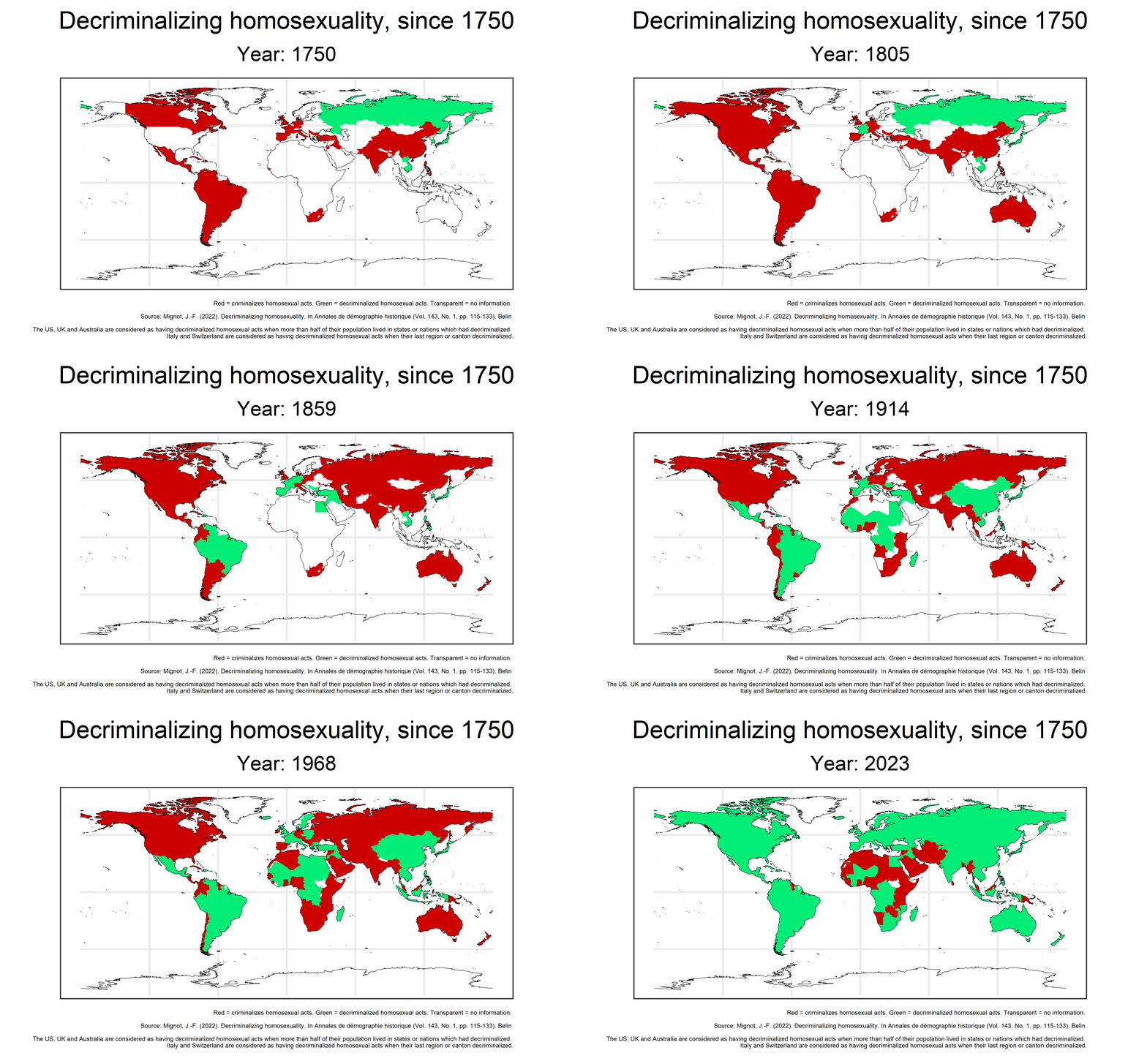
More and more people live in countries that have decriminalized homosexual relations, from 11% of the global population in the late 18th century to 79% in the early 21st century. However, as Jean-François Mignot observes, due to faster population growth in criminalizing countries, this trend may soon reverse.


Today, around 21% of the world’s population live in countries where homosexual acts (between consenting adults in private) are a criminal offence punished with fines, corporal punishment, imprisonment or even the death penalty. This implies that around 79% of humans reside in nations where homosexual acts have been decriminalized.

How did we get there? Where, when and how have homosexual relations been decriminalized in the world since the Age of Enlightenment? And is the proportion of humans living in a country which has decriminalized homosexuality more likely to increase, or decrease, in the foreseeable future?

Historical data on the legality of homosexual acts – and historical population numbers as well as UN population projections until 2100 – were gathered on 203 present-day countries, allowing us to answer these questions.

The first wave of decriminalization, from the French Revolution


In the late 18th century, when just 11% of the world’s population lived in countries where homosexual acts were not a criminal offense, France became the first country to decriminalize these practices. The French Penal Code of 1791, drafted in the liberal spirit of the Enlightenment, abolished a “crowd of imaginary crimes”, including sodomy, and the French Penal Code of 1810, which was applied in Napoleonic Europe, inspired the first wave of decriminalization in Western Europe (and, indirectly, in the French, Spanish, Dutch and Belgian colonies), Latin America and the Ottoman Empire. However, in the 19th century fewer than 25% of humans lived in a country where homosexual relations were not illegal. Most notably, Great Britain criminalized “buggery” at home and disseminated this criminalization across its immense empire in Africa, the Middle East, Asia and Oceania.
 

The second wave of decriminalization, since the 1960s


From 1950 to 2020, the proportion of countries where homosexual acts were not a criminal offense almost doubled, from 35 % to 66 %. This second wave, beginning in the 1960s in Western and Northern Europe and Canada, then spread to Oceania, Eastern Europe and finally Asia. It was driven by liberalization of public opinion and social movements. In India, homosexual acts were decriminalized by the Supreme Court decision Navtej Singh Johar v. Union of India (2018). Africa is the only continent where, since 1950, the decriminalization movement has had relatively little success.

Recriminalization in the Muslim world?


In contrast to these trends, in countries with a Muslim majority, fewer people now live in a country where homosexual acts are not illegal; the proportion fell from 47% in 1950 to 41% in 2020. In addition, since the 1990s, several sub-state entities not included in the animated map have begun to criminalize homosexual acts or impose stricter penalties in the name of Islamic law (sharia). This is the case in provinces of southern Somalia; in the Chechen Republic of the Russian Federation (1996); in Indonesia in the province of Aceh (2002) and in the capital of South Sumatra (2006); and in the northern states of Nigeria (1999). Punishments for homosexual acts are also especially harsh in a few Islamic-law states and sub-state entitiesю

The future of decriminalization


Relatively more humans are now legally free to engage in homosexual acts, but will this long-term trend continue? There are reasons to doubt it. First, the diffusion of religious fundamentalism, especially but not only in the Muslim world, may lead some countries to recriminalize homosexual acts. Second, countries where homosexual acts are currently illegal have higher fertility and will have faster population growth in the future than those where they are not criminalized today. This is why the share of humans who are legally free to engage in homosexual acts will likely decrease, unless, of course, attitudes and laws change in a large enough number of sufficiently populated countries where homosexuality is currently outlawed.

References

Tuesday, February 21, 2023

Anglican church and same sex marriages

Англиканство и однополые браки:
консервативные церкви отреклись от архиепископа Кентерберийского


Архиепископы нескольких англиканских церквей из разных регионов мира в знак протеста против решения Церкви Англии благословлять однополые пары заявили, что больше не считают архиепископа Кентерберийского лидером всемирного Англиканского сообщества.

В начале февраля Генеральный синод Церкви Англии после двух дней дебатов сделал важный символический шаг навстречу однополым парам: разрешил им приходить в церковь и получать благословение.

"Генеральный Синод Церкви Англии приветствует предложения, согласно которым однополые пары, заключившие гражданский брак или находящиеся в гражданском партнерстве, смогут приходить в церковь для благодарения, посвящения их отношений Богу и получения Божьего благословения", - говорилось в официальном сообщении Синода.

Это еще не признание однополых браков со стороны церкви, а лишь разрешение однополым парам приходить в церковь и получать благословение именно в качестве пары, но и такой шаг возмутил консервативных архиепископов Всемирного южного содружества англиканских церквей.

Заявление об утере архиепископом Кентерберийским Джастином Уэлби статуса морального лидера подписали главы англиканских церквей Южного Судана, Судана, Чили, региона Индийского океана, Конго, Мьянмара, Бангладеш, Уганды, Александрии и Меланезии.

"Церковь Англии выбрала путь разрыва с теми провинциями, которые хранят верность исторической библейской вере [...] мы больше не может признавать архиепископа Кентерберийского первым среди равных лидеров глобального содружества", - говорится в заявлении.

Англиканские церкви мира объединены в Англиканское содружество, но все они автокефальны, самостоятельны и равны, и предстоятель Церкви Англии, архиепископ Кентерберийский, считается лишь символическим лидером содружества.

Thursday, January 27, 2022

parents to children ?

same sex family

Передаётся ли гомосексуальность родителей их детям?


В общественном сознании, как в России, так и на Западе, довольно глубоко укоренилось мнение, что ребёнок, воспитываемый гомосексуальными родителями, непременно станет гомосексуалом, даже если он приёмный и биологически к этому не предрасположен. Насколько это интуитивное мнение соответствует реальности? Нет сомнений, что есть геи и лесбиянки, чьи родители также гомосексуалы. Но единичные примеры это не доказательство, к тому же подавляющее большинство гомосексуалов имеет гетеросексуальных родителей. Чтобы подтвердить или опровергнуть данное мнение нужно сравнить частоты геев и лесбиянок среди взрослых детей, выросших в гетеросексуальных и гомосексуальных семьях. Такие исследования проводились и, вопреки ожиданиям, оказалось, что частоты гомосексуальности были сходны в сравниваемых группах. Причём данный результат проявился уже в ранних работах, когда отношение к гомосексуальности было более чем неодобрительным и заранее предполагалось негативное влияние гомосексуальности родителей на их детей. 

Так что мнение о неизбежности гомосексуальной ориентации детей геев и лесбиянок явно не соответствует действительности.

Sunday, January 2, 2022

Do they do better in school?

Дети из гомосексуальных семей лучше успевают в школе?


Продолжаю тему двух предыдущих постов о влияния гомосексуальности родителей на их детей. Напомню, что результаты многочисленных исследований данного вопроса крайне противоречивы. Это во многом связано со сложностью формирования репрезентативной (то есть отобранной случайным образом) и достаточно большой выборки детей из гомосексуальных семей. Действительно, в большинстве исследований изучаемые выборки были небольших размеров и представляли собой “convenience sample”. А это означает, что отбор не был случайным, а из-за малочисленности выборки статистический анализ зачастую оказывался малоинформативным. Однако этих проблем нет в исследованиях, использующих данные всеобщей переписи населения или масштабных опросов, таких как American Community Survey (ACS). Однако здесь на первый план выходит другая проблема - правдивость ответов. Дело в том, что количество гомосексуальных семей в целом невелико и поэтому даже незначительное число «ложных» ответов может существенно исказить картину. К примеру, американское статистическое агентство было вынуждено дезавуировать свою оценку количества гомосексуальных семей, основанную на опросе ACS 2010 года, так как при верификации оказалось, что около половины семей, обозначивших себя гомосексуальными, в действительности таковыми не были. Но, даже оставляя в сторону вероятность ложных ответов, такие исследования имеют принципиальное ограничение – они фиксируют положение дел только на данный момент времени (поэтому их часто сравнивают с фотоснимком). Из-за этого невозможно проследить за изменениями структуры семей, определить, как долго ребёнок жил с данными родителями и были ли за это время в семье разводы, новые браки и другие события, способные повлиять на ребёнка.

Благодаря внедрению «цифровизации» у исследователей стали появляться возможности сопоставления и анализа различных документов, относящихся к конкретному человеку, (свидетельство о рождении/ браке/ разводе, налоговая декларация, результат ЕГЭ и др.). При этом анонимность сохраняется. Информация в документах, несомненно, более достоверна, чем получаемая при опросах. Исследование, о котором пойдёт речь в данном посте, интересно именно тем, что оно основано только на использовании документов. В нём сравнивалась школьная успеваемость детей из гомосексуальных и традиционных семей. Результаты представлены в статье “School Outcomes of Children Raised by Same-Sex Parents: Evidence from Administrate Panel Data”, которая была опубликована в 2020 году в журнале American Sociological Review. Статья доступна и содержит все «прелести», характерные для социологических работ (26 страниц плюс приложение). Но методически это исследование, на мой взгляд, значительно совершеннее, чем другие работы по этой теме. Так что стоит рассмотреть его результаты (несмотря на мою неприязнь к социологическим статьям).

Данное исследование стало возможным благодаря существованию в Голландии уникальной (так её характеризуют авторы) «административной панели» (базы данных), которая охватывает всё население страны. Авторы воспользовались данными, относящимися к периоду с 1995 по 2019 год. В Голландии гомосексуальное партнёрство регистрируется с 1998 года, а гомосексуальные браки с 2001 года. У каждого жителя страны есть свой идентификационный номер, ведётся регистрация места проживания (также имеющее численное обозначение) и его смены, то есть для каждого домохозяйства можно прояснить, какие номера и в какое время в нём проживали. Для каждого номера есть информация о поле, дате рождения, обучении, ежегодных доходах и др., с ним также связаны номера родителей, партнёров, детей (как собственных, так и приёмных). Анализируя этот огромный массив данных, авторы идентифицировали номера всех детей, рождённых в период с 1998 по 2007 год (ограничение 2007 годом связано с тем, что дети, рождённые позднее, на момент исследования ещё не закончили начального обучения). Из них были отобраны только дети, которые жили в семьях с двумя родителями. Общее число таких детей составило 1 204 692, из них 2971 жили в семьях с родителями одного пола (в большинстве случаев это были дети лесбиянок и только в 185 семьях оба родителя были геи). На основании данных о проживании были также выделены подгруппы детей, которые жили с родителями с самого рождения (среди гомосексуальных семей таких было 1300).

Коротко о данных, оценивающих учёбу. Начальное обучение в Голландии начинается с 5-летнего возраста и продолжается 7 лет. В последний год, то есть в 12-летнем возрасте, проводится тест, одинаковый для большинства школ (CITO-test), но с ним сопоставимы и иные проводимые тесты. На основании результатов теста принимается решение по какому из трёх возможных путей пойдёт дальнейшее (вторичное) образование - (пред)профессиональное, общее, или (пред)университетское. Завершившим вторичное обучение выдаётся диплом. В исследовании дети из традиционных и гомосексуальных семей сравнивались как по результатам теста начальной школы, так и по доле тех, кто смог завершить вторичное обучение и получить соответствующий диплом.

Начнём с результатов теста в конце начальной школы. Поскольку в разные годы сложность теста могла слегка отличаться, они были стандартизованы, благодаря чему результаты разных лет можно рассматривать совместно. Для каждой группы рассчитывалось среднее значение стандартизованных результатов теста. Сравнение проводилось по отношению к детям из традиционных семей, что определялось как разница в средних значениях теста. Однако величина этой разницы измерялась несколько необычно – в единицах стандартного отклонения. Для тех, кто далёк от статистики, поясню, что чем больше эта величина, тем значительнее различие; если она отрицательна, то успеваемость хуже чем в группе, с которой проводится сравнение, а если она положительна, то, соответственно, успеваемость лучше. Результаты этого сравнения приведены в таблице 1.

Табл.1 Сравнительные результаты теста в конце начального обучения

Напомню, что в таблице 1 приводятся отличия, выявляемые при сравнении с детьми из традиционных семей. В первой строке даны результаты, касающиеся всех детей из гомосексуальных семей, а во второй только тех из них, кто жил в семье с рождения. Первый столбец относится к детям из гомосексуальных семей, второй к детям из традиционных семей. В третьем столбце показаны результаты прямого сравнения, а в последнем столбце они даны после контроля по социоэкономическим параметрам, способным влиять на результат. Среди последних пол ребёнка, поскольку мальчики и девочки могут отличаться как по успеваемости, так и по их отношение к гомосексуальности родителей. Другие параметры касаются родителей - степень образованности, средний возраст, этническое происхождение, доход, состав и размер семьи. Контролирование этих параметров осуществлялось с помощью статистического метода, называемого линейной регрессией. Во всех четырёх сравнениях, приведённых в таблице 1, у детей их гомосексуальных семей результат теста в среднем был лучше, чем у их сверстников из традиционных семей. При этом статистическая значимость выявленных отличий намного превосходила традиционное значение приемлемого порога р ≤ 0.05. Лучший показатель (0.194) был у детей, живших с гомосексуальными родителями с рождения. Однако различие заметно уменьшалось после контроля по социоэкономическим факторам – почти двукратно для группы «Все» (0.106 против 0.054) и чуть меньше для группы «В семье с рождения» (0.194 против 0.139). Заканчивая с начальным обучением, отмечу, что для меня различия, выраженные в единицах стандартного отклонения, слишком абстракты и не позволяют судить о том, насколько они существенны. Возможно для таких как я, авторы и привели в своей статье имеющиеся в научной литературе данные, согласно которым обучение у хорошего педагога улучшает результаты тестов на 0.32 стандартных отклонений. То есть приведённые в таблице 1 отличия (включая максимальное 0.194) меньше тех, что связаны с уровнем преподавания.

Теперь рассмотрим результаты, касающиеся вторичного обучения. В этом случае сравнивались доли тех, кто смог его завершить (получил диплом). Сравнение опять-таки шло с детьми из традиционных семей. Его результаты показаны в таблице 2 (различия оценены в процентах).

Табл.2 Сравнительные результаты теста по окончанию вторичного обучения

На первый взгляд, результаты сравнения неоднозначны. Так при прямом сравнении у детей из гомосексуальных семей (группа «Все») результат на 7% хуже, чем у их сверстников из традиционных семей, а в группе «В семье с рождения» результат обратный – на 1% лучше. Однако оба эти отличия оказались статистически незначимы (поэтому значение р для них в таблице отсутствует). Это означает, что достоверной разницы при прямом сравнении не выявлено. А вот после контролирования по социоэкономическим факторам результат оказался лучшим у детей из гомосексуальных семей, причём с высокой статистической значимостью (p<0.001). В сравнении с детьми из традиционных семей результат был лучше на 4% в группе «Все» и на 4.8% в группе «В семье с рождения».

Таким образом, данное исследование показывает, что успеваемость детей из гомосексуальных семей не только не хуже, но возможно даже лучше, чем у их сверстников из традиционных семей. Предвижу возмущённые комментарии, но предлагаю не торопиться. Авторы исследования, хотя и, несомненно, предвзяты, тем не менее, интерпретируют полученные результаты достаточно объективно. Они обращают внимание на то, что оценки заметно меняются при контроле социоэкономических параметров. Это означает, что по этим параметрам гомосексуальные родители в среднем отличаются от традиционных. И действительно в данном исследовании гомосексуальные родители в среднем были более образованными и материально обеспеченными. Это вполне объяснимо, так как гомосексуальные пары должны иметь достаточно средств, требуемых для оплаты искусственного оплодотворения у лесбиянок или суррогатного материнства геев. Финансовый вопрос важен и в случае приёмных детей, так как при принятии решения органами опеки семейный доход является одним из важнейших факторов. Ну а финансовое благополучие коррелирует с уровнем образования. Ещё один фактор, на который указывают авторы, это более высокая мотивация иметь ребёнка. В отличие от детей, родившихся потому что «залетела», у гомосексуальных пар всё тщательно взвешено и спланировано (поэтому их средний возраст в исследовании несколько выше, чем в традиционных семьях). Чтобы стать родителями гомосексуальные пары должны преодолеть довольно много сложностей (бюрократических, медицинских, финансовых и иных), к тому же в обществе они нередко встречаются с довольно неприязненным отношением к себе. Поэтому далеко не все гомосексуальные пары решаются завести ребёнка. Те же, кто осуществил своё желание стать родителями, должны были быть сильно на это мотивированны. Говоря о школе, невозможно не отметить, что дети гомосексуальных родителей там часто подвергаются буллингу (об этом говорят исследования, проводимые в разных странах, в том числе и в «продвинутых» в отношении толерантности США и Австралии). С данной проблемой не так-то просто справится и, планируя ребёнка, гомосексуальная пара должна это тоже учитывать.

Thursday, December 2, 2021

children in homosexual families

Нешуточные страсти вокруг статьи о негативных последствиях для детей из гомосексуальных семей


Мнение, что гомосексуальность родителей негативно сказывается на детях, живущих в таких семьях, глубоко укорено в сознании очень многих людей по всему миру. Однако в чём проявляется такое негативное воздействие? Хотя поискам ответа на этот вопрос посвящены многочисленные исследования, их результаты довольно противоречивы. Согласно одним, у таких детей в сравнении с их сверстниками из обычных семей понижена успеваемость и хуже показатели психического и физического здоровья. Другие же исследования подобных отличий не выявили, а в некоторых показатели у детей гомосексуальных родителей были даже несколько лучше. Важно отметить, что почти во всех случаях изучали не случайную выборку детей из гомосексуальных семей, а так называемый “convenience sample” («удобная выборка»), то есть тех, кто был доступен, кого удалось рекрутировать для участия в исследовании. Однако результаты, получаемые при изучении “convenience sample”, нужно рассматривать лишь как предварительные. В большинстве исследований имелся ещё один недостаток - маленький размер выборки. Из-за этого некоторые выявленные риски не достигали уровня статистической значимости. С другой стороны нельзя было исключить и обратного - риски, размер эффекта которых невелик, могли быть не выявлены в маленькой выборке. Именно поэтому в 2005 году американская ассоциация психологов, на основании анализа данных 49 исследований, констатировала, что убедительные доказательства негативного воздействия отсутствуют, но изучение данного вопроса следует продолжить, в том числе с применением иных методическимх подходов.

К тому времени, когда делалось данное заключение, вектор отношения к самой проблеме сильно изменился. Если исследователи 80-90х годов прошлого века исходили из того, что негативное воздействие, несомненно, имеется и его надо лишь чётко охарактеризовать, то в нынешнем веке доминирующей стала обратная установка, направленная на доказательство отсутствия такого воздействия. Во многом это было следствием политизации любых тем, касающихся ЛГБТ. На этом фоне «громом среди ясного неба» стало исследование американского социолога Mark Regnerus “How different arethe adult children of parents who have same-sex relationships? Findings from the NewFamily Structures Study” (Насколько отличны взрослые дети родителей, имевших однополые отношения? Результаты Исследования Новых Семейных Структур”). Эта статья была опубликована в 2012 году в авторитетном научном журнале Social Science Research. Доступ к ней через редакцию журнала платный, но на сайте она в открытом допуске, правда там есть пометки (некоторые фрагменты текста выделены жёлтым цветом).

Данное исследование вызвало необычайно большой общественный интерес. О нём писали ведущие СМИ мира, на его результаты ссылались политические деятели, в том числе и российские, их приводили в качестве аргументов в Верховном Суде США. В самом же научном сообществе по этому поводу разразился грандиозный скандал. Так что же такого было в этой статье, что вызвало такую реакцию? Попробуем разобраться, но предупреждаю, что это потребует некоторых усилий.

Особенностью рассматриваемого исследования было то, что оно касалось не детей, а взрослых людей в возрасте от 18 до 39 лет, некоторые из которых имели гомосексуальных родителей. Для формирования выборки была привлечена коммерческая компания Knowledge Networks, предоставляющая услуги опроса населения в академических целях. Данная компания имеет сформированную панель жителей США, которая, как заявлено, довольно близко соответствует популяции этой страны. При проведении анкетирования по какой-то конкретной теме, компания использует часть людей из этой панели. Анкетирование проводится в электронном формате или по телефону. Вопросы анкеты предоставляются теми, кто заказывает опрос, в данном случае это был Mark Regnerus. Он охарактеризовал полученную таким образом выборку, как «популяционную» и считал её лишённой недостатков, свойственных “convenience sample”.

Выборка, вошедшая в исследование и получившая название NFSS (New Family Structures Study), включала 2988 человек. В зависимости от типа семьи, в которой росли опрошенные, автор распределил их на 8 групп. Ниже даны названия этих групп и количество человек в каждой из них:
1) IBF - Intact Biological Family (мать и отец, неразведённые), N= 919
2) LM - Lesbian Mother (мать лесбиянка), N= 163
3) GF - Gay Father (отец гей), N=73
4) Adopted (приёмные родители), N= 101
5) Divorced (родители развелись), N= 116
6) Stepfamily (один из родителей неродной), N = 394
7) Single parent (только один родитель), N = 816
8) All others (иные варианты), N = 406

В каждой группе определялись средние значения для 40 изучаемых параметров, которые были представлены в трёх таблицах (показаны ниже). В таблицу 1 входили параметры только с двумя возможными вариантами ответа. К примеру «Являешься ли в настоящее время безработным?» Ответ либо «да», либо «нет». Таблица 2 касалась параметров, определяемых непрерывными величинами, то есть, задана определённая шкала, внутри которой опрашиваемый решал какое значение ему соответствует. К примеру, по вопросам об уровне образованности, здоровью, осознанию себя счастливым использовалась непрерывная шкала от 1 до 5. В таблице 3 были представлены параметры, оцениваемые количеством событий, например, число арестов.

Таблица 1

Таблица 2

Таблица 3

Сравнение групп по каждому из параметров проводилось в трёх вариантах. В первом случае сравнение шло с группой IBF (семья с отцом и матерью) и отличия, оказавшиеся статистически значимыми (р≤0.05), обозначены в таблицах жирным шрифтом. Во втором случае сравнение было опять-таки с той же IBF, но здесь с помощью логической регрессии осуществляли поправки по полу, возрасту, расе и другим параметрам. Статистически значимый результат обозначен в этом случае как ​* (звёздочка). В третьем случае сравнение шло с группой LM (матери лесбиянки) и статистически значимый результат обозначен как ^ (каретка).

Из данных таблиц следует, что дети гомосексуальных родителей (группы LMи GF) в сравнении со сверстниками из обычных семей (группа IBF) хуже успевали в учёбе; они чаще курили и использовали марихуану, чаще становились жертвами сексуального насилия со стороны взрослых, их чаще арестовывали и др. Войдя во взрослую жизнь, они оказались менее приспособленными (более высокая частота безработных, зависимость от социальных пособий, более частые депрессии и др.). Именно на основании этих данных Mark Regnerus и сделал вывод, что гомосексуальность родителей приводит к негативным последствиям для их детей.

Публикация данной статьи вызвала шквал возмущения, особенно со стороны ЛГБТ. Оставим пока в стороне чрезмерно эмоциональную реакцию последних и посмотрим на критические замечания, высказанные профессионалами. И вот здесь выяснилось, что методическая часть работы, мягко говоря, дефектна. Социологи вдребезги разнесли утверждение, что выборка соответствует популяции. По их мнению, то, как коммерческая компания Knowledge Networks отбирает людей для опроса, никак не позволяет назвать выборку случайной, то есть она фактически тот же самый “convenience sample”. Но самая большая критика касалась того, как формировались группы, имевшие гомосексуальных родителей (LM и GF). Вопрос анкеты не спрашивал прямо, была ли мать лесбиянкой или отец геем. Он был сформулирован по-другому: Did either of your parents ever have a romantic relationship with someone of the same sex? (Были ли у кого-либо из ваших родителей когда-либоромантические отношения с кем-то того же пола?). Но данные опросов в США свидетельствуют, что многие люди в какие-то моменты своей жизни имели однополые сексуальные контакты, но отнюдь не считают себя гомосексуалами (об этом в посте). Другие претензии касались гомогенности группы LM (мать лесбиянка). Так, многих, включённых в эту группу, можно было также отнести к группе Singleparent или к группе Divorced. Фактически, только двое из группы LM были из стабильных гомосексуальных семей. В эту же группу были отнесены и 12 опрошенных, которые отметили гомосексуальность обоих родителей. Автор объяснил, что это было сделано с целью увеличения размера группы LM (иначе статистический анализ вряд ли был информативен). Но тогда вполне можно предположить, что причиной худших показателей в группе LM в сравнении со стабильными гетеросексуальными семьями, является не гомосексуальность родителей, а какой-то иной фактор, например стресс от развода родителей. Не буду касаться других «изъянов» исследования, но отмечу тот факт, что Mark Regnerus пошёл навстречу своим критикам и предоставил им первичные данные NFSS. Несколько учёных независимо друг от друга провели собственный анализ этих данных и никаких негативных последствий для детей гомосексуальных родителей не выявили. Эти результаты были также опубликованы в научных журналах, в том числе и Social Science Research. Для меня остаётся загадкой, почему социологи игнорируют поправку Бонферрони, которая требуется при проведении множественных сравнений. Никто из критиков о ней даже не упоминал, а ведь с данной поправкой исчезла бы статистическая значимость большинства результатов. Как бы там ни было, для меня очевидно, что результаты работы Mark Regnerus нельзя считать достоверными.

Это то, что касается чисто научной стороны вопроса. Но была ещё одна, которая этически, по крайней мере, для меня кажется не совсем приглядной. Так в редакцию журнала Social Science Research в связи с публикацией в нём статьи Mark Regnerus было направлено письмо за подписью большого числа (цифры варьируют от 150 до 200) социологов и психологов. Его «зачинщиком» был профессор права из Университета в Лос-Анжелесе, занимающийся вопросами демографии ЛГБТ сообщества и сам открытый гей. Редакцию обвиняли в том, что статья Mark Regnerus была опубликована слишком быстро (хотя понятно, что скорость публикации определяется тем, как быстро рецензенты дают своё заключение). Указывалось на то, что деньги на исследование (действительно очень большие) были получены автором от довольно консервативных институтов (но тогда надо осуждать и гранты «либерального происхождения»). Один социолог даже потребовал от редактора журнала Social Science подать в отставку за сам факт публикации статьи Mark Regnerus. Активность проявили и многие обычные ЛГБТ активисты, выразившие своё возмущение в многочисленных публикациях в СМИ. Один блогер-гей даже потребовал от университета уволить Mark Regnerus за нарушение этики и научную фальсификацию, так что комитет по этике университета был вынужден провести расследование. В итоге обвинения не подтвердились и Mark Regnerus по сей день остаётся профессором этого университета.

Вообще такой ажиотаж вокруг научной статьи выглядит довольно странно. Можно привести массу примеров, когда опубликованные результаты оказались недостоверными и последующие исследования их опровергли. Но всё дело в том, что в данном случае речь шла вовсе не о науке. Шумиха вокруг статьи была вызвана тем, что именно в это время в США шла борьба за то, чтобы гомосексуальные браки были признаны на всей территории страны и чтобы они были уравнены с браком между мужчиной и женщиной (marriage equality – равенство браков). В научном сообществе по этому поводу произошёл раскол, оно разделилось на тех, кто за равенство браков (среди них подписанты письма в редакцию) и тех, кто против (Mark Regnerus и поддержавшие его исследователи).

В заключение поста приходится констатировать, что вопрос о влиянии гомосексуальности родителей на их детей так и остался без ответа. Поэтому в следующем посте я продолжу эту тему и приведу результаты других исследований. На мой взгляд, методически они выполнены более корректно, хотя изначальная предвзятость их авторов налицо.

EIS-gen

Wednesday, October 13, 2021

monarchy and same sex marriage

Премьер-министр Нидерландов: 

наследная принцесса сможет вступить в однополый брак и стать королевой


В настоящее время наследницей титула короля Виллема-Александра является его старшая дочь Амалия, которой скоро исполняется 18

Наследница трона Нидерландов сможет вступить в однополый брак и унаследовать при этом королевский титул, заявил премьер-министр страны Марк Рютте.

Однополые браки в Нидерландах законны с 2001 года, однако до недавнего времени не обсуждалось, применимы ли они к королевской семье.

Премьер-министр заявил, что члены королевской семьи смогут вступать в однополые браки так же, как и другие жители страны. Эта позиция изложена в письменном ответе премьера на вопрос от одного из депутатов парламента от его собственной партии.

Рютте оговорился, что на данный момент речь идет о сугубо теоретической ситуации.

"Кабинет министров не считает, что наследник престола или король должен отречься, если он или она вступит в брак с лицом своего пола", - написал премьер-министр.

В Нидерландах наследника престола назначает правительство. В конституции страны говорится, что наследником может быть "законный потомок" царствующего монарха.

В настоящее время наследницей престола является старшая дочь короля Виллема-Александра, принцесса Амалия, которой в декабре исполняется 18 лет.

Летом в стране большой резонанс вызвала книга, в которой ставился вопрос о том, сможет ли она унаследовать трон, если пожелает вступить в однополый брак.

При этом в книге ничего не говорилось о личной жизни принцессы Амалии. Никаких признаков грядущей свадьбы на данный момент нет.

Известно, что в будущем году принцесса собирается поступать в университет и отказалась от королевских доходов, которые ей положены на период учебы.

В любом случае парламент должен будет одобрить любой брак королевы или наследной принцессы, подчеркнул премьер-министр Рютте.

Если брак окажется однополым, пока не ясно, каков будет статус детей такой супружеской пары (приемных или от донора спермы), признал глава нидерландского правительства.

Monday, June 28, 2021

The U.S. Can't Move Forward on LGBTQ Rights Without Reparations


Demonstrators carry signs calling for protection of the LGBTQ community from discrimination as they march in a picket line in front of Independence Hall in Philadelphia on July 4, 1967 .

BY OMAR G. ENCARNACIÓN JUNE 26, 2021 7:00 AM EDT

Encarnación is Professor of Political Studies at Bard College, where he teaches comparative politics and Latin American and Iberian studies. His new book is The Case for Gay Reparations

It is generally hard to know when a social revolution has achieved its goals. In the case of the American gay rights revolution, however, it appears that this is an easy one to call. At least as far as the national media is concerned, the view that gay rights have been decisively won has become conventional wisdom. Victory: The Triumphant Gay Revolution is one of the best-known journalistic accounts of the struggle for gay rights in the U.S. That book’s premise is pointedly echoed by a 2019 article in The Atlantic titled “The Struggle for Gay Rights is Over.” But America’s gay rights revolution seems unfinished or incomplete in the absence of a national reckoning with the country’s shameful history of systemic discrimination and violence towards the LGBTQ community. The absence of this reckoning makes the U.S. an outlier among Western democracies with a history of repression of homosexuality.

In recent years, the idea of “gay reparations,” broadly understood as policies intended to make amends for the legacies of systemic gay discrimination and violence, has become something of a global phenomenon. In 2017, the British Parliament enacted Turing Law, a legislation that conveyed an apology and a posthumous pardon to those convicted of “gross indecency,” a criminal charge intimately associated in British history with the persecution of gay men since the Victorian era. It honors Alan Turing, the famed computer scientist credited with breaking German military codes during World War II. In 1952, Turing was convicted of gross indecency, after confessing to a homosexual relationship with another man, and forced to undergo chemical castration. Britain’s example has been emulated by Ireland, Canada, and New Zealand. Germany has offered financial compensation to those who faced prosecution under Paragraph 175, the infamous portion of the German Penal Code that criminalized same-sex attraction dating to 1871; it also built a national monument to the victims of the so-called “Gay Holocaust,” the unknown number of gay males who perished in Nazi concentration camps. As part of a policy of “moral rehabilitation,” Spain has pledged to wipe clean the criminal records of some 5,000 gays and lesbians imprisoned under the homophobic laws of the Franco regime.

Given the variety of gay reparations available, which one should the U.S. embrace? For the Mattachine Society of Washington, D.C., the most prominent American organization demanding gay reparations, the United States should emulate the British example. In particular, the “Mattachines,” whose name references a pre-Stonewall gay rights organization that fought for acceptance of homosexuality within the legal and medical establishments, want an acknowledgement and an apology from the US Congress for the Lavender Scare, the witch-hunt of homosexuals triggered by President Dwight Eisenhower’s 1953 executive order banning “perverts” from working in the federal government. That order occasioned the firing of thousands of federal employees on the suspicion of being homosexuals and forced many to undergo obotomies, insulin-induced comas, and gay conversion therapy with the aim of changing their sexual orientation at federal institutions such as Washington, D.C’s St. Elizabeths Hospital. An acknowledgment and apology, the Mattachines contend, will be a giant step toward realizing “full citizenship” for gay people, a type of ethical citizenship that is not only concerned with rights and responsibilities but also with repairing indignity and degradation.

It’s hard to disagree with the Mattachines’ demand for an apology not only for the Lavender Scare, but also for the many other indignities and degradations that the American gay community has endured at the hands of the government, such as “don’t ask, don’t tell.” That notorious 1993 policy forced gays and lesbians to keep their homosexuality a secret if they wished to remain in the military. By the time it was lifted in 2011, some 13,000 service men and women had been dismissed from their jobs for their unwillingness to comply with the policy. As suggested by the Western European experience, an apology to the LGBTQ community is often a gateway for other reparations, including rehabilitation and compensation. Moreover, an apology would be grounded in historical precedent, an important point since it would lend legitimacy to the apology. Past apologies in American history include the Acknowledgement and Apology for Mistreatment of Native Hawaiians (1993); the Acknowledgement and Regret for the Chinese Exclusion Laws (2012); the apology given to Japanese Americans sent to internment camps during World War II (1988); and the apologies for the institution of slavery and Jim Crow laws issued by the House of Representatives (2008) and the Senate (2009).

Finally, as the most popular and least controversial form of gay reparation, an apology is unlikely to trigger a backlash from the traditional foes of the LGBTQ community. The Christian Right has met every gay rights breakthrough in American history with a vigorous pushback. After the 1969 Stonewall Riots, the touchstone of the contemporary gay rights movement, moral crusaders like Phyllis Schlafly, Anita Bryant, and Jerry Falwell declared war on homosexuality. Lawrence v. Texas, the 2003 Supreme Court decision that struck down all remaining sodomy laws across the US, launched a wave of state constitutional amendments banning gay marriage and an unsuccessful attempt to ban gay marriage in the US Constitution. Obergefell v. Hodges, the Supreme Court decision that legalized gay marriage, triggered the claim that marriage equality would undermine the civil rights of Christians. This claim, in turn, gave rise to “religious freedom restoration laws” intended to address “Christian victimization.” These laws allow for discrimination against LGBTQ people as long as this discrimination is rooted in sincerely held religious beliefs.

All of this said, gay reparations in the U.S. should not begin and end with an apology. Any apology or act of remorse should be supplemented with a truth commission tasked with chronicling the systemic discrimination that the LGBTQ community has endured over the course of American history. Truth commissions are nonjudicial bodies entrusted with the task of investigating a particular event or history, usually one involving human rights abuses, premised on the view that shedding light on the truth is critical to overcoming trauma, to say nothing of avoiding history repeating itself. In some cases, a truth commission is a means to an end, as was the case of the truth commission that investigated Argentina’s infamous Dirty War. The commission’s final report, Nunca Más (Never Again), opened the way for the successful prosecution of the top brass of the Argentine military on human rights charges. But in other cases, as in South Africa’s Truth and Reconciliation providing an unvarnished chronicle of the truth (usually from the victims’ perspective) is an end in itself.

Brazil and Canada provide contrasting examples of how a truth commission can be employed to make amends to the gay community. In 2011, the Brazilian Congress created a truth commission to examine the human rights abuses committed by the military regime in place between 1964 and 1985. Due to the insistence of activists, the Commission became the first one in the world to incorporate LGBTQ repression. Presented in 2014 to President Dilma Rousseff (herself a victim of the military regime), the final report found that: “Although there was no formalized and coherent state policy to exterminate homosexuals, the state’s ideology of national security clearly contained a homophobic perspective that represented homosexuality as harmful, dangerous, and contrary to the family. This view legitimized direct violence against gay people, violations of their rights and of their way of living and socializing.”

Canada’s gay reparation policies were set into motion by “Grossly Indecent: The Just Society Report,” an accounting of the repression of sexual minorities in Canadian history released in 2017 by the Egale Human Rights Trust, Canada’s leading LGBTQ organization. At the heart of the report was the so-called “gay purge,” a policy of government-sanctioned discrimination that lasted until the 1990s, and that caused thousands to lose their government jobs and face prosecution because of their sexual orientation and gender identity. The report demanded that Prime Minister Justin Trudeau apologize to the LGBTQ community and make reparations to the victims of anti-gay discrimination. In November 2017, Trudeau expressed “shame and sorrow and deep regret for the things we have done that I stand here today and say we were wrong. We apologize. I am sorry. We are sorry.” The apology came with a payout of $85 million to the victims of those purged from the government because of their homosexuality. According to Canadian media reports, the payout represents “the largest financial commitment by any national government for past wrongs committed against sexual minorities.”

Despite the seemingly uncontroversial nature of an apology to the American LGBTQ community and a truth commission to document systemic anti-gay discrimination and violence, no one should expect smooth sailing for either proposal. Reparations are inherently difficult, stemming from their perception as exclusionary and divisive. Those making the case for reparations invariably uphold themselves as a historically repressed minority deserving of reparations. Inevitably, this victimization invites others to wonder whether they, too, are deserving of reparations. In the case of the United States, discussions about gay reparations are made more difficult by the unaddressed legacy of slavery and Jim Crow laws.

None of this, however, should deter American gay activists from demanding some form of reparation. Indeed, it behooves American LGBTQ rights organizations like Human Rights Campaign and others to capitalize upon this moment of national reckoning with racial injustice to remind the public of the painful legacy of anti-gay laws, policies and practices and how this legacy intersects with other forms of oppression in American history. LGBTQ people of color are more likely to be victims of discrimination and police violence than the wider LGBTQ population. The impressive gay rights advances of recent decades–especially the legalization of same-sex marriage in 2015 and the extension of anti-LGBTQ discrimination protection under the 1964 Civil Rights Act in 2020 (all victories won at the Supreme Court) are something to celebrate and take pride in. But these victories cannot remove the stain that the history of anti-gay discrimination and violence has left on American democracy. The removal of this stain can only come from a formal reckoning with this history.

Tuesday, May 18, 2021

Advancing LGBTQI health research

Insurance
by Tonia C PoteatCarmen H LogieL Leigh Ann van der Merwe

Since the groundbreaking 2011 UN resolution called for attention to the violence and discrimination committed against individuals because of their sexual orientation and gender identity, the visibility of LGBTQI populations has increased globally. There is mounting evidence of LGBTQI health inequities driven by stigma, discrimination, and violence. In December, 2020, 70 UN member states had criminal laws targeting sexual or gender minorities—two with de facto criminalisation and 68 with specific criminal provisions against same-sex sexual practices, six of which prescribe punishment with the death penalty. Despite recognition of these structural and social determinants of health, insufficient progress has been made in actions to address them.

Many aspects of LGBTQI health and their determinants are woefully understudied. Key priorities for advancing LGBTQI health research include filling gaps in knowledge by region, health condition, sexual orientation and gender identity group, theoretical frameworks, and methods. Importantly, researchers must collect and use data to advance the wellbeing of LGBTQI individuals, communities, and populations (panel). Simply identifying disparities by sexual orientation, gender identity, or intersex status is not enough and could exacerbate stigma against LGBTQI people in some settings. Researchers must also frame health disparities within the sociopolitical conditions that create them, clearly document the connection between these conditions and LGBTQI health, and conduct analyses that can lead to effective interventions.

Panel

Recommendations for filling gaps in LGBTQI health research


Populations and topics


• It is important that data analyses disaggregate participants by sexual orientation and gender identity rather than assume results apply across broad LGBTQI categories.
• Research is needed that disentangles identity, attraction, and practices, as well as sex and gender identity from gender attribution.
• Lesbian health outside of North America is understudied, particularly on topics other than breast cancer and obesity. There is a need for research on lesbian sexual health, including sexual function, HIV, and safer sex. COVID-19 impacts are underexamined with lesbian and bisexual women.
• Gay men's health needs to be examined beyond HIV, with a life course perspective.
• Transgender health issues should be examined beyond HIV, gender-affirming surgery and mental health problems.
• The health of intersex people should be studied beyond the impacts of surgical and hormonal treatments to focus on holistic health.
• Sexual pleasure is important to examine as a component of sexual health and rights among sexual and gender minority people.
• Strengths-based research frameworks are needed, particularly those that examine solidarity, social cohesion, and connectedness, and health benefits of social movement building. Individual and collective resilience must also be examined to document and promote the strengths of LGBTQI communities.
• Intervention research is needed that addresses systemic and structural issues, as well as community-led intervention research informed by community priorities.
• Research on structural factors is required, including power structures, health impacts of criminalisation, legal protections, and social norms and attitudes.
• There are knowledge gaps of the health impacts of incarceration and alternatives to incarceration among LGBTQI people.
• Increased research is needed on non-communicable diseases with LGBTQI populations.
• More research is needed on health-care provider perceptions, attitudes, and knowledge toward LGBTQI clients, including effective strategies to improve provider care across diverse geographical contexts.
• Behaviour change research has focused almost exclusively on reducing health risk behaviours of LGBTQI individuals. Studies are needed that examine ways to promote behaviour change among policy makers and other people in power—eg, how to turn adversaries into advocates.

Frameworks and methods


• Methods can use population-based data, including adding sexual orientation and gender identity measures to demographic and health surveys and other national surveys, and ensuring privacy, confidentiality, and protection.
• Approaches can advance dialogue on research ethics board considerations for conducting research with (rather than on) LGBTQI people, with critical reflection on how LGBTQI people are often framed as inherently vulnerable.
• Longitudinal cohort data are needed across global contexts, especially data on older LGBTQI people.
• Methods can be developed that honour diverse identities and accurately measure sexual orientation and gender identity, avoiding analytic microaggressions.
• Intersectional approaches to LGBTQI health research should take into account the variance between and within high-income, low-income, and middle-income contexts and move beyond the minority stress model to explicitly incorporate the role of power structures in determining health outcomes.
• Inclusive studies should aim to have LGBTQI sample sizes large enough for robust analysis.
• Qualitative studies can be developed to better understand nuances, experiences, processes, and the “why” behind LGBTQI health inequities, alongside documenting experiences of health-enabling environments.

Most data on LGBTQI health are from high-income countries in North America and Europe. Existing research typically focuses heavily on HIV among men who have sex with men, uses non-probability convenience samples, and applies frameworks to describe health inequities that emphasise risk behaviours rather than the agency and strengths of LGBTQI populations that can be leveraged. More research is needed to fill knowledge gaps in countries at all income levels and to examine multidimensional aspects of health, including non-communicable diseases and resilience.

A minority stress framework has generated important evidence on the relations between stigma and poor health among LGBTQI populations. This framework rejects notions of innate pathology and highlights the fundamental social and structural causes of health inequities. However, more research is needed on positive experiences and resiliencies in LGBTQI communities. Understanding how LGBTQI people cope and thrive can provide crucial information for the development of effective strengths-based interventions grounded in social cohesion and community connectedness. Longitudinal and cohort studies are needed to better understand how experiences across the life course affect the lives of LGBTQI people, not only by describing the accumulation of minority stressors, but also by exploring identity formation, access to social support, adaptive coping strategies, family formation, and healthy ageing.

Increasingly, research has identified variability in health experiences by sex characteristics, sex assigned at birth, gender identity and expression, and sexual identity and behaviour. For example, in North America, bisexual women have been found to experience higher rates of sexual violence and poorer mental health than lesbians. Studies across the globe indicate that HIV prevalence is higher in transgender people than in cisgender people, typically driven by clustering of structural and psychosocial factors.  Attention to the specific health concerns of each group within the LGBTQI umbrella is important. Specifically, more research is needed broadly on the health of transgender men, lesbians, and bisexual people. Research with gay and bisexual men and transgender women rarely examines health issues beyond HIV; by contrast lesbian and bisexual women are under-represented in HIV research. Research with intersex individuals must move beyond a focus on surgery and sexual anatomy to explore broader aspects of health and rights-affirming approaches to intersex medical care.

LGBTQI people are diverse by sex, ethnicity, socioeconomic status, age, and ability, among other identities. More research is needed to understand how these intersecting identities converge, and the ways in which their associated privileges or disadvantages affect the health outcomes, health-care experiences, and priorities of LGBTQI people. An intersectional approach to health research with LGBTQI people locates the source of health inequities within systems of power, considers the interplay between social identities (eg, race) and inequities (eg, racism), exposes the negative impact of the status quo on marginalised communities, and centres the lived experiences and diversity of LGBTQI people.

Research questions and study designs must be guided by priorities and knowledge of LGBTQI communities to produce relevant data. In countries where aspects of sexual orientation and gender identity and expression are criminalised, data collection can be difficult; in such settings, researchers run the risk of state actors using LGBTQI data for entrapment, harassment, arrest, and persecution. The very criminalisation that interferes with quality data collection also drives health inequities that remain understudied and inadequately addressed. Work to fill gaps in LGBTQI health research must use community-based approaches to try to prevent harm to participants and misuse of data. Broader political and social efforts to protect LGBTQI people against criminalisation, violence, and discrimination based on sexual orientation and gender identity and expression are key to advancing LGBTQI health.

Although data gaps remain, interventions cannot wait. There are plenty of data on the stigma, discrimination, and social exclusion experienced by many LGBTQI people, and we know these experiences drive health inequities. Interventions must improve LGBTQI health and promote health equity. Interventions may span social–ecological dimensions, including: structural level policies and laws to protect rights and ensure freedom from discrimination; community level norms, values, and attitudes; interpersonal relationships; and intrapersonal domains of self-worth, self-acceptance, and internalised stigma. Interventions can be tailored for different groups—eg, reducing stigma in structural and social arenas among general populations, educators, and health-care providers or building resilience, stigma coping, and advocacy, and mitigating internalised stigma with LGBTQI people. Interventions tailored for stigma reduction and health promotion with LGBTQI people can use a life course approach that considers developmental stages, from childhood and adolescence, to emerging adulthood, parenthood, caregiving, and ageing. Importantly, implementation science research is needed to understand how interventions work, for whom, and in what context, so that they can be sustained beyond the end of research studies by government, non-governmental, and community actors.

Больше букаф, хорошых и разних

Sunday, May 16, 2021

The Political Nature of Sex —

Transgender in the History of MedicineList of authors.

Ketil Slagstad, M.D.

Article | Metrics34 References

черно-белый контейнер с ногами, Шива Лингам Индуизм Ганеша Пуджа, Чакра, религия, лакшми, брахма
On July 18, 2016, the final rule of the Department of Health and Human Services (HHS) implementing Section 1557 of the Affordable Care Act regarding gender nondiscrimination went into effect. Advocates were relieved that the law now included protections against discrimination in health care “on the basis of sex” that applied to transgender patients. These protections ensured that patients were treated in a manner consistent with their gender identity and, among other safeguards, helped U.S. transgender patients access gender-affirming therapy. Four years later, under the Trump administration, HHS proposed revising this rule so that antidiscrimination provisions would apply only to “male or female and as determined by biology.” Advocates for transgender rights feared the rollback would jeopardize specific health services and leave trans people especially vulnerable to discrimination. On June 15, 2020, the U.S. Supreme Court in Bostock v. Clayton County held that the prohibition on discrimination in employment “because of…sex” in Title VII of the Civil Rights Act of 1964 applies to gender identity and sexual orientation. On the night of his inauguration, on January 20, 2021, President Joe Biden issued a wide-ranging executive order to enforce the court’s ruling and to prevent and combat discrimination on the basis of gender identity and sexual orientation.

The Trump administration’s proposed change, the Supreme Court ruling, and Biden’s executive order are perhaps the most high-profile and consequential illustration that the definition of sex has become a highly contested and polarizing issue in contemporary society and political debates. Yet historians of medicine recognize that the relevant moral and scientific questions, which seem so utterly modern, touch on age-old themes in medical understanding.

In our current cultural moment, discussions about whether sex and gender are spectrums or dichotomies have taken center stage. Defenders of transgender rights are often accused of pushing identity politics or “gender ideology.” But the current situation has not appeared out of the blue: attempts to define sex and gender have been a recurrent theme in medical history, and because the topic of transgender rights is necessarily also a medical one, this legacy underpins the current debates. A greater awareness of this history can help doctors become more responsible, empathetic, and reflective when we meet with transgender and gender-nonconforming patients.

While biologists have rooted a definition of sex in the evolution of species and the capability of producing small or large gametes, doctors have been confronted with a practical challenge: treating patients whose bodies or identities cannot easily be categorized as either male or female. The history of sex in medicine is therefore also a history of doctors adopting and modifying theories of sex to the task of practicing medicine. But even if doctors have often based their definitions on physical characteristics — gametes, gonads, internal reproductive organs, external genitalia, hormones, chromosomes, and genes — medical understandings of sex have evolved with technological developments and in response to political, bureaucratic, and legal demands, such as a desire to provide clear-cut answers in criminal cases or to promote the cultural ideal of marriage.

Knowledge production about sex, however, has not been a one-way street from experts to laypeople. People with bodies, identities, or desires that did not fit societal norms have pushed back, asserted agency and self-definition, and shaped categories in therapeutic and research settings. And historically, scientific and medical understandings of sex have shifted largely by attending to “anomalous” forms of embodiment and identities — a pattern illustrated by five cases: the hermaphrodite, the homosexual, the intersex body, the transsexual, and the transgender person.

The Hermaphrodite: Sex between Dichotomy and Spectrum


For a long time, two fundamentally different models of sex existed in science and medicine — the binary and the spectrum — and each had social implications. For early modern writers, the “hermaphrodite” threw into question medical and scientific theories and classifications. Work in the tradition of Aristotle conceived of sex as polar opposites: the heat of the heart determined sex, and hermaphroditism was merely a matter of the genitals rather than the organism as a whole. Although genitalia could be ambiguous, sex was binary.

Writers following Hippocrates and Galen, by contrast, saw sex as a product of both the maternal and paternal seed and the left and right sides of the uterus. This set of variables opened up a variety of intermediate phenotypes that threatened a binary model of sex. The obsession with the hermaphrodite among medical writers in the mid-16th century can be seen as a manifestation of a revival of Hippocratic theories and of a broad “male anxiety” about sexual ambiguity and immoral conduct. Hermaphroditism became emblematic of all kinds of sexual ambiguity, including sodomy and transvestism, which illustrated how the definition of sex responded to moral and political questions in society.

The Homosexual: Inseparability of Sex and Sexuality


Another “anomalous” figure that has played an important role in the creation of sex is the homosexual. In medicine in the late 19th and early 20th centuries, the concept of gender did not exist, and sex and sexuality were intertwined and inseparable. Psychiatrists in the German-speaking world began to categorize and pathologize people whose identities and bodies violated the heterosexual norm of sexuality and binary understandings of sex. The prominent Berlin psychiatrist Carl Westphal, for instance, coined the term “contrary sexual feeling,” which tied together the phenomena of cross-dressing and same-sex attraction. In Psychopathia Sexualis, the psychiatrist Richard von Krafft-Ebing expanded sexual psychopathological theory into a complex taxonomic system of “sexual perversions.” He divided “contrary sexual feeling” into acquired and congenital forms that were expressed to a greater or lesser degree: homosexuality represented an early stage, whereas “metamorphosis sexualis paranoica” was defined as the delusional idea of sex transformation or the feeling of belonging to the “other” sex.

A broad constellation of sexual perversions, from homosexuality and a gender identity incongruent with birth sex to somatic manifestations such as the masculinization or feminization of secondary sex characteristics, were fundamental to late 19th-century theories of sexual pathology. Contemporary understandings of sexuality as distinct from sex or gender identity would have made little sense to late 19th-century psychiatrists.

Like some psychiatrists, activists in the homosexual liberation movement of the late 19th century also evoked biology in arguing that homosexuality was congenital. One early activist, Karl Heinrich Ulrichs, argued that homosexuals (or “urnings”) belonged to a “third sex,” a woman’s soul in a male body, referring back to Aristophanes’ tale of the origin of love in Plato’s Symposium, which depicted three original beings of three different sexes. In opposing punishment for homosexuals, doctors and sexologists in the sexual reform movement argued that homosexuality had congenital causes and was part of human variation, not immoral conduct or a psychiatric disorder. Challenging both sexual pathology and psychoanalytic reasoning, the physician and sexual reformist Magnus Hirschfeld’s theory of “intermediate sexual stages” placed sex and sexuality on a spectrum, evoking biologic and endocrinologic arguments: “It cannot be repeated often enough” Hirschfeld wrote, “that the human being is not man or woman but man and woman.”

By the late 19th century, gonads had become the primary marker of a patient’s sex — this period is sometimes called “the age of the gonads” — but cases emerged that puzzled doctors, who had to use other criteria in trying to determine sex unequivocally. The increased influence of genetic and endocrinologic research on medicine in the late 19th and early 20th centuries further undermined strict gonadal criteria.

The birth of psychoanalysis in the early 1900s and the advent of psychosexuality and considerations of the patient’s own experience of a gendered self added complexity to the concept of sex. Sex was not understood as a binary biologic category in scientific and medical discourse at that time, as it often is today: bisexuality was not limited to sexuality but referred to an inert, latent potential in every human being to develop in a male or female direction.

Transsexual and Intersex People: Intervening in the Body


Doctors’ handling of transsexual and intersex patients has been fundamental to contemporary understandings of sex. But historically, these categories have also been fluid. In Berlin in the 1920s, doctors at Hirschfeld’s Institut für Sexualwissenschaft performed the first sex-reassignment surgeries on “transsexual” people, embracing a bisexual, endocrinologic, and sexologic framework of sex. The United States, however, lacked a similar medical understanding of transsexual identity and embodiment, so when people we would now consider transgender contacted the Johns Hopkins Hospitals for care, they used the language of intersex to obtain similar treatment. Their doctors nonetheless considered these patients to be homosexual, thereby precluding any form of medical treatment and prohibiting the emergence of trans identities in medical discourse.

The approach changed in the second half of the 20th century with the popularization of the concept of “transsexualism” and the creation of university-based gender-identity clinics. The media coverage of American Christine Jorgensen’s gender-confirmation therapy in Copenhagen in the early 1950s rapidly spread worldwide, with headlines such as “Ex-GI Becomes Blonde Beauty.” Though the treatment protocols were not new, sex seemed to be in flux in new ways, as Jorgensen’s story brought the notion of “sex change” to the public and raised awareness of transsexual issues. Since synthetic sex hormones had become available in the 1930s and made it easier to modify the body to make it more congruent with peoples’ experiences of their inner selves, doctors were increasingly confronted with a fundamental question: Instead of intervening in patients’ bodies, would it not be better to help change the person’s identity by other means — for instance, by psychotherapy?

The Birth of Gender: Regulating the Normal


Doctors defending “sex change therapy,” such as the endocrinologist Harry Benjamin, staunchly rejected this notion, and their practice of offering hormonal and surgical treatment rested on complex theories of child development proposed by psychologists and doctors working with intersex children at Johns Hopkins Hospital. The Hopkins team’s research and clinical work led them to a new concept that would gain paramount importance for modern societies: gender.

In the 1950s, John Money and colleagues published a series of articles in the Bulletin of the Johns Hopkins Hospital in which they claimed, on the basis of examinations of numerous “hermaphrodites,” that the most reliable “prognosticator” of a person’s gender role was the “sex of assignment,” not biologic categories of chromosomal sex, gonadal sex, hormonal sex, internal reproductive structure, or morphology of external genitalia. They therefore discarded the idea that psychological or social sex was biologically or genetically predetermined and developed a model of “gender identity or role” formation based on a behavioral–adaptational framework: the first 18 months of life represented a crucial window in which one’s gender identity could be molded, after which it would become cemented. The crucial concept was “imprinting”: since bodily morphology and child rearing interacted in a complex biosocial matrix, the presence of “ambiguous” genitalia threatened the formation of a firm, univocal gender identity or role as either man or woman. Therefore, the genitals of intersex babies should be made as “normal looking” as possible, meaning unambiguously masculinized or feminized, using hormones and surgery. After surgery, parents were told never to talk to their children about this part of their past and to raise them according to the gender and sex the professionals had assigned. Later studies nonetheless showed that the doctors’ blind belief in gender identity’s social changeability was wrong.

In other words, the concept of gender once again opened up an understanding of sex as plastic, but not in the sense that it represented a plurality of ways of expressing gender: the treatment protocol was underpinned by a fragile concept of gender that hinged on the belief that bodies and gender roles must be aligned and the normative idea that a good life depended on being unambiguously gendered and sexed. The psychoanalyst Robert Stoller, who helped establish the Gender Identity Center at UCLA in the 1960s, refined these theories into a concept of “core gender identity.” Gender identity’s unchangeability would become an axiom and justification for future gender-affirming therapy. Hence, gender, a concept that would become a crucial resource for feminists in challenging patriarchal structures — systemic inequalities often justified with reference to biologic differences between men and women — originally came from medicine and protected the integrity of the binary model of sex.

Toward the turn of the century, activists and trans people increasingly took issue with the tendency of the medicalized concept of transsexualism and the concept of the “wrong body” to reduce and delimit trans people’s identities and experiences. The term “transgender,” which emerged in the 1990s, was a response to this problem, allowing for myriad nonconforming and nonnormative forms of gender identity and expression.

Mobilizing Biology


A milestone in transgender history occurred in 2019, when the World Health Organization removed “gender identity disorder” from the chapter on mental illnesses in the International Classification of Diseases and replaced it with a new diagnosis of “gender incongruence” in a new chapter on sexual health. Transgender people were thus no longer labeled mentally ill, and trans, nonbinary, and gender-nonconforming identities were recognized as expressing human variation.

Nevertheless, various groups, including social conservatives, have opposed transgender rights, and some feminists, including the author J.K. Rowling, have instrumentalized biology to oppose a U.K. law on gender self-declaration, arguing that “sex is real.” The Trump administration decided that transgender personnel cannot serve in the U.S. military except in their assigned birth sex, a decision that was revoked by President Biden on January 25. Under the Trump administration, the Department of Housing and Urban Development proposed allowing homeless shelters to discriminate against transgender people by admitting people according to “biological sex,” and it provided a list of characteristics for identifying trans women, including height, facial hair, and Adam’s apples.

Yet when the Trump administration sought to establish a legal definition of sex based on inspection of external genitals and genetic testing, the editors of Nature responded by declaring that “anatomy does not define gender”: “The research and medical community now sees sex as more complex than male and female, and gender as a spectrum that includes transgender people and those who identify as neither male nor female.” Major scientific and medical organizations such as the Endocrine Society have used genetic and neuroradiologic research to argue that gender identity is not a mere “social construct” but also the product of biology. And the American Medical Association has adopted a policy on educating the medical community and the public about the “medical spectrum of gender,” including the recognition that “an individual’s genotypic sex, phenotypic sex, sexual orientation, gender and gender identity are not always aligned or indicative of the other” and that gender may differ from sex assigned at birth.

Looking through Nature


These examples demonstrate how transgender rights trigger discussions about the nature of sex. But that effect is nothing new: repeatedly throughout the history of Western thought, “nature” has provided a rich resource for shaping norms, settling categories, and stabilizing concepts of normality. What counts as natural and what role nature plays in the order of things, however, are historically contingent. In the center of the medieval and Renaissance concept of nature, for instance, stood the goddess Natura, who protected heterosexual sex and the continuation of the human species. Since the word “nature” became a synonym for the genitals, the “hermaphrodite” became a site for demonstrating not only natural variation but also nature’s normative role in protecting the moral order.

In the history of medicine, the common has often been equated with the normal. In the past 150 years, we’ve seen how diagnostic and classificatory systems have pathologized and stigmatized people whose bodies, identities, or desires did not fit social norms. However, history also provides examples of doctors listening to the needs of trans and intersex patients and using medical knowledge to provide empathetic care. By shaping and guarding the concept of sex, doctors have enabled some bodies and ways of living while invalidating others. Ultimately, the medical categories of homosexuality, intersex, and transsexualism have shaped contemporary understandings of sex.

The process of working out the concepts of sex and gender continues in relation to trans people. The inclusion, removal, and reinsertion of gender nondiscrimination in the Affordable Care Act are just another reminder of the inseparability of politics from the scientific boundaries of sex and gender. The history of medicine offers an antidote to the notion that we are simply looking at “nature” when we see sex and gender: what counts as sex and gender is historically changeable, morally infused, and politically loaded.

Disclosure forms provided by the author are available at NEJM.org.

This article was published on February 3, 2021, at NEJM.org.

I thank Anne Kveim Lie and Jeremy Greene for feedback on an early draft of this manuscript as well as two anonymous reviewers whose suggestions helped improve the manuscript.

Author Affiliations


From the Institute of Health and Society, Faculty of Medicine, University of Oslo, Oslo; and the Institute for the History of Medicine and Ethics in Medicine, Charité Universitätsmedizin Berlin, Berlin.

Sunday, April 25, 2021

Enfants de familles homoparentales : les résultats scolaires, une preuve de réussite

Published on N-IUSSP.ORG April 19, 2021

Children of same-sex parents: an educational success story


Jan Kabátek, Francisco Perales

Challenging claims of disadvantage in same-sex parented families, Jan Kabátek and Francisco Perales find that same-sex-parented children actually outperform their peers in many areas of academic achievement.

Over the last 50 years, there have been dramatic changes in social attitudes and legislation toward same-sex relationships (Roseneil et al 2013). Within this short time frame, many countries have moved from criminalization to robust institutional support – enabling same-sex couples to be formally recognized, marry, and adopt children. Despite these developments, same-sex parenting remains a highly controversial and politicized issue, and one that is tightly intertwined with discussions around same-sex marriage.

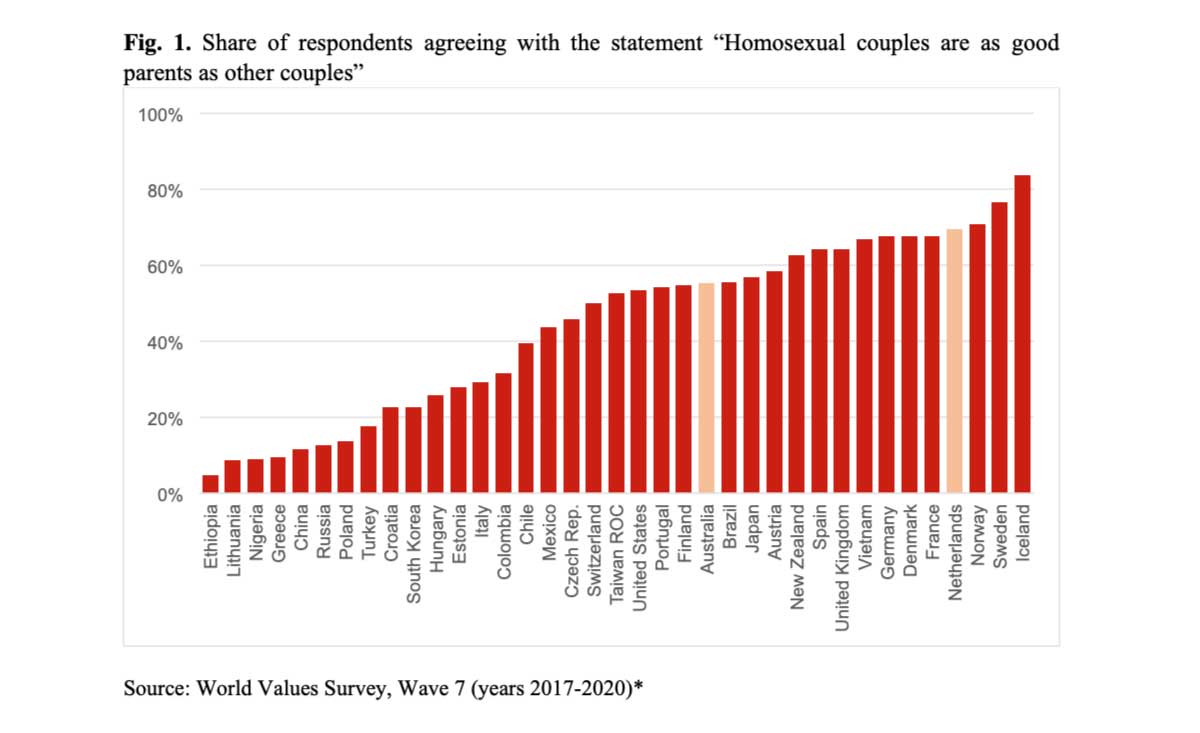
Data from the most recent wave of the World Values Survey, a large cross-national survey of public opinion, confirms that support for same-sex parenting is far from unanimous. A sizable share of the population across multiple countries still believes that same-sex parents cannot raise children as well as different-sex parents (Figure 1).

These beliefs are often bolstered by “common wisdom” arguments that are rarely backed up by robust empirical evidence. For example, some commentators maintain that children need both male and female parental role models to thrive, that non-biological parents invest less effort in parenting their children, and that children in same-sex-parented families may be subjected to shame and bullying.

However, these beliefs have also been fueled by questionable academic studies examining the comparative outcomes of these children.

Prior research


Mark Regnerus’s, a sociologist and professor at the University of Texas at Austin conducted a controversial study in 2012 that serves as a cautionary tale about the negative and far-reaching consequences that poor data and unsuitable analytical methods can exert on research findings in this field.

The  (2012) study claimed that people raised by same-sex parents experienced worse health and socioeconomic outcomes in adulthood than people raised by different-sex parents. Yet subsequent re-analyses of the same data by several leading researchers demonstrated that such associations emerged almost entirely due to an array of misclassification, mismeasurement and other analytic problems (Cheng and Powell 2015, Rosenfeld 2015).

The damage of the Regnerus study was however done, with its spurious findings receiving intense international media coverage and becoming a ‘go-to’ resource for activist groups lobbying against same-sex marriage. Such findings not only permeated the public debate on same-sex parenting, but were also presented in court in attempts to prevent the introduction of same-sex marriage legislation across US states.

Nevertheless, the Regnerus study constitutes an outlier in the broader literature on same-sex parenting. A large majority of studies on the topic have found that same-sex parents are able to provide their children with as healthy and nurturing home environments as different-sex parents. Yet these studies have also been often called into question, with critics pointing out that they are typically based on suboptimal data and methods (Allen 2015).

The most common criticism is that the studies tend to rely on ‘convenience’ samples. These are small and selective samples of same-sex-parented families, who may be approached at LGBT events or recruited through mailing campaigns. Critics (rightfully) argue that the outcomes of such families may differ from those of the broader population of same-sex families, and that this can distort the reliability of the studies and their conclusions.

Our new study


In our study, we were able to move beyond the vast majority of research conducted in this space. We did this by analyzing data covering the full population of children living in the Netherlands (more than 1.4 million children in total), comparing the academic outcomes of all children raised by same-sex couples with all children raised by different-sex couples. We conducted the study in the Netherlands because it is one of only a few countries in the world that allows researchers to link together life-long anonymized data from multiple population registers, containing high-quality administrative information on children and their families (Kabátek and Ribar 2020).

Thanks to these data, we were able to statistically account for various pre-existing characteristics that may differ between same-sex- and different-sex-parented families—for example, the higher average education attainment of individuals in same-sex couples, or their lower average incomes. This means that our analyses compared children in same-sex- and different-sex-parented families that are similar in all observable characteristics except for their parents’ sex.

Our key findings go counter to those reported by Regnerus (2012). Children in same-sex-parented families attain higher scores on national standardized tests than children in different-sex-parented families. Their advantage amounts to 13 per cent of a standard deviation, which is comparable to the advantage associated with both parents being employed as opposed to being out of work. We also find that children in same-sex-parented families are slightly more likely (1.5 per cent) to graduate from high school, and much more likely (11.2 per cent) to enroll in college than children in different-sex-parented families.

Our results thus challenge “common wisdom” arguments against same-sex parenting, and lend preliminary support to other scholarly perspectives that emphasize the possible benefits of same-sex parenthood. For example, same-sex parents are likely to face substantive barriers to parenthood (including social scrutiny, greater costs of conceiving a child, and legislative hurdles) and overcoming these barriers may strengthen their commitment to parental roles. Combined with the fact that same-sex couples face minimal odds of becoming parents through ‘accidental’ pregnancies, this can result in more positive parenting practices in same-sex-parented families.

Implications for other countries


The Netherlands features high levels of public approval of same-sex relations and provides robust legislative protection to sexual minorities. Therefore, we argue that the Dutch institutional context represents a ‘best-case scenario’ concerning the achievement of children in same-sex-parented families.

Same-sex-parented families in other countries may be subject to environmental hurdles that remain beyond the control of parents and that may negatively affect their children. These may include a lack of access to the social institution of marriage and more profound experiences of stigma and discrimination (Perales and Todd 2018).

By undertaking our analyses in the Netherlands, we were able to retrieve findings that are more likely to reflect the influence of same-sex parenting itself, and less likely to reflect external influences stemming from non-inclusive institutional environments. Therefore, our findings portray a viable scenario of what could happen in countries with more restrictive institutional environments, should they direct comparable efforts towards the inclusion of sexual minorities.

Altogether, the message stemming from our findings is clear: being raised by same-sex parents bears no independent detrimental effect on children’s outcomes. In socio-political environments that provide high levels of legislative and public support, children in same-sex-parented families thrive.

*Source figure 1 – worldvaluessurvey.org


References

  • Allen Doug (2015) More Heat Than Light: A Critical Assessment of the Same-Sex Parenting Literature, 1995–2013, Marriage & Family Review, 51(2): 154-182. doi.org/10.1080/01494929.2015.1033317
  • Cheng Simon, Powell Brian (2015) Measurement, methods, and divergent patterns: Reassessing the effects of same-sex parents. Social Science Research, 52, July, 615-626. DOI: 10.1016/j.ssresearch.2015.04.005.
  • Kabátek Jan, Perales Francisco (2021) Academic Achievement of Children in Same- and Different-Sex-Parented Families: A Population-Level Analysis of Linked Administrative Data From the Netherlands. Demography. doi.org/10.1215/00703370-8994569
  • Kabátek Jan, Ribar David C (2020) Daughters and Divorce. The Economic Journal, December. doi.org/10.1093/ej/ueaa140
  • Perales Francisco, Todd Abram (2018) Structural stigma and the health and wellbeing of Australian LGB populations: Exploiting geographic variation in the results of the 2017 same-sex marriage plebiscite. Social Science & Medicine, 208: 190-199. doi.org/10.1016/j.socscimed.2018.05.015
  • Regnerus Mark (2012) How different are the adult children of parents who have same-sex relationships? Findings from the New Family Structures Study. Social Science Research, 41(4): 752-770.
  • Roseneil Sasha, Crowhurst Isabel, Hellesund Tone, Santos Ana Cristina, Stoilova Mariya (2013) Changing Landscapes of Heteronormativity: The Regulation and Normalization of Same-Sex Sexualities in Europe. Social Politics: International Studies in Gender, State & Society, 20(2): 165–199. doi.org/10.1093/sp/jxt006
  • Rosenfeld Michael J. (2015) Revisiting the Data from the New Family Structure Study: Taking Family Instability into Account. Sociological Science, September, DOI 10.15195/v2.a23.

Friday, March 19, 2021

Male gays in the female gaze: women who watch m/m pornography

Garrard Conley was sent for conversion therapy
to ‘treat’ his sexual identity
 
This paper draws on a piece of wide-scale mixed-methods research that examines the motivations behind women who watch gay male pornography. To date there has been very little interdisciplinary research investigating this phenomenon, despite a recent survey by PornHub (one of the largest online porn sites in the world) showing that gay male porn is the second most popular choice for women porn users out of 25+ possible genre choices. While both academic literature and popular culture have looked at the interest that (heterosexual) men have in lesbian pornography, considerably less attention has been paid to the consumption of gay male pornography by women. Research looking at women's consumption of pornography from within the Social Sciences is very focused around heterosexual (and, to a lesser extent, lesbian) pornography. Research looking more generally at gay pornography/erotica (and the subversion of the ‘male gaze’/concept of ‘male as erotic object’) often makes mention of female interest in this area, but only briefly, and often relies on anecdotal or observational evidence. Research looking at women's involvement in slashfic (primarily from within media studies), while very thorough and rich, tends to view slash writing as a somewhat isolated phenomenon (indeed, in her influential article on women's involvement in slash, Bacon-Smith talks about how ‘only a small number’ of female slash writers and readers have any interest in gay literature or pornography more generally, and this phenomenon is not often discussed in more recent analyses of slash); so while there has been a great deal of very interesting research done in this field, little attempt has been made to couch it more generally within women's consumption and use of pornography and erotica or to explore what women enjoy about watching gay male pornography. Through a series of focus groups, interviews, and an online questionnaire (n = 275), this exploratory piece of work looks at what women enjoy about gay male pornography, and how it sits within their consumption of erotica/pornography more generally. The article investigates what this has to say about the existence and nature of a ‘female gaze’.

Keywords: pornography gay female gaze women male/male pornography