Showing posts with label вес. Show all posts

Saturday, June 10, 2023

Weight change and risk of obesity-related complications

A retrospective population-based cohort study of a UK primary care database


Kamlesh Khunti F. MedSci, Volker Schnecke PhD, Christiane Lundegaard Haase PhD, Nina M. Harder-Lauridsen PhD, Naveen Rathor MD, Kasper Sommer MSc, Camilla S. Morgen PhD
https://doi.org/10.1111/dom.15154

Aims To examine associations between weight loss/gain and risk of developing 13 obesity-related complications (ORCs), stratified by baseline body mass index (BMI).
Materials and Methods

In this retrospective cohort study, we included adults with obesity (>30 kg/m2) from the UK Clinical Practice Research Datalink GOLD database with weight change (−50% to +50%) between Years 1 and 4 (N = 418 774 [median follow-up: 7 years]). Associations between weight change, baseline BMI and risk of developing ORCs during follow-up were assessed using Cox proportional hazard models.

Results The impact of weight change on ORCs was generally dependent on baseline BMI. Four clear patterns were seen across the 13 outcomes. Pattern 1 showed greatest weight loss benefit for people with low baseline BMI (type 2 diabetes, sleep apnoea, hypertension and dyslipidaemia); Pattern 2 showed most weight loss benefit at lower baseline BMI but no significant weight loss effect at higher baseline BMI (asthma, hip/knee osteoarthritis and polycystic ovary syndrome); Pattern 3 showed benefit in most cardiovascular diseases with weight loss (chronic kidney disease, heart failure, atrial fibrillation and venous thromboembolism), but no additional benefit with >10% weight loss; Pattern 4 showed no clear relationship between weight change and unstable angina/myocardial infarction and depression. We found similar but opposite patterns for weight gain.

Conclusions Weight loss benefit is dependent on weight loss magnitude and initial BMI, and weight gain is associated with a similar risk increase. Four patterns of association were identified between degree of weight change, baseline BMI and 13 ORCs

Friday, January 6, 2023

The economics of thinness

It is economically rational for ambitious women to try as hard as possible to be thin


Dec 20th 2022 | NEW YORK

Mireille guiliano is a slim and successful woman. She was born in France and studied in Paris before working as an interpreter for the United Nations. She then worked in the champagne business and in 1984 joined Veuve Clicquot whose performance was, at the time, rather flat. She fizzed up the ranks and launched their American subsidiary. In 1991 she became its chief executive and ran it with great success. In her apartment overlooking downtown Manhattan, she offers a glass of water before quipping “You know how much I love water.” She is correct; drinking plenty of water is a key rule in “French Women Don’t Get Fat”, her bestselling book on how to lose weight and stay slim “the French way”.

In the book she describes her discomfort when as a teenager she gained weight while spending a summer in America. Her uneasiness comes to a head when she returns home to France and her father, instead of rushing to hug her, tells her she looks “like a sack of potatoes”. She goes on a new diet plan, remembers her old French habits (lots of water, controlled portions, moving regularly) and tips the scales back in her favour.

As a successful woman who is willing to talk publicly about her appearance and her weight, Ms Guiliano is rare. “Of course no one wants to talk about it,” she says. “It is much easier to pretend it comes naturally.” Successive waves of feminism have told smart women they should have emancipated themselves from vanity—as they have from domestic servitude and an existence defined by procreation.

But as a woman greatly affected by a comment about her weight she is not rare. Aubrey Gordon, the co-host of the Maintenance Phase, a podcast which unpicks the problems with modern weight loss and wellness, was told by a doctor that she was overweight aged just ten. Roxane Gay, an American writer, describes the shock on her parents’ faces when she returned home from her first term at boarding school, aged 13, weighing 30 pounds (around 14 kgs) more than she did when she went away.

These experiences are deeply personal but also universal, at least in the rich world. They reflect the pressure on women to look like an “ideal”. That ideal has changed over time. Renaissance nudes boast ample curves. But in more recent decades it has been defined by thinness. In the 1980s in New York it was the “social x-ray”, a term coined by Tom Wolfe in his novel “Bonfire of the Vanities” to describe women so slight they existed only in two dimensions. This morphed into the “heroin chic” ideal of London in the 1990s.

Today the perfect body is the “weasel bod”, says one Los Angelena, who is surrounded by women seeking physical perfection. These women strive to look streamlined and sleek, like a weasel, as though they could slip through water without disturbing it. Pursuit of such a body might permit a little more food than the regimes of the past but it is just as difficult to attain.

All women eventually recognise the importance placed upon their bodies. It is as though girls are walking through a forest unaware and are then shown the trees. They can wonder how the trees got there, how long they have been growing and how deep their roots really go. But there is little they can do about them and it is almost impossible to imagine the world any other way. And the fiction that clever and ambitious women, who can measure their worth in the labour market on the basis of their intelligence or education, need pay no attention to their figure, is difficult to maintain upon examination of the evidence on how their weight interacts with their wages or income. The relationship differs in poor countries where rich people are generally heavier than poor ones.

Wealthy people are thinner than poor ones in countries such as America, Britain, Germany and rich Asian countries, such as South Korea. There is typically a gently downward sloping relationship between most measures of weight, like body mass index (bmi), a measure of obesity, or the share of a population that is obese, and income, as measured by wages, the share of people below a poverty line or their income quartile.

That poor people are more likely to be overweight has often been explained by arguments that obesity, in the rich world, is a feature of poverty. Poor people may struggle to afford healthy foods. They may reach for processed or fast foods because they lack the time to prepare meals at home or have less time to exercise because low-wage jobs often involve working long shifts and can be less flexible than those performed by the “laptop class”. Or because low income is often a function of limited education, perhaps, so goes the thinking, that lack of education extends to a lack of knowledge about how to maintain a healthy weight.

The problem with all of these explanations is that the correlation between income and weight at the population level in advanced countries is driven almost entirely by women. In America and Italy the relationship between income and weight or obesity is flat for men and downward-sloping for women. In South Korea the correlation is positive for men but this is more than offset by the sharply negative correlation in women. In France the relationship slopes gently downwards for men, but the slope is much steeper for women. These kinds of patterns seem to hold across most rich countries and appear robust to various ways weight or obesity might be measured.
The duchess’s decree

In other words, rich women are much thinner than poor women but rich men are about as fat as poor men. Wallis Simpson, whose marriage to King Edward VIII prompted his abdication, is supposed to have said that a woman “can never be too rich or too thin”. Apparently she must be both or neither.

That should give pause to anyone who thinks that poverty can explain why people are overweight or obese, or that being rich helps people to maintain a lower weight. You must then explain why those dynamics seem only to affect women. Perhaps the relationship would look the same for both sexes, but the occupations they do that require or might result in slimness differ. Men disproportionately do lower-paid physically active jobs, like construction (although nurses spend as much time walking or standing as builders, and are disproportionately women). Some rich women, such as actresses, might be explicitly required to be thin to play certain roles.


Still, it is hard to believe that either dynamic explains the entire difference. Data from the American Bureau of Labour Statistics (bls) suggest that just 3.5% of civilian workers do intensely physical jobs (and some of those categories, like exercise instruction and dancing, employ plenty of women). Only 0.1% of workers do jobs such as acting. That there is a gender gap in the relationship between income and weight, which cannot easily be explained by other differences between men and women, indicates another explanation: perhaps being thin helps women become rich.

Myriad studies find that overweight or obese women are paid less than their thinner peers while there is little difference in wages between obese men and men in the medically defined “normal” range. There are exceptions: one Swedish study found that obese men were paid less, but obese women were not. But research in America, Britain, Canada and Denmark suggests that overweight women do have lower salaries. The penalty for an obese woman is significant, costing her about 10% of her income.

The stigma against overweight people has grown with their number


This might understate reality because it is hard to measure the wage gap for someone who was not offered employment because of their size. The upper estimates of the wage premium for a women being thin are so significant that she might find it almost as valuable to lose weight as she would to gain additional education. The wage premium for getting a master’s degree is around 18%, only 1.8 times the premium a fat women could, in theory, earn by losing around 65lbs—roughly the amount that a moderately obese women of average height would have to lose to be in the medically defined “normal” range. The penalty appears to be particularly significant for white women—evidence for black or Hispanic women is weaker (though could be explained in part the fact that studies often use bmi which can misclassify these women).

Discrimination against fat women has not diminished as their numbers have risen. “We might expect a declining penalty due to the increase in the percentage of overweight individuals,” wrote David Lempert, an economist, in a working paper for the bls, because it has become more normal to be overweight. Instead the stigma against overweight people has grown with their number; it almost doubled between 1980 and 2000. He suggests this may be because “the increasing rarity of thinness has led to its rising premium.”

The conclusion of the paper layers one infuriating sentence on top of another. As larger women age, he writes, they incur the effects of years of cumulative wage discrimination. Controlling for other factors, their starting wages are lower. Throughout their working careers, these women receive fewer raises and promotions. His paper shows “that an obese 43-year-old woman received a larger wage penalty in 2004 than she received at 20 in 1981,” and also that “an obese 20-year-old woman receives a larger wage penalty today than she would have in 1981 at age 20.”

This might reflect, in part, the higher costs that obese employees might impose on their employers, especially in America. Health-insurance premiums in America are often paid by employers, and very overweight or obese people tend to incur higher costs, partly because they suffer more health problems as they age. Still, it is unclear why these costs would be passed on only to women. And studies in Canada and Europe (where government-funded health care is the norm) find similar sized wage penalties for women.

Meanwhile, the idea that the penalty for being obese might be rising, not falling, is backed up by the data from the “implicit bias” test run by Harvard University. It asks test-takers to associate people of different races, sex, sexual orientation or weight with words like good or bad. And in general the findings are trending in a positive direction—discrimination on the basis of race and sex has fallen over the last decade. Negative associations of gay people have fallen by a third. Weight is the exception—attitudes towards heavy individuals have become substantially more negative.

In this context the arguments often made for why women and girls feel such pressure to be thin and suffer from low self-esteem when they are not appear woefully incomplete. Perhaps women do feel bad about themselves because they compare themselves to the gazelles that populate the covers of magazines and are duped into thinking those photos are unedited and attainable. Maybe their parents or a doctor commented on their weight when they were young. But in addition to those pressures is the powerful incentive of the market: women accurately perceive that failing to lose weight or be thin will literally cost them.

It is economically rational for everyone to devote time to education because it has clear returns in the labour market and for future wages. In the same way it appears to be economically rational for women to pursue being thin. Obsessing over what and how much to eat and paying for fancy exercise classes are investments that will bear returns. For men they are not.

To some extent women know this. A generation ago they seemed to take it for granted. “The most basic thing to get on with after your job—or during it—is how you look and feel. It is unthinkable that a woman bent on ‘having it all’ would want to be fat, or even plump,” wrote Helen Gurley-Brown, the editor of Cosmopolitan magazine in the 1980s and 1990s in her book “Having It All”, before rattling off advice about how to survive on 800 calories a day, encouraging women to weigh themselves daily and to accept that “dieting is hell and stop getting depressed about it!”

Such attitudes were more acceptable four decades ago. But the economic reality does not seem to have shifted much. All that has changed is the narrative, which has embraced body positivity and shunned dieting. Instead of the South-Beach diet or Atkins women eliminate foods—becoming gluten-free, vegan, low-sugar—under the guise of health or wellness, to improve their gut health or raise their energy levels. People spend large sums to attend Soul Cycle classes, a kind of boutique indoor cycling, to be strong and fit, not to burn calories. “Even glossy women’s magazines now model scepticism toward top-down narratives about how we should look…but the psychological parasite of the ideal woman has evolved to survive in an ecosystem that pretends to resist her,” writes Jia Tolentino in her book “Trick Mirror”. Feminism “has not eradicated the tyranny of the ideal woman but, rather, has entrenched it and made it trickier.”

The perception of total control is misguided


Because being very obese comes with elevated health risks, some might argue it is not a problem that there are incentives for women to lose weight. But this relies on two wobbly pillars of logic. First, that people’s weight really is within their control. And second, that shame is an effective motivator.

Most people have experienced the effect that eating a little less and moving a little more has on their physical form and so it is common to think that weight and obesity is a mutable trait—one that slim people work to achieve and fat people fail to achieve. If this were the case, then it might seem possible for women to opt out of discrimination on the basis of weight, by conforming to the body type society demands of them.

Yet the perception of total control is misguided. People often report gaining weight when they start taking antidepressants; women tend to if they suffer from conditions such as polycystic ovarian syndrome. Ms Gay describes how her weight gain occurred in the aftermath of a brutal sexual assault. It also raises the question of why a great slice of humanity collectively lost control of their eating habits in the 1980s, when obesity rates began to soar in developed countries. Scientists are unsure of the answer (some point to the rise of processed foods) but they do agree that it is almost impossible to lose weight and stay smaller—and people who achieve this are far rarer than those who spend their lives trying, failing and blaming themselves.

Perhaps shame can work for some people, on the margin. It worked for Ms Guiliano. When asked why her reaction to her father’s comment was to decide to lose weight, rather than to tell him off, she pauses for a moment. “But, of course,” she says, “he was right.”

Too high a price


But think, too, of the huge cost that the stigma, shame or the fear of becoming overweight has on all of the women and girls who spend their lives worrying about what becoming that way might cost them. It is impossible to move around the world as a woman and not notice the time, energy and investment women make in logging the food they eat, reading diet books and attending exercise classes. Anyone who has tried a juice cleanse or a cabbage soup diet will know that the pursuit of thinness can come at the expense of other important things girls and women might want to do, like being able to focus on exams and work or enjoy food.

According to some surveys, girls as young as six recognise the expectation that they should be thin. Then adolescents “overwhelmed by sudden expectations of beauty, transmit anorexia and bulimia to one another like a virus,” writes Ms Tolentino. The tragedy is that there is no escape. Most women seem to try to conform. Some choose not to. Many simply fail. But whatever path is taken, it seems to come at a great cost. ■

illustrations: diana ejaita

This article appeared in the Christmas Specials section of the print edition under the headline "The weight of the world"

Tuesday, August 9, 2022

rising obesity in an aging America

поколение телевизора?

U.S. obesity is slowing gains in life expectancy and widening racial health disparities. New research examines the health impact and social consequences of obesity to inform intervention and prevention strategies.


Obesity rates have risen dramatically in recent years, nearly doubling among older U.S. adults to include two in every five Americans ages 65 and older. For individuals, prolonged obesity increases the risk of chronic disease, disability, and early death, along with high health care costs and greater odds of needing nursing home care.

Addressing the obesity epidemic will require attention to both individual behaviors and contextual factors such as socioeconomic disparities and burdens of discrimination. These behaviors and factors contribute to differences in obesity prevalence across populations.

This issue of PRB’s Today’s Research on Aging (Issue 42) examines recently published work of researchers supported by the National Institute on Aging (NIA) who are probing the health impact and social consequences of obesity. Understanding these dynamics can inform more effective intervention and prevention strategies and enable policymakers and health care administrators to plan for the challenges ahead.

The NIA-funded studies summarized in this report provide evidence that supports research and investment in a variety of approaches to prevent and address obesity, including:
  • Reduce the availability and consumption of ultra-processed foods and sugary beverages, especially in schools.
  • Improve food security, especially among families with children.
  • Expand proven school, community, and workplace programs for improving diet and physical activity, particularly those that target youth and young adults.
  • Ensure that all adults, especially those with obesity, are screened and treated for risk factors for cardiovascular diseases and diabetes.
  • Address the wide range of racial and ethnic disparities related to stress and differences in access to health care, healthy food, and opportunities for physical activity.

Wednesday, February 23, 2022

will obesity cut the gains of longevity?

A big challenge for the 21st century

February 21, 2022 Alfredo L. Fort

Two recent global phenomena appear to be working against each other: longevity and obesity. The rapid increase of the latter, in both developed and developing countries, may jeopardize the progress of the former, besides worsening quality of life, at all ages. Alfredo Fort discusses the issue and offers a few possible solutions.

Aging and longevity


Within the lifetime of an average person, the age at death has increased considerably. With the advent of vaccinations, better health promotion and care, and improvement in standards of living, fewer newborns and young children have died, while more people have survived into adulthood and older ages. At world level, the average length of life has increased by nearly 17 years in the last five decades, from 55 years in the 1960s to 72 years currently, and will likely continue to rise to about 85 years by 2100 (Figure 1).
Greater longevity will increase the number of older adults, and this, coupled with the decline in births, increase their proportion: between 2020 and 2100, for instance, people aged 80 and older, currently about 146 million, may become 881 million. By 2073 or so, for the first time ever, there will be more people aged 65 and over than under 15.

The new global phenomenon of overweight and obesity


At the same time, however, a global phenomenon is causing concern: obesity. This is defined as an excess of a person’s weight compared to their height. The measure most currently used is the body mass index (BMI), the body weight in kilograms divided by the square of its height, in meters. In adults (20+ years), overweight begins at 25 kg/m2 while the more challenging subset, obesity, starts at 30 or more kg/m2. In children, given their continued growth over the years, standard curves have been created and excesses over standard deviations (SD) (e.g., over 2 or 3 SD) or percentiles (e.g., ≥85th or ≥95th) from such curves are used to diagnose overweight and obesity.

For example, in the USA, from 1960 to 1994 the prevalence of overweight was relatively stable at about 31%, while age-adjusted obesity nearly doubled from 13% to 23%. Unfortunately, the trend has continued, and some 55% of the US population is now overweight or obese (Hruby and Hu, 2015).

Overweight and obesity are not just a US problem: the phenomenon is rapidly expanding in both developed and developing countries (Figure 2). Globally, overweight affects nearly 40% of adults, and conditions are not much better among children and adolescents – of both sexes. By 2016, more than 1.9 billion adults were found to be overweight, of whom more than a third, or 650 million, were obese (WHO, 2021).

Causes of obesity and their impact on health


The logical causal mechanism of obesity is an imbalance between increased consumption of high-energy foods (fats and sugars) and less physical activity, which in turn is related to sedentary living (worsened during the COVID-19 lockdowns), one of the consequences of urbanization. A 1990-2017 Global Burden of Disease (GBD) modelling study across 195 countries found that some 11 million deaths could have been avoided in 2017 (“one in every five deaths globally”) with a better diet. Overall, the study found that suboptimal diet is responsible for more deaths than “any other risks globally, including tobacco smoking” (GBD Diet Collaborators, 2017).

Sedentarism, or the persistence of physical inactivity in a population, the other risk factor associated with overweight, is now recognized by WHO as a “global public health problem” and the fourth leading risk factor responsible for more than 5 million deaths per year. WHO estimates that a quarter of adults and 81% of adolescents do not meet the recommended standards on physical activity.

Obesity and its risk factors are associated with increased mortality and ill health. In the USA in 2000, 15% of deaths were attributable to excess weight. WHO has declared that overweight and obesity “are major risk factors for non-communicable diseases” such as cardiovascular diseases (mainly heart attack and stroke), diabetes, osteoarthritis, and some cancers (e.g., endometrial, breast, ovarian, prostate, liver, gallbladder, kidney and colon) (WHO, 2021).

Coincidentally, the conditions mentioned above are also those that commonly affect older people and they are also increasing in a similar manner over time. For example, diabetes has increased four-fold in all age groups since 1980 and, in people over 65 years of age, it has been estimated that the number of people with diabetes (123 million in 2017) will double by 2045 (Longo et al, 2019).
 

How to combat overweight and obesity


The basic conditions associated with overweight and obesity should be addressed from young ages, to reduce their prevalence later in life, when they may well cancel out the gains obtained on longevity. The most important action seems to be to distinguish between good and bad diets, in terms of amount and quality of foods (see Figure 3 on two contrasting food servings).
Next, healthy living styles are essential, with regular, age-calibrated physical activity. For example, for children, WHO recommends 60 minutes of moderate intensity aerobic activity per day, and 150 minutes per week for adults over 18 years (WHO, 2020).

Other measures include ensuring that overweight and obesity become part of the discussion of population health and well-being in the new Sustainable Development Goals (SDG) — where they are currently not included. Several practical actions could be considered, among which, for instance, convening a UN/WHO world meeting on the topic, creating gyms and sport centers in urban areas; enacting legislation for workplaces to allow breaks for physical activity; and restricting and taxing sugary and processed drinks and foods.

These timely actions may have beneficial effects, not only quantitatively (reducing mortality), but also qualitatively, improving health at all, and especially older, ages.
 

References

  • GBD 2017 Diet Collaborators. Health effects of dietary risks in 195 countries, 1990-2017: a systematic analysis for the Global Burden of Disease Study 2017. The Lancet. 2019. 393: 10184, pp 1958-1972. May 11.
  • Harvard T.H. Chan School of Public Health. Undated. Obesity Prevention Source. Obesity Causes. Food and Diet. Undated. Accessed April 9, 2021.
  • Hruby, Adela and Frank B. Hu. 2015. The Epidemiology of Obesity: A Big Picture. Pharmacoeconomics. 33(7): 673-689. doi: 10.1007/s40273-014-0243-x.
  • Longo, Miriam, Giuseppe Bellastella, Maria Ida Maiorino, Juris J. Meier, Ketherine Esposito, and Dario Giugliano, 2019. Diabetes and Aging: From Treatment Goals to Pharmacologic Therapy, Frontiers in Endocrinology, https://doi.org/10.3389/fendo.2019.00045.
  • Ng, Marie et al (The GBD 2013 Obesity Collaboration). 2014. Global, regional and national prevalence of overweight and obesity in children and adults 1980-2013: A systematic analysis. Lancet. August 30; 384(9945): 766-781.
  • UN – United Nations Department of Economic and Social Affairs, Commission on Population and Development (2019), World Population Prospects 2019 Highlights.
  • World Health Organization. Physical activity. 2020. Accessed April 9, 2021. World Health Organization. Obesity and overweight. 2021. Accessed April 9, 2021.

Friday, December 21, 2018

Who’s to Blame for Fat Shaming?

ожирение

It’s time for the medical community to admit mistakes and stop blaming patients for obesity


Obesity is such an emotionally charged issue in large part because it has become entangled with a person’s willpower and character. This makes it different from almost every other disease due to the unspoken accusation that you did it to yourself.

Many physicians unconsciously engage in fat shaming because they believe that pointing out the many ways a person could’ve done better gives patients extra motivation to lose weight. As if the whole world was not reminding them every single day.

When it comes to fat shaming, I believe the camp that’s popularized the “Calories In, Calories Out” (CICO) mentality are responsible for a share of the blame. I’m talking about physicians and researchers who constantly insist that “a calorie is a calorie” or “it’s all about calories” or “eat less, move more.” What they actually imply with this rhetoric is “it’s all your fault.” Instead of treating the disease of obesity with compassion and understanding, this mentality infuses it with personal shame. I’m here to argue that calories in versus calories out is a pack of lies fed to us by corporate interests.
Obesity has come to be understood as a fundamental imbalance of energy and calories. This is a crucial mistake.
If you develop breast cancer, for example, nobody secretly thinks you should have done more to prevent it. Nobody condescendingly tells you to “get with the program.” If you have a heart attack, you don’t face accusations [in the US not in Ru]. Yet obesity has become a disease singularly unique in its association with shame. CICO folks imply that if you could just stop eating and stop being lazy, you too could look like Brad Pitt. But it’s not true. Instead, this deflects the blame for the obesity epidemic from ineffective dietary advice that’s been peddled for decades.

Obesity has come to be understood as a fundamental imbalance of energy and calories. This is a crucial mistake. As I argue in my book The Obesity Code, this obsessive fixation on calories needs to stop.

Up until the 1970s, there was little obesity, and people had virtually no idea how many calories they ate or burned. Yet, without effort, people all around the world lived without obesity.

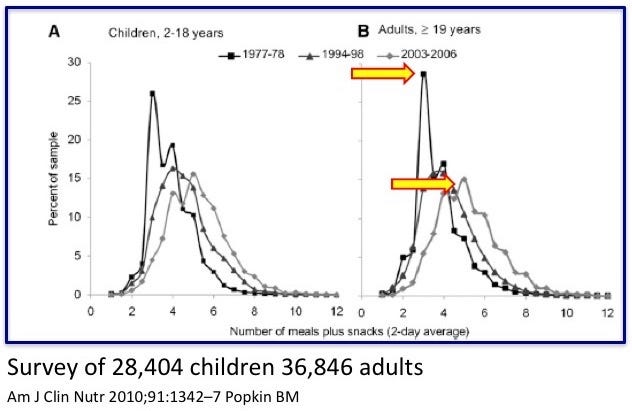
If the majority of people were able to avoid obesity without counting calories, then how did counting calories become so fundamental to weight stability since 1980? There are two main changes in the American diet since the 1970s. First, we were advised to lower the amount of fat in our diet and increase the amount of carbohydrates. The push to eat more white bread and pasta turned out not to be particularly slimming. But there’s also another problem that largely flew under the radar: the increase in meal frequency.

In the 1970s, people typically ate three times per day: breakfast, lunch, and dinner.

By 2004, the number of meals eaten per day had increased closer to six per day—almost double. Now, snacking was not just an indulgence, it was encouraged as a healthy behavior. Meal skipping was heavily frowned upon.

The admonishments against meal skipping were especially loud. Doctors and dietitians told patients to never ever skip a meal. Yet from a physiological standpoint, if you don’t eat, your body will burn some body fat to get the energy it needs. That’s all that happens. It’s the entire purpose the body carries fat in the first place. We store fat so we can use it. If we don’t eat, our bodies use the body fat.

As people gained more weight, the calls for people to eat more and more frequently grew louder. Doctors would say to cut calories and eat constantly—graze, like a dairy cow in a pasture.
People with obesity are victims of poor advice to eat more often and lower dietary fat in a desperate effort to reduce caloric intake.
But the advice didn’t work. Either the dietary advice for weight loss was bad, or the advice was good, but the person was not following it. I believe that the former is correct. Therefore, people with obesity are victims of poor advice to eat more often and lower dietary fat in a desperate effort to reduce caloric intake. Their weight problems are a symptom of a failure to understand the disease of obesity. I do not believe they have low willpower or weak character. Many physicians and researchers believe the latter conclusion. They believe the problem is the patients. But that conclusion suggests that the obesity epidemic is the result of a worldwide collective simultaneous loss of willpower and character. Was this obesity crisis actually a crisis of weak willpower?

Somewhere around 40 percent of the U.S. adult population is classified as obese and 70 percent are overweight or obese. Suppose a teacher has a class of 100 children. If one student fails, that may certainly be the child’s fault. Perhaps they didn’t study. But if 70 children are failing, then is it not more likely the teacher’s fault? In obesity medicine, the problem was never with the patient. The problem was the faulty dietary advice patients were given.

This is why obesity is not only a disease with dire health consequences but a disease that comes with a lot of shame. People blame themselves because everybody tells them it is their fault. Nutritional authorities throw around the euphemism “personal responsibility.” But it’s not.

The real problem is an underlying assumption that obesity is all about calories eaten versus calories burned. The natural conclusion of this line of thinking is that if you are obese, “it’s your fault” and you “let yourself go.” You either failed to control your eating or did not exercise enough. But obesity is not a disorder of too many calories. I argue it’s a hormonal imbalance of hyperinsulinemia. Cutting calories when the problem is insulin is not going to work.

Not only do people with weight problems suffer all the physical health issues—type 2 diabetes, joint problems, etc.—but they’re also shamed for it. It’s time for the medical community to admit its mistakes and stop playing the patient blame game.

Sunday, September 9, 2018

height and weight of a newborn in Stalin period

из фб Алексея Орлова, обсуждение там же
Он приводит картинку, таблицу и кусок текста из Миронова

"Жизненный уровень в Советской России при Сталине по антропометрическим данным"

из каментов:
Сам Миронов пишет:
Эти данные чрезвычайно показательны. Во-первых, размеры тела и вес отдельного новорожденного еще в большей степени, чем рост и вес ребенка или подростка, зависят от краткосрочных изменениях внешней среды (в данном случае — от состояния материнского организма), а не от генотипа. Во-вторых, жители Москвы и Ленинграда в советское время находились в привилегированном, сравнительно с другими городами страны, положении в отношении зарплаты, медицинского обслуживания и снабжения продуктами питания. Тем не менее и в Москве даже к середине 1950-х гг. показатели роста и веса новорожденных были ниже, чем накануне «великого перелома», а в отношении веса новорожденных — ниже, чем до революции. Рост и вес новорожденных существенно колебались по годам, отражая колебания и физиологического статуса их матерей: за 42 года, с 1916 по 1957 гг., длина тела 23 раза понижалась по сравнению с предыдущим годом и 19 раз повышалась, а вес — соответственно 24 и 18 раз. Надо также иметь в виду, что в некоторые годы, в периоды самых резких кризисов (например, в 1933 г.), вообще рождалось меньше детей или, родившись, они умирали, не попав в регистрацию, причем это с большей вероятностью затрагивало матерей с наиболее низким физиологическим статусом. В результате происходило некоторое искусственное завышение средних показателей для рожденных и зарегистрированных детей. При всех колебаниях показателей на графиках заметны периоды, когда рост и вес имели повышательную тенденцию, что, по-видимому, было связано с общим улучшением экономической ситуации в стране (в середине 1920-х и во второй половине 1930-х гг., а также после Второй мировой войны). Видны и периоды явного ухудшения (конец 1920-х — начало 1930-х гг., Вторая мировая война). Но некоторые повороты кривых объяснить сложнее. Таковы, в частности, увеличение длины тела новорожденных между 1916 и 1926 гг. или резкое падение их веса в 1937 г. Общая же тенденция — это снижение показателей примерно до середины 1940-х годов и медленный рост после этого. Но самые высокие показатели середины 1920-х гг. даже к середине 1950-х так и не были достигнуты.

имхо: запрет аборта, но в Ленинграде менее выражено, что заставляет усумницо

Wednesday, October 12, 2016

is Bashkortostan a republic

муртаза рахимов
"Прописанные в договоре полномочия и сама Декларация о суверенитете позволяли республике динамично развиваться на протяжении 20 лет. Как только мы об этом позабыли, перестали пользоваться, то превратились в заурядный регион", - сказал Рахимов журналистам местных СМИ.

Экс-президент в очередной раз привел в пример соседний Татарстан, где статус суверенного государства сохраняется даже под сильным давлением Москвы.

"Соседи наши сохранили не просто должность президента Татарстана - это только символ, а одно из ведущих мест в стране. Как ты сам себя уважаешь, так и будут относиться к тебе", - добавил Рахимов.

По его словам, именно суверенитет дал республике практически все, чем сегодня она обладает в экономическом и социальном плане. "Из последней десятки мы по большинству показателей в итоге переместились в первую десятку в РФ", - отметил экс-президент Башкортостана.

Thursday, March 19, 2015

a guide for healthy drinking

утро понедельника

Alcohol screening and intervention for risky drinking: A guide for physicians


но канадский

Current Canadian guidelines for low-risk drinking recommend no more than 10 drinks a week for women (with no more than 2 drinks a day on most days) and a maximum of 15 drinks a week for men (with no more than 3 drinks a day on most days). They recommend that pregnant women abstain from drinking.
для врачей: FRAMES approach:
  • Feedback of risk
  • Responsibility for change
  • Advice
  • Menu of options
  • Empathy[модное словцо, помогает от всех болезней, особенно социально значимых]
  • Self-efficacy
The authors state that these "policy changes would help to ensure equitable care for those with at-risk drinking and alcohol use disorders, thereby reducing the burden of disease and saving costs."

вопрос на/за сыпку 1 дриньк = ???
вопрос на/за сыпку 2 -- это шарлатанство ?

Sunday, September 15, 2013

Lenin: есть калории и есть калории

так и знал: худей/неху деЙ -- смысла нет
и немедленно съел калорию, а лутшэп выпил, патамушто помогает токо дисбактериоз, а для него вотка -- точтонада, пойду худеть (хотя воскресение уже, не перехудетьба)
Читайте Экономист: не забывайте -- англичанин=мудретс

Thursday, March 28, 2013

Obesity and overweight

толстушко ВОЗ опубликовала новые тематические факты:
  • С 1980 года число лиц во всем мире, страдающих ожирением более чем удвоилось (то-есть: растёт быстрее населения).
  • В 2008 году более 1,4 миллиарда взрослых людей в возрасте 20-ти лет и старше страдали от избыточного веса (остальные от голода?). Из этого числа свыше 200 милионов лиц мужского пола и почти 300 миллионов лиц женского пола страдали ожирением (существенное гендерное неравенство, а чем объяснить?).
  • Шестьдесят пять процентов населения мира проживают в странах, где избыточный вес и ожирение приводят к смерти большее число людей, чем пониженная масса тела.
  • В 2010 году более 40 миллионов детей в возрасте до 5 лет имели избыточный вес.
  • Ожирение можно предотвратить.
Индекс массы тела (ИМТ) – простое отношение веса к росту, часто используется для классификации ожирения и избыточного веса. Индекс рассчитывается как отношение веса тела в килограммах к квадрату роста в метрах (кг/м2).
По определению ВОЗ:
  • ИМТ больше или равен 25 – избыточная масса тела
  • ИМТ больше или равен 30 – ожирение
читать дальше на сайте ВОЗ, ещё дальше -- диспут ЛинкедИна