Showing posts with label Латинская Америка. Show all posts

Wednesday, October 9, 2024

The crisis-driven shifts of Venezuelan migration patterns

September 12, 2024 Jenny Garcia Arias

The Venezuelan exodus stands as the largest displacement in recent Latin American history, with around 22.5% of the population now living abroad. Drawing on data from seven of the main destination countries for Venezuelans, Jenny Garcia estimates the demographics of recent outflows, the chronology of associated changes, and the implications for those remaining in the country.


When a crisis occurs, demographic patterns can shift dramatically, leading to rapid changes in outward migration and local population compositions. As the crisis progresses, the likelihood of migration varies across individuals, influenced by the evolving costs and benefits of this choice. Accurately assessing population at risk is crucial for understanding levels and trends in demographic phenomena, and precise age and gender estimates are essential for evaluating the full impact of the ongoing crisis on both migrants and the remaining population.

The Venezuelan crisis


The recent Venezuelan migration crisis exemplifies how socio-economic and political instability can precipitate significant demographic shifts. The situation in Venezuela, formerly a destination for migrants, has undergone a dramatic reversal, resulting in one of the largest population exoduses in recent history, and the largest in recent Latin American history. According to the Inter-Agency Coordination Platform for Refugees and Migrants from Venezuela (R4V), as of June 2024, 7.7 million Venezuelans are living abroad, constituting approximately 22.5% of the estimated population (R4V, 2024).

The roots of the Venezuelan migration crisis are deeply embedded in the country’s economic collapse. A pivotal moment occurred in 2015, following the decline in oil prices that plunged Venezuela into a profound recession. The period from 2018 to 2019 was especially devastating, marked by hyperinflation, above 65%, and a 35% contraction in GDP. These economic adversities were compounded by extreme poverty, with 75% of the population living in severe hardship and nearly 90% of households unable to meet basic food needs (ENCOVI, 2022). The deteriorating quality of life, characterized by rampant crime, food scarcity, and human rights violations, forced many Venezuelans to flee.

Current research on Venezuelan migrants focuses on analyses conducted in receiving countries, and most estimates have highlighted the fluctuating size of the emigrant population throughout the crisis. However, there is limited understanding of the demographic characteristics of these crisis-driven outflows. This gap in knowledge is primarily attributed to the lack of available data, as Venezuela does not maintain emigration records, and data collection practices differ across receiving countries.

In a recent study (Garcia Arias, 2024) I explored the demographic dynamics of the emigrant Venezuelan population by estimating annual age and gender-specific outflows between 2011 and 2021 and summarizing the demographic implications for both emigrants and those remaining in the country. To do this, I exploited data from seven major destination countries, accounting for approximately 90% of the Venezuelan-born population residing abroad as of April 2022. The data sources included administrative records, population censuses, migrant surveys, continuous household surveys, and population registries.

The changing demography of outflows


In the 1990s, the number of Venezuelans living abroad was slightly over 185,000, increasing to 317,000 by 2000 and approximately 560,000 by 2010 (UN DESA 2020). These emigrants were predominantly members of Venezuela’s middle and upper classes, including businesspeople, highly skilled professionals—especially former oil industry employees—and first or second-generation descendants of immigrants to Venezuela. Their primary destinations included the United States, Spain, Italy, and Portugal (Freitez 2011). These outflows were predominantly female (55%), with a mean age of about 28.2 years.

Three key phases have since marked the crisis-induced changes in the demographics of Venezuelan emigration:
1) The onset of the crisis (2014-2017) marked a shift from highly skilled labor migration to family migration. The Venezuelan diaspora increased from 800,000 nationals abroad in 2014 to 2 million in 2017. The average age of these additional 1.21 million migrants dropped to its lowest level in 2015 (24.9 years for men and 25.4 years for women), and about 26% were under 15 years of age. These outflows largely consisted of entire families, often binational, seeking nearby destinations. Countries such as Colombia, Chile, Peru, and Ecuador emerged as primary destinations for Venezuelans. The incipient crisis also prompted a large number of young men to migrate; for the first time, the number of migrating men surpassed that of women (102 men per 100 women).
2) Acute phase of the crisis (2018-2020): During this period, 3.52 million Venezuelans left the country. Adults aged 20 to 45 constituted 54% of outflows, with women outnumbering men (95 men per 100 women). Only 18% of emigrants were under 15 years old. This phase was marked by a large portion of young women traveling alone. Migration patterns diversified, with an increasing number of middle- and lower-income individuals among outflows. People from across the entire country migrated; medium-sized and small towns replaced the historical role of the major cities as the main sources of migrants (ENCOVI 2022). 
3) Impact of the COVID-19 pandemic (2021): The pandemic influenced migration trends, with continued, albeit reduced, emigration driven by family reunification. The proportion of older adults over 55 years, particularly women, among total outflows increased from 5% (2014-2017) to 12%. Additionally, Venezuelan migrants previously settled in southern countries of the American continent started redirecting their destinations towards the north.

By 2021, 63.6% of Venezuelans living abroad were between 15 and 45 years old, 16.1% were under 15 years old, and the remaining 20.3% were aged 46 years or older. Among this population, 49% were men and 51% were women.

The demography of those who remain


The mass emigration from Venezuela has profound implications for those who remain. The migration-induced changes have resulted in an 18% loss of the population aged 15 to 64 and a 20% loss of women of reproductive age (15 to 49 years). Consequently, the proportion of the elderly population (65 years or older) is 10% larger than it would otherwise have been. Furthermore, the large-scale emigration of women of reproductive age has led to a cumulative birth deficit since 2014 exceeding 500,000, equivalent to about a year without births in the country.
The repercussions of outmigration will extend beyond a mere reduction in the working-age population and accelerated population aging in coming years; the future functionality of Venezuela’s labor market is also profoundly affected. At the micro level, families left behind face additional challenges, including increased caregiving responsibilities.

The demographic characteristics of this crisis-driven migration, coupled with its prolonged duration, significantly reduce the likelihood of substantial return migration in the coming years. This situation is further compounded by the widespread lack of confidence in national institutions and political freedoms. To date, only negligible return migration has been reported, and when it does occur, it often serves as a strategy to redirect migration toward another destination. Thus, migration has surpassed both fertility and mortality as the primary driver of demographic change in Venezuela.

References

Garcia Arias, J. (2024), The Demography of Crisis-Driven Outflows from Venezuela. Population and Development Review. https://doi.org/10.1111/padr.12651
Encuesta de Condiciones de Vida- ENCOVI. 2022. “Informe de resultados.” Caracas: UCAB-Universidad Católica Andrés Bello.
Freitez, A. 2011. “La emigración desde Venezuela durante la última década.” Temas De Coyuntura, 63 (January): 11–38.
R4V. 2024. Coordination platform for refugees and migrants from Venezuela.
United Nations (2020). International Migrant Stock 2020: Highlights. New York. Department of Economic and Social Affairs. Population Division

Friday, September 13, 2024

The crisis-driven shifts of Venezuelan migration patterns

September 12, 2024 Jenny Garcia Arias

The Venezuelan exodus stands as the largest displacement in recent Latin American history, with around 22.5% of the population now living abroad. Drawing on data from seven of the main destination countries for Venezuelans, Jenny Garcia estimates the demographics of recent outflows, the chronology of associated changes, and the implications for those remaining in the country.


When a crisis occurs, demographic patterns can shift dramatically, leading to rapid changes in outward migration and local population compositions. As the crisis progresses, the likelihood of migration varies across individuals, influenced by the evolving costs and benefits of this choice. Accurately assessing population at risk is crucial for understanding levels and trends in demographic phenomena, and precise age and gender estimates are essential for evaluating the full impact of the ongoing crisis on both migrants and the remaining population.

The Venezuelan crisis


The recent Venezuelan migration crisis exemplifies how socio-economic and political instability can precipitate significant demographic shifts. The situation in Venezuela, formerly a destination for migrants, has undergone a dramatic reversal, resulting in one of the largest population exoduses in recent history, and the largest in recent Latin American history. According to the Inter-Agency Coordination Platform for Refugees and Migrants from Venezuela (R4V), as of June 2024, 7.7 million Venezuelans are living abroad, constituting approximately 22.5% of the estimated population (R4V, 2024).

The roots of the Venezuelan migration crisis are deeply embedded in the country’s economic collapse. A pivotal moment occurred in 2015, following the decline in oil prices that plunged Venezuela into a profound recession. The period from 2018 to 2019 was especially devastating, marked by hyperinflation, above 65%, and a 35% contraction in GDP. These economic adversities were compounded by extreme poverty, with 75% of the population living in severe hardship and nearly 90% of households unable to meet basic food needs (ENCOVI, 2022). The deteriorating quality of life, characterized by rampant crime, food scarcity, and human rights violations, forced many Venezuelans to flee.

Current research on Venezuelan migrants focuses on analyses conducted in receiving countries, and most estimates have highlighted the fluctuating size of the emigrant population throughout the crisis. However, there is limited understanding of the demographic characteristics of these crisis-driven outflows. This gap in knowledge is primarily attributed to the lack of available data, as Venezuela does not maintain emigration records, and data collection practices differ across receiving countries.

In a recent study (Garcia Arias, 2024) I explored the demographic dynamics of the emigrant Venezuelan population by estimating annual age and gender-specific outflows between 2011 and 2021 and summarizing the demographic implications for both emigrants and those remaining in the country. To do this, I exploited data from seven major destination countries, accounting for approximately 90% of the Venezuelan-born population residing abroad as of April 2022. The data sources included administrative records, population censuses, migrant surveys, continuous household surveys, and population registries.

The changing demography of outflows


In the 1990s, the number of Venezuelans living abroad was slightly over 185,000, increasing to 317,000 by 2000 and approximately 560,000 by 2010 (UN DESA 2020). These emigrants were predominantly members of Venezuela’s middle and upper classes, including businesspeople, highly skilled professionals—especially former oil industry employees—and first or second-generation descendants of immigrants to Venezuela. Their primary destinations included the United States, Spain, Italy, and Portugal (Freitez 2011). These outflows were predominantly female (55%), with a mean age of about 28.2 years.

Three key phases have since marked the crisis-induced changes in the demographics of Venezuelan emigration:

1) The onset of the crisis (2014-2017) marked a shift from highly skilled labor migration to family migration. The Venezuelan diaspora increased from 800,000 nationals abroad in 2014 to 2 million in 2017. The average age of these additional 1.21 million migrants dropped to its lowest level in 2015 (24.9 years for men and 25.4 years for women), and about 26% were under 15 years of age. These outflows largely consisted of entire families, often binational, seeking nearby destinations. Countries such as Colombia, Chile, Peru, and Ecuador emerged as primary destinations for Venezuelans. The incipient crisis also prompted a large number of young men to migrate; for the first time, the number of migrating men surpassed that of women (102 men per 100 women).

2) Acute phase of the crisis (2018-2020): During this period, 3.52 million Venezuelans left the country. Adults aged 20 to 45 constituted 54% of outflows, with women outnumbering men (95 men per 100 women). Only 18% of emigrants were under 15 years old. This phase was marked by a large portion of young women traveling alone. Migration patterns diversified, with an increasing number of middle- and lower-income individuals among outflows. People from across the entire country migrated; medium-sized and small towns replaced the historical role of the major cities as the main sources of migrants (ENCOVI 2022).

3) Impact of the COVID-19 pandemic (2021): The pandemic influenced migration trends, with continued, albeit reduced, emigration driven by family reunification. The proportion of older adults over 55 years, particularly women, among total outflows increased from 5% (2014-2017) to 12%. Additionally, Venezuelan migrants previously settled in southern countries of the American continent started redirecting their destinations towards the north.
By 2021, 63.6% of Venezuelans living abroad were between 15 and 45 years old, 16.1% were under 15 years old, and the remaining 20.3% were aged 46 years or older. Among this population, 49% were men and 51% were women.

The demography of those who remain


The mass emigration from Venezuela has profound implications for those who remain. The migration-induced changes have resulted in an 18% loss of the population aged 15 to 64 and a 20% loss of women of reproductive age (15 to 49 years). Consequently, the proportion of the elderly population (65 years or older) is 10% larger than it would otherwise have been. Furthermore, the large-scale emigration of women of reproductive age has led to a cumulative birth deficit since 2014 exceeding 500,000, equivalent to about a year without births in the country.
The repercussions of outmigration will extend beyond a mere reduction in the working-age population and accelerated population aging in coming years; the future functionality of Venezuela’s labor market is also profoundly affected. At the micro level, families left behind face additional challenges, including increased caregiving responsibilities.

The demographic characteristics of this crisis-driven migration, coupled with its prolonged duration, significantly reduce the likelihood of substantial return migration in the coming years. This situation is further compounded by the widespread lack of confidence in national institutions and political freedoms. To date, only negligible return migration has been reported, and when it does occur, it often serves as a strategy to redirect migration toward another destination. Thus, migration has surpassed both fertility and mortality as the primary driver of demographic change in Venezuela.

References

Tuesday, May 14, 2024

Plummeting fertility in Uruguay, 2016-2021

May 13, 2024 Wanda Cabella, Mariana Fernández Soto, Ignacio Pardo and Gabriela Pedetti

Uruguay’s total fertility rate plummeted from nearly 2 children per woman in 2015 to 1.37 in 2021. As Wanda Cabella, Mariana Fernández Soto, Ignacio Pardo, Gabriela Pedetti note, this unprecedented decline was mainly fueled by decreasing adolescent and early fertility rates.


In the mid-20th century, Uruguay had a total fertility rate (TFR) of 3 children per woman, half the Latin American average, following a very early demographic transition. At the turn of this century, TFR approached replacement level in most Latin American countries, aligning Uruguayan fertility with regional trends, particularly, the coexistence of low total fertility and high adolescent fertility rates, typical of Latin American populations.


The three phases of the fertility decline


In more detail, the recent evolution of Uruguayan fertility can be broken down into three distinct phases:

1) a decline to below replacement-level fertility (1996–2005),
2) a period of relative stability (1996–2015), and
3) a particularly sharp decrease from low to lowest-low fertility levels (2016–2021) (Figure 1).

In 1996–2005, the main mechanism fueling decline was the increasing adoption of a “stopping behavior” after 2 children, with a sharp reduction of births of order 3 or higher (Nathan, Pardo and Cabella 2016). Conversely, in 2016-2021, a large decline is apparent in all age groups, but particularly among younger women, up to age 22 (Figure 2).

Decomposing change: the role of young and adolescent fertility


The decomposition of change is more revealing, especially if we express it as the contribution of each age and birth order to the reduction of the TFR (Figure 3). In the area corresponding to order 1, the reduction in first births before the age of 24 accounts for 30% of the total decline over the period. The decrease in second births among women under that same age was another important contributing factor, accounting for 15% of the total. Finally, more than a fifth of the decline is explained by the decrease in third and higher-order births among women aged 30 or above.
In short, a sharp decline in first births in adolescence and early youth, associated primarily with the postponement of the first birth, played a major role in the decline, but stopping was the most probable mechanism behind the reduction of higher order fertility rates among older women.

Mean age at first birth, which remained stable at around 24 years for a few decades and increased by barely a year between 1978 and 2011 (Nathan 2015), climbed by 1.5 years during the six years (2016-2021) of the big decline (from 24.9 to 26.4 years). Graphically, this change in the fertility regime can also be seen with conditional fertility rates: the traditional bimodal curve of the age at first birth is gradually transforming into a unimodal one (Nathan, Pardo, and Cabella 2016; Pardo and Cabella 2018). While this more flattened pattern still represents considerable heterogeneity in fertility timing, it contrasts drastically with the bi-modal shape of 2016 (Figure 4).

Conclusions: behavioral change and future trends


What explains this abrupt fertility decline? Considering that lower adolescent and early fertility played a leading role, it is reasonable to assume that most women deferred their first child during the period, probably exploiting the modern subdermal contraceptive implants, whose use has increased rapidly in recent times (Ceni et al. 2021). If this is true, some of the births that were avoided by adolescents and young women during the big decline will take place in the coming years, increasing rates in the 25-29 and older age groups. This might trigger a slight rebound in the TFR at some point, although it is difficult to predict its timing and extent.

The factors behind the decision not to have a(nother) child are not fully understood yet, but several contextual aspects may be considered. After a thirty-year period of extensive family change that resembled the Second Demographic Transition, Uruguay witnessed large-scale public debates on sexual and reproductive health rights, and the implementation of associated policies. For instance, abortion and same-sex marriage were legalized in 2012 and 2013, respectively. Some years later, official sex education programs were amended, and the National Strategy for the Prevention of Unintentional Adolescent Pregnancy was introduced.

With the spread of feminism in the Southern Cone, the big decline also overlapped with intense social change. Some of the main issues of the public debate during these years are relevant to a discussion on reproductive behavior. These include the difficulties of reconciling work and childcare, the potential conflict between family life and leisure, and the social normativity associated with motherhood.

It is also true, however, that no major social or economic shock has occurred in recent years in Uruguay, and that the true causes of the abrupt fertility decline of 2016–2021 remain poorly understood.

References

  • Cabella W., Fernández Soto M., Pardo I., Pedetti G. (2024) The big decline: lowest-low fertility in Uruguay (2016–2021). Demographic Research 50(16): 443–456. 10.4054/DemRes.2024.50.16
  • Ceni R., Parada C., Perazzo I., Sena E. (2021). Birth collapse and a large‐scale access intervention with subdermal contraceptive implants. Studies in Family Planning 523: 321–342. doi:10.1111/sifp.12171.
  • Nathan M. (2015). La creciente heterogeneidad en la edad al primer hijo en Uruguay: Un análisis de las cohortes 1951–1990. Notas de Población 100: 35–60. doi:10.18356/ecf4b5ea-es.
  • Nathan M., Pardo I., Cabella W. (2016). Diverging patterns of fertility decline in Uruguay. Demographic Research 34(20): 563–586. doi:10.4054/DemRes.2016. 34.20.
  • Pardo I., Cabella W. (2018). A bimodal pattern in age at first birth in southern cone countries? Population Review 57(2): 1–22. doi:10.1353/prv.2018.0004.

Tuesday, November 28, 2023

Abortion and race in Brazil

National Abortion Surveys 2016 to 2021

Debora Diniz Marcelo Medeiros Pedro H. G. Ferreira de Souza Emanuelle Goés ABOUT THE AUTHORS


We examine racial differentials in abortion among women in Brazil using data from three editions of the Brazilian National Abortion Survey (PNA), 2016, 2019 and 2021. We test the difference in means in data from separate surveys, combined surveys without reweighting, and combined and reweighted surveys. We also use logistic models for the chance of having an abortion. The results indicate that there is a consistent racial differential in the three editions of PNA, with the percentage of abortions among Black women being higher than among white women. In the combined and reweighted surveys, among Black women of all ages the probability of having had an abortion is 11.03% while among white women it is 7.55%. This means a difference of 3.5 percentage points, which translates into a 46% higher probability for Black women, statistically significant values for a 5% interval. Logistic regressions produce similar results, with an average predicted probability of 12.61% for Black women and 8.90% for white women, also significant. Racial differences remain statistically significant for various combinations of PNA editions. However, in the separate surveys, the difference in means tests are only statistically significant in 2016. Black refers to the group formed by Black and Brown women (pretas and pardas). Due to the small sample size, it is not possible to say much about the differences with Asian and Indigenous women.

Key words:

Abortion; Color or race; National Abortion Survey; Brazil

Monday, October 30, 2023

almost in Russian

Early disengagement from education and work: “ninihood” in Latin America

October 30, 2023 Chia Liu, Andrés F. Castro Torres and Ewa Batyra

Latin America faces a unique societal challenge: high numbers of young adults, especially women, who neither work nor pursue education, known colloquially as “nini.” Using census microdata for 12 countries, Chia Liu, Andrés Castro Torres, and Ewa Batyra examine the dynamics of young adults’ disengagement from public spheres (e.g., formal work and formal education) and shed light on the roles of family, gender, and social class as significant determinants of “ninihood”.


The term “nini” encapsulates the plight of young adults who find themselves disconnected from both work and education (De Hoyos, Popova, & Rogers, 2016). It’s estimated that almost 20% of youths between 15 to 25 years old in Latin America are part of this group. At the same time, early parenthood and union formation are widespread in Latin America, where many young adults, particularly women, are occupied with household and care work. To cast light on this complex socio-economic landscape, in a recently published paper, we explored the dynamics between parenthood, gender roles on one side, and labour force and formal educational participation on the other (Liu, Castro Torres & Batyra, 2023).

The “nini” phenomenon: gender and social class dynamics


In the 12 Latin American countries under study, a significant proportion of women aged 20 to 25, at least one out of every four, can be categorized as “ninis”. In Guatemala, Honduras, and Nicaragua, this proportion is even higher, above 50%. On the other hand, among men in the same age group, the percentage is notably lower, below 20% (Figure 1).
The discussion pertaining to “ninihood” is delicate. Latin America is a region with large informal labour markets, with many people working in the shadow economy, and therefore rarely captured in official data. Thus, the term is controversial because informal and uncompensated work is often left out of the picture. Despite the importance of these under-acknowledged work activities, those not engaged in formal education or the formal labour market have been found to experience high levels of insecurity. The “nini” phenomenon, essentially an early disengagement from education and work, has wide-ranging consequences, such as limited lifetime earnings, economic vulnerability and social marginalization. At the societal level, untapped human potential hampers economic growth, while unmet needs may fuel social unrest.

Given the stark differences in “ninihood” between men and women observed in Latin America (Figure 1), our study delves into the intricate relationship between early family formation, especially for women, and the accumulation of human capital. The gender and social class gradients that emerge underscore the challenges women face in remaining visible in the formal public sphere: disengagement primarily affects socially disadvantaged women, especially in Central America. Women from lower social origins who leave the parental home to enter conjugal union and parenthood at younger ages are particularly at risk. Being in a partnership increases the risk of being a “nini” for women, but reduces it for men, confirming the pervasiveness of the male breadwinner model in conjugal households.

Implications for policy and gender equality


Early family formation heightens the risk of exclusion from formal institutions and social safety nets. For those who fall into the “nini” category, transitioning into adulthood is fraught with challenges, leading to disparities in access to vital resources like unemployment insurance, healthcare, and pension schemes. Our findings emphasize the critical role of women’s engagement in the formal labour market, particularly in a context of limited social protection and single motherhood, and prompts us to reconsider how we view women’s engagement with public life, especially in the Global South.

This work on early parenthood, gender roles, and labour force participation in Latin America shines a light on the complexities behind the “nini” phenomenon. The results underscore the urgent need for governments to address the issue of disengagement from the public sphere, by improving access to employment and education, for example, especially among women and lower socio-economic classes. As Latin America strives for inclusive growth and development, acknowledging the role of early family formation and gender dynamics is essential for fostering economic security, social equality, and individual well-being.

References

Saturday, August 26, 2023

BRICS countries: life expectancy at birth from 2000 to 2021

Globally, average life expectancy from birth has risen from 67.6 years in 2000 to 72.75 years in 2020. Of the BRICS countries, life expectancy in Brazil and China has been above the global average during this time, while India's and South Africa's have consistently been below, and Russia's was below until 2017. Life expectancy from birth has risen in all five BRICS countries over these two decades, although there was a drop of almost three years in South Africa between 2000 and 2005, due to the prevalence of HIV/AIDS, and a slight drop of almost half a year in Russia from 2000 to 2003, due to the prevalence of unhealthy lifestyles and alcohol/substance abuse.BRICS countries: life expectancy at birth from 2000 to 2021

Monday, July 10, 2023

inequality in aging

Socioeconomic inequalities in functional health in Chilean older adults

July 10, 2023 Pedro Olivares-Tirado and Rosendo Zanga Pizarro

Old age is frequently marred by ill health. Socioeconomic conditions, too, play their part: the poorest also suffer from worse health conditions in Chile, as Pedro Olivares-Tirado and Rosendo Zanga Pizarro show, and arguably also elsewhere.


In the last three decades, Chile has experienced accelerated demographic ageing. In the 2017 Census, older adults (OA60+, aged 60 years and over) represented 16% of the country’s population, a share that is projected to increase to about 31% in 2050 (CELADE 2017). Population ageing raises the issue of the “quality of ageing” (Scott 2021), which may be significantly lowered by impairments in self-care, mobility, and cognitive functions affecting autonomy, independence and well-being in older persons. Different measures may be used to determine functional limitations. Regarding basic activities of daily living (BADL), six items are usually used: eating, bathing, personal mobility, toilet use, getting in/out of bed and dressing.

Socioeconomic inequalities and functional limitations


Functionality depends also on the social context in which older adults live and on their socioeconomic status, both of which affect their access to the healthcare system (Zhanget al 2019, Huang and Fu 2021).

Despite public policy improvements, Chile still has inequality in access, opportunity, quality, and financial coverage of health care, particularly among older adults (Fuentes-García et al 2013, Moreno et al. 2021). In a recent paper (Olivares-Tirado and Zanga Pizarro 2022), we examined the association between socioeconomic inequalities and functional limitations among Chilean older adults using self-reported BADL limitations and household income from the National Socioeconomic Characterization Survey-2017 (CASEN/2017).

Over 44,000 OA60+ were surveyed, 56% of them women. Most of them lived in urban areas, and had average schooling of 10.7 years for men and 9.3 years for women. The average adjusted household income was 1,638 US$ for men and 1,532 US$ for women. Furthermore, 85% of the OA60+ were covered by public health insurance, 7% by private health insurance, and the remaining were retired from the armed forces or had no insurance.

Table 1 shows the percentage of BADL limitations among OA60+, stratified by sex and severity. About 87% men and 81% of OA60+ women had no BADL limitation. Concerning each BADL, personal mobility was the daily activity that showed the most significant functional limitations in both sexes, followed by bathing and dressing. In all BADLs, women presented more severe functional limitations than men.
Figure 1 shows trends in BADL limitations of the poorest (first two deciles) and richest (last two deciles) OA60+ across age groups and by sex. An exponential increase in the frequency of BADL limitations across age groups in both sexes was observed. Women have higher prevalence (and higher severity) of BADL limitations than men in all age groups. The difference between the poorest and the wealthy decreases with advancing age.
Let us consider the case of personal mobility limitation rates, for instance (other limitations have similar patterns, not shown here). Figure 2 shows the gradient of both severity levels, by gender and income decile, from the poorest (decile I) to the richest deciles (decile X). It emerges clearly that personal mobility limitations decline as income increases, and are always higher for women.

Policy implication of socioeconomic inequalities in functional health


While everybody is more likely to experience functional limitations as they age, significant gender and socioeconomic inequalities exist among Chilean older adults. Poor people present higher values in both severity levels of BADL limitations than rich people, and women are more affected than men.

These findings highlight the need for policies and programs to combat these socioeconomic inequalities in early adulthood in order to prevent and reduce limitations in functional health later in life. This goal will require significant changes in the social infrastructure and institutions around health, education, jobs, careers, pensions, legislation and community relationships.

The implication of living longer and achieving healthy ageing will inevitably place increased responsibility on the individual. The young generation most affected by increased longevity trends will require the most significant changes and adaptations in terms of education, careers, jobs and lifestyles.

References

  • CELADE. 2017. Long term population estimates and projections 1950-2100 Chile. 2017 Revision.
  • Fuentes-García A, Sánchez H, Lera L, Cea X, Albala C. 2013. Desigualdades socioeconómicas en el proceso de discapacidad en una cohorte de adultos mayores de Santiago de Chile. Gac Sanit. 27(3): 226–232.
  • Huang F, Fu P. 2021. Intergenerational support and subjective wellbeing among oldest-old in China: the moderating role of economic status. BMC Geriatr 21, 252. https://doi.org/10.1186/s12877-021-02204-y
  • Moreno X., Lera L., Moreno F. et al. 2021. Socioeconomic inequalities in life expectancy and disability-free life expectancy among Chilean older adults: evidence from a longitudinal study. BMC Geriatr 21, 176. https://doi.org/10.1186/s12877-021-02126-9.
  • Olivares-Tirado P, Zanga Pizarro. 2022. Socioeconomic Inequalities in Functional Health in Older Adults. Journal of Population Ageing 16(3). https://doi.org/10.1007/s12062-022-09404-3
  • Scott AJ. 2021. The longevity society. Lancet Healthy Longev. 2(12): e820-e827. doi: 10.1016/S2666-7568(21)00247-6.
  • Zhang CQ, Chung PK, Zhang R, Schüz B. 2019. Socioeconomic Inequalities in Older Adults’ Health: The Roles of Neighborhood and Individual-Level Psychosocial and Behavioral Resources. Front Public Health. 7:318. doi:10.3389/fpubh.2019.00318

Wednesday, February 15, 2023

Adolescent fertility hampers education

The case of Chile

February 13, 2023 Viviana Salinas and Valentina Jorquera-Samter

How does adolescent fertility affect high school completion for boys and girls in Chile? Controlling for socioeconomic and academic selectivity, Viviana Salinas and Valentina Jorquera-Samter find that a teenage mother is 13% less likely to complete high school, whereas the corresponding probability decline for a teenage father is 3%.


Social sciences have a long-standing interest in the consequences of early parenthood on different domains of the life course. Early studies showed that adolescent fertility reduced educational attainment and consequently sent teenage mothers on a path of precarious employment and low income (Card, Wise, and Morgan 1987; Moore and Waite 1977; Waite and Moore 1977). Researchers soon noticed that teenagers who get pregnant form a selected group, typically with limited socioeconomic resources and poor school performance. These characteristics, and others of the same nature, tend to favor both adolescent fertility and poor educational outcomes. Failing to account for this overestimates the adverse effect of adolescent fertility on education (Diaz and Fiel 2016; Kane et al. 2013).

Assessing the effect of adolescent fertility on education in Chile


Several techniques have been developed to properly estimate the effect of adolescent fertility on education, taking into account selectivity (or “treatment selection”, in the jargon of causal inference). In a recent study (Salinas and Jorquera-Samter 2022), we employed one of these techniques (propensity score weighting) to estimate the effect of adolescent fertility on the probability of completing high school, net of selection due to the socioeconomic origin and prior academic performance. While most previous research on this topic focuses on girls and the U.S., we studied Chile, we included boys, and we tested explicitly for gender differences.

Besides, we exploited an innovative data source. While the few estimations that exist for Latin America rely on surveys, we used register data from the Ministry of Education covering a cohort of students attending publicly funded schools from 2011 to 2018.

In Chile, adolescent fertility (births to women aged 15-19 years) has declined sharply in recent years, from 53 per 1,000 in 2008 to 23 per 1,000 in 2018 (Rodriguez Vignoli and Roberts 2020). This is largely below the Latin America average (61 per 1,000 in 2020). Besides, high-school enrollment is high and dropout rates are relatively low (Ministry of Education of Chile 2020). In 2020, the completion rate for upper secondary education (12 years of schooling) was 85.8% in Chile, as compared to 63.7% in Latin America as a whole (UNESCO 2022).

Does adolescent fertility affect the probability of high school completion differently for girls and boys?


Our estimates of the effect of adolescent fertility on the probability of completing high school are shown in Table 1. After dealing with the selectivity of origin in terms of socioeconomic status and prior academic performance, we find that a teenage girl who experiences adolescent fertility is about 13% less likely to complete high school, whereas the corresponding probability decline for a teenage boy is only 3%. The introduction of an interaction term in the pooled sample confirms that this effect is different by gender.
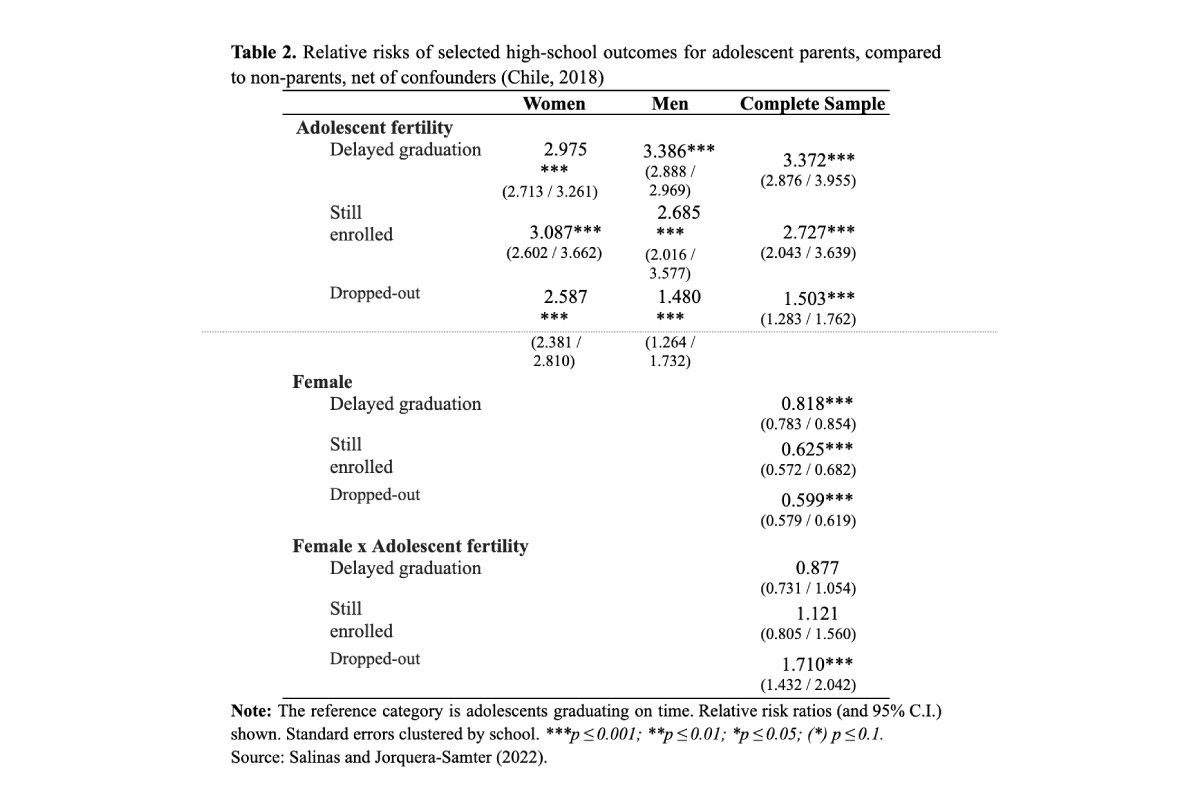
Adolescent fertility affects not only the probability of completing high school, but also the probability of delaying graduation, dropping out, and is still enrolled in the system three years past the expected graduation time, for both genders (table 2). All of these negative outcomes are between 1.5 and 3.4 times more likely for adolescent parents. However, as seen in the results for the pooled sample, significant gender effects of adolescent fertility are detectable only on the probability of dropping out, which is higher for adolescent mothers than adolescent fathers.

Conclusion


In short, the detrimental effects of adolescent fertility on educational performance are strong in Chile, for both genders, and on a couple of relevant outcomes (high school completion and risk of dropping out) they are larger for girls than boys. Note that these are net effects, everything else equal, including, for instance, socioeconomic origin and prior academic performance.

From a policy perspective, these results indicate the need for policies aimed at preventing adolescent fertility, in the first place, and, failing that, at human capital recovery for teens who drop out of school after becoming parents.

References

  • Card, J.J. and Wise, L.L. (1987). Adolescent Mothers and Their Children in Later Life. Family Planning Perspectives 19(4):142–151. doi:10.2307/2135159.
  • Diaz, C.J. and Fiel, J.E. (2016). The Effect(s) of Teen Pregnancy: Reconciling Theory, Methods, and Findings. Demography 53(1):85–116. doi:10.1007/s13524-015-0446-6.
  • Kane, J.B., Morgan, S.P., Harris, K.M., and Guilkey, D.K. (2013). The Educational Consequences of Teen Childbearing. Demography 50(6):2129–2150. doi:10.1007/s13524-013-0238-9.
  • Moore, K.A. and Waite, L.J. (1977). Early Childbearing and Educational Attainment. Family Planning Perspectives 9(5):220–225. doi:10.2307/2134432.
  • Rodriguez Vignoli, J. and Roberts, A. (2020). El descenso de la fecundidad adolescente en Chile. Antecedentes, magnitud, determinantes y desigualdades. Serie de Estudios INJUV. https://www.injuv.gob.cl/sites/default/files/estudioembarazo.pdf
  • Salinas V. And Jorquera-Samter V. (2020) Adolescent fertility and high school completion in Chile: Exploring gender differences, Demographic Research, 47(31): 967–1008. Doi: 10.4054/DemRes.2022.47.31
  • UNESCO. (2022) Education in Latin America and the Caribbean at a Crossroads. https://www.unicef.org/lac/media/37791/file/Education%20in%20Latin%20America%20and%20the%20Caribbean%20at%20a%20crossroads.pdf
  • Waite, L.J. and Moore, K.A. (1977). The Impact of an Early First Birth on Young Women’s Educational Attainment. Social Forces 56(3):845–865

Saturday, February 11, 2023

Argentina

"Полный самолет беременных". 

В Аргентине пытаются совладать с наплывом женщин из России


Суд в Аргентине разрешил въехать в страну всем шестерым гражданкам России, которые были ранее задержаны в аэропорту страны после прилета. Об этом ТАСС сообщил адвокат троих россиянок Кристиан Рубилар.

Беременные россиянки прилетели в столицу Аргентины Буэнос-Айрес, но поначалу им отказали во въезде. Причем, как сообщил заведующий консульским отделом посольства России в Аргентине Георгий Полин, одна из девушек оставалась в зоне вылета с 7 февраля.

Ранее глава миграционной службы Аргентины Флоренсия Кариньяно заявила, что отказ во въезде россиянкам связан с возникшими у сотрудников миграционной службы подозрениями в том, что они предоставили ложную информацию о цели поездки.

По ее словам, россиянки въехали в страну как туристки, несмотря на то, что все находились на поздних сроках беременности.

Кариньяно выступила с заявлением после того, как в четверг вечером в Аргентину одним рейсом прибыли сразу 33 беременные гражданки России, что насторожило сотрудников миграционной службы.

Аргентина предоставляет гражданство родившимся в стране детям, а их родители могут на этом основании получить постоянный вид на жительство, а вслед за этим – и аргентинский паспорт. Он дает в том числе право на безвизовый въезд в страны Евросоюза.

Из-за этого в Аргентину и раньше приезжали беременные женщины, чтобы родить там ребенка, но после вторжения России в Украину страна испытывает ощутимый наплыв беременных россиянок.

По словам Кариньяно, с августа 2022 года поток российских граждан в Аргентину заметно увеличился. А всего за прошлый год в страну въехало порядка 10,5 тысяч беременных гражданок РФ.

"Примерно половина из них находилась в последнем триместре, многие сообщили, что уже на 33-й или 34-й неделе беременности", – сказала чиновница в интервью аргентинскому телевидению.

Адвокат россиянок, которые были задержаны в аэропорту, заявил местным СМИ, что его клиентки пытаются спастись от войны и репрессий, поскольку выражение несогласия с российской политикой чревато тюрьмой. Однако глава миграционной службы убеждена, что это не так.

Примерно 7000 из этих женщин вернулись домой сразу после родов, дав поручение аргентинским юристам оформить документы на гражданство для младенцев, а впоследствии – и для родителей, сообщила она.

"Проблема в том, что они приезжают, рожают детей и после этого покидают Аргентину, чтобы никогда больше не возвращаться. Мы не можем позволить им бесстыдно нам лгать, утверждая, что они туристки, хотя на самом деле это не так", – заявила Кариньяно.

Как заявила Кариньяно, всё это вызывает озабоченность у аргентинских властей, и сейчас по факту такого вида "туризма" начато расследование.

Friday, February 10, 2023

Earth's Moving Plates

On February 6 and 7, the Southeast of Turkey and the Northwest of Syria have been hit by devastating earthquakes. In addition to the main tremor that reached a magnitude of 7.8 on the Richter scale, more than 20 aftershocks with magnitudes between 5.0 and 7.5 were registered in the earthquake-ravaged region around Gaziantep. Since Monday, the death toll of the disaster has climbed to 17,000 in Turkey and neighboring Syria, according to CNN.

The cause of the Turkey-Syria earthquake - and all other earthquakes - lies in the phenomenon of plate tectonics, i.e. the continental drift of the plates which make up the Earth's mantle. As our graphic shows, several such plates meet in Turkey, which significantly increases the risk of serious earthquakes. Even more importantly, some plates in Turkey move convergently, i.e. they are approaching each other, which also makes major earthquakes more likely than in places where plates move apart. More specifically, the East Anatolian fault - along which this week's earthquake occurred - is characterized by a convergent boundary with the African plate to the south and a transform boundary of horizontal movement with the Eurasian plate to the north. This further exemplifies how much seismic activity is present in the region that has now been turned into a disaster zone.

Turkey lies on the Anatolian Plate, which is on the line of tension between the Arabian and Eurasian Plates. The African Plate, which contributed to the formation of the Alps 60 million years ago by drifting north, also borders the Anatolian Plate. Along the edges of the Pacific Plate runs the so-called Ring of Fire responsible for much of the world's volcanic activity - another place where convergent plate boundaries exist. Other plates are the Australian, North American and South American plates. The strongest earthquakes in recent history all took place along the Ring of Fire, which also includes the well-known Mariana Trench, around the Pacific Plate. An earthquake with a magnitude of 9.5 was measured in Valdiva, Chile, in 1960. In 2004, an earthquake in the Indian Ocean off Sumatra reached a magnitude of 9.1 to 9.3 and in 2011 in the Japanese region of Tōhoku, an undersea earthquake with a magnitude of 9.1 and the ensuing tsunami caused widespread devastation and numerous deaths.Earth's Moving Plates

Wednesday, January 11, 2023

key metric

Max Roser, Esteban Ortiz-Ospina and Hannah Ritchie (2013) - "Life Expectancy". Published online at OurWorldInData.org. Retrieved from: 'https://ourworldindata.org/life-expectancy' [Online Resource]

для затравки:

Life expectancy is the key metric for assessing population health. Broader than the narrow metric of the infant and child mortality, which focus solely at mortality at a young age, life expectancy captures the mortality along the entire life course. It tells us the average age of death in a population.

Estimates suggest that in a pre-modern, poor world, life expectancy was around 30 years in all regions of the world.

Life expectancy has increased rapidly since the Age of Enlightenment. In the early 19th century, life expectancy started to increase in the early industrialized countries while it stayed low in the rest of the world. This led to a very high inequality in how health was distributed across the world. Good health in the rich countries and persistently bad health in those countries that remained poor. Over the last decades this global inequality decreased. No country in the world has a lower life expectancy than the countries with the highest life expectancy in 1800. Many countries that not long ago were suffering from bad health are catching up rapidly.

Since 1900 the global average life expectancy has more than doubled and is now above 70 years. The inequality of life expectancy is still very large across and within countries. in 2019 the country with the lowest life expectancy is the Central African Republic with 53 years, in Japan life expectancy is 30 years longer.

для сравнения:
в Чили 78.9, в Португалии 81, наш уровень 69.4 — Казахстан (больше не нашол, это конечно оценка, но принципиально ситуёвину в РФ не меняет)

Friday, November 19, 2021

the Esperanza Patient

Scientists report finding a second person to be ‘naturally’ cured of HIV, raising hopes for future treatments

Xu Yu, an immunologist at the Ragon Institute of MGH, MIT, and Harvard and senior author of a new report on a second person to be "naturally" cured of HIV.

One evening in March 2020, a doctor walked out of a hospital in the Argentine city of Esperanza cradling a styrofoam cooler. He handed it to a young man who’d been waiting outside for hours, who nestled it securely in his car and sped off. His destination, a biomedical research institute in Buenos Aires, was 300 miles away, and he only had until midnight to reach it. That day, while his sister was inside the hospital giving birth to her first child, Argentina’s president had ordered a national lockdown to prevent further spread of the coronavirus, SARS-CoV-2, including strict controls on entering and leaving the nation’s capital. If the brother didn’t make it, the contents of the cooler — more than 500 million cells from his sister’s placenta — would be lost, along with any secrets they might be holding.

The woman was a scientific curiosity. Despite being diagnosed with HIV in 2013, she’d never shown any signs of illness. And traditional tests failed to turn up evidence that the virus was alive and replicating in her body. Only the presence of antibodies suggested she’d ever been infected. Since 2017 researchers in Argentina and in Massachusetts had been collecting blood samples from her, meticulously scanning the DNA of more than a billion cells, searching for signs that the virus was still hiding out, dormant, ready to roar to life if the conditions were right. They wanted to do the same with her placenta because even though it’s an organ of the fetus, it’s loaded with maternal immune cells — a target-rich environment to mine for stealth viruses.

As the scientists reported Monday in Annals of Internal Medicine, they didn’t find any. Which means that the woman, who they are calling the “Esperanza Patient” to protect her privacy, appears to have eradicated the deadly virus from her body without the help of drugs or a bone marrow transplant — which would make her only the second person believed to have cured herself of HIV, without drugs or any other treatment.

“This gives us hope that the human immune system is powerful enough to control HIV and eliminate all the functional virus,” said Xu Yu, an immunologist at the Ragon Institute of MGH, MIT, and Harvard and senior author on the new report. “Time will tell, but we believe she has reached a sterilizing cure.” The discovery, which was previously announced at the Conference on Retroviruses and Opportunistic Infections in March, could help identify possible treatments, researchers said.

Only two times in history have doctors effectively cured HIV — in 2009 with the Berlin Patient and in 2019 with the London Patient — both times by putting the virus into sustained remission with a bone marrow transplant from a donor with a rare genetic mutation that makes cells resistant to HIV invasion. Those cases proved a cure was feasible, but transplants are expensive and dangerous, and donors difficult to find.

“Curing HIV was always assumed to be impossible,” said Steven Deeks, a longtime HIV researcher and professor of medicine at the University of California, San Francisco who was not involved in the study. He and Yu have teamed up in the past to study HIV patients whose immune systems put up a fiercer fight than most. In a Nature study published last year, they found that such individuals had intact viral genomes — meaning the virus is capable of replicating — but they were integrated at places in the patients’ chromosomes that were far from sites of active transcription. In other words, they were squirreled away and locked up inside a dusty corner of the DNA archives.

In one patient they examined, a 67-year old California woman named Loreen Willenberg, the researchers didn’t find any intact virus in more than 1.5 billion of her cells. Willenberg had maintained control of the virus for nearly three decades without the use of antiretroviral drugs. If the Esperanza Patient is the second person known to have been naturally cured of HIV, Willenberg is the first.

“With these possible natural cures providing a roadmap for a cure, I am hoping we can come up with an intervention that one day might work for everyone,” said Deeks.

About a decade into the AIDS pandemic, doctors began to find a handful of patients who tested positive for the HIV virus but experienced no symptoms, and were later found to have vanishingly low levels of the virus in their bodies. At the time, these case studies were presumed to be one-offs; maybe these fortunate few caught a glitchy strain of HIV that wasn’t particularly good at replicating, giving their immune systems a rare edge against a disease that was considered universally deadly until the first antiretroviral drugs were developed.

But the more doctors looked, the more such patients they discovered. The past few decades have revealed that people with unusually potent immune responses make up about 0.5% of the 38 million HIV-infected people on the planet. Scientists call these people “elite controllers,” and in recent years they have become the subject of intense international study.

Because their bodies represent a model of a cure for HIV, if researchers can figure out what makes them special, they might be able to bottle it up into medicines, gene therapies or other one-time treatments that could free millions from a lifetime of antiretroviral drug-taking. They might even find ways to boost the immune systems of non-responders — people whose natural defenses were so ravaged by HIV that they’re now hyper-susceptible to a host of other health woes.

One of HIV’s dirtiest tricks is that when it enters a cell — usually a T cell or other immune cell — it makes a DNA copy of itself that integrates into that cell’s genome. So when that cell’s protein-making machinery comes across that bit of viral code, it unwittingly builds more copies of the HIV invader. Antiretroviral drugs disrupt this process, buying patients’ immune systems time to find and kill these hijacked cellular factories. But some DNA copies of the viral blueprint persist — scientists call them proviruses. In theory, they could wake up and start making a virus at any time.

Paula Cannon, a molecular microbiologist who studies HIV and gene editing at the University of Southern California’s Keck School of Medicine, compares proviruses to embers lingering behind the fire of first infection, smoldering for years. If the wind kicks up just right, the fire rages to life. That’s why people need to take antiretroviral drugs for life and why they can never be cured; we have no way of attacking or wiping out these latent integrated HIV genomes. And until recently, there weren’t even good methods for detecting them. But Yu’s group has been at the forefront of developing methods that allow scientists to crack open billions of immune cells and sort through their DNA looking for the smoking remains of infections past.

“This paper is a nice showcase of the level of sophistication of the analyses that can be done now,” said Cannon. “Finding somebody who is an elite controller who not only is currently not exhibiting any HIV RNA viruses in her body, but also doesn’t look like she has the potential to do that any time in the future, isn’t exactly surprising, but it is exciting. The more we study people like this, the more I think some clues are going to come out that we’ll be able to apply to HIV-infected individuals more broadly.”

Deeks said he’s most curious to learn more about what happened during the first few days and weeks after the Esperanza Patient was infected. For some reason, her body didn’t develop antibodies to all the various HIV proteins one might expect. That suggests her natural defenses slammed the brakes on viral replication early, before the virus could spread and overwhelm her immune system. Usually, that only happens if someone starts antiretroviral drugs very early.

It can be a little tricky to study what happened in someone’s body nearly a decade ago. What’s left is the memory of the immune response the Esperanza Patient once mounted. Many of the immune system’s players are transient molecules, and unearthing evidence of them now may prove nearly impossible — like trying to find a fossil of a jellyfish or a flatworm. But Deeks said comparing her DNA or immune cell gene expression to other patients’ might reveal something interesting.

Those are the types of analyses Yu’s group is now working on, together with the Esperanza Patient’s physician, Natalia Laufer, an HIV researcher at El Instituto de Investigaciones Biomédicas en Retrovirus y SIDA in Buenos Aires who studies elite controllers. Their hope is that by combining data from their cohorts with others from around the world — including children in South Africa whose bodies have begun to control the virus after being on HIV drugs for most of their lives — that patterns of protection will begin to emerge that might one day be harnessed to produce cures.

In an email, the Esperanza Patient told STAT that she doesn’t feel special, but rather, blessed for the way the virus behaves in her body. “Just thinking that my condition might help achieve a cure for this virus makes me feel a great responsibility and commitment to make this a reality,” she wrote. Her first child is healthy and HIV-free, and she and her partner are now expecting a second, said the woman, who did not want to be named.

“It is such a beautiful coincidence that Esperanza is where she lives,” said Laufer. “Esperanza” translates, literally, to “hope.” That’s what Laufer said she felt when she met her patient in 2017.

“That individuals can be cured by themselves is a change in the paradigm of HIV,” Laufer said. She added the caveat that scientists may never be able to say “cure” for sure, because that would require the impossible task of sequencing every one of the patient’s cells. But, Laufer said, “we are seeing indications that it’s possible for some individuals to completely control infection with HIV. And that’s very, very different from what we thought 40 years ago.”

This story has been updated with the correct year doctors reported on the successful treatment of the Berlin Patient, Timothy Ray Brown.

About the Author

Megan Molteni
Science Writer
Megan Molteni is a science writer for STAT, covering genomic medicine, neuroscience, and reproductive tech. megan.molteni@statnews.com@MeganMolteni 

Saturday, July 17, 2021

Abdala

На Кубе заявили о 100%-ной эффективности вакцины Abdala против тяжелых форм ковида


По словам директора разработавшего препарат Центра генной инженерии и биотехнологии Марты Айалы, такие данные получены по итогам третьей фазы клинических испытаний

ТАСС, 17 июля. Кубинская вакцина от коронавируса Abdala в ходе третьей фазы клинических испытаний продемонстрировала стопроцентную эффективность против тяжелых форм заболевания и летального исхода. Об этом в субботу сообщило агентство Prensa Latina со ссылкой на разработчиков.

"Уже получены данные об эффективности по итогам третьей фазы клинических испытаний [вакцины от коронавируса] Abdala, результаты отличные", - приводит агентство слова директора разработавшего вакцину Центра генной инженерии и биотехнологии Марты Айалы.

Айала добавила, что фокус-группу [какие-то новации в методах исследований, или просто терминология?] исследования эффективности вакцины планируют увеличить до 300 тыс. человек.

Ранее Центр государственного контроля за лекарствами, оборудованием и медицинскими приборами (CECMED) Кубы разрешил экстренное применение вакцины от коронавируса Abdala. Во второй половине июня Куба объявила о завершении клинических испытаний препарата, его эффективность против симптоматического протекания коронавируса составила 92,28%.

Friday, February 5, 2021

butterfly effect

а где Чингиз Хан?

Итог: решение танского императора дать тюркскому дворянину более высокий статус ведёт к упадку династии Тан, что ведёт к возвышению монголов, которые объединяют Россию под началом Москвы, вытесняют иранские языки из Центральной Азии, вытесняют тюркские племена в Малую Азию, что приводит к османскому запрету на европейскую торговлю в восточном направлении, что приводит к испанским кораблям, направляющимся на Запад, что приводит к европейской колонизации Америки и в конечном итоге к возникновению Соединённых Штатов.

По материалам публикации (англ.).

Sunday, December 13, 2020

Running Short Of ICU Beds

Department of Health and Human Services data reported by the New York Times has detailed average U.S. hospital and ICU bed occupancy rates for the week ending December 03. It paints an extremely disturbing picture of a health system that is buckling under the strain of the pandemic in some parts of the country. Current hospital capacity stands at 59 percent while ICU occupancy is 72 percent, with both figures climbing steadily. The numbers are already significantly higher than that in some parts of the country. 2,200 counties were included in the analysis and the average hospital is 90 percent in 126 of them and well above that in some countries in Kentucky, Georgia, Minnesota, Oklahoma and Texas.

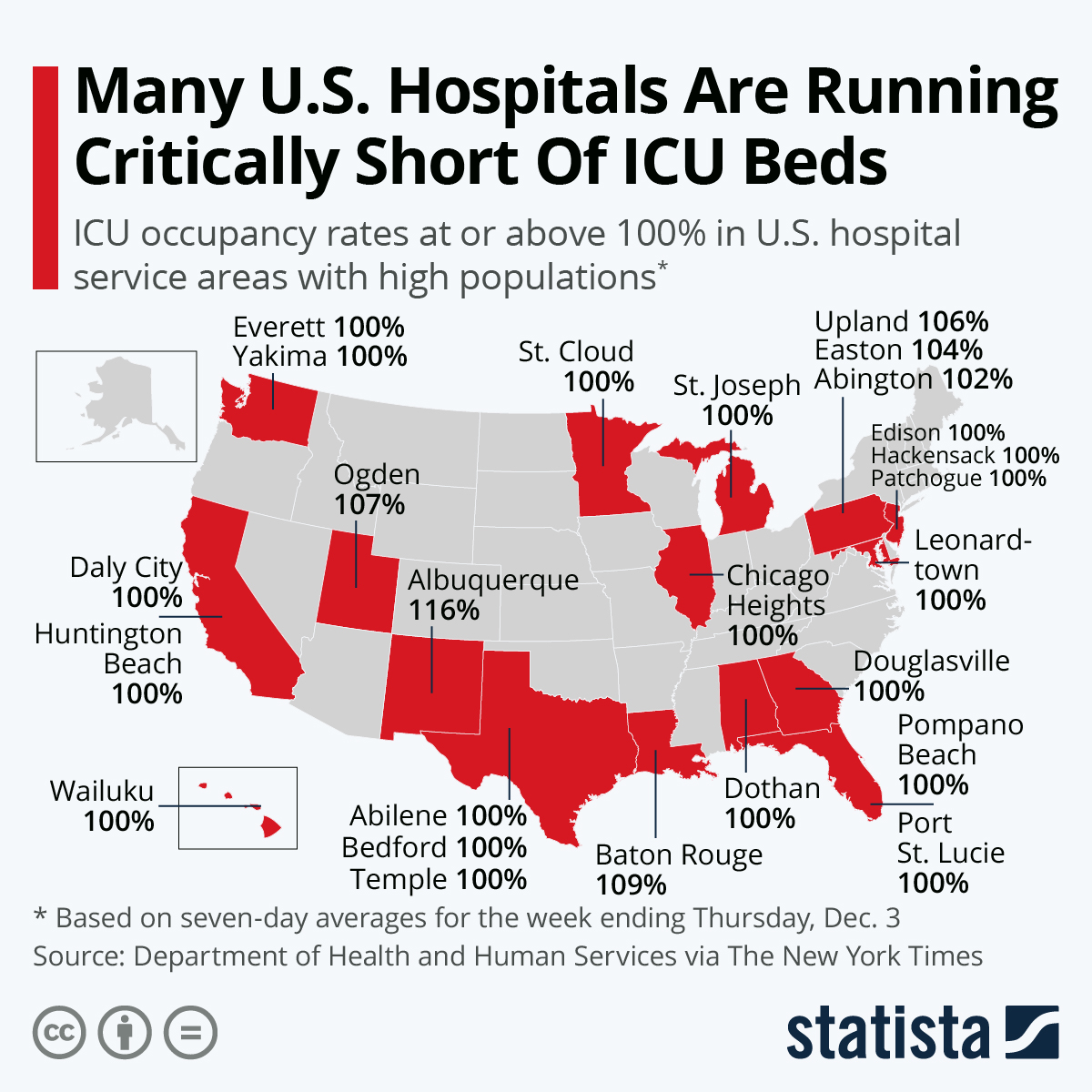
According to the dataset, ICU bed capacity is already at or above 100 percent in 113 hospital service areas with the highest occupancy rate seen in Cullman, Alabama, at 131 percent [на картинке почему-то нет]. It also looked at how things are developing in areas with a high population, an ominous trend which is illustrated on this map. There are zero ICU beds available in Albuquerque, for example, which has an occupancy rate of 116 percent. In Baton Rouge, that figure is 106 percent while it stands at 107 percent in Ogden, Utah. The New York Times described the situation in El Paso as marginally better with 13 free ICU beds out of 400 in total, which still makes for an occupancy rate of 95 percent.

More than a third of Americans now live in areas that are running critically short of free ICU beds and that hospitals serving 100 million people reported fewer than 15 available intensive care beds at the end of last week. The situation is worse in some places, however, particularly across a swathe of Midwest, South and Southwest. One in 10 people in those areas lives in an area where ICU beds are completely full or 95 percent full. The disturbing hospital-level data comes as the U.S. registered more than 3,00 deaths in 24 hours for the first time. With an FDA panel meeting to consider approving Pfizer's vaccine, there is some badly needed hope on the horizon.Infographic: Many U.S. Hospitals Are Running Critically Short Of ICU Beds | Statista
такое впечатление, что в Мексике и остальной Латинской Америке — полная жопа

Friday, June 19, 2020

Venezuelan Refugee Crisis

According to UN data, the Venezuela refugee crisis has been growing in 2019 and could be on track to become the world's biggest while numbers of displaced persons from Syria are stabilizing. By the end of 2019, 4.5 million Venezuelans had been forcibly displaced outside of their home country. This is up from just 300,000 in 2017. Syria, the biggest current refugee crisis, reached its height in 2018 with 6.7 million displaced people. The same number was counted in 2019.

While the number of Syrian refugees and those in a refugee-like situation had been rising since 2011, Venezuelan refugee numbers jumped up quickly, testing the preparedness of humanitarian organizations in the region.

Brookings Institution, which analyzed the data, notes that compared to the Syrian crisis, the Venezuelarefugee situation is severely underfunded, putting the lives of hundreds of thousands of people at risk because of the lack of food and medical assistance.
Infographic: Venezuelan Refugee Crisis Grows in 2019 | Statista
цифрами приведены данные за последний (2019) год, 
насколько понимаю при том, что население Сирии меньше 20 млн, 
красная линия, а с ней и остальные вызывают подозрение

Wednesday, May 6, 2020

Does Economics Make You Sexist?

What Sexism in Higher Ed Looks Like
by Valentina Paredes M. Daniele Paserman

Recent research has highlighted unequal treatment for women in academic economics along several different dimensions: promotion, hiring, credit for co-authorship, and standards for publication in professional journals. Can the source of these differences lie in biases against women that are pervasive in the discipline, even among students in the earliest stages of their training? In this paper, we provide direct evidence on the importance of explicit and implicit biases against women among students in economics relative to other fields. We conducted a large scale survey among undergraduate students in Chilean universities, among both entering first-year students and upperclassmen. The survey elicits measures of implicit bias, explicit bias, and gender attitudes. We document that, on a wide battery of measures, economics students are more biased than students in other fields. There is some evidence that economics freshmen are more biased already upon entry, before exposure to any economic classes. The gap becomes substantially more pronounced among upperclassmen, in particular for male students. We also find evidence of an increase in bias in a sample of students that we can follow longitudinally. Differences in political ideology and religiosity explain essentially all the gap at entry, but none of the increase in the gap with exposure. Exposure to female students and female professors attenuates some of the bias of economics students. 

Tuesday, April 7, 2020

Programa de Salud Reproductiva y Planificación Familiar

Published on N-IUSSP.ORG April 6, 2020

Family planning and child health care: the Peruvian case, 1996-2000


Marianna Battaglia, Nina Pallarés


In 1996-2000, for the first time in Peru, surgical contraception was promoted among indigenous women, and sometimes imposed upon them. As Marianna Battaglia and Nina Pallarés show, its overall positive impacts on contraceptive use and child mortality conceal substantial heterogeneity by ethnicity.

The PNSRPF (1996-2000)


Over the period 1996-2000, Peru carried out an unusual family planning program called Programa de Salud Reproductiva y Planificación Familiar (PNSRPF). At the time, infant and child mortality rates were exceptionally high in the country (45.8 and 23.5 per thousand live births in 1994, respectively) and there was a high prevalence of chronic malnutrition among children under five years (25.8% in 1996; UNICEF 2008). The Peruvian Ministry of Health promoted the PNSRPF with the stated purpose of addressing widespread poverty in the country through the reduction of fertility and of maternal and perinatal mortality. Its introduction was gradual, mainly through the celebration of health festivals that lasted about two days (Aramburú 2002). During these festivals, mobile medical teams visited the villages to provide information on family planning and contraception, and to offer health care services. Depending on the village health infrastructure, interventions occurred in the local health clinic or in the nearest hospital, or inside specially equipped ambulances (mobile sterilization units). All health services were provided free of charge, including voluntary surgical contraception, previously illegal.

However, several sources reported irregularities during the program implementation and documented episodes of forced sterilization among indigenous women from rural areas (Boesten 2007; Byker and Gutierrez 2012; Tamayo 1999). They were often pressured to have surgery through harassment of the household, and/or were offered money or food in exchange. The government administration refused to recognize such irregularities, never publicly stated guidelines about target populations, and did not officially report the existence of sterilization quotas.

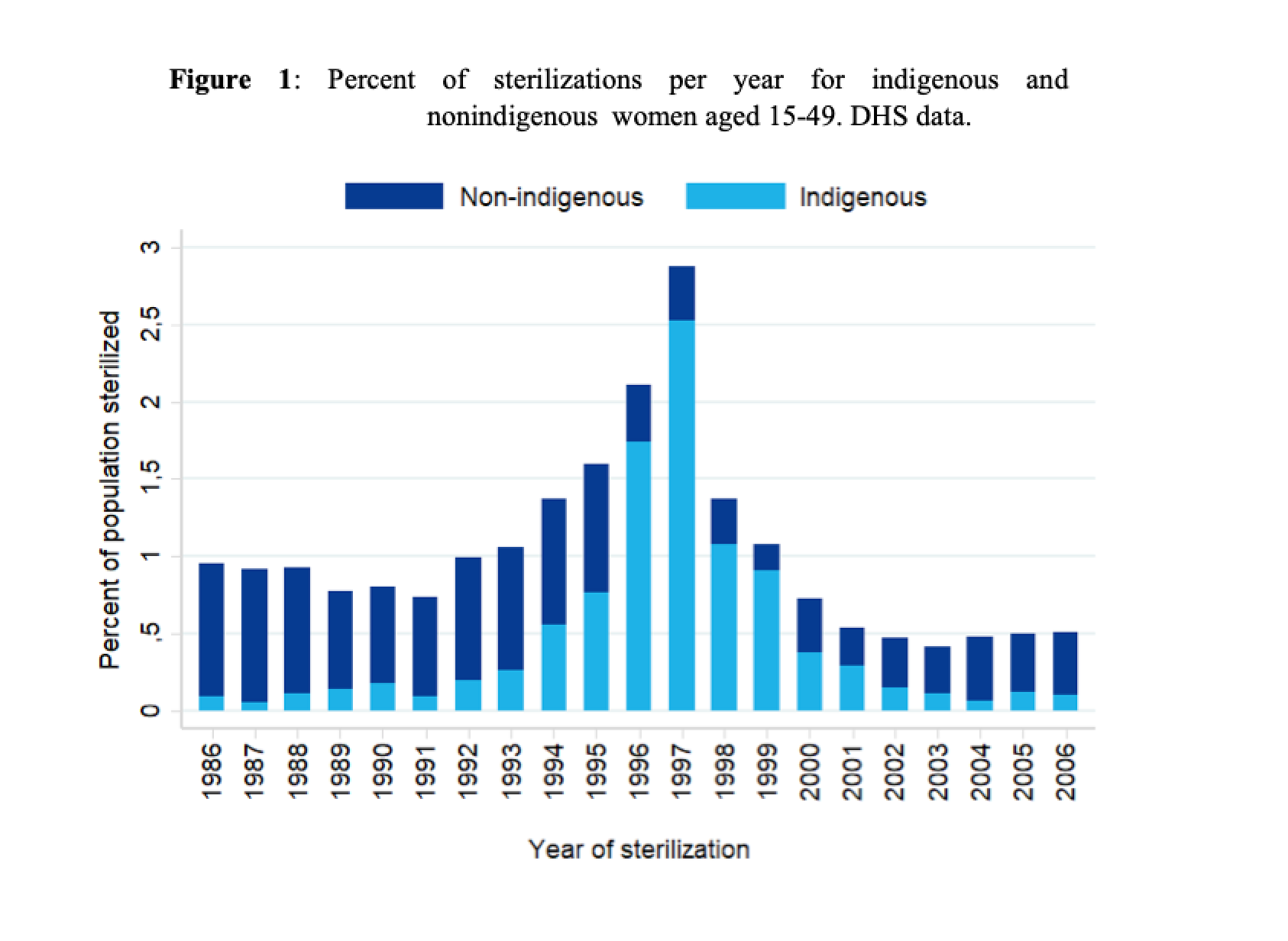
The peak years of the family planning campaign were 1996 and 1997. In 1998, the Committee of Latin America and the Caribbean for the Defense of Women’s Rights (CLADEM) made a public statement accusing the family planning program of forced sterilization, and a first international investigation was launched. The Peruvian Ministry of Health replied to the accusations and changed the way the program goals were stated (Aramburú, 2002). Figure 1 reports the annual percentage of sterilizations among nonindigenous and indigenous women aged 15-49. DHS data show that indigenous women were less prone to choose sterilization both before and after the family planning program, in contrast with nonindigenous women who were already using permanent contraceptive methods even before it.

Consequences of the policy on women’s use of contraceptive methods and newborn child health care


In a recent paper (Battaglia and Pallarés (2020), we studied the effects of exposure to this unusual family planning program on child mortality and child health care and document differential child health care behaviors correlated with permanent or temporary interventions to reduce fertility, especially for those women among whom permanent intervention was aggressively promoted. To identify the areas of the country affected by the policy, we used the incidence and timing of surgical contraception among indigenous women in each province using data collected by the CLADEM (Tamayo 1999) and the Demographic and Health Surveys (DHS). We compared provinces where it is more likely that mobile medical units arrived earlier to celebrate health festivals (treated) with provinces where they arrived later (control), and observed the impact of the policy in the short term, i.e. in the year when the policy reached the treated provinces.

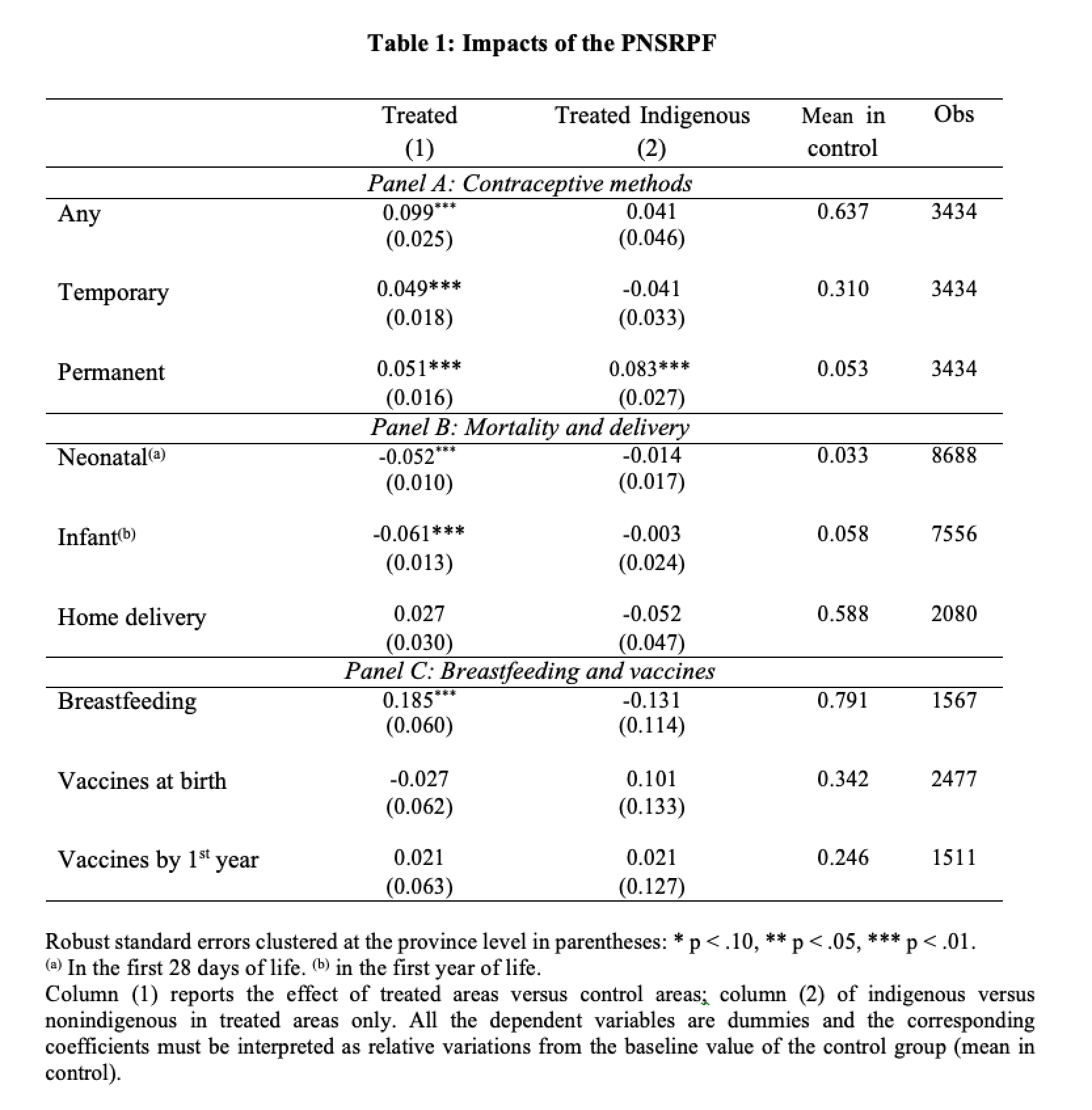
As reported in Panel A of Table 1, due to the family planning program, women in treated areas were more likely to use any method of contraception (almost 10 percentage points), than women in control areas. The increase in sterilization was significantly higher (8.3 percentage points) for indigenous than for nonindigenous women.

Furthermore, children in treated provinces, born or conceived before the policy, were less likely to die within their first year of life compared to children in control provinces. Neonatal and infant mortality decreased by 5 to 6 percentage points (Panel B).

These results can be partially explained by a longer duration of breastfeeding in treated provinces (Panel C), where mothers were 18.5 percentage points more likely to breastfeed their children for longer than expected, given their age. On average, the duration of breastfeeding increased by three weeks, from 10.2 to almost 11 months in this group. Breastmilk has immunological benefits and breastfeeding protects against water- and food-borne diseases. Breastfeeding is also associated with lower rates of infant mortality from diarrheal disease and acute respiratory infection (Jayachandran and Kuziemko 2011).


Medical research also shows that childhood vaccination, in particular against measles and tetanus, is associated with substantial reductions in child mortality (World Health Organization 2017). However, children’s likelihood of receiving the appropriate vaccinations at birth and by the first year of life was not significantly affected by the policy.

By comparing women in treated provinces who used a contraceptive method with those who did not, we observe that nonindigenous children whose mothers used contraception benefited from the policy whatever the method used (Table 2). The children of nonindigenous women who adopted temporary methods were 17.6 percentage points less likely to die in there the first year of life and 7.1 percentage points less likely to be delivered at home, compared to children whose mothers did not use any contraceptive method. The children of sterilized mothers were 23.1 percentage points more likely to be breastfed for longer.


Conversely, among indigenous mothers, the effects on their children’s health care were positive if they used temporary methods but much less so if they were sterilized. Children whose mothers used temporary contraception were both more likely to be breastfed for longer (roughly one month more) and to receive the required vaccinations at birth (26.1 percentage points), compared to children whose mothers did not use any contraception. Even though mortality was lower among children born to mothers who were sterilized, this seems to be mainly related to safer conditions of childbirth rather than better child care after delivery.

What did we learn?


DHS data do not tell us who freely decided to adopt a permanent contraceptive method and who was forced to do so. Therefore, we cannot derive strong conclusions and claim any causal interpretation of the impact of contraception on child health. Nevertheless, these results are informative of differences by ethnicity in reactions to the policy and of the heterogeneous impacts on child health care when a policy intervention is aggressively promoted. As Byker and Gutierrez (2012) noted, when birth control is imposed, the benefits of making choices about fertility are lost and having fewer children may not translate into substantial improvements in the health care they receive.

References
  • Aramburú, Carlos E. 2002. “Politics and Reproductive Health: A Dangerous Connection.” in Interregional Seminar on Reproductive Health, Unmet Needs and Poverty. Bangkok, Thailand. Paper presented at the CICRED conference, 25-29 Nov.
  • Battaglia, Marianna and Nina Pallarés. 2020. “Family Planning and Child Health Care: Effect of the Peruvian Programa de Salud Reproductiva y Planificación Familiar, 1996– 2000”. Population and Development Review, forthcoming.
  • Boesten, Jelke. 2007. “Free Choice or Poverty Alleviation? Population Politics in Peru under Alberto Fujimori.” European Review of Latin American and Caribbean Studies 82, 3-20.
  • Byker, Tanya and Italo A. Gutierrez. 2012. “Fertility and Family Well-being Effects of an Aggressive Family Planning Policy in Peru in the 1990s.” PSC Research Report No. 12-765.
  • Jayachandran, Seema and Ilyana Kuziemko. 2011. “Why Do Mothers Breastfeed Girls Less than Boys: Evidence and Implications for Child Health in India.” Quarterly Journal of Economics 12 (3), 1485-1538.
  • Tamayo, Julia. 1999. “Nada Personal: Reporte de Derechos Humanos Sobre la Aplicación de la Anticoncepción Quirúrgica en el Perú, 1996-1998.” Technical report, Comité de América Latina y el Caribe para la Defensa de los Derechos de la Mujer (CLADEM), Lima.
  • UNICEF. 2008. Situation of Children in Peru. Executive Summary. Technical report, United Nations Children’s Fund (UNICEF) and Instituto Nacional de Estadística e Informática (INEI).
  • World Health Organization. 2017. 2017 Assessment Report of the Global Vaccine Action Plan. Technical report, Strategic Advisory Group of Experts on Immunization on the Progress towards GVAP Targets. World Health Organization 2017.

Wednesday, February 12, 2020

Trends in Premature Deaths Among Adults in the United States and Latin America

Question What are the premature mortality rates for US Latino populations compared with those of other US populations and Latin American countries?

Findings In this descriptive cross-sectional study of 16 populations, premature mortality rates were lower among US Latino populations compared with US African American and white populations. The overall favorable mortality trends in 12 Latin American countries were comparable with those of US Latino populations and, in many cases, better than those of US white populations.

Meaning Premature mortality rates are lower among US Latino populations and in several Latin American countries than among US white populations, which may be indicative of a broad “Latino or Hispanic paradox.”

Age-Standardized All-Cause Mortality Rates per 100 000 Population in 2001 and 2015 

Mortality rates for women (A) and men (B) aged 20 to 64 years are shown by population group. The US groups are highlighted with lighter shading.>