Showing posts with label гендерный переход. Show all posts

Tuesday, March 25, 2025

arkanzas

Республиканцы предложили наказывать тех, кто способствует гендерному «переходу» несовершеннолетних


Республиканцы штата Арканзас предложили закон о защите уязвимой молодёжи (Vulnerable Youth Protection Act). Если закон будет принят, то любой, «кто вызывает социальный „переход“ несовершеннолетнего или способствует ему», может быть привлёчен к ответственности. Под «переходом» понимается любое действие, «посредством которого несовершеннолетний принимает или одобряет гендерную идентичность, отличающуюся от его биологического пола». В том числе это касается одежды, местоимений, причёски или имени.

К примеру, закон позволит гражданам подавать иски против парикмахеров, если те постригли ребёнка в «неконформном» в половом отношении стиле. Говоря проще, если девочка пришла домой со стрижкой «под мальчика», родители смогут подать в суд. С юридической точки зрения, считает редактор BILD Юдит Гёрс, закон ставит в уязвимое положение не только парикмахеров, но всякого владельца магазина, который продаст 16-летнему подростку бюстгальтер. Или учителя, который обращается к своему ученику-транссексуалу по выбранному им самим мужскому или женскому имени.

Законопроект внесён от имени Мэри Бентли — христианки, активистки движения против абортов и владелицы производства пластиковой посуды. Бентли считает: никому не должно быть позволено убеждать детей в том, что они «родились не в том теле», а молодым людям с «гендерной путаницей» может помочь только психотерапевт.

Эвелин Риос Стаффорд, первый и единственный транссексуал в Арканзасе, разорвала законопроект на части, потому что из-за него судам грозит «волна необоснованных исков по самым абсурдным ситуациям». По мнению Стаффорд, даже комплимент причёске транс-подростка может стать уголовным преступлением.

«Это говорит о том, что у трансгендерных детей нет гарантированных Конституцией прав на контроль над собственным телом», — говорит Стаффорд.

Генеральный прокурор-республиканец Арканзаса Тим Гриффин также раскритиковал закон за нарушение свободы слова. В результате Мэри Бентли отозвала законопроект, чтобы внести в него поправки. Что из этого получится, пока неясно, однако республиканка известна своим упорством. В 2023 году она вопреки многочисленным возражениям провела закон, разрешающий подавать иски о халатности против врачей, предлагающих процедуры по смене пола.

Tuesday, January 28, 2025

transgender

Минюст России потребовал ликвидировать фонд «Трансгендер»


Как сообщает «Медиазона» (в реестре «иноагентов»), соответствующий иск управления министерства по Москве зарегистрировал Кунцевский районный суд.

Фонд «Трансгендер», оказывавший помощь транслюдям, привлек внимание чиновников в феврале 2024 года.

В прошлом году после плановой проверки руководство фонда получило письмо от ведомства, в котором организацию обвинили в «активной пропаганде вседозволенности, безнравственности и эгоизма».

Как рассказала ОВД-Инфо (в реестре «иноагентов») директор фонда Яэль Демедецкая, чиновники в своем письме ссылались на запись семинара фонда 2017 года. В акте проверки были приведены цитаты его участников семинара и сделан вывод, что эти обсуждения не соответствуют стратегии национальной безопасности России.

🔗 Читать нас без VPN можно здесь: bit.ly/bbcrussian

Wednesday, April 17, 2024

premium poetry

Dementev

Российская поэтическая премия запретила номинироваться поэтам-трансгендерам


Организаторы поэтической премии Андрея Дементьева внесли условие, по которому на конкурс «не допускаются граждане, сменившие пол», с мотивировкой «в целях сохранения традиционных для российского общества <…> представлений о браке, семье, материнстве, отцовстве, детстве».

Это указано в перечне необходимых материалов на сайте премии.

От участников требуют прилагать копию свидетельства о рождении, а также давать ответ на соответствующий вопрос в анкете и заверять ее подписью.

При этом россияне, совершившие трансгендерный переход, обычно могут получить новые свидетельства о рождении.

Доподлинно установить факт перехода только по ним невозможно.

Награды лауреатам предусмотрены в двух категориях, в одной обещают премию в 300 тысяч рублей, в другой — 700 тысяч рублей.

Премия названа в честь советского литератора и поэта-песенника Андрея Дементьева. Среди прочего он был замглавреда и потом главным редактором литературно-художественного журнала «Юность» в 1972–1993 годы.

Стихотворение Дементьева декламировал Владимир Путин 8 марта 2018 года в качестве поздравления.

На сайте премии также сообщается, что в годы руководства «Юностью» Дементьев вступил в отношения с девушкой по имени Анна Пугач, почти на тридцать лет его младше и только что выпустившейся из школы — она пришла работать в журнал в отдел писем. Позже Пугач вышла за него замуж и сама стала известной журналисткой. Они были в браке до смерти Дементьева в 2018 году.

Tuesday, April 16, 2024

danger

Новый закон о смене пола в Германии ущемляет права женщин

 — журналистка BILD


В пятницу Бундестаг принял Закон о самоопределении. Теперь менять пол в ФРГ можно раз в год с помощью простого устного заявления. Глава новостной службы BILD Майке Клебль назвала это «чёрным днём» для прав женщин и напомнила, что в Бундестаге уже заседают два депутата-трансгендера. Это Тесса Гансерер и Нике Славик (на фото), прошедшие в парламент по женскому списку «Зелёных». Публикуем полный текст Клебль:

«Десятилетия борьбы за права женщин, безопасные зоны и равные права сметены одним взмахом. Это окончательная победа мужчин над женщинами. Это может показаться радикальным. Но именно это и происходит, когда мужчины решают, что означает быть женщиной, и могут заявлять о себе как о женщинах посредством устного заявления, присваивая себе их права и безопасные зоны. Квоты для женщин сейчас де-факто отменены. Даже если они и противоречивы, сама демократическая дискуссия о привилегиях [женщин] теперь невозможна по закону. Хуже того: женщин принуждают делиться своими безопасными зонами, такими как раздевалки, с теми, кто объявил себя женщиной, не отказавшись от бороды и пениса. Женщин заставляют воспринимать мужчин в их раздевалке, как женщин. Это не что иное, как принуждение.

Сторонники [закона] поспешили назвать это «единичным случаем». Но уже есть множество сообщений из нашей страны и из-за границы о мужчинах в женской одежде, которые нападали на женщин в женских раздевалках. Мне неизвестно, чтобы женщина в мужской одежде напала на мужчин ради секса в мужской раздевалке. Никто не против улучшения условий жизни настоящих трансгендеров, которых на самом деле очень мало. Но не за счёт всех женщин и девочек. Этот закон не делает мир лучше. Просто женщинам стало ещё опаснее, чем было раньше»

Friday, November 10, 2023

Vatican statement

Ватикан заявил, что люди, совершившие трансгендерный переход, смогут проходить обряд крещения в католической церкви, если это не приведет к скандалу или не вызовет «замешательство».


В доктринальном отделе Ватикана также заявили, что трансгендерные люди могут быть крестными родителями при крещении и свидетелями на свадьбе.

Этот шаг – очередная попытка папы Франциска сделать Католическую церковь более доступной для ЛГБТ-сообщества.

Ватикан разъяснил отношение к транс-людям после того, как бразильский епископ Хосе Негри написал письмо руководителям церкви с шестью вопросами, касающимися ЛГБТ и их участия в крещении и бракосочетании.

подробнее
Если ссылка выше не открывается, читайте здесь.

Wednesday, November 8, 2023

new names

«Ждать приплода ни с того ни с сего не приходится»

Депутаты и общественники обсудили меры борьбы с абортами


В Госдуме прошел круглый стол на тему «Вопросы прерывания беременности. Законодательные аспекты». Депутаты пообещали внести поправки в законодательство, запрещающие, в частности, аборты в коммерческих клиниках. Они также предложили сократить срок разрешения на прерывания с 12 до 8 недель беременности и наделить отцов правом принимать решение об аборте. Впрочем, не все участники дискуссии согласились, что такие меры помогут исправить демографическую ситуацию.
Заслуженный врач России, член комитета Госдумы по охране здоровья Вероника Власова начала мероприятие по вопросам прерывания беременности с цитаты президента Владимира Путина: «Укрепление института семьи и патронажа, защита материнства и детства — все это вопросы, имеющие приоритетное значение для развития нашего государства». Тем самым задала высокую планку выступающим. Те постарались как минимум не снижать пафос.

Первый зампредседателя профильного думского комитета Леонид Огуль обозначил три блока проблем: социальная политика в отношении семей с детьми, приоритет репродуктивного здоровья не только женщин, но и мужчин (здесь господин Огуль напомнил, что недавно Госдума добавила слово «отцовство» в название комитета по вопросам семьи, женщин и детей) и нравственно-духовное воспитание «наших россиян». «Мы боремся за то, чтобы включить в школьную программу дисциплину "Мое здоровье". Вспомните свое детство: где вы услышали о той или иной запретной теме? От друзей, на улице, но от не специалиста, не от педагога,— пояснил Леонид Огуль.— Мы как-то разговаривали с духовным отцом и у него спросили, что сделать с интернетом, беда какая-то, надо закрывать. А он сказал, что интернет как нож, можно хлеб порезать, а можно человека и убить. Вот здесь самое важное — заниматься духовно-нравственным направлением…»

Первый замруководителя комитета Госдумы по контролю Дмитрий Гусев сообщил, что ему известны по крайней мере три теории происхождения души, и все они признают, что душа возникает в момент зачатия. Поэтому, считает депутат, права эмбрионов нужно регулировать законодательно, а возможностью принимать решение об аборте необходимо наделить как мать, так и отца — ведь в случае, если эмбрион в утробе имеет душу, этого требует семейный кодекс РФ.

За согласие отца, если брак зарегистрирован, выступила и Вероника Власова. В перечень других изменений в закон «Об основах охраны здоровья граждан», которые предложит профильный комитет, войдет информированное добровольное согласие одного из родителей в случае с несовершеннолетней беременной (сейчас согласие родителей требуется только для подростков до 16 лет). Также она предложила проводить аборт по желанию женщины только в государственных больницах при сроке до восьми недель включительно после обязательного УЗИ и демонстрации сердцебиения плода матери. В настоящее время законодательством такой срок определяется до 12 недель. А искусственное прерывание беременности по социальным показаниям должно проводиться при сроке беременности до 12 недель (сейчас до 22 недель). К таким показаниям относится, в частности, беременность в результате изнасилования. «У России должен быть путь многодетности. Женщины должны рожать в браке не менее трех счастливых и здоровых детей»,— завершила выступление Вероника Власова.

Большинство участников говорили о необходимости запретить аборты в частных клиниках, так как эти учреждения не дают статистику о числе проведенных операций, не соблюдают требования о днях тишины и, в конце концов, даже делают «криминальные аборты». Поэтому данные замруководителя департамента медпомощи детям, службы родовспоможения и общественного здоровья Минздрава России Виктории Сахаровой были как будто даже лишними (случайно или нет, но у нее в этом самом месте ненадолго отключился микрофон): «Мы погружаем частное здравоохранение в нашу систему. Добавили их в статистические формы отчета. Мы видим, сколько они проводят доабортного консультирования. Все наши меры позволили сохранить 47 тыс. беременностей. Это большое достижение как государственной, так и частной медицины».

Шире на проблему предложил смотреть заслуженный деятель наук РФ Виктор Радзинский — «легенда акушерства и гинекологии», как представила его Вероника Власова. Он напомнил, что восьмимиллиардный житель Земли появился на семь лет позже прогнозов ООН, которые до сих пор неуклонно сбывались, а это значит, что «мир перестал рожать».

Господин Радзинский вспомнил «русский крест», демографическую ситуацию, которая сложилась в начале 90-х с небольшим перерывом на «благословенные» 2012–2016 годы и продолжается сейчас — когда смертность превышает рождаемость.

«Ждать приплода ни с того ни с сего не приходится, не от кого. Причем же здесь 300 тыс. абортов?» — обратился он к участникам круглого стола. Виктор Радзинский прокомментировал ранее прозвучавшие предложения: «Согласие мужа не требовать, у нас 34% неполных семей, где взять того мужа? Отца — ни в коем случае. Потому что она идет на аборт, так как отец убьет или братья убьют. За запрет в частных клиниках 22% опрошенных. Изъятие аборта из ОМС — 100% против, и врачей, и женщин. Что касается сокращения сроков на аборт: врачи не против, если запретить кюретаж (выскабливание эмбриона)». Господин Радзинский, может быть, и хотел бы продолжить, но его перебили из зала криками: «Прекратите это безобразие. Слушать это невозможно. Зачем вы обманываете».

Слово взял Леонид Огуль: «Нам ВОЗ много чего рекомендует. Мы вот разгребаем здесь, в Госдуме. Я очень горд, что в нашем созыве запретили смену… аборт… — оговорился он и тут же добавил: — Значит, запретим. Запретили смену пола. Мы не говорим о том, что все, кто забеременел, будут рожать, но это должно быть как-то духовно в головах наших людей».

Президент фонда «Семья, страна, мир» Инга Юмашева начала свое выступление 14 стихом 31 главы Священного Писания: «Глас слышен в Раме, вопль и горькое рыдание; Рахиль плачет о детях своих». Она посетовала, что мы «объективно» не слышим такой плач по «убитым в утробе детям». Госпожа Юмашева напомнила и про спецоперацию: «Победа над фашизмом в СВО невозможна без победы над фашизмом внутри. Аборт по желанию — это убийство невинного человека по причине неудобства, несостоятельности, нездоровья и несвоевременности. Мы должны назвать зло злом и сделать все, чтобы его стало меньше».

Градус напряженности немного снизила главный внештатный специалист по репродуктивному здоровью женщин Минздрава России Наталия Долгушина. Она сообщила, что 10 ноября будут опубликованы клинические рекомендации по прерыванию беременности, в которых отражено многие из того, о чем говорили участники круглого стола.

Так, Минздрав рекомендует отказаться от кюретажа, разделять женщин, которые пришли на аборт и на сохранение беременности, ввести возможность остановки медикаментозного аборта с помощью других препаратов, проводить УЗИ и показывать сердцебиение плода перед абортом.

Госпожа Долгушина предложила не менять законы сразу, а ряд мер, которые могут нести «определенные риски», пока включать в такие документы, как клинические рекомендации и порядки,— их в случае чего легко переписать. Вероника Власова заверила, что это только первый шаг на пути законодательной борьбы с абортами.

Наталья Костарнова

Friday, October 27, 2023

ban

В июле 2023 года Владимир Путин подписал закон, запрещающий операции, связанные с трансгендерным переходом, соответствующую гормональную терапию, а также смену гендерного маркера в документах.

Изменение гендерного маркера - это когда в графе «пол» в паспорте букву «М» меняют на «Ж» или наоборот. Раньше это было возможно после прохождения специальной медицинской комиссии, на которой сексолог, психолог и психиатр ставили диагноз «транссексуализм».

За два с половиной месяца до вступления нового закона в силу проект Queer Svit, петербургская небинарная группа СНеГ, Анна Ерошенко и другие активисты помогли 395 транслюдям пройти специальную комиссию и получить необходимые справки. Начался этот проект с поста известного медиаменеджера и издателя Ильи Красильщика, случайно оскорбившего представителей группы, и так регулярно попадающей под дискриминацию.

источник

Thursday, June 1, 2023

gender marker law

В России могут полностью запретить смену гендерного маркера для транс-людей. 
Чем это обернется?


Что Госдума предлагает запретить?


Сейчас по закону для того, чтобы сменить гендерный маркер и провести необходимые операции, транс-люди должны сначала получить справку с диагнозом "трансексуализм". На ее основании можно поменять свидетельство о рождении, а затем - паспорт. Также после получения справки транс-люди могут получать медицинскую помощь: гормональную терапию и направление на операции.

Законодательные изменения в этой области впервые анонсировали министр юстиции Константин Чуйченко и глава Следственного комитета Александр Бастрыкин в мае. Выступая на Петербургском юридическом форуме, они заявили, что транс-люди являются мошенниками.

Басткрыкин говорил о том, что люди якобы пользуются лазейкой в законе, чтобы получить справку о трансгендерности и избежать призыва или мобилизации [настоящая цель?]. А Чуйченко заявил, что стоит ввести запрет на изменение документов без предварительно проведенных операций и что транс-людей нужно отправлять на "лечение".

Поэтому тогда казалось, что в будущем законопроекте речь будет идти только об ужесточении процедуры смены документов.

Однако внесенная в Госдуму версия документа полностью запрещает и смену документов, и медицинскую помощь транс-людям.

Зачем нужен этот закон?


В пояснительной записке к законопроекту говорится, что в Конституции России не предусмотрена "смена пола", а также "промежуточные варианты полов вроде Родитель № 1 и родитель № 2" - формулировка, которую неоднократно использовал президент Владимир Путин.

Также отмечается, что законопроект направлен на укрепление стратегии России по национальной безопасности и поддержание "традиционных российских ценностей".

Еще во время обсуждения закона о введении повсеместного запрета на "гей-пропаганду" в 2022 году депутаты и чиновники не скрывали, что это решение принято на фоне и вследствие войны в Украине.

Депутаты тогда заявляли, что помимо войны в Украине Россия ведет и "духовную борьбу с западом" - поэтому запрет "гей-пропаганды" и "пропаганды смены пола" поможет одержать борьбу с "новым миропрорядком".

Новый законопроект "нужен для того, чтобы государство еще больше вмешивалась в частную жизнь граждан и укрепляло тот режим, который существует", говорит юрист ЛГБТ-движения "Выход" Ксения Михайлова (организация признана в России иностранным агентом).

"Чем больше государство вмешивается в частную жизнь, тем сильнее и лучше оно контролирует своих граждан", - считает она.

Как будет выглядеть жизнь транс-людей в России?


Сейчас в России "транссексуализм" считается медицинским диагнозом. Лечение, которое назначается в данным случае, - гормональная терапия и хирургическое вмешательство - подпадает под запрет нового закона.

Таким образом депутаты запрещают лечение определенной категории людей, у которых имеется такой диагноз.

Подробнее читайте здесь
Если ссылка не открывается - то здесь, и здесь

Monday, April 24, 2023

gender stability

Минюст России собирается ограничить возможность смены пола в паспорте


"Сейчас прежде всего речь идет о том, чтобы законодательно исключить возможность смены пола в паспорте и остальных документах", – заявил в интервью ТАСС министр юстиции Константин Чуйченко. Речь идет не о полном исключении такой возможности, а только о смене пола "путем простого изменения документов", следует их сказанного чиновником.

Возможность изменения пола была закреплена в российском законодательстве в 1997 году, с 2018 году начали действовать механизмы, позволяющие изменять пол в паспорте, и сейчас одним из оснований для внесения исправлений в паспорт является справка об изменении пола, выданная медицинской организацией, напомнил министр.

"При этом обязательность проведения хирургических вмешательств для получения лицом справки об изменении пола не предусматривается", – сказал Чуйченко.

Сославшись на статистику, он сообщил, что с 2018-го по 2022 год было зарегистрировано более 2 700 случаев смены пола по документам, после смены пола было зарегистрировано "порядка 190 браков".

"Человек, сменивший пол в паспорте, но физиологически оставшись прежним, может заключать брак, усыновлять детей. Так же возникают вопросы, с какого возраста такой человек, сменивший пол на бумаге, может выходить на пенсию? Или, если нарушит закон, в какое исправительное учреждение его направлять? И так далее", – перечислил министр.

Однако это не главное – главным министр юстиции считает задачу укрепить "семейные ценности", которые были вписаны путинскими поправками в Конституцию России. Смена пола в паспорте, по его утверждению, не соответствуют "текущим концептуальным документам и конституционным приоритетам".

Поправки в закон "Об основах охраны здоровья граждан", по замыслу Чуйченко, позволят "исключить в нашей стране возможность сменить пол человека путем простого изменения документов".

Wednesday, December 28, 2022

lili elbe

Lili Ilse Elvenes (28 December 1882 – 13 September 1931), better known as Lili Elbe, was a Danish painter, trans woman and among the early recipients of gender-affirming surgery (sex reassignment surgery).

She was a painter under her birth name Einar Wegener. After transitioning in 1930, she changed her legal name to Lili Ilse Elvenes and stopped painting; she later adopted the surname Elbe. She died from complications following a uterus transplant.

The UK and US versions of her semi-autobiographical narrative were published posthumously in 1933 under the title Man into Woman: An Authentic Record of a Change of Sex. A film inspired by her life, The Danish Girl, was released in 2015. [смотрел, и тут писал — хорошее кино, но тяжело смотреть]

Tuesday, August 16, 2022

The Social Situation

Homophobia and Discrimination on Grounds of Sexual Orientation and Gender Identity in the EU Member States


On December 18 2008 the UN General Assembly heard a strong declaration drafted by France and The Netherlands on behalf of the European Union and co-sponsored by sixty-six countries from all regions. It called for the global decriminalization of homosexuality and condemned human rights violations based on sexual orientation or gender identity. 

In the European Union Article 13 of the EC Treaty prohibits any discrimination based on sexual orientation and the EU’s Charter of Fundamental Rights is the first international human rights charter to explicitly include the term “sexual orientation”. The legal study we published in June 2008 shows that 18 EU Member States already provide quite comprehensive protection against discrimination on grounds of sexual orientation. In July 2008, a further step has been made when the European Commission proposed stronger EU wide protection against discrimination on all grounds. 

The social situation, however, is worrying. In recent years a series of events in EU Member States, such as the banning of Pride marches, hate speech from politicians and intolerant statements by religious leaders, have sent alarming signals and sparked a new debate about the extent of homophobia and discrimination against lesbian, gay, bisexual, transsexual and transgendered (LGBT) persons in the European Union. Such events led the European Parliament to adopt in 2005 a resolution condemning homophobia and sexual orientation discrimination.

Two years later in the summer of 2007 the European Parliament asked the newly established Fundamental Rights Agency to develop a comprehensive comparative report covering all EU Member States on the situation regarding homophobia and sexual orientation discrimination. In response the Agency carried out a large scale legal and social research project during 2007 and 2008.

This comprehensive report composed of two parts, a legal and a social analysis, is presented to the European Parliament and its Committee on Civil Liberties, Justice and Home Affairs as evidence for actions needed in order to respect, protect and promote the fundamental rights of LGBT persons across the EU.

The social analysis contained in this publication is based on data and contextual information contained in country reports for all EU Member States. Unique material was gathered through fieldwork interviews with LGBT NGOs, Equality Bodies and public authorities in all Member States and a questionnaire survey of stakeholders. This new data has been combined with a thorough examination of existing academic studies and Eurobarometer surveys to develop the second part of our report, a comprehensive social analysis that complements the FRA’s legal analysis released in June 2008.

The work shows that the current human rights situation for lesbians, gay men, bisexuals, transsexuals and transgender persons is not satisfactory. Many LGBT persons experience discrimination, bullying and harassment, while, more worryingly, occurrences of physical attacks were also detected: Derogative words are used for gays and lesbians at schools. Harassment can be an everyday occurrence at the workplace. Relationships often lack the ability to secure one another as full legal partners. At retirement homes, awareness of LGBT persons’ needs is rare. Under these circumstances ‘invisibility’ becomes a survival strategy. In a European Union that bases itself on principles of equal treatment and non-discrimination legislation this is unacceptable. 

What needs to be done? 


Combating fundamental rights violations effectively requires first of all a firm political commitment to the principles of equal treatment and non-discrimination. Political leaders at EU and national level need to take a firm stance against homophobia and discrimination against LGBT and transgendered persons contributing in this way to a positive change in public attitudes and behaviour. 

Secondly, it requires good knowledge of the situation based on robust data guiding the development of evidence based policies and actions. This research represents an important positive step in this direction. But equality authorities and other specialised bodies in many Member States still need to develop data collection mechanisms, promote scientific research, and actively encourage LGBT people to come forward and lodge complaints on incidents of discrimination. 

In the light of the findings of this social analysis, the Agency welcomes the European Commission’s Proposal for a Council Directive on implementing the principle of equal treatment between persons irrespective of religion or belief, disability, age or sexual orientation. This new Directive would extend the protection against discrimination on grounds of sexual orientation beyond the area of employment and thus address some of the key issues emerging from this report. The opinions contained in this report provide EU institutions and the Member States, as our Regulation requires, with the necessary assistance and expertise in order to support them when taking measures or action within their respective spheres of competence to fully respect fundamental rights.

In closing I would like to thank for their work the staff of the Agency, Caroline Osander, project manager from the Danish Institute for Human Rights , and project manager, Mikael Keller, consultant Mads Ted Drud-Jensen from COWI .

Morten Kjaerum Director, European Union Agency for Fundamental Rights

Friday, June 17, 2022

LGBT Adults Report Anxiety, Depression During Pandemic

Regardless of Household Type, LGBT Adults Struggled More With Mental Health Than Non-LGBT Adults

THOM FILE AND MATTHEW MARLAY JUNE 16, 2022 (без впн не увидите)

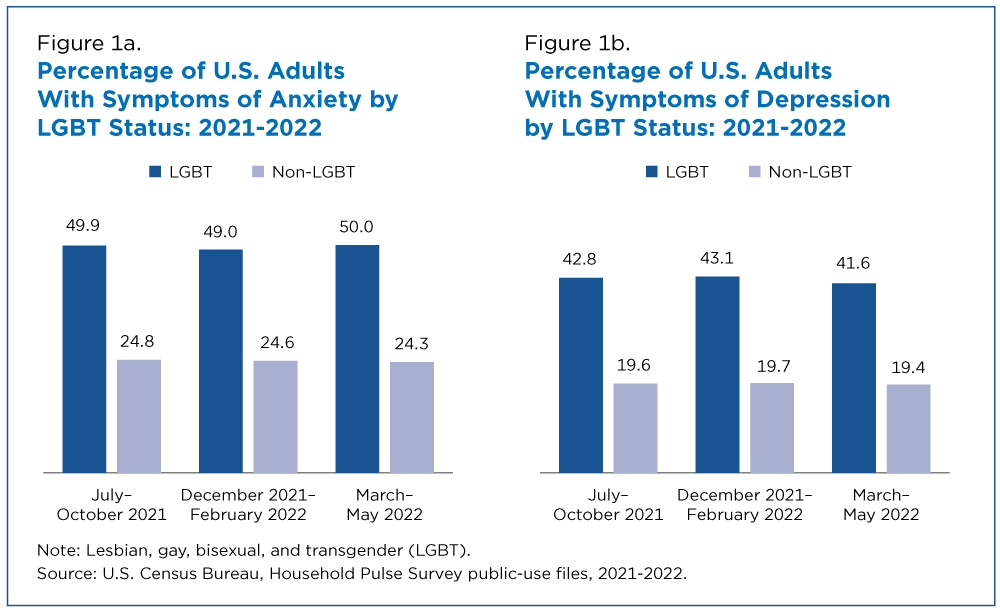
Lesbian, gay, bisexual, and transgender (LGBT) adults have consistently reported higher rates of symptoms of both anxiety and depression amid the coronavirus pandemic than non-LGBT adults, according to U.S. Census Bureau data.

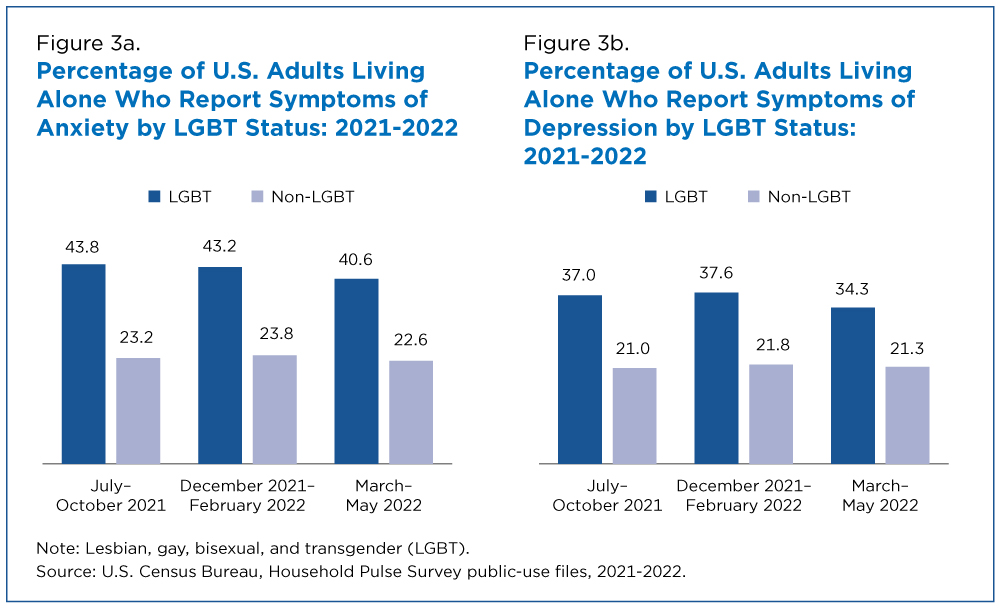
The results were the same regardless of the period in question: LGBT adults ages 18 and older reported roughly twice the rate of mental health challenges as non-LGBT adults (Figures 1a and 1b).

As previous research indicated, younger respondents were more likely to identify as LGBT. Future research will look at the intersection of age and mental health among respondents who identify as LGBT.

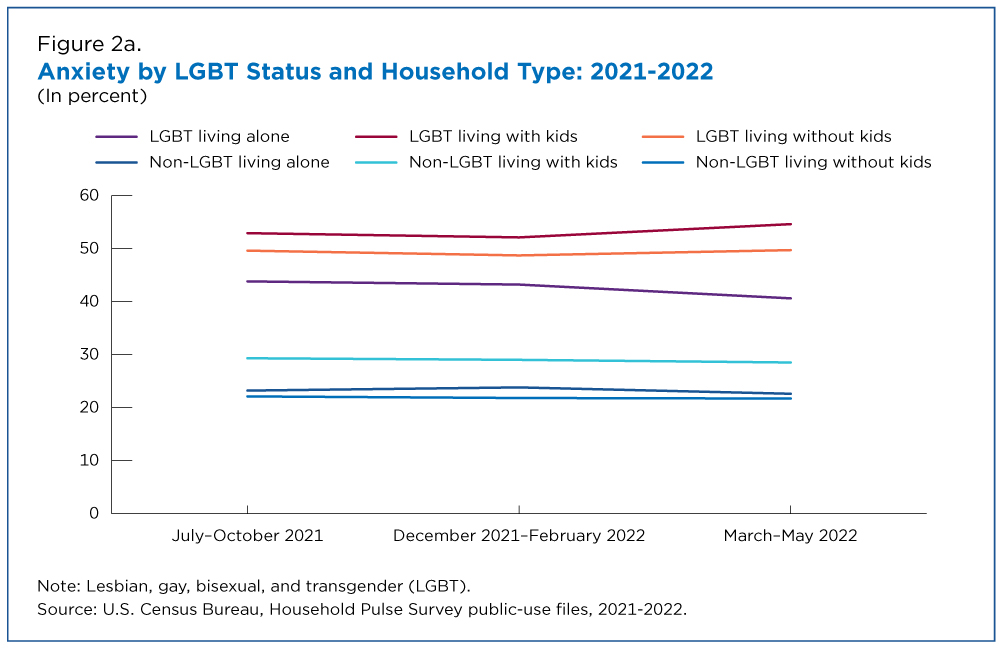
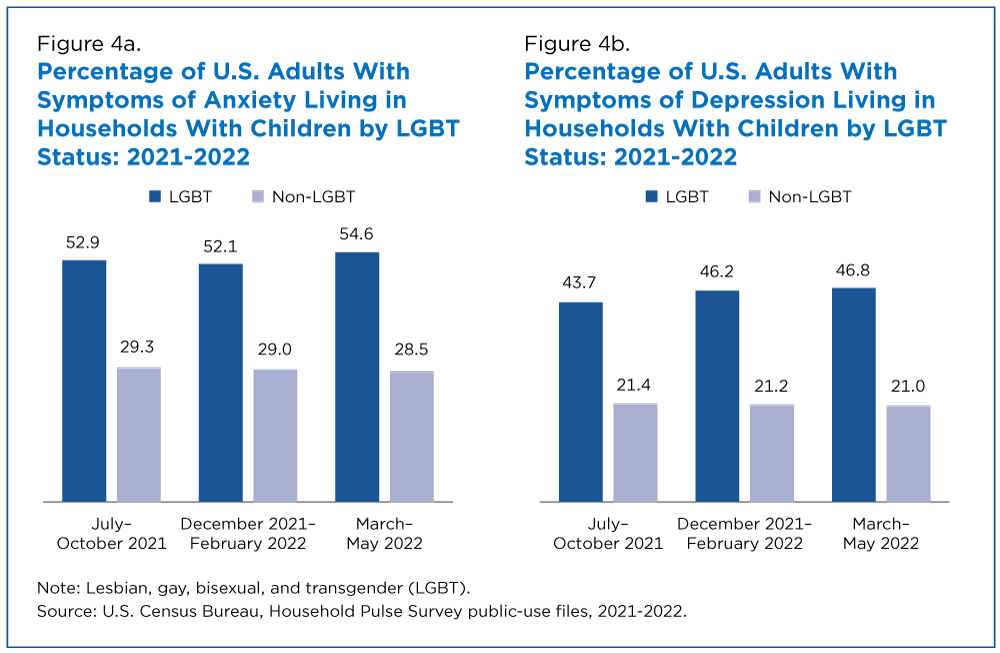
LGBT adults living in households with children were more likely than adults (regardless of LGBT status) in other types of households to report anxiety symptoms.

Household Pulse Survey and Mental Health


The Census Bureau’s Household Pulse Survey (HPS) provides insight into the mental health and well-being of its respondents.

Since the HPS began in April 2020, it has asked two questions related to symptoms of anxiety and two questions about symptoms of depression.

In July 2021, it also began asking about sexual orientation and gender identity (SOGI).

This analysis uses multiple data collection phases of the survey to assess the pandemic’s mental health toll on U.S. adults 18 years and older:
  • Phase 3.2: July 21–October 20, 2021 (Approximately 6.2 million invitations sent, 382,908 responses, response rate of 6.1%).
  • Phase 3.3: December 1, 2021–February 7, 2022 (Approximately 3.1 million invitations sent, 211,303 responses, response rate of 6.7%).
  • Phase 3.4: March 2– May 9, 2022 (Approximately 3.1 million invitations sent, 209,694 responses, response rate of 6.7%).

Mental Health Challenges and Household Type


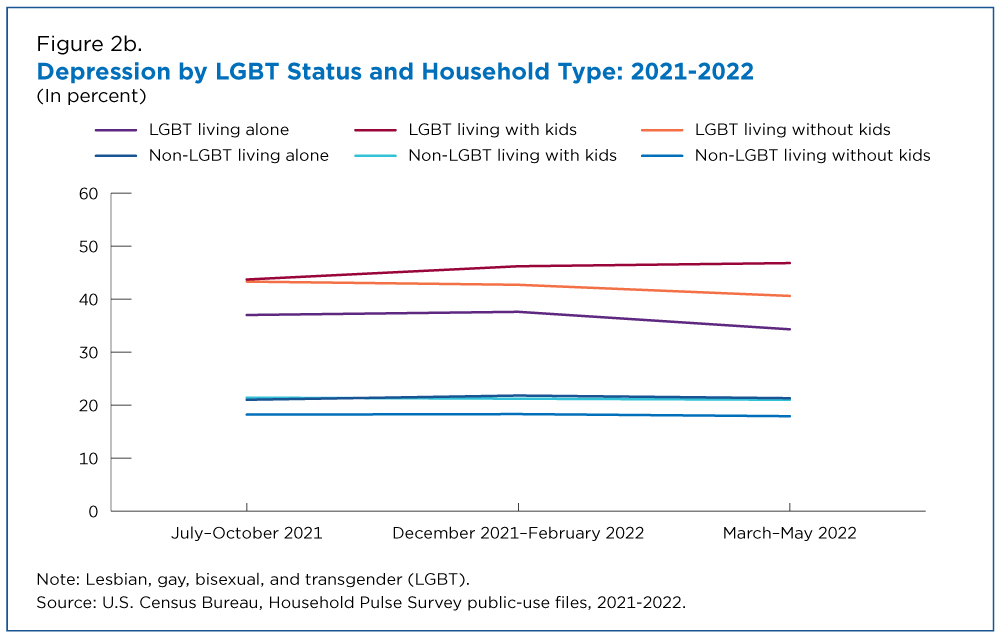
Previous Census Bureau research indicated that adults living alone during the pandemic were more susceptible to mental health challenges than those living with others, but this current analysis shows that when differentiating between LGBT and non-LGBT households, mental health disparities become more nuanced (Figures 2a and 2b).

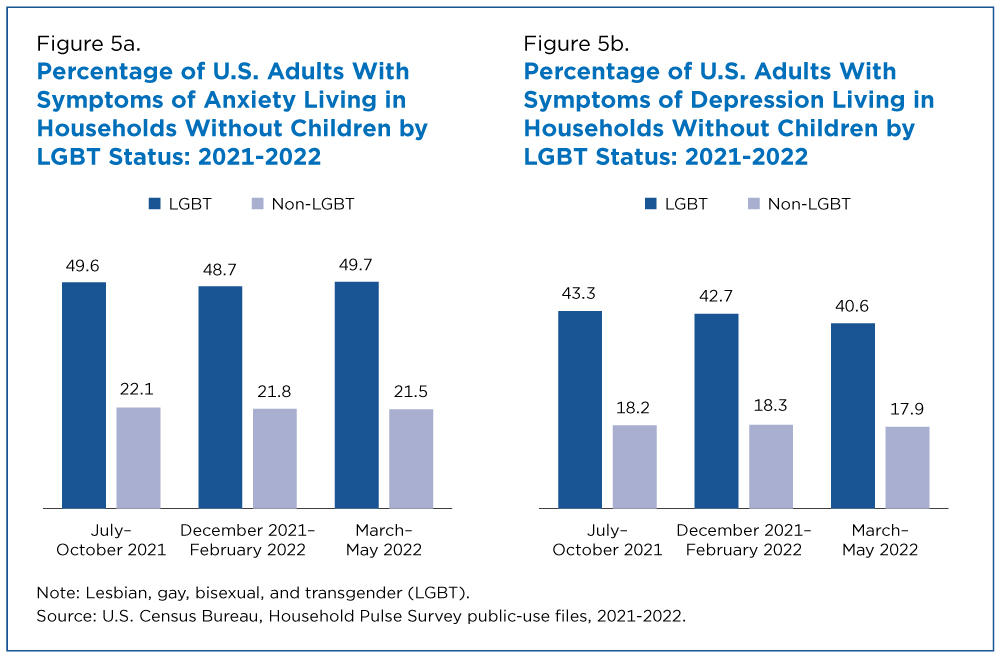
Although the HPS does not collect information about all members of a household, it does ask about the presence of other adults and children. “Without kids” includes the adult respondent living with at least one other adult but no children; “with kids” includes the adult respondent living with children, either with or without other adults.


Throughout the time series, LGBT adults living in households with children were more likely than adults (regardless of LGBT status) in other types of households to report anxiety symptoms.

The depression results were slightly less definitive. But regardless of the mental health outcome in question or LGBT status, HPS data consistently pointed to mental health struggles being more pervasive for LGBT adults.

Whether it be adults living by themselves (Figures 3a and 3b), in households with children (Figures 4a and 4b), or in households without children (Figures 5a and 5b), LGBT adults reported higher rates of both anxiety and depression than their non-LGBT counterparts during Phases 3.2-3.4 of the survey.


Defining LGBT


Earlier versions of the HPS asked respondents only for their sex (male or female). Since July 2021, the survey has included three separate SOGI questions.

The first asks about assigned sex at birth:
  • What sex were you assigned at birth on your original birth certificate?
Choice of answers: Male or Female.

The next question asks about current gender self-identification:
  • Do you currently describe yourself as male, female, or transgender?
Choice of answers: Male, Female, Transgender, or None of these.

The latest version of the survey also now asks about sexual orientation:
  • Which of the following best represents how you think of yourself?
Choice of answers: Gay or lesbian; Straight, that is not gay or lesbian; Bisexual;Something else; or I don’t know

Survey respondents are categorized as LGBT if they report a sex at birth that does not align with their current gender identity; report a sexual orientation of gay, lesbian, or bisexual; or if they currently identify as transgender.

Respondents whose sex at birth aligns with their current gender identity and who select Straight on the sexual orientation question are categorized as non-LGBT.

Respondents who select None of these on the current gender question and either Something else, I don’t know, or Straight on the sexual orientation question are categorized as “Other.”

Additionally, respondents whose sex at birth aligns with their current gender identity but who select either Something else or I don’t know on the sexual orientation question are also categorized as “Other.”

Survey questions related to sexual orientation and gender identity aim to understand the effect of the coronavirus pandemic across different subpopulations.

However, because the HPS is designed to rapidly produce experimental estimates, caution should be exercised when using these results as standalone markers of the prevalence of LGBT adults in the general population.

Measuring Anxiety and Depression


For mental health, the survey asks four questions, two relating to symptoms of anxiety and two relating to symptoms of depression.

These questions were developed in partnership with the National Center for Health Statistics (NCHS). This analysis follows an approach outlined by NCHS, which categorizes individuals based on how frequently they reported feeling anxious or depressed, consistent with diagnoses of generalized anxiety disorder or major depressive disorder.

Near Real-Time Data From HPS


The HPS is designed to provide near real-time data on how the pandemic has affected people’s lives. Information on the methodology and reliability of these estimates can be found in the Source and Accuracy statements for each data release. These statements also include information on the invitations and response rates.

Data users interested in state level sample sizes, the number of respondents, weighted response rates, and occupied housing unit coverage ratios can review the quality measures file, available on the Household Pulse Survey Technical Documentationwebsite. In comparison to other Census Bureau surveys, response rates for the HPS are low, and data users should exercise caution when interpreting estimates from the survey, especially with regards to the impact of potential non-response bias.

As a part of the Census Bureau’s experimental data series, the HPS was designed to have low respondent burden, provide quick turnaround on product releases, and produce estimates that meet urgent public needs. All estimates discussed here were calculated from public-use microdata files.

Thom File is a sociologist in the Census Bureau’s Social, Economic, and Housing Statistics Division.
Matthew Marlay is a sociologist and demographer in the Social, Economic, and Housing Statistics Division.

Friday, February 18, 2022

it is a result

Каждая восьмая женщина хоть раз в жизни жалела, что она не мужчина


О том, что родились женщинами, приходилось жалеть 12% представительниц женского населения России. Среди мужчин число тех, кто переживал моменты разочарования в своей гендерной принадлежности, втрое меньше. В опросе сервиса по поиску высокооплачиваемой работы SuperJob приняли участие по 1600 экономически активных мужчин и женщин из всех округов страны.

Подавляющее большинство мужского населения страны (92%) никогда не жалели о том, что родились мужчинами. Лишь 4% представителей сильного пола бывали в ситуациях, когда проскакивала мысль: уж лучше было бы быть женщиной! Судя по комментариям, чаще всего таким моментом оказывалась служба в армии. Мужчины также вспоминали о том, как непросто делать первые шаги при знакомстве с девушками, и о завышенных, по их мнению, требованиях работодателей.

В моментах разочарования в своей гендерной принадлежности молодые люди до 34 лет признаются намного чаще, чем мужчины старше 45 (9% против 2%), а респонденты с доходом менее 50 тыс. руб. — чаще тех, кто зарабатывает свыше 80 тыс. руб. (6% против 1%). За 11 лет, минувших с аналогичного исследования SuperJob, число мужчин, никогда не жалевших о том, что родились мужчинами, практически не изменилось.

Среди женщин тех, кому доводилось жалеть о своей гендерной принадлежности, втрое больше, чем среди мужчин, — 12%. Контекстный анализ комментариев показал, что чаще всего подобные мысли возникают у женщин в быту (например, когда нужно сменить колесо, передвинуть холодильник, сделать ремонт), а также на работе, когда становится очевидна разница в зарплатах мужчин и женщин. Свою особую уязвимость представительницы слабого пола также чувствуют в ситуациях харрасмента. Не доводилось жалеть о своей принадлежности 78% россиянок.

Об эпизодах разочарования в своей гендерной принадлежности чаще рассказывали женщины до 34 лет (21%) и россиянки с доходом менее 50 тыс. руб. (15%). По сравнению с 2011 годом более чем в 2 раза увеличилось число представительниц прекрасного пола, которые никогда не жалели о том, что родились женщинами.


Место проведения опроса: Россия, все округа
Населенных пунктов: 385
Время проведения: 10—14 февраля 2022 года
Исследуемая совокупность: мужчины старше 18 лет
Размер выборки: 1600 респондентов

Tuesday, December 14, 2021

Sex Is as Sex Does

Governing Transgender Identity


What the evolving fight for transgender rights reveals about government power, regulations, and the law

Every government agency in the United States, from Homeland Security to your state’s Department of Motor Vehicles to your local elementary school, has the authority to make its own rules for sex classification. Many transgender people find themselves in the bizarre situation of having different sex classifications on different documents. Whether you can change your legal sex to “F” or “M” (or more recently “X”) depends on what state you live in, what jurisdiction you were born in, and what government agency you’re dealing with. In Sex Is as Sex Does, noted transgender advocate and scholar Paisley Currah explores this deeply flawed system, showing why it fails transgender and non-binary people. Providing examples from different states, government agencies, and court cases, Currah explains how transgender people struggle to navigate this confusing and contradictory web of legal rules, definitions, and classifications. Unlike most gender scholars, who are concerned with what the concepts of sex and gender really mean, Currah is more interested in what the category of “sex” does for governments. What does “sex” do on our driver’s licenses, in how we play sports, in how we access health care, or in the bathroom we use? Why do prisons have very different rules than social service agencies? Why is there such resistance to people changing their sex designation? Or to drop it from identity documents altogether? 

In this thought-provoking and original volume, Sex Is as Sex Does reveals the hidden logic that has governed sex classification policies in the United States and shows what the regulation of transgender identity can tell us about society’s approach to sex and gender writ large. Ultimately, Currah demonstrates that, because the difficulties transgender people face are not just the result of transphobia but also stem from larger injustices, an identity-based transgender rights movement will not, by itself, be up to the task of resolving them. 

ISBN: 978-0814717103

Tuesday, May 18, 2021

Advancing LGBTQI health research

Insurance
by Tonia C Poteat, Carmen H Logie, L Leigh Ann van der Merwe

Since the groundbreaking 2011 UN resolution called for attention to the violence and discrimination committed against individuals because of their sexual orientation and gender identity, the visibility of LGBTQI populations has increased globally. There is mounting evidence of LGBTQI health inequities driven by stigma, discrimination, and violence. In December, 2020, 70 UN member states had criminal laws targeting sexual or gender minorities—two with de facto criminalisation and 68 with specific criminal provisions against same-sex sexual practices, six of which prescribe punishment with the death penalty. Despite recognition of these structural and social determinants of health, insufficient progress has been made in actions to address them.

Many aspects of LGBTQI health and their determinants are woefully understudied. Key priorities for advancing LGBTQI health research include filling gaps in knowledge by region, health condition, sexual orientation and gender identity group, theoretical frameworks, and methods. Importantly, researchers must collect and use data to advance the wellbeing of LGBTQI individuals, communities, and populations (panel). Simply identifying disparities by sexual orientation, gender identity, or intersex status is not enough and could exacerbate stigma against LGBTQI people in some settings. Researchers must also frame health disparities within the sociopolitical conditions that create them, clearly document the connection between these conditions and LGBTQI health, and conduct analyses that can lead to effective interventions.

Panel

Recommendations for filling gaps in LGBTQI health research


Populations and topics


• It is important that data analyses disaggregate participants by sexual orientation and gender identity rather than assume results apply across broad LGBTQI categories.
• Research is needed that disentangles identity, attraction, and practices, as well as sex and gender identity from gender attribution.
• Lesbian health outside of North America is understudied, particularly on topics other than breast cancer and obesity. There is a need for research on lesbian sexual health, including sexual function, HIV, and safer sex. COVID-19 impacts are underexamined with lesbian and bisexual women.
• Gay men's health needs to be examined beyond HIV, with a life course perspective.
• Transgender health issues should be examined beyond HIV, gender-affirming surgery and mental health problems.
• The health of intersex people should be studied beyond the impacts of surgical and hormonal treatments to focus on holistic health.
• Sexual pleasure is important to examine as a component of sexual health and rights among sexual and gender minority people.
• Strengths-based research frameworks are needed, particularly those that examine solidarity, social cohesion, and connectedness, and health benefits of social movement building. Individual and collective resilience must also be examined to document and promote the strengths of LGBTQI communities.
• Intervention research is needed that addresses systemic and structural issues, as well as community-led intervention research informed by community priorities.
• Research on structural factors is required, including power structures, health impacts of criminalisation, legal protections, and social norms and attitudes.
• There are knowledge gaps of the health impacts of incarceration and alternatives to incarceration among LGBTQI people.
• Increased research is needed on non-communicable diseases with LGBTQI populations.
• More research is needed on health-care provider perceptions, attitudes, and knowledge toward LGBTQI clients, including effective strategies to improve provider care across diverse geographical contexts.
• Behaviour change research has focused almost exclusively on reducing health risk behaviours of LGBTQI individuals. Studies are needed that examine ways to promote behaviour change among policy makers and other people in power—eg, how to turn adversaries into advocates.

Frameworks and methods


• Methods can use population-based data, including adding sexual orientation and gender identity measures to demographic and health surveys and other national surveys, and ensuring privacy, confidentiality, and protection.
• Approaches can advance dialogue on research ethics board considerations for conducting research with (rather than on) LGBTQI people, with critical reflection on how LGBTQI people are often framed as inherently vulnerable.
• Longitudinal cohort data are needed across global contexts, especially data on older LGBTQI people.
• Methods can be developed that honour diverse identities and accurately measure sexual orientation and gender identity, avoiding analytic microaggressions.
• Intersectional approaches to LGBTQI health research should take into account the variance between and within high-income, low-income, and middle-income contexts and move beyond the minority stress model to explicitly incorporate the role of power structures in determining health outcomes.
• Inclusive studies should aim to have LGBTQI sample sizes large enough for robust analysis.
• Qualitative studies can be developed to better understand nuances, experiences, processes, and the “why” behind LGBTQI health inequities, alongside documenting experiences of health-enabling environments.

Most data on LGBTQI health are from high-income countries in North America and Europe. Existing research typically focuses heavily on HIV among men who have sex with men, uses non-probability convenience samples, and applies frameworks to describe health inequities that emphasise risk behaviours rather than the agency and strengths of LGBTQI populations that can be leveraged. More research is needed to fill knowledge gaps in countries at all income levels and to examine multidimensional aspects of health, including non-communicable diseases and resilience.

A minority stress framework has generated important evidence on the relations between stigma and poor health among LGBTQI populations. This framework rejects notions of innate pathology and highlights the fundamental social and structural causes of health inequities. However, more research is needed on positive experiences and resiliencies in LGBTQI communities. Understanding how LGBTQI people cope and thrive can provide crucial information for the development of effective strengths-based interventions grounded in social cohesion and community connectedness. Longitudinal and cohort studies are needed to better understand how experiences across the life course affect the lives of LGBTQI people, not only by describing the accumulation of minority stressors, but also by exploring identity formation, access to social support, adaptive coping strategies, family formation, and healthy ageing.

Increasingly, research has identified variability in health experiences by sex characteristics, sex assigned at birth, gender identity and expression, and sexual identity and behaviour. For example, in North America, bisexual women have been found to experience higher rates of sexual violence and poorer mental health than lesbians. Studies across the globe indicate that HIV prevalence is higher in transgender people than in cisgender people, typically driven by clustering of structural and psychosocial factors.  Attention to the specific health concerns of each group within the LGBTQI umbrella is important. Specifically, more research is needed broadly on the health of transgender men, lesbians, and bisexual people. Research with gay and bisexual men and transgender women rarely examines health issues beyond HIV; by contrast lesbian and bisexual women are under-represented in HIV research. Research with intersex individuals must move beyond a focus on surgery and sexual anatomy to explore broader aspects of health and rights-affirming approaches to intersex medical care.

LGBTQI people are diverse by sex, ethnicity, socioeconomic status, age, and ability, among other identities. More research is needed to understand how these intersecting identities converge, and the ways in which their associated privileges or disadvantages affect the health outcomes, health-care experiences, and priorities of LGBTQI people. An intersectional approach to health research with LGBTQI people locates the source of health inequities within systems of power, considers the interplay between social identities (eg, race) and inequities (eg, racism), exposes the negative impact of the status quo on marginalised communities, and centres the lived experiences and diversity of LGBTQI people.

Research questions and study designs must be guided by priorities and knowledge of LGBTQI communities to produce relevant data. In countries where aspects of sexual orientation and gender identity and expression are criminalised, data collection can be difficult; in such settings, researchers run the risk of state actors using LGBTQI data for entrapment, harassment, arrest, and persecution. The very criminalisation that interferes with quality data collection also drives health inequities that remain understudied and inadequately addressed. Work to fill gaps in LGBTQI health research must use community-based approaches to try to prevent harm to participants and misuse of data. Broader political and social efforts to protect LGBTQI people against criminalisation, violence, and discrimination based on sexual orientation and gender identity and expression are key to advancing LGBTQI health.

Although data gaps remain, interventions cannot wait. There are plenty of data on the stigma, discrimination, and social exclusion experienced by many LGBTQI people, and we know these experiences drive health inequities. Interventions must improve LGBTQI health and promote health equity. Interventions may span social–ecological dimensions, including: structural level policies and laws to protect rights and ensure freedom from discrimination; community level norms, values, and attitudes; interpersonal relationships; and intrapersonal domains of self-worth, self-acceptance, and internalised stigma. Interventions can be tailored for different groups—eg, reducing stigma in structural and social arenas among general populations, educators, and health-care providers or building resilience, stigma coping, and advocacy, and mitigating internalised stigma with LGBTQI people. Interventions tailored for stigma reduction and health promotion with LGBTQI people can use a life course approach that considers developmental stages, from childhood and adolescence, to emerging adulthood, parenthood, caregiving, and ageing. Importantly, implementation science research is needed to understand how interventions work, for whom, and in what context, so that they can be sustained beyond the end of research studies by government, non-governmental, and community actors.

Больше букаф, хорошых и разних

Sunday, May 16, 2021

The Political Nature of Sex —

Transgender in the History of MedicineList of authors.

Ketil Slagstad, M.D.

Article | Metrics| 34 References

черно-белый контейнер с ногами, Шива Лингам Индуизм Ганеша Пуджа, Чакра, религия, лакшми, брахма
On July 18, 2016, the final rule of the Department of Health and Human Services (HHS) implementing Section 1557 of the Affordable Care Act regarding gender nondiscrimination went into effect. Advocates were relieved that the law now included protections against discrimination in health care “on the basis of sex” that applied to transgender patients. These protections ensured that patients were treated in a manner consistent with their gender identity and, among other safeguards, helped U.S. transgender patients access gender-affirming therapy. Four years later, under the Trump administration, HHS proposed revising this rule so that antidiscrimination provisions would apply only to “male or female and as determined by biology.” Advocates for transgender rights feared the rollback would jeopardize specific health services and leave trans people especially vulnerable to discrimination. On June 15, 2020, the U.S. Supreme Court in Bostock v. Clayton County held that the prohibition on discrimination in employment “because of…sex” in Title VII of the Civil Rights Act of 1964 applies to gender identity and sexual orientation. On the night of his inauguration, on January 20, 2021, President Joe Biden issued a wide-ranging executive order to enforce the court’s ruling and to prevent and combat discrimination on the basis of gender identity and sexual orientation.

The Trump administration’s proposed change, the Supreme Court ruling, and Biden’s executive order are perhaps the most high-profile and consequential illustration that the definition of sex has become a highly contested and polarizing issue in contemporary society and political debates. Yet historians of medicine recognize that the relevant moral and scientific questions, which seem so utterly modern, touch on age-old themes in medical understanding.

In our current cultural moment, discussions about whether sex and gender are spectrums or dichotomies have taken center stage. Defenders of transgender rights are often accused of pushing identity politics or “gender ideology.” But the current situation has not appeared out of the blue: attempts to define sex and gender have been a recurrent theme in medical history, and because the topic of transgender rights is necessarily also a medical one, this legacy underpins the current debates. A greater awareness of this history can help doctors become more responsible, empathetic, and reflective when we meet with transgender and gender-nonconforming patients.

While biologists have rooted a definition of sex in the evolution of species and the capability of producing small or large gametes, doctors have been confronted with a practical challenge: treating patients whose bodies or identities cannot easily be categorized as either male or female. The history of sex in medicine is therefore also a history of doctors adopting and modifying theories of sex to the task of practicing medicine. But even if doctors have often based their definitions on physical characteristics — gametes, gonads, internal reproductive organs, external genitalia, hormones, chromosomes, and genes — medical understandings of sex have evolved with technological developments and in response to political, bureaucratic, and legal demands, such as a desire to provide clear-cut answers in criminal cases or to promote the cultural ideal of marriage.

Knowledge production about sex, however, has not been a one-way street from experts to laypeople. People with bodies, identities, or desires that did not fit societal norms have pushed back, asserted agency and self-definition, and shaped categories in therapeutic and research settings. And historically, scientific and medical understandings of sex have shifted largely by attending to “anomalous” forms of embodiment and identities — a pattern illustrated by five cases: the hermaphrodite, the homosexual, the intersex body, the transsexual, and the transgender person.

The Hermaphrodite: Sex between Dichotomy and Spectrum


For a long time, two fundamentally different models of sex existed in science and medicine — the binary and the spectrum — and each had social implications. For early modern writers, the “hermaphrodite” threw into question medical and scientific theories and classifications. Work in the tradition of Aristotle conceived of sex as polar opposites: the heat of the heart determined sex, and hermaphroditism was merely a matter of the genitals rather than the organism as a whole. Although genitalia could be ambiguous, sex was binary.

Writers following Hippocrates and Galen, by contrast, saw sex as a product of both the maternal and paternal seed and the left and right sides of the uterus. This set of variables opened up a variety of intermediate phenotypes that threatened a binary model of sex. The obsession with the hermaphrodite among medical writers in the mid-16th century can be seen as a manifestation of a revival of Hippocratic theories and of a broad “male anxiety” about sexual ambiguity and immoral conduct. Hermaphroditism became emblematic of all kinds of sexual ambiguity, including sodomy and transvestism, which illustrated how the definition of sex responded to moral and political questions in society.

The Homosexual: Inseparability of Sex and Sexuality


Another “anomalous” figure that has played an important role in the creation of sex is the homosexual. In medicine in the late 19th and early 20th centuries, the concept of gender did not exist, and sex and sexuality were intertwined and inseparable. Psychiatrists in the German-speaking world began to categorize and pathologize people whose identities and bodies violated the heterosexual norm of sexuality and binary understandings of sex. The prominent Berlin psychiatrist Carl Westphal, for instance, coined the term “contrary sexual feeling,” which tied together the phenomena of cross-dressing and same-sex attraction. In Psychopathia Sexualis, the psychiatrist Richard von Krafft-Ebing expanded sexual psychopathological theory into a complex taxonomic system of “sexual perversions.” He divided “contrary sexual feeling” into acquired and congenital forms that were expressed to a greater or lesser degree: homosexuality represented an early stage, whereas “metamorphosis sexualis paranoica” was defined as the delusional idea of sex transformation or the feeling of belonging to the “other” sex.

A broad constellation of sexual perversions, from homosexuality and a gender identity incongruent with birth sex to somatic manifestations such as the masculinization or feminization of secondary sex characteristics, were fundamental to late 19th-century theories of sexual pathology. Contemporary understandings of sexuality as distinct from sex or gender identity would have made little sense to late 19th-century psychiatrists.

Like some psychiatrists, activists in the homosexual liberation movement of the late 19th century also evoked biology in arguing that homosexuality was congenital. One early activist, Karl Heinrich Ulrichs, argued that homosexuals (or “urnings”) belonged to a “third sex,” a woman’s soul in a male body, referring back to Aristophanes’ tale of the origin of love in Plato’s Symposium, which depicted three original beings of three different sexes. In opposing punishment for homosexuals, doctors and sexologists in the sexual reform movement argued that homosexuality had congenital causes and was part of human variation, not immoral conduct or a psychiatric disorder. Challenging both sexual pathology and psychoanalytic reasoning, the physician and sexual reformist Magnus Hirschfeld’s theory of “intermediate sexual stages” placed sex and sexuality on a spectrum, evoking biologic and endocrinologic arguments: “It cannot be repeated often enough” Hirschfeld wrote, “that the human being is not man or woman but man and woman.”

By the late 19th century, gonads had become the primary marker of a patient’s sex — this period is sometimes called “the age of the gonads” — but cases emerged that puzzled doctors, who had to use other criteria in trying to determine sex unequivocally. The increased influence of genetic and endocrinologic research on medicine in the late 19th and early 20th centuries further undermined strict gonadal criteria.

The birth of psychoanalysis in the early 1900s and the advent of psychosexuality and considerations of the patient’s own experience of a gendered self added complexity to the concept of sex. Sex was not understood as a binary biologic category in scientific and medical discourse at that time, as it often is today: bisexuality was not limited to sexuality but referred to an inert, latent potential in every human being to develop in a male or female direction.

Transsexual and Intersex People: Intervening in the Body


Doctors’ handling of transsexual and intersex patients has been fundamental to contemporary understandings of sex. But historically, these categories have also been fluid. In Berlin in the 1920s, doctors at Hirschfeld’s Institut für Sexualwissenschaft performed the first sex-reassignment surgeries on “transsexual” people, embracing a bisexual, endocrinologic, and sexologic framework of sex. The United States, however, lacked a similar medical understanding of transsexual identity and embodiment, so when people we would now consider transgender contacted the Johns Hopkins Hospitals for care, they used the language of intersex to obtain similar treatment. Their doctors nonetheless considered these patients to be homosexual, thereby precluding any form of medical treatment and prohibiting the emergence of trans identities in medical discourse.

The approach changed in the second half of the 20th century with the popularization of the concept of “transsexualism” and the creation of university-based gender-identity clinics. The media coverage of American Christine Jorgensen’s gender-confirmation therapy in Copenhagen in the early 1950s rapidly spread worldwide, with headlines such as “Ex-GI Becomes Blonde Beauty.” Though the treatment protocols were not new, sex seemed to be in flux in new ways, as Jorgensen’s story brought the notion of “sex change” to the public and raised awareness of transsexual issues. Since synthetic sex hormones had become available in the 1930s and made it easier to modify the body to make it more congruent with peoples’ experiences of their inner selves, doctors were increasingly confronted with a fundamental question: Instead of intervening in patients’ bodies, would it not be better to help change the person’s identity by other means — for instance, by psychotherapy?

The Birth of Gender: Regulating the Normal


Doctors defending “sex change therapy,” such as the endocrinologist Harry Benjamin, staunchly rejected this notion, and their practice of offering hormonal and surgical treatment rested on complex theories of child development proposed by psychologists and doctors working with intersex children at Johns Hopkins Hospital. The Hopkins team’s research and clinical work led them to a new concept that would gain paramount importance for modern societies: gender.

In the 1950s, John Money and colleagues published a series of articles in the Bulletin of the Johns Hopkins Hospital in which they claimed, on the basis of examinations of numerous “hermaphrodites,” that the most reliable “prognosticator” of a person’s gender role was the “sex of assignment,” not biologic categories of chromosomal sex, gonadal sex, hormonal sex, internal reproductive structure, or morphology of external genitalia. They therefore discarded the idea that psychological or social sex was biologically or genetically predetermined and developed a model of “gender identity or role” formation based on a behavioral–adaptational framework: the first 18 months of life represented a crucial window in which one’s gender identity could be molded, after which it would become cemented. The crucial concept was “imprinting”: since bodily morphology and child rearing interacted in a complex biosocial matrix, the presence of “ambiguous” genitalia threatened the formation of a firm, univocal gender identity or role as either man or woman. Therefore, the genitals of intersex babies should be made as “normal looking” as possible, meaning unambiguously masculinized or feminized, using hormones and surgery. After surgery, parents were told never to talk to their children about this part of their past and to raise them according to the gender and sex the professionals had assigned. Later studies nonetheless showed that the doctors’ blind belief in gender identity’s social changeability was wrong.

In other words, the concept of gender once again opened up an understanding of sex as plastic, but not in the sense that it represented a plurality of ways of expressing gender: the treatment protocol was underpinned by a fragile concept of gender that hinged on the belief that bodies and gender roles must be aligned and the normative idea that a good life depended on being unambiguously gendered and sexed. The psychoanalyst Robert Stoller, who helped establish the Gender Identity Center at UCLA in the 1960s, refined these theories into a concept of “core gender identity.” Gender identity’s unchangeability would become an axiom and justification for future gender-affirming therapy. Hence, gender, a concept that would become a crucial resource for feminists in challenging patriarchal structures — systemic inequalities often justified with reference to biologic differences between men and women — originally came from medicine and protected the integrity of the binary model of sex.

Toward the turn of the century, activists and trans people increasingly took issue with the tendency of the medicalized concept of transsexualism and the concept of the “wrong body” to reduce and delimit trans people’s identities and experiences. The term “transgender,” which emerged in the 1990s, was a response to this problem, allowing for myriad nonconforming and nonnormative forms of gender identity and expression.

Mobilizing Biology


A milestone in transgender history occurred in 2019, when the World Health Organization removed “gender identity disorder” from the chapter on mental illnesses in the International Classification of Diseases and replaced it with a new diagnosis of “gender incongruence” in a new chapter on sexual health. Transgender people were thus no longer labeled mentally ill, and trans, nonbinary, and gender-nonconforming identities were recognized as expressing human variation.

Nevertheless, various groups, including social conservatives, have opposed transgender rights, and some feminists, including the author J.K. Rowling, have instrumentalized biology to oppose a U.K. law on gender self-declaration, arguing that “sex is real.” The Trump administration decided that transgender personnel cannot serve in the U.S. military except in their assigned birth sex, a decision that was revoked by President Biden on January 25. Under the Trump administration, the Department of Housing and Urban Development proposed allowing homeless shelters to discriminate against transgender people by admitting people according to “biological sex,” and it provided a list of characteristics for identifying trans women, including height, facial hair, and Adam’s apples.

Yet when the Trump administration sought to establish a legal definition of sex based on inspection of external genitals and genetic testing, the editors of Nature responded by declaring that “anatomy does not define gender”: “The research and medical community now sees sex as more complex than male and female, and gender as a spectrum that includes transgender people and those who identify as neither male nor female.” Major scientific and medical organizations such as the Endocrine Society have used genetic and neuroradiologic research to argue that gender identity is not a mere “social construct” but also the product of biology. And the American Medical Association has adopted a policy on educating the medical community and the public about the “medical spectrum of gender,” including the recognition that “an individual’s genotypic sex, phenotypic sex, sexual orientation, gender and gender identity are not always aligned or indicative of the other” and that gender may differ from sex assigned at birth.

Looking through Nature


These examples demonstrate how transgender rights trigger discussions about the nature of sex. But that effect is nothing new: repeatedly throughout the history of Western thought, “nature” has provided a rich resource for shaping norms, settling categories, and stabilizing concepts of normality. What counts as natural and what role nature plays in the order of things, however, are historically contingent. In the center of the medieval and Renaissance concept of nature, for instance, stood the goddess Natura, who protected heterosexual sex and the continuation of the human species. Since the word “nature” became a synonym for the genitals, the “hermaphrodite” became a site for demonstrating not only natural variation but also nature’s normative role in protecting the moral order.

In the history of medicine, the common has often been equated with the normal. In the past 150 years, we’ve seen how diagnostic and classificatory systems have pathologized and stigmatized people whose bodies, identities, or desires did not fit social norms. However, history also provides examples of doctors listening to the needs of trans and intersex patients and using medical knowledge to provide empathetic care. By shaping and guarding the concept of sex, doctors have enabled some bodies and ways of living while invalidating others. Ultimately, the medical categories of homosexuality, intersex, and transsexualism have shaped contemporary understandings of sex.

The process of working out the concepts of sex and gender continues in relation to trans people. The inclusion, removal, and reinsertion of gender nondiscrimination in the Affordable Care Act are just another reminder of the inseparability of politics from the scientific boundaries of sex and gender. The history of medicine offers an antidote to the notion that we are simply looking at “nature” when we see sex and gender: what counts as sex and gender is historically changeable, morally infused, and politically loaded.

Disclosure forms provided by the author are available at NEJM.org.

This article was published on February 3, 2021, at NEJM.org.

I thank Anne Kveim Lie and Jeremy Greene for feedback on an early draft of this manuscript as well as two anonymous reviewers whose suggestions helped improve the manuscript.

Author Affiliations


From the Institute of Health and Society, Faculty of Medicine, University of Oslo, Oslo; and the Institute for the History of Medicine and Ethics in Medicine, Charité Universitätsmedizin Berlin, Berlin.

Tuesday, April 27, 2021

share of US adults identified as LGBT

A total of 5.6 percent of U.S. adults identified as LGBT in 2020, a new record high. Gen Z, newly added to the latest edition of a survey by Gallup, is the gayest generation in terms of self-identification. Almost 16 percent of those born between 1997 and 2002 identified as LGBT, compared with around 9 percent of Millennials.

While scientists believe that the share of LGBT individuals has not actually changed over time, younger people in the U.S. are more likely to be openly gay, lesbian, bisexual or transsexual. Even within the generation of Millennials, defined as those born between 1981 and 1996, self-identification quotas rose in the past years. In 2014, only 6.3 percent of Millennials had said they identified as LGBT.

For older generations, levels of self-identification did not change majorly in the past decade. The Gallup survey question did not ask respondents to identify as other sexes, sexual identities or sexual orientations like intersex, asexual or queer.Infographic: 5.6 Percent of U.S. Adults Identify as LGBT | StatistaЭто 20й год, а вот и 21 подоспел:

Share of LGBT population living in the U.S. states as of February 2021, by status of transgender exclusions in private health insurance coverage

Friday, February 5, 2021

tg sexual orientation

Похоже, что у трансгендеров нет доминирующего варианта сексуальной ориентации. Об этом свидетельствуют данные исследования, организованного и проведённого самим трансгендерным сообществом. Его результаты опубликованы в виде отчёта. В этом исследовании было опрошено несколько тысяч трангендеров по самым различным вопросам. Сексуальная ориентация была лишь одним из них. На рисунке (см. ниже) представлены данные, касающиеся частот различных вариантов сексуальной ориентации у трансгендеров М>Ж и Ж>М.  

ист: (c)EIS-gen

Monday, February 1, 2021

transgender persons

Трансгендеры. 

Медицинский взгляд на проблему.


Формирование половой системы и «гендерное программирование» мозга у подавляющего большинства людей идут в одном направлении (либо мужском либо женском), как правило, в соответствии с половыми хромосомами. Однако эти процессы самостоятельны и разделены во времени (пол формируется раньше). Напомню, что в принципе любой эмбрион, независимо от половых хромосом, имеет потенциал развиться как в мужчину, так и женщину. При определённых генетических дефектах возникают сбои в формировании пола, в результате которых рождаются ХХ мужчины (пост 11) и ХY женщины (пост 12) [этот пост №29, ссылка в низу]. Однако в этих случаях пол и гендер совпадают. А вот у трансгендеров ситуация иная. Их пол нормально сформирован и соответствует половым хромосомам, а сбой [сбойность хорошо бы как-то аргументировать] связан с процессом «гендерного программирования» мозга, который по каким-то причинам переключается на противоположное направление. В итоге гендер не соответствует ни полу тела, ни половым хромосомам.

Осознание чужеродности пола собственного тела приводит к серьёзному психологическому дискомфорту. Именно поэтому в медицине используют термин гендерная дисфория (в греческом языке дисфория означает мучение, страдание). Человек ощущает себя «заключённым в неправильное тело» [вопрос о правильности решается мозгом, а не телом]. У некоторых трансгендеров неприятие собственных гениталий оказывается настолько сильным, что им невыносимо их видеть или просто коснуться. Всё это приводит к подавленному настроению, озлоблению, повышенной раздражительности, необоснованным вспышкам гнева и агрессивности. Человек ищет выход из своего состояния, пытаясь жить в соответствии со своим гендером, а последний явно смешен в сторону противоположного пола. В этот момент начинает подключаться второй фактор, ещё более усиливающий психологический дискомфорт - отрицательное отношение общества к поведению, не соответствующему полу человека. Во многих случаях гендерная дисфория протекает настолько тяжело, что человек решается на самоубийство. Опубликованные данные по частоте суицидальных попыток среди трансгендеров в США просто ужасающие - 41% пытались свести счёты с жизнью.

Степень негативного воздействие со стороны общества во многом зависит от традиции отношения к трансгендерам. В постах 22-27 рассказывалось об этносах, позволяющих этим людям быть иными, то есть и ни мужчинами и ни женщинами (их считают третьим полом или «ложными женщинами» или как-то иначе [раньше думал, что третий пол — это лесбиянки]). Профессор Paul Vasey, многие годы изучающий трансгендеров (фаафафине) Самоа (пост 27) отмечает несравненно большую толерантность местного населения в сравнении со странами Запада.

Традиции европейской цивилизации до недавнего времени признавали только мужчин и женщин. Поэтому логично, что выходом для западных трансгендеров было изменение своего пола на противоположный (с помощью операции и/или приёма гормональных препаратов).

В зависимости от времени возникновения гендерного конфликта различают два варианта - Гендерная дисфория взрослых и подростков и Гендерная дисфория детей. Гендерная дисфория детей проявляется в раннем детстве задолго до периода полового созревания. Ребёнок недоволен тем, как его одевают и в какие игры его вовлекают. Он требует, чтобы его называли именем, характерным для противоположного пола, то же касается одежды и игр. Ребёнок постоянно находится в сильном раздражении, вызванным тем, что его считают мальчиком, тогда как он хочет быть девочкой (или наоборот). Ребёнок настойчиво требует, чтобы родители признали в нем того, кем он сам себя считает. Естественно, в детском возрасте ни о каком хирургическом или гормональном воздействии с целью изменения пола не может быть и речи. Обычно гормональная терапия разрешается только после достижения 16 лет, а вопрос о проведении операции по смене пола рассматривается после того, как исполнится 18 лет.

Имея дело с гендерной дисфорией детей, медики оказываются перед сложной дилеммой. С одной стороны можно просто ждать совершеннолетия, правда за это время пройдёт период полового созревания и возникшие вторичные половые признаки ещё больше усилят гендерную дисфорию. С другой стороны можно с помощью препаратов максимально затормозить половое созревание вплоть до совершеннолетия. Правда, блокаторы полового созревания совсем небезвредные, они могут оказывать негативное влияние на развитие других систем организма.

Есть ещё один аспект, который усложняет выбор стратегии действий по отношению к таким детям. Дело в том, что часть из них, пройдя период полового созревания, принимает свой биологический пол и у них нет желания его изменить. Правда, в большинстве таких случаев они оказываются гомосексуалами. Читатель возразит, что сексуальная ориентация и гендер – это разные вещи. Это действительно так, но вспомните, какое количество геев среди ведущих модельеров мира [anecdotis evidence]. Наверняка они в детстве предпочитали мастерить одежду для кукол, а не мальчишеские игры. Так что поведение ребёнка, несоответствующее его полу, может быть как отображением гендерной дисфории, так и будущей гомосексуальности.
Звёзды Голливуда Анджелина Джоли и Синтия Никсон и со своими трансгендерными детьми

Коротко о гендерной дисфории взрослых. Она проявляется позднее, а сам переход может произойти даже в пожилом возрасте. Яркий пример это Брус Дженнер. Олимпийский чемпион в десятиборье, с великолепным мужским телом, был трижды женат, в каждом браке имел по два ребёнка. После завершения спортивной карьеры был звездой телевидения, богат, успешен. Но в возрасте 64 лет Брус меняет свой пол на женский и становится Кэйтлин. В своих интервью Кэйтлин говорит, что она всегда знала, что она женщина.
Брус Дженнер (слева), ставший в 2015 году Кэйтлин Дженнер (справа)

В 20 веке гендерная дисфория рассматривалась в медицинском сообществе как психическое нарушение. Однако такая трактовка подвергалась резкой критике, прежде всего со стороны ЛГБТ сообщества, так что в ряде стран данное состояние было выведено из раздела психических нарушений. Тем не менее, психиатры продолжают играть ключевую роль в жизни трансгендеров. Дело в том, что легальный доступ к гормональной терапии и тем более к изменяющим пол операциям возможен только при наличии заключения психиатра о том, что у данного человека диагностирована гендерная дисфория.

Раскол по отношению к тому, как трактовать гендерную дисфорию, существует и в самом трансгендерном сообществе. Некоторые считают, что это вообще не медицинская проблема; с их точки зрения депрессия или чрезмерная раздражительность, характерные для данного состояния, в основном вызваны негативным отношением общества к трансгендерам. Однако с этим согласны далеко не все трансгендеры. Один из их аргументов имеет финансовую основу. Дело в том, что если гендерная дисфория это болезнь, то её лечение может включаться в медицинскую страховку.

Следующий пост о том, как медицина пытается помочь страдающим от гендерной дисфории.

(c)EIS-gen

Монологи российских хирургов, которые проводят операции по смене пола