Showing posts with label депопуляция. Show all posts

Thursday, November 2, 2023

extinction of humanity

Первый глобальный саммит, посвященный безопасному использованию искусственного интеллекта, стартовал в Британии. В течение двух дней технологические гиганты, эксперты и политики будут обсуждать основы регулирования и безопасного использования технологий ИИ.

В первый день работы саммита было подписано «первое в мире соглашение» о том, как управлять наиболее рискованными формами искусственного интеллекта.

В саммите также принял участие Илон Маск, владелец компаний Tesla и X. Накануне встречи он вновь выступил с предупреждением, что ИИ может привести к вымиранию человечества.

Подробнее
Ссылка без VPN.

Wednesday, October 11, 2023

Should or should not China be afraid of population decline?

October 9, 2023 Wang Feng

China’s population boom is over: demographic aging and decline will characterize its foreseeable future. However, according to Wang Feng, this will not entail a decrease in the standard of living of its citizens, or of China’s role in the globalized world, thanks to unparalleled improvements in education and health.


China’s onset of population decline was instantly greeted by a chorus of doomsayers. The pessimists were quick to equate this demographic turning point with the end of China’s economic growth, even the end of China’s growing global geopolitical influence. Such predictions are overly simplistic and are largely based on the premise of a population-growth driven economic development model that the world has gotten so used to in the past half century and more. Yet it takes little knowledge of economics to know that labor is only one of the key ingredients of economic output. And even labor is not just a number. China’s economic boom in the past several decades indeed benefited from a large reservoir of hard-working labor, in particular the vast flows of rural migrants to cities, but one needs to be reminded that it was institutional change that has made the feared “surplus labor” during China’s planned economy era into a highly productive labor force in the last four decades.

Should China be afraid of its population decline? Can China, and the world, adapt to a new era of global demographics featured by population aging and decline, just as they adapted to the era of population explosion? Rather than being fixated on simple population numbers, be it the size of the labor force or dependency ratios, one needs to look deeper, taking stock of the characteristics of the population, and appreciating the importance of institutional conditions that have allowed past economic successes, and that will be crucial in facing future challenges.

It’s not all about a number: new faces of the Chinese population


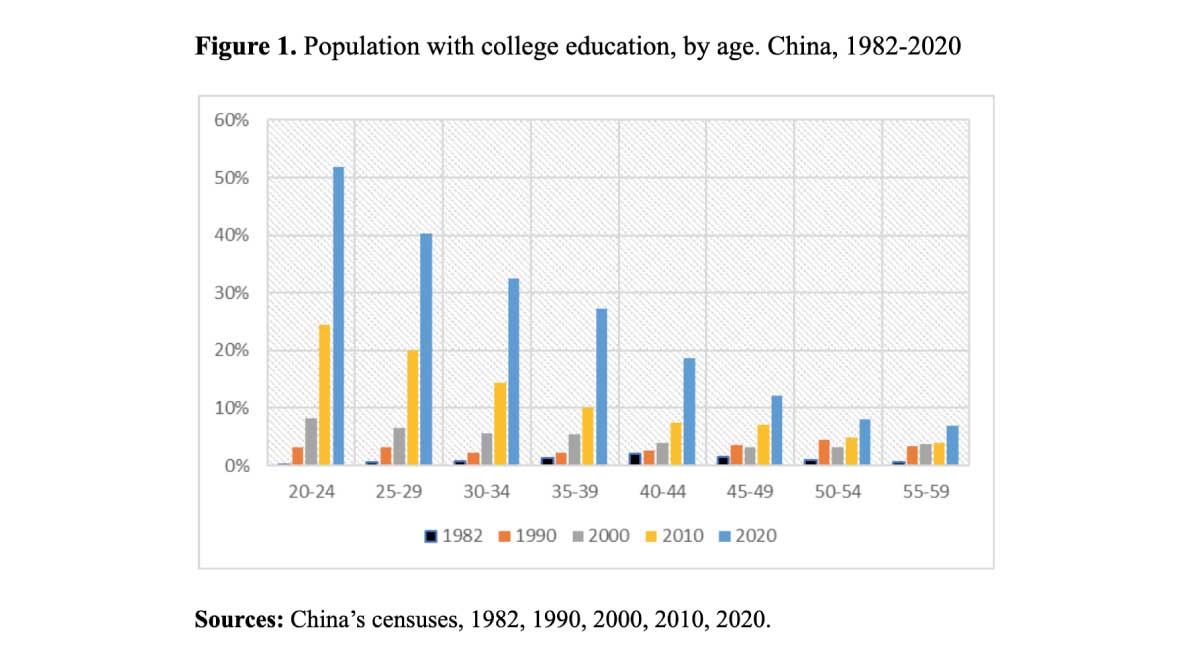
Thanks to its historic economic boom and social transformations, China now has the most educated young population in its history. Four decades ago, when the first post-Mao population census was taken in 1982, the picture that emerged was one of a population that was already largely literate. Yet the near universal literacy among the young at the time was just that, basic literacy. Among those aged 15 to 19, who benefited the most from the expansion of education at that time, only slightly over 40 percent had junior high school or high school education. The share was only barely 20 percent among those in their 30s. The share of the population with tertiary education was miniscule: less than 1 percent of people in their late 20s and early 30s had attended college.

China has undergone an explosive growth in higher educational opportunities. Between 1998 and 2010, annual enrollment in colleges rose more than six-fold, from barely a million to nearly seven million.1 By 2020, annual enrollment in tertiary education had reached 9.7 million.2 With an annual birth number dropping to a new low of 10.6 million in 2021, China has virtually reached tertiary education enrollment saturation. Even without further expansion, all children born in the early 2020s will be able to enroll in higher education in the future.

Vast improvements in educational attainment can be appreciated by comparisons across age groups and over the decades. As shown in Figure 1, around 10 percent of the population aged 45 to 49 in 2020 had a college education. Among the youngest age group, those aged 20 to 24, the share was five times higher, with over half already having tertiary educational attainment. Four decades ago, in this age group, the share was less than 0.25 percent and in 2010 the share was less than 25 percent. By 2020, more than a third of young people in their prime working age (20 to 34) already had tertiary education. Such a rapid shift in the educational level of the young population has transformed the Chinese economy and society in numerous fundamental ways, from work and income to consumption and participation in social and political affairs.

Health and survival


China now also has the healthiest population in its history. As China ascended from a low-income to an upper-middle income society, its population’s health profile further converged toward that of high-income countries. This convergence has come with two faces: one in the general health level of the population, and the other in disease profiles. As China’s life expectancy further increased, approaching that of high-income societies, its composition of causes of death also shifted, and is now dominated by deaths from non-communicable diseases, resembling the pattern seen in other high-income and aging populations. In contrast to earlier generations, whose early-life health risks were mostly attributable to poor nutrition, those raised during China’s age of abundance face a whole different set of risks. The term of malnutrition has acquired a new meaning in China. In the early 2010s, for instance, 244.5 million or 23.2 percent of adults aged 18 and over had hypertension, with another 435 million, or 41.4 percent having pre-hypertension, according to Chinese guidelines.3

Life expectancy is not only increasing at birth, but also at advanced ages. In China, as in the neighboring East Asian countries of Japan and South Korea, life expectancy at 65, the normal cut-off age for defining the elderly population, nearly doubled between 1950 and 2020, from 9.1 years to 17.7 years (Figure 2). Greater longevity, like educational expansion among the young, is similarly transforming the economy by enabling people to work until later ages and creating new markets to meet the needs of older adults.

Not all is gold that glitters


Recognizing these new features of the Chinese population is not to dismiss the challenges associated with China’s historical demographic shift. China will face serious fiscal challenges, which will make economic transformation and continued growth more imperative. In the first decades of the twenty-first century, public spending on health care and on pensions as a share of GDP has already more than doubled. This combined spending already accounted for more than a quarter of all government spending by 2020, or close to 10 percent of GDP.4 One study has projected that population aging alone could drive up such public spending to 20 percent of GDP by 2040, and to 23 percent by 2050.5 Increasing per capita benefits to levels commensurate with that of a high-income society could increase the share of public spending much faster, to 32 percent of GDP by 2050. In the absence of any substantial increase in government revenue, such a share would imply that the entire government revenue would have to be used for such public spending, mostly in support of an aging population.

Rather than spelling the country’s fate based on simple population numbers, however, a new economic growth model is essential for sustaining increased living standards of the population. China had an abundant supply of labor during its planned economy years, but that labor was not put to productive use. China has shifted its course of economic growth and now has the most educated and the healthiest population in its long history. The end of population growth, therefore, is by no means an automatic end of economic growth. What should be feared is not a smaller and older population. The challenges will give rise to innovation and adaptation, as history has shown us again and again.

Foot notes

  • 1 China Statistical Yearbook 2010, Table 20-7. The enrollment number includes both four-year university courses and three-year vocational courses. In 2010, 3.1 million of the 6.6 million enrolled students were in three-year vocational institutions.
  • 2 China Statistical Yearbook 2021, Table 21-7.
  • 3 www.ahajournals.org/doi/full/10.1161/CIRCULATIONAHA.117.032380
  • 4 Public spending as a share of GDP estimated by the IMF for 2020 was 35.4 percent.
  • 5 Cai, Yong, Feng Wang, and Ke Shen. 2018. “Fiscal Implications of Population Aging and Social Sector Expenditure in China.” Population and Development Review 44 (4): 811–31. http://www.jstor.org/stable/45174458.

Friday, February 24, 2023

South Korea’s birthrate sinks to fresh record low as population crisis deepens

South Korea’s birth rate has fallen to its lowest level since records were first kept in 1970

Latest statistics show 249,000 babies were born in 2022, a fall of 4.4% from the previous year


Justin McCurry in TokyoWed 22 Feb 2023

South Korea’s demographic crisis has deepened after new data showed the number of babies born last year reached another record low.

According to figures released on Wednesday by Statistics Korea, 249,000 babies were born in 2022, a fall of 4.4% from the previous year and the third year in a row that deaths have exceeded births in Asia’s fourth-biggest economy.

The birthrate also dropped to a record low, dealing a blow to government efforts to encourage couples to have more children.

A South Korean woman can now expect to have an average of 0.78 children in her lifetime – the lowest level since records were first kept in 1970 – making South Korea the only country in the world with a fertility rate below one.

Experts say the rate needs to be at least 2.1 to keep the country’s populationstable at 52 million.

It is not the only country battling declining birthrates – Japan’s government recently warned that population decline was taking the country “to the brink of social dysfunction” – but the trend in South Korea is particularly alarming for policymakers.

More young people are choosing to delay starting families or giving up on having children altogether.

They cite the high cost of raising children, poor job prospects amid an economic slowdown, and rising real estate prices, while some women say they prefer to prioritise their personal freedom and have ruled out finding a marriage partner.

As a result, the number of marriages in South Korea reached an all-time low of 193,000 in 2021.

The average age at which women give birth was 33.5 in 2022, according to the new data, up 0.2 from a year earlier. On average, women gave birth to their first child at 33. Just 24 babies were born for every 1,000 women in their late 20s – down 3.5% from a year earlier – the Yonhap news agency reported.

With the world’s lowest fertility rate and a rapidly ageing population, concern is growing about the strain on South Korea’s economy and the pension system, which may become depleted in the coming decades.

The population shrank for the first time on record in 2021, and is projected to fall further, to 38 million, by 2070.

Like Japan, local governments in South Korea have launched programmes to encourage people to have children, including cash handouts and help with fertility treatment and medical expenses – measures experts say fail to properly address sky-high living costs and changing attitudes towards gender roles and work-life balance.

In December, the South Korean government unveiled a package of measures to address the low birthrate and ageing population, including shortening career breaks for women after they have children, more affordable housing and better job opportunities for young people. The unemployment rate among people aged 25 to 29 reached 5.6% in January, higher than the national average of 3.6%.

The government of president Yoon Suk-yeol is offering 700,000 won ($540) a month to families with a child aged under a year old, with the payment set to rise to 1m won starting next year, the Nikkei business newspaper said.

The government has also said it will seek to loosen restrictions on migrant labour to tackle population decline, an idea opposed by many conservative South Koreans.

Wednesday, November 2, 2022

we are all from Denisov cave

[британские, верить можно наглоасксы же] Ученые

неандертальцы могли вымереть не из-за вражды с гомо сапиенс, а в результате скрещивания с ними

31 октября 2022

По версии ученых, к гибели неандертальцев привело регулярное скрещивание с гомо сапиенс

Почему именно вымерли неандертальцы, для ученых до сих пор большая загадка. Есть гипотеза, что к этому привела борьба с гомо сапиенс (линия развития нынешнего человечества). Но возможно, все было наоборот - неандертальцы вымерли не из-за вражды и соперничества с гомо сапиенс, а из-за того, что скрещивались с ними.


Авторы исследования, опубликованного в журнале PaleoAnthropology, полагают, что исчезновение неандертальцев могло стать результатом долгого скрещивания между этими двумя видами - количество особей с неандертальской ДНК постепенно сокращалось и в итоге сошло на нет.

Правда, исследователи оговариваются: пока расшифровано всего 32 генома неандертальцев - выборка небольшая и, возможно, не самая показательная, и для более уверенных выводов нужны дальнейшие исследования.

Профессор Крис Стрингер, научный руководитель Музея эволюции человека и соавтор статьи, говорит, что до сих пор в научном сообществе мало обсуждают, как именно произошло скрещивание этих двух видов.

"Мы предполагаем, что именно это могло привести к вымиранию неандертальцев - если они регулярно скрещивались с гомо сапиенс, это могло сокращать их популяцию до тех пор, пока они не исчезли", - говорит он.

Первая встреча


Около 2% людей, живущих сейчас за пределами Африки, носят в себе гены неандертальцев. Это объясняется ареалом обитания неандертальцев.
Во Франции нашли пещеру, в которой жили и неандертальцы, и наши предки. Как это меняет представления о каменном веке?
Неандертальцы: такие же люди, как мы, просто им не повезло?

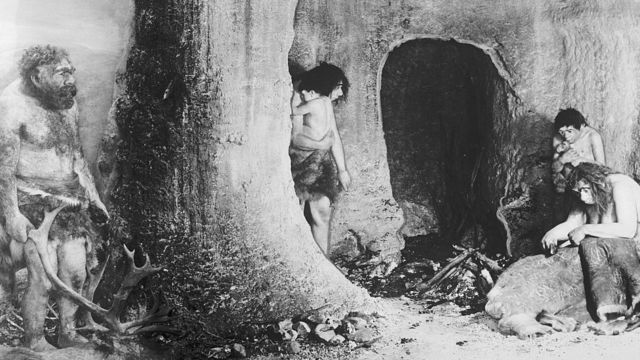
Репродукция неандертальского мужчины на выставке Музея естественной истории в Лондоне, апрель 2022

600 тысяч лет назад гомо сапиенс жили на Африканском континенте, в то время как неандертальцы заняли территории современной Европы и Азии (вплоть до южной Сибири).

Сотни тысяч лет они существовали параллельно, не пересекаясь. Пока примерно 250 тысяч лет назад гомо сапиенс не начали предпринимать вылазки за пределы Африки. Тогда-то, согласно генетическим данным, они и встретились с неандертальцами.

"Не зная точно, как выглядели и вели себя неандертальцы, мы можем только предполагать, что гомо сапиенс подумали, что встретили своих родственников", - размышляет профессор Стингер.

При этом, между ними, по всей вероятности, был сильный языковой барьер - значительно больше, чем между любыми современными языками. Как следствие, и мозг и голосовой аппарат у этих видов были разными.

Была между ними и разница почти в 600 генов, которые отвечают за внешний вид и развитие, особенно те, что касались строения лица и голоса. У неандертальцев, например, была мощная надбровная дуга, которая служила еще и средством коммуникации для передачи сигналов.

Репродукция неандертальской женщины из пещеры Сидон в Астурии. Зал предыстории в Национальном археологическом музее в Мадриде, Испания.

Однако различия не помешали неандертальцам и гомо сапиенс начать размножаться друг с другом. Детали пока не ясны, известно только, что неандертальские гены, которые есть в нас сейчас - не то же самое, что получалось в результате того раннего скрещивания, когда гомо сапиенс только вышли из Африки.

Современные неандертальские гены - результат гораздо более поздних массовых миграций, которые предприняли гомо сапиенс примерно 60 тысяч лет назад.

Как они скрещивались?


Скрещивание во время первых походов гомо сапиенс на север могло быть результатом взаимного ухаживания, но возможно и то, что оно было не вполне дружелюбным.

Во всяком случае, наши ближайшие родственники - современные шимпанзе - демонстрируют оба типа поведения.

Когда в природе скрещиваются разные виды (и животные, и растения), бывает так, что размножение может идти только в каком-то одном направлении. Например, самец одного вида может оплодотворить самку другого, но если самка первого вида скрещивается с самцом второго, то у них с размножением ничего не получится.

Короткая митохондриальная ДНК современных людей, характерная для неандертальцев, передается от матери, что позволило ученым сделать вывод, что потомство могли производить только самки неандертальцев с самцами гомо сапиенс.

Есть также некоторые свидетельства того, что самцы-гибриды могли быть менее плодовитыми, чем самки.

Неандертальская семья в пещере 50 тысяч лет назад. Репродукция в Филдовском музее естественной истории, Чикаго.

По мере того, как неандертальцы все больше скрещивались с гомо сапиенс, они все меньше спаривались между собой. А учитывая, что группы неандертальцев были и так малочисленны и сильно разбросаны из-за климатических условий (в Европе и Азии в то время погодные условия были значительно более суровыми, чем сейчас), гибридизация этого вида в конечно счете привела к его вымиранию.

"Мы не знаем, стал этот очевидно односторонний поток генов результатом того, что скрещивания в другую сторону происходили, но были неудачными, либо просто имеющаяся у нас выборка неандертальских генов нерепрезентативна", - говорит процессор Стрингер.

"По мере расшифровки большего количества геномов неандертальцев мы сможем увидеть, передавалась ли от гомо сапиенс неандертальцам какая-то ядерная ДНК, и тогда сможем понять, насколько верна наша идея", - добавляет он.

Ученым предстоит ответить и на аналогичные вопросы по отношению к другому виду гоминидов - денисовскому человеку или денисовцу - чтобы составить более полную картину того, как наш вид взаимодействовал с ближайшими родственниками.

Денисовский человек - это вымерший вид или подвид людей, ставший известным после находки фрагментов скелета в Денисовой пещере в Алтайском крае. Денисовцы населяли ареал, пересекающийся по времени и месту с территориями в Азии, где жили неандертальцы и современные люди.

Подпишитесь на нашу рассылку ”Контекст”: она поможет вам разобраться в событиях.

Wednesday, October 19, 2022

More equitable sharing of housework facilitates childbearing among dual-income couples

October 17, 2022 Jolene Tan

As female labour force participation continues to rise in Taiwan, more women are faced with the dual burden of employment and household responsibilities. Jolene Tan highlights the impact of a more equal division of labour on childbearing, as egalitarian couples are more likely to give birth than inegalitarian couples.


In most societies, women typically spend more time on domestic labour than men. Consequently, women bear the greater burden of balancing work and family duties as they become more engaged in paid employment. This conflict between work and family may increase their stress and decrease their desire for having children, resulting in lower overall fertility rates.

Declining fertility and increasing female labour force participation in Taiwan


In Taiwan, with the increase in female labour force participation rates over the last two decades, fertility rates have declined (Figure 1). These trends reflect the first stage of the gender revolution in which progress in female education and employment outpaces progress in gender equity within households (Goldscheider, Bernhard & Lappegård 2015). This dual burden of paid labour and household responsibilities for women leads to lower fertility. Conversely, the second stage of the gender revolution, when the male contribution to domestic chores increases, easing the burden on women, can go hand in hand with a somewhat higher fertility rate.

More dual-earner than sole-earner families


In a recent study (Tan 2022), I investigated the impact of different configurations of paid and unpaid labour among couples on childbearing outcomes. I used data on 1,969 heterosexual, married or cohabiting couples with an average age of 31.1 years for female partners and 33.8 years for male partners at baseline. About 32% of the couples had no children when first observed, and 68% had children. The analysis controls for child parity and examines parity progression between observations. Given that the data come from a panel study (2003-2012), attrition may be an issue, as couples who dropped out of the study (488 couples) may have different characteristics from those who remained (1,969 couples). Indeed, the couples who dropped out are more likely to be younger, childless, dual earners with an equal division of labour, co-residing with their parents, not employing any domestic help, and residing in metropolitan areas. Given the association between the propensity of nonresponse and the observed data, full information maximum likelihood estimation was applied to account for the attrition.

To provide an overview of the gendered landscape in Taiwan, let us first look at the range of labour arrangements that couples might deploy. Four indicators measuring couples’ employment status, proportion of income, proportion of time spent on paid work, and proportion of time spent on housework are jointly used to capture the division of labour within couples. The use of proportional contribution of labour demonstrates how much an individual contributes to paid and unpaid work relative to their partner.

For example, consider two dual-earner couples reporting similar paid work arrangements and relative income contributions. One reports that the male partner does not contribute to household chores, whereas the other reports that both partners contribute equally. The first case would indicate a more traditional division of domestic labour, and the second a more egalitarian arrangement. This example illustrates how different configurations of paid and unpaid labour among couples can provide important information on the varying degrees of gender equality within each couple. In another example, consider two dual-earner couples with an unequal division of domestic labour, where the female partner takes on a larger proportion of housework. One of them reports that the female partner contributes the larger share of household income, while the other reports that the female partner contributes only a small fraction of household income. In this instance, the female partner in the first case would likely have greater bargaining power to negotiate better sharing of domestic labour than the female partner in the second case.

Between 2003 and 2012, based on the nationally representative longitudinal survey, four main division of labour arrangements can be identified (Figure 2):
1) traditional male breadwinner (30.3%),
2) inegalitarian dual-earners (31.1%),
3) egalitarian dual-earners (32.2%), and
4) female breadwinner (6.4%).

There is a higher proportion of dual-earner than sole-earner families in Taiwan, with roughly equal proportions of dual-earner couples adopting egalitarian or inegalitarian arrangements.

Division of labour arrangements and fertility


As each couple-wave observation is assigned a division of labour type based on the highest probability of group membership, the labour division variable is time-varying. Tracking the same couples over time, I examined the association between the different division of labour arrangements and the likelihood of giving birth by the next observation, adjusting for all other covariates. The one-year lag between couples’ division of labour and the birth of a child allows for an examination of the influence of labour division on fertility.

In the years 2003–2012, compared to couples who adopt the traditional male breadwinner arrangement, the odds of having a child are reduced by 28% for egalitarian dual-earner couples, 31% for inegalitarian dual-earner couples, and 47% for female-breadwinner couples. As the one-year lag between labour division and fertility may not be long enough for fertility to adapt, a two-year lag was also tested, leading basically to the same results (Figure 3). In the two-year lag model, the odds are reduced by 30%, 56% and 63%, respectively.

In short, among dual-earner couples, those with a more egalitarian division of labour are more likely to give birth compared to couples with a less egalitarian arrangement. The female breadwinner arrangement results in the lowest likelihood of childbearing. In fact, the fertility of full-time working women is probably even lower than it seems here, where I focused on couples, and on lasting ones on top of that. If women who are financially independent are less willing than others to form a partnership, or to remain partnered, they are not well represented in this panel, and their fertility is presumably very low, if not zero.

Making a case for the second gender revolution


While the male breadwinner arrangement leads to the highest likelihood of childbearing, it is important to improve gender equity in household responsibilities as the percentage of dual-earner families continues to rise. Taiwan has made great strides towards the first half of the gender revolution by welcoming women into the workplace, but it is now important to complete the second half of the revolution, improving women’s position in both the private and public spheres. More significant household contributions by men will not only alleviate women’s dual burden, they can also foster greater connection to the family and facilitate childbearing.

References

Goldscheider, F., Bernhardt, E., & Lappegård, T. (2015). The Gender Revolution: A Framework for Understanding Changing Family and Demographic Behavior. Population and Development Review 41 (2): 207–239. doi:10.1111/j.1728-4457.2015.00045.x. Tan, J. (2022). Couples’ Division of Labour in Taiwan. Chinese Sociological Review. doi:10.1080/21620555.2022.2084066.

Saturday, October 8, 2022

Elon Musk Is Totally Wrong About Population Collapse

Tesla’s outspoken CEO thinks the biggest threat facing the planet is people not having enough babies. Demographers disagree.


EARLY 20TH-CENTURY FRANCE faced an existential threat: Its citizens weren’t having enough babies. In 1900, the average French woman gave birth to three children throughout her lifetime while over the border in Germany women were averaging five. For decades, France’s population had hovered stubbornly at around 40 million while that of its European rivals grew larger. “It is the most significant fact in French life. In no other country in the world is the birth rate so low,” wrote American journalist Walter Weyl in 1912.

French society swung into action to avert the crisis. Pronatalist organizations sprung up, and by 1916 half of all French parliamentarians were part of a lobbying group that pushed policies aimed at raising birth rates. An annual prize was inaugurated, awarding 25,000 francs to 90 French parents who had raised nine or more children. Laws restricting abortion and contraceptives were passed, and mothers of large families were honored with medals according to how many children they had raised.

None of this shifted the trajectory of France’s falling birth rates. “Forty-one million Frenchmen face 67 million Germans and 43 million Italians,” lamented former minister Paul Reynaud in January 1937. “As far as numbers are concerned, we are beaten.” Reynaud was right, of course, but only for so long. In the decades after World War II, the French population swelled—bolstered by a baby boom and strong immigration. This postwar boom has long since worn off, but France still has the highest fertility rate of any EU country: The much-feared population collapse never came to pass.

Anxiety about falling populations, however, never went away. Now the most prominent public worrier is Elon Musk, for whom stagnating birth rates don’t just represent a crisis for specific countries, but an existential threat to the entire planet. “Assuming there is a benevolent future with AI, I think the biggest problem the world will face in 20 years is population collapse,” Musk said at an AI conference in August 2019. The issue is clearly playing on his mind. “Population collapse due to low birth rates is a much bigger risk to civilization than global warming,” he tweeted in 2022. “Mark these words.”

Demographers have marked Musk’s words—but they don’t agree with his dire predictions. “With 8 billion people and counting on the earth, we don’t see a collapse happening at present time, and it’s not even projected,” says Tomas Sobotka at the Vienna Institute of Demography. Even the most pessimistic projections put the world population in 2100 at around 8.8 billion. This is far below the UN’s more widely agreed upon estimate of 10.4 billion, but it’s still about 800 million more people than are on the planet today. Most projections agree that the world’s population is going to peak at some point in the second half of the 21st century and then plateau or gradually drop. Framing this as a collapse “is probably too dramatic,” says Patrick Gerland, chief of the United Nations’ Population Estimates and Projections Section.

According to the UN, the only region that will see an overall decline between 2022 and 2050 is eastern and southeastern Asia. Other regions tell a completely different story. The population in sub-Saharan Africa will almost double from 1.2 billion in 2022 to just under 2.1 billion in 2050. In the same period, India’s population will grow by over 250 million to overtake China’s as the largest in the world. For most of the world, population decline just isn’t something to worry about—“either now or in the foreseeable future,” Gerland says.

But what about the very distant future? Japan’s population is already declining, and the country has one of the lowest total fertility rates in the world—Japanese women average 1.3 children across their lifetime. For a population to stay constant, this number would need to be 2.1, assuming there’s no migration and that life expectancy stays roughly constant. If the fertility rate stays below 2.1 for long enough, the population number will start to fall. In Japan, we can see this happening—having peaked at 128.1 million in 2010, the country’s population slowly fell to 125.8 million over the following decade.

Samir KC, a demographer at the International Institute for Applied Systems Analysis (IIASA) near Vienna, has looked at what would happen if the world’s total fertility rate stayed below replacement levels for the next millennium. If that total rate held at 1.84 babies per woman—the UN’s estimate of what it will be in 2100—the population would fall from 10.4 billion in 2100 to 1.97 billion in 2500 and 227 million in the year 3000. As Sabotka wrote over email, “this is not exactly a population collapse, but rather a slow-motion population decline.” And we’re talking about time scales of millennia. Fixating on global population collapse today is like someone in the year 1000 worrying about the Y2K bug.

What might happen in the next 1,000 years that could change the path of population growth? Nuclear wars, pandemics, whole new religions and family preferences, the prospect of colonizing other planets or hugely extending the human lifespan. Hilary Greaves, a professor of philosophy at the University of Oxford, says that if we really care about maximizing the number of humans on the planet, our top priority should be avoiding any risks that might wipe out humanity altogether. One thousand years is a long, long time. Assuming current population trends will hold over that period might be a big mistake.

The Joy of Smaller, Older Populations


For most of human history, our population grew at a crawl: Between 10,000 BCE and 1700 CE, the world’s population grew at a rate of just 0.04 percent annually. At one point in our prehistory, the human population might have dropped as low as a few thousand people. Even after the advent of agriculture and the rise of cities, populations would fluctuate as infectious diseases and famines came and went. But in the 19th century this trend of extremely slow growth started to reverse as the number of people surviving childhood dramatically increased. It took 124 years for the world’s population to increase from 1 billion to 2 billion between 1803 and 1927. Adding the next billion took 33 years, then 15 and then 12. To people born in the latter 20th century, fast-growing populations seem the norm.

“Our mental views are built around this view that a growing population is natural, that it’s more robust,” says David Weil, an economist at Brown University in Rhode Island. Economically speaking, there is some truth to this. Fertility rates tend to fall as countries grow in wealth and women become more educated. Countries shifting from high to low fertility rates usually go through a period when there are lots of people of working age and proportionally fewer who are very young or very old. This so-called “demographic dividend” is thought to be one of the main reasons the economies of South Korea, Taiwan, Hong Kong, and Singapore grew so quickly in the second half of the 20th century.

Sooner or later, however, the demographic dividend comes to an end. “Some day the party ends and you’re back to where you are,” says Weil. But he argues that a slowly shrinking population doesn’t spell an economic disaster. He says that with fewer very young people in a population, as well as older people having longer working lives, the ratio of dependents to working-age people will gradually start to even out, and countries with smaller populations will benefit from innovation in countries that are growing. “I’m quite good with the idea that over the next century or so we’re just going to be adding more Einsteins that are born in India or China or Nigeria, so a shrinking number of people in European countries is not going to lead to technological stagnation.”

Falling populations might even be a thing to celebrate. That’s according to Vegard Skirbekk at the Norwegian Centre for Fertility and Health. In his new book, Decline and Prosper! Changing Global Birth Rates and the Advantages of Fewer Children, he argues that a world with low birth rates could be a much nicer place to live. When you have fertility that is somewhat below replacement levels, “we can cope quite well with it,” he says. The percentage of the US workforce working in agriculture has steadily dropped over the past century, but productivity per worker has never been higher. Simply put, we can produce more with fewer working-age people today than at any time in history. With the right policies to redistribute wealth, falling populations could be a boon rather than a curse.

More Babies, Please


Many governments don’t see falling populations in such a rosy light. China’s population will probably peak this year, and after decades of restricting family sizes, the central government is encouraging its citizens to make more babies. Some cities are offering parents cash bonuses for second and third children, while others have pledged to build cheaper nurseries or cut rents for larger families.

It’s unlikely that pronatalist policies can completely turn the tide of decreasing populations. Since 1996, the Japanese government has enacted a raft of policies to try to increase family sizes, but the preference for smaller families has stubbornly remained. Samir KC, the IIASA demographer, always starts his course at Shanghai University by asking his students how many children they plan on having in their lifetime. This year, for the first time, some students responded by saying that they didn’t plan on having any at all.

Rather than simply encouraging people without children to start having babies, societies need to adapt to suit a wider range of lifestyles, says Skirbekk. There’s some evidence that societies with stronger social welfare nets and greater gender equality have higher birth rates, which might explain why Nordic women tend to have more babies on average than people in southern Europe. Expensive housing is another reason people limit their family size, even if they want more children. Countries that adopt policies to make their societies more fair and equal may bolster fertility rates while also benefiting those who don’t have children.

Meanwhile, countries like South Korea and Japan that have historically limited immigration are having to rethink their approach by allowing people to settle in areas with a dearth of workers. Immigration is also playing a role at a global level. Between 2000 and 2020, immigration to high-income countries contributed more to population growth than babies being born within their borders. In fact, the biggest population loss today isn’t happening in Asia, but in Eastern Europe, where the UN projects that a combination of high emigration and low birth rates will see populations fall by a fifth in Bulgaria, Latvia, Lithuania, and Serbia.

Perhaps one of the real drivers behind Musk’s fear of population collapse is an unwillingness to imagine a world that looks very different from the one he grew up in. More than half of all the increase in global population up to 2050 will be concentrated in just eight countries: the Democratic Republic of the Congo, Ethiopia, Egypt, India, Nigeria, Pakistan, the Philippines, and Tanzania. By that same year, the proportion of the global population over 65 will reach 16 percent—its highest-ever level. Some countries will be struggling to adapt to aging populations, while others will still be growing rapidly. And the world will still not have hit its peak population. If France’s turn-of-the-century population anxiety can teach us anything, it’s that it may be wiser to make a better world today than agonize over birth rates we have little control over.

Monday, September 26, 2022

Shrinking smartly and sustainably

Join our upcoming workshop at The European Week of Regions and Cities.

When: Monday, 11 October 2022 4:30 PM to 6:00 PM CEST
Where: Online


Population Europe, hosted by the Max Planck Society, and OECD Centre for Entrepreneurship, SMEs, Regions and Cities are organising the session ‘Shrinking smartly and sustainably’ at the 20th European Week of Regions and Cities during 10-13 October 2022. We invite you to exchange smart and sustainable solutions to the increasing population losses.

The online-workshop brings together policy-makers and experts to discuss policies on adapting to shrinking populations in regions and countries experiencing sustained and strong population losses. Prominent experts will be asked for a short review of the current depopulation and ageing trends as well as the local and European perspectives to act upon the demographic challenges. In the second round, the OECD and Population Europe will propose a number of ‘imagined futures’ based on foresight analysis to stir debate and identify policy trade-offs and challenges for different types of regions. The participants following the session online will have the chance to comment and ask questions live via multiple platforms.

Register now


Speakers

    • Fabrice Dalongeville, Mayor, Municipality of Auger-Saint-Vincent, France
    • Anne Goujon, Population and Just Societies (POPJUS) Program Director, International Institute for Applied Systems Analysis (IIASA), Austria
    • Patrik Johansson, Deputy director at the Division for Regional and Rural Development, Ministry of Enterprise and Innovation, Sweden
    • Sebastian Klüsener, Research Director on Demographic Change and Ageing, The Federal Institute for Population Research (BiB), Germany
    • Pedro Ribeiro, Mayor, Municipality of Almeirim, Portugal
    • Lewis Dijkstra, Head of the Economic Analysis Sector of the Directorate-General for Regional and Urban Policy, European Commission

Saturday, July 16, 2022

EU Population Declines for Its Second Year

The EU’s population has decreased for the second year running, reflecting the devastating impacts of the coronavirus, according to Eurostat. The bloc’s population had been increasing year on year, hitting a pre-pandemic peak of 447,485,231 people on January 1, 2020. Where there were 447,000,548 people registered across the 27-country bloc in 2021, the number dropped to 446,828,803 by the start of this year.

While Covid is likely the main contributor to this decline, it’s not the only cause. The EU has an aging population, with one in five people over the age of 65. At the same time, fewer babies are being born, with the rate having fallen from 10.2 live births out of every 1,000 population in 2001 to 9.1 in 2020, according to Eurostat’s Demography of Europe 2022 report. This means the natural change of the EU population is negative. While it’s been that way for about a decade, this decline had been masked by the net positive impact of migration, which was temporarily frozen due to the pandemic’s travel bans.

The data comes as the world nears its 8 billion mark. Despite natural declines in Europe and in several other countries, the world is on the whole seeing numbers continue to climb, albeit at the slowest rate of growth since 1950. India is set to become the most highly populated country on the planet as of 2023, overtaking China, according to the UN. An increasing population means there will be a greater demand for food, water and energy, placing more pressure on the world’s resources.EU Population Declines for Its Second Year You will find more infographics at Statista

Sunday, May 22, 2022

depopulation

В Эстонии рассчитывают, что украинские беженцы помогут задержать сокращение населения


В Эстонии рассчитывают, что оставшиеся в стране украинские беженцы помогут задержать сокращение населения. Как передает «Интерфакс», об этом говорится в отчете Центра мониторинга развития.

Согласно данным отчета, 30 тыс. украинских беженцев, оставшиеся на постоянное проживание в Эстонии, помогли бы задержать сокращение населения более чем на 20 лет.

Всего в Эстонию, по данным Департамента полиции и погранохраны, на конец апреля прибыло более 35 тыс. украинских беженцев.

По словам эксперта Центра мониторинга развития Магнуса Пийритса, трудно предсказать окончательное количество беженцев и время их пребывания в Эстонии, поскольку конфликт на Украине продолжается.

В Эстонии уже несколько лет естественный прирост населения является отрицательным. Численность населения страны по данным Департамента статистики по состоянию на 1 января 2022 года составляла 1 331 796 человек.

Tuesday, April 5, 2022

Changing attitudes may explain the decline in US birth rates since 2007

March 21, 2022 by Melissa S. Kearney and Phillip B. Levine

The US birth rate has fallen since the 2007 Great Recession, with no signs of reversing. This decline has occurred among women of different age subgroups, education levels, races, and ethnicities, and it cannot be explained by demographic, economic, or policy changes. A possible reason, Melissa Kearney and Phillip Levine argue, is changing attitudes about having children in the U.S.


For the roughly two and a half decades between 1980 and 2007, the US birth rate hovered around 65-70 births per 1,000 women aged 15-44. It followed a predictable pro-cyclical pattern, falling during economic downturns and recovering when the situation improved (Dettling and Kearney 2014; Schaller 2016; Kearney and Levine 2020). But something changed around the time of the Great Recession, as shown in Figure 1. The US birth rate fell precipitously with the economic downturn of 2007-2009 and it did not recover when the economy revived. Rather, it continued a steady descent, falling by almost 20 percent between 2007 and 2020 to 55.8 births per 1,000 women.

The decline in births cannot readily be explained by contemporaneous demographic, economic, or policy factors


The sustained decline in US births since 2007 is driven more by a decline in initial childbearing (first births) than by higher-order births, consistent with an increase in rates of childlessness. It has occurred among both married and unmarried women in their early 20s, late 20s, and teens (in fact, the teen birth rate in the U.S. has been falling steadily since the mid-1990s), among White, Black, Hispanic and non-Hispanic women (with the largest decrease observed among Hispanic women), and among women with and without college degrees.

Various explanations have been put forward in speculative news articles and opinion pieces for this sustained decline in US births over the past decade and a half, including the high cost of childcare, the high level of student debt carried by young adults, or the improved occupational opportunities for women. However, the widespread nature of the decline makes it unlikely that any single explanation will have substantial explanatory power. Furthermore, the sharp downturn around 2007 suggests that the overall decline does not primarily reflect a single contemporaneous factor; other than the Great Recession, there was no major change in US policy around that time. For instance, student debt may be affecting the childbearing plans of some small groups of women, but it cannot explain why women both at the top and bottom of the education distribution are having fewer children. Nor did the extent or nature of student debt in the U.S. change sharply around 2007.

In a recent paper (Kearney, Levine, Pardue, forthcoming), we show that neither changes in demographic composition nor changes in economic or policy factors can account for the sustained decline in US birth rates since the Great Recession. In terms of demographics, the population of US women of childbearing age has shifted toward groups that tend to have higher birth rates. In terms of state level economic and policy factors, none of the measures shown in previous research to have a causal effect on annual birth rates – such as labor market conditions, social policy indicators, or reproductive health policy measures – have changed since 2007 in ways that could statistically account for the sustained decline. We also find no evidence of a cross-sectional relationship between state level variations in birth rates and changes in women’s relative earnings, take-up rates of long-acting reversible contraception (LARC), or childcare and home rental prices over this time. The relevant data offer little to no evidence that economic and policy factors besides the Great Recession are responsible for the large, sustained decline in the US birth rate since 2007.

Shifting priorities?


A more plausible explanation is that the attitudes and priorities of the generation of adults who entered their early 20s in the early 2000s and later are different from those of earlier generations (Kearney, Levine, Pardue, forthcoming).

A cohort-based explanation better fits the empirical patterns observed in the data. Cohorts of US women born after the mid-1980s are having fewer births at all ages. Figure 2 shows that the three cohorts that entered their young adult years in 1992, 1997, and 2002 (born between 1968 and 1982), all had similar childbearing age profiles. Then, the cohort of women who entered young adulthood in 2007 (the 1983-87 birth cohort) had fewer children throughout their 20s and 30s, as did the next two cohorts – those who entered their prime childbearing years in 2012 and 2017 (born between 1988 and 1997). In other words, later cohorts of mothers have fewer children at every age than women in earlier cohorts.
These cohort patterns give rise to the speculative hypothesis that shifting priorities may be the primary driver of the birth rate decline since 2007. Perhaps more recent cohorts of young adults have different childbearing preferences, aspirations for life, and views about parenting norms. (Such an explanation might apply to similar declines observed in other high-income countries over recent decades.) These shifts could reflect preferences and norms that changed primarily in earlier decades, long before 2007 – such as more intensive parenting practices and expanding economic opportunities for women – in ways that profoundly shaped the world views of today’s younger adults.

If the decline in births reflects a (semi)permanent shift in priorities, as opposed to transitory economic or policy factors, the U.S. is likely to see falling birth rates and a general decline in fertility for the foreseeable future. This has consequences for projected US economic growth and productivity, and for the fiscal sustainability of current social insurance programs.

References

  • Dettling, Lisa and Melisa S. Kearney. “House Prices and Birth Rates: The Impact of the Real Estate Market on the Decision to Have a Baby,” Journal of Public Economics 110, February 2014: 1-166
  • Kearney, Melissa S. and Phillip B. Levine. 2020. “Half a Million Fewer Children? The Coming Covid Baby Bust.” Brookings Institution.
  • Kearney, Melissa S., Phillip B. Levine, Luke Pardue, forthcoming. The Puzzle of Falling US Birth Rates Since the Great Recession, Journal of Economic Perspectives.Schaller, Jessamyn. 2016.”Booms, busts, and fertility testing the becker model using gender-specific labor demand.” Journal of Human Resources 51, no. 1: 1-29.

Monday, January 17, 2022

fertility does not depend on abortion

Демонстрация за свободный доступ к абортам и контрацепции,
Париж, ноябрь 1972 г. © AFP
Похоже вчера тв.ру очередной фейк про аборты распространило, его даже в яндексе нет.

«Манифесту трехсот сорока трех» за легализацию абортов во Франции — 50 лет


Ксения Гулиа

5 апреля 2021 года исполнилось 50 лет «Манифесту трехсот сорока трех», ставшему важным политическим жестом на пути легализации абортов во Франции. В эпоху, когда аборт еще считался уголовным преступлением, 343 женщины открыто заявили, что делали аборты и потребовали их декриминализации. Среди них были такие знаменитости, как Катрин Денев и Марина Влади. Текст манифеста составила Симона де Бовуар. 50 лет спустя 343 женщины подписали новое воззвание — за продление срока для абортов без медицинских показаний.

«Манифест трехсот сорока трех»


50 лет назад, 5 апреля 1971 года, журнал Le Nouvel Observateur опубликовал «Манифест трехсот сорока трех» за легализацию абортов. В ту эпоху во Франции аборт еще считался уголовным преступлением, за которое можно было сесть в тюрьму.

Текст манифеста составила Симона де Бовуар. В самом начале петиции говорилось, что каждый год во Франции миллион женщин делают подпольные аборты, которые проходят в опасных условиях. Симона де Бовуар назвала себя одной из миллионов женщин, сделавших подпольный аборт.

Еще 342 женщины осмелились открыто заявить, что сделали аборт, и призвали отменить наказание за прерывание беременности. Обращение подписали французские артистки, певицы, журналистки, писательницы, но также неизвестные широкой публике женщины. Среди известных подписанток — Аньес Варда, Марина Влади, Катрин Денев, Анна Вяземски, Маргерит Дюрас, Брижитт Фонтэн, Жанна Моро, Франсуаза Саган и другие.

«Я заведу ребенка, если у меня на это будет желание. Никакое моральное давление, никакие институты, никакая экономическая необходимость не могут меня заставить» иметь детей, — говорилось в обращении.

Популярности воззванию добавил еженедельник Charlie Hebdo, поддержавший инициативу «трехсот сорока трех». Впрочем, из-за Charlie Hebdo за петицией закрепилось противоречивое название «манифеста 343 шлюх» (manifeste des 343 salopes). Через неделю после выхода манифеста Charlie Hebdo вышел с заголовком на первой полосе «Кто обрюхатил 343 шлюхи из Манифеста об абортах?». Под этой надписью сатирическое изображение политика Мишеля Дебре, который отвечает: «Это было ради Франции». Мишель Дебре тогда был одним из лидеров право-консервативного крыла и ярым противником абортов.

Через два года в том же Le Nouvel Observateur вышел «манифест трехсот тридцати одного» — петиция врачей, заявивших, что практиковали аборты, несмотря на законодательный запрет.

Отметим, что в октябре 2013 года в правом издании Causeur вышел «манифест 343 мерзавцев» (manifeste des 343 salauds) против проекта закона о наказании для клиентов проституции и в поддержку секса за деньги. Эта петиция вызвала скандал и критику, ее подписантов обвинили в отношении к женщинам как к объектам купли-продажи. Отсылку к манифесту 1971 года критики называют неуместной и скандальной. Отметим также, что в 2016 году во Франции проституированных признали жертвами насилия и ввели наказание для их клиентов, переняв т.н. «шведскую модель».

50 лет спустя


«Манифест трехсот сорока трех» стал важной вехой на пути легализации абортов во Франции. Прерывание беременности по желанию женщины в отсутствие медицинских показаний (interruption volontaire de grossesse, IVG) впервые было декриминализовано в 1975 году законом Симоны Вейль.

С тех пор законодательство в этой сфере эволюционировало. Так, с 1982 года аборты стали полностью покрываться государственным социальным страхованием. В 1993 году было введено наказание за попытки помешать проведению абортов. В 2017 году эту меру распространили на антиабортную дезинформацию в интернете. В 2001 году срок для IVG был поднят с 10 до 12 недель беременности.

После 12 недель беременности во Франции возможны аборты по медицинским показаниям (interruption médicale de grossesse, IMG). Речь идет о случаях, когда беременность угрожает жизни и здоровью женщины или о особо тяжелых и неизлечимых пороках плода. И решение здесь принимают уже врачи.

Учитывая нехватку специалистов и закрытие профильных центров, между консультацией и самой процедурой аборта женщинам порой приходится ждать несколько недель. В итоге некоторые не успевают уложиться в отведенные законом 12 недель. Те, у кого есть на это средства, едут в другие страны, где аборты без медицинских показаний делают на более поздних сроках. Например, в Испанию, где IVG проводят до 14 недель беременности, или в Нидерланды, где IVG возможно до 22 недель. «Выездных» абортов практикуется по нескольку тысяч в год.

50 лет спустя, 4 апреля 2021 года, в газете Le Journal du Dimanche была опубликована петиция за продление срока для IVG — аборта по желанию женщины. Ее подписали 343 женщины. «Мы еще не получили полное право распоряжаться своим телом. Патриархат мешает нам делать выбор», — говорится в обращении. Там же подчеркивается, что право на аборт — хрупкое, и история показывает, что во время разного рода кризисов — политических, санитарных или социальных — женские права сокращают первыми.

Петицию среди прочих подписали певица Ванесса Паради, актрисы Лор Калами, Изабель Карре и бывшая министр Нажат Валло-Белкасем. Среди подписанток — те, кто были вынуждены сделать аборт за пределами установленных французским законом 12 недель беременности.

В октябре 2020 года нижняя палата французского партамента — Национальное собрание — одобрила законопроект о продлении срока на IVG с 12 до 14 недель беременности. Эту инициативу поддержало «президентское большинство» в Нацсобрании, но правительство высказывалось с осторожностью. Министр здравоохранения Оливье Веран указывал в частности, что в этом случае может «обрушиться» число гинекологов, практикующих аборты без медицинских показаний. Во Франции у врачей есть право отказаться от проведения IVG.

В январе Сенат с правым большинством отклонил это предложение. После этого проект закона вернулся в Национальное собрание на второе чтение. Однако в феврале он был снят с повестки дня из-за шквала поправок, предложенных правыми «Республиканцами».


Академик РАМН, доктор медицинских наук, президент Российского общества акушеров-гинекологов Владимир Серов в интервью RFI подчеркивает: рождаемость никак не зависит от абортов.

Tuesday, September 28, 2021

it is not fun, it is not fake

Время Больших Решений


«Есть нечто более сильное, чем все на свете войска, — это идея, время которой пришло»
Виктор Гюго

Россия исчерпала время и социальные ресурсы инерционного развития. Наступает время Больших Решений и Больших Проектов.


В чём они? Об этом статья.

Большие перемены

Мы живём-таки в эпоху перемен.

После десятилетий относительной стабильности человечество входит в системный кризис, который вызовет социально-политические потрясения большинства стран.

Экспертный консенсус по этому вопросу налицо [как грил Гуриев: то мы?], споры идут лишь о дате сваливания мира в «кризисное пике» — 2022/23 или 2024/25 гг., что в историческом масштабе не суть.

Существующий миропорядок уже (!) радикально меняется, угрожая погрузить в хаос весь так называемый «цивилизованный мир».

Страны, которые смогут выстоять в этот период (а по экспертным оценкам — «период турбулентности» продлится до 2030 года), создадут новые правила и новый миропорядок. Проигравшие отстанут навсегда, а некоторые останутся лишь в истории, как это произошло с великими империями античности или некоторыми европейскими государствами в ХХ веке.

Нарастающая волна мирового хаоса может перехлестнуть и границы России.

В то же время, как это было не раз в истории, глобальный кризис является шансом на возрождение России как одного из мировых лидеров XXI века.

Мы привыкли рассуждать о наших проблемах — мол, «раньше будущее было лучше…», но суть в том, что у остальных потенциальных мировых игроков оно — будущее — хуже. Состояние нашей армии и ВПК, резко выросший уровень продовольственной безопасности, тысячелетний исторический опыт, а главное — образованность, мудрость, пассионарность и навыки мобилизации, присущие русскому народу, дают России исторический шанс. [полный песдетс!!! это третий класс, что там в первом?]

Большие идеи


Опыт человеческой цивилизации показывает, что экономика и естественные потребности людей далеко не всегда первичны для наций. Вначале было слово — вернее, большая идея, смысл бытия дающая!

В чём смысл России?
Сначала взгляд с исторической перспективы.

Генерал-фельдмаршал русской армии Христофор Миних, немец по происхождению, писал в далёком 1765 году: «Русское государство имеет то преимущество перед всеми остальными, что оно управляется непосредственно самим Господом Богом. Иначе невозможно объяснить, как оно вообще управляется…»
А современный европейский политик португалец Мануэл Баррозу, размышлявший об этом же, сказал как-то: «Россия — цивилизация, притворяющаяся страной». И это так! Россия — сложившая исторически и культурно — суверенная цивилизация.

Гуру политтехнологий француз Жак Сегела, «избравший» немало президентов, неоднократно подчёркивал, что люди голосуют за идею, а не за правую, левую или центристскую программу! Вспомните, как генерал де Голль говорил: «У меня есть чёткая идея Франции».

Россия как идея — в чём она? Дам своё видение.

Она — в наших просторах необъятных, позволяющих жить, не толкаясь локтями.

Она — в нашей цивилизационной православной миссии, в справедливой соборности, вмещающей все народы и религии. Все мы разные здесь внутри, и все мы русские там — вовне, особенно когда приходит беда.

Она — в нашем миролюбии. Россия — страна-миротворец. Страна, пережившая десятки войн, терявшая миллионы, но восстававшая из пепла и побеждавшая, ценит мир, как никто и нигде.

Она — в нашем воинстве. Русский солдат любит жизнь и не ищет смерти, но готов жизнь отдать за землю нашу — таков воинский долг, и так было всегда. Нам чужого не надо, но что наше — то наше.

Она в нашей семейственности, в красоте наших женщин и детей, в прекрасной природе, где есть всё для души.

Она — в нашей тысячелетней истории, где были и революции, и бунты, и предательство элит, и героизм народа, и великие свершения, и трагические поражения, и громкие победы.

Она — в наших культуре и науке, которыми гордится всё человечество.

Она — в нашем суверенитете. Суть идеи России — в самом её тысячелетнем существовании!

Большие развилки


Сегодня Россия стоит на распутье, пытаясь определиться с моделью будущего.

Причём для нас речь может идти только лишь о своём — присущем и суверенном — решении.

Пока же — все постсоветские годы — Россия двигалась в парадигме догоняющего развития, пытаясь примерить на себя западную демократию. Сегодня эта модель «трещит по швам» — тем важнее России найти свой путь.

Se va el tiempo de las muñecas de cartón — «Время картонных кукол прошло» (исп. поговорка). Для преодоления целевой расфокусировки и дефицита воли власти России необходимо определиться со стратегическим курсом страны, приемлемым большинству населения не просто на ближайшие несколько лет, а на несколько поколений вперёд.

Это назревшее самоопределение тем более важно, поскольку Запад в опоре на пятую колонну здесь развязал против России ментальную войну, задача которой, «перезагрузив» мировоззрение, подменив цели россиян, и молодёжи в первую очередь, лишить нас суверенного будущего.
В случае реализации худшего, «инерционно-догоняющего», сценария страна потеряет целостность, а население России может сократиться на несколько десятков миллионов — останутся лишь работающие «за еду» «служебные люди», необходимые для обеспечения работы «трубы», через которую на Запад и в Китай будут перекачиваться природные ресурсы.

Можно не сомневаться, компрадорская финансово-экономическая «элита» сдаст страну и отправится проживать «непосильно нажитое» на свои средиземноморские ривьеры.

Такова будет цена «безволия и бездействия».

Большие проекты


Любая сложная система в своём развитии чередует этапы накопления с этапами изменения. В физике это соответствует накоплению потенциальной энергии, которая в определённый момент переходит в стадию расхода и выплеска — в кинетическую энергию.

Социальные системы — такие как общество и государство — также со временем накапливают в себе потенциал социальной энергии — запрос на обновление, перемены, развитие. Сегодня в России заканчивается этап накопления, этап аккумулирования той потенциальной энергии, которая готова вылиться в деятельное, созидательное творчество общества.

Сколь бы привлекательной ни была стабильность, очень важно не пройти развилку, не упустить тот момент, когда запрос на перемены пора реализовать в действие — в энергию созидания. В этом мудрость политического руководства: в его способности уловить этот самый момент. Если же этот момент упускается, накопившаяся энергия может реализоваться не в энергию созидания, а в энергию разрушения. Чтобы не пропустить эту развилку, нужно владеть ситуацией, понимать глубинные смыслы идущих в системе процессов, обладать механизмами управления системой.

Большие Решения — это способность не только уловить, спрогнозировать момент перехода, но, прежде всего, возглавить/оседлать эту накатывающую волну социальной энергии, направив её на созидание, на то, что принято в политике называть «большие проекты, меняющие мир».

Большие угрозы и возможности


География как судьба — это про Россию.

России нужно сосредоточиться на себе.

Модель «Россия будущего» — это народная империя, основанная на принципе «самодержавия» — не в смысле восстановления монархии, а в смысле истинного народовластия, где мы — россияне — во главе с сильным государственным лидером (государем) сами себя держим через сильное местное самоуправление, каким, к примеру, было земство в конце XIX века.

Для реализации этой «рамочной модели» необходима политическая воля, новая стратегия геосоциального и геоэкономического устройства страны, базирующаяся на трёх составляющих — безопасности, сбережении народа и территориально-экономической связанности.

Сформировавшаяся ныне стратегия концентрации ресурсов в мегаполисах, навязанная России извне, противоречит её цивилизационному коду [лаптем щи хлебать?] и закладывает инфраструктурную и геополитическую бомбу под наше будущее.

Необходимо формирование встроенной в систему государственного управления антикризисной социально-экономической модели мобилизационного типа, не только дублирующей/страхующей на случай возникновения разного рода гибридных кризисов типа коронавируса или техногенных сбоев в будущем, но — и это главное — формирующей платформу стабильного развития на всём пространстве нашей громадной страны на десятилетия вперёд.
Известный американский аналитик, ведущий мировой эксперт по вопросам прогнозирования будущего мировой экономики, автор концепции «чёрного лебедя», предсказавший кризис 2008 года, Нассим Талеб спрогнозировал кризис мегаполисов, катализированный ковидной эпидемией. Он писал: «Нарастает тренд, который «убьёт города», — люди начнут массово переселяться из мегаполисов в малые города и сельскую местность».

Здесь кратко перечислю лишь некоторые уязвимости и угрозы мегаполисной территориальной концепции:
  • мегаполисы крайне уязвимы для эпидемий и разного рода техногенных катастроф;
  • социологи свидетельствуют: мегаполис комфортен для жизни лишь в условиях общественного согласия, иначе он превращается в «каменные джунгли»;
  • все массовые протесты последних десятилетий — «цветные» революции, национально-освободительные движения, бескровные и кровавые перевороты — все они своей центральной сценой имели столичные города и мегаполисы;
  • мегаполисы «производят одиночество», отчуждают людей друг от друга. Это снижает доверие и солидарность в обществе, что критически значимо для России;
  • сейчас на Москву и Санкт-Петербург приходится треть ВВП России. В этих двух мегарегионах живёт больше людей, чем за Уралом;
  • один только Московский регион, занимающий не более процента от территории Российской Федерации, вобрал в себя практически пятую часть всего российского населения.
  • вынужденно скапливаясь в узких ограниченных точечных зонах, жители наших мегаполисов теряют творческую созидательную энергию, существуя в сверхплотности: сегодня, обладая 1/7 частью мировой суши, мы живём в 7-10 раз скученнее, теснее и этажнее, чем те же англичане и немцы.
«Скученность» и концентрация населения в мегаполисах — это разнонаправленный с русским цивилизационным кодом тренд.

В этой навязанной нам Западом концепции Россия теряет своё основное геополитическое и геостратегическое преимущество — колоссальные пространства, собранные и кровью сохранённые нашими предками за сотни лет.

Вывод таков: главным уроком коронакризиса и «ресурсного проклятия» экономики должно стать пространственно-территориальное переосваивание страны, потому что сбалансированное распределение точек роста экономики и населения — это ключевой элемент национальной безопасности России.

Решение этих вопросов крайне актуально, ибо отсутствие социально-пространственной стратегии в российской политике уже привело к депопуляции территорий, формированию социальных пустошей и созданию «поясов отчуждения» — городов-спутников и пригородов, населённых пауперами, зачастую этноокрашенными.

Необходимо перейти от укрупнения и концентрации к разумному рассредоточению, к формированию единого стандарта управления и качества жизни по всей территории России.

Большой проект России


Россия всегда «вытягивала себя за волосы из болота» Большими Проектами — от похода Ермака и покорения Сибири до Транссиба, космоса, ядерного проекта, русской Арктики и воссоединения с Крымом.

Таким Большим Проектом России могут стать города и территории развития Сибири и Дальнего Востока, где уже имеются многие виды ресурсов, промышленный и научный потенциал, но наблюдается дефицит кадров и управленческих компетенций, а также главная проблема и угроза — депопуляция
Напомню классическое определение Сибири: это вся восточная часть России — от Уральских гор до Тихого океана.

Именно с освоением Сибири Московская Русь стала Россией — великой евроазиатской державой.

Сибирь является ключевым связующим регионом между Арктикой, Дальним Востоком, Центральной Азией и европейской частью России.

Там, в Сибири, можно модернизировать существующие, но в первую очередь нужно строить новые города в комфортных природно-климатических зонах, города современного типа, логика размещения и развития которых будет привязана к природным ресурсам.

Это будут города самой передовой архитектуры с развитой инфраструктурой и наукой, образованием и здравоохранением, города комфортные, привлекательные и интересные для жизни — молодёжи прежде всего.

Эти города народной империи станут точками «сборки русского мира»!

Выступая в Новосибирске перед научным сообществом, министр обороны России генерал армии Сергей Шойгу [набрал себе советников] говорил о назревшей необходимости строительства в Сибири трёх-пяти научно-промышленных центров с населением от 300 тыс. до 1 млн человек.

Именно научно-промышленных и экономических центров, которые станут новыми полюсами притяжения как для населения со всей России, так и для наших соотечественников из ближнего и дальнего зарубежья.

Такие центры дадут мощный импульс развитию Сибирского региона и в конечном счёте — устойчивому развитию всей(!) российской экономики.

Речь идёт не просто о строительстве новых населённых пунктов, а именно о развитии Сибирского макрорегиона и страны в целом.

Напомним пророческую мысль Михаила Ломоносова: «Российское могущество прирастать будет Сибирью и Северным океаном. И достигнет до главных поселений европейских в Азии и в Америке». Ломоносов неслучайно Сибирь и Северный Ледовитый океан написал через союз «и». Их следует развивать вместе, а не раздельно. И потому фокусирование на развитии Сибирского региона наряду с Арктикой — сегодня своевременно и обоснованно.

Как подчёркивал Сергей Шойгу: «Нужно построить современный «Кедровый тракт» — безопасный и эффективный маршрут между Европой и Китаем…» Необходимость такого транспортного коридора, причём прежде всего безопасного, уже очень чётко обозначилась, стоит только вспомнить последние события с блокировкой Суэцкого канала, нападением пиратов, а также текущую ситуацию в Афганистане. Это важно и для международных транспортных потоков. А для России «Кедровый тракт» имеет огромное значение ещё и как возможность интеграции в глобальные производственные цепочки между Европой и Азиатско-Тихоокеанским регионом.

Большая история — Транссиб


Великий мудрец Гёте писал примерно следующее: «Смелые мысли играют роль передовых шашек в игре; они нередко гибнут от непонимания, но обеспечивают итоговую победу…»

Россия имеет успешный опыт реализации больших проектов. Вспомним здесь, пожалуй, главный из них — Транссиб: как и для чего он рождался, как принималось Большое Решение по нему.

17 марта 1891 года император Александр III подписал рескрипт. «Повелеваю ныне приступить к постройке сплошной через всю Сибирь железной дороги, имеющей соединить обильные дары природы сибирских областей с сетью внутренних сообщений», — предписывал государь. Комитет министров Российской империи месяцем ранее также признал возможным начать работы по сооружению Великого Сибирского Пути одновременно с двух сторон. Было вынесено решение о том, что «Сибирская железная дорога, это великое народное дело, должна осуществляться русскими людьми и из русских материалов».

Армия России и тогда была в авангарде Большого Проекта: Транссиб как проект создавался силами военных инженеров, картографов, железнодорожников, топографов и других специалистов.

Какова была главная стратегическая цель этого Большого Проекта?

Готовя высочайшее решение, Генеральный штаб 5 декабря 1890 г. представил доклад, озвученный полковником Н.А. Волошиновым на собрании императорского российского географического общества (ныне — РГО). Там отмечалось: «…Приступая к вопросу о сплошной, непрерывной дороге через всю Сибирь, необходимо, прежде всего, дать себе ответ, для чего она нужна. Нужно вычленить главную, руководящую цель постройки, и в зависимости от неё определится всё остальное.… Цель великой непрерывной дороги через всю Сибирь состоит не в том, чтобы развить хлебопашество на Юге или поднять золотопромышленность на Севере, а в том, чтобы уничтожить неблагоприятное влияние громадных расстояний, чтобы сжать всю эту длинную и узкую полосу, чтобы приблизить Тихий океан к европейской России и соединить реки, прорезающие плодородные участки Сибири».
То есть наиглавнейшим приоритетом Транссиба было не осваивание богатств Сибири, а именно обеспечение связности гигантской империи.

Жизнь полностью подтвердила правильность этой стратегии!

Крайне важно это понимать сегодня, когда частью элит Сибирь воспринимается лишь как ресурсный центр добычи и перекачки богатств.

Любая смена или корректировка курса — это нарушение сложившегося в элитах status quo, это напряжение и необходимость действия. Сейчас у нас, увы, экономика в немалой части своей — это экономика экспорта сырья и финансово-валютных перетоков. «Сибирский поворот» резко меняет всё. Появляется политическая воля перехода на мобилизационный формат развития [каковы ваши инструменты?].

Как и сейчас Большой Проект «Сибирский поворот», так и тогда Транссиб вызвал «бурление мозгов и смятение чувств» либеральной интеллигенции и сопротивление в части элит — местных и центральных, заёрзавших на своих насиженных тёплых местах.

Противников строительства великой магистрали было множество: пугали болотами, дремучей тайгой со зверьём, беспощадными морозами, гнусом, непроходимыми реками, дикими аборигенами и многим другим. Сторонников пути, связующего Россию, объявляли аферистами-мечтателями и психически нездоровыми людьми.

В элитах также было сопротивление.

Министр внутренних дел Иван Дурново ещё за два года до начала строительства утверждал, что создание Транссиба приведёт к массовому неконтролируемому переселению крестьян в Сибирь — из-за чего, мол, во внутренних губерниях опустеют деревни и вздорожают рабочие руки в городах.

Местные «царьки» тоже не молчали. «Первое, что следует ожидать от дороги, это наплыв разных аферистов, ремесленников и торговцев, затем явятся скупщики, цены поднимутся, губерния наводнится иностранцами, наблюдение за сохранением порядка станет невозможным», — тревожился тобольский губернатор.

Но особенным упорством и ожесточённостью критики отличался тогдашний министр финансов Иван Вышнеградский, который, «ужасаясь небывалой цене дороги», предлагал (sic!!!) выход из положения — иностранные инвестиции от самих (!) банкиров Ротшильдов, предварительное согласие которых было к тому моменту им уже получено. Но государь Александр III, разборчивый в связях, это решение не утвердил.

Прошло больше ста лет, но как же всё это похоже на наши дни, как это почти дословно напоминает критику нового Большого Проекта — стоит только поменять некоторые имена и устаревшие определения.

Сергей Кужугетович напомнил в своём интервью этим «критиканам»: «На совещании у президента, где обсуждались важные макроэкономические проекты, не вспомню точно кто сказал: «Денег же нет». На что Владимир Владимирович ответил: «Их никогда не будет, если не начать что-то делать».

Уместно в завершение этого раздела привести притчу о том, как ученик спросил мудреца-учителя: «Как долго ждать перемен?» — «Если ждать — то долго».

Большая идеология


Идеология нужна тогда, когда она становится мотивом для реального действия, для бездействия идеология не нужна. Сегодня востребована идеология активного наступательного движения.

В чём идеология Большого Проекта?

Приведу лишь основные идеологемы:
  • переход на мобилизационную экономику и частичное закрытие от распадающегося глобального мира;
  • решающее значение лидерской, организующей роли государства;
  • государство берёт под свой контроль экономическое, информационное и географическое пространство страны;
  • идея единого хозяйственного плана страны как ключевого организующего документа возрождения и пересоздания отечественной экономики на основе синтеза лучших сторон государственного планирования и рыночной самоорганизации;
  • подчинение финансовой системы целям экономического роста, обеспечение экономики дешёвыми и длинными деньгами;
  • новая территориальная политика — приоритет государства. Отказ от стратегии мегаполисной урбанизации. Из территории шестнадцати мегаполисов и обезлюдевших огромных пространств Россия должна превратиться в равномерно заселённую и обустроенную малоэтажную страну;
  • формирование единого стандарта управления и качества жизни по всей территории РФ. Рабочие места, школы, поликлиники, ФАПы, аптеки, магазины, дома культуры, дворовый спорт, досуг и другое — всё это должно быть сохранено и обеспечено повсюду, а где надо, воссоздано на местах;
  • национализация элит по принципу «кто не с нами, тот против нас». Те, «кто не с нами», должны осознать, что они рискуют лишиться всего. Меритократический принцип формирования новых управленческих кадров. Целевая задача — под Большой проект — кадровая перезагрузка элит с переносом части столичных функций в Сибирь;
  • обеспечение на постоянной основе приоритетов социально-экономического развития;
  • образование — важнейшее и ключевое звено новой стратегии. Это социальное ядро всего механизма реализации Большого Проекта. Подразумевается резкое повышение уровня обеспечения учителя. По статусу: все учителя — государственные служащие;
  • рост уровня удовлетворённости и счастья людей (индекс счастья). Показатель удовлетворённости граждан должен быть обязательным и сквозным для всех национальных проектов, государственных программ и иных документов стратегического планирования социально-экономической направленности;
  • рост реальных доходов населения. Данный показатель должен иметь главное, а рост ВВП — подчинённое значение;
  • опора на традиционные ценности, историю и культуру России;
  • сборка «русского мира» — возвращение в страну соотечественников, проживающих за рубежом;
  • ключевой показатель — рост численности населения, включая рост рождаемости до уровня не ниже естественного воспроизводства населения;
  • вопросы безопасности — ключевые! Это базовая платформа реализации Большого Проекта и развития России в целом;
  • армия России и ВПК — центр мобилизации, возрождения экономики, включая принципы контроля и планирования на основе Государственного оборонного заказа (ГОЗ);
  • армия России — основной источник идеологии служения Отечеству, центр формирования и воспитания новых национально ориентированных управленцев для государства (образование, медицина, наука и др.) и, в том числе, для возрождения России через Большие Проекты;
  • геосоциальная политика жёстким образом увязывается с военно-территориальным устройством и вопросами безопасности страны.

Заключение


Государственная власть — центр кристаллизации России. Она не имеет права быть слабой, оторванной от народа и не уверенной в перспективах страны на десятилетия вперед, она должна быть способной принимать большие решения!

Великий русский философ Василий Розанов писал: «Единственный порок российского государства — это его слабость. Слабое государство не есть уже государство, а просто его нет».

Суть предлагаемого Большого Проекта — сохранение и преумножение земли и народа России. Эта стратегия выдвинута Президентом В.В. Путиным в Посланиях и закреплена поправками в Конституцию.

Да, это трудное и даже рисковое дело. Но это историческая миссия российской власти времён третьего десятилетия XXI века. Исполнить эту миссию — долг перед идущими нам на смену поколениями.

Время Больших Решений пришло!

© Действительный государственный советник 3-го класса
Андрей Ильницкий

родина должна знать своих героев:
Автор выражает глубокую признательность Александру Галушке, Сергею Караганову, Александру Лосеву, а также Дмитрию Евстафьеву, Дмитрию Куликову и Анне Шафран — за единомыслие и поддержку.