Showing posts with label политика населения. Show all posts

Friday, December 20, 2024

demography

президент

Путин о демографии. 

Рассказывает редактор Русской службы Би-би-си Ольга Шамина


Демография — одна из любимых тем Владимира Путина. Российские власти пытаются повысить рождаемость в России уже несколько десятилетий — пока не слишком успешно.

«Уровень рождаемости, к сожалению, упал до 1,41%, это очень мало», — заявил Путин. По его словам, чтобы население росло, нужно повысить уровень рождаемости до 2,3%, заявил президент.

Россия в последние годы действительно оказалась в демографическом яме. Об этом демографы предупреждали еще несколько лет назад. Причины, по словам Путина, как раз в сложном прошлом. Резкий спад рождаемости был во время Великой отечественной войне и в 1990-е годы после развала СССР — «такой же результат, как после войны», объясняет Путин.

Тут он действительно прав: демографы говорят о том, что кризисы в России совпадали в последние годы со взрослением немногочисленных поколений. Но Путин умолчал, что то же самое произошло в 2022 году. На рынок труда и в детородный возраст вышло малочисленное поколение 1990-х годов — и в это время Россия начала полномасштабное вторжение в Украину.

И это не может ударить по демографии, во-первых, просто из-за массового ухода мужчин на войну. Во-вторых, в периоды потрясений — к которым точно можно отнести войну — многие откладывают рождение детей, несмотря на все выплаты со стороны государства.

Повысить рождаемость власти пытаются уже несколько десятилетий. В 2012, 2018 и в 2024 годах Путин каждый раз представлял программу развития России — каждый раз это происходило после его очередного переизбрания. В каждой этой программе были предусмотрены меры по поддержке демографии — и пока к серьезному росту рождаемости они не привели.

Подробнее читайте в нашей трансляции: https://bbc.in/4glctcp

🔗 Читать нас без VPN можно здесь: bit.ly/bbcrussian

Friday, November 22, 2024

towards skilled labor

Olga Chudinovskikh, Oxana Kharaeva

Migration policy towards skilled labor in the Russian Federation 


Chudinovskikh, O., & Kharaeva, O. (2020). Migration policy towards skilled labor in the Russian Federation. BRICS Journal of Economics, 2 (1), 80–102. https://doi.org/10.38050/2712-7508-2020-11 

The article analyzes the policy of the Russian Federation towards skilled foreign labor in retrospect — from the moment of the collapse of the USSR to the present day. It is shown that throughout the recent history of law-making and in practice, labor migrants have been considered mainly as a temporary phenomenon despite the country’s need for qualified personnel who could become a part of its resident population. The article attempts to systematize existing channels of skilled migration and provides main principles of their operation. It is shown that, with the exception of a program aimed at the so-called highly skilled specialists (HSS), other forms of attracting foreign workers do not offer a package of conditions that can interest potential migrants in moving to Russia. The system of attracting HSS has not yet shown its effectiveness and is mainly used for simplified temporary access to the Russian labor market. The State Program of assistance to the resettlement of compatriots, formally intended for migrants with ethnic and cultural affinity to the population of Russia, actually uses the principles of selection of skilled labor migrants. Only at the end of 2019, steps were taken that made it easier for graduates of Russian universities and technical schools, as well as specialists with professions in demand, to obtain a residence permit. However, these steps look half-hearted. Comparing the Russian experience with the practice of some foreign countries gives grounds for thinking about what tools and approaches can improve the effectiveness of the Russian policy towards qualified migrants and arouse their interest in moving to our country for permanent residence.

Sunday, September 15, 2024

new policy

Власти Москвы объяснили направления на проверку фертильности

В Москве запускают проект в сфере репродуктивного здоровья женщин, он призван помочь спланировать беременность и родить здорового ребенка. По направлениям женщинам предлагают проверить уровень гормона, отвечающего за фертильность


Выдача женщинам направлений на анализы для проверки способности забеременеть в центрах женского здоровья и в женских консультациях Москвы связана с запуском новой программы. Она призвана помочь женщинам спланировать беременность и родить здорового ребенка, пояснила заместитель мэра Москвы по вопросам социального развития Анастасия Ракова.

О том, что жительницам Москвы на порталы mos.ru и ЕМИАС начали массово приходить приглашения на сдачу анализа для проверки фертильности, сообщил портал Msk1 со ссылкой на читательниц.

Принять участие в программе могут женщины в возрасте от 18 до 40 лет. Проект запускается в сентябре, его разработали совместно с репродуктологами и акушерами-гинекологами, сообщила Ракова. В его рамках женщинам предложат узнать о возможностях организма и бесплатно сдать анализ крови для оценки уровня антимюллерова гормона (АМГ).

Этот гормон напрямую связан со способностью забеременеть, отметила заммэра. Он показывает, насколько высока фертильность женщины и каково количество имеющихся у нее яйцеклеток. Их запас в организме ограничен и уменьшается с каждым годом.

В случае если запас будет снижен, женщину пригласят в центр женского здоровья или в женскую консультацию. Там ей предложат пройти «полный комплекс необходимых мероприятий, чтобы она стала мамой здорового ребенка».

Так, женщина сможет бесплатно сохранить яйцеклетки в специализированном биобанке с помощью заморозки — криоконсервации. Их будут хранить при температуре минус 196 градусов, чтобы женщина в будущем смогла использовать их и забеременеть. Также женщины смогут бесплатно воспользоваться процедурами ЭКО и переноса эмбриона при соблюдении определенных условий.

Некоторым пациенткам специалисты предложат сделать генетическую диагностику эмбрионов перед их переносом. Это делают в случаях, когда высок риск родить ребенка с генетическими патологиями, метод помогает определить наследственные заболевания.

Monday, August 12, 2024

population policy

ФОМу в его обычный опросник по репродуктивным планам (у Росстата такие опросы по всем параметрам масштабнее и подробнее) явно сверху ввернули первый вопрос про отношение к более позднему рождению первенца.


Ну и что же получили?


Закономерно бОльшее неодобрение, чем одобрение это вызывает ТОЛЬКО в возрастной группе 60+. И то лишь на чуть-чуть.

В возрастных группах, которые и рожают детей, это вызывает одобрение.

То есть ВДП, Второй Демографический Переход, он же SDT, в России зашёл уже настолько далеко, что одобряется обществом и особенно более молодой его половиной.

А демографической политикой у нас пытаются рулить деды не то что 60+, а 70+. Оцените уровень непонимания у них. Отсюда и "успехи".

То есть деды 70+ глупо надеются переломить молодёжь через колено и развернуть длинный тренд вспять, потому что ошибочно считают, что это повысит рождаемость.

В то время как причинно-следственная связь между более ранним материнском дебютом и более высокой итоговой рождаемостью (а не наоборот, когда смутное или отчётливое желание иметь много детей побуждает рожать раньше), видимо, отсутствует. Даже на индивидуальном уровне. Корелляция не гарантирует каузацию.

А уж на межстрановом уровне нет связи между средним возрастом рождения первенца и рождаемостью вплоть до среднего возраста материнского дебюта 29-30 лет. Напомню, в РФ он 26,2, и за 6 лет вырос на 0,4 года.

Поэтому глупые попытки повысить рождаемость через её омоложение были заранее обречены на провал, о чём я говорил и писал ещё в 2017-2018, когда первые лица стали высказывать такие желания, и они стали предприниматься в некоторых российских регионах.

Прошло 6-7 лет, провал очевиден, но государство упорствует в своей ошибке, чем усугубляет и без того непростую ситуацию. Ведь почти всё падение рождаемости между 2019 и 2024 случилось по вторым детям, рождаемость которых была подорвана переносом львиной доли Маткапитала на первенцев.

При этом рождаемость прекрасно и сильно поднимается крупными (сейчас уже в районе 1,5-2млн) разовыми выплатами, начиная со ВТОРОГО ребёнка. Уже проверено неоднократно.

Tuesday, August 29, 2023

Social and mental health outcomes

Social and mental health outcomes of adolescents conceived via medically assisted reproduction

August 28, 2023 Alice Goisis

The number and proportion of children born after medically assisted reproduction (MAR) is increasing fast and many gaps in knowledge remain about their longer-term well-being. Using population register data from Finland, Alice Goisis and colleagues compare a range of social and mental health outcomes amongst MAR and naturally conceived adolescents.


Introduction


Against the backdrop of the postponement of childbearing behaviours and the increased availability of Medically Assisted Reproduction (MAR) treatments over the last decades, the proportion of families formed via MAR has been rising rapidly and the positive trend is expected to continue (Faddy, Gosden, and Gosden 2018). MAR is playing an increasingly important role in the realization of fertility intentions in advanced societies and to date an estimated 10 million children have been born after MAR. Yet, our understanding of MAR-conceived children’s well-being beyond the childhood period is still limited.

In a recently published article in the European Journal of Population (Remes et al. 2022), using Population register data on all children born in Finland 1995-2000, we compared a range of social and mental health outcomes among MAR and naturally conceived adolescents between families in the overall population and, for a subset of families who conceived both via MAR and naturally, within families. The latter approach enabled us to adjust for family characteristics which are shared by siblings but unobserved in the data.

In the analysed data, 4.9% (n = 13,757) of adolescents had been conceived through MAR techniques. On average, in line with existing work (Goisis et. al 2020), MAR-conceived adolescents had more advantaged backgrounds: their parents had higher levels of education and income, were more likely to be married and less likely to smoke during pregnancy than parents of children conceived naturally.

Social outcomes results


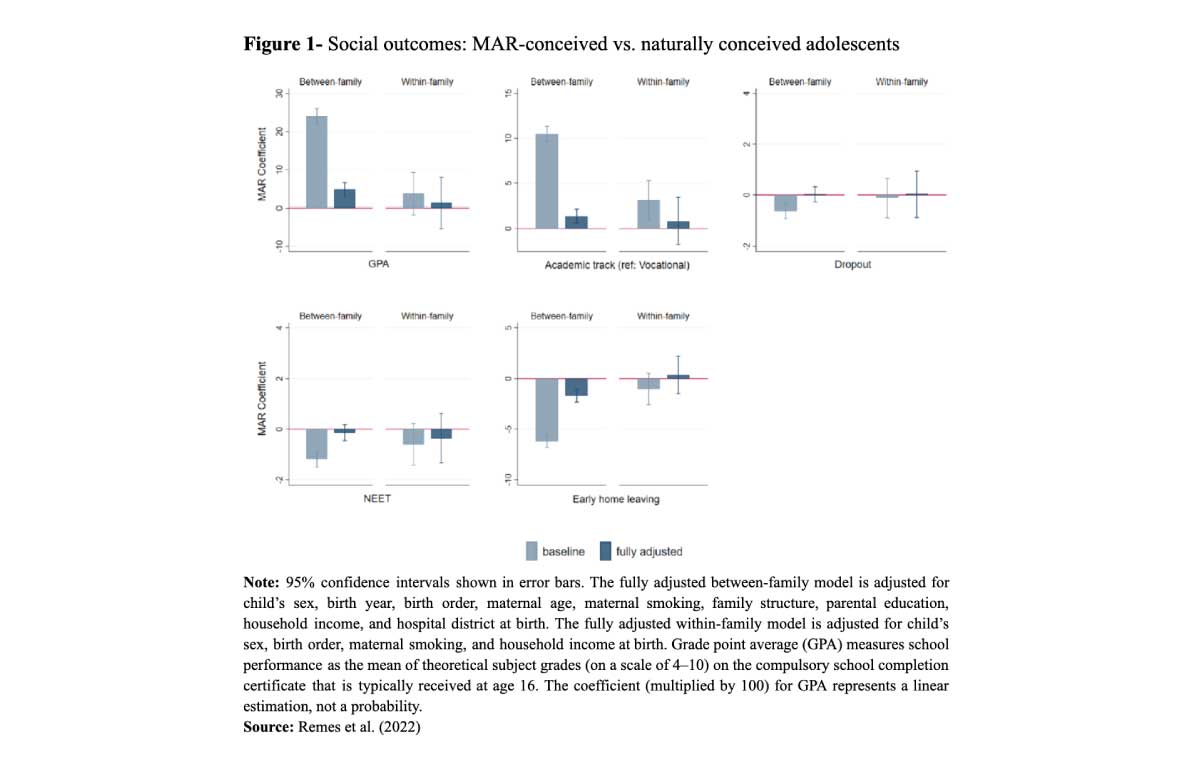
In the analyses that did not adjust for family characteristics, MAR-conceived adolescents had higher school grades and their likelihood of school dropout, not being in education or employment (NEET), and early home-leaving were lower than among naturally conceived adolescents. However, this advantage over naturally conceived children was largely explained when we adjusted for sociodemographic characteristics (Figure 1). This pattern was further supported by the analyses where we compared MAR-conceived adolescents to their naturally conceived siblings, which showed no differences in the social outcomes. These results suggest that MAR-conceived children had better social outcomes because they benefitted from their parents advantaged characteristics.

Mental health outcomes results


In the analyses that did not adjust for family characteristics, the results largely showed no differences between MAR and naturally conceived adolescents. However, when adjusted for child and parental characteristics, MAR-conceived adolescents were found to be more likely to have received care for any mental disorder and for internalizing disorders, in particular (Figure 2). This pattern of associations was also observed in the within-family analyses. Therefore, MAR-conceived adolescents advantaged social background compensates for the otherwise increased risk of poorer mental health outcomes. This increased risk might be related to parental anxiety and depression associated with the experience of subfertility, which could expose the children to a higher risk of mental health problems. Another possible pathway could be higher expectations and overprotectiveness amongst MAR parents that adversely affect their children’s socio-emotional outcomes. More research is needed to understand the possible mechanisms underlying the observed association.

Conclusions


The results paint a generally reassuring picture for adolescents born after MAR who, on average and before taking into account family characteristics, show better social outcomes and similar mental health outcomes to children conceived naturally. Moreover, they show the importance of integrating family characteristics whilst investigating MAR children’s outcomes. Indeed, the positively selected and advantaged characteristics of MAR parents help explain why MAR-conceived children outperform naturally conceived children on social outcomes, and are likely to compensate for their otherwise increased risk of mental health disorders. Finally, the comprehensive perspective on MAR children offered by this study highlights a potential trade-off and variation in the link between MAR and adolescent outcomes across different dimensions of well-being. Although relatively small, the observed mental health differences raise concerns and deserve further investigation.

References

  • Faddy Malcolm J., Gosden Matthew D., Gosden Roger G. 2018. “A Demographic Projection of the Contribution of Assisted Reproductive Technologies to World Population Growth.” Reproductive Biomedicine Online 36(4):455–58.
  • Goisis, A., Håberg, S., Hanevik, H., Magnus, M.C., Kravdal Ø. (2020). The demographics of assisted reproductive technology births in a Nordic country Human Reproduction 35(6): 1441–1450.
  • Remes, H., Palma, M., Peltonen, R., Martikainen, P. and Goisis, A. (2022) The well-being of adolescents conceived through medically assisted reproduction: a population-level and within-family analysis. European Journal of Population 38: 915–949.

Friday, July 7, 2023

The new Asian family

East Asian governments must try to manage a momentous social change they cannot prevent

насколько мы востчные? думаю: да, география мало что меняет

The concept of “Asian values”, once championed by leaders across the region, went out of vogue after the Asian financial crisis of 1997. The idea that East and South-East Asia’s disciplined governments had a unique economic edge over the decadent West suddenly seemed less compelling. Today in prosperous East Asia a different facet of those ballyhooed values is looking even more parlous. In China, Japan, South Korea and Taiwan, Asians’ supposed commitment to conservative family life is collapsing. As we report in our Asia and China sections this week, millions of young people are opting for looser, often lonelier and—in the East Asian context—less male-dominated arrangements. In a region that is home to over a fifth of humanity, the socioeconomic and demographic consequences will be vast, potentially destabilising and will shape millions of lives.

In Japan, where the shift first became evident, married couples with at least one child accounted for 42% of households in 1980, and single people 20%. That has flipped. In 2020 couples with children accounted for 25% of households, and singletons 38%. And the decline is continuing. Last year 17% of Japanese men and 15% of women aged 18-34 said they would not marry, up from 2% and 4% in the early 1980s, and China recorded its lowest-ever number of marriages, half as many as a decade ago.

In some ways young Chinese, Japanese, Taiwanese and South Koreans are following a path charted in rich countries elsewhere. Between 1960 and 2010 Europe’s marriage rate fell by half, for many of the reasons that are now driving down East Asian rates. To many people, marriage seems increasingly anachronistic and unaffordable. Across East Asia it is still widely understood in Confucian terms, as the union of a dominant man and submissive woman. In South Korea a married woman is referred to as Jip-saram, or “home person”, and her husband as Bakat-yangban, or “man outside”.

High property prices are an added disincentive to setting up a marital home. Alternative domestic arrangements are becoming more accepted; besides singledom, they include intergenerational flat-sharing and, less often, cohabiting and gay partnerships. And growing numbers of middle-class women are putting off marriage to concentrate on their careers.

Traditional values are hard on women at work, too. East Asia has some of the world’s best-educated women, yet its overall record on female empowerment is poor and in some ways worsening. On the World Economic Forum’s gender-equality ranking of 153 countries, China—where women are said to “hold up half the sky”—slipped from 63rd in 2006 to 102nd in 2022. South Korea has the widest gender pay gap in the oecd.

If most of this sounds familiar, two things make East Asia’s great social change distinct and hugely troublesome. First, the taboo against having children outside marriage remains as rigid as ever. Across the oecd, 40% of births are outside wedlock. In Japan, South Korea and Taiwan less than 5% are. (The figure in China is unavailable, revealingly, but not thought to be higher.)

The result is a plummeting fertility rate. South Korea’s, at 0.78, is the lowest recorded anywhere and Taiwan’s only slightly higher. Japan’s and China’s are just above half the replacement rate. China’s cruel one-child policy, now replaced by panicked officials with calls to have three, exacerbated its demographic squeeze. But as the regional picture shows, it would have happened anyway. The total population of the four East Asian countries is predicted to shrink by 28% between 2020 and 2075.

The second problem is that the region’s governments are making the situation worse. None seriously broaches the only policy guaranteed to revive East Asia’s flagging demography: mass immigration. Their main response is to try to resuscitate marriage with economic perks—including tax breaks and subsidised weddings—with little success. South Korea’s president, Yoon Suk-yeol, admits that his country has, in essence, squandered 280trn won ($215bn) on such policies. Worse, he and his counterparts in China and Japan are doubling down on the conservative approach that their citizens increasingly object to.

South Korea’s previous administration sought to extend benefits to single parents and unmarried couples. Mr Yoon, who blames the low fertility rate on feminism, has put a stop to that. Under Xi Jinping, China promises its citizens a Confucian revival and arrests gay-rights activists. Japan’s ever-ruling Liberal Democratic Party is also against reforming marriage, including by refusing to make it available to gay couples, although most voters want to see that change.

There are pockets of progress, notably in Taiwan, which recently took a more liberal course. It has legalised same-sex marriage and in May permitted gay couples to adopt children—though it is too soon to know whether these changes will show up in the statistics. But the region as a whole is stuck between modernity and tradition, suffering some of the worst effects of both. East Asians are free to disdain traditional family roles, but not to redefine them. That is why millions resort to childlessness and solitude.

Governments should try to complete this lopsided revolution. Even if social change is not entirely within their grasp, and does not happen overnight, they can at least stop resisting it. To make family life more attractive, they need to deal with its gender imbalances as well as its costs by, for example, making paternity leave routine. They should look beyond heterosexual marriage, as their citizens have, and extend legal recognition to cohabiting, gay and other non-traditional arrangements—and afford them the support married couples now enjoy, especially over child-rearing. It is self-defeating and outrageous that China prevents single women from freezing their eggs, or that Japan makes it nearly impossible for gay couples to foster children.

Let them not wed


Such policies would not fix the region’s demography. But they would have a more positive effect on it than the current ones. More important, they would leave millions freer to lead the lives they choose, especially women and gay people. East Asian governments have overseen the greatest-ever economic boom. Now they must attend to their citizens’ happiness and liberty. ■

For subscribers only: to see how we design each week’s cover, sign up to our weekly Cover Story newsletter.

This article appeared in the Leaders section of the print edition under the headline "The new Asian family"

Tuesday, April 25, 2023

Is Anti-Immigrant Sentiment Owned by the Political Right

European Studies, Postsocialism, Migration Studies,Politics of Knowledge, Anti-Immigrant Attitudes
https://doi.org/10.1177/00380385231161206
Publication Date: 2023 | Publication Name: Sociology

In political and social scientific discourses, the link between right-wing political orientation and anti-immigrant sentiment is often presented as a universal social fact. Based on a systematic examination of the association between left-right political orientation and attitudes towards migrants, the article demonstrates a clear inconsistency in the strength and direction of this presumed association in postsocialist European countries. We provide two analytical explanations for this inconsistency. The first challenges the western-centric idea that people leaning towards the political right tend to hold conservative views that shape their tendency to express antiimmigrant sentiment. The second explanation pertains to the limited relevance of the left-right political orientation scale for postsocialist subjects, making it difficult to attribute anti-immigrant sentiment to specific political orientations. In conclusion, we discuss specific social identities of the holders of hostile attitudes towards outsiders in postsocialist Central and Eastern Europe, which western-centric analytical models do not capture.

Monday, December 5, 2022

America is open

В представленной монографии собран, проанализирован и систематизирован уникальный концептуальный, статистический, эмпирический материал, дающий возможность научного познания сложных процессов адаптации населения к новой социальной реальности. Опираясь на данные российской и зарубежной статистики, результаты собственных исследований, авторы обосновывают необходимость научного объяснения последствий социально-экономических трансформаций современного российского общества, потребность корректировки проводимой социальной политики.

Народонаселение современной России: воспроизводство и развитие

Evgeny Morgunov
2015, Народонаселение современной России: воспроизводство и развитие / Под ред. проф. Локосова В.В. М.: Экон-Информ, 2015. - 411 с.

Monday, September 26, 2022

Shrinking smartly and sustainably

Join our upcoming workshop at The European Week of Regions and Cities.

When: Monday, 11 October 2022 4:30 PM to 6:00 PM CEST
Where: Online


Population Europe, hosted by the Max Planck Society, and OECD Centre for Entrepreneurship, SMEs, Regions and Cities are organising the session ‘Shrinking smartly and sustainably’ at the 20th European Week of Regions and Cities during 10-13 October 2022. We invite you to exchange smart and sustainable solutions to the increasing population losses.

The online-workshop brings together policy-makers and experts to discuss policies on adapting to shrinking populations in regions and countries experiencing sustained and strong population losses. Prominent experts will be asked for a short review of the current depopulation and ageing trends as well as the local and European perspectives to act upon the demographic challenges. In the second round, the OECD and Population Europe will propose a number of ‘imagined futures’ based on foresight analysis to stir debate and identify policy trade-offs and challenges for different types of regions. The participants following the session online will have the chance to comment and ask questions live via multiple platforms.

Register now


Speakers

    • Fabrice Dalongeville, Mayor, Municipality of Auger-Saint-Vincent, France
    • Anne Goujon, Population and Just Societies (POPJUS) Program Director, International Institute for Applied Systems Analysis (IIASA), Austria
    • Patrik Johansson, Deputy director at the Division for Regional and Rural Development, Ministry of Enterprise and Innovation, Sweden
    • Sebastian Klüsener, Research Director on Demographic Change and Ageing, The Federal Institute for Population Research (BiB), Germany
    • Pedro Ribeiro, Mayor, Municipality of Almeirim, Portugal
    • Lewis Dijkstra, Head of the Economic Analysis Sector of the Directorate-General for Regional and Urban Policy, European Commission

Saturday, September 10, 2022

population policy

Thursday, May 19, 2022

debilitation

AAT
из отсюда [ДЕМОГРАФИЧЕСКОЕ ВОЗРОЖДЕНИЕ ИЛИ DECEPTIO VISUS ? {если поп росту — обман зрения}]:

В оценке ситуации этого периода как массовой дебилизации населения мы сходимся с рядом авторов, прежде всего с Н. Эберстадтом, подразумевая под этим ослабление, истощение, регресс в развитии населения, который отбрасывает страну к уже, казалось бы, преодоленному прошлому.
 
Представляется, что термин debilitation как травматические, необратимые изменения точен, хотя и многообразен (атрофия, истощение, регресс, рецидив, неудача), поэтому переводится с трудом и отличается от термина дебилизации, имеющего узкий смысл с медицинским оттенком.

автор=Ткаченко Александр Александрович – доктор экономических наук, профессор, заместитель директора Института исследований международных экономических отношений Финансового университета при Правительстве РФ (125993, Россия, г. Москва, Ленинградский пр-кт, 49; AATkachenko@fa.ru)

Monday, February 21, 2022

Can policies halt the fertility decline?

February 14, 2022 Janna Bergsvik, Agnes Fauske and Rannveig Kaldager Hart

Family-friendly policies can raise fertility and explain at least part of fertility differences across countries, say Janna Bergsvik, Agnes Fauske, and Rannveig Kaldager Hart. Countries that have thus far provided only limited support for families can build on solid evidence if they choose to expand family policy programs.

Below-replacement fertility is a cause of concern in several advanced economies, but consensus has thus far been limited on the effectiveness of family-friendly policies. How effective are they, really? In a recently published article, we provide a systematic review of available evidence since 1970 in Europe, the US, Canada and Australia (Bergsvik, Fauske and Hart 2021). We conclude that family-friendly policies do contribute to high fertility, and their effects are not only temporary (as feared, e.g., by Gauthier 2007). However, these effects can be measured only when due allowance is made for policy changes that are large enough to affect fertility.

New evidence on the effects of parental leave


Our findings confirm that the effects of cash transfers are likely only transitory. However, we come to different conclusions for the effects of parental leave. While these were generally believed to be “weak,” “mixed,” or “not unequivocal”, we find them to be strong, as is public childcare provision. These two policies go a long way in alleviating the conflict between women’s roles as workers and mothers, and evidence of effects is abundant in contexts where this conflict was presumably quite high, such as Norway in the 1970s and Central Europe in the 2000s. When implemented together, these two policies allow parents to retain their jobs while they care for their newborn, and then go back to paid work when their child is ready to be cared for by others. As such, these policies may both increase fertility by reducing opportunity costs, and increase maternal labor supply. Very long compensated parental leave may, however, cement traditional gender roles, leading to lower earnings and weaker career development for women as compared to men (Datta Gupta et al. 2008).

Policies meeting the gender revolution


What about the effect of policies in pacing up the last step in the “gender revolution”, namely fathers’ involvement in the home (Goldscheider et al. 2015)? For paternity quotas, whereby a share of the parental leave is reserved for fathers, a negative effect on fertility emerged in Spain, while no effect was found in the Nordic countries. Unlike childcare and parental leave, effects of paternity quotas on mothers’ opportunity costs are indirect, and contingent on fathers responding by permanently increasing their efforts at home. Furthermore, men may be reluctant to father (many) children if their domestic responsibilities increase. Evidence is scarce, however, and in part weakened by the fact that small incremental changes in this area did not produce any measurable fertility variation. We note, in passing, that while evaluation designs in this field of research can only capture the effects of policy change, it seems logical to infer that family-friendly policies exert a fertility-enhancing effect not only at the time of their introduction, but also later on, if they are consistently implemented.

Women’s increased education and employment have contributed to raising the age at first childbirth in several countries. For European countries struggling with low fertility, offering assisted reproductive treatments with high success rates to women of all ages might be a policy option. As women in their late 30s account for an increasing share of births, the potential for assisted reproduction to sustain fertility is increasing. A positive side note is that these births will be to parents who, arguably, are strongly motivated to raise children.

Combining low inequality and high fertility


Family policies usually aim to balance several goals, and awareness of population heterogeneity in responses is important for understanding their total impact on society. It is striking that universal transfers seem to have the largest fertility effects among well-off families who need them the least. Unlike universal transfers, earnings-compensated parental leaves imply a relatively large redistribution toward higher-earning couples, and this group also sees the most positive effects on fertility.

In-kind services (child care and health services), in contrast, do not show the same social pattern of fertility effects. When policy makers consider where to allocate scarce resources, effects on other outcomes than fertility are relevant, too. High-quality health services and childcare early in life have long-term positive effects on health, educational attainment, and earnings, particularly for children from poorer families, and stand out as policies with potential to both reduce inequality and increase fertility.

References

  • Bergsvik J., Fauske A., Hart R.K. 2021. Can Policies Stall the Fertility Fall? A Systematic Review of the (Quasi-) Experimental Literature, Population and Development Review, online first (https://doi.org/10.1111/padr.12431)
  • Datta Gupta N., Smith N., Verner M. 2008. “The Impact of Nordic Countries’ Family Friendly Policies on Employment,Wages and Children.” Review of Economics of the Household 6(1): 65–89.
  • Gauthier A.H. 2007. “The impact of family policies on fertility in industrialized countries: a review of the literature.” Population Research and Policy Review 26 (3): 323-346.
  • Goldscheider F., Bernhardt E., Lappegård T. 2015. “The Gender Revolution: A Framework for Understanding Changing Family and Demographic Behavior.” Population and Development Review 41(2): 207-239.

Tuesday, September 21, 2021

Order

нацпроекты по боку? 
или куда?


ПРАВИТЕЛЬСТВО РОССИЙСКОЙ ФЕДЕРАЦИИ

Р А С П О Р Я Ж Е Н И Е


от 16 сентября 2021 г. № 2                 МОСКВА


1. Утвердить прилагаемый план мероприятий по реализации в 2021 - 2025 годах Концепции демографической политики Российской Федерации на период до 2025 года, утвержденной Указом Президента Российской Федерации от 9 октября 2007 г. № 1351 "Об утверждении Концепции демографической политики Российской Федерации на период до 2025 года" (далее - план мероприятий).
2. Федеральным органам исполнительной власти, органам управления государственными внебюджетными фондами и органам исполнительной власти субъектов Российской Федерации осуществлять финансовое обеспечение плана мероприятий в пределах бюджетных ассигнований, предусмотренных им в соответствующих бюджетах бюджетной системы Российской Федерации на соответствующий финансовый год.
3. Федеральным органам исполнительной власти, ответственным за реализацию плана мероприятий, ежегодно, до 1 марта года, следующего за отчетным, представлять в Минтруд России информацию о ходе реализации плана мероприятий.
4. Минтруду России ежегодно, до 1 апреля года, следующего за отчетным, представлять в Правительство Российской Федерации доклад о ходе реализации плана мероприятий на основе информации, полученной от федеральных органов исполнительной власти, ответственных за реализацию плана мероприятий.
5. Рекомендовать органам исполнительной власти субъектов Российской Федерации при осуществлении своей деятельности обеспечить реализацию плана мероприятий.

Председатель Правительства Российской Федерации
М. Мишустин

Han Chinese population shares in Tibet:

Early insights from the 2020 census of China

September 20, 2021 Andrew M. Fischer
ASIA, CHINA, MOBILITY, POPULATION, TIBET


The early results of the 2020 Census of the People’s Republic of China shed light on the highly politicised issue of Han Chinese population shares in the Tibetan areas of western China. Andrew M. Fischer highlights two contrasting patterns. Han shares increased in the Tibet Autonomous Region (TAR) but from a small base, reaching 12 percent in 2020. However, they fell in the other Tibetan areas.


As snippets of the 2020 Census of China are slowly being released, we can already gain valuable insights into the population dynamics of the minority regions in Western China. It is worth highlighting these insights now, given that the release of the detailed census will probably take much more time (the 2010 census was not released for over two years), and because Chinese migration to Tibetan areas has resurfaced as an object of international concern and scrutiny.

The officially recognised and indigenous Tibetan areas in China cover a region about the size of Western Europe. About half of these areas and half the Tibetan population are in the Tibet Autonomous Region (TAR), which is entirely composed of Tibetan areas and often referred to simply as ‘Tibet’. The other half of the population lives in Tibetan ‘autonomous areas’ spanning four other western provinces: Gansu, Qinghai, Sichuan and Yunnan.

The initial census data on all these areas were compiled from provincial and prefecture level statistical communiqués, some of which are online, and others only reported in local newspapers (such as with the Qinghai communiqués).1

The level of detail varies across the communiqués. Many – especially at prefectural level – do not divulge ethnic decompositions. Those that do only present a binary of Han and minority, not differentiating between various minority groups (such as Tibetans and Hui Muslims), except for the TAR communiqué, which specifies Tibetans. Nonetheless, parsing through the data can reveal several important trends that confirm previous demographic studies (e.g., Fischer 2008, 2014; Childs 2008; Ma 2011).

Regional distinctions


Interestingly, trends are opposite across the two halves of Tibet, particularly between the TAR and Qinghai, the province with the next highest Tibetan population share and the second most subsidised province in China after the TAR. Moreover, the difference has intensified since the 2000s (Figure 1). The Han Chinese population share has increased sharply in the TAR, encouraged by massive subsidies from the central government that exceeded 100 percent of the TAR GDP from 2010 onwards (Fischer 2015). The increase has also accelerated with respect to the 2000s, but from a small base, and the Han remain a small minority.
Outside of the TAR, Han Chinese shares have fallen (or remained stable in Yunnan). The fall is sharpest in Qinghai, where it is also faster than in the 2000s. If these trends continue, minorities in Qinghai will become the majority within a few years.

Table 1 shows the differences in population dynamics that underlie these trends. The TAR population grew by almost two percent a year during the 2010s, through a combination of relatively high natural growth rates (NGR) and net in-migration.
In contrast, in the provinces with Tibetan areas outside of the TAR, populations either stagnated or declined due to net out-migration (difference between total and natural rates of change). The stagnation or decline was mostly attributed to Han Chinese, due to strong out-migration combined with low NGRs. Conversely, NGRs among minorities were higher than the average provincial rates in all areas besides Yunnan, thereby compensating for the Han.

Peripheral structural tendencies


These data reflect a general tendency facing relatively poor peripheral areas, that of net population outmigration to more central locations. This is all the more problematic in the heavily subsidised context of the TAR. Moreover, such emigration is more prominent among non-indigenous Han Chinese, who are more urban, educated, and mobile in these western regions, and more culturally connected to other parts of China, whereas local Tibetans (and other minorities) are less mobile and have higher NGRs (Iredale et al 2003; Fischer 2008, 2014; and Ma 2011).

This tendency is best exemplified by Gansu, currently the poorest province in China (see a note below), where the population declined over the decade despite a positive NGR. Similarly, even though Qinghai and Yunnan grew, their annualised growth rates were also significantly lower than their NGRs. Only Sichuan managed to register slightly higher annual total growth rates than natural growth rates.

Obviously, these provincial aggregates do not capture the dynamics in sub-provincial Tibetan areas outside the TAR. However, there are strong indirect indications that general tendencies are similar, or even more pronounced in these areas. Examples are given in Table 2, focusing on several of the larger Tibetan autonomous prefectures outside of the TAR.
The strongest population growth was in the two remotest prefectures in Qinghai, namely Guoluo and Yushu, both of which are almost entirely Tibetan and do not border any non-Tibetan areas. Using the proportion of the population aged 0-14 years old as a rough proxy for NGR data (which are not available for these prefectures), it is clear that their growth rates have been driven by relatively high NGRs among local Tibetans, whose age structure is the youngest in China. The less remote prefectures that border Han areas, and that have lower minority shares and older population structures – Gannan, Aba and Ganzi – exhibit low or negative population growth, closer to their respective provincial trends.

The TAR exception and development implications


The TAR is the exception to the rule. Yet even despite doubling over two decades, its low Han share in 2020 will still probably be greeted with incredulity by those who claim the government has been swamping the local population with Han in-migrants. This may partly owe to the fact that journalists and other observers mostly visit these areas in the summer, when the Han Chinese population swells from tourism, which may bias the picture of who the local residents really are.

Moreover, we know from previous censuses that the Han are disproportionately concentrated in the urbanised core of Lhasa and to a lesser extent in other major towns, and that very few reside in rural areas (Fischer 2008; Ma and Lhundup 2008; Yeh and Henderson 2008; Ma 2011). And that is precisely why their presence is so sensitive – not because of their population share, but because they dominate economic opportunities in these urban centres, where they are also most visible. They also have strong competitive advantages over locals, given the Chinese linguistic biases in the state-dominated urban economies.

Hence, the key issue around Han in-migration to these Tibetan areas is the strong competitive pressures that it brings at a key moment of socio-economic transition for locals. These pressures may arguably persist even when Chinese population shares are declining if urban employment opportunities do not keep up with the needs of the rapidly urbanising local population. These subtleties need to be assessed to have a better understanding of the grievances that in-migration might exacerbate in such contexts.

References

  • Childs, Geoff (2008). Tibetan Transitions: Historical and Contemporary Perspectives on Fertility, Family Planning and Demographic Change. Leiden: Brill.
  • Fischer, A. M. (2008). ‘“Population Invasion” versus Urban Exclusion in the Tibetan Areas of Western China.’ Population and Development Review 34 (4): 631-662.
  • Fischer, A. M. (2014). The Disempowered Development of Tibet in China: a study in the economics of marginalisation. Lanham, MD: Lexington, pp. 83-126.
  • Fischer, A. M. (2015). ‘Subsidising Tibet: an interprovincial comparison of western China up to the end of the Hu-Wen administration.’ China Quarterly 221 (March 2015): 73-99.
  • Fischer, A. M. (2021). ‘Chinese Population Shares in Tibet Revisited: Early insights from the 2020 census of China and some cautionary notes on current population politics.’ ISS Working Paper No. 684, July 2021.
  • Iredale, Robyn, Naran Bilik, and Fei Guo (2003). China’s Minorities on the Move: Selected Case Studies. Armonk, NY: M. E. Sharpe.
  • Ma, Rong (2011). Population and Society in Contemporary Tibet. Hong Kong: Hong Kong University Press.
  • Ma, Rong, and Tanzen Lhundup (2008). ‘Temporary Migrants in Lhasa in 2005.’ Journal of the International Association of Tibet Studies 4: 1-42.
  • Yeh, Emily T., and Mark Henderson. 2008. ‘Interpreting Tibet’s Urbanization: Administrative Scales and Discourses of Modernization.’ Journal of the International Association of Tibetan Studies4: 1-44.
notes below (unclear since both are 2)
See Fischer (2021) for a detailed list. These communiqués were collected and sent to me by a local researcher, who prefers to remain anonymous.

In 2018 Gansu had a per capita GDP of 31,336 yuan, less than half the national average of 64,644 yuan (4,490 USD and 9,260 USD, respectively, converted at the average nominal exchange rate for 2018 of 6.98 yuan/USD).

Thursday, September 24, 2020

territorial segregation in Poland

Зоны без ЛГБТ. 

Зачем их создают города в Польше и что там происходит


Люси Эш Би-би-си

АВТОР ФОТО, GETTY IMAGES

Десятки небольших городов Польши некоторое время назад объявили себя зоной, "свободной от идеологии ЛГБТ". Враждебность политиков по отношению к вопросу о правах геев достигла высшей точки накала, настроениям более либеральной части польского общества противопоставляются традиционные религиозные ценности. Проживающие в этих краях геи вынуждены выбирать - эмигрировать, не высовываться … или бороться с притеснением.

Редактор журнала Томаш Сакиевич пригласил меня в свой офис в Варшаве. К моему удивлению, он берет мою руку, которую я, как и положено, только что протерла санитайзером, и целует ее как польский кавалер XVIII века.

Затем он протягивает мне стикер, который бесплатно прилагается к каждому номеру его еженедельника - правой Gazeta Polska. На стикере радужный флаг перечеркнут черным крестом. "Мы раздали уже 70 тысяч таких, - говорит Сакиевич. - И люди поздравили нас, потомы что мы, поляки, любим свободу".

АВТОР ФОТО, GETTY IMAGES

Около 100 городов и регионов по всей Польше - почти треть страны - приняли резолюции, объявляющие их свободными от ЛГБТ. Эти резолюции, скорее, символичны и не имеют законной силы, но они стали новым оружием во все более ожесточенной войне культур Польши.

Сакиевич говорит мне, что люди должны быть вольны сами выбирать, с кем им заниматься сексом, и с гордостью подчеркивает, что во многом Польша - прогрессивная страна. Здесь гомосексуальность перестала считаться уголовным преступлением еще в 1932 году, на десятилетия раньше, чем это произошло в большинстве европейских стран.

Но он против того, что он сам называет "агрессивной идеологией, пропагандирующей гомосексуальность". Он также считает, что борьба за права геев - это концепция, импортированная из США и Западной Европы и представляющая угрозу традиционным гетеросексуальным польским семьям.

Сегодня Сакиевичу за 50, он вырос в Польше, которая находилась под контролем Советского Союза. Власти решали за людей, что им думать, препятствовали влиянию Церкви и были нетерпимы к диссидентам. Как ни странно, но именно в этом же самом Сакиевич теперь обвиняет кампанию ЛГБТ.

Томаш Сакиевич

"Коммунисты размахивали красными флагами и говорили людям, что они борются за бедных, за рабочих, за крестьян, - говорит он. - Сегодня активисты держат радужные флаги и говорят, что сражаются за права сексуальных меньшинств. Ни тогда, ни сейчас это не было и не является правдой. И мы, как свидетели советских времен, просто обязаны предостеречь других о том, насколько могут быть опасны подобные идеи".

Таких же ультраправых взглядов придерживаются высокопоставленные политики и представители очень влиятельной католической церкви Польши. В одной из предвыборных речей в рамках кампании переизбрания на пост президента Анджей Дуда назвал продвижение прав ЛГБТ-сообщества идеологией "более разрушительной, чем коммунизм". Архиепископ Кракова недавно предостерег от распространяющейся "нео-марксистской радужной чумы".

В условиях санкционированной государством гомофобии и в основном враждебно настроенной прессы есть опасность, что польские геи будут снова вынуждены затаиться, особенно в маленьких городах.

Свидник, расположенный в паре часов езды к юго-востоку от Варшавы, стал первым городом, принявшим резолюцию против ЛГБТ-идеологии.

Барт Сташевски в Свиднике

Я приехала в Свидник субботним утром, шестеро ЛГБТ-активистов раздавали на центральной площади листовки, наклейки с надписью "любовь есть любовь" и пончики, присыпанные разноцветным драже. Один из представителей сообщества Барт Сташевски организовал необычный, по его словам, тур по востоку Польши, призванный показать людям, что геи - обычные граждане.

"Мы радужные разрушители легенд. Мы не агрессивны. Мы никого не провоцируем ни нашими шариками, ни нашими флагами, ни пончиками", - добавляет он.

Но на другой стороне улицы группа из примерно 30 молодых людей громко кричит. "Свидник - без радужной пропаганды", - выкрикивают они, пытаясь перекричать музыку, несущуюся из колонок гей-активистов.

Один из них, с бритой головой, говорит мне, что ему не нравится посыл ЛГБТ-группы. "Они не хотят вписываться в наше общество. И мы не хотим их в этом городе", - говорит он.

"Они ослабляют нацию, - говорит другой. - И это и есть цель врагов Польши. Война - это больше не танки и не ракеты. Страны разрушают, создавая хаос. Именно это и пытаются сделать эти геи".

Две группы разделяет длинная шеренга полицейских в касках и пуленепробиваемых жилетах. Им жарко на горячем солнце.

"Честно говоря, я рад, что полиция здесь, - говорит Сташевски. - Мы чувствуем себя в большей безопасности". По его словам, многие геи, лесбиянки, бисексуалы и трансгендеры в последнее время эмигрировали, чтобы избежать преследования.

Город Тухув, основанный в Средние века, с населением 6500 человек тоже объявил себя зоной, свободной от ЛГБТ. В городском парке я встречаю подростка-гомосексуала. Филип (имя изменено) переехал сюда из более крупного и либерального города. Его родители без проблем приняли его сексуальную ориентацию.

В Тухуве Филипу тоже ни разу не приходилось бояться за свою безопасность, но это не значит, что в этой части Польши (100 км от Кракова) легко быть геем.

"Однажды мы с моим другом держались за руки, и некоторые люди выкрикивали в наш адрес всякие оскорбления", - рассказывает он. По его словам, чтобы жить спокойно, геи в Тухуве должны быть невидимыми. Ему самому до сих пор удавалось избегать плохих ситуаций только потому, что он домосед и проводит большую часть своего времени, играя в видеоигры за компьютером.

На воскресной мессе в великолепной церкви Благословенной Девы Марии в стиле барокко, возведенной на холме, откуда открывается вид на город, я встретила Гражину Карас. Она - оплот местной общины, занимается сбором денег на различные благотворительные проекты, открыла "горячую линию" для местной молодежи.

Позднее, за чашкой кофе, она рассказывает мне, что полностью поддерживает резолюцию города о "зоне без ЛГБТ". Ее также беспокоят рекомендации ВОЗ в отношении сексуального образования, которые она считает пагубными.

Разного рода пристрастия безудержно распространились в Тухуве, говорит Гражина, но ее в основном беспокоит не алкоголь или наркотики, а интернет и мастурбация.
Казимеж и Гражина Карас


"Наши молодые люди в ужасе от того, что это делают, и хотят остановиться. Но не могут, они не знают, что делать. Я отправляю их к сексологу в церковную клинику", - говорит она.

В этом месте в разговор вмешивается ее муж Казимеж и говорит, что гомосексуальность - это болезнь, которая поддается лечению.

"Но для этого нужно желание, - говорит он. - Это не приговор и не означает, что нужно оставаться гомосексуалом до конца жизни. Что-то с этим сделать можно". Он рекомендует американскую книгу под названием "Каминг-аут гетеросексуала".

Уровень рождаемости в Польше сейчас находится на самой низкой отметке со времен Второй мировой войны, и госпожу Карас очень беспокоит вопрос демографии. "Гомосексуальные сообщества не могут гарантировать укрепление нашего отечества", - говорит она мне.

В ходе кампании переизбрания в июне этого года президент Дуда подписал "Семейную Хартию", в которой пообещал препятствовать заключению браков между гомосексуальными парами и усыновлению ими детей, а также запретить обсуждение темы ЛГБТ в школах.

Гжегож Немьец, местный алтарник, ставший депутатом городского совета и проголосовавший за резолюцию против ЛГБТ-идеолгии, говорит, что его беспокоит вопрос сексуального образования, он хочет, чтобы дети росли в "нормальных семьях". По его словам, никто в горсовете Тухува не выступил против резолюции, хотя трое воздержались от голосования.

Но в августе комиссар Европейского Союза по вопросам равноправия возмутился, заявив, что это противоречит ценностям ЕС и основным правам человека. За этим последовало редкое наказание: Тухув и еще пять городов были лишены финансирования в рамках программ европейских городов-побратимов.

Гжегож Немьец

Немьец говорит мне, что был очень удивлен таким решением, но рад, что министр юстиции Польши компенсировал Тухуву потери, выписав городской казне чек на сумму, в три раза превышающую сумму, невыплаченную ЕС.

"Евросоюзу придется прислушаться к нашему правительству, - говорит он. - Польша встает с колен, и мы больше не будем жить по указке немцев или французов".

Но на прошлой неделе Урсула фон дер Ляйен, глава Еврокомисии, сделала бескомпромиссное заявление.

"Быть собой - это не идеология. Это идентичность человека", - сказала она, выступая перед аплодирующим парламентом в Брюсселе.

"Я хочу сказать предельно ясно: зоны, свободные от ЛГБТ - это зоны, свободные от человечности. И им нет места в нашем союзе".


Магдалена Маршавек [исключит Польшу из ЕС?]

В муниципалитете Тухува мэр города Магдалена Маршавек говорит мне, что ее пост не позволил ей голосовать ни за, ни против резолюции, но, по ее словам, она не против геев и была в ужасе, когда начала получать послания ненависти со всего мира.

Тогда она опубликовала в "Фейсбуке" длинный пост, в котором пожаловалась, что Тухув стал пешкой в чужой игре.

"Я хочу, чтобы люди поняли, что все это делается не ради нас, нашей жизни, наших обрядов. Это политические партии, Евросоюз и организации ЛГБТ используют Тухув для продвижения своих интересов", - говорит она.

Некоторые польские политики выступили в защиту прав геев. На церемонию инаугурации президента Дуды десять женщин-парламентариев надели яркую одежду и маски с радужным принтом. У некоторых в руках были копии конституции, этим они хотели продемонстрировать, что, по их мнению, президент нарушил основной закон страны.

Но активисты ЛГБТ считают, что либеральные политики их подвели, так как не предприняли никаких конкретных действий. Они говорят, что мирные кампании против гомофобии уже ни к чему ни приведут. По мнению активистки небинарных меньшинств Малгожаты Шутович, известной как Маргот, время раздачи стикеров и пончиков прошло.

Маргот

При рождении Маргот звали Михал. Она является основательницей радикального феминистского квир-сообщества под названием Stop Bzdurom ("Прекратите нонсенс"). В июне этого года несколько его участиц вступили в конфликт с водителем грузовика, принадлежавшего консервативной благотворительной организации Fundacja Pro, известной своей кампанией против абортов.

Грузовики этой организации с прикрепленными громкоговорителями ездят по городам Польши с сообщениями, в которых ставится знак равенства между гомосексуальностью, сексуальным образованием и педофилией. "Мы не хотим, чтобы наши дети сомневались в своей идентичности", - говорит представитель организации Анна Щербата.

"Мы хотим, чтобы они росли счастливыми и здоровыми, и чтобы никто над ними не надругался", - добавляет она.

"По сути, идея, которую они распространяют через свои громкоговорители, заключается в том, что геи насилуют детей", - говорит Маргот, которая только недавно вышла из тюрьмы.

После вмешательства международной общественности ее отпустили под залог, но ей все еще грозит 7 лет тюрьмы, если ее признают виновной в избиении людей и нанесении материального ущерба. Маргот настаивает, что лишь пыталась помешать водителю грузовика, который снимал ее с соратницами на телефон. "Мне очень хотелось его избить, но он был в три или четыре раза крупнее меня", - смеется она.

"Я хочу показать моей общине, что мы больше не должны жить в страхе. Мы долгие годы просили хотя бы минимальной законной защиты, если не от дискриминации, то хотя бы от физического насилия", - добавляет Маргот.

Когда я спрашиваю, можно ли считать, что она выступает за применение физической силы, настроение Маргот резко меняется, и она отвечает мне набором ругательств.

"Люди, которые не испытали на себе жизнь ЛГБТ-сообщества в этой стране, не должны нас судить, - говорит она зло. - И не надо удивляться, если нас в конце концов вынудят взять ситуацию в свои руки".


Но и ультраконсерваторы тоже рвутся в бой. Крайне правая организация "Вся польская молодежь" поклялась "забить радужных подонков", они в ярости от того, что радужные флаги появляются на статуях Иисуса Христа и Девы Марии.

"Я только что прочитал в "Твиттере" пост одного из гей-активистов о том, что время мирной борьбы подошло к концу, - говорит Матеуш Маржох, протестующий у здания университета в Варшаве. - Ну что ж, тогда пусть знают, что если они решили прейти к действиям, наша сторона не побежит прятаться. Мы встретим их лицом к лицу. И это будет болезненно".

Wednesday, September 16, 2020

fb personal

Сегодня ответил на пост и написал, что пиндосы прагматичны и на обещания не клюют — в результате был забанен за hate speech, что меня не устраивает. Пожаловался, было можно, за секс и пожаловаться было некуда. 
We confirmed your comment didn't follow the Community Standards
Today at 12:03 PM
We reviewed your comment again and it doesn't follow our Community Standards.

Интересно, что будет если писать: бульбаши, кацапы и хохлы?
Попробую через недельку.

Saturday, January 18, 2020

Fertility in mainland China

"Бомба замедленного действия". Рождаемость в Китае упала до минимума за 70 лет


Эксперты называют снижение рождаемости бомбой замедленного действия для демографии страны


Рождаемость в Китае упала до самой низкой отметки со времен образования Китайской народной республики 70 лет назад, несмотря на отмену правила "одна семья - один ребенок".

В 2019 году в стране родилось 14,65 миллиона детей, что на 580 тысяч меньше, чем в предыдущем. Согласно Национальному агентству статистики, это самый низкий показатель с 1949 года.

Рождаемость в Китае постепенно падает уже много лет, что представляет серьезную проблему для второй по величине экономики мира.

При этом продолжительность жизни в Китае несколько возросла, поэтому численность населения в 2019 году составила 1,4 миллиарда человек вместо 1,39 млрд в предыдущем году.

Эксперты называют ситуацию бомбой замедленного действия для демографии страны, когда работающему меньшинству придется содержать неработающее большинство.

По рождаемости Китай, где в 2019 году родилось 10,48 детей на тысячу человек, уступает США (12 детей на тысячу человек - данные 2017 года), но опережает Японию (8 на 1000).

По данным Всемирного банка, средний показатель рождаемости по всему миру в 2017 году составил 18,65 детей на 1000 человек.

Гендерный дисбаланс


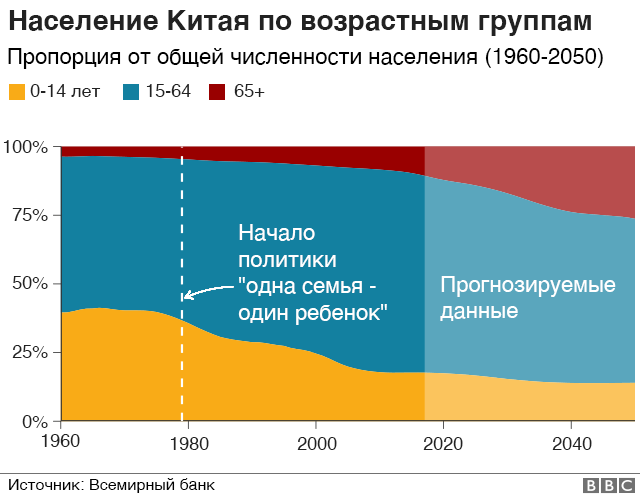
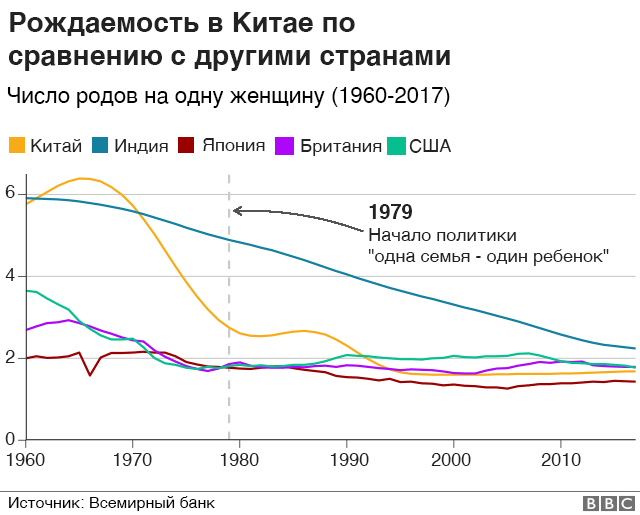
В 1979 году, чтобы затормозить рост населения, власти Китая ввели политику "одна семья - один ребенок". Нарушение этого закона влекло за собой большие штрафы, увольнение с работы, а иногда и принудительные аборты.

Исключения делались для жителей сельской местности, если их первенцем стала девочка, для представителей этнических меньшинств, а с 2013 года - также для пар, где хотя бы один родитель - единственный ребенок в своей семье.

По мнению специалистов, именно эта политика привела к огромному гендерному дисбалансу в стране. Согласно данным за 2019 год, мужское население Китая превышает женское более чем на 30 миллионов человек.

Конец "политики одного ребенка" был положен в 2015 году, когда власти разрешили семьям иметь по двое детей.

Однако эта реформа не смогла остановить сокращение рождаемости, поскольку, говорят эксперты, не была поддержана такими сопутствующими мерами, как выплаты на уход за ребенком и продление декретного отпуска.

Многие семьи просто не могут себе позволить больше одного ребенка.

Friday, December 13, 2019

Reale Bevölkerungspolitik

Ольга Глацких. Кадр из видео 

Заявившую о ненужности молодежи свердловскую чиновницу вернули на работу


В отношении Глацких окончена проверка и с 10 декабря она вернулась на дсвою прежнюю должность.

Олимпийская чемпионка, глава департамента молодежной политики правительства Свердловской области Ольга Глацких, в начале ноября оскандалившаяся фразой о ненужности молодежи и отсутствии обязательств государства перед гражданами, вернулась на свое рабочее место. Об этом сообщает ИА Regnum, сославшись на сканированный документ за подписью губернатора Свердловской области Евгения Куйвашева.

В распоряжении №251-РГ говорится о том, что в отношении Глацких окончена проверка, и с 10 декабря она вернулась на должность руководителя областного департамента молодежной политики. Журналисты уточнили, что официальный комментарий от чиновников пока не поступил.

Отвечая в Кировграде на вопрос о финансировании молодежных проектов, Ольга Глацких сообщила о том, что молодежи «государство в принципе ничего не должно», поскольку «вам должны ваши родители, потому что они вас родили» и «государство их не просило вас рожать». Куйвашев пообещал разобраться с ситуацией, подчеркнув, что не согласен с точкой зрения своей подчиненной. Вскоре чиновницу отстранили от должности на время служебной проверки. Позже региональные СМИ со ссылкой на источник в аппарате главы региона писали о том, что чиновница отделается выговором. Увольняться по собственному желанию Глацких отказалась, заявив, что сделать это ей «совесть не позволяет». Затем появилась информация о том, что для исключения Глацких из кабинета министров её департамент губернатор решил присоединить к министерству образования региона.

Monday, June 10, 2019

Demographic Changes and Macroeconomic Challenges

Haruhiko Kuroda
Keynote Speech at the G20 Symposium in Tokyo

日本語
Haruhiko Kuroda
Governor of the Bank of Japan
January 17, 2019

Introduction


I would like to express my sincere gratitude to G20 finance and central bank deputies and distinguished academics from around the world for attending this G20 Symposium organized by the Bank of Japan and the Ministry of Finance of Japan. This year, Japan assumes the G20 presidency for the first time. It is my great pleasure to co-host this symposium as one of the kick-off events of Japan's G20 presidency.

When considering the relationship between demographic changes and economic developments, the work of Malthus naturally comes to mind. In the late 18th century, Malthus argued that the means of substance, particularly agricultural production, would limit population growth. Later, for some time, the population issue remained a minor topic in economics. However, as economic growth theory regained its central role in economics, the relationship between population and economic developments attracted increased attention once again. Furthermore, policy makers and the business community have increasingly been interested in the impact of demographic changes on the economy, as advanced and some emerging economies have experienced, or are expected to experience, declining and aging populations.

In Japan, the working age population peaked in 1995 and the total population in 2008, and both have been declining since then. The share of the elderly population in the total population was 10 percent in 1985, but this increased to 28 percent in 2017. Among the G20 members, Japan is the most affected by the population issue. While some emerging economies in the G20 are now seeing an increase in their young-age labor force, these countries will also face the aging problem sooner or later. I believe it is important for G20 members to learn from each other's demographic conditions, institutional settings, and policy responses. Such mutual learning would be beneficial for member countries when conducting policy management in the future. This is one of the reasons why we chose aging as one of the G20 agenda items this year.

As is obvious from the discussions this morning -- and this will no doubt be confirmed this afternoon -- there are a number of issues to be considered when tackling the demographic problem. I assume that staff members in charge of this symposium have had much difficulty in framing the discussion with a focus on critical issues since there are so many different angles from which they can even begin approaching this problem. As I cannot touch upon all the issues in a limited time, I would like to concentrate on three basic questions here.

I. Impact on the Macroeconomy


The first question is: "Does an aging and declining population hinder economic growth?" Many people might intuitively answer "yes." However, given the impact technological innovation can have, for example, the answer could be "yes" or "no." As policy makers, we are obliged to pursue appropriate policy measures so that the answer can become "no."

Needless to say, an aging and declining population leads to a decrease in the labor force population and puts downward pressure on economic growth from the supply side. In addition, a simple back-of-the-envelope calculation suggests that per capita growth would be lower. This is because the reduced production of a declining labor force is shared with an increasing proportion of retired elderly people. If pessimism about future economic growth prevails, not only future but also present demand could be stifled as people are discouraged from current investment and consumption.

An aging and declining population, however, does not necessarily push down macroeconomic and per capita growth rates. Based on growth accounting, the economic growth of a country is affected not only by demographic changes but also by capital accumulation and changes in total factor productivity. Even though demographic changes have a negative impact on economic growth, economic growth could be stimulated by promoting capital accumulation and innovation. In fact, we have seen recently in Japan how active investment in equipment and software has been substituting for human labor amid a declining labor force. There have been major innovations in areas such as AI and IoT, and in drug developments to tackle serious diseases. In order to promote such innovations, it is important to provide the best possible education for young people, and for middle-aged and elderly people to have access to recurrent educational opportunities. This will lead to increased labor productivity across all generations and to improvements in macroeconomic growth and per capita living standards.

Changes in demography could encourage changes in a country's industrial structure. As aging proceeds, demand for labor-intensive services such as health care will increase. In Japan, the labor share of medical and care services in 2002 was about 7 percent, but it increased to about 12 percent in 2017. As a population ages and declines, the labor force also declines and labor market conditions in the medical and care service industries become very tight. Appropriate policy measures must be implemented to promote smooth labor movement between industries and to encourage innovation so that more people can receive proper medical and care services.

Since demographic changes have an impact on a country's saving and investment patterns, they will also affect international capital flows and current account developments. Savings will generally decline as the working-age population declines and the elderly population increases. This is because the working-age population is likely to accumulate savings from a life-cycle perspective, while the elderly population is likely to dissave accumulated assets. However, the longevity of elderly people has also increased, due to advances in medical technology. Therefore, we must not simply assume that all elderly people dissave their assets. If the elderly assume that their life expectancy will be much longer than before, they could hesitate to dissave and choose to continue working in order to save more in the early stages of their elderly lives. Saving patterns may differ from country to country due to differences in social security systems. Regarding investment patterns, a country with an increasing working-age population tends to have abundant investment opportunities with higher growth potentials. However, there could be differences in investment developments among aging countries due to advances in innovation.

II. Impact on Fiscal Conditions and Social Security Systems


The second question introduces a practical but most pressing agenda: "How do we maintain a social security system with an aging population and fewer children?"

Many countries maintain pay-as-you-go pension systems. Regarding medical and care services, most countries have public insurance systems, except for the United States, where private insurance is dominant. As aging proceeds, expenditure on medical and care services and pension payments increase, while tax revenues and social security premiums decline. This raises concerns about fiscal balances. When many countries around the world established their medical, elderly care, and pension systems after World War II, it was assumed that the demographic structure of these countries was pyramid-shaped, that is, a small elderly population was supported by a much greater working-age population. However, as social security systems are commonly constructed on a pay-as-you-go basis, a decline in fertility rates and increased longevity has altered the demographic structure and put pressure on fiscal balances. Public debt continues to rise in many countries due to increased medical, elderly care, and pension expenditures. This continuous increase in public debt prompts people to defensively save more money in anticipation of increased burdens as well as decreased public payments in the future.

Pension payments, as well as medical and care expenditures for the elderly, are supported by payments made by the working-age population. Demographic structures are now totally different from when the social security systems were initially established. Since World War II, the fertility rate has declined, and the longevity of the elderly has increased due to medical developments. These significant changes to demographic structures must be taken into account as we continuously assess the most appropriate public social security systems.

In addition, it is worth considering a division of labor between the public and private sectors for medical treatment, elderly care, and pension systems. Several decades ago, capital and financial markets and asset management businesses were still in the process of development. Households had limited opportunities to manage their portfolios at their own discretion when planning for their retirement. However, we now have various investment assets available and households can manage their portfolios in accordance with their risk profiles and needs. Now we need to consider what combination would be the most appropriate between public and private pensions, and what mix would be the most desirable between pay-as-you-go and funded pensions, and between defined benefit and defined contribution systems.

III. Impact on Monetary Policy and the Financial System


The third question is: "Does aging make our job more difficult?" That is, how does an aging population affect monetary policy and the financial system?

As was mentioned in the discussion of the impact on the macroeconomy, the natural rate, which is consistent with potential growth rates, will decline if long-term growth rates decline together with a declining and aging population. There will be downward pressure on real interest rates as the natural rate declines. As a result, nominal interest rates consistent with their economic potential decrease, given that the inflation rates are constant. In a low interest rate environment, there is a greater risk that central banks will face the zero lower bound problem, as the starting point of monetary easing is to lower market interest rates below the neutral level of interest rates. We have invented various unconventional monetary policy measures to tackle this issue, such as negative interest rate policies, lowering of longer-term interest rates, and depressing risk premiums by purchasing various assets based on experiences of past financial crises. Therefore, we now know we have the tools to stimulate the economy even when we face the zero lower bound problem. However, we need to carefully monitor and evaluate the effects of these unconventional measures on economic developments, prices, and financial conditions since the transmission mechanisms, benefits, and side-effects of these measures could be different from those of conventional monetary policy measures based on controlling short-term interest rates.

Following the experience of the Global Financial Crisis, in which central banks in many advanced economies faced the zero lower bound of short-term interest rates, some economists have proposed that central banks should set higher inflation targets and maintain higher nominal interest rates during normal economic periods in preparation for times of crisis. This suggestion has been discussed at various conferences, but no central bank has moved away from a global standard of the inflation target of 2 percent. It has been pointed out that one reason for this is the possibility that, since fluctuations in the inflation rate become more pronounced as inflation becomes higher, households and firms would find it difficult to make economic decisions. {1,2}

In the face of an aging and declining population, a low-interest rate environment may promote changes within financial systems and in the business models of financial institutions. {3} As a low interest rate environment persists and credit demands become stagnant amid declining population, banks might accelerate their search-for-yield activities such as expanding their exposures to overseas assets and increasing loans and investments to firms with higher credit risks. If that were the case, the entire financial system could become less stable. From a longer-term perspective, there is a possibility that supply-side adjustments such as mergers and acquisitions might proceed.

On the other hand, demographic changes also promote innovation and positive changes within firms as they try to keep abreast of new trends. This creates new financial service needs, such as merger and acquisition activities and lending. A growing elderly population will lead to increased business opportunities for life insurance companies, pension funds, and asset management firms since elderly people need good financial management for their retirement. Policy makers need to manage prudential policy appropriately, taking into account the fact that the risk profiles of financial institutions could be dramatically transformed during times of demographic change.
The Bank of Canada considered the costs and benefits of increasing the inflation target above 2 percent when it renewed its inflation target in 2016. There was the benefit of reducing the risks facing the zero lower bound of nominal interest rates by setting higher inflation targets. The Bank, however, considered that this benefit is lower than the potential costs, such as misallocation of resources due to the higher inflation rate and losing credibility by changing inflation targets when other central banks of advanced economies maintained a two percent inflation target. Therefore, the Bank concluded that it would retain the inflation target of 2 percent.
Bank of Canada, "Renewal of the Inflation-Control Target," Background Information, October 2016.

Concluding Remarks


As I have explained so far, there are various issues to be considered regarding demographic changes. Japan, the host of this year's G20 meetings, is facing the most aged society in the world. I consider it an important opportunity for us all, including Japan, to share and learn from each other's experiences and knowledge.

I would like to conclude my speech, with the hope that today's symposium will provide valuable input for subsequent meetings of the G20.

Thank you very much for your attention.


1 Okun (1971) pointed out that there is a positive correlation between inflation rates and inflation variations.
2 Okun, Arthur M. (1971), "The mirage of steady inflation." Brookings Papers on Economic Activity, 1971: 485-498, 1971.
3 See the following speech for details of changes within the financial sector in an aging society. "Demographic Changes and Challenges for Financial Sector," remarks at the Paris EUROPLACE Financial Forum in Tokyo, November 19, 2018.


  • Full Text [PDF 175KB]
  • По-руски
  • Для сравнения
  • Наша стратегия
  • Communiqué,G20 Finance Ministers and Central bank Governors Meeting, Fukoka.(Jun.8-9,2019)
  • Thursday, February 14, 2019

    Has the Situation Changed Since the Soviet Era?

    Сакевич
    Unfortunately, I cannot cite more recent statistics because the way of classifying registered abortions in the statistics has changed, and the Rosstat data published since 2015 are not compatible with the earlier data. For the period since 2015, we can analyze the dynamic only of a certain category of abortions, for instance induced abortions before 12 weeks performed by a woman’s choice in hospitals operating under the auspices of the Ministry of Health (such abortions amount to 54 percent of all abortions conducted in the framework of the Ministry of Health; the remaining 46 percent comprises miscarriages, abortions for medical reasons, and some other categories).

    из интервью В. Сакевич М. Липман

    Abortion in Russia: How Has the Situation Changed Since the Soviet Era?

    мб, будет и по русски, но пока нет
    в картинках есть ошибки — должны исправить