Showing posts with label деньги. Show all posts

Wednesday, September 11, 2024

no money

это — ссылка

Депутат Госдумы Ирина Филатова рассказала, как повысить рождаемость.


Она уверена, что традиционные ценности недопустимо заменять «потребительством, саморазвитием, кошечками и собачками». «Думать, что выделение денег на стимулирование рождаемости достаточно для решения проблемы — большое заблуждение. Не деньги — залог воспроизводства населения, а воспитание, морально-этические и религиозные рамки», — заявила депутат.

🔵 Bloomberg

Saturday, November 25, 2023

Assortative Mating and Wealth Inequalities Between and Within Households

в картинке что-то не то — тыцните по ней
by Philipp M Lersch, Reinhard Schunck

Positive assortative mating may be a driver of wealth inequalities, but this relationship has not yet been examined. We investigate the association between assortative mating and wealth inequality within and between households drawing on data from the United States Survey of Income and Program Participation and measuring current, individual-level wealth for newly formed couples (N = 3936 couples). We find that partners positively sort according to wealth over and above sorting by age, race, education, and income. In the absence of assortative mating according to wealth, the Gini coefficient for between-household wealth inequality would be 7 percent lower. Wealth inequalities would thus remain high if couples did not match by wealth. We find a within-household wealth gap of about USD 23,000 to the disadvantage of women. Whereas the within-household wealth gap would be markedly greater for women at the bottom and in the middle of the female wealth distribution without assortative mating, we also find that women would have a substantial wealth advantage under random matching at the top of the female wealth distribution.

Thursday, June 29, 2023

The Future of Money

As of June 2023, 11 countries have adopted central bank digital currencies (CBDC), with an additional 53 being in advanced planning stages and 46 researching the topic. According to data from the Atlantic Council, the earliest digital version of a fiat currency issued by a central bank is the Bahamian Sand Dollar introduced in 2019. The most recent addition to the countries issuing a CDBC is Jamaica with JAM-DEX, which was added to mobile payment provider Lynk in July 2022. As our chart shows, the movement through the pipeline between pilot projects and implementation has accelerated over the past two years.

In June 2021, only six countries had adopted this type of digital currency, all of which were Caribbean islands. Nigeria introduced the eNaira in October 2021, with four additional Caribbean island states following until July 2022. The implementation of CBDC is not limited by country borders though. Notable cross-border programs in the pilot phase include mBridge, a bank-to-bank project including the central banks of China, Thailand, Hong Kong and the United Arab Emirates, as well as the digital euro, which the European Union is currently setting up a legal framework for and the continuation of which will supposedly be decided by the European Central Bank in October 2023.

Compared to regular cryptocurrencies like Bitcoin and even stablecoins aligned to a traditional fiat currency, transactions with central bank digital currencies aren't necessarily carried out on a decentralized protocol by a private entity, but supervised by the issuing authority. Instead of having a checking account with a regular bank, citizens of the country could exchange their fiat currency 1:1 for digital tokens issued by and claimed on the corresponding central bank. So unlike Bitcoin, Ethereum and other digital tokens, CBDC isn't intended as a means of financial speculation but rather to, for example, provide the un- and underbanked better access to money and make digital payments more time- and cost-efficient. As of now, regular digital and mobile payment solutions also fulfill at least some of these needs, even though they are mainly in the hands of private companies.

Centralizing a digital currency is not without its drawbacks, however. Digital currencies are particularly vulnerable to cybercrime and efficiently regulating this new technology can require a massive administrative, financial and legal effort. By some critics, CDBCs are also seen as prestige projects with little to no impact. Adoption rates also seem uncertain due to concerns about data privacy and security. In the Bahamas, the first official implementation of a CDBC only led to an adoption rate of eight percent and a circulation of roughly 300,000 Sand Dollars. Central Bank Digital Currency: The Future of Money?

Wednesday, June 14, 2023

millionaire's migration

китайцы — не дураки, а китайцы

Рекордного исхода миллионеров из России не случилось. 
Её опередил Китай


Консалтинговая компания Henley & Partners и New World Health представили очередной доклад о миграции состоятельных граждан в мире.

По итогам 2022 года наибольшее число миллионеров — около 10,8 тысяч – уехали из Китая. Наибольшее количество прибывших состоятельных лиц зафиксировано в ОАЭ — 5,2 тысяч.

В прошлом году аналитики предсказывали самый массовый исход состоятельных граждан за всю историю страны. Прогнозировалось, что Россию покинут сразу около 15 тысяч долларовых миллионеров — 15% от их общего числа на конец 2021 года. С таким показателем РФ должна была занять первое место в рейтинге по оттоку частного капитала. Но по итогам 2022 года Россию покинули 8,5 тысяч миллионеров — на 43,4% меньше, чем ожидалось, отмечает «Коммерсантъ». Россия по оттоку миллионеров заняла второе место – после Китая.

Monday, June 12, 2023

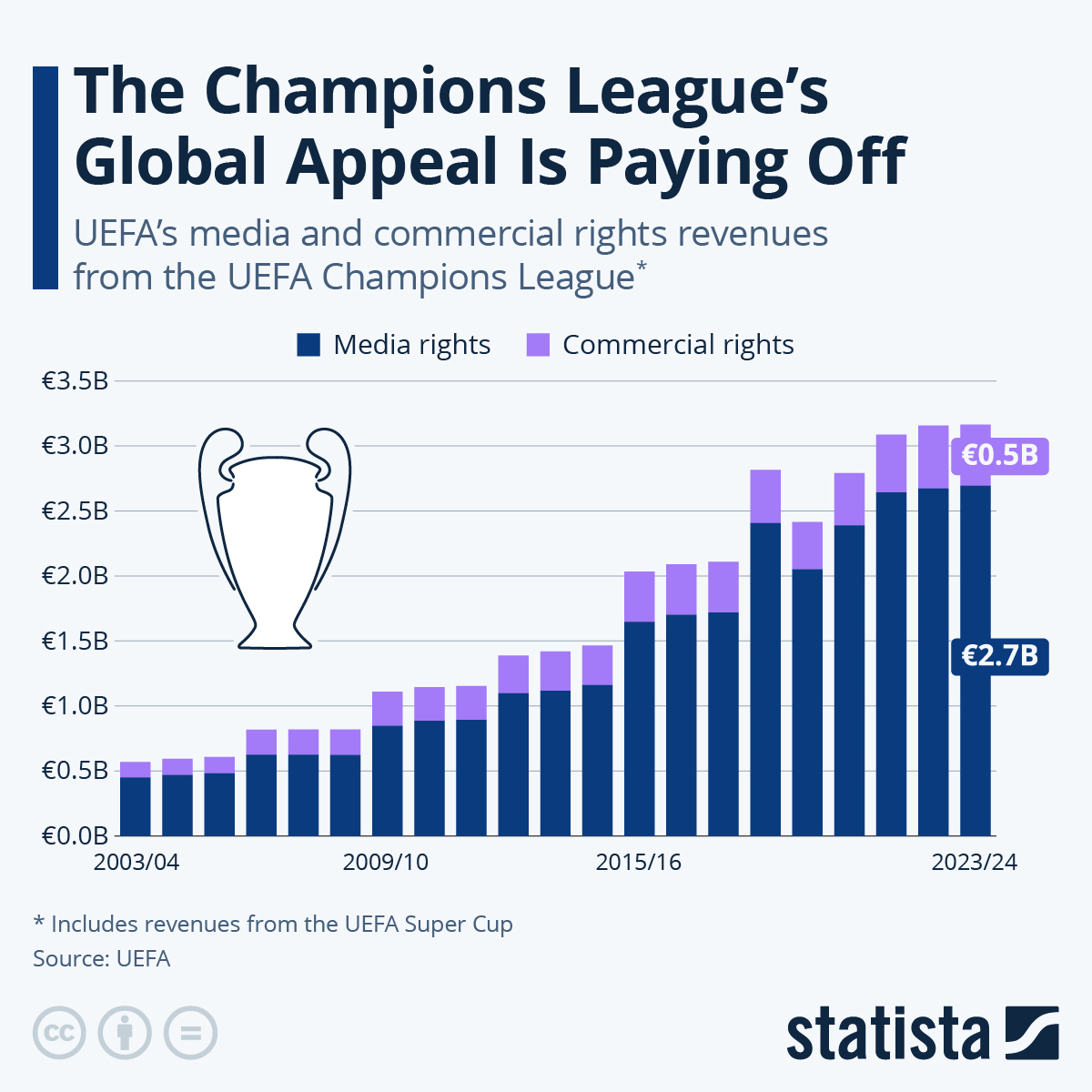
Global Appeal Is Paying Off

When the UEFA Champions League Final between Manchester City and Inter Milan kicks off in Istanbul on Saturday, football fans from all across the globe will be watching. After all, it is the biggest club competition in the world, where fans get to watch star-studded teams compete for European glory and a place in the game's history books.

For UEFA, Europe’s football governing body, the competition’s global appeal is paying off handsomely. Over the two decade, the media and commercial rights for the Champions League have more than quintupled in value. In the 2021/22 season, UEFA made €3.1 billion from Champions League rights, up from €569 million in the 2003/04 season.

Looking at UEFA's lower-tier club competitions, the Europa League and the Conference League, highlights how far ahead the Champions League is in terms of its status and commercial appeal. Last season, UEFA's revenue from Europa League and Conference League media and commercial rights amounted to €468 million, which is just 15 percent of what the Champions League brought in.

Global Appeal Is Paying Off

Sunday, March 12, 2023

the cost of a national team

Сколько стоят футбольные сборные стран Европы


Самые дорогие национальные команды оказались в Англии и Франции: 1.28 и 1.01 миллиарда долларов соответственно! Немного не дотянули до миллиарда сборная Португалии (903 млн), Германии (890) и Испании (872)

А вот сборные стран Балтии и Исландии стоят совсем дёшево - даже меньше, чем Азербайджана и Молдовы(!)

Российскую сборную оценили в 172 миллиона - где-то на уровне Норвегии, побольше, чем сборную Словакии, но поменьше, чем сборную Турции

кортинко тыцабельно, но Украина больше Рф 
(видимо по зряплатам игроков)

Thursday, March 17, 2022

limiting information and data

Uniqlo
Wall Street Journal March 16, 2022

How to Tell If Sanctions Are Hitting the Russian Economy


The Kremlin is trying to hide the impact of measures taken against its economy by limiting information and data


By Paul Hannon and Caitlin Ostroff

The success or failure of the West’s economic war against Russia is crucial to the outcome of the fight in Ukraine. But knowing whether the sanctions are working will be difficult.

Since the Russian invasion last month, Europe and the U.S. have hit the world’s 11th largest economy with sanctions designed to cut it off from the global financial system and from the imports it needs to run its economy. Hundreds of companies have gone beyond the sanctions and stopped doing business with Russia.

Estimates of the economic damage vary widely. The Institute for International Finance, a grouping of international banks, expects Russian economic output to fall by a third this year. Economists at credit-ratings firm Standard & Poor see a contraction of 6.2% in 2022, while Moody’s Analytics estimates the sanctions-induced slowdown will cut economic output by between 13.5% and 24% depending on the duration of the conflict, and the scale of the decline in Russian energy exports.

“This is a massive act of self-harm,” said Gaurav Ganguly, an economist at Moody’s.

Russian President Vladimir Putin acknowledged Wednesday that the sanctions had damaged the country’s economy.

“Our economy will need deep structural changes in these new realities, and I won’t hide this—they won’t be easy, they will lead to a temporary rise in inflation and unemployment,” Mr. Putin said in televised remarks Wednesday before a video meeting with Russian government officials.

There are two ways to track the impact of the sanctions: with economic data or with on-the-ground details like layoffs, shortages and production cuts. Russia has moved to limit access to both.

Since Russia invaded Ukraine at the end of February, the U.S. and allied countries have imposed heavy sanctions on Russia. WSJ’s Shelby Holliday dives into how these sanctions are affecting everyone from President Vladimir Putin to everyday Russian citizens.

The Russian central bank last week suspended the release of figures on its foreign-exchange reserves for three months, saying that during that time “all publications” would use the $643.2 billion figure that was valid on March 4.

Russia’s stock market also hasn’t traded for almost three weeks, a sign that Moscow is trying to hide the economic reality. Russian stocks listed in London have fallen near zero and have since been delisted, with Russia’s largest lender, Sberbank Russia PJSC, among those removed from trading. Shares traded for as little as a penny before being delisted.

Government economic data like gross domestic product, unemployment and inflation are released with a lag. The data from February is mixed, reflecting the tensions before the invasion and the early fallout from the war. Russia saw a sharp rise in its trade surplus, reflecting much higher prices for oil and gas, its principal exports.
However, other figures pointed to a pickup in inflation, while a survey of purchasing managers at manufacturers recorded a decline in output and new orders for the first time in six months. This measure, known as the Purchasing Managers Index, is produced by a private company and will likely give the first insight into how the economy has responded to sanctions when it is released on April 1.

More current data indicates problems ahead for the Russian economy. The ruble has weakened, with one dollar buying 112 rubles, up from 75 at the start of the year. Russia’s central bank more than doubled interest rates to 20%, to encourage holders not to sell the ruble.

A weaker ruble will boost the cost of imports denominated in euros or dollars, raising inflation. At the same time, the big rate increase will make it more expensive for households and businesses to borrow, weighing on growth. The Russian central bank will meet Friday and could outline further actions.
Russia’s economic data has been considered accurate in the past. The numbers showed a 2% decline in economic output due to the sanctions in 2014, and have recorded the economy’s big swings since the end of the Soviet Union. The sanctions this time are much more severe, leading economists to predict a bigger economic decline.

But economists are worried that Russia’s clampdown on free speech and access to foreign news sources will make it harder to determine the impact of sanctions.

“When you have war, you don’t care about accurate reporting,” said Maxim Mironov, an associate professor of finance at IE Business School in Madrid who grew up in the Soviet Union and has researched Russia’s economy and corruption. “You do care about propaganda.”

One the ground, there are already some hints of the economic pain to come. According to the Yale School of Management, 380 international companies have announced their withdrawal from Russia since the invasion of Ukraine. Some of those companies have committed to paying wages for a limited period, but after that, unemployment should rise and those products will be unavailable, potentially causing inflation as supply shrinks.

Russians have lined up for imported medications, which aren’t covered by sanctions. But prices are expected to rise following the ruble’s tumble.

According to Windward, a shipping-data company, calls to Russian ports by commercial cargo and tanker vessels were 40% lower in the first six days of March than a year earlier, a sign that exports and imports are already in decline.

There are also signs that shortages of parts and equipment from Western suppliers are hitting factory output, including the suspension of production at a maker of Lada automobiles.

Offsetting any pain from sanctions will be continued exports of oil, natural gas and minerals at high prices. Western products could also be replaced by goods from China, potentially keeping prices down and providing jobs for Russians.

Many of the economists who would track the impact of sanctions have left Russia, worried that they could be punished for publishing accurate accounts of the economy. Some say they will continue to publish from abroad.

Vladimir Putin became Russia’s president in 2000, and takes credit for stabilizing the economy after the collapse of the Soviet Union. The economy shrank each year from 1990 to 1996, but grew by 10% and then 5.1% in his first two years in office, and each subsequent year until the global financial crisis.

An economic decline caused by the war in Ukraine could undercut Mr. Putin’s reputation for managing the Russian economy.

Thursday, March 3, 2022

War Chest

Data from the Central Bank of Russia shows that the country's gold and foreign exchange reserves have been increasing for some time. While at the beginning of 2018 the reserves totaled almost $448 billion in value, this 'war chest' is currently around $630 billion - a growth of 41 percent. "That would be enough to pay for all imports for a year without Russia having to export anything," according to the German Commerzbank's chief economist Jörg Krämer.

Over the weekend, however, the West has acted to severely restrict Russia's ability to utilize these reserves, as part of its response to the country's invasion of Ukraine. Among the sanctions imposed, the U.S. announced that it would block dollar assets of Russia’s central bank and its Direct Investment Fund. In announcing the new measures, U.S. secretary of the treasury Janet Yellen said: "The unprecedented action we are taking today will significantly limit Russia’s ability to use assets to finance its destabilizing activities, and target the funds Putin and his inner circle depends on to enable his invasion of Ukraine."

This move has its roots in the more limited U.S. response in 2014 to Russia's annexation of Crimea. A senior U.S. official is quoted by the Guardian as saying: "When we took those actions, [the Russians] decided that they were going to try and build a war chest to try and defend against the actions that we may take if they were to take further actions in Ukraine or elsewhere in the world. We knew that this existed and we knew that ultimately, one of the things that we would need to do to ensure that our sanctions would be effective is at some point to go after that war chest and that’s exactly what we’ve done today."Infographic: Russia's Growing Reserves 'War Chest' | Statista

Wednesday, March 2, 2022

cash

Сегодня отказаться от наличных денег готово меньше россиян, чем год назад


Ситуация на рынках привела к увеличению числа россиян, которые не готовы полностью отказаться от наличности. В опросе сервиса по поиску высокооплачиваемой работы SuperJob приняли участие 1600 представителей экономически активного населения страны.

Практически 3 из 4 россиян не хотят отказываться от наличных денег: «Сняла со счета все сбережения, теперь — только наличка»; «Я готов абсолютно отказаться от безналичных и электронных псевдоденег».

Полностью перейти на безналичный расчет готовы лишь 15%: «Я и так практически не пользуюсь наличными». Больше всего желающих отказаться от монет и банкнот в пользу безналичных расчетов — среди россиян до 34 лет и граждан с доходом от 80 тыс. руб. (по 22%).

По данным SuperJob, количество экономически активных россиян, готовых отказаться от наличных, выше всего было в июле 2014 года (21%), ниже всего — в июле 2020-го, первый год пандемии (12%). Летом прошлого года число сторонников отказа от наличных чуть выросло (до 18%), сейчас же, на волне новой порции экономических санкций, снизилось на 3 процентных пункта.

Место проведения опроса: Россия, все округа
Населенных пунктов: 394
Время проведения: 28 февраля — 1 марта 2022 года [а тут, бац, и SWIFT: куку]
Исследуемая совокупность: экономически активное население России старше 18 лет
Размер выборки: 1600 респондентов

Sunday, March 22, 2020

Pretty Woman

Pretty Woman with her partner
2020 marks the 30th anniversary of “Pretty Woman,” a revolutionary romantic comedy starring Richard Gere and Julia Roberts as a businessman and sex worker who fall madly in love. While the controversial nature of the film at the time may have factored into its meteoric success, the classic movie still stands the test of time as the highest international grossing romantic comedy of all-time.

After the film’s release date on March 23, 1990, “Pretty Woman” went on to accumulate nearly half a billion dollars worldwide in box office sales – an incredible achievement from a reported budget of just $14 million. The movie did wonderfully in the states as well, raking in $178 million in the domestic box office.

Despite being 30 years old, “Pretty Woman” still blows another rom-com's out of the water in terms of international box office success. The next closest U.S. movie is “Sex and the City: The Movie,” which debuted in 2008 and has since made over $415 million globally. The list of top-earning box office rom-com shows just how far the genre has fallen since it’s heyday in the 1990s and 2000s, however, modern takes are trying to reignite it. “Crazy Rich Asians,” for instance, was released less than two years ago and made a respectable $238 million internationally.
Pretty Woman

Tuesday, October 22, 2019

The Financial Cost Of America's Opioid Crisis

Even though the Centers for Disease Control and Prevention reported that U.S. overdose deaths fell last year for the first time since 1999, 68,557 people still died. The federal government has been recording the number of deaths throughout the U.S. opioid crisis and at least 400,000 Americans have died since 2000. While the human side of the crisis has been well documented, it has proven more difficult to estimate its financial cost.

The huge death toll has an adverse impact on many sectors of the economy and several studies have attempted to gauge that impact with varying results. A new analysis has now been released by the Society of Actuaries which found that the collective cost of factors such as healthcare, mortality and lost productivity have added up to hundreds of billions of dollars over the past four years.

The report estimated that between 2015 and 2018, the crisis cost the U.S. $631 billion (a midpoint estimate). $253 billion of that can be attributed to mortality costs, $205 billion to healthcare costs and $96 billion to lost productivity. Criminal Justice costs came in at an estimated $39 billion with child/family assistance and education adding up to $34 and $5 billion respectively.

Over the past four years, an estimated $186 billion (29 percent) of the total economic burden of the crisis was borne by federal, state and local governments while the remainder was borne by the private sector and individuals. In 2017, the total cost was estimated at $171 billion and that increased to $179 billion in 2018. The projected midpoint cost for 2019 currently stands at $188 billion.
Infographic: The Financial Cost Of America's Opioid Crisis | Statista

Tuesday, September 10, 2019

Where Elementary School Teachers Get Paid The Most

It's back to school season and across much of the world, teachers and students are gearing up for another academic year. The date when U.S. schools actually open their doors after the summer break varies considerably between regions which can mean anywhere between July and early September. Many schools actually open after the long Labor Day weekend which is considered the unofficial end of summer. While many kids will be experiencing a nerve-wracking first day of school, many teachers will also be having their first day as well. In 2017, a U.S. elementary school teacher could expect to earn an initial salary of $39,138, a paycheck that's higher than in many other developed nations, according to OECD data.

Within 15 years, U.S. elementary school teachers see their pay rise to just over $61,000 on average. Salary levels are similar north of the border in Canada where teachers starting out in elementary school take home $39,222 on average and $65,000 when they get 15 years of experience under their belts. Luxembourg has the best elementary teacher pay of any nation according to the OECD with a starting salary of $70,000 and then an average $102,500 when a decade and a half of experience is accumulated.

In many developed EU countries, new elementary teachers can expect to earn less than half of Luxembourg's starting salary with France and Italy key examples where new teachers take home less than $30,000. Even after 15 years in the job, their prospects don't improve too much with pay only reaching $36,000 in France and $34,400 in Italy. Starting salaries are similar in developed Asian countries where elementary teachers start off with just over $30,000 in Japan and South Korea. Their long-term prospects are better, however, with teachers who have notched up 15 years of experiencing taking home more than $50,000.
Infographic: Where Elementary School Teachers Get Paid The Most | Statista

Wednesday, April 10, 2019

Immigrants In The U.S. Send Billions Of Dollars Home

A large portion of immigrants all over the world set money aside and send it back home to help their families. When all of those payments are added together, the amount of money being moved every year is massive, competing with international aid as one of the biggest financial inflows to developing natons. Pew Research recently released data based on World Bank figures that shows the estimated collective sum of remittance payments in 2017. That year, the worldwide total was estimated at $625 billion, a seven percent increase on 2016 when the total is thought to have been $586 billion.

In the United States alone, the total amount of remittance payments is estimated to have been more than $148 billion in 2017. A study conducted in 2004 found that over 60 percent of the 16.5 million latin American-born adults living in the country that year were regularly sending money home. This still holds true according to Pew's new data which estimates total remittance payments to Mexico at over $30 billion. China came a distant second with $16.14 billion while India had the third-highest amount at $11.7 billion. Some of the world's biggest and most developed economies were high up on the remittance list as well with $2.83 billion sent back to South Korea and $2.80 sent to Germany in 2017.
Infographic: Immigrants In The U.S. Send Billions Of Dollars Home | Statista

Sunday, March 31, 2019

Assortative Mating Based on Parental Wealth

Wednesday, January 30, 2019

How Rich Is Rich?

How much would you have to earn in a year in the U.S. before someone considered you rich? According to a recent YouGov poll, that depends heavily on you ask. The research found that the American public considers an annual income between $90,000 and $100,000 necessary to be deemed rich. The fieldwork for the survey was carried out in September 2018 and it found that 76 percent of respondents think an annual income of $10,000 constitutes being poor. That label gets shaken off once yearly earnings hit $30,000 with half of the population saying someone in this income category is neither rich nor poor.

While there is a sense of division as to whether a $90,000 paycheck makes someone rich or poor, a majority of 56 percent of respondents agree that a person earning $100,000 a year is rich. The survey also asked people how rich or poor they consider themselves with 64 percent saying they are neither. According to the Department of Health and Human Services, the 2019 poverty line for a family of four in the U.S. is an income of $25,470 a year. 12.3 percent of the population, 39.7 million people, were classed as living in poverty in 2017.
Infographic: How Rich Is Rich? | Statista 

Tuesday, January 15, 2019

stop migration

Е Пескова
Российских граждан предложили обложить налогом за выезд из России. Такую идею предложила организация по продвижению бизнес-патриотизма АВАНТИ, передает РИА Новости.

Для стимулирования отрасли они предлагают обложить россиян и иностранных граждан налогом за пересечение границы в размере 500 рублей. Ассоциация уверена, что это позволит в кратчайшее время возродить туристическую отрасль России и повысить ее конкурентоспособность.

Предложения о введении налога направлены в Государственную Думу и Совет Федерации. Ассоциация отмечает, что в условиях сложной международной обстановки особую важность приобрели вопросы развития внутреннего туризма.


«Финансовая поддержка туристическому сектору страны из бюджета России на ближайшие семь лет составит примерно 422,2 миллиарда рублей. Реализация предложенной нашей ассоциацией инициативы способна принести дополнительно около 35 миллиардов рублей в год», — говорится в докладе ассоциации.

В АВАНТИ добавили, что позитивно оценивают меры государственной поддержки отрасли, особенно в отношении Крыма, тем не менее текущей поддержки недостаточно.

Sunday, November 18, 2018

induced abortion and age at retirement

Плакат кампании против абортов CitizenGo. Фото: espresso.repubblica.itПлакат кампании против абортов CitizenGo.
Фото: espresso.repubblica.it

L'Espresso: Россия и Азербайджан потратили миллионы евро на борьбу с абортами в Европе


Россия и Азербайджан в 2012-2017 годах потратили миллионы евро на финансирование сети ультраконсервативных европейских НПО, борющихся с абортами и гей-браками. Об этом говорится в расследовании L'Espresso.

Часть многомиллиардных средств [скажика Жуков ведь не даром], выведенных из России и Азербайджана и отмытых через офшоры, поступала в итальянский фонд Novae Terrae, зарегистрированный в Ломбардии; затем деньги распределялись между организациями в других европейских странах.

Учредитель фонда Лука Волонте, бывший член ПАСЕ от Италии, сейчас находится под судом по обвинению в получении 2,39 миллиона евро от азербайджанского режима через офшорные компании на лоббирование интересов Баку. Через фонд Волонте каждый месяц проходило около ста тысяч евро, поступавших от сети офшорных компаний.

Всего, по данным издания, через эту офшорную сеть в 2012-2014 годах на финансирование различных проектов в Европе было потрачено более 3 миллиардов евро. Около половины этой суммы - деньги не азербайджанского происхождения, в том числе средства Рособоронэкспорта и других российских госкомпаний.

Как показало расследование международного журналистского консорциума OCCRP, в 2011-2014 годах из России через молдавские банки было незаконно выведено 20,8 миллиарда долларов.

Финансирование от фонда Novae Terrae получали различные христианские НПО - православные, католические, организации евангельских христиан в США, Британии, Италии, Испании, Венгрии и Польше. С 2014 года Novae Terrae выделял средства римскому католическому институту Dignitatis Humanae Institute. В том же году на конференции этой организации выступал будущий главный советник президента США Дональда Трампа по вопросам политической стратегии Стивен Бэннон.

Novae Terrae активно участвует в работе Всемирного конгресса семей - форума сторонников "традиционных ценностей". В этом году конгресс проходил в Кишиневе под патронатом президента Молдавии Игоря Додона. Следующий Всемирный конгресс семей состоится в марте 2019 года в Вероне при поддержке партии евроскептиков "Лига" (бывшая Лига севера, похоже не бывшая). Один из организаторов и спонсоров мероприятия - близкий к Владимиру Путину "православный олигарх" Константин Малофеев, находящийся под санкциями за поддержку террористов в Донбассе.

Sunday, October 28, 2018

is it worth ?

Wednesday, October 10, 2018

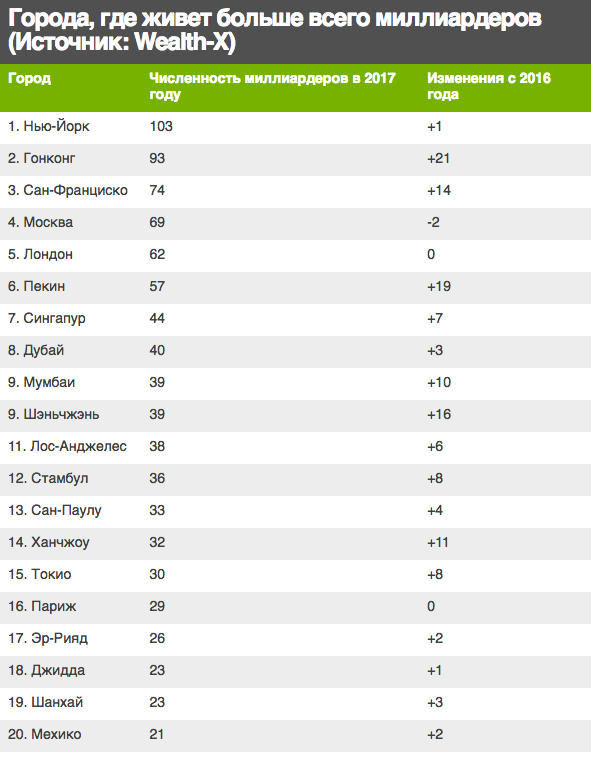
World Ultra Wealth Report

Если верить последнему изданию World Ultra Wealth Report ("Всемирного доклада о сверхбогатстве"), ежегодному исследованию, которое публикует международная консалтинговая компания Wealth X, в Гонконге сейчас 93 миллиардера, на 21 больше, чем в 2016 году, и больше, чем в любом другом городе мира за исключением Нью-Йорка.
бабосы

Tuesday, October 24, 2017

ready for a sharp deterioration

здесь вам не тут
Министр финансов Антон Силуанов доложил премьеру Дмитрию Медведеву «о мерах по модернизации валютного контроля» («Ведомости» ознакомились с копией документа, его подлинность подтвердили два федеральных чиновника). Нужно либерализовать валютное законодательство, признает Силуанов, например отменить обязательный возврат экспортной выручки в страну. Но взамен он просит дать ЦБ и правительству право в кризис вводить жесткие валютные ограничения.

Среди них: требовать от экспортеров репатриировать деньги, в обязательном порядке продавать валюту, получать разрешения на покупку валюты, открывать спецсчета для отдельных видов валютных операций и резервировать под них деньги. Такие поправки предлагается ввести в закон о валютном контроле. Сейчас валютные операции между резидентами и нерезидентами могут проводиться без ограничений.

типа: для отмены тюрем сделаем тюрьмой фсё
каменты