Showing posts with label Азия. Show all posts

Friday, January 24, 2025

thai land

В Таиланде вступил в силу закон о легализации однополых браков. Ожидается, что на церемонии в Бангкоке сегодня в брак вступит более тысячи пар.


Король Таиланда Маха Вачиралонгкорн в сентябре подписал принятый парламентом закон, который легализует подобные союзы.

В законе брак определяется как партнерство двух лиц, а не мужчины и женщины, как было раньше. Однополые пары получат право пользоваться всеми льготами, а также усыновлять и удочерять детей.

Таиланд стал первым государством Юго-Восточной Азии, где легализованы союзы между людьми одного пола.

«Неважно, какого вы пола и кого вы любите, любовь не знает границ. Все будут защищены одними и теми же законами», — заявила на прошлой неделе премьер-министр страны Пхэтхонгтхан Чиннават.

Saturday, October 12, 2024

asian fertility

asian fertility

Рождаемость в странах Азии


Полезная картинка для тех, кто ещё верит в "безумно растущее население Китая" и вот это вот всё: рождаемость в Китае в 2024 составила 1.2 ребёнка на женщину! Для поддержания населения на постоянном уровне, напомним, нужно где-то 2.1 ребёнка на женщину. 1.2 - это что-то, близкое к катастрофе, а 0.9, как в Южной Корее - это уже катастрофа, причём тяжелейшая.

Более того, во другой из двух самых населённых стран мира - Индии - рождаемость уже опустилась до 2 детей на женщину, так что и население Индии где-то скоро начнёт снижаться.

В целом же, хотя в среднем по Азии рождаемость пока ещё обеспечивает прирост населения (2.17 ребёнка на женщину), на таком уровне эта цифра держится за счёт Средней Азии и Ближнего Востока. В большей части стран ЮВА, к примеру, она уже опустилась ко вполне себе европейским уровням

Saturday, July 20, 2024

type of xenophobia

Korean-style carrot
Морковь по-корейски (тыц по картинке — ссылка)

Почему репатриантов из стран бывшего СССР в Южной Корее порой ожидает прохладный прием


Южная Корея переживает острый демографический кризис. Несмотря на щедрые денежные дотации и поддержку с жильем, в стране самый низкий в  мире коэффициент рождаемости, продолжающий падать из года в год.

Если эта тенденция сохранится, к 2100 году население Южной Кореи может сократиться вдвое.

«Если я не буду переводить на русский, другие дети не поймут ни одного урока», — говорит Яна Ким, 11-летняя ученица начальной школы Данпо в Асане, городе невдалеке от Сеула.

Яна лучше всех в классе говорит по-корейски. Большинство из ее 22 одноклассников говорят по-русски, а вот на корейском — не очень.

Почти 80% учеников школы Данпо считаются «мультикультурными учениками» — то есть они или иностранные граждане, или их родители не являются гражданами Кореи.

«Точные цифры назвать сложно, поскольку у родителей разное гражданство и статус проживания, — говорит завуч школы Чу Дэ Ёль. — Но считается, что большинство мультикультурных учеников — это корёин».

Корёин — это этнические корейцы, чьи предки эмигрировали из Кореи на Дальний Восток Российской империи в конце XIX — начале XX веков. Многие из этих семей были депортированы в Центральную Азию в 1930-х годах в рамках сталинской политики «зачистки границ». Они жили в бывших советских республиках — в Узбекистане и Казахстане, — и по мере смены поколений постепенно забыли корейский язык, поскольку он был запрещен.

Опыт Асана в работе с этническими корейцами из-за рубежа высвечивает более широкие проблемы, с которыми сталкивается Южная Корея при решении проблемы иммиграции — весьма сложного вопроса в одной из наиболее этнически однородных в мире стран.

«Уже сейчас существует значительное психологическое сопротивление притоку этнических корейцев, которые внешне не отличаются от нас. Поэтому меня беспокоит, как Корея сможет принять других иммигрантов в будущем», — говорит Сон Дон Ги, эксперт по корёин из университета Инха.

Sunday, November 26, 2023

Racialization and Reproduction: Asian Immigrants and California’s Twentieth-Century Eugenic Sterilization Program

By Marie Kaniecki, Nicole L Novak, Sarah Gao, Natalie Lira, Toni Ann Treviño, Kate O’Connor, Alexandra Minna Stern

During the twentieth century, state health authorities in California recommended sterilization for over 20,000 individuals held in state institutions. Asian immigrants occupied a marginalized position in racial, gender, and class hierarchies in California at the height of its eugenic sterilization program. Scholars have documented the disproportionate sterilization of other racialized groups, but little research exists connecting the racist, gendered implementation of Asian immigration restriction to the racism and sexism inherent in eugenics. This study examines patterns of coercive sterilization in Asian immigrants in California, hypothesizing higher institutionalization and sterilization rates among Asian-born compared with other foreign- and US-born individuals. We used complete count census microdata from 1910 to 1940 and digitized sterilization recommendation forms from 1920 to 1945 to model relative institutionalization and sterilization rates of Asian-born, other foreign-born, and US-born populations, stratified by gender. Other foreign-born men and women had the highest institutionalization rates in all four census years. Sterilization rates were higher for Asian-born women compared with US-born [Incidence Rate Ratio (IRR) = 2.00 (95% CI: 1.61, 2.48)] and other foreign-born women (p < 0.001) across the entire study period. Sterilization rates for Asian-born men were not significantly higher than those of US-born men [IRR 0.95 (95% CI 0.83, 1.10). However, an inflection point model incorporating the year of sterilization found higher sterilization rates for Asian-born men than for US-born men prior to 1933 [IRR 1.31 (95% CI 1.09, 1.59)]. This original quantitative analysis contributes to the literature demonstrating the health impact of discrimination on Asian-Americans and the disproportionate sterilization of racial minorities under state eugenics programs.

Friday, July 7, 2023

The new Asian family

East Asian governments must try to manage a momentous social change they cannot prevent

насколько мы востчные? думаю: да, география мало что меняет

The concept of “Asian values”, once championed by leaders across the region, went out of vogue after the Asian financial crisis of 1997. The idea that East and South-East Asia’s disciplined governments had a unique economic edge over the decadent West suddenly seemed less compelling. Today in prosperous East Asia a different facet of those ballyhooed values is looking even more parlous. In China, Japan, South Korea and Taiwan, Asians’ supposed commitment to conservative family life is collapsing. As we report in our Asia and China sections this week, millions of young people are opting for looser, often lonelier and—in the East Asian context—less male-dominated arrangements. In a region that is home to over a fifth of humanity, the socioeconomic and demographic consequences will be vast, potentially destabilising and will shape millions of lives.

In Japan, where the shift first became evident, married couples with at least one child accounted for 42% of households in 1980, and single people 20%. That has flipped. In 2020 couples with children accounted for 25% of households, and singletons 38%. And the decline is continuing. Last year 17% of Japanese men and 15% of women aged 18-34 said they would not marry, up from 2% and 4% in the early 1980s, and China recorded its lowest-ever number of marriages, half as many as a decade ago.

In some ways young Chinese, Japanese, Taiwanese and South Koreans are following a path charted in rich countries elsewhere. Between 1960 and 2010 Europe’s marriage rate fell by half, for many of the reasons that are now driving down East Asian rates. To many people, marriage seems increasingly anachronistic and unaffordable. Across East Asia it is still widely understood in Confucian terms, as the union of a dominant man and submissive woman. In South Korea a married woman is referred to as Jip-saram, or “home person”, and her husband as Bakat-yangban, or “man outside”.

High property prices are an added disincentive to setting up a marital home. Alternative domestic arrangements are becoming more accepted; besides singledom, they include intergenerational flat-sharing and, less often, cohabiting and gay partnerships. And growing numbers of middle-class women are putting off marriage to concentrate on their careers.

Traditional values are hard on women at work, too. East Asia has some of the world’s best-educated women, yet its overall record on female empowerment is poor and in some ways worsening. On the World Economic Forum’s gender-equality ranking of 153 countries, China—where women are said to “hold up half the sky”—slipped from 63rd in 2006 to 102nd in 2022. South Korea has the widest gender pay gap in the oecd.

If most of this sounds familiar, two things make East Asia’s great social change distinct and hugely troublesome. First, the taboo against having children outside marriage remains as rigid as ever. Across the oecd, 40% of births are outside wedlock. In Japan, South Korea and Taiwan less than 5% are. (The figure in China is unavailable, revealingly, but not thought to be higher.)

The result is a plummeting fertility rate. South Korea’s, at 0.78, is the lowest recorded anywhere and Taiwan’s only slightly higher. Japan’s and China’s are just above half the replacement rate. China’s cruel one-child policy, now replaced by panicked officials with calls to have three, exacerbated its demographic squeeze. But as the regional picture shows, it would have happened anyway. The total population of the four East Asian countries is predicted to shrink by 28% between 2020 and 2075.

The second problem is that the region’s governments are making the situation worse. None seriously broaches the only policy guaranteed to revive East Asia’s flagging demography: mass immigration. Their main response is to try to resuscitate marriage with economic perks—including tax breaks and subsidised weddings—with little success. South Korea’s president, Yoon Suk-yeol, admits that his country has, in essence, squandered 280trn won ($215bn) on such policies. Worse, he and his counterparts in China and Japan are doubling down on the conservative approach that their citizens increasingly object to.

South Korea’s previous administration sought to extend benefits to single parents and unmarried couples. Mr Yoon, who blames the low fertility rate on feminism, has put a stop to that. Under Xi Jinping, China promises its citizens a Confucian revival and arrests gay-rights activists. Japan’s ever-ruling Liberal Democratic Party is also against reforming marriage, including by refusing to make it available to gay couples, although most voters want to see that change.

There are pockets of progress, notably in Taiwan, which recently took a more liberal course. It has legalised same-sex marriage and in May permitted gay couples to adopt children—though it is too soon to know whether these changes will show up in the statistics. But the region as a whole is stuck between modernity and tradition, suffering some of the worst effects of both. East Asians are free to disdain traditional family roles, but not to redefine them. That is why millions resort to childlessness and solitude.

Governments should try to complete this lopsided revolution. Even if social change is not entirely within their grasp, and does not happen overnight, they can at least stop resisting it. To make family life more attractive, they need to deal with its gender imbalances as well as its costs by, for example, making paternity leave routine. They should look beyond heterosexual marriage, as their citizens have, and extend legal recognition to cohabiting, gay and other non-traditional arrangements—and afford them the support married couples now enjoy, especially over child-rearing. It is self-defeating and outrageous that China prevents single women from freezing their eggs, or that Japan makes it nearly impossible for gay couples to foster children.

Let them not wed


Such policies would not fix the region’s demography. But they would have a more positive effect on it than the current ones. More important, they would leave millions freer to lead the lives they choose, especially women and gay people. East Asian governments have overseen the greatest-ever economic boom. Now they must attend to their citizens’ happiness and liberty. ■

For subscribers only: to see how we design each week’s cover, sign up to our weekly Cover Story newsletter.

This article appeared in the Leaders section of the print edition under the headline "The new Asian family"

Friday, February 24, 2023

South Korea’s birthrate sinks to fresh record low as population crisis deepens

South Korea’s birth rate has fallen to its lowest level since records were first kept in 1970

Latest statistics show 249,000 babies were born in 2022, a fall of 4.4% from the previous year


Justin McCurry in TokyoWed 22 Feb 2023

South Korea’s demographic crisis has deepened after new data showed the number of babies born last year reached another record low.

According to figures released on Wednesday by Statistics Korea, 249,000 babies were born in 2022, a fall of 4.4% from the previous year and the third year in a row that deaths have exceeded births in Asia’s fourth-biggest economy.

The birthrate also dropped to a record low, dealing a blow to government efforts to encourage couples to have more children.

A South Korean woman can now expect to have an average of 0.78 children in her lifetime – the lowest level since records were first kept in 1970 – making South Korea the only country in the world with a fertility rate below one.

Experts say the rate needs to be at least 2.1 to keep the country’s populationstable at 52 million.

It is not the only country battling declining birthrates – Japan’s government recently warned that population decline was taking the country “to the brink of social dysfunction” – but the trend in South Korea is particularly alarming for policymakers.

More young people are choosing to delay starting families or giving up on having children altogether.

They cite the high cost of raising children, poor job prospects amid an economic slowdown, and rising real estate prices, while some women say they prefer to prioritise their personal freedom and have ruled out finding a marriage partner.

As a result, the number of marriages in South Korea reached an all-time low of 193,000 in 2021.

The average age at which women give birth was 33.5 in 2022, according to the new data, up 0.2 from a year earlier. On average, women gave birth to their first child at 33. Just 24 babies were born for every 1,000 women in their late 20s – down 3.5% from a year earlier – the Yonhap news agency reported.

With the world’s lowest fertility rate and a rapidly ageing population, concern is growing about the strain on South Korea’s economy and the pension system, which may become depleted in the coming decades.

The population shrank for the first time on record in 2021, and is projected to fall further, to 38 million, by 2070.

Like Japan, local governments in South Korea have launched programmes to encourage people to have children, including cash handouts and help with fertility treatment and medical expenses – measures experts say fail to properly address sky-high living costs and changing attitudes towards gender roles and work-life balance.

In December, the South Korean government unveiled a package of measures to address the low birthrate and ageing population, including shortening career breaks for women after they have children, more affordable housing and better job opportunities for young people. The unemployment rate among people aged 25 to 29 reached 5.6% in January, higher than the national average of 3.6%.

The government of president Yoon Suk-yeol is offering 700,000 won ($540) a month to families with a child aged under a year old, with the payment set to rise to 1m won starting next year, the Nikkei business newspaper said.

The government has also said it will seek to loosen restrictions on migrant labour to tackle population decline, an idea opposed by many conservative South Koreans.

Friday, February 10, 2023

Earth's Moving Plates

On February 6 and 7, the Southeast of Turkey and the Northwest of Syria have been hit by devastating earthquakes. In addition to the main tremor that reached a magnitude of 7.8 on the Richter scale, more than 20 aftershocks with magnitudes between 5.0 and 7.5 were registered in the earthquake-ravaged region around Gaziantep. Since Monday, the death toll of the disaster has climbed to 17,000 in Turkey and neighboring Syria, according to CNN.

The cause of the Turkey-Syria earthquake - and all other earthquakes - lies in the phenomenon of plate tectonics, i.e. the continental drift of the plates which make up the Earth's mantle. As our graphic shows, several such plates meet in Turkey, which significantly increases the risk of serious earthquakes. Even more importantly, some plates in Turkey move convergently, i.e. they are approaching each other, which also makes major earthquakes more likely than in places where plates move apart. More specifically, the East Anatolian fault - along which this week's earthquake occurred - is characterized by a convergent boundary with the African plate to the south and a transform boundary of horizontal movement with the Eurasian plate to the north. This further exemplifies how much seismic activity is present in the region that has now been turned into a disaster zone.

Turkey lies on the Anatolian Plate, which is on the line of tension between the Arabian and Eurasian Plates. The African Plate, which contributed to the formation of the Alps 60 million years ago by drifting north, also borders the Anatolian Plate. Along the edges of the Pacific Plate runs the so-called Ring of Fire responsible for much of the world's volcanic activity - another place where convergent plate boundaries exist. Other plates are the Australian, North American and South American plates. The strongest earthquakes in recent history all took place along the Ring of Fire, which also includes the well-known Mariana Trench, around the Pacific Plate. An earthquake with a magnitude of 9.5 was measured in Valdiva, Chile, in 1960. In 2004, an earthquake in the Indian Ocean off Sumatra reached a magnitude of 9.1 to 9.3 and in 2011 in the Japanese region of Tōhoku, an undersea earthquake with a magnitude of 9.1 and the ensuing tsunami caused widespread devastation and numerous deaths.Earth's Moving Plates

Monday, February 6, 2023

Reproductive burden and women’s employment in India

January 30, 2023 Chhavi Tiwari and Srinivas Goli

Low and declining female labour force participation in India has been a puzzle and a key policy question in the recent past. Chhavi Tiwari and Srinivas Goli argue that it depends on a particularly strong motherhood penalty. India needs more effective work–family reconciliation policies if female economic activity is to be sustained.

India’s female labour-force participation (FLFP) is low and has declined over time. It was just 20% in 2019, down from 25% in 2011 and 32% in 2005 (ILO, 2022). This has negative consequences both at the individual level (e.g., for women’s autonomy and households’ wellbeing) and at the macro level, as it slows down economic growth and cancels out the potential advantages of India’s current favourable age structure (the demographic “window of opportunity”; James & Goli, 2016; Goli et al., 2021).

Lack of appropriate data has made it difficult for researchers to understand the complex dynamics of the labour market, and to solve the puzzle of the low and declining female participation. In a recent article (Tiwari, Goli and Rammohan 2022), we used a panel dataset covering seven years to better investigate the issue. We focused, in particular, on the number of children “at home”, aged 0-14 years, because caring responsibilities tend to fall disproportionately on women, in India as elsewhere (Francavilla and Giannelli, 2011).

How do children influence women’s labour force participation?


FLFP in India has traditionally been higher among the poor, because women work out of necessity to contribute to household income. Things may be changing, however, as FLFP did not increase in this group between 2004–05 and 2011–12 (Figure 1). Conversely, it increased among non-poor women by 8%, reaching 28.1% in 2011–12. Across fertility levels, FLFP increased among childless women especially, from 19.6% to 35.5%, but much less among women with three or more children.

Children’s influence on FLFP can be better understood by relating women’s transition into and out of the labour market to their fertility transition. Having, and remaining at, a small number of children leads to greater labour market participation, as shown in Figure 1, with more women entering than leaving the labour market, both among the poor and the non-poor (Figure 2).
In our scientific article (Tiwari, Goli and Rammohan 2022), we estimated the net effect of the reproductive burden on labour market participation. Each (subsequent) child reduces the probability of working, but the effect is strongest for high parities, from the third child onwards. Note that this is not merely an association: there seems to be a truly causal effect of reproductive burden on labour market outcomes.

In the same analysis, we also found that living in larger household positively affects labour market participation among women with a large progeny, because other family members (especially elder women) can take care of young children. We also found that the motherhood penalty is highest for women belonging to Scheduled Castes / Scheduled Tribes (SC/ST) and for women with no formal education.

Conclusion


In India, women’s entry into, or exit from, the labor market is sensitive to changes in the number of their offspring, which suggests the need for stronger work-family reconciliation policies. India’s 2017 Maternity (Amendment) Bill tried to address this problem, by increasing the length of paid maternity leave for working women from 12 weeks to 26 weeks. However, its effects are limited, because this provision only covers mothers who work in the formal labour market, while approximately 84% of the female labour force is in the informal sector, with no access to maternity leave provisions (Williams, 2017).

Several policies to sustain and improve women’s labour supply and reduce the motherhood penalty, are already in place. These include the Anganwadi set up under the Integrated Child Development Services programme launched in 1975, that provide free services such as basic health care and pre-school activities for children in rural areas (Maity, 2006). Such initiatives need to be expanded and extended to urban areas, where declining labor supply has been a concern among economists.

The question of paternity leaves must also be addressed, to promote gender balance in childcare responsibility. In short, India needs stronger and better “work-family” policies, to enable women to reconcile the tension between maternity/childcare and employment.

Foot note


1 These are people who live in “absolute poverty” (below the so-called Tendulkar poverty line), which is based on (purchasing-power-adjusted) monthly per-capita consumption expenditure, and varies across states (Desai et al., 2010).

References

  • Desai, S. B., Dubey, A., Joshi, B. L., Sen, M., Shariff, A., & Vanneman, R. (2010). Human development in India. New York: Oxford University.
  • Francavilla, F., & Giannelli, G. C. (2011). Does family planning help the employment of women? The case of India. Journal of Asian Economics, 22(5), 412–426.
  • Goli, S., James, K. S., Singh, D., Srinivasan, V., Mishra, R., Rana, M. J., & Reddy, U. S. (2021). Economic returns of family planning and fertility decline in India, 1991–2061. Journal of Demographic Economics, 1–33. https://doi.org/10.1017/dem.2021.3.
  • International Labour Organization (ILO), ILOSTAT database. Data as of June 2022. https://data.worldbank.org/indicator/SL.TLF.CACT.FE.ZS?locations=IN
  • James, K. S., & Goli, S. (2016). Demographic changes in India: Is the country prepared for the challenge. Brown J. World Aff., 23, 169.
  • Maity, B. (2016). Interstate Differences in the Performance of” Anganwadi” Centres under ICDS.
  • Tiwari, C., Goli, S., & Rammohan, A. (2022). Reproductive burden and its impact on female labor market outcomes in India: Evidence from longitudinal analyses. Population Research and Policy Review, 1–37. https://doi.org/10.1007/s11113-022-09730-6.
  • Williams, C. C. (2017). Reclassifying economies by the degree and intensity of informalization: The implications for India. In Critical perspectives on work and employment in globalizing India (pp. 113–129). Springer, Singapore.

Friday, January 27, 2023

Foreign trade

Внешнеторговая политика стран ЕАЭС: результаты имитационного моделироаания


А. Б. Гиноян, А. А. Ткаченко

Авторы исследуют влияние внешней торговли на развитие Евразийского экономического союза (ЕАЭС). Актуальность исследования связана с ролью внешней торговли в интеграционных процессах стран ЕАЭС. Цель исследования — на базе модифицированной гравитационной модели международной торговли выявить возможный вклад изменений внешнеторговой политики стран ЕАЭС в рост их внешней торговли. Использован метод оценки псевдо-максимального правдоподобия, каким является пуассоновская регрессия. На основе результатов гравитационной модели, охватывающей данные 97 стран с объемами 95% мирового ВВП и 85% международных торговых потоков, авторами выявлен потенциальный вклад возможных изменений внешнеторговой политики стран ЕАЭС, включая переориентацию страновых направлений, в рост их внешнеторгового оборота. Авторами дана количественная оценка внешнеторгового потенциала стран ЕАЭС в торговле с основными партнерами. Проведена оценка влияния на объем внешней торговли Беларуси ее возможного присоединения к ВТО, что может увеличить этот объем на 11,4%. Особое внимание уделено моделированию потенциала торговли стран ЕАЭС с 40 ведущими торговыми партнерами. Анализ внешней торговли этих стран показывает отсутствие заметных изменений в структуре ее направлений, а внешнеторговый оборот продолжает расти недостаточными темпами. Результаты имитационного моделирования позволили прийти к выводу, что страны ЕАЭС имеют значительный торговый потенциал с США, ОАЭ, Сингапуром, Швецией, Малайзией, Испанией и Бразилией, а фактический объем торговли с этими странами составляет менее 50% от по-тенциально возможного. Реализация этого потенциала требует, как показано в работе, существенных изменений во внешнеэкономической ориентации стран ЕАЭС и модификации внешнеторговой политики.

Ключевые слова:
внешнеэкономическая политика; Евразийский экономический союз; гравитационная модель; моделирование внешней торговли; потенциал внешней торговли; имитационное моделирование

Saturday, December 10, 2022

Debates Around Abortion in the Global North: Europe, North America, Russia and Asia

By means of a historical, legal and scientific approach, this book identifies the issues, progress and setbacks in the right for women to access abortion in various countries of the Global North.

The book provides insights on the past, present and potential actions and struggles in the future about continuing to have the right to procure an abortion. Rites and rituals in order to better understand the practices of Asian countries, such as China, Japan and Taiwan, permeate discussions and debates. The volume presents the repercussions of the Covid-19 pandemic on access to abortion healthcare services and abortion, and the innovative initiatives and schemes designed and implemented. The latter encourages health professionals and decision-makers to reflect on the ‘good practices’ and retain and develop over the long term.

This edited collection is intended for academics and students across the social sciences and healthcare sector, members of the legal profession, healthcare professionals, activists, policy-makers, and any stakeholders working for and caring about women’s reproductive rights and abortion rights.

Россия отдельно от Северной Европы и Азии, но дороговатко

Thursday, December 8, 2022

korean age

Жители Южной Кореи официально помолодеют на год или два. Там меняют систему отсчета возраста


Панде Ле Бао из парка развлечений "Эверленд" в пригороде Сеула устроили праздник по случаю дня рождения. Но сколько ей исполнилось - 4, 5 или 6 лет? (снимок 2016 года)

Парламент Южной Кореи во вторник принял закон, который отменяет традиционную для страны систему подсчета возраста - так называемый "корейский возраст". Согласно закону, система отменяется в официальных документах с июня 2023 года, и все инстанции переходят на стандартную международную.

Как заявил представитель правящей "Партии народной власти" Ю Сан Бом, пересмотр направлен на сокращение ненужных социально-экономических издержек, поскольку из-за путаницы в системах подсчетов возникает много правовых и общественных споров.

До нынешнего момента самым распространенным методом подсчета возраста населения в стране был так называемый "корейский возраст", когда человеку записывают 1 год в момент его рождения, и потом годы прибавляются в каждый в первый день лунного Нового года (а не в день рождения, как в других странах).

По другому методу, который также используется в Южной Корее, новорожденному засчитывают ноль лет, и первый год жизни прибавляют 1 января. Этот метод используют, преимущественно, для определения возраста, с которого разрешено употреблять алкоголь и покупать сигареты.

При этом стандартную международную систему - когда при рождении записывают ноль лет, и прибавляют годы в каждый следующий день рождения - в Южной Корее с 1960 года используют для медицинских и юридических целей.

Корейцы крутят огненные шашки во время фестиваля "Тэборым", посвященного первому полнолунию нового лунного года (23 февраля 2012 г, Сеул). В этот день, в лунный новый год, все жители по корейской системе стали старше на год

Таким образом, южнокорейцу, рожденному 31 декабря 2002 года, к 8 декабря 2022 будет 19 лет по международной системе и 20 или 21 год по двум системам, существующим в Южной Корее.

Эта традиционная для некоторых азиатских стран система подсчета возраста родом из древнего Китая. В Японии и Вьетнаме она применяется в традиционных обрядах и религиозных процессах.

Однако официально и Китай, и Япония отказались от восточно-азиатской системы подсчета десятки лет назад.

В Южной Корее эта система, по мнению экспертов, сохранилась из-за ее культуры иерархии, когда возраст играет важную роль в том, как люди взаимодействуют друг с другом.

"Когда люди обнаружат, что они на год или два моложе, это окажет положительное влияние на общество", - считает глава министерства законодательства Южной Кореи Ли Ван Гю.

По его словам, правительство будет широко продвигать новую возрастную систему, чтобы помочь ей прижиться в повседневной жизни граждан.

"Для серьезных изменений нужны не только административные меры, но и общественные усилия по разрушению культуры, основанной на рангах", - отмечает Ким Чон Квон, профессор права университете Чунганг в Сеуле.

материал CNN, но по английски

Wednesday, December 7, 2022

Afghans' Views on International Leadership

It’s been over a year since the United States withdrew its military from Afghanistan. A recent survey conducted by Gallup has captured a snapshot of the sentiments of residents on the ground. Conducted through face-to-face interviews in Dari and Pashto, a random sample of 1,000 adults were spoken to in Afghanistan between July 20 and August 27, 2022.

When asked about the job performance of the leadership of a number of different foreign governments, approval ratings were low overall. Less than one in five respondents approved of the U.S. government’s leadership. This is up 4 percentage points from one year ago, when it hit a record low. Germany, also involved in the withdrawal, saw equally low ratings of 18 percent, with a fall of 7 percentage points from one year prior. Meanwhile China, the main trading partner to engage in trade with the Taliban alongside Pakistan, also saw a fall in approval, dropping by 7 percentage points to only 14 percent.

By comparison, the Islamic countries Saudi Arabia and neighboring Iran, had higher ratings as of August, at 40 percent and 25 percent approval, respectively. Since the question was not asked in these countries in 2021, we do not know if this has increased or decreased since the time of the withdrawal.

In the most recent series of surveys conducted by Gallup, Afghans rated their lives worse than any population has since the first publication of the World Poll. Gallup writer Jay Loschky explains: “Afghans didn’t always view the leadership of other countries unfavorably, but they now find themselves in a seemingly hopeless situation and failed by the international community.”

It is important to note here this chart’s limitations in so far that the data hides details such as the disparities in approval ratings between different ethnic communities within Afghanistan. For instance, where 53 percent of ethnic Hazaras approved of the U.S., only 8 percent of Pashtuns stated the same.Afghans' Views on International Leadership

Saturday, November 26, 2022

return of Europe

похители же
Миф о похищении Европы, дочери финикийского царя Агенора, открытым текстом констатирует факт азийского происхождения европейской культуры. Социокультурное противопоставление Азии и Европы противоречит этому бесспорному мифологическому факту. Необходимо вернуть из забвения восточные истоки западной культуры и показать континентальный формат евразийской культуры.

чтобы это (азийского) значило?

Возвращение Европы, или континентальный масштаб евразийской культуры // Евразийская альтернатива / Под редакцией В.К. Левашова, Н.Г. Хайруллиной. Тюмень: ТИУ, 2016.


тут есть, куда посмотреть

Saturday, November 19, 2022

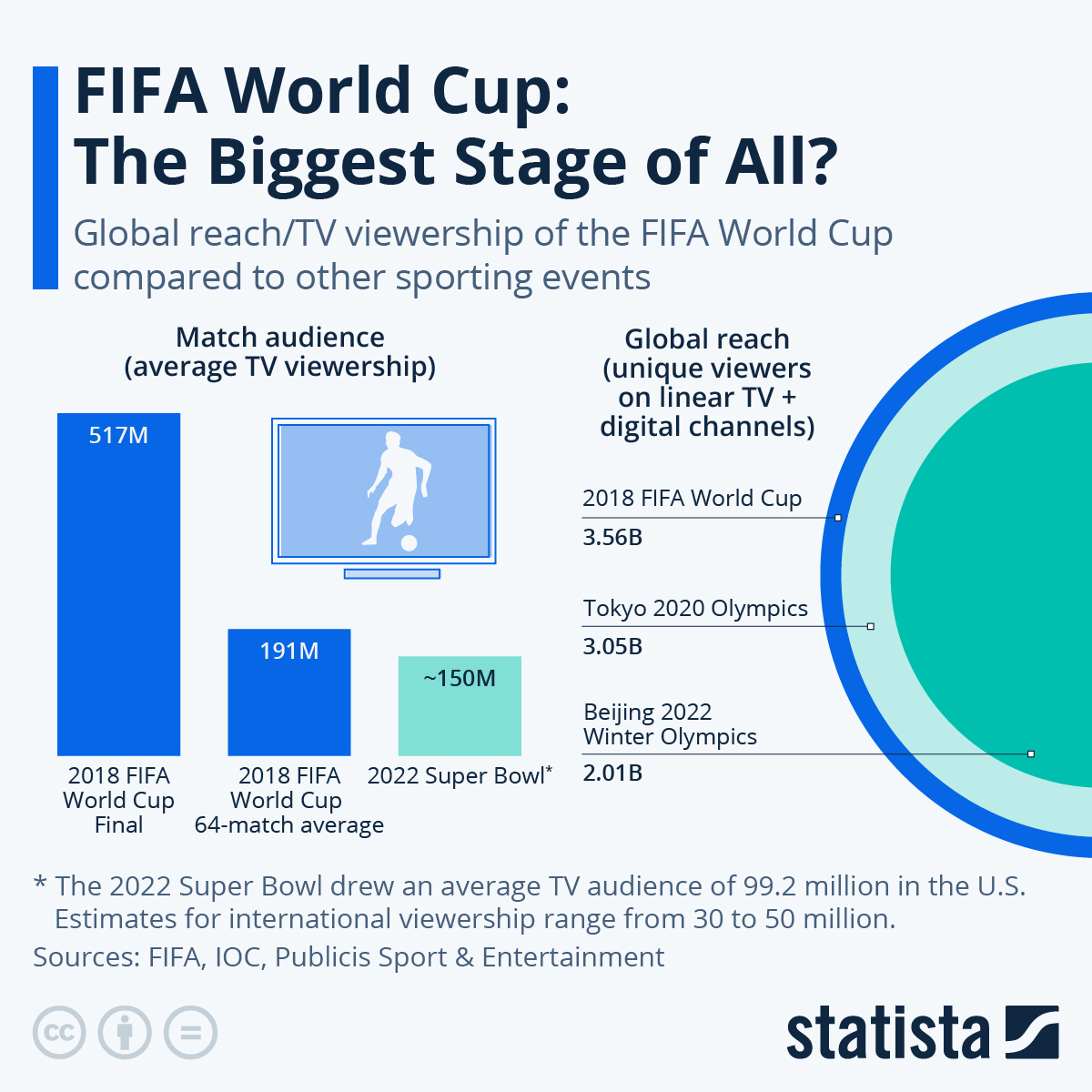
FIFA World Cup: The Biggest Stage of All?

When Qatar and Ecuador kick off the 2022 FIFA World Cup on Sunday, it is the beginning of what is arguably the biggest sporting event in the world. While maybe not the greatest spectacle in sports – that honor goes to the Super Bowl, which is bridging the gap between sports and entertainment unlike any other event – the quadrennial FIFA World Cup is probably the most followed competition in the world of sports.

Taking the Super Bowl as a measuring stick reveals the extraordinary scale of the World Cup’s global appeal. According to FIFA, the average live TV audience for the 64 matches at the 2018 World Cup in Russia was 191 million. That’s significantly more than estimates for the Super Bowl’s TV viewership, which was just short of 100 million in the U.S. this year plus an estimated 30 to 50 million across the globe. Keep in mind, it’s not the World Cup final we’re talking about, it is every single one of the 64 matches played over the course of a month. The final is at another level altogether, with the 2018 clash between France and Croatia drawing an average TV audience of 517 million people, as live coverage of the game reached more than a billion people in total.

Looking at the overall reach of the FIFA World Cup, it even puts the Olympics to shame. In 2018, an estimated 3.56 billion people watched at least one minute of World Cup coverage on linear TV or across digital channels, compared to 3.05 billion for the Tokyo 2020 Olympics and 2.01 billion for the Beijing 2022 Winter Games. And Russia 2018 was no outlier in that respect: Brazil 2014 reached similar numbers and so did South Africa 2010 before it. The matter of fact is that football truly is a global game, played and followed across the globe like no other sport. Whether the controversial decision to award the 2022 World Cup to Qatar will affect the event’s reach is yet unclear, but polls suggest that, all criticism aside, hundreds of millions of football fans will tune in once the ball is actually rolling.FIFA World Cup: The Biggest Stage of All?

Tuesday, September 13, 2022

Fewer and later births in South Korea, especially among more educated women

September 12, 2022 Jolene Tan

With a total fertility rate of 0.81 in 2021, South Korea has the lowest fertility rate in the world. Within a generally declining trend, and very low levels globally, Jolene Tan finds that patterns in the timing of childbearing and the number of children in this country depend strongly on women’s educational level. The implications may be unfavourable.


South Korea ranks amongst the highest-achieving OECD member countries for women’s education: 76% of women between 25 and 34 years of age had a tertiary qualification in 2020, in comparison with just 64% among men (OECD 2022). This rate is higher than the average for OECD countries, where the proportions are 52% and 39%, respectively. The significantly higher educational level of women in South Korea has important implications for the demography of the country, as higher educational achievement is usually associated with lower fertility (Kravdal and Rindfuss 2008).

Fertility transition and educational expansion in South Korea


In the 1960s, the South Korean government launched programmes to curb fertility, encouraging the use of contraceptives and promoting a two-child norm. Consequently, South Korea’s total fertility rate declined rapidly between 1960 and 1985, from 6.1 to 1.7 children per woman. Meanwhile, compulsory primary education was established and the expansion of higher education gained pace in the early 1980s.
Figure 1 shows the evolution of education and fertility trends over the past 20 years, with the former increasing and the latter declining over time.

Decline in fertility across birth cohorts


Nationally representative longitudinal data show that South Korean women in more recent birth cohorts are having fewer and later births. Focusing on first births (Figure 2), let us compare women born between 1960 and 1964 with those born 20 years later, between 1980 and 1984. Half of the former had their first child by 26 years of age, while among the latter group, this median age rises to 29 years. By age 38, 95% of the former had had at least one child, compared with only 68% of the latter.

Women with higher education are having fewer children and delaying childbirth


Beyond declines in cohort fertility, there are also marked fertility differentials by education, as better-educated women tend to delay their first birth and have fewer children (Figure 3; Tan 2022). This is not surprising, as women with lower educational levels leave school and start family formation at an earlier stage. Education also improves women’s employment opportunities and potential income, and the increasing opportunity costs of child raising induce them to delay or reduce childbearing. Furthermore, highly educated women may prioritise individual aspirations and self-actualisation over having children. Consequently, South Korea’s low fertility rate may decrease further as women’s educational levels rise.

Persistent and widening educational differentials in fertility


Combining these trends, an increasing fertility gap by educational level emerges among women in the most recent birth cohorts (Figure 4). Note, however, that women with lower educational levels were once the majority, but they are increasingly becoming a minority among recent generations, and Figure 4 does not account for this structural shift in educational composition. After an initial fertility convergence, for the 1965–1969 and 1970–1974 birth cohorts, education–fertility differentials then become more pronounced. This emerging fertility divergence for younger women alerts us to prominent fertility disparities that may affect social stratification and reproduction.

Potential implications of fertility bifurcation


Larger families have historically been associated with lower child education (Knodel et al. 1990). Better-educated women with low fertility rates can arguably invest more in their children’s education and provide them with additional resources to achieve higher educational and labour market outcomes. In contrast, less-educated women with more children may face greater resource constraints that may affect their children’s educational attainment and futures. This is the case in South Korea, where over 75% of middle- and high-school students receive private supplementary tutoring in addition to the regular school curriculum, and most of this additional educational spending is borne by parents (Anderson and Kohler 2013). Accordingly, South Korea’s distinctive education–fertility patterns may reinforce inequalities and aggravate the stratification process (Park 2007).

The future of fertility


A moderate stratification in fertility rates may leave some room for advancement for those born in lower socio-economic strata. The gap may narrow as less advantaged groups adopt the behaviour of their more advantaged counterparts and eventually catch up. The government can facilitate narrowing of disparities by ensuring that children have sufficient resources, particularly in terms of education access and quality. Moreover, fertility differentials are not the only concern. Global fertility levels are also important, as they should not diverge too much from the replacement target of two children per woman. As more women are able to attain higher educational levels, fertility delay and childlessness may become more common. If education (and, arguably, the ensuing labour market competition) is indeed an obstacle to childbearing, the future of fertility may rest upon the continuation and support of policies to facilitate younger generations in establishing families and realising their ideal family size.

References

  • Anderson, Thomas, and Hans-Peter Kohler. 2013. ‘Education Fever and the East Asian Fertility Puzzle: A Case Study of Low Fertility in South Korea’. Asian Population Studies 9, no. 2: 196–215. doi:10.1080/17441730.2013.797293.
  • Knodel, John, Napaporn Havanon and Werasit Sittitrai. 1990. ‘Family Size and the Education of Children in the Context of Rapid Fertility Decline’. Population and Development Review 16, no. 1: 31–62. doi:10.2307/1972528.
  • Kravdal, Øystein, and Ronald R. Rindfuss. 2008. ‘Changing Relationships Between Education and Fertility: A Study of Women and Men Born 1940 to 1964’. American Sociological Review 73, no. 5: 854–73. doi:10.1177/000312240807300508.
  • OECD (The Organisation for Economic Co-operation and Development). 2022. ‘Population with Tertiary Education’.
  • Park, Hyunjoon. 2007. ‘Inequality of Educational Opportunity in Korea by Gender, Socio-economic Background, and Family Structure’. The International Journal of Human Rights 11, no. 1–2: 179–97. doi:10.1080/13642980601176324.
  • Statistics Korea. 2022. ‘Birth and Death’.
  • Tan, Jolene. 2022. ‘Educational Differentials on the Transition to First Birth in South Ko

Tuesday, June 21, 2022

competing for migrants

Южная Корея переманивает у России мигрантов из Кыргызстана


Жители Таласской области Кыргызстана получат возможность трудоустроиться в Южной Корее по программе централизованного набора, передает Радио Азатлык.

По соглашению между двумя странами, в этом году 50 жителей Таласской области будут трудоустроены на краткосрочные сельскохозяйственные работы (до 5 месяцев), а в следующем году квоту увеличат до 300 человек.

В начале этого года Южная Корея возобновила процесс найма граждан Кыргызстана по трудовым договорам, который был приостановлен в марте 2020 года из-за ограничений, связанных с COVID-19. За последние 15 лет в этой стране трудоустроено 3500 кыргызстанцев.

По последним официальным данным, в странах зарубежья работает 1 млн 118 тысяч граждан Кыргызстана. Согласно Программе развития до 2026 года, в ближайшие 5 лет власти намерены сократить безработицу в стране с 5,8 до 5%. И планируется это сделать, в первую очередь, за счет миграции в том числе в Европу и Японию.

❗​​Goodbye, Russia - Hello, Europe: сезонные рабочие из Кыргызстана и Таджикистана поехали в Великобританию

Tuesday, May 24, 2022

U.S. Leadership Approval High in Asia

According to surveys in 32 Asian countries, the approval of U.S. leadership has substantially recovered during the tenure of President Joe Biden. Gallup found that 41 percent of Asians approved of U.S. leadership in 2021, up from just 31 percent in 2020. Biden is currently on a tour of Asia and will meet the leaders of Japan, South Korea and Australia on Tuesday. The grouping is part of a strategy to strengthen U.S. influence in the region as a counter to China.

Only German leadership was regarded slightly higher in Asia. 43 percent of respondents said they approved of it, with 2021 surveys carried about during Angela Merkel's and her successor Olaf Scholz's time in office. Chinese leadership, on the other hand, has seen falling approval recently. Ratings reached a low of just 27 percent last year.

Close U.S. allies in the region, like those in the aforementioned Asian "Quad" group, were among those rating U.S. leadership above average – with ratings of 50 percent and higher – as did respondent from historical ally the Philippines (71 percent). More favorable ratings came out of Taiwan (45 percent), Vietnam (45 percent), New Zealand (48 percent) and Thailand (49 percent). Low ratings came out of Pakistan, Indonesia, Singapore and Hong Kong.Германия — такая маленькая, сравнительно

Wednesday, May 18, 2022

simple

Умные арабы: пищевой кризис из-за Украины не опасен для стран Залива?


Нефтяные страны Персидского Залива подошли к глобальному продовольственному кризису, вызванному войной в Украине, весьма подготовленными, отмечается в аналитическом обзоре закрытого для широкой аудитории московского Института Ближнего Востока.

По состоянию на 2021 год все эти страны входят в 30-ку ведущих стран мира по индексу оценки национальной продовольственной безопасности. Высокая степень готовности арабских стран к кризисным угрозам в продовольственном секторе объясняется основательной подготовкой на национальном уровне к такого рода рискам и тщательным планированием. Они смогли за последние два десятилетия существенно диверсифицировать и упрочить сеть закупок продовольствия на мировых рынках, что позволяет им активно маневрировать для устойчивого и стабильного обеспечения поставок из других стран основных стратегических видов продовольственной номенклатуры.

Кроме того, ряд стран Персидского залива инвестировали в приобретение обширных пахотных земель в третьих странах, особенно в Африке, что позволило им выращивать необходимую монокультуру [почему не стерео?] на этих землях для последующего обеспечения своего внутреннего спроса.

▪️ Cаудовская Аравия с 2008 года последовательно приобретала дешевые пахотные земли в Судане, Кении и Эфиопии для производства зерновых, одновременно сокращая внутреннее производство пшеницы на 12% для сокращения нагрузки на собственные водные ресурсы.
▪️ В сформулированной Катаром в 2017 году новой национальной стратегии продовольственной безопасности особо подчеркивается важность превентивных мер планирования, cоздания резервов и воссоздания целого ряда ключевых отраслевых производств на случай кризиса (например, молочного производства).
▪️ В новой стратегии продовольственной безопасности ОАЭ от 2018 года содержится целевая задача по вхождению в десятку лидеров по глобальному рейтингу (индексу) продовольственной безопасности до 2051 года. Решением этой задачи займется специально созданное в ОАЭ министерство продовольственной безопасности.
▪️ Более амбициозные задачи ставит Кувейт в своей новой национальной стратегии по достижению устойчивых продовольственных систем до 2030 года, одобренной в конце 2021 года. Согласно этой стратегии, власти Кувейта рассчитывают выйти на уровень самообеспечения, хотя бы по некоторым стратегическим видам продовольствия, за счет массового внедрения современных технологий и инвестирования в малые и средние фермерские хозяйства.

Sunday, April 17, 2022

с19 mortality

NYT: исследования ВОЗ показывают, что реальная смертность от коронавируса в несколько раз выше официальных данных


Исследования, проведенные Всемирной организацией здравоохранения и, в частности, израильским экспертом Ариэелем Карлински, показали, что реальная смертность от коронавируса в мире в несколько раз превышает официально публикуемые данные, пишет газета The New York Times.


По оценке ВОЗ, от коронавируса с весны 2020 года до конца 2021 года в мире умерли около 15 миллионов человек. По официальным данным, основанным на отчетах министерств здравоохранения различных стран, смертей от COVID-19 на сегодняшний день немногим более 6 миллионов.

Публикация этих данных в течение нескольких месяцев откладывается из-за возражений со стороны властей Индии, пишет NYT. ВОЗ приходит к выводу, что именно в этой стране было больше всего не учтенных смертей от коронавируса: не менее 4 миллионов, а вовсе не полмиллиона, как следует из отчетов индийского минздрава. Но власти Индии оказывают давление на ВОЗ, требуя не публиковать эти данные.

Пресс-секретарь ВОЗ Амна Смаилбегович заявила NYT, что организация планирует публикацию отчета в этом месяце (в апреле 2022 года).

В публикации NYT названы и другие страны, которые явно занижают данные по смертности от коронавируса. Это, в частности, Индонезия и Египет. Затруднен сбор данных в странах Африки.

Явным образом значительно занижены официальные показатели смертности от коронавируса в России, где минздрав заявляет о примерно 370 тысячах умерших, а Росстат отмечает избыточную смертность – более 1 млн человек (эти данные близки к оценке ВОЗ по РФ).

Весьма сомнительны и официально публикуемые данные о смертности от коронавируса по Китаю.

Израильский экономист Ариэль Карлински, создавший и поддерживающий базу данных о смертности в мире и работавший с ВОЗ, отмечает, что власти разных стран "очень разумно опасаются последствий" публикации точных данных о смертности от коронавируса. Огласка подобных сведений может привести к резкому росту недовольства властями, не справившимися с задачами по борьбе с эпидемией.