Showing posts with label Швеция. Show all posts

Tuesday, March 28, 2023

long hoped-for

Income and fertility – a positive relationship?

March 27, 2023 Martin Kolk
In Sweden, a positive association is emerging between income and fertility, Martin Kolk observes. Men and women with higher incomes have more children than their less wealthy peers, and the poorest are the least likely to have children. If the trend continues, the income-fertility relationship of the 20th century, to which we are accustomed, may be reversed in the 21st century.


Is it poorer or richer people who have more children? This question, central to many of the founders of social science and statistics in the 19th and 20th centuries, remains an important topic in demography. It is common wisdom among both the public and many researchers that poorer individuals have more children, but in a new study, I provide evidence that this idea may be incorrect, at least in Sweden (Kolk, 2022).
 

Lifetime earnings and fertility


To evaluate life course income, and assess its association with childbearing, I used yearly Swedish taxation registers, restricting the analysis to national data on Swedish-born men and women, who were studied separately. Analyzing my data by birth cohorts, I summed all re-evaluated incomes over working ages. This allowed me to circumvent many of the issues related to short-term interrelations between income and childbearing, such as women leaving the labor market to take care of young children.

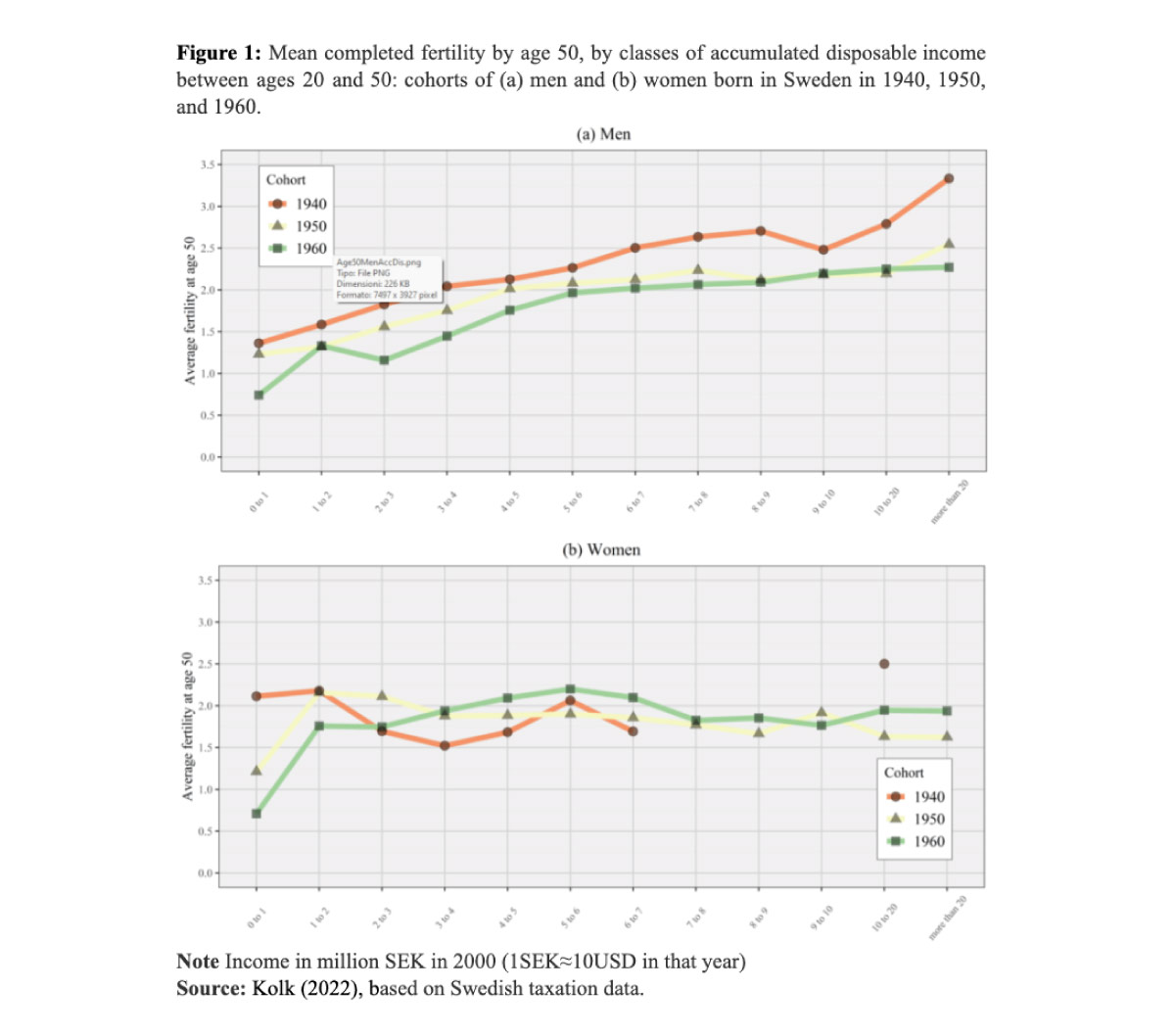
For men, a consistently positive gradient emerged for all cohorts: the number of children increases monotonically across income (Figure 1, panel 1a). For women, the relationship is more complicated and changes over time (Figure 1, panel 1b). Among those born in the 1940s, no or very low income (i.e., being or becoming a homemaker) is associated with the highest number of children. In later cohorts, however, the reverse is true: it is women with no or little income who have the lowest fertility, although the relationship vanishes above a certain income threshold (women of all upper income classes having similar fertility).
Much of this relationship is due to low income among childless men and women, suggesting that an increasingly large group of low socioeconomic status individuals are excluded from partnerships and childrearing (Figure 2). Lifetime incomes are highest for men and women with 2-4 children, although for very high numbers of children (5 and above, representing less than 1.5% of the population), incomes are somewhat lower.
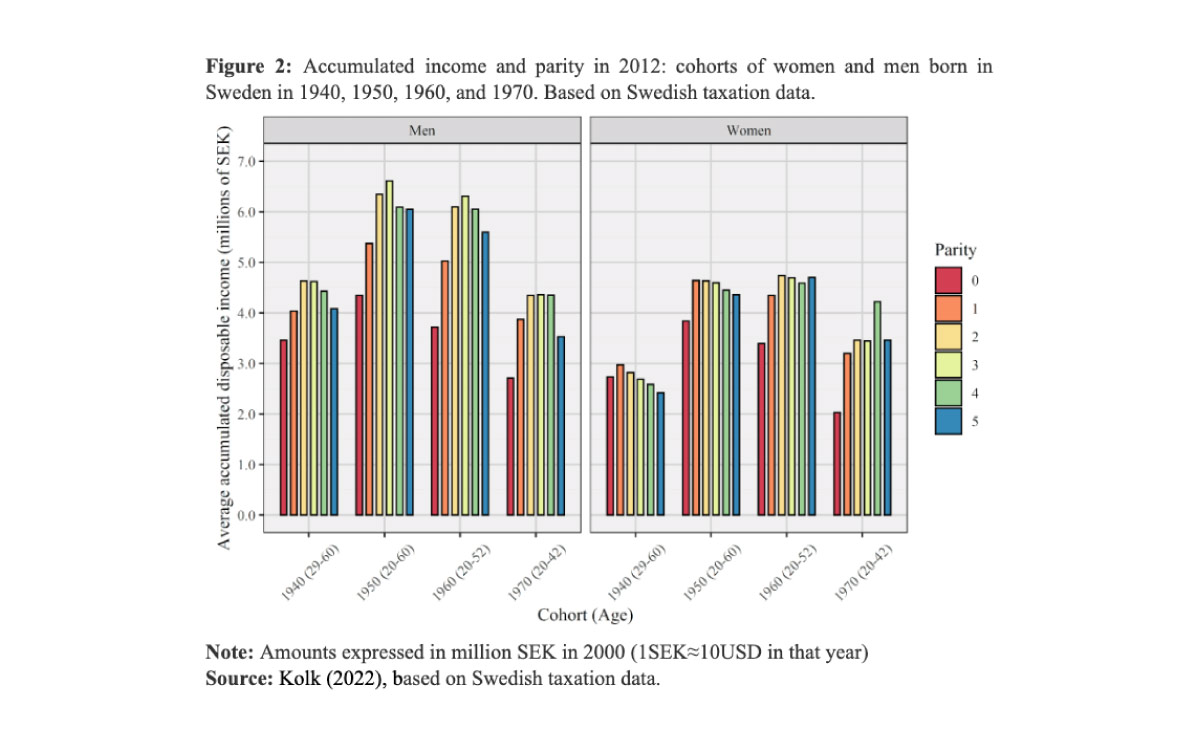
Both figures (1 and 2) refer to disposable income, which includes government transfers to parents, such as parental leave and child allowances. This may partly affect the findings as the Swedish welfare state provides many benefits for parents, and these are usually paid to mothers. Indeed, if we include only labor income (excluding parental leaves and child allowances), we get similar results for men, but not for women: the gradient remains negative for more birth cohorts (the richer having fewer babies), and it turns positive only for those born in the 1970s.

Implications


Previous negative associations between income and fertility may have been partly due to cultural orientations and values that differed between high and low socioeconomic status groups in Sweden (and other countries), but these differences are either shrinking or being outweighed by a new economic reality: children, who are expensive but arguably desirable to large groups in society, may be becoming a luxury that not everybody can afford.

Sweden is a society where combining wage labor and childrearing is still largely possible: some of the reasoning above may be conditioned on welfare state support for childrearing and female employment, and many of my findings may not be applicable to other contexts. Nevertheless, if I were to make a forecast for the 21st century, I would speculate that a positive relationship between income and fertility will emerge in an increasing number of contexts all over the world, in one or more of the following forms:

• an individual-level positive gradient between personal income and fertility,
• a positive link between fertility and the business cycle, and
• higher fertility in the world’s richest countries than in less wealthy parts of the globe.

Indeed, the findings of an increasing number of studies are consistent with these patterns: e.g., Hopcroft (2022) in the US, Fox et al (2019) at the regional level in Europe, and Jalovara and Fasang (2020) in Finland.

References

  • Kolk, M. (2022). The relationship between life-course accumulated income and childbearing of Swedish men and women born 1940–70. Population Studies, available online
  • Fox, J., Klüsener, S., & Myrskylä, M. (2019). Is a positive relationship between fertility and economic development emerging at the sub-national regional level? Theoretical considerations and evidence from Europe. European Journal of Population, 35, 487‒518.
  • Hopcroft, R. L. (2022). Husband’s income, wife’s income, and number of biological children in the US. Biodemography and Social Biology, 67(1), 71‒83.Jalovaara, M., & Fasang, A. E. (2020). Family life courses, gender, and mid-life earnings. European sociological review, 36(2), 159‒178.

Thursday, August 31, 2017

effectiveness of contraceptive methods

Perception of effectiveness of contraceptive method currently in use (n = 721). 

from:

Use of Contraception and Attitudes towards Contraceptive Use in Swedish Women - A Nationwide Survey


Article in PLoS ONE 10(5):e0125990 · May 2015

Wednesday, September 28, 2016

Pavel Sheremet memory

Вчера сходил в вышку на вечер памяти Павла Шеремета
это его мама и жена
вечер памяти Павла Шеремета
в Киеве у него вроде была другая жена, которая до этого была женой Гонгадзе
обоих убили — каково ей теперь? и народу вокруг неё ?

а этот (ниже) дяденька — швецкий корреспондент в Москве
поскольку обсуждали свободу слова, принёс благодарность России за введение свободы слова и гражданского порядка в Швеции
в этом году 250 лет введения празднуют
отдельное спасибо передал Петру Алексеичу Романову (он же первый) за Полтавскую битву
вечер памяти Павла Шеремета
в принципе этот пассаж и у Солженицына есть в каком-то произведении

Friday, April 8, 2016

male abortion and gender equality

Marcus Nilsen, chairman of Liberal Youth of Sweden West
Молодежное крыло Либеральной партии Швеции (LUF Väst) предложило легализовать «мужские аборты», чтобы уравнять мужчин и женщин в праве отказаться от ребенка, сообщает издание The Local.

Согласно проекту, мужчины смогут отказываться от ребенка в течение первых 18 недель беременности у женщины с последующим правом не выплачивать алименты, однако в дальнейшем он не сможет претендовать на отцовские права. 18-недельный срок совпадает с разрешенным для абортов периодом беременности, согласно законам Швеции.

«Это значит, что мужчина сможет отказаться от прав и обязанностей родителя», — отметил представитель LUF Väst, отметив, что это уравняет права мужчин и женщин в вопросе прерывания беременности.

Ист

Sweden may well have among the most accepting views of abortion in the world — one recent poll found that 84 percent of the country supports a woman's right to have an abortion whenever she wants one. Yet a proposal from a Swedish group to offer men the right to a "legal abortion" of an unborn child has not been met with enthusiasm.

The idea, proposed by a regional branch of the youth wing of the centrist Liberal Party, would allow a potential father to legally abdicate his responsibility toward the child up to the 18th week of a woman's pregnancy. The man would lose any rights to visit the child but also would not pay any child support he may otherwise be required to contribute.

Marcus Nilsen, chairman of Liberal Youth of Sweden (LUF) West, told the newspaper Aftonbladet that the idea had actually come from a group of women inside his party. "It is important to discuss the role of men in pregnancy," Nilsen explained, adding that the proposed system would make it clear when men are legally required to play a role in their child's life and when they are not.

"It is important that men are honest with their intentions," he said. "With this proposal, there is a clear legal decision."

The proposal has sparked a debate within Sweden, with some sticking up for the plan and others denouncing it. On Twitter, some Swedes referred to the idea as "madness" and "disgusting" and described the Liberal Party as an April Fools' joke. Even the party's central office was unimpressed with the idea. "We think that the current legislation is good as it is," Eric Aronsson, press officer for the Liberals, told the website Nyheter24.

Johanna Franden, an international football correspondent for Aftonbladet who is based in Paris, was one of the rare voices of support for the idea, explaining on Twitter that she thought it made sense.

Thursday, December 31, 2015

life expectancy

новогоднее:
Керстин Анита Марианне Экберг (швед. Kerstin Anita Marianne Ekberg; 29 сентября 1931, Мальмё — 11 января 2015, Рокка-ди-Папа) — шведская актриса и фотомодель. Наиболее известна ролью Сильвии в фильме Федерико Феллини «Сладкая жизнь» 1960 года и считается одним из секс-символов итальянского кино 60-х годов

актриса и фотомодель, умерла в 2015 году, а кто родился 29 сентября 1931 года на юге Швеции в городе Мальмё в многодетной семье  ?
о ту пору никто не знал.
толь ко через некоторое время стали догадываться:  в 1950 году, по настоянию матери, приняла участие в конкурсе «Мисс Швеция», в котором одержала победу.

отсюда ожидаемая продолжительность жизни шахтёров при рождении — непрально поставленный вопрос
можно грить о среднем возрасте смерти шахтёров
а если он помрёт пенсионером — куда девацо, что ему в свидетельство о смерти напишут ?

Wednesday, December 9, 2015

sexual education

A guide to clitoral sex
это со шведской выставки, вполне реальное учебное пособие
что любопытно при этом: уровень абортов тинэйджерок в РФ уже ниже, чем в Швеции

Thursday, October 15, 2015

before dark

дружба народов Шведские ученые пытаются создать лекарство от алкоголизма. Результаты двух независимых исследований, проведенных в Каролинском институте (Karolinska Institutet) и Сальгренской академии (Sahlgrenska Academy) свидетельствуют о том, что вещество  OSU6162 существенно снижает тягу к алкоголю.

Известно, что дофамин вызывает чувство удовлетворения, что может быть связано, например, со вкусной едой, хорошо выполненным делом или сексом. Выработку дофамина также вызывает употребление алкоголя или наркотических средств.

Чем чаще выпивает человек, тем больше выделяется дофамина, вызывая эйфорию и удовольствие. Постепенно подкрепляющая система мозга становится менее чувствительна к алкоголю и выработка дофамина сокращается. Развивается привыкание: человек вынужден употреблять все больше и больше алкоголя, стремясь получить удовольствие.

Пиа Стеенсланд (Pia Steensland) и ее коллеги провели ряд экспериментов на лабораторных крысах, в течение года употреблявших алкоголь. Уровень дофамина у этих животных был гораздо ниже, чем у здоровых крыс. OSU6162 способствовал нормализации уровня дофамина в подкрепляющей системе головного мозга.

В другом эксперименте приняли участие 56 человек, страдающих алкоголизмом. В течение двух недель одна половина испытуемых получала OSU6162, а другие — плацебо. После этого исследователи изучали поведение людей в ситуации, где им предоставлялась возможность выпить. Оказалось, что участникам из первой группы хватало всего одной порции алкоголя, а те, кто получал плацебо, выпивали больше. Участники из первой группы получили от выпивки гораздо меньше удовлетворения, чем добровольцы, входившие в контрольную группу.

Скажы Швеции: НеТ

Monday, July 20, 2015

epidemiological transition


В зале немецкой гигиены на Парижской выставке выставлено, между прочим, собрание медалей, отлитых в разных странах по поводу оспы и оспопрививания. 

Первая была выбита в Швеции в 1756 году.

Sunday, February 3, 2013

pay-as-you-go clearwater revival

жди, не спеша
Простых решений не бывает
pay-as-you-go -- это савецкая социалистическая система пенсионного обеспечения, -- единственно верная и научно-обоснованная (имхо), не то што накопительная лабуда, кою нам пытаюцо впарить гарвардские мальчеги, шопъихъ.
Но, алармизды в бессильной злобе пытаюцо пудрить моск, шо, якобы, пенсионная система рухнет от того, что число пенсионэроф растёт, а тружеников уменьшаецо
Экономист пишет, что шведы нашли некоторое решение: notional defined-contribution (NDC) scheme, which can restore financial sustainability. The NDC model retains pay-as-you-go state financing but mimics a privately funded DC plan.
Что именно они предлагают -- понимаю не вполне (гугел щетает: Условная с установленными взносами), но они, по кр мере, идут тем путём, которым надо, а не как некоторые
прям скажем с привлечением науки=демографии: When they retire their pension benefits are based on the notional capital they have accumulated, which is turned into annuities through a formula based on life expectancy at their retirement age
У меня такое подозрение, что это простое увеличение пенсионного возраста, тогда как нам его скорее надо понижать.