Showing posts with label сети. Show all posts

Monday, March 18, 2024

networks

Как социальные сети влияют на демократию?


Интересные цифры к запрету TikTok в США: 64% американцев считают, что соцсети... Вредны для демократии! Первое место в мире по этому показателю. Только ещё в 3 странах не меньше половины населения видит соцсети как что-то вредное для демократии: в Нидерландах (54%), Франции (51%) и Австралии (50%)

Но и в целом, жители развитых стран достаточно часто оказываются не в восторге от социальных сетей в этом вопросе.

А вот жители развивающихся стран, напротив, чаще всего говорят, что соцсети на развитие демократии влияют положительно: в лидерах тут Нигерия и Мексика (по 77%)

Wednesday, June 2, 2021

social media fakes


таки не понял: это глобальные фейки или фейки.ру?
как по тексту, скорей всего, фейки.ру:
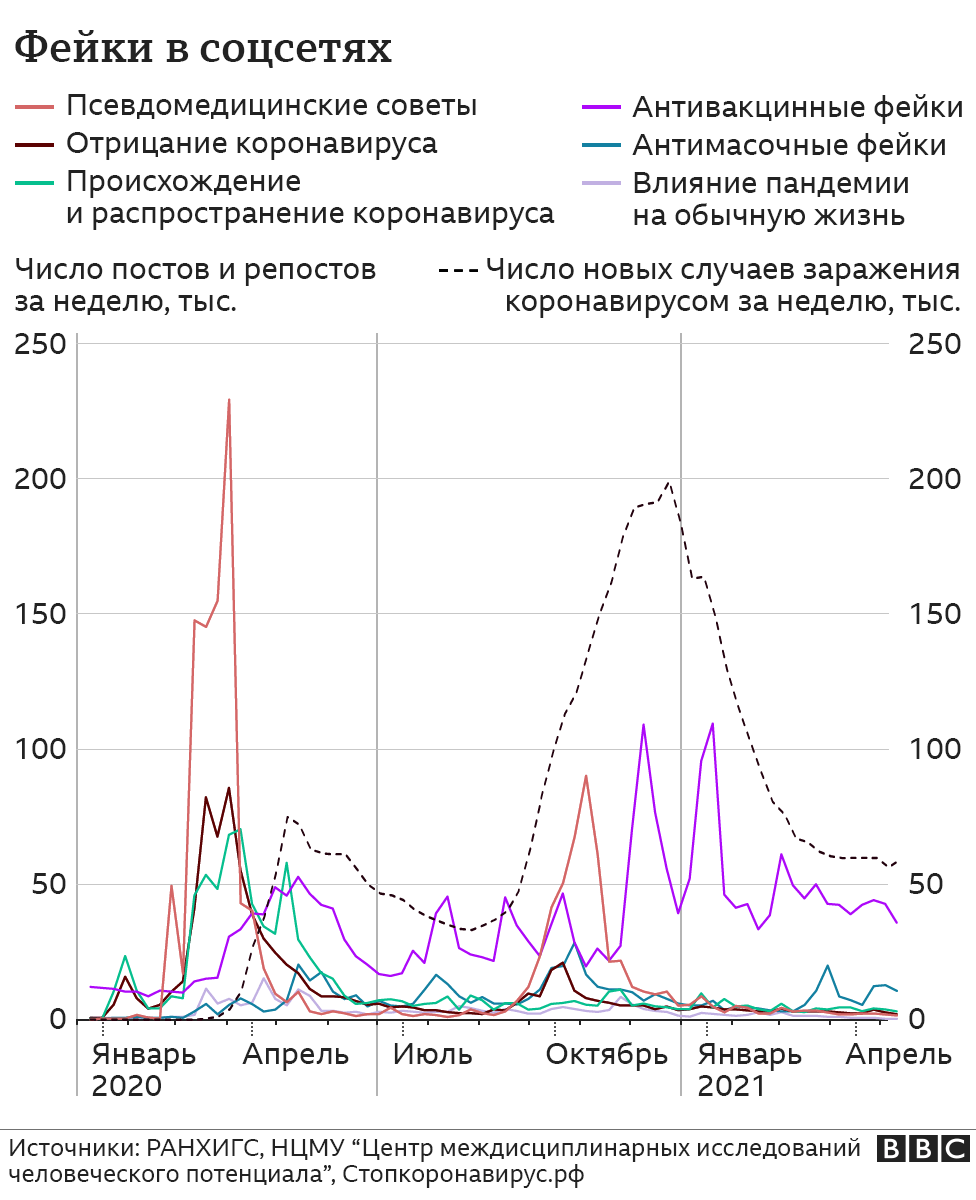
Исследовались различные соцсети, в том числе "Фейсбук", "ВКонтакте", "Твиттер", "Одноклассники". Было зафиксировано более 6 млн постов и репостов, воспроизводящих разные коронавирусные фейки.

"Популярность слухов о вреде прививок от коронавируса связана с тем, что они упали на уже хорошо разработанную почву: разнообразные представления о вреде разных прививок существуют очень давно - в контексте коронавируса они просто актуализировались и немного поменяли содержание", - считает Александра Архипова, научный сотрудник РАНХиГС и специалист Центра междисциплинарных исследований человеческого потенциала.

"Похоже, что в первую очередь людей интересовало самолечение: во всяком случае, больше всего запросов задавали про "Арбидол" и азитромицин, которые якобы помогают от коронавируса", - говорится в сообщении исследователей.


Самый популярный фейк - при Covid-19 надо принимать "Арбидол" и антибиотик азитромицин. Кроме того, большую популярность получил фейк о том, что при коронавирусе следует дышать парами водки и принимать имбирь. [имбирь необязательно, а вотку токо пить !!! не фейк]

Другая группа популярных фейков была связана с вакцинами - в частности, речь шла о Билле Гейтсе, мировом правительстве и "золотом миллиарде". Также в ходу была информация о том, что якобы при вакцинации в тело вводится чип.

Были и антимасочные фейки - о том, что носить маски вредно, и о том, что в масках живут черные черви.

Часть слухов была посвящена происхождению коронавируса. Например, тому, что коронавирус - это чье-то оружие.

Многие пользователи "Яндекса" искали поддельное стихотворение Пушкина о жизни на карантине.

"Есть несколько популярных историй про россиян, которые сообщают что-то из-за рубежа, - говорит Дарья Радченко, научный сотрудник РАНХиГС и специалист Центра междисциплинарных исследований человеческого потенциала. - Например, история про несуществующего русского врача Юру, который якобы работал в Ухани и близко знает и сам коронавирус, и способы борьбы с ним. Или обращение доктора Колосова из Италии, который советовал дышать водкой. Кажется, "свой человек за границей" пользуется у россиян особым авторитетом".

Некоторые фейки оказались особенно популярны в отдельных городах, отмечают авторы исследования.

В Казани чаще, чем в среднем в больших городах России, интересовались фейком о "наночервях", которые живут в масках. Авторы исследования связывают это с жестким масочным режимом, который действовал в городе.

В Сочи был повышенный интерес к фейку о живущей в море бактерии Синтии - ее винили в возникновению коронавируса.

Sunday, May 31, 2020

structural shocks and extreme exposures related to covid

Sex During Coronavirus

Социология коронавируса, сборник статей


In the United States, nearly all states have issued stay-at-home orders. Most people’s lives are legally and structurally confined to their neighborhoods and the resources in those neighborhoods. This means that structural inequality has the potential to be exacerbated rather than reduced.Let’s take two neighborhood profiles. On one hand, people in well-resourced neighborhoods with stocked grocery stores, spacious yards, and telework may largely live their days typing on laptops, accidently displaying their video on Zoom meetings, and exercising on their new Peloton bikes. On the other hand, people in low-income neighborhoods are stuck with limited produce and food options, a reduced public transportation schedule that further exposes them to risks of contracting the coronavirus, and “essential” work with low wages that has not kept pace with inflation and often leads them to serve those living in the well-resourced neighborhood.

The articles in this wave of our COVID-19 special online issue address shocks to social institutions that lead to extreme outcomes. Branch documents how the coronavirus may lead to over policing and a lasting legacy that formalized a surveillance state. Lewis-McCoy and Pothen address how local geographies matter. Lewis-McCoy gives us insights into the lives of people in New Rochelle, New York (considered ground zero of the COVID-19 outbreak in the United States). Pothen discusses how social networks matter during unstable times. Accordingly, it is even more important for scientists to be trusted.

Eyal discusses why the COVID-19 pandemic may be a make or break moment for the science community. He argues it is critically important for academics and scientists to reestablish themselves with the public as a trusted source during an era of perceived “fake news.”

The final three pieces in this issue address how families are being impacted by the coronavirus. Gengler discusses how families simply are not structurally prepared to live in a moment of crisis, while Balboa highlights the strength of family ties. Carpenter ends by discussing sex and the role the coronavirus may have on romantic and sexual relationships.

We hope the articles being released in this special online issue are useful for providing more in-depth analysis beyond headlines and White House meetings where the president discusses TV ratings. People are dying, healthcare providers and frontline workers are trying to preserve their physical, mental, and emotional health, and families are struggling. Social context matters in moments like these for people to put what is occurring on a micro-level in a broader structural context. We believe these articles help to provide this balance.

– Rashawn Ray and Fabio Rojas

Friday, November 1, 2019

Disparities in mortality and marriage create unequal kin safety nets in the USA

Published on N-IUSSP.ORG October 28, 2019

Un filet de sécurité parental plus faible dans les milieux populaires aux États-Unis


Sohn Heeju

Heeju Sohn quantifies the diverging kin networks of adults with low and high socioeconomic status (SES) in the United States. In 2013, high SES adults had about 13 years with parents who were alive and living with each other, while low SES adults had only about 6.5 years. Rising single-parenthood and lagging life expectancy among low SES families are resulting in greater inequalities in kin networks.

When people experience hardship or uncertainty, they often turn to kin for support. Parents are frequent sources of support such as emergency childcare, a down payment on a house, or a place to stay during bouts of unemployment. Parents’ sense of obligation towards their children usually extends beyond the very early phases of their lives, and parents often view their resources as a safety net for their children. Therefore, the longer and healthier the parents live, the longer adult children can benefit from them. It is also the case that adult children whose parents are still married to each other receive more help than children whose parents never married or divorced (Silverstein & Bengtson, 1997).

Inequality in safety nets in the US


Demographic trends in the United States in the past half-century have created unequal parental safety nets between people with different socioeconomic resources. While people are living longer overall, improvements in life expectancy among people with low SES (socio-economic status) are lagging (Sasson, 2016). And while divorce rates have been decreasing among high SES people, non-marital childbearing, single parenthood, and divorce have maintained their historical highs among people with low SES (McLanahan, 2004). These trends portend a fraying of the family safety net for people with few socioeconomic resources.

Do people with low socioeconomic status have potentially weaker parental safety-nets now than before? And what demographic factors contribute to this rising inequality? These questions are often difficult to study, because parents and adult children typically live in different households. In a recent publication (Sohn, 2019) I addressed the data challenge by applying the Brass Orphanhood method on the Panel Study of Income Dynamics (PSID). The PSID is a multi-generational dataset that is nationally representative of the United States. In 1988 and in 2013, respondents were asked whether their parents were still alive, and if so, whether they were married to each other. These responses can be used to create and decompose multi-state life tables of parents’ survival and marital status by their children’s age, SES, and cohort. The analysis focuses on the parental safety-net between age 25 and 49 when the adult child may rely on their parents for support as they start new careers, buy first homes, and start families.

Low SES adults have weaker parental safety nets than 25 years ago


High SES adults in both 1988 and 2013 spent about 13 years with both parents alive and together (Figure 1). A small increase in single-parenthood among their parents between 1988 and 2013 was almost entirely offset by a rise in their life expectancies (Sohn, 2019). The story is starkly different for low SES adults, however. In 1988, these spent about 11.5 years with two parents who were married to each other, but in 2013 this condition lasted for only 6.3 years.¹ And as many as 62 percent of low SES adults in 2013 spent the entirety of their young adulthood (age 25 to 49) without parents who were married to each other (Figure 2); by age 25, only 38 percent had two married parents.


Single-parenthood is the driver of the growing disparity in parental safety nets


In 1988, the death of the father was the primary reason why parents were not living together for both low and high SES adult children: about 10 percent of adults would have experienced the death of a father in the first 10 years of early adulthood. Fathers were living longer in 2013, but this improvement in life expectancy is completely overshadowed by the large rise in the proportion of parents who were never married or divorced. While parents’ union dissolution increased for both high and low SES adults, the rise was significantly greater among parents of low SES adults.

Figure 3 shows the formal decomposition of the increasing disparity in the number of years low and high SES adults have with parents who are married to each other. In 1988, differences in parents’ life expectancies accounted for 97 percent of that disparity, while parents’ non-marital childbearing and divorce accounted for only 3 percent. In 2013, 63 percent of the large socioeconomic disparity was due to the differences in parents’ non-marital childbearing and divorce.

Implications for the next generation


Sarah Mclanahan foreshadowed the “diverging destinies” of high- and low-SES families 15 years ago (McLanahan, 2004). Fifteen years later, I show that the effect of growing up in single-parent families extends into adulthood and is setting up weak kin networks for the next generation of children. In the case of the United States, people who are already disadvantaged in many socioeconomic dimensions are also disadvantaged when it comes to kin-based support. People are living longer, and relationships between grandparent and grandchild are becoming more consequential, and yet, the benefits are likely muted for low SES families.

Low SES adults, who are more likely to be single parents themselves, spend more years with divorced or widowed parents who may not be able to provide emotional and material support. Having a single parent as an adult also increases the risk of becoming a member of the “sandwich generation”, providing care to both young children and aging parents. Children of these low SES adults likely receive less of their parents’ and grandparents’ resources than children of high SES adults who start life with the support of both their parents and grandparents.

References

  • McLanahan, S. (2004). Diverging Destinies: How Children Are Faring Under the Second Demographic Transition. Demography, 41(4), 607–627. https://doi.org/10.1353/dem.2004.0033
  • Sasson, I. (2016). Trends in Life Expectancy and Lifespan Variation by Educational Attainment: United States, 1990-2010. Demography, 53(2), 269–293. https://doi.org/10.1007/s13524-015-0453-7
  • Silverstein, M., & Bengtson, V. L. (1997). Intergenerational Solidarity and the Structure of Adult Child‐Parent Relationships in American Families 1. American Journal of Sociology, 103(2), 429–460. https://doi.org/10.1086/231213
  • Sohn, H. (2019). Fraying Families: Demographic Divergence in the Parental Safety Net. Demography, 1–22. https://doi.org/10.1007/s13524-019-00802-5

¹ These are synthetic measures, which means that they were calculated on the data of a single year (1988 and 2013, respectively) and express what would happen to a cohort of individuals who lived their entire life in those conditions.

Thursday, July 4, 2019

how childless people perform

childlessness
Dr Robin A Hadley
The social networks of older people are a significant influence on their health and wellbeing. Adult children are an important element in their parent's network and provide the majority of informal care. The morphology of personal networks alters with age, employment, gender and relationships. Not having children automatically reduces both vertical familial structure and affects the wider formal and informal social links that children can bring. Childless men are missing from gerontological, reproduction, sociological and psychological research. These fields have all mainly focused on family and women. This paper reports on an auto/biographical qualitative study framed by biographical, feminist, gerontological and lifecourse approaches. Data were gathered from semi-structured biographical interviews with 14 self-defined involuntarily childless men aged between 49 and 82 years old. A latent thematic analysis highlighted the complex intersections between childlessness and individual agency, relationships and socio-cultural structures. The impact of major lifecourse events and non-events had significant implications for how childless people perform and view their social and self-identity. I argue that involuntary childlessness affects the social, emotional and relational aspects of men's lived experience across the lifecourse.

Doi: 10.1017/S0144686X19000837
Publication Date: 2019
Publication Name: Ageing & Society

Saturday, September 21, 2013

networking

от социальных сетей уже голова болит
ушед из ЖЖ, тут скушноватко, но спокойно
отлично от ФБ, где буяит, отнимая время
из других сетей пользую SlideShare, ResearchGate, LinkedIn, Academia + пользуемыйе как почта для контактов с парой приятелей Однокласнеги
мб, чо и забыл ?
попробовал Манда лай, не пошло, теперь наткнулся на Figshare -- кто-нить пробовал?