Showing posts with label моделирование. Show all posts

Wednesday, July 5, 2023

The Hidden Footprint

Paris Fall/Winter Couture Week kicks off today. The industry as a whole has come under scrutiny in recent years for its huge environmental footprint, be it through resource use, pollution or unsustainable materials. But one element that is somewhat overlooked is the impact of the many shows themselves. And there are many - while London, Milan, Paris, New York make up the ‘big four’, there are many more in other cities, including major trade shows in Copenhagen, Tokyo and Seoul. Not to mention that womenswear and menswear often have different collections for both the Spring/Summer season and another for Fall/Winter, as well as Pre-Fall and Resort lines.

Carbon Trust & ORDRE collected data on the emissions generated from the business travel of designers and buyers attending fashion weeks and collections in a year. The researchers found that in the 12 months starting from the Spring/Summer 2018 season, a total of 241,000 tonnes of carbon emissions were created from air travel, accommodation, intercity travel and the transportation of collections by roughly 11,000 individual retail buyers and 5,000 designers. That’s more than the 2017 greenhouse gas emissions of Saint Kitts and Nevis (238,000 tCO2e), and would be enough to light up Times Square, New York City for 58 years.

The following chart shows that New York was the city whose fashion weeks had the worst environmental impact worldwide, responsible for 60,000 tCO2e that year alone, followed by Paris with 45,000 tCO2e and London with 28,000 tCO2e. The average carbon footprint for a buyer is 12.1 tCO2e while the average footprint for a designer employee is 7.6 tCO2e.

According to the report, these are even likely conservative estimates, considering the fact the research only focused on the travel emissions associated with the commercial aspects of fashion weeks and collections, i.e. the movements of designers and buyers, rather than all other groups such as the media and influencers.

This report has fuelled already mounting global pressure to improve the sustainability of the fashion industry. While there’s still some way to go, the calls have been heeded by many companies. For example, London Fashion Week June 9-12 is a hybrid of both online and real life, while Copenhagen Fashion Week introduced a number of requirements around the business practices and materials designers must abide by in order to be included in the show.

The writers of the report recommend several steps to improve the emissions generated in future years, including avoiding flying business class which has a higher carbon footprint per passenger than economy class, seeking to combine long distance trips, choosing to travel by train rather than flying where possible and combining seasons and collections.

The scope of the research included travel to and from fashion weeks, travel within cities during fashion weeks, staff accommodation, and the transportation of collections, including at collections in Amsterdam, Antwerp, Auckland, Barcelona, Beijing, Berlin, Brussels, Chicago, Copenhagen, Düsseldorf, Florence, Las Vegas, Los Angeles, Madrid, Munich, Naples, Seoul, Shanghai, Stockholm, Tokyo and Zurich.The Hidden Carbon Footprint of the Fashion Industry

Sunday, October 23, 2022

Handbook of Palaeodemography

This book series is devoted to publications of international relevance in population studies and demography as promoted by the French National Institute for Demographic Studies (INED, Paris). As one social science among many, demography is interlinked with related disciplines such as sociology, anthropology, history or linguistics, and continuously explores its boundaries with neighbouring disciplines, ranging from epidemiology and biology to economics. The studies published in this series are based on solid empirical research and firm methodological foundations or research findings. Particular attention is paid to long-term and/or collaborative surveys.

The series provides international visibility toworks of high academic standard, and promotes an internationally acknowledged style of demographic research, upheld by INED for more than half a century and rekindled in various fields such as the study of demographic situations around the world, the relationship between demographic conditions and development; international comparisons; migration, identities and territories; family studies; gender studies and sexuality; ageing, health and mortality; trajectories, mobility and social networks.

INED Population Studies Volume 2
Editors
Eric Brian and Jean-Marc Rohrbasser Editorial Advisory Board Isabelle Attane, Didier Breton, Youssef Courbage, Olivia Ekert-Jaffe, Cecile Lefevre, Godelieve Masuy-Stroobant, Wilfried Rault, Arnaud Re´gnier-Loilier, Claudine Sauvain-Dugerdil

παλαιός — древний (по древнегречески), то-есть, про модели гл.обр.

Monday, October 3, 2022

it was a modernization

Рассматриваются проблемы стратегического проектирования социально-экономического развития России, национальных интересов России в изменяющемся мире, модернизации российской экономики на основе инновационного и технологического развития, демографического и регионального развития, модернизации российского здравоохранения, образования и науки. В ежегоднике представлены материалы XVII Международной научной конференции «Модернизация России: приоритеты, проблемы, решения», проведенной в рамках Общественно-научного форума «Россия: ключевые проблемы и решения».

Wednesday, September 21, 2022

murder and suicide

2019, Социологические исследования
https://doi.org/10.31857/S013216250003753-1
Publication Date: 2019

Уровни смертности от убийств и самоубийств – индикатор благополучия общества и ценности человеческой жизни. После 2000-х гг. в России они демонстрируют уверенное снижение. Однако другой блок причин смерти, повреждения с неопределенными намерениями, являющийся резервуаром латентных убийств и самоубийств, стремительно растет и с 2014 г. превышает совокупный уровень смертности от убийств и самоубийств. В результате фактические данные об убийствах и самоубийствах оказываются недооцененными. Ситуация усугубляется, поскольку региональные практики кодирования причин смерти могут в значительной степени деформировать структуру смертности, отчего недостаточно простого пропорционального перераспределения повреждений с неопределенными намерениями внутри класса «Внешние причины заболеваемости и смертности» МКБ-10. Цель данной работы – оценить реальный уровень смертности от убийств и самоубийств с использованием модельного региона, в котором доля повреждений с неопределенными намерениями минимальна. Предложен алгоритм, позволяющий существенно уточнить решение задачи. Для отдельных регионов в зависимости от принятой гипотезы перераспределения повреждений с неопределенными намерениями продемонстрирован значимый недоучет конкретных причин смерти.

Sunday, September 18, 2022

semantic field of modern Russian parenthood

Реконструируется смысловое поле современного российского родительства. На материалах эмпирического исследования выделяются идеал-типические модели родительства: родительство как репродукция, как подтверждение гендерной нормативной роли, как обязанность, как один из жизненных проектов, как сфера самореализации. Представлены основные содержательные характеристики каждой из реконструированных моделей.

Monday, January 31, 2022

mortalite, fatalite, letalite

где собака порылась? – никак понять не могу

Какова «истинная» смертность от COVID-19? Ответа на это вопрос нет, и он вряд ли будет


На сегодня (18-1-2022) по официальным данным с начала пандемии COVID-19 в мире от него умерло около 5,6 миллиона человек. То, что реальное число смертей больше, мало у кого вызывает сомнения. Но насколько больше? В последнем номере Nature (датирован 20 января 2022) опубликована статья, озаглавленная «The efforts to count the pandemic’s global death toll” (в вольном переводу: «Усилия для подсчёта глобального числа смертей от СOVID-19»). Это не научная статья, а популярное описание научных подходов, используемых в этой области. В самый раз для меня - неспециалиста по демографии, медицинской статистики и математических моделей. Полагаю, она будет интересна и читателям моего блога.

Начну с конца. Вывод, причём не только автора-журналиста, но и профессионалов, мнение которых он цитирует - на сегодня нет достоверного способа оценить глобальное число смертей от COVID-19. И дело не только и не столько в том, что у многих стран достоверная статистика смертности отсутствует. Основная проблема связана с неопределённостями в определении «ожидаемой смертности» (того, какой бы она была бы, если бы не пандемия). Значение ожидаемой смертности предопределяет «избыточную смертность». А ведь последняя является главным «инструментом», используемым для «поправки» официальных данных о смертности от COVID-19. Казалось бы, всё ясно – избыточная смертность это разница между смертностью реальной и ожидаемой, при условии отсутствия эпидемии. Но как подсчитать ожидаемую смертность? С моей «дилетантской колокольни» это было совсем неочевидно. Вот лишь несколько вопросов, однозначного ответа на которые нет. За сколько лет усреднять? Как учитывать изменения возрастной структуры популяции и общем уровне здоровья населения? Вклад природных катаклизмов?

Для любителей простых решений замечу, что по мнению экспертов демографов, приведённому в статье, широко распространённый способ расчета ожидаемой смертности (усреднение за предшествующие пять лет) удовлетворительным считаться не может.

Необходим более «утончённый» подход, что и реализуется в различных математических моделях. Проблема в том, что таких моделей может быть «сконструировано» очень много, но какая из них даёт «правильную» оценку определить невозможно. А предсказания разных моделей отличаются, порой разительно. Для примера, на рисунке ниже представлены предсказания избыточной смертности в Японии (мало у кого в мире медицинская статистика лучше). Расчёты сделаны двумя «популярными» математическими моделями - журнала The Economist и авторитетного американского исследовательского института IHME (Institute of Health Metrics and Evaluation). Cиняя кривая – официальные данные, красные кривые – предсказания каждой из моделей, бледный тон - 95% доверительные интервалы.

Как видите предсказания моделей, даже в таком относительно «лёгком» случае как Япония, противоположны. Кстати, значимые детали этих моделей пока не опубликованы, и они корректируются в «закрытом режиме». В результате первоначальная оценка модели IHME для США из 900 тысяч превращалась в 670 тысяч. Так можно ли доверять предсказаниям этих моделей, хотя они сейчас и на слуху? На мой взгляд, нет. А ведь эти предсказания нередко преподносятся как «разоблачительные».

На этом остановлюсь. Но замечу, что статья значительно детальнее моего поста о ней. В ней ещё много интересного, включая довольно неожиданный для меня подход – подсчёт могил на кладбищах крупных городов по спутниковым снимкам. Так-что советую постом не ограничиться и ознакомится с оригиналом.

Thursday, January 13, 2022

Remodelling social surveys – trade-offs and opportunities

In recent years there has been a trend towards face-to-face surveys exploring push-to-web, web-first and mixed-mode options.

This process has been accelerated by the COVID-19 pandemic, which has shown how fragile reliance on a single mode can be.

But switching approaches or implementing mixed-mode designs involve complex trade-offs regarding representation, measurement, respondent experience, time and cost, which are rarely fully understood.

The National Centre for Social Research (NatCen)’s new Centre for Social Survey Transformation has been launched to explore the lessons learned from the last two years and to help understand these trade-offs.

At this survey methodology seminar, NatCen will discuss how they are transforming data collection activities, introducing their REMoDEL approach. REMoDEL stands for Review Evaluate Model Design Experiment Launch.

This approach provides a clear, systematic process for transforming social surveys and generating robust evidence around the trade-offs involved.

The webinar will focus on the British Social Attitudes (BSA) transformation programme, which aims to explore the feasibility of transitioning BSA to a mixed-mode design.

The team will summarise steps taken so far, exploring key findings on sample composition and comparative estimates, and will outline future plans based on these findings.

Finally, NatCen will explore the challenges and opportunities that lie ahead for social surveys.
About the speakers:

Peter Cornick

Peter Cornick is the Director of NatCen’s Centre for Social Survey Transformation. In this role he leads multidisciplinary teams to deliver methodological, analytical and developmental research projects.

He advises on methodological challenges, helping survey commissioners and methodologists to investigate and understand complex problems and processes.

He brings a wealth of experience in survey design and delivery. He has worked in applied social research for more than 15 years and has led some of the country’s foremost social research studies, including the British Social Attitudes (BSA) survey and the National Travel Survey.

Shanna Christie

Shanna Christie is a Research Director within the Centre for Social Survey Transformation.

She has over ten years of experience using predominantly quantitative research methods and has developed significant expertise in survey methodology.

Shanna is currently leading an experiment as part of the BSA Transformation Programme.

It also involves designing and implementing a study that aims to transition the traditional and long-standing paper travel diary on the National Travel Survey to a digital approach.

Shane Howe

Shane Howe is a Senior Researcher in the Centre for Social Survey Transformation.

His experience focuses on quantitative methods with an emphasis on a survey and questionnaire design.

He has recently been part of several projects which aim to understand the impact of shifting modes on survey data and minimise disruption to trend series data.

Attendance at City events is subject to our terms and conditions.

Thursday, November 25, 2021

Towards Bayesian Model-Based Demography

Thursday, 9 December, at 2-3 PM CET
Online, Zoom (in English)

The main objectives of the book are to pursue methodological advancement in demography and migration studies through combining agent-based modelling with empirical data, Bayesian statistical inference, appropriate computational techniques, and psychological experiments in a streamlined modelling process, with the overarching aim to contribute to furthering the model-based research agenda in demography and broader social sciences.

Authors
Prof. Jakub Bijak, Dr Martin Hinsch and Dr Sarah Nurse, University of Southampton; and Prof. Adelinde Uhrmacher, University of Rostock

Panellists
  • Prof. Alexia Fürnkranz-Prskawetz, Vienna University of Technology and Vienna Institute of Demography (VID)
  • Dr Eric Silverman, University of Glasgow
  • Prof. Frans Willekens, Netherlands Interdisciplinary Demographic Institute (NIDI)
Foreword by Prof. Daniel Courgeau, French Institute for Demographic Studies (INED)
If you have questions or problems signing up, please contact us at events@population-europe.eu

Sunday, August 8, 2021

MoH draft plan on mortality in 2021

МЗ планирует следующие показатели на 2021 год, вопрос не до конца согласован, но проект есть.
РФ в целом = 71.69, что на .15 меньше, чем в 2020 году, .15 — это практически длинный месяц
стобы не искать подолгу Москва=76.37, СПб=74.34

Friday, August 6, 2021

The adverse consequences of global harvest and weather disruptions on economic activity

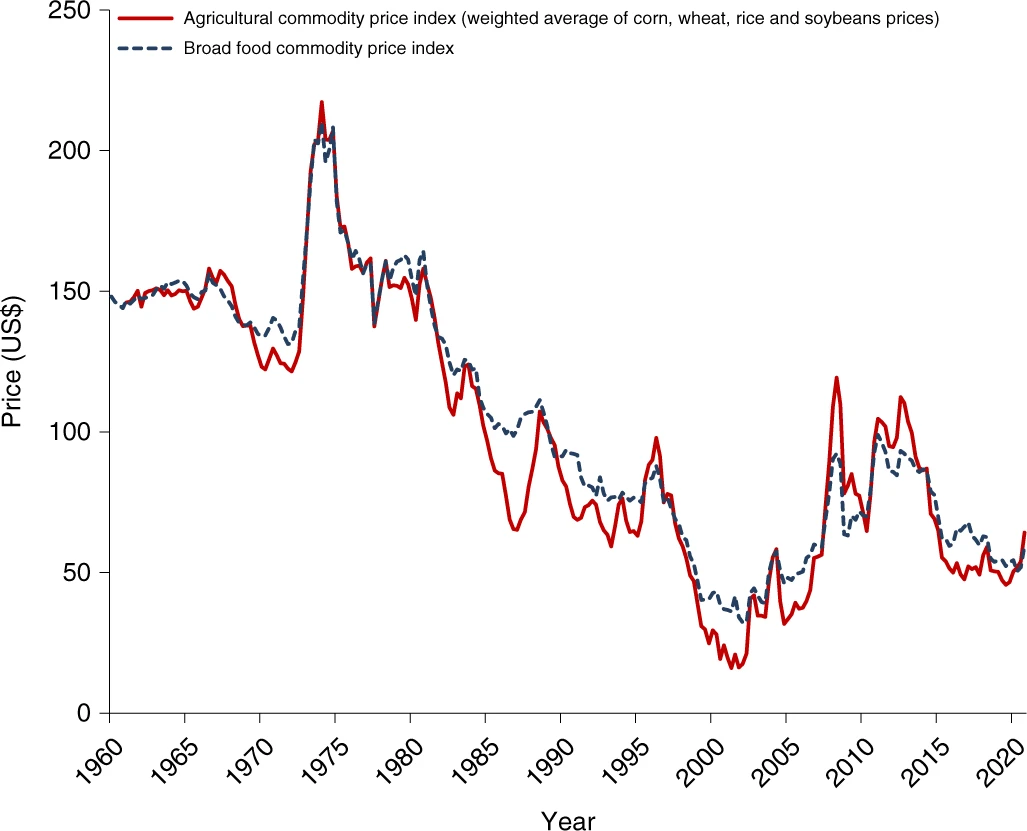
Extreme weather events are expected to increase with climate change. Such events are detrimental to local economic activity but could also affect countries that are not directly exposed through global agricultural production shortfalls and price surges. Here, estimations for 75 countries show that increases [видишь суслика?] in global agricultural commodity prices caused by harvest or weather disruptions in other regions of the world significantly curtail economic activity. The impact is considerably stronger in advanced countries, despite relatively lower shares of food in household expenditures. Effects are weaker when countries are net exporters of agricultural products, have large agricultural sectors, and/or are less integrated into global markets for non-agricultural trade. Once we control for these characteristics, the relationship between the country’s income per capita and the economic repercussions becomes negative. Overall, these findings suggest that the consequences of climate change on advanced countries, particularly through food prices, maybe larger than previously thought.

Evolution of global real agricultural commodity prices over time

The agricultural commodity price index is a trade-weighted average of the prices of corn, wheat, rice and soybeans. The broad food commodity price index is a trade-weighted average of benchmark food prices for cereals, vegetable oils, meat, seafood, sugar, bananas and oranges. All prices are in US$ and measured as 100 times the natural log of the index, deflated by US CPI. Data from the IMF (https://data.imf.org/).


A sustainable development pathway for climate action within the UN 2030 Agenda

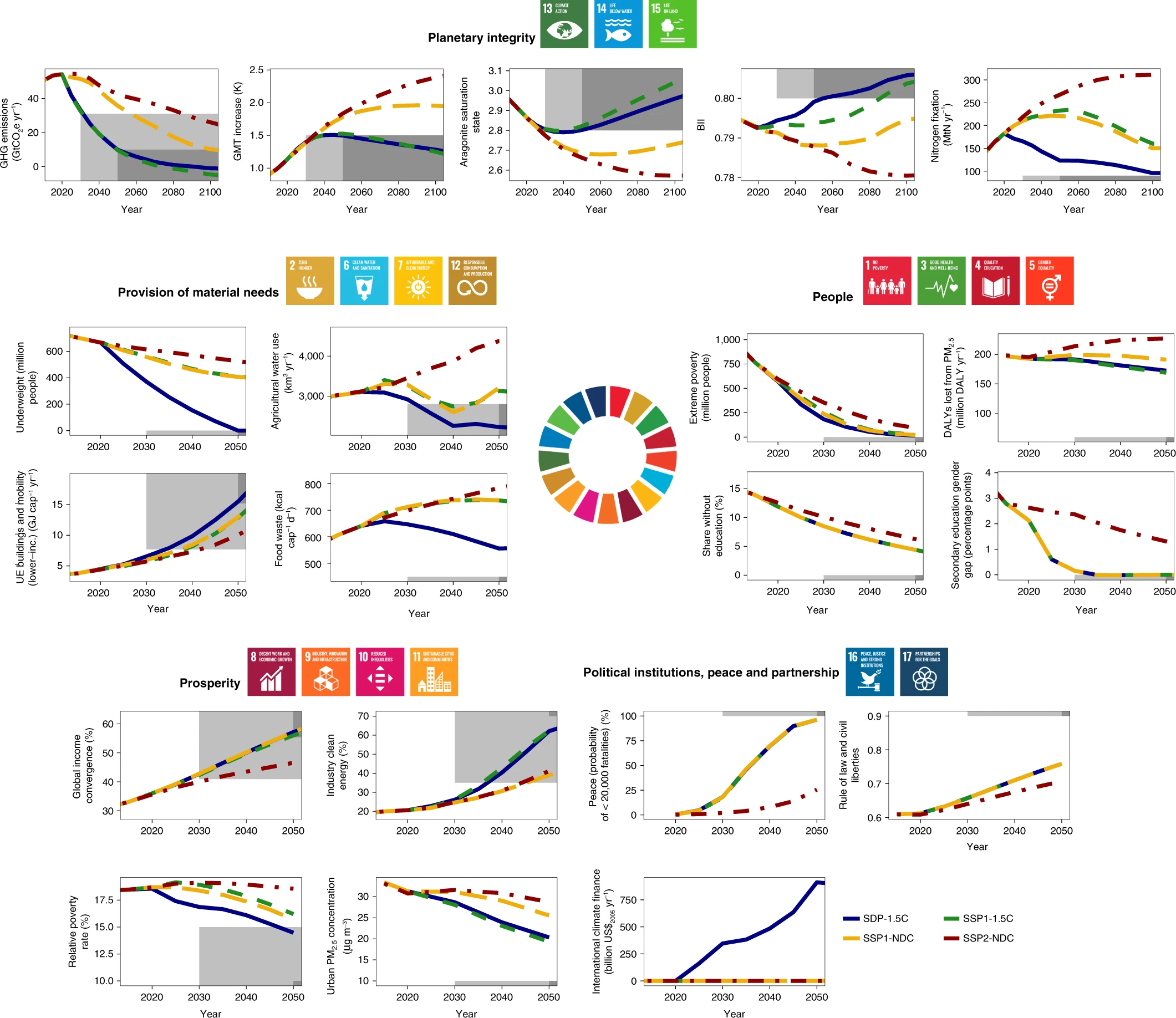
Ambitious climate policies, as well as economic development, education, technological progress, and less resource-intensive lifestyles, are crucial elements for progress towards the UN Sustainable Development Goals (SDGs). However, using an integrated modeling framework covering 56 indicators or proxies across all 17 SDGs, we show that they are insufficient to reach the targets. An additional sustainable development package, including international climate finance, progressive redistribution of carbon pricing revenues, sufficient and healthy nutrition and improved access to modern energy, enables a more comprehensive sustainable development pathway. We quantify climate and SDG outcomes, showing that these interventions substantially boost progress towards many aspects of the UN Agenda 2030 and simultaneously facilitate reaching ambitious climate targets. Nonetheless, several important gaps remain; for example, with respect to the eradication of extreme poverty (180 million people remaining in 2030). These gaps can be closed by 2050 for many SDGs while also respecting the 1.5 °C target and several other planetary boundaries.

Overview of headline SDG indicator values grouped into five clusters

We compare our sustainable development pathway scenario (SDP-1.5C) to a number of other scenarios (main text). Grey shaded areas illustrate the target values (light shading for 2030 and dark shading for 2050), where available. All indicators are global sums or (population-weighted) averages, with the exception of useful energy (UE) per capita where we show an average of lower-income regions (REMIND–MAgPIE regions, Sub-Saharan Africa, India, East Asian countries except for China and Japan). ‘Global income convergence’ is the ratio of global GDP per capita to the OECD GDP per capita. For the ‘planetary integrity’ cluster we show results until 2100; otherwise, we restrict them to the time horizon until 2050. DALYs, disability-adjusted life years; PM2.5, fine particulate matter (diameter <2.5 μm); cap, capita; BII, biodiversity intactness index.


Thursday, July 29, 2021

The interplay between COVID-19 restrictions and vaccination

by Chad R Wells, Alison P Galvani

March 31, 2021 DOI:https://doi.org/10.1016/S1473-3099(21)00074-8

An intervention is only as effective as the extent to which people are willing to adopt recommended measures. One obstacle to the success of COVID-19 interventions, especially in the USA, has been the politicisation of control measures, including the adoption of masks and physical distancing. Interplay between acceptance of non-pharmaceutical interventions and vaccination shapes local transmission dynamics. Despite the importance of human behaviour to the epidemiological trajectory, the integration of these interdependent factors into COVID-19 vaccination models has rarely been done. In The Lancet Infectious Diseases, Peter Jentsch and colleagues account for these considerations in their assessment of COVID-19 mortality under different vaccination programmes.

Multifaceted approaches are necessary to control the spread of SARS-CoV-2, particularly in the months before widespread vaccination coverage is achieved. However, the staunch opposition to non-pharmaceutical interventions among a substantial proportion of some populations has hampered control of the outbreak. Only 65% of Americans report consistently wearing a mask in public.
 The willingness to wear a mask in public was also found to be heterogeneous among different regions in the USA and across time.
 For example, willingness to wear a mask regularly varied from 57% in the midwest region to 87% in the northeast region. 
This heterogeneity in behaviour is especially precarious given that vaccine uptake is similarly clustered. As of March 4, 2021, the median proportion of the population who had received at least one dose of COVID-19 vaccine across the nine states in the northeast region was 6% greater than the median for the 12 states in the midwest. 
Conversely, regions with lower adherence to non-pharmaceutical interventions will require higher levels of herd immunity to interrupt transmission [почему?] and could prolong the epidemic throughout the country and beyond by continuously seeding cases.
Risk perceptions are fundamental drivers of behavioural shifts.
Consequently, the adoption of non-pharmaceutical interventions is likely to wane as vaccination becomes more widespread and prevalence falls. Even before the effects of vaccination campaigns are fully realised, their initiation could boost optimism which might, in turn, lead to the relaxation of non-pharmaceutical interventions. Jentsch and colleagues 
developed an innovative multilevel epidemiological model accounting for the temporal response of public health authorities in concert with alternative vaccination strategies, integrating population acceptance of non-pharmaceutical interventions using game theory. By considering the effect of vaccination on the implementation and practice of non-pharmaceutical interventions, the projected burden of COVID-19 during a vaccination campaign is more realistic than if these components were neglected.
The data-driven analysis used in this study
 was informed by age-stratified case counts, mobility, and seroprevalence data for Ontario, Canada, over the course of the COVID-19 epidemic. Their simulations show that prioritising young individuals (aged <20 years) for COVID-19 vaccination is never the optimal strategy to minimise deaths. 
This result is attributed to the assortative mixing patterns, along with the disproportionate fatality rates between young people and older adults.
 Differences in the age-specific likelihood of vaccine refusal further underscore the greater public health impact of targeting older people (aged ≥60 years). Specifically, only 53·5% of individuals aged 18–49 years report a willingness to vaccinate compared with 75% for individuals aged 65 years and older. 
Prioritizing older people in long-term care homes could be essential in reducing mortality, given their increased vulnerability, the rapid rate of spread within the homes, and that a concerning proportion of care workers are unwilling to be vaccinated.
 In an extension of their baseline model, Jentsch and colleagues
 also considered vaccine refusal over the course of the campaign.
To promote concomitant vaccination uptake and non-pharmaceutical intervention adherence, there are myriad approaches that have proven effective. Although data from the Guttman Center for Public Opinion Research and Policy at the Israel Democracy Institute have shown substantial initial vaccine hesitancy in Israel, the country has achieved the highest vaccination coverage worldwide so far by employing multiple strategies to alleviate concerns, maximise access, and streamline distribution.
 Rapid vaccination was facilitated by extensive education campaigns regarding vaccine safety and efficacy, establishment of vaccination sites throughout the country, including remote areas, and efficient centralisation of funding and coordination through their national health-care system.
 6 weeks into the vaccination campaign, 34·9% of Israel's population had received at least one dose of the vaccine, in contrast to 9·4% in the UK, 7·2% in the USA, 2·8% in France, and 2·4% in Italy.
The reductions in transmission that are achieved by adherence to non-pharmaceutical intervention and vaccination recommendations also decelerates the evolution of the virus. The emergence of more transmissible variants exacerbates the COVID-19 pandemic, particularly if vaccines are less efficacious against the novel variants. Any erosions in vaccine efficacy make non-pharmaceutical interventions all the more imperative. Reciprocally, fatigue over non-pharmaceutical interventions and the ensuing degradation in adherence requires urgent acceleration in vaccination coverage.

Sunday, June 6, 2021

Inferring number of populations and changes in connectivity under the n-island model

population models
Population Models
Inferring the demographic history of species is one of the greatest challenges in populations genetics. This history is often represented as a history of size changes, ignoring population structure. Alternatively, when structure is assumed, it is defined a priori as a population tree and not inferred. Here we propose a framework based on the IICR (Inverse Instantaneous Coalescence Rate). The IICR can be estimated for a single diploid individual using the PSMC method of Li and Durbin (2011). For an isolated panmictic population, the IICR matches the population size history, and this is how the PSMC outputs are generally interpreted. However, it is increasingly acknowledged that the IICR is a function of the demographic model and sampling scheme with limited connection to population size changes. Our method fits observed IICR curves of diploid individuals with IICR curves obtained under piecewise stationary symmetrical island models. In our models we assume a fixed number of time periods during which gene flow is constant, but gene flow is allowed to change between time periods. We infer the number of islands, their sizes, the periods at which connectivity changes and the corresponding rates of connectivity. Validation with simulated data showed that the method can accurately recover most of the scenario parameters. Our application to a set of five human PSMCs yielded demographic histories that are in agreement with previous studies using similar methods and with recent research suggesting ancient human structure. They are in contrast with the view of human evolution consisting of one ancestral population branching into three large continental and panmictic populations with varying degrees of connectivity and no population structure within each continent.

pdf

Thursday, April 1, 2021

in a visual world if you aren't noticed you just don't exist

The Rise And Rise Of The Spornosexual


Max Olesker spent three months in the gym to find out what ripped-to-shit feels like


By Max Olesker

Even now, still, it's 'Brad Pitt in Fight Club'. That's the body blokes ask for," says personal trainer Tim Walker. "He looks great but he's not massive. He's just got really good abs, good arms and an alright chest. And that's what people want: to be lean, have a six pack." Walker, 34, from Essex, has been a personal trainer since 2003, and for the last 12 years has specialised in transforming men's physiques in 12 weeks. "My clients tend to be from 20 to around 50 years old," Walker says. "I'm training one bloke who's 57." The programme is intense and comprehensive, consisting of four weekly one-on-one sessions with Walker plus "homework" (think sprints, press-ups and cardio) and a complete diet overhaul. It's a schedule I have agreed to undertake.

I'm embarking on Walker's three-month Warrior Workout because I'm investigating men's bodies. That is, ahem, I'm investigating the trend of men getting increasingly… ripped. Jacked. Pumped. Whatever you call it, it's a certain type of "fit". "There's this big thing now called 'physique training'," Walker says. "It's all about having abs, looking like a fitness model." It's a look that has come to prominence in recent years. "It used to be bodybuilding," Walker adds, "but that look's unattainable — you have to take steroids. With physique training, instead of spending 10 years trying to build mass, you just get really lean."

This tendency towards buffness is a cultural phenomenon defined by author and journalist Mark Simpson as "spornosexuality". The term, denoting men who strive to look like sportsmen or porn stars, marks the next stage in the evolution of the preening, mediated "metrosexual" (a word Simpson introduced to the public consciousness in a 1994 article in The Independent, then popularised in a 2002 piece for US news site salon.com).

Simpson first began writing about "sporno" culture in 2006, noting the rise in hypersexualised, homoprovocative imagery of sportsmen: Dolce & Gabbana's fashion shoots featuring the Italian national football team in the shower in 2006; Freddie Ljungberg on the cover of Attitude magazine; the French rugby players of the Dieux du Stade nude calendars. The concept appeared as one of the New York Times' 2006 Ideas of the Year. In 2014, Simpson pronounced the metrosexual finally dead — superseded by the spornosexual.

The spornosexual is a more extreme breed of man than his metro forebear. He is just as plucked, tanned and moisturised, but leaner, buffer, more jacked and obsessed not just with "looking good" in the abstract, but with the actual physical proportions of his frame: the striation of his abs, the vascularity of his biceps, the definition of his calves.

He defines himself less by the clothes he wears than by his HD-ready body, which is perpetually ready to be ogled on the beach, admired on the high street as it bursts out of a skin-tight plunging V-neck T-shirt, or rubbed-up-against under the flickering strobe of an Essex nightclub. He was defined as the "modern British douchebag" by writer Clive Martin in Vice, who described him as "an erection in a vest. A walking, preening monument to the British masculinity crisis, a sports science Übermensch with an indecent exposure charge to his name."

Do I want to become one of… those people? A tattooed, deep-tanned, skin-tight-V-neck-T-shirt-wearing, fist-pumping #lad? Well, no. Definitely not. But do I want to shake off the soft, doughy outer layer that working life and indolence have led me to develop? To acknowledge and then do battle against the stringy arms, appalling posture and incipient gut that I must have privately decided to ignore at some point in my mid-twenties? To devote myself, shamelessly, to the cultivation of my physique, radically change my lifestyle and try and look like (or, at the very least, feel like) some completely unattainable combination of Cristiano Ronaldo in an underwear shoot and Chris Hemsworth as Thor? To attempt to spornolize my body? Yes. Yes, I do.

Partly it's just vanity, obviously. A desire to find out what it feels like to be lean, strong and muscular. To walk around with the swagger of someone who is no longer in denial about their waist measurement. To show off to my mates, to impress my girlfriend. But there's also a different sort of curiosity. A slight case of Fear Of Missing Out that stems from the worry that, at 27, I only missed out on being engulfed by sporno culture by a few short years.

I mention this to Walker. "Yeah, it's not my generation that's properly into it, but the one below. The guys in their early twenties," he says. The creeping awareness that being hench now seems to be de rigueur for lads a few years younger than me was what prompted my investigation into the phenomenon in the first place. I just want to know what it feels like. Is that so wrong?

The night before my Warrior Workout programme begins, I go to a restaurant with my girlfriend and eat my last unhealthy meal (cheeseburger, thick-cut chips, two glasses of red wine, a side-order of dread). While I am dimly aware of what might lie ahead, I am acutely aware that Walker recently helped Men's Health writer Jamie Millar achieve an extraordinary, cover-model physique. The bar has been set high (and loaded with weights). It begins.

The next day, Walker measures me. I'm out of shape. Not fat-fat, but deeply unremarkable. The weak, soft, shapeless frame of a 27-year-old man with a career involving zero physical exertion. Walker documents my not-particularly-vital statistics in a Google spreadsheet, and then we get down to the business of lifting weights. It's absolute hell. Throughout my first session with Walker — a punishing, non-stop bombardment of squats, chin-ups, dead lifts, press-ups, shoulder presses and rows — I spend the hour attempting not to throw up. After our second — a leg-obliterating succession of squats, lunges and dead lifts — I take 20 minutes to walk to a destination Google Maps tells me is approximately 500m from the gym.

Very gradually, though, I start to adjust. Dormant muscle fibres begin to flicker to life. My lung capacity starts to improve. The workouts become almost… enjoyable? I start to get into a rhythm. I keep pumping iron and attempt to trace the sporno movement back to its source.

Hugh Jackman tweeted, "If the bar ain't bendin', then you're just pretendin'," when he was preparing for 2014's X-Men: Days of Future Past. The tweet is accompanied by a picture of the actor deadlifting 180kg and looking, as many online commentators noted, both huge and jacked. The most impressive thing about Jackman's transformation is not just how stacked his Wolverine has become, it's how much more stacked his Wolverine has become since the first time he played the character.

Look at the evidence. In 2000, Jackman's physique is athletic but not otherworldly. Over the course of the subsequent six films in the X-Men franchise, he grows increasingly lean and muscular. By the time he appears in last year's outing, filmed when Jackman was some 44 years of age, he's an absolute beast.

At this point, it's worth clarifying the nature of "metrosexuality" as Mark Simpson originally meant it, that is, not as shorthand for "bloke who uses moisturiser". "Metrosexuality is, in a paradox that Wilde would have relished, not skin deep," he told The Telegraph. "It's not about facials and manbags, guyliner and flip-flops. It's not about men becoming 'girly' or 'gay'." Rather, it's about the young-man-as-mediated-individual.

A product of the myriad pressures exerted on him by gleeful marketeers pumping aspirational imagery of men into pop videos, fragrance adverts, TV shows, filmsand magazines such as this one. Simpson says, "It's about men becoming everything. To themselves. Just as women have been encouraged to do for some time."

Spornosexuality, then, places further pressure on men by requiring them to not only tick all of the metro boxes (ie, looking groomed, smelling good, dressing exclusively in branded clothing) but also to adhere to a specific physical ideal. It's an improbable, sporty, porny, ripped-to-shit ideal, and means that men are increasingly beholden to the same unrealistic body expectations that have long plagued women, with the abdominal "V-line" becoming as fetishised as the "thigh gap".

With the spornosexual movement in full flight, men are now constantly bombarded with potent imagery of celebrities with improbable physiques: some of the most potent and pervasive are from Hollywood. Which leads us back to Wolverine and his deadlifts…

Jackman is not alone: Hollywood's leading men have been getting buffer for some time. The strapping, athletic physique of Christopher Reeve's 1978 Superman looks puny in comparison to the extraordinary proportions of modern Man of SteelHenry Cavill. Michael Keaton's Batman got by in a plastic muscle suit, as did Val Kilmer and George Clooney, but not so Christian Bale, who in 2005 debuted a Dark Knight who looked as pumped without the suit as he did with it (your move, Ben Affleck).

That same year, Daniel Craig signed up to inherit the role of James Bond. The spy, an enduring archetype of aspirational Hollywood masculinity, never needed a six-pack before, but in the modern, sporno era it is as essential a tool in Bond's arsenal as the hover-gondola was to Roger Moore in Moonraker. Daniel Craig, in unveiling his eye-popping physique as he strode out of the sea, gave us the first Bond who required that his protein be shaken not stirred. Or, as Simpson puts it, "With Craig, Bond finally became his own busty Bond Girl."

That's not to say Hollywood hasn't been plying us with images of muscular men since the year dot, from broad-shouldered swimmer Johnny Weissmuller's Tarzan in the Thirties to bodybuilder Steve Reeves' Hercules in the Fifties (and subsequent identikit sword 'n' sandals heroes).

Arnie, of course, dragged bodybuilding into the mainstream with his star-making turn as Conan the Barbarian in 1982, but he, too, was an outsider. Despite lacing many of his roles with wry humour, Schwarzenegger remained an unknowable freak attraction: his Olympian frame forged from superhuman Austrian willpower and futuristic robot technology. He did not seem mortal and was rarely presented as such.

In the modern era, however, the spornolized Hollywood star has a body like a Greek statue as a matter of course. Matt Damon, 44, is reprising his role as pumped-up secret agent Jason Bourne, Brad Pitt is still lean at 51 and Channing Tatum has retained the body he first monetised when working as a stripper. Even Chris Pratt, Parks and Recreation's very own bumbling man-child Andy Dwyer, transformed himself from cuddly to chiseled for his role in Guardians of the Galaxy. Despite superhero movies' copious use of CGI, the real-life transformation of an actor's body is inevitably one of the most crowd-pleasing special effects it is possible to achieve.

Hollywood, however, is losing ground to a faster, more democratic means of distributing body-image-warping content — social media. Indeed, in a society where nearly everyone carries an internet-enabled HD camera in their pockets, the internet provides the perfect platform for spornos to broadcast their achievements to the world at large. A pioneer, in the fields of both online peacocking and the cultivation of a spornosexual physique, was Australian bodybuilder Aziz Shavershian, popularly known as Zyzz, who died in 2011 aged 22, the result of a congenital heart defect.

Zyzz, who resembled Tom Daley as drawn by a Manga pornographer, truly embodied the sporno ideal. After his death, his catchphrases — "You mirin'?" and "You jelly?" — have been taken up as sporno slang and placed alongside, "Do you even lift, bro?" and "Friends don't let friends skip leg day" in the hallowed annals of internet fitness meme culture.

Though Zyzz is no longer with us, many others sharing his philosophy have become Instagram celebrities. Leaders of the pack include Yugoslavian fitness model Sadik Hadzovic (150k followers), former coal miner Cory Gregory (305k followers) and aptly-named Canadian model Marc Fitt (490k followers): men comparatively unknown to the world at large, but with a growing and appreciative online fanbase ready and willing to fawn over their "big ass lats and shoulders", "awesome chest pump" and "clavicle width" whenever they post a pic (which, fear not, is regularly).

Among the most successful of the online sporno generation is Lazar Angelov, a Bulgarian personal trainer who commands a vast audience on both Facebook and Instagram (7.8m likes and 1.2m followers, respectively). A man of unerring symmetry — in both his fat-free physique and his facial hair, which appears to have been painted on — Angelov's feeds are a constant klaxon-call to the world's spornosexuals, mainly via photos of him working out and motivational phrases, generally superimposed over photos of him working out.

On Instagram, an unapologetic snap of his stomach, captioned simply "#Monday #AbsCheck", accrues 43.7k likes. Over on Facebook, Angelov bellows "WORK HARD STAY HUMBLE" in capitalised Impact typeface over a black and white photo of his naked upper body, to 124,748 likes and 3,602 shares.

Two-thirds of the way through my training regime, I am constantly exhausted, constantly sore, and constantly going either to or from the gym. My whole life becomes governed by an immutable set of weekly edicts issued by Walker. I buy Tupperware containers and begin to weigh each of my five daily high-protein meals, then log them for his approval on the My Fitness Pal app, as per his orders. Walker tells me I "no longer eat breakfast. From now on, think of it as 'Meal One'." On some days, my 'Meal One' consists of chicken and spinach. Alcohol is verboten in this new world, as are carbohydrates. As is sugar. As is fruit. I am restricted to one coffee per day. My strict adherence to the times I must eat means that I find myself hastily consuming meals while on the bus, outside in the street and, on one particularly low occasion, standing on the eastbound Central Line platform at Oxford Circus tube station.

I want to quit. But I've made the commitment, and categorically refuse to back out — what would Lazar Angelov think of me? I check his Facebook page for inspiration. There's a photo of a lion's head, accompanied by the phrase, "Your state of mind is a magnet that creates your reality". I'm not sure what this means. I make myself a protein shake (Monkey Nutrition, strawberry flavour). Onwards.

I write to Mark Simpson, the sporno daddy himself. I explain that I'm currently in the middle of my programme, and that I have found myself simultaneously fascinated and repulsed by sporno culture: the enthusiastic pursuit of a physical aesthetic and, particularly, the documenting of your bodybuilding achievements via every available social media outlet feels somehow un-British. Vulgar.

"Of course," Simpson counters, via email. "That's one of its great virtues. Vulgarity, like sex, is never ironic. Which is why hipsters, the anti-sexual wing of metrosexuality, hate spornosexuals. Which shades into the general, historical English (middle class) problem with bodies and pleasure. And the particular discomfort with the 'open', 'passive', neediness of today's male's desire to be desired."

I mention to Simpson my theory that Hollywood's men are becoming increasingly stacked. He doesn't disagree, but notes, "I also think that Hollywood still has problems with red-blooded spornosexuality, and its full-on sensuality and shameless tartiness. Hollywood often feels the need to justify all that male voluptuousness with dead bodies — he's no spornosexual, dude! He's a warrior! In that I think that they're way behind much of Essex and the North East."

Simpson's not wrong. In fact, one of the great get-out clause words driving the male fitness push seems to be "functionality". It's the prevailing ethos behind CrossFit, the über-popular, organised workout system, a variation of which Daniel Craig used to carve his 007 physique. It is also the raison d'etre of Gym Jones (yes, named after the cult leader) the austere, private, near-mythical training facility in Salt Lake City run by world-class alpine climber Mark Twight. Twight's severe methods recently transformed Henry Cavill's frame and Gym Jones first achieved notoriety for training the cast of 2006's 300 (a seminal cinematic moment on the sporno timeline).

The genius of the word "functionality" is that it allows closet-spornos — those who are secretly exercising to attain a pumped, aesthetically-pleasing physique but are too grown-up to admit it — to pursue their goal with impunity. Take Simon Waterson, Daniel Craig's personal trainer for the Bond films. "Aesthetics were never on the table", he sniffed in an interview with bodybuilding.com. "It wasn't about creating a certain look; it was about creating a certain performance, being functional, and being able to look like you can do shit. The aesthetics was just a byproduct." And as for those light-hearted souls over at Gym Jones? "Our objective is functional fitness, and not merely the appearance of fitness: actual capacity strengthens confidence, a facade is merely physical." But of course.

The end is in sight. For better or worse, in two days I will have "Evolved". Something that strikes me about the process is that no-one in the gym — not Walker, nor any of the other trainers — has made any passing reference to steroid usage. Not in passing, not as a joke, not at all. I ask Walker about them. "Steroids get used more by people who're looking to get massive," he says. "There just aren't as many of them about at the moment. But what the young lads, the 19, 20, 25-year-olds, are jumping on at the moment are the aggressive fat strippers. Things like ephedrine, clenbuterol, ECA." As a shortcut to staying trim, presumably? "Yeah, lads feel they have to be massively lean, and that they have to go out on the piss. It's not possible to do both, but they do. It's Geordie Shore's fault."

Yes, so-called "scripted reality" shows Geordie Shore (and its New Jersey predecessor in the US) and The Only Way Is Essex are obvious bastions of the sporno ideal. "It's fitting," says Simpson, "that in a post-industrial landscape, the lads in these programmes work on their own bodies in the gym instead of someone else's property/product down the gym or the shipyard. The 'structured' reality is their own hyper-real bodies."

Simpson goes further, providing a socio-historic explanation for the Geordie attraction to sporno. "The North East was carpet-bombed by Thatcherism in the Eighties," says Simpson. "Coal and shipbuilding disappeared and were replaced by shopping, service industries, gyms and tanning salons. Metrosexuality and then spornosexuality both took root in the North East because a new generation of young men had to adapt to the wreckage around them, while their fathers' traditional ideas about masculinity were as redundant now as they were themselves. The post- industrial North East ended up being on the 'coalface' of metrosexuality and then spornosexuality."

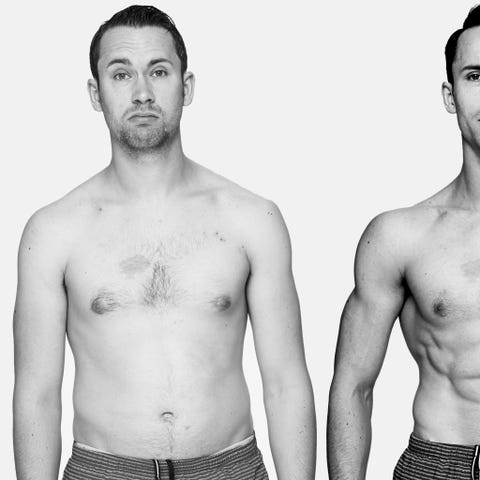
After 12 weeks, 48 training sessions, 64 protein shakes, four "cheat meals" that spiralled wildly out of control, 316½ chin-ups and at least four mental breakdowns later, it's over. I am delirious with exhaustion and have developed a pathological aversion to chicken breast, but Tim Walker really does know what he's doing. The "after" photos are taken. I feel relief, more than anything else. I have achieved what I set out to — I have transformed myself as best I could — but I realise the thing that makes me happiest of all is that very soon I'll be allowed to eat some bread. It's a good feeling.

And what comes next? What happens after spornosexuality? I ask the man who, if past form is anything to go by, is likely to be leading the pop-culture vanguard when the next zeitgeist-capturing phrase is coined. "The eager male self-objectification that spornosexuality symbolises is only likely to continue," says Mark Simpson, "in a world in which the sexual division of labour and loving has broken down. Not only have men discovered that they like — no love — being looked at, traditionally a 'feminine' pleasure, they have also learned that in a visual world if you aren't noticed you just don't exist."

Or, as Walker succinctly puts it: "People love it. There's no top or pair of shoes you could wear that gets as much reaction as a six pack."

Sunday, August 30, 2020

Modelling COVID-19 mortality at the regional level in Italy

Италия и ковид
Italy was harshly hit by COVID-19, registering more than 35,000 deaths between February and July, 2020. The virus spread unequally across the country, with northern regions witnessing more cases and deaths than those in the centre and south. We investigate demographic and socio-economic factors that contributed to the diverse regional impact of the virus in Italy. Within a smoothing framework, we divide regions into three well-defined groups of High, Middle and Low mortality by cluster analysis. Extending the Poisson regression model to account for regional clusters, we find that COVID-mortality is positively associated with the share of ICU utilization, GDP per capita, proportion of the older population and the number of COVID-19 positive cases, while it is negatively associated with the delay of region-specific outbreaks and the number of tests performed. Our results have relevant policy implications for potential resurgence of COVID-19 infections in Italy and across the world.

Источники: тут и тут
карта тыцабельна, на самом деле — существенно больше

Monday, July 6, 2020

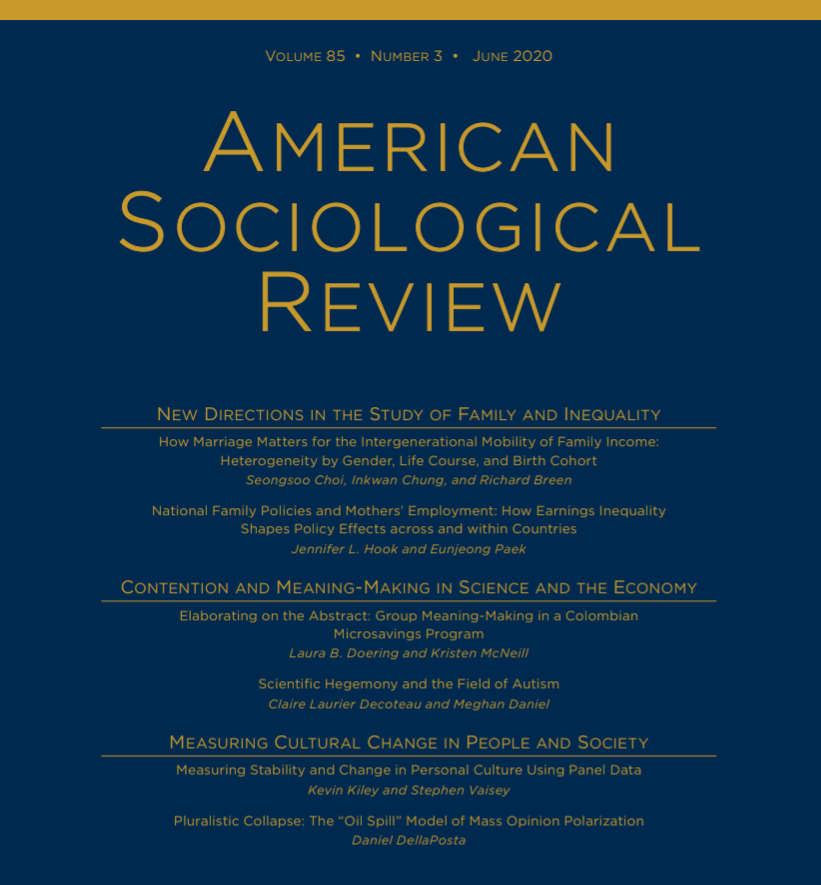
Measuring Stability and Change in Personal Culture Using Panel Data

ASR
Models of population-wide cultural change tend to invoke one of two broad models of individual change. One approach theorizes people actively updating their beliefs and behaviors in the face of new information. The other argues that, following early socialization experiences, dispositions are stable. We formalize these two models, elaborate empirical implications of each, and derive a simple combined model for comparing them using panel data. We test this model on 183 attitude and behavior items from the 2006 to 2014 rotating panels of the General Social Survey. The pattern of results is complex but more consistent with the settled dispositions model than with the active updating model. Most of the observed change in the GSS appears to be short-term attitude change or measurement error rather than persisting changes. When persistent change occurs, it is somewhat more likely to occur in younger people and for public behaviors and beliefs about high-profile issues than for private attitudes. We argue that we need both models in our theory of cultural evolution but that we need more research on the circumstances under which each is more likely to apply.

Kevin Kiley, Stephen Vaisey
First Published June 5, 2020 Research Article
https://doi.org/10.1177/0003122420921538

Wednesday, December 13, 2017

infertility planning

Typical-use contraceptive failure rates
прав был ДИ:
население настороженно относится к термину планирование семьи
и вот:
Национальную модель службы планирования семьи внедрят в систему здравоохранения Беларуси в 2018 году. Об этом на пресс-конференции республиканского конгресса «Мама Pro» в Могилеве сообщила главный акушер-гинеколог Министерства здравоохранения Беларуси Юлия Савочкина. В том числе эта модель подразумевает развитие специализированных центров репродуктивного здоровья и планирования семьи в районах.

основание [см первую строчку таблицы no method, или тут]:
Уровень бесплодия среди супружеских пар в Беларуси приближается к 16% [c какой стороны?], отметила Юлия Савочкина. По данным ВОЗ, критической отметкой считается 15%. Поэтому разрабатывается национальная модель службы планирования семьи.

Депутаты на следующий год запланировали внесение дополнений и изменений в закон о вспомогательных репродуктивных технологиях, рассказал TUT.BY акушер-гинеколог, депутат палаты представителей Национального собрания Беларуси, член постоянной комиссии по здравоохранению, физической культуре, семейной и молодежной политике Александр Старовойтов.

— Поэтому сейчас принимаются предложения от специалистов для того, чтобы эффективность лечения от бесплодия была выше. Существующий закон вышел в 2012 году, а любой закон должен соответствовать веянию времени, — подчеркнул депутат.

интересно: где там собака порылась? запретить ЭКО штолле?


Monday, November 14, 2016

Wednesday, November 9, 2016

Center for Russian Studies at RANEPA

пришло по почте, ещё в какую-то базу угодил,
но любопытно

Ирина Гарскова, вице-президент ассоциации «История и компьютер», доцент кафедры Исторической информатики Московского Государственного Университета им. М.В. Ломоносова, представит две лекции, посвященные количественным методам в социальных и гуманитарных науках.

Лекция 1.

Математические методы в социальных и гуманитарных исследованиях.

10 ноября 2016 г., начало в 19:00

РАНХиГС, 5 корпус, Зал Ученого Совета.

Ведущий специалист в области количественных методов исследования Ирина Гарскова расскажет о современном уровне развития математических методов анализа и перспективах их применения в социально-гуманитарных науках. В наш информационный век мы сталкиваемся с огромным потоком данных, модели и принципы работы с которыми будут рассмотрены на лекции. Особое внимание Ирина Марковна уделит методам статистического анализа.

Лекция 2.

Разнообразие возможностей современного исследователя: методы работы с текстами и изображениями, методы сетевого анализа и математическое моделирование.


17 ноября 2016 г., начало в 19:00

РАНХиГС, 2 корпус, 237 ауд.

Ирина Гарскова продемонстрирует роль компьютерных технологий в актуальных социальных и гуманитарных исследованиях на примере компьютеризированного анализа текста, 3D моделирования и пространственного анализа. Во второй лекции цикла будут рассмотрены понятия нелинейности, неустойчивости, альтернативности развития и возможности математического моделирования социальной динамики.


Регистрация для граждан РФ: https://www.surveymonkey.com/r/9PGC8LP

Регистрация для граждан других стран: https://www.surveymonkey.com/r/9Z335C9


--

Center for Russian Studies

RANEPA Moscow


crs.ranepa.ru

Wednesday, November 2, 2016

understanding health and disease

понимание болезни и здоровья
Уважаемые коллеги!

Приглашаем Вас принять участие в заседании совместного семинара Института проблем управления РАН и Института вычислительной математики РАН «Математическое моделирование и системная биология» под руководством д.б.н. А.И.Михальского и д.ф.-м.н. А.А.Романюхи, которое состоится 10 ноября 2016 г. в 15:00 в Институте проблем управления РАН по адресу ул. Профсоюзная 65, ауд.7. Проезд метро "Калужская". Для оформления прохода в Институт просьба сообщить заранее (до 10 ноября) о намерении участвовать в заседании Михальскому А.И. по адресу ipuran@mail.ru.

На заседании будет заслушан доклад профессора Йохена Мау (университет Генриха Гейне, г. Дюссельдорф, Германия) на тему

«Всеобъемлющее понимание болезни и здоровья».


Аннотация доклада размещена на сайте семинара по адресу http://www.popmodel.narod.ru/_mau/abstr.htm

--

Секретарь семинара "Математическое моделирование и системная биология"

д.б.н., к.т.н. А.Михальский

т.(495)3348820


www.popmodel.narod.ru