Showing posts with label теория. Show all posts

Sunday, December 10, 2023

aesthetics

This article is devoted to the search for a consistent view of the phenomenon of the aesthetic – from the perspective of the libertarian project, taking into account both the discursive and practical approaches of the past and contemporary post-anarchist criticism. As part of this search, a comparative analysis of conventional, Marxist, and anarchist approaches to the aesthetic is undertaken. On the basis of this, a theoretical markup of the problematic of the aesthetic in general is developed. In the course of this, a detailed classification of problems, principles, and strategies related to clarifying the anarchist relationship with the aesthetic, according to its own internal logic, is formulated. 

Статья посвящена поиску непротиворечивого понимания феномена эстетического – из перспективы либертарного проекта, с учётом как дискурсивных и практических подходов прошлого, так и современной постанархистской критики. В рамках этого поиска предпринимается сравнительный анализ конвенционального, марксистского и анархистского подходов к эстетическому. На его основании разрабатывается теоретическая разметка проблематики эстетического в целом. В ходе этого формулируется подробная классификация проблем, принципов и стратегий, связанных с уточнением анархистского взаимоотношения с эстетическим, сообразно его собственной внутренней логике.

Saturday, December 9, 2023

THE CONCEPT OF GENDER

The gender perspective looks at the impact of gender on people's opportunities, social roles and interactions. Successful implementation of the policy, programme and project goals of international and national organizations is directly affected by the impact of gender and, in turn, influences the process of social development. Gender is an integral component of every aspect of the economic, social, daily and private lives of individuals and societies, and of the different roles ascribed by society to men and women.

Social scientists and development experts use two separate terms to designate biologically determined differences between men and women, which are called "sex differences", and those constructed socially, which are called "gender differences". Both define the differences between men and women, but they have very different connotations.

Sex refers to the permanent and immutable biological characteristics common to individuals in all societies and cultures, while gender defines traits forged throughout the history of social relations. Gender, although it originates in objective biological divergencies, goes far beyond the physiological and biological specifics of the two sexes in terms of the roles each is expected to play. Gender differences are social constructs, inculcated on the basis of a specific society's particular perceptions of the physical differences and the assumed tastes, tendencies and capabilities of men and women. Gender differences, unlike the immutable characteristics of sex, are universally conceded in historical and comparative social analyses to be variants that are transformed over time and from one culture to the next, as societies change and evolve.

Gender relations are accordingly defined as the specific mechanisms whereby different cultures determine the functions and responsibilities of each sex. They also determine access to material resources, such as land, credit and training, and more ephemeral resources, such as power. The implications for everyday life are many, and include the division of labour, the responsibilities of family members inside and outside the home, education and opportunities for professional advancement and a voice in policy-making.

This document is a translation of a paper written in Spanish by Mercedes Pedrero, a consultant for the FAO Women and Population Division, in collaboration with the Statistics Division. Mercedes Pedrero based her work on a document by Francesca Perucci, another FAO consultant, substantially changing the content and form and adding new sections.

The exercises presented in the annexe were prepared for the 1996 regional workshop held in San Salvador: Agricultural Censuses, Statistics and Gender. This workshop brought together officers from all Spanish-speaking countries of Central America and the Caribbean. Their enthusiastic and excellent participation proved a valuable contribution to this work. The case studies were prepared by Agnès Le Magadoux, a consultant for the Women in Development Service.

Method of the Year 2023:

methods for modeling development

Nature Methods volume 20, pages 1831–1832 (2023)

In vitro embryo models supported by methods development in adjacent fields have revolutionized our understanding of embryogenesis.


The process of development begins with a single cell that then progresses through multicellular forms and undergoes rounds of cell fate commitment and tissue patterning to ultimately form a complex body structure. The intricate mechanisms controlling the development of a zygote into a fetus during pregnancy have long been out of reach for researchers due to technical and ethical considerations. However, the last few years have seen tremendous advances in methods development that have shed light on these ‘black box’ events.

Pioneering methods in this space have successfully recapitulated key embryonic stages in vitro and thus reshaped our understanding of development. For example, two landmark papers in 2021 reported in vitro models of the human blastocyst, which is an early preimplantation developmental stage. Earlier this year a team reported a human perigastrulation model that recapitulates key events such as the formation of the amniotic and yolk sac cavities, early neurulation and organogenesis.

These models were further refined by incorporating extraembryonic tissues to study postimplantation events. For instance, two studies published in 2023 reported human stem cell-derived embryo models that could recapitulate embryonic events up to day 14 postimplantation in vivo.

These methods for modeling human development follows on the heels of technological advances and achievements first reported in mouse studies. Two seminal papers described in vitro models derived from mouse stem cells that could recapitulate natural mouse embryos in utero up to 8.5 days postfertilization. These embryos developed until the organogenesis stage, co-developing with extraembryonic tissues. The complexity of this model, which mimicked natural embryos in morphological and transcriptomic analysis, led to more authentic organ and tissue development. However, while conclusions can be drawn from studying developmental processes in animal models, species specific features of human embryonic development can be easily missed in such cases.

For the remarkable insights into embryogenesis enabled by these sophisticated models, we have chosen methods for modeling development as our Method of the Year 2023.

In this special issue, a Comment by Magdalena Zernicka-Goetz provides an in-depth look at the latest embryo models that have been reported. These models are poised to help researchers to investigate the molecular mechanisms behind morphogenesis and the signaling cues that underlie the tissue patterning. Zernicka-Goetz warns researchers that while these embryo models lead to novel insights, they are far from perfect recapitulations of the in vivo embryo. Indeed, it is imperative to be aware of the limitations of a system and how it might affect the inferences that are drawn.

The fidelity of an in vitro model must always be verified against in vivo-derived tissue. In the case of embryonic tissue, this poses a particular challenge due to the limited availability of embryos for research as well as ethical issues surrounding human embryo manipulations. A Comment by Muzlifah Haniffa and colleagues discusses how the advent of single-cell multiomic technologies and the subsequent developmental cell atlases have served as essential benchmarks for testing the validity of an embryo model.

Beyond the development of cell atlases, single-cell technologies have also led to the emergence of sophisticated methods for lineage tracing and trajectory analysis. Although these methods have not yet been extensively used for human embryonic models, they have been instrumental in mapping cell fate events, such as in human brain organoids10 and zebrafish embryos. In a Comment, Bushra Raj describes recent methodological advances in this field and its potential for studying snapshots of development.

The state-of-the-art embryo models have been bolstered by decades of research into methods for the in vitro culture of mammalian embryos. Hongmei Wang and colleagues explore this in their Comment. They write that to optimize culture conditions that support an in vitro embryo, there is still a need for the development of biomaterials that mimic the physiological microenvironment of the embryos, as well methods to study the mechanical environment experienced by cells during the stages of embryogenesis.

This opinion is echoed by Idse Heemskerk and colleagues in another Comment, which discusses recent methods that now allow researchers to map the forces within a developing embryo. The Comment explores how embryo models have the potential to shed light on the interplay between tissue mechanics, patterning and morphogenesis. Related to this, a research paper in this same issue from Hervé Turlier and colleagues reports foambryo, a method for performing force inference from 3D fluorescence images of mouse and ascidian embryos. A second research paper, by Noah Mitchell and Dillon Cislo, presents TubULAR, a tissue cartography method for analyzing deformations in dynamic tissues during processes such as morphogenesis.

A nascent approach to studying embryonic development is computational embryology. Researchers explore how to computationally generate and perturb virtual embryos that are built from experimental data. A research article from the team of Patrick Müller describes a deep learning-based approach to grade the similarities between embryos at different time points. In an earlier issue of Nature Methods, the same team published EmbryoNet, a neural network that can analyze zebrafish embryo phenotypes and link them to major signaling pathways. Our News Feature also checks in with researchers in this area, who share hopes and challenges concerning digital embryos and their future.


In a discussion about advances in embryo research, it would be remiss to not consider the ethical implications of engineering human embryo models. In their Comment, ethicists Nienke de Graeff, Lien De Proost and Megan Munsie explain the new ethical questions posed by embryo models. They discuss whether embryo models should be held to the same guidelines as organoids or whether their developmental potential affords them a new status.

Embryo models, especially human systems, are a new and exciting frontier supported by parallel methods development in the fields of single-cell omics, biomaterials and mechanobiology. We must have an open and transparent dialog about the limitations of these methods as well as the ethical risks of in vitro human embryos models. Meanwhile, we hope you are with us as we recognize the potential these methods have in not only unraveling the details of embryogenesis but also modeling development and pregnancy-related disorders.


We hope you enjoy reading this year’s Method of the Year issue and wish you a very happy 2024!

за поздравлениями, к которым не без удовольствия присоединяюсь, ссылка на саму статью, в которой и ссылки и референсы, в общем — всё, как положено.

Tuesday, December 5, 2023

The climate theory of everything


James Murray 30 November 2023

A personal essay on how the climate crisis is reshaping everything and why COP28 matters much more than you think

We've passed the point of no return.
Too late to save the environment.
Quit single use plastic,
My low key cocaine habit.
None of my friends are okay.


Liz Lawrence - None of my friends

I'm scared of the Santa Clarita fires,
I wish that it would rain.


Lana Del Rey - Blue Bannisters

"The difficulty lies not so much in developing new ideas as in escaping from old ones."

John Maynard Keynes

It is the Australian autumn of 2002. John Howard has just won an election through a combination of populism, misinformation, and the stoking of anti-immigrant feeling, providing a cynicism-soaked playbook that dominates anglosphere politics to this day.

Gathered around a campfire, about an hour's drive from Uluru, we're a group of young Gen Xers and first wave Millennials from the Global North, long before any of those terms had taken on their current shape and freighted meaning. We hail from the US, Japan, Germany, Korea, Israel, Hungary, Ireland, the UK. It is a veritable United Nations, except with only a privileged subset of the global middle class properly represented, which is to say not entirely unlike the actual United Nations. Backpackers is the standard label, and we do have backpacks, but we're tourists really.

The stars look like they have been painted on an infinite backdrop and the crackling of the fire and the chatter of young people is the only noise. The conversation drifts towards politics and fear. September 11th was just a few months ago and everyone shares their memories of the hyper-real act of terror that killed thousands and already feels as if has shifted our generation's hopes and dreams on their axis. The 'long 90s' of idealism, hedonism, and relative peace is on its death bed, where it will remain until the financial crash of 2008 administers the final rites. Everyone is rightly worried about what comes next. A cycle of vengeance and pain is about to spin out of control.

One of our number knows what is coming. He is an Israeli in his mid-20s and possibly the least soldierly looking person I've ever met. He talks about his national service, the tension of wanting to protect your family and country from those who want to destroy it, and the horror of being asked to inflict violence, the moral dilemma of being pressed into the service of your nation by a government you don't fully trust.

There is a short silence, broken by the Australian tour guide. He has spent most of the evening flirting with a couple of young Brits who passed their A-levels the previous summer - an endeavour that will prove successful soon enough. "Human beings will only stop killing each other," he says, with the drawl of a practised Outback philosopher, "when the aliens arrive and we all realise we have much more in common than we think." He is clearly a bit high.

More than 20 years on and the aliens have not yet arrived. Human beings are still killing each other. The COP28 Climate Summit kicks off in Dubai today with the world arguably at its most dangerous juncture since that infamous night in 1983 when a Russian officer disobeyed official protocols that would have seen an immediate nuclear attack launched, and instead double checked the alarm that erroneously suggested US nuclear warheads were heading towards Moscow.

A cataclysm is by no means guaranteed, but seasoned historians talk of the conditions being in place for a great power conflict. Numerous low level proxy wars have been simmering away for much of the past decade. But now two major conflicts have erupted that combine ancient territorial claims, medieval brutality, 19th century geopolitical manoeuvring, and 21st century digital propaganda. As the former soldier and writer Mike Martin observed as Russia's invasion of Ukraine intensified: "This is how global wars start, right? Wars begat wars". Meanwhile, the superpower that previously sought to keep a lid on such escalation is one Presidential slip or half decent Russian disinformation campaign away from re-electing an avowed authoritarian who struggles to pronounce NATO, let alone understands what it is for. Every year that passes without a repeat of that 1983 near miss - or worse - feels like a win.

This shaking of the global order is taking place against a backdrop of a not so slow motion environmental disaster. A Marxist analysis of the current moment would contend that the worsening security outlook has economics at its root. That the levels of inequality and injustice, the reliance on an extractive, exploitative, neo-colonial model is unsustainable, and therefore it cannot be sustained. Others would counter that what we are watching is a revival of the Great Game, a multipolar world where different nations with different histories and cultures wrestle for power and resources, where, like a packed pub at kicking out time, perceived acts of disrespect spark an uncompromising response from insecure men.

Both these hypotheses can obviously be true at the same time, but there is also something else going on. Geography comes before history. When the first quarter of the 21st century is assessed, the overarching meta-narrative will surely be the spiralling upwards of global temperatures, the physical impacts on the biosphere that have come with that warming, and humanity's deeply flawed response to it. The rise of China, the muscle-flexing adventurism of the petrostates, the economic slowdown of the Global North, the decline of democracy and the march of populism - all this will feature in the history books, but each of these trends are sparked or shaped by ecosystem collapse, gathering climate-induced migration, food price instability, and the start of the world-historic transition away from fossil fuels.

Almost every challenge governments are struggling to get a grip on has a climate angle. Inflation, migration, housing shortages, energy and food price volatility, deindustrialisation, extreme weather, economic stagnation, authoritarian aggression, the populist search for scapegoats. All these issues are either caused or exacerbated by our reliance on fossil fuels and the climate impacts that result. This is so obvious that it is rarely commented upon and easily ignored. It just is. The entire global economy is made inherently unstable by its reliance on fuels where the price can be manipulated and the polluting externalities are not accounted for. The foundations of our way of life have been fracked. Climate change then becomes the economy's way of overcompensating for its rampant insecurity.

It is unclear if this cycle can be broken. The Paris Agreement of 2015 has helped transform the global economy, catalysing the development of the cheapest energy and the fastest industrial revolution in history. Over 90 per cent of the global economy is committed to achieving net zero emissions within three or four decades. Clean technologies are changing the energy and automotive industries beyond recognition; the global innovation pipeline suggests aviation, buildings, shipping, steel, and agricultural industries will soon follow their lead.

And yet, for all this progress global greenhouse gas emissions are still rising, the world is on track for 3C of warming, and the Paris Summit feels increasingly like the last hurrah of post-war multilateralism.

That meeting in the French capital was the first time I spent more than two nights away from my first son, who had been born earlier that year. His brother followed two years later, and the first time I was away from him for more than a night was the Glasgow Climate Summit of 2021. When they were born, my brain flushed with the hormones that ensure you regard the bawling creature that is pushing you into near terminal levels of sleep deprivation as the most precious thing that ever existed, I promised myself I'd write only one piece a year on my darling boys. I have comfortably honoured that pledge, allowing the annual parental love letters to lapse after just three years.

The main reason for this oversight is the low-level chaos of parenthood and mid-life. At six and eight Fraser and Calum are still the world's best people, a source of never-ending joy and amusement. But there is considerably less doe-eyed affection flying around when two clouds of roiling testosterone keep battering each other over the tiniest slight. The love between siblings is the fiercest love there is. Their tussles with the anxieties and impulses that define life are a daily test of empathy and patience for everyone in their orbit - a test it is impossible to pass 100 per cent of the time. It is also the most incredible privilege to watch them work their way through the vagaries of growing up, and the most daunting responsibility to imperfectly help them find their way forward. It is a task that can't help but make you both more understanding of everyone's complexities and foibles - of how we are all just fragile balls of water, our personalities and desires beholden to our brain chemistry and formative years - and more angrily protective on behalf of a generation that from Covid to climate is being failed.

But the other reason I stopped writing about the boys is that it is hard to find new ways to articulate that nagging fear that they face a daunting future. The specific threats presented by climate breakdown and the crises and wars it could trigger loom large, but in some ways worse is the way these fears bleed into the culture, creating an ever-present sense of dislocation and gathering crisis. Even the recent Disney film Elemental had a climate migration subplot. This is the milieu for the rest of all our lives now. How could it be anything but? The need to sometimes take a breath and make peace with that fact is draining.

These fears are exacerbated in the UK at least by what is now approaching two decades of flatlining wages and stagnant productivity - an unprecedent room temperature economic disaster that leaves an entire two generations of people angry and frustrated at the realisation they will be poorer than their parents. On its recent tour, one of my favourite bands, The National, was selling t-shirts emblazoned with the words 'Sad Dad'. It is a joke, a self-knowing nod to music that is solipsistic and despondent, even when shot through with moments of quotidian beauty. But the joke hits pretty hard. The dads are sad, and so are the mums; so is everyone. Even Gen Z, who by rights should be tearing things up with a hedonistic abandon, seem to be finding the inherent optimism of youth dented by broken housing markets, fraying social contracts, and the siren calls of the populist right. Something has gone badly wrong.

If the climate is at the heart of these interlocking economic, societal, and security crises then the only solution is to tackle the root cause. Applying a climate lens improves every policy and instils greater optimism and better returns in every project. Climate action is the only viable path out of these dangerous decades.

Thankfully, since the Paris Agreement was signed this hypothesis has become an increasingly influential economic consensus. There is a widespread acceptance that clean technology delivers cheaper energy, increasingly equitable economic prosperity, and better living standards. There are reasons why President Biden called his green stimulus package the Inflation Reduction Act. There are reasons why the EU and the UK's Labour opposition want to copy him. There are reasons why China's economic plan is to dominate green industries. This is why the world's three largest markets are all rushing to embrace green growth and making the pursuit of net zero emissions their strategic North Star.

Take housing as just one example. There is already a housing theory of everything that argues that almost all the UK's economic and societal woes (woes shared by many other industrialised nations) can be tackled by building more houses. Want economic growth, improved productivity, and better quality of life? Then get building.

But this theory is subsumed by the climate theory of everything. If you are going to build more homes, you want those homes to be ultra-efficient, clean tech adorned, climate resilient, and located in walkable communities. Then you get not just economic growth, but also lower energy bills, enhanced energy security, improved health, reduced risks, lower insurance premiums, less atomised communities, greater entrepreneurialism, and lower emissions. Why would you not do this? The climate warrior the world needs right now is social media menswear guru Derek Guy who recently posited an alternative version to the 'trolley problem': "You can either pay $750/month to ride a trolley for two hours every day to work, or you can create affordable, walkable neighbourhoods where you can wear nice little outfits and walk to work in 15 mins. What do you choose?"

The same rationale applies across every industry. Greener is better, more efficient, more secure, and comes with more co-benefits. The capital costs can be higher, but that is only because of the market failure of under-priced pollution, and besides the running costs are invariably lower and the multiplier effects are greater. The net zero transition is Keynsianism for the 21st century. And if the last 15 years has taught us one thing, it is that Keynes was always right.

Growing numbers of political and business leaders get this. They understand that a green house or electric car is more comfortable and cheaper to run than a conventional house or polluting car, that clean air unlocks massive health benefits, that without sustainable agriculture a food crisis looms. Above all, they can see how an economy built on energy that is secure, localised, and predictably priced removes the shifting sands of a fossil fuel economy that is inherently unstable. Uncouple the economy from that volatility and the rewards that would flow in terms of sustainable growth, quality of life, and enhanced security are borderline panglossian. This is the only game in town. The alternative is 3C of warming and a century of rolling disasters, of food shocks and scapegoats, of walls and gun turrets.

The countries that fail to respond to this shifting reality will lose out. As former Bank of England chief economist Andy Haldane observed recently: "The world is facing right now an arms race in re-industrialisation. And I think we're at risk of falling behind in that arms race unless we give it the giddy up… China has been at this - green tech - for many, many years, and has stolen a march in many, many technologies, including solar and batteries. The West has belatedly woken up. The Inflation Reduction Act is throwing cash to the wall on that… The EU is now playing catch up, [and] the UK currently is not really in the race at any kind of scale." There is no alternative.

The problem is how to get from here to there. How to ensure that the clean energy revolution accelerates at sufficient pace that fossil fuel demand can fall both rapidly and in lockstep with constrained supply. How to execute such a delicate balancing act when so many states and communities remain fully dependent on the revenues that flow from the supply of the fuels that have both proudly powered civilisation for two centuries and pushed humanity out of the climatic envelope it relied upon for millennia. How to manage the economic fall out from rapidly replacing the sprawling gas power plant just down the road from the Dubai Exhibition Centre. How to marginalise the climate sceptics and convince the polluting vested interests that their risk analysis is wrong and their short termism is going to destroy everything.

This is why COP28 and the entire UN climate process matters so much. At a time when too many countries are at each others' throats, when great powers jostle for primacy and their proxies unleash horrors, this is a peace summit. It is a mechanism for multilateralism and the recognition of both shared humanity and aligned self-interest. It is a forum that seeks to tap the qualities we all try to teach the next generation, and yet too easily let slip: patience, empathy, responsibility, perseverance, resilience, trust, respect, kindness. As Pete Betts - the recently departed and much missed British diplomat and veteran of countless COPs - used to say of the UN climate talks: "We didn't always agree, but we trusted the other side enough to know that if they said something, it was because they had reasons to say it and you had to listen."

There is an understandable reluctance to speak in such idealistic terms. No ceasefires will be signed in Dubai. Utopianism invites the satirists to do their worst. The meeting could easily end in failure with petrostates clearly incentivised to talk publicly about climate action and carbon capture potential while privately lobbying ferociously to lock in decades more fossil fuel demand.

But there is also grounds for optimism. There is a deal to be done. A deal that would set new clean tech deployment goals that would empower governments as they look to turbocharge already record green investment. That would deliver the long overdue reforms that can unleash flows of climate finance into the developing economies that need it most. That would provide funding for climate-related loss and damage from industrialised and emerging economies alike. That would give businesses and investors the confidence they need to face down current economic headwinds and unleash a new wave of green investment and innovation. That would see all countries publicly recognise that regardless of whether they are 'phased out' or 'phased down', the fossil fuel era is drawing to its close and the accelerated winding down of coal, oil, and gas supplies is now the world's most pressing and most complicated policy challenge.

Deliver that and for all the immense challenges it faces, the world could be on a considerably better path in a fortnight's time. A path that makes good on the promise of the Paris Agreement and ensures emissions really do peak this year, delivering a civilisation level milestone on route to a net zero emission economy by mid-century. A path that redirects capital from the polluting industries of the 20th century to the life-affirming, job-creating industries of the 21st century. A path that reminds the world's many different tribes that what we are facing is an alien climate, and it is everyone's interests to come together to thwart it.


Keep up to date with all the latest news and updates from this year's UN Climate Summit at BusinessGreen's COP28 Hub here

Wednesday, May 17, 2023

esoteric in history

древо жизни

Историческая эзотерика как метод познания: как российские псевдоученые способствовали антизападному повороту Москвы


Andreas Umland
 2023, The Ideology and Politics Journal

Ряд параакадемических тенденций в российской общественной науке помог подготовить войну в Украине. Помимо пропагандистских кампаний Кремля, интеллектуальная деформация российской элиты под влиянием манихейских идей таких теоретиков, как Лев Гумилев и Александр Дугин, отчасти ответственна за растущее отделение России от Европы. Постсоветский общественный дискурс заражен множеством спекулятивных, часто конспирологических, а иногда оккультных или расистских теорий. Их сторонники вытеснили признанных обществоведов и историков из интеллектуальных и медийных дебатов. Этот параллельный общественный дискурс развивался с начала гласности, 35 лет назад, и стал одним из факторов подготовивших нападение России на Украину в 2014 году.

Friday, January 14, 2022

engineering notation

Вообще рекомендую блог, но по-англ (не для скрепанутых, но их и.нет),
там попо дробнее


Many scientific disciplines routinely use scientific notation when dealing with very large or very small numbers. Quantities are expressed as a number between 1 and 10 [the coefficient] times a power of 10. For example, the speed of light in a vacuum is estimated at 299,792,498 meters per second. In scientific notation, this would be approximately 3.0 x 10⁸. This abbreviated or shorthand form of the original number is easier to remember and to say or write. It also makes it easier to keep track of zeros or decimal places in calculations.

Although not to the same extent as physics or astronomy, demography also involves relatively large and small numbers [for example, world population [7,800,000,000], or the probability of death of a 10-year-old female in a low-mortality population [0.00068], but the use of scientific notation in the demography is rare.

Of the more recent origin and less widely used is engineering notation. This is analogous to scientific notation but allows coefficients between 1 and 1,000 and limits exponents to multiples of 3. The exponents correspond to familiar metrics such as thousands, millions, billions, etc. for large numbers, and thousandths, millionths, billionths, etc. for small numbers. In engineering notation, for example, the speed of light [299,792,498] would be 229.8 x 10⁶. The exponent 6 indicates millions; coefficient 229.8 gives the number.

A closer look at these two ways of abbreviating numbers suggests engineering notation may be the more useful tool for demography.


Про автора
:

Thomas K. Burch is an Adjunct Professor, Dept. of Sociology, University of Victoria [Canada] and a Regional Associate, Center for Studies in Demography and Ecology, University of Washington. He is Professor Emeritus, Western University, London, Ont., where he served from 1975 to 2000, working to develop a Ph.D. program in social demography. Before joining the faculty at Western, he taught at Marquette Univ., Milwaukee, Wisc. And Georgetown University, Washington, D.C. He has been a visiting professor at the Univ. of California, Berkeley, and at the Univ. of Rome, and a guest researcher at the Max Planck Institute for Demographic Research, Rostock, Germany. From 1970 to 1975 he was Associate Director, Demographic Division, The Population Council, New York, NY.

His main areas of research and publication are fertility, marriage and divorce, and household and family. Late in his career, he focused on a methodological assessment of demography as a science, with particular attention to theory and models. A recent summary of this work is Model-Based Demography: Essays on Integrating Data, Technique and Theory, Max Planck Institute for Demographic Research and Springer Open, 1918 [open access]. In a first-year university course in organic chemistry, the author used a slide rule for all calculations. As a graduate student in the late 1950s, he used mechanical calculators that would add, subtract, multiply and divide – only – with no tapes or printouts. Calculations involving logarithms, exponentials or roots required consulting large reference books of tables. The computer revolutionized demographic calculation.

Tuesday, May 25, 2021

Quelle divergence culturelle entre italiens et étrangers ?

Published on N-IUSSP.ORG May 24, 2021

Italians and foreigners: how distant are they, culturally speaking?


Gustavo De Santis, Mauro Maltagliati, Alessandra Petrucci

Can cultural distance hinder the integration of foreigners? The answer would be easier if we knew what cultural distance is. Gustavo De Santis, Mauro Maltagliati and Alessandra Petrucci try to measure it in Italy, with an original method. Despite the scarcity of good empirical indicators, three results seem to emerge: 1) within all groups, Italians included, heterogeneity is large; 2) foreigners from different countries differ among themselves and 3) a long stay in Italy seems to favour cultural convergence.

Cultural distances are frequently evoked, especially by researchers who need to justify what their models cannot explain, but they are very hard to define and measure. When it comes to groups (in our case national groups: Italians and foreigners of various nationalities living in Italy) the very notion of cultural distance may be based on the false assumption of internal homogeneity.

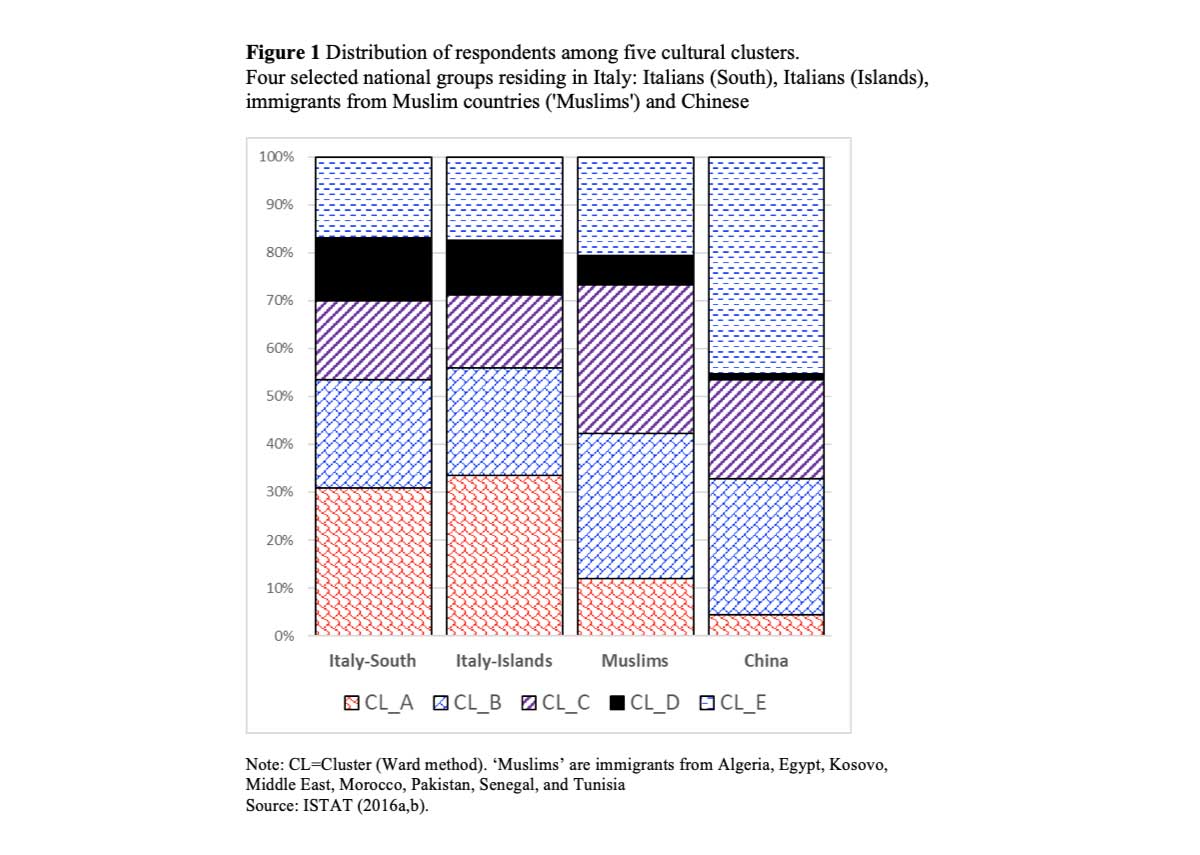
Not very clear, is it? OK, let us try with an example. Consider Figure 1 and assume that the five cultural clusters ‘make sense’, i.e. that they correctly identify five different cultural typologies. Note that we ignore the cultural characteristics of each of these typologies, and we do not need to know them, at least initially. On the y axis we read proportions: among Italians (from the South and from the two main Islands) about 30% of respondents are of type A, ~25% are of type B, … and ~17% are of type E. As the proportions are approximately the same in the two cases, we conclude that the two groups of Italians are very similar, although not internally homogeneous.

Conversely, the Chinese living in Italy have a markedly distinct distribution of individuals across typologies: only about 4% are of type A, ~28% of type B, … and as many as ~45% of type E. Muslims (a short term for immigrants ‒ of unknown religion ‒ from predominantly Muslim countries) appear to be somewhere in-between, although in their case the share of typologies B (~30%) and C (~31%) is larger than in other instances.

Two things emerge from this analysis.

  1. ‘National culture’ is not a specific typology. Each national group has (at least) five such typologies (and probably more, but in our case there are statistical indications that stopping at five categories is enough). What changes is the proportion of the members of that group (nation or area of origin) who can be classified in each of the five typologies.
  2. Based on these proportions (better: on their differences), an estimate of the relative distance between (national) groups may be attempted.

An application to Italy (2011-2013)


This is the approach that we followed in a recent paper, with data taken from two similar ISTAT surveys conducted in Italy between 2011 and 2013, the latter covering the general population, the former focused on foreigners (De Santis, Maltagliati and Petrucci, 2021).

The main results of our analysis are displayed in Figure 2, which uses proportions (those of Figure 1, but for all groups) to calculate (Euclidean) distances, and then (with little loss of information, i.e. little distortion) forces these distances to appear on a Cartesian plane.


Italians form a homogeneous group, relatively speaking. However, within Italy, a clear north-to-south gradient appears. Northern Italians are culturally closer to immigrants from neighbouring European countries (France, Germany, and North-Central Europe). Southern Italians, instead, appear closer to other nationalities, starting with those around the Mediterranean Basin.

Some countries from homogeneous regions are highlighted, such as those from Latin America, or from the Indian peninsula. The fact that they are close, in Figure 2, means that their members have a comparable distribution among the five cultural typologies mentioned at the beginning.

The Chinese living in Italy are the culturally farthest immigrant group, according to our estimates, an outcome that conforms to expectations and to other sources (e.g. ISTAT 2020).

Finally, people of foreign origin, but who later acquired the Italian nationality (labelled ‘IT2’), lie somewhere in-between: they are somewhat detached from Italians with Italian origin, but they are closer to them than any other foreign group living in Italy.

What lies behind (or better, inside) our clusters


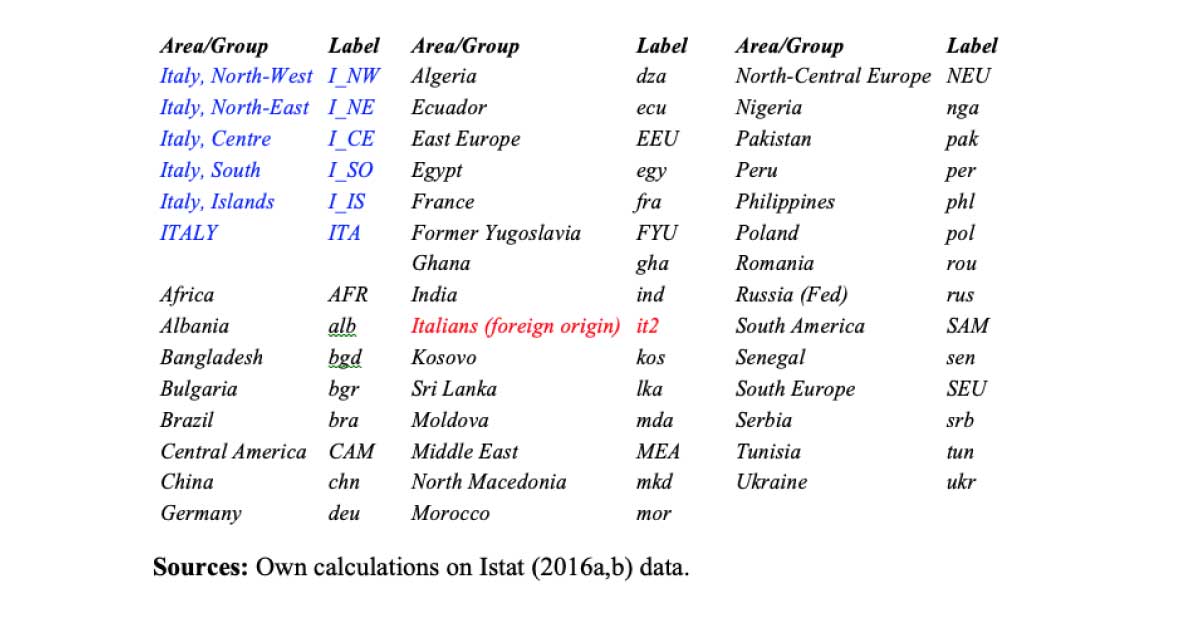
The construction of our five clusters is based on the 11 empirical indicators listed in Figure 3: how often certain ‘objects’ are used (e.g. personal computers), or certain activities are carried out (reading books, attending concerts, etc.) or politics is discussed. Admittedly, it is not culture proper that is being evaluated here: rather, it is the use of (free) time, which is influenced by culture but also by several other factors that we cannot control for (e.g. personal resources). Our indicators are less than ideal, we admit, but this is as far as we could go if we wanted to merge the two ISTAT surveys that were needed to compare foreigners (ISTAT 2016a) with Italians (ISTAT 2016b).


Figure 3 gives an idea of the main characteristics of the members within each cluster. For example, the members of cluster C (Secluded from the social world, if we want to label them) do few or none of the listed activities, similar in this respect to the members of cluster B (Semi-secluded), who are just slightly more active when it comes to dancing, or reading newspapers and magazines. (This was the case of immigrants from predominantly Islamic countries, remember?)

In cluster E (Surfers) we find individuals who frequently use PCs and surf the internet, go to the cinema, or to concerts (all types of live music) and go dancing, but who never talk about politics (as is the case for the Chinese, in Figure 1). The members of cluster A (Active) are quite or very active in all the activities indicated, and they also talk a lot about politics: many Italians are like that (see again Figure 1). Finally, there are the members of group D, the Committed: they talk a lot about politics, keep themselves decently informed, and disdain certain facets of modernity, such as PC, internet and discos.

However, one point should be emphasized: in any national group, there are individuals of all clusters (that is, of all typologies, which seems inconsistent with such notions as ‘national homogeneity’, ‘typical traits’, and so on: what changes is (merely?) the relative frequency of the various typologies.

What do we learn from all this?


First, we must caution readers against hasty interpretation. We refer them to the original article for the limitations of our findings, in terms, for instance, of available empirical indicators to assess the ‘cultural orientation’ of our respondents, clustering criteria, and impossibility of controlling for certain covariates (age, sex, education, income, etc.; De Santis, Maltagliati and Petrucci, 2021).

Also, we do not have any empirical indication of how time and selection influence our results. For instance, let us consider people of foreign origin who are now Italians. Acquiring the Italian nationality is a long and painful process. Therefore the ‘IT2’ group has, on average, a longer period of permanent stay in the country than any other group. The fact that they are culturally closer to Italians than all others may be interpreted in two main ways:
they were selected from the start, and it is precisely this affinity that made them stay in the country and decide eventually to become Italians, they gradually got used to the ‘Italian way of thinking’, and their proximity to Italians at the end of the process indicates that people can and do change: cultural convergence is possible and is taking place.

Either way, cultural distances do not seem to be insurmountable obstacles when it comes to integrating foreigners in a host country. And, in all cases, those who evoke them can now start to measure them (if empirical data permit, of course).

Acknowledgements

Financial support is gratefully acknowledged from two sources:
1) JPI MYBL / CREW Project (Joint Programme Initiative: More Years Better Life, 2016 Call. CREW: Care, retirement and wellbeing of older people across different welfare regimes. MIUR Decree: n. 3266/2018; Official Bulletin no. 32 7. Feb 2019), and
2) MIUR-PRIN 2017 Grant (Italian Ministry of University and Research, Prot. N. 2017W5B55Y).

References

Saturday, December 14, 2019

A Historical Examination of Military Records of US Army Suicide, 1819 to 2017

In this study, the present elevated rates of suicide among active-duty personnel in the US Army served as possible evidence of a pattern that differs from that of the past 200 years. This study, and others like it, could allow for increased testing of causal theories against a longer timeline, considering that, if a model cannot explain the past, it draws into question its prognostic applicability. With the collection of additional historic data sets, researchers may be able to parse out correlation from causation concerning a host of comparative factors associated with US military suicide.

The consultation of historical data in this study could open to new avenues, dialogues, and collaborations in a more holistic search to better understand suicide. The systematic historical analysis could prepare us to make more informed decisions. The historical perspective of this study provides researchers and policymakers additional opportunities for data and theoretical analysis as well as increased perspectives. It is a cautious step toward better integration and acceptance of historical frameworks and data from the past 200 years in modern efforts to reduce suicides among active-duty personnel in the US Army.
Suicides Rates Among Active-Duty Personnel in the US Army, 1843-2017

Sunday, June 16, 2019

motivation

According to a United Nations report, 3.2% of the world population or 258 million people, live in a country other than their country of birth. Between 1990 and 2017, the number of international immigrants increased by 69% or 105 million, with the majority of immigration taking place between 2005 to 2017. The phenomenon of cross-border immigration is an important aspect of international relations and modern life. People migrate from their country of origin for a variety of reasons: to avoid conflicts or violence, or distressed environmental challenges; to escape poverty, to provide better opportunities for their children, to reunite with families, to obtain a better education and to find employment. They face tough and challenging decisions and take life-threating risks to make a move domestically or across the borders. 

Why do people migrate from their home country and what are the motivational factors that lead to such an unforeseeable journey? How do they choose their destination? This paper applies motivational theory to this migration. I investigate the personal, social, economic, and cultural variables that are the critical basis of these motivations. Europe, with 78 million immigrants, holds the 2nd place in the world, and Germany, with the most immigrants, holds the 1st place among European countries. More than 1.6 million new immigrants arrived in Germany in 2014. I have employed the motivation theory to immigrants in Germany in order to determine why people emigrate to other countries.

...

Data from Syrian, Afghans, Polish, and Chinese immigrants in Germany were critical to the investigation of general motivational theories of migration. I have applied three different theoretical motivations — motivational theory of preservation, the motivational theory of self-development, and motivational theory of materialism — to the data and have confirmed the validity of all three theories. It means, moving forward, that ever more attention needs to be paid to motivation theory, across many other cases and diverse global regions, as it seems to have that magical intellectual quality of being both flexible and accurate.

Ebad Mobaligh is an entrepreneur, IT professional, community organizer, and a doctoral student with  American Military University’s Global Security program. He loves playing and watching soccer. He lives in the San Francisco area with his wife and four children.

source: Modern Diplomacy

Thursday, May 16, 2019

the biggest misconceptions in male fertility

Tuesday, October 13, 2015

Demographic theories and histories


Институт демографии Национального исследовательского университета «Высшая школа экономики» приглашает Вас принять участие в Международном семинаре 

“Демографическая теория и демографическая история: от описания к объяснению”

Семинар состоится 22 – 23 октября 2015 года в здании НИУ ВШЭ по адресу Большой Трехсвятительский пер., д. 3, аудитория 537
Официальные языки конференции – русский и английский (обеспечивается синхронный перевод)
Предварительная программа 

22 октября 2015 (четверг)
9.00 – 9.45
Регистрация
9.45 – 10.00
Открытие конференции. Приветственное слово Е.Г.Ясина


Секция 1. Теория и методология. Часть 1 (модератор – С.Иванов)
10.00 – 10.20
Демографический гомеостаз (А.Вишневский.НИУ ВШЭ, Москва)
10.20 – 10.40
О концептуальной связи между понятиями «первого» и «второго» демографического перехода (А. Авдеев.InstitutdeDémographiedel'UniversitéParis 1, Франция)
10.40 – 11.00
Между общностью и сложностью, закономерностью и случайностью: 
пространство объяснительных стратегий в демографии (М. Клупт.СПбГЭУ, Санкт-Петербург)
11.00 – 11.20
Демография: наука без единой теории? (Н. Зверева.МГУ,Москва)
11.20 – 11.40
Демографический переход в России в годы Второй мировой войны: 
начало процесса или фальстарт?(В. Исупов.НГУ, Новосибирск)
11.40 – 12.00
Кофе брейк


Секция 2. Теория и методология.  Часть 2 (модератор – М.Клупт)
12.00 – 12.20
Демографическая трансформация – будущее разнообразие? (Д. Коулмэн.OxfordUniversity, Великобритания)
12.20 – 12.40
Демографическая политика в международных отношениях (С.Иванов.НИУ ВШЭ, Москва)
12.40 – 13.00
Связь глобальных демографических и экологических проблем: методологические аспекты (И. Макаров.НИУ ВШЭ, Москва)
13.00 – 13.20
Вклад экономистов в демографические исследования: Саймон Кузнец (А.Ткаченко.Финуниверситет/РАНХиГС, Москва)
13.20 – 13.40
Семья Кулишеров: исследователи мировых миграций (М.Тольц.HebrewUniversityofJerusalem, Израиль)
13.40 – 15.00
Перерыв на обед


Секция 3. Рождаемость (модератор – А.Вишневский)
15.00 – 15.20
Новейшие тенденции рождаемости в России в свете существующих демографических теорий (С. Захаров.НИУ ВШЭ, Москва)
15.20 – 15.40
К вопросу о начале регулирования рождаемости в России (Б.Миронов.СПбГУ, Санкт-Петербург)
15.40 – 16.00
Традиционное демографическое поведение русского населения в XIX в. (И. Троицкая.МГУ, Москва)
16.00 – 16.20
По пути второго демографического перехода: современный этап трансформации модели рождаемости в развитых странах (А. Ракша.НИУ ВШЭ, Москва)
16.20 – 16.40
Кофе брейк


Секция 4. Миграция (модератор – Л.Карачурина)
16.40 – 17.00
Трудовая пространственная мобильность населения России и ее роль в процессах урбанизации (Т.Нефедова.ИГ РАН, Москва)
17.00 – 17.20
Сельско-городской континуум: история и география идеи (А. Трейвиш.ИГ РАН, Москва)
17.20 – 17.40
Теоретико-методологические предпосылки изучения отходничества крестьян на заработки в России в 1920-е гг.  (В.Моисеенко.МГУ, Москва)
17.40 – 18.00
Интеграция международных мигрантов: методологические подходы изучения и реализации политик (В. Мукомель.ИС РАН, Москва)
18.00 – 20.00
Фуршет


23 октября 2015 (пятница)
Секция 5. Смертность и продолжительность жизни. Часть 1 (модератор – В.Школьников)
10.00 – 10.20
От теории эпидемиологического перехода к теории санитарного перехода и далее (Ф. Меле, Ж. Валлен.Institutnationald´étudesdémographiques, Франция)
10.20 – 10.40
Отражение эпидемиологического перехода в смертности реальных поколений в период перехода (Е.Андреев.РЭШ, Москва)
10.40 – 11.00
Различия в продолжительности жизни в развитых странах: измерение и декомпозиция изменений во времени (С. Тимонин.НИУВШЭ/РЭШМосква.В. Школьников, MaxPlankInstituteForDemographicResearch, Германия/РЭШ, Москва)
11.00 – 11.20
Особенности смертности в старших возрастах. Как новые открытия согласуются с теорией смертности (Л. Гаврилов, Н. Гаврилова.Center on Aging, NORC at the University of Chicago, USA, США)
11.20 – 11.40
Демографические потери вследствие голода 1932-1933 гг. на Украине на фоне других республик Советского Союза (Н. Левчук. ИДСИ,  НАН Украины, Украина)
11.40 – 12.00
Кофе брейк


Секция 6. Смертность и продолжительность жизни. Часть 2 (модератор –Е. Андреев)
12.00 – 12.20
Что можно узнать, изучая предикторы долголетия,  применительно к теории? (Л. Гаврилов, Н. Гаврилова.Center on Aging, NORC at the University of Chicago, USA, США)
12.20 – 12.40
Является ли линия Оупена-Вопеля хорошим предиктором продолжительности жизни в будущем (Ф. Меле, Ж. Валлен. Institutnationald´étudesdémographiques, Франция)
12.40 – 13.00
Смертность в России. В чем уникальность? (В. Школьников, MaxPlankInstituteForDemographicResearch, Германия/РЭШ, Москва)
13.00 – 13.20
Особенности эпидемиологического развития России (В.Семенова. ЦНИИОиЗ МЗ РФ, Москва)
13.20 – 14.30
Перерыв на обед


Секция 7. Гиперболический рост населения Земли. Часть 1 (модератор – А.Коротаев)
14.00 – 14.20
Развитие математической модели  С.П. Капицы и ее приложение к прогнозированию макроэкономической динамики (А.Акаев. НИУ ВШЭ, Москва)
14.20 – 14.40
О законе гиперболического роста численности населения Земли (В.Кононов. Независимый эксперт, Курск)
14.40 – 15.00
О причинах гиперболического роста населения Земли и ухода от сингулярности (С.Цирель. НМСУ«Горный», Санкт-Петербург)
15.00 – 15.20
За пределами гиперболического роста. Вероятностный подход к разработке сценариев демографического перехода (С.Махов. Институт прикладной математики им. М.В.Келдыша, Москва)
15.20 – 15.40
Кофе брейк


Секция 8. Гиперболический рост населения Земли. Часть 2 (модератор – С.Цирель)
15.40 – 16.00
Технологический императив как основа теории глобального демографического процесса (А.Подлазов. Институт прикладной математики им. М.В.Келдыша, Москва)
16.00 – 16.20
Построение подходящей двухпараметрической динамической демографической модели: 3 основных шага  (А.Юров. БФУ, Калининград)
16.20 – 16.40
К выведению компактной модели макродемографической и макроэкономической динамики на период до 1973 года (А.Коротаев. НИУ ВШЭ, Москва)
16.40 – 17.00
Иерархия динамики в трехкомпонентной демографической модели (Е.Постников. КГУ, Курск)


17.00 – 17.30
Закрытие конференции

Tuesday, April 16, 2013

A Framework for Analyzing the Proximate Determinants of Fertility

аффтар! пешы ищо
Статья с этим названием вышла 35 лет назад в журнале Population and Development Review,  Vol. 4, No. 1, Mar., 1978 (ссылка в Jstore).
В статье John Bongaarts расписал Proximate Determinants или Intermediate Variables (IV какбe девичья фамилия PD) рождаемости.
Работа была спроовоцирована слабостью социально-экономического подхода к анализу рождаемости, то-есть, в реалиях одинаковые соц-эк условия генерили не только разные уровни рождаемости, но и её разнонаправленную динамику, то-есть, подход не давал ничего. Надо было исправлять искривления:) ДжБ предложил смотреть на рождаемость попроще, как на бездуховный биологический процесс. Забегая вперёд замечу, что он получил феерический какбе побочный результат : все животные равны.

ДжБ предложил очень простую квантификацию непосредственных детерминант рождаемости, разбиваемых до него на три большие группы:
  1. экспозиция, она же брачность (социальная форма), или появление (менархе) и исчезновение (менопауза) риска зачатия;
  2. поведение, зависящее от числа уже рождённых детей, или регулирование числа рождений, то-есть, контрацепция и искусственный аборт; 
  3. естественная (при отсутствии намеренного ограничения) рождаемость, определяемая послеродовой стерильностью, частотой впиндюривания, стерильностью, внутриматочной смертностью плода (выкидыш и мёртворождение), длительностью периода способности к зачатию.
Автор, как водится в подобных случаях, стоял на плечах гигантов, а именно Энсли Коула и Луи Анри (сугубая имха, пож: напрауте и углупьте). По всей видимости отправной точкой послужили индексы Коула, аналог первой компоненты рождаемости по Бонгаартсу.
Сама модель имеет следующий вид:
TFR =  Cm × Cc × Ca × Ci × TF, где
TFR - коэффициент суммарной рождаемости, или суммарный коэффициент рождаемости (дело вкуса), число детей, рождаемое женщиной за всю жизнь при наблюдаемых интенсивностях повозрастной рождаемости, очень популярный показатель, наряду с младенческой смертностью и продолжительностью жизни;
Cm - индекс брачности или доля, состоящих в браке;
Cc - индекс контрацепции, зависящий от доли предохраняющихся, сочетания используемых методов и их практической эффективности;
Ca - индекс искусственных (induced) абортов, нам это ближе всего, только теперь начинаем отходить, но, видимо, недалеко, близэнько
Ci - индекс послеродовой стерильности, определяемый продолжительностью грудного вскармливания.
TF - плодовитость, аналогичная рождаемости, потенциал рождаемости, ещё более потенциальный, чем естественная рождаемость.
Все индексы С меньше 1 и больше 0. Чем меньше индекс, тем сильнее его влияние, тем в большей степени он сжимает плодовитость.
После того как модель начала собственную жизнь алгебра поверила гармонию, и таварысчы стали писать формулу на фкус и цвет (см. вики для примера). Но мы-та.ру знаем что 9×2=2×9 -- неправославно нихира, и ДжБ нас тут подкрепляет в вере. Двигаясь покомпонентно слева направо мы переходим, с одной стороны, какбе из реальности в мир чистых идей (от рождаемости к естественной рождаемости и плодовитости), а, с другой -- от белой фаты под марш Мендельсона в мир грязнокровавого хлюпанья:
TFR > TMFR > TNFR > TF
TFR = TMFR × Cm, где TMFR -- брачная рождаемость;
TMFR = TNFR × Cc × Ca, где TNFR -- естестенная рождаемость (изобретённая Анри);
TNFR = TF × Ci.
> - направление движения мысли, а не больше/меньше. По величине как раз наоборот: справа налево происходит уменьшение.

Все вещи, предложенные ДжБ, либо наблюдаемы практически напрямую, либо расчитываются из относительно несложных и доступных наблюдений. Коме этого у него получилось что TF -- инвариант, независящий от климата, состояния в агрессивных или прогрессивных политических блоках, формы правления и достатка в домохозяйстве семьи. Это дало прочное основание для сравнения одного населения с другим в реальности, а не в мире национальных или социально-экономических мифов.

упг (17 апр, сегодня хоронят Тэтчер):
добавлю про инвариант.
Рез-т ДжБ: TF=15.3. Значение совпадает с полученным Анри и опубликованным в 1961 году в Eugenics Quarterly (Some data on natural fertility). Рез-т Анри: около 17% репродуктивного периода женщины она, или пара являются стерильными. То-есть, на самом деле репродуктивный период не 35 лет (50-15), а 25, или менее. Предполагая (вполне обоснованно), что цикл рождения и восстановления плодовитости составляет 20 месяцев, получаем те же 15, число детей, которое может родить женщина, доживающая до конца плодовитого периода (50), начавшая половую жизнь сразу после появления возможности зачатия, никогда не предохраняющаяся, не делающая абортов и не практикующая т.наз extended breastfeeding.
От себя замечу, что многие рез-ты фактуры (база) по естественной рождаемости получены в клинике Сэнгер, которая сразу по открытии начала документировать и анализировать чел репродукцию.

О направлениях изменения индексов С в демографическом переходе -- задачка для индивидуальной медитации, enjoy.

  • бонус: пруфлинька на какой-то, вроде филипинский (оч. медленный, но рабочий) сервер, зато оригинальный текст
  • ну, и, кто ищет тот всегда найдёт (на сайте Population Council)