Showing posts with label СМИ. Show all posts

Monday, February 10, 2025

migration

СМИ со ссылкой на исследование демографов написали, что в Россию вернулись 10% релокантов. 

Но так интерпретировать работу ученых нельзя. Почему? Рассказывает соавтор этого исследования


4 февраля на сайте «Демоскоп Weekly» вышла статья демографов Юлии Флоринской и Никиты Мкртчяна «География новой российской эмиграции (по материалам опроса россиян, уехавших из России в 2022–2023 гг.)». Основные выводы из исследования мы пересказали в нашем канале.

Другие СМИ тоже написали об исследовании, но передали его выводы некорректно. Данные опроса экстраполировали на всех эмигрантов, но метод авторов не позволяет этого делать. Вот что говорит соавтор исследования, ведущий научный сотрудник Центра «ИНСАП» ИПЭИ РАНХиГС Юлия Флоринская:

«Бойкий заголовок, вынесенный во все издания, начиная с “Ведомостей”, не соответствует действительности.

В нашей работе речь шла исключительно о 3,5 тысячах опрошенных, которые никак не репрезентируют всех эмигрантов. Опрос проводился на неслучайной потоковой выборке — это значит, что пройти его мог любой эмигрант, у которого была ссылка на исследование. Мы старались охватить как можно больше стран, широко распространив ссылку на опрос. Поэтому выводы нельзя экстраполировать на всех уехавших.

Это не количественное исследование, и его нельзя так трактовать. Провести полноценное количественное исследование российской эмиграции невозможно».

Saturday, February 17, 2024

Gonzalo

Освещение смертей американского журналиста Гонзало Лира и Алексея Навального в ведущих американских СМИ, число публикаций по подсчетам RT.

кто такой Навальный хорошо известно русскоговорящим, поэтому ссылка только на Гонсало (умер в украинской тюрьме 12 января 2024)

Sunday, October 15, 2023

TV in Russia

Южная Корея проиграла Китаю: россияне переходят на телевизоры из КНР


После девяти лет доминирования на российском рынке телевизоров южнокорейский Samsung уступил место китайскому Haier. Об этом говорится в обзоре «Коммерсанта».

Продажи телевизоров по итогам января—сентября увеличились на 35–40% и в тройке лидеров закрепились китайские вендоры.

Эксперты считают, что при сохранении санкций ушедшие вендоры рискуют полностью потерять российский рынок, а за лидерство будут бороться китайские Haier и Hisense.

Tuesday, July 4, 2023

data sources

Откуда современная молодёжь получает информацию о политических событиях


Из социальных сетей: 86.6% вошедших в исследование молодых людей узнают о политических событиях из социальных сетей. Ещё 76.5% - из интернет-СМИ, больше половины от родственников или друзей/знакомых.

А вот телевизор смотрит только 45% респондентов! И этот показатель очень сильно зависит от миграционных установок: среди желающих остаться жить в своём регионе телевизор смотрит почти 55%, а среди тех, кто собирается уезжать жить в другой регион или другую страну - всего 37%

Sunday, June 4, 2023

The Most And Least Trusted News Publications in the U.S.

Journalism geared toward a younger audience seems to be in crisis, especially in the United States. With MTV News and BuzzFeed News shutting down and Vice Media declaring bankruptcy, former darlings of the new media world of the 21st century seem to be going under amid the macroeconomic turmoil caused by the last stretches of the pandemic and the war in Ukraine. As our chart based on a recent YouGov survey shows, U.S. citizens tend to rely on well-established institutions when it comes to journalism.

Topping the list with a net trust score of 53 is The Weather Channel. The publication operates weather.com and a dedicated pay television channel offering weather forecasts and weather event coverage since 1982. One of its two parent companies, The Weather Company, is co-owned by IBM since 2016. Coming in second and third are the non-commercial nonprofit Public Service Broadcasting and the world's oldest national broadcaster, the BBC, which was founded in 1922.

On the other end of the spectrum are right-leaning or outright right-wing publications like Infowars, The Daily Caller and Breitbart News, which are distrusted by more survey participants from the representative sample than those who trust these outlets. Infowars, in particular, is seen as an untrustworthy source, with a net trust score of -16. This might be attributable to host Alex Jones being recently found guilty in two defamation cases connected to the Sandy Hook school shooting. Jones claimed the event was staged and was sentenced to $1.5 billion in punitive damages payable to the victims' families. The Most And Least Trusted News Publications in the U.S.

Friday, May 5, 2023

press freedom

Индекс свободы прессы 2023


В свежем рейтинге свободы прессы от "Репортёров без границ" Россия заняла 164 место из 180 - упав на 9 мест по сравнению с 2022. Теперь мы находимся чуть ниже Бангладеш и чуть выше Турции.

Самая свободная в мире пресса - в странах Северной Европы. Топ-5 стран в мире: Норвегия, Ирландия, Дания, Швеция и Финляндия. Хуже всего со свободой прессы - в КНДР, Китае, Вьетнаме, Иране и Туркменистане.

В целом же за десять лет существования рейтинга (с 2013 по 2023) число стран с "хорошей" ситуацией в области свободы прессы снизилось более чем втрое: с 26 до нынешних 8; а с "очень серьёзной" ситуацией - выросло в полтора раза с 20 до 31. И это грустно

Wednesday, May 18, 2022

UN family and cholera

ВОЗ боится распространения холеры в Мариуполе


Из-за разрушенной системы водоснабжения в Мариуполе возможно распространение инфекционных заболеваний, в частности, холеры, заявила региональный директор по чрезвычайным ситуациям Всемирной организации здравоохранения Дорит Ницан.

"Мы получили информацию от неправительственных организаций, которые там работают, что на улицах просто болото, и канализационная вода смешивается с питьевой", - сказала Ницан на пресс-конференции.

Она напомнила, что случаи холеры были зафиксированы в Мариуполе еще до 2011 года, поэтому ВОЗ готовится к возможности новых вспышек, в частности, готовит противохолерные комплекты и вакцины.

Стали понятны опасения РФ по поводу холеры, вспомнил ещё дружбанские времена и интервью украинского Онищенко телевизору:
— что вы собираетесь делать с холерой?
— ничего
— ???
— она идёт вверх по Днепру, а обещают заморозки — вибрион погибнет.

Tuesday, April 26, 2022

The 'defactualization' of America.

The Scrum
The Scrum April 25, 2022

Ukraine as mirror.


By Patrick Lawrence

Longtime correspondent abroad, author and essayist, numerous books and awards. Foreign affairs commentator for 25 years.

This is the first of an occasional series, to appear in four parts, considering various aspects of our “bubble of pretend,” that protective membrane within which most Americans prefer to reside, safely removed from the realities of our circumstances, the disorders of our time, and, of course, the responsibilities we share for these circumstances and disorders. My concern as I began these pieces, sometimes tipping into morbid fascination, was that our collective psychology, as I understand the term, has deteriorated these past few years to such an extent it calls into question the survival of our polity, if not our republic.

—P.L.

It is perfectly obvious by now, to anyone who cares to look, that mainstream media in America and the other Western powers are not reporting the Ukraine crisis accurately.

Let me try that another way: The government-supervised New York Times and the rest of the corporate-owned media on both sides of the Atlantic lie routinely to their readers and viewers as to why Russia intervened in Ukraine, the progress of its military operation, the conduct of Ukrainian forces, and America’s role in purposely provoking and prolonging this crisis.

So far as I know, this is the first war in modern history with no objective, principled coverage in mainstream media of day-to-day events and their context. None. It is morn-to-night propaganda, disinformation and lies of omission—most of it fashioned by the Nazi-infested Zelensky regime in Kiev and repeated uncritically as fact.

There is one thing worse than this degenerate state of affairs. It is the extent to which the media’s malpractice is perfectly fine to most Americans. Tell us what to think and believe no matter if it is true, they say, and we will think and believe it. Show us some pictures, for images are all.

There are larger implications to consider here. Critical as it is that we understand this conflict, Ukraine is a mirror in which we see ourselves as we have become. For more Americans than I wish were so, reality forms only in images. These Americans are no longer occupants of their own lives. Risking a paradox, what they take to be reality is detached from reality.

This majority — and it is almost certainly a majority — has no thoughts or views except those first verified through the machinery of manufactured images and “facts.” Television screens, the pages of purportedly authoritative newspapers, the air waves of government-funded radio stations—NPR, the BBC—serve to certify realities that do not have to be real, truths that do not have to be true.

This leaves us in a sad and very parlous place.

Sad: Is there some state more pitiful than having no genuine connection to one’s own thoughts, perceptions, experience—altogether to one’s life? If Americans are not a profoundly sad people behind all the smiles we see in advertising, idiotic comedy shows, and on Facebook, then I must be missing something.

Parlous: Over the course of some decades—from the mid–Cold War years, I would say—Americans have been rendered highly vulnerable to the manipulations of those who control the images through which most people have come to live. Anyone who has read a history of the 20th century knows where this can lead.

The two months that have passed since the Russian intervention on 24 February have been shocking on both these counts. The derelictions of the press and broadcasters are without precedent in my lifetime, and with Vietnam, the Iraq War, and the covert operation in Syria among the wreckage in the rearview mirror, this is saying something.

I will let the American public’s enthusiasm for the sinkhole that is Ukraine, the Azov Battalion, and the ridiculous posturing of President Volodymyr Zelensky, the comedian who is no longer funny, speak for itself.

Ten days into the Russian intervention, the propaganda coming out of Kiev was already so preposterous The New York Times felt compelled to publish a piece headlined, “In Ukraine’s Information War, a Blend of Fact and Fiction.” This was a baldly rendered apologia for the many “stories of questionable veracity,” as The Times put it, then in circulation. I do love The Times for its delicate phrasing when describing indelicate matters.

There was the “Ghost of Kiev” story, featuring an heroic fighter pilot who turned out to derive from a video game. There were the Snake Island heroes, 13 Ukrainian soldiers who held out to the death on some small speck in the Black Sea, except that it turned out they surrendered, though not before Zelensky awarded them posthumous medals of honor that were not posthumous.

After railing against disinformation for years, The Times wants us to know, disinformation is O.K. in Ukraine because the Ukrainians are our side and they are simply “boosting morale.”

We cannot say we weren’t warned. The Ghost of Kiev and Snake Island turn out now to be mere prelude, opening acts in the most extensive propaganda operation of the many I can recall [некоторые ветераны покидают].

There was the maternity ward the Russians supposedly bombed in Mariupol. And then the theater, and then the art school. All filled with huddling citizens the Russian air force cynically targeted because “this is genocide,” as the ever-intemperate Zelensky does not hesitate to assert.

All of this has been reported as fact in the Times and other major dailies and, of course, by the major broadcasters. There have been pictures. There have been videos, all very persuasive to the eye.

And then, as evidence mounts that these incidents were staged as propaganda to frame the Russians and draw NATO forces directly into the war, a silence worthy of a Catholic chapel descends. We read no more of the maternity ward that turned out to be an improvised Azov base, or the theater, where citizens were herded, photographed in raggedy blankets, and sent away. Ditto the art school: Nothing more on this since the initial reports began to collapse. No body counts, no mention of the fact that Russian jets did not fly over Mariupol on the days in question.

Before proceeding to Bucha, the greatest of the outrages to date, I must reproduce a quotation from that propaganda-is-O.K. piece The Times published in its 3 March editions. It is from a Twitter user who was distressed that it became public that the Ghost of Kiev turned out to be a ghost and the Snake Island heroes didn’t do much by way of holding the fort.

“Why can’t we just let people believe some things?” this thoughtful man or woman wanted to know. What is wrong, in other words, if thinking and believing nice things that aren’t true makes people feel better?

America the beautiful, or something like that.

Bucha is a suburb of 35,000 souls a few miles north of Kiev and one of the cities Russian forces began to evacuate on 29 March as peace talks in Istanbul progressed. Two days later the mayor, Anatoly Fedoruk, celebrated the city’s liberation in a selfie-speech to his citizenry. He made no mention of anything untoward in Bucha’s streets, backyards, or public spaces.

Four days later, 2 April, a special unit of the Ukrainian national police deployed to Bucha. And suddenly the place turns out to be a hellhole: bodies in the streets — 410, according to the Prosecutor General’s office in Kiev — evidence of atrocities galore, people bound and shot point blank. The whole nine, in short.

The outrage from Washington, London and Paris—“worldwide outrage,” this would be — was instant. No demand for an impartial inquiry, forensic inspections, or any such thing. No one asked why corpses left in the street for five days appeared to be fresh, or why the relatives of the dead left them there until Kiev’s commando unit arrived [склонность приврать детектид].

António Guterres, the U.N. secretary-general, was level-headed enough to state, “It is essential that an independent investigation leads to effective accountability.” This is the only sound position at this point. But we know from a long history how far SGs at the U.N. get with this sort of talk.

In my read this is yet another of the false flags the Kiev regime flies almost by the day now. Paying-attention people will not miss the striking similarity between these incidents and the numerous put-up jobs that featured in Washington’s covert operation in Syria and the campaign of those famous “moderate rebels” who desperately wanted to draw the U.S. into the conflict.

As a matter of principle we must await evidence of what happened in Bucha, even as we know we are likely to see as much about events there as we have in Mariupol. We also know that to most people neither evidence nor its absence matters.

We have been told once again what to think and believe, and most of us will think and believe it.

We are to add this to various other “truths” now almost universally accepted: The Russian intervention had nothing to do with NATO expansion and was “unprovoked”—that favored term in the Biden regime. Ukrainian forces have pushed the Russians into retreat: not that the pressure on Kiev was a Russian diversionary tactic to keep Ukrainian forces away from Donbass where the fighting is.

After the Pentagon Papers came out in 1971, Hannah Arendt published an essay in The New York Review of Books called “Lying in Politics.” In it she wrote of America’s slide into a sort of collective psychosis she termed “defactualization.” Facts are fragile, Arendt wrote, in that they tell no story in themselves. They can be assembled to mean whatever one wants them to mean. This leaves them vulnerable to the manipulations of storytellers.

“The deliberate falsehood deals with contingent facts,” Arendt explained in this remarkable piece of work, “that is, with matters which carry no inherent truth within themselves, no necessity to be as they are; factual truths are never compellingly true.”

A dead body in a Ukrainian street, in other words, can be assigned a meaning that, once it is established, evidence to the contrary cannot be used to erase.

It is a half-century since Arendt published “Lying in Politics.” And it is to that time, the 1960s and 1970s, that we must trace the formation of what now amounts to America’s great bubble of pretend. The world as it is has mattered less and less since Arendt’s time, the world as we have wished it to be has mattered more and more.

Nine years before Arendt published her NYRB piece, Daniel Boorstin brought out The Image: Or, What happened to the American Dream, an unjustly neglected work. “I describe the world of our making,” he wrote, “how we have used our wealth, our literacy, our technology, and our progress to create the thicket of unreality which stands between us and the facts of life.”

The press, as you can imagine, did not escape Boorstin’s scrutiny. “The reporter’s task,” he wrote memorably, “is to find a way to weave these threads of unreality into a fabric the reader will not recognize as entirely unreal.”

This is our condition. The Ukraine crisis is the mirror that reflects us as we are.

Now I will relate a peculiar coincidence, pertinent to our case.

A few weeks ago I took it upon myself to watch Marcel Ophuls’ The Sorrow and the Pity, all four hours of it. This is the famously explosive documentary that forced the French to come to terms with the extent to which they had collaborated with the Nazis during the three years and some they occupied France.

This film has a special meaning for me. It came out in 1969, just as I arrived in Paris for university studies. France was in an uproar over Ophuls’ film. It was banned from broadcast on French television until 1981. I did not understand much of this at the time.

The Sorrow and the Pity shredded to pieces, relentlessly, unblinkingly, the national myth that the French had all been heroes of the resistance, or had aided it, or had in some way stood against the collaborationist Vichy regime of Marshal Pétain, hero of Verdun in World War I, capitulationist in World War II. This was nothing like the case.

Now I understand what the young student long ago could not quite grasp. The French simply could not face Ophuls’ unyielding exposure of who they had been. Ophuls had punctured the enduring bubble of pretend within which they had lived for 25 years after the 1945 victory in Europe.

People can live in these bubbles a very long time. The unreality within them can be very persuasive. The French finally emerged from their bubble. It was painful, a passage full of angst, but they were fortunate to have escaped.

Will we have our interim of sorrow, of pity, and emerge from our bubble the better for it? May we someday be so blest.

имхо: по-моему, это и называется в огороде — бузина, в Киеве — дядька, но, хорошо, что в США ещё можно быть диссидентом

Monday, February 14, 2022

demonization of migration

Ссылка из телеграм-канала "Демография упала", — это мы.
Тут видна некоторая демонизация ввпх2 + не уверен в фактографии, но, в основном, написано неплохо и очень эмоционально. Это+, имхо. Ксенофобия — тема очень интересная и нетривиальная, любопытно: автор свободен?

Мы уже как-то писали о том, каким удивительным и подозрительным образом вспышки пропаганды ненависти к меньшинствам в России совпадают с периодами, когда рейтинги одобрения президента падают до минимальных значений.

Вот немного истории:

В 2005 НЕодобрение деятельности президента Путина впервые надолго превысило 30%. Тогда же начались массированные нападки на мигрантов в СМИ и госорганах: МВД рассказывало на каждом углу, что мигранты совершили примерно все 146% преступлений в стране (называя нелегальными мигрантами-преступниками граждан России, совершивших преступление не в том регионе, где у них была «прописка»), СМИ ве(ре)щали, что проклятые гастарбайтеры в своих копеечных зарплатах вывезли вообще все деньги из России в свои родные страны.

В июне 2011 г. неодобрение деятельности президента опять достигло 30%+ и держалось на высоком уровне до 2014 г. И тогда же, с июня 2011, возобновились истерики о том, что мигранты (и опять «мигрантами» были жители Подмосковья, нарушившие закон в Москве) всех убили/ограбили/изнасиловали. Но добавился и новый сюжет: депутаты Госдумы рассказывали, что мигрантов так много и они такие нерусские, что русских в России уже совсем почти не осталось (и это тоже наглая ложь: между переписями 2002 и 2010 гг. доля русских в населении не изменилась).

Антимигрантская истерия достигла пика в 2013 г. после того, как исторического пика достигло НЕодобрение работы президента Путина – почти 40%. В помощь госпропаганде тогда даже т.н. «оппозиция», повизгивая от восторга, наперегонки с властями разжигала ксенофобию.

Но первобытная мигрантофобия почему-то не помогла, и тогда россиянам предложили дополнительно возненавидеть ЛГБТ, слишком умных (которые занимаются интеллектуальным трудом вместо работы на заводе), и тех, кто не хочет жертвовать патриарху Гундяеву на покупку новых невидимых часов.

Однако россияне тогда не нашли в своем кармане руку мигранта, в своей спальне руку ЛГБТ, а в ближайшей церкви руку богохульника. Зато стали замечать в этих чувствительных местах руку государства. И неодобрение деятельности президента оставалось на максимумах.

Вернуть президенту его личный 2007-й (с максимальным уровнем одобрения, когда всё вокруг цвело и пахло) помог только погром соседней страны маленькой победоносной войной, да и то лишь на пару лет.

Во время всеобщей ковидной истерии в 2020 г. неодобрение президента вновь выросло и тут же всякие подозрительные «патриоты» начали рассказывать, как голодные безработные мигранты прямо завтра устроят массовую резню (которая, естественно, не произошла).

Летом прошлого года неодобрение Путина вновь достигло былых исторических максимумов – около 40%, и антимигрантская истерия воспылала с удесятеренной силой, подхваченная буквально всеми: чиновниками, силовиками, «партией власти», «системной» и «несистемной» «оппозицией», медиа.

Ну а что еще делать, когда из-за роста цен россияне тратят на еду половину дохода (а вторую половину на жилье и коммуналку), а непогрешимый вождь впал в детство и не может наиграться в войнушку, тратя на свои игрища треть федерального бюджета?

Может, наконец, ввести давно обещанную программу продовольственных сертификатов для бедных, которую Минпромторг мурыжит в себе и никак не может родить уже 7 лет?
(зато производителей и продавцов водки, повинных в сотнях тысяч преждевременных смертей ежегодно, Минпромторг яростно оберегает как Кащей свое последнее яйцо).

Конечно же нет! В такой ситуации надо дружно возненавидеть кого-то такого, чтобы был не похож на большинство, и чтобы каждый оголодавший россиянин легко мог дотянуться кулаком до неславянской морды этого врага.

Опытные флюгеры, почуяв кого назначили очередным главным врагом, соревнуются друг с другом в самых безумных, идиотских и вредных запретительных инициативах в сфере миграции.

Продолжение см. в следующем посте ↓
Продолжение (Начало см в предыдущем посте ↑)


Губернатор Калужской области, подыгрывая слепой народной ксенофобской ярости (которую сама же власть и раздраконила), запретил переезжать в регион русским людям из-за границы. Пресс-служба правительства области официально заявила, что ведется учет этнической принадлежности мигрантов, и по программе переселения соотечественников, якобы, раньше переезжало много славян, а теперь мало славян и поэтому она отменяется.

Такого учета не может существовать, потому что этническая принадлежность указывается в заявке по желанию (и далеко не всеми). Программа переселения соотечественников — не программа этнической репатриации, и выкидывать из нее участников из-за их этноса это просто преступление.

Хотя это возможно, если областные чиновники каждый год вручную шерстили многотысячные списки фамилий участников программы и, основываясь на своих субъективных фантазиях, подсчитывали долю потенциальных переселенцев с недостаточно славянскими фамилиями.

Русские люди из Казахстана (а также Украины, Молдовы, Киргизии, Узбекистана и пр.) составляют большинство участников программы переселения Соотечественников. А значит они мигранты, а мигрантов сейчас положено ненавидеть и шпынять. Поэтому регион больше не участвует в программе переселения соотечественников из-за рубежа, по которой он ежегодно получал из федерального бюджета миллионы рублей, а также суперлояльных России образованных квалифицированных русскоязычных работников.

Но такая региональная самодеятельность — мелочь по сравнению с вредительством, которым занимаются «правоохранители». С этого года все иностранцы, приезжающие в Россию работать (и все остальные, приезжающие на 90 и более дней), обязаны проходить дактилоскопирование и специальный медосмотр (включая детей школьного возраста).

Дактилоскопирование и фотографирование иностранцев, якобы, должно улучшить контроль за нахождением иностранцев в России, потому что, по мнению правительства России, любой мигрант — это потенциальный террорист, особенно семилетний школьник-иностранец.

Авторы этих нововведений вероятно не осознают, что сбор отпечатков пальцев — это не внедрение в организм чипа с трекером Глонасс, а значит контролировать нахождение иностранца и искать его в случае необходимости эта мера не поможет.

Зато эти люди отлично знают другое: достаточно произнести волшебное слово «терроризм», как мозг у государства автоматически отключается, а включается система подачи бабла из бюджета на расширение деятельности ведомств.

Минздрав должен был определить, как именно будет проводиться медосмотр и какой срок будет действовать справка. И Минздрав почему-то решил, что медосмотр будет длиться до месяца, а соответствующая справка с его результатами будет действительна всего 3 месяца.

Поправка:

Минздрав недавно сделал разъяснение, что раз в три месяца проходить медосмотр не обязательно. Правда появилось оно только через месяц действия новых правил и после обращений общественных организаций и жалоб иностранцев. Выглядит как исправление уже совершенной бюрократической ошибки с попыткой сохранения хорошего лица.

Но и это хорошо, хотя сроки действия медосмотра в разъяснении не указаны.

В общем, эта вредительская затея, реализуемая, якобы, ради всеобщей безопасности, уменьшит ту самую безопасность, а дополнительно нанесет ущерб почти всему и всем в России.

Кто же останется в выигрыше? Одни лишь только жрецы безопасности [что хорошо, то хорошо]— силовики. Те, что повыше, будут пилить дополнительные бюджеты, а что пониже — снимать дополнительный урожай коррупционной мзды с выросшего нелегального поля.

Wednesday, December 1, 2021

How Ukrainian media construed migrants

‘Who contributes more?’ How Ukrainian media construed migrants’ life strategies vs. what the Ukrainian public wanted to know

Liudmyla Yuzva & Anna Tashchenko

Humanities and Social Sciences Communications volume 8, Article number: 289 (2021) 


Having chosen the topic of active contribution to social life, one of the most important aspects facilitating deeper social integration, we present the results of a three-staged sociological discourse analysis of media messages related to migrants and migration. In our study, we consistently used a number of methods — a quantitative and qualitative content analysis, semantic analysis, discourse positions’ analysis, critical discourse analysis, and an in-depth analysis of focus group interviews. The combination of them all helped us reveal specific details of media image constructing as well as requests for information on migrants’ life strategies. We took into account media discourse in fifteen top Ukrainian media over the span of time between 2015 and 2018, focusing on the differences between media discursive strategies based on the form of ownership (state/private), audiovisual type (printed/TV/Internet) and the degree of trustworthiness/popularity of the media among Ukrainians, the actors that had the advantage of being quoted in the media and the groups of migrants being displayed to practice certain active or passive life strategies. The messages with implicit meanings regarding the active migrants’ life strategy were less present in the state-controlled top media and the most trusted/popular top media. Similarly, the messages with implicit meanings regarding both the active and passive migrants’ life strategies featured less frequently in the top printed media. In the context of understanding ‘goodness’ as equivalent to ‘activity’, we found that in the top Ukrainian media there were two ‘good’ categories of migrants: first, internal migrants in Ukraine and, second, migrants from Ukraine (Ukrainian emigrants). However, it turned out that the first place regarding the presence of implications about ‘passivity’ (i.e., ‘badness’) went again to internal migrants in Ukraine. The opinions held by Ukrainians about what the media should have shown were clearly in favor of what migrants were offered by their destination society (thus, in favor of ‘passive’ media image), and all that the Ukrainians would like to see and hear included both favorable and unfavorable objective social life conditions.

Friday, July 9, 2021

Scale Of Problems In Belarus

The European Union has imposed new economic sanctions on Belarus after a Ryanair flight from Athens to Vilnius was forced to land in Minsk, resulting in the detention of opposition blogger Roman Protasevich. Joe Biden condemned the incident "in the strongest possible terms" while President of the EU Commission Ursula von der Leyen descibed "the hijacking of the Ryanair plane by the Belarus regime is an attack on democracy". Ryanair boss Michael O'Leary labelled it "state-sponsored hijacking" and "state-sponsored piracy."

The incident sets a new and grim precedent in Belarus, a country that was at the center of a disputed election last year. It saw Alexander Lukashenko win yet another term in office and that resulted in Belarus being rocked by the biggest protests in its history. In response, the government clamped down on demonstrations through violence and arrests, with some protestors claiming the authorities used torture.

Over the years, a plethora of international reports have shown just how much freedom is really curtailed in Belarus. This infographic pulls some of the most recent results together, highlighting the country's ranking in major reports we have frequently covered at Statista. For example, it only manages 148th out of 167 nations in the 2020 Democracy Index from the Economist Intelligence Unit. It also scores poorly in the 2020 World Press Freedom Index by Reporters Without Borders, coming in 158th out of 180 countries and territories.Infographic: International Reports Highlight Scale Of Problems In Belarus | Statista
Corruption Perception — 48 место в 2020 году, РФ на 35 месте — то-есть, менее терпима к коррупции

Friday, July 2, 2021

Why most people who now die with Covid in England have had a vaccination

David Spiegelhalter and Anthony Masters

Don’t think of this as a bad sign, it’s exactly what’s expected from an effective but imperfect jab

An 18-year-old boy is vaccinated at Tottenham Hotspur’s stadium in London (кстати, гря). 

A Mail On line headline on 13 June read: “Study shows 29% of the 42 people who have died after catching the new strain had BOTH vaccinations.” In Public Health England’s technical briefing on 25 June, that figure had risen to 43% (50 of 117), with the majority (60%) having received at least one dose.

It could sound worrying that the majority of people dying in England with the now-dominant Delta (B.1.617.2) variant have been vaccinated. Does this mean the vaccines are ineffective? Far from it, it’s what we would expect from an effective but imperfect vaccine, a risk profile that varies hugely by age and the way the vaccines have been rolled out.

Consider the hypothetical world where absolutely everyone had received a less than perfect vaccine. Although the death rate would be low, everyone who died would have been fully vaccinated.

The vaccines are not perfect. PHE estimates two-dose effectiveness against hospital admission with the Delta infections at around 94%. We can perhaps assume there is at least 95% protection against Covid-19 death, which means the lethal risk is reduced to less than a twentieth of its usual value.

But the risk of dying from Covid-19 is extraordinarily dependent on age: it halves for each six to seven year age gap. This means that someone aged 80 who is fully vaccinated essentially takes on the risk of an unvaccinated person of around 50 – much lower, but still not nothing, and so we can expect some deaths. [кроме Спутника, естественно, который является элексиром вечной жизни, уколовшись им никто не умер]

The PHE report also reveals that nearly a third of deaths from the Delta variant are of unvaccinated people over 50, which may be surprising given high vaccine coverage; for example, Open SAFELY estimates more than 93% among the 65-69s. But there are lower rates in deprived areas and for some ethnicities and communities with limited coverage will continue to experience more than their fair share of loss.

Coverage and effectiveness are important numbers for assessing vaccination programmes. It is better to look at cool analysis by analysts, rather than hot takes on social and other media.

David Spiegelhalter is chair of the Winton Centre for Risk and Evidence Communication at Cambridge. Anthony Masters is statistical ambassador for the Royal Statistical Society

Thursday, July 1, 2021

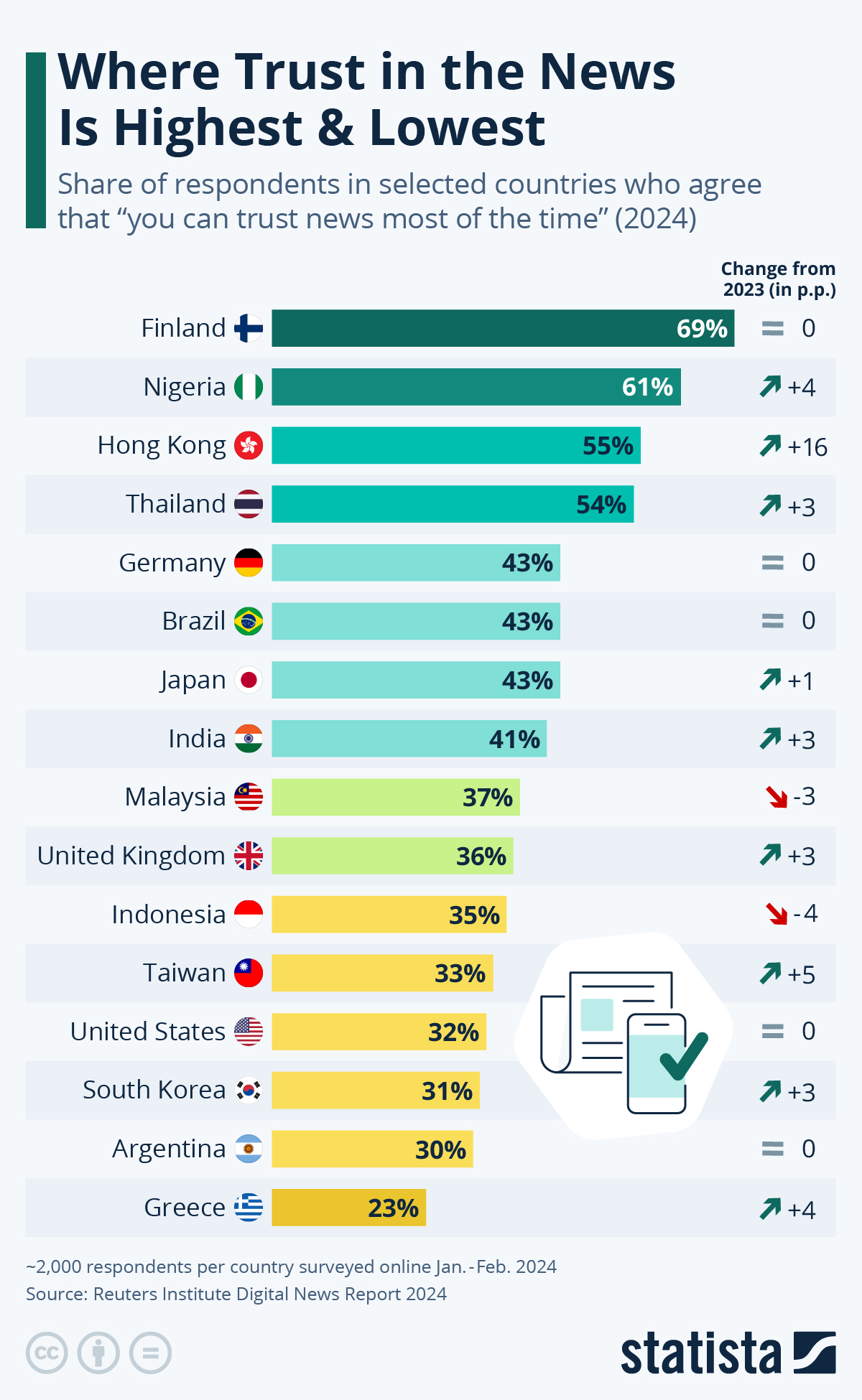
Trust In The News

The Reuters Institute For The Study Of Journalism released its 2021 Digital News Report this week which polled 92,000 consumers in 46 markets about a range of digital news topics ranging from the pandemic's impact on consumption to the progress of paid business models as well as trust and misinformation. When it comes to the latter, the research found that overall trust in the news rebounded strongly over the past year across the majority of the 46 markets analyzed.


Finland had the highest share of respondents agreeing "you can trust news most of the time" at 65 percent which marks a nine percentage point increase since the last edition of the report. The United States made little progress and it is rock bottom of the report with only 29 percent of people trusting the news most of the time.

The research states that the trust gains across most markets might be due to extensive coverage of Covid-19 which may have had the effect of making news more straightforward and fact-based in addition to pushing partisan politics off the main agendy. According to the report, the United States did not record the gains seen in other countries due to deep division about an allegedly stolen election as well as the aftermath of George Floyd's killing. Infographic: Where Trust In The News Is Highest & Lowest | Statista

Thursday, April 22, 2021

fierce competition

Песков заявил, что Россия участвует в жесткой конкуренции за работу ученых в стране


Говоря о данных статистики об оттоке российских ученых из страны, представитель Кремля заметил, что "это не всегда отток, это чаще миграция"

ищу три отличия

МОСКВА, 22 апреля. /ТАСС/. Кремль не видит трагедии в миграции отечественных ученых, заявил журналистам в четверг пресс-секретарь президента РФ Дмитрий Песков.

Говоря о данных статистики об оттоке российских ученых из страны, представитель Кремля заметил, что "это не всегда отток, это чаще миграция". "Ученые - абсолютно свободные люди и они работают в тех местах, где реализуются наиболее интересные проекты, где создаются наиболее комфортные условия", - отметил Песков. Он подчеркнул, что "в этом плане Россия - участница очень конкурентной среды".

"Справедливости ради нужно напомнить, что какие-то ученые уезжают, потом возвращаются, и в то время, когда одни уезжают в какие-то другие лаборатории, другие ученые наоборот возвращаются в Российскую Федерацию", - отметил Песков. По его словам, "это двусторонний процесс, он абсолютно нормальный".

Представитель Кремля указал, что "нет абсолютно" ничего трагичного в этой ситуации. "Это жесткая конкурентная среда, для ученых должна быть среда комфортной, они должны реализовывать свои знания, таланты, научные потенциал, государство или какие-то частные структуры обязаны создать им эти условия", - подчеркнул Песков. Он вновь отметил, что "Россия участвует в этой конкуренции".

только вчера услышал в диспуте, было про арест двух докторов наук, женщину прямо на лекции

+ инфа=размышлизма 


Sunday, April 11, 2021

opening a secret

‘You Can’t Trust Anyone’: Russia’s Hidden Covid Toll Is an Open Secret

Graves from 2020 and 2021 at the Rubezhnoye cemetery on the outskirts of Samara, Russia.

The country’s official coronavirus death toll is 102,649. But at least 300,000 more people died last year during the pandemic than were reported in Russia’s most widely cited official statistics.

By Anton Troianovski
April 10, 2021

SAMARA, Russia — She burst into the hospital morgue and the bodies were everywhere, about a dozen of them in black bags on stretchers. She headed straight for the autopsy room, pleading with the guard in a black jacket: “Can I speak to the doctor who opened up my father?”

Olga Kagarlitskaya’s father had been hospitalized weeks earlier in a coronavirus ward. Now he was gone, cause of death: “viral pneumonia, unspecified.” Ms. Kagarlitskaya, recording the scene on her smartphone, wanted to know the truth. But the guard, hands in pockets, sent her away.

There were thousands of similar cases across Russia last year, the government’s own statistics show. At least 300,000 more people died last year during the coronavirus pandemic than were reported in Russia’s most widely cited official statistics.

Not all of those deaths were necessarily from the virus. But they belie President Vladimir V. Putin’s contention that the country has managed the virus better than most. In reality, a New York Times analysis of mortality data shows deaths in Russia during the pandemic last year were 28 percent higher than normal — an increase in mortality greater than in the United States and most countries in Europe.

Deaths in Russia Were Much Higher Than Normal Last Year

Deaths from all causes, shown for selected European countries and the U.S., is the most reliable way to compare mortality during the pandemic across countries.

COUNTRYDEATHS ABOVE
NORMAL
TOTAL EXCESS
DEATHS
COVID-19 DEATHS
REPORTED
COVID-19 DEATHS
PER 100,000
Russia0.28362,30257,00239
Spain0.2371,20050,046106
Italy0.1985,60055,53592
U.K.0.1779,70082,620124
U.S.0.17385,100316,37096
Poland0.1648,70017,15045
Czech Rep.0.1511,9008,30778
Switzerland0.137,2007,21084
Sweden0.128,1008,58283
France0.1253,10055,38183
Netherlands0.1214,70010,49161
Portugal0.1210,1005,55954
Austria0.127,3004,47350
Hungary0.076,9004,67248
Finland0.041,5004899
Germany0.0319,30022,40627
Source: New York Times analysis of federal mortality statistics. Note: Excess deaths include deaths from Covid-19 and other causes. Time period shown is April through December 2020 for Russia and mid-March through December 2020 for all other countries. Reported Covid-19 deaths reflect official reported deaths from governments and health authorities, including figures that may have later been revised. In Russia, the government reports a Covid-19 death toll much lower than Rosstat, the national statistics agency.

“People didn’t know the objective situation,” Ms. Kagarlitskaya said. “And if you don’t know the objective situation, you are not afraid.”

For much of the last year, Russia has appeared more focused on the public-relations and economic aspects of the pandemic than on fighting the virus itself. After a harsh two-month lockdown last spring, the government largely lifted restrictions last summer, a boon for public opinion and the economy, even as the disease spread more rapidly.

By the fall, Russian scientists had developed a Covid vaccine widely seen as one of the best in the world — but the Kremlin has put a greater emphasis on using the Sputnik V shot to score geopolitical points rather than on immunizing its own population.

Perhaps the starkest sign, though, of the state’s priorities is its minimization of the coronavirus death toll — a move that, many critics say, kept much of the public in the dark about the disease’s dangers and about the importance of getting a vaccine.

Asked to sum up 2020 at his year-end news conference in December, Mr. Putin rattled off statistics showing that Russia’s economy had suffered less than that of many other countries. Indeed, even as Europe introduced lockdowns in the fall and winter, Russians were largely free to pack nightclubs, restaurants, theaters and bars.

A mural in honor of health care workers in Samara.

Dancing and drinking at a restaurant in Samara.

But Mr. Putin said nothing about the pandemic’s human toll — one that, in the dry monthly data releases of his own government’s statistics agency, is only now coming into full view.

The official Russian coronavirus death toll of 102,649 as of Saturday — reported on state television and to the World Health Organization — is far lower, when adjusted for the population, than that of United States and most of Western Europe.

However, a far different story is told by the official statistics agency Rosstat, which tallies deaths from all causes. Russia saw a jump of 360,000 deaths above normal from last April through December, according to a Times analysis of historical data. Rosstat figures for January and February of this year show that the number is now well above 400,000.

In the United States, with more than twice the population of Russia, such “excess deaths” since the start of the pandemic have numbered about 574,000. By that measure, which many demographers see as the most accurate way to assess the virus’s overall toll, the pandemic killed about one in every 400 people in Russia, compared with one in every 600 in the United States.

“It’s hard to find a worse developed country” in terms of Covid mortality, said Aleksei Raksha, an independent demographer in Moscow. “The government is doing all it can to avoid highlighting these facts.”

The Russian government says it counts only deaths confirmed to have been directly caused by the coronavirus in its official toll. Additional cases confirmed by autopsy are part of a separate tally published monthly by Rosstat — 162,429 as of the end of last year, and more than 225,000 though February.

But large regional disparities undermine the notion that the reason for the low official toll is simply methodological.

The city of Moscow had 28,233 excess deaths in 2020, according to Rosstat figures, and reported 11,209 confirmed coronavirus deaths as part of the official toll. The region of Samara — a relatively well-off area where the Volga River bends past oil fields and car factories as it nears Kazakhstan — had 10,596 excess deaths, a jump of 25 percent over the 2019 mortality rate. Yet the region reported only 606 official coronavirus deaths last year.

In 2020 the region of Samara had 10,596 excess deaths, a jump of 25 percent over the 2019 mortality rate.

Commuters in a subway station. The region of Samara is a relatively well-off area where the Volga River bends past oil fields and car factories as it nears Kazakhstan.

“The published numbers are trustworthy,” said Armen Benyan, Samara’s health minister. “And they are what they are.”

He acknowledged that most of the excess deaths in his region were indeed caused by the pandemic in some way. A heart attack in a coronavirus-stricken patient, for example, would not have shown up in the official toll.

The low official toll has contributed to the obliviousness of Russians to the virus’s dangers in some cases — and to their profound distrust of the government’s messaging regarding the pandemic in others. Last October, a poll found that most Russians did not believe the government’s tally of coronavirus cases: Half of those who did not believe the tally thought it was too high, while half thought it was too low.

In February, another poll found that 60 percent of Russians said they were not planning to get Russia’s Sputnik V coronavirus vaccine, and that most believed the coronavirus to be a biological weapon.

In the Samara region, Inna Pogozheva’s mother, an obstetrician-gynecologist, died in November after being hospitalized with a Covid-19 referral based on a CT scan. The undertakers, clad in rubber boots and hazmat suits, carried her mother from the morgue into their hearse in a sealed coffin, then doused each other in disinfectant.

But there was no word about Covid-19 on the death certificate.

Ms. Pogozheva said she did not know what to believe about the pandemic — including whether, as the widely circulating and false conspiracy theories go, the Gates Foundation might be behind it. But one thing was certain, she said: She will not get vaccinated, even after seeing Covid’s devastation up close. After all, if she cannot trust her mother’s state-issued death certificate, why should she trust the Russian government about the safety of the vaccine?

“Who the heck knows what they mixed in there?” Ms. Pogozheva said. “You can’t trust anyone, especially when it comes to this situation.”

Inna Pogozheva’s mother, an obstetrician-gynecologist, died in November after being hospitalized in a coronavirus ward.

Ballet dancers performing “Swan Lake” at the Samara Academic Opera and Ballet Theater. As Europe brought in lockdowns in the fall and winter, Russians were free to pack nightclubs, restaurants, theaters and bars.

Ms. Pogozheva is appealing to have her mother’s cause of death reinvestigated. The next of kin of a medical worker shown to have died from Covid-19 caught on the job are entitled to a special payout from the state. Ms. Kagarlitskaya, whose father was a paramedic, succeeded in having his cause of death changed to Covid-19 after her outrage went viral on Instagram and Samara’s governor personally intervened.

For all the death, there has been minimal opposition in Russia — even among Mr. Putin’s critics — to the government’s decision to keep businesses open last winter and fall. Some liken it to a Russian stoicism, or fatalism, or the lack of an alternative to keeping the economy running given minimal aid from the state.

Mr. Raksha, the demographer, noted that the elevated mortality that accompanied the chaos and poverty of the 1990s, after the collapse of the Soviet Union, was deadlier than the overall toll of the pandemic.

“This nation has seen so many traumas,” Mr. Raksha said. “A people that has been through so much develops a very different relationship to death.”

In the Samara region, according to the excess death statistics, the pandemic took the life of as many as one in every 250 people. Viktor Dolonko, the editor of a culture newspaper in the city of Samara, says that about 50 people he knew — many of them part of the region’s thriving arts scene — lost their lives during the pandemic. But he does not believe that Samara should have closed its theaters — currently, they are allowed to be filled to 50 percent of capacity — in order to slow the spread of the disease.

The deaths during the pandemic have been tragic, he said, but he believes they have mostly occurred in people who were of a very advanced age or had other health problems, and were not all related to the virus. Mr. Dolonko, 62, says he wears a mask in crowded places and frequently washes his hands — and regularly goes to gallery openings and shows.

“You can choose between continuing to live your life, carefully, or to wall yourself up and stop living,” Mr. Dolonko said. “Unlike you” — Westerners — “Russians know what it means to live in extreme conditions.”

At a Samara church service on a recent Sunday, the Rev. Sergiy Rybakov preached, “Let us love one another,” and the congregants hugged and kissed. One 59-year-old woman, leaving the service, explained why she did not fear catching the virus there: “I trust God.”

The Rev. Sergiy Rybakov, center, leading a Sunday service last month.

The Samara regional art museum on a Saturday afternoon.

A website tracking coronavirus deaths in the Orthodox Church lists seven members of the clergy in the Samara region; Father Sergiy knew several of them well. He said he figured Russia had lifted its coronavirus restrictions because there was no end in sight to the pandemic. He quoted Dostoyevsky: “Man grows used to everything, the scoundrel!”

“We are growing used to living in a pandemic,” Father Sergiy said. “We are growing used to the deaths.”

Anton Troianovski is the Moscow bureau chief for The New York Times. He was previously Moscow bureau chief of The Washington Post and spent nine years with The Wall Street Journal in Berlin and New York. @antontroian
A version of this article appears in print on April 11, 2021, Section A, Page 4 of the New York editionwith the headline: ‘You Can’t Trust Anyone’: Russia’s Hidden Covid Toll Is an Open Secret. 


Russia’s Virus Undercount