Showing posts with label Ирландия. Show all posts

Monday, April 17, 2023

Northern Ireland's Violent History

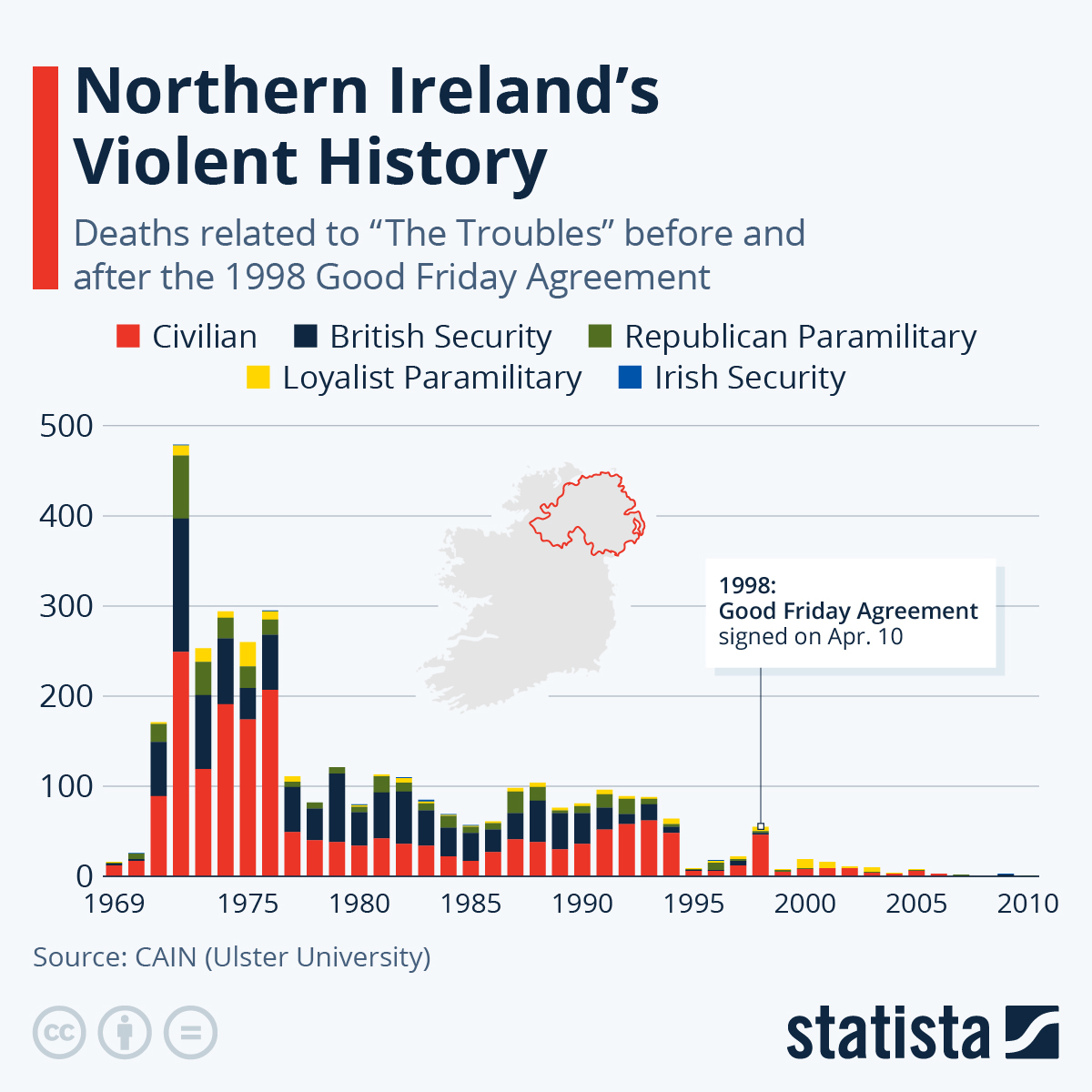
U.S. President Biden is due to visit Northern Ireland and the the Republic of Ireland next week, marking the 25th anniversary of the Good Friday Agreement - generally acknowledged to have ended the conflict known as 'The Troubles', though instances of sporadic violence have occurred since.

The conflict was fought on political and national grounds, encompassing ethnic and sectarian dimensions. According to CAIN at Ulster University, 3,568 people died during The Troubles from 1969 to 2010. 1,879 were civilian and 1,117 were members of the British security forces. A further 300 were republican paramilitaries, 162 were loyalist paramilitaries and 11 were Irish security.Northern Ireland's Violent History

Saturday, March 18, 2023

St. Patrick's Day: 31 Million Americans Claim Irish Ancestry

U.S. President Joe Biden is welcoming Irish Taoiseach Leo Varadkar to the White House today as part of a Saint Patrick’s Day tradition, celebrating the two countries' strong ties. As well as taking part in several St. Patrick’s Day events together, including the taoiseach (prime minister) gifting the U.S president a bowl of shamrock, the two leaders are expected to discuss Biden's upcoming trip to Ireland and Northern Ireland on the 25th anniversary of the  U.S.-brokered Good Friday Agreement.

The United States and Ireland have long been close allies and economic partners, with a large Irish diaspora living in the U.S. In fact, the first ever parade on Saint Patrick's Day was actually held in the U.S., taking place in New York City in 1762. In 1991, Congress even designated March as Irish-American Heritage Month.

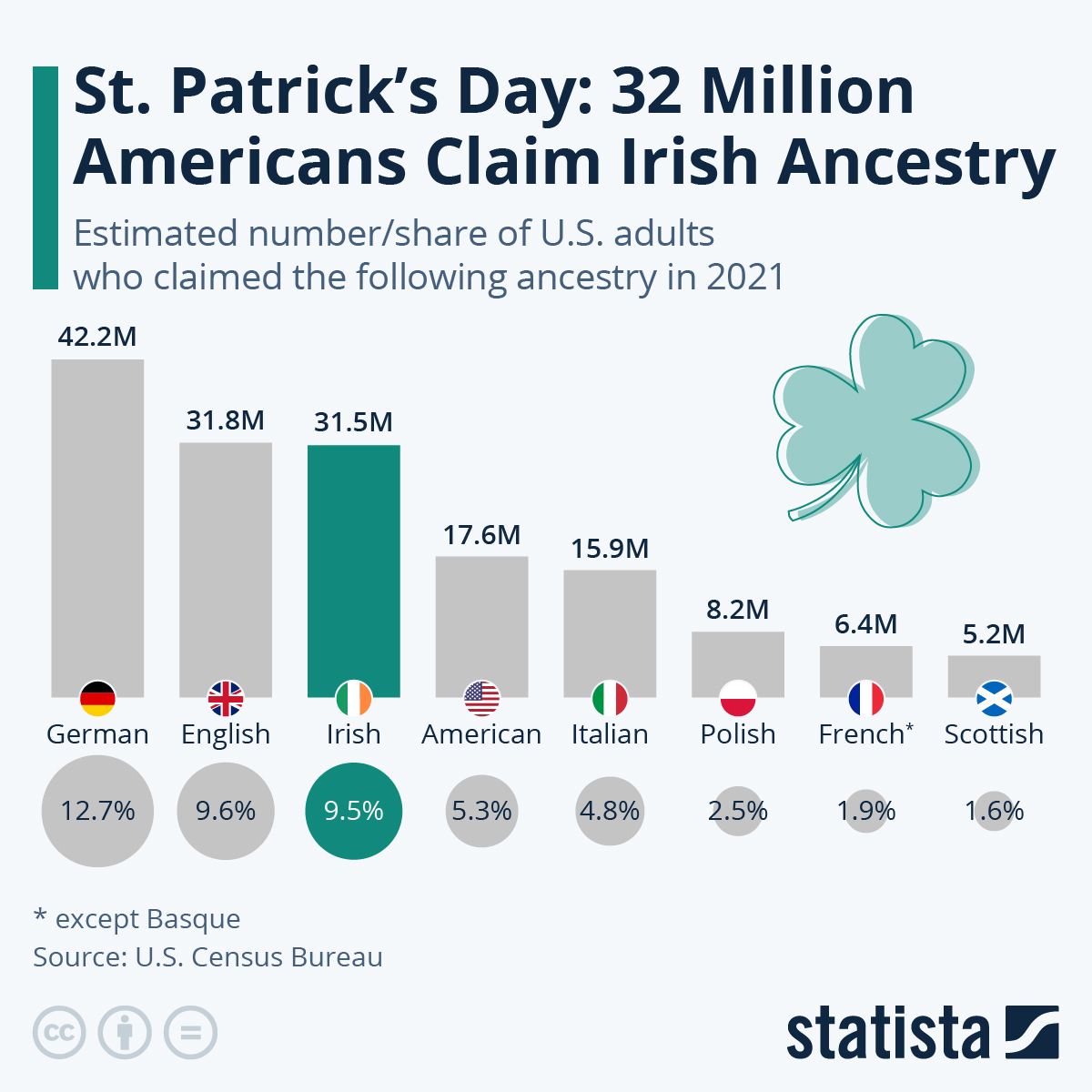
But how many U.S. citizens can actually claim Irish ancestry? According to data from the U.S. Census Bureau, some 31.5 million Americans claimed Irish ancestry in 2021, accounting for 9.5 percent of the population. German ancestry is ahead, however, with 42.2 million U.S. citizens claiming ancestral links with Europe's economic powerhouse. In second place comes English ancestry, with a further 31.8 million Americans having historical familial ties with the country.St. Patrick's Day: 31 Million Americans Claim Irish Ancestry наследие не может быть единственным :) , про =100%

Saturday, August 13, 2022

Anti-abortion Activism in Poland and the Republic of Ireland

c.1970s–1990s*


by 
Sylwia Kuźma-Markowska, American Studies Center, University of Warsaw, Warsaw, Poland.
Laura Kelly, School of Humanities, University of Strathclyde, Glasgow, UK.

We are grateful for the support of our funding bodies; Sylwia Kuźma-Markowska's research is a result of the research project “Catholicising Reproduction, Reproducing Catholicism: Activist Practices and Intimate Negotiations in Poland, 1930 — Present” (principal investigator Agnieszka Kościańska), funded by the National Science Centre, Poland (Opus 17 scheme, grant number 2019/33/B/HS3/01068) and Laura Kelly's research was funded by a Carnegie Trust for The Universities of Scotland Research Incentive Grant. We would also like to thank the “Catholicizing Reproduction, Reproducing Catholicism” research team (Jędrzej Burszta, Agata Chełstowska, Agata Ignaciuk, Natalia Jarska, Agnieszka Kosiorowska, Agnieszka Kościańska, and Natalia Pomian) for their helpful comments on an earlier draft. Finally, we are grateful to members of the KU Leuven Medicine and Catholicism since the Late 19th Century network. In particular we would like to thank the special issue editors, as well as Tinne Claes, Yuliya Hilevych, and Agata Ignaciuk for their valuable comments on earlier drafts and the three referees for their useful feedback.

This comparative article explores anti-abortion activism in Poland and Ireland from the period of the 1970s to the early 1990s. Drawing on a range of archival and printed sources, it sheds light on the Polish and Irish anti-abortion movements as a part of transnational anti-abortion efforts and underscores the importance of studying such phenomena transnationally, in a comparative perspective. We argue that despite political, social, and legislative differences that characterised both countries during this period, several pertinent parallels existed between Polish and Irish anti-abortion activism. As we show, both movements relied on transnational anti-abortion networks and discourses, employed medical knowledge to legitimise their efforts, and represented women undergoing abortion as victims.

Wednesday, January 26, 2022

What are the factors behind a 73% drop in teenage pregnancies in Ireland?

Dramatic statistic reflects many strands of societal change here in past two decades

Tue, Jan 25, 2022, 06:01
Sheila Wayman


Teenage births represented 5.7% of the 54,789 births in the Republic in 2000; in 2020, they accounted for just 1.5% of the 55,959 births that year. 

It is Health Season in The Irish Times. In print and online, we will be offering encouragement and inspiration to help us all improve our physical and mental health in 2022. See irishtimes.com/health

A dramatic 73 per cent fall in the number of births to teenage mothers in Ireland over the past 20 years is a lone statistic, but one that reflects many strands of societal change.

No single factor can explain this downward trend but a new document, Information Summary about Teenage Pregnancy in Ireland 2000-2020, to be published by the Health Service Executive (HSE) this week, takes a research-based look at how it has been achieved. It is something to be celebrated because this sort of positive development often goes under the radar when public focus tends to be on what’s going wrong with everything, rather than what’s going right.

Of course, not every teenage birth is a negative experience for all involved, but documented evidence and common sense indicate that such early parenthood is a monumental challenge, with the risk of adverse outcomes, and so best avoided.

Teenagers in Ireland today are more likely to remain in education and more likely to make healthier lifestyle choices than in the past

In the first year of the new millennium, 3,116 births to teenage mothers were recorded, according to the Central Statistics Office (CSO). By 2020, that figure had dropped to 830. In percentage terms, teenage births represented 5.7 per cent of the 54,789 births in the Republic in 2000; in 2020, they accounted for just 1.5 per cent of the 55,959 births that year.

It’s not the case, as some might suppose, that more pregnant teenagers were opting for abortions because there has been a sharp downward trend there too. In 2018, 218 Irish-resident teenagers used abortion services in England and Wales, compared with 884 in 2000. That is a decrease of 75 per cent. [не понял арифметики] (An age breakdown is not available of the 6,577 women who had abortions in the Republic in 2019, the first year after the introduction of the latest abortion legislation here.)

The HSE document also refers to the unknown numbers of people buying abortion pills online before the changes in legislation. But it cites a study in which one online provider of these pills reported consultations with 5,650 women from the island of Ireland over six years between 2010 and 2015, of whom 4.6 per cent were under the age of 20.

Teenagers can be stigmatised in a particular way, says Maeve O’Brien, interim programme lead with the Sexual Health and Crisis Pregnancy Programme (SHCPP), in an interview with The Irish Times. “But when you look at the data, they’re doing brilliantly [as well as in Russsia] because they are being supported to do so and we just wanted to make that point.”

She and her team in the health and wellbeing section of HSE strategy and research tracked and analysed the figures for teenage births. This summary of their findings, available on sexualwellbeing.ie, concludes that “teenagers in Ireland today are more likely to remain in education and more likely to make healthier lifestyle choices than in the past”.
Graph shows a 73% drop in the number of births to teenage mothers from 2000–2020. Graphic: Information Summary about Teenage Pregnancy in Ireland 2000-2020.

Eighty per cent of sexually active 17-18 year-olds always use some form of contraception and about 90 per cent use it the first time they have sex, according to findings from the Growing Up in Ireland longitudinal study. Indications of more responsible behaviour from other studies include the percentage of 10-17-year-olds who reported ever having been drunk falling from 32 per cent in 2002 to 19 per cent in 2018, and the rate of smokers in that age group dropping from 18 per cent to 5.3 per cent over the same period.

The explanation for the reduction in teenage pregnancies is complex and multi-factorial, says O’Brien, and it’s also part of a global trend. “But the key point is that there have been broad policy, legislative and societal changes in Ireland in the last 20 years that have contributed to a supportive environment.”

Here we look at some of the factors at play over the past two decades in the proverbial “village” that it takes to raise a child.

More sex education


Relationships and sexuality education (RSE) isn’t something that just happens in schools, but the introduction of an RSE curriculum within the education system back in 1996 has had an accumulative effect.

“Evidence shows it is having a positive effect where young people are getting it and people think the quality of it is good,” reports O’Brien.

However, ensuring consistent delivery and quality of such teaching is still a work in progress, as acknowledged by the current review of RSE provision being undertaken by the National Council for Curriculum and Assessment, within the broader context of Social, Personal and Health Education (SPHE) across both primary and secondary schools.

It is more critical than ever that teenagers receive clear, factual information about sexual health and contraception

O’Brien praises “excellent partnerships between statutory and community providers” that aim to support people to improve their health and wellbeing generally, of which sexual health is a part.

“Young people need safe spaces, they need supportive, trustworthy adults around them,” she says. In working with schools, youth organisations and parents, the SHCPP is trying to ensure appropriate information is conveyed to young people in a supportive way.

The medical director of the Irish Family Planning Association, Dr Caitríona Henchion, says it’s clear from its services that teenagers are more aware that they need to protect themselves from sexually transmitted infections (STIs) as well as unintended pregnancy.

“However, misinformation about sexual health among teenagers is still very common,” she continues. “It is more critical than ever that teenagers receive clear, factual information about sexual health and contraception so that they are empowered to be safe and healthy if they are in a sexual relationship.”

Parenting changes


Criticism and debate about RSE tends to focus on schools but they complement rather than replace the parents’ role, says O’Brien, whose programme has also identified a “cultural component” in Ireland to parent-child communication about sexual health.

“A lot of parents said they got nothing when they were children, but they really wanted to change this for their own children. But when it came to doing it, they still lacked confidence and they were concerned about transgressing the norms of other parents.”

This demonstrates a shift in attitude towards talking to children about sexuality but also legacy issues. “There’s a desire to do it, which wasn’t there in the past, but we are still being prevented in some way by our past,” says O’Brien.

Now contraception is an early and active suggestion by parents to their teenagers as they see the drawbacks of an unwanted pregnancy

What used to be referred to as “the talk” – although ideally it should be a series of age-appropriate discussions over a number of years – doesn’t have to be focused on sex. “It’s having conversations about puberty and linking that to becoming an adult and what that means,” she says. But parents’ discomfort is still problematic.

Some 45 per cent of young people have discussed sex and relationships with parents by age 13, according to Growing Up in Ireland data, and that rises to 60 per cent by age 17. “But that leaves 40 per cent by age 17 that hadn’t. So there’s still a bit of work there,” she remarks.

However, today’s parents are more likely now to be leaving boxes of condoms in teenagers’ bedrooms rather than books about “growing up” as their parents did, suggests Aileen Hickie, chief executive of Parentline. This confidential support service is 40 years old this year and has seen “a vast change in attitude” among callers.

Parents in the past were generally horrified at the idea of suggesting contraception to their daughters as they believed that would encourage promiscuity, she says. “Now it is an early and active suggestion by parents to their teenagers as they see the drawbacks of an unwanted pregnancy and are more accepting that their child is sexually active.”

Easier access to contraception


Contraception has become much more available to teenagers over the past two decades and the range of options has also increased. The situation will be further improved by the introduction this August of a scheme, funded in Budget 2022, to provide free contraception to all young people aged 17-25 years.

Wider use of of long-acting reversible contraceptives (LARCs) has been indicated as a factor in the reduction of teen pregnancies in the UK. However, the Irish Family Planning Association says that in the absence of robust up-to-date Irish data on the use of contraception by sexually active adolescents, it can’t confirm that LARCs have contributed to the decline in teenage pregnancy here.
Graph shows a 75% drop in the number of teenagers who travelled to the UK for an abortion from 2000-2018. Graphic: Information Summary about Teenage Pregnancy in Ireland 2000-2020.

However, LARCs provide a “fit and forget” option, and are considerably more effective than user-dependent methods such as the pill or the condom, says Henchion. With the high upfront cost of this method being a barrier for some, the new scheme will remove cost as a consideration from contraceptive decisions for 17-19-year-olds. But, she adds, “the IFPA strongly believes there should not be a lower age limit on this scheme, so that younger teenagers are not left behind”.

Prof Abbey Hyde of UCD school of nursing, midwifery and health systems, who led the first comprehensive study of teenage sexuality in Ireland in 2004, says research at that time found inconsistent use was a huge problem for those who used contraception, especially if they were under the influence of alcohol.

Wider use of emergency contraception since then may be one of the many contributing factors to fewer teenage pregnancies. Access to the so-called “morning after pill” was made easier here in 2015 when it became available without a prescription.

Although, Hyde points out, this would only account for teenagers motivated to act by the belief that they might be pregnant. There was evidence from previous studies of a lack of “agency” about preventing pregnancy among young people who came from a background of culturally and socio-economic disadvantage.

It wasn’t that they went out to get pregnant, it’s rather that they drifted in because of this general milieu, their set of circumstances, meant they weren’t active agents over any part of their lives, let alone fertility.”

Increased educational attainment


The rise in the numbers of young people staying in school to complete their Leaving Cert and going on to third-level is regarded as a significant factor. Higher levels of education have been shown to contribute to improved health generally and are linked to protective behaviours.

Irish research suggests that those who leave school by age 17, or who have lower levels of educational attainment, are more likely to report having sex before they reach 17, and are more likely to experience a crisis pregnancy.

Of those pupils who started secondary school in 2014, 91.5 per cent stayed in school to complete the Leaving Certificate, compared with 78.3 per cent who entered first year in 1994.

Unplanned pregnancy can happen to any young person, but teenagers for whom the future seems most uncertain remain the most vulnerable

This increase in school retention “feeds into less teen pregnancy because research shows that the more you have to lose in terms of your life plan, the more careful you would be around contraception”, explains Margaret Morris, national coordinator of the Teen Parents Support Programme.

With that comes the “cumulative idea of norms shifting”, says Hyde. When young people look around their neighbourhood, they are less likely to see their peers becoming pregnant.

Unplanned pregnancy can happen to any young person, but teenagers for whom the future seems most uncertain remain the most vulnerable. These include youngsters living in, or having just left, State care and also those growing up in acute socio-economic disadvantage.

The SHCPP has worked closely with Tusla on how to address the fact that so many young people leaving care were parents by their early 20s at the latest, says O’Brien. She also commends HSE colleagues for the healthy communities initiative, which focuses on the most deprived areas.

Not for a minute, she adds, is the SHCPP suggesting that the fall in teenage pregnancy is an indicator, by itself, of good adolescent health or “that our work here is done. We are very aware that teenagers are constantly facing new and different challenges. We will continue to try to address these as they evolve.”

National support programme


Early parenthood in Ireland may be falling but a national support programme for teenage parents is still only able to reach about 25 per cent of them.

The Teen Parents Support Programme, run by Treoir, the national federation of services for unmarried parents and their children, has 11 projects around the country. But it wants additional resources to expand its operations.

“Ideally, we would like all teen parents to have this kind of support,” says the TPSP national co-ordinator Margaret Morris. There is no dispute, she says, about the effectiveness of the long-term, consistent support they offer, from pregnancy right through to when the child reaches two years of age – and beyond in some circumstances.

She has been working in this field for almost 17 years and has observed a “wonderful decline” in numbers of teenage parents.

Hopefully, this will continue because unless a young parent gets very good support, whether it’s from an organisation like us, or from the family and from school, their life chances and the life chances of the child are hugely reduced. There aren’t that many of them now so we should be able to support all of them.”

In her experience, families rally around teen parents, particularly the grandmothers. That’s not to say there isn’t usually an adaptation period of coming to terms with the idea, when there may be anger towards both the young woman and the father. Also, some are very stretched in what support they can provide.

The significant change Morris has witnessed over the years is the attitude of schools, which have been much more supportive.

We are getting referrals from hospitals, Tusla and other social services asking us to support this group who are not teenagers, but still extremely young

“I think they see it less now as a reflection of the school as they might have 20 years ago. I would see a big shift there but I think families have always done their best.”

More than half the teenagers are referred to the TPSP by maternity hospitals, others by Tusla, GPs, youth organisations and schools. She welcomes that fact that most come to them antenatally.

There is no other comparable service for teen parents, says Morris, as they work with them “where they’re at as young people”. They can be scatty and inconsistent, like all teenagers, and she believes their staff are very good at dealing with that.

However, she acknowledges the achievements of organisations such as Tusla, who get a bashing all the time. Tusla’s School Completion Programme has succeeded in keeping at-risk youngsters in education and it also deserves a lot of credit, she says, for its Prevention Partnership and Family Support work. Wider health education as promoted by the HSE, has also helped.

Yet, there are still many vulnerable young parents that Morris would like to be able to reach. “There are areas in Dublin, such as Clondalkin, where schools have asked for a TPSP programme and there isn’t one.”

The TPSP would like to be able to increase its work with teenage fathers and also extend its services to parents under 25.

A woman having a baby at age 20 or 21 is now very young in societal terms, Morris points out, since the average age for a woman giving birth is 33.1 years, according to CSO figures from 2019. “We are getting referrals from hospitals, Tusla and other social services asking us to support this group who are not teenagers, but still extremely young.”
Tuesday, November 30, 2021

damned Irish conservatives

Ireland makes contraception free for the under 25s


The Irish Department of Health has confirmed that free contraception for young women will be made available in August, 2022.

Minister Stephen Donnelly said that it is envisaged the scheme, aimed at women aged 17-25, will cost between €18m to €22m per year.

It was announced last month that the contraceptive pill will be available to this age group for a nominal €1.50 prescription charge. The cost of fitting and removing long-term contraception such as implants will be free. Two doctor's consultations per year regarding contraception will also be free of charge for women in that age group.

This programme complements existing free contraception initiatives including the National Condom Distribution Service (NCDS).

Thursday, March 18, 2021

30 mln in the USA

For the second year running, Ireland is experiencing a highly abnormal Saint Patrick's Day with shuttered pubs and deserted streets replacing the marching bands, bag pipers and revelers. Usually, 13 million pints of Guinness are consumed across the world in honor of Ireland's national day (enough to fill two and a half Olympic swimming pools) but the ongoing pandemic is going to ensure any festivities are subdued.

Even though Saint Patrick's Day is a major event in Ireland, it is also huge in the United States where a large Irish diaspora celebrates the holiday in style. U.S. Saint Patrick's Day traditions even tend to go a step further than the Emerald Isle with Chicago dying its river green in an impressive display. The first ever parade on Saint Patrick's Day was actually held in the U.S. and it occurred in New York City all the way back on March 17, 1762.

The connection between the U.S. and Ireland has remained strong for years and Congress designated March as Irish-American Heritage Month in 1991. Traditionally, the Irish taoiseach (prime minister) flies to Washington D.C. every year on March 17 to present the U.S. president with a bowl of shamrock. This year's ceremony will be a virtual affair between Micheál Martin and Joe Biden.

Given the strength of those links, how many U.S. citizens can actually claim Irish ancestry? According to data from the U.S. Census Bureau, some 30.4 million Americans claimed Irish ancestry in 2019, 9.2 percent of the population. German ancestry is ahead, however, with 40.4 million U.S. citizens claiming ancestral links with Europe's economic powerhouse. A further 7.2 million Americans have historical familial ties witn England.Infographic: St. Patrick's Day 2021: 30 Million Americans Claim Irish Ancestry | Statista

Friday, January 15, 2021

Mother and Baby Homes Commission of Investigation

20 лет
The Mother and Baby Homes Commission of Investigation
(officially the Commission of Investigation into Mother and Baby Homes and certain related matters) is a judicial commission of investigation, established in 2015 by an order of the Irish government to investigate mother and baby homes—institutions, most run by Catholic religious sisters, where unwed women were sent to deliver their babies.[1] It was set up following claims that the bodies of up to 800 babies and children may have been interred in an unmarked mass grave in the Bon Secours Mother and Baby Home, located in Tuam, County Galway. Its remit additionally covers investigation into the records of and the practices at an additional thirteen Mother and Baby Homes. The members of the three-person Commission are Judge Yvonne Murphy (chairperson), Dr William Duncan and Professor Mary E. Daly.

Originally scheduled to issue its final report by February 2018, the Commission was granted a series of extensions.[2][3] In January 2021, the final report detailed that around 9,000 children, one in seven of those born in the 18 institutions covered by the Commission's terms of reference, had died in them between 1922 and 1998, double the rate of infant mortality in the general population.[4] The final report was published on 12 January.[4] On 13 January 2021, the Taoiseach Micheál Martin made a formal apology to survivors on behalf of the state.[5][6]

Friday, April 3, 2020

teleabortions in Ireland


Sunday, December 1, 2019

Is retirement detrimental to later-life cognition?

Published on N-IUSSP.ORG December 3, 2018

La retraite nuit-elle aux fonctions cognitives des seniors ?


Irene Mosca, Robert E. Wright

A growing body of research has suggested that one way to preserve cognition in later-life is to delay retirement and continue to work into the later years. Irene Mosca and Robert E. Wright test this hypothesis using data for older Irish women. They find that women who have been retired for longer have lower cognition. However, this effect is only small.

Cognitive abilities are the mental skills people need to carry out any task from the most simple to the most complex. These mental skills include functions such as awareness, information handling, memory, and reasoning. Cognitive abilities tend to deteriorate in older age. It has been suggested that engaging in mental exercise and maintaining an engaged lifestyle can help preserve cognition and slow down cognitive decline in later-life. Examples of such activities are recreational pastimes (such as crossword puzzles and playing chess), learning a new skill or studying a foreign language (Tucker-Drob and Salthouse 2011).

A growing body of research has suggested that another way to preserve cognition is to delay retirement and continue to work into the later years. The hypothesis is that workers engage in more mental exercise than retirees because work environments provide more cognitively challenging and stimulating environments than do non-work environments such as the home (Rohwedder and Willis 2010). If this hypothesis is correct then there should be a negative relationship between retirement and cognition. Some evidence of such a relationship has been found in European countries and the US. However, most of the existing studies focus on men or do not disaggregate by sex.

Our study (Mosca and Wright 2018) tests the hypothesis that longer retirement duration is associated with lower cognition in later-life among women. We believe that focusing on women is important because the employment histories for men and women are generally different. In most high-income countries, men typically work uninterruptedly from when they complete schooling until retirement, with ill health and unemployment being the main factors causing deviation from this pattern. The pattern for women is typically different because child-bearing and child-rearing frequently result in mothers leaving the labor force, often for considerable periods of time.

Data and findings


We use data for older Irish women collected in the third wave of The Irish Longitudinal Study on Ageing (TILDA). TILDA is a nationally representative sample of community-dwelling individuals aged 50 or older in Ireland. The survey collects detailed information on the economic, health, and social aspects of the respondents’ lives. Respondents also undergo a thorough health assessment with a specially-trained nurse either in a dedicated health assessment center in Trinity College Dublin or in their own home. Assessing respondents’ cognition is one of the key components of TILDA health assessment.

In our study, we employ four measures of cognition that are collected as part of the nurse-led health assessment. They have been previously unexplored in the retirement/cognition literature and are tests of visual scanning, mental processing speed, task switching, and concentration. The first two measures are the paper-based Colour Trail Tasks 1 and 2 in which respondents are asked to draw a line with a pencil connecting numbers in circles. The second two measures are Choice Reaction Time and Variability. These involve a computer-based task in which respondents are required to press the corresponding button after a stimulus appears on-screen. The performance indicator for all four measures is the time taken to successfully complete the test, with shorter completion time indicative of better performance.

Ireland offers a unique setting to investigate the relationship between retirement and cognition among women. Between the 1920s and the 1970s, many women were forced to leave employment – in a sense, retire – at marriage. This was due to a policy of legally-binding gender discrimination introduced by the Irish Government, known as the Marriage Bar. As this policy was abolished only in the 1970s, many of the women affected by it are still alive and are among the TILDA respondents. Many of these affected women have been retired for many years as they left the labor market when they were young.

The key finding of our research is that retirement duration and cognition are negatively related. That is, the longer a woman has been retired or has not worked in the labor market, the lower her cognition in later life, controlling for confounding factors affecting cognition. This key finding is descriptively shown in Figure 1. Women who have been retired for longer are slower at completing the four cognitive tests. However, our formal statistical analysis shows that this effect is small in magnitude. We argue that perhaps this effect is small because the women in our sample substituted work-related activities with non-work activities after withdrawing from the labor market. For example, it could be that the positive effect of child-bearing and child-rearing on cognition outweighs the negative effect of time not working. We do not find strong evidence in favor of this “substitution hypothesis”. However, to investigate this with rigor would require the collection of detailed employment and life histories, which are not currently a feature of the TILDA survey.

We believe that further research based on additional data is needed to further clarify the relationship between not working in the formal labor market and later-life cognition. Distinguishing the relative importance of the work environment and of alternative uses of time during retirement for maintaining levels of cognition in later life should be a priority.

References

  • Mosca, I. & Wright, R.E. (2018). Effect of Retirement on Cognition: Evidence from the Irish Marriage Bar. Demography, 55(4), 1317–1341.
  • Rohwedder, S., & Willis, R.J. (2010). Mental retirement. Journal of Economic Perspectives, 24(1), 119–138.
  • Tucker-Drob, E.M., & Salthouse, T.A. (2011). Individual differences in cognitive aging. In T. Chamorro-Premuzic, S. von Stumm, & A. Furnham (Eds.), The Wiley-Blackwell handbook of individual differences (pp. 242–268). Oxford, UK: John Wiley & Sons.

Monday, March 18, 2019

St. Patrick's Day By The Numbers

On both sides of the Atlantic, pub owners, marching bands, bagpipers and revellers are gearing up to celebrate St. Patrick's Day which falls on Sunday. These days, the Irish holiday is also a big deal for the Irish diaspora in many countries around the world, particularly in the United States where many people have Irish ancestry. It's often said that the first ever St. Patrick's Day parade was held in New York City in 1763 by Irish soldiers serving in the British army. More recent research claims the first ever parade actually occurred in 1601 in Augustine, Florida. By contrast, Ireland's first state-sponsored parade was held in Dublin in 1931. [Москва выпала, но тут тоже бывало, включая парады — как теперь, не знаю]

The celebrations have been criticized in recent years for being too commercialized and given that an estimated 13 million pints of Guinness are consumed on March 17th every year (enough to fill two and a half Olympic-sized swimming pools), that is somewhat understandable. The following infographic shows some key facts and spending trends behind St. Patrick's Day, particularly in the United States. Chicago is one of the best places to celebrate and its festivities kick off at noon on Saturday. The city is notable for dying the river green, a tradition that began in 1962 and involves 40 lbs of dye. The green color lasts about five hours.

The event is still hugely popular with young Americans and according to the National Retail Federation, 72 percent of those aged 18-34 plan to celebrate this year. Total U.S. spending is expected to reach $5.6 billion in 2019, a slight decrease on $5.9 billion last year with average spending expected to be just over $40. Boston is another great city for St. Patrick's Day festivities and it claims the title as the most Irish city in the country with 20.4 percent of its population reporting Irish ancestry. Given the extent of its connections with Ireland, it throws an impressive parade every year and it the South Boston Parade starts in "Southie" at 1pm on Sunday.
Infographic: St. Patrick's Day By The Numbers | Statista

Tuesday, November 20, 2018

Irish Famine and mass migration

Cormak O'Grada (Кормак О'Града)
приглашаем вас принять участие в научном семинаре Института демографии 

«Демографические вызовы XXI века», 

который состоится 26 ноября 2018 года.
С докладом на тему 

«Irish Famine and mass migration: lesson for today» 

выступит Cormak O'Grada (Кормак О'Града )

Cormac Ó Gráda is an Irish economic historian and professor emeritus of economics at University College Dublin. His research has focused on the economic history of Ireland, Irish demographic changes, the Great Irish Famine (as well as other famines), and the history of the Jews in Ireland.

He is a member of the Cliometrics Society, the Economic History Society, the European Historical Economics Society, the Irish Economic and Social History Society, and the Royal Irish Academy. He has served on the editorial boards of Journal of Economic History, Explorations in Economic History, and the Agricultural History Review, and is a former coeditor for the European Review of Economic History. He is the President of the Economic History Association. In 2010, he won a Gold Medal from the Royal Irish Academy, of which he has been a member since 1994. He has been a visiting professor to a number of universities around the world, including the University of British Columbia, New York University, the University of Copenhagen, and Princeton University.

Ó Gráda is a prolific writer. He has written and published seven books in addition to numerous journal articles and collaborations, with over 100 academic papers available online.

Books:

• Ireland: A New Economic History, 1780-1939. Oxford: Oxford University Press. 1994.

• A Rocky Road: The Irish Economy Since the 1920s. Manchester: Manchester University Press. 1997.

• Black '47 and Beyond: The Great Irish Famine in History, Economy, and Memory. Princeton, NJ: Princeton University Press. 1999.

• Famine Demography: Evidence from the Past and the Present. Oxford: Oxford University Press. 2002.

• Jewish Ireland in the Age of Joyce: A Socioeconomic History. Princeton, NJ: Princeton University Press. 2006.

• Famine: A Short History. Princeton, NJ: Princeton University Press. 2009.

• Eating People Is Wrong, and Other Essays on Famine, Its Past, and Its Future. Princeton, NJ: Princeton University Press. 2015.

The American Conference for Irish Studies awarded the James S. Donnelly, Sr. Prize to two of his books, Black '47 and Beyond (1999) and Jewish Ireland in the Age of Joyce (2006)

Начало семинара в 15-30

Семинар состоится по адресу: ул. Мясницкая д. 20, ауд. 101.

Всех, кто планирует принять участие в семинаре, просим подтвердить участие до 12:00 23 ноября, заполнив форму http://goo.gl/forms/EZYvfU0Iy34nqu3k1

или по телефону +7 (495) 772 95 90 * 11823 (Мария Винник).

Thursday, April 12, 2018

struggling for an obligatory insurance funds

аборт в Польше
Гуголь какбе подтверждает аборт в Польше запрещён, но сделать можно
5 апреля 2018 lenta.ru опубликовала статью


Церковные матки

Россиянок лишают абортов. Кому это выгодно?


Канешна абортов не лишают, но пока
Пока РФ остаётся с весьма либеральным законодательством, и, несмотря на ах.какую активность законодателя, ведомого передовыми идеями РПЦ, многие страны нам завидуют (нашараша, но это не шютка ниразу). 

Для справки: в большинстве стран мира аборт ваще запрещён, а там, где разрешон (в основном, Европа, кроме Ирландии, Польши и вроде бы Мальты), препятствий для реализации права ещё больше. Курс партии и патрии, описатый в статейке, как раз на зад в еврики, а лутшэ сразу в Польшу или Мальту.

Но, высказано: является ли борьба борьбой с абортом? Норот обоснованно подозревает, что на самом деле так называемые пролайферы РПЦ и их полезные идиоты рубятся за бабло мед.страха:
Протоиерей Максим Обухов рассказал, что работает над организацией работы священнослужителей в женских консультациях по типу сестринских отделений. «Лицензию получить не трудно. Тогда и будем получать деньги из ОМС», — сказал он.
Парень рубит сук, на котором сидит. 

Sunday, March 18, 2018

Lá Fhéile Pádraig

Every year, more than 13 million pints of Guinness are consumed across the world to celebrate St. Patrick's Day. Ireland's national holiday has become a global celebration with Americans in particular fond of celebrating their inner Irishness. That comes as little surprise given that some 39.6 million people in the U.S. claim Irish heritage, nearly seven times the entire population of Ireland. The most recent census data shows that Boston, Middlesex County and Peabody in Massachusetts are the most Irish American towns in the country. Many other places will don the green this weekend and splash the cash.

The National Retail Federation has forecast that 60 percent of Americans will celebrate this weekend with planned spending expected to reach a record $5.9 billion. On average, that means every person will spend $39.65. Chicago always has an exciting St. Patrick's Day celebration where the river turns green. 400,000 people are expected to turn out for the long term tradition tomorrow and 60 pounds of dye will be required to turn the river green between Columbus and Wacker drives. Of course, many people will be hoping for a sublime pint of Guinness this weekend and according to the makers themselves, it takes 119.5 seconds to pour the perfect pint. Many others will enjoy a nice glass of Irish whiskey, something that has become increasingly common in the states. Back in 1996, 280,000 cases of Irish whiskey were consumed and that had risen steadily to 3.65 million by 2016.
Infographic: St. Patrick's Day In The U.S. By the Numbers  | Statista
две минуты, чтобы налить пинту Гинеса — во это норма жизни

Sunday, October 9, 2016

Brexit into Ireland

Following the UK's referendum vote to leave the EU, many Remain voters scrambled to grasp hold of the Irish branches of their family trees, obtain Irish passports and remain in the EU. This resulted in a surge in demand for Irish passports from Britain in the months since. According to RTE, some studies estimate that six million British citizens could be eligible for dual citizenship.

In the three months following the referendum, applications for Irish passports from people in England, Scotland and Wales almost doubled according to data released by the Irish Department of Foreign Affairs. In the three months from July to September, 21,549 British residents applied for an Irish passport compared to 10,959 during the same period last year. Northern Ireland also saw its Irish passport applications rise to 15,757 compared to 9,401 last year.

This chart shows the number of British applications for Irish passports in 2015 & 2016 (excluding Northern Ireland).Infographic: Irish Passport Applications From Britain Are Soaring | Statista
вчера был длинный и научно обоснованный рекзит
сегодня короткий, но наглядный брекзит

Tuesday, February 2, 2016

recommendation


шикарная весчь, отлично пьёцо
Black and Tan made with Guinness Draught and Harp lager Any pub worth its stout can pour you a Black and Tan, the classic two-toned beer elixir. But you don't have the leave the house to enjoy this gravity-defying creation....

Sunday, March 17, 2013

why Patrick?

есть какая-нить рациональная конспирология: почему Патрик, почему Ирландия?

или мне просто самому пиво нравицо и никаких далекоидущих конспирологий.нет?
он следы их есть: