Showing posts with label семья. Show all posts

Friday, January 24, 2025

abortion

В России не будут запрещать аборты. 

Но давление на женщин усилится – итоги Года семьи


Месяц назад в России завершился объявленный Путиным Год семьи. Основной проблемой, которой власти занимались в этот год, было падение рождаемости. И здесь можно подвести кое-какие итоги.


🟢 Запрета абортов (пока) не будет

В конце года Путин необычайно эмоционально говорил о демографических проблемах в стране и называл ситуацию драматической. Однако идти на крайние меры государство пока не готово.

Власти не стали запрещать аборты из-за резко негативного восприятия этой меры гражданами. Поэтому и в обозримом будущем вводить прямой запрет они не планируют.

«На верхнем уровне – президента и администрации – эта тема не была поддержана абсолютно», – объясняет высокопоставленный собеседник, разрабатывающий меры в сфере демографии.

По его словам, отрицательное отношение россиян к запрету абортов власти зафиксировали в соцопросах. В Кремле опасаются, что эта мера поднимет и без того высокую тревожность граждан, говорит он. Другой собеседник, в Минздраве, подтверждает, что власти оглядываются на общественное мнение: «Запрещать аборты слишком опасно, население это не примет». Также не стоит вопрос о выводе абортов из ОМС, говорят собеседники.


🔴 Но власти усилят пропаганду и давление на женщин

Тем не менее задача повышения рождаемости остается приоритетом для чиновников всех уровней – так велел Путин. Поэтому власти будут продолжать пробовать любые меры, не предполагающие прямого запрета на прерывание беременности, говорят наши собеседники. В первую очередь пропагандистские инструменты и психологическое давление, как, например, запрет пропаганды чайлдфри, штрафы за склонение к абортам, доабортное консультирование.

Естественно, главная мишень этих мер – женщины. Именно они в опросах наиболее категорично выступают против запретов, говорит источник, разрабатывающий меры по демографии (в опросе близкого к Кремлю ФОМ от декабря 2023 года 75% женщин были против запрета абортов наряду с 54% мужчин). Некоторые чиновники рассказывают, что даже их собственные родственницы высказали свое недовольство: «Моя 75-летняя мама внезапно пришла ко мне и отчитала: даже не лезьте туда, это дело женщины».

«Если вдруг большинство женщин станет за запрет, то это будет иметь шанс», – объясняет логику властей наш собеседник.

Основное бремя здесь лежит на губернаторах – именно они ответственны за показатели рождаемости и смертности в своих регионах, а теперь по ним в Кремле будут оценивать их эффективность.

«Регионы очень активно обмениваются практиками. Находится кто-то смелый, все остальные смотрят: по башке не дали? Давайте тоже попробуем», – объясняет бум креатива в части мер по повышению рождаемости в регионах собеседник в руководстве одного из них.

Сейчас более чем в десяти регионах введены штрафы за склонение к абортам, а в 31 субъекте – допвыплаты за раннюю беременность.


☝️Рост рождаемости для Путина – «задача исторического масштаба»

Именно так характеризуют отношение Путина к проблеме низкой рождаемости наши источники, но он и сам не скрывает этого. На заседании Госсовета в декабре, где подводились итоги Года семьи, Путин говорил, что чиновники должны начинать и заканчивать свой день мыслями о рождаемости, призывал всех брать пример с Чечни и Тывы – двух регионов, где доминируют правила традиционного общества, а также говорил о качестве спермы в разных странах (что? да!).

Поэтому совсем исключать, что государство в борьбе за рождаемость дойдет и до запрета абортов, нельзя.

«Завтра какое-нибудь духовное лицо может прийти к президенту и сказать, что это надо обязательно делать [запрещать аборты], невзирая на социологию. И все», – рассуждает высокопоставленный источник в правительстве.

Отбивать усилия главных лоббистов ограничений прерывания беременности – РПЦ и таких близких к ней людей, как олигарх Константин Малофеев – гражданским чиновникам дается все тяжелее, признают собеседники.

Thursday, June 6, 2024

Drivers of fathers’ parental leave uptake in Belgium


The dynamics of parental leave uptake in couples have received increasing attention in recent years. This reflects greater societal awareness of issues relating to gender equality and work-life balance, but is also a result of the relatively low rate of parental leave uptake by fathers in many countries. A large body of academic literature has proposed several complementary explanations for differences in fathers’ parental leave uptake, including parenting ideologies and policy design features.
 

The relative resources hypothesis


Micro-economic considerations are also important. Among these, the relative resources hypothesis posits that the partner with lower wage potential is more likely to use parental leave because this minimizes forgone household income. Consequently, higher parental leave uptake is to be expected among fathers whose wages are lower than their partner’s (i.e., who are the secondary earner within the couple). However, despite being often referred to as a micro-economic determinant of couples’ decision-making (e.g. regarding the gender division of paid labour), we still do not fully understand whether and when the relative resources hypothesis holds as an explanation for low male parental leave uptake.

Secondary-earner fathers are more likely to use parental leave


In a recent study (Wood, Marynissen, Van Gasse 2023), we used large-scale longitudinal register data for Belgium to quantify the significance and magnitude of the relative resources pattern in fathers’ parental leave uptake. A subsample of 1,810 couples was observed longitudinally throughout the father’s period of eligibility for parental leave. Logit models of fathers’ parental leave uptake were estimated, classifying fathers in three levels of relative contribution to the household labour income: less than 40%, 40%‒60%, and more than 60%.

Results confirm that the lower the father’s contribution to household labour income, the higher the probability that he will use parental leave (Figure 1). However, this does not imply that household income constellations where the father is the secondary earner translate into higher male than female leave-taking. Additional models estimating female leave uptake in couples indicate that even within couples with a secondary-earner father (i.e. fathers’ wage <40%), the probability of the father taking parental leave does not exceed that of the mother (Figure 1).

When is it about the money?


In a second stage, we also combined quantitative register-based analyses and qualitative in-depth interviews to explore four factors that potentially moderate relative resources mechanisms in fathers’ leave-taking decisions: household income, workplace factors, incomplete information, and gendered parenting ideals.

Both the quantitative and qualitative results of our study suggest that the stimulating impact of being a secondary earner on leave uptake among men is strongest among fathers in female-dominated employment sectors (Figure 2, left panel), where parental leave is depicted as more institutionalized and normalized. The positive impact of being a secondary-earning father disappears completely if he is employed in a gender equal or male-dominated workplace.Regarding couples’ total income position, quantitative and qualitative results indicate that the occurrence and strength of the relative resources mechanism as an explanation for fathers’ leave uptake depends on the financial resources at the couple level (Figure 2, right panel). Low household income levels are seen as an important limitation on couples’ opportunities to make free decisions on parental leave uptake since leave use implies a substantial income loss. In contrast, high household income levels enhance the stimulating impact of being a secondary earner on leave uptake among men.

Finally, the qualitative results also show that limited information about parental leave schemes and gendered parenting ideals may act as potential moderators of the relative resources mechanism, a finding that warrants further attention in quantitative research. With respect to the former, considerable variation emerges in access to information about parental leave and its financial consequences, which in turn limits the degree to which relative wage positions are considered in parental leave decisions.

Gendered parenting ideals and gender role attitudes are also a moderating factor which – in case of relatively traditional views on gendered parenting roles – potentially trumps the positive impact of being a secondary earner among fathers. Unfortunately, the register data at hand did not allow us to test moderations of the relative resources mechanism in terms of limited information and gendered parenting ideals.

Cross-national variation seems to matter, yet requires further attention


The findings supporting the relative resource hypothesis in Belgium align with similar observations in Canada and Luxembourg (Marshall, 2008; Zhelyazkova and Ritschard, 2018), as well as with more commonly addressed gender patterns regarding relative wages and couples’ gendered labour force exits or changing working hours after childbirth (e.g., for Belgium: Wood et al., 2018). However, the results for Belgium diverge from previous findings for Nordic countries; parental leave uptake is notably higher among fathers when mothers and fathers earn similar wages in Norway (Lappegård, 2008; Naz, 2010) and Sweden (Marynissen et al., 2019), and no relative resources pattern is observed for fathers’ parental leave use in Finland (Lammi-Taskula, 2008). This contextual variation in the relative resources mechanism may be related to the forerunner position of Nordic countries, with highly paid and extensive earmarked leave for fathers and a commitment to gender equality as a long-standing, cross-cutting, and highly prioritized policy objective.

Conclusion


In short, secondary-earning fathers in Belgium are more likely to use parental leave than fathers with wages equal to or higher than their partner. However, relative wages only provide a limited answer to the puzzle of gender and leave taking, as primary-earning mothers are not less likely to use parental leave than their male partners. The positive association between being a secondary earner and parental leave uptake by fathers is strongest amongst men employed in female-dominated sectors of employment and couples in the highest couple wage tertile, which suggests that the stimulating effect of being a secondary earner only operates when conditions allow. Hence, the increasing prevalence of couples with a secondary-earner father will not automatically yield gender equality in parental leave uptake. This might inspire policy makers to enhance public knowledge on parental leave systems, improve workplace support for leave uptake in male-dominated sectors of employment, and address inclusiveness of leave schemes to couples with lower wages.

References

  • Bygren, M., & Duvander, A.-Z. (2006). Parents’ Workplace Situation and Fathers’ Parental leave Use. Journal of Marriage and Family, 68(2), 363‒372.
  • Lammi-Taskula, J. (2008). Doing fatherhood: understanding the gendered use of parental leave in Finland [Report]. Fathering, 6, 133+.
  • Lappegård, T. (2008). Changing the Gender Balance in Caring: Fatherhood in the Division of Parental Leave in Norway. Population Research and Policy Review, 27, 139‒159.
  • Marshall, K. (2008). Fathers’ use of paid parental leave. Perspectives on Labour and Income(Statistics Canada), June 2008, 5-14.
  • Marynissen, L., Mussino, E., Wood, J., & Duvander, A.-Z. (2019). Parental Leave Uptake in Belgium and Sweden: Self-Evident or Subject to Employment Characteristics? Social Sciences, 8(312).
  • Naz, G. (2010). Usage of parental leave by fathers in Norway. International Journal of Sociology and Social Policy, 30(5/6), 313-325. https://doi.org/10.1108/01443331011054262
  • Wood, J., Kil, T., & Marynissen, L. (2018). Do women’s pre-birth relative wages moderate the parenthood effect on gender inequality in working hours? Advances in Life Course Research, 36(57-69). https://doi.org/https://doi.org/10.1016/j.alcr.2018.04.002
  • Wood, J., Marynissen, L., & Van Gasse, D. (2023). When is it About the Money? Relative Wages and Fathers’ Parental Leave Decisions. Population Research and Policy Review, 42(6), 93. https://doi.org/10.1007/s11113-023-09837-4.
  • Zhelyazkova, N., & Ritschard, G. (2018). Parental Leave Take-Up of Fathers in Luxembourg. Population Research and Policy Review, 37(5), 769‒793. https://doi.org/10.1007/s11113-018-9470-8

Thursday, May 9, 2024

The shifting landscape of family forms around the world

May 6, 2024 David S. Reher

Living arrangements have changed over the past five decades, leading to a decline of the extended family, growth of the nuclear family and, more recently, the appearance of living alone as a significant lifestyle option for many. Diversity continues to prevail around the world. These trends, David Reher argues, suggest patterns for the relatively near future.


Introduction


Knowledge of the family and the way it functions is essential for our understanding of contemporary society. Existing debates point to the uniqueness of the nuclear family in the developed West and the role development played in this process. Yet lack of comparable data for much of the world has limited the scope of research on the family around the world. Addressing this issue is now possible thanks to the revolution in census microdata provided within the IPUMS project (Minnesota Population Center 2020).

In a recent publication (Esteve & Reher, 2024), Albert Esteve and I make use of massive amounts of data (from 90 countries and 279 samples) to address key issues related to family organization –specifically to living arrangements and the way they have changed over the past half century. We classified basic living arrangements into three categories for each individual present in the household: living alone, living only with nuclear kin (parents, offspring and/or spouses), and living with at least one non-primary kin (grandparents, grandchildren, aunts, uncles, cousins, etc.) in addition to other primary kin. We estimated exposure rates for every age group and type of living arrangement. Combining these rates for all ages enabled us to generate estimates of the relative share of the life course spent in each type of living arrangement. The results provide a nuanced view of co-residence patterns for societies around the world over the past half century.
 

Major results


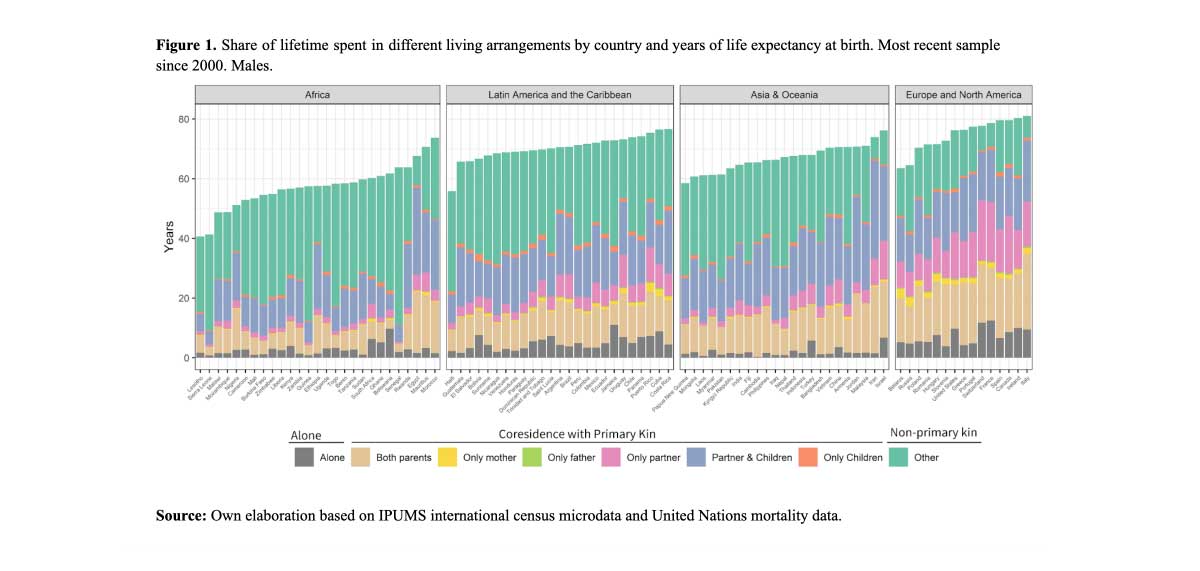
At the start of the twenty-first century there continued to be a wide diversity of family forms around the world. In some regions, people spent a large share of their lifespan living in large families with an abundant presence of non-primary kin and/or non-kin (e.g. many African countries), while in others, people spent most of their lives in households with only nuclear kin (e.g. most developed countries). The results presented in Figure 1 are based on males for the most recent census for each country. Individual country data are arranged by macro region (generally continent) and, within each region, according to the life expectancy in each country. In this way, columns are higher in countries with higher life expectancy. The disparities in the share of the lifespan spent living with non-primary kin (the key to all extended families) are vast, ranging from relatively low in Europe and North America to more than 50 per cent of total life expectancy in most of Africa and in many Latin American and Asian countries. At the outset of the twenty-first century, the world of the family was a diverse one indeed. The predominance of the nuclear family, so important for our understanding of the family around the world, only existed in the developed world, while extended families were predominant elsewhere.
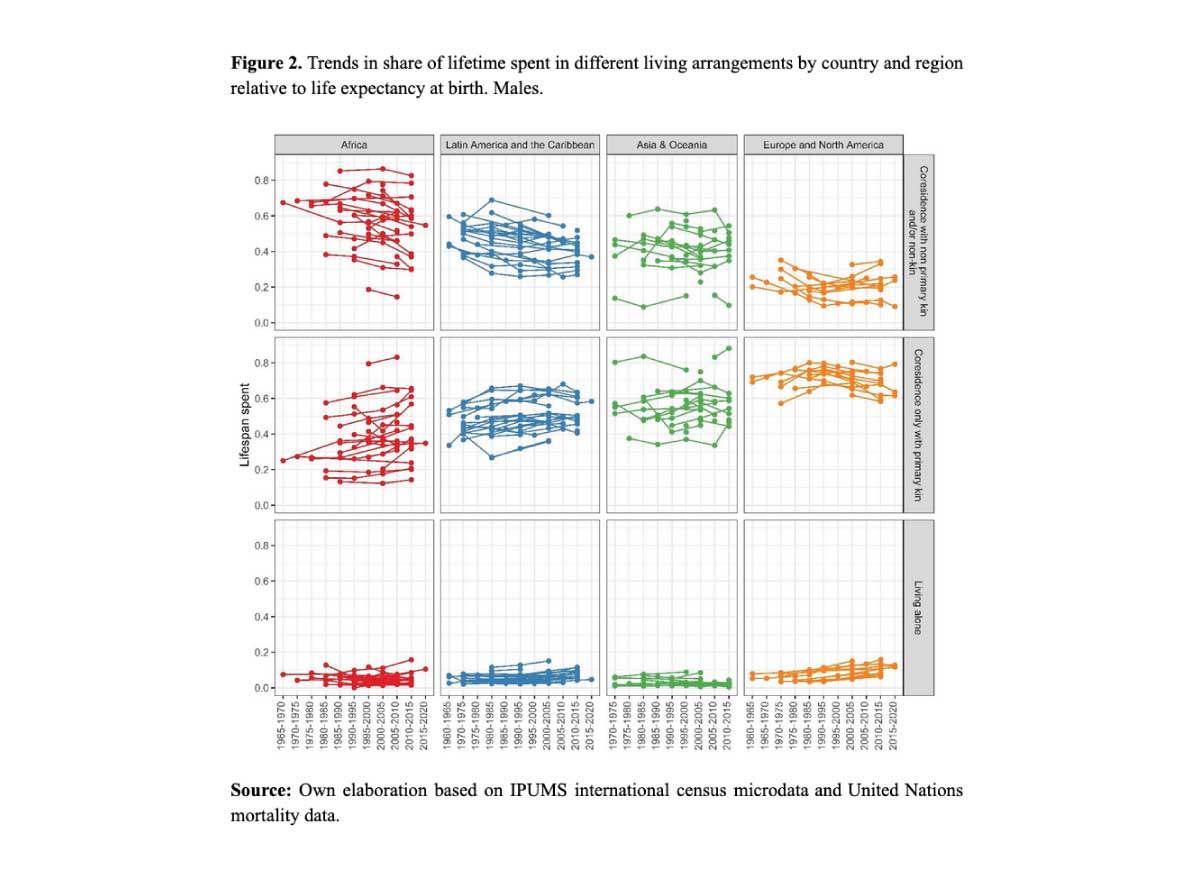
Change over time is shown in Figure 2 (again, only males) where different living arrangements are organized in horizontal panels and world regions are shown vertically. It is important to remember here that everywhere the sum of propensities for the three different living arrangements is, by definition, 1.0 in all countries. This figure shows the changes that have occurred over the past half century, with census dates marked by circles and country trends by lines.
A major result from this figure is that the growth in the prevalence of living arrangements based only on primary kin (nuclear families) around the world over the past half century is especially strong in countries where starting levels were lower. Generally, growth in the prevalence of the nuclear family has been substantial and, by implication, that of the extended family has declined. It is important to underscore the overall diversity of these estimates, both in recent years and in the past. Africa was and is the world region where the presence of non-primary kin was, and continues to be highest, though there have been evident declines. This also fits for Latin America and Asia, yet the prevalence of extended families tends to be lower. The basic pattern of change, however, is very different in the developed world, where from the start the prevalence of nuclear families is much higher than elsewhere. Beginning in the 1990s, however, there is a clear halt to the decrease of extended families, coupled with a modest decline in nuclear families and increases in the shares of people living alone.

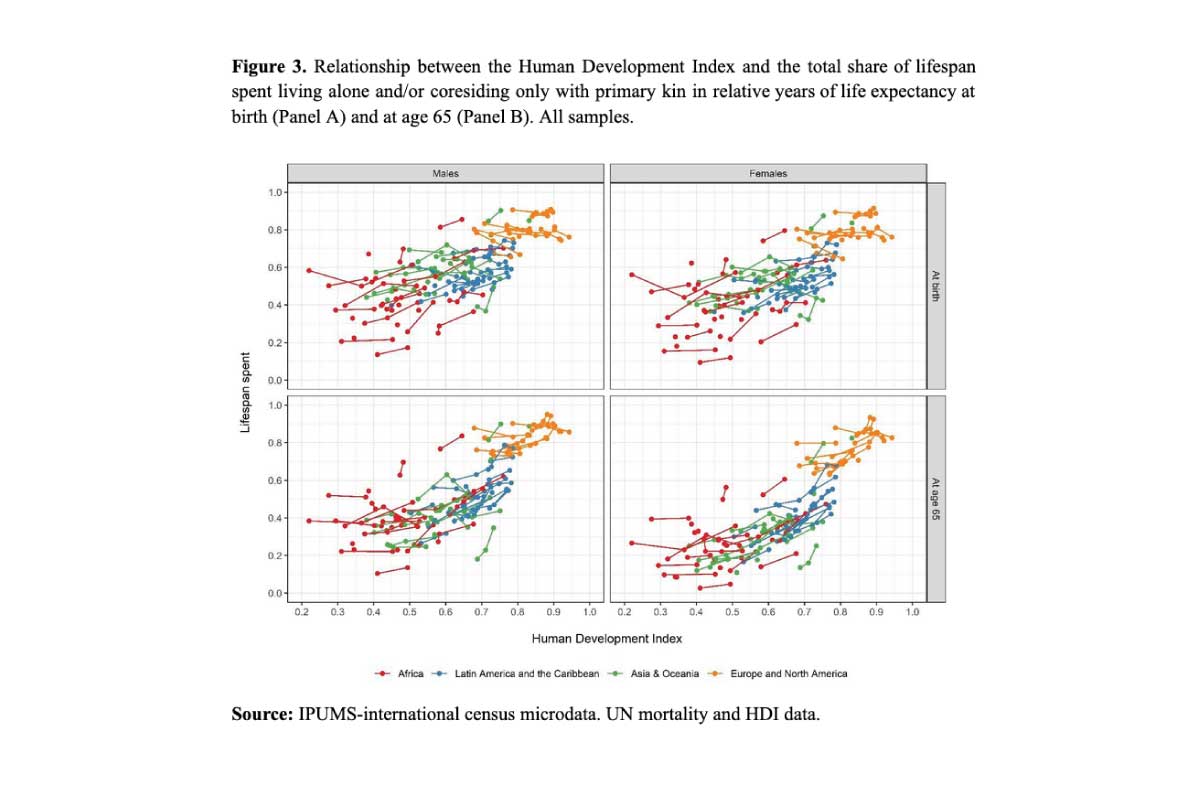
Countries with the highest levels of development are invariably ones where the prevalence of coresidence with non-primary kin and the extended family are lowest, yet time trends for individual countries are not always clear (see Figure 3 with results for males and females). If we only use data for elderly adults (>65) the links between development and the share of the lifespan spent living alone and/or with only nuclear kin are clearer.

A brief discussion


Should current trends continue, in the relatively near future we can expect a continued growth of nuclear living arrangements in much of the world. We can also expect, however, slow or negative growth, coupled with a continuing trend towards an incipient decomposition of the components of kinship in societies where living with nuclear kin is highest, caused largely by on-going reductions in the presence of offspring and of parenting couples in nuclear households. Quite possibly this will take place together with increases in the prevalence of either living alone or living in households including persons unrelated by kinship. These trends have important implications for policy, for society, and for the meaning itself of the family and family life in different parts off the world. Rapidly shrinking household size in much of the world provides a relevant backdrop for these important changes in kin-based co-residence (Esteve et al., 2024). In aging societies, the capacity of families to rely on traditional support networks for the health and well-being of their vulnerable members raises significant concerns.

It is often held that development is a major determinant of the prevalence of the nuclear family because it enables family groups to live in small units and, when the need arises, to avail themselves of institutional supports such as day care that tend to be widespread in societies that can afford them. It also brings improvements in health, longer lives and higher education for large segments of the population. Our study provides some support for this premise. It also points to the major role potentially played by fertility and mortality in shaping kin networks themselves and their needs, and invites further research on the emerging subject of the demography of kinship. Where networks are dense in human and social capital, kin available for co-residence are abundant and will be in demand. As these networks shrink, the prevalence of living arrangements based only around primary kin will increase and the presence of non-primary kin in households around the world will tend to decrease. Mortality also plays a role, especially because of its implications for health and longevity as well as the way it affects the number of available kin.

Once again, the timing and pace of the demographic transition emerges as a key factor in explaining the long-term trends of major social indicators. This does not negate the importance of culturally constrained preferences and values for family development over time, but it does appear to be a key marker for the timing and intensity of change. Development is, of course, important, but is not the sole factor. When kin networks shrink to their bare minimum, the realm of conscious choice tends to emerge as a key element in shaping family life. The influence of the second demographic transition on family structures in North America and Europe and, potentially, in many other societies around the world now and in the future, serves as a pertinent example.

Moving a bit further back in time, these findings also suggest that the prevalence of extended family living arrangements in much of the developing world may have peaked in the 1950s or 1960s, when fertility remained exceptionally high and mortality was already in sharp decline in many parts of the world. By contrast, in the developed world, fertility and mortality were already relatively low and, by implication, kin networks were relatively small, nuclear living was the norm, and ideas of change were pervasive. In this part of the world where closely aligned patterns of fertility and mortality together with relatively modest levels of population growth characterized the entire demographic transition, it is likely that kin networks were consistently modest in size and nuclear living was widespread well before the onset of the twentieth century.

A key, albeit surprising, finding of this paper is the evidence it provides of a recent trend reversal currently taking place in much of the most developed world involving large declines in co-residence only with primary kin, major increases in living alone, and modest increases in co-residence with non-primary kin. This trend is likely related to the spreading effects of the second demographic transition, to increasing longevity, to shrinking kin networks and to the increasing difficulties experienced by families in much of the world (Esteve and Reher 2021). Could it constitute the most recent stage of a fundamental pattern of family development over time outlined, at least in part, in this paper? Possibly. While speculative, this viewpoint warrants further investigation.

References

  • Esteve, Albert, David S. Reher. 2021.”Rising Global Levels of Intergenerational Coresidence Among Young Adults”. Population and Development Review 47 (3): 691-717. https://doi.org/10.1111/padr.12427.
  • Esteve, Albert and David S. Reher. 2024. “Trends in Living Arrangements around the World”. Population and Development Review. https://doi.org/10.1111/padr.12603.
  • Esteve, Albert, Maria Pohl, Federica Becca, Huifen Fang, Juan Galeano, Joan García-Román, David Reher, Rita Trias-Prats, and Anna Turu. 2004. “A global perspective on household size and composition, 1970–2020.” Genus – Journal of Population Sciences, 80 (2), pp 1-22. https://doi.org/10.1186/s41118-024-00211-6

Friday, April 12, 2024

Global household trends:

converging sizes, divergent structures

April 8, 2024 Maria Pohl and Albert Esteve

Household structures reflect and affect social, economic, and demographic dynamics. Albert Esteve and Maria Pohl use the new CORESIDENCE database to explore the transformation of households over the last five decades. Their findings suggest a global decline in average household size, although household structures continue to differ across countries.


Households are core units of social organization and reproduction. Their fundamental characteristics, namely size and composition, reflect complex socio-economic and demographic changes (Bongaarts, 2001; Therborn, 2004, 2014). For instance, increases in one-person and two-person households at the expense of larger households might be driven by demographic changes, such as fertility decline or increased longevity. Household characteristics can have far-reaching implications for housing markets, intra and inter-household transfers, or gender relations. Studying household size or composition comparatively and over time allows us to understand how societies change, not only from a demographic standpoint but also from social and economic perspectives.

Comparative research on households on a global scale has remained relatively scarce due to data constraints. The newly developed open-access, open-source CORESIDENCE database aids researchers in filling this gap by providing harmonized household data on the national and subnational scales for 156 countries and 1,511 regions (Galeano et al., 2024), making it possible to study families and households on an international scale. Family researchers, like those studying fertility and mortality, can address questions about family change based on the increasing availability of empirical data, thanks to census microdata available from the Integrated Public Use of Microdata Series (IPUMS) and survey data from Demographic Health Surveys (DHS), Multiple Indicator Cluster Surveys (MICS), or the European Labor Force Surveys (EU-LFS).
 

Converging sizes: moving towards smaller households


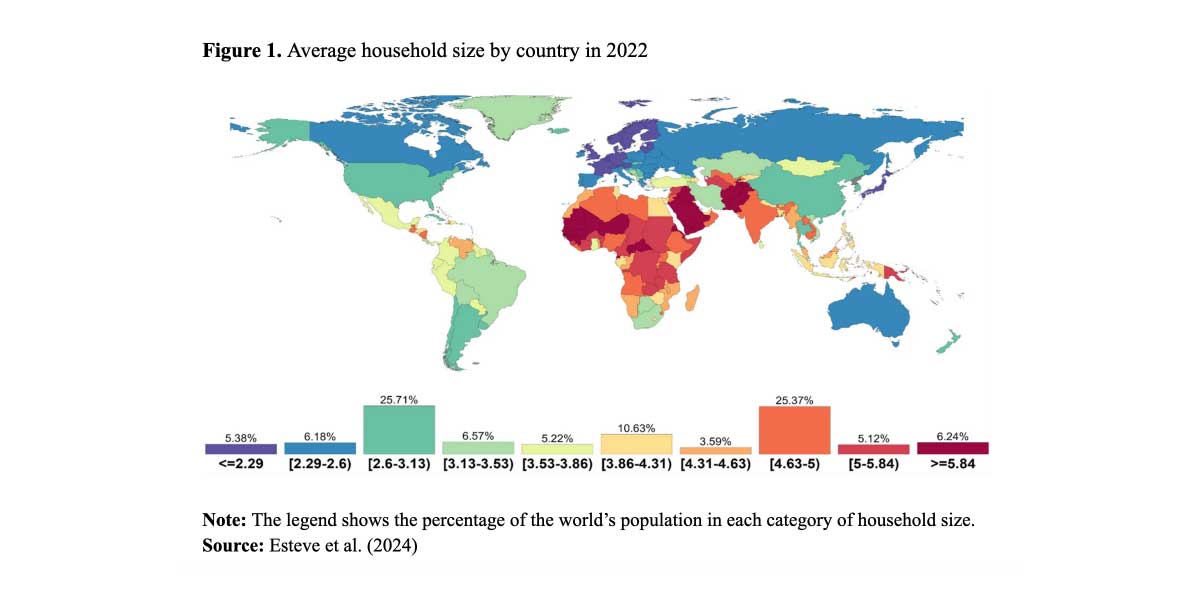
Despite some definitional differences, households are considered to be suitable units for comparative research (Bongaarts, 2001). Household size refers to the number of people who are living together in a dwelling at the time of data collection. It differs substantially across countries as it reflects their diverse fertility levels (Figure 1). However, it is also determined by social norms and customs governing family-formation processes, such as norms for establishing a new, separate household upon marriage.
Households are, on average, smallest in some East Asian countries and in Europe. Denmark leads this group, with an average household size of 1.8 people. The largest households, on average, can be found in Sub-Saharan Africa and among countries of the Arabian Peninsula and Central Asia, reaching a maximum of 8.4 people per household in Senegal, for example. The vast majority of the world’s population (around 83 percent) lives in countries with an average household size of between 2.3 and 5 persons.

Household size has declined quite steadily over the past five decades, by approximately 0.5 people per decade. When average household size in a country falls to around two, the rate of decline slows down: countries with comparatively large households and high fertility levels will likely drive any further decline in average household size. Shrinking households in contexts with relatively small households might suggest an increase in one-person households, driven by young adults who postpone their transition to adulthood or by older adults, such as women who live alone after the death of a partner. However, households do not shrink in all contexts: socio-economic conditions may foster intergenerational coresidence or alternative household configurations that could, at least partially, counteract the reduction in household size due to fertility decline. Moreover, some countries (e.g. Senegal) have maintained large households despite demographic changes.
 

Divergent structures: the roles of children and other relatives


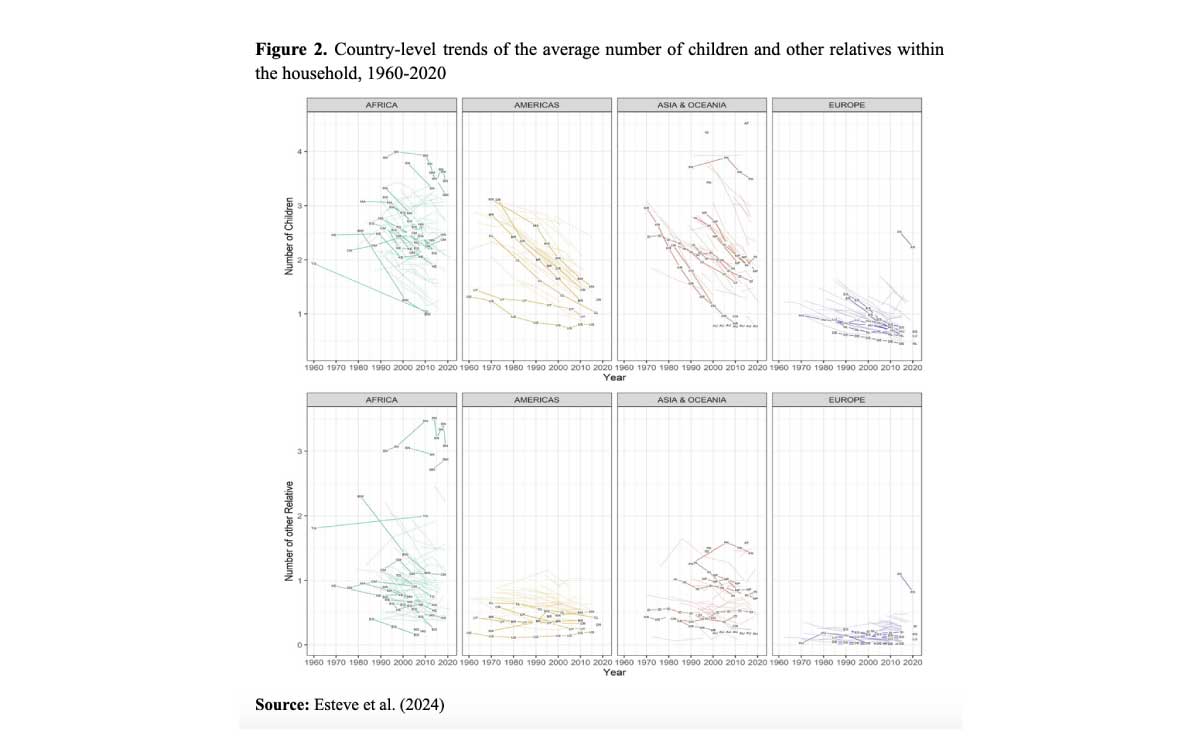
The internal structure of a household is called household composition. This structure is based on a reference person in the household, commonly referred to as the household head or reference person in survey and census data. Household composition varies in response to demographic changes, such as a decline in fertility or changes in family and relationship forms, such as living-apart-together or intergenerational coresidence (Furstenberg, 2019). Household composition further reflects the age structure of a population: the number of children and adults available in a society for distribution across households differs according to the underlying age composition of the population.

Fertility decline is a core driver of shrinking household size. However, across many contexts, the presence of other relatives of the household head is another crucial component of household composition. If the number of children in the household declines but the presence of other relatives remains stable, their relative weight in the household may increase, with possible implications for care transfers, decision-making processes, and family dynamics.

Figure 2 highlights the decline in children in the household (upper panel) across all major world regions. While children are the central driver of global heterogeneity in household size and composition, another important group contributing to global variation in household size and composition is that of other relatives (lower panel). In many countries, the presence of other relatives in absolute numbers has remained relatively unchanged.

Conclusions


Family patterns, socio-economic and demographic transformations, and cultural systems influence the persistent heterogeneity in household composition (Cherlin, 2012). Our results support the “convergence to divergence” hypothesis, which postulates that future family changes driven by social phenomena are certain but will produce different outcomes in different contexts (Pesando & GFC Team, 2019; Therborn, 2004, 2014). Fertility declines increase the prevalence of smaller households, yet we find persistent internal complexity of households in several countries. Interactions of global trends such as declining fertility and increasing life expectancy will result in different typologies of households, depending on the context in which such changes occur. We further anticipate that a continued decline in fertility rates will lead to smaller households and changes in household composition due to fewer living relatives available for coresidence.

The timing and occurrence of life-course events, societal structures, and individual factors drive variation in household structures. Shifts in transfer patterns, housing demand, gender relations, the division of labour, and living arrangements are some of the possible implications of changes in household structures. The CORESIDENCE project investigates these issues by examining links between households, living arrangements, and related socio-demographic indicators. The project entails macro- and micro-level analyses across various contexts, data sources, and spatial levels. We also invite and encourage other researchers to use the CORESIDENCE database.

Funding: CORESIDENCE is supported by an Advanced Grant funded by the European Research Council (ERC). Grant agreement ID: 101052787.


References

  • Bongaarts, J. (2001). Household size and composition in the developing world in the 1990s. Population Studies, 55(3), 263–279. https://doi.org/10.1080/00324720127697
  • Cherlin, A. J. (2012). Goode’s World Revolution and Family Patterns : A Reconsideration at Fifty Years. Population and Development Review, 38(4), 577–607. https://doi.org/10.1111/j.1728-4457.2012.00528.x
  • Esteve, A., Galeano, J., Turu, A., García-Román, J., Becca, F., Fang, H., Pohl, M., & Trias-Prats, R. (2023). The CORESIDENCE Database: National and Subnational Data on Household and Living Arrangements Around the World, 1964-2021. Zenodo. https://doi.org/10.5281/ZENODO.8142652
  • Esteve, A., Pohl, M., Becca, F., Fang, H., Galeano, J., García-Román, J., Reher, D., Trias-Prats, R., & Turu, A. (2024). A global perspective on household size and composition, 1970–2020. Genus, 80(1), 2. https://doi.org/10.1186/s41118-024-00211-6
  • Furstenberg, F. F. (2019). Family Change in Global Perspective: How and Why Family Systems Change. Family Relations, 68(3), 326–341. https://doi.org/10.1111/fare.12361
  • Galeano, J., Esteve, A., Turu, A., García-Roman, J., Becca, F., Fang, H., Pohl, M., & Trias-Prats, R. (2024). CORESIDENCE: National and subnational data on household size and composition around the world, 1964–2021. Scientific Data, 11(1), 145. https://doi.org/10.1038/s41597-024-02964-3
  • Pesando, L. M., & GFC team. (2019). Global Family Change: Persistent Diversity with Development. Population and Development Review, 45(1), 133–168. https://doi.org/10.1111/padr.12209
  • Therborn, G. (2004). Between sex and power: family in the world, 1900 – 2000 (Reprinted). Routledge.
  • Therborn, G. (2014). Family Systems of the World: Are They Converging? In. J. Treas, J. Scott, & M. Richards (Eds.), The Wiley Blackwell Companion to the Sociology of Families (1st ed., pp. 1–19). Wiley. https://doi.org/10.1002/9781118374085.ch1

Tuesday, January 16, 2024

a strong family

«Не на одной крепкой семье все строится» 

Что такое традиционные ценности и насколько они нужны россиянам?

Наступивший 2024 год был объявлен в России Годом семьи. Как говорится в указе президента, сделано это для популяризации госполитики в сфере защиты семьи и сохранения традиционных ценностей. Но что такое традиционные ценности, строится ли на них жизнь современных россиян и действительно ли их разделяет вся страна? Об этом «Лента.ру» поговорила с кандидатом социологических наук, научным сотрудником Международной лаборатории исследований населения и здоровья НИУ ВШЭ Еленой Чуриловой.

«Лента.ру»: Что вообще такое традиционные ценности и традиционная семья в понимании социологов и россиян? И может ли традиционная семья в современном понимании не разделять эти ценности?

Елена Чурилова: С точки зрения социологов, демографов, исторически традиционная семья — большая, многопоколенная, патрилокальная, расширенная. То есть состоящая не только из супружеской пары, но и их родителей, детей, братьев и сестер со стороны мужа. В этой семье наблюдался авторитарный характер общения между детьми и родителями.

Это значило, по крайней мере для демографического поведения, что любые судьбоносные, жизненно важные вопросы решались родителями юноши или девушки: когда вступать в брак, с кем и так далее. Они подбирали жениха или невесту, ориентируясь при этом не на внешнюю привлекательность, а на хозяйственность, трудолюбие, экономическое положение семьи жениха или невесты. Девушку старались выдать замуж пораньше, чтобы она в девках не засиделась и тем более в подоле внебрачного ребенка не принесла. А если в семье было несколько девушек на выданье, то это было, скажем так, экономически обременительно, потому что для каждой нужно было собрать приданое.

Юношу старались женить, пока он молод, еще готов слушаться родителей и принять ту невесту, которую ему выберут. С социальной точки зрения, пока юноша не вступил в брак, с ним в обществе никто даже не считался

Исторически традиционная семья была большая, широкая. И это было выгодно для семьи: чем больше рабочих рук, тем больший урожай можно собрать, тем больше шансы выжить, если выдался неудачный год. Эта семья была многорожающая, но ввиду того, что до XX века была очень высокая младенческая смертность, в этой семье было не так уж много детей. Из тысячи родившихся младенцев в те времена первый год могли не пережить до половины — в зависимости от того, были какие-то эпидемии или нет.

Конечно, сейчас все изменилось: под традиционной семьей теперь обычно подразумевают союз, основанный на официальном браке. Кроме того, сторонники традиционной семьи отрицательно относятся к сожительствам, разводам, абортам и считают, что ребенок должен воспитываться именно в полной семье.

Если мы говорим непосредственно про традиционные ценности, то есть классификация Рональда Инглхарта. Согласно этой классификации, к традиционным ценностям относятся семья, высокая религиозность, высокий социальный конформизм, готовность ориентироваться на общество, принимать какие-то решения власти, соглашаться с ними. Ориентация на общественно одобряемые нормы — высокая, а на свои личные предпочтения и желания — наоборот, низкая.

И россияне — такие?

Что касается поддержки традиционной, религиозной семьи самой по себе, в которой мужчина — глава семьи и добытчик, то социологические опросы показывают, что никакой ориентации россиян на такую семью, где во главе мужчина, нет. Например, недавний опрос ВЦИОМ, который проводился летом 2023 года, показал, что 68 процентов россиян от 18 лет и старше считают, что главы в семье вообще быть не должно, а решения нужно принимать сообща. Причем среди молодежи от 18 до 34 лет еще больше тех, кто считает, что в семье не должно быть главы. Если мы будем смотреть на социологические опросы про распределение обязанностей, то в половине семей у нас оба супруга зарабатывают деньги и совместно решают какие-то бытовые вопросы.

В чем есть в России некоторый перекос — в равномерности распределения между мужчинами и женщинами обязанностей по воспитанию детей. Женщины, как правило, больше занимаются воспитанием детей, без особого участия со стороны мужа. Но тут есть маленький нюанс: в России довольно длительный отпуск по уходу за ребенком. Поэтому женщина, тем более если у нее несколько детей, в этом отпуске проводит довольно долгое время и уделяет все его детям и быту: она не работает, у нее альтернатив особо и нет.

Кроме того, женщины не всегда имеют возможность выйти из отпуска по уходу за ребенком пораньше — не в три его года, а, допустим, в год. Во-первых, не все работодатели готовы к тому, что женщина будет работать неполный рабочий день или будет часто уходить на больничный. Во-вторых, чтобы выйти раньше на работу, нужно, чтобы ребенок в год или полтора получил место в детском саду на полный день или хотя бы чтобы была включенная бабушка, готовая сидеть с ребенком. Наконец, маленькие дети действительно часто болеют, так что женщины часто сами рассуждают: «какой из меня работник».

Если говорить о таких индикаторах, как отношение к разводам, к воспитанию детей в неполных семьях, то в большинстве своем среди россиян приемлемы и разводы, и воспитание детей матерями-одиночками. И большинство, особенно женщины, считают, что должно быть право на аборт, его не нужно у них отнимать

Надо при этом сказать, что в России общество неоднородное, страна многонациональная и многоконфессиональная. Конечно, части людей присуща большая религиозность и соблюдение каких-то традиций, ориентация на общественные нормы и правила. Другая часть общества более секулярная, и такая ориентация у него выражена меньше. Но однозначно сказать, что большинство россиян придерживается традиционной модели семьи, нерушимой, основанной только на браке и без возможности развестись, — такого нет, хотя есть группы, которые считают, что должно быть именно так.

При этом поддержка брака как юридической нормы оформления союза среди россиян всегда была высока: если посмотреть данные последней переписи населения, среди людей в возрасте от 30 до 44 лет среди тех, кто состоит в партнерских отношениях, 90 процентов состоят именно в зарегистрированном браке. Незарегистрированные союзы или сожительства скорее характерны для молодежи — 18-24 года. Сожительство является неким пробным этапом перед официальным созданием семьи, оно дает возможность понять, тот ли партнер выбран, можно ли с ним в принципе вступать в брак. И наши исследования, в том числе о рождении детей, показывают, что россияне предпочитают создавать официальную семью, когда речь идет о необходимости или желании стать родителями, — большинство предпочтет брак, если произошла незапланированная беременность. Брак из России не уходит, это наиболее популярная форма отношений — он был, есть и будет.

В указе о сохранении традиционных ценностей сказано, что все религии вносят вклад в сохранение этих ценностей, но особая роль принадлежит православию. Традиционные ценности основаны именно на нем?

В России 75-80 процентов населения относит себя к православным. Но одно дело, когда у людей во время социологических опросов спрашивают, какую религию они исповедуют, а другое дело — реальное проявление этой религиозности: соблюдение постов, посещение церкви на регулярной основе, венчание, крещение, религиозное воспитание детей. Таких активных православных верующих — процентов десять во всем населении наберется. Большинство тех, кто называют себя православными, можно отнести к номинально верующим. Они говорят «да, мы верим в бога», но по факту их религиозность ограничивается отмечанием больших праздников, обычно Рождества и Пасхи, когда они сходят в церковь или посмотрят праздничную службу по телевизору.

С другой стороны, есть сложно уловимая для социологов (да и для священнослужителей) группа — глубоко верующие люди, которые церковь регулярно не посещают, но регулярно молятся, соблюдают пост, все религиозные обряды. Власти, конечно, ориентируются на то, что большинство россиян православные, но не учитывают, что люди ведут скорее светскую жизнь, и в реальности глубоко религиозных людей не так много. Есть исследования, что в последние годы среди православной молодежи стало больше тех, кто включен в церковную жизнь, но насколько широка в реальности эта категория и какой вклад она внесет в рождаемость, пока не очень понятно.

Я бы сказала, что религиозность все-таки связана с традиционными ценностями, потому что в православии, да и в христианстве в целом всячески приветствуется семья, основанная на браке. Церковь позитивно относится к рождению детей, в христианстве негативное отношение к разводам, поэтому предполагается, что если человек религиозен, для него важна крепкая семья.

А если человек неверующий или номинально верующий — ему не подойдут традиционные ценности?

Семья как таковая и ее необходимость признается большинством россиян. Другое дело, что не на одной крепкой семье все строится — людям важно иметь не только крепкую семью, но и личностный карьерный рост, социально-общественное признание. Согласно исследованию коллег из МГУ (есть в распоряжении «Ленты.ру»), тем, кто не стремится реализовать себя в карьере, особенно важна крепкая семья: они так пытаются показать свою успешность — в семейной жизни.

То есть семья — одна из ценностей, которые есть у людей. Сейчас семья важна как психологически комфортное убежище, человеку должно быть там хорошо. Если есть какие-то разногласия, постоянные споры или асоциальное поведение одного из супругов, то за такую семью не хотят держаться. Зачем семья, в которой плохо? И такие отношения стремятся прервать, поэтому в таком случае, с человеческой точки зрения, в разводе нет ничего плохого

Более того, у нас становится все больше людей, вступающих в повторные союзы, в которых качество отношений может быть гораздо выше. От установки «один брак на всю жизнь» мы отошли уже очень давно — разводов было много еще в СССР, хоть с ними и пытались бороться. Другое дело, что в Советском Союзе не было возможности для совместного проживания мужчины и женщины, если они не состояли в браке, не было возможности даже получить комнату в общежитии. Этой форме отношений позволила развиться 1990-е рыночная экономика, появление свободного рынка жилья.

Говорят, что традиционные ценности должны помочь росту рождаемости, и как раз ими обосновывают попытки ограничить аборты в регионах России. Это правда поможет?

Надо сказать, что низкая рождаемость у нас уже очень-очень давно. 

С середины 1960-х суммарный коэффициент рождаемости упал ниже 2,1. Дальше был небольшой период в 1980-е, когда он поднимался чуть выше уровня воспроизводства. А в 1990-е рождаемость уже окончательно стала низкой и не поднималась выше двух ни разу, даже несмотря на политику материнского капитала. И, насколько мне известно, ни в одной из развитых стран, где установился режим низкой рождаемости, не удалось поднять суммарный коэффициент до уровня выше 2,1. Есть примеры стран, которые стараются поддерживать суммарный коэффициент на уровне 1,8-1,9 за счет довольно развитой системы пособий, поддержки женщин и детей. Но такого, чтобы страна развернулась и перешла от массовой малодетности к массовой многодетности, я не знаю.

Такие меры, как ограничение или запрет абортов, не приведут к повышению рождаемости. Более того, число прерываний беременности у нас в последние годы постоянно снижается, и снижение идет начиная с середины 1990-х. Вероятно, это снижение продолжится и без ограничения абортов. Это происходит из-за того, что растет контрацептивная культура у мужчин и женщин.

Нужно понимать, что аборты по медицинским показаниям не исчезнут. Но если мы хотим, чтобы нежелательных беременностей становилось меньше, чтобы беременности были запланированными, надо думать в сторону повышения знаний о контрацепции. Потому что исторические примеры запрещения абортов в СССР в 1930-е, в Румынии с конца 1960-х по 1980-е говорят, что эти меры приводят к краткосрочному всплеску рождаемости, а дальше женщины приспосабливаются — или избегают зачатия или прибегают к нелегальным абортам, или ездят в другие страны, где аборт разрешен.

Сейчас женщины будут более тщательно следить за контрацепцией, возможно, вырастет спрос на услуги вазэктомии и стерилизации и, конечно, может возрасти избегание сексуальных связей.

Что касается разводов, в СМИ периодически мелькают предложения об увеличении госпошлины, но никаких разговоров об ограничении пока не было и, надеюсь, не будет. Но разводы с рождаемостью никак не связаны: человек может найти нового партнера после развода и завести ребенка с ним.

А еще в 2023-м звучали предложения ограничить образование. Ситуация, при которой россиянки не будут работать и получать образование, а останутся дома и будут воспитывать детей, реальна?

Это совершенно нереалистично. В России довольно высока роль женщин на рынке труда. Надо сказать, что даже демографическая ситуация с точки зрения рабочей силы в России не самая благоприятная именно потому, что женщины составляют примерно половину этой силы. Если все женщины уйдут, кто вместо них будет работать? Помимо традиционно женских сфер образования и медицины есть еще всевозможные услуги, связанные с продажами, сферой красоты, и везде задействованы женщины.

Сейчас невозможно заставить женщину рожать много детей, даже лишив ее возможности работать: есть эффективные средства контрацепции, все возможности для планирования рождения ребенка. В реальности наши многодетные семьи — это семьи, где трое детей. У женщины большой репродуктивный период — с 15 до 49 лет, и чтобы родить троих детей в этот период, все равно надо прибегать к контрацепции, даже эта многодетность — планируемая.

Чтобы кто-то неконтролируемо рожал — это редкий случай, кто-то, может, так живет по религиозным убеждениям, но три, четыре ребенка, даже пятеро детей будут планироваться

Есть неблагополучные семьи, в которых все рожденные дети — случайные, незапланированные, но это скорее исключение: женщины не особо стремятся рожать больше троих детей. Для того чтобы многодетность стала массовой, нужны совершенно другие жилищные и экономические условия. Обычное жилье в России, особенно в крупных городах, имеет в основном маленькую площадь и комнатность. На рынке новостроек представлены в основном квартиры-студии или однокомнатные. Для семьи с тремя-четырьмя детьми нужна квартира или дом, в котором будут три-четыре отдельные спальни.

Финансовая нагрузка на многодетную семью получается очень большая: детей надо кормить, обувать, одевать, давать им образование, а это значит, что совокупный доход семьи при пересчете на члена семьи будет становиться меньше, — это повышенный риск бедности. Люди же, как только появляется первенец, начинают ощущать, что ребенок — это дорого. А если детей несколько, женщине проблематично сочетать работу и их воспитание. При этом она должна работать — мужчине одному трудно обеспечивать семью, где трое несовершеннолетних, и тут возможностей тоже не так много.

Я бы сказала, что полный возврат к массовой многодетности, тем более к тому, чтобы в семьях было по пять-шесть и более детей, у нас невозможен.

В реальности возможна переориентация на двухдетность и трехдетность, но для этого нужны условия и массовое жилищное строительство доступного жилья, в котором будут представлены трех-, четырех- и пятикомнатные квартиры

А также меры поддержки занятости женщин, чтобы они могли сочетать работу и уход за детьми, поощрение работодателей, которые дают такую возможность, например, организуют детские комнаты на крупных предприятиях, частично субсидируют детский летний отдых, потому что работающим родителям без помощи бабушек и дедушек сложно организовать присмотр за несколькими детьми, например, в период летних каникул.

По-вашему, в какой момент произошла переориентация на традиционные ценности?

В начале двухтысячных в общественном пространстве стало гораздо больше разговоров о том, что нужно повышать рождаемость. В 1990-е было не до демографии — там были огромные экономические проблемы, но когда они были решены и у государства появилась возможность поддерживать семью, случился такой консервативный поворот. И с каждым годом об этом говорят все больше.

Другое дело, что это можно назвать движением против ветра, потому что от традиционной семьи, многопоколенной и многорожающей, где глава мужчина, мы отошли сто с лишним лет назад. Вернуться к этому невозможно — экономическая ситуация и контекст совершенно другие, у большинства нет такой религиозности и, главное, потребности в традиционных ценностях.

К тому же в те времена, когда семья была истинно традиционной, не было возможности контролировать рождаемость, — мы можем только гадать, насколько вообще многодетность и многорождаемость были желанными до XX века. Есть исторические свидетельства, что люди спокойно относились к тому, что теряли детей: это была обыденность. Сейчас это изменилось — повысилась ценность человеческой жизни, изменилось отношение к детям, воспитанию.

Матери-одиночки, уклонисты от алиментов, домашнее насилие, детдома, неблагополучные семьи и так далее. Как это может соседствовать с картиной традиционных ценностей?

Надо понимать, что неблагополучные семьи всегда были, есть и будут. Всегда есть социальные иждивенцы, которые рожают ради пособия. Есть проблема с алкоголизмом в части населения, и в таких семьях тоже рождаются дети.

Ежегодно около 10-12 процентов новорожденных — это дети одиноких матерей, женщин, которые не состоят в официальном браке и отец ребенка которых не признал отцовство. Но семьи одиноких матерей не обязательно неблагополучные, просто все заботы и о ребенке, и о материальном благополучии ложатся на плечи матери.

Россия действительно чуть ли не единственная в мире борется за традиционные ценности?

Я бы сказала, что все страны, которые столкнулись с низкой рождаемостью, начинают в какой-то момент беспокоиться и искать способы преодолеть сокращение рождаемости, потому что в дальнейшем это ведет к тому, что увеличивается доля пожилых в населении, демографическая нагрузка на работоспособное население. Это совершенно меняет и рынок услуг, то есть потребности пожилых должны удовлетворяться. Поэтому да — государства, конечно, этим обеспокоены.

Другое дело, что повернуть вспять низкую рождаемость вряд ли возможно. Развитые европейские страны в большинстве своем пришли к такой политике, что стараются поддержать семьи в их стремлении родить желаемое число детей, но при этом не лезут в семью. У них есть меры материальной поддержи, борьба с бедностью, политика, направленная на улучшение сочетаемости родительства и семейной жизни, отпуска по уходу за ребенком не только для матерей, но и для отцов — в общем, спектр мер. Но я уже говорила, что меры материального характера дают краткосрочный эффект.

Похожая на российскую семейная ориентированность характерна для Северной Европы. Там поддержка семьи идет не на словах. Там широкий спектр помощи, политика по увеличению доступности мер планирования семьи, чтобы семьи могли рожать желаемое число детей в желаемые сроки, и никто их там не подгоняет.

В основном там не запретительная политика, а наоборот — делают более доступной контрацепцию, вводят сексуальное образование, рассказывают о репродуктивном здоровье. Хотят рожать в 30 лет? Пусть рожают в 30, а мы сделаем все, чтобы они родили тех двух-трех детей, которых они хотят.

Saturday, December 9, 2023

Feminist Perspectives on Reproduction and the Family

Historically, few of the philosophers who defended justice in the public political realm argued for just family structures. Instead, most viewed the family as a separate realm that needed to be protected from state intrusion. The private sphere and the public sphere were dichotomized into separate realms with the latter beyond the reach of public action. Where these philosophers did not legitimate private power in the family, they simply ignored it.

John Stuart Mill was a notable exception, arguing in The Subjection of Women, that the inequality of women in the family was incompatible with their equality in the wider social world. Consider, he asks, the consequences of “the self-worship, the unjust self preference” nourished in boys growing up in male dominated households in which “by the mere fact of being born male he is by right the superior of all and every one of an entire half of the human race” (1869, 86–87). How will such boys grow up into men who treat women as equals? Feminist scholarship has continued, extended and deepened this attack on the conception of the family as a private personal realm. Indeed, the idea that “the personal [that is, the family] is political” is the core idea of most contemporary feminism.

Family and Marriage:

A Cultural Construct and a Social Invention


More than one hundred years of cross-cultural research has revealed the varied forms humans have invented for “partnering”—living in households, raising children, establishing long-term relationships, transmitting valuables to offspring, and other social behaviors associated with “family.” Once again, the universality and evolutionary origins of the U.S. form of the human family is more fiction than fact, a projection of our cultural model of family and gender roles onto the past and onto the entire human species.

Families exist in all societies and they are part of what makes us human. However, societies around the world demonstrate tremendous variation in cultural understandings of family and marriage. Ideas about how people are related to each other, what kind of marriage would be ideal, when people should have children, who should care for children, and many other family related matters differ cross-culturally. While the function of families is to fulfill basic human needs such as providing for children, defining parental roles, regulating sexuality, and passing property and knowledge between generations, there are many variations or patterns of family life that can meet these needs. This chapter introduces some of the more common patterns of family life found around the world.

Tuesday, November 28, 2023

Joint physical custody of children in Europe

A growing phenomenon

November 27, 2023
Mia Hakovirta, Daniel R. Meyer, Milla Salin, Eija Lindroos and Mari Haapanen

As union dissolution becomes more frequent around the world, the living arrangements of children of separated parents have become an important issue. Joint physical custody (JPC) is believed to be the best solution for them, and probably also for their parents. Mia Hakovirta, Daniel R. Meyer, Milla Salin, Eija Lindroos and Mari Haapanen study the prevalence of JPC in European countries.


A growing number of children are affected by parental divorce or separation. When parents do not live together, the children’s living arrangements (physical custody) are determined either by the parents themselves or by a family court. For much of the last century in Europe, physical custody was typically awarded solely to the mother, with some fathers being awarded limited scheduled visits. Policies then changed to give fathers more time with their children and to give parents the possibility of joint physical custody (JPC, also known as shared care). Nowadays, children can live primarily with their mother or father (an arrangement called sole physical custody, or SPC) or can spend substantial time with both (JPC). Although some scholars restrict the definition of JPC to cases where children spend exactly half of their time with each parent, in a recent paper we decided to use a broader definition, including cases where children spend at least a third of their time with each parent (Hakovirta et al 2023).

Practicing joint physical custody (JPC) has been linked to several positive outcomes for children and parents, such as better co-parenting and less inter-parental conflict (Augustijn 2023). For children, JPC is associated with better socio-emotional and psychological well-being, as well as lower levels of stress (e.g. Nielsen 2018, Steinbach 2019, Turunen 2017). In addition, some studies indicate that mothers’ well-being and life satisfaction are higher under JPC than under sole physical custody (SPC) (Augustijn 2023).

In our study, we use European Union Statistics on Income and Living Conditions survey data (EU-SILC) to describe levels and trends of JPC in several European countries. We break our results down by children’s age and by JPC type, equal or unequal, which is a novel contribution to the comparative literature. Under unequal joint physical custody, children spend 10 to 14 nights per month with one parent (and 16 to 20 nights per month with the other) while under equal joint physical custody the children spend 15 nights with both parents.

Results


Figure 1 shows children’s physical custody arrangements in 2021. Across Europe, 12.5% of children in separated families lived in equal JPC arrangements, 8.2% lived in unequal JPC arrangements, and 79.3% lived in the more traditional sole physical custody arrangement.
Even though direct comparisons with previous studies are not possible, our results show a significant increase in the prevalence of JPC in less than 20 years. Substantial cross-national variation exists. Equal JPC is most common in Sweden (42.5% of children in separated families), followed by Finland (23.8%) and Belgium (19.6%). More than one in ten children in separated families in Slovenia, Denmark, Spain, and France live under this type of arrangement, but only, 5% or less in nine countries (Czech Republic, Croatia, Hungary, Lithuania, Romania, Cyprus, Greece, Italy, Austria). Unequal JPC arrangements are most common in Denmark (26.2%), followed by Sweden (11.2%), Slovenia (11.1%), and Belgium (10.7%).

Table 1 breaks down these results by children’s age. Sole physical custody is more common for the youngest (0–5 years) and the oldest (16-17 years) children, reaching 84.8% and 82.5% respectively. JPC is more prevalent at the intermediate ages (6 to 15), especially the equal type, accounting for 13 to 16% of the total.

Discussion


JPC is becoming more common: we estimate that it concerned 13.0% of children aged 11–15 not living with both parents in 2021, compared to 5.7% in 2002–2010.

The rate of equal JPC is highest in mid-childhood, at ages 6 to 10, with lower rates for younger and older children, especially those aged 16–17. This is the expected pattern if we presume that young children are more in need of residential stability (or more in need of maternal attachment) and older children want fewer residential transitions to facilitate peer relationships.

In all age groups, and considering unequal as well as equal JPC, we see substantial variation across countries, with clear regional differences. Consistent with prior studies we find that in Northern European countries – Belgium, France, Spain, and Slovenia – children are more likely to experience JPC. Traditions and legal contexts differ across countries: for example, in Belgium and Spain, JPC has been the presumptive arrangement for at least the past decade.
Even though some countries have substantially more JPC than others, our results show that the overall increase in JPC is a widespread phenomenon. In eight countries for which there are data from 2002–2010 in Steinbach and colleagues (2021), and for which we have sufficient numbers of children aged 11–15 to make indicative comparisons, equal JPC arrangements have increased. Only in Hungary and Italy have they declined, and in both of these countries equal JPC is quite uncommon (2.5% and 2.8% in the early data and 0.5% and 1.9% in recent data). In several countries, increases are large, with rates doubling or more in Croatia, Estonia, Finland, Spain, and Sweden.

These changes are substantial, and may have widespread implications for the lives of these children and their parents. Whether social policy has kept pace with this new reality is a matter of debate.

References

  • Augustijn Lara. (2023). Post-separation care arrangements and parents’ life satisfaction: Can the quality of co-parenting and frequency of interparental conflict explain the relationship? Journal of Happiness Studies 24: 1319–1338.
  • Hakovirta Mia, Meyer Daniel R., Salin Milla, Lindroos Eija and Haapanen Mari (2023) Joint physical custody of children in Europe: A growing phenomenon. Demographic Research 49(18): 479–492.
  • Nielsen Linda (2018). Joint versus sole physical custody: Children’s outcomes independent of parent–child relationships, income, and conflict in 60 studies. Journal of Divorce & Remarriage59(4): 247–281.
  • Steinbach Anja (2019). Children’s and parents’ well-being in joint physical custody: A literature review. Family Process 58(2): 353–369.
  • Steinbach Anja, Augustijn Lara and Corkadi Gerrit (2021). Joint physical custody and adolescents’ life satisfaction in 37 North American and European countries. Family Process 60(1): 145–158
  • Turunen, Jani (2017). Shared physical custody and children’s experience of stress. Journal of Divorce & Remarriage 58(5): 371–392.

Thursday, September 14, 2023

Fathers and Sons, Daughters – precisely speaking

это ссылка

Бывший муж-*удак


И вот, спустя 13 лет после развода, я решила начать заполнять свой дневник...

Данный пост не требует комментариев от людей «с улицы». Для Вас создам отдельный пост. [их, тем не менее, полно, правла, по уверению одного комментатора – неугодные удалены, но и так – хорошо:)]

Сейчас такой этап, когда дочь уже взрослая, я живу отдельно, и поняла что хочу свою «скотинку», только в человеческом обличии. Благо детей больше не рожать, и поиск, казалось бы, уже проще..

Так вот. При знакомстве я всегда говорю что муж был один, и тот оказался Чудаком на букву М. И разумеется, закономерный (казалось бы) вопрос: « а чего ж ты с ним жила, раз он такой?!»

Ну так вот в жизни бывает, что всё дерьмо человеческое лезет только в конце отношений. А в данном случает ещё и инициатором развода был он.

«Нам нужно развестись, я тебя больше не люблю — мы разные»

Да, чувак, мы разные: ты мальчик, я девочка.. у меня внутрь писька, у тебя наружу — и как ты раньше не замечал!?

Моя семья распалась, когда мне было 10 лет, и мне не хватало общения с отцом, хотя он любил меня и сестру, но мама... да, так тоже бывает — многие советские семьи так распадались, так настраивали детей против родителей...

Я не хотела этого своей дочери, поэтому всегда пыталась находить компромиссы, шла навстречу мужу, чтобы сохранить «полноценную» семью.

«Я конечно понимаю, что откажешь, но всё же: может оставишь мне дочь?»

Ляпнул чел, с рассеянным склерозом в анамнезе и постоянным наличием алкоголя в организме. ..

Ещё один заезженный совковый шаблон: хочешь узнать, какой будет жена — посмотри на тёщу.

Это к слову о настраивании чада против одного из родителей.

Ребят, ну вы серьёзно!? Я так хотела ребёнка, что буду осознанно травмировать его психику!? «спасибо» папаше, который болт положил ещё с момента как решил развестись... и который всегда бил себя в грудь со словами «Я люблю свою дочь!» .. Который просто забил на всё, ушёл жить в квартиру к своей маме, оставив меня собирать пожитки, искать кто поможет с переездом в родительский дом, с шестилетней дочерью, кошкой, мебелью и т.п.

Я ему часто говорила: мне не нужно настраивать дочь против тебя, но со временем она сама поймёт какое ты говно... Ведь одно дело говорить и обещать что-то мне, взрослой женщине, и не выполнять обещаний, и совершенно другое: говорить это «любимой», а что самое страшное, любящей тебя искренне, чисто и беззаветно детской душе, которая скучает, ждёт тебя и верит!

Вот поэтому *удак — это не оскорбление, нет, это характеристика моего бывшего мужа.

P.S. несмотря на всё это, я говорю дочери: какой бы ни был, это отец. Пиши ему сама, раз он не пишет. Не когда что-то нужно, а просто так...

Пишет, а в ответ ка правило игнор.

Ну да, новая жена, новая дочь..

Monday, August 21, 2023

census ru register aging

Всероссийская перепись населения, проводившаяся в 2021 году, показала, что доля домохозяйств, состоящих из одного человека, составила 41,8%, при этом в 2002 году доля одиночек была почти вдвое меньше и составляла 22,3%.


Полные семьи с детьми занимают лишь пятую часть из всех домохозяйств (20,7%).

Из всех семей с детьми 37,7% составляют матери-одиночки (их доля увеличилась с 2002 года на 6%). Также вырос процент семей из отцов-одиночек с детьми — с 4,1% в 2002 году до 8,2% в 2021 году.

Friday, July 7, 2023

The new Asian family

East Asian governments must try to manage a momentous social change they cannot prevent

насколько мы востчные? думаю: да, география мало что меняет

The concept of “Asian values”, once championed by leaders across the region, went out of vogue after the Asian financial crisis of 1997. The idea that East and South-East Asia’s disciplined governments had a unique economic edge over the decadent West suddenly seemed less compelling. Today in prosperous East Asia a different facet of those ballyhooed values is looking even more parlous. In China, Japan, South Korea and Taiwan, Asians’ supposed commitment to conservative family life is collapsing. As we report in our Asia and China sections this week, millions of young people are opting for looser, often lonelier and—in the East Asian context—less male-dominated arrangements. In a region that is home to over a fifth of humanity, the socioeconomic and demographic consequences will be vast, potentially destabilising and will shape millions of lives.

In Japan, where the shift first became evident, married couples with at least one child accounted for 42% of households in 1980, and single people 20%. That has flipped. In 2020 couples with children accounted for 25% of households, and singletons 38%. And the decline is continuing. Last year 17% of Japanese men and 15% of women aged 18-34 said they would not marry, up from 2% and 4% in the early 1980s, and China recorded its lowest-ever number of marriages, half as many as a decade ago.

In some ways young Chinese, Japanese, Taiwanese and South Koreans are following a path charted in rich countries elsewhere. Between 1960 and 2010 Europe’s marriage rate fell by half, for many of the reasons that are now driving down East Asian rates. To many people, marriage seems increasingly anachronistic and unaffordable. Across East Asia it is still widely understood in Confucian terms, as the union of a dominant man and submissive woman. In South Korea a married woman is referred to as Jip-saram, or “home person”, and her husband as Bakat-yangban, or “man outside”.

High property prices are an added disincentive to setting up a marital home. Alternative domestic arrangements are becoming more accepted; besides singledom, they include intergenerational flat-sharing and, less often, cohabiting and gay partnerships. And growing numbers of middle-class women are putting off marriage to concentrate on their careers.

Traditional values are hard on women at work, too. East Asia has some of the world’s best-educated women, yet its overall record on female empowerment is poor and in some ways worsening. On the World Economic Forum’s gender-equality ranking of 153 countries, China—where women are said to “hold up half the sky”—slipped from 63rd in 2006 to 102nd in 2022. South Korea has the widest gender pay gap in the oecd.

If most of this sounds familiar, two things make East Asia’s great social change distinct and hugely troublesome. First, the taboo against having children outside marriage remains as rigid as ever. Across the oecd, 40% of births are outside wedlock. In Japan, South Korea and Taiwan less than 5% are. (The figure in China is unavailable, revealingly, but not thought to be higher.)

The result is a plummeting fertility rate. South Korea’s, at 0.78, is the lowest recorded anywhere and Taiwan’s only slightly higher. Japan’s and China’s are just above half the replacement rate. China’s cruel one-child policy, now replaced by panicked officials with calls to have three, exacerbated its demographic squeeze. But as the regional picture shows, it would have happened anyway. The total population of the four East Asian countries is predicted to shrink by 28% between 2020 and 2075.

The second problem is that the region’s governments are making the situation worse. None seriously broaches the only policy guaranteed to revive East Asia’s flagging demography: mass immigration. Their main response is to try to resuscitate marriage with economic perks—including tax breaks and subsidised weddings—with little success. South Korea’s president, Yoon Suk-yeol, admits that his country has, in essence, squandered 280trn won ($215bn) on such policies. Worse, he and his counterparts in China and Japan are doubling down on the conservative approach that their citizens increasingly object to.

South Korea’s previous administration sought to extend benefits to single parents and unmarried couples. Mr Yoon, who blames the low fertility rate on feminism, has put a stop to that. Under Xi Jinping, China promises its citizens a Confucian revival and arrests gay-rights activists. Japan’s ever-ruling Liberal Democratic Party is also against reforming marriage, including by refusing to make it available to gay couples, although most voters want to see that change.

There are pockets of progress, notably in Taiwan, which recently took a more liberal course. It has legalised same-sex marriage and in May permitted gay couples to adopt children—though it is too soon to know whether these changes will show up in the statistics. But the region as a whole is stuck between modernity and tradition, suffering some of the worst effects of both. East Asians are free to disdain traditional family roles, but not to redefine them. That is why millions resort to childlessness and solitude.

Governments should try to complete this lopsided revolution. Even if social change is not entirely within their grasp, and does not happen overnight, they can at least stop resisting it. To make family life more attractive, they need to deal with its gender imbalances as well as its costs by, for example, making paternity leave routine. They should look beyond heterosexual marriage, as their citizens have, and extend legal recognition to cohabiting, gay and other non-traditional arrangements—and afford them the support married couples now enjoy, especially over child-rearing. It is self-defeating and outrageous that China prevents single women from freezing their eggs, or that Japan makes it nearly impossible for gay couples to foster children.

Let them not wed


Such policies would not fix the region’s demography. But they would have a more positive effect on it than the current ones. More important, they would leave millions freer to lead the lives they choose, especially women and gay people. East Asian governments have overseen the greatest-ever economic boom. Now they must attend to their citizens’ happiness and liberty. ■

For subscribers only: to see how we design each week’s cover, sign up to our weekly Cover Story newsletter.

This article appeared in the Leaders section of the print edition under the headline "The new Asian family"

Sunday, June 18, 2023

grandson

Умер внук Льва Троцкого. 
Он был свидетелем убийства деда


В Мексике на 98-м году жизни умер внук революционера Льва Троцкого Эстебан Волков; он был живым свидетелем убийства деда советским агентом Рамоном Меркадером.

Эстебан (Всеволод) Волков остался сиротой после самоубийства матери и в возрасте 13 лет переехал к деду – к тому времени Троцкий, один из главных организаторов октябрьского переворота и создатель Красной армии, исключенный из ВКП(б), в 1929 году высланный из СССР и несколько лет проживший в разных странах Европы, обосновался в Мексике.

Мать Эстебана Зинаида, старшая дочь Троцкого и его первой жены Александры Соколовской, в 1930 году получила разрешение эмигрировать из СССР, а в 1933-м, находясь в тяжелой депрессии, покончила с собой в Берлине. Отец, Платон Волков, остался в Советском Союзе и в 1936 году был расстрелян.

Троцкий был убит в Мехико 20 августа 1940 года по личному приказу Сталина. Советский агент Меркадер ударил революционера ледорубом. Убийца отправился на 20 лет в мексиканскую тюрьму, а остаток дней провел в Москве.

Эстебан Волков после убийства Троцкого остался в Мексике с вдовой деда. Он окончил университет, выучился на химика и вырастил четверых детей. В свое время он делился воспоминаниями с Би-би-си – прочесть их можно здесь.

Monday, May 29, 2023

The avoided and excluded knowns

If you have no children, who will care for you when you're old?

people ageing without children/family


Dr Robin A Hadley

In the Western world, childlessness affects one in four men and one in five women. In the UK the numbers of people ageing without children aged over 65 years is projected to rise to above 2 million by 2030. Although precarity in ageing is increasingly recognised in academia, people ageing without children are not acknowledged as a group and dismissed as a ‘non-category’ (1, 2). This means they are in danger of being invisible to academia, policymakers and other institutional stakeholders.

Friday, May 5, 2023

tinder

Лучшие шутки про уход Tinder из России


Tinder свайпнул россиян влево после многолетнего знакомства.

В ответ Виталий Милонов предложил создать отечественные аналоги с верификацией через Госуслуги, чтоб без «фейковых аккаунтов с проститутками и содержанками», а вице-спикер Госдумы от ЛДПР пообещал вернуть дискотеки.

Экспромты высоких инстанций трудно превзойти, российские пользователи сделали, что смогли.


Wednesday, April 26, 2023

Kinlessness and loneliness before and during the COVID-19 Pandemic

April 24, 2023 Bruno Arpino, Christine A. Mair, Nekehia T. Quashie and Radoslaw Antczak

The pre-COVID literature established that lacking a partner or children was among the risk factors for loneliness among older people. Bruno Arpino, Christine A. Mair, Nekehia T. Quashie, and Radoslaw Antczak examine the associations of loneliness with partnership and parenthood and whether they changed with the COVID-19 pandemic.


Research prior to the COVID-19 outbreak identified being unpartnered or childless as risk factors for loneliness among older adults (Dahlberg et al. 2022; Fokkema et al. 2012). The COVID-19 pandemic might have affected loneliness among kinless older adults differently from the rest of the older population. With the aim of fighting the spread of the virus, several mitigation policies and recommendations were implemented at national, regional, and local levels. These mitigation strategies, which were especially stringent during the first phases of the pandemic and varied across countries, included avoidance of public social spaces, minimizing physical contact with others, “stay-at-home” orders, and full physical isolation, especially for older adults, and those with health issues in particular.

Kinlessness, loneliness and the COVID-19 pandemic


The “physical distancing” imposed by these strategies also produced “social distancing”, i.e. reduced social contacts, at least face-to-face (Arpino et al. 2021). Thus, anti-COVID policies may have exacerbated risks of loneliness, among older adults especially (Dahlberg 2021; van Tilburg et al. 2021). These consequences may have been more serious for those lacking close kin, such as unpartnered or childless older adults. For example, the types of contacts that are more common in networks of kinless older adults, such as extended family and non-family ties, may have been more vulnerable to disruption during the pandemic compared to partner and child ties.

On the other hand, linkages between parenthood, partnership, and loneliness are complex and may have been particularly nuanced during the pandemic. For example, older parents who are accustomed to frequent in-person contact with their children may have experienced an uptick in loneliness when child contact was disrupted. Childless older adults, on the other hand, might be more accustomed to less contact and may therefore have experienced less disruption.

Loneliness before and during the pandemic in Europe


In a recent study (Arpino et al. 2022), we examined whether unpartnered and childless older adults (aged 50 years and over) were more likely to report loneliness compared to those with these family ties, and whether the gap in loneliness between those with and without these ties increased during the COVID-19 pandemic. Our analyses are based on data from the Survey of Health, Ageing and Retirement in Europe (SHARE). We used pre-COVID data from wave 8, which started in October 2019 but was suspended in all countries in March 2020 due to the COVID-19 outbreak. We also used data from the SHARE Corona Survey 1 (SCS1) implemented between June and August 2020 to collect information on individuals’ behaviours and conditions during the pandemic.

Our analyses show that before the pandemic, when asked “Have you felt lonely recently?”, unpartnered and childless older adults were more likely to report loneliness compared to those with these family ties (Table 1, M1a-M2a). This remained true even when both factors were considered together, although the effect of childlessness on loneliness was smaller (Table 1, M3a). Older adults lacking one tie only (unpartnered parents or partnered childless) were at greater Kinlessness and loneliness before and during the COVID-19 Pandemic of loneliness compared to those who had both ties (Table 1, M4a).

During the pandemic, the associations between family ties and loneliness remained stable, with no notable change in the effects of being childless or unpartnered on loneliness before versus during the pandemic (Table 1, M1b-M3b). However, in contrast to the pre-COVID period, considering the combination of being childless and unpartnered made no difference (Table 1, M4b): In fact, in this case, the average marginal effect (AME) of parenthood is very similar for partnered and unpartnered individuals; similarly, the AME of partnership does not change significantly by parenthood. As a result, the effects of being unpartnered and childless on loneliness became more independent during the pandemic..

Feeling more lonely during the pandemic


Our second outcome examines whether people reported feeling more lonely during the pandemic. We found that unpartnered individuals were more likely to report feeling lonelier during the COVID-19 pandemic compared to those in a partnership. Childless individuals, on the other hand, were not at higher risk of reporting feeling lonelier compared to parents (Table 1, M1c-M3c). The effect of being unpartnered was slightly stronger among childless individuals, but the difference in the impact of being unpartnered on loneliness between childless and parent individuals was not statistically significant (Table 1, M4c).
Changes and stability in feeling lonely compared to before the pandemic

Our third outcome was obtained by combining the answers to the question “Have you felt lonely recently?” asked of respondents who participated in both the regular SHARE wave 8 and the SCS1. This analysis (not presented in Table 1) highlights that unpartnered individuals were more likely to “have become lonely” during the pandemic, while childless and unpartnered individuals were less likely to “exit” loneliness if they felt lonely before the pandemic.

Conclusions


We found that both before and during the pandemic, lacking close kin (especially a partner) was associated with a higher risk of feeling lonely among older Europeans. However, “kinless” older adults (unpartnered and childless) were not lonelier than those who lacked only one of these ties. This may signal that kinless individuals have developed a range of resources and different coping strategies to manage the lack of close kinship ties, such as a rich network of friends (Mair, 2019).

While “physical distancing,” “lockdown,” and “stay-at-home” mitigation measures provided protection from COVID-19, the restrictions on face-to-face interactions and public spaces for socializing also removed key sources of social integration for those who were already more likely to spend time alone (e.g., the unpartnered). As the population of unpartnered and childless older adults grows globally, future public health strategies should seek a balanced mitigation approach that also considers the consequences of isolation, particularly for those who are already at higher risk for loneliness.

References

  • Arpino, B., Pasqualini, M., and Bordone, V. (2021) Physically distant but socially close? Changes in non-physical intergenerational contacts at the onset of the COVID-19 pandemic among older people in France, Italy and Spain. European Journal of Ageing, 18, 185–194.
  • Arpino B., Mair C. Quashie N., and Antczak R. (2022) Loneliness Before and During the COVID-19 Pandemic: Are Unpartnered and Childless Older Adults at Higher Risk? European Journal of Ageing. 19, 1327–1338.
  • Dahlberg L (2021) Loneliness during the COVID-19 pandemic. Aging & Mental Health, 25(7): 1161–1164.
  • Dahlberg L, McKee KJ, Frank A, Naseer M (2022) A systematic review of longitudinal risk factors for loneliness in older adults. Aging & Mental Health, 26(2): 225–249.
  • Fokkema, T., De Jong Gierveld, J., & Dykstra, P.A. (2012). Cross-national differences in older adult loneliness. The Journal of Psychology, 146(1-2), 201-228.
  • Mair, Christine A. (2019). “Alternatives to Aging Alone?: ‘Kinlessness’ and the Importance of Friends across European Contexts.” Journal of Gerontology: Social Sciences 74(8):1416-1428.
  • Van Tilburg, T.G., Steinmetz, S., Stolte, E., van der Roest, H., & de Vries, D.H. (2020). Loneliness and Mental Health During the COVID-19 Pandemic: A Study Among Dutch Older Adults. Journal of Gerontology: Social Sciences, 76(7), e249-e255