Showing posts with label экономика. Show all posts

Monday, December 16, 2024

Key rate and inflation

Ключевая ставка и инфляция

#статьи #лонгрид

Тема, вызывающая с каждым днём и каждой еженедельной публикацией инфляции от Росстата всё больше и больше холиваров обсуждений. Так всё же, рост ставки ускоряет или замедляет инфляцию?!

Прежде всего, ничто не ново под луной: все наши нынешние популярные рассуждения от самых разных комментаторов про то, что из-за роста ставки падает предложение и в результате ещё больше растут цены, уже давным-давно были озвучены. Обычно их исток датируют высказыванием 1970 года(!) американского сенатора Райта Патмана (Wright Patman), что поднимать ставку для борьбы с инфляцией - это как "подливать бензин в огонь". И аргументы были ровно те же, что приводят сейчас у нас. За прошедшие с тех пор более, чем полвека, в научной литературе эту позицию исследовали достаточно детально - и она не так и безумна, как выставляют некоторые (другие) наши комментаторы.

Но пойдём по порядку. Мейнстримная позиция сейчас заключается в том, что рост ставки всё же снижает инфляцию - и есть целый ряд каналов, по которым работает этот эффект (почитать научно-популярное изложение можно, к примеру, у ЕЦБ). По большей части: депозиты привлекательнее -> меньше спрос -> меньше денег -> ниже цены. Или выше ставка -> привлекательнее вложения в экономику -> крепче нацвалюта -> дешевле импорт -> ниже цены. И таких каналов несколько.

При этом и "эффект Патмана" (а его так и называют) имеет право на существование - и есть достаточно много эмпирических свидетельств его существования! К примеру, в этой работе (очень приятно и не-технически написанной, хотя и довольно старой - 2001 года) выделяется три эффекта, навевающих на мысли о существовании механизмов монетарной политики, работающих через предложение (а рост издержек - это как раз история про предложение). Обычно это называется cost channel (канал издержек):
- Даже небольшие изменения ставки влияют на выпуск сильнее, чем должны по моделям, не учитывающим влияние ставок на издержки
- В ответ на рост ставок (и в целом ужесточение монетарной политики) обычно сначала происходит рост цен, а снижения приходится ждать. Этот price puzzle впервые был замечен ещё в 1992
- Монетарная политика действует на основные экономические показатели не так, как другие события, влияющие чисто на сторону спроса.

А вот есть совсем свежая работа, где инфляция (американская, само собой) раскладывается на инфляцию за счёт спроса и за счёт предложения. И да, инфляция за счёт предложения во многие периоды времени ничуть не уступает инфляции за счёт спроса! И вроде бы там же получается, что на инфляцию за счёт спроса монетарная политика влияет сильнее, чем на инфляцию предложения (соответственно, эффект монетарной политики должен быть в рамках мейнстрима), но тут всё зависит от структуры каждой конкретной экономики в каждый конкретный момент.

Мораль? С моралью тут сложно. В любом случае, монетарная политика не действует мгновенно, и рост ставки (который, надо полагать, продолжится и дальше) перейдёт в снижение цен не сразу. Правда, пора бы уже, ну на край к весне...

Но и существование канала издержек отрицать и сбрасывать со счетов не стоит. Как минимум - стоило бы попробовать прикинуть масштаб инфляции каждого из видов (хотя бы в духе статьи по последней ссылке).
 
Хотя, понятное дело, все эти статьи написаны и теории придуманы для экономик в "нормальном" режиме существования, а у нас сейчас всё весьма аномально, скажем честно...

Saturday, December 14, 2024

abricosovs

A I Abrikosov wth granddaughters
В главе книги о московских фирмах - поставщиках Императорского Двора - представлена история знаменитой кондитерской фабрики купцов Абрикосовых (ныне им. Бабаева), а также история наиболее выдающихся представителей этой семьи. Авторы - Н.Ю. Абрикосова (кандидат биологических наук), Г.Н. Ульянова (доктор исторических наук)

Saturday, November 16, 2024

national debt

долг

Госдолг 30 крупнейших экономик мира


Среди 30 крупнейших мировых экономик Россия в этом году занимает 3 место с конца по величине госдолга: наш госдолг размером в 19.7% ВВП конечно больше, чем 2.3% в Брунее и 6.5% в Гонконге (и да, они тоже вошли в топ-30 экономик мира!), но на самом деле смотрится очень пристойно на фоне других стран.

В Японии (лидер рейтинга) госдолг составляет 252% ВВП. В идущем следом Сингапуре - 162% ВВП. В Лаосе - 122.8%, за ним с минимальным (в 0.6 п.п.) отставанием идут США. Госдолг оказался выше ВВП также на Шри-Ланке, в Канаде и Великобритании.

В Китае, если учесть долги местных правительств, госдолг составит 130%, что даст ему третье место в общем зачёте. Но Китай обычно рапортует госдолг без местных правительств и картина становится получше: всего 83.6%

Saturday, September 14, 2024

Beer consumption is falling

Гермвния ???

В Баварии закрывается одна из старейших пивоварен, которая проработала 334 года


Пивоварня Schlössle-Bier из города Ной-Ульм остановит производство в конце декабря. Глава пивоварни Криста Цоллер объясняет, что ее компания не может выдержать конкуренции с промышленными гигантами.

Пивоварня Schlössle-Bier появилась в 1690 году, когда трактиру на границе с Баден-Вюртембергом впервые разрешили варить собственное пиво. Вскоре пивоварня стала процветающей и разливала до 150 тысяч литров пива в год. Однако сейчас ее содержание стало нерентабельным.

«Потребление пива падает, но цены на сырье и энергию растут. Вот уже десять лет пивоварня приносит нам убытки», — сказала Цоллер.

В настоящее время объем производства пива на пивоварне Schlössle-Bier приближается к отметке в 100 тысяч литров — это на треть меньше, чем в 2018 году. В последнее время Schlössle-Bier варила десять сортов пива, в том числе пять крафтовых.

«Цена должна быть почти в два раза выше, тогда мы могли бы снова потратить деньги на новое оборудование. Но сейчас на рынке это не представляется возможным. Бюрократия также осложняет нам жизнь. В таких условиях каждый предприниматель задумывается о том, хочет ли он продолжать свой бизнес», — добавила Цоллер.

@BILD_Russian

Saturday, August 31, 2024

Governing Transgender Identity

Foreword to the 2024 Edition


Sex Is as Sex Does draws attention to what few journalists, elected officials, or scholars outside of transgender studies have understood: one’s legal sex is never decided once and for all. Whether a transgender person can change it to F, M, or the non-binary designation of X has varied considerably not only from state to state but also from agency to agency, even within the same jurisdiction. This book shows how government agencies have been far less interested in adhering to any universal idea about what sex is—assignment at birth, self-understood gender identity, and so on—than in what sex does for that agency’s work. For example, officials in prisons have often defined sex differently than do officials in departments of motor vehicles, even when those officials work in the same state. 

Now that policing the gender binary has been transformed from an unremarkable aspect of bureaucratic policymaking to a weapon in the culture wars, everyone is paying attention. As Donald Trump noted in 2023, “I talk about cutting taxes, people go like that [mimicking polite applause]; I talk about transgender, everyone goes crazy. Who would have thought? Five years ago, you didn’t know what the hell it was.” Trump echoes the findings of public opinion research: in this third decade of the twenty-first century, transgender issues have become one of the most politically polarizing topics in the United States. In the last few years, Republican-controlled state legislatures have introduced hundreds of bills limiting medical care for trans people and barring transgender students from school sports and restrooms, among other anti-trans measures. In addition, “Women’s Bills of Rights” have been introduced in over a dozen state legislatures and, as of this writing, have passed in a handful. At the time of writing these bills usually define sex according to one’s reproductive capacity, which is determined at birth. Some officials have interpreted these laws, which install the definition of sex across the state’s legal code, to mean that every identity document issued by the state must reflect only an individual’s birth sex.

What had been a confusing but little noticed bureaucratic patchwork of contradictory policies within states has now been transformed into a stark partisan map of “red” and “blue” states. Even as Republicans enacted laws targeting multiple aspects of trans life, twenty-one states under Democratic control changed policy to allow people to choose an X for the gender marker on their driver’s license. In those jurisdictions, state IDs can usually be changed to X, F, or M just by filling out a form. In the wake of the 2022 Dobbs v. Jackson Women’s Health Organization decision and trans medical care bans, around a dozen blue states have passed refuge or shield laws for transgender people, their families, and medical professionals, oſten combining protections for reproductive and gender-affirming care. (The Texas Attorney General attempted to breach this jurisdictional divide in November 2023 when he demanded that a hospital in Seattle, Washington, provide his office with the names of any trans youth who had leſt Texas to receive gender-affirming care in the previous two years. Anticipating this flex from red states, the Washington legislature had already passed a shield law.) 

At the time of writing, a meme in circulation riffs off Dr. Seuss’s classic book, Oh, the Places You’ll Go! Under the title, “Oh, the Places I’m Allowed to Go!,” a map of the US highlights about twenty states that are “relatively safe” for trans people. While no doubt well-intentioned, the Manichean political vision it reflects (blue states are good places, red states are bad places) suggests that transgender people have everything they need in blue states. It also erases the trans and gender non-conforming people who are making their lives in red states, forging communities, and nurturing new forms of support, mutual aid, and resistance. Certainly, the absence of policies intended to harm trans people and the presence of those intended to help are good. But to assume that the solution to right-wing anti-trans policies lies only in reparative policies that let people change their sex classification and provide gender-affirming care is to become a victim of the false choices of liberalism. Recognition is necessary but not sufficient. Like everyone else in the US, trans people are subjected to the quotidian cruddiness of normal life under the conditions of representative neoliberalism—vast income inequality, the climate crisis, declining life expectancy, patchy or nonexistent health care in general, mass incarceration, and the ongoing defunding of public education. 

One of the book’s central arguments is that the misclassification of trans people was at first an unanticipated byproduct of patriarchy. Over the course of the twentieth century, as the government got out of the business of upholding male domination through the law, the rationale for consistently denying requests for sex reclassification faded from view. Because the law no longer explicitly subordinated women, maintaining an impenetrable border between men and women would no longer be necessary. Government agencies and courts started managing sex classification more minutely, with policies depending on how sex was put to use in a particular governmental context. (I take no position on the various debates about what sex “really is.” In my work, I define it as a decision about M, F, or X backed by the force of law.) Transgender people were oſten accidental beneficiaries of liberal feminism

In our current moment, the tail is wagging the dog—a targeted attack on trans people, whose numbers are growing but remain a small part of the population, will undermine and possibly even reverse feminist achievements in the legal arena. The legislative assaults on transgender people absolutely reflect anti-trans animus. But they also index a larger anxiety about the changes wrought by feminism. Debates about which bathrooms trans girls and women use and which teams they play on give conservatives the opportunity not only to excise trans people from public life but also to re-subordinate women. Very oſten, the stated rationale of anti-trans bills, made clear in the rhetoric and oſten the titles, is to “protect women’s rights.” But a different picture emerges if we look at what the legislation actually does. For example, in some jurisdictions with sports bans, cisgender girls who have won events have been subject to investigation when the concerned parents of losing competitors “accuse” them of being assigned male at birth. Another example: In 2023, the Commissioner of the Texas Department of Agriculture announced to employees that they must dress in clothes consistent with their “biological gender.” While this policy was intended to resonate with other state initiatives specifically targeting transgender people, it accomplishes more than that: it brings gender norms back in. Not only will trans men be forced to wear clothes traditionally coded as feminine, but so too will cisgender women. Moves to reverse the trajectory of women’s equality through anti-trans legislation are also surfacing in the reasoning about sex discrimination claims in some of the decisions upholding these laws.

The raucous debates over the definitions of sex taking place in legislatures might lead some to conclude that the battle now truly centers “what sex is.” In the rhetoric around the “Women’s Bills of Rights” and other anti-trans legislation, the right wing vehemently declares that sex falls within the purview of God and/or nature. (This insistence has had the paradoxical effect of making disagreements about the meaning of sex part of our democratic life.) But the certitudes of these pronouncements are easily dismissed when convenient. Over and over throughout history—through the machinery of enslavement, welfare, social security, labor, and tax policy—capital’s need for labor has prevailed over abstract commitments to an immutable sex binary and the complementary gender roles it sustains. In the colonies and the new American Republic, for instance, despite the prevalence of the language of marriage, family, and the benefits of domesticity for women, theories of gender difference were not applied to enslaved people. There were no protections for their marriages, which could be sundered at will through the sale of one spouse. In the words of historian Tera W. Hunter, “The ideology of race trumped the ideology of domesticity.”

Or consider a more recent example, one that disproportionately affects women although it is gender-neutral on its face. During the height of the COVID-19 pandemic, the federal government expanded the child tax credit, raising the amount of tax credits and making them refundable. No single policy has done so much to alleviate child poverty: between three and four million children were liſted out of it. It made it possible for more families to follow the patriarchal model of a male wage earner and a woman caring for children at home, which would seem to be a win for the right wing. But in 2022, Republicans in Congress let it lapse. Why? the University of Chicago’s Becker Friedman Institute (as in Gary Becker and Milton Friedman, prophets of neoliberal economic theory) had warned ominously that the expanded credit would incentivize parents to stay home, shrink the labor force, and force wages up. Gender roles can be redefined if the economy demands it. It is likely that most of these policy- makers would also cosponsor legislation mandating that everyone carry a driver’s license listing their birth sex. That’s not a contradiction, because sex remains a pliable contrivance of politics and governing.

Sunday, August 18, 2024

aging projection

Коэффициент демографической нагрузки пожилыми в разных странах мира: сейчас и в 2050


В среднем по миру, на 100 людей трудоспособного возраста приходится 16 пожилых (в возрасте 65+), но по странам картина меняется очень сильно

В Японии сейчас на 100 трудоспособных приходится 54.5 пожилых, а к 2050 году, по прогнозам, этот показатель вырастет до... 80.7! И если и текущая ситуация близка к катастрофе, то что будет в 2050 даже страшно подумать

В Германии, Италии и Франции этот показатель сейчас составляет около 40, к 2050 он будет в диапазоне от 54.5 во Франции до 74.4 в Италии (что тоже вполне себе катастрофично)

В Китае к 2050 демографическая нагрузка пожилыми окажется выше, чем в США и Канаде, и немногим ниже, чем сейчас в Японии. Здоровые числа из представленных стран к 2050 останутся только в Индии

У нас сейчас, по расчётам из свежей статьи, этот показатель - порядка 25 пожилых на 100 работоспособных, ко второй половине века он может вырасти до 60 в зависимости от сценария (в среднем - до 40)

Monday, August 5, 2024

cards

Самые популярные системы платёжных карт в мире


Оказывается, китайский Union Pay обошёл MasterCard по ежегодному числу транзакций ещё в 2017 году!

Лидер (пока что) Visa: 267 миллиардов транзакций в 2023 году. У Union Pay 228 миллиардов, у MasterCard - всего 171 млрд. Такими темпами ещё лет через пять у Union Pay есть все шансы обогнать и Visa - хотя, конечно, это вопрос во многом политический, а не экономический.

Saturday, July 13, 2024

Remittance

Remittances may redefine the demographic support ratio

June 24, 2024 Lukas Tohoff, Daji Landis, Letizia Mencarini and Arnstein Aassve

When measuring the demographic support ratio, including only the country’s residents may prove insufficient. Lukas Tohoff, Daji Landis, Letizia Mencarini, and Arnstein Aassve develop a novel demographic indicator to account also for remittances, and show that, especially in middle-income countries, figures changes considerably.


It is much easier and cheaper to send money across national borders today because of new financial service providers such as Wise, Remitly, or WorldRemit, which have substantially reduced international financial transaction costs. These new financial service providers, as well as an earlier wave of improved access to banking, have massively promoted cross-country money transfers – even those of only small amount. As a result, total remittances sent to low- and middle-income countries have increased approximately twelvefold in the last 30 years and amounted to $626 billion in 2022. In fact, remittances have already outpaced other capital flows into developing countries, including foreign direct investment and official development assistance.

In a recent publication (Tohoff et al. 2024), we examine the previously overlooked link between remittances and demographic support. Why do money transactions matter to demography? Because the interaction between the demographic composition of a country and its economy matters. As we know, during the period when a country transitions from high fertility and mortality rates to low ones, there are many working adults and relatively few dependent children and seniors. This advantageous ratio can pave the way for rapid growth, during this period and beyond. It can kickstart economic growth and poverty reduction. In other words, a country can fully cash in on its demographic dividend.

However, if there are not enough jobs for the growing workforce, demographic transitions can go terribly wrong. High unemployment, coupled with large youth bulges, increases the risk of conflict, and can have a destabilizing effect on society. While emigration helps reduce population pressures, the demographic dividend has (historically) been lost with the exodus of workers. As we show, the burgeoning role of remittances is changing that paradigm.

A remittances-adjusted support ratio: RASR


To account for the support offered through remittances, we developed a new demographic indicator: the remittances-adjusted support ratio (RASR). We incorporate remittances into the well-established support ratio (SR) by expressing them as worker equivalents. The support ratio is generally defined as the ratio of effective workers to effective consumers in a population. To express remittances (money) as effective workers (people), we divide net remittances by a country’s average per capita labour income. This yields what we call effective shadow workers. For example, if a country receives 1 million USD in remittances and the mean annual per capita labour income of this country is 10,000 USD, then this equates to 100 shadow workers. The money sent by migrants is equal to 100 average annual incomes back home or, in other words, the remittances are equivalent to the support of 100 average workers. To calculate the RASR, we simply add these shadow workers to the numerator of the established support ratio, thereby incorporating their supportive role into the indicator.

Adjusting for remittances may make a large difference


Our findings reveal significant differences between traditional support ratios and the remittances-adjusted support ratio, particularly in middle-income countries (Figure 1). Even as early as the 1990s, the remittances adjustment makes a clearly visible difference, and the gap between the two support ratios has steadily increased since then. Today, the remittance adjustment is particularly large in the Caribbean, Central America, Southern Asia, Eastern Europe, and Central Asia. In the Philippines, for instance, the RASR is more than 10 percent larger than the classical support ratio; in El Salvador it is more than 30 percent larger, underscoring the pivotal role of remittances in bolstering demographic support.
In high income countries, the RASR is not notably different from the classical support ratio, as (negative) net remittances divided by high average incomes yield a negligible number of (negative) shadow workers. In Germany, the US, or the UK, for instance, we see basically no effect of remittances on demographic support. When migrants work in these high-income countries, they might even play a dual supporting role. They support their host country by working and paying taxes and they support people in their country of origin via remittances.

Promoting migration while facilitating remittances may now be an attractive policy approach for countries facing a large youth bulge and too few employment opportunities. Such a solution is not equivalent to keeping and employing the youth at home, however. While remittances can be very valuable in supporting a country’s population in good times, they tend to make countries more dependent and vulnerable in times of global crises. Furthermore, the outflow of high-skilled workers is not in the long-term interest of developing countries, even if it leads to higher remittance inflows in the short to medium term.

It is difficult to assess the extent to which countries are already exploiting remittances as part of their growth strategies. The identification of causal links between the RASR and economic growth is ambiguous. It is plausible that the additional support of remittances leads to more economic growth. However, in a country where the economy and wages are growing fast, there is little reason for its citizens to emigrate. So, a simple correlation coefficient between remittances and economic growth will not be particularly informative.

Conclusion


The RASR shows that demographic support in many countries is much higher than the classical support ratio would suggest. Remittances already play a critical role in economic and demographic support today. Once we take them into account, we can see that a country’s demographic composition matters – not just across age groups but also across national borders. Anyone who is concerned with the demographic composition of low- and middle-income countries should therefore look not just at the people who live in the country itself, but also at citizens abroad. Important demographic support comes from people who have left their homeland but continue to support their loved ones through the power of cheap and accessible remittances.
 

References

  • Tohoff L., Landis D., Mencarini L., Aassve A. (2024) Remittances-Adjusted Support Ratio, Population and Development Review (online first), https://doi.org/10.1111/padr.12627

Friday, July 12, 2024

OECD data, publications and analysis become freely accessible

OECD member states map
The OECD has taken the important step of removing all restrictions to its content and publications. The introduction of the Creative Commons CCBY 4.0 licence now enables seamless access to OECD publications and data through our brand new website.

“The adoption of an open-access information model is a significant milestone with all OECD data, publications, and analysis becoming freely accessible to everyone, under an open licence”, OECD Secretary-General Mathias Cormann said. “These developments reaffirm the OECD’s commitment to strengthening our global relevance and impact, by ensuring accessibility of evidence-based data, analysis and best practice policy recommendations to help policy makers deliver better policies and find effective multilateral solutions to the shared global challenges of our time.”

To facilitate information discovery, we’ve redesigned the OECD website. This will help you find content more efficiently, by topic and by country, enabling full access to a catalogue of almost 30,000 items from the OECD archives, which you can now access, download, and share.

Visit the new OECD.org to explore all our data and analysis

Friday, June 7, 2024

war

Герман Греф (26-10-2021)

«Мы находимся на пределе экономического роста». 

Редактор Русской службы Би-би-си Ольга Шамина о критике военной экономики без упоминания войны

Можно ли говорить о проблемах российской экономики, спровоцированных войной, не произнося самого слова «война»?

Вот свежий пример. «Это примитивная модель экономического роста — деньги из бюджета и деньги из кредитных организаций направлены на потребительский рынок. Товаров не становится больше, люди больше производить их не начинают, цены на них повышаются, производительность труда не растет, она падает. В этом состоит исчерпаемость сегодняшней модели роста», — так глава «Сбера» Герман Греф описал на Петербургском международном экономическом форуме-2024 нынешнее состояние экономики России.

«Сбер» ежегодно устраивает на ПМЭФ деловой завтрак. На этом мероприятии Греф, а также некоторые чиновники и бизнесмены позволяют себе критику ситуации в экономике страны. Цитаты регулярно попадают в новости.

Например, в 2022 году «сберовский» деловой завтрак запомнился очень эмоциональным выступлением миллиардера Алексея Мордашова о том, что России, возможно, нужна война.

В 2024 году участники завтрака тему войны и противостояния с Западом обходят, как и причины нынешней ситуации в экономике — Греф буквально называет геополитическую ситуацию «специфической». Но это не помешало ему выступить с редкой сейчас пессимистической характеристикой российской экономики.

«Сегодня модель нашего экономического роста чрезвычайно проста. Все возрастающие бюджетные траты, в первую очередь, в машиностроении, приводят к тому, что предприятия повышают заработные платы. Распространение повышения заработных плат по экономике происходит очень быстрыми темпами, мы этого никогда раньше не видели», — описал ситуацию в экономике Греф.

О том, почему так быстро растет машиностроение и почему государство начало так активно тратиться, Греф умолчал, как и о высоких зарплатах россиянам, воюющим в Украине.

Есть и второй драйвер этого роста — кредиты, признает Греф, это дает экономике шанс, но «не долгосрочный», и в целом рост российской экономики — «хрупкий». Низкую безработицу и высокую загрузку производственных мощностей — обычно эти факторы как очень благоприятные отмечает Владимир Путин — Греф называет признаками того, что «мы находимся на пределе экономического роста».

Уровень сложности продукции в российской экономике в последние годы не менялся, зависимость от нефти и газа сохраняется, перечислил Греф. Выходом из этого он видит развитие технологий, в первую очередь, искусственного интеллекта, но пока признаков этого не слишком много: конкуренция в экономике остается невысокой, инвестиции в новые технологии сравнительно невелики.

Неожиданно эту риторику поддержал зампред правительства Дмитрий Чернышенко: он рассказал о демографической яме и падении производительности труда в России, которые ничего хорошего экономики не обещают. «Мы теперь верим все, что нас всех спасет искусственный интеллект. А что нас еще может спасти? Потому что только это новое сейчас, все остальное повторяется из года в год?» — сказал Чернышенко. Вопрос прозвучал риторически.

Saturday, May 4, 2024

sweet home

Россияне, которые вернулись домой из-за границы, обеспечили до трети экономического роста РФ в 2023 году — Bloomberg


По оценкам Bloomberg, отток граждан из России замедлился, более того — примерно 40-45% уехавших в начале войны уже вернулись обратно. Властям это на руку: «обратная» миграция добавила от одной пятой до одной трети к 3,6% годового экономического роста России. Количество вернувшихся составляет только 0,3% от общего числа занятого населения. Этого мало, чтобы закрыть дефицит кадров на рынке труда, но достаточно, чтобы стимулировать рост ВВП.

Кроме того, истории о возвращении россиян из-за рубежа используются пропагандой как подтверждение русофобии. Bloomberg приводит данные социологов, согласно которым 25% россиян жалуются на дискриминацию за границей. Среди других причин — трудности или отказы при попытке получить или продлить ВНЖ, более высокие зарплаты в РФ в отраслях с «высокой добавленной стоимостью».

Sunday, March 3, 2024

inflation

Прогнозируемая инфляция на 2024 год. Искренне сочувствуем Венесуэле и Зимбабве.

Таймс Новости&Финансы

Sunday, January 21, 2024

moscow

Россия – это страна, созданная для защиты Москвы


Маленькая табличка, которая говорит о настоящем устройстве России больше, чем десятки больших статей.

Почти 70% современных офисов (класса А и В) от всей их площади в стране находится в Москве. Т.е. не только государственное, но и бизнес-управление страной сосредоточено в Москве. На местах в стране, в небольшом числе городов – только точечные управленческие фактории метрополии.

И больше половины складов страны – в Московском регионе. Т.е. это ещё и главный распределительный центр страны.

Очень наглядная иллюстрация к тезису американского экономического историка Томаса Пуэйо, который приводил недавно: «Россия – это страна, созданная для защиты Москвы».

The Economist

Saturday, January 20, 2024

suicides

Как часто мужчины в разных странах мира совершают самоубийство.


В России - один из самых больших показателей в мире (какое-то время вообще шли на первом месте).
само убийства

Saturday, December 16, 2023

liveable cities

Head of data journalism
Once again the liveability index from EIU, our sister company, is one of our most popular pieces of data journalism this year. Readers in their millions come to find where their city sits in the ranking, but they leave with a broader understanding of the world. This year marked a full recovery from the covid pandemic and the index suggests that life in cities is better than at any time in the past 15 years, albeit not quite everywhere. Kyiv—too dangerous to be surveyed when Russia invaded Ukraine in 2022—is back in the ranking but sits near the bottom, hampered by war-damaged infrastructure. And there’s a clear pattern among the best performers. Nine of the top ten are what I call “Goldilocks cities”: not too big (the high crime rates and congestion found in metropolises can drag scores down) and not too small (good transport and cultural attractions are a must). This year, Vienna was just right.

Thursday, December 14, 2023

eggs

Россия обнулила пошлины на яйца: ждут поставки из Турции


На фоне резкого роста цен на куриные яйца в России, правительство решило отменить пошлины на этот вид продукции, чтобы исправить ситуацию с помощью импорта, сообщает РБК. Нулевые пошлины вступят в силу 1 января 2024 года. В настоящее время пошлина составляет 15%.

Министерство сельского хозяйства тем временем сообщает, что в ближайшие дни будут импортированы куриные яйца из Азербайджана. Вскоре после этого последуют поставки из Турции. Импорт должен стабилизировать цены в течение месяца.:

Нулевые пошлины будут действительны в течение полугода.

В октябре 2023 года куриные яйца подорожали на 23,9% по сравнению с октябрем 2022 года.

Западные санкции, введенные после широкомасштабного вторжения в Украину, привели к росту цен, в том числе, и на продовольствие.

source: xxx

Saturday, November 11, 2023

Out of Office

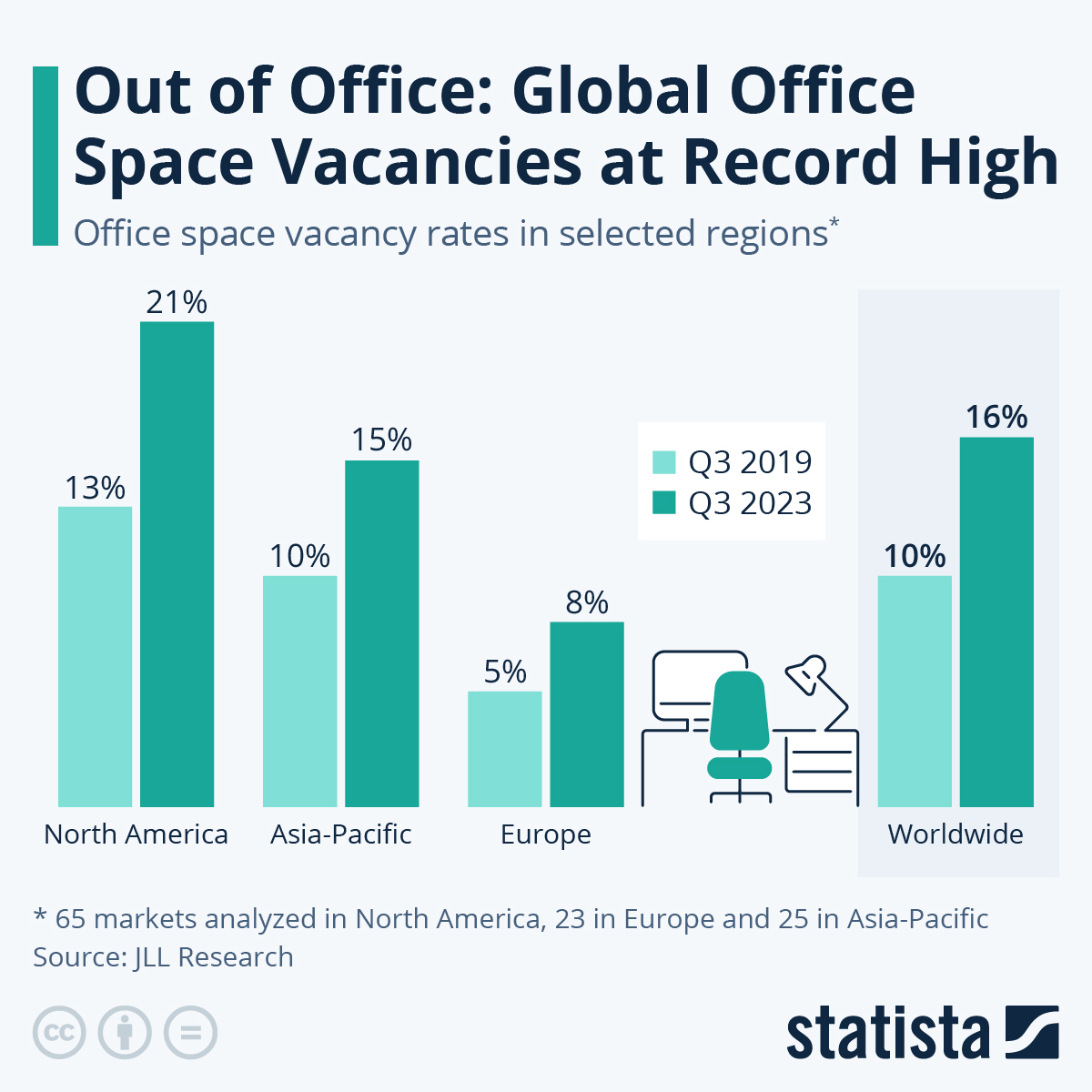
Out of Office: Global Office Space Vacancies at Record High
Fresh rumors about a possible bankruptcy of WeWork sent shockwaves around the commercial real estate market last week, leaving office landlords around the world trembling with fear at the prospect of losing one of their largest tenants. Especially in prime markets such as New York City, San Francisco, London and Paris, WeWork played an outsized role in the office rental market, occupying large swaths of premium office space.

The reports of WeWork’s imminent demise come at the worst possible time for landlords, who are already struggling to find tenants, as many companies are reducing their office footprint to reduce costs and adapt to the post-pandemic world of hybrid work. According to real estate specialist Jones Lang LaSalle (JLL), office vacancy rates are higher than ever, reaching 21 percent in the U.S. and Canada in Q3 2023 and 16 percent globally, i.e. in the 100+ markets analyzed by JLL Research. In both cases, that’s an increase of 60 percent compared to pre-pandemic vacancy rates, which stood at 13 and 10 percent in North America and globally in Q3 2019, respectively.

At the end of June, WeWork operated 906,000 workstations in 777 locations across 39 countries, with total (current and long-term) lease obligations amounting to $14.2 billion. While it’s unclear what will happen to these locations in case of bankruptcy, landlords look certain to lose out on a large chunk of their agreed-upon leases and to end up with even more excess supply of prime office space.

Saturday, November 4, 2023

structural dynamics

Динамика структуры ВВП за 2022-2023 годы


В свежем СЭПР Росстат приводит оценки компонент ВВП в текущих ценах за второй квартал 2023, так что теперь у нас есть уже полтора года динамики с начала СВО.

Прежде всего, надо обратить внимание на драматическое падение чистого экспорта с 18.4% ВВП в 1 квартале 2022 до нынешних 4% ВВП. Правда, и цифры начала 2022 были аномальными, в сумме за 2021 чистый экспорт был ровно в два раза ниже: 9.2% ВВП.

Потребление домашних хозяйств продолжает расти и уже превысило 52% от ВВП. В конце 2022 оно падало до 46.8%, до этого было достаточно стабильно и близко к докризисным уровням 2021 года.

Сильно выросла доля госпотребления (и опять же, понятно почему). Интересно другое: весь 2022 оно держалось на докризисном уровне, и лишь в 2023 начало расти: сразу с 17.4% в конце 2022 до 24.1% в 1 квартале 2023, сейчас опустилось до 20%

Валовое накопление основного капитала достигло пиковых 29% в 4к2022, но сейчас вернулось в окрестность докризисных уровней

Saturday, October 28, 2023

inflation

Инфляция в Европе в сентябре 2023


Наш ЦБ вчера в очередной раз повысил ставку для борьбы с инфляцией - но, что интересно, даже наши текущие 6% (официальные 6%, у кого как дорожает его личная потребительская корзина - большой-большой вопрос) выглядят довольно неплохо на фоне других стран Европы, прежде всего - Восточной Европы. В Польше инфляция приблизилась к 8%, в Чехии и Словакии перешагнула этот уровень, а в Венгрии она оказалась больше 12%. О Турции и говорить не приходится

Для стран Западной Европы сейчас тоже характерна достаточно высокий уровень инфляции: в Великобритании она составила 6.3% (чуть выше, чем у нас!), во Франции - 5.7%, немногим ниже наших цифр

Friday, October 27, 2023

Russian spendings

За год россияне стали больше экономить, но и у стратегии «больше тратить» увеличилось число приверженцев


В опросе сервиса по поиску высокооплачиваемой работы SuperJob россияне рассказали об изменениях в своих личных финансовых стратегиях за последний год. В опросе приняли участие экономически активные граждане из всех округов страны.

Рассказывая об изменениях в личной финансовой стратегии, почти каждый второй россиянин отметил, что за последний год стал больше экономить (49%). Чаще тратить стали только 14% опрошенных. У 26% респондентов личная финансовая стратегия за год не изменилась.

Число сторонников стратегии «больше экономить» выше среди мужчин (54% против 43% среди женщин). Россияне старше 45 лет стремятся к сокращению расходов чаще более молодых сограждан (53%). Чем выше уровень доходов, тем больше приверженцев экономии: 43% среди респондентов с зарплатой до 50 тысяч рублей в месяц, 57% — среди зарабатывающих от 80 тысяч рублей.

Число сторонников стратегии «больше тратить» выше всего среди россиян моложе 34 лет (21%).

За год несколько выросло как число тех, кто считает, что нужно больше тратить (с 9 до 14%), так и количество стремящихся к экономии (с 46 до 49%).

Место проведения опроса: Россия, все округа
Населенных пунктов: 384
Время проведения: 24—26 октября 2023 года
Исследуемая совокупность: экономически активное население России старше 18 лет, имеющее личную финансовую стратегию
Размер выборки: 1600 респондентов