Showing posts with label счастье. Show all posts

Sunday, May 26, 2024

happiness is a warm gun

Рэнкинг стран мира по величине межпоколенческого разрыва в ощущении себя счастливым.


На данных Всемирного опроса ценностей (WVS - World Values Survey)

Разница в доле ощущающих себя счастливым среди респондентов до 30 лет и респондентов 50 лет и старше, процентных пунктов.

Величина разницы дана в скобках после названия страны.

В норме молодые поколения всегда счастливее старших (по ряду причин, но, в первую очередь, из-за состояния здоровья).

В лидерах опять посткоммунистические страны из-за того, что поколения этих народов, успевшие повзрослеть в коммунистических режимах, чудовищно травмированы шоковым переходом к рынку и прекрасными 90-ми.

Обратная ситуация, когда молодые менее счастливы, чем старшие — очень ненормальная и свидетельствует о том, что в таких обществах есть серьезные проблемы.

Friday, June 2, 2023

kids are happy

В том, что детство современных детей счастливее их собственного детства, убежден лишь 1 из 5 россиян


1 июня — Международный день защиты детей. Лишь 1 из 5 россиян считает, что детство нынешнего подрастающего поколения счастливее, чем их собственное. В опросе сервиса по поиску высокооплачиваемой работы SuperJob приняли участие 1600 представителей экономически активного населения из всех округов страны.

Каждый второй россиянин (51%) не считает детство нынешних детей более счастливым, чем свое. Эту позицию опрошенные чаще всего объясняют чрезмерной увлеченностью подрастающего поколения гаджетами, нехваткой живого общения со сверстниками и подвижных игр на свежем воздухе. Напротив, каждый пятый (22%) убежден, что сегодняшние дети счастливее: родители уделяют им больше внимания, чем это было принято у предыдущих поколений, а современные информационные технологии предоставляют немыслимые ранее возможности. Затруднились оценить, какое поколение детей более счастливо, 27% россиян: «В материальном смысле они благополучнее нас, но в нашем детстве мир был безопаснее, и мы были свободнее».

Чем старше респонденты, тем чаще они склонны идеализировать свое детство и критиковать душевное состояние современных детей. Так, если среди опрошенных в возрасте до 34 лет такую позицию разделяют 46%, то среди россиян старше 45 лет — уже 56%. Убежденность в том, что нынешнее поколение детей ничуть не счастливее предыдущих, наиболее характерно для респондентов с доходом от 80 тыс. руб. в месяц (58%).

Необходимо отметить, что склонность идеализировать свое детство была присуща россиянам и ранее: так, и в 2007, и 2009 году, отвечая на аналогичный опрос SuperJob, большинство не считало современных им детей более счастливыми. За 16 лет выросло число россиян, которые затрудняются оценить, чье детство счастливее.

Место проведения опроса: Россия, все округа
Населенных пунктов: 375
Время проведения: 30—31 мая 2023 года
Исследуемая совокупность: экономически активное население России старше 18 лет
Размер выборки: 1600 респондентов

Подробнее

Friday, March 17, 2023

Global happiness up six points since last year: 73% now say they are happy

Global survey unveils drivers of happiness, finds life satisfaction roaring in Latin America but dropping in many Western countries; while people strive for social connections, many are pessimistic about the future of relationships and one in five say they have no one to turn to for support.


On average, nearly three in four (73%) adults across 32 countries describe themselves as happy, according to the results of a new Ipsos survey. Of all the countries surveyed, those with the highest proportions of happy citizens are China (91%), Saudi Arabia (86%), and the Netherlands (85%).

Global happiness has increased for the second year in a row. It is six points higher than a year ago and 10 points higher than it was in August 2020, just months after COVID disrupted people’s lives around the world. The overall increase masks very different trends across regions: while the proportion of self-reported happy people has risen sharply across Latin America, it has taken a tumble in many Western countries. Year-over-year changes range from 26-point gains in Colombia and Argentina to a 13-point dip in Great Britain.
On average, happiness in middle-income countries (as defined by the World Bank) saw a more pronounced increase than it did in high-income countries. The average happiness level of middle-income countries has surpassed that of high-income countries for the first time since Ipsos started tracking them in 2011.

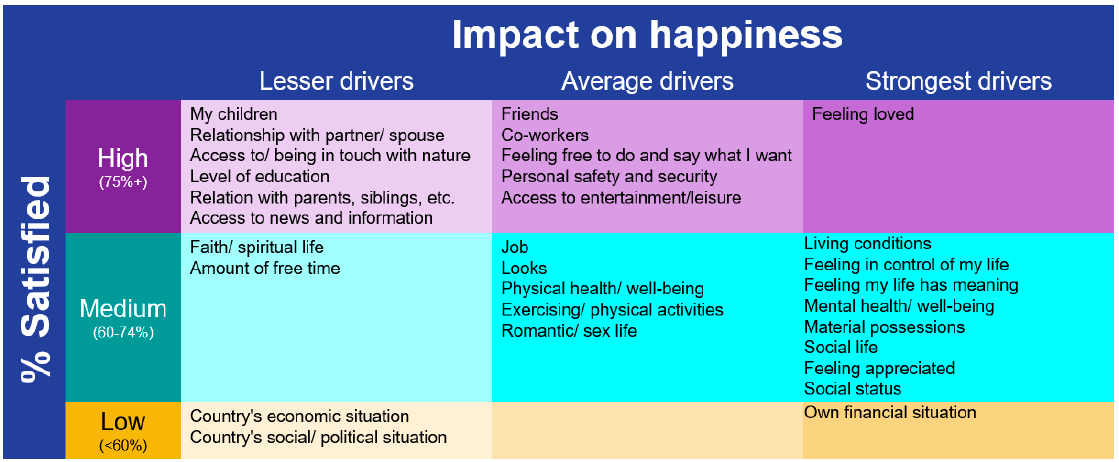
Among all the aspects of their life, people tend to be most satisfied with their relationships — with their children, spouse, relatives, friends, co-workers, and with nature— and with knowledge-related areas such as their level of education and their access to information. On average globally, people tend to be least satisfied with the economic, political, or social situation of their country, their own finances, their romantic or sex life, and their physical activity.

However, the survey finds that people are most likely to say they are happy if they are satisfied that their life is meaningful, if they feel in control of their life, if they feel valued, and/or if they are satisfied with their mental and material well-being. The drivers of happiness vary little by gender, with the notable exceptions of marital relationships and mental health (more important to women's happiness) and of one’s own financial situation (more important to men's happiness).
The study reveals that many people lack a support system. Globally, only 72% have friends or relatives they could turn to for help, including less than two-thirds in in Japan, Brazil, and South Korea, and generally among those with a lower income. Four in 10 say they have recently experienced a distressing event with higher proportions among Gen Zers and Millennials, those with a lower income, and women.

Furthermore, while large majorities in nearly every country surveyed say they are happy, pessimism about the future of relationships prevails. Twice as many say it will become harder than say it will become easier for singles to find a romantic partner, for couples to maintain a happy relationship, and for people to have close friendships they can count on. Pessimism is particularly pronounced among Boomers and GenXers, the less educated and less affluent, unmarried adults, and more generally among citizens of high-income countries.

Detailed Findings

Who and where are people the happiest?


On average across the 32 countries polled, 73% say they are very or rather happy. Among those countries, respondents from China (91%), Saudi Arabia (86%), the Netherlands (85%), India (84%), and Brazil (83%) report the highest level of happiness, while respondents from Hungary (50%), South Korea (57%) and Poland (58%) report the lowest. The U.S. hovers around the middle of the pack, with 76% of American respondents saying they are very or rather happy.

This year’s increase in the global level of happiness is driven by Latin American countries, many of which show remarkable year-over-year increases, including Colombia (+26 percentage points), Argentina (+26), Brazil (+20), and Peru (+18). Conversely, many Western countries post declines in year-over-year reported happiness: Great Britain (-13 percentage points), Poland (-7), Canada (-6), Belgium (-5), Germany (-5), and former happiness champion Australia (-5).

What are people satisfied with?


Globally, people say they are most satisfied with their relationships with their friends and family, while far fewer say they are satisfied with their country’s economic and political situation.

Among 30 aspects of life, five of the top six showing the highest levels of satisfaction pertain to relationships:
  • My children (if a parent) (85%)
  • Relationship with partner/spouse (if has one) (84%)
  • Access to/in touch with nature (80%)
  • Level of education (80%)
  • Relationship with relatives (78%)
  • Friends (78%)
The five aspects respondents are least likely to be satisfied with are:
  • Country’s social and political situation (40%)
  • Country’s economic situation (40%)
  • Own financial situation (57%)
  • Romantic/sex life (63%)
  • Exercising/physical activities (65%)
The areas of life respondents are happy with tend to vary depending on their country’s level of economic development. Relative to other aspects of their life, citizens of higher-income countries tend to be satisfied with their personal safety and security, material possessions and living conditions more than are those of middle-income countries. The latter tend to be more satisfied with their religious life, physical health, and looks than are citizens from more affluent countries.

What makes people happy?


Ipsos measured the relationship between all respondents’ reported level of overall happiness and level of satisfaction with 30 aspects of life. This analysis helped rank order all 30 aspects of life measured in terms their relative impact on overall happiness. It brings to light that the top five drivers of happiness are, in order: feeling one’s life has meaning, feeling in control of it, mental health and well-being, social life, and living conditions.

Among all 30 aspects of life, satisfaction with one’s children has the lowest impact on happiness, reflecting that most parents are satisfied with their children even if they are unhappy about other things in their life.

Challenging circumstances and access to support networks


Though family and friends are among the most prevalent sources of happiness, one in five adults lack a support system of friends or family they can rely on during difficult situations – even as many report having experienced distressing events in the past year.

Globally, 72% on average say they have friends or relatives that they could rely on to help them in case of need. This leaves 21% of adults saying they don’t have friends or relatives to rely on. (The remaining 7% preferred not to answer.)
  • Respondents from Japan (54%), Brazil (58%), and South Korea (61%) are the least likely to say they have these support networks, while those from the Netherlands (82%), Indonesia (79%), and Portugal (79%) are the most likely to report having them.
  • Lower-income, less educated, unmarried, and Gen Z respondents are also less likely to say they have access to support networks compared to higher-income, more educated, married, and older respondents, respectively.
Despite an alarmingly high number of people globally without access to support networks, many report experiencing distressing events that may have been easier to navigate with support networks. On average, 39% of respondents globally say they recently experienced a disturbing or distressing event that prevented them from feeling good about their life, while 37% said they are currently or recently faced a difficult situation that they could not resolve by themselves.
  • Gen Z, millennial, and lower-income respondents are also far more likely to say they have gone through distressing events recently than older and wealthier respondents.

Many are pessimistic about the future of finding friends and romance


The results of this study underscore the importance of friends and family as a major area of satisfaction in people’s lives. But just as many lack these relationships, many also feel that it will become harder to find or maintain these relationships.

About twice as many people say it will get more difficult rather than easier for single people to find a romantic partner (43% vs. 22%), for people to find close friends (43% vs. 23%), and for married couples to maintain happy relationships (43% vs. 21%). This pessimism is most pronounced among Boomers and Gen X respondents, females, and respondents that are unmarried, have lower income, or are unemployed.

Consumer confidence as a measure of happiness


Another key finding from this study is that, at the country-level, levels of happiness tend to reflect levels of consumer sentiment. Ipsos compared the percentage of happy adults and Ipsos’s Consumer Confidence Index across the 22 countries where both were measured in the same survey and found they are highly correlated. The Consumer Confidence Index tracks people’s sentiment about their financial situation, their ability to make purchases and investments, and perceptions of their local economy, job security and future opportunities.

Friday, February 10, 2023

Earth's Moving Plates

On February 6 and 7, the Southeast of Turkey and the Northwest of Syria have been hit by devastating earthquakes. In addition to the main tremor that reached a magnitude of 7.8 on the Richter scale, more than 20 aftershocks with magnitudes between 5.0 and 7.5 were registered in the earthquake-ravaged region around Gaziantep. Since Monday, the death toll of the disaster has climbed to 17,000 in Turkey and neighboring Syria, according to CNN.

The cause of the Turkey-Syria earthquake - and all other earthquakes - lies in the phenomenon of plate tectonics, i.e. the continental drift of the plates which make up the Earth's mantle. As our graphic shows, several such plates meet in Turkey, which significantly increases the risk of serious earthquakes. Even more importantly, some plates in Turkey move convergently, i.e. they are approaching each other, which also makes major earthquakes more likely than in places where plates move apart. More specifically, the East Anatolian fault - along which this week's earthquake occurred - is characterized by a convergent boundary with the African plate to the south and a transform boundary of horizontal movement with the Eurasian plate to the north. This further exemplifies how much seismic activity is present in the region that has now been turned into a disaster zone.

Turkey lies on the Anatolian Plate, which is on the line of tension between the Arabian and Eurasian Plates. The African Plate, which contributed to the formation of the Alps 60 million years ago by drifting north, also borders the Anatolian Plate. Along the edges of the Pacific Plate runs the so-called Ring of Fire responsible for much of the world's volcanic activity - another place where convergent plate boundaries exist. Other plates are the Australian, North American and South American plates. The strongest earthquakes in recent history all took place along the Ring of Fire, which also includes the well-known Mariana Trench, around the Pacific Plate. An earthquake with a magnitude of 9.5 was measured in Valdiva, Chile, in 1960. In 2004, an earthquake in the Indian Ocean off Sumatra reached a magnitude of 9.1 to 9.3 and in 2011 in the Japanese region of Tōhoku, an undersea earthquake with a magnitude of 9.1 and the ensuing tsunami caused widespread devastation and numerous deaths.Earth's Moving Plates

Wednesday, February 2, 2022

are you as happy as an ?

Friday, September 17, 2021

Swiss, elderly, single, and childless. Happy?

September 16, 2021 by Malgorzata Mikucka

Around the world, more and more people age without close kin. Contrary to expectations, however, according to Małgorzata Mikucka, this does not reduce their life satisfaction, or at least not systematically and not in Switzerland.

Contemporary adults are at increasing risk of ageing without close living kin (Verdery et al, 2019). Past studies showed that old-age singlehood and childlessness are typically associated with lower life satisfaction and greater material disadvantage (Dykstra 2009). However, the question remains about what happens as age progresses.

In a recent paper, I tried to understand the nexus between family situation and life satisfaction among a sample of older Swiss, using data from the Swiss Household Panel, SHP (Mikucka, 2020). The panel started in 1999, and when I conducted my analysis, data were available up to 2017. I tested whether unmarried and childless respondents were less satisfied with their lives than married people and parents, and how these differences evolved with age.

The Swiss way to life satisfaction


In the cohort aged 60–64 years at first observation (any year between 1999 and 2007), married people were indeed more satisfied with their lives than those who were never-married, divorced, or widowed (Fig. 1). However, the differences in the older cohort (75–79 years old) were not statistically significant, except for divorced fathers who were less satisfied than married fathers. The result for the younger cohort is consistent with previous literature which documented the greater life satisfaction of married than unmarried people (Bures et al. 2009). Conversely, childlessness did not systematically correlate with life satisfaction. This lack of difference is at odds with some past studies (Albertini and Arpino 2018), but it may be explained by the cross-country variation of the consequences of childlessness.
To understand whether the differences related to family situation intensified or declined with age, I analysed within-individual changes in life satisfaction over the period 1999-2017 (Figure 2). Life satisfaction among married parents (the reference category in the analysis) declined slightly with age. This baseline rate of decline did not differ systematically with gender or education, but it was shaped by life course transitions. This suggests that, at least in Switzerland, life satisfaction trajectories are shaped by the events that people experience, rather than by their underlying characteristics.

Do inequalities cumulate as people get older?


Theoretically, two opposite mechanisms may shape the consequences of kinlessness as people progress into advanced old age. The first is the mechanism of cumulative (dis)advantage. It postulates that, due to longer exposure to (dis)advantageous conditions, the differences among groups intensify with age (Dannefer 2003). In my analysis, the group experiencing the most “advantageous conditions” were married parents, judging from their high initial life satisfaction at the age of 60–64 years. The group with lowest life satisfaction at the same age were never-married mothers.

According to the cumulative (dis)advantage hypothesis, the life satisfaction trajectories of married parents should be more positive than those of the divorced, widowed, or never married. However, my results did not conform to this pattern (Figure 2). On the contrary, the life satisfaction of some subgroups of unmarried respondents (e.g. divorced and never-married mothers) increased at a faster rate than that of the married.

Partly consistent with the hypothesis of cumulative (dis)advantage was the pattern for never-married mothers (figure 2, third panel). This group’s life satisfaction, low at the start, declined more rapidly than in other groups, past age 75. However, the support for the hypothesis was only partial because the initial life satisfaction disadvantage was observed only in the younger cohort, whereas the faster rate of life satisfaction decline occurred only among the older cohort.

Ageing as an equalizing experience?


The alternative theoretical mechanism is called “age-as-leveller” (Dupre 2007): it postulates that as age advances, health becomes the most important, if not the only, predictor of life satisfaction, and as age-related health decline affects everybody, lower life satisfaction should characterize all groups.

Qualitative inspection of the predicted results of Figure 2 suggests that the life satisfaction gap between married and previously married people has been closing for both men and women, in both younger and older cohorts. However, only a few of these changes are statistically significant (Mikucka, 2020). Moreover, the gap closes in the younger cohort only, whereas the hypothesis predicts that the levelling mechanism should play a role primarily at advanced ages.

Conclusions


Neither the cumulative (dis)advantage hypothesis, nor age-as-leveller mechanism accurately describe the effect of family situations on life satisfaction when people become old. Instead, the buffering effect of parenthood seems more relevant.

Childlessness itself makes little systematic difference for life satisfaction and its dynamics in Switzerland in the observed years. However, elderly men who became widowers experienced a greater loss of life satisfaction if they were also childless (Figure 3). Additionally, life satisfaction of childless married and divorced respondents in the older cohort declined more rapidly than that of parents (Mikucka 2020). These results suggest that parenthood may have a protective buffering effect in certain cases, e.g. among men entering widowhood, but not in general.
Never-married mothers appear to be a particularly fragile group. Single parenthood is in itself a difficult experience (e.g., Meier et al. 2016), especially in a conservative social context, like that of Switzerland.

However, the main take-home message from this research is that growing instability of marriages and ageing without close kin do not pose a considerable threat for life satisfaction of elderly people in Switzerland, and probably also in other relatively wealthy countries offering welfare support. The (often implicit) assumption that lack of close family is particularly painful and detrimental for elderly persons did not find consistent support in my data.

References

  • Albertini M., B. Arpino. 2018. Childlessness, parenthood and subjective wellbeing: The relevance of conceptualizing parenthood and childlessness as a continuum. Preprint. DOI: 10.31235/osf.io/xtfq6
  • Bures R.M., T. Koropeckyj-Cox, M. Loree. 2009. Childlessness, parenthood, and depressive symptoms among middle-aged and older adults. Journal of Family Issues 30(5): 670–687.
  • Dannefer D. 2003. Cumulative advantage/disadvantage and the life course: Cross-fertilizing age and social science theory. The Journals of Gerontology Series B: Psychological Sciences and Social Sciences 58(6): S327–S337.
  • Dupre M.E. 2007. Educational differences in age-related patterns of disease: Reconsidering the cumulative disadvantage and age-as-leveler hypotheses. Journal of Health and Social Behavior 48(1): 1–15.
  • Dykstra P.A. 2009. Childless old age. In International Handbook of Population Aging, pages 671–690. Springer.
  • Mikucka M. 2020. Old-Age Trajectories of Life Satisfaction. Do Singlehood and Childlessness Hurt More When People Get Older?. Swiss Journal of Sociology, 46(3), 397-424.
  • Meier A., K. Musick, S. Flood, R. Dunifon. 2016. Mothering experiences: How single parenthood and employment structure the emotional valence of parenting. Demography 53(3): 649–674.
  • Verdery A.M., R. Margolis, Z. Zhou, X. Chai, J. Rittirong, J. (2019). Kinlessness around the world. The Journals of Gerontology: Series B, 74(8), 1394-1405.

Monday, May 24, 2021

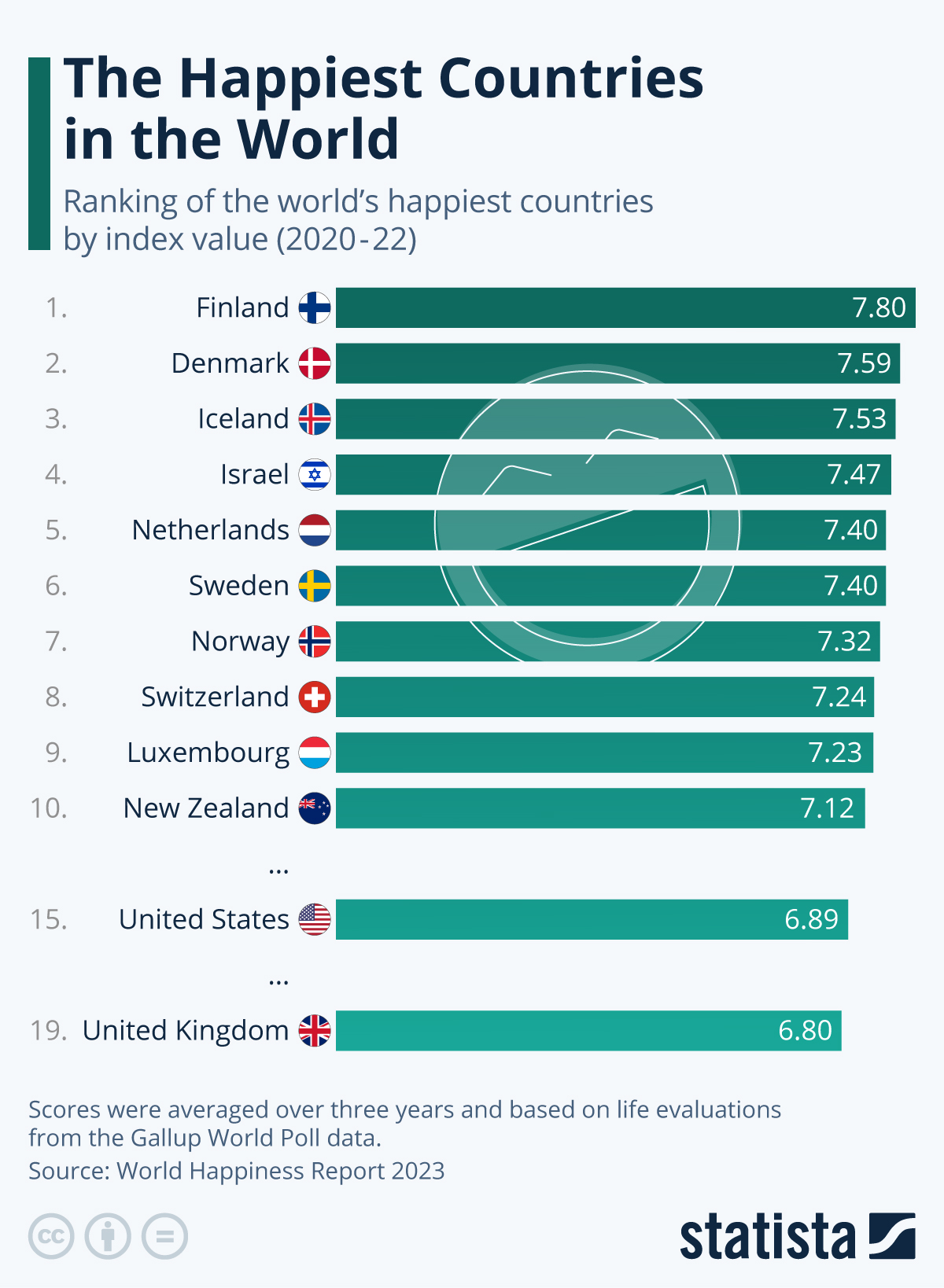
The Happiest Countries in the World

Scandinavia is still the world's happy place, firmly holding on to the top 3 of the World Happiness Report in 2020. Finland, Iceland and Denmark were named as the world's three happiest countries in the study that is based on surveys by Gallup as well as developmental indicators.

Despite the onset of the COVID-19 pandemic, happiness scores did not change majorly around the world in 2020. The majority of interviews for the report was carried out during the first wave of the pandemic in spring 2020.

Switzerland rose two ranks from 2019, coming in fourth. Germany even moved up ten ranks into seventh place. New Zealand is now the only non-European countries to make it into the top 10 of the happiest countries as Canada sank to rank 15.

The U.S. rose from rank 19 to rank 14, while it was downhill for the UK. The country tumbled from rank 14 to rank 18. Israel became the second highest ranking country outside of Europe in 11th place, while Taiwan scored highest in Asia (rank 19). The best-scoring country out of Africa was Nigeria in rank 59.Infographic: The Happiest Countries in the World | Statista

зато мы делаем ракеты

Wednesday, November 13, 2019

In Switzerland, fertility does not rhyme with happiness

Published on N-IUSSP.ORG November 11, 2019

En Suisse, fécondité ne rime pas avec bonheur


Malgorzata Mikucka

Parenthood typically improves people’s life satisfaction, even if only in the short run. Surprisingly, instead, Malgorzata Mikucka finds that a second birth has a negative, albeit temporary, effect on Swiss mothers’ life satisfaction. This may depend on the social pressure to have children, coupled with policies that do not support parenthood.

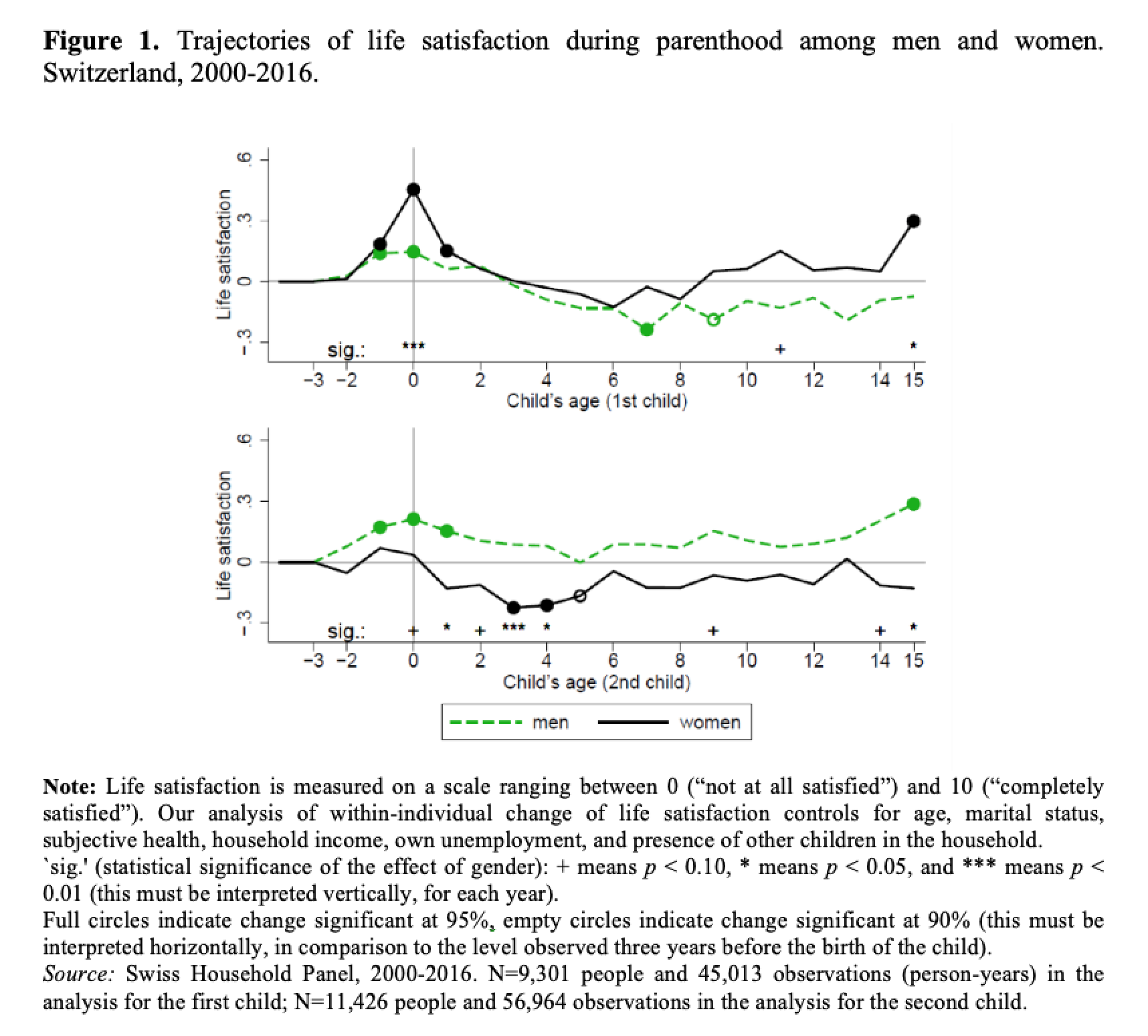
In a recent paper (Mikucka and Rizzi, 2019) we analyse how parenthood affects life satisfaction in Switzerland. We use data of the Swiss Household Panel for the years 2000-2016: this is a longitudinal study that records, among others, individual trajectories of life satisfaction. We analyse the life satisfaction of parents, i.e. people who were observed in the waves directly preceding or following a birth, and whose (first or second) child was aged 15 or younger. Although we were theoretically able to follow respondents for up to a maximum of 17 consecutive years, no respondent was observed over the whole period (see also note to Figure 1).
1
Two interesting patterns emerge. First, surprising as it may seem, fertility does not necessarily improve life satisfaction. In fact, it may even reduce it, albeit temporarily. Second, the decline in life satisfaction during parenthood seems specific to Switzerland and may be driven by the poor state support for families with children. Indeed, work-family conflict and economic costs of parenthood appear to play a prominent role on this outcome.

The parenthood paradox (when you take decisions that make you less happy)


We know from past studies that parents’ (and especially mothers’) life satisfaction increases, albeit only temporarily, in the year preceding and following the birth of the first child (e.g. Myrskylä and Margolis, 2014). This is true also in Switzerland (2000 to 2016), according to our data, but not for the second child: when they are between 1 and 4 years old, the life satisfaction of their mothers declines to below the pre-birth level (Figure 1).

This pattern is unexpected for three reasons. First, similar analyses for other countries (e.g., Myrskylä and Margolis, 2014, for Germany and the UK) consistently show that parenthood improves life satisfaction, even if only temporarily. This suggests that the worsening of life satisfaction following parenthood may be specific to Switzerland.

Second, fertility control in Switzerland is virtually perfect, and couples are free to decide whether and when to have children. Childlessness in Switzerland is among the highest in the world (e.g., above 20% among women born in 1960) and it is socially accepted (Burkimsher and Zeman, 2017). Not surprisingly, people predominantly plan their parenthood: in our sample, for instance, 67% of first children and 81% of second children were planned. Thus, mothers consciously choose to have the child(ren) who will later reduce their life satisfaction.

The third reason why our result is surprising is that two-child families are the dominant family type in Switzerland, which suggests that a majority of families choose a path that, at least in the relatively short run, diminishes their life satisfaction.

Between-group differences do not help to solve the puzzle. For instance, we expected that people with a stronger `taste for children’ would have a second child sooner after the first one and also that they would derive more satisfaction from parenthood. Our results show the opposite. Women who had their second child shortly (one or two years) after the first one had experienced more negative trajectories of life satisfaction with the first child than women who waited longer before having a second child (Figure 2).
2
While it seems rational to expect that people who want a certain thing (a child, in this case) should be happier once they get it, our analysis suggested that this does not apply to having children in Switzerland. What are the possible explanations? One is that people are incapable of predicting how their fertility decisions will affect their life satisfaction and end up choosing what makes them unhappy. Another possibility is that, when taking important decisions in their lives, people account not only for their expected life satisfaction, but also for some other factors, among which social norms and values (e.g., children should have at least one sibling). In other words, people may willingly make choices that will make their lives harder. Besides, parenthood may be a source of meaning and psychological reward, but it may also conflict with other life goals, such as career or leisure. This brings us to the second interesting pattern in our results, namely the consequences of Swiss policies for parenthood.

When policies do not help: work-family conflict and the economic cost of parenthood


Switzerland is an interesting case for the study of parenthood and life satisfaction, because, despite its high standard of living, state support for families with children is low. Childcare in Switzerland is expensive, maternity leave is short, and parental leave does not exist at all (OECD, 2015). In families with small children to be cared for, the mothers predominantly resort to part-time employment. Expensive childcare and the reduced earning capability of mothers likely produce two types of outcomes: work-family conflict and economic pressures.

Our results indeed show that work-family conflict shapes the life satisfaction of mothers in Switzerland. The care-intensive stage of parenthood with the second child is especially challenging, and this is when mothers’ life satisfaction falls below its pre-birth level. Moreover, during the same care-intensive stage with a first child, life satisfaction among higher educated mothers declines more than among lower educated mothers (Figure 3), suggesting that combining parenthood with a career is particularly problematic. No similar pattern shows up for men, who seem to be less affected by time pressures and juggling work and family responsibilities.
3
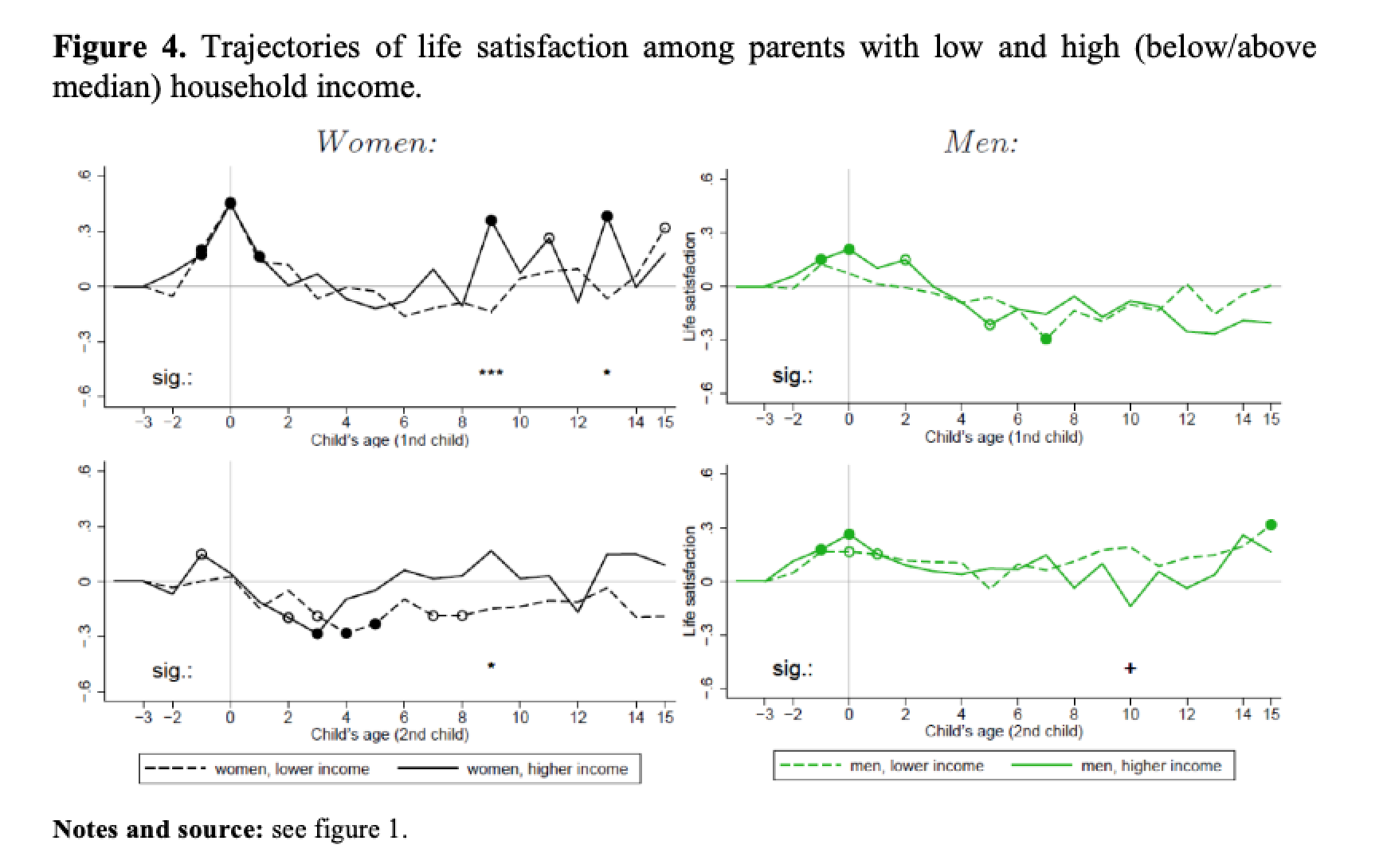
Economic pressure should not be downplayed. The trajectories of life satisfaction among mothers of school-age children depend on their incomes: mothers with higher (above-median) household incomes experience more positive changes of life satisfaction than mothers with lower (below-median) household incomes (Figure 4). No similar pattern shows up for men.

4
Overall, our results suggest that the low state support for families that characterizes the Swiss context worsens the experience of parenthood, especially for mothers. Public opinion seems to be aware of this: in a recent study, about half of the respondents stated that paid leave should be longer than the current four months, and about 80% agreed that part of the leave should be reserved for the father (Valarino et al. 2017). In the light of our analysis, such changes might plausibly improve the day-to-day experience of parenthood.

References:

  • Burkimsher, M., & Zeman, K. (2017). Childlessness in Switzerland and Austria. In M. Kreyenfeld & D. Konietzka (Eds.), Childlessness in Europe: Contexts, causes, and consequences, demographic research monographs (A series of the Max Planck Institute for Demographic Research). Cham: Springer.
  • Mikucka, M., & Rizzi, E. (2019). The Parenthood and Happiness Link: Testing Predictions from Five Theories. European Journal of Population, 1-25.
  • Myrskylä, M., & Margolis, R. (2014). Happiness: Before and after the kids. Demography, 51(5), 1843–1866.
  • OECD. (2015). Family database. Paris: Electronic Database.[если кто видел/пользовал — свистните, пож]
  • Valarino, I., Duvander, A.-Z., Haas, L., & Neyer, G. (2017). Exploring leave policy preferences: A comparison of Austria, Sweden, Switzerland, and the United States. Social Politics: International Studies in Gender, State and Society, 25(1), 118–147.

Святость материнства: ад нака


Friday, June 1, 2018

Is Cohabitation As Good As Marriage

скажи сексу: нет
This study investigates changes in happiness and life satisfaction associated with transitions into cohabitation and marriage in 12 waves from the British Household Panel Survey (BHPS) collected between 1997 and 2009. Theory suggests that happiness is an emotional state that is linked to one’s physiological reactions to life events, whereas satisfaction is a cognitive evaluation that also depends on social comparisons with other important reference groups as well as the individual’s desires, expectations, and hopes. A longitudinal (fixed effects) analysis that controls for time-invariant variation in subjective well-being indicates that entering cohabitation is as beneficial for people’s happiness as entering marriage. Entering marriage is slightly more satisfying than cohabitation but only among previously never-married individuals. This is true for men and women and across age and cohorts. These findings indicate that cohabitation provides similar benefits to marriage with regard to happiness but not how previously never married individuals view their overall satisfaction with their lives.

Keywords:
Cohabitation Marriage Satisfaction Happiness Longitudinal data

Is Cohabitation As Good As Marriage for People’s Subjective Well-Being? Longitudinal Evidence on Happiness and Life Satisfaction in the British Household Panel Survey

Thursday, January 18, 2018

Social benefits and economy


ESS ERIC‏ @ESS_Survey

People from the #UK, #France and #Ireland are most likely to think that social benefits and services place too great a strain on the economy. Those in #Iceland, #Russia and #Israel tend to think the opposite is true

Monday, December 4, 2017

what a wonderful day: besiegement

денёк, урожайный на песдеты:
Орудием холодной войны в международной политике стало распространение социальной патологии Child-free в России, высшей точки эгоцентризма, прикрытой молодёжной субкультурой и псевдофилософией. Это одна из форм демографической войны, которая, возможно, намеренно инспирируется в ряд стран, выступающих для кого-то геополитическими конкурентами.
Это ад.суда:

ДОБРОВОЛЬНО БЕЗДЕТНЫЕ КАК СОЦИАЛЬНАЯ ПАТОЛОГИЯ СОВРЕМЕННОЙ ДЕМОГРАФИИ

VOLUNTARY CHILDLESSNESS AS SOCIAL PATHOLOGY MODERN DEMOGRAPHY
Рассматриваются источники возникновения сетевого сообщества – чайлдфри. Показаны взаимосвязи с другими организациями, пропагандирующими бездетность
We consider the sources of the network community – childfree. Showing the relationship with other organizations that promote childlessness
Ключевые слова: социальная патология, чайлдфри, сообщество, Интернет-сообщество, Американская Лига, Российская ассоциация «Планирование семьи»
Key words: social pathology, childfree, community, online community, American League, the Rus- sian Association «Family Planning»
Гуманитарные науки
УДК 316
ЖУРНАЛ:
АСПИРАНТ. ПРИЛОЖЕНИЕ К ЖУРНАЛУ ВЕСТНИК ЗАБАЙКАЛЬСКОГО ГОСУДАРСТВЕННОГО УНИВЕРСИТЕТА
Издательство: Забайкальский государственный университет (Чита)
ISSN: 2074-9155
Орудия холодной войны

Monday, August 14, 2017

sadness for breakfast

Больше оружия и фаллоимитаторов
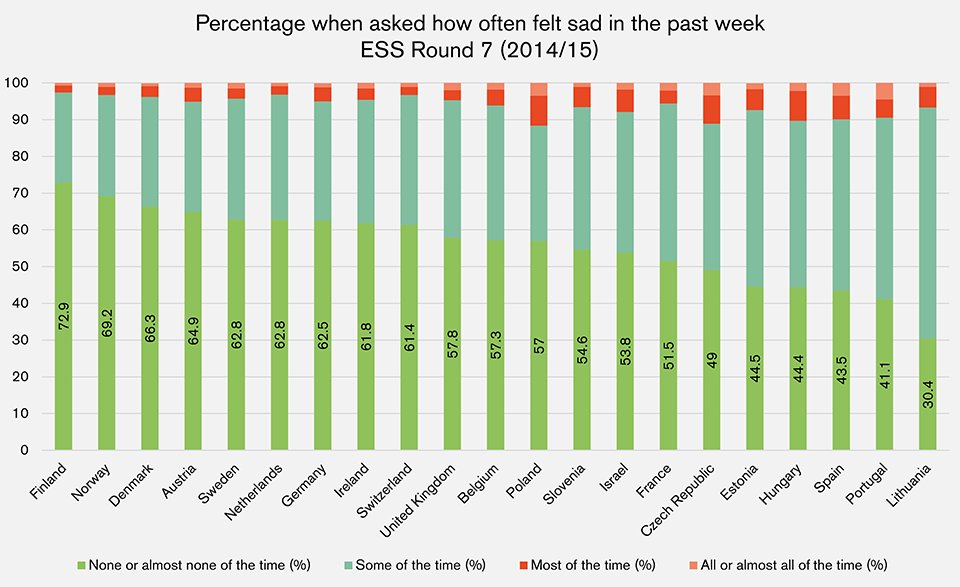
72.9% of Finnish respondents did not feel sad in the past week, compared with 30.4% of Lithuanians

Some days are just bad days, that's all. You have to experience sadness to know happiness, and I remind myself that not every day is going to be a good day, that's just the way it is! (с) Dita Von Teese

Saturday, May 20, 2017

Happiness and Life Satisfaction

не устал = не отдыхай
by Esteban Ortiz-Ospina and Max Roser : в деньгах счастье

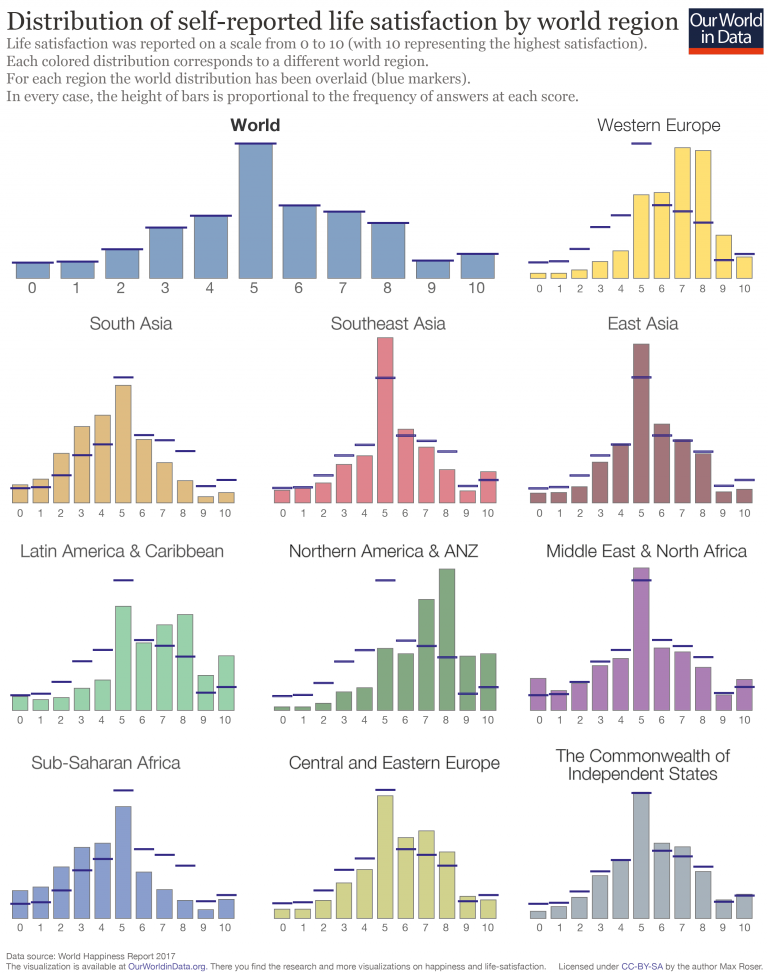
The World Happiness Report is a well-known source of cross-country data and research on self-reported life satisfaction. The map below shows, country by country, the ‘happiness scores’ published in the World Happiness Report 2017.

The underlying source of the happiness scores in the World Happiness Report is the Gallup World Poll—a set of nationally representative surveys undertaken in more than 160 countries in over 140 languages. The main life evaluation question asked in the poll is: “Please imagine a ladder, with steps numbered from 0 at the bottom to 10 at the top. The top of the ladder represents the best possible life for you and the bottom of the ladder represents the worst possible life for you. On which step of the ladder would you say you personally feel you stand at this time?” (Also known as the “Cantril Ladder”.)

The map below plots the average answer that survey-respondents provided to this question in different countries. As with the steps of the ladder, values in the map range from 0 to 10.

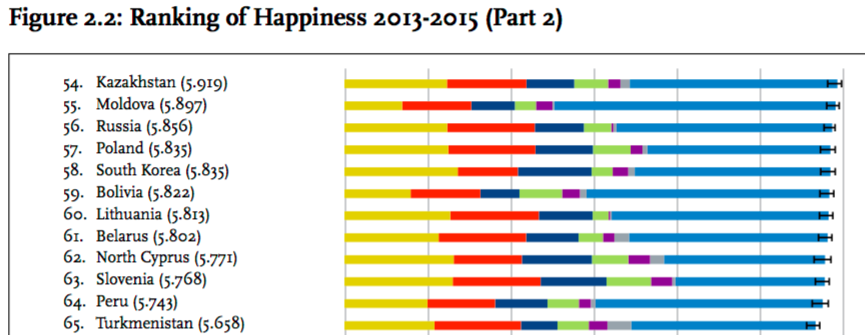
There are large differences across countries. According to 2016 figures, Nordic countries top the ranking: Finland, Norway, Denmark, the Netherlands and Iceland have the highest scores (all with averages above 7). In the same year, the lowest national scores correspond to Central African Republic, South Sudan, Tanzania, Rwanda and Haiti (all with average scores below 3.5).

You can click on any country on the map to plot time-series for specific countries.

As we can see, self-reported life satisfaction correlates with other measures of well-being—richer and healthier countries tend to have higher average happiness scores. (More on this in the section below.)

happiness
If you are interested in data on country-level distributions of scores, the Pew Global Attitudes Survey provides such figures for more than 40 countries.
see data

Sunday, February 26, 2017

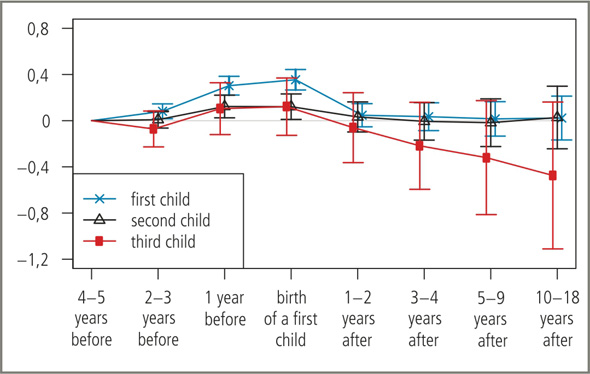
The birth of the third child doesn´t make parents happier

по ординате — щастье, наскоко понимаю


Whereas satisfaction levels among parents in Germany improve at the birth of the first and second child, they decline sharply with the birth of the third child.

Tuesday, April 12, 2016

reporting happiness

Исследования, проведенные группой социологов при ООН в рамках подготовки Отчета о всемирном уровне счастья, показали, что рождение детей преимущественно не приносят счастья родителям. Особенно это касается женщин и молодых семей, а удовлетворенность жизнью с рождением ребенка существенно повышается лишь у вдов и вдовцов, а также возрастных групп старше 55 лет.
[то-есть, через колено, деды/бабки, но что-то не оч вепицо в социологов при ООН, не прут, имхо]
Результаты подсчетов продемонстрировали, что наличие детей существенно и негативно влияет на уровень удовлетворенности жизнью. Этот эффект усиливается еще больше, если учесть количество детей. По сравнению с контрольной бездетной группой падение удовлетворения жизнью прямо связанно с увеличением количества детей в семье, хотя влияние эффекта перестает существенно увеличиваться уже после третьего ребенка.
положительная эмоция токо у овдовевших
все беды от детей — зачем их только рожают ???
попы ткаот гадки + больше картинок

Wednesday, March 2, 2016

Locations of optimists

These days, people in China are the world's most optimistic by far. In fact, someone in China is more than twice as likely as someone from another country (out of 17 surveyed) to say that the world is improving. The research, conducted by YouGov, found that Indonesia was the next most optimistic country with 23 percent of respondents saying the world is getting better. People in the United States and Britain were far more pessimistic with only 6 and 4 percent respectively feeling that the world is improving.
This chart shows the percentage of people who think the world is getting better.
Infographic: The World's Most Optimistic Countries | Statista
Скандинавы плотненька построились, и немного англа, но Канады нет совсем, как ни странно
от мира.ру ожидать не приходицо

Thursday, February 25, 2016

Communist China is the happiest places on Earth

По корейским исследованиям с севера самые щастливые жытели жывут в КНР (100 очков из 100 возможных — perfectissimo), КНДР — пачотнае второе место, на последнем месте США (3 очка), даже у РФ больше, но данных нет
привет участникам соревнований
из Гардиан по на вотке YD , фраг менты

The happiest countries ranked out of 100


1. China - 100
2. North Korea - 98
3. Cuba - 93
4. Iran - 88
5. Venezuela - 85 (Палестина стрип где?)
152. South Korea - 18
203. United States - 3

U.S. or North Korea? How they match up


Average wage
U.S. $42,000 a year
N.K. around $50 a year

Cost of house
U.S. $250,000
N.K.: $150

Leader's claim to fame
Barack Obama: The 'Mr Cool' of world politics
Kim Jong-il: Known for his snappy dress sense

Number of McDonald's
U.S. 13,381
N.K. None - although Kim Jong-il claims to have invented the hamburger

Number of golf courses:
U.S. 16,944
N.K. One and in 1994 Kim Jong-il got five holes in one during a 38-under par round there

Average temperature in capital (самый важный показатель, объясняющий буквально фсё):
Washington DC: 12.2c
Pyongyang: 9.75c

Monday, February 22, 2016

sexual satisfaction and happiness


Writing at the Wall Street Journal, Elizabeth Bernstein reports on a study to be released later this month in the Journal of Sex Research. Researchers at a handful of universities including Cal State and the Kinsey Institute surveyed nearly 40,000 married and/or cohabitating people back in 2006—average age 40 for women, 46 for men, to determine sexual satisfaction and happiness.
“Couples who are more satisfied are driven to have sex more often, which gives them more satisfaction and leads to more frequency,”
When men and women ranked their “strongest predictors” of satisfaction, it looked like this:

Men:
  • mood setting 
  • sexual variety 
  • communication 
Women:
  • orgasms 
  • mood setting 
  • communication
...having an orgasm for a man is such a given that he doesn’t even have to rank it as a predictor.
и много всякого другого любо пыц.ва

Saturday, January 10, 2015

unhappy families

Поиски новогоднего календаря, авторские песни и насыщенная танцевальная программа. Благотворительный концерт для детей из неблагополучных и многодетных семей Минска и Минского района прошел сегодня в столице.

по ссылке есть видео на езыге оригинала, выделенное звучит приблизительно.таг:

нещастных и шматдзетных сямей

мидии и грамадзяне однозначно определяют многодетность как нещастье