Showing posts with label страхование. Show all posts

Thursday, July 6, 2023

Suicide risk and immigration background

Suicide risk and immigration background of married couples in Sweden

July 3, 2023 Anna Oksuzyan, Sven Drefahl, Jennifer Caputo and Siddartha Aradhya

Is it better to intermarry? Using Swedish registry data, Anna Oksuzyan, Sven Drefahl, Jennifer Caputo, and Siddartha Aradhya investigate whether people married to someone from a different ethnic background (i.e., who are intermarried) have a different risk of suicide than those who are married to someone from their same ethnic background.


Suicide and marriage


Suicide ranks high among the causes of death worldwide, accounting for more than one in every 100 deaths globally in 2019 (WHO 2021). A famous study on the social predictors of suicide by the sociologist Emile Durkheim first documented that suicide was less common among married people in 1897 (Durkheim 1897), and more recent research has consistently found the same pattern. Studies broadly show that marriage benefits both physical and mental health through many mechanisms, including the companionship and economic resources it provides. However, they also find that the health benefits of marriage can vary across characteristics such as race/ethnicity (Martínez et al. 2016) and gender (Gove 1973). Less research has examined whether the health benefits of marriage are linked to the immigration background of a person’s spouse. The literature supports conflicting expectations.

Intermarriage and well-being


Intermarriage is widely considered to be one of the strongest indicators of an immigrant’s integration into a host country. Living with a native-born spouse may improve immigrants’ social integration and well-being by helping them learn the language, enhancing their understanding of the host country’s culture and social systems, and facilitating access to social networks and employment. Accordingly, intermarriage has been associated with better economic outcomes among immigrants in Sweden (Dribe and Lundh 2008). Intermarriage may also benefit native-born partners by increasing their cultural capital (Rodríguez-García 2015), which provides advantages in social life.

On the other hand, studies suggest that intermarriage predicts a greater likelihood of marital conflict. Intermarried couples may have sociocultural differences in values, norms, and communication styles. They may also be exposed to discrimination. These circumstances can reduce marital quality and may take a toll on intermarried persons’ well-being. Indeed, prior research shows that intermarriages are less stable than unions between people from the same ethnic background (Kalmijn, de Graaf, and Janssen 2005). A recent study showed that both partners in marriages between native German women and immigrant men had worse mental health than the partners in marriages involving two native-born Germans (Eibich and Liu 2021). These findings collectively imply that the relationship between marriage and mental health may differ by nativity.
 

Intermarriage and suicide risk


In a recent study (Oksuzyan et al. 2023), we investigated whether suicide risk in Sweden differs between intermarried people and those married to someone from their same ethnic background. The study used national Swedish registry data from the years 1991 to 2016. We included all married individuals aged 18 and older in our analysis (N = 6,249,727). A total of 18,116 deaths due to suicide occurred over the course of the study.

We found some evidence that intermarried people in Sweden were at greater risk of suicide. More precisely, in marriages between a native-born Swedish man and an immigrant woman, both partners were at higher risk of suicide death than in marriages where both partners were native-born Swedes (Figure 1). However, we did not find a similar elevated risk among partners in marriages between Swedish women and immigrant men. In addition, the increased suicide risk of immigrant women married to male Swedes was present only among those from non-Western countries (Figure 2). The suicide risk of intermarried immigrant women from Western nations was comparable to that of immigrant women married to other immigrants from their same country.
Why might people in marriages between a Swedish man and an immigrant woman be at greater risk of suicide? One possibility is that these marriages are characterized by more asymmetric power relations than marriages involving immigrant men and Swedish women. Immigrant men were more likely to marry “down” in terms of education when they married a native-born woman compared to when they married an immigrant woman, i.e., to trade-off their higher socioeconomic status with the “prestige” of marrying a native woman (Kalmijn and van Tubergen 2006). These unions follow the conventional gender norms that are still prevalent in Sweden and other European nations, where men are considered to be the breadwinners and women are expected to be homemakers. In contrast, there may be conflicting expectations about gender roles in binational marriages between immigrant women with a higher socioeconomic status than their local Swedish partner.

It may also be that native-born Swedish men and immigrant women with disadvantages that may increase their suicide risk, such as poorer health behaviors and mental health, are more likely to intermarry. To test for the possibility that people in these marriages have a health disadvantage and a greater risk of death more broadly, we analyzed differences in all-cause mortality by intermarriage group. However, we did not find the same elevated hazard of death for all-cause mortality among immigrant women married to native men as we did for suicide mortality.

We also found that immigrant men and women who marry an immigrant from their same origin country had a markedly lower risk of suicide relative to Swedes married to Swedes. This finding is consistent with our initial expectation that marriages involving partners from the same ethnic background share migration experiences and are healthier, on average, than native-born persons.

Conclusion


Our study provides preliminary evidence that some individuals in intermarriages between immigrants and native-born persons are at increased risk of suicide mortality. They signal the possibility that marrying someone with a different ethnic background may potentially introduce additional stressors to marriage, such as cultural conflict, marital discord, and relationship inequality, with long-term consequences for mental health and well-being.

References

Monday, June 5, 2023

vacation loan

Только 3 из 100 готовы ехать в отпуск в кредит


3% россиян собираются брать или уже взяли кредит на летний отпуск. Чаще других займы на отпуск в финансовых организациях берет старшее поколение. В опросе сервиса по поиску высокооплачиваемой работы SuperJob приняли участие 1600 трудоустроенных представителей экономически активного населения, уходящего в отпуск этим летом.

Взять кредит на летний отпуск планируют 3 из 100 россиян (3%). Причем чаще всего заем ради отдыха оформляют опрошенные старше 45 лет (6%). По их мнению, финансовые сложности не должны препятствовать отдыху: «Перемены положительно сказываются на качестве работы и отношении к жизни». Однако большинство опрошенных (89%) против такого подхода: «Кто берёт кредит на отпуск?! Нет денег — сиди дома».

Противников «отпускных» кредитов больше среди мужчин, чем среди женщин (91% против 87% соответственно). Те, кто планирует провести отпуск за границей, чаще других отказываются влезать в долги ради отдыха (94%).

Как показали исследования SuperJob, чаще всего этим летом россияне мечтают провести отпуск на море (17%). При этом среднестатистический отпускной бюджет в этом году — 46 тыс. руб. на неделю на одного человека.

Место проведения опроса: Россия, все округа
Населенных пунктов: 351
Время проведения: 11—30 мая 2023 года
Исследуемая совокупность: трудоустроенное экономически активное население России старше 18 лет, уходящее в отпуск летом 2023 года
Размер выборки: 1600 респондентов

Подробнее

Saturday, July 16, 2022

BUNMD

бунд
Life expectancy in the United States increased by a remarkable 30 years over the course of the 20th century. This impressive progress was driven primarily by advances in the treatment of infectious diseases and delayed mortality for those living with chronic illness (Crimmins and Zhang 2019), but the benefits accrued unevenly. Inequality in mortality between the most advantaged and the least advantaged actually increased over time (Preston and Elo 1995), and by the beginning of the 21st century, the gap in life expectancy between the top and bottom 1% of income earners was over 14.6 years (Chetty et al. 2016).

Despite the longstanding interest in racial and class-based inequalities in health and mortality in the United States (Schwandt et al. 2021; Elo 2009), research is often hampered by data limitations (Card et al. 2010; Song and Coleman 2020). Most research into the general dimensions of mortality disparities using microdata have relied on survey data, with sample sizes that preclude the analysis of smaller population subgroups such as the oldest-old. In the absence of comprehensive population-level registry data such as those found in the Scandinavian countries, researchers are increasingly turning to administrative datasets from agencies such as the Social Security Administration to answer some of the most pressing questions in social science research (Chetty et al. 2016; Card, Dobkin, and Maestas 2008; Card et al. 2010; Meyer and Mittag 2019; Ruggles 2014). While the recent introduction of the United States Mortality Database has created a valuable new resource for studying aggregate mortality trends at the state level (USMDB 2021), public-use administrative microdata for mortality research remains scarce. When available, it is often cumbersome to use.

We introduce the Berkeley Unified Numident Mortality Database (BUNMD), a cleaned and harmonized version of administrative mortality records from the Social Security Administration. The BUNMD represents one of the first publicly available, large-scale administrative microdata resources for studying mortality. We anticipate that the size (N = 49 million) and spatial detail will open up new avenues for high-resolution mortality research. Furthermore, the open-access nature of the dataset will ensure this research is reproducible and extendable. The BUNMD can be downloaded here.

Thursday, September 30, 2021

off-label medicines.ru

Клинические рекомендации пойдут по этапу


Со следующего года работу ЛПУ по ОМС оплатят исключительно при соответствии её клиническим рекомендациям. Отклонение от КР дорого обойдётся врачу и клинике - на их основе будет финансироваться медицинская помощь в регионах. Большинство нозологий и патологических состояний не удостоилось собственных КР, как поступать со страдающими ими пациентами?
Вероника Игоревна
Принятые с подачи экс-министра Скворцовой в 2019 году изменения статуса клинических рекомендаций с 1 января 2022 года дают КР неведомую силу: только по ним должны работать врачи, только на их базе составляться планы по объёму медпомощи населению, только они определят затраты по каждому тарифу. Несмотря на то, что это только «рекомендации» и провозглашение строго индивидуального подхода к каждому пациенту, в российской медицине клинические рекомендации становятся молитвенником и законником.

Вероника Игоревна в лёгкую обещала принять 1200 КР за пару лет, но работа по составлению и утверждению началась только после её освобождения от должности. Нет рекомендаций у подавляющего большинства нозологий, все утверждённые в бытность Скворцовой КР давно исчерпали срок действия и переведены в архив. Практически полным набором может похвастать только онкология, но и там нет КР по сопроводительной и симптоматической терапии состояний и осложнений лечения.

«В феврале мы направили в Минздрав уведомление о том, что пишем 11 клинреков по сопроводительной терапии. Но нас уведомили, что их принять невозможно якобы потому, что нет таких диагнозов», – поделился руководитель групп по разработке КР профессор Алексей Трякин. Пресс-служба Минздрава предпочла заморозить дискуссию, ответив, что КР разрабатывает профессиональное сообщество, а ведомство их либо принимает, либо возвращает на доработку.

Под угрозой срыва апрельский законопроект о разрешении закупки не зарегистрированных препаратов off-label, сегодня отсутствующих в КР. Подчинённый Минздраву ЦЭККМП предложил на лекарства off-label заблаговременно готовить досье, которые включать в КР на этапе их написания, но дальше предложений дело не пошло. Утверждённые в 2020 и 2021 годах КР имеют ограниченный срок годности – не более 2 лет, большие сомнения, что бесплатно обременённые их созданием профессиональные ассоциации смогут соблюсти сроки написания документов по всему спектру "своих" нозологий.

Минздрав не усомнился в нужности и высоком статусе КР, предложив разбить сроки их написания и утверждения. Так с 1 января 2022 года исполнять надлежит только КР, размещённые в открытом доступе до 1 октября сего года (список нозологий Минздрав не прикладывает). Размещённые с октября по июнь 2022 года начнут действовать с 1 января 2023 года. Не успевшие попасть в Рубрикатор до июня 2023 вступят в законную силу с 1 января 2024 года.

Разобраться, что и когда было размещено - не простая задача, в Рубрикаторе не предусмотрено размещение КР по специальностям, нет даты утверждения – только год и ID-номер. Врачу предлагается принять к исполнению документ, если таковой уже попал в Рубрикатор. МирВрача третий год готовит сокращённые версии КР и не оставит этой работы.

Wednesday, August 25, 2021

insurance in crisis

На лечение больных COVID-19 до конца года потребуется 111 млрд рублей


Стоимость медицинской помощи пациентам с коронавирусом по итогам второго полугодия превысит 111 млрд руб., следует из расчетов Федерального фонда обязательного медицинского страхования (ФОМС). При расчетах фонд ориентировался на прогноз Минздрава, согласно которому за этот период в стране может заразиться COVID-19 еще около 3,9 млн человек. Об этом сообщает РБК со ссылкой на аналитическую записку Счетной палаты об исполнении бюджета ФОМС за первое полугодие 2021 года.

По данным ФОМС, из 3,9 млн потенциальных зараженных стационарная медицинская помощь может потребоваться только 20%, это примерно чуть более 784 тыс. госпитализаций. На оказание медпомощи застрахованным россиянам во втором полугодии фонду нужно будет 65,4 млрд руб., еще около 60 млрд руб. нужно на компенсацию оплаты труда работников и коммунальных услуг.

Минздрав пояснил, что прогноз заболеваемости COVID-19 сделан «с учетом тенденций развития санитарно-эпидемиологической обстановки в России и других странах в 2020 году и первой половине 2021 года, а также с учетом количества переболевших и вакцинированных». По данным ведомства, коррекция прогноза в сторону уменьшения возможна при увеличении числа вакцинированных граждан.

За первое полугодие ФОМС потратил на медпомощь больным COVID-19 218 млрд руб., из них 208,8 млрд направлено на лечение больных в стационарах. Средняя стоимость госпитализации одного пациента с COVID-19 в России в первом полугодии составила 135,4 тыс. руб. По данным Минздрава, стоимость лечения рассчитывается с учетом расходов на необходимые медицинские процедуры и применение лекарств, предусмотренных стандартами медпомощи.

С начала пандемии в России выявили более 6,7 млн зараженных коронавирусом, умерли 177,6 тыс. человек. При этом врачи стали чаще фиксировать тяжелые случаи протекания коронавируса у детей. По данным на 20 августа, в России от COVID-19 вакцинировано более 43 млн человек.

Подробнее о заболеваемости — в материале “Ъ” «До детей докопался».
Данные обновлены 25.08.2021 в 11:55 по московскому времени
Вся статистика, графики и карты

Monday, June 14, 2021

risk mgt?

пиздетс
Немецкие и шведские ученые проанализировали риски, которые влечет за собой потепление климата Земли. Результат их научных изысканий опубликован на сайте Earth System Dynamics.

С помощью IT-технологий исследователи воссоздали три миллиона сценариев развития событий в случае потепления климата всего на два градуса. Около 30 процентов этих сценариев приводят к катастрофе. Так называемый эффект домино необратимо изменит жизнь всей планеты - к такому выводу пришли ученые.

Авторы публикации подчеркивают, что к их исследованию нужно относиться не как к прогнозу, а как к "анализу рисков". Однако, по их словам, "результаты все равно вызывают опасения".

Tuesday, May 18, 2021

Advancing LGBTQI health research

Insurance
by Tonia C Poteat, Carmen H Logie, L Leigh Ann van der Merwe

Since the groundbreaking 2011 UN resolution called for attention to the violence and discrimination committed against individuals because of their sexual orientation and gender identity, the visibility of LGBTQI populations has increased globally. There is mounting evidence of LGBTQI health inequities driven by stigma, discrimination, and violence. In December, 2020, 70 UN member states had criminal laws targeting sexual or gender minorities—two with de facto criminalisation and 68 with specific criminal provisions against same-sex sexual practices, six of which prescribe punishment with the death penalty. Despite recognition of these structural and social determinants of health, insufficient progress has been made in actions to address them.

Many aspects of LGBTQI health and their determinants are woefully understudied. Key priorities for advancing LGBTQI health research include filling gaps in knowledge by region, health condition, sexual orientation and gender identity group, theoretical frameworks, and methods. Importantly, researchers must collect and use data to advance the wellbeing of LGBTQI individuals, communities, and populations (panel). Simply identifying disparities by sexual orientation, gender identity, or intersex status is not enough and could exacerbate stigma against LGBTQI people in some settings. Researchers must also frame health disparities within the sociopolitical conditions that create them, clearly document the connection between these conditions and LGBTQI health, and conduct analyses that can lead to effective interventions.

Panel

Recommendations for filling gaps in LGBTQI health research


Populations and topics


• It is important that data analyses disaggregate participants by sexual orientation and gender identity rather than assume results apply across broad LGBTQI categories.
• Research is needed that disentangles identity, attraction, and practices, as well as sex and gender identity from gender attribution.
• Lesbian health outside of North America is understudied, particularly on topics other than breast cancer and obesity. There is a need for research on lesbian sexual health, including sexual function, HIV, and safer sex. COVID-19 impacts are underexamined with lesbian and bisexual women.
• Gay men's health needs to be examined beyond HIV, with a life course perspective.
• Transgender health issues should be examined beyond HIV, gender-affirming surgery and mental health problems.
• The health of intersex people should be studied beyond the impacts of surgical and hormonal treatments to focus on holistic health.
• Sexual pleasure is important to examine as a component of sexual health and rights among sexual and gender minority people.
• Strengths-based research frameworks are needed, particularly those that examine solidarity, social cohesion, and connectedness, and health benefits of social movement building. Individual and collective resilience must also be examined to document and promote the strengths of LGBTQI communities.
• Intervention research is needed that addresses systemic and structural issues, as well as community-led intervention research informed by community priorities.
• Research on structural factors is required, including power structures, health impacts of criminalisation, legal protections, and social norms and attitudes.
• There are knowledge gaps of the health impacts of incarceration and alternatives to incarceration among LGBTQI people.
• Increased research is needed on non-communicable diseases with LGBTQI populations.
• More research is needed on health-care provider perceptions, attitudes, and knowledge toward LGBTQI clients, including effective strategies to improve provider care across diverse geographical contexts.
• Behaviour change research has focused almost exclusively on reducing health risk behaviours of LGBTQI individuals. Studies are needed that examine ways to promote behaviour change among policy makers and other people in power—eg, how to turn adversaries into advocates.

Frameworks and methods


• Methods can use population-based data, including adding sexual orientation and gender identity measures to demographic and health surveys and other national surveys, and ensuring privacy, confidentiality, and protection.
• Approaches can advance dialogue on research ethics board considerations for conducting research with (rather than on) LGBTQI people, with critical reflection on how LGBTQI people are often framed as inherently vulnerable.
• Longitudinal cohort data are needed across global contexts, especially data on older LGBTQI people.
• Methods can be developed that honour diverse identities and accurately measure sexual orientation and gender identity, avoiding analytic microaggressions.
• Intersectional approaches to LGBTQI health research should take into account the variance between and within high-income, low-income, and middle-income contexts and move beyond the minority stress model to explicitly incorporate the role of power structures in determining health outcomes.
• Inclusive studies should aim to have LGBTQI sample sizes large enough for robust analysis.
• Qualitative studies can be developed to better understand nuances, experiences, processes, and the “why” behind LGBTQI health inequities, alongside documenting experiences of health-enabling environments.

Most data on LGBTQI health are from high-income countries in North America and Europe. Existing research typically focuses heavily on HIV among men who have sex with men, uses non-probability convenience samples, and applies frameworks to describe health inequities that emphasise risk behaviours rather than the agency and strengths of LGBTQI populations that can be leveraged. More research is needed to fill knowledge gaps in countries at all income levels and to examine multidimensional aspects of health, including non-communicable diseases and resilience.

A minority stress framework has generated important evidence on the relations between stigma and poor health among LGBTQI populations. This framework rejects notions of innate pathology and highlights the fundamental social and structural causes of health inequities. However, more research is needed on positive experiences and resiliencies in LGBTQI communities. Understanding how LGBTQI people cope and thrive can provide crucial information for the development of effective strengths-based interventions grounded in social cohesion and community connectedness. Longitudinal and cohort studies are needed to better understand how experiences across the life course affect the lives of LGBTQI people, not only by describing the accumulation of minority stressors, but also by exploring identity formation, access to social support, adaptive coping strategies, family formation, and healthy ageing.

Increasingly, research has identified variability in health experiences by sex characteristics, sex assigned at birth, gender identity and expression, and sexual identity and behaviour. For example, in North America, bisexual women have been found to experience higher rates of sexual violence and poorer mental health than lesbians. Studies across the globe indicate that HIV prevalence is higher in transgender people than in cisgender people, typically driven by clustering of structural and psychosocial factors.  Attention to the specific health concerns of each group within the LGBTQI umbrella is important. Specifically, more research is needed broadly on the health of transgender men, lesbians, and bisexual people. Research with gay and bisexual men and transgender women rarely examines health issues beyond HIV; by contrast lesbian and bisexual women are under-represented in HIV research. Research with intersex individuals must move beyond a focus on surgery and sexual anatomy to explore broader aspects of health and rights-affirming approaches to intersex medical care.

LGBTQI people are diverse by sex, ethnicity, socioeconomic status, age, and ability, among other identities. More research is needed to understand how these intersecting identities converge, and the ways in which their associated privileges or disadvantages affect the health outcomes, health-care experiences, and priorities of LGBTQI people. An intersectional approach to health research with LGBTQI people locates the source of health inequities within systems of power, considers the interplay between social identities (eg, race) and inequities (eg, racism), exposes the negative impact of the status quo on marginalised communities, and centres the lived experiences and diversity of LGBTQI people.

Research questions and study designs must be guided by priorities and knowledge of LGBTQI communities to produce relevant data. In countries where aspects of sexual orientation and gender identity and expression are criminalised, data collection can be difficult; in such settings, researchers run the risk of state actors using LGBTQI data for entrapment, harassment, arrest, and persecution. The very criminalisation that interferes with quality data collection also drives health inequities that remain understudied and inadequately addressed. Work to fill gaps in LGBTQI health research must use community-based approaches to try to prevent harm to participants and misuse of data. Broader political and social efforts to protect LGBTQI people against criminalisation, violence, and discrimination based on sexual orientation and gender identity and expression are key to advancing LGBTQI health.

Although data gaps remain, interventions cannot wait. There are plenty of data on the stigma, discrimination, and social exclusion experienced by many LGBTQI people, and we know these experiences drive health inequities. Interventions must improve LGBTQI health and promote health equity. Interventions may span social–ecological dimensions, including: structural level policies and laws to protect rights and ensure freedom from discrimination; community level norms, values, and attitudes; interpersonal relationships; and intrapersonal domains of self-worth, self-acceptance, and internalised stigma. Interventions can be tailored for different groups—eg, reducing stigma in structural and social arenas among general populations, educators, and health-care providers or building resilience, stigma coping, and advocacy, and mitigating internalised stigma with LGBTQI people. Interventions tailored for stigma reduction and health promotion with LGBTQI people can use a life course approach that considers developmental stages, from childhood and adolescence, to emerging adulthood, parenthood, caregiving, and ageing. Importantly, implementation science research is needed to understand how interventions work, for whom, and in what context, so that they can be sustained beyond the end of research studies by government, non-governmental, and community actors.

Больше букаф, хорошых и разних

Friday, April 23, 2021

illegal HIV+ migrants access to health care

ДК

Уважаемые коллеги,

приглашаем вас принять участие в научном семинаре Института демографии им. А.Г. Вишневского

«Демографические вызовы XXI века»,


который состоится 27 апреля 2021 года.

С докладом на тему

«Барьеры и неформальные стратегии доступа к медицинской помощи трудовых мигрантов, живущих с ВИЧ-инфекцией, в России в условиях нелегальности»


выступит Даниил Кашницкий, аспирант Института демографии им. А.Г. Вишневского НИУ ВШЭ, младший научный сотрудник Института социальной политики НИУ ВШЭ.

Оппоненты:

Сакевич Виктория Ивановна, кандидат экономических наук, старший научный сотрудник Института демографии им. А.Г. Вишневского НИУ ВШЭ,

Флоринская Юлия Фридриховна, кандидат географических наук, ведущий научный сотрудник Института социального анализа и прогнозирования РАНХиГС при Президенте РФ.

Аннотация выступления:

В исследовательском проекте (в рамках учебы в аспирантуры) я предпринял попытку изучить формальные и неформальные стратегии доступа к здравоохранению среди иностранных мигрантов с ВИЧ-инфекцией в России. На примере данной группы мигрантов исследую, как государство формирует пространство легальной неопределенности, таким образом осуществляя контроль над мигрантами. Также я проблематизирую вопрос отсутствия реальных данных о заболеваемости и распространенности ВИЧ-инфекции среди иностранных мигрантов в России.

Саму по себе миграцию не следует понимать как фактор риска заболеваний, однако низкий доступ к медицинским услугам, разлука с семьей, незащищенный труд, проживание в плохих условиях и ограниченная осведомленность о рискованном поведении негативно влияют на социальные детерминанты здоровья и способствуют уязвимости мигрантов к ВИЧ, туберкулезу, а также способствуют повышенному травматизму и другим заболеваниям.

Согласно ФЗ-38, Россия запрещает законное пребывание ВИЧ-инфицированным иностранцам. Следовательно, значительная часть иностранцев с ВИЧ вынуждена скрывать свой ВИЧ-статус и проживать в нелегальном статусе, в случае если они не могут вернуться в домой в свою страну исхода. Такие мигранты остаются без доступа к специализированной терапии для лечения ВИЧ-инфекции, а также не могут получить медицинский полис ОМС для обращения с другими проблемами медицинского характера.

Исследование основано на качественных интервью с экспертами НПО, докторами и 15 ВИЧ-положительными людьми с опытом проживания в России в качестве иностранных мигрантов. Я детально обсуждаю эпидемиологические, экономические и социальные последствия запрета проживания иностранных мигрантов с ВИЧ-инфекцией в контексте миграционной политики, формулируя рекомендации и пытаясь наметить вехи для дальнейших научных и научно-практических исследований в этой области.


Начало семинара в 12:00.
Семинар состоится онлайн в ZOOM (см. инструкцию).
Рабочий язык: русский.

Всех, кто планирует принять участие в семинаре, просим подтвердить участие до 10:00 27 апреля, заполнив форму https://zoom.us/meeting/register/tJ0lcumrqjkiHdSLS2tP0Egnd5tLgPL3qUDi

При возникновении проблем при регистрации и подключению к семинару вы можете написать по e-mail: valergany@gmail.com (Валерий Юмагузин).

Будем рады встрече!

Monday, February 15, 2021

fertility treatments for LGBTQ couples

Cuomo mandates health insurance companies in New York to cover fertility treatments for LGBTQ couples


By amNY News

Governor Andrew Cuomo

Health insurance companies in New York must immediately cover fertility treatments for queer couples, according to a new statewide mandate announced on Feb. 11.

Governor Cuomo is directing the Department of Financial Services to eliminate any extra costs facing same-sex couples seeking fertility treatments such as in-vitro fertilization, egg freezing, sperm donations, and more. Queer people are sometimes forced to pay six to 12 months of out-of-pocket costs for fertility treatments before qualifying for coverage, while cisgender, heterosexual couples do not face these same barriers.

The Governor’s office did not immediately respond to a question asking whether the mandate extends to transgender people in heterosexual relationships.

“For too long same sex couples have been denied coverage for immediate infertility benefits, forcing them to pay high — often prohibitive — out-of-pocket costs to start a family,” Cuomo said in a written statement. “No New Yorker should be denied the opportunity to become a parent, nor the joys of raising a child, because of their sexual orientation, and this change reflects what we as New Yorkers know to be true: that love is what makes a family, that inclusivity is our strength and that the law should work for all New Yorkers.”

In a statement, Melissa DeRosa, the Governor’s spokesperson and chair of the Council on Women and Girls, said the move is a step toward removing barriers in reproductive health care.

“New York is leading the nation in protecting the rights of all New Yorkers and making it easier to start a family by expanding access to safe and affordable fertility treatments,” DeRosa said. “Family planning is a profoundly personal and emotional journey, and it should not be made harder by bureaucracy.”

She added, “These new actions mark a major win for women and the LGBTQ community, and we will continue breaking down barriers to family planning until every New Yorker has access to the protections and services they need to start a family of their own.”

Last April, the state legalized paid gestational surrogacy — which is when a surrogate carries a baby who has no biological relation to them — after a prolonged fight over concerns that the surrogates carrying babies and those donating eggs were not provided with enough protections and rights. Out lesbian Assemblymember Deborah Glick was among those who mounted resistance to the surrogacy effort, telling the New York Times that gestational surrogacy amounted to “pregnancy for a fee, and I find that commodifcation of women troubling.”

Surrogacy-related protections are slated to go into effect Feb. 15, according to the governor.

This story first appeared on our sister publication gaycitynews.com.

Thursday, January 14, 2021

Air Crash Deaths Increased In 2020 Despite Covid-19

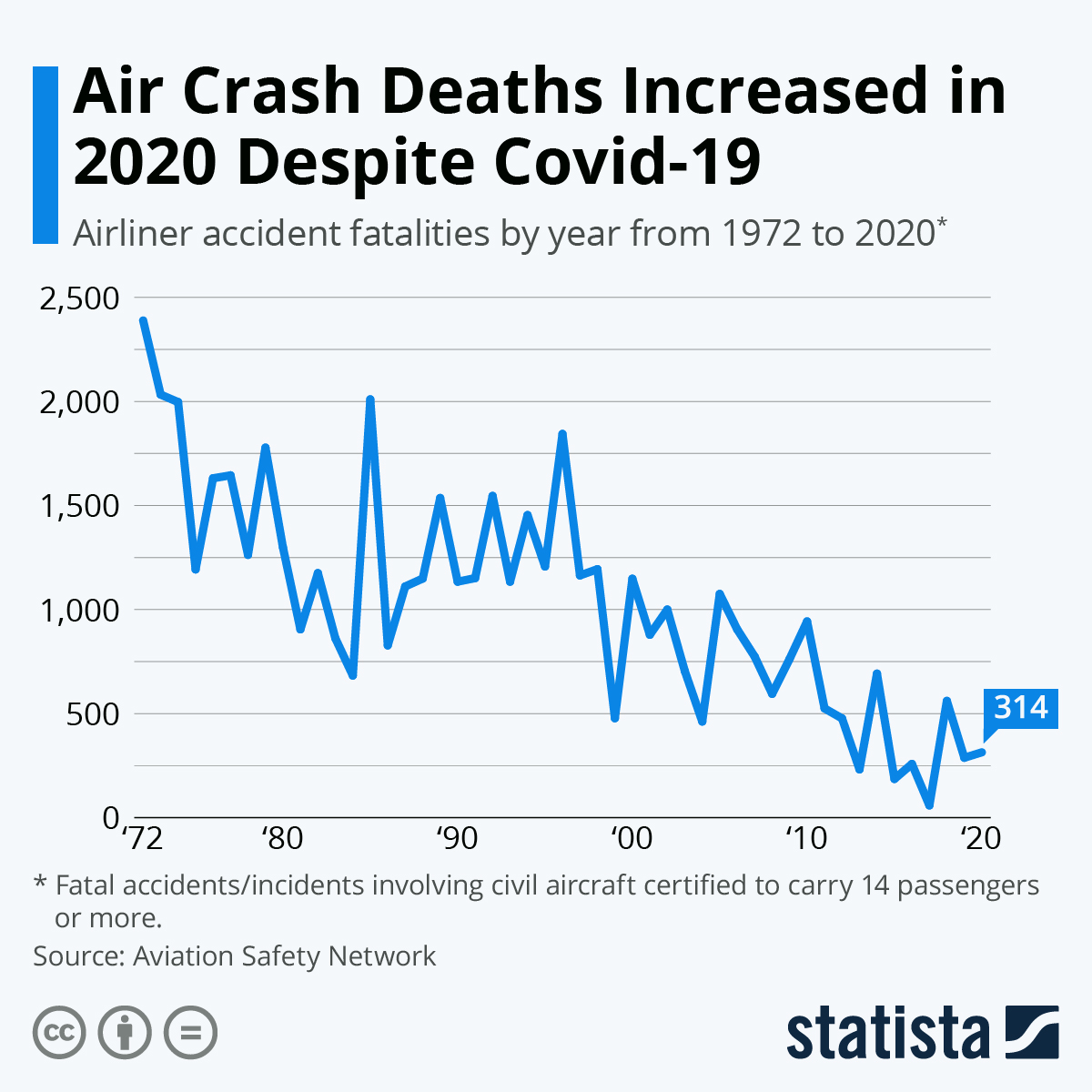
2020 saw an increase in the number of people killed in air crashes around the world despite the Covid-19 pandemic leading to a dramatic reduction in the number of operational flights. Aviation Safety Network data released in early January shows that there were eight fatal airliner crashes registered and 314 deaths. The number of fatal airliner crashes was the lowest ever recorded in a full year and both figures are below the industry's five-year average. It is also important to mention that they take into account two incidents where airliners were inadvertently shot down, killing 182 passengers and crew.

ASN states that industry studies found that the global air traffic volume in 2020 was just half of 2019 with around 19 million fights [l пропущено?] operated, equivalent to the total number in 1999. Back then, ASN registered 43 fatal accidents for the year that resulted in 689 fatalities, illustrating the strides that have been made in aviation safety over the past 20 years. 2017 remains the safest year on record with 10 fatal accidents registered and 44 deaths. Even though progress has been made in recent years, challenges remain and ASN outlines two from 2020 that need to work: approach and landing accidents along with commercial flights through conflict zones.

India and Turkey saw runway excursion accidents in 2020 with 23 fatalities which shows that work needs to be done in preventing runway overruns and ensuring environments adhere to International Civil Aviation Organization guidelines (ICAO). The organization also outlined improvements that are necessary for following ICAO guidance on flights through conflict zones. It comes after the shooting down of a Ukraine International Airlines Boeing 737 in Iran in January of last year while an East Express Airways aircraft were also downed in Somalia in May 2020.Infographic: Air Crash Deaths Increased In 2020 Despite Covid-19 | Statista

Tuesday, August 11, 2020

U.S. Health Insurers Profits Boom Amid Pandemic

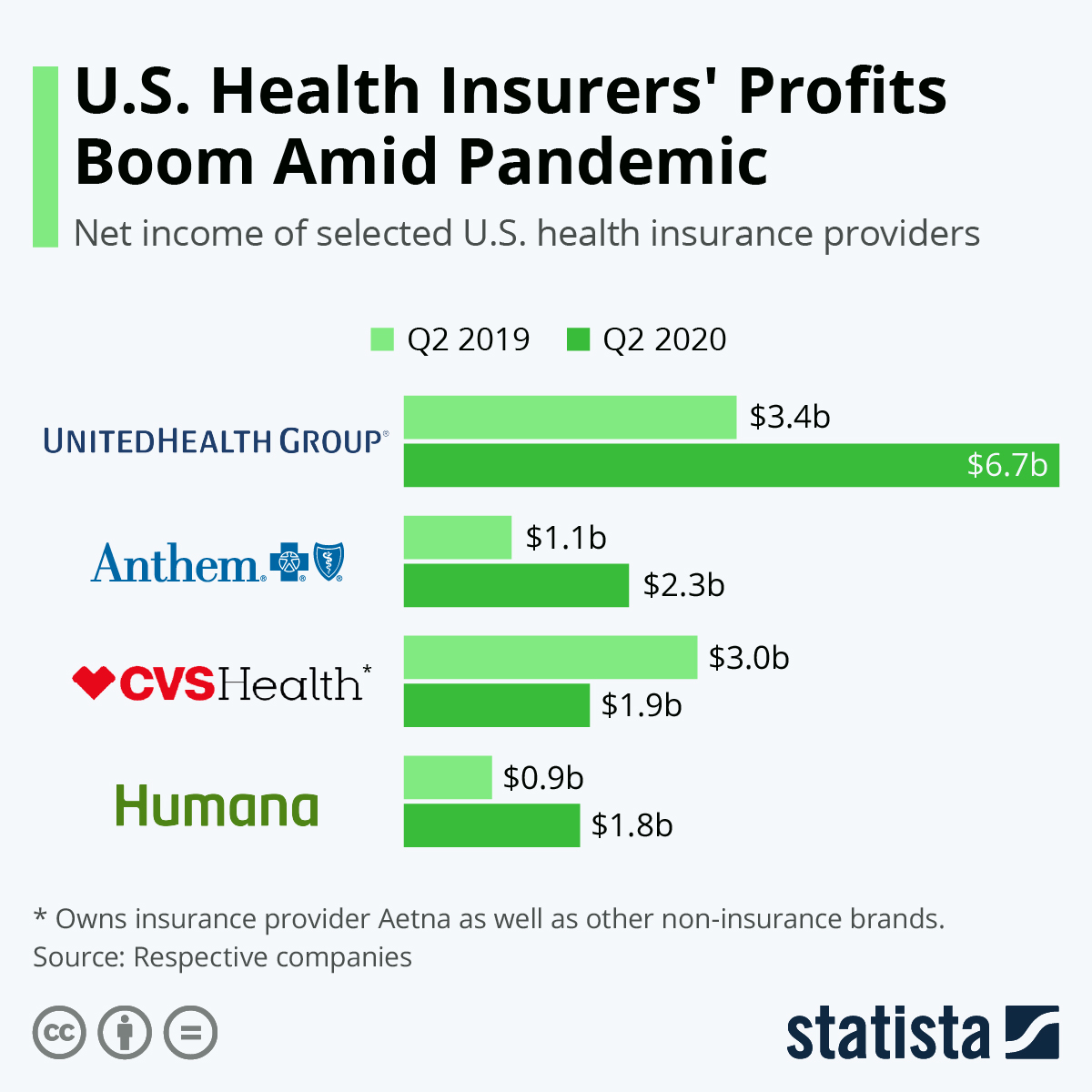
Across the world, some business models have proven resiliant throughout the coronavirus pandemic with online retailers such as Amazon and streaming services like Netflix thriving. A catastrophic health crisis may seem like a good financial opportunity for health insurance companies and according to the most recent results of some major U.S. players, they are raking in billions of extra dollars thanks to the pandemic, with some companies even doubling their profits.

In some parts of the country, hospitals are being overwhelmed by an influx of patients with some announcing staggering financial losses. Meanwhile, major health insurance providers have been able to avoid paying big money for major surgeries and other complex procedures while people have stopped visiting their local doctors in recent weeks. That has led to a drastic increase in net income for most health insurance companies between Q2 of last year and Q2 of 2020 with a selection compared on this infographic.

For example, the UnitedHealth Group doubled its income from $3.4 billion to $6.7 billion with Anthem's also growing by a similar percentage, climbing from $1.1 billion to $2.3 billion. CVS Health owns insurance provider Aetna as well as several other brands including pharmaceutical companies. It added an extra billion dollars in net income in the second quarter of 2020. Humana also posted staggering numbers with a net income of $1.8 billion versus $940 million for Q2 of last year.

The Affordable Care Act saw the profits of health insurance companies capped under the requirement that they pay out rebates for the benefit of their customers, a process which does not seem to be occurring quickly enough given the severity of the current situation. That has prompted the Health and Human Services Department to weigh in on the situation and it has advised health insurance providers to accelerate the rebate process and reduce premiums.Infographic: U.S. Health Insurers Profits Boom Amid Pandemic | Statista

Wednesday, August 5, 2020

An income of an average Russian

доход
Ваши денежки

Исследование: доход более 70% россиян не превышает 25 тыс. рублей в месяц

При этом у 45% граждан доход составляет 15 тыс. рублей


МОСКВА, 7 июля. /ТАСС/. Среднемесячный доход более 70% россиян не превышает 25 тыс. рублей, при этом у 45% граждан доход составляет 15 тыс. рублей, говорится в совместном исследовании страховой компании "Росгосстрах жизнь" и научно-технического центра "Перспектива", проведенном в июне.

При этом по сравнению с аналогичным исследованием, проведенным до начала пандемии коронавируса в феврале, доля граждан с доходом до 5 тыс. рублей в месяц выросла с 6,9% в феврале до 8,1% в июне, с доходом 5-15 тыс. рублей - с 31,2% до 36,5%, а доля граждан с заработком в пределах 15-25 тыс. рублей увеличилась с 25,6% до 28,2%.

Больше всего жителей с доходом 15-25 тыс. рублей в Хабаровском крае (50%), Московской (43,8%) и Белгородской (41,7%) областях.

В то же время снизилась доля респондентов с доходом 25-35 тыс. рублей (с 15,3% до 13%), а также с доходами 35-50 тыс. рублей (с 11,5% до 8,5%) и 50-100 тыс. рублей (с 7,6% до 3,5%).

Согласно исследованию, о "значительном" снижении доходов за время пандемии заявил каждый пятый россиянин, а каждый десятый полностью потерял заработок.

"В ходе июньского исследования половина респондентов (50,3%) сообщили, что уровень их дохода и дохода членов их семьи с момента начала пандемии и введения режима самоизоляции не изменился. В то же время у 19,7% респондентов среднемесячный доход с марта "значительно" сократился. Еще 16,5% опрошенных рассказали о "значительном" снижении уровня дохода одного или нескольких членов их семьи. Каждый десятый потерял заработок полностью", - отмечается в исследовании.

Tuesday, March 17, 2020

to panic or not to panic

наше главное отличие — спокойствие, мы не срём — или освоили безбумажную технологию
это вчера вечером, около 9 часов


сральная бумага вроде есть
а крупы уже нет, рис есть, но мало-мало

Saturday, February 29, 2020

ban abortion ban

Епифанова О.Н

Вице-спикер Думы выступила против вывода абортов из системы ОМС

Ольга Епифанова считает, что запрет абортов не улучшит демографию, а "прибавит криминала и женской смертности"


МОСКВА, 28 февраля. /ТАСС/. Вице-спикер Госдумы Ольга Епифанова ("Справедливая Россия") считает нецелесообразным вывод абортов из системы обязательного медицинского страхования (ОМС).

"У нас в стране пока нет достаточного количества центров помощи женщинам в кризисных ситуациях, чтобы выводить аборты из системы ОМС. Поэтому давайте оставим российским женщинам право решать и возможность исполнить свое решение", - приводит слова Епифановой ее пресс-служба.

По ее мнению, запрет абортов не улучшит демографию, а "прибавит криминала и женской смертности". "Решение об искусственном прерывании беременности может приниматься не только по желанию будущей матери, но и по вполне объективным медицинским показаниям. Разделить эти потоки, на мой взгляд, нереально. Да и с точки зрения борьбы с коррупцией шаг совсем недальновидный", - полагает она.

Парламентарий также выступила против запрета суррогатного материнства и искусственного оплодотворения (ЭКО). "Часто бывает, что одна из этих процедур - единственный способ сохранить семью. Ситуация, когда супруги не могут родить ребенка, становится трагедией и способствует разводу", - отметила Епифанова.

Thursday, January 2, 2020

United States Health Care Reform

Progress to Date and Next Steps 

об авторе статьи, откуда картинки:
Barack Obama, JD
President of the United States, Washington, DC

Percentage of Individuals in the United States Without Health Insurance, 1963-2015

Data are derived from the National Health Interview Survey and, for years prior to 1982, supplementary information from other survey sources and administrative records. The methods used to construct a comparable series spanning the entire period build on those in Cohen et al and Cohen and are described in detail in Council of Economic Advisers 2014. For years 1989 and later, data are annual. For prior years, data are generally but not always biannual. ACA indicates Affordable Care Act.

Decline in Adult Uninsured Rate From 2013 to 2015 vs 2013 Uninsured Rate by State

Data are derived from the Gallup-Healthways Well-Being Index as reported by Witters and reflect uninsured rates for individuals 18 years or older. Dashed lines reflect the result of an ordinary least squares regression relating the change in the uninsured rate from 2013 to 2015 to the level of the uninsured rate in 2013, run separately for each group of states. The 29 states in which expanded coverage took effect before the end of 2015 were categorized as Medicaid expansion states, and the remaining 21 states were categorized as Medicaid nonexpansion states.

Percentage of Workers With Employer-Based Single Coverage Without an Annual Limit on Out-of-pocket Spending 

Data from the Kaiser Family Foundation/Health Research and Education Trust Employer Health Benefits Survey.

Rate of Change in Real per-Enrollee Spending by Payer

Data are derived from the National Health Expenditure Accounts.1 Inflation adjustments use the Gross Domestic Product Price Index reported in the National Income and Product Accounts.40 The mean growth rate for Medicare spending reported for 2005 through 2010 omits growth from 2005 to 2006 to exclude the effect of the creation of Medicare Part D.

Out-of-pocket Spending as a Percentage of Total Health Care Spending for Individuals Enrolled in Employer-Based Coverage

Data for the series labeled Medical Expenditure Panel Survey (MEPS) were derived from MEPS Household Component and reflect the ratio of out-of-pocket expenditures to total expenditures for nonelderly individuals reporting full-year employer coverage. Data for the series labeled Health Care Cost Institute (HCCI) were derived from the analysis of the HCCI claims database reported in Herrera et al, HCCI 2015, and HCCI 2015; to capture data revisions, the most recent value reported for each year was used. Data for the series labeled Claxton et al were derived from the analyses of the Trueven Marketscan claims database reported by Claxton et al 2016.

Medicare 30-Day, All-Condition Hospital Readmission Rate

Data were provided by the Centers for Medicare & Medicaid Services (written communication; March 2016). The plotted series reflects a 12-month moving average of the hospital readmission rates reported for discharges occurring in each month.

Abstract


Importance The Affordable Care Act is the most important health care legislation enacted in the United States since the creation of Medicare and Medicaid in 1965. The law implemented comprehensive reforms designed to improve the accessibility, affordability, and quality of health care.

Objectives To review the factors influencing the decision to pursue health reform, summarize evidence on the effects of the law to date, recommend actions that could improve the health care system, and identify general lessons for public policy from the Affordable Care Act.

Evidence Analysis of publicly available data, data obtained from government agencies, and published research findings. The period examined extends from 1963 to early 2016.

Findings The Affordable Care Act has made significant progress toward solving long-standing challenges facing the US health care system related to access, affordability, and quality of care. Since the Affordable Care Act became law, the uninsured rate has declined by 43%, from 16.0% in 2010 to 9.1% in 2015, primarily because of the law’s reforms. Research has documented accompanying improvements in access to care (for example, an estimated reduction in the share of nonelderly adults unable to afford care of 5.5 percentage points), financial security (for example, an estimated reduction in debts sent to collection of $600-$1000 per person gaining Medicaid coverage), and health (for example, an estimated reduction in the share of nonelderly adults reporting fair or poor health of 3.4 percentage points). The law has also begun the process of transforming health care payment systems, with an estimated 30% of traditional Medicare payments now flowing through alternative payment models like bundled payments or accountable care organizations. These and related reforms have contributed to a sustained period of slow growth in per-enrollee health care spending and improvements in health care quality. Despite this progress, major opportunities to improve the health care system remain.

Conclusions and Relevance Policy makers should build on progress made by the Affordable Care Act by continuing to implement the Health Insurance Marketplaces and delivery system reform, increasing federal financial assistance for Marketplace enrollees, introducing a public plan option in areas lacking individual market competition, and taking actions to reduce prescription drug costs. Although partisanship and special interest opposition remain, experience with the Affordable Care Act demonstrates that positive change is achievable on some of the nation’s most complex challenges.

Special Communication August 2, 2016

Thursday, September 12, 2019

Traveller Pastoral

чья на тумбочке юбка чёрная?
Что-то сбудется, что-то станется
Во Франции суд признал мужчину, скончавшегося во время секса в командировке, жертвой несчастного случая на рабочем месте. Теперь компания будет выплачивать его семье компенсацию.

Как пишет французское издание BFMTV, в 2013 году строительная компания TSO отправила своего инспектора техники безопасности в Луару. Во время командировки он оказался в постели с незнакомкой. Встреча закончилась трагически - во время секса мужчина скончался от инфаркта.

Фонд первичного медицинского страхования посчитал произошедшее несчастным случаем на работе. По словам специалистов, секс - такая же часть жизни, как работа, прием пищи или чистка зубов. Работодатель с таким заключением не согласился. В фирме заявили, что смерть наступила не в процессе выполнения работы и не в том номере отеля, который оплатила для работника компания.

Суд оказался на стороне погибшего. Он постановил, что поскольку в момент смерти мужчина находился в командировке, обстоятельства, которые привели к смерти, не имеют значения. Кроме того, представители компании не предоставила доказательств, что работник прервал командировку по личным причинам.

А то и станется, что подкинется,
Будут волосы все распатланы.
Общежитие да гостиница -
Вот дворцы твои, клеопатровы.
Сядь, не бойся, выпьем водочки,

Wednesday, August 7, 2019

police insurance

наебалово
ОСАГО спасёт мир
не путайте с insurance police

ГИБДД, столичный Центр организации дорожного движения (ЦОДД) и Российский союз автостраховщиков (РСА), как выяснил “Ъ”, начали тестирование в Москве системы автоматической проверки наличия полиса ОСАГО с помощью дорожных камер. Пока водителям вместо штрафа за нарушение отправляют письма от ГИБДД с рекомендацией оформить страховку. Подобные послания получат в ближайшие дни более 5 тыс. автовладельцев, общее число выявленных нарушений за три месяца тестирования — более 700 тыс. [силовая поддержка бизнеса?]

О запуске в тестовом режиме системы автоматической проверки автомобилей без полиса ОСАГО рассказали источники “Ъ”. Система работает пока в тестовом режиме в Москве. Автовладельцы получат не традиционные штрафные постановления, а информационные письма от УГИБДД по Москве. «Выявлена эксплуатация» автомобиля, владелец которого не застраховал автогражданскую ответственность, сказано в документе, рекомендуется оформить полис. По завершении тестирования нарушителям придет штраф 800 руб., говорится в письме. Водителю также предлагается позвонить на горячую линию РСА, если допущена ошибка (страховка есть). Официального подтверждения от ГУ МВД по Москве, куда “Ъ” направлял запрос, вчера получить не удалось.

Возможность проверки «автогражданки» с помощью камер обсуждается с 2015 года. В качестве пилотной площадки выбрана Москва. Даты запуска системы назывались минимум четыре раза, но ни разу этого не произошло. В конце 2018 года тема обсуждалась на заседании правительственной комиссии по безопасности движения, вице-премьер Максим Акимов дал МВД и РСА поручение разобраться с проблемой до 1 февраля 2019 года.

Как уже рассказывал “Ъ”, основная сложность заключается в алгоритме информационного взаимодействия. Напомним, штраф за езду без полиса выносит ГИБДД. Для этого нужно проверить автовладельца по базе данных РСА. В Москве работает более 1,5 тыс. камер (находятся в введении ЦОДД), в сутки они фиксируют порядка 50 млн проездов всех авто (3 млн транспортных средств). Такое количество запросов информационная система РСА выдержать не может. В рамках тестирования системы ЦОДД направляет в ГИБДД данные обо всех уникальных проездах в конкретный день. Госавтоинспекция дополняет их сведениями о номере кузова, шасси, VIN, другими данными и переправляет этот массив в РСА.

РСА, в свою очередь, используя собственную базу данных, формирует перечень автовладельцев, у которых нет полиса. Список возвращается в ГИБДД, где формируется информационное письмо для направления по адресу регистрации владельца (доступ к персональным данным есть только у полиции). Кроме того, учитывается 10-дневный период, в течение которого автовладелец может законно ездить без ОСАГО. Первые письма уже отправлены 5,5 тыс. автовладельцев, их машины обнаружены без полиса еще 21 мая. Поскольку система только тестируется, несколько месяцев ушло на перепроверку данных.

Пока речь идет фактически о ручной сверке баз данных, говорит источник “Ъ”, знакомый с ситуацией. Впоследствии в рамках Федеральной информационной системы ГИБДД должен быть создан автоматизированный сервис, который позволит ЦОДД, Госавтоинспекции и РСА оперативно обмениваться данными. Только после этого сервис выйдет на полную мощность и автовладельцев начнут штрафовать. Когда это случится, пока неизвестно.

Тестирование перед запуском проекта шло несколько месяцев, в результате в Московском регионе было выявлено 730 тыс. нарушителей без ОСАГО,— рассказал “Ъ” президент РСА Игорь Юргенс.— Спустя 20 дней мы повторно проверили всех этих водителей. Отклонение по цифрам было единичным, это означает, что лишь немногие из них купили полис ОСАГО за это время».

Новая система после проведения пилота в Москве заработает и в других городах, рассчитывают в РСА, в частности в Казани и Санкт-Петербурге, заявлял ранее господин Юргенс. Впоследствии система может быть распространена на всю Россию. Отметим, в июне 2019 года парламент Кабардино-Балкарии внес в Госдуму законопроект об ужесточении ответственности за повторное управление авто без ОСАГО, предлагается санкция в виде лишения прав, в РСА эту инициативу уже поддержали.

С массовым распространением электронных полисов ОСАГО появились новые мошеннические схемы, когда агенты звонят автовладельцам, предлагая заключить договор со скидкой, пояснил “Ъ” координатор движения «Синие ведерки» Петр Шкуматов. «Многие на это ведутся, получают электронное ОСАГО через непонятные сайты и сервисы, распечатывают и ездят, не подозревая, что автогражданки у них на самом деле нет,— говорит он.— Все эти люди были бы неприятно удивлены, получив штраф с камеры. Поэтому рассылка информационных писем в рамках пилота — хорошее решение».

Saturday, July 27, 2019

Longevity will become a major electoral talking-point

the silver tsunami
The Longevity Industry will be the Biggest and Most Complex Industry in Human History (the previous story, it is a continuation)
  • The financial industry has a specific role to play in the development of the global Longevity sphere.
  • It will be necessary for novel financial systems to be developed which monetize Healthy Longevity and repeatedly reinvest in the technologically-reinvigorated working population if they are to survive the silver tsunami.
  • The opposing megatrends of the aging population and advanced biomedicine are forcing the reform of business models for insurance companies, pension funds, banks, and investment firms, and opening up new opportunities around AgeTech, WealthTech, InsurTech and the rise of novel financial derivatives tied to the global Longevity Industry.
This article was written by Margaretta Colangelo and Dmitry Kaminskiy

Wednesday, April 17, 2019

backward capability

огни заднего хода
Быстрое (оно реально было быстрым) снижение числа и частоты абортов является заслугой общественного здравоохранения. Public health по масонски. Именно общественного, а не государственного. По русски и слов то таких нет. Роль минздрава настолько мала, что её трудно заметить. Из позитивных дейстивий можно добпым словом помянуть создание РАПС (планирования семьи). Теперь её практически нет, а то, что осталось — иностранный агент.

Почему столько крика об абортах?


Именно по этой причине. Гусударственное неучастие. Снижение произошло усилием населения, развитием его культуры при полном отсутствии государственной политики. Вертикаль не запретила, и на этом спасибо. РПЦ непричём. Видимо назначена для проведения политики с таким результатом, но как результат достигнуть не имеет представления. Делает, как обычно, то-есть, топорно.

Каким образом будут развиваться события и возможен ли регресс?


Узнаем в ближайшем будущем.

Monday, March 25, 2019

Population aging and fiscal challenges in China

Feng Wang, Ke Shen, Yong Cai

Rapid economic and demographic changes can pose serious challenges to governments, especially when a modern welfare system must be built, with a radical shift from family-oriented to state-based social protection. The case of China, as WANG Feng, Ke SHEN, and Yong CAI point out, may be particularly salient in this respect.

The fiscal burden associated with population aging has become an increasingly common concern globally. Rising public spending is driven both by unprecedented population aging and by a shift in resource allocation from the family and kin to the state, accompanied by the development of modern state welfare regimes. Among the countries in the world facing the challenges of a rising fiscal burden, China, with its rapidly aging population and its large-scale welfare expansion, is a case in point.

China’s rapid population aging and social welfare expansion


China is in the middle of a highly compressed population aging process that is almost unparalleled in the world, due to its rapid mortality and fertility decline. With current fertility of 1.6 children per woman – a level it has now maintained for about two decades – China’s elderly population is expected to account for above a quarter of the country’s total population by 2050, up from a level of 10.8 percent in 2016 (United Nations 2017). China’s population aging also comes with another characteristic: a large share of families have only one child, a legacy of China’s 35-year enforcement of its one-child policy (Wang et al. 2018). Weakened family support makes public support of the elderly especially essential.

Benefiting from its economic boom and wealth accumulation over the past few decades, China has taken ambitious steps to revamp and rebuild its social welfare system, especially since the start of the new millennium. Public spending on social welfare in China has grown at a faster rate than the economy as a whole.

In the five years between 2009 and 2014 alone, government spending on education as a share of GDP rose from 3.0 to 3.6 percent, on health it jumped from 1.9 to 2.8 percent, and on pensions from 2.5 to 3.6 percent. By comparison, government expenditure on national defense and public security both stabilized at 1.3 percent of GDP over the same period. It is also noteworthy that China’s pension spending has increased at a faster rate than education spending, and by 2014, the former had caught up with the latter, a turning point that most OECD countries had reached by the middle of the twentieth century, but after a much slower demographic transition.

The level of welfare provision (still low by international standards but rising rapidly), masks an additional characteristic which China shares with several emerging social welfare systems: inequality. In China, both public health insurance and the pension system remain highly fragmented, and benefit levels vary widely, e.g. by urban-rural residence and employment type (Shen et al. 2018).

Mounting fiscal pressure


Within the next 15 to 30 years, China will face unprecedented fiscal pressure to fund its social welfare programs in response to accelerating population aging and inevitable welfare expansion. Using a methodology developed under the National Transfer Accounts (NTA) framework (Miller et al. 2011), we projected the future fiscal burden in China by combining per capita benefit generosity levels derived from an analysis based on the NTA method and UN population projections (Cai et al. 2018). Our projection results reveal that assuming no change in the benefit generosity ratio (BGR) – defined as benefit expenditure per member of the eligible population relative to GDP per working-age adult – and with the medium fertility assumption of the United Nations, public spending on education, health care, and pensions as a share of GDP could increase from 10 percent in 2014 to about 15 percent in 2030, and to over 20 percent by 2050 (Figure 1).
легендарная китайская пенсия
An alternative scenario is a gradual increase in China’s benefit generosity level to the 2009 OECD average level by 2030, in line with China’s aspiration to become a high-income society and its government’s promise to deliver adequate public welfare. Under such a scenario, the combined public spending on education, health care, and pensions as a share of GDP could double to 20 percent by 2030 (up from 10 percent in 2014), triple by 2050, and remain above 40% up to 2100 (Figure 1).

What do these numbers mean in terms of the fiscal burden for China? According to the IMF estimate, China’s general government revenue (including taxes, social security contributions, property income and other income) rose from 18.3 percent of GDP in 2007, to 24.8 percent in 2010, and to 29.2 percent in 2015. Assuming no further increase in this share (general government revenue on GDP), by 2030 nearly half of all government revenue will be absorbed by these three items under the scenario of “no generosity increase”. Under the scenario of a gradual increase in the benefit generosity ratio, social spending would account for the totality of Chinese government revenue by mid-century. Such a trend is, of course, unsustainable.

Hard choices


The inevitable increase in fiscal burden associated with population aging and welfare expansion poses hard choices for policy makers in China. To meet rising fiscal demand, the government can either increase revenue or reduce benefit levels. Given the generally low level of benefit generosity in today’s China, particularly for the rural and urban unemployed, it would be politically and socially unacceptable to lower benefit levels. The question is, rather, at what pace can the benefit level be increased? So the available options lie more within the revenue side of the equation.

As for pensions, less than 40% of China’s working population are covered by the Urban Employee Pension Insurance, which has a combined contribution rate of 28 percent (20 percent from employers and 8 percent from employees), a rate believed by many to be too burdensome for employers and employees alike. Conversely, government revenue as a share of GDP in China is still relatively low, at only around 30 percent, compared, for instance, with the Nordic countries, France and Belgium, where it stands at 50 percent or more. To top up its pension fund, China has also resorted to another source, selling off shares of its state-owned enterprises.

Any substantial future increase in government revenue will come with costs and constraints, however. Raising taxation levels for social spending, which is probably unavoidable, can have negative consequences for investment (other than education) and consumption, which in turn can affect overall economic growth, and it may also increase intergenerational inequality, with adverse consequences for the welfare of the upcoming generations.

China’s economic ascendance to an upper middle-income country has come with major social and environmental sacrifices and challenges. One such challenge is to rebuild a social welfare system from the ruins of its socialist past, in a way that proves more homogeneous than it has been thus far, and that is compatible with its market economy system and its rapidly increasing income level. Rapid population aging and continued economic changes will not make things easier.

References

  • Cai, Yong, Wang Feng, and Ke Shen. 2018. “Fiscal implications of population aging and social sector expenditure in China.” Population and Development Review. 44 (4): 811-831.
  • Miller, Tim, Carl Mason, and Mauricio Holz. 2011. “The fiscal impact of demographic change in ten Latin American countries: Projecting public expenditures in education, health, and pensions,” in D. Cotlear (ed.), Population Aging: Is Latin America Ready? Washington DC: The World Bank, pp. 233–272.
  • Shen, Ke, Wang Feng, and Yong Cai. 2018. “A benevolent state against an unjust society? Inequalities in public transfers in China,” China Sociological Review, Published online 31 Jan 2018.
  • United Nations, Department of Economic and Social Affairs, Population Division. 2017. World Population Prospects: The 2017 Revision. New York: United Nations.
  • Wang Feng, Yong Cai, Shen Ke, and Stuart Gietel-Basten. 2018. “Is demography just a numerical exercise? Numbers, politics, and the legacies of China’s one-child policy.” Demography 55 (2): 693-719.