Showing posts with label деревня. Show all posts

Thursday, April 27, 2023

The World's Megaprojects

Megaprojects have been growing larger globally and many of them have recently centered on the Arab Gulf Region. Construction software company 1Build estimates that before the end of the decade, the world will see the first construction megaproject with a cost estimation exceeding $1 trillion. Right now, there are several projects underway that exceed the size of $100 billion - despite the fact that $10 billion construction proposals were considered to be megaproject just some years ago.

Out of all nine ongoing megaprojects identified by 1Build, International Construction Magazine and Construction Review to cost $100 billion or more, four were being built in Arab Gulf States. This includes the ambitious project of Neom City, actually a collection of futuristic towns and cities which are being built in Northwestern Saudi Arabia and are expected to house 450,000 people by 2026. One of the developments, The Line, has received the most attention for being planned as a completely enclosed city 170 km in length, 200 meters in width and 500 meters in height.

More expensive than Neom City is the EU's Trans-European Transport Network. The large-scale infrastructure upgrade estimated to cost $600 billion includes the building of railway lines, roads, shipping routes and related structures in EU member countries to improve long-distance transport.

Projects on the peninsular have also suffered a setback, as the $250 billion, 2,000 km project to connecting GCC member countries by rail - initially to be completed by 2018 - was halted. However, the project could resume soon. Other megaprojects in the region include entertainment and tourism complex Dubailand, King Abdullah Economic City North of Jeddah in Saudi Arabia and Silk City in Northern Kuwait, which will be home to the world's future tallest building.The World's Megaprojects

Friday, May 25, 2018

letters from the village

из фб (топикстарт, жена священника ушла к любовнице):

Дмитрий Архаров Вторая. Про еду для мужа. Есть такая книга А. Энгельгардта "Письма из деревни", рекомендую. Это профессор-химик, который в 80-х годах позапрошлого века был вынужден отправиться в свое поместье в Смоленской области. Раз в год он писал письмо, которое публиковал уже не помню какой журнал. Так как ему пришлось там зарабатывать, а не просто, как Толстой с косой по утру размахивать, он очень много интересного пишет про крестьян, расходящееся с представлениями городских разночинцев и интеллигентов. И там есть очень интересные гендерные дела. В частности, если мужчина "шел на сторону", то жена не была обязана его кормить. Наоборот, его публично чморила. Это было прямо связано с выполнением супружеского долга. У нее были обязанности работать в поле в посевной и сборный период. Но остальные полгода она могла работать на себя. Деньги которые она зарабатывала (автор нанимал баб для обработки льна) не просто не могли быть отняты мужем, их не могли взять и всякие исправники, даже при нехватки налогов (их должен платить муж). Советую почитать. Письма разные, но там изумительные истории есть.

Другими словами, скрепы — фейк типа викинга.

Thursday, February 12, 2015

large cities are becoming safer for life in the US

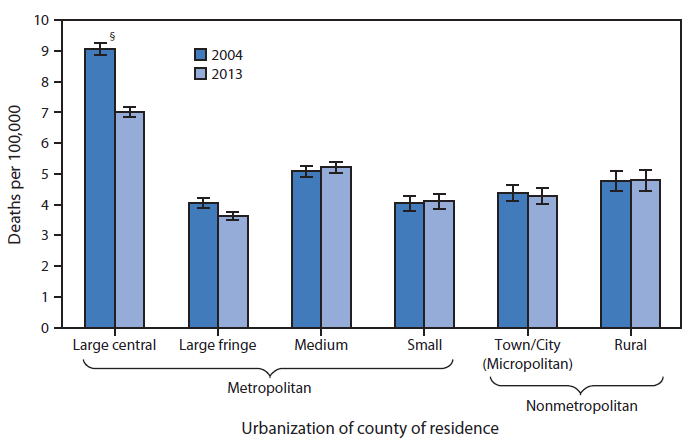
в большом городе за последние 10 лет жить стало безопаснее, чем в деревне, но в США

Age-Adjusted Homicide Rates,* by Urbanization of County of Residence — United States, 2004 and 2013
* Age-adjusted rates per 100,000, based on the 2000 U.S. standard population. Deaths from homicide are coded *U01–*U02, X85–Y09, and Y87.1 in the International Classification of Diseases, 10th Revision.
Counties were classified into urbanization levels based on a classification scheme that considers metropolitan/nonmetropolitan status, population, and other factors.
§ 95% confidence interval.
From 2004 to 2013 in the United States, the age-adjusted homicide rate in large central metropolitan counties decreased 23% (from 9.1 to 7.0 deaths per 100,000 population), and the rate in large fringe metropolitan counties (suburbs of large cities) decreased by 10% (from 4.1 to 3.6). For four other county urbanization types (medium and small metropolitan and town/city [micropolitan] and rural nonmetropolitan), rates in 2004 and 2013 were similar. For both years, the homicide rates in large central metropolitan counties were higher than the rates for all other county types, and the rates for medium metropolitan counties were higher than the rates for large fringe and small metropolitan counties, and town/city (micropolitan) nonmetropolitan counties. Overall, in the United States, the 2004 age-adjusted homicide rate was 5.9 deaths per 100,000 population, and the 2013 rate was 5.2.
Source: National Vital Statistics System. Available at http://wonder.cdc.gov.


Ист = Weekly 
February 13, 2015 / 64(05);133