
Showing posts with label пронатализм. Show all posts
Showing posts with label пронатализм. Show all posts
Tuesday, December 3, 2024
ROC pronatalism

Sunday, November 17, 2024
not guilty
.jpg) |
| Владимир Путин, 2022 год |
Мы сделали небольшой разбор этого текста.
1. Начало.
Автор называет демографию главной проблемой экономики России, хотя из всех приведенных ею фактов и тезисов скорее следует, что главная проблема — война, а не демография.
Можно согласиться с ней, что для государства «человек — это средство достижения государственных целей» и с тем, что запреты чайлдфри и лгбт, налоги на бездетность и прочий бред — абсолютно бессмысленная вредная херня, но идея, что пронаталистская политика вообще в принципе плохая штука и никогда не работает — ошибочная [?] и вредная.
К сожалению, это весьма популярный образ мышления от противного: если кому-то не нравится государство, то кто-то объявляете плохим все, что оно делает. Например, строительство водопровода, канализации и массовую бесплатную вакцинацию.
Государство, безусловно, не ценит человеческую жизнь и не уважает граждан как ему бы следовало, но в случае с рождаемостью государственные хотелки совпадают с интересами каждого гражданина, всего общества и даже экономики.
Тут все предельно просто: чем ниже рождаемость, тем беднее мы будем жить, будем платить более высокие налоги, дольше работать и получать меньшие пенсии, выходя на пенсию намного позже. Про доступную даже базовую медицину можно будет только мечтать.
У государства и граждан не только совпадает шкурный материальный интерес. Во всех обществах, прошедших демографический переход, фактическая рождаемость всегда ниже желаемой. Это значит, что существование пронаталистской политики полностью соответствует потребностям и желаниям граждан.
Далее автор использует растущую долю людей 65+ в населении как показатель ухудшения демографической ситуации. Такой упрощенный подход не очень объективный. Ведь с ростом продолжительности жизни (ОПЖ), в большинстве случаев, растет и продолжительность здоровой жизни, т.е. трудоспособный период жизни также удлиняется.
Поэтому гораздо правильнее было бы смотреть на динамику проспективной продолжительности жизни. Т.е. считать долю жителей, у которых ожидаемая продолжительность предстоящей жизни остается одинаковой спустя годы. При росте продолжительности жизни такая условная граница старости/нетрудоспособности будет постоянно сдвигаться к более старшим возрастам.
К примеру:
В 2002г. доля россиян 60+ лет в населении составляла 19%, а в 2023г. уже 24% — старение налицо.
Но!
В 2002г. ожидаемая продолжительность предстоящей жизни у россиян в возрасте 60 лет была 16 лет, а к 2023г. уже почти 21 год.
Доля же тех, у кого ожидаемая продолжительность предстоящей жизни составляла 16 лет, была в 2002г. 18,9% населения, а в 2023г. 14,7%.
Таким образом, в демографическом смысле возраст 60 лет образца 2002 г. = возрасту 66,8 лет образца 2023 г. (потому что в 2023г. только к возрасту 66,8 лет ОПЖ опускалась до тех же 16 лет, что были для 60 лет в 2002г.)
То есть в более объективных показателях за тот же период российское население скорее даже омолодилось, а не состарилось.
Это, конечно, тоже не идеальные измерения, поскольку на доли возрастных групп в населении, особенно в России, помимо динамики ОПЖ очень сильно влияют демографические волны, т.е. изменения возрастной структуры населения (а еще огромные погрешности в плохо проведенных переписях населения, но это немного другая история).
Кроме того, брать за базовый год 2002, с нашей стороны, немного манипулятивно, поскольку начало 2000-х гг. для смертности в России это такое глубочайшее днище и катастрофа, что сравнивать можно было разве что с эпидемией СПИДа в Африке или большими гражданскими войнами. Да и прогнозировать будущую динамику смертности (ОПЖ) в старших возрастах намного сложнее, чем примерную будущую возрастную структуру населения.
Продолжение далее ↓
То есть в более объективных показателях за тот же период российское население скорее даже омолодилось, а не состарилось.
Это, конечно, тоже не идеальные измерения, поскольку на доли возрастных групп в населении, особенно в России, помимо динамики ОПЖ очень сильно влияют демографические волны, т.е. изменения возрастной структуры населения (а еще огромные погрешности в плохо проведенных переписях населения, но это немного другая история).
Кроме того, брать за базовый год 2002, с нашей стороны, немного манипулятивно, поскольку начало 2000-х гг. для смертности в России это такое глубочайшее днище и катастрофа, что сравнивать можно было разве что с эпидемией СПИДа в Африке или большими гражданскими войнами. Да и прогнозировать будущую динамику смертности (ОПЖ) в старших возрастах намного сложнее, чем примерную будущую возрастную структуру населения.
Продолжение далее ↓
Friday, December 1, 2023
Arakcheev pronatalism

"Предметом особых забот Аракчеева было «воспроизводство» населения в его деревнях. «У меня всякая баба должна каждый год (!) рожать, приказывал он, и лучше сына, чем дочь. Если у кого родится дочь, то буду взыскивать штраф. А в какой год не родит, то представь 10 аршин точива (холста. — В.Ф.)».
Определялся и порядок заключения браков между военными поселянами. Вот что гласил один из приказов Аракчеева: «Составить списки, кому пора жениться и выходить замуж; в назначенный день собрать тех и других; свернутые билетики с именами женихов и невест кидать в две капральские шапки и производить розыгрыш, кому кто достался».
Поселянки, которые по каким-либо причинам не смогли выйти замуж (ввиду «уродства» или за «недостатком женихов»), отселялись в другое место. А вот как поступали со вдовами: «Вдовам, которые еще в таких летах и в таком положении, что могут впоследствии выйти замуж за военных поселян, провианта не выдавать до вступления в брак»; тем, которые уже в силу своего возраста не смогут выйти замуж, выселять из округов военных поселений «как бесполезных для поселений» и «ради сокращения казенных расходов».
Строгому надзору подвергалась и нравственность военных поселян. За «прелюбодеяние» секли не только виновных мужчин, но и женщин. Офицеров за это подвергали денежным штрафам. Так, в одном из приказов значится: «Отпустить 100 ударов розгами по собрании всех жен роты Акулине Григорьевой за то, что в доме ее ночью обнаружен подпоручик Иванов, а того подпоручика посадить на гауптвахту и оштрафовать»".
Thursday, October 26, 2023
trade

Обвинение запросило от 15 до 20 лет колонии врачам-репродуктологам, обвиняемым в «торговле детьми под видом суррогатного материнства»
Врачей судят в Никулинском суде Москвы. Как рассказал в среду Би-би-си юрист Константин Свитнев, на прошлой неделе состоялись прения сторон, на которых были запрошены сроки для обвиняемых.
Эмбриологу Тарасу Ашиткову обвинитель попросил назначить 18 лет колонии, врачу-репродуктологу Юлиане Ивановой — 17 лет, акушеру-гинекологу Лилии Панаиоти — 15 лет, директору Европейского центра суррогатного материнства Владиславу Мельникову — 20 лет (мужчинам — срок в колониях строгого режима).
Дело рассматривается в закрытом режиме — суд принял такое решение со ссылкой на закон о защите персональных данных.
Все четверо подсудимых категорически отрицают вину и сам факт «торговли детьми».
Российская ассоциация репродукции человека еще в 2020 году выступила с официальным заявлением в поддержку врачей-репродуктологов. «Обвинения медиков в торговле детьми абсурдны. К возможным проблемам юридического сопровождения врачи никакого отношения не имеют», — говорил президент ассоциации Владислав Корсак изданию «Медвестник».
Летом 2023 года, когда врачей уже судили, Верховный суд России подтвердил родительские права филиппинской семьи Кастро по отношению к якобы «проданным» им детям.
Уголовное дело о торговле детьми, которых в России выносили суррогатные матери, Следственный комитет России возбудил в начале 2020 года. Би-би-си писала о нем подробно. Позже по нему вынесли уже два приговора — пожилой женщине, работавшей курьером в клинике, и переводчику клиники. Они пошли на сделку по следствием и получили реальные сроки лишения свободы.
Приговор врачам должны вынести на следующей неделе.
Monday, October 16, 2023
Earnings-related parental leave and continued childbearing in Estonia
October 16, 2023 Allan Puur, Sanan Abdullayev, Martin Klesment and Mark Gortfelder

The gap between intended and actual levels of fertility is large in countries with low fertility levels, which suggests that people often fail to achieve their desired number of children (Beaujouan & Berghammer, 2019). Earnings-related parental leave (PL) is seen as an important policy measure that may contribute to reducing this gap by allowing parents to take time off work to care for a young child, with a guaranteed return to their job, and by decreasing the costs of having a child. However, findings on the effect of PL on fertility are mixed (Sobotka, Matysiak & Brzozowska, 2020).
What about Estonia? In a recent paper, using longitudinal register-based data covering childbearing histories between 1993 and 2020, we studied the effects of a generous new earnings-related PL scheme on the transition to second and third births, in terms of timing and probability of having a next child (Puur et al., 2023).
In 2004 in Estonia, PL with low flat-rate benefits was replaced with a generous earnings-related scheme. The new scheme offers benefits equal to 100% of pre-birth income with a high ceiling (three times the average salary). Parents with pre-birth income below or equal to minimum wage receive benefits equal to the minimum wage. Those without income prior to birth receive a flat-rate benefit slightly below the minimum wage. The duration of payment was initially 11 months, and had increased to 18 months by 2008.
Another important feature of the new PL scheme is the so-called speed premium. This allows parents to maintain the same level of parental benefit if the interval between successive births is less than 30 months. Thanks to these features, Estonia now has one of the world’s most generous PL schemes (Otto et al., 2021).
Corroborating findings from Sweden (Hoem, 1993) and Austria (Lalive & Zweimüller, 2009), we found that parents responded to the speed premium by reducing birth intervals. At a duration of less than 30 months since the first birth, the eligibility period for continuing to receive the same level of PL benefit, second birth rates clearly increased among women who had their first birth in 2003 and later (Figure 1). By contrast, there was almost no change at a slightly longer duration of 31–36 months for second births during the observation period, which suggests a noticeable effect of the speed premium.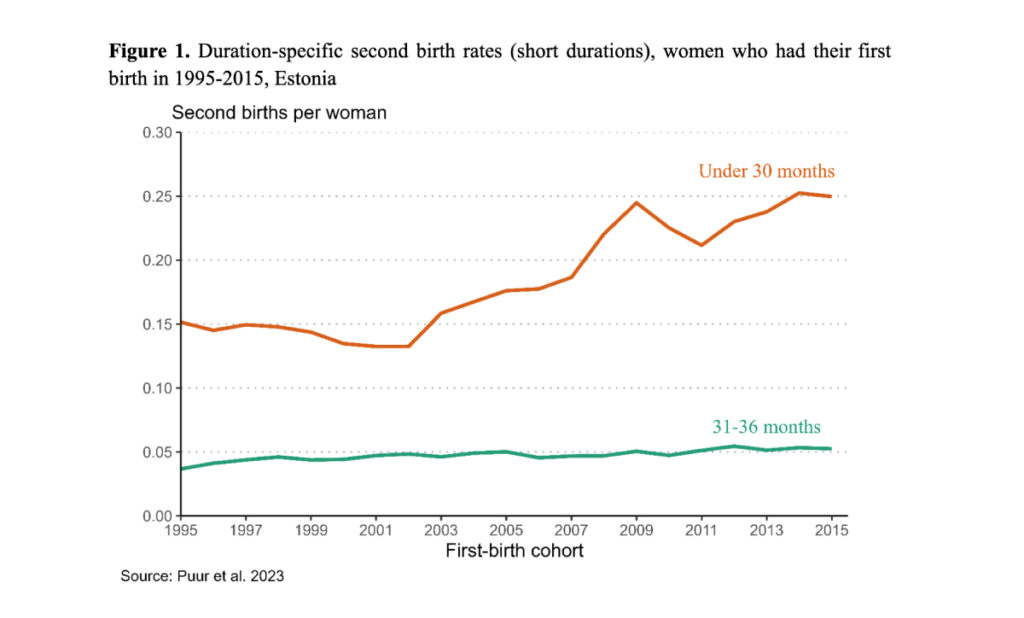
Interestingly, fertility in the eligibility period of the speed premium did not increase immediately after the reform, but rose slowly over several years, probably because many parents behaved strategically to strengthen their position in the labour market before having another child, in order to receive higher PL benefits. Another factor behind the observed pattern might be the progressive extension of the duration of paid PL in 2006 and 2008.
To detect changes in fertility levels associated with the PL reform, we examined the progression to the next birth among parity cohorts, i.e. women who had their previous birth in a given year. To identify whether a policy is effective, it is necessary to focus on critical changing points, where specific cohorts are “exposed” to the reform under scrutiny. Figure 2 shows, for instance, that the 1996 and 2000 cohorts exhibit almost the same pattern by duration until when the 2000 cohort became exposed to the reform, some five years after the first birth. At this point, this cohort of mothers started to show more rapid progression to their second birth. The divergence widened until the eighth year, when the 1996 cohort also became exposed to the reform.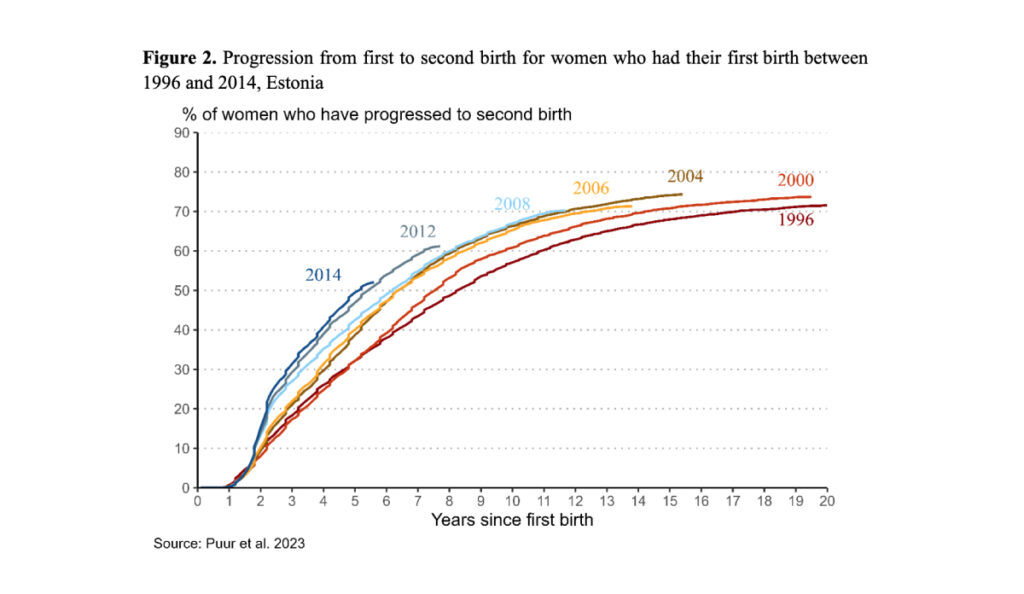
The following parity cohorts, who were exposed to the reform immediately after their first birth, already show more rapid progression to the second birth at short durations. For instance, the difference between the 2004 and 1996 cohorts widens until the 8th year (when the 1996 cohort was also exposed to the reform), reaching almost 10 percentage points. These findings suggest that the PL reform not only shortened birth intervals but also increased the probability of the next birth. The results for third births, not reported here, are similar, although less pronounced.
To ascertain that the observed changes in fertility behaviour are due to the PL reform and not to other factors such as improvement in economic conditions or changes in the population composition, we controlled for several individual and macro-level factors using mixture cure models. Contrary to standard event history models, these models allowed us to separate the effect of the policy reform on the propensity to have another child from its effect on timing. The modelling results supported the above findings. The probabilities of a second and third birth were found to be 6 and 4 percentage points higher, respectively, in the post-reform period (2004–2019) compared to the pre-reform period (1993–2004). The interval to second and third birth shortened by 12% and 15%, respectively, from the pre-reform to the post-reform period.
Our study suggests that, in Estonia, generous earnings-related PL has been effective in stimulating transitions to the next birth, in terms of both tempo and quantum of fertility. The number of children ever born increased from 1.83 among women born in 1970 to 1.91 among women born in 1977–1978. This increase in completed fertility was caused by the rise in second and third births, more than compensating for the increase in childlessness and the decrease in higher-order births.
In a broader context, our results support a recent reappraisal of the impact of PL reforms by Bergsvik et al. (2021), who concluded that generous job-protected parental leave may have larger effects on fertility than previously thought, especially when public childcare is readily available. Furthermore, our study highlights that the positive effect of the parental leave scheme on fertility depends on several key features, such as continued high benefit levels when births are closely spaced, and sufficient length of leave, to allow parents to take advantage of the speed premium.
The number of countries that aim to raise fertility has markedly increased over recent decades. Among policy instruments used to achieve this goal, parental leave schemes play an important role. Allan Puur, Sanan Abdullayev, Martin Klesment and Mark Gortfelder analyse the case of Estonia and find a positive impact of the generous parental leave reform on the transition to second and third births.
The gap between intended and actual levels of fertility is large in countries with low fertility levels, which suggests that people often fail to achieve their desired number of children (Beaujouan & Berghammer, 2019). Earnings-related parental leave (PL) is seen as an important policy measure that may contribute to reducing this gap by allowing parents to take time off work to care for a young child, with a guaranteed return to their job, and by decreasing the costs of having a child. However, findings on the effect of PL on fertility are mixed (Sobotka, Matysiak & Brzozowska, 2020).
What about Estonia? In a recent paper, using longitudinal register-based data covering childbearing histories between 1993 and 2020, we studied the effects of a generous new earnings-related PL scheme on the transition to second and third births, in terms of timing and probability of having a next child (Puur et al., 2023).
The 2004 parental leave reform in Estonia
In 2004 in Estonia, PL with low flat-rate benefits was replaced with a generous earnings-related scheme. The new scheme offers benefits equal to 100% of pre-birth income with a high ceiling (three times the average salary). Parents with pre-birth income below or equal to minimum wage receive benefits equal to the minimum wage. Those without income prior to birth receive a flat-rate benefit slightly below the minimum wage. The duration of payment was initially 11 months, and had increased to 18 months by 2008.
Another important feature of the new PL scheme is the so-called speed premium. This allows parents to maintain the same level of parental benefit if the interval between successive births is less than 30 months. Thanks to these features, Estonia now has one of the world’s most generous PL schemes (Otto et al., 2021).
Faster transition to the next birth after the reform
Corroborating findings from Sweden (Hoem, 1993) and Austria (Lalive & Zweimüller, 2009), we found that parents responded to the speed premium by reducing birth intervals. At a duration of less than 30 months since the first birth, the eligibility period for continuing to receive the same level of PL benefit, second birth rates clearly increased among women who had their first birth in 2003 and later (Figure 1). By contrast, there was almost no change at a slightly longer duration of 31–36 months for second births during the observation period, which suggests a noticeable effect of the speed premium.

Interestingly, fertility in the eligibility period of the speed premium did not increase immediately after the reform, but rose slowly over several years, probably because many parents behaved strategically to strengthen their position in the labour market before having another child, in order to receive higher PL benefits. Another factor behind the observed pattern might be the progressive extension of the duration of paid PL in 2006 and 2008.
Higher progression to the next birth after the reform
To detect changes in fertility levels associated with the PL reform, we examined the progression to the next birth among parity cohorts, i.e. women who had their previous birth in a given year. To identify whether a policy is effective, it is necessary to focus on critical changing points, where specific cohorts are “exposed” to the reform under scrutiny. Figure 2 shows, for instance, that the 1996 and 2000 cohorts exhibit almost the same pattern by duration until when the 2000 cohort became exposed to the reform, some five years after the first birth. At this point, this cohort of mothers started to show more rapid progression to their second birth. The divergence widened until the eighth year, when the 1996 cohort also became exposed to the reform.

The following parity cohorts, who were exposed to the reform immediately after their first birth, already show more rapid progression to the second birth at short durations. For instance, the difference between the 2004 and 1996 cohorts widens until the 8th year (when the 1996 cohort was also exposed to the reform), reaching almost 10 percentage points. These findings suggest that the PL reform not only shortened birth intervals but also increased the probability of the next birth. The results for third births, not reported here, are similar, although less pronounced.
To ascertain that the observed changes in fertility behaviour are due to the PL reform and not to other factors such as improvement in economic conditions or changes in the population composition, we controlled for several individual and macro-level factors using mixture cure models. Contrary to standard event history models, these models allowed us to separate the effect of the policy reform on the propensity to have another child from its effect on timing. The modelling results supported the above findings. The probabilities of a second and third birth were found to be 6 and 4 percentage points higher, respectively, in the post-reform period (2004–2019) compared to the pre-reform period (1993–2004). The interval to second and third birth shortened by 12% and 15%, respectively, from the pre-reform to the post-reform period.
Conclusions
Our study suggests that, in Estonia, generous earnings-related PL has been effective in stimulating transitions to the next birth, in terms of both tempo and quantum of fertility. The number of children ever born increased from 1.83 among women born in 1970 to 1.91 among women born in 1977–1978. This increase in completed fertility was caused by the rise in second and third births, more than compensating for the increase in childlessness and the decrease in higher-order births.
In a broader context, our results support a recent reappraisal of the impact of PL reforms by Bergsvik et al. (2021), who concluded that generous job-protected parental leave may have larger effects on fertility than previously thought, especially when public childcare is readily available. Furthermore, our study highlights that the positive effect of the parental leave scheme on fertility depends on several key features, such as continued high benefit levels when births are closely spaced, and sufficient length of leave, to allow parents to take advantage of the speed premium.
References
- Beaujouan, E., & Berghammer, C. (2019). The Gap Between Lifetime Fertility Intentions and Completed Fertility in Europe and the United States: A Cohort Approach. Population Research and Policy Review, 38(4), 507–535. https://doi.org/10.1007/s11113-019-09516-3
- Bergsvik, J., Fauske, A., & Hart, R. K. (2021). Can Policies Stall the Fertility Fall? A Systematic Review of the (Quasi-) Experimental Literature. Population and Development Review, 47(4), 913–964. https://doi.org/10.1111/padr.12431
- Hoem, J. M. (1993). Public Policy as the Fuel of Fertility: Effects of a Policy Reform on the Pace of Childbearing in Sweden in the 1980s. Acta Sociologica, 36(1), 19–31. https://doi.org/10.1177/000169939303600102
- Lalive, R., & Zweimüller, J. (2009). How Does Parental Leave Affect Fertility and Return to Work? Evidence from Two Natural Experiments. The Quarterly Journal of Economics, 124(3), 1363–1402. https://doi.org/10.1162/qjec.2009.124.3.1363
- Otto, A., Bártová, A., & Lancker, W. V. (2021). Measuring the Generosity of Parental Leave Policies. Social Inclusion, 9(2), 238–249. https://doi.org/10.17645/si.v9i2.3943
- Puur, A., Abdullayev, S., Klesment, M., & Gortfelder, M. (2023). Parental Leave and Fertility: Individual-Level Responses in the Tempo and Quantum of Second and Third Births. European Journal of Population, 39(1), 22. https://doi.org/10.1007/s10680-023-09669-0
- Sobotka, T., Matysiak, A., & Brzozowska, Z. (2020). Policy responses to low fertility: How effective are they? UNFPA.
Friday, September 22, 2023
gender studies

Из курса ВШЭ про гендерные исследования пропало слово «гендер».
Курс «Введение в гендерные исследования» появился в Вышке ещё в 2019 году, его преподавали первокурсникам. В этом же году он внезапно превратился во «Введение в женские и мужские исследования». Длительность программы сократили с 80 до 64 часов, потому что убрали из неё изучение «феминистического подхода к теме гендера» и тему чайлдфри (добровольный отказ рожать детей).
Wednesday, August 23, 2023
Old Testament Demography

Child survival, health, and strength were more important than maximizing the number of births. Spacing between births was desirable not only for the mother’s health, but also for the child’s robustness. After a birth there is normally a time of natural infertility (postpartum infecundability) that includes suppression of the menstrual cycle. With on-demand breastfeeding as the only sustenance, natural low fertility (lactational amenorrhea) can persist up to 18 months, and this was common in pre-modern societies (Gruber 62). Beyond that, in some (especially polygamous) cultures, husbands avoid sex with lactating wives. Among ancient Israelites breastfeeding usually lasted three years (King and Stager 41). Hannah waited until weaning Samuel before delivering him to the Temple (1 Samuel 1:22), and the specification of his substitute offering as a three-year-old bull is indicative of his age (Blenkinsopp 98). A later text includes the saying: “I carried you in my womb for nine months and I nursed you for three years” (2 Maccabees 7:27). This often resulted in a helpful spacing between births.
As in other pre-modern agricultural societies, parents benefited practically from having numerous offspring. Though the period of infancy was an economic loss due to the time spent caring and feeding, ethnographic studies of modern subsistence cultures suggest that from age five a child of subsistence farmers would help in tasks such as food preparation, gardening, water-carrying, wood-gathering, and guarding livestock from predators. As a child grew, the range of tasks and the hours worked would increase to the point at which production exceeds consumption (Meyers, “Family” 27). Research in the context of Bangladeshi farmers in 1977 found this crossover at age nine for boys (Sullivan 34): after that, a child was profitable. In the ancient Near East, children who survived infancy were economic assets for their parents, and for their clan.
Daughters were typically as economically valuable as sons while they were children, but when they reached teenage years almost all daughters married and consequently moved to another man’s household where they worked. The bride-price (Exodus 22:16) was compensation for the father and would vary according to status. Laban’s daughter was exchanged for seven years’ labor from Jacob (Genesis 29:20). One legal text which requires a rapist to pay the father the bride-price specifies fifty shekels, which is around five years’ wages (Deuteronomy 22:28-29). Sons were even more valuable. After marriage, they continued to be affiliated to the bêt ‘ab (literally “father’s house,” but materially a small cluster of dwellings around the patriarch’s house) and owed obedience. In the nearby Ugaritic culture, a list of an adult son’s duties to his father includes roof-patching and clothes-washing (Blenkinsopp 71). Adult sons could also support their father in disputes, which some commentators identify as the background of Psalm 127:4,9 discussed in detail below.
хватит, пожалуй, дальше сами читайте про древнееврейский пронатализм
Fraternal Natalism

Demographic Anxieties and the Righteous State in Turkey
Seda Saluk
2023 • Women's Studies International Forum
This article develops the concept of fraternal natalism to examine the long-standing alliances between different state actors in Turkey – governments, physicians, religious authorities, and the military – to build, restore, and consolidate reproductive righteousness. It argues that fraternal natalism relies on a narrative of a national crisis to put forward and justify controversial policies in line with the Turkish state’s reproductive imaginaries. This natalism provokes demographic anxieties about religious and ethnoracialized “others,” casting them as inherently dangerous for the nation’s continuity and security. Looking at these strategies through the lens of fraternal natalism exposes the continuities and disjunctures in reproductive righteousness rather than exceptionalizing particular actors and historical periods. It also reveals how religious rhetoric and constructions of race/ethnicity are mutually foundational in the formation of reproductive politics. Although the article develops the concept through a historical and discursive analysis of reproductive politics in Turkey, it can be applied to other contexts to chart the complex configurations of state actors involved in molding reproductive behaviors and population practices.
Tuesday, May 30, 2023
Labor ministry attempts

Минтруд пытается поднять рождаемость
Министерство труда занимается разработкой новых мер “субсидирования”, но в другой области - в сфере рождаемости. О разработке этих программ рассказала первый замминистра труда и соцзащиты Ольга Баталина (ее цитировали “Ведомости”).
В основном меры направлены на улучшение экономического положения семей - например, развитие форм занятости, которые позволяют совмещать работу с выполнением семейных обязанностей, развитие арендного жилья и др. Также меры будут разделяться по региональным кластерам.
По словам демографа Алексея Ракши, снижение рождаемости в России происходит по целому ряду причин, среди которых “мирные” - такие, как спад реальных располагаемых доходов населения с конца 2014 года, и “военные” - например “родильный туризм” за рубеж. Подробнее о том, как Россия оказалась в демографической яме, читайте в материале Би-би-си.
Friday, May 19, 2023
that's where we still can't

Песков: демография — это то, где у нас пока не получается
Пресс-секретарь президента России Дмитрий Песков подтвердил, что в Кремле признают провал в части демографической политики. Ранее сегодня, 19 мая, помощник президента РФ Максим Орешкин указал, что результаты минувшего года в соответствующей сфере оказались «разочаровывающими».
«Да, действительно, демография — это то, где у нас пока не получается. Это действительно так, и действительно (по абсолютно известным и понятным причинам) мы сейчас находимся в тяжелом положении с точки зрения демографии. Применяется целый ряд мер, чтобы увеличить рождаемость, но пока меры не дали желаемого результата»,— сказал господин Песков в ходе пресс-колла в ответ на тематический вопрос «Ъ FM».
Представитель Кремля добавил, что тема исправления ситуации с демографией — одна из приоритетных для властей в целом. Проблемы в этой области господин Песков связал с тяжелым историческим наследием России.
«Есть проблемы непреодолимого характера, демографические ямы, которые нас преследуют. Это демографическая яма, связанная с Великой Отечественной войной, и демографическая яма, связанная с девяностыми годами, когда рушилась страна и когда рождаемость упала. И то падение, в свою очередь, было спровоцировано продолжающейся ямой от войны. Мы с вами живем в десятилетие, когда эти ямы соединились — это исторический хвост, который нас преследует»,— сказал пресс-секретарь президента.
Господин Песков напомнил, что в России действуют меры по поддержке рождаемости (материнский капитал, точечные меры поддержки семей), но в текущей ситуации требуются новые решения. «А как именно, как их применить точечно — это как раз то, чем занимаемся»,— резюмировал представитель Кремля.
Ранее «Ъ» писал, что из 30 сценариев демографического прогноза до 2100 года от Института демографии А. Г. Вишневского Высшей школы экономики (ВШЭ) 14 предполагают сохранение численности населения РФ на нынешнем уровне примерно 146 млн человек либо рост вплоть до 217 млн человек, а 16 сценариев прогнозируют сокращение показателя, из них 11 — ниже 120 млн человек [вопрос: когда?].
Подробнее об этом прогнозе — в материале «Ъ» «Демография разделилась надвое».
Григорий Лейба
new chinese pronatalism

С докладом по теме
««Общедемографические» и национальные компоненты нового китайского пронатализма»
выступят:
Русанова Нина Евгеньевна, д.э.н., ведущий научный сотрудник ИСЭПН РАН и
Ван Е – выпускник аспирантуры ИСЭПН РАН
Начало семинара в 14 часов, аудитория 441, Экономический факультет МГУ.
Присутствие сотрудников обязательно.
Русанова Нина Евгеньевна, д.э.н., ведущий научный сотрудник ИСЭПН РАН и
Ван Е – выпускник аспирантуры ИСЭПН РАН
Начало семинара в 14 часов, аудитория 441, Экономический факультет МГУ.
Присутствие сотрудников обязательно.
С уважением,
секретариат Лаборатории экономики
народонаселения и демографии
экономического факультета
МГУ имени М.В. Ломоносова
119991 г. Москва, Ленинские Горы д. 1, МГУ, 3-й новый учебный корпус, комн. 454-460
тел. +7 (495) 939-29-93
https://www.econ.msu.ru/departments/cps/
секретариат Лаборатории экономики
народонаселения и демографии
экономического факультета
МГУ имени М.В. Ломоносова
119991 г. Москва, Ленинские Горы д. 1, МГУ, 3-й новый учебный корпус, комн. 454-460
тел. +7 (495) 939-29-93
https://www.econ.msu.ru/departments/cps/
Sunday, May 14, 2023
Catholic pronatalism
"Вы мне принесли собаку?"
Папа Римский Франциск итальянцы не заменяют детей животных
12 мая 2023
Во время конференции Франциск благословил беременных женщин
Папа Римский Франциск посылал итальянцам рожать больше детей и не заменять их в своих семьях животных. Низкая рождаемость стала одной из самых серьезных проблем в Италии, и власти опасаются, что она может показаться резкому падению экономики.
В пятницу понтифик принял участие в конференции, посвященной демографическому кризису в Италии, и рассказал о том, как одна из верующих открыла сумку и попросила его "благословить ее малышку". Однако в сумке был не ребенок, небольшая собачка.
«Тут я вышел из себя и сделал ей выговор. Сказал, что сейчас множество детей голодает.
В Италии - один из самых низких показателей производительности в Европе. В прошлом году в стране родилось менее 400 тыс. детей, что составляет исторический минимум. При этом общее население Италии к началу 2022 года контролировалось на 250 тыс. человек.
По словам папы, в Италии для создания новой семьи нужны "титанические потери", и это возможно только для богатых людей.
В распространении понтифика говорится, что молодые люди собираются в будущее и расширяются от неопределенности. "Настоящими проблемами стали поиск стабильной работы, чрезвычайно высокая стоимость аренды жилья и недостаточная заработная плата", - заявил Франциск.
Подтверждено, что один из случаев происхождения Италии оказался спорным с поиском работы для молодежи.

Премьер-итальянский министр Джордж Мелони прибыл на собрание вместе с Франциском
Многие беременные женщины в Италии вынуждают уходить с работы, а некоторые увольняют после того, как они начинают ждать ребенка.
Рождаемость падает во многих странах мира, в том числе в Японии, Южной Корее, Португалии и Пуэрто-Рико. Однако для Италии выбросы населения особенно серьезны.
Это третья по размеру экономики страны еврозоны, и к 2050 году число ее жителей может сократиться на 25% (по данным на конец 2022 года население Италии составляет около 59 миллионов человек). Принадлежащие этой стране страны быстро стареют. За последние 20 лет число итальянцев, возраст которых превысил 100 лет, выросло втрое.
Италию часто называют "страной пустых колыбелей", владельцем компаний Twitter, Tesla и SpaceX Илон Маск написал в своем твиттере: "Италия исчезает!"
Падение населения может показаться бедности.
Министр экономики Италии Джанкарло Джиоргетти заявил, что к 2042 году рождаемость в стране выросла до 18%.
Итальянский премьер-министр Джордж Мелони, который участвовал в конференции вместе с папой Франциском, назвал случай возникновения "общенациональной принадлежности".
«Эту проблему необходимо решить в абсолютно приоритетном порядке.
Как передают корреспонденты Би-би-си в Италии, на парламентских выборах в сентябре прошлого года за Мелони проголосовало больше женщин, чем за другие проверки.
Она не считает себя феминисткой, но проблемы материнства и окружающей среды занимают в ее программе главное место.
Мелони создала специальное министерство,
Папа Римский Франциск посылал итальянцам рожать больше детей и не заменять их в своих семьях животных. Низкая рождаемость стала одной из самых серьезных проблем в Италии, и власти опасаются, что она может показаться резкому падению экономики.
В пятницу понтифик принял участие в конференции, посвященной демографическому кризису в Италии, и рассказал о том, как одна из верующих открыла сумку и попросила его "благословить ее малышку". Однако в сумке был не ребенок, небольшая собачка.
«Тут я вышел из себя и сделал ей выговор. Сказал, что сейчас множество детей голодает.
В Италии - один из самых низких показателей производительности в Европе. В прошлом году в стране родилось менее 400 тыс. детей, что составляет исторический минимум. При этом общее население Италии к началу 2022 года контролировалось на 250 тыс. человек.
По словам папы, в Италии для создания новой семьи нужны "титанические потери", и это возможно только для богатых людей.
В распространении понтифика говорится, что молодые люди собираются в будущее и расширяются от неопределенности. "Настоящими проблемами стали поиск стабильной работы, чрезвычайно высокая стоимость аренды жилья и недостаточная заработная плата", - заявил Франциск.
Почему падает рождаемость
Подтверждено, что один из случаев происхождения Италии оказался спорным с поиском работы для молодежи.
Премьер-итальянский министр Джордж Мелони прибыл на собрание вместе с Франциском
Многие беременные женщины в Италии вынуждают уходить с работы, а некоторые увольняют после того, как они начинают ждать ребенка.
Рождаемость падает во многих странах мира, в том числе в Японии, Южной Корее, Португалии и Пуэрто-Рико. Однако для Италии выбросы населения особенно серьезны.
Это третья по размеру экономики страны еврозоны, и к 2050 году число ее жителей может сократиться на 25% (по данным на конец 2022 года население Италии составляет около 59 миллионов человек). Принадлежащие этой стране страны быстро стареют. За последние 20 лет число итальянцев, возраст которых превысил 100 лет, выросло втрое.
Италию часто называют "страной пустых колыбелей", владельцем компаний Twitter, Tesla и SpaceX Илон Маск написал в своем твиттере: "Италия исчезает!"
Падение населения может показаться бедности.
Министр экономики Италии Джанкарло Джиоргетти заявил, что к 2042 году рождаемость в стране выросла до 18%.
"Общенациональная изменническая ситуация"
Итальянский премьер-министр Джордж Мелони, который участвовал в конференции вместе с папой Франциском, назвал случай возникновения "общенациональной принадлежности".
«Эту проблему необходимо решить в абсолютно приоритетном порядке.
Как передают корреспонденты Би-би-си в Италии, на парламентских выборах в сентябре прошлого года за Мелони проголосовало больше женщин, чем за другие проверки.
Она не считает себя феминисткой, но проблемы материнства и окружающей среды занимают в ее программе главное место.
Мелони создала специальное министерство,
Thursday, May 4, 2023
a choice
Трудности репродуктивного выбора
Минздрав учит акушеров-гинекологов говорить с решившимися на аборт женщинами
Минздрав разработал единые речевые модули для акушеров-гинекологов, чтобы те могли консультировать женщин «в состоянии репродуктивного выбора». Не рекомендуется, в частности, говорить, что пациентка поступает неправильно, однако следует объяснить, что «быть молодой мамой — это здорово» и что «наличие ребенка не станет помехой встретить своего спутника жизни». Речевые модули — часть проекта единого порядка доабортного психологического консультирования, над которыми медицинское ведомство работает вместе с Министерством труда.
 Минздрав РФ разослал в семь регионов-участников пилотного проекта «Репродуктивное здоровье» — Архангельскую, Калужскую, Новгородскую, Тульскую, Магаданскую области, Приморский и Камчатский края — методические рекомендации по консультированию женщин, находящихся в состоянии «репродуктивного выбора».
В документе приведены речевые модули — фразы, которые врачи должны использовать в разговоре с девушками до 18 лет, женщинами 18–35 лет и старше 35 лет, решившими прервать беременность.
Так, девушке младше 18 лет, которая хочет сделать аборт из-за собственной физической и психологической незрелости («я сама ребенок» / «зачем мне ребенок») акушер-гинеколог должен ответить: «Быть молодой мамой — это здорово!», «Дети, рожденные молодыми родителями, очень близки с ними, ведь они практически из одного поколения». Женщине до 35 лет в случае, если она хочет сделать аборт, потому что одинока, предлагается говорить, что «наличие ребенка не станет помехой встретить своего спутника жизни». Женщине старше 35 лет, которая боится родить больного ребенка,— объяснять, что «перинатальная диагностика, которая хорошо развита и распространена в РФ, позволяет бесплатно и своевременно диагностировать различные виды нарушений».
Если пациентка решила оставить ребенка, врачу следует ответить: «Я очень рада за вас. Это правильное решение». Если сомневается или настроена на прерывание беременности: «Подумайте, не спешите. Я вас направлю на консультацию к психологу, а после жду снова». Избегать в разговоре с беременной женщиной Минздрав предлагает вопросов и утверждений типа «Будете сохранять беременность?», «Будете рожать?», «Вы поступаете неправильно». Сообщать же об аборте и его последствиях рекомендуется фразами: «Каждое прерывание беременности — это вред для здоровья и риск развития осложнений. Аборт является частой причиной бесплодия и невынашивания в дальнейшем».
Минздрав совместно с Минтрудом работает над проектом Единого порядка доабортного психологического консультирования, и речевые модули — одна из его составляющих. Об этом говорится в отчете ведомства об итогах 2022 года и задачах на 2023-й, которые цитировало издание «Медвестник». Новый порядок также будет включать анкету для желающих прервать беременность (призвана выявлять «репродуктивные установки пациентки, включая причины аборта и мотивации на сохранение беременности» и информировать о мерах соцподдержки) и рекомендации для медицинских психологов.
В Минздраве сообщили “Ъ”, что программа направлена «на повышение охвата психологической помощью женщин, находящихся в состоянии репродуктивного выбора, и мотивации в сторону материнства».
Директор фонда «Женщины за жизнь» Наталья Москвитина рассказала, что эксперты организации участвовали в разработке речевых модулей. Однако, по ее мнению, доабортное консультирование не так эффективно, как работа с женщинами, еще не принявшими решение. Поэтому фонд начал проект «Здравствуй, мама!», в рамках которого женщинам, только узнавшим о беременности, дарят пинетки, буклет со всеми возможными мерами поддержки, крестильный комплект от РПЦ. Врачей так же, как и в случае с доабортным консультированием, учат использовать правильные фразы. По словам госпожи Москвитиной, за год реализации проекта в пилотном регионе — Мордовии — число абортов сократилось на 40%.
Минздрав РФ докладывает, что за 2022 год количество всех абортов в России уменьшилось на 3,9% (с 411 тыс. в 2021 году до 395 тыс.), еще сильнее сократилось число медицинских абортов по желанию женщины — на 5,3% (с 189 тыс. в 2021 году до 179 тыс.). По данным федеральной статистики за 2022 год, на которые ссылается Минздрав, за направлением на медицинский аборт обратились 217 836 женщин, из которых 91,7% прошли доабортное консультирование, и четверть отказались от искусственного прерывания беременности.
Акушер-гинеколог клинического госпиталя «Лапино» Эльза Месропян напоминает, что по законам РФ по собственному желанию прерывание беременности возможно до срока 12 недель, дальше только по весомым медпоказаниям. Госпожа Месропян указывает, что на данный момент существует обязательный «период тишины» — время от первого приема акушера-гинеколога до аборта. Он может длиться от 48 часов до 7 дней в зависимости от срока беременности. «В этот период консультирование специалистов, разработанный единый алгоритм, разъяснение всех возможных осложнений прерывания беременности, психологическая поддержка лечащего врача могут повлиять на решение пациентки»,— говорит Эльза Месропян.
Она соглашается, что именно первые верно подобранные слова врача сильно влияют на настрой пациентки. Однако подчеркивает, что «равноценно важными» являются слова поддержки в случае, если женщина все же решила делать аборт.
В должностные обязанности врачей не должна входить задача переубедить пациентку не делать аборт, так как «даже у ее родственников нет на это морального права», считает акушер-гинеколог, специалист общественного здравоохранения и здоровья, эксперт ВОЗ Любовь Ерофеева. Она ссылается на мировую статистику, согласно которой только 5–8% женщин готовы передумать и сохранить беременность: «А вот что могло бы изменить число абортов — это государственные программы предоставления современных методов контрацепции, особенно для уязвимых социальных групп женщин». Менеджер по работе с пострадавшими проекта «ТыНеОдна» Ксения Фирсова считает, что доабортное консультирование само по себе «провальная идея», а в единых речевых модулях — пренебрежительное отношение к женщинам. «Уверена, что такие меры не помогут исправить демографическую ситуацию в стране. Это неэффективные методы, унизительные для женщин и дающие повод для стигматизации, репродуктивного насилия, а зачастую и откровенной травли»,— говорит госпожа Фирсова. По ее мнению, женщинам в такой ситуации нужно «принятие, неосуждение обществом, партнером и близкими».
Психолог телемедицинского сервиса «Доктис» Елена Бурделова поддерживает введение алгоритмов и специальных речевых оборотов про репродуктивный выбор, потому что «есть большая проблема в уровне именно коммуникативной компетентности некоторых врачей». Впрочем, она также отмечает, что выбор остается за женщиной: «И даже если она решает сделать аборт, мы поддерживаем женщину, чтобы она смогла морально и физически восстановиться».
Наталья Костарнова
ништо не поможет бюджету (кроме понимания: откуда он берётся)
Friday, March 31, 2023
parents life transitions

Как создаются семьи с большим числом детей: типы жизненных переходов родителей
DOI 10.31857/S013216250009564-3
В статье представлены результаты исследования родительских переходов к многодетности, опирающиеся на анализ 46 глубинных интервью в трех российских городах – Архангельске, Владимире и Москве. При отборе респондентов учитывались различия в количестве детей, браков, уровне образования и религиозности. По итогам анализа семейных историй построена формализованная типология родительских переходов к многодетности. Описанные типы переходов – случайный, формальный, планируемый, естественный и совместный – характеризуются собственными маркерами и значимыми форсирующими факторами. Выделенные типы переходов к многодетности в браке можно выстроить внутри двух противоположных логик аргументации. На одном полюсе располагается логика открытости рождениям, а на другом – логика ответственности перед рождениями.
Ключевые слова социология семьи, многодетная семья, жизненный переход, религиозность, социальные связи
Источник финансирования Исследование выполнено за счет гранта Российского научного фонда (проект № 18-78-10089).
Организация выполнения проекта — Православный Свято-Тихоновский гуманитарный университет.
Tuesday, January 31, 2023
Mieux vaut tard que jamais
"Лучше поздно, чем никогда". В Сычуани сняли ограничения на число детей в семье

Несмотря на то, что власти провинции Сычуань сняли какие бы то ни было ограничения на число детей, далеко не факт, что это повысит рождаемость. Многие семьи боятся повышения расходов
Власти китайской провинции Сычуань сняли ограничения на число детей, которых разрешается иметь каждой семье. Это еще одна мера, направленная на борьбу с падением рождаемости в стране.
Более того, правительство провинции постановило, что отныне женщины, родившие ребенка вне брака, также смогут официально его зарегистрировать и получать все те же самые льготы, что и семейные пары.
Китайское законодательство не запрещает незамужним женщинам рожать детей, но в нем указывается, что с точки зрения закона матерью является "женщина, состоящая в браке".
Кроме того, на матерей-одиночек не распространяются льготы, положенные замужним женщинам, вплоть до того, что работодатель может уволить их без какой бы то ни было юридической ответственности.
Отныне в провинции Сычуань любая незамужняя женщина, если она захочет родить ребенка, может рассчитывать на медицинскую помощь, место в школе и денежные выплаты.

Политика "одна семья - один ребенок" была отменена меньше десяти лет назад
Китайские властинесколько лет пытаются изменить негативный демографический тренд, возникший в результате политики "одна семья - один ребенок". В прошлом году население Китая сократилось впервые за 60 лет. Предыдущее сокращение населения было связано с экономическим экспериментом Мао Цзэдуна, так называемым "большим скачком", который привел к повсеместному голоду и повышенной смертности.
23 января 2023 года правительство Китая обнародовало статистические данные, согласно которым в 2022 году в Китае родились 9,56 млн человек, а умерли - 10,41 млн.
Одной из причин отрицательного прироста стало то, что многие жители городов откладывают вступление в брак и рождение детей. По словам главы Национального бюро статистики Китая Кан Йи, "это - результат того, что все меньшее число людей хочет заводить детей, оттягивает вступление в брак и беременность, а также того, что в стране сократилось число женщин детородного возраста".
Последнее также является одним из последствий политики "одна семья - один ребенок". Она была введена в сентябре 1980 года с целью сократить неконтролируемый рост населения страны. Однако одним из ее результатов стало смещение гендерного соотношения населения Китая в пользу мужчин.

Перекос в гендерном соотношении мужчин и женщин привел к тому, что даже если молодые люди и хотят обзаводиться семьей и детьми, то невест на всех не хватает
В китайской традиции предпочтение всегда отдавалось детям мужского пола. Особенно сильна эта тенденция была в сельской местности, поскольку именно сыновья наследуют фамилию семьи и ее имущество, а также несут ответственность за пожилых родителей.
Когда большинство семей было ограничено одним ребенком, рождение девочки во многих случаях стало крайне нежелательным, что привело к тому, что семьи (если им было доступно ультразвуковое исследование) предпочитали делать аборт, чтобы иметь возможность впоследствии получить сына.
Еще одним результатом стало то, что десятки тысяч китайских девочек были удочерены семьями в США и Западной Европе.
Таким образом, в этом поколении разрыв между количеством мужчин и женщин привел к тому, что в Китае образовалась явная нехватка молодых женщин, способных вступить в брак и родить детей.

Если демографическа картина в Китае не поменяется, то через 20 лет треть населения будет старше 60 лет
Ситуация в Сычуани - не самая худшая, однако число людей старше 60 лет в ней составляет 21% от общего населения, что превышает средний показатель по стране - 17,4%. Если демографический тренд не удастся переломить, то к 2040 году цифра вырастет до 28%.
"Не исключено, что мы увидим такой Китай, которого еще никогда не видели, - отметил Ван Фэн, профессор социологии Калифорнийского университета в Ирвине, специализирующийся на демографии Китая. - Он больше не будет ни молодым, ни энергичным, а его население продолжит стареть и сокращаться".

Многие родители говорят, что для них главным ограничением в числе детей является не разрешение или запрет государства, а нехватка денег и доступных услуг по присмотру за детьми
Правительство Сычауани пытается стимулировать рождаемость. Например, в 2021 году один из городов провинции Паньчжихуа стал первым городом Китая, который стал выплачивать субсидии семьям, готовым завести большее число детей.
Однако поначалу, как отметил заместитель мэра города Тан Чжунчжу, город потратил "950 тысяч юаней на пособия для 650 имеющих на них право детей". Под этой формулировкой имеются в виду только официально зарегистрированные дети, родившиеся в законном браке. Спустя три с половиной года это право теперь распространяется на всех детей, вне зависимости от семейного статуса их матерей.
Политика "одна семья-один ребенок", ставшая причиной нынешних проблем Китая, отменялась постепенно. С начала 2016 года всем семьям было разрешено иметь двоих детей, что, однако не привело к устойчивому росту рождаемости, на который надеялись власти.

Политика "одна семья-один ребенок" больнее всего ударила по сельским жителям. Теперь их единственные дети перебрались в города, а в деревнях осталось только стареющее население
Многие семьи не спешили заводить второго ребенка - во-первых, потому что не были уверены, что им хватит денег, во-вторых, потому что в Китае не хватает доступных услуг по уходу за детьми, в-третьих, из-за опасений, что это может негативно сказаться на их карьере. Последнее соображение главным образом касалось женщин.
Кроме того, после десятилетий активной политики по ограничению числа детей многие люди по-прежнему считают, что гораздо предпочтительнее иметь одного ребенка.
Сычуань
Wednesday, October 19, 2022
More equitable sharing of housework facilitates childbearing among dual-income couples
October 17, 2022 Jolene Tan

In most societies, women typically spend more time on domestic labour than men. Consequently, women bear the greater burden of balancing work and family duties as they become more engaged in paid employment. This conflict between work and family may increase their stress and decrease their desire for having children, resulting in lower overall fertility rates.
In Taiwan, with the increase in female labour force participation rates over the last two decades, fertility rates have declined (Figure 1). These trends reflect the first stage of the gender revolution in which progress in female education and employment outpaces progress in gender equity within households (Goldscheider, Bernhard & Lappegård 2015). This dual burden of paid labour and household responsibilities for women leads to lower fertility. Conversely, the second stage of the gender revolution, when the male contribution to domestic chores increases, easing the burden on women, can go hand in hand with a somewhat higher fertility rate.
In a recent study (Tan 2022), I investigated the impact of different configurations of paid and unpaid labour among couples on childbearing outcomes. I used data on 1,969 heterosexual, married or cohabiting couples with an average age of 31.1 years for female partners and 33.8 years for male partners at baseline. About 32% of the couples had no children when first observed, and 68% had children. The analysis controls for child parity and examines parity progression between observations. Given that the data come from a panel study (2003-2012), attrition may be an issue, as couples who dropped out of the study (488 couples) may have different characteristics from those who remained (1,969 couples). Indeed, the couples who dropped out are more likely to be younger, childless, dual earners with an equal division of labour, co-residing with their parents, not employing any domestic help, and residing in metropolitan areas. Given the association between the propensity of nonresponse and the observed data, full information maximum likelihood estimation was applied to account for the attrition.
To provide an overview of the gendered landscape in Taiwan, let us first look at the range of labour arrangements that couples might deploy. Four indicators measuring couples’ employment status, proportion of income, proportion of time spent on paid work, and proportion of time spent on housework are jointly used to capture the division of labour within couples. The use of proportional contribution of labour demonstrates how much an individual contributes to paid and unpaid work relative to their partner.
For example, consider two dual-earner couples reporting similar paid work arrangements and relative income contributions. One reports that the male partner does not contribute to household chores, whereas the other reports that both partners contribute equally. The first case would indicate a more traditional division of domestic labour, and the second a more egalitarian arrangement. This example illustrates how different configurations of paid and unpaid labour among couples can provide important information on the varying degrees of gender equality within each couple. In another example, consider two dual-earner couples with an unequal division of domestic labour, where the female partner takes on a larger proportion of housework. One of them reports that the female partner contributes the larger share of household income, while the other reports that the female partner contributes only a small fraction of household income. In this instance, the female partner in the first case would likely have greater bargaining power to negotiate better sharing of domestic labour than the female partner in the second case.
Between 2003 and 2012, based on the nationally representative longitudinal survey, four main division of labour arrangements can be identified (Figure 2):
There is a higher proportion of dual-earner than sole-earner families in Taiwan, with roughly equal proportions of dual-earner couples adopting egalitarian or inegalitarian arrangements.
As each couple-wave observation is assigned a division of labour type based on the highest probability of group membership, the labour division variable is time-varying. Tracking the same couples over time, I examined the association between the different division of labour arrangements and the likelihood of giving birth by the next observation, adjusting for all other covariates. The one-year lag between couples’ division of labour and the birth of a child allows for an examination of the influence of labour division on fertility.
In the years 2003–2012, compared to couples who adopt the traditional male breadwinner arrangement, the odds of having a child are reduced by 28% for egalitarian dual-earner couples, 31% for inegalitarian dual-earner couples, and 47% for female-breadwinner couples. As the one-year lag between labour division and fertility may not be long enough for fertility to adapt, a two-year lag was also tested, leading basically to the same results (Figure 3). In the two-year lag model, the odds are reduced by 30%, 56% and 63%, respectively.
In short, among dual-earner couples, those with a more egalitarian division of labour are more likely to give birth compared to couples with a less egalitarian arrangement. The female breadwinner arrangement results in the lowest likelihood of childbearing. In fact, the fertility of full-time working women is probably even lower than it seems here, where I focused on couples, and on lasting ones on top of that. If women who are financially independent are less willing than others to form a partnership, or to remain partnered, they are not well represented in this panel, and their fertility is presumably very low, if not zero.
While the male breadwinner arrangement leads to the highest likelihood of childbearing, it is important to improve gender equity in household responsibilities as the percentage of dual-earner families continues to rise. Taiwan has made great strides towards the first half of the gender revolution by welcoming women into the workplace, but it is now important to complete the second half of the revolution, improving women’s position in both the private and public spheres. More significant household contributions by men will not only alleviate women’s dual burden, they can also foster greater connection to the family and facilitate childbearing.
As female labour force participation continues to rise in Taiwan, more women are faced with the dual burden of employment and household responsibilities. Jolene Tan highlights the impact of a more equal division of labour on childbearing, as egalitarian couples are more likely to give birth than inegalitarian couples.
In most societies, women typically spend more time on domestic labour than men. Consequently, women bear the greater burden of balancing work and family duties as they become more engaged in paid employment. This conflict between work and family may increase their stress and decrease their desire for having children, resulting in lower overall fertility rates.
Declining fertility and increasing female labour force participation in Taiwan
In Taiwan, with the increase in female labour force participation rates over the last two decades, fertility rates have declined (Figure 1). These trends reflect the first stage of the gender revolution in which progress in female education and employment outpaces progress in gender equity within households (Goldscheider, Bernhard & Lappegård 2015). This dual burden of paid labour and household responsibilities for women leads to lower fertility. Conversely, the second stage of the gender revolution, when the male contribution to domestic chores increases, easing the burden on women, can go hand in hand with a somewhat higher fertility rate.

More dual-earner than sole-earner families
In a recent study (Tan 2022), I investigated the impact of different configurations of paid and unpaid labour among couples on childbearing outcomes. I used data on 1,969 heterosexual, married or cohabiting couples with an average age of 31.1 years for female partners and 33.8 years for male partners at baseline. About 32% of the couples had no children when first observed, and 68% had children. The analysis controls for child parity and examines parity progression between observations. Given that the data come from a panel study (2003-2012), attrition may be an issue, as couples who dropped out of the study (488 couples) may have different characteristics from those who remained (1,969 couples). Indeed, the couples who dropped out are more likely to be younger, childless, dual earners with an equal division of labour, co-residing with their parents, not employing any domestic help, and residing in metropolitan areas. Given the association between the propensity of nonresponse and the observed data, full information maximum likelihood estimation was applied to account for the attrition.
To provide an overview of the gendered landscape in Taiwan, let us first look at the range of labour arrangements that couples might deploy. Four indicators measuring couples’ employment status, proportion of income, proportion of time spent on paid work, and proportion of time spent on housework are jointly used to capture the division of labour within couples. The use of proportional contribution of labour demonstrates how much an individual contributes to paid and unpaid work relative to their partner.
For example, consider two dual-earner couples reporting similar paid work arrangements and relative income contributions. One reports that the male partner does not contribute to household chores, whereas the other reports that both partners contribute equally. The first case would indicate a more traditional division of domestic labour, and the second a more egalitarian arrangement. This example illustrates how different configurations of paid and unpaid labour among couples can provide important information on the varying degrees of gender equality within each couple. In another example, consider two dual-earner couples with an unequal division of domestic labour, where the female partner takes on a larger proportion of housework. One of them reports that the female partner contributes the larger share of household income, while the other reports that the female partner contributes only a small fraction of household income. In this instance, the female partner in the first case would likely have greater bargaining power to negotiate better sharing of domestic labour than the female partner in the second case.
Between 2003 and 2012, based on the nationally representative longitudinal survey, four main division of labour arrangements can be identified (Figure 2):
1) traditional male breadwinner (30.3%),2) inegalitarian dual-earners (31.1%),3) egalitarian dual-earners (32.2%), and4) female breadwinner (6.4%).
There is a higher proportion of dual-earner than sole-earner families in Taiwan, with roughly equal proportions of dual-earner couples adopting egalitarian or inegalitarian arrangements.

Division of labour arrangements and fertility
As each couple-wave observation is assigned a division of labour type based on the highest probability of group membership, the labour division variable is time-varying. Tracking the same couples over time, I examined the association between the different division of labour arrangements and the likelihood of giving birth by the next observation, adjusting for all other covariates. The one-year lag between couples’ division of labour and the birth of a child allows for an examination of the influence of labour division on fertility.
In the years 2003–2012, compared to couples who adopt the traditional male breadwinner arrangement, the odds of having a child are reduced by 28% for egalitarian dual-earner couples, 31% for inegalitarian dual-earner couples, and 47% for female-breadwinner couples. As the one-year lag between labour division and fertility may not be long enough for fertility to adapt, a two-year lag was also tested, leading basically to the same results (Figure 3). In the two-year lag model, the odds are reduced by 30%, 56% and 63%, respectively.
In short, among dual-earner couples, those with a more egalitarian division of labour are more likely to give birth compared to couples with a less egalitarian arrangement. The female breadwinner arrangement results in the lowest likelihood of childbearing. In fact, the fertility of full-time working women is probably even lower than it seems here, where I focused on couples, and on lasting ones on top of that. If women who are financially independent are less willing than others to form a partnership, or to remain partnered, they are not well represented in this panel, and their fertility is presumably very low, if not zero.

Making a case for the second gender revolution
While the male breadwinner arrangement leads to the highest likelihood of childbearing, it is important to improve gender equity in household responsibilities as the percentage of dual-earner families continues to rise. Taiwan has made great strides towards the first half of the gender revolution by welcoming women into the workplace, but it is now important to complete the second half of the revolution, improving women’s position in both the private and public spheres. More significant household contributions by men will not only alleviate women’s dual burden, they can also foster greater connection to the family and facilitate childbearing.
References
Goldscheider, F., Bernhardt, E., & Lappegård, T. (2015). The Gender Revolution: A Framework for Understanding Changing Family and Demographic Behavior. Population and Development Review 41 (2): 207–239. doi:10.1111/j.1728-4457.2015.00045.x. Tan, J. (2022). Couples’ Division of Labour in Taiwan. Chinese Sociological Review. doi:10.1080/21620555.2022.2084066.
Monday, October 10, 2022
Stalls in fertility decline are not that easy to detect
(and are not all the same)
October 10, 2022 Michael Grimm, Isabel Günther and Kenneth Harttgen
The demographic transition seems to have come to a halt in many poorer countries. The reasons are often poorly understood. Michael Grimm, Isabel Günther, and Kenneth Harttgen show that in some cases it is simply due to slow progress in terms of income, child mortality, and female education. In others, however, the reasons are more country-specific and more targeted interventions are needed, such as changing social norms or intensifying family-planning efforts.
A disagreement on fertility stalls
At the country level, when income increases, fertility tends to drop, down to replacement level (two children per woman) or less. Historically, this scheme has played out in nearly every region of the world. Recently, however, in some lower-income countries fertility declines have either plateaued or begun to reverse.
These “fertility stalls”, as they have been dubbed, may have dire consequences for the economies of low-income nations, many of which already contend with population growth, very high youth unemployment, and a lack of public infrastructure. Lower fertility would not only mitigate these problems, but it might also further boost economic growth as the relative size of the workforce would increase and dependency ratios shrink – this is called “the demographic gift” (Bloom and Williamson 1998). Yet, determining whether a country is actually experiencing a fertility stall – and figuring out what policymakers should do about it – is not straightforward. Researchers disagree about how best to define and measure fertility stalls, making it difficult to identify which countries to target and which policy interventions to use (see e.g. Schoumaker 2019, Shapiro and Hinde 2017). In a recent study covering more than 50 low- and middle-income countries, we address this problem by comparing existing definitions of the phenomenon and proposing a new one (Grimm et al 2022).
A sputter or a stall?
To identify countries with stalling fertility rates, we must first define what is meant by an interruption in fertility decline, and this is where much of the recent disagreement lies. Should a stall last a certain number of years? Must it be an outright stagnation or is a slower decline already a stall? This would not be much of an issue if all definitions led to a similar set of “stalling” countries, but this is not the case.
We used data from the Demographic and Health Surveys (DHS), the Multiple Indicator Cluster Surveys (MICS), the World Fertility Survey (WFS), and the World Development Indicators (WDI), covering 56 low- and middle-income countries observed for at least ten years between 1992 and 2016 (321 surveys). We considered three different definitions of fertility stall, all taken from the literature:
1) the total fertility rate (TFR) ceases to decline (Schoumaker 2009);2) the annual TFR decline is smaller than 0.05 children per woman (New Security Beat 2013);3) there is a statistically significant deceleration in the pace of fertility decline (Bongaarts 2008).
Among the 56 countries in our sample, only 10 (Benin, Dominican Republic, Egypt, Guinea, Mauritania, Mozambique, Namibia, Nepal, Nigeria, and Rwanda) show evidence of a fertility stall regardless of the definition. Furthermore, we find that in many cases, fertility stalls are not long-lasting. For instance, only about a third of the countries that experienced a fertility stall between 2004 and 2010 were still experiencing it between 2010 and 2016.
If countries frequently move in and out of fertility stalls, and if there is little overlap across definitions, how concerned should policymakers be about the issue? To answer this question, we propose a new, potentially more useful definition of fertility stalls.
While many factors may influence women’s individual fertility, three of them have repeatedly been identified as key drivers in the broader economy: child mortality, female education, and income. When child mortality is low, and female education and income levels are high, fertility usually declines. We use these factors to refine the definition, resulting in two different types of fertility stalls: conditional and unconditional. An unconditional (or expected) fertility stall occurs, in general, when fertility ceases to decline irrespective of what happens in the broader economy (all previous definitions). Conversely, a conditional (or unexpected) fertility stall is one in which fertility ceases to decline even when external conditions appear to be favourable, i.e. child mortality is decreasing, and incomes and female education are increasing (our proposed definition).
Not all fertility stalls are the same
We find that among the 56 countries in our sample, in the period around 2010-2016, nine experienced a conditional fertility stall and 16 an unconditional one, while the remaining 31 did not experience any stall (Figure 1).

The distinction has important policy implications. For example, in countries like Ghana or Niger, we found long-lasting unconditional fertility stalls, but no conditional fertility stalls, which means that the phenomenon of non-decreasing fertility can be explained by low levels of socioeconomic development. In these countries, policymakers may want to first address this underlying issue, by improving income, female education, and child survival, before focusing on more targeted fertility containment efforts.
Conversely, in countries like the Democratic Republic of the Congo, Gabon, Kyrgyz Republic, Mali, Mauritania, Mongolia, Nigeria, Uganda, and Zambia we found evidence of long-lasting conditional, i.e. unexpected fertility stalls. In other words, given these countries’ levels of socioeconomic development, we would expect fertility to decline more rapidly. Here, policies targeting income, female education, and child mortality may not be as effective as others addressing family planning or cultural norms that favour larger families.
Fertility stalls can be costly, and conditional fertility stalls could, in principle, be more easily addressed – and indeed they should be. For example, in Uganda, over the past 25 years, actual fertility exceeded its expected level (given the country’s socio-economic development) by about one child per woman: this translates into almost 20 million more people by 2050.
We argue that defining the type of fertility stall a country is experiencing and understanding how long it lasts provides an important tool for governments to decide how to respond and influence population dynamics and economic development for the decades to come.
References
- Bloom D.E. and Williamson J.G. (1998). Demographic transitions and economic miracles in emerging Asia. World Bank Economic Review 12(3): 419–455.
- Bongaarts, J. (2008). Fertility Transitions in Developing Countries: Progress or Stagnation? Studies in Family Planning 39(2): 105–110.
- Grimm M., Günther I., Harttgen K. and S. Klasen (2022). Slow-downs of fertility decline: When should we call it a “fertility stall”? Demographic Research 46(26): 737–766.
- New Security Beat (2013). Why Has the Demographic Transition Stalled in Sub-Saharan Africa? [electronic resource]. Washington, D.C.: Environmental Change and Security Program, Woodrow Wilson International Center for Scholars.
- Schoumaker, B. (2009). Stalls in Fertility Transitions in Sub-Saharan Africa: Real or Spurious? Louvain-la-Neuve: Département des Sciences de la Population et du Développement, Université catholique de Louvain (Document de Travail 30).
- Schoumaker B. (2019). Stalls in Fertility Transitions in sub‐Saharan Africa: Revisiting the Evidence. Studies in Family Planning 50(3): 257–278.
- Shapiro D. and Hinde A. (2017). On the pace of fertility decline in Sub-Saharan Africa. Demographic Research 37(40): 1327–1338.
Saturday, October 8, 2022
Elon Musk Is Totally Wrong About Population Collapse
Tesla’s outspoken CEO thinks the biggest threat facing the planet is people not having enough babies. Demographers disagree.

EARLY 20TH-CENTURY FRANCE faced an existential threat: Its citizens weren’t having enough babies. In 1900, the average French woman gave birth to three children throughout her lifetime while over the border in Germany women were averaging five. For decades, France’s population had hovered stubbornly at around 40 million while that of its European rivals grew larger. “It is the most significant fact in French life. In no other country in the world is the birth rate so low,” wrote American journalist Walter Weyl in 1912.
French society swung into action to avert the crisis. Pronatalist organizations sprung up, and by 1916 half of all French parliamentarians were part of a lobbying group that pushed policies aimed at raising birth rates. An annual prize was inaugurated, awarding 25,000 francs to 90 French parents who had raised nine or more children. Laws restricting abortion and contraceptives were passed, and mothers of large families were honored with medals according to how many children they had raised.
None of this shifted the trajectory of France’s falling birth rates. “Forty-one million Frenchmen face 67 million Germans and 43 million Italians,” lamented former minister Paul Reynaud in January 1937. “As far as numbers are concerned, we are beaten.” Reynaud was right, of course, but only for so long. In the decades after World War II, the French population swelled—bolstered by a baby boom and strong immigration. This postwar boom has long since worn off, but France still has the highest fertility rate of any EU country: The much-feared population collapse never came to pass.
Anxiety about falling populations, however, never went away. Now the most prominent public worrier is Elon Musk, for whom stagnating birth rates don’t just represent a crisis for specific countries, but an existential threat to the entire planet. “Assuming there is a benevolent future with AI, I think the biggest problem the world will face in 20 years is population collapse,” Musk said at an AI conference in August 2019. The issue is clearly playing on his mind. “Population collapse due to low birth rates is a much bigger risk to civilization than global warming,” he tweeted in 2022. “Mark these words.”
Demographers have marked Musk’s words—but they don’t agree with his dire predictions. “With 8 billion people and counting on the earth, we don’t see a collapse happening at present time, and it’s not even projected,” says Tomas Sobotka at the Vienna Institute of Demography. Even the most pessimistic projections put the world population in 2100 at around 8.8 billion. This is far below the UN’s more widely agreed upon estimate of 10.4 billion, but it’s still about 800 million more people than are on the planet today. Most projections agree that the world’s population is going to peak at some point in the second half of the 21st century and then plateau or gradually drop. Framing this as a collapse “is probably too dramatic,” says Patrick Gerland, chief of the United Nations’ Population Estimates and Projections Section.
According to the UN, the only region that will see an overall decline between 2022 and 2050 is eastern and southeastern Asia. Other regions tell a completely different story. The population in sub-Saharan Africa will almost double from 1.2 billion in 2022 to just under 2.1 billion in 2050. In the same period, India’s population will grow by over 250 million to overtake China’s as the largest in the world. For most of the world, population decline just isn’t something to worry about—“either now or in the foreseeable future,” Gerland says.
But what about the very distant future? Japan’s population is already declining, and the country has one of the lowest total fertility rates in the world—Japanese women average 1.3 children across their lifetime. For a population to stay constant, this number would need to be 2.1, assuming there’s no migration and that life expectancy stays roughly constant. If the fertility rate stays below 2.1 for long enough, the population number will start to fall. In Japan, we can see this happening—having peaked at 128.1 million in 2010, the country’s population slowly fell to 125.8 million over the following decade.
Samir KC, a demographer at the International Institute for Applied Systems Analysis (IIASA) near Vienna, has looked at what would happen if the world’s total fertility rate stayed below replacement levels for the next millennium. If that total rate held at 1.84 babies per woman—the UN’s estimate of what it will be in 2100—the population would fall from 10.4 billion in 2100 to 1.97 billion in 2500 and 227 million in the year 3000. As Sabotka wrote over email, “this is not exactly a population collapse, but rather a slow-motion population decline.” And we’re talking about time scales of millennia. Fixating on global population collapse today is like someone in the year 1000 worrying about the Y2K bug.
What might happen in the next 1,000 years that could change the path of population growth? Nuclear wars, pandemics, whole new religions and family preferences, the prospect of colonizing other planets or hugely extending the human lifespan. Hilary Greaves, a professor of philosophy at the University of Oxford, says that if we really care about maximizing the number of humans on the planet, our top priority should be avoiding any risks that might wipe out humanity altogether. One thousand years is a long, long time. Assuming current population trends will hold over that period might be a big mistake.
The Joy of Smaller, Older Populations
For most of human history, our population grew at a crawl: Between 10,000 BCE and 1700 CE, the world’s population grew at a rate of just 0.04 percent annually. At one point in our prehistory, the human population might have dropped as low as a few thousand people. Even after the advent of agriculture and the rise of cities, populations would fluctuate as infectious diseases and famines came and went. But in the 19th century this trend of extremely slow growth started to reverse as the number of people surviving childhood dramatically increased. It took 124 years for the world’s population to increase from 1 billion to 2 billion between 1803 and 1927. Adding the next billion took 33 years, then 15 and then 12. To people born in the latter 20th century, fast-growing populations seem the norm.

“Our mental views are built around this view that a growing population is natural, that it’s more robust,” says David Weil, an economist at Brown University in Rhode Island. Economically speaking, there is some truth to this. Fertility rates tend to fall as countries grow in wealth and women become more educated. Countries shifting from high to low fertility rates usually go through a period when there are lots of people of working age and proportionally fewer who are very young or very old. This so-called “demographic dividend” is thought to be one of the main reasons the economies of South Korea, Taiwan, Hong Kong, and Singapore grew so quickly in the second half of the 20th century.
Sooner or later, however, the demographic dividend comes to an end. “Some day the party ends and you’re back to where you are,” says Weil. But he argues that a slowly shrinking population doesn’t spell an economic disaster. He says that with fewer very young people in a population, as well as older people having longer working lives, the ratio of dependents to working-age people will gradually start to even out, and countries with smaller populations will benefit from innovation in countries that are growing. “I’m quite good with the idea that over the next century or so we’re just going to be adding more Einsteins that are born in India or China or Nigeria, so a shrinking number of people in European countries is not going to lead to technological stagnation.”
Falling populations might even be a thing to celebrate. That’s according to Vegard Skirbekk at the Norwegian Centre for Fertility and Health. In his new book, Decline and Prosper! Changing Global Birth Rates and the Advantages of Fewer Children, he argues that a world with low birth rates could be a much nicer place to live. When you have fertility that is somewhat below replacement levels, “we can cope quite well with it,” he says. The percentage of the US workforce working in agriculture has steadily dropped over the past century, but productivity per worker has never been higher. Simply put, we can produce more with fewer working-age people today than at any time in history. With the right policies to redistribute wealth, falling populations could be a boon rather than a curse.
More Babies, Please
Many governments don’t see falling populations in such a rosy light. China’s population will probably peak this year, and after decades of restricting family sizes, the central government is encouraging its citizens to make more babies. Some cities are offering parents cash bonuses for second and third children, while others have pledged to build cheaper nurseries or cut rents for larger families.
It’s unlikely that pronatalist policies can completely turn the tide of decreasing populations. Since 1996, the Japanese government has enacted a raft of policies to try to increase family sizes, but the preference for smaller families has stubbornly remained. Samir KC, the IIASA demographer, always starts his course at Shanghai University by asking his students how many children they plan on having in their lifetime. This year, for the first time, some students responded by saying that they didn’t plan on having any at all.
Rather than simply encouraging people without children to start having babies, societies need to adapt to suit a wider range of lifestyles, says Skirbekk. There’s some evidence that societies with stronger social welfare nets and greater gender equality have higher birth rates, which might explain why Nordic women tend to have more babies on average than people in southern Europe. Expensive housing is another reason people limit their family size, even if they want more children. Countries that adopt policies to make their societies more fair and equal may bolster fertility rates while also benefiting those who don’t have children.
Meanwhile, countries like South Korea and Japan that have historically limited immigration are having to rethink their approach by allowing people to settle in areas with a dearth of workers. Immigration is also playing a role at a global level. Between 2000 and 2020, immigration to high-income countries contributed more to population growth than babies being born within their borders. In fact, the biggest population loss today isn’t happening in Asia, but in Eastern Europe, where the UN projects that a combination of high emigration and low birth rates will see populations fall by a fifth in Bulgaria, Latvia, Lithuania, and Serbia.
Perhaps one of the real drivers behind Musk’s fear of population collapse is an unwillingness to imagine a world that looks very different from the one he grew up in. More than half of all the increase in global population up to 2050 will be concentrated in just eight countries: the Democratic Republic of the Congo, Ethiopia, Egypt, India, Nigeria, Pakistan, the Philippines, and Tanzania. By that same year, the proportion of the global population over 65 will reach 16 percent—its highest-ever level. Some countries will be struggling to adapt to aging populations, while others will still be growing rapidly. And the world will still not have hit its peak population. If France’s turn-of-the-century population anxiety can teach us anything, it’s that it may be wiser to make a better world today than agonize over birth rates we have little control over.
Monday, September 26, 2022
The old and the new natalism are not at odds
September 26, 2022 Laurie F. DeRose

Public policy in the Global North tends to be pronatalist. Policies that make it easier for working adults to have children are favored to ensure support for older retirees by the coming generations, to stabilize the workforce more generally, or simply to address equity concerns: men have always been able to combine work and childrearing, but enabling women to do so sometimes requires public support.
Even where gender equity is not the end goal of profamily policy, it may be the means. The idea that gender equity can be the new natalism rests on evidence from both couples and countries. At the couple level, women who have more support in childrearing (either through public policy or a partner who shares in domestic tasks) are more likely to have two children rather than stopping at one. At the country level, more egalitarian societies have total fertility that is closer to two children per woman than more patriarchal ones (Rindfuss et al. 2016).
At first sight, this emphasis on gender equity seems counter to what used to be a prime support for higher fertility, namely religion. Religion has historically been a pronatalist force, but because it fosters traditional gender role attitudes, its importance for fertility could wane in contexts where gender equity is thought to be emerging as the new natalism.
In a recent paper, I tested whether, across the last three decades, more religious Northern countries have been slower to develop the widespread egalitarian gender role attitudes associated with fertility recovery (DeRose 2021). They haven’t. In fact, gender equitable attitudes have spread faster in more religious countries, in part because it is easier to move from 45% to 55% support for workplace equity than from 85% to 95%. The pool of potential adopters of equitable attitudes is greater where existing support is lower.
In addition, more religious countries are no less likely to advance beyond 65% support for workplace gender equality. This threshold is important because the relationship between gender role attitudes and fertility is curvilinear (Figure 1)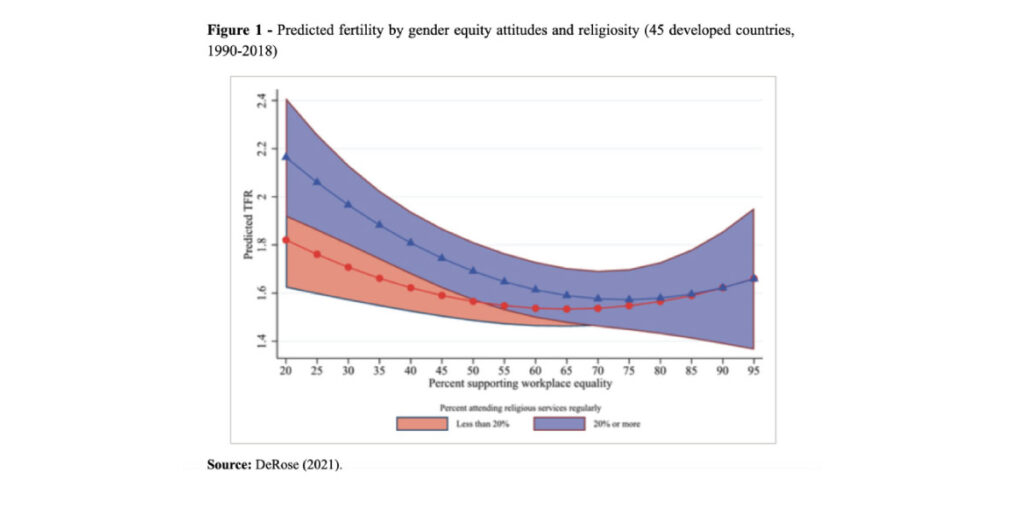
Women’s mass entry into the workforce and the development of public support for working women was associated with lower fertility levels: only the highest levels of gender equity promote higher fertility. If country religiousness impeded the development of widespread support for gender equity, religious countries would be less likely to reach the part of the range where gender equity becomes pronatalist (right part of Figure 1, top part of Figure 2). Figure 2 shows how both less religious countries (blue dots, more than one dot per country) and more religious ones (dots connected by lines and countries identified in the legend) fall both above and below 65%:
This does not mean that secularization is irrelevant for gender role attitudes. On the contrary, countries like Malta, where support for workplace equality has surpassed 65%, would perhaps not have reached this level if over 80% of the population had continued to attend religious services regularly. The key point in this context is that even in a highly religious country like Malta, further advances in already high levels of support for workplace equality can be expected to promote fertility. The old and the new natalism are not really in competition.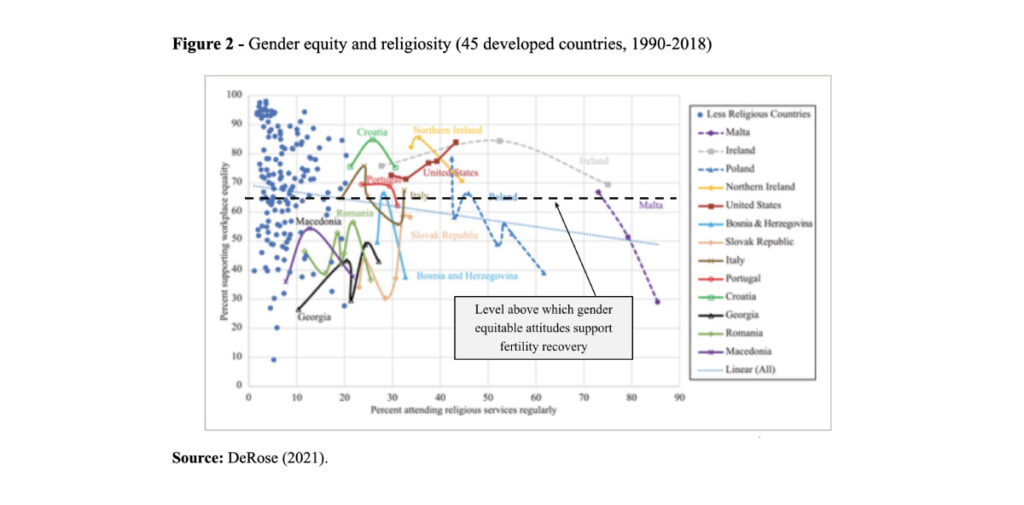
My conclusion is that competition between the “old” and the “new” natalism is less of an issue than their negative association might imply. By tracing the evolution of country-level gender equity in more and less religious countries of Europe and North America, it appears that country-level religiosity does not dampen the potential for a fertility recovery stimulated by gender equity. Also worth noting is that the curvilinear relationship between gender equity and fertility, originally “discovered” with reference to the years 1990–2009 (Arpino, Esping-Andersen and Pessin 2015), still remains valid today.
Religion has historically been a pronatalist force, but because it fosters traditional gender role attitudes, it could impede a fertility recovery stimulated by gender equity. Instead, Laurie DeRose explains how religion and gender equity do not undermine each other’s pronatalism.
Even where gender equity is not the end goal of profamily policy, it may be the means. The idea that gender equity can be the new natalism rests on evidence from both couples and countries. At the couple level, women who have more support in childrearing (either through public policy or a partner who shares in domestic tasks) are more likely to have two children rather than stopping at one. At the country level, more egalitarian societies have total fertility that is closer to two children per woman than more patriarchal ones (Rindfuss et al. 2016).
At first sight, this emphasis on gender equity seems counter to what used to be a prime support for higher fertility, namely religion. Religion has historically been a pronatalist force, but because it fosters traditional gender role attitudes, its importance for fertility could wane in contexts where gender equity is thought to be emerging as the new natalism.
Are more religious countries slower to adopt egalitarian gender role attitudes?
In a recent paper, I tested whether, across the last three decades, more religious Northern countries have been slower to develop the widespread egalitarian gender role attitudes associated with fertility recovery (DeRose 2021). They haven’t. In fact, gender equitable attitudes have spread faster in more religious countries, in part because it is easier to move from 45% to 55% support for workplace equity than from 85% to 95%. The pool of potential adopters of equitable attitudes is greater where existing support is lower.
In addition, more religious countries are no less likely to advance beyond 65% support for workplace gender equality. This threshold is important because the relationship between gender role attitudes and fertility is curvilinear (Figure 1)

Women’s mass entry into the workforce and the development of public support for working women was associated with lower fertility levels: only the highest levels of gender equity promote higher fertility. If country religiousness impeded the development of widespread support for gender equity, religious countries would be less likely to reach the part of the range where gender equity becomes pronatalist (right part of Figure 1, top part of Figure 2). Figure 2 shows how both less religious countries (blue dots, more than one dot per country) and more religious ones (dots connected by lines and countries identified in the legend) fall both above and below 65%:
This does not mean that secularization is irrelevant for gender role attitudes. On the contrary, countries like Malta, where support for workplace equality has surpassed 65%, would perhaps not have reached this level if over 80% of the population had continued to attend religious services regularly. The key point in this context is that even in a highly religious country like Malta, further advances in already high levels of support for workplace equality can be expected to promote fertility. The old and the new natalism are not really in competition.
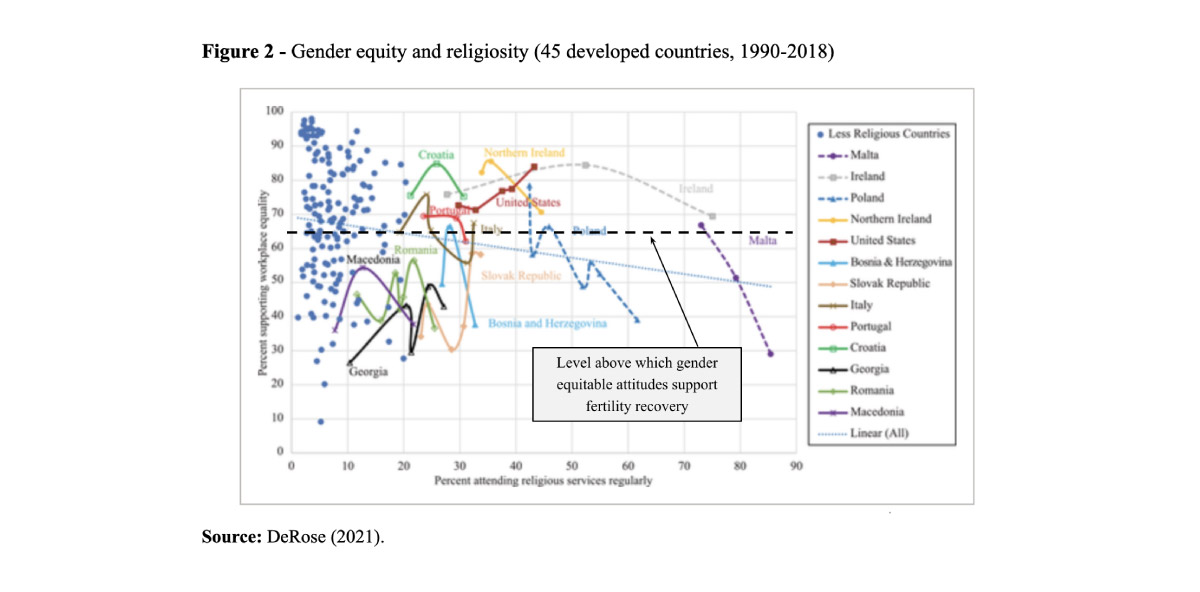
Conclusions
My conclusion is that competition between the “old” and the “new” natalism is less of an issue than their negative association might imply. By tracing the evolution of country-level gender equity in more and less religious countries of Europe and North America, it appears that country-level religiosity does not dampen the potential for a fertility recovery stimulated by gender equity. Also worth noting is that the curvilinear relationship between gender equity and fertility, originally “discovered” with reference to the years 1990–2009 (Arpino, Esping-Andersen and Pessin 2015), still remains valid today.
References
- Arpino B., Esping-Andersen G. and Pessin L. 2015. How Do Changes in Gender Role Attitudes Towards Female Employment Influence Fertility? A Macro-Level Analysis. European Sociological Review, 31(3): 370–382.
- DeRose L.F. 2021. Gender equity, religion, and fertility in Europe and North America. Pop & Dev Rev, 47(1): 41–55.
- Rindfuss R.R., Choe M.K. and Brauner-Otto S.R. 2016. The emergence of two distinct fertility regimes in economically advanced countries. Popul Res Policy Rev, 35: 287–304.
Subscribe to:
Posts (Atom)