Showing posts with label развод. Show all posts

Wednesday, December 18, 2024

nuptiality

На 10 бракосочетаний в России приходится 8 разводов

 — это третье место в мире, заявила советник гендиректора ВЦИОМ Елена Михайлова. По ее словам, это долгосрочный тренд, который связан со снижением ценностной значимости официального брака. Михайлова также отметила, что некоторые граждане манипулируют семейным статусом для получения соцподдержки от государства.

🤑 The Экономист

Friday, November 29, 2024

divorce

Россиян хотят насильно мирить при разводе. 


С такой инициативой выступили в Госдуме. В случае принятия законопроекта, суд сделает применение супругов в течение трех месяцев обязательным. Сейчас этот срок можно сократить до минимума по желанию одного из супругов.

🤑 The Экономист

Wednesday, April 24, 2024

divorce

Россия вошла в Топ-5 стран по количеству разводов

Tuesday, November 28, 2023

Joint physical custody of children in Europe

A growing phenomenon

November 27, 2023
Mia Hakovirta, Daniel R. Meyer, Milla Salin, Eija Lindroos and Mari Haapanen

As union dissolution becomes more frequent around the world, the living arrangements of children of separated parents have become an important issue. Joint physical custody (JPC) is believed to be the best solution for them, and probably also for their parents. Mia Hakovirta, Daniel R. Meyer, Milla Salin, Eija Lindroos and Mari Haapanen study the prevalence of JPC in European countries.


A growing number of children are affected by parental divorce or separation. When parents do not live together, the children’s living arrangements (physical custody) are determined either by the parents themselves or by a family court. For much of the last century in Europe, physical custody was typically awarded solely to the mother, with some fathers being awarded limited scheduled visits. Policies then changed to give fathers more time with their children and to give parents the possibility of joint physical custody (JPC, also known as shared care). Nowadays, children can live primarily with their mother or father (an arrangement called sole physical custody, or SPC) or can spend substantial time with both (JPC). Although some scholars restrict the definition of JPC to cases where children spend exactly half of their time with each parent, in a recent paper we decided to use a broader definition, including cases where children spend at least a third of their time with each parent (Hakovirta et al 2023).

Practicing joint physical custody (JPC) has been linked to several positive outcomes for children and parents, such as better co-parenting and less inter-parental conflict (Augustijn 2023). For children, JPC is associated with better socio-emotional and psychological well-being, as well as lower levels of stress (e.g. Nielsen 2018, Steinbach 2019, Turunen 2017). In addition, some studies indicate that mothers’ well-being and life satisfaction are higher under JPC than under sole physical custody (SPC) (Augustijn 2023).

In our study, we use European Union Statistics on Income and Living Conditions survey data (EU-SILC) to describe levels and trends of JPC in several European countries. We break our results down by children’s age and by JPC type, equal or unequal, which is a novel contribution to the comparative literature. Under unequal joint physical custody, children spend 10 to 14 nights per month with one parent (and 16 to 20 nights per month with the other) while under equal joint physical custody the children spend 15 nights with both parents.

Results


Figure 1 shows children’s physical custody arrangements in 2021. Across Europe, 12.5% of children in separated families lived in equal JPC arrangements, 8.2% lived in unequal JPC arrangements, and 79.3% lived in the more traditional sole physical custody arrangement.
Even though direct comparisons with previous studies are not possible, our results show a significant increase in the prevalence of JPC in less than 20 years. Substantial cross-national variation exists. Equal JPC is most common in Sweden (42.5% of children in separated families), followed by Finland (23.8%) and Belgium (19.6%). More than one in ten children in separated families in Slovenia, Denmark, Spain, and France live under this type of arrangement, but only, 5% or less in nine countries (Czech Republic, Croatia, Hungary, Lithuania, Romania, Cyprus, Greece, Italy, Austria). Unequal JPC arrangements are most common in Denmark (26.2%), followed by Sweden (11.2%), Slovenia (11.1%), and Belgium (10.7%).

Table 1 breaks down these results by children’s age. Sole physical custody is more common for the youngest (0–5 years) and the oldest (16-17 years) children, reaching 84.8% and 82.5% respectively. JPC is more prevalent at the intermediate ages (6 to 15), especially the equal type, accounting for 13 to 16% of the total.

Discussion


JPC is becoming more common: we estimate that it concerned 13.0% of children aged 11–15 not living with both parents in 2021, compared to 5.7% in 2002–2010.

The rate of equal JPC is highest in mid-childhood, at ages 6 to 10, with lower rates for younger and older children, especially those aged 16–17. This is the expected pattern if we presume that young children are more in need of residential stability (or more in need of maternal attachment) and older children want fewer residential transitions to facilitate peer relationships.

In all age groups, and considering unequal as well as equal JPC, we see substantial variation across countries, with clear regional differences. Consistent with prior studies we find that in Northern European countries – Belgium, France, Spain, and Slovenia – children are more likely to experience JPC. Traditions and legal contexts differ across countries: for example, in Belgium and Spain, JPC has been the presumptive arrangement for at least the past decade.
Even though some countries have substantially more JPC than others, our results show that the overall increase in JPC is a widespread phenomenon. In eight countries for which there are data from 2002–2010 in Steinbach and colleagues (2021), and for which we have sufficient numbers of children aged 11–15 to make indicative comparisons, equal JPC arrangements have increased. Only in Hungary and Italy have they declined, and in both of these countries equal JPC is quite uncommon (2.5% and 2.8% in the early data and 0.5% and 1.9% in recent data). In several countries, increases are large, with rates doubling or more in Croatia, Estonia, Finland, Spain, and Sweden.

These changes are substantial, and may have widespread implications for the lives of these children and their parents. Whether social policy has kept pace with this new reality is a matter of debate.

References

  • Augustijn Lara. (2023). Post-separation care arrangements and parents’ life satisfaction: Can the quality of co-parenting and frequency of interparental conflict explain the relationship? Journal of Happiness Studies 24: 1319–1338.
  • Hakovirta Mia, Meyer Daniel R., Salin Milla, Lindroos Eija and Haapanen Mari (2023) Joint physical custody of children in Europe: A growing phenomenon. Demographic Research 49(18): 479–492.
  • Nielsen Linda (2018). Joint versus sole physical custody: Children’s outcomes independent of parent–child relationships, income, and conflict in 60 studies. Journal of Divorce & Remarriage59(4): 247–281.
  • Steinbach Anja (2019). Children’s and parents’ well-being in joint physical custody: A literature review. Family Process 58(2): 353–369.
  • Steinbach Anja, Augustijn Lara and Corkadi Gerrit (2021). Joint physical custody and adolescents’ life satisfaction in 37 North American and European countries. Family Process 60(1): 145–158
  • Turunen, Jani (2017). Shared physical custody and children’s experience of stress. Journal of Divorce & Remarriage 58(5): 371–392.

Thursday, September 14, 2023

Fathers and Sons, Daughters – precisely speaking

это ссылка

Бывший муж-*удак


И вот, спустя 13 лет после развода, я решила начать заполнять свой дневник...

Данный пост не требует комментариев от людей «с улицы». Для Вас создам отдельный пост. [их, тем не менее, полно, правла, по уверению одного комментатора – неугодные удалены, но и так – хорошо:)]

Сейчас такой этап, когда дочь уже взрослая, я живу отдельно, и поняла что хочу свою «скотинку», только в человеческом обличии. Благо детей больше не рожать, и поиск, казалось бы, уже проще..

Так вот. При знакомстве я всегда говорю что муж был один, и тот оказался Чудаком на букву М. И разумеется, закономерный (казалось бы) вопрос: « а чего ж ты с ним жила, раз он такой?!»

Ну так вот в жизни бывает, что всё дерьмо человеческое лезет только в конце отношений. А в данном случает ещё и инициатором развода был он.

«Нам нужно развестись, я тебя больше не люблю — мы разные»

Да, чувак, мы разные: ты мальчик, я девочка.. у меня внутрь писька, у тебя наружу — и как ты раньше не замечал!?

Моя семья распалась, когда мне было 10 лет, и мне не хватало общения с отцом, хотя он любил меня и сестру, но мама... да, так тоже бывает — многие советские семьи так распадались, так настраивали детей против родителей...

Я не хотела этого своей дочери, поэтому всегда пыталась находить компромиссы, шла навстречу мужу, чтобы сохранить «полноценную» семью.

«Я конечно понимаю, что откажешь, но всё же: может оставишь мне дочь?»

Ляпнул чел, с рассеянным склерозом в анамнезе и постоянным наличием алкоголя в организме. ..

Ещё один заезженный совковый шаблон: хочешь узнать, какой будет жена — посмотри на тёщу.

Это к слову о настраивании чада против одного из родителей.

Ребят, ну вы серьёзно!? Я так хотела ребёнка, что буду осознанно травмировать его психику!? «спасибо» папаше, который болт положил ещё с момента как решил развестись... и который всегда бил себя в грудь со словами «Я люблю свою дочь!» .. Который просто забил на всё, ушёл жить в квартиру к своей маме, оставив меня собирать пожитки, искать кто поможет с переездом в родительский дом, с шестилетней дочерью, кошкой, мебелью и т.п.

Я ему часто говорила: мне не нужно настраивать дочь против тебя, но со временем она сама поймёт какое ты говно... Ведь одно дело говорить и обещать что-то мне, взрослой женщине, и не выполнять обещаний, и совершенно другое: говорить это «любимой», а что самое страшное, любящей тебя искренне, чисто и беззаветно детской душе, которая скучает, ждёт тебя и верит!

Вот поэтому *удак — это не оскорбление, нет, это характеристика моего бывшего мужа.

P.S. несмотря на всё это, я говорю дочери: какой бы ни был, это отец. Пиши ему сама, раз он не пишет. Не когда что-то нужно, а просто так...

Пишет, а в ответ ка правило игнор.

Ну да, новая жена, новая дочь..

Wednesday, June 28, 2023

Educational disparities in partnership formation and dissolution in Finland (1990-2019)

June 26, 2023 Linus Andersson and Marika Jalovaara

As marriage declines and divorce increases, partnership trends and household composition become increasingly determined by trends in the formation and dissolution of non-marital cohabiting unions. Marika Jalovaara and Linus Andersson show that in Finland, the decline in marriage is not offset by an equivalent increase in cohabitation, and educational disparities in the prevalence of unions have increased somewhat from already-high levels in 1990. These patterns are remarkably similar for men and women.


The decline in marriage and the increase in divorce have continued well beyond the turn of the millennium in the Nordic countries and elsewhere. But does that mean that fewer people live with a partner? And are trends similar across gender and educational levels? To evaluate the trends in partnerships and the educational gradients therein, in a recent paper we analysed both marital and non-marital forms of (coresidential) partnership formation and dissolution from 1990 to 2019 in Finland (Jalovaara and Andersson 2023).

Trends in cohabitation and marriage


One of the major changes in family behaviour of the 20th century was that fewer people married and among those who did, more divorced. Family demographers have long pointed out that trends in marriage and divorce rates are consequential for both childbearing and well-being. Yet, non-marital partnerships have to some extent replaced marital ones, maintaining a balance in the share of the population living with a partner. However, this “compensating” effect may be only partial, in part because of sheer numbers, and in part because, while all forms of partnership are critical for individuals’ childbearing and household economy, marriage remains a stronger predictor of fertility and (relational and financial) stability than simple cohabitation.

The picture is further complicated by disparate evidence suggesting that trends in marital and non-marital partnerships differ for men and women, even when they have comparable educational levels. Finally, quality data on non-marital partnership formation and dissolution over time are generally scant.

This is not the case in Finland, however, where we could access population register data that include the dates of marriage and divorce as well as the dates of non-marital cohabitation and dissolution for the entire population from 1990 to 2019. We focused on the age groups from 18 to 45 years because these are the ages when partnership formation is most common (and relevant for childbearing). We found that marriage prevalence (the share of the population who are married) declined in Finland across all educational groups among both men and women (Figure 1). In total, the share of married persons declined from 48% to 28% for all men from 53% to 33% for all women, with levels that are lower, the younger the age group.
We then considered partnership prevalence as a status of being either married or in a non-marital cohabiting union (Figure 2). If non-marital partnerships have indeed replaced marital partnerships, we would expect stability in total partnership prevalence from 1990 to 2019. Instead, we found a decline in total union prevalence. This is particularly the case among the group without upper secondary education, among whom the prevalence has fallen by more than 20 percentage points for men and almost 30 percentage points for women. Among individuals with medium levels of education, total union prevalence has decreased by three to eight percentage points over the past three decades. In contrast, we found a slight increase in total partnership prevalence among men and women with high education, although not for all age groups.

Further analyses of the formation and dissolution of non-marital unions led us to conclude that non-marital unions were not sufficiently numerous and durable to fully compensate for the decline in marriage. Rates of separation (the share of partnered individuals who separate) have increased steadily over time across all types of union, while total partnering rates (the share of those who marry or enter a cohabiting union among the population not married or cohabiting) have been declining since around 2010 (Table 1).

Implications


The decline in marriage and the increase in divorce are key features in the changing picture of the demography of the family. Yet, this is only half of the story: non-marital cohabitation has replaced marital unions but only to a limited extent. Forming a partnership and having children are fundamentally related. A higher share of non-marital cohabiting unions – more prone to partnership break-up than marriages – in combination with a lower total partnering rate during childbearing ages, can have negative consequences for childbearing.

A reversed, or different, causal chain is also possible. The partnership trends we observe in Finland may be driven by a decreased desire for childbearing, or there may be common underlying forces that depress childbearing and partnerships. Be as it may, a trend away from partnerships is, in itself, likely to depress fertility.

Moreover, trends toward fewer and less stable couple households have implications for welfare policies. The household is a core economic unit and often protects against financial risks (e.g. unemployment). In countries where redistributive policy is adapted to dual-earner households in particular, trends towards fewer partnerships should be taken into consideration.

Finally, these trends are largely uniform across gender, even at comparable levels of education. While substantial differences exist, these are matters of degree rather than kind. Other studies (Kolk 2022, Andersson 2022) also show that educational and socioeconomic differences in family dynamics are similar in gender-egalitarian Nordic countries such as Finland, where women and men now have quite similar social and economic roles.

References

Sunday, April 30, 2023

Accused of Witchcraft

Waldrada, illustration by Pollie Scott

I have enlisted the help of my esteemed colleague Dr Chris Halsted, a lecturer at the University of Maryland College Park, to tell you about a fascinating woman who lived across the sea in the kingdom of Lotharingia. Chris researches gender, ethnicity, and geography in early medieval texts and is particularly interested in women who have been accused of magic and witchcraft - like Waldrada, the subject of this month’s newsletter.


Waldrada: The Woman Accused of Witchcraft during a Medieval Divorce Scandal


Guest Author: Dr Chris Halsted

In the middle of the ninth century, a woman named Waldrada was wrapped up in a royal divorce scandal that could rival that of Henry VIII. Waldrada was the mistress of King Lothar II, who ruled over a Frankish kingdom at the center of the former Carolingian empire. The scandal ensued when Lothar attempted to divorce his wife, Theutberga, and marry Waldrada instead. During Lothar’s campaign for a divorce, these two women both faced wild and scandalous accusations from those with political and religious interests in the fate of the royal marriage. What we know about Waldrada comes almost entirely from this highly charged and high-profile divorce case, making her one of the most consequential yet mysterious figures of the middle ages.

Very little is known about Waldrada’s early life. From what we can tell, her background was aristocratic but not especially distinguished. She was likely already in a relationship with Lothar when he became king in 855 at the age of eighteen. However, Lothar did not marry Waldrada, but a woman named Theutberga, the sister of a powerful magnate. Lothar would later claim that he only married Theutberga because her brother had threatened to obstruct his rise to kingship if he refused.

Though Lothar married another woman, Waldrada was not cast aside. Lothar and Waldrada probably already had children by the time of his marriage, and they would go on to have at least four illegitimate children: a son and three daughters. This was of vital importance to the divorce scandal: Lothar’s marriage to Theutberga was childless, and so he had no legitimate heir.

Obtaining a divorce was no simple matter. Churchmen from the time of Lothar’s grandfather Charlemagne onwards had standardized rules surrounding marriage. Not only had it been decided that the keeping of a ‘concubine’ was unlawful, but remarriage after repudiating one’s wife (which could only be done in the case of adultery) was also forbidden. By the 850s, these strict rules on remarriage had come crashing up against the realities of political life among the imperial elite: Lothar’s attempt to divorce his wife and marry Waldrada is only the most famous among several marriage scandals that engulfed his extended family, including his cousin Judith’s marriages to the Kings of Wessex.

These rules motivated Lothar to levy scandalous accusations against his wife Theutberga in an attempt to secure a divorce. The young king accused her of having an incestuous relationship with her brother Hucbert before their marriage, in which they had coupled ‘as men do with men’. This had apparently resulted in a pregnancy that had then been aborted. The reasons for these extreme accusations were twofold: first, incest and ‘sodomy’ were both crimes that made a marriage unlawful; if Lothar could successfully convince the broader political community that his marriage to Theutberga had been unlawful in the first place, he would be then free to marry Waldrada. The second reason was political: by dragging Hucbert into it, Lothar made Theutberga’s most powerful ally complicit in her supposed crimes.

In response to these accusations, voices from Theutberga’s camp accused Waldrada of witchcraft, saying she had bewitched the king as part of a plot to seize power. This was something of a trope in Carolingian gender discourse: a similar accusation had been levied against the Empress Judith in the 830s, for example, and it is possible that something similar befell Arnulf of Carinthia’s queen Uota.

Lothar’s plan to set Theutberga aside and marry Waldrada failed. Under pressure from his bishops, his uncles who ruled the neighboring kingdoms, and Pope Nicholas II, he took Theutberga back in 858. A second attempt at divorce, in 862, was temporarily successful, and Waldrada was even presented to the court as Lothar’s queen, but in 863 her fortunes turned again. Nicholas annulled the divorce and excommunicated Waldrada.

By this point even Theutberga wished for divorce, wanting to rid herself of her troublesome involvement with Lothar and retire to a convent. Both Waldrada and Theutberga’s fortunes had risen and fallen tumultuously alongside Lothar’s campaign for divorce. The political wrangling with Pope Nicholas ended with his death in 867. Nicholas’ successor, Adrian II, was more generous to the women involved, giving Theutberga permission to live without Lothar, and lifting Waldrada’s ex-communication.

In 869, Lothar made the journey to Italy to try to convince the pope that he should be allowed to once more marry Waldrada, but on the way there he fell ill and died, the issue of his marriage still unresolved. His uncles immediately divided his kingdom between them — Lothar still had no legitimate heirs. Lothar’s failed marriage politics had led to the failure of his kingdom.

For a variety of reasons — the sensational nature of the accusations, the novelty of a royal divorce and remarriage, and the political importance of reproduction by the heirless Lothar — this crisis became possibly the best-documented Carolingian scandal. Kings and popes wrote letter after letter, bishops and churchmen compiled manuscripts on church law, historians marked down their opinions both during and after the crisis. Perhaps our best source for the crisis is De Divortio, a lengthy treatise on the matter by Archbishop Hincmar of Rheims, one of the most eminent churchmen of the day. Hincmar’s work provides a primer through which modern historians can understand the issues at stake — up to and including a discussion of love potions, succubi, and other relevant supernatural issues.

Although Lothar died with the issue still unresolved, it was the anti-Waldrada camp that won out in the history books. Later writers remember Waldrada as a seducer and tyrant, the archetype of the scheming woman trying to supplant the rightful queen Theutberga. The later chronicler Regino of Prüm would blame the entire downfall of the Carolingian dynasty on Waldrada and Lothar’s relationship, arguing that the sexual sin of their relationship prompted God to curse the family with sterility. The Life of St. Deicolus, written in the tenth century, blames Waldrada for the mismanagement of the monastery of Lure, implying that her sins caused it to be attacked by Hungarians some eighty years later. Over the course of the long Carolingian era, Waldrada became a scapegoat, blameable for seemingly anything that went wrong which could be even vaguely connected to her.

But the person of Waldrada gets lost in the scandal that surrounded her. Among the accusations and slanders, the arguments about canon law, politics and magic, we get very little sense of her actual personality. What was her relationship with Lothar like? Was she eager to be a queen, or horrified by the continent-wide drama her relationship had catalyzed? Modern historians have often followed medieval ones in blaming Waldrada for the entire affair, portraying her as a power-hungry and ambitious woman — this is surely nothing more than misogyny, as the polemic sources surrounding the case give us very little reason to trust them.

Against the backdrop of a century of royal marriage controversies, starting with Wallis Simpson and refusing to relent since, it’s worth taking a moment to consider the person in the midst of the chaos. Very shortly, we will witness the coronation of a king and queen with at least a superficially similar story — marriage, affair, divorce, and remarriage, though this one without the accusations of witchcraft. We know the players in the modern case all too well — but who Waldrada was, and the actual facts and events of the relationship at the center of her sensational case, have become swallowed up in history.

Friday, April 14, 2023

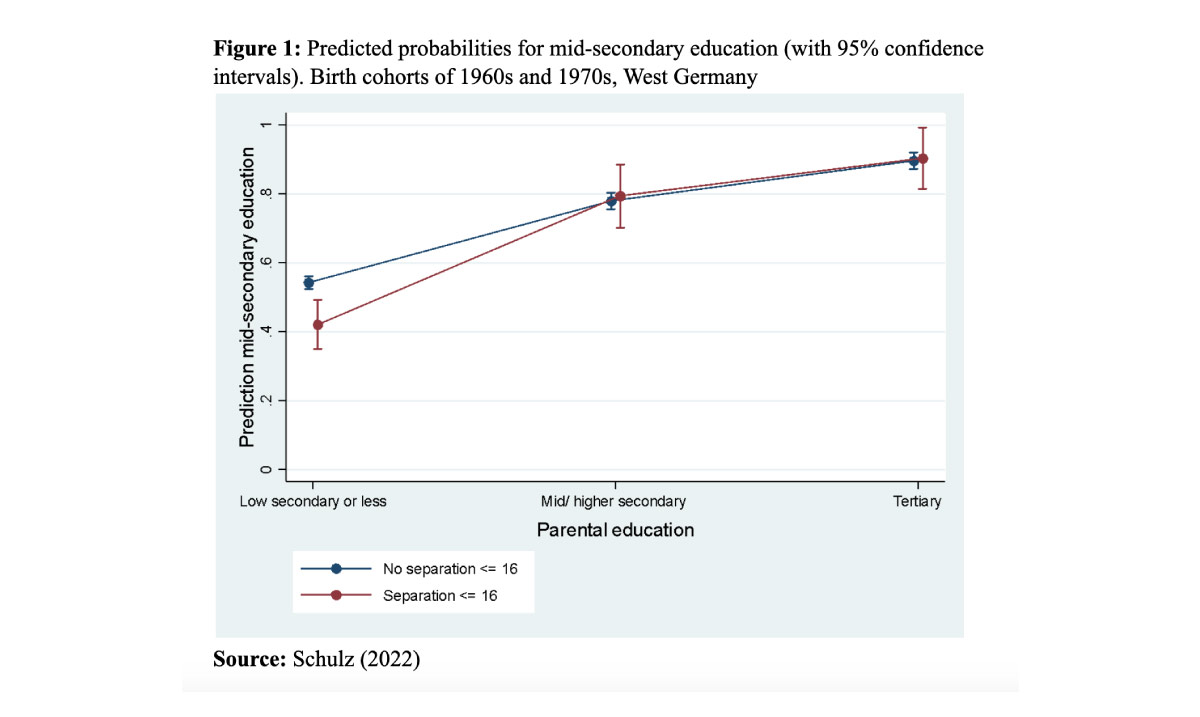
Differential educational consequences of parental separation in West Germany

April 3, 2023 Wiebke Schulz

Children are not all equally influenced by parental separation. Wiebke Schulz shows that children with parents from a lower educational background have fewer chances of completing mid-secondary education. This is less true, however, for higher-secondary education.


Children who experience parental divorce or separation tend to attain lower levels of education. Upon separation, children may lose out on the social, financial, informational and relational resources that foster their learning and hence their educational attainment (Amato 2000). The extent to which this occurs, however, is known to depend on their socioeconomic background (Grätz 2015). In a recent study (Schulz 2022), I show that it also depends on the outcome of interest: completion of mid- or higher-secondary education.

A synthetic theoretical perspective


For lower educational outcomes, children from higher educational backgrounds may experience smaller penalties, because parental resources are sufficient to compensate for the losses incurred upon divorce. For instance, children with better educated parents are less likely to experience crucial changes in their environment and in their relationship with their parents, and thus might be less disturbed by the experience of parental separation. According to this “compensation perspective”, children from lower status backgrounds should suffer more from parental separation than children of better-educated parents (Bernardi 2014; Boudon 1998).

The compensation hypothesis may not be applicable to higher educational outcomes, however, where the consequences of parental separation may even be more severe for “privileged” children. Lower status children typically have less access to social origin resources that improve their chances of attaining higher levels of schooling in the first place, including information on the returns of higher education. This means that children from lower social backgrounds who successfully transition to advanced tracks are especially selected in terms of ability and motivation. The disturbances caused by parental separation may have fewer adverse effects on the educational career of this highly selected group. Conversely, higher status children, for whom completion of higher secondary education is the norm, may feel more harshly the loss of resources that would have been available if their parents had not separated: they have “more to lose”.

A case in point: West Germany


My analysis is based on a sample of 6,855 children born in the 1960s and 1970s in West Germany (German Life History Study). My main finding is that variations in parental separation consequences by parental educational background (the highest level of educational attainment of either mother or father) are in line with the compensation perspective: the consequences of parental separation on completion of mid-secondary education – and also to a certain extent higher-secondary education – were more severe for disadvantaged children, and indeed limited to this group.

Children from low educational backgrounds who experienced parental separation had considerably lower chances of completing mid-secondary education (Figure 1), while for children from mid- and high-educational backgrounds the chances did not vary meaningfully according to separation experience. Hence, for the case of mid-secondary education, the consequences of parental separation were limited to children from low status backgrounds, which provides support for the compensation perspective.
Children from lower educational backgrounds who experienced parental separation were likewise disadvantaged in their chances of completing higher-secondary education, although, in this case, to a much lesser extent. For children from higher status background, parental separation was much less strongly related to their chances of completing higher-secondary education and estimates are statistically insignificant. My conclusion, therefore, is that the “compensation hypothesis” also holds, albeit less so, for higher educational outcomes (see also Figure 2).

Conclusions


Considering more than one educational outcome highlights dynamics linking family processes and inequality that might otherwise go unrecognized. In Germany, a context with a strongly stratified and hierarchically organized education system, only disadvantaged children are adversely affected by separation, particularly at a low threshold (mid-secondary education). These unequal heterogeneous consequences could be missed in studies that focus only on higher levels of educational attainment. More broadly, this suggests that studies examining heterogeneous consequences, for example, regarding well-being and cognitive abilities, should move beyond mean effects and look at various points of the outcome distribution.

References

  • Amato, P.R. (2000). The consequences of divorce for adults and children. Journal of Marriage and Family 62(4): 1269–1287. doi:10.1111/j.1741-3737.2000.01269.x.
  • Bernardi, F. (2014). Compensatory advantage as a mechanism of educational inequality: A Regression Discontinuity based on month of birth. Sociology of Education 87(2): 74–88. doi:10.1177/0038040714524258.
  • Boudon, R. (1998). Social mechanisms without black boxes. In: Hedström, P. and Swedberg, R. (eds.). Social mechanisms: An analytical approach to social theory. Cambridge University Press: 172–203. doi:10.1017/CBO9780511663901.008.
  • Grätz, M. (2015). When Growing Up Without a Parent Does Not Hurt: Parental Separation and the Compensatory Effect of Social Origin. European Sociological Review 1–12. 10.1093/esr/jcv057
  • Schulz, W. (2022). Do the consequences of parental separation for children’s educational success vary by parental education? The role of educational thresholds, Demographic Research, 47, S. 883 – 918. doi:10.4054/DemRes.2022.47.28

Wednesday, March 1, 2023

Health before and after union dissolution

Health before and after union dissolution among mothers, fathers and children

January 16, 2023 Øystein Kravdal and Jonathan Wörn

Norwegian register data indicate that parents’ mental health deteriorates prior to union dissolution but improves afterwards. In contrast, Øystein Kravdal and Jonathan Wörn note, children seem to experience a continued worsening of their mental health after a break-up. There is only modest evidence of poorer physical health before the dissolution, but a clear adverse post-dissolution trend emerges in non-infectious physical diseases, especially among mothers.


The dissolution process


Several studies have shown that partnered individuals have relatively good health (Kravdal, Wörn and Reme 2022), especially if the relationship quality is high (Robles et al. 2014). Unfortunately, for many couples, the relationship becomes less rewarding after some time together and they may even struggle with serious disagreements or conflicts. At some point, at least one of the partners may feel that life, after all, would be better outside the union and take the decision to separate. Presumably, most parents take the expected consequences for their children into account in such deliberations.

After the break-up, there will obviously be some relief from the tension that triggered it, but new conflicts may arise, about dividing up property or the children’s living arrangements, for example. Additionally, there may be setbacks such as financial hardship, childcare issues, or distress because of moving to another area. In some cases, these problems may be persistent or even get worse over time, although the overall life situation may still be better – at least for some of the family members – than if the union had remained intact. In other families, the problems may wane as new sources of support and emotional satisfaction are found, and after some time life quality is perhaps not much lower than before the relationship problems started. This kind of temporary difficulty is often referred to in the divorce literature as a “crisis response”, as opposed to the more “chronic strain” that may be experienced (Amato 2000).

Such changes in relationship quality and life circumstances during the years before and after a union dissolution may have implications for the health of both parents and children, and a huge number of studies have addressed this issue. However, many factors influence both union dissolution likelihood and health, and even the investigations that have taken this into account in relatively advanced ways have provided rather mixed evidence.

Union dissolution and mental health in Norway


In a recent study, we estimated how marital separation and dissolution of consensual unions affected the health of Norwegian parents and their first child if the child was no older than 18 years at the break-up (Kravdal and Wörn 2023). The analysis was based on nationwide register data, and the annual number of consultations with general practitioners (GPs) between 2006 and 2018 was used as a health indicator. In total, households were observed over about 800,000 years. We controlled for all measured and unmeasured factors that are constant over time by comparing the number of consultations at different times before and after the break-up for the same individual.

As one might expect, the number of consultations where the patient was diagnosed with a mental health problem increased among both mothers and fathers for some years before a union dissolution (Figure 1), when the relationship quality typically deteriorates. The numbers dropped immediately afterwards, although within the post-dissolution decade that could be studied, they remained higher than long before the dissolution (e.g. four years or more). In the long run, mothers appeared to be slightly more adversely affected than fathers.
Consultations for mental health problems before the dissolution also increased for children, although less so than for parents (also after taking into account the generally fewer consultations for such problems among children; not shown). At this stage, the children are possibly influenced by changes in parental behaviour caused by their relationship problems. Interestingly, this increase in consultations for mental health problems continued and even intensified after the break-up. The patterns were similar for daughters and sons. At first sight, this may suggest that, while a break-up comes as a (partly expected) relief to the parents, it harms the children. In other words, the children’s interests may not have been taken sufficiently into account in the decision-making. This is not necessarily the case, however, as these children might have experienced even worse health consequences had their parents stayed together. The general pattern did not vary much across married or cohabiting couples.

Physical health


In contrast to the findings for mental health, there was almost no increase in consultations for non-infectious physical diseases before a dissolution for any of the family members. This is consistent with the hypothesis that effects on physical health are less immediate than effects on mental health (Hughes and Waite 2009). However, numbers of consultations started increasing later, for mothers especially, with a smaller increase or stability for the others. The upturn among mothers was not much smaller than their pre-dissolution increase in consultations for mental health problems, but because mothers in general consult GPs three times more often for physical than for mental illnesses, the increase in consultations for physical health problems is much smaller in relative terms. A dip could be seen among mothers in the break-up year, but this was entirely a result of musculoskeletal ailments (not shown), which perhaps were underdiagnosed that year or reported as mental health problems.

The more adverse trend for mothers than fathers is noteworthy. Although one might expect mothers to have more economic problems after a break-up, and also to be more burdened by childrearing, other problems may be felt more strongly by fathers, and earlier studies have not given a clear picture about the difference between the two parents. The trends in consultations suggest that children’s physical health is also negatively affected by their parents’ break-up. This seems to hold especially for daughters, although gender differences are not always clear, and appear to be model-sensitive.

One might expect life changes before and after dissolution to affect social interaction patterns, and perhaps to increase vulnerability to infections because of sleep deprivation or other stress-induced health burdens. However, the overall conclusion was that the number of consultations for infections remained quite constant through the dissolution process (not shown). The clearest exception was a temporary surge in the break-up year and subsequent year for mothers.

Conclusion


In summary, our analysis indicates that the health of the entire family may be influenced by a dissolution process, although the break-up itself may give certain health benefits. It is important to note that even if the parents appear to be on a favourable health trajectory after the break-up, that is not necessarily the case for the children.

References

  • Amato, Paul R. (2000). The consequences of divorce for adults and children. Journal of Marriage and Family 62(4): 1269-1287.
  • Hughes, Mary E., and Linda J. Waite (2009). Marital biography and health at mid-life.” Journal of Health and Social Behavior 50(3): 344-358.
  • Kravdal, Øystein, Jonathan Wörn, and Bjørn-Atle Reme (2022) Mental health benefits of cohabitation and marriage: A longitudinal analysis of Norwegian register data. Population Studies(online first) www.tandfonline.com/doi/full/10.1080/00324728.2022.2063933
  • Kravdal, Øystein, and Jonathan Wörn. (2023). Mental and physical health trajectories of Norwegian parents and children before and after union dissolution. Population and Development Review online first. http://doi.org/10.1111/padr.12530
  • Robles, Theodore F., Richard B. Slatcher, Joseph M. Trombello, and Meghan M. McGinn. (2014). Marital quality and health: a meta-analytic review,” Psychological Bulletin 140(1): 140-187.

Tuesday, February 21, 2023

That may not be good news.

Penis length has grown 24% in recent decades. 


KAREN WEINTRAUB | USA TODAY

Studies of men from around the world show that the length of the erect penis has grown 24% over the last 30 years. [что сов.пало]


That sounds like it would be good news but it concerns some male fertility experts.

"The million-dollar question is why this would occur," said Dr. Michael Eisenberg, a urologist and male fertility specialist at Stanford Medicine, who led the research, published Tuesday in The World's Journal of Men's Health.

Other research has shown that both sperm count and testosterone levels are falling.

Penile length may not be directly related to fertility, Eisenberg said, but anything that changes the reproductive system is fundamental to human existence and "something we should pay attention to and try to understand why."
What the study showed

Studies have measured penile length dating back at least 80 years, Eisenberg said.

He and his team compiled data from 75 studies conducted between 1942 and 2021, on nearly 56,000 men. They found the average erect penis length increased by 24% over the last 29 years.

The trend was apparent in different regions of the world, he said. "This was not isolated to a specific population."

The average length of the erect penis across all regions and decades was about 5.5 inches, the study found.

Dr. James Hotaling, a urologist and men's infertility specialist at the University of Utah Health, praised the study but said he's not yet convinced that penises are growing longer.

The simplest explanation, he said, is that the method of measurement has changed over the last 30 years – though there's no evidence that has happened.

Why study this?


Eisenberg got interested in the topic because of declining male sperm counts and testosterone levels. He thought research would show that penises are shrinking as these levels fall and men get more obese.

Instead, he found that they're growing and at a pretty fast clip. "It certainly was very surprising," he said.

Hotaling said it's unclear what the clinical impact of this finding might be, but he agreed that it contradicted his expectations. "This would not support the sperm apocalypse."

What might explain it?


Eisenberg thinks the change in length might be explained by earlier puberty. Boys, like girls, have been reaching puberty earlier in recent years. Perhaps, he said, that's giving their bodies a longer time to grow overall.

Hotaling wants more evidence. Sometimes early puberty stunts growth, he said, and it's not clear whether hitting puberty early makes puberty last longer.

It's probable, he said, that chemical exposures could affect penis length, but there's no evidence for that.

"If the findings were the opposite," and penises were shrinking, he said, "everybody would be freaking out."

Hotaling published a paper in 2021 showing that men with infertility have slightly shorter penises on average than men without infertility.

At the time, he thought the same biological factor – technically called testicular dysgenesis syndrome – might be behind both infertility and shorter length. But this study seems to go against that hypothesis.


"I don't have a great explanation for it," he said of the new finding. "I think it merits further investigation."

Hotaling said he hopes the research, whether supported in the future or not, will encourage men who are concerned to talk to their doctor.

"Anything that gets men thinking about their health is good," he said.

Contact Weintraub at kweintraub@usatoday.com

Health and patient safety coverage at USA TODAY is made possible in part by a grant from the Masimo Foundation for Ethics, Innovation and Competition in Healthcare. The Masimo Foundation does not provide editorial input.

Tuesday, December 27, 2022

How To Co-Parent Effectively After a Divorce

A 5-point parenting plan and Google Docs finally made us better parents to our twin boys

Photo by Mick Haupt on Unsplash

If my ex and I had focused less on ourselves, then we could have come to a better co-parenting model earlier. Thankfully, we did improve.

The rollercoaster ride for us isn’t over, but the ups and downs have gotten much smoother. This is what I learned along the way—including the advice I was given but didn’t take at the time.

Last month, I texted my ex-partner. The twins want gaming laptops. I think we should buy them one each for Christmas.

Within seconds she replied. Great idea. Perhaps we can meet up and select them together.

This is a fairly mundane text exchange. But for me and my ex, this was a huge step. And it showed the progress made over a long 10-year battle. One that involved anger, resentment, jealousy, and frustration. Plus several abusive messages.

After 10 years, we had finally learned to co-parent. And through this, I hope that anyone in a similar situation will be able to follow what I did and do likewise.

The Breakdown


In May 2010, with our twin boys just three years old, my wife Heather and I decided to separate. It was an extremely tough decision, but we had grown so far apart, the relationship was barely functioning.

I had held on as long as I could, purely for my sons. I didn't want them to be part of a broken home. To be destined to move between their parents' houses for the rest of their childhood.

From a selfish perspective, I couldn't imagine not seeing them every day. Being apart and wondering what they were up to. I was worried this would make me less of a father. I wanted to be as involved in their lives as possible.

I didn't know how to tell them the news or if they would even understand. How could we bring up the subject and tell them mummy and daddy would no longer live together.

What followed next was the first sign that co-parenting after a separation would be hard. And it is something many people go through. According to the Stepfamily Foundation, “Sixty-six percent of couples who live together or are remarried will break up when children are involved. The majority of American families have shifted from the original biologically connected mother, father, and child.”

Two parents, two different paths


My day at work had been one of aimless procrastination, stressing how about to tell my children the news.

When I returned home to give the heartbreaking news, I saw the two playing happily together. I was teary-eyed, and with a deep breath, I told Heather that we needed to talk to them, and then I would pack my bags and leave.

With a dismissive tone, she said, “I’ve told them already. You can pack and leave now.”

I felt like I had been stabbed in the heart. Such an important family discussion had been held without me being present. What had she said? What were their reactions? Did she blame me? As a writer, I was used to controlling the narrative, but I had no idea what was said about me.

Furious and hurt, I packed my bags and left. Divorce is tough, but surely this was the worst possible start. And it was only going to get worse due to my inexperience in dealing with relationship conflict.

Co-Parenting — What NOT To Do


The first year of our separation was full of anger, resentment, and legal fights. Where we live, counseling is compulsory before any divorce is granted. We did the mandated sessions, which were futile. There was so much anger that the sessions weren't the least bit productive.

They descended into arguing and pointing the blame at each other before ending in frosty silence. Outside of the sessions were even worse.

I wanted equal time with my children, but Heather would only agree to a 70/30 share in her favor. On top of this, she was demanding hefty financial payments, which led to even more anger. I felt like I was being punished financially and emotionally.

This led to many angry text exchanges. I was letting emotion get the better of me, and this showed in my communication. Heather took a passive-aggressive approach, which led to me fuming and wallowing in self-pity.

We were both wrong, but neither would admit this or try anything different. The anger at each other was too deep, and this affected our parenting. Picking up the children from each other’s houses was an awkward experience for all four of us. The children would run from the car to inside the house to get the exchange over as quickly as possible. Every time I saw this, my heart broke.

Marriage and family therapist Dr. Juliana Morris gives the following advice: “Self-reflect and own your role in ending the relationship. When you are happier individually, it’s easier to co-parent with focus and intention.”

It is great advice and one that we wrongly ignored. We were stuck in a cycle of angry text messages and awkward drop-offs—a cycle that seemed to have no end.

Subsequently, we were each doing our own thing, independently of what the other thought or felt. And this is quite common. According to a study by the American Psychological Association, parents that share custody are “more likely to have detached, distant, and ‘parallel’ parenting relationships than to have ‘co-parenting’ relationships where they work closely together, communicate often, interact regularly, coordinate household rules and routines, or try to parent with the same parenting style.”

How We Changed Our Communication — The 5 Point Vision Statement


Breaking the vicious cycle was hard, but we needed to do it. I spoke to friends who had been through similar circumstances. I showed them the texts. They were shocked. It needed to change, and one of us had to be the first to do it. I decided to focus on five key factors that we could both work on.

1. Move past the hate


The first step was to overcome my hate for Heather. It wasn’t productive for anyone. I was angry, very angry, but I needed to let it go. Holding onto the anger was holding the co-parenting back.

The focus had been on my hate for Heather rather than my love for my children. Jennifer Hurvitz, the author of “One Happy Divorce,” advises that “when you are in a co-parent relationship, you have to love your children more than you hate your spouse.”

I decided to change my mindset for my kids.

2. Implement a business relationship


I decided to treat my relationship with Heather as a business relationship. It will be based on appointments, meetings, and updates, all without any emotion at all.

I needed to remove any hint of emotion from communication; anything that could be interpreted negatively or a perceived attack. It would be just the same way I would take to a client or work colleague.

I will pick them up at 3 p.m. on Monday.

Sam is unwell and is not at school today.

Noah has a party to attend on June 13

Short, simple, and factual. They would usually be met with replies of OK.

As ‘business colleagues’ we had a shared mission and goal and both agreed to work toward it.

3. Say YES more


Part of the negative cycle was spurred by my need to win every argument, every discussion, every point raised. It was like there was a fictitious scoring system, and I had to be ahead on the scorecard.

If Heather asked to drop the boys off at 5 p.m. instead of 3 p.m., I would say no, just for the sake of it. If I wanted to change days with her, she would say no. Our first and only reply to most requests was no.

Even for the small requests, we would say no. We needed a circuit breaker, so we decided to say yes unless there was a major reason not to.

This was the hardest step for us to implement. After years of saying no, it was a major change. At college, I had performed improv and the first rule we learned was to always say agree and say yes. I needed to remember my old improv ways and agree with Heather more.

4. Never criticize


One thing that flows from hate is the need to criticize each other. All this resulted in was the boys seeing their parents in a negative light.

Divorce and Parenting Coach, Rosalind Sedacca says, “When you put down their other parent, your children are likely to interpret it as a put-down of part of them. When both parents are guilty of this behavior, it can create great confusion along with a sense of unworthiness and low self-esteem. “Something’s wrong with me” becomes the child’s unconscious belief.”

We both agreed not to criticize each other in any way in front of the boys. Pointing out flaws in their mother was an easy game to play for me. Not saying anything or actually saying something positive was hard. But we agreed to try.

5. Children come first, second, and third


This should go without saying, but sadly we needed to say it. Sam and Noah's needs always had to come first, no matter how inconvenient it was for either of us. Once we learned to say YES more, this seemed to happen naturally, but we had to agree to write this down. Not just say these words but act on them.

As an example, I needed to make the changeovers a more positive experience. Excited to see your mother today? I bet she has some great activities planned! I promised to walk them to the front door and greet their mother with a polite hello and a smile.

I didn't want to, but their needs had to come above mine. And me sitting in the car and driving off as they ran to the door wasn’t a positive experience for them.

Sherrill A. Ellsworth, a former judge and co-founder of coParenter, says “Co-parents need to suck it up and become a collaborative team for the sake of the child.”

We both needed to suck it up.

And so, based on these five non-negotiables (and several weeks of messaging), we had a basic co-parenting plan in place that we both agreed to.
Our brief, succinct plan. Source: Author

In business terms, it could be classified as our vision statement. Importantly, it was short and easy to follow.

The First Test of the New Plan


It was a few weeks later when the first test of the new plan came into play. I was driving my children to school when Noah said he had a joke for me.

“Great, tell me,” I said. He then told me an anti-Semitic joke. I was crushed. I am Jewish, and Heather isn't, which makes my son half Jewish. This joke was offensive to all of us. I asked Noah who told him the joke, and he said it was Heather’s partner, whom she was now living with.

I pulled to the side of the road, blood boiling, ready to send a lengthy text berating her and the ‘Nazi’ she lived with. I had to pull back and remember our new plan. I dropped the boys at school and went for a short walk to compose myself. I then went through our non-negotiables and decided to send a text.

Factual without emotion. No hate toward her or criticisms. A simple text requiring a simple action.

Noah told me an anti-Semitic joke that Bruce told him. Please find out if true and what happened.

I hit send and waited. Normally I would either get no reply or a reply saying I was wrong and causing problems.

OK. I will speak to him and the boys after school.

I was surprised and relieved. What could have been an inflammatory situation descending into insults and arguments was handled swiftly.

The next day I received:

I spoke to Bruce and told him what he did was wrong. I also explained to the boys why it was wrong. It will never happen again.

It was a big step forward for our new co-parenting attitude. And a big thumbs up to our process.

One small step for Ash and Heather. One giant leap for co-parenting.

Our Co-Parenting Bible


I never thought Google would make the best co-parenting tool we could use, but it did. Google Docs took us to the next level.

With a large volume of texts and emails being sent, it often led to schedule conflicts and the potential to get back to the negative cycle. Taking on the business relationship model, Heather suggested we move everything to Google Docs. We would have one Master Schedule that was rolling 12 months in advance.

It would list all major dates, where the boys needed to be, and any comments that needed to be made by either of us. Any requests to change the schedule would be made here in red. The other parent would then comment and (usually) approve in green.
Source: Author Google Doc

It is a simple method but works very well. We now have spreadsheets for 2018, 2019, 2020, and 2021. We can also easily go back and see who the boys were with at any date and any past requests. Everything is tracked.

This helps diffuse arguments — for example, we can see who the boys spent their birthday with each year (something we rotate) or any other special occasion. Before we started using the Master Google Doc, there were enormous fights over this. It has removed any emotion as it is treated as a business document. Better still it has cut down on the incessant texts and emails

Now everything is recorded in perpetuity. It is a one-stop-shop for all our parenting requirements. I have a new partner who has become stepmother to my sons, and she also has access and input into the Document.

It isn't an understatement to say that this Google Doc has allowed us to become successful co-parents after years of frustration. When I win Father of the Year I will thank Google in my acceptance speech.

Two Parents, One Path to Success


The model has worked better than I could have imagined. It has cut down on texts and emails, and in turn, any arguments.

It has provided consistency for our children who are settled and performing well in school and their sports. They see parents united rather than divided.

We now share custody 50/50, which has been a big positive for my partner and me. I know many parents don’t get enough time with their children (I was one), so this is the biggest win.

We now also split all costs evenly, which in turn eliminates many of the arguments.

An example of success


Before our plan, we did parent-teacher interviews separately. Our hatred for each other on full display for teachers to see. They would meet with one of us to discuss our child's school results. And then on the next day meet with the other. It was a waste of the teachers' time to double up and illustrate that we weren’t on the same page.

Now we attend parent-teacher interviews together. Admittedly our chairs are as far apart from each other as the room allows (we were social distancing before there was social distancing!), but we’re present in the same room together.

Our pinnacle of success


The high point for our co-parenting was the four of us heading to a computer store in December to choose laptops for the boys. It was the first time we had done something like this for over 10 years. The boys were so happy to receive new laptops and see all of us involved in the purchasing and buying.

It was a simple thing that many families across the world do each day, but it was akin to scaling Mount Everest for us. Something that the four of us could never have imagined a few years ago.

It had taken 10 years, but we had a successful co-parenting model in place.

Key Factors in Our Success


It was a decade long process for us; I hope that anyone reading this going through a relationship breakup with children involved doesn't take this long. In summary, the factors that led us to success and I would recommend are:
  • Moving past the hate and viewing your relationship as completed rather than failed.
  • Remove all emotion from communication. Treat the relationship as a working relationship. You don’t need to be friends just amiable colleagues with the same ‘work’ goal.
  • Always put the children's’ needs above your own.
  • Pick your battles. Don’t focus on the small things.
  • Have an easy to update system for communication. Google Docs is perfect for this.
  • Keep it simple. Our plan had five key planks to the agreement that were easy to follow. And the Google Doc eliminated the need for messages and emails and made for an easy-to-follow schedule.
I will never be friends with Heather. But I will be a co-parent. And that, to me, is the most important relationship I can have with her.

Tuesday, November 29, 2022

Cohabitation matters when studying breakups of couples with different migrant backgrounds

November 21, 2022 Layla Van den Berg and Dimitri Mortelmans

Endogamy (partners of the same geographical origin) is said to lower the risk of marriage dissolution. However, once cohabitation is included in the analysis of Belgian (register) data, Layla Van den Berg and Dimitri Mortelmans say, differences in dissolution risks between exogamous and endogamous couples become smaller or disappear entirely.


Better to stick with your own kind?


What we know from the literature on couple formation and dissolution is that people are more likely to choose a partner who belongs to the same origin group (Kalmijn, 1998) and that, upon marriage, these endogamous couples are also less likely to divorce. Higher divorce risks for exogamous couples are generally explained by differing preferences, values, norms and communication styles that make it harder to take joint decisions, such as spending free time, buying a home, and raising children. In addition, family and the broader community may sanction people who choose a partner outside their (origin) group, for instance by withholding support. Exogamous couples are also more likely to face discrimination and public disapproval, which may affect the quality of their life, undermining the stability of their relationship.

However, the literature that links endogamy to lower divorce risks has focused almost solely on married couples, ignoring unmarried cohabitation. This is scarcely justifiable in contexts such as the European one, where unmarried cohabitation has risen both as a living arrangement that precedes marriage and as an alternative to it (Billari & Liefbroer, 2010). In addition, both the prevalence and the perception of unmarried cohabitation can differ strongly between majority and minority groups. In the case of Belgium, for instance, unmarried cohabitation is widely accepted among natives, but it is often regarded as unstable and unreliable among couples with a Turkish or Moroccan background.

Couple dissolution, with and without unmarried cohabitation


With regard to Belgium, we investigated the matter in a recent publication. Using data from the Belgian Social Security Register between 1998 and 2013, we analyzed the four largest immigration communities (from Southern Europe, Morocco, Turkey and Congo/Burundi/Rwanda, respectively), although in what follows, for reasons of space, we will briefly discuss only the Moroccan and the Turkish cases (Van den Berg & Mortelmans, 2022).

We found support to previous studies showing that, among marriages without a period of premarital cohabitation, endogamy goes along with lower divorce risks. However, we also found that couples that have been involved in unmarried cohabitation show substantially different patterns. Among the couples who married after premarital cohabitation or remained unmarried throughout the observation period, dissolution risks of exogamous couples barely differ from endogamous Southern European, Turkish, and Moroccan couples (the three most relevant immigrant communities in Belgium), and may even prove more resilient.

While more can be found in our original article, illustrative evidence for the couples with at least one partner of Moroccan or Turkish origin can be found in Figure 1 and Figure 2, respectively. All types of couples are less resilient than endogamous Belgian ones, but the “advantage” of endogamy emerges only in the case of direct marriage.

Conclusion


In short, unmarried cohabitation matters and it should not be disregarded when studying the dissolution of endogamous and exogamous relationships. Although the literature states that crossing group boundaries generally results in higher divorce rates compared to forming a relationship within one’s own origin group, this does not always appear to be the case for marriages formed after a period of unmarried cohabitation, or at least not in Belgium in the period under study (1998‒2013).

This may be in part the result of selection: cohabitation may be a sort of “trial marriage” where partners test their compatibility, the absence of which precludes marriage, later on. However, panels C of Figures 1 and 2 suggest that also among cohabiting couples who do not “evolve” into a marriage, all of whom are comparatively more fragile than others, endogamy is not a protecting factor.

As exogamous couples cross an important symbolic boundary, they are likely to be tested more severely. Compared to their endogamous equivalent, they may experience a stronger social burden and may benefit from less social and family support. Unmarried cohabitation may therefore offer a less visible alternative to marriage for mixed couples, who can experiment with their relationship while minimizing the pressure and possible social sanctions from family and the broader community. This can provide an opportunity to navigate more easily the specific challenges associated with exogamy.

References

Wednesday, November 2, 2022

separation

Thursday, August 11, 2022

divorce

Россияне стали чаще разводиться. Психологи объяснили это удалёнкой и политикой


Число разводов в России в первом полугодии 2022 года выросло на 3,3% по сравнению январём–июнем 2021-го. Об этом говорится в материалах Росстата, которые изучил «Секрет фирмы». При этом количество браков увеличилось незначительно — всего на 0,2%. Специалисты по социальной психологии рассказали «Секрету», что среди причин расставаний — продолжение удалёнки, политические разногласия и сильно выросшая информационная нагрузка.


С января по июнь 2021 года в России оформили 307 500 разводов. Тогда количество расторгнутых браков называли самым большим за все предыдущие семь лет. В 2022 году тенденция продолжилась: в первом полугодии российские загсы зарегистрировали 317 830 разводов.

В январе 2022 года россияне разводились на 6,4% чаще, чем в том же месяце прошлого года. Самый сильный рост произошёл в мае, когда в стране зарегистрировали 58 772 развода (+20%). В июне показатель вырос на 5,4% год к году.

Лидером по росту числа разводов стал Северный Кавказ — плюс 61%. В Дагестане и Ингушетии количество расторгнутых браков увеличилось вдвое — до 6664 и 1297 соответственно. В Чечне разводов стало в три с половиной раза больше — 4221.

Тем не менее, в регионах Северного Кавказа статистика расторжений брака остаётся одной из самых низких в стране. В январе–июне 2022 года там зарегистрировали всего 22 378 разводов. Это чуть меньше, чем в одной только Москве (23 203).

Почему так происходит


На отношениях внутри семей продолжает сказываться одно из последствий пандемии — удалённая работа, отметил социальный психолог Алексей Рощин.

«Ещё на этапе пандемии многие браки надломились. Люди слишком много провели времени вместе и уже не выдерживают. У супругов наступает пресыщение зачастую, усталость друг от друга. Многие черты, которые им казались вполне терпимыми при прежнем образе жизни, при постоянном общении стали невыносимыми», — пояснил специалист.

Рожин [это уже другой или всётот же?] предположил, что на браки также повлияло нагнетание паники и страха, в том числе в информационном пространстве. Замужние женщины хотят чувствовать себя со своими супругами, «как за каменной стеной», подчеркнул психолог. По его словам, они привыкли считать мужей надёжными партнёрами, которые способны поддерживать и защищать их, однако кризисные условия заставляют женщин смотреть на своих мужчин иначе.

«Политическая и медийная турбулентность не сплотила супругов, а наоборот, подорвала метафизическую основу брака. Женщины начали видеть в своих супругах не защитников, а таких же слабых людей, которых можно выбить из колеи. В итоге наступило разочарование и понимание, что брак не оправдан. И эта тенденция, видимо, будет продолжаться ещё длительное время, отражаясь на статистике по разводам», — считает психолог.

Социолог, доцент НИУ ВШЭ Ольга Савинская отметила, что последние события в России и в мире стали для многих людей потрясением. Расхождения в политических взглядах для некоторых могли послужить толчком к разводу. Однако эксперт призвала учитывать, что зачастую люди идут к расставанию долго.

«Может быть, политическая ситуация и возникшие на её почве разногласия стали просто триггером, поводом к расставанию. Но сами причины развода нередко закладываются годами», — отметила Савинская.

В свою очередь, демограф Алексей Ракша считает [вместа посыла нах всех с месячной статистикой, ... но впочем песня не о нём, а о любви...], что текущий рост числа разводов находится в рамках погрешности. Он напомнил, что в России (ранее РСФСР) высокая разводимость наблюдается с 1970-х годов, а в 1990-х она подросла ещё сильнее.

«При этом в развитых странах наблюдается такая тенденция: чем выше число браков, тем выше "разводимость". В этом отношении мы похожи на США, где тоже регистрируют много браков», — объяснил эксперт.

Увеличение количества разводов на Северном Кавказе он связал с попытками семей с помощью расторжения брака добиться выплат, которые положены «одиноким» матерям. «Ведь главные браки в мусульманских республиках — религиозные, а не гражданские», — добавил Ракша.

Wednesday, June 22, 2022

divorce is a cognitive function

Marital Loss and Cognitive Function: Does Timing Matter? 

Get access
Zhenmei Zhang, PhD, Hui Liu, PhD, Yan Zhang, PhD

We find that those who were widowed at younger ages had lower cognitive function than their counterparts who were widowed at older ages, for both men and women, after controlling for covariates. Household income and health-related factors partially accounted for the positive association between age at widowhood and cognitive function. Those who divorced at younger ages also had lower cognitive function than their counterparts who divorced at older ages, but this association was only present among men, not women. Health-related factors partially accounted for the association between age at divorce and cognitive function among men.

Saturday, February 12, 2022

THE LULL MIGHT END

и одеяло попов в хлам

THE LULL THE LULL MIGHT END — Renu emails Nightly:


When the pandemic first settled into our daily life — when we started to realize that two weeks to flatten the curve was woefully inadequate — many predicted that so much forced home life would also spark a divorce surge.

Nearly two years later, it’s clear that marriages didn’t buckle under the virus. But now, on the cusp of our second pandemic Valentine’s Day, with mask and other mandates lifting, there’s a sense among divorce lawyers that some long-delayed splits are on the way. The Covid lull may end the divorce lull.

“Some speculate there may be, quote unquote, pent up demand,” said Cary Mogerman, a St. Louis-based attorney who is the president of the American Academy of Matrimonial Lawyers. “I will say this: Last month, I’ve seen a lot of new traffic and it’s different than last year at this time.”

The divorce rate has been on the decline for decades, and so far, the pandemic hasn’t disrupted that long-term trend, said Wendy Manning, founder of the Center for Family and Demographic Research at Bowling Green State University. Manning and her team looked at administrative data in 35 states and found that the number of divorces continued going down in 2020. In some states, divorce declined more than it had in previous years.

The pandemic absolutely increased relationship conflict, Manning said. Couples continued to fight over many of the same issues, child care, money, housework, rather than social distancing or masking.

But couples are generally less likely to get divorced during times of economic uncertainty, Mogerman said. In the aftermath of the 2008 recession, he said that his phone didn’t ring for six months.

So the reason that divorces didn’t spike before — the economy and life uncertainty — may also be the reason that they could start to take off this year. Divorce is expensive, moving out can be tricky and court proceedings were delayed by the pandemic.

Even so, Manning isn’t ready to predict a 2022 divorce surge. She believes there are also pandemic-related reasons why fewer couples are splitting up — it’s been harder to have an affair and some families benefited from extra bonding time at home. Marriage rates, as well as divorce rates, are on the decline. Those who are getting married tend to be more educated and wealthier, giving them a better chance of weathering the pandemic with minimal economic disruption.

“There is a lot of media right now about how marriage is the pathway to success in life,” Manning said. But as much as Democrats and Republicans want to support stable families and marriage, there isn’t a readymade policy that can just promote marriage and prevent potential divorce surge, she said. “You can’t just slap marriage on people,” she said.

Still, romantics have at least one reason to take heart this year. Nearly 2.5 million weddings are expected to take place in 2022, according to the Wedding Report, an industry trade group. That’s the most weddings since 1984, which is also around the time that divorce rates started dropping.

Monday, December 20, 2021

What Tears Couples Apart

A Machine Learning Analysis of Union Dissolution in Germany


This study contributes to the literature on union dissolution by adopting a machine learning (ML) approach, specifcally Random Survival Forests (RSF). We used RSF to analyze data on 2,038 married or cohabiting couples who participated in the German Socio-Economic Panel Survey, and found that RSF had considerably better predictive accuracy than conventional regression models. The man’s and the woman’s life satisfaction and the woman’s percentage of housework were the most important predictors of union dissolution; several other variables (e.g., woman’s working hours, being married) also showed substantial predictive power. RSF was able to detect com- plex patterns of association, and some predictors examined in previous studies showed marginal or null predictive power. Finally, while we found that some personality traits were strongly predictive of union dissolution, no interactions between those traits were evident, possibly reflecting assortative mating by personality traits. From a methodo- logical point of view, the study demonstrates the potential benefts of ML techniques for the analysis of union dissolution and for demographic research in general. Key features of ML include the ability to handle a large number of predictors, the automatic detec- tion of nonlinearities and nonadditivities between predictors and the outcome, generally superior predictive accuracy, and robustness against multicollinearity.

Wednesday, February 24, 2021

Parents of daughters are more likely to divorce than those with sons

But the difference only emerges when the children are teenagers

Science & technology Feb 6th 2021 edition

Feb 6th 2021

Daughters have long been linked with divorce. [но в Англии?] Several studies conducted in America since the 1980s provide strong evidence that a couple’s first-born being a girl increases the likelihood of their subsequently splitting up. At the time, the researchers involved speculated that this was an expression of “son preference”, a phenomenon which, in its most extreme form, manifests itself as the selective abortion or infanticide of female offspring.

Work published in the Economic Journal, however, debunks [теорию, мяхка выражаясь, опровергает нах] that particular idea. In “Daughters and Divorce”, Jan Kabatek of the University of Melbourne and David Ribar of Georgia State University, in Atlanta, confirm that having a female first-born does indeed increase the risk of that child’s parents divorcing, in both America and the Netherlands. But, unlike previous work, their study also looked at the effect of the girl’s age. It found that “daughter-divorce” risk emerges only in a first-born girl’s teenage years (see chart). Before they reach the age of 12, daughters are no more linked to couples splitting up than sons are. “If fathers were really more likely to take off because they preferred sons, surely they wouldn’t wait 13 years to do so,” reasons Dr Kabatek. Instead, he argues, the fact that the risk is so age-specific requires a different explanation, namely that parents quarrel [милые ругаются — токо тешатся?] moreover the upbringing of teenage daughters than of teenage sons.

Taken over the years, the daughter effect, though real, is small. In the Netherlands, by the time their first-born is 18, 20.12% of couples will have divorced if that child is a son, compared with 20.48% if she is a daughter—an increase in the probability of 1.8%. But in the five years when the first-born is between the ages of 13 and 18, that increase goes up to 5%. And it peaks, at 9%, when the child is 15. In America, for which the data the researchers collected were sparser than those in the Netherlands, the numbers are roughly double this.

Anyone who has—or has been—a teenager knows how turbulent those years can be. [хорошо сказано :)] Surveys confirm that teenage daughters and fathers, in particular, get on each other’s nerves. They also show that parents of teenage daughters argue more about parenting than do the parents of sons and that mothers of teenage daughters report significantly more disagreements with their partners over money, and become more open to the idea of divorce. [механизм-то какой?] Earlier research has also shown that one of the most common things parents fight over is how much they should control their teenagers’ personal choices, such as how they dress, whom they date, and where they work.

In light of all this, it is intriguing to note that Dr Kabatek and Dr Ribar found one type of couple who seem immune to the daughter effect: those in which the father grew up with a sister. Having seen things somewhat from a sister’s point of view may act as a sort of social inoculation. [прикольно?]

This article appeared in the Science & Technology section of the print edition under the headline "Teenage rampage"

Sunday, February 7, 2021

Child loss: divorce or additional fertility?

Published on N-IUSSP.ORG May 21, 2018

Child loss in Finland: does it induce divorce or additional fertility?


Jan Saarela

Together with Fjalar Finnäs and Mikael Rostila, Jan Saarela shows that in Finland the death of a minor child has only a modest influence on the parental divorce risk, whereas it strongly affects the couple’s probability of having another child.


In economically advanced societies, the death of minor child is a rare and unexpected event, presumably highly stressful and traumatic. Does it affect the stability of parental relationship? The sparse existing evidence on this matter is inconclusive, mainly because of methodological limitations associated with sampling and difficulties in tracking couples. Furthermore, one must account for the possibility that losing a child may also affect subsequent fertility, since parents of reproductive age may be inclined to give birth to a new child.

Indeed, in international population research, a central line of inquiry has been to assess how fertility changes in response to mortality. Most of this research relates to demographic consequences of large-scale macro shocks in less developed countries (Nobles, Frankenberg and Thomas 2015) or to contexts where infant and child mortality are generally high. In such situations, the (relatively low) survival prospects of children tends to keep fertility high (Preston 1978, Montgomery and Cohen 1998). Conversely, in societies with low levels of fertility and child deaths, the death of a child is generally considered so unlikely that parents do not “hoard” children, but when a child death does occur, they may try increase their fertility, to “compensate” for their loss.

In a recent paper (Finnäs, Rostila and Saarela 2018), we study how a child’s death relates both to the parental divorce risk and to parity progression within the same study population in a highly developed country.

Large-scale population data


Since both separation and subsequent fertility depend on a couple’s number of children, the associations between child loss and parental separation, and between child loss and fertility, are likely to be parity-specific. Few studies have attempted to dissect this complex interrelation, primarily because of lack of suitable data. Luckily, however, these are available in Finland, thanks to its register-based longitudinal data, which make it possible to follow couples from specific events, e.g., marriage or the birth of the first child. Finland has one of the lowest child and infant mortality rates in the world, and a low fertility rate (Table 1). In such a context, losing a child may be considered a highly traumatic experience. The data we use cover the period 1971-2003, and include parental socioeconomic and demographic variables that are known to affect the risks of divorce and parity progression.

We model divorce and parity progression as two competing events at each parity, meaning that subsequent to the death of a child, the couple may either divorce or give birth to another child. Consequently, we are not concerned with the issue of whether having another child affects the divorce risk.

The intuition with this set-up is that stable marriages are associated with a higher childbearing risk and may therefore influence any effect of child loss on the divorce risk. The associations naturally depend on whether women in the couples are of childbearing age, and they are likely dependent on parity and potentially on the birth order of the deceased child. We therefore obtain parity-specific estimates for how the death of a child relates to both the divorce risk and the risk of parity progression by prospectively following married couples without any previous experience of child loss. Process time starts from the birth of each additional child. At each parity, couples are observed for at most 15 years subsequent to the birth of each additional child. We focus on couples in their first marriages with children, and on deaths of young children. As in the other Nordic countries, the majority of all childhood deaths in Finland occur in infancy. Approximately 70 per cent of all deaths among children aged under 15 years in the data occur during the first two years of life, and most of these are infant deaths. Cohabiting couples are not studied, because their coverage is not sufficiently extensive for the time period studied.

Strong associations between child loss and parity progression


For couples with one child, we observe no increase in the divorce risk associated with child loss (Table 2). For couples with two or three children, the divorce risk increases if a child dies, but only moderately, by between 7 and 22 per cent, depending also on family size and the sibling order of the deceased child.

The risk of having another child, on the other hand, differs notably between couples who experience child loss and those who do not. At parity one, the risk ratio is more than twice as high, while at parity two it is almost three times higher if the first child dies and 4.5 times higher if the second child dies. At parity three, the pattern is similar, although at lower levels: the risk ratio is 1.2 if the first child dies, 1.5 if the second child dies, and 2.6 if the third child dies. In other words, here too, replacement childbearing is more likely if a younger child dies. Since we focus on couples with women of childbearing age who recently gave birth to a child, these associations are likely not driven by fecundity, but rather by a higher inclination to have another child. Consistent with the strong two-child norm in the Nordic countries (Andersson et al. 2006), the most common aim for couples appears to be having two live children.

Conclusion


Our study reveals that replacement childbearing dominates any effect that child loss may have on the divorce risk. Bereaved couples of reproductive age are highly inclined to give birth to a new child, thus “replacing” their loss. We show also that ignoring replacement fertility would exaggerate the association between child loss and parental divorce. Furthermore, insufficient consideration of compensatory fertility behaviour may be a reason for why the previous literature on the association between a child’s death and parental divorce has been inconclusive. Future studies on individual and societal consequences of child loss need to consider this compensatory behaviour. However, it must be stressed that in countries with higher child and infant mortality rates, losing a child may be a less unexpected and more shared experience. This would mean that the social consequences may differ from the ones we find here, and the estimated associations with regard to divorce may be even lower.

References

  • Andersson, G., Hank, K., Rønsen, M., and Vikat. A. (2006). Gendering family composition: sex preferences for children and childbearing behavior in the Nordic countries. Demography 43: 255-267.
  • Finnäs, F., Rostila, M., and Saarela, J. (2018). Divorce and parity progression following the death of a child: A register-based study from Finland. Population Studies 72: 41-51.
  • Montgomery, M. R. and Cohen B. (eds) (1998). From Death to Birth: Mortality Decline and Reproductive Change.Washington, DC: National Academies Press.
  • Nobles, J., Frankenberg E., and Thomas D. (2015). The effects of mortality on fertility: population dynamics after a natural disaster. Demography 52: 15–38.
  • Preston, S. H. (1978). The Effects of Infant and Child Mortality on Fertility. New York, NY: Academic Press.