Showing posts with label авиа. Show all posts

Saturday, October 7, 2023

airport

Количество аэропортов в разных странах мира


Россия занимает пятое место по общему числу аэропортов в мире: у нас их 1200. Неплохо? В целом да, но тут смотря с чем сравнивать.

В США (тоже огромная страна, но всё же меньше нашей) больше 13 тысяч аэропортов - первое место в мире! В занимающей вторую строчку Бразилии (меньше России, и, как и у нас, значимая часть площади страны особо никем не заселена - только вместо нашей тундры у них джунгли) больше 4 тысяч аэропортов.

А на третьем месте по общему числу аэропортов находится... Относительно небольшая Мексика! Их там больше 1700! Канадские 1400 смотрятся уже близко к нашим цифрам

А в целом, из топ-10 стран только две находятся не в Америке: Россия и Индонезия (10-ая строчка, почти 700 аэропортов)

Надеюсь, для Германии точно посчитали. Или там определение другое?

Friday, June 16, 2023

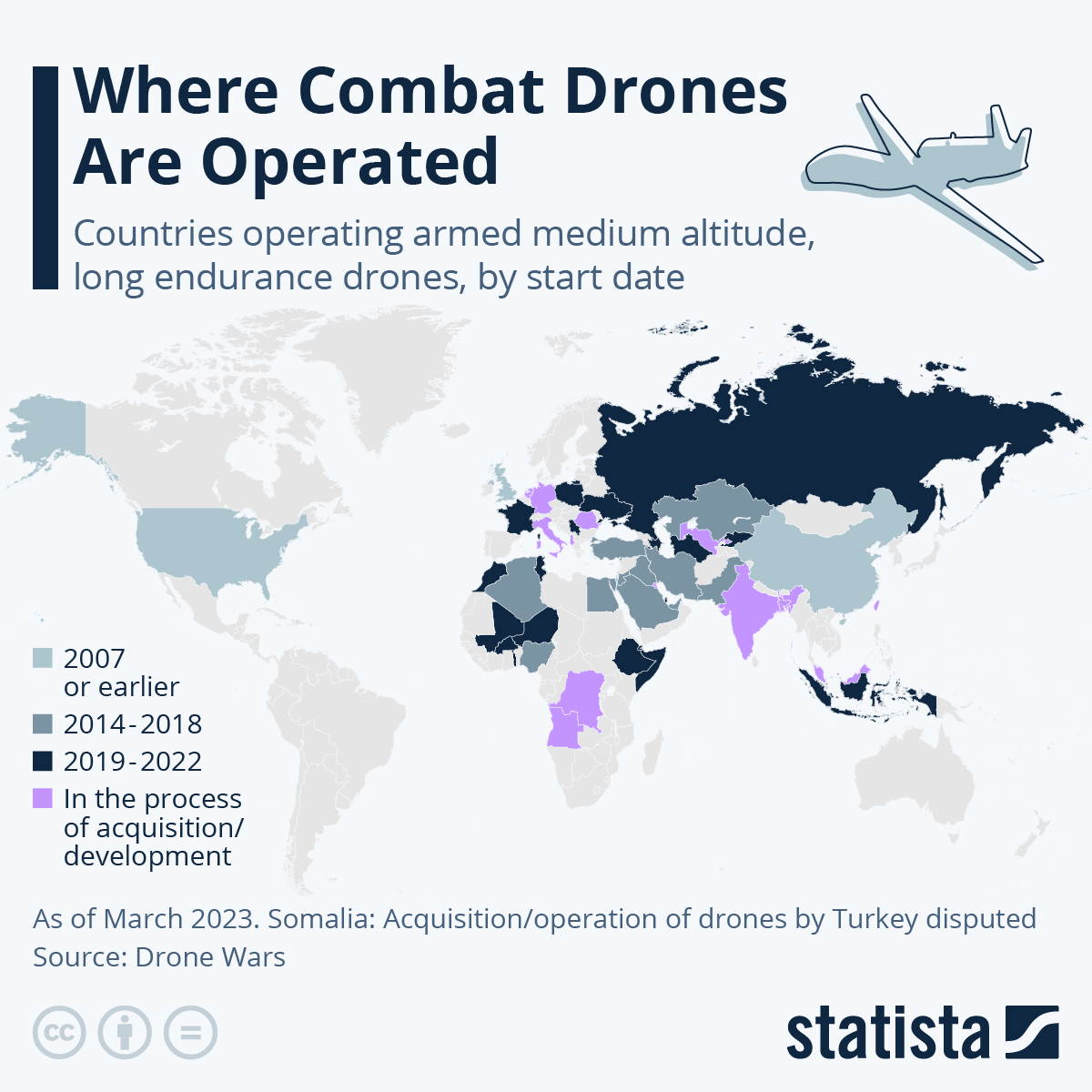
Where Combat Drones Are Operated

Ahead of Indian Prime Minister Narendra Modi's visit to the United States, Washington has urged the country to overcome bureaucratic hurdles in a planned deal for large armed drones. The contract would be worth $2 billion to $3 billion, according to Livemint.

Data from the website Drone Wars shows that India is in the process of developing its own large armed drones and is seeking to acquire technology from the U.S. in the MALE and HALE (high altitude, long endurance) categories, with no specific program start date set yet.

Operating armed medium altitude, long endurance (MALE) drones is becoming increasingly common for militaries in Europe, Asia, the Middle East, and Northern Africa. Early adopters of the technology were the United States and the United Kingdom (both using U.S. technology) as well as Israel and China (using their own technologies) between 2001 and 2011.

China's early adoption subsequently led to heavy exports of MALE drones to countries in Asia, the Middle East and Africa in between 2014 and 2018, including Nigeria, Saudi Arabia, Egypt, Algeria and Pakistan. In the same time period, Iran and Turkey developed their own capabilities. Turkey's technological push led to more exports between 2019 and 2022, this time with a heavier focus on Africa. France was only the second country to receive U.S. MALE drones in 2019. Other countries and territories except India wanting to arm U.S. drones in the future are the Netherlands and Italy, while Taiwan has already signed such a contract.Where Combat Drones Are Operated

Thursday, September 23, 2021

Roland Garros

Roland Garros colored
 оказывается это не теннисный турнир, лётчег-из требитель

В 1911 Гарро участвовал в воздушных гонках Париж-Мадрид и Париж-Лондон-Париж, в ней он занял второе место.

В сентябре 1911 он установил мировой рекорд высоты — 5610 м.

В 1913 году Ролан Гаррос получил мировую известность, совершив первый беспосадочный перелёт через Средиземное море из Фрежюса на юге Франции в Биззерту в Тунисе. Гаррос так рассказывал об этом полёте:

«Находясь над открытым морем, я обнаружил, что горючего осталось двадцать литров, максимум на час полёта. И тут в разрывы облаков я увидел три маленькие чёрные точки, над ними — три вьющихся дымных хвоста… Страхи разом исчезли! Я был больше не одинок… Снижаюсь… Меня замечают. Все три судна разворачиваются и следуют моим курсом».

Моряки развернулись, чтобы иметь возможность оказать помощь лётчику.

Когда Гаррос приземлился в Бизерте, в баке его Морана оставалось пять литров бензина.

Осенью 1913 года за этот перелёт его наградили Орденом Почётного Легиона.

В начале 1914 года Гаррос встретился в Париже с известным русским авиатором Харитоном Славороссовым. Ролан Гаррос вместе с авиатором Жюлем Ведрином помогли Славороссову устроиться «гастролирующим пилотом» в фирмы Кодрон и Моран-Солнье.

Thursday, January 14, 2021

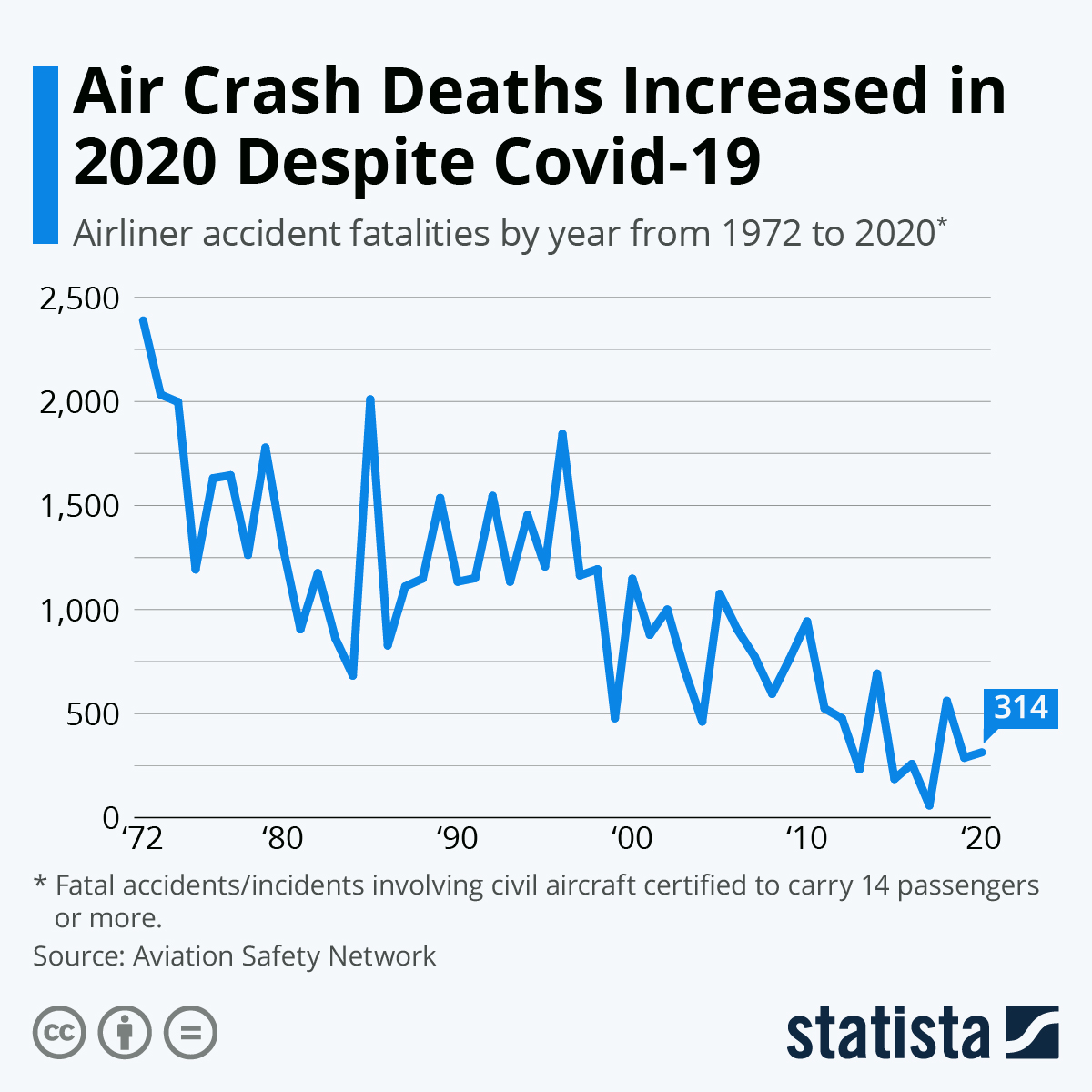
Air Crash Deaths Increased In 2020 Despite Covid-19

2020 saw an increase in the number of people killed in air crashes around the world despite the Covid-19 pandemic leading to a dramatic reduction in the number of operational flights. Aviation Safety Network data released in early January shows that there were eight fatal airliner crashes registered and 314 deaths. The number of fatal airliner crashes was the lowest ever recorded in a full year and both figures are below the industry's five-year average. It is also important to mention that they take into account two incidents where airliners were inadvertently shot down, killing 182 passengers and crew.

ASN states that industry studies found that the global air traffic volume in 2020 was just half of 2019 with around 19 million fights [l пропущено?] operated, equivalent to the total number in 1999. Back then, ASN registered 43 fatal accidents for the year that resulted in 689 fatalities, illustrating the strides that have been made in aviation safety over the past 20 years. 2017 remains the safest year on record with 10 fatal accidents registered and 44 deaths. Even though progress has been made in recent years, challenges remain and ASN outlines two from 2020 that need to work: approach and landing accidents along with commercial flights through conflict zones.

India and Turkey saw runway excursion accidents in 2020 with 23 fatalities which shows that work needs to be done in preventing runway overruns and ensuring environments adhere to International Civil Aviation Organization guidelines (ICAO). The organization also outlined improvements that are necessary for following ICAO guidance on flights through conflict zones. It comes after the shooting down of a Ukraine International Airlines Boeing 737 in Iran in January of last year while an East Express Airways aircraft were also downed in Somalia in May 2020.Infographic: Air Crash Deaths Increased In 2020 Despite Covid-19 | Statista

Sunday, November 29, 2020

The Mammoth Cost Of Operating America

The non-partisan U.S. Government Accountability Office (GAO) recently released an overview of mission capable rates and the cost of operating U.S. military aircraft. It examined more than 40 different aircraft types, finding that only three of them reached their mission capable goals between fiscal years 2011 and 2019. In total, the report put the collective cost of operating all of the U.S. military's aircraft fleets at $49 billion in fiscal year 2018, taking operational & support (O&S) costs such as maintenance as well as supply support in account. O&S generally makes up 70 percent of a weapon system's total life cycle costs and it includes spare parts, depot and field maintenance, contract services, engineering support and personnel, amongst other factors.

20 aircraft types experienced an increase in their O&S costs from fiscal year 2011 through 2018, 22 saw a decrease and three remained consistent. At $118 million, the Navy's KC-130T Hercules fleet had the lowest operating cost of all the military's fleets during the above period while the Air Force's KC-135T Stratotankers cost $4.24 billion to keep flying, the most of any aircraft type (primarily due to the fleet's size and age). Alongside those availability rates, the research also provides an interesting list of the cost of keeping some of America's leading combat aircraft operational in fiscal year 2018.

The Air Force's bombers are the most expensive aircraft in the U.S. inventory to keep operational, primarily due to their age and complexity. In fiscal year 2018, for example, the B-2 Spirit had operating costs per aircraft at close to $63 million, a figure that is high due to the extra work rquired to maintain that aircraft's low observability characteristics, such as its stealth coating. By comparison, the nearly 70-year old B-52 costs $25 million to keep mission-capable while the B-1B comes in at $23.7 million per aircraft. The high cost of maintaining stealth aircraft is also evident in the fighter fleet.

America's two most sophisticated combat aircraft - the F-22 Raptor and F-35 Lightning II - are also the most expensive fighter jets to maintain at $22 million and $13.4 million per aircraft in fiscal year 2018, respectively. The F-22 is demanding for its maintainers, requiring a three-week packaged maintenance plan for every 300 flight hours. Lessons learned with existing stealth aircraft such as the B-2, F-117 and F-22 were incorporated into the F-35's design to make maintenance easier and the introduction of a computerized program to handle any work that's required is just one example. Nevertheless, the F-35 is still more expensive to maintain than older U.S. fighter aircraft such as the F-15 and F-16 that both cost less than $10 million per year to keep in the air.Infographic: The Mammoth Cost Of Operating America's Combat Aircraft | Statista

Friday, November 20, 2020

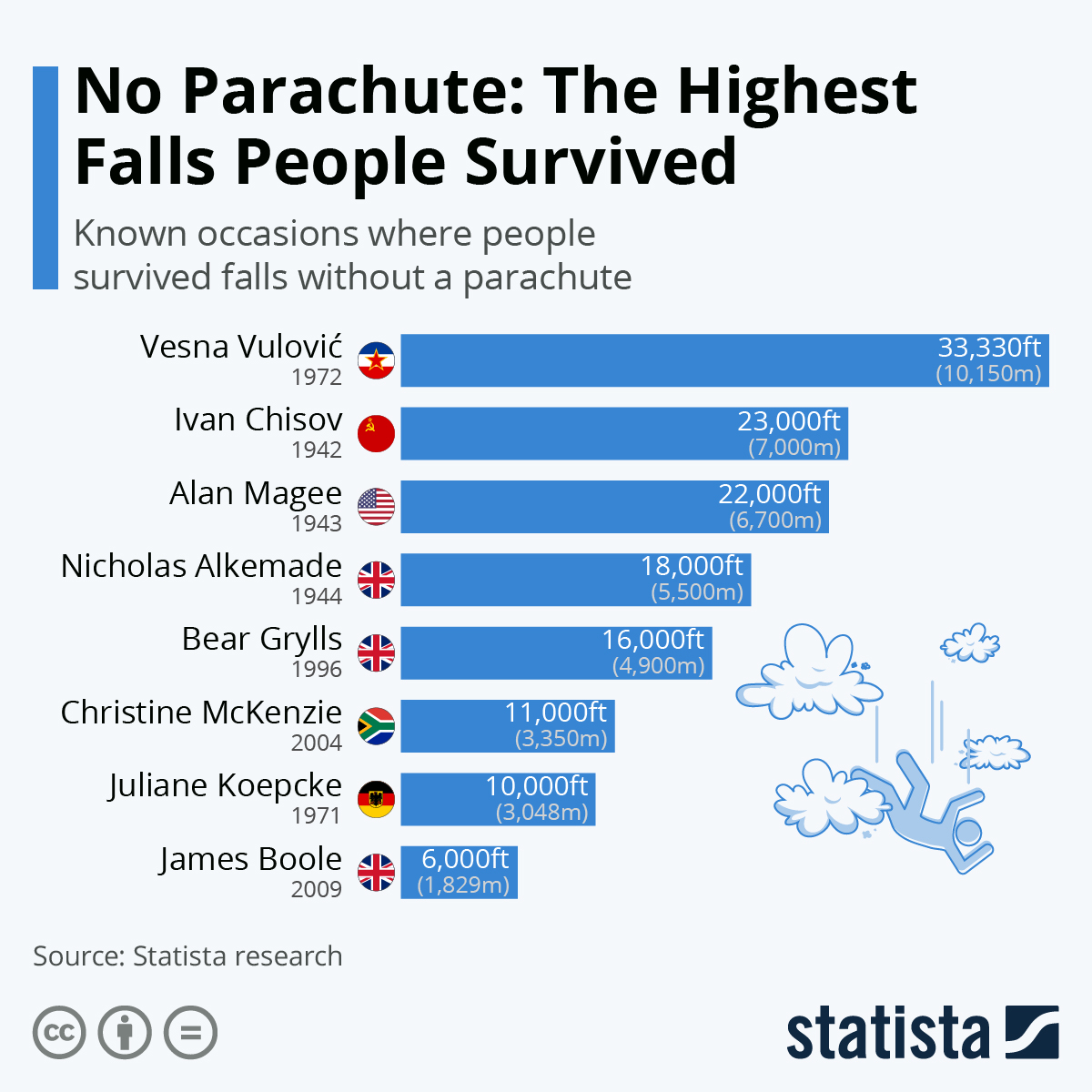
No Parachute

There have been some incredible instances of people falling out of airplanes without parachutes and surviving. Take the story of Alan Magee, an American airman who survived a 22,000-foot fall from a damaged B-17 bomber over France in 1943. Thrown clear of the aircraft and rendered unconcious, he fell four miles before crashing through the glass roof of St. Nazaire train station, shattering it and miraculously surviving, though with severe injuries.

The all-time record for surviving the highest fall without a parachute belongs to Yugoslavian flight attendant Vesna Vulović. She was the sole survivior of a bomb placed onboard JAT Flight 367 in 1972 which saw her plummet more than 30,000 feet. Experts believe she survived by being trapped by a food cart inside a section of the aircraft's fuselage which subsequently landed at an angle on a heavily wooded and snowy mountainside in Czechoslovakia.

Soviet Air Force lieutenant Ivan Chisov and Royal Air Force sergeant Nicholas Alkemade also survived in similar circumstances, thrown clear of bombers in the Second World War before landing in a mixture of snow and trees. Remarkably, Alkemade only suffered a sprained leg after falling 18,000 feet. The following infographic provides a list of known occasions where people survived extremely high falls without a parachute.Infographic: No Parachute: The Highest Falls People Survived | Statista

Wednesday, December 4, 2019

Moon landing: space medicine and the legacy of Project Apollo

Apollo 11 lunar module in a lunar landing configuration,
July 20, 1969 Copyright © 2019 NASA
On July 20, 1969, after a fraught 13 minutes of final descent, Apollo 11's commander Neil Armstrong and lunar module pilot Edwin “Buzz” Aldrin Jr made their historic first landing on the surface of the Moon. The US National Aeronautics and Space Administration (NASA) estimates that all-told 400 000 people were involved in that effort. The Project Apollo workforce had laboured tirelessly to achieve the goal set by US President John F Kennedy in 1961 of getting a human crew to the surface of the Moon and back before the end of the decade. Project Apollo saw state-of-the-art science, technology, and engineering applied to enable what was arguably the most ambitious feat of exploration in the history of our species. The flight of Apollo 11 had been preceded by a fierce schedule of testing, which had seen newly developed space craft and technology launched and tested in orbit around the Earth and Moon.

The protection of Apollo's human crews from the harsh environment of space was a formidable challenge. In the 1960s, human space flight was a genuine leap into the unknown and NASA flight surgeons were still unsure what hazards the space environment might present. Scientists could only guess at the likely consequences of extraterrestrial expeditions. They knew something of the nature of the physical environment: the high vacuum, its thermodynamics, the radiation and weightlessness. But precisely how this environment would interact with human physiology was unknown. Charles Berry, NASA flight surgeon and chief of medical operations for Project Apollo, once remarked on the difficulties of fulfilling the clinician's role during the project amid a programme whose core culture was driven by engineering considerations rather than medical science. The “engineering community developed 0·999 reliability figures for all of the parts of the spacecraft and launch vehicles…I had repeatedly said that I could not do that for astronauts; I had no opportunity to select the vendors, nor to have a quality assurance program developed for parts or subsystems or systems, and certainly could not test any of them to destruction”, he said. Research into human health in space presented many challenges. In this period, the flights involved only a handful of astronauts, and there was no uniformity in their flight profiles or durations. And because the number of flights was so small, it was near impossible to anonymise data acceptably. Added to that was the challenge of carrying out scientific investigations in the weightless environment of space. Nevertheless, the astronauts were willingly subjected to a battery of tests.

Pre and post flight measurements of endocrine, electrolyte, and fluid volume changes were made. Cardiovascular, musculoskeletal, and neurovestibular assessments were done, as well as haematological and biochemical analyses. In-flight heart rate and ECG telemetry were monitored. Crews took part in microbiological investigation, radiation dosimetry, and nutritional and metabolic studies. Although rudimentary, the resulting dataset formed the bedrock for all that followed.

But there was more for NASA flight surgeons to contend with than life science research. Medical events occurred throughout the Apollo programme. During the 11 Apollo flights, there were cases of everything from upper respiratory tract infections and dehydration to neurovestibular disturbance and decompression illness. Apollo astronauts would comment in later years about cramped quarters, difficulties with sleeping, spacesuit gloves that separated fingernails from finger beds during lunar excursions, the poor quality of their food, and tricky toileting arrangements. Yet from Apollo we learned how to persist in space and make it a frontier that we were capable of exploring.

More than 500 people have flown in space since Project Apollo. The past two decades have seen the International Space Station (ISS) used as a laboratory in low Earth orbit for a wide-ranging programme of scientific research, exploring everything from astrophysics and Earth science to genomics and virology. The investigation of human physiology— particularly the effects of microgravity upon the human body—has been a central feature of these expeditions.

Space life scientists now know that the space environment impacts almost all of the human body's physiological systems. Antigravity muscle groups exhibit sarcopenia during space flight and substantial osteopenia is similarly seen in load-bearing regions of the skeleton. Without effective countermeasures, mean rates of loss of bone mineral density while in space can exceed 1–2% per month. However, NASA's advanced resistive exercise device, which uses a combination of pistons and fly-wheel assemblies to mimic the inertial load of free weights and allows the crews to exercise effectively during space flight, has been successful in substantially reducing musculoskeletal losses.

Cardiovascular physiology is also altered, in the first instance by cephalad fluid shifts from the lower body to the upper torso and head, and complete unloading of the weight of tissues on vascular structures that accompany deployment in microgravity. Plasma volume is depleted and this reduction in circulating volume is accompanied by remodelling of the baroreceptor reflex arc. The resultant autonomic alterations can be viewed as an appropriate recalibration of the cardiovascular system to the weightless environment of space and the absence of orthostatic challenge. However, for some astronauts, these alterations lead to problems with orthostatic intolerance immediately after return to Earth.

The neurovestibular system and other sensory inputs that inform position and locomotion appear to exhibit a complex dependence on gravitational cues. Famously, during the 1968 flight of Apollo 8—the first human space exploration mission to leave Earth and orbit the Moon—commander Frank Borman had nausea and vomiting in what became NASA's first recorded case of space adaptation syndrome.
Astronaut Edwin E Aldrin Jr, lunar module pilot,
walks on the surface of the moon during Apollo 11
extravehicular activity on July 20, 1969,
astronaut Neil A Armstrong, commander, took this photograph,
Copyright © 2019 NASA 

The neurological system has continued to be something of an enigma in the field of space medicine. Shifts in visual acuity during space flight have been reported by astronauts since the space shuttle era. But more recently, these have been linked to a constellation of neuro-ophthalmic findings, including posterior globe flattening, disc oedema, cotton wool spots, and choroidal folds. In several returning crewmembers with disc oedema, mild elevation of intracranial pressure, as assessed by lumbar puncture, has been observed. This relatively new phenomenon gives pause for thought and requires comprehensive investigation to establish its true aetiology and operational significance.

NASA's research has focused mainly on the cardiorespiratory, musculoskeletal, and neurological systems because these have the greatest potential to impact mission operations. But broader disturbances have since been observed, including alterations in wound healing, immune function, and circadian rhythm. 50 years after the first landing on the Moon, our exploration of the effects of the space environment on the human body continues. However, while the widespread alterations in physiology remain intriguing, the experience aboard the ISS has been reassuring. Astronaut crews have been deployed regularly, for many months at a time, over the past two decades without significant operational consequences from these physiological changes.

Beyond the fascinating physiological findings, Apollo was an endeavour at the edge of possibility where risk to human life, technology, and science coincided. It is where much of modern medicine operates today, and within that similarity lie some of the most important lessons that medicine can glean from space exploration.

Apollo was a watershed in history—the point after which pushing back the frontiers of science, medicine, and exploration would take more than the heroic efforts of any individual or group of individuals. It demanded the collaborative efforts of an army of people, enmeshed with state-of-the-art science, technology, and engineering. It is often said that Armstrong, talking about the lunar landing in later years, was uncomfortable in interviews where he was lionised as the hero of Apollo 11's Moon landing, because he saw himself merely as the tip of the spear.

Acknowledging the vastness of the organisation, the need for collaboration and delegation, and the Apollo Project's dependence on technology is about more than attempting a departure from the age-old heroic narrative. It is also about appreciating the complexity of the endeavour. Like space flight, medicine depends on the complexity of a many layered system and the leveraging of technology for its capability.

But while the advantages of systems of this type are myriad, there is a price to pay. Failures in complex systems are inevitable and often difficult to predict. They arise as emergent features whose genuine root causes can be impossible to trace. In our practice and in our investigation of adverse events, health professionals often perceive medicine to be simpler in structure and operation than it truly is. The practice of medicine is—and always has been—far more complicated than rocket science. And despite the great benefits that derive from exploration and medicine, there can be no successful endeavour in these spheres without the underlying possibility of human catastrophe.

This brings us on to the subject of risk. It is tempting to think of Project Apollo as a decade-long programme of superlative performance that went from strength to strength and culminated in the successful landing of Armstrong and Aldrin. This was not the case. NASA, facing a near insurmountable challenge, found itself in difficulty for much of the first 5 years of the Apollo programme. With stretched resources and substantial production pressures, programmes progressively fell behind target. Both the construction of the lunar module in Long Island and the command module in California ran into trouble.

The whole organisation was fraught with fundamental problems, but the cadence of production and mission operations was so fierce, and the political pressure to deliver so acute, that no one was able to see it clearly. Later, after the Space Shuttle Challenger accident in 1986, this phenomenon would become understood more formally as normalised deviance—a culture in which people, operating at the limits of their resources, repeatedly tolerate events at the edges of acceptability, creating an environment where more fundamental errors of judgment go unnoticed.

It was not until February, 1967, when an accident during a ground test on the launch pad at Cape Canaveral killed astronauts Virgil “Gus” Grissom, Roger Chaffee, and Edward H White, that the parlous state of NASA's operations became fully appreciated. That incident—the Apollo 1 fire—resulted from poor design, inadequate safety culture, and a failure of leadership and managerial oversight. After that loss, NASA recalibrated its operational culture, reinvesting itself in the effort and conducting a root and branch overhaul of all of its construction lines and operational procedures. It is a remarkable case study of an organisation's recovery from catastrophic failure.

For the crews on the ground, there was more at risk besides life and limb. The pace of work was relentless. Flight controllers joked that they worked so hard, and for so little overtime, that the US Government achieved the first landing on the Moon at a fraction of its true cost. But in that is a kernel of difficult truth. From the astronauts and the flight controllers in mission control to the engineers and assembly workers on the factory line, everyone worked round the clock, through many nights and weekends. Relationships suffered and the divorce rate among NASA employees directly involved in mission operations was notoriously high.

The human impact of that relentless work rate is perhaps best captured in the words of Wally Schirra who flew as commander of Apollo 7, the first crewed mission of the Apollo programme, which launched just 21 months after the fire. Famously, the relationship between his astronaut crew and mission control became strained. None of them was assigned to later flights. Later, in an interview with Life Magazine in 1968, Schirra would make this telling remark: “The space age is very hungry. It devours people. I have been completely devoured by this business.”

The story of Apollo 11's success is one that will stand for all time, but we should be careful what lessons we choose to draw. The difficulty in understanding the causes of Apollo's success lies partly in the immense complexity of that endeavour: it was a vast sociotechnical feat that is difficult to deconvolve. But among the first lessons we might draw is this: as human as endeavours like exploration or medicine appear, these are complex pursuits in which most of the safety and reliability lie in the design and adequacy of the engineered environment. Ultimately, the system does most of the work and we, wrongly, tend to take most of the credit.

The second lesson lies in understanding that, like medicine, space flight is not and can never be an intrinsically safe endeavour. The goal of human space exploration is not safety, it is an operation in which risk is balanced against the benefits that might derive from proceeding with the mission. In the coming era, we will get no further than low Earth orbit if our politicians and society are unable to accept this. In the same vein, I've begun to wonder whether the near singular pursuit of safety in medicine is entirely correct. Perhaps we should be focusing more firmly on calibrating risk appropriately against benefit while, at the same time, improving the way we communicate the challenges involved in that balancing act.

The third lesson lies in the human costs. With burnout among clinicians reportedly at record levels in our medical workforce, that element is worth some consideration. The great unspoken truth of Project Apollo is that, like medicine, it achieved the nearly impossible, against the odds, under huge pressure, but consumed many people, lives, and relationships in the process. We should recognise that vast teams are capable of great things; Project Apollo is an example par excellence of this. But to succeed, under pressure of resource and time, NASA was forced to burn something more than rocket fuel. Nevertheless, on this 50th anniversary, we rightly celebrate Project Apollo for its legacy of discovery; the landing of the lunar module Eagle on the surface of the Moon on July 20, 1969, was a seminal moment in the history of our species. The same curiosity that first led us to look out across the stars to try and understand the universe also drew us within, to attempt to better understand ourselves. The road ahead is littered with risk and difficult questions, but the voyage of exploration continues, in all its complex wonder.


Kevin Fong is author and presenter with Andrew Luck-Baker, author and series producer, and Rami Tzabar, series editor, of 13 Minutes to the Moon, a BBC World Service podcast 

I thank NASA astronaut Dr Michael Barratt and NASA flight surgeon Dr Stevan Gilmore for their comments on an earlier version of this essay.

Friday, February 22, 2019

bronze

On Tuesday, U.S. President Donald Trump signed an order calling on the Department of Defense to draft legislation on a potential U.S. military presence in space. Proposals for a so-called space force have been around for a while but gained momentum when Trump picked up on the idea in early 2018.

Now, a group of scientists has called on the president to reconsider his plans and warm up to the idea of space as a place where different nations coexist peacefully. The Union of Concerned Scientists, a science advocacy group with an extensive satellite database, pointed out that military activity was only a minor part of all things happening in space. Instead, the group claimed that space was, in fact, a place where people worked together beyond national interests.

Data from the group’s database backs up this claim. Out of the 1,957 satellites listed as active, only 302 have military uses. While the U.S. is the country with most satellites in space (830), multinational cooperations come in fourth place.
Infographic: The Countries with the Most Satellites in Space | Statista

Sunday, February 17, 2019

pilots' migration

стерхи? не думаю
19 февраля в 18:10 состоится совместный семинар Лаборатории исследований рынка труда (ЛИРТ) и Центра трудовых исследований (ЦеТИ), на котором будет представлен доклад 

«Факторы международной трудовой миграции пилотов российских авиакомпаний». 


Докладчик: Фокеев Максим, магистр факультета бизнеса и менеджмента ВШЭ.

В работе исследуются факторы принятия решения о работе за рубежом российскими пилотами. Эмпирическую базу исследования составили данные анкетного опроса 375 пилотов 31 российской авиакомпании, проведенного в 2018 г. Используя модель бинарного выбора, авторы оценили вероятность принятия пилотами решения о работе за рубежом. Значимыми факторами принятия решения стала относительная зарплата, количество социальных программ, возраст, семейное положение, квалификация пилота, информированность об условиях работы за рубежом и география полетов компании из аэропорта базирования. Обнаружена непрямая зависимость между возрастом пилота и склонностью к трудовой миграции.

Оппонент: Марина Лопатина, младший научный сотрудник ЛИРТ ВШЭ.

Адрес: ул. Шаболовка, 26, корп. 5, этаж 3, ауд. 5309.

Язык семинара: русский.

Приглашаются все желающие!

Для тех, у кого нет пропуска в НИУ ВШЭ, просьба – пришлите, пожалуйста, до 12:00 18 февраля ФИО (полностью) и место работы (учебы) по электронной почте lgubajdullina@hse.ru (Лилия Губайдуллина).


С уважением,

Лилия Губайдуллина

Менеджер

Центр трудовых исследований


+7 (495) 772-95-90 *23299

Friday, January 11, 2019

The World's Most Punctual Airlines

A solid on-time performance is vital to success in the increasingly competitive world of commercial aviation. After being named the world's most punctual airline for four years in succession, Latvian flag carrier airBaltic has now been usurped by Panama's Copa Airlines. That's according to the latest edition of OAG's Punctuality League which tracked 58 million flight records in 2018 to determine the airlines with the best on-time performance.

OAG defines on-time performance as a flight that arrives or departs within 15 minutes of its scheduled arrival/departure time. That also takes into account instances of cancellation. Last year, 89.79 percent of Copa Airlines flights operated on schedule, slightly ahead of airBaltic's 89.17 percent. Panama also did well in the airport segment with Panama City named the most punctual medium-sized airport worldwide.

Only two U.S. airlines made the list of the top-20 most punctual in 2018. Hawaiian came fourth with an on-time performance of 87.52 percent while Delta came in 16th with 83.08 percent of its flights operating on schedule. Among airports with 30 million departing seats or more, Tokyo Haneda had the best on-time performance followed by Atlanta and Singapore Changi.
Infographic: The World's Most Punctual Airlines  | Statista

Sunday, April 22, 2018

avia 2017

а олени лутшэ

Пассажирские самолеты в мире не падали, сообщают два исследования отрасли.


Пассажирские лайнеры в мире не падали, сообщают датская консультационная компания To70 и Сеть авиационной безопасности в своих отчетах. И это несмотря на то, что перелетов было больше всего за всю историю. Впрочем, To70 считает, что "чрезвычайно" низкий уровень инцидентов следует рассматривать скорее как "удачу".
Сеть авиационной безопасности сообщает, что всего в мире произошло 10 смертельных инцидентов, в которых погибли 79 человек. Эти цифры касаются гражданских воздушных судов, имеющих сертификат на перевозку минимум 14 человек. В прошлом году организация насчитала 15 таких инцидентов, которые привели к 303 смертей. Самая серьезная авиакатастрофа 2017 года, по этим данным, произошла в январе, когда турецкий грузовой самолет упал на деревню в Кыргызстане. Тогда погибли четыре члена экипажа и 35 человек на земле.
Упомянутые отчеты не учитывали инцидентов с военными самолетами и вертолетами. Так, крупнейшая авиакатастрофа года не попала в статистику. Речь идет о падении мьянманского военно-транспортного самолета в июне, когда погибли 122 человека. Также отчеты не учитывали аварий малых самолетов. За последние два десятилетия количество смертей от авиационных инцидентов стабильно уменьшается. В 2005 году в мире погибали более 1000 человек, которые летели коммерческими пассажирскими рейсами. В последний раз пассажирский лайнер падал в ноябре 2016 года в Колумбии. А последняя авиакатастрофа, в которой погибли более 100 человек, произошла в Египте в 2015 году.
Сеть авиационной безопасности говорит, что роковой пассажирский рейс случается всего один раз на 7 млн 360 тысяч перелетов. По подсчетам To70 - один раз на 16 млн перелетов, но ее отчет был сделан до авиакатастрофы в Коста-Рике, произошедшей на новый год. "2017 год был самым безопасным за всю историю авиации", - сказал представитель компании Адриан Янг, но добавил, что гражданская авиация все еще несет "очень большие риски". Среди них он упомянул, в частности, новые технологии, например риск возгорания литий-ионных батарей на борту, и "проблемы психического здоровья и усталости" экипажа. Также он вспомнил, что было несколько серьезных инцидентов, которые обошлись без жертв. В частности отказ двигателя самолета Air France.

Monday, January 15, 2018

The Most Punctual Airlines Worldwide

For the fourth year in succession, airBaltic has been named the world's most punctual airline by UK-based aviation data monitor OAG. The Latvian national carrier serves over 60 destinations from its home base in Riga and 90 percent of its flights departed or arrived on schedule in 2017. OAG's defines on-time performance as flights that arrive or depart within 15 minutes of their scheduled arrival and departure times.

Hong Kong Airlines only managed a punctuality rate of 74.46 percent in 2016, but last year, that grew sharply to 88.83 percent. Hawaiian Airlines rounds off the top three with 87.24 percent of its flights arriving or departing on schedule. Only two U.S. airlines made OAG's top-20 list. The other one is Deltawhich ranked 16th with 82.95 percent of its flights on time.

СССР не смог убить привычку работать, какни странно
Infographic: The Most Punctual Airlines Worldwide  | Statista

Friday, September 29, 2017

the cost of Syria

авианосец курильщика
Два года назад, 30 сентября 2015 года, Россия начала военную операцию в Сирии. Русская служба Би-би-си собрала основные цифры этой кампании.

За время сирийской кампании, по официальным данным, российская авиация сделала около 30 тысяч боевых вылетов и нанесла больше 92 тысяч авиаударов.

В ходе девяти ракетных ударов с моря было выпущено около 70 крылатых ракет.

До берегов Сирии дошел и "Адмирал Кузнецов" - единственный тяжелый авианесущий крейсер в России. Крейсер сопровождала корабельная группа Северного флота. Путешествие стоило России от 7,5 до 10 млрд рублей ($170 млн), по подсчетам РБК.

За два года в Сирии, по официальным данным, погибли 38 российских военнослужащих. Однако, согласно подсчету агентства Рейтер, опубликованному в начале августа 2017 года, число погибших значительно больше - 78 человек.

В сентябре 2017-го стало известно о гибели в Сирии российского генерала Валерия Асапова - он стал самым высокопоставленным российским военным, погибшим за два года сирийской операции.

В марте 2016-го Владимир Путин заявил, что Россия потратила на сирийскую кампанию 33 млрд рублей. Таким образом, одни сутки в Сирии обходились России в 180 млн рублей.


Исходя из этих данных, партия "Яблоко" подсчитала, что сирийская кампания могла стоить около 140 млрд рублей ($2,4 млрд). Министерство обороны России опровергает эту сумму.

Официальных данных о том, сколько на самом деле Россия потратила за два года военной операции в Сирии, нет.

Tuesday, August 8, 2017

lessons of lost and found

вчера дочь возвращалась домой,
рейса в аэпортах прибытия/выбытия нет, авикомпания с большим опозданием, на на флайтрадаре есть операвтивно

звоню фбуком: как дела?
всё нормально, только
девушка по ошибке взяла мой чемодан с ленты (точно такой же, как и у меня) и уехала
урок №1: не паникуй
када чемодан скамуниздили, тонешъ и ваще

урок №2: помощь
от авиакомпании/аэропорта, токо имя/фамилия владельца такого же чемодана
тут же надежда: владельцу нужен свой чемодан
ни перевозчик, ни аэропорт багаж не ищут, токо сам (стоимость ненайденного чемодана = €1300), поэтому спасибо спутнице/подружке — не бросила, не уехала

урок №3: социальные сети полезны
стал искать в фб, не нашол
проснулась мама и, стала искать в контактике, свой аккаунт удалил, а дочери в голову не пришло (см №2) — быстро нашла
доступность интернета
связь работает: деушко поначалу полезла в бутылку, но быстро сообразила

урок №4: индивидуализация
когда то, на заре туманной юности, наклеивал на свой чемодан свой маршрут и все контакты

такшта
мб, что-то ещё полезное?

Sunday, July 16, 2017

Which Plane Seats Are Safest?

When choosing your plane seat, there are a number of things you might consider. Do I want a window or the aisle? Should I pay more for extra legroom? [это где-то в ин ых мир ах] Most people don’t want to think about the possibility of a crash, but if you were unfortunate enough to be involved in one, which seat is safest?

Looking at reports from the National Transportation Safety Board, Popular Mechanics came to the conclusion that booking a place in the rear cabin offers the highest rate of survival. Of the 20 crashes (each of which involved both fatalities and survivors) they investigated, those sitting in the back had a 69 percent chance of staying alive, compared to a less favorable 49 percent in business class.
Infographic: Which Plane Seats Are Safest? | Statista ята думал, что всё наоборот: хвост — самое опасное место, а оказалось — там только кормят в последнюю очередь + туалет и очередб вни во

Sunday, May 21, 2017

Russian airports


курсором пойнтера надо скользить, чтобы посмотреть данные, где нет
Всего равно 134,730,018
Источник
Больше половины пролетает через М-ву — 1значна = нелепая организация перевозок пассажырофф

Thursday, May 18, 2017

Uber's Reputation Has Taken a Major Hit

мой маленький икс пириенц с убером чисто негативен, но не по вине убера
просто в Домодедово не работал интернет, никакой, ни местный, ни мтсный
вне всякага сомнения это и есть  a Major Hit

The past six months have been nothing short of terrible for Uber from a PR standpoint. First the company’s CEO Travis Kalanick drew criticism for joining then President-elect Trump’s economic advisory board in December, then #deleteUBER started trending on Twitter after the company had allegedly tried to profit from the chaos at U.S. airports after Trump had signed the first travel ban. To make things worse, the company also faced widespread criticism for promoting an aggressive, sexist corporate culture and finally got sued for allegedly stealing trade secrets from Google’s self-driving vehicle arm Waymo.

According to a recent survey published by management consulting firm cg42, all those negative headlines did leave a mark on Uber’s reputation. As our chart shows, the percentage of consumers with a negative perception of the world’s most valuable startup jumped from 9 to 27 percent in response to the news stories. To make things worse, these stories have been the main reason for people to stop using Uber in the past six months.
Infographic: Uber's Reputation Has Taken a Major Hit | Statista You will find more statistics at Statistaвав

Monday, April 10, 2017

natural life in the city

шёл сегодня на уроки, вдруг слева что-то дёргается и падает на газон, некоторый стук и шелест, смотрю ничего не вижу, присмотрелся а там, как оказалось, некая птиса сбила голубя (а, мб, и не голубя — калибр гра наттъ неизвестен) аки Талалихин и собираецо есть, насколько понимаю,
таkшта презавтриковые фотки

Wednesday, September 7, 2016

Wednesday, August 24, 2016

helicopters ru

Robinson R44
Produced 5610 (2012)
22 августа 2013 года на совещании в Ростове-на-Дону Владимир Путин потребовал от руководства вертолётной отрасли увеличить выпуск гражданских машин. Прошло три года, но их производство только сокращается.
... готовая и «живая» линия по производству двигателей дожидалась серийного запуска машины в Воронеже. После официальной заморозки проекта, стапели были разобраны.
Рост производства вертолётов, наметившийся в конце нулевых годов, был достигнут в первую очередь за счет увеличившегося гособоронзаказа. То есть отрасль, по сути, села на бюджетную иглу, где ей было комфортно.
Руководство «Вертолётов России» и «Ростеха» связывает эти проблемы с тяжелой ситуацией в экономике. Но, что характерно, холдинг теряет свои позиции и на внешних рынках, хотя по логике вещей падение курса рубля должно было повысить конкурентоспособность российской техники

читать про дробнее:

Отказ управления. Успехи топ-менеджеров «Вертолётов России»