Showing posts with label вода. Show all posts

Thursday, October 19, 2023

How Thirsty Is Our Food?

We're all by now familiar with the term 'carbon footprint', but what about our water footprint? While most people have their upcoming bill in mind when taking a long shower or watering the lawn, does anyone really think about H20 when grocery shopping?

As the infographic below shows, depending on your diet, the food we buy can have a huge water footprint. If you buy 1kg of beef for a barbecue at the weekend, there has been an average of 15,415 liters of water used in its production!

Breaking up meat's monopoly as the most thirsty food type is nuts, with 9,063 liters of water needed to produce the average kilo. Further down the scale are fruits and vegetables, requiring 962 and 322 liters per kilogram respectively. In terms of the most water-efficient way to consume calories, the best option from this list is cereals -one kilocalorie demanding 0.51 liters.How Thirsty Is Our Food?

Friday, September 15, 2023

The Deadliest Floods & Storms of the Past Three Decades

Flooding in Northern Libya has killed an estimated 5,000 people, government officials said Wednesday. As 10,000 more are missing, this number could still rise [по последним данным вдвое больше + по всей видимости, первое число будет ещё расти]. The devastating disaster - caused by downpours of stor m Daniel that burst dams near the coastal city of Derna Sunday night - is already one of the deadliest floods of the past 30 years. This is according to data by Munich Re, Swiss Re and Aon.

As seen in the numbers, the extreme forces unleashed by tsunamis have caused some of the most deadly floods of the past decades, like in the 2004 Indian Ocean tsunami and the 2011 earthquake and tsunami in Japan, which killed around 220,000 and more than 18,000 people, respectively. Tropical cyclones hitting underdeveloped and underprepared countries like Myanmar, Bangladesh, India, the Philippines and Honduras have also seen very high death tolls in the past.

Nations that lack the resources and political stability to adequately prepare for natural disasters still bear the brunt of their consequences. Libyan policy researchers interviewed by The New York Times said that there seem to have been no dam monitoring or evacuation orders despite storm Daniel's known path. Additionally, the weak Libyan state which is stuck in perpetual post-civil war conditions is complicating aid efforts and their coordination.

As tsunami detection and disaster preparedness have improved over the decades, fewer people have actually died in flooding - one of the biggest killers among natural disasters historically. In between 1970 and 1975, three flood and storm events in Bangladesh, China and Vietnam killed around 630,000 people in total. In 1887, 1931 and 1939, major river floods in China still killed in between and estimated 500,000 and 4 million people each. The biggest flood disaster of recent times, the Indian Ocean tsunami of 2004, was as brutal as it was due to the lack of detection systems, as the ocean experiences fewer tsunamis than the Pacific. An initiative to set up one in the Western part of heavily affected Indonesia has since failed. India, however, set up its own system successfully after the catastrophe.

In 2013, an extreme downpour in Northern India caused deadly floods and landslides. The event's tragically high death toll is in connection with a Hindu pilgrimage taking place at the time in the area. Venezuela in 1999 experienced a similar event in a geographically prone area where many homes were swept out to the ocean.The Deadliest Floods & Storms of the Past Three Decades

Wednesday, June 14, 2023

Ukraine's Dams & Reservoirs

Ukraine's dams have been the target of attacks on multiple occasions since the Russian invasion in February 2022. The destruction of the Kakhovka dam on 6 June though was on a level not previously seen in this war. The resulting deluge triggered a humanitarian disaster: claiming lives, displacing people, cutting off drinking water, and swamping agricultural land. Ukraine and Russia have accused each other of carrying out a potential war crime.

New reports are now also emerging of another dam destruction, this time a smaller one on the Mokri Yaly River in the Donetsk region. Ukraine has accused Russia of doing so in order to slow Ukrainian advances in the region. With the increasingly pivotal role being played in the war by the dams of Ukraine, this infographic reveals where the country's over 1,000 reservoirs are located, and the volume of water which they held before the conflict began.Ukraine's Dams & Reservoirs

Wednesday, May 26, 2021

Hurricane Seasons Since 1967

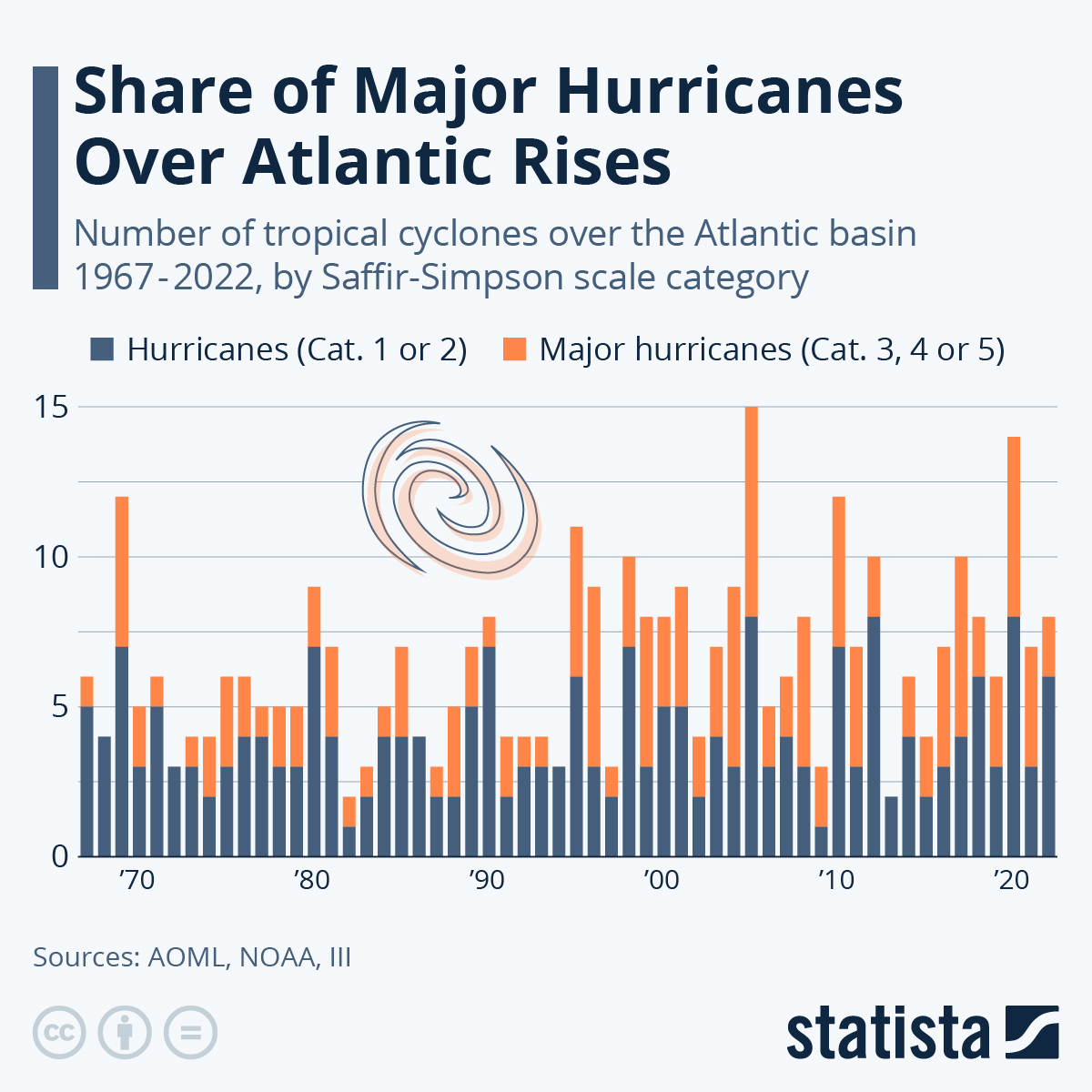
The National Oceanic and Atmospheric Administration predicted an active Atlantic hurricane season for 2021 on Thursday. NOAA said that it expects six to ten hurricanes to occur during the year, with three to five of those likely to become major hurricanes of Category 3 or above on the Saffir-Simpson scale.

The 2020 season was already an extremely busy one for hurricanes, as our chart shows. A total of 14 hurricanes formed over the Atlantic basin - the most since 2005, the year of Hurricane Katrina. Six of those were major hurricanes, including Hurricane Laura, which made landfall in Louisiana in August, and Hurricanes Eta and Iota, which caused devastation in Central America in November.

Once more, NOAA ran out of alphabetically ordered storm names and had to resort to the Greek alphabet as early as September 18. NOAA names all tropical storms over the Atlantic even though only some turn into hurricanes. In 2020, there where a whopping 30 named storms, a new record which created nine greek alphabet names and led the discontinuation of the Greek alphabet auxiliary list. Because the names of storms that cause major damage are typically retired, repeated use of Greek letters charted a quick path for them to become obsolete - like already happened in the case of Eta and Iota.

2019, on the other hand, was a rather subdued hurricane season, but shows another interesting trend. Half of the six hurricanes that occurred that year were major hurricanes - a trend that started in the late 1990s. The number of hurricanes in categories 3-5 on the Saffir-Simpson scale has increased from on average of around 1.6 per year in the 1970s and 1980s to an average of 3.1-3.8 per year in the 2000s and 2010s. Climate change has been identified as a reason why stronger hurricanes occur.

More evidence that hurricane seasons are changing can be deferred from the timing of named storms. 2020's first storm - Arthur - was named on May 15 after forming near the Bahamas. This made 2020 the sixth consecutive year that a named storm formed before the start of the official season on June 1.

2005, when Hurricane Katrina struck New Orleans, was the worst hurricane seasons since 1851, records from the National Oceanographic & Meteorological Laboratory at NOAA show. Hurricane Katrina was just one of seven major hurricanes observed in the Atlantic basin that year, making almost half of all tropical cyclones in 2005 major hurricanes. 2005 was the year with most hurricanes in the Atlantic (15), followed by 2020 (14), 2010 (12, including Hurricane Sandy) and 1969 (also 12).Infographic: Unpredictable Danger: Hurricane Seasons Since 1967 | Statista

Thursday, January 28, 2021

Alert Age

Once a large dam has reached the age of 50 years, whoever is in charge of its maintenance should be especially alert to the upkeep challenges and dangers an old dam can create. According to a new report by the U.N. Institute for Water, Environment and Health, dam keepers in the UK and Japan are most likely to be worried about the age of their water storage infrastructure. In both countries, average dam age has surpassed 100 years, double of what the report calls the “alert” age for large dams, defined as those with a height of at least 15 meters or a capacity of at least 3 million cubic meters (for dams between 5 and 15 meters high).

At the moment, the age of dams is reaching a critical point in many countries at the same time. The reason for this is the dam-building frenzy which occurred in the middle of the 20th century. In the late 1950s as well as in the 1970s, upwards of 1,100 dams were constructed every year. Since 1990, that number has dropped below 500 and below 300 since the year 2000.

The U.N. experts expect the number of new dam projects to remain low in the future, leaving the options of replacement or decommission for existing water storage infrastructure. Public safety and environmental concerns weighed against the cost and benefit of keeping a dam will decide their fates around the world. Already, dam failures (of all sizes of dams) have ballooned since 2005 and keep rising, having reached 175 incidents for the years 2015-2019.

The most common use for dams around the world is irrigation, followed by hydropower, water supply, flood control and recreation. According to the report, 40 percent of the world’s agricultural production depends on dams for its water supply. China – the country with most large dams by far – is also approaching “alert” age with the average dam constructed 46 years ago. The U.S. is the leader in dam removal, proving that the risk and cost associated with old dams can be eliminated altogether in many cases. In the past 30 years, the country has decommissioned more than 1,200 dams.Infographic: Where Dams Have Reached
странно, но Голландии нет, почему?
на островах строят по-другому?

Thursday, December 10, 2020

Where American City Dwellers Lack Access To Running Water

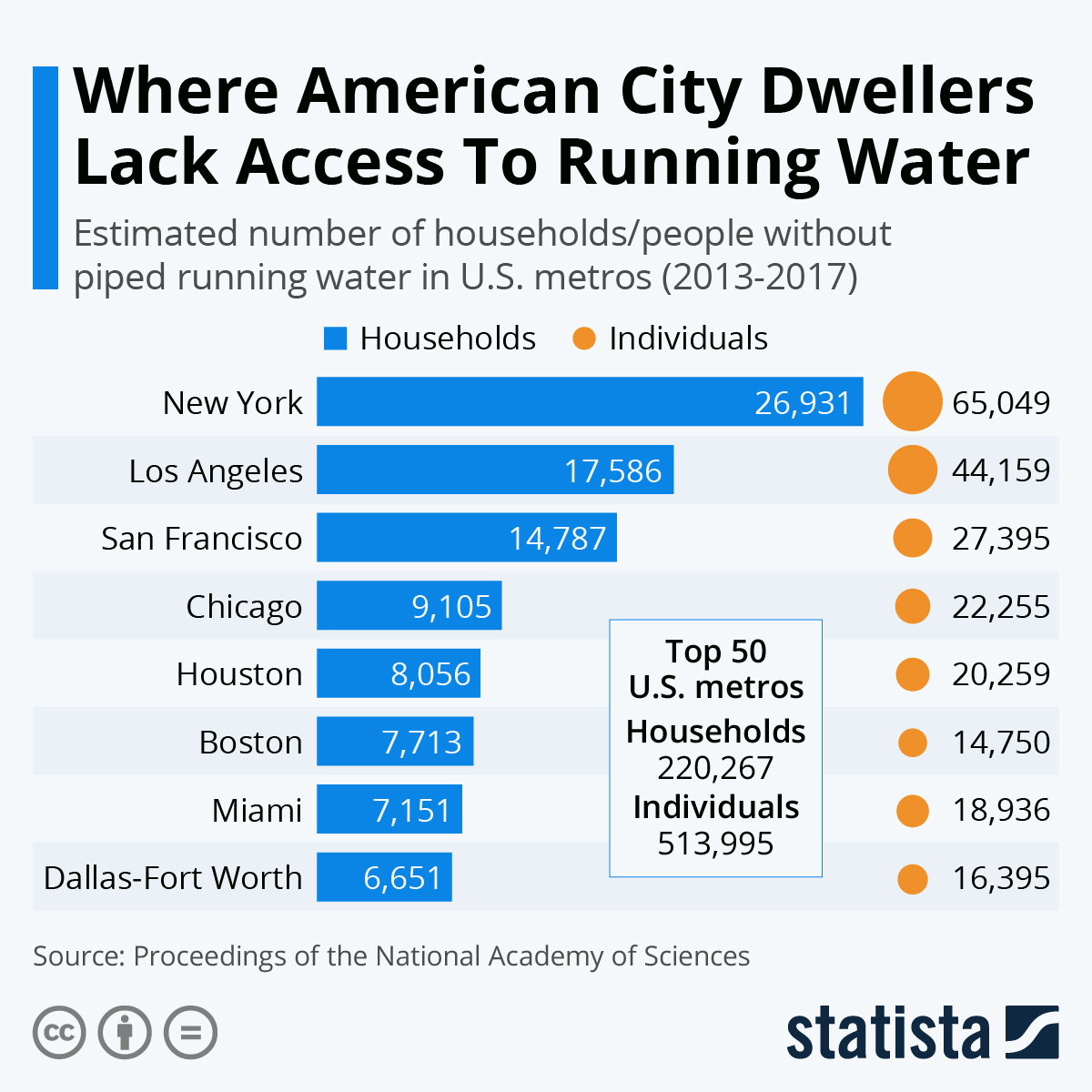
The Proceedings of the National Academy of Sciences has released a report exploring the geography of insecure water access in the United States. Describing safe, reliable, and equitable water access as a fundamental human right that proves critical to both health and livelihoods, the research found that 471,000 U.S. households lack universal access to "complete plumbing" - approximately 1.1 million individuals. "Complete plumbing" is currently defined as having access to piped hot and cold water and a bathtub or shower that is all located within the housing unit and used only by its occupants.

The problem is most evident in urban areas with 73 percent of all affected households located in cities and 47 percent in the country's 50 largest metropolitan areas. That figure tracks closely with national population distribution. An estimated 220,300 households and 514,000 individuals do not have access to piped water within the 50 largest metros. The research found that New York has the highest number of both households and people without complete plumbing at about 27,000 and 65,000 respectively, followed by Los Angeles and San Francisco.

According to the report, "the spatial and sociodemographic patterns of plumbing poverty reveal that urban water insecurity is a relational condition reflecting disparities of race and class". It adds that urban water management and security have largely been framed as a supply issue to date. Worryingly, the research found that residents without access to safe piped water are 35 percent more likely to be people of color and 61 percent more likely to be renters rather than property owners.Infographic: Where American City Dwellers Lack Access To Running Water | StatistaЛюбопытно, да?

Sunday, June 21, 2020

thunderstorm


ураганный результат, точне дождик прошёл — травку водой причесал

Thursday, February 27, 2020

ex planation

если в кране нет воды

Минздрав объяснил отсутствие водопровода и отопления в больницах


Во время составления отчета, в котором говорится об отсутствии водопровода в трети российских детских больниц и поликлиник, Счетная палата учитывала в том числе технические помещения (склады, гаражи, котельные), поэтому получились такие цифры. Об этом заявили в Минздраве, сообщает РИА Новости.

По данным ведомства на 1 января 2019 года, вода была в 19,3 тысячах из 20 тысяч медицинских зданий с амбулаторной помощью. Центральным отоплением оснащены 17,5 тысячи построек, канализацией —18,7 тысячи. Стационарная медпомощь оказывалась в 11 тысячах зданий по всей стране. В 10,6 тысячах из них имелся водопровод, в 10 тысячах — отопление, 10,5 тысячах — канализация.

Ранее были опубликованы выдержки из анализа Счетной палаты о положении дел в здравоохранении в 2018–2019 годах. Там говорилось, что всего в России 116 865 медицинских зданий. В 52 процентах из них не было горячей воды, в 30 процентах — самого водопровода. В каждом третьем не было туалета, 41 процент зданий не имели центрального отопления. 14 процентов построек были в аварийном состоянии.

Tuesday, July 2, 2019

global climate change

наводнение
ласково называемое подтопление
Причиной наводнения в Иркутской области стали атмосферные аномалии и глобальное изменение климата. Об этом сообщается на сайте Иркутского государственного университета (ИГУ).

Специалисты географического факультета ИГУ провели анализ погодных и климатических факторов, которые привели к паводкам. Выяснилось, что в регионе произошла уникальная ситуация, при которой в западной части Иркутской области наблюдалось взаимодействие сразу трех воздушных масс — арктической, субтропической и крайне редкого в регионе влажного воздуха с Тихого океана.

К тому же в регион, который и так подвержен паводкам, 25 и 26 июня пришел тропический циклон, а также холодный циклонический вихрь. «Это тепло и влага в условиях неоднородного рельефа проявили себя в развитии облачности и соответствующих осадков», — отметили в ИГУ.

По мнению ученых, из-за глобальных изменений климата подобные происшествия могут повториться в будущем.

Ранее 2 июля в Минздраве сообщили, что эпидемиологическая ситуация в Иркутской области может обостриться после схода воды. В ведомстве отметили, что в регионе может начаться вспышка кишечной инфекции и геморрагической лихорадки, которую разносят грызуны.

В шести районах Иркутской области объявлена чрезвычайная ситуация из-за наводнения, вызванного подъемом рек и затяжными дождями. Из-за паводка оказались затоплены более 6,7 тысячи жилых домов. В результате наводнения погибли 14 человек, 13 пропали без вести, сообщили в МЧС России. Опознать удалось 13 погибших, детей среди них нет.

Thursday, February 21, 2019

Drip irrigation

капельное орошение
Президент упомянул про «социальный контракт»: государство готово дать людям деньги при условии того, что люди возьмут на себя какие-то обязательства (найти работу или переквалифицироваться). Никто не отрицает возможности такого подхода, но это очень узкая мера. Она работает далеко не для всех бедных семей: предполагается, что в семье должен быть кто-то работающий, но при этом все оказались почему-то ниже черты бедности. Потом, если у вас доходы хотя бы на немного превышают черту бедности, вы вообще никуда не попадаете, ни в какие социальные контракты.

Блять! госудаоство готово дать нам наши же деньги — ахуеть можно. Для этого надо предположить, что государство рисует деньги и раздаёт их, то-есть, надо быть типа глазьевым.

Анатолий Вишневский
Директор Института демографии ВШЭ


— Такие экономические обещания, скорее, имеют политический смысл. Дескать, правительство о вас заботится. Однако на рождаемость они повлиять серьезно не смогут. Помощь для семей с детьми может только приветствоваться, но считать, что сравнительно незначительные обещанные материальные блага могут побудить людей рожать — неверно.

Отдельные люди могут повестись на подобные меры, но они все равно не сопоставимы с затратами, в том числе времени и энергии, которые требуются для воспитания современного ребенка. Люди достаточно осмысленно и трезво относятся к решению вопроса о том, рожать или не рожать. Если у вас есть один или два ребенка, и вам дают, допустим, налоговые льготы, то это очень хорошо. Но люди не рожают еще одного ребенка только потому, что они ее получили (конечно, если они не планировали ребенка независимо от льгот).

Низкая рождаемость — часть образа жизни современного человека. Есть страны богаче России, где материальное положение людей лучше, соответственно, там и рождаемость чуть выше [или ниже]. Но ее все равно недостаточно для того, чтобы обеспечивать так называемое простое воспроизводство, и недостаточно, чтобы поддерживать численность населения.

Сейчас в России складывается не очень благоприятная демографическая ситуация. У нас сокращается число потенциальных родителей, поскольку преобладает поколение, родившееся в 90-е годы, когда рождаемость была низкой — соответственно, родилось мало детей. Однако наше государство не является изгоем или «образцом низкой рождаемости».

Friday, November 3, 2017

regular journey mid point

IMG_2597
всегда тут купался, а теперь порубили дерева, и оне в реку упали
как быть?
IMG_2595

Sunday, October 15, 2017

Gender Equality and Reproductive Health Outcomes

Webinar:

Using Storytelling and Participatory Media to Support Gender Equality and Reproductive Health Outcomes


[что такое Participatory Media — чат/форум/сеть?]

The Interagency Gender Working Group with StoryCenter Presents

Tuesday, October 17, 2017 10:00am Eastern / 3 pm GMT


For the past 15 years, StoryCenter’s Silence Speaks initiative has developed and refined unique methods for surfacing powerful, first-person stories and positions them as tools for education and training, community mobilization, and policy advocacy for improved reproductive health and gender equality.

This webinar will explore the use of project case-studies to illustrate how storytelling can be used in the family planning and reproductive health (FP/RH) context to engage local community members as storytellers and advocates; challenge unhealthy gender norms; and promote the adoption of healthy, gender equitable behaviors and policies.

This webinar aims to help participants:

  •     Describe key elements of a successful, community-based model integrating personal storytelling and participatory media;
  •     Understand how this model can encourage dialogue around gender-issues that influence FP/RH outcomes such as gender-based violence, engaging men, and supporting individuals and couples to make and carry out their reproductive intentions;
  •     Identify how sharing stories at different levels of the social-ecological model for public health can effect change; and
  •     Learn about key steps and resources required to develop effective storytelling and participatory media projects.


To register for this webinar, please fill out the form found here by October 10, 2017. Once registered, you will be sent a link to the webinar platform.

For additional information, please contact Zema Mirza at zmirza@usaid.gov.

We hope to see you online!

Monday, June 20, 2016

Säämäjärv

В начале 1970-х на берегах озера был снят кинофильм «А зори здесь тихие». В 80-е годы в деревне Руга, на берегу Сямозера, снимался фильм «Холодное лето пятьдесят третьего…».

18 июня 2016 года на озере перевернулись 2 лодки и плот с детьми из летнего лагеря вблизи деревни Сяргилахта: 15 детей погибли. Решением губернатора Республики Карелия Александра Худилайнена 20 июня в Карелии был объявлен день траура. Мэр Москвы Сергей Собянин так же объявил 20 июня днём траура в Москве, о чём сообщил в своём Твиттере. Соболезнования семьям погибших выразил президент России Владимир Путин, а также премьер-министр Финляндии Юха Сипиля.
Säämäjärv
подробнее об озере
У меня нехорошее подозрение, что дело там не в шторме и не в ночи :(

Friday, May 27, 2016

this is not the case

поливалка я не 1 во вселенной:

В мэрии объяснили полезность мытья дорог в дождь, над чем смеялись еще в советское время


Работу поливальных машин в дождь высмеивал еще советский сатирический киножурнал "Фитиль". "Несмотря на плохие погодные условия, наши машины стопроцентно выехали на линию", - отчитывался перед руководством начальник автобазы. С тех пор прошло 40 лет, но вопрос, зачем мыть дороги в дождь, остался актуальным. Департамент ЖКХ и благоустройства внезапно решил на него ответить.

В сухую погоду работа коммунальных служб строится следующим образом: поливальные машины под высоким давлением вышибают пыль из асфальта и смывают мусор в лоток, где его собирает щетками уборочная техника. При этом скорость поливалок составляет 30 километров в час, а "подметалок" - не более семи километров в час, "поэтому при сухой и тем более жаркой погоде поверхность дороги быстро высыхает, и воздушные потоки от проезжающих машин выдувают мусор снова на проезжую часть", объясняют в ведомстве.

В дождь же на дороги попадает грязь с грузовиков, водители которых вопреки правилам не моют колеса, с легковых машин, которые "нерадивые владельцы" паркуют на газонах, и с самих газонов. "В последующем такую грязь достаточно сложно отмыть. Таким образом, мойка асфальтового покрытия при дожде позволяет решить несколько задач, в том числе качественное прометание при постоянном увлажнении и смыв с проезжей части грязи, находящейся в жидком состоянии", - сообщает пресс-служба. Сомневающимся предлагают устроить бытовой эксперимент: сначала потереть загрязненную землей поверхность сухой щеткой, затем увлажнить и еще раз потереть, а потом обильно смочить и поработать щеткой еще раз.

не совсем то, но кое-что

Friday, May 20, 2016

L'Arroseur arrosé

продолжая тему: сегодня дождь, но полив на страже поливания и разбазаривания
помидоры, беларусы, поливальщик и спартак
поливальщик наблюдается в центре картинки, вроде он даже не поливает — просто катаецо, но в этом глубокий смысл
его можно понять, пройдя по ссылкам

Monday, May 16, 2016

water accounting

любопытный результат установки щёчегоф воды, персонально ни с кого теперь лишнего не спросить, поэтому приходицо лезти в бюджет (расходная часть), ну и
белочка в помощь (доходной части)
рестораторы и фрайдиз
белочка и поливальщик

Saturday, March 26, 2016

Saturday, March 23, 2013

Water in Central Asia

ccылка на карте указана, я взял у АП тут (actually MWL, her husband?).
вспомнил сопсный дисер, бывший какбе как раз про это :)
-: высыхание Арала (как и наполнение Каспия) подтверждает гумилёвщину, которой пользовался
по нонешней зиме это особенно доказательно
такие карты, канешна, асилить не мог, хотя водный баланс можно было бы нарыть (если не секрет)