Ambitious climate policies, as well as economic development, education, technological progress, and
less resource-intensive lifestyles, are crucial elements for progress towards the UN Sustainable Development Goals (SDGs). However, using an integrated modeling framework covering 56 indicators or proxies across all 17 SDGs,
we show that they are insufficient to reach the targets. An additional sustainable development package, including international climate finance, progressive redistribution of carbon pricing revenues, sufficient and healthy nutrition and improved access to modern energy, enables a more comprehensive sustainable development pathway. We quantify climate and SDG outcomes, showing that these interventions substantially boost progress towards many aspects of the UN Agenda 2030 and simultaneously facilitate reaching ambitious climate targets. Nonetheless, several important gaps remain; for example, with respect to the eradication of extreme poverty (180 million people remaining in 2030). These gaps can be closed by 2050 for many SDGs while also respecting the 1.5 °C target and several other planetary boundaries.
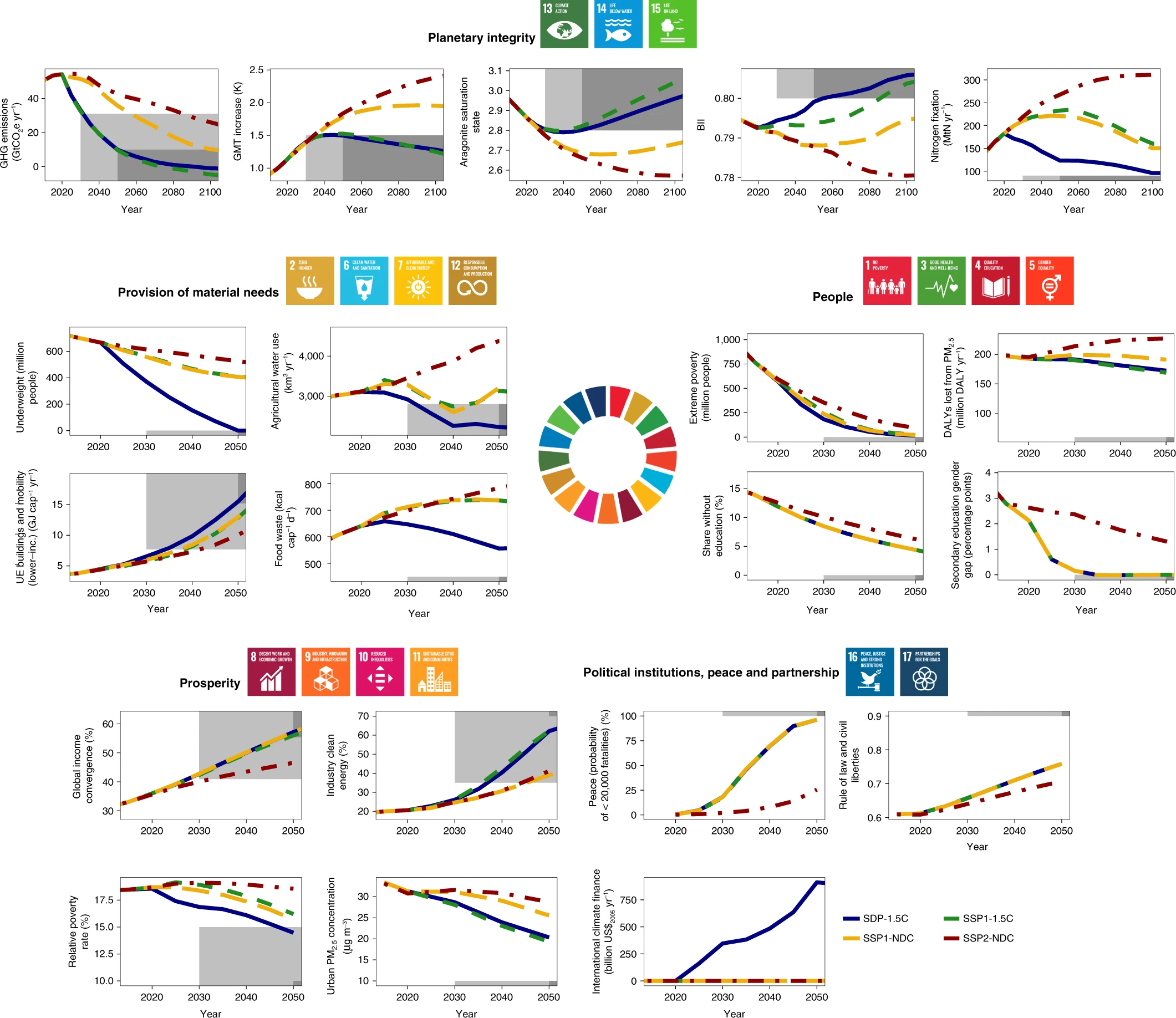
Overview of headline SDG indicator values grouped into five clusters
We compare our sustainable development pathway scenario (SDP-1.5C) to a number of other scenarios (main text). Grey shaded areas illustrate the target values (light shading for 2030 and dark shading for 2050), where available. All indicators are global sums or (population-weighted) averages, with the exception of useful energy (UE) per capita where we show an average of lower-income regions (REMIND–MAgPIE regions, Sub-Saharan Africa, India, East Asian countries except for China and Japan). ‘Global income convergence’ is the ratio of global GDP per capita to the OECD GDP per capita. For the ‘planetary integrity’ cluster we show results until 2100; otherwise, we restrict them to the time horizon until 2050. DALYs, disability-adjusted life years; PM2.5, fine particulate matter (diameter <2.5 μm); cap, capita; BII, biodiversity intactness index.

No comments:
Post a Comment