Extreme weather events are expected to increase with climate change. Such events are detrimental to local economic activity but could also affect countries that are not directly exposed through global agricultural production shortfalls and price surges. Here, estimations for 75 countries show that increases [видишь суслика?] in global agricultural commodity prices caused by harvest or weather disruptions in other regions of the world significantly curtail economic activity. The impact is considerably stronger in advanced countries, despite relatively lower shares of food in household expenditures. Effects are weaker when countries are net exporters of agricultural products, have large agricultural sectors, and/or are less integrated into global markets for non-agricultural trade. Once we control for these characteristics, the relationship between the country’s income per capita and the economic repercussions becomes negative. Overall, these findings suggest that the consequences of climate change on advanced countries, particularly through food prices, maybe larger than previously thought.
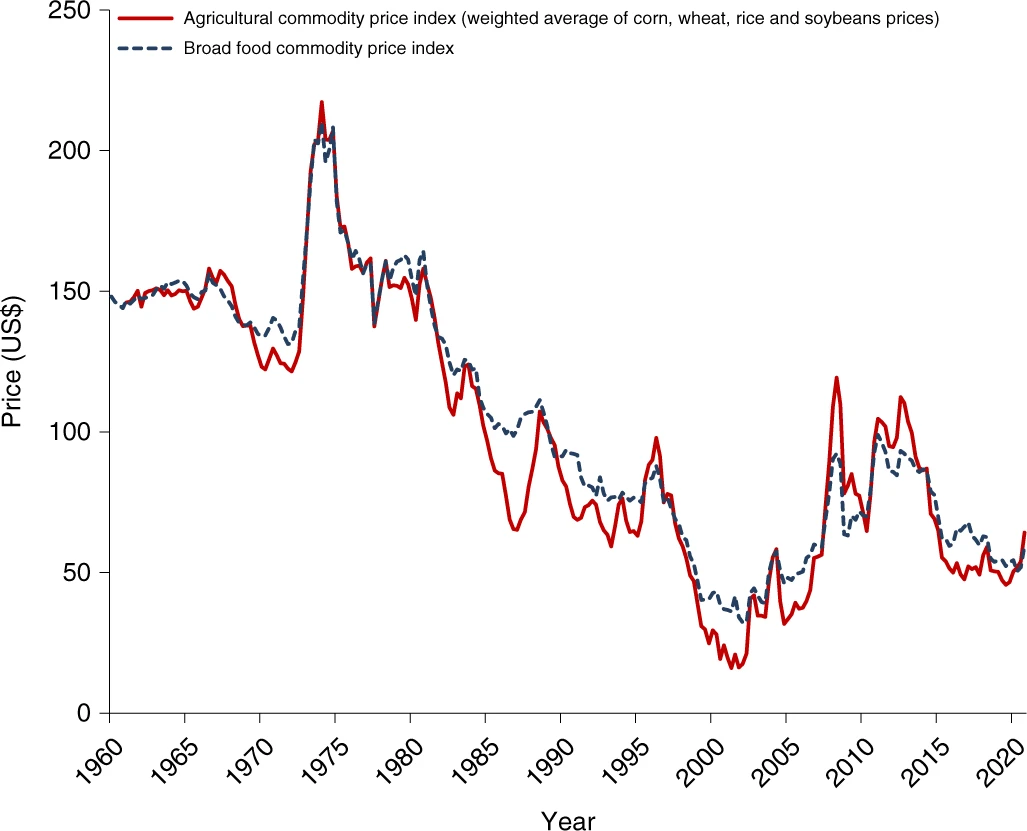
Evolution of global real agricultural commodity prices over time
The agricultural commodity price index is a trade-weighted average of the prices of corn, wheat, rice and soybeans. The broad food commodity price index is a trade-weighted average of benchmark food prices for cereals, vegetable oils, meat, seafood, sugar, bananas and oranges. All prices are in US$ and measured as 100 times the natural log of the index, deflated by US CPI. Data from the IMF (https://data.imf.org/).

No comments:
Post a Comment